




Abstract
The post-WWII era saw junior military officers launch revolutionary coups in a number of post-colonial states. How did these events transform colonial-era state elites? We theorize that the inexperienced leaders of revolutionary coups had to choose between purging threats and delivering ambitious projects of state-led transformation, leading to a threat-competence calculation that patterned elite turnover. To illustrate our argument, we trace the careers of 674 high-ranking officials in Egypt following the Free Officers’ seizure of power in July 1952. A multilevel survival analysis shows that officials connected to Egypt’s deposed monarch and very senior officials were most vulnerable to being purged. Experienced bureaucrats and those with university education were more likely to be retained. This threat-competence calculation also informed which ministries experienced more purging. Qualitative triangulation with biographies, memoirs, newspaper reports, and speeches corroborates the mechanism. The findings show why radical state-led change often requires a degree of elite-level continuity.
Introduction
In the decades following World War II, military officers seized power in a number of post-colonial states. Building on a new literature on purging (e.g., Bokobza et al., 2022; Goldring & Matthews, 2021; Sudduth, 2017; Wong & Chan, 2021), we return to this period to examine how colonial-era state elites were transformed by these events. 1 In doing so, we highlight a fundamental dilemma faced by inexperienced leaders that can powerfully inform the logics of purging: how to ward off potential counterrevolutionary threats from within the state, while also delivering complex and far-reaching social and economic change. This dilemma was particularly acute for post-colonial regimes brought to power through revolutionary coups, which were frequently led by junior officers. 2 Typically grouped together in conspiratorial cells and operating at a distance from organized politics, these officers possessed little in the way of administrative experience or technical expertise, leading to an important, albeit hitherto underappreciated, threat-competence calculation that patterned who among the old colonial-era elite was purged and who was retained.
The scope conditions of our argument are informed by Trimberger’s (1978) classic work on ‘revolutions from above’. In the postwar period, revolutionary military officers, often avowedly Third Worldist in orientation, looked to repurpose colonial-era states into vehicles for national independence and autarkic industrialization (Horowitz & Trimberger, 1976). These projects emerged from revolutionary coups, which are analytically distinct from coups that simply attempt to modify ‘the political structure’ or ‘restore a declining order’ (Trimberger, 1978, pp. 151–156).
3
Such coups frequently targeted aristocracies left over from the colonial period. This often saw the expropriation of colonial-era elites and the institution of republican politics and economic developmentalism (Eibl, 2020; Hertog, 2022). To give a sense of the universe of cases to which our analysis applies, Figure 1 draws on a dataset of coups by officer status collated by Albrecht et al. (2021) and one compiled by Colgan (2012) on revolutionaries that undertook radical or transformative economic policies, such as land reform or the mass nationalization of industry.
4
While most coups in the MENA (and globally) have not attempted revolutionary projects, the ones that did, for example, in Egypt (1952), Iraq (1958), Syria (1963), Algeria (1965), Libya (1969), and Sudan (1969), have had long-run effects on social, political, and economic life (Al-Qazzaz, 1971; Chalcraft, 2016: ch 3; Khuri, 1982; Lenczowski, 1966). MENA countries with at least one revolutionary coup. Notes: Inset map shows the global distribution. Some countries see multiple revolutionary coups. Senior officer coups shown where no junior officer coup has taken place.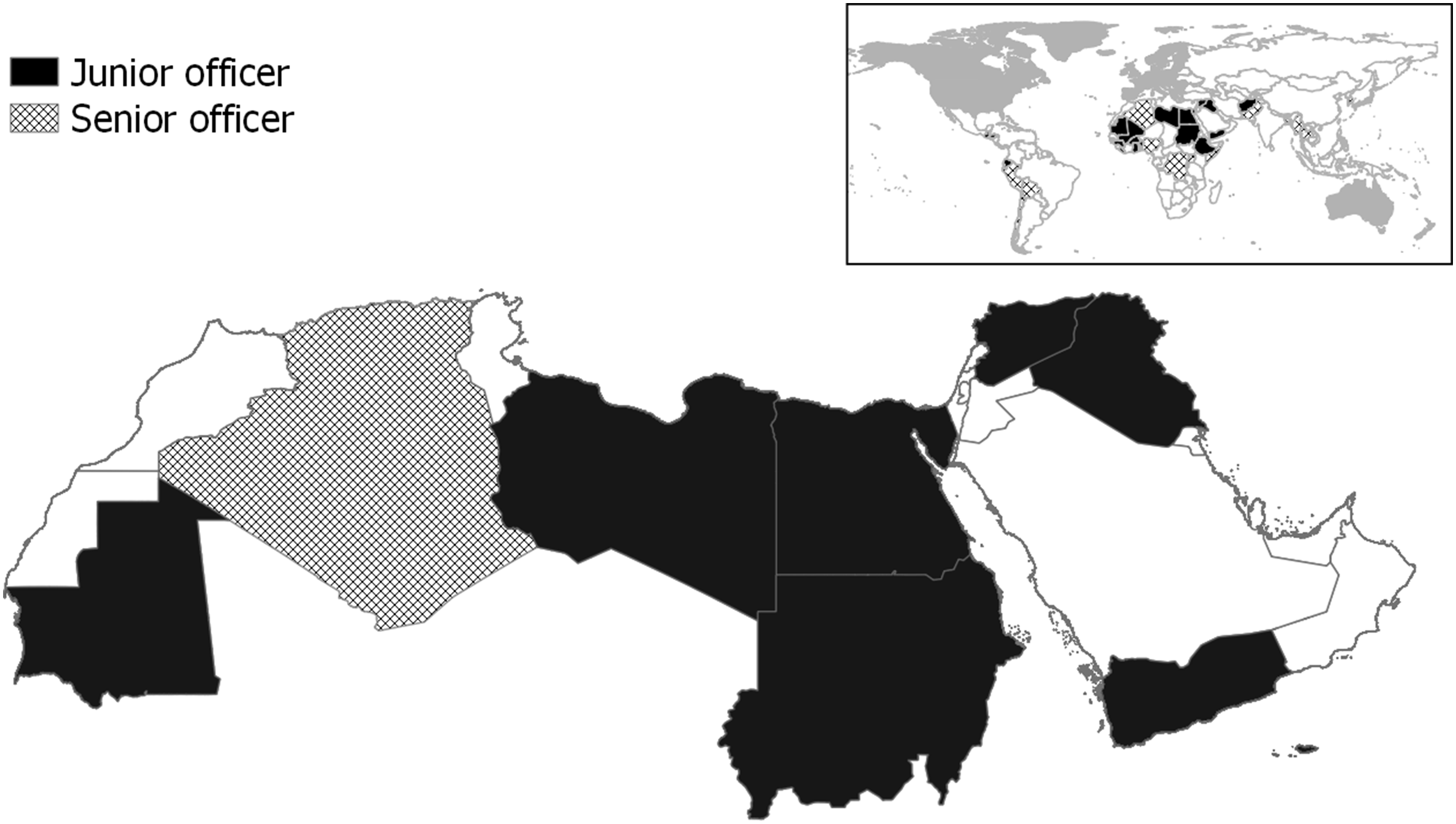
How did these events transform preexisting, state elites? 5 To answer this question, we study the aftermath of the July 23 Revolution in 1952, when the Free Officers, led by Lieutenant Colonel Gamal Abdel Nasser, overthrew Egypt’s monarchy. 6 The Free Officers’ model of state capture—synonymous with ‘Arab nationalism, republicanism, socialism, and progress and involving a mobilization among nationalist junior officers using the tactic of a revolutionary coup within the army’ (Chalcraft, 2016, p. 361)—served as a critical, early exemplar that inspired copycat coups in post-colonial states across the MENA and beyond (Ben Hammou & Powell, 2022; Thompson, 1974). 7 Indeed, the subsequent emulation of the Free Officers’ repertoire forms the basis of an important new literature that disaggregates the socioeconomic causes and consequences of coups based on the seniority and grievances of the coup plotters (Albrecht & Eibl, 2018; Albrecht et al., 2021).
We examine the relationship between this mode of revolutionary action and the logics of purging by analyzing a novel dataset of Egyptian state officials. Compiled from biographical registers published in the years before and after July 1952, these sources record rich individual- and workplace-level information on 674 Egyptian ministers and high-ranking bureaucrats who held office on the eve of the July 23 Revolution. Multilevel survival analysis allows us to reconstruct the biographical- and ministry-level correlates of purging in the subsequent period. We deepen our understanding of the statistical findings by triangulating our results with a range of qualitative sources, including biographies, memoirs, newspaper reports, and speeches. Here, our qualitative analysis adopts the logic of a process-tracing test: to have confidence in the quantitative results, we should find corresponding evidence in the record of the Free Officers’ decision-making during our analysis period.
Our analysis points to a threat-competence calculation in patterning who was purged and who was retained. We begin by constructing index variables capturing an individual’s threat and competence at the time of the coup. Interacting these indexes suggests that the Free Officers prioritized purging the most threatening elites, irrespective of their other characteristics. After adjusting for threat, competent officials were retained in office for longer. Disaggregation provides a more nuanced picture. Officials with ties to Egypt’s deposed monarch and very senior figures in the state bureaucracy were prioritized for purging. At the same time, the Free Officers’ relative inexperience and lack of expertise in key areas meant that they were more likely to retain experienced officials and those who possessed university education. We also find evidence for residual workplace effects that operated net of individual-level characteristics. Officials working in security ministries and other institutions that were integral to the power structure of the old regime were at much greater risk of being purged. Officials working in highly specialized ministries tied to the economy, production, foreign affairs, and education were more insulated from purging.
These results suggest that the leaders of revolutionary coups weighed the potential threat posed by an individual to the new order against their ability to help deliver revolutionary change. Triangulation with qualitative sources helps to establish the mechanism: the Free Officers, who were preoccupied with the possibility of counterrevolution and spoke publicly about the need to purge Egypt’s colonial-era state elite, also realized that the knowledge and capacity to implement their ambitious raft of revolutionary policies could not come from their ranks alone. While they attempted to remedy this shortfall by developing their own expertise, the pressures of governance ensured that they also had to keep on some figures from the ancien régime. Our findings contribute to recent scholarship that seeks to explain important instances of elite-level continuity following episodes of ostensibly radical political change (e.g., Hassan & Kodouda, 2022; Lankina, 2021; Lankina & Libman, 2021; Snegovaya & Petrov, 2022).
Purging to Transform the Post-Colonial State
Recent scholarship on purges pivots around their timing and the individual-level characteristics of those who might be purged. In line with the coalitional approach to authoritarian power relations, this new literature has tended to focus on shallow purges in contemporary autocracies (e.g., Easton & Siverson, 2018). These are limited removals of rivals from the upper levels of the political elite, whether in the cabinet (Bokobza et al., 2022), executive bodies such as juntas or party committees (Goldring & Matthews, 2021), the armed forces (Braithwaite & Sudduth, 2016; Sudduth, 2021), or domestic security agencies (Greitens, 2016). Shallow purges recur in autocracies because they are an effective and low-cost means of gaining an upper hand against internal rivals. Not only do they remove elements of the elite deemed threatening or problematic, but they also send a clear message to would-be conspirators about who is in charge. These purges tend to be shallow since credible signaling requires only a minimum of removals.
We explore an alternative logic of purging in post-colonial settings, one insufficiently explicated in the new literature: purges that underpinned projects of revolutionary state-led development undertaken by junior military officers. As with other forms of revolutionary political change, this often involved the wholesale ‘substitution’ and ‘displacement’ of preexisting state elites (Brinton, 1952, p. 4; Tilly, 1978, p. 195). We can think of these as deep purges, which were the primary mechanism by which this process of substitution took place. While exhibiting some shared logics with shallow purges, deep purges following revolutionary coups, like the phenomenon of revolution itself, are historically rarer and much costlier.
Threat-Competence Calculation
A principal concern for any regime that comes to power via extrainstitutional means—revolutionary or not—is the perceived threat posed by officials and bureaucrats who did not participate in the conspiracy or who will be dislocated by it. After all, counterrevolutions are ‘elite-protecting’ efforts to restore the status quo ante (see also Mulholland, 2017; Slater & Smith, 2016, p. 1476). Hence, junior officers brought to power through a revolutionary coup face strong incentives to carry out purges: forcible removals of perceived rivals (Goldring & Matthews, 2021; Kim, 2021; Sudduth, 2021; Wong & Chan, 2021).
In such contexts, purges are an obvious means of concentrating and preserving state power. But they can also have deleterious effects depending on their implementation, so there is a good reason to think they are not indiscriminate. One challenge is that purges are resource-intensive endeavors. Establishing purging criteria, gathering evidence, and identifying culpable actors require both institutional knowledge and time, neither of which revolutionaries have in excess early on (Baerwald, 1977; Novick, 1968, ch. 5). 8 This is particularly salient when revolutionary junior officers are in the vanguard. They may have a general appreciation of potential allies and enemies and essential and nonessential personnel, but it is necessarily limited due to their distance from the power center.
We can think of threat here as operating along two principal dimensions: as being tied to an individual’s biographical characteristics and to the characteristics of their workplace. In terms of individual-level characteristics, we might expect that senior-level officials, particularly those with linkages to a deposed ruler or former colonial master, are a convenient and logical target of purging, especially if officers want to signal their ascendancy and the dawn of a new post-colonial order (Bokobza et al., 2022; Braithwaite & Sudduth, 2016; Buehler & Ayari, 2018). For similar reasons, old-regime officials with greater visibility and presence in the state apparatus, for instance, those who hold multiple government portfolios, are also likely to be more vulnerable (Bokobza et al., 2022; Gueorguiev & Schuler, 2016; Lee & Schuler, 2020). The initiators of revolutionary coups are also likely to perceive military officers who did not participate in the conspiracy as especially threatening (Geddes et al., 2018, p. 120).
We suspect that threat perception is also tied to where old-regime elites work—and the institutional resources and knowledge that they might bring to bear to stymie the process of revolutionary change. Most obviously, officials working in ministries associated with internal and external security, some portion of whom may be holdovers from colonial rule, may be seen as more capable of launching counterrevolution (Nalepa & Piotrowska, 2022). Equally, revolutionaries are likely to perceive sovereign institutions, such as parliaments or royal courts, or else some other government ministry that is integral to the power structure of the ancien régime, as rival sources of authority and prestige. In all of these workplaces, we might expect that officials will face an elevated risk of being purged, regardless of their individual characteristics.
At the same time, any instinct to purge must also be counterbalanced by an awareness that the expertise and experience to deliver revolutionary goals cannot come solely from within the ranks of the officers themselves. This is because revolutionaries of all stripes tend to seize power without the ‘substantive expertise’ required for administration (Weber, 1978, p. 1081). Some revolutionary experiences, such as protracted national-liberation struggles, may foster institutional control and capacity (Levitsky & Way, 2013; Liu, 2022). But even then, the range of state activities is sufficiently large and diverse that revolutionary movements will almost always face a shortfall of trustworthy, competent operators to fill high-level technical and administrative positions (Groth, 1972, pp. 40–41).
This presents a dilemma that is in tension with any desire—and rhetorical commitment—to break completely with the past and purge the ancien régime. No revolutionary movement can hope to rule for very long, withstanding the strong opposition that revolution typically invites, without a capable and cooperative state apparatus. This is doubly salient when revolutionaries come to power promising an impatient public that they will deliver transformative change. Since bureaucratic structures are difficult and time-consuming to reform, let alone construct from scratch, a segment of the old elite will therefore almost certainly be invaluable to any new revolutionary regime that is under pressure to justify their takeover (Hassan, 2020; Rueschemeyer & Evans, 1985).
This need for expert support and experience of state affairs is particularly, though counterintuitively, acute when military officers lead revolutionary change ‘from above’. The military is hierarchical and centralized and may appear ideally suited to manage the state. Although state-like in structure—they frequently have departments in charge of finance and education, for example—militaries are often unable to scale up their operations to the level of the modern, institutionally complex state (Dowse, 1969; Finer, 1962). This is especially pronounced in contexts where militaries were kept small and domestically oriented under colonialism (Killingray, 1999, pp. 9–11). The substance of ruling, politics, also tends to elude officers, who prefer ‘the apolitical politics of consensus, acquiescence and government by fiat’ rather than bargaining and compromise (Nordlinger, 1977, p. 1137). A deep concern with corporate interests, historically a key motivator of coups, and intraorganizational factionalism, similarly undermines military decision-making (Sohn, 1968; Thompson, 1972). As a result, officers typically develop alliances with experienced civilians when they are in a position to govern (Feit, 1973; Welch, 1970).
Taken together, there is a good reason to expect that not all members of an ancien régime are victims of revolutionary coups. Some, especially those with experience and expertise that the coup plotters do not possess or cannot easily replace, must also participate in the project of transforming the state. Here again we can think of competence as operating along two principal dimensions: as related to an individual’s biographical characteristics and to their place of work. Just as revolutionaries may appreciate an individual’s expertise and experience, we might also expect that officials employed in key, technical ministries will be less vulnerable to being purged by virtue of the importance of those ministries to maintaining state capacity—and their future role in delivering ambitious developmentalist project.
All else being equal, these observations point to a threat-competence calculation patterning who among the old state elite is purged and who is retained. Such a calculation has been identified in consolidated regimes, where autocrats use shallow purges and other organizational measures to manage regime survival and balance domestic security agencies against one another (see, e.g., Greitens, 2016; Magiya et al., 2023). Our contribution suggests that this calculation takes on a specific logic for revolutionary regimes in formation, where the revolutionaries’ grip on power is precarious and the political imperative is to deliver ambitious projects of inward-oriented development and social transformation. Crucially, the know-how to implement this cannot come solely from the new ruling elite. This is especially pronounced when the agents of revolutionary change are junior military officers. Here, we should expect that the survival of the new regime should trump all other considerations. At the same time, a subset of the ancien régime, who possess attributes that cannot easily be replaced, will have to be retained. In what follows, we test this claim by exploring the logics of purging following the Free Officers’ seizure of power in Egypt in 1952.
The July 23 Revolution in Egypt
In the early morning of July 23, 1952, a small group of Egyptian junior officers seized key installations and infrastructure in Cairo and arrested much of the country’s military leadership. After years of condemning public corruption and British imperialism, these Free Officers were relatively subdued when announcing the coup, pledging to implement political and societal reforms before returning to their barracks (Abou-El-Fadl, 2019, p. 112; Gordon, 1992, pp. 56–57; Jankowski, 2001, pp. 15–16). To avoid the appearance of outright military rule, they tasked a former Prime Minister to lead a new technocratic cabinet, while also establishing a parallel leadership in the form of the Revolutionary Command Council (RCC) (Vatikiotis, 1961, p. 74; Vaucher, 1960, pp. 21–22). 9
Composed of leading Free Officers, the RCC was designed to shape and oversee the work of the cabinet (Abu al-Fath, 1991, pp. 124–137; Vaucher, 1960, p. 16). But first it had to establish its positions. There was no theorist of the revolution (Nasr, 1999, p. 175). Even the fate of King Faruq, whom the Free Officers had frequently denounced, was not settled at the time of the coup (Gordon, 1992, p. 60). Action preceded planning—purposely, by some accounts. The executive committee of the Free Officers was ideologically heterogeneous, so any attempt to establish consensus ahead of time would have threatened fracturing the group (Abu al-Nur, 2001, pp. 36–37; Ali, 2002, pp. 199, 212–213; Hammad, 2005, p. 30). With a new cabinet in place to govern, the RCC had time to develop a clear program in the days and weeks that followed (St. John, 1961, pp. 109–110; Vaucher, 1960, p. 22).
What is clear is that purges were always a priority (e.g., Clark, 1952; The Times, 1952a). On August 9, Decree-Law no. 130 was passed, formalizing the establishment of seven purge committees that were invested with investigative and juridical authority (al-Waqai al-Misriyya, 1952a; The Times, 1952c). To facilitate their work, members of the Free Officers were placed in the state bureaucracy and tasked with drafting secret reports on the loyalty and competence of officials and bureaucrats (Abu al-Fath, 1991, p. 173). A new body, staffed by some 20 officers, was established to surveil and oversee this work (Aclimandos, 2004, p. 912). Those who were purged were given no right to an appeal; those who retained their positions were subjected to ongoing scrutiny (Abu al-Fath, 1991, p. 176; al-Hakim, 1999, p. 111). This process was so important to the RCC that in early September 1952 it was announced that a new decoration would be issued to all officers and soldiers who were in the army on the day of the coup. Its colors were chosen to reflect the priorities of the RCC: red for revolution, black for corruption, and white for the purge (al-Waqai al-Misriyya, 1952b; Be’eri, 1970, p. 101; The Manchester Guardian, 1952b).
Against this backdrop, the civilian Prime Minister lasted less than two months. A wealthy landowner himself, he was at loggerheads with the RCC over its desire to implement land reform (Gordon, 1992, pp. 66–67). It soon became clear to the RCC that the revolution would not be successful unless revolutionaries were in sole command (Nasr, 1999, p. 171). The cabinet was subsequently dissolved and Major General Muhammad Nagib, the titular leader of the Free Officers, was installed as Prime Minister in early September 1952.
Now in complete control, the RCC set about transforming Egypt’s state and economy. The first—and landmark—policy was land reform. The new law limited ownership to 200 feddans (slightly more than 200 acres) with any excess redistributed to landless farmers (O’Brien, 1966, p. 76). This was an attempt to redress economic inequality, while also ‘undercutting the political power of the landed aristocracy by stripping away its economic base’ (Gordon, 1992, p. 62). Ottoman-era aristocratic titles, which denoted wealth and royal favor, were also abolished (Baraka, 1998, pp. 144–145; Gordon, 1992, pp. 61–62). The RCC also expropriated the properties and finances of the royal family, channeling both into a rapidly expanding public sector (al-Gawhari, 1978, pp. 31–32; Eibl, 2020, p. 220). The constitution, which endowed the monarch with wide-ranging powers, was abrogated in December 1952 (Beattie, 1985, p. 152). The elected parliament was shuttered and all political parties were banned a month later and their assets seized by the state. In July 1953, on the anniversary of the revolution, the monarchy was abolished and Egypt declared a republic. In the following period, large numbers of private businesses were nationalized as the RCC embarked on a policy of state-led, autarkic industrialization (Waterbury, 1983).
Crucially, the expertise and experience needed to implement these policies could not come from the Free Officers alone. Figure 2 shows the ranks of all 335 Free Officers who participated in the July 23 Revolution.
10
The modal Free Officer was a captain (40%). The second most frequently recurring rank was first lieutenant (25%). The Free Officers’ leaders were also young and inexperienced. The median age of the RCC was just 33 (Vatikiotis, 1961, p. 48). Among its members, who were selected to ensure representation of all service branches, only two—Nagib and Major Khalid Muhyi al-Din—had graduated from university (Imam, 1999, p. 151; Kandil, 2014, pp. 15–16; Vatikiotis, 1961, p. 48).
11
Nasser was the only other leading Free Officer with any university education, having spent 6 months studying law in 1936 (Mansfield, 1969, p. 27). Free Officers by rank.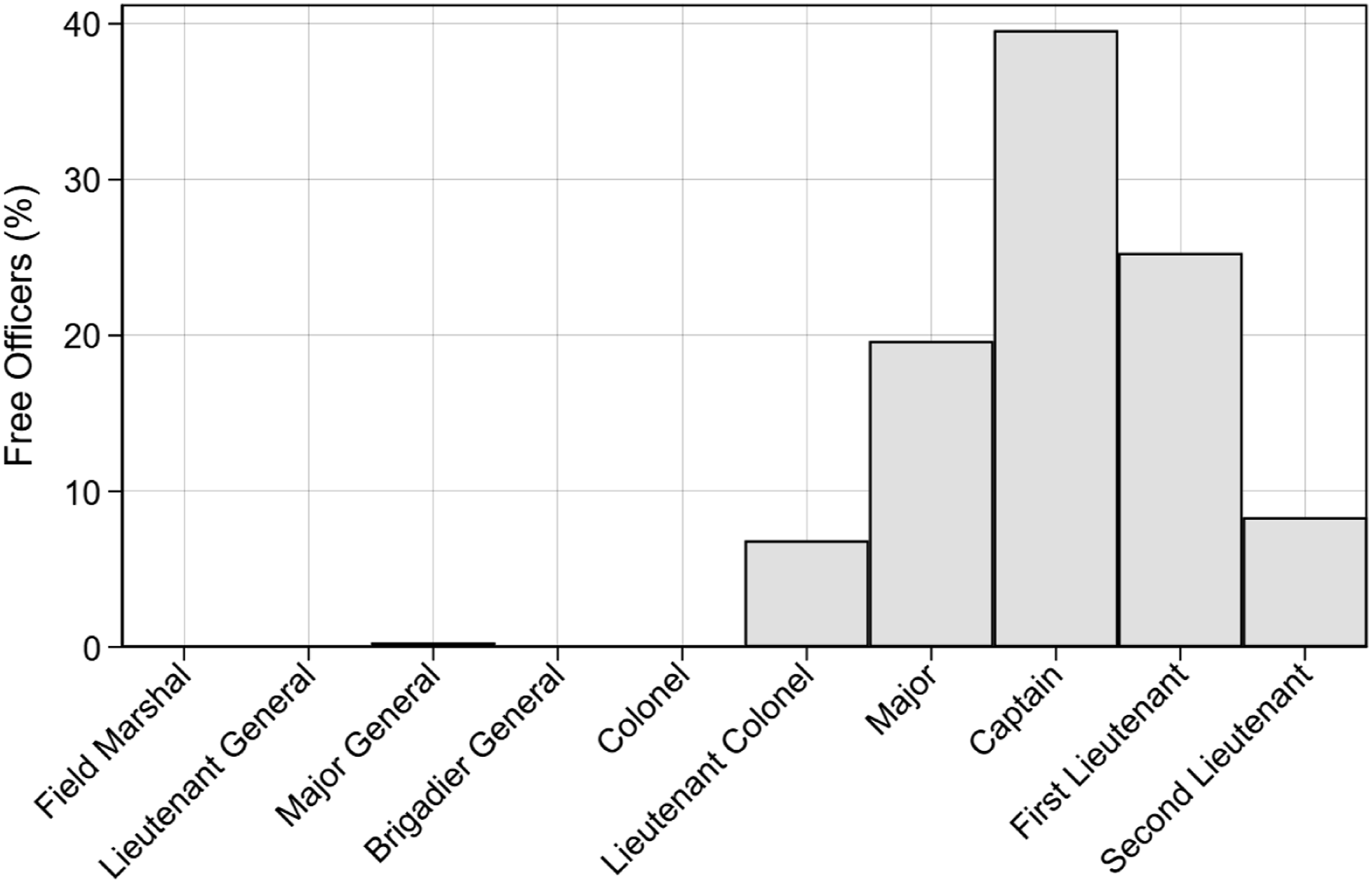
The Egyptian Royal Military Academy also left the Free Officers unprepared in several key areas. Figure 3 summarizes its library holdings at the time when many of the Free Officers received their training.
12
Naturally, most of the texts were dedicated to military history and science. This left little formal exposure to, or instruction in, key areas relevant to governance, such as law, economics, public administration, and diplomacy. The Free Officers could also not call on family members or connections for guidance. Hamrush (1984) compiled detailed biographical information on 37 Free Officers. Of these, two had fathers working in midranking positions in the state bureaucracy. The remainder was mostly farmers, military officers, lawyers, and minor public officials. This forms the basis of a common characterization of the Free Officers: that they came from relatively humble origins and lacked governmental experience (Ayubi, 1980, p. 159; Be’eri, 1970, p. 321; Vatikiotis, 1961, p. 46). If the Faruq-era state elite were the descendants of Egypt’s Ottoman aristocracy, the Free Officers were, in the words of Nagib, ‘the grandsons of peasants’ (Neguib, 1955, p. 13). Books by subject area taught in the military academy, 1940.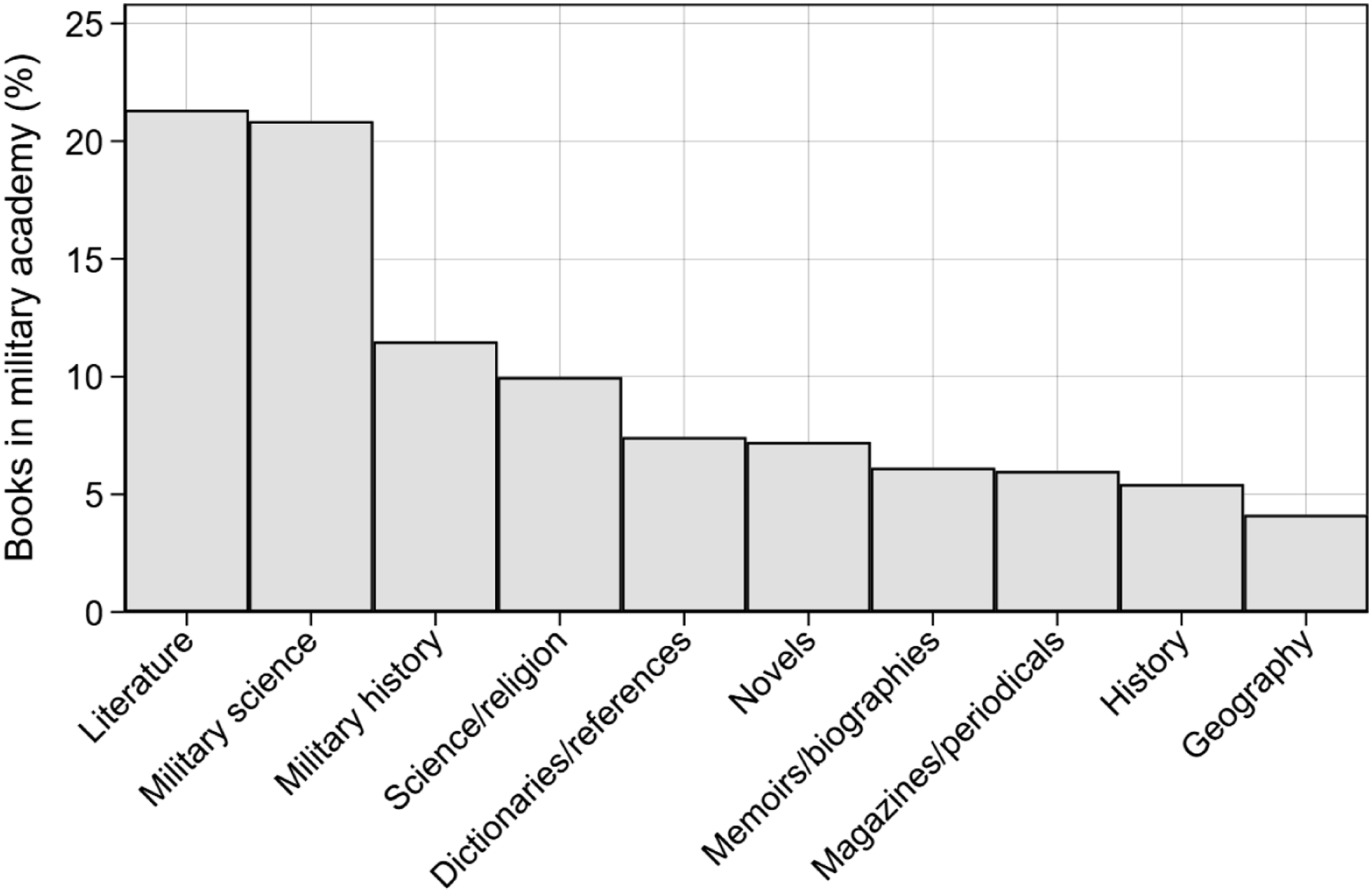
Data and Method
To study how the Egyptian state elite was transformed by the July 23 Revolution, we draw on a novel source: Who’s Who in Egypt and the Near East. 13 Compiled in Egypt between 1934 and 1959, this was a register of the country’s political, social, and economic elite that was updated and published annually. 14 We assembled a time series of these publications from 1939 to 1959 by digitizing individual editions held in the libraries of the Centre d’études et de documentation économiques, juridiques et sociales (CEDEJ) in Cairo, the British Library, King’s College London, and the University of Wisconsin–Madison. Contained in the front matter of each edition is a seemingly complete list of ministers and high-ranking bureaucrats in the Egyptian government. 15 The 1952 edition, which was published just months before the Free Officers’ coup, contains records for 674 officials. 16 Subsequent editions allow us to trace individual survival and turnover in office over time. Each edition also contains extended biographical sketches, and this allows us to construct variables recording individual-level characteristics. 17
Dependent Variable
Our unit of analysis is an individual located in their ministry year. The analysis period begins in 1952 and ends in 1959 following the establishment of the United Arab Republic with Syria.
18
The outcome of interest is an individual’s survival time. Figure 4 is the Kaplan–Meier estimate showing the probability of officials surviving in office following the revolution. Fully 343 members of the pre-52 state elite (51%) were purged within a year. A further 190 (28%) were purged the following year. Notably, over ten percent of Faruq’s officials were still in position six years later. Kaplan–Meier survival estimate for pre-1952 state elite following the Free Officers' seizure of power.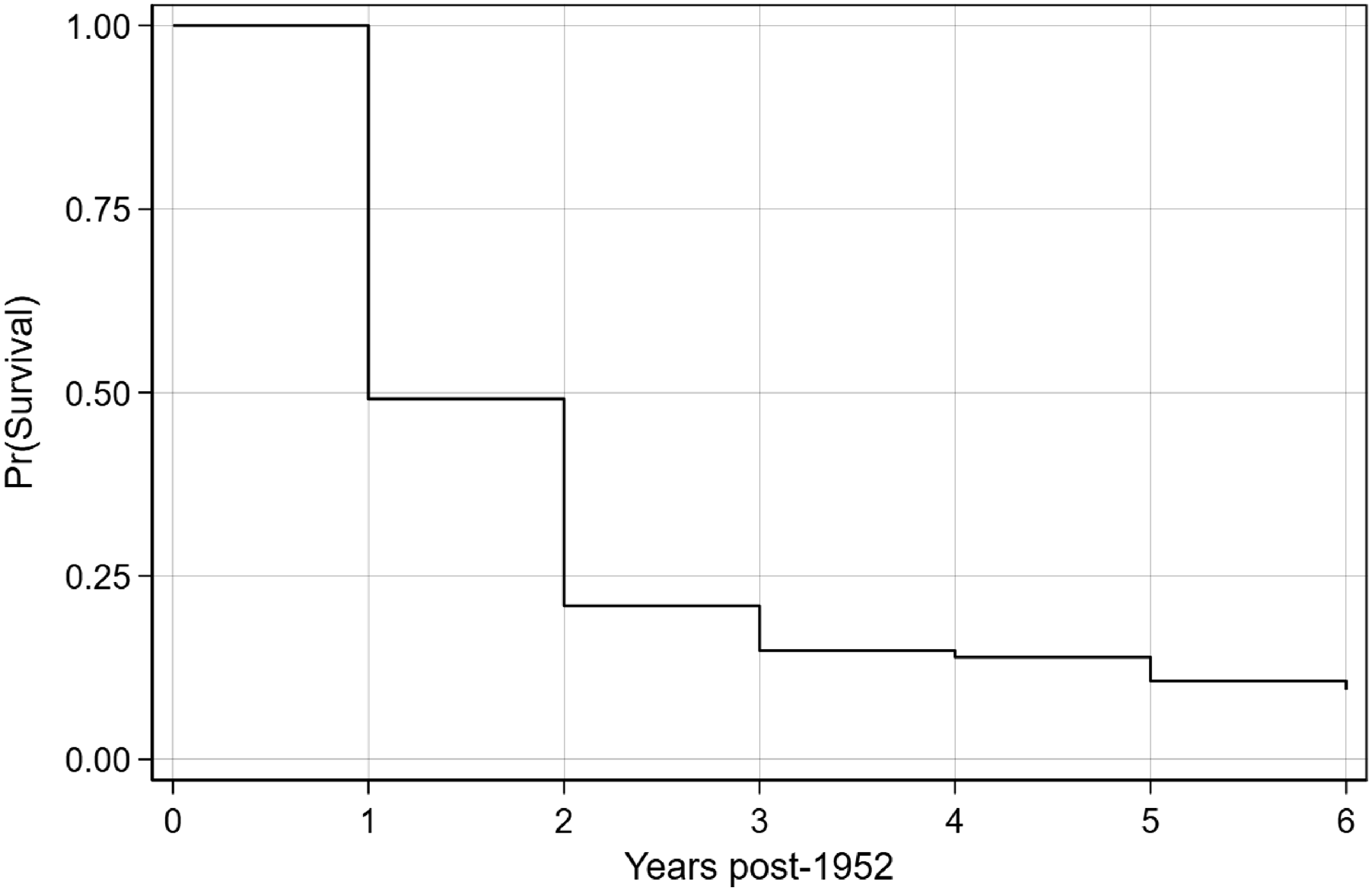
We use multilevel survival analysis to explain variation in why some individuals were retained in office longer than others. Diagnostics suggest that elite survival was subject to nonproportional hazards, so we implement a log-normal, accelerated-failure time model; random intercepts account for shared frailties for individuals working in the same ministry or institution. Here, the survival time (t) for individual (i) located in ministry (m) in year (y) is modeled as follows:

Operationalizing Threat and Competence
In a first specification, we operationalize threat and competence by combining several individual-level measures into summative index variables. 19 Higher values on these indices reflect either more threat or more competence.
Our threat index draws on five different variables measured at the individual level. We expect very senior officials to be seen as more threatening to the Free Officers’ agenda, so we enter a dummy variable for whether an individual was a minister or undersecretary, which was the most senior subministerial rank (al-Waqai al-Misriyya, 1951, p. 16). To capture an individual’s ties to the monarchy, we enter the number of royal honors that an official had received, transformed using a started log. The Free Officers had publicly committed ‘to destroy the political power of the pasha class’, that is, the aristocracy, so we enter a dummy for whether an individual holds the honorific of Pasha or Bey (Gordon, 1992, p. 59). Naturally, we expect that junior military officers will be threatened by other military officers who did not participate in the conspiracy, which we capture using a dummy variable. Finally, we expect that individuals who hold multiple portfolios in the state bureaucracy will be seen as more threatening by the incoming regime, measured as a count of positions held. Taken together, we expect that higher scores on this index should be negatively associated with an individual’s survival time.
We measure competence by combining two comprehensive measures capturing experience and specialist knowledge. As already noted, the Free Officers lacked expertise in many key areas and very few of its members had received an advanced education. From the case details, we know that university graduates were highly prized for this reason, so we code a dummy variable for whether a member of the pre-1952 state elite possessed university-level education. 20 To measure experience, we enter the number of years from 1939 to 1952 that an individual had been a member of the state elite, transformed to its logarithm. 21 Ceteris paribus, if competence helped to shield an individual from being purged, this variable should increase their survival time in office. To test whether threat supersedes competence, we multiply these two indexes to create an interaction term. Our expectation is that high levels of competence will be insufficient to shield individuals who are also deemed to be very threatening. We also decompose each index to identify those more specific factors influencing elites’ survival outcomes. In the robustness section we test that the index results are robust to the exclusion of positions, which may also be capturing competence.
Controls
We adjust our estimates by accounting for a number of plausible time-invariant and time-varying confounders. We expect that larger ministries and institutions will see more turnover than smaller ministries, so we enter the logged number of individuals in a ministry at the point of the revolution. We include senior diplomats and Foreign Ministry officials as members of the Faruq-era elite. Diplomats posted abroad may have been less vulnerable to being purged based on our assumption that officials close at hand will be prioritized. It may also be that diplomats possess expertise and specialist knowledge that makes them indispensable. To account for this, we measure the logged distance in kilometers between officials’ workplaces and the Republican Palace in Cairo. 22 Once in power, the RCC parachuted members of the Free Officers into leading positions in the state bureaucracy. To take into account the effects of this newly acquired experience on the survival of pre-1952 state elites, we enter the cumulative individual years accrued by Free Officers in a given ministry year, transformed to the logarithm plus one. Another confounding factor is the consolidation of Nasser’s power in 1954, which we capture with a dummy variable for that year. 23 Finally, the Free Officers initially enjoyed the support of the Muslim Brotherhood, the largest Islamist movement in Egypt, who pushed to overhaul the country’s institutions of Islamic religious authority (Vatikiotis, 1961, pp. 77–78). To capture whether establishment religious figures were more vulnerable to purging, we code a dummy variable for whether an official is identified with the religious honorific of shaykh.
Results
Figures 5, 7, and 9 are the results from a series of multilevel survival models, with coefficients expressed as median survival time ratios located on their 95% confidence intervals. The full regression outputs are reported in Appendix Tables 3, 4, and 5. How individual threat and competence predict elite survival.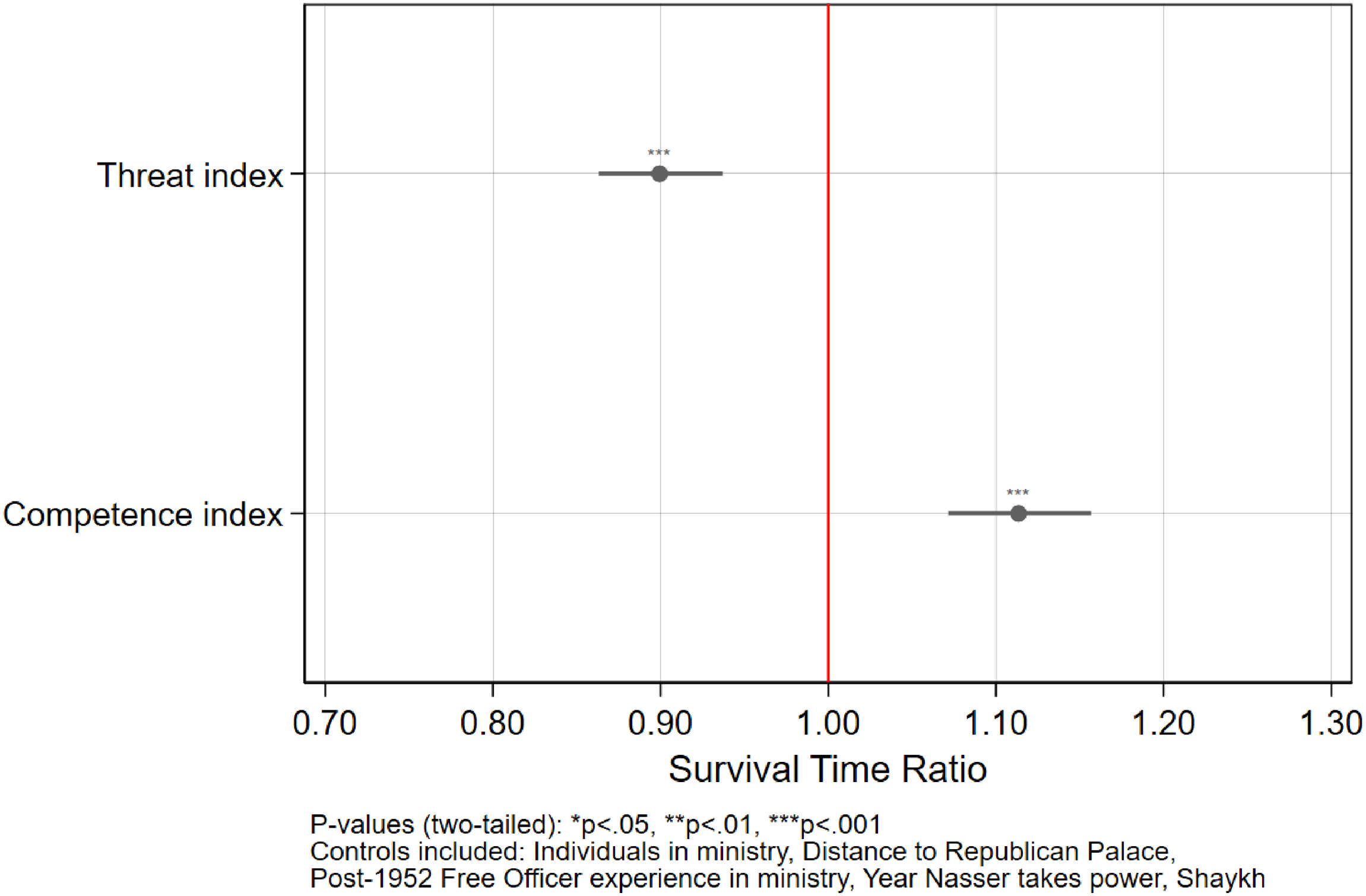
Beginning with Figure 5, we find initial support for our argument that both threat and competence powerfully patterned elite survival and turnover. Our index capturing threat is significantly negatively associated with a reduction in survival time (p < .001). We find the opposite relationship with regards to competence. Ceteris paribus, higher values on the competence index are statistically significantly associated with an official surviving longer in office (p < .001).
Figure 6 plots the survival curves for both indices at the 1st and 99th percentiles with all other variables set to their means and inclusive of random effects. Three years after the revolution, the midpoint of our analysis period, an individual at the first percentile of the threat index—somebody whose individual attributes would be considered nonthreatening to the Free Officers—had a 32% probability of surviving in office. The probability of survival is more than halved (15%) for an official at the 99th percentile of the index. We see the inverse relationship for competence. All else being equal, an official located at the 99th percentile of our competence index has a 20% higher probability of surviving in office than an official at the first percentile for competence. How survival varies by percentile of threat and competence.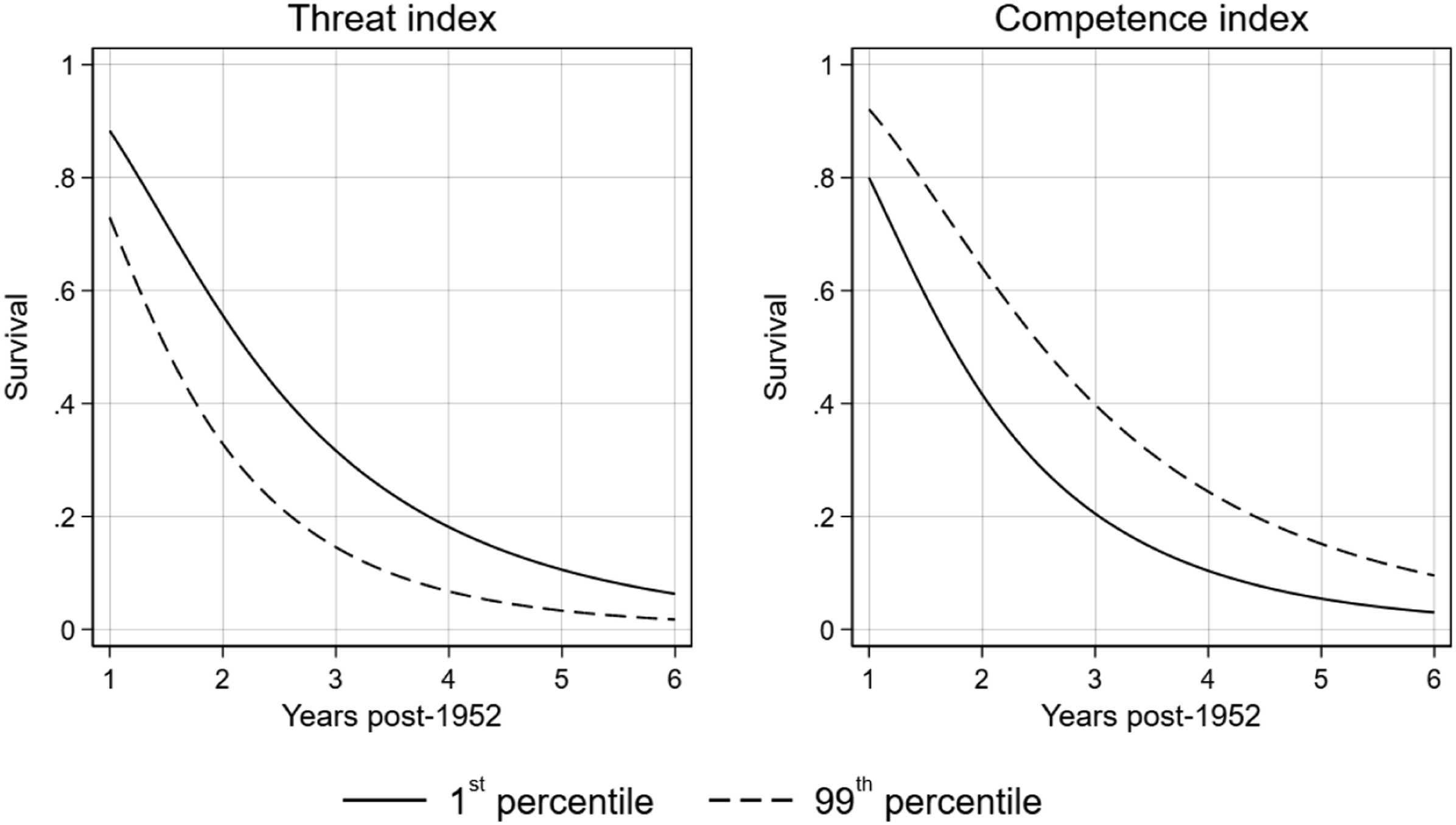
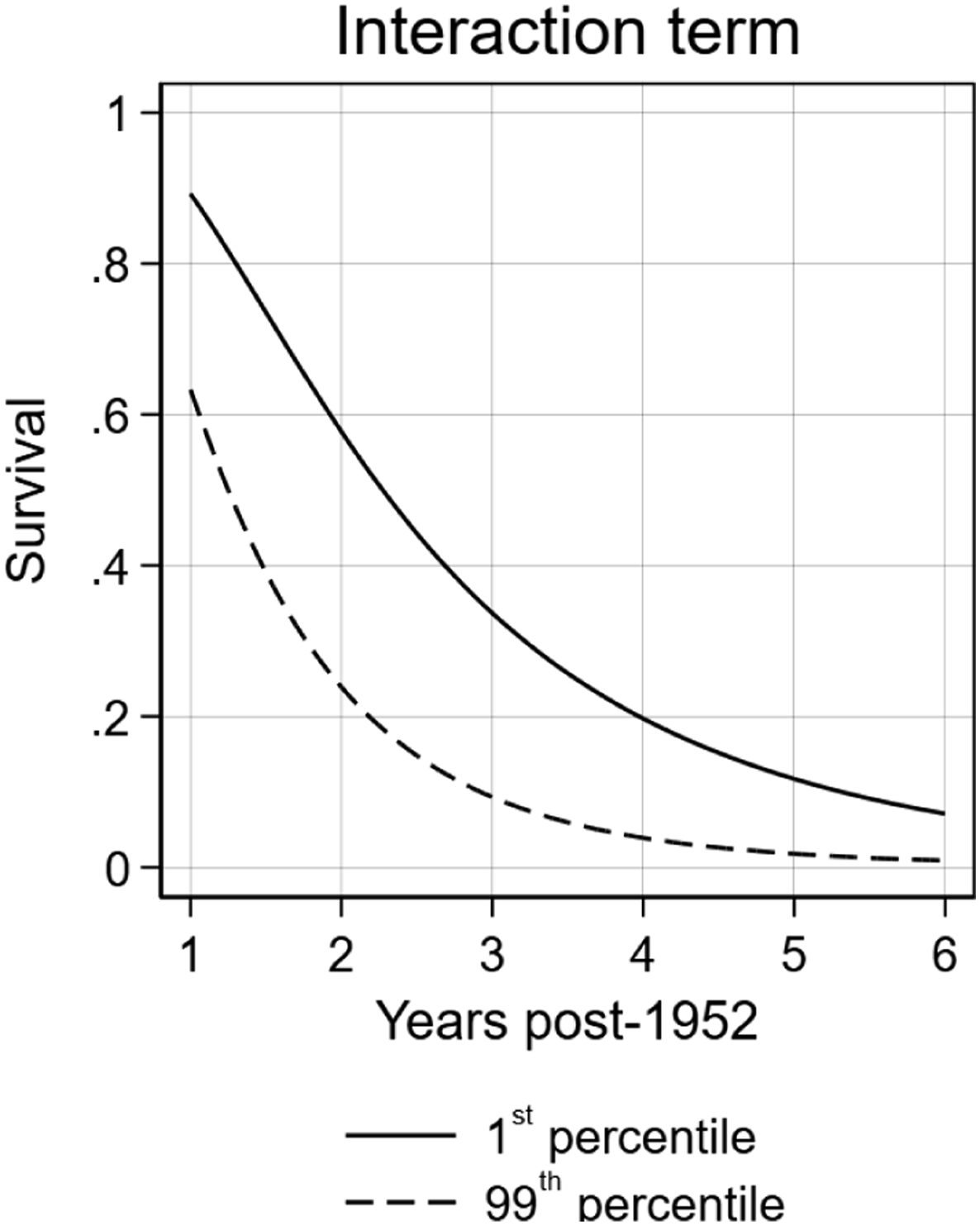
Figure 7 tests an interaction term for threat and competence. Elites who score highly on both the threat and competence indexes had statistically significantly reduced survival times. This suggests that, irrespective of an official’s longevity in office and educational profile, threat ultimately trumped competence. To deepen this point, Figure 8 plots the survival curve for the interaction term at the 1st and 99th percentiles. Interaction term. Survival curves for interaction term.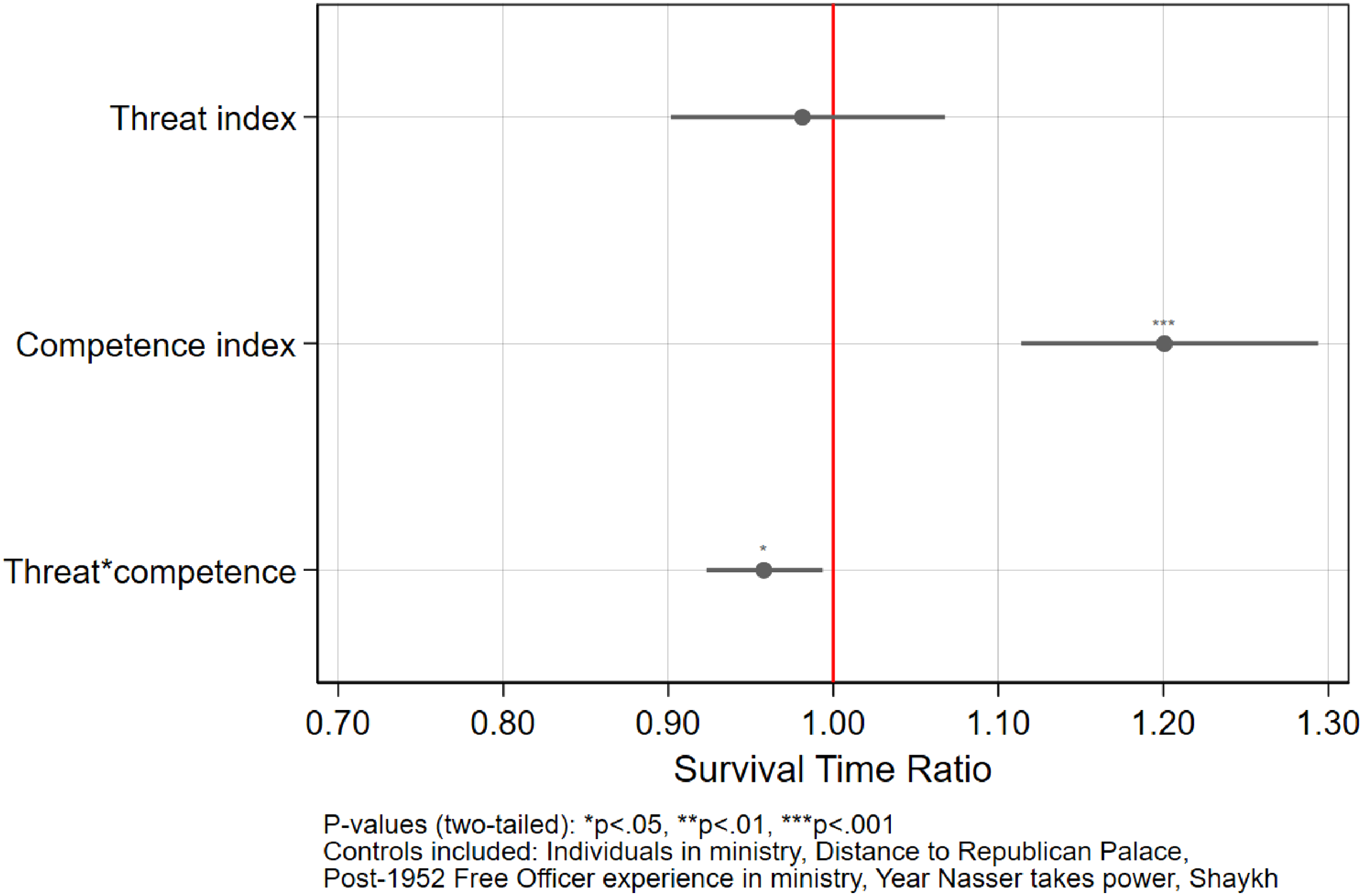
We can further enrich these findings through disaggregation. Figure 9 repeats our analyses but decomposes each index by its constituent variables. The median survival time for a senior official is 17.5% lower when than a more junior official (p < .01). Officials who received more royal honors from the monarch had significantly and substantively lower survival times (p < .001). Being a Pasha, Bey, or military officer is negatively associated with an individual’s survival time; however, neither of these variables are statistically significant at conventional levels. Officials who held multiple positions in the state bureaucracy were more likely to be purged (p < .05). After accounting for these characteristics, individuals who had spent more years in the state elite prior to the revolution were statistically significantly more likely to be retained in office for longer (p < .001). The median survival time for an official with university education was 13.6% times greater than an official without university education (p < .01).
24
Disaggregating threat and experience indices to predict elite survival.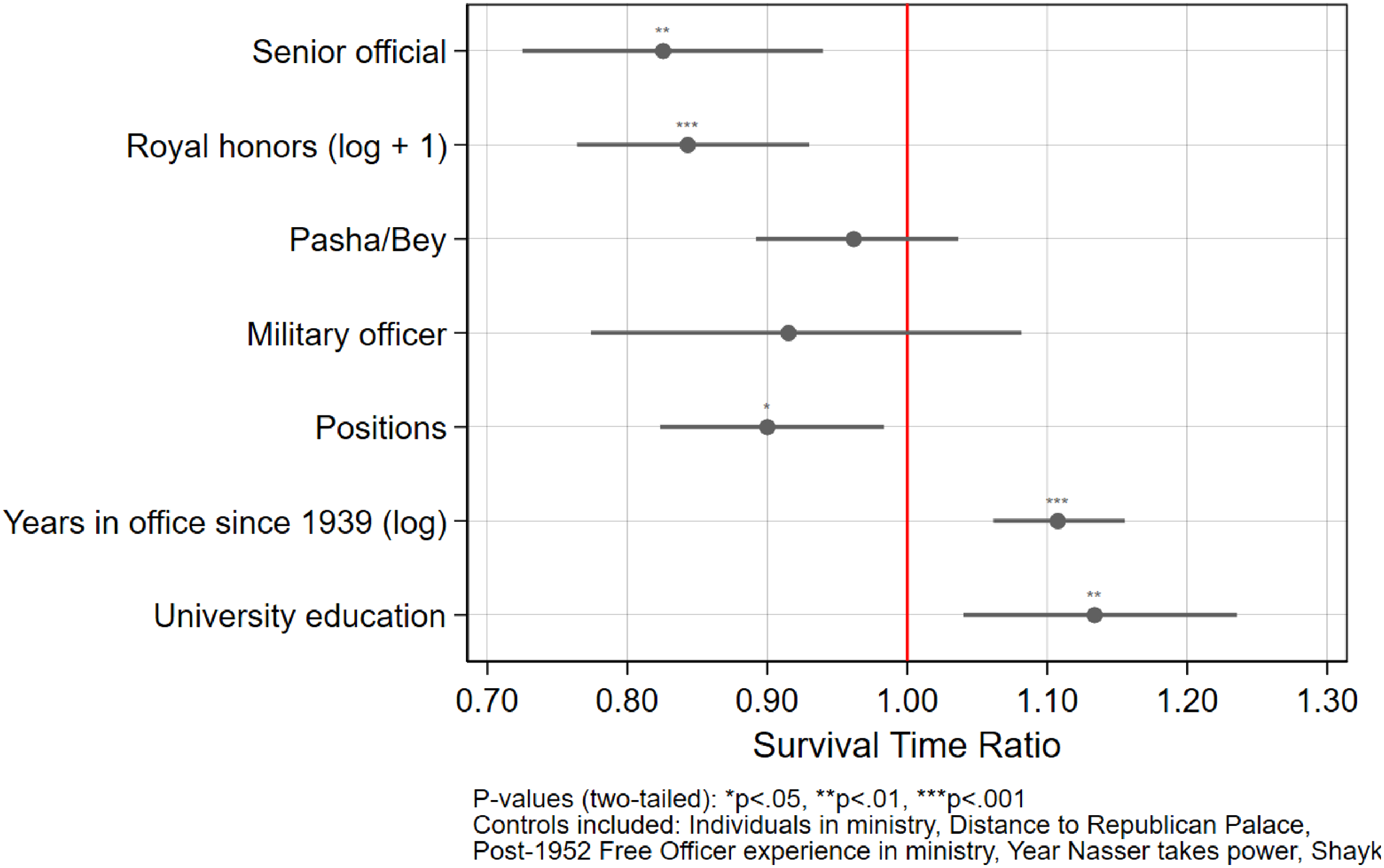
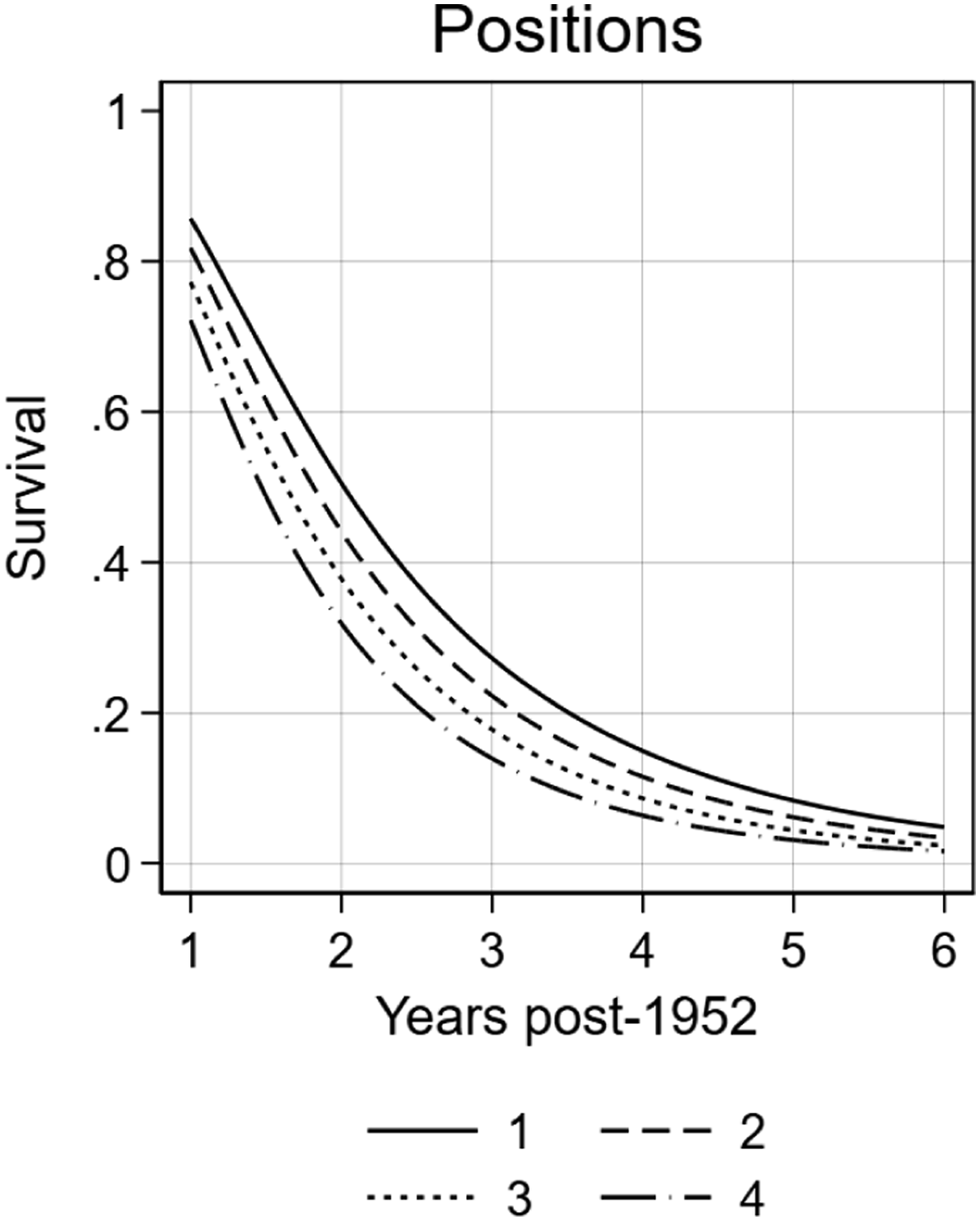
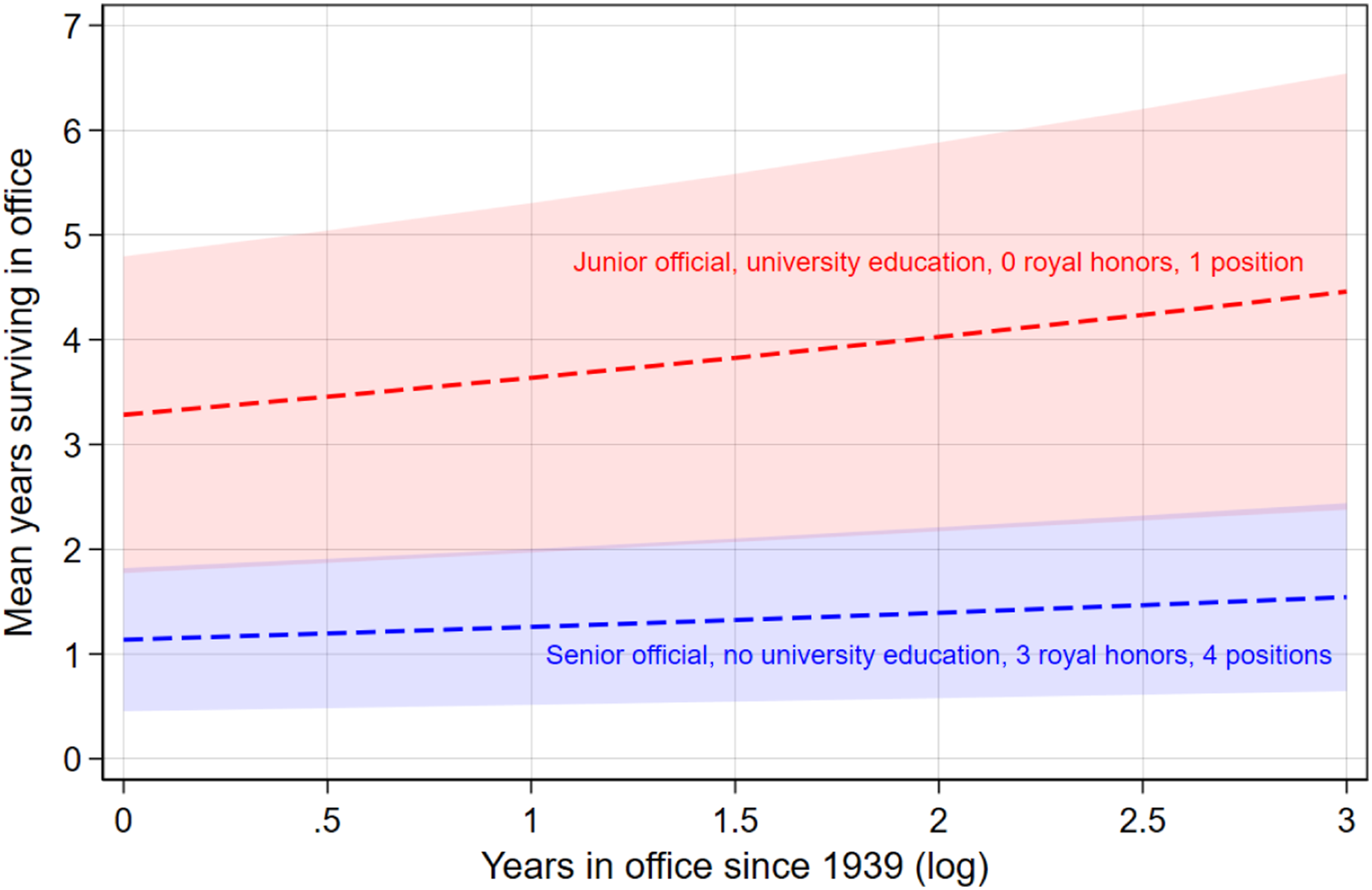
Figures 10 and 11 are the survival curves for the significant continuous variables reported in Figure 6. Confining attention to the likelihood of survival 3 years after the Free Officers came to power, increasing the number of royal honors bestowed on a state official from the 1st to the 99th percentile reduces the probability of that official surviving in office from 28 to 16%. After adjusting for the threat that an official posed, the most experienced bureaucrats have a 16% higher likelihood of being retained than a newly appointed official. An official who holds 4 portfolios in the state elite has a 14% lower probability of surviving than an official who holds only 1 post. These survival probabilities can be combined into hypothetical profiles. Three years post-1952, a senior Faruq-era official with 3 royal honors, 4 positions, no university education, and 1 year of experience had a 4% chance of surviving in office. Contrariwise, a junior official with university education, 10 years of experience, 1 position, and no royal honors had a 40% chance of survival. Figure 12 shows the mean expected survival time in years for these profiles as a function of an individual’s experience in office. Again, we find that, on average, individuals with characteristics that could be considered less threatening and signaled competence tended to survive in office for longer. How survival varies by percentile of royal honors and experience in office. How survival varies by the number of positions held. Predicted years in office post-1952 by hypothetical profile.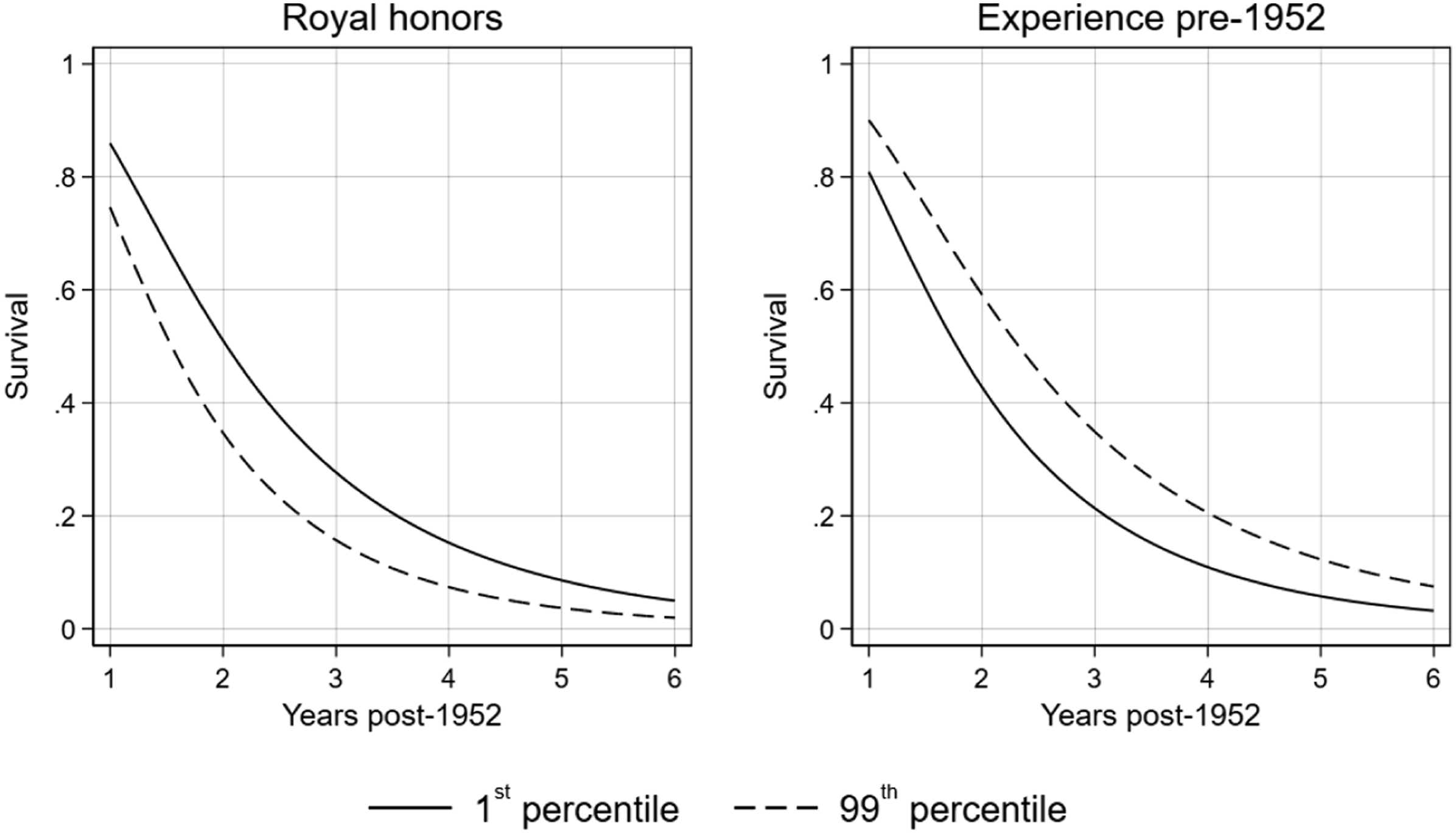
We can also explore the institutional factors shaping individual survival and exit. Figure 13 shows the values of the ministry-level random intercepts (ζ
m
) from the results reported in Figure 9. These intercepts record the residual between-ministry variance shaping individual survival, net of all covariates. Scrutinizing these intercepts, we see that, even after entering variables accounting for various individual-level factors, time-varying events, and workplace characteristics, there remains significant and substantial, residual institutional effects patterning who from the pre-1952 elite was purged and who was retained. In particular, officials working in the security ministries (Interior and War) appear to have been much more vulnerable to being purged, even after accounting for their individual characteristics. We also find residual institutional effects associated with reduced survival times for officials working in the state council that coordinated the various branches of the state, as well as parliament, the diplomatic corps, and the Ministries of Municipal and Rural and Social Affairs. These associations suggest that certain ministries were seen as particularly threatening to the Free Officers’ agenda, making all officials working therein more vulnerable to purging. By contrast, officials from the Ministries of Foreign Affairs and Education were much more likely to survive in office for longer by virtue of belonging to those institutions. Individuals working in ministries related to the economy, production, and public infrastructure were also more likely to be retained in office longer. Interestingly, after accounting for an individual’s ties to Faruq, their seniority, and membership of the country’s class of notables, officials employed in the royal court also enjoyed longer survival times. Residual institution-level effects on individual survival.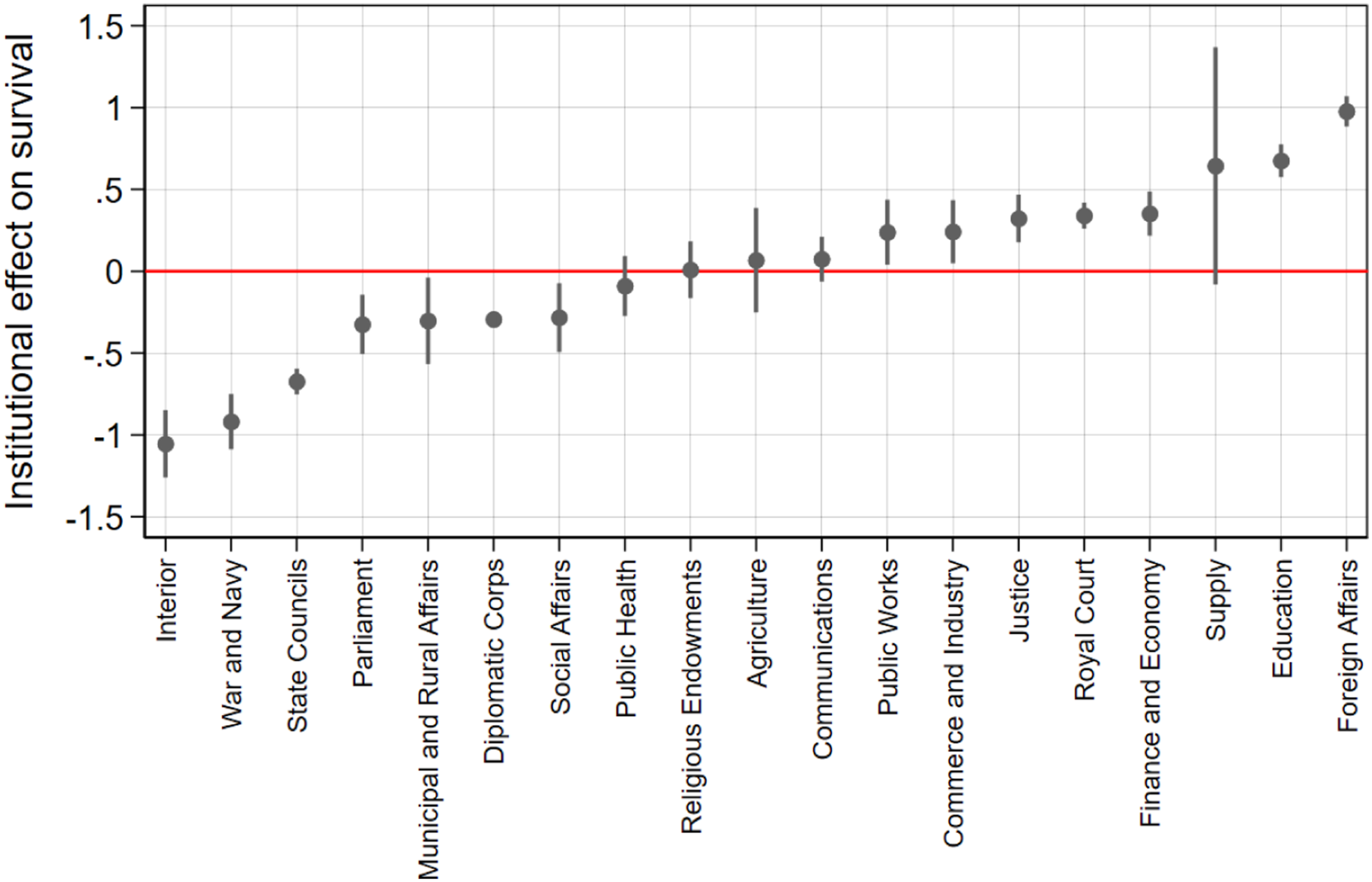
Alternative Controls and Specifications
We can also account for additional confounding. It might be that more elderly officials exited the state elite due to natural causes, such as retirement or ill-health. We capture this with an individual’s age. To account for religious loyalties, we also enter a dummy variable for whether an official was Muslim. While the case literature stresses that the Free Officers had no meaningful social ties to the Faruq-era elite, we can also try to rule this out statistically. Here, we test a dummy variable generated by a string-matching algorithm that is coded as 1 if a member of the pre-1952 elite shared the same surname with either a member of the Free Officers or an officer who joined the state elite in the years following the revolution. In Egypt, social clubs have long functioned as key sites of elite networking and socialization (Baraka, 1998, pp. 189–194). Membership in these clubs may have brought members of the pre-1952 state elite into contact with the Free Officers, thereby offering them protection from being purged. We account for this by testing a count of the social clubs that officials belonged to, transformed to the square root. Note that there is substantial missingness on several of these variables, so we use a random forest imputation algorithm to recover rows that would otherwise be lost through listwise deletion. Appendix Table 6 shows the results, which are statistically and substantively identical to those reported in Figure 9.
Are our results dependent on the inclusion of certain covariates? Appendix Tables 7, 8, and 9, are reduced form models including only the theoretically relevant variables. Finally, while our disaggregated results show that all of our theoretically relevant variables are signed in the anticipated direction, readers may object to the inclusion of certain variables in the indexes. In particular, the number of positions might capture both threat and competence. Per Appendix Table 10, we can remove this variable from the threat index and instead enter it as a separate control, which does not substantively change the results.
Qualitative Evidence
We now look to corroborate our statistical findings regarding a threat-competence calculation in this section. Drawing on biographies, memoirs, newspaper reports, and speeches, we adopt the logic of process-tracing tests. If such a calculation arising from the Free Officers’ inexperience and revolutionary ambitions led to variation in elite survival, we should find evidence for the implied mechanism in the historical record.
‘…Because the Government Machinery was Corrupt, It Had to be Cleansed and Reformed’
Writing in the American magazine Foreign Affairs, Nasser (1955), by that point the Prime Minister, outlined the rationale for the July 23 Revolution. It was, he insisted, a national revolution against an incompetent monarch and a parliament that had failed to end British rule and brought immiseration to the countryside. ‘And because the government machinery was corrupt’, he concluded, ‘it [too] had to be cleansed and reformed’ (Nasser, 1955, p. 203). Reading the Free Officers’ speeches from this period, corruption was often invoked as a justification for purges. But in reality, according to one of Nasser’s confidants at the time, purges were driven by perceived loyalty to King Faruq rather than corruption per se (Abu al-Fath, 1991, p. 175; see also Darwish, 1962, p. 207; The Manchester Guardian, 1952a, The Times, 1952b). When Nagib assumed the premiership in early September 1952, he claimed as much: ‘The movement was … against all those who co-operated with the ex-King’ (The Manchester Guardian, 1952c). He further corroborates this point in his memoir, which was published only three years after the revolution: that the Free Officers targeted individuals ‘whose only offence was that they held office under King Faruk’ (Neguib, 1955, pp. 170–171).
Those who avoided arrest were either dismissed by one of the purge committees or forced to resign. We find statistical evidence for this in the diplomatic corps, where appointments ‘relied solely upon royal patronage’ (Whidden, 2013, p. 161). This is corroborated by contemporaneous reports that diplomats connected to Faruq were quickly replaced. To give some prominent examples, Amin Muhammad Fahim was a longstanding advisor to Faruq and his father—a connection that saw him bestowed with several royal honors (Hammuda, 1991, p. 24). At the time of the revolution, Fahim was the first secretary at the Egyptian embassy in Rome (Hammuda, 1991, p. 112). Shortly thereafter, it was officially announced that Fahim had ‘resigned’ from his role (al-Waqai al-Misriyya, 1952c; Fawzi, 1994, pp. 10–11). A similar fate befell the Egyptian ambassador to London, Abd al-Fattah Amr, who was also a former royal advisor (al-Waqai al-Misriyya, 1952d). Muhammad Ali Sadiq, the Egyptian ambassador to the Netherlands, was also dismissed at this point (The Manchester Guardian, 1952d). Sadiq was the uncle of Narriman, the Queen of Egypt, and had represented her in the negotiations over her marriage contract with Faruq (Fawzi, 1994, p. 58).
Guiding these decisions was a concern that the revolution could be ended in the same way that it had begun. According to one of his biographers, Nasser was preoccupied with the possibility of counterrevolution: ‘“Every revolution faces the danger of counter-revolution,” he [Nasser] told himself. “The makers of every coup must watch out for a counter-coup”’ (St. John, 1961, p. 99). In line with our statistical results, civil servants who served during this period recall that senior officials in particular were targeted for purging, especially Faruq’s ministers and their undersecretaries. The rationale for this was straightforward: many of these individuals were political appointees and were therefore viewed as a natural source of opposition (Darwish, 1962, pp. 199–210).
There is also evidence corroborating our finding that the Free Officers targeted whole ministries and state institutions for purging due to the potential threat that their officials posed. This was especially the case for the security ministries. As a former Ministry of Interior official notes: ‘[I]t was evident that the more political a ministry was, the higher the number of employees dismissed. In this respect, it was known that the Ministry of Interior which was responsible for internal security, public safety, police force, political organizations, elections, immigration, passports, secret police, and licenses, scored the highest ratio’ (Darwish, 1962, p. 210).
This logic also applied to the military and the Ministry of War. Observers from this period record that the Free Officers prioritized purging the high command to ensure their ‘continued control and security’ (al-Boghdadi, 1977a, p. 64; see also Nasr, 1999, p. 155). Nasser himself oversaw this process, ‘quietly, methodically …[preparing] the appointments, transfers, dismissals’ (Vaucher, 1960, p. 15). As a result of these purges, military leaders, including those employed in the Ministry of War, were replaced with officers deemed loyal to the RCC (Nasr, 1999, p. 217).
Why were non-security ministries also singled out for purging? One example in our data is the Ministry of Municipal and Rural Affairs. Established only two years before the coup, it was regarded as one of the ‘less dynamic, less important, and less progressive’ ministries (Ayubi, 1980, p. 188; Darwish, 1962, p. 274). Yet it was crucial from the standpoint of the RCC, which was committed to developing the countryside and thus eliminating the power base of Egypt’s political elite (Johnson, 2004, pp. 164–176; Wheelock, 1960, pp. 117–118). Faced with a potentially obstructive bureaucracy that threatened to impede its agenda, and determined to undermine the standing of politically influential landowners, the RCC purged many of the ministry’s officials. Following the purges, a core Free Officer was appointed minister in 1954. A similar fate befell the parliament, two-fifths of which were personally appointed by the king (Hughes, 1952). The balance were drawn from Egypt’s aristocracy and landowning classes (Baraka, 1998, p. 250). This extended to the senior bureaucrats who ran the chamber, some of whom were themselves members of leading political parties (see, e.g., al-Shalaq, 2010, p. 37). Given its social composition, it is not surprising that, per our statistical results, officials associated with Egypt’s parliament were especially vulnerable to being purged.
‘We are in Dire Need of Technical, Capable, Patriotic Men’
Nasser and the RCC were undoubtedly concerned with revanchism. But they were also keenly aware of their limitations and so were privately reconciled to keeping on Faruq-era holdovers to manage the state and implement policy (see Badeau, 1955, p. 27). Mere days after July 23, Nagib told a group of reporters at a press conference, ‘I am a military man; I do not understand politics’ (Nagib, 1952). He was even more forthcoming in his memoir: ‘Our difficulty was that we didn’t know how to do it. None of us had ever had any political experience, and, though my experience as a senior officer was helpful, it was not the sort of experience I needed to make the day-to-day decisions required of a Prime Minister’ (Neguib, 1955, p. 171).
In his biography of Nasser, St. John (1961, p. 128) recalls how, in the weeks following the revolution, RCC member Muhyi al-Din recommended calling in university professors, lawyers, engineers, and doctors to aid the Free Officers in mastering their newly acquired responsibilities. Nasser, the member whose vote mattered most on the RCC, agreed: ‘Often they [the civilian experts] stayed around the barracks until three or four o’clock in the morning, trying to help the young army officers understand the complex new matters with which they now had to concern themselves’.
Having committed to improve the lot of the peasantry, for example, the RCC looked to agricultural and legal experts to craft the land-reform scheme that would come to define the revolution (al-Boghdadi, 1977a, pp. 64–65). The Ministry of Agriculture became the institutional locus of these efforts (Gadalla, 1962, pp. 41–42). Equally intensive was commandeering, cataloging, and liquidating the assets of the royal family. Although overseen by the Technical Office of the RCC, the forensic precision of such an effort necessitated the involvement of state officials (al-Gawhari, 1978, pp. 31–32; Aref, 2007, p. 154).
Of note, the Free Officers did attempt to develop their own expertise in a bid to overcome this competence deficit. Several RCC members took it upon themselves to specialize in specific areas of administration (Abu al-Fath, 1991, pp. 176–177). Some even took leave to go to university before returning to take up new positions (e.g., Hamrush, 1984, pp. 182, 370). The RCC also placed officers in civilian roles across the state (Hamrush, 1992, pp. 237–238; The New York Times, 1952; Vatikiotis, 1984, p. 185). Nasser thought that by embedding with state bureaucrats, the Free Officers would ‘learn the secrets of the profession of government and become accustomed to dealing with civilian regulations and laws’ (Baybars, 1976, p. 166). But this quickly generated a new set of problems. The officers were ill-equipped ‘to intervene in the work of the civilian sectors and state administrations’ (cited in al-Hakim, 1999, p. 111). As St. John (1961, p. 128) summarizes, while the RCC could be confident in their loyalty, ‘they [i.e., the junior officers] knew more about taking a machine gun apart than dictating to a stenographer’. The RCC, or at least Nasser himself, was made aware of the corrosive effects of their presence, including alleged corruption and self-dealing among those newly exposed to the prerogatives of power (Fawzi, 1990, pp. 216–218; Sallam, 1986, p. 101).
These efforts notwithstanding, the Free Officers clearly struggled to compensate for their lack of experience in running a large and modern state. Speaking to an audience of supporters in 1953, Nagib (1953) laid bare the scale of their problems: ‘You know that we need expertise in a number of different fields, from engineering, and medicine, and economics, and so on …That is why I want each of you to write down ten names, and then submit them to me within a week at most, because we are in dire need of technical, capable, patriotic men (our emphasis added)’.
Under pressure to meet public expectations, it was perhaps inevitable that the Free Officers found themselves having to call on officials that they inherited from the Faruq-era bureaucracy. As one firsthand observer records: ‘The new ministers [appointed by the RCC] were facing great and unanticipated challenges. They were faced with the immediate problems of assuming responsibility for departments that they knew nothing about. They had to implement the legislative and administrative reforms promised by the Revolution to satisfy the impatient public eager for rapid results …In any government, such pressures force cabinet members to lean heavily on their permanent bureaucrats …The old [Faruq-era] bureaucrats represented experience and knowledge of doing government work. Therefore the new elite was willing to win them over to their side’ (Darwish, 1962, p. 198–201).
This logic is especially visible in relation to economic policy. The Free Officers came to power at a moment of economic difficulty. Struggling to close a budget deficit of £40 million, the new cabinet had to pursue a program of austerity and tax rises (Little, 1954, p. 143). Sensitive to public opinion, the officers expressed concerns to the Ministry of Finance about raising taxes that would affect the general population, preferring instead to tax the wealthy. But they eventually relented, deferring to the ministry’s expertise (al-Imari, 1986, ch. 3). As Waterbury (1983, pp. 51–53) writes, the RCC generally knew what it wanted when it came to the economy but left the specifics to the civilian experts. This helps to explain higher retention rates in the Ministries of Finance, Supply, Commerce and Industry, and Public Works.
The same is true for foreign affairs. Although the RCC purged diplomats with ties to the former monarch, it was also conscious of the need to retain foreign-policy expertise, which its members lacked. This extended to Mahmud Fawzi, who was previously the Egyptian ambassador to the United Nations and the United Kingdom and whom the Free Officers promoted to lead the Ministry of Foreign Affairs. Explaining this decision, St. John (1961, p. 131) writes: ‘The RCC men were aware that he [Fawzi] had a reputation for being able to out-talk and out-manoeuvre even suave men from Downing Street and the Quai d’Orsay, and that he was respected personally by rulers in most of the capitals of the world. He seemed to have no political philosophy of his own, and when the Free Officers called him in for consultation he agreed to serve them as loyally as he had tried to serve others. So, until they could develop some Free Officer who could approach Mahmud Fawzi in this field, they decided to let him handle foreign affairs’.
Similar beliefs motivated the appointment of Ahmed Hussein, a former cabinet minister with strong international credentials, as the Free Officers’ first ambassador in Washington (Johnson, 2004, pp. 176–178). A willingness to work with competent and experienced Faruq-era officials even extended to former courtiers. In one prominent example, Salah al-Shahid, Faruq’s master of ceremonies, was kept on by the RCC due to his administrative experience; he would faithfully serve Nagib and then later Nasser (see al-Shahid, 1976). Such sudden and enduring shifts in loyalty were not uncommon. As Darwish (1962, p. 199) recounts, many of Egypt’s old state elite hoped to retain their positions in the new order and so worked hard to signal their fealty to the Free Officers.
Discussion and Conclusions
If rupture is central to the definition of revolution and the rhetoric of revolutionaries, rarely is it complete. From the classical revolutions of Europe to more contemporary ones in post-colonial settings, the case literature points to important instances of civil servants and state officials weathering rapid and radical transitions of power (Church, 1981; Rose, 1984; Soemardjan, 1957; Velychenko, 2011; Vu, 2016). As we have shown, these forms of elite-level continuity are likely essential to revolutionary coups launched by junior officers. This is because the expertise and know-how to implement radical policies cannot come from the ranks of the coup plotters themselves.
In the years following the Free Officers’ takeover, there was a significant turnover in the Egyptian elite, overseen by purge committees which targeted officials on the basis of their biographical characteristics and place of work. At the same time, a degree of elite-level continuity was essential to delivering a program of social and economic transformation. In choosing which state officials to purge, our results suggest that the Free Officers prioritized the most senior officials and those with ties to Egypt’s monarch, as well as officials employed in the security ministries and institutions that were central to the power structure of the old regime. Bureaucrats with more experience and university education were more likely to survive in post for longer. So too were officials working in ministries that required specialized knowledge and expertise that could not be easily replaced or cultivated.
Taken together, these findings point to a threat-competence dilemma that powerfully patterned elite survival and turnover during a pivotal episode of radical political change. Here, we should reiterate the scope conditions of both our argument and the results: our case speaks to revolutions from above launched by junior military officers, a class of revolutionary action that marked the second half of the 20th century. In these episodes, small groups of nationalist officers seized power in the name of national liberation and transformative developmental projects. As with the case of Egypt, these revolutionary coups often installed long-lasting regimes that would profoundly reshape both national and international politics.
How might the composition of the coup plotters impact purge dynamics in other cases? While our focus has been on junior officers, the postwar period also saw senior officers seize power in a bid to launch revolutionary projects. We might expect that these officers, who sometimes sat at the center of the power structure for years prior to seizing power, would have a more refined appreciation of both opponents and allies in the state elite (Albrecht et al., 2021). In consequence, we might expect that purges following senior revolutionary coups are more targeted, and thus shallower. Of course, senior officers will still suffer from a competence deficit, and so will have to rely on some part of the old state elite to deliver their policies. Of note here, the cases that we focus on in this paper relate to Third Worldist officers, who seized power in the name of national liberation and socio-economic emancipation. These officers might crudely be labeled ‘leftist’ insofar as their agendas and international relations often aligned with the Soviet Union or the Non-Aligned Movement of post-colonial states. Of course, the 20th century also saw regime change coups launched by more ‘reactionary’ senior officers aligned with the United States, who also undertook transformational economic programs, including the adoption of free-market reforms and economic liberalization. In such cases, we would expect that threat from the old state elite is both high and salient, especially if the top echelons of the state were appointed by ideological opponents. At the same time, we might also anticipate that right-wing officers also face a competence shortfall, but this might be addressed by importing expertise from the business sector or academic proponents of free-market economics (see, e.g., Valdes, 1995). Taken together, these points suggest that both the biographical and workplace markers of threat and competence may change, depending on the ideological hue of the coup plotters.
Another consideration is the presence of civilian allies outside the elite. In some revolutionary coups, officers drew on the support of revolutionary parties and social movements (Kinney, 2019). We suspect that the presence of such allies might reconfigure the threat-competence calculation in several ways. In the first instance, their presence might generate certain markers of threat. Membership of a sympathetic or opposing political party could be leveraged as a purge criterion, thereby mitigating the risks of error that are associated with deep purges (Li & Manion, 2022). Being able to draw on a pool of politically reliable civilians might also diminish the necessity to retain some holdovers from the ancien régime, although membership of an anti-system party is not in itself a guarantee of administrative competence (Ben Hammou, 2023). Taking these points together, it seems likely that the threat-competence calculation that we identify was especially pronounced in cases such as the July 23 Revolution in Egypt, where the coup plotters were reliant on a small pool of non-experts and had few, if any, political connections.
What were the purge dynamics for lower-ranking civil servants and officials? While we lack comparable systematic data, we can offer some informed speculation. Lower-ranking officials with substantive ties to purged members of the state elite may be more at risk of themselves being purged (Saijo, 2023). However, our intuition is that the scale of purging will still be more limited among lower strata of officials following a revolutionary coup. Our reasoning is twofold: first, revolutionary coups launched by junior officers typically involved only small numbers of individuals working together in a conspiracy. In consequence, the coup plotters will struggle to replace large numbers of lower-ranked officials with trustworthy alternatives, Second, as noted elsewhere, alongside their numerical weakness, revolutionary officers also suffer from a competence deficit: they lack knowledge of everyday processes of state administration and will be under pressure to both deliver pre-existing functions, while also delivering on their promises of radical change. Taking these two points together, we suspect that revolutionaries will be more likely to attempt to co-opt and convert the numerically larger number of lower-ranked state officials, rather than purge them.
This discussion also holds important implications for how we conceptualize and empirically operationalize coups. In our conception, coups do not necessarily end with the ousting of a regime’s leader but instead telescope into longer-run concerns related to regime consolidation and state transformation. This makes our analysis more aligned with scholarship on contentious politics (e.g., Barrie, 2023; Ketchley, 2017), which stresses the unfolding of processes over time. This angle of vision complicates recent scholarship on the differences between regime-change and reshuffling coups (Aksoy et al., 2015; Chin et al., 2021). As we see in the Egyptian case, the actual process of regime change and consolidation—in the sense of uprooting and substituting the old elite—took years. These dynamics and their attending logics are inevitably flattened and excised in accounts that reduce coup characteristics to binary outcomes observed at a single point in time.
This also naturally invites a reflection on purge dynamics following nonrevolutionary coups. Revolutionary coups are by definition anti-systemic and revolutionary projects that promise the expropriation of social and economic elites will inevitably generate large constituencies of potential opponents—and so the pool of potentially threatening elites is naturally much larger. At the same time, competence is in both short supply and high demand in the aftermath of a revolutionary coup. Nonrevolutionary coups, by contrast, are often premised on a continuity of state function, if not leadership. This leads up to expect that, after a coup that simply reshuffles the political elite, the threat-competence dilemma that we identify is much less relevant and that the level of purging for the state elite will be lower.
It is an open empirical question as to how our findings relate to purges following other forms of revolutionary state capture. While they differ in mode, the consequences of social revolutions and revolutionary coups are ostensibly similar (Trimberger, 1978). Both represent a break with the old order and tend to produce a stronger, more bureaucratized central state (Foran & Goodwin, 1993; Skocpol, 1979). However, we suspect that purge dynamics may differ because the relationship of the revolutionaries to the state differs. The social revolutions of the 19th and 20th centuries often resulted in a period of protracted struggle, oftentimes violent, for power between various factions (Huntington, 1971, p. 268; Stinchcombe, 1999). It often took time for a new authority to establish itself. In the interregnum, the prerevolutionary structure of the state was sometimes rendered obsolete. By contrast, recent political revolutions have tended to telescope into democratization processes that are less consequential for state transformation. In these episodes, revolutionaries often struggle to consolidate some degree of civilian democratic authority, leaving prerevolutionary state elites broadly intact (Beissinger, 2022; Hassan & Kodouda, 2022).
Against this backdrop, revolutions from above, and in particular those brought about via revolutionary coups, were likely more structurally preservationist than social revolutions but more transformational than recent instances of political revolution. This is because revolutionary coups were an effective means of capturing state institutions, albeit without large-scale mobilization from below or an independent base of support among the citizenry. Radical military officers therefore had to utilize state power to consolidate their revolutionary successes (Skocpol & Trimberger, 1977, p. 108; Trimberger, 1978, p. 105). Thus, these actors needed only to stabilize authority, not reconstruct it altogether. In the process, the bureaucracy became the premier site of post-revolutionary power dynamics, and as we have shown in the Egyptian case, it underwent deep purges to conform to the new leadership.
Supplemental Material
Supplemental Material - Purging to Transform the Post-Colonial State: Evidence From the 1952 Egyptian Revolution
Supplemental Material for Purging to Transform the Post-Colonial State: Evidence From the 1952 Egyptian Revolution by Neil Ketchley and Gilad Wenig in Comparative Political Studies.
Footnotes
Acknowledgments
Holger Albrecht, Maryam Alemzadeh, Christopher Barrie, Humeyra Biricik, Steven Brooke, Ferdinand Eibl, Youssef El Chazli, Thoraya El-Rayyes, Kevan Harris, Mai Hassan, Thomas Hegghammer, Steffen Hertog, Stathis Kalyvas, Kevin Koehler, Marc Lynch, Michael Mann, Tarek Masoud, Jacob Nyrup, Eugene Rogan, John Sidel, Avi Shlaim, Sidney Tarrow, and Ana Verdnik gave helpful comments and suggestions. We are also grateful to the three anonymous reviewers and editors at CPS, whose comments helped us hone the argument. Versions of this paper were presented at the Centre d’études et de documentation économiques, juridiques et sociales (CEDEJ) in Cairo; the Middle East Centre at St Antony’s College, the University of Oxford; the T. E. Lawrence Seminar at All Souls College, University of Oxford; the Department of Sociology, University of Oxford; the Political Sociology and the Global South working group at the University of California, Los Angeles (UCLA); the Seminar for Comparative Social Analysis at UCLA; the University of Konstanz; the 2022 Annual Meeting of the Middle East Studies Association; and the POMEPS Virtual Research Workshop. Ahmad Atif, Sofie Gilbert, and Katie Pollock provided excellent research assistance.
Declaration of Conflicting Interests
The author(s) declared no potential conflicts of interest with respect to the research, authorship, and/or publication of this article.
Funding
The author(s) received no financial support for the research, authorship, and/or publication of this article.

Supplemental Material
Supplemental material for this article is available online.
Notes
Author Biographies
References
Supplementary Material
Please find the following supplemental material available below.
For Open Access articles published under a Creative Commons License, all supplemental material carries the same license as the article it is associated with.
For non-Open Access articles published, all supplemental material carries a non-exclusive license, and permission requests for re-use of supplemental material or any part of supplemental material shall be sent directly to the copyright owner as specified in the copyright notice associated with the article.
