




Abstract
Understanding the political consequences of civil war exposure is a challenging task, given the myriad of overlapping and at times divergent mechanisms involved. This article provides evidence of the persistent political legacy stemming from exposure to a violent class conflict. We revisit the Finnish Civil War of 1918 and first trace out the impact of local conflict exposure on electoral outcomes over a quarter-century period between the World Wars. To do so, we combine a difference-in-differences approach with historical data on the geographical distribution of civil war casualties and election outcomes. We document that the local electoral performance of left-wing parties that were associated with the insurgents was persistently and negatively affected by civil war casualties on both sides of the conflict. We also discuss potential mechanisms behind this finding and further show that the civil war had an enduring impact on the Finnish political landscape over a hundred years.
Introduction
How does violent class conflict shape election outcomes? When revolutionary parties succeed, they often take control of the government, but the fate of parties that back unsuccessful revolutions is less certain. Voters might be inclined to punish the instigators or reward the attempt. Moreover, even unsuccessful revolutions can lead to swift societal changes and result in greater concessions and wealth redistribution, which in turn matter for subsequent political outcomes.
Such multiple, intertwined, and even divergent mechanisms make understanding political behavior and preferences in post-conflict societies a complicated task. We touch upon these issues by studying how local variation in voting behavior was shaped by casualties of the Finnish Civil War of 1918 (see, for example, Alapuro, 1988; Upton, 1980 for background). The Finnish Civil War is commonly characterized as a class conflict between the insurgents (the Reds who were typically members of the working classes) and the government troops (the Whites who were mostly from the middle and upper classes). 1 The conflict started as an offshoot of the Bolshevik Revolution in Russia, and it ended in May 1918 with the win of the conservative Senate-led forces. It ended up being one of the bloodiest civil conflicts experienced in Europe during the 1900s with around 39,000 casualties.
We trace out the effects of local conflict exposure on the electoral support of left-wing parties—which had close ties with the losing insurgent side of the Finnish Civil War—over the medium and long run. Our main focus is on the quarter-century period between the World Wars. Although historians have argued that the civil war left the Finnish society more polarized than it was before the conflict, the period that we study has commonly been referred to as the era of reconciliation during which the country became reunited (Kähönen, 2019). We illuminate the political transformation during this period using detailed individual-level data on all recorded civil war casualties and a novel panel of municipal electoral results, coupled with a difference-in-differences strategy. The casualty data allow us to separate civil war casualties by the side of the conflict and municipality of census registration, which in turn enables us to construct different measures of local exposure to the Finnish Civil War.
Our main finding is that the local support of left-wing parties was persistently and negatively affected by civil war casualties on both sides of the conflict. Voters reacted particularly strongly to casualties on the government side and in regions that the government controlled at the end of the civil war.
Several factors seem to be behind this adverse electoral effect. Part of the negative impact is mechanical: supporters of the left-wing parties perished in the war, and so the left simply had fewer potential voters after 1918. However, this mechanical effect cannot explain why voters would have reacted to White casualties in a similar manner. A second plausible mechanism is a societal backlash against the parties associated with the losing side of the civil war, which was potentially more significant in localities with greater exposure to the civil war. Such societal backlash mechanism is indirectly suggested by the facts that the effects are larger in absolute terms for White casualties and in White Finland—that is, in the government-controlled regions.
The backlash mechanism is closely associated with two other channels. On the one hand, we present evidence that greater exposure to the conflict may have sparked more right-wing nationalism among the voters. We find that it was especially the right-wing parties that gained the most in places that were more affected by the civil war. On the other hand, fear of a Bolshevist revolution, associated with higher civil war exposure, could have induced a change in voting behavior. In line with this mechanism, we see a decline in left-wing parties’ electoral support already in 1917 when the civil war had not officially commenced but there were already signs of a revolution being underway.
We also argue that significant political and economic reforms—notably a major land reform and an extension of the franchise in municipal elections—that occurred after the Finnish Civil War also played a crucial role in the electoral shift. It is plausible that voters responded to these policies by rewarding the governing parties from the political center and right. Following the Civil War, economic inequality decreased, particularly in those municipalities with higher levels of insurgency participation (see also Meriläinen et al., 2023)—although this was not the case in municipalities that suffered more White casualties. The adverse effect in these regions calls for further explanations.
Contrary to several earlier studies on civil wars and their political repercussions (Alacevich & Zejcirovic, 2020; Blattman, 2009; Iwanowsky & Madestam, 2019), we do not find any evidence suggesting that municipalities more exposed to the civil war saw a decrease (or an increase) in voter turnout rates. This echoes the result of Coupé and Obrizan (2016) that victimization in the Eastern Ukraine conflict has not increased political participation. They conclude that this contrast highlights the importance of country- and context-specific studies. Furthermore, we provide suggestive evidence that the winning side did not capture the electoral process. Specifically, we find no evidence associating local civil war exposure with election tampering through the disqualification of votes.
While our main focus is on the more immediate inter-war period when the nation was rebuilding, we also show that the adverse effects of exposure to the Civil War on left-wing parties’ electoral support persist even in the 2000s—more than a hundred years after the conflict. The Finnish case we study bears similarities to many other set ups where a civil war has influenced party politics in a persistent manner. For instance, in Ireland, Fianna Fail emerged as the party of the victors, while Fine Gael became the party of the losers (Gallagher, 1985).
The present study of the political aftermath of the Finnish Civil War of 1918 makes a number of contributions to the literature on the consequences and exposure of civil wars. In particular, our paper adds to an emerging literature on electoral politics in post-civil war societies. 2
First, we study a context that has not received much attention in earlier scholarship, namely, Finland. Our evidence thus comes from a country that became fully democratic shortly after the civil war and that has since developed into a strong economy with strong institutions. Many of the existing analyses concern countries that are still in the process of economic and political development (De Luca & Verpoorten, 2015; Haass & Ottmann, 2022; Iwanowsky & Madestam, 2019). We consider a class conflict which is a type of conflict that has perhaps been under-examined in previous work, even if class conflicts have profoundly shaped the mass politics of Europe in the 19th and 20th centuries (see also Tur-Prats & Valencia Caicedo, 2020 for another example).
Second, this article provides a comprehensive picture of the electoral consequences of civil war exposure in Finland by studying both sides of the conflict with plausibly differential effects. This approach contrasts prior work, which has typically focused on the consequences of rebel violence (Blattman, 2009; Cassar et al., 2013; Weintraub et al., 2015), or violence by government forces (Balcells, 2012; Miguel & Roland, 2011; Rozenas et al., 2017).
Third and last, we are able to quantify the electoral repercussion over a longer course of time. In their reviews of literature on civil wars, Blattman and Miguel (2010) and Davenport et al. (2019) note that the long-term political consequences are among the most poorly understood repercussions of civil wars—although more recent work has started uncovering these effects (Barceló, 2021; Costalli & Ruggeri, 2019; Getmansky & Weiss, 2023b; Tur-Prats & Valencia Caicedo, 2020). By providing such evidence, our article also adds to the burgeoning literature on historical persistence in economic and political development (Arroyo Abad and Maurer, 2021; Cirone & Pepinsky, 2022; Walden & Zhukov, 2020).
The remainder of the article is organized as follows. We next discuss the historical background of our study and continue with relevant theoretical considerations in the third section. The fourth section introduces our data and empirical approach. We then present our empirical findings in the fifth section. The sixth and final section concludes the study.
The Finnish Civil War and Its Aftermath
We begin by describing the historical context of our study. We first discuss the conditions in Finland around and after the Russian Revolution in 1917. The second subsection gives further background on the civil war that started in January 1918. In the third subsection, we discuss the conditions in Finland after the civil war.
Finland After the Russian Revolution
The year 1917 was a period of considerable upheaval in Finland, largely due to the repercussions of the Russian Revolution (Haapala, 2009a; Upton, 1980). At that time, Finland was still an autonomous region within Russia. However, the Russian Revolution also presented Finland with an opportunity to become independent in December 1917. This did not happen under easy circumstances. Political power and control over the Grand Duchy of Finland were transferred to the weak Finnish Parliament, followed by the withdrawal of the Russian army and the dissolution of the Russian-backed police. This transition created a power vacuum both politically and in law enforcement, and more extreme social unrest began to arise. To uphold peace, both the workers and landowners formed their own militias and guards (Haapala, 2009a).
During the year 1917, strikes, demonstrations, and even violent skirmishes became more frequent across Finland. People demanded better working conditions, a land reform, and an extension of the franchise, among other things. This unrest peaked in early November 1917 when the country saw a general strike, fueled in part by food shortages and soaring inflation (Haapala, 2009a). On the eve of the general strike, Vladimir Lenin himself urged Finnish socialists to instigate a revolution and seize control of the country’s government (Meri, 1995, p. 314). The general strike, which some view as a prelude to the revolution, also served as a display of power by the working-class militias. The militias organized rather effectively, especially in southern parts of Finland (Haapala, 2009a).
The general strike ended by mid-November due to a decision by the Workers’ Revolutionary Central Committee. They viewed non-violent class conflict as a better option than an uprising (Ketola, 1987). However, the working-class militias were not entirely under the Central Committee’s control, and violence had escalated during the general strike.
Although the lack of an uprising disappointed many revolutionaries, the general strike had various repercussions. Fearing a full-scale revolution, the conservative government made significant concessions by November 1917, largely aligning with the demands of the Social Democrats. They limited working days to 8 hours and reformed voting rights in municipal elections (Upton, 1980). However, these changes were not deemed significant enough by the insurgents, and the struggle for control of Finland continued with local skirmishes and bursts of violence (Hoppu, 2009a).
The Finnish Civil War of 1918
The Finnish Civil War officially began in January 1918 with an insurgency in Helsinki and quickly spread nationwide (Hoppu, 2009a; Meri, 1995; Upton, 1980). The Civil War was a class conflict involving two parties. The insurgents, also known as the Reds, were primarily composed of industrial and agricultural workers and led by a faction of the Social Democratic Party. In addition to Finnish soldiers, the Reds were supported by Russian volunteers. The government side, also known as the Whites, consisted primarily of volunteers from the middle and upper classes from the previously formed guards. The government also conscripted soldiers from the areas it controlled during the Civil War. The Whites were further supported by the German Imperial Army (Hoppu, 2009b; Upton, 1980).
Meriläinen et al. (2023) demonstrate that economic inequality, along with related factors such as the coercion of agricultural workers, was a significant driver of local insurgency participation. Economic inequality also resulted in political inequality. While national elections had been organized using universal and equal suffrage since 1906, voting rights (and the number of votes each voter received) in local elections were tied to the amount of taxes a voter paid. This was a significant restriction, given the number of important policies determined at the local level.
Though Meriläinen et al. (2023) view societal inequalities as an essential driver of civil war participation, it is probable that external factors, particularly the Russian Revolution, played a critical role in igniting the civil conflict. As Upton, 1980, p. 31) states: “Much of what happened in 1917–1918 can be traced back to the situation before 1914, but it is obvious that that nothing in Finland’s situation in 1914 made revolution, achieving independence, or civil war inevitable or even likely.”
The hostilities of 1918 lasted for four months, from January until May, culminating in a victory for the Senate-led government forces. The civil war, along with its aftermath, resulted in approximately 39,000 casualties, which equates to around one percent of the population at the time (Meriläinen et al., 2023). This makes it one of the bloodiest civil wars in Europe. The majority of the casualties were among the insurgents. However, most insurgent casualties were not the result of battles. Instead, many Reds were executed, and the vast majority died in prison camps after the war.
Aftermath of the Conflict
This conflict caused a deep divide in Finnish society. According to numerous historians and social scientists (e.g., Alapuro, 1988; Kähönen, 2019), the Finnish society was even more polarized post-conflict than before the civil war. The Whites, victors of the civil war, maintained control over political and economic life. The Reds, having instigated and lost the conflict, faced strong societal backlash.
Immediately after the war, nearly 80,000 Reds were held in prison camps under poor conditions, with inadequate food and widespread contagious diseases. Beyond that, Reds and their families faced various forms of discrimination (Alapuro, 1991; Heimo, 2010). Reds were depicted as brutal murderers, while violence perpetrated by the Whites was either downplayed or not discussed at all. There was also sporadic political violence against those individuals known to have fought on the Red side (Tikka, 2005).
Finland gradually became more harmonious during the time period between the World Wars. The nation had at least partially healed from the wounds and reached national unity by the time the country fought in the Winter War in 1939. A notable factor in preventing further conflict was the implementation of fundamental policy changes that reduced economic and political inequality after the civil war (Haapala, 2009b; Meriläinen et al., 2023). The extensive land reform the state carried out during the post-conflict years was particularly significant. As the Finnish economy heavily relied on agriculture at the time, much of the underlying economic inequality was linked to disparities in land ownership.
Indeed, Meriläinen et al. (2023) demonstrate that after the Finnish Civil War, inequality decreased most significantly in areas that were the most unequal prior to the conflict and consequently had the highest number of insurgents. Moreover, the central government implemented a major reform that established universal suffrage in municipal elections, as opposed to voting rights and the number of votes being tied to the voter’s income. 3
These major policy changes occurred despite the left’s declining electoral support. While the Social Democratic Party held 92 out of 200 seats in the Parliament the year before the civil war, it lost 12 seats after the civil war in the 1919 election. The policy reforms were a response to the revolution by the other parties. 4
Still, the fact that the Social Democratic Party remained relatively strong after the civil war may seem surprising, especially when considering other post-conflict societies where parties supporting insurgencies have become marginalized and even prohibited. This endurance was plausibly due to the party’s popularity prior to the civil war in Finland. Banning the party could have provoked another revolutionary attempt, given Finland’s political climate and the instability caused by the Russian Revolution, and considering the strength of the insurgency. Daly (2019) studies the electoral success of political actors involved in civil war violence and concludes that the distribution of military power at the end of a conflict is a fundamental determinant of public support for such parties.
A further factor that contributed to the survival of the Social Democratic Party was its moderation. After the civil war, the revolutionary faction of the Social Democratic Party fled to the Soviet Union. The party leadership was then assumed by a more moderate group of social democrats who had abstained from participating in the conflict (Upton, 1980). These new leaders emphasized the importance of cooperation in reuniting the country after the civil war.
Electoral Repercussions of the Finnish Civil War
Our primary interest is in studying the political repercussions of the Finnish Civil War. In particular, we want to understand how local exposure to the civil war affected the electoral support of parties that were close to the losing Red side. From a theoretical point of view, it is not obvious that there would be a net effect of civil war exposure on political behavior. And if there is one, its direction is not trivial. This section lays out relevant theoretical considerations and their empirical implications.
Firstly, there could be mechanical effects of civil war exposure—which we will later measure by the casualty rate—on voting outcomes. Those who participated in the civil war plausibly had some ties with political parties. The insurgents were close to the socialist parties, while those who fought for the government were more likely supporters of the political parties of the center and the right. If supporters of a particular party perished in the conflict, we would expect the party support to decline accordingly.
Related to this argument, Costalli and Ruggeri (2019) discuss organizational, or meso-level, consequences of civil war. They argue that former combatants can create strong local party organizations which can help mobilize voters in elections. If localities with more civil war casualties had more fighters in general, the implications of a greater exposure to the civil war become less opaque. This type of mechanism would imply an increase in the electoral performance of the left in the Red-controlled areas, which also had the most Red casualties, while the White-controlled areas might have witnessed a boost in the support of the incumbent, center-right parties. 5 That said, we suspect that the Finnish Civil War did not last long enough that the strong local party organizations that this mechanism requires would have emerged.
On the other hand, a vendetta hypothesis would suggest that the left-wing parties may have suffered from a societal backlash due to their association with the Reds that initiated the rebellion (Balcells, 2010, 2017). Furthermore, it was the insurgent side that lost the civil war. We would expect this sort of backlash to be the greatest where the government side suffered the most. Having said that, the governing parties could also have experienced a similar backlash from the violence perpetrated by the government troops. One important example of the White terror is the prison camps that the government founded during and after the civil war. Prisoners were executed in these camps, and many died due to the inhumane conditions. We hypothesize that if the vendetta mechanism is at play, voter reactions depend on the type of victimization or cause of death: a punishment for the parties associated with each side of the civil war could be greater for more gruesome deaths, such as executions.
Instead of a backlash effect, some authors argue that war victimization can trigger a “rally ’round the flag” effect. Such an effect has been documented in the context of international conflict and retrospective voting (e.g., Berinsky 2009), although the support is not robust (e.g., Getmansky & Weiss, 2023a; Karol & Miguel, 2007). If this type of force is a dominant one, more Red casualties should have led to more votes for the left—which, however, seems somewhat unlikely in our context given the societal backlash against the Reds. It is perhaps easier to see how the governing parties could have benefited electorally from a larger number of White casualties, which in contrast would imply electoral demise for the left.
Related to the “rally ’round the flag” mechanism, several authors have recently argued and presented empirical evidence that war bolsters nationalism (Acemoglu et al., 2022; Cagé et al., 2023; De Juan et al., 2023; Koenig, 2023). Increased nationalism could follow if exposure to the conflict fosters narratives about heroism or the idea of the nation. It is thus possible that the bloodshed of the Finnish Civil War, especially White casualties, incited nationalism, particularly among conservatives and in areas that were controlled by the Whites during the conflict. To understand whether this mechanism is empirically plausible, we also examine how the conservative vote share evolved after the civil war.
Another aspect of the same issue is the possibility that voting behavior was influenced by anti-Russia sentiment and the left’s association with the Russian state, as well as potentially by the fear of a Bolshevist revolution also in Finland. These fears might have been most potent in locations that were heavily exposed to the civil war. See Acemoglu et al. (2022) and Rasmussen and Carl Henrik Knutsen (2023) for analogous arguments regarding Italy and Norway, respectively.
The fear of revolution, persisting even after the Finnish Civil War, may have driven various policy reforms aimed at diminishing societal inequalities and thus maintaining peace. Meriläinen et al. (2023) illustrate that these significant post-conflict reforms in Finland—particularly the municipal franchise and land reforms—were most impactful in areas with the highest insurgency participation rates. Voters may have favored the incumbent government for these policies and subsequent improvements in well-being, rather than supporting the left-wing parties in the opposition.
Lastly, examining the relationship between civil war exposure and party support is further complicated by the well-documented impact of civil conflict on civic participation in post-conflict societies, as per the civil war scholarship (Alacevich & Zejcirovic, 2020; Blattman, 2009; Iwanowsky & Madestam, 2019). If the Finnish Civil War also negatively affected voter turnout, it’s crucial to consider that alterations in the voter turnout base could have resulted in additional and ambiguous partisan outcomes.
In all, these theoretical considerations lead to uncertain empirical predictions regarding the sign of the effect of civil war exposure on electoral outcomes, even though the most plausible hypotheses would suggest negative effects of civil war exposure on the electoral support for left-wing parties. Furthermore, the theoretical insights suggest that the effects of civil war exposure might differ based on both which side suffered the casualties, and, geographically, on which side of the conflict controlled the region during the civil war. We will delve into these aspects in our empirical analyses.
Data and Empirical Approach
This section describes our data and empirical strategy. We have collected and digitized an extensive amount of historical data, which we will analyze using a difference-in-differences approach. Replication data and code to reproduce the results in this study are provided by Meriläinen and Mitrunen (2023).
Data
Our data set combines municipality-level data on civil war exposure with election results and other local-level variables, and it largely builds upon the replication data from Meriläinen et al. (2023). Overall, the data cover 419 municipalities, although the exact number of municipalities used in analyses may vary according to data availability.
Civil War Casualties
We use a unique data set of all Finnish Civil War casualties, collected by the Finnish government in the Suomen sotasurmat 1914–22 project, to measure local exposure to the civil war. 6 We utilize information on all casualties associated with the Finnish Civil War recorded in these data, an overwhelming majority of which occurred during the year 1918. Although the civil war officially started in 1918, there were several local clashes (e.g., strikes that turned violent) already during the fall of 1917. This violence resulted in a small number of casualties. We include deaths that occurred during this time period in our data when the side of the casualty is recorded. Some deaths (especially on prison camps) also occurred in 1919 after the civil war was already over.
Importantly, these data include the side of the conflict (Red or White) and the municipality of registration of each individual who died in the civil war. Given that we use the municipality of census registration (i.e., the municipality where the individual was registered to live in) instead of the municipality of death, it is likely that our casualty measures reflect civil war participation more generally rather than merely the intensity of local battles. In the case of Red casualties, we believe that this exposure measure captures local revolutionary sentiment more broadly.
In total, there are around 39,550 individuals who died in the civil war in the data set. We scale the number of casualties by the total municipal population in 1910. This yields an average casualty rate of .93%. Most of the casualties were insurgents (.77% of the population vs. .16% for the Whites).
Panels A–C of Figure 1 illustrate the geographical variation in civil war exposure. Municipalities in the southern parts of the country were hit the hardest by the civil war in terms of casualty rate, and most of these casualties were Red. However, municipalities along the western coast and in the southeastern parts of the country witnessed many casualties (relative to the municipal population) on the White side. Civil war exposure and change in left-wing electoral support.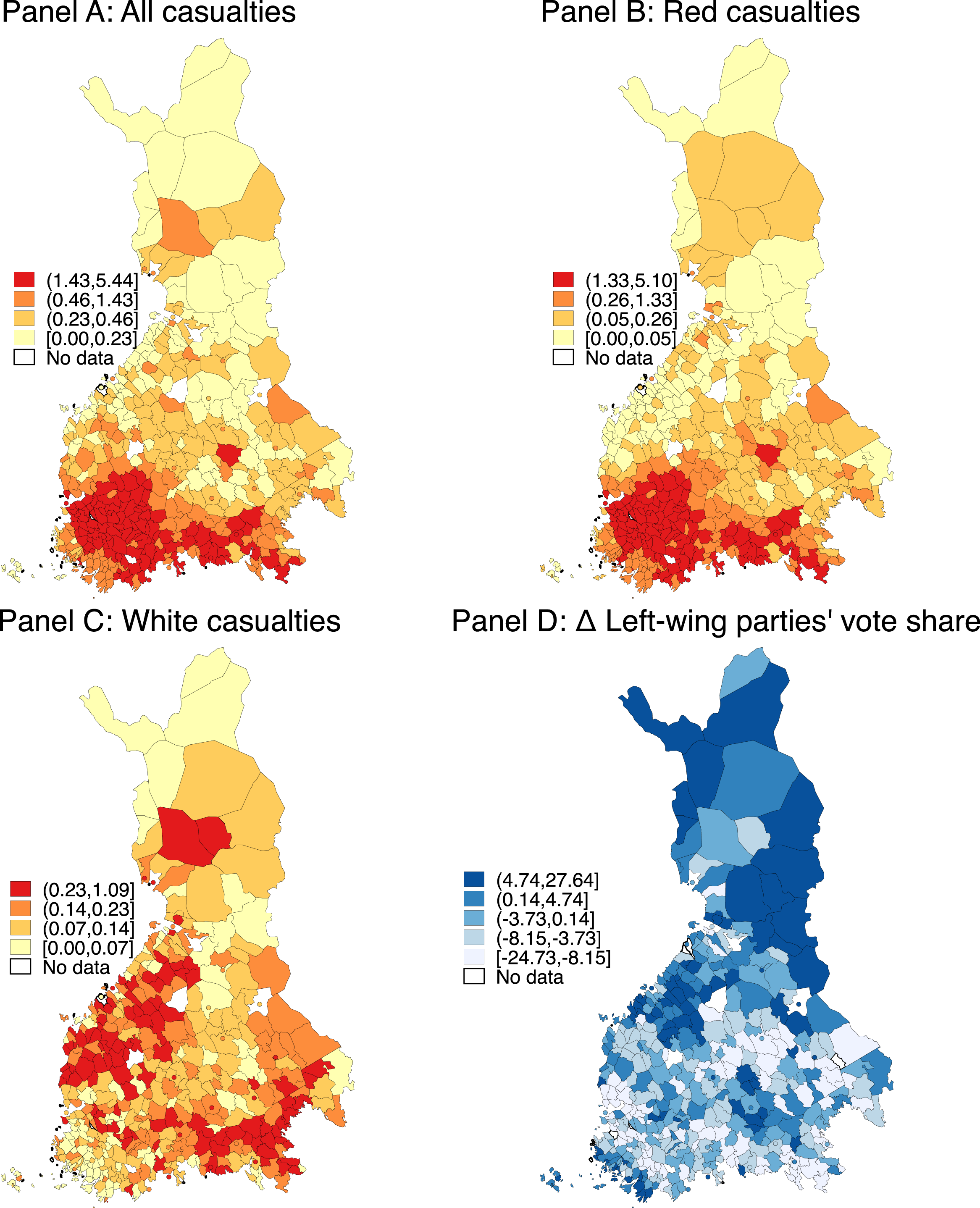
Electoral Outcomes
We have further collected novel municipality-level information on voting in parliamentary elections spanning 26 years. Given that Finnish parliamentary elections have had universal and equal suffrage since 1906, there are no major changes in the composition of the electorate that could stem from large suffrage reforms.
In the primary analyses, we focus on elections held between 1910 and 1936. The first post-conflict election was held in 1919, but we consider 1917 as the first treatment year (and thus, 1910–1916 as the pre-treatment period) due to violent clashes that started after the Russian Revolution in 1917 but before the Finnish Civil War, setting the stage for the larger conflict.
In total, we use data from thirteen elections spanning 26 years. The election results come from official publications by Statistics Finland. Among other information, these publications report voter turnout, votes by party, and the number of rejected votes. Our primary focus is on the electoral performance of left-wing parties, although we also consider some auxiliary dependent variables. On average, left-wing parties gained almost 40% of the municipal vote share. We are mainly interested in how this vote share changes depending on exposure to the civil war. Panel D of Figure 1 shows the changes on the Finnish map. The left experienced greater declines in its popularity especially in southern parts of the country. In other parts, such as in many northern municipalities, left-wing parties grew in popularity after 1918.
Visually, there appears to be correlation between civil war exposure and change in left-wing parties’ electoral support. We confirm this association in Appendix Figures OA1-OA6 which correlate different casualty rates with the change in left-wing parties’ vote share.
Although there were changes in the party system around the civil war years, the major parties did not experience any party break-ups. Nor were any new major parties born during the inter-war period that is our main focus. The largest left-wing party was the Social Democratic Party, on top of which there were a number of less prominent socialist parties.
Control Variables
We combine our data on civil war exposure and electoral outcomes with municipalities’ background characteristics. The first covariate we include in our analyses is local economic inequality before the Finnish Civil War (more specifically, in 1904). These data come from Hjelt and Broms (1904), and they are only available for rural municipalities. Including this control is important, because pre-conflict inequality was a prominent driver of civil war participation and electoral success of the Social Democratic Party before 1918 (Meriläinen et al., 2023). We also exploit geographical information (longitude, latitude, ruggedness, and altitude) of the municipalities as well as their population size as control variables to further improve comparability. 7
Empirical Strategy: Difference-in-Differences
With these data at hand, we estimate two types of difference-in-differences specifications that relate civil war casualties with electoral outcomes. The first one is a standard difference-in-differences specification of the following form

Here, y mt is either left-wing parties’ vote share or another dependent variable in municipality m in the year t. β is the regression coefficient of interest which corresponds to the effect of civil war exposure on the dependent variable, relative to the time period preceding the civil war.
We take 1910–1916 as the pre-treatment period. Although the civil war did not officially start until 1918, there were local skirmishes that paved the path for the civil war already during 1917 that could plausibly impact electoral outcomes. Furthermore, our casualty data include a small number of casualties from that year who are classified as civil war casualties and for whom we know the side of the conflict that they supported.
In our estimations, we control for municipality fixed effects, λ m . This means that we net out all time-invariant municipality-level characteristics and estimate our results using within-municipality variation in civil war exposure. Moreover, we control for year-specific shocks by netting out time fixed effects, λ t . 8 ɛ mt denotes the error term. We cluster the standard errors at the municipality level.
To illustrate the dynamic, long-run relationship between civil war casualties and voting behavior, we also estimate the following flexible event-study specification

Now, δ t are year-specific coefficients for the effect of civil war casualties on voting outcomes, relative to the base year 1916. As before, λ m and λ t are the municipality and time fixed effects, respectively. η mt is the error term. Also for this specification, we cluster the standard errors at the municipality level.
If two assumptions hold, we can treat the difference-in-differences estimates as causal. First, there should be no time-varying confounders at the local level that affect the dependent variable that we have not accounted for. Any confounders that are fixed over time are absorbed by the municipality fixed effects, and the year fixed effects control for shocks that are common for all municipalities in a given year. Second, we assume that vote shares would have evolved in the same way in differentially exposed localities, had the municipalities not been exposed to the civil war. While this assumption cannot be directly tested, we can provide support for this assumption by verifying that there are no observable pre-treatment trends in the more exposed municipalities. In the baseline specification, we can assess robustness to the inclusion of time trends. Furthermore, in the event-study specification, the year-specific regression coefficients should be indistinguishable from zero for the pre-treatment years.
Recent methodological work has noted that difference-in-differences designs may be problematic when the treatment is continuous. Callaway, Goodman-Bacon, and Sant’Anna (2021) state that such an approach yields interpretable causal estimates if and only if a “strong parallel trends assumption” holds. In other words, the evolution of outcomes across all levels of civil war exposure ought to have been the same, had the conflict not occurred. To further back up our findings and to avoid potential issues arising from a continuous treatment, we reproduce all our estimation results using a binary treatment with less strict identifying assumptions where we split the sample in two: high exposure (casualty rate above the median) and low exposure (casualty rate below the median). The main takeaways remain unchanged even with this alternative modeling choice. We report and discuss these estimation results in detail in Online Appendix F.
Main Findings
We report our empirical findings in this section. In sum, we find adverse electoral effects on the left-wing parties close to the insurgents due to local civil war exposure. We also shed light on several mechanisms that could explain our results.
Short- and Medium-Run Results
Civil War Casualties and Support for the Left
Effect of Civil War Casualties on Left-Wing Parties’ Vote Share.
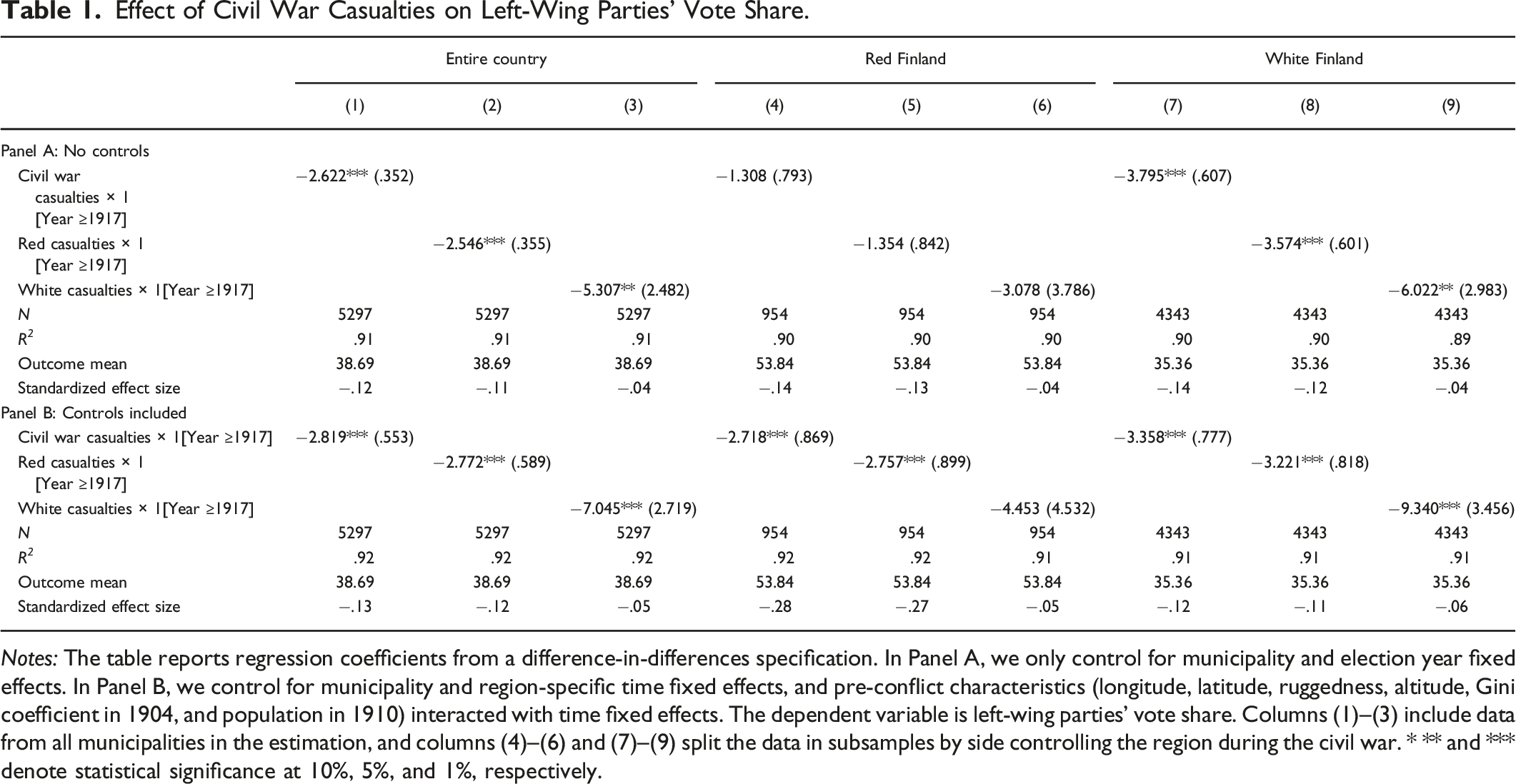
Notes: The table reports regression coefficients from a difference-in-differences specification. In Panel A, we only control for municipality and election year fixed effects. In Panel B, we control for municipality and region-specific time fixed effects, and pre-conflict characteristics (longitude, latitude, ruggedness, altitude, Gini coefficient in 1904, and population in 1910) interacted with time fixed effects. The dependent variable is left-wing parties’ vote share. Columns (1)–(3) include data from all municipalities in the estimation, and columns (4)–(6) and (7)–(9) split the data in subsamples by side controlling the region during the civil war. * ** and *** denote statistical significance at 10%, 5%, and 1%, respectively.
In Panel B, we introduce additional controls: region-specific year fixed effects, and year fixed effects interacted with a host of pre-civil war characteristics. Although including these covariates reduces the point estimate slightly, the main message remains unchanged.
Figure 2 presents the corresponding results from the dynamic difference-in-differences specification that includes a full set of covariates. The yearly estimates show that the fall in the left-wing party support was immediate, and persisted at least until the last election before the Second World War in 1936. Another observation that arises from the figure is that civil war casualties appear to be associated with left-wing parties’ electoral performance already a year before the conflict. A plausible explanation for this dip is that the estimate is picking up effects of having experienced milder skirmishes that started already in the fall of 1917. As we discussed earlier, the clashes between municipal militias of the Reds and safety guards of the Whites took some casualties already during 1917. These casualties—who were largely Reds—are also recorded in our data, and they were highly centered in certain geographical locations. Effect of civil war casualties on left-wing parties’ vote share.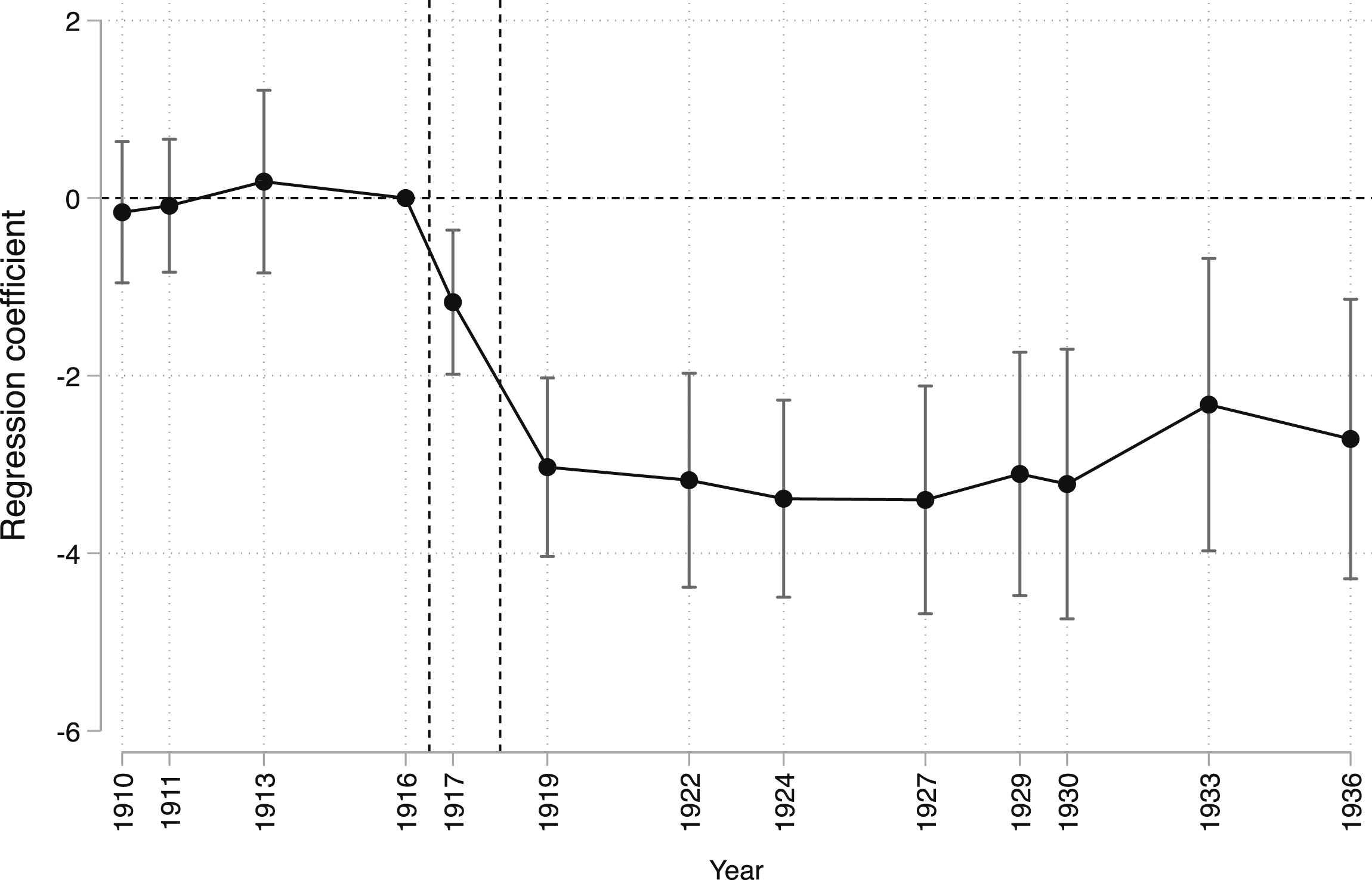
This sentiment is echoed, for example, in an Uusi Päivä newspaper article from October 12th, 1917 (p. 3), after the election: “General disorder and often violent strikes in rural areas, not all of which were approved by the union leadership, have also influenced the election results. This is most clearly demonstrated by the fact that the relative decrease in the number of socialist votes was greatest in the northern electoral district of the Turku province, where labor disputes, during which the socialist class hatred idea often received an overly concrete expression, raged like a contagious disease.”
Finally, to substantiate the identifying assumption, notice that the point estimates are very stable and statistically indistinguishable from zero the years 1910–1916. Furthermore, if we control for linear time trends in our baseline specification, our results remain unchanged (see Appendix Table OA1).
Effects by Casualty Side
Our data distinguish casualties by the side of the conflict, which allows us to separately assess how casualties on the insurgent and government sides mattered for election outcomes after the civil war. We turn into this analysis in columns (2) and (3) of Table 1. 10 These regression results show that both Red and White casualties mattered for left-wing parties’ electoral success.
Furthermore, it appears that voters responded more strongly to White casualties: a one percentage point higher White casualty share is associated with a 5 − 7 percentage point decrease in left-wing parties’ vote share, while the same estimate is around 3 percentage points for Red casualties. However, there were considerably fewer White casualties than Red casualties, and the overall effect seems to be driven by the insurgent casualties. It is also worth noticing that the standardized effect sizes implied by the estimation results are smaller for casualties who fought alongside with the government troops.
Regional Heterogeneity
During the Civil War, the Reds mostly controlled parts of Southern Finland. The remaining parts were under the control of the Whites. We further examine whether the territorial control towards the end of the civil war interacted with the casualty shares in columns (4)–(9) where we split the municipalities in our sample to “Red Finland” (the Uusimaa and Häme regions) and “White Finland” (the remaining regions). In Online Apperndix G, we show that our results are robust to splitting our country based on front lines in the beginning of the conflict.
The regression coefficients are greater in absolute terms for municipalities that were located in White Finland than for municipalities that were located in Red Finland. Having said that, the standardized effects of overall and Red casualties are larger in Red Finland than in White Finland. Appendix Figures OA7 and OA8 present the corresponding event-study graphs. The patterns we see in these graphs echo the results shown here.
Type of Victimization
Our analysis thus far pools together all types of casualties, independent of the type of victimization. However, our data allow us to separate the effects by cause of death: battle deaths, executions, and prison camp deaths. The latter include only Reds died in prison camps, many of them after the civil war was already over.
Effect of Civil War Casualties (by Cause of Death) on Left-Wing Parties’ Vote Share.
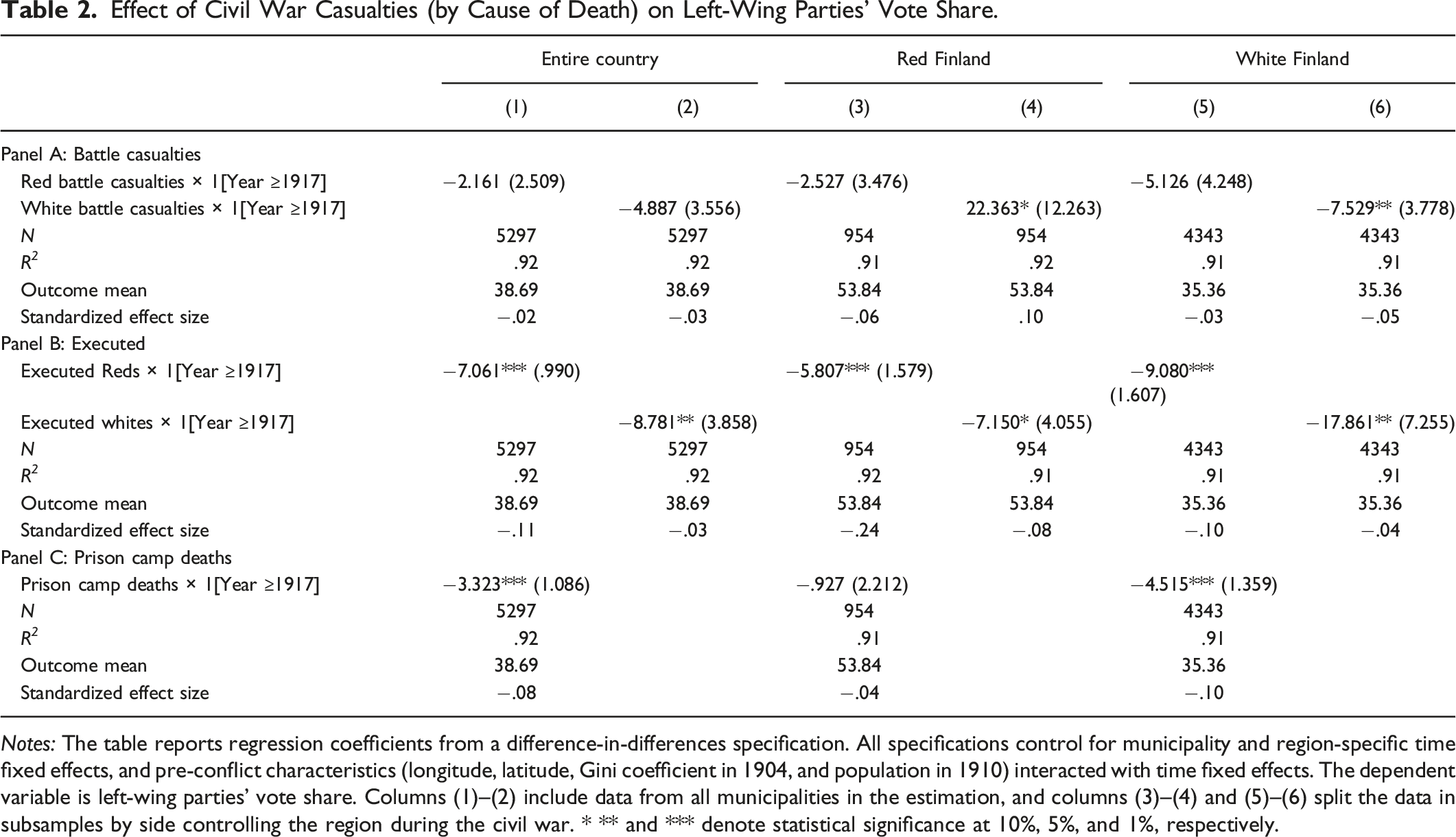
Notes: The table reports regression coefficients from a difference-in-differences specification. All specifications control for municipality and region-specific time fixed effects, and pre-conflict characteristics (longitude, latitude, Gini coefficient in 1904, and population in 1910) interacted with time fixed effects. The dependent variable is left-wing parties’ vote share. Columns (1)–(2) include data from all municipalities in the estimation, and columns (3)–(4) and (5)–(6) split the data in subsamples by side controlling the region during the civil war. * ** and *** denote statistical significance at 10%, 5%, and 1%, respectively.
Other Parties’ Electoral Performance
Which parties got the votes that the left-wing parties lost? In Figure 3, we shed light on other parties electoral success before and after the civil war.
11
We split the parties in two groups: the Agrarian Party (Maalaisliitto)—the main moderate party in Finland at the time—and the (center-)right-wing parties. Panel A of the figure suggests that the vote share of the Agrarian Party was potentially positively affected by civil war exposure in the short run, but the effects become less prominent in absolute terms and statistically insignificant already in 1922. It appears that other parties in the political center and right were the main benefactors (Panel B). Their vote share was positively and persistently affected by the civil war. We further look at effect heterogeneity in Red Finland and White Finland in Appendix Table OA2. The effects are mainly driven by municipalities in Red Finland. Effect of civil war casualties on vote share of the Agrarian Party and the right-wing parties.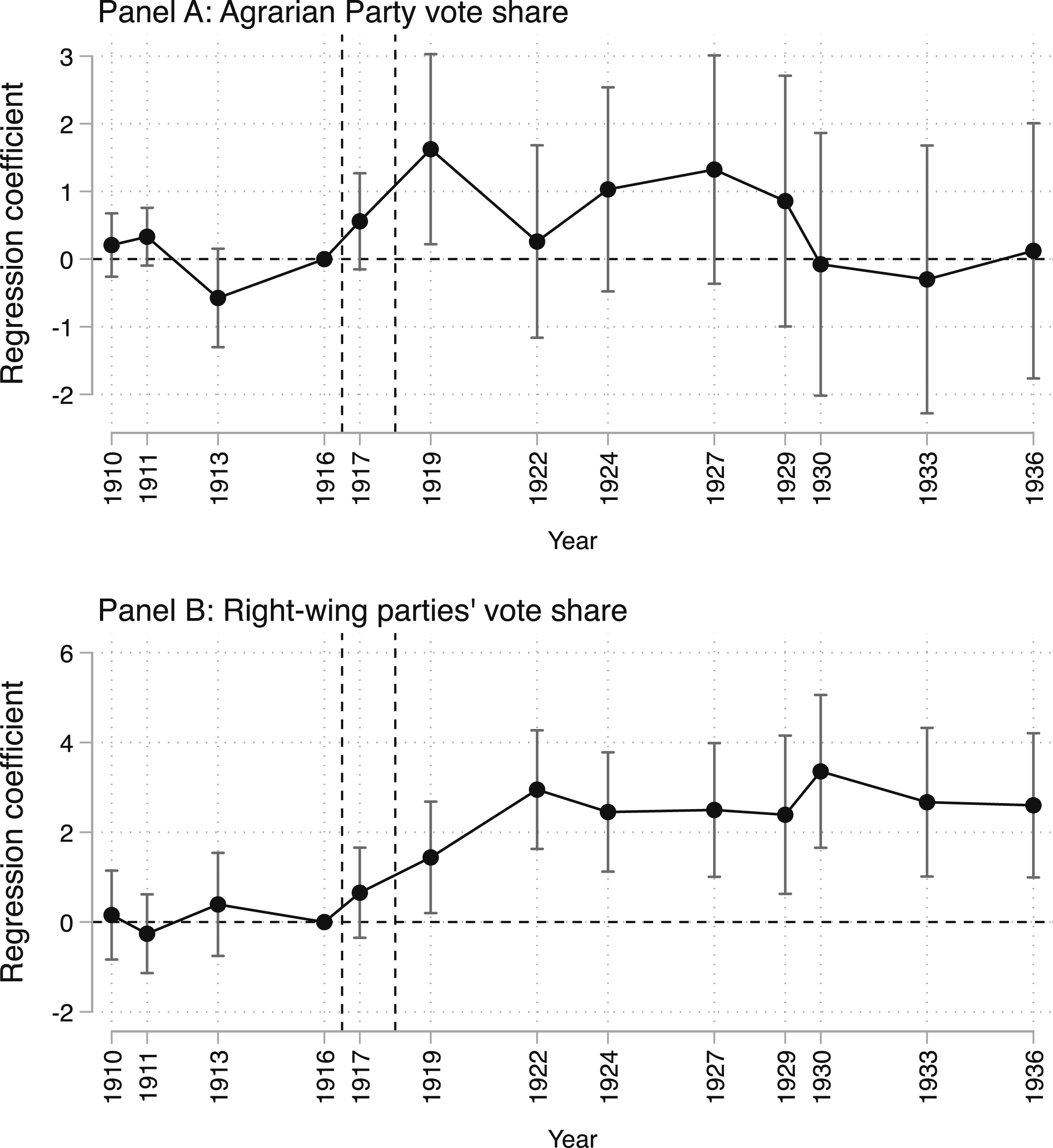
Historians have frequently noted how Finland was more polarized soon after the Finnish Civil War than before (e.g., Kähönen, 2019). Our findings go hand in hand with this remark, as we observe that the vote shares of the main opponents of the left-wing parties increased the most in locations that were more exposed to the civil war.
Towards the Second World War, the polarization was increasingly driven by the rise of the radical right. We thus complement our findings in Appendix Table OA3 by looking at the performance of the radical right-wing party, the Patriotic People’s Movement, in the 1936 election when it ran as a stand-alone party for the first time. We see that a greater civil war exposure is indeed positively associated with the electoral performance of the radical right-wing party, in particular in White Finland.
Potential Mechanisms
We now turn to discussing potential reasons for the negative effect on left-wing parties’ electoral support. The goal of these analyses is to explore which theoretically relevant mechanisms could be driving our findings and which not. However, we are not able to quantify the relative importance of different mechanisms.
Mechanical Effects
It is plausible that part of our findings are explained by a mechanical effect. Most casualties of the Civil War fought for the Reds, and they were typically supporters of the left-wing parties. Recall that our analysis focuses on national elections which had had universal and equal suffrage already since 1906. Locations that saw more casualties may have experienced a greater decline in left-wing parties’ vote share merely because of this mechanical effect.
Yet, it is unlikely that this kind of mechanical effect would be the sole driver of our results. This is because of the magnitude and persistence of the point estimates, and because we also find a negative impact of White casualties. According to our data, the aggregate vote share for the socialist parties decreased by around 10 percentage points from 48.7% in 1916 to 38.8 in 1936. In our sample, the aggregate Red death share is around .8% of the population. It is thus unlikely that the loss of life could solely explain the whole effect, or how it persists over time. Similarly, there is no negative impact on turnout or the number of voters in the more exposed municipalities, suggesting that the effect is not driven by changes in the electorate.
Backlash Against the Losing Side
The civil war and the events that followed it have encouraged some voters to distance themselves from the socialist parties. For example, Balcells (2012) argues that individuals reject the political identities associated with the perceived perpetrators of violence. Balcells provides evidence of this mechanism in the context of the Spanish Civil War.
After the Finnish Civil War, the Reds encountered significant societal backlash. Those who had fought for the Red side, as well as their supporters, believed their struggle was against the wealthy elites in an effort to achieve a more equitable society. However, the Whites, who dominated the post-civil war narrative, positioned the Reds as perpetrators of violence. According to the Whites, they had fought for the freedom of the Finnish people and for the Finnish independence.
The heterogeneity analyses provide further indicative support for the backlash mechanism. While the regression coefficients are negative throughout our analyses, albeit in many cases statistically insignificant, they are larger in absolute terms for White casualties—the side that won the war—and in White Finland—where the citizens might have been least sympathetic towards the losing side of the war. Moreover, we see in Table 2 that the effects are particularly large for executed individuals suggests that the atrocities of the civil war triggered an emotional reaction against the parties on the losing side of the conflict.
War and Nationalism
The results discussed above would also allow the interpretation that exposure to the civil war could have bolstered nationalist and conservative sentiments among Finnish voters. This interpretation is further supported by the notion that it was particularly the right-wing parties that benefited electorally from a greater exposure to the civil war; we even find that the radical-right party performed better in more conflict-affected municipalities the first time it ran in the 1930 s. However, it appears less likely that the effects would stem from combat heroism igniting nationalism, as suggested by Cagé et al. (2023) in France. Namely, we do not see any systematic evidence that battle casualties would have led to changes in voting behavior—recall the results in Table 2.
Fear of a Bolshevist Revolution
The patterns in our data also lend support to the hypothesis that voting behavior was influenced by fear of a Bolshevist revolution in Finland. Firstly, we see a negative and statistically significant impact of civil war casualties already in the 1917 election when the war had not officially started. Secondly, the effects of Red civil war casualties on voting behavior are in line with this mechanism, especially if the casualty rate measure is telling about local revolutionary tendencies more broadly. Having said that, it is difficult if not impossible to disentangle the fear of revolution mechanism from a more general nationalistic and anti-Russian sentiment. The large effects for White casualties would point towards this possibility.
Whether these mechanisms could explain the effects in the longer run could be debated. It is important to bear in mind that despite the decline in popularity, the Social Democratic Party maintained much of its popular support even after the civil war. It remained the largest left-wing party, but it did become considerably more moderate and anti-revolutionary.
The party that partially absorbed the more radical elements of the Social Democratic Party was the Socialist Workers’ Party of Finland. This party, founded in 1920, did have revolutionary elements. The Socialist Workers’ Party of Finland ran in the 1922 election and gained considerable popularity with 27 elected MPs, but it was banned already in 1923 due to its connections with the Communist Party of Finland—a party that had been founded in 1918 in Moscow and was led from Russia.
We study the relationship between the popularity of the Socialist Workers’ Party of Finland and civil war exposure in Online Appendix Table OA4. Overall and Red casualties do not appear to be correlated with the electoral performance of the party. Nevertheless, we do find large negative and statistically significant estimates for White casualties, lending some support for the ideas discussed here.
Changes in Redistribution
The years following the civil war saw a number of important policy changes that led to decreases in inequality (Meriläinen et al., 2023). We now consider the possibility that these decreases were associated with civil war exposure. Importantly, several authors have demonstrated that voters reward incumbent governments for policies that benefit them (de Janvry et al., 2014; De La & Ana, 2013; Zucco, 2013). In our case, the incumbent government was composed of parties in the political center and right. On the other hand, the reduced inequality might also have led to less demand for redistribution, as suggested by the much celebrated politico-economic theory of redistribution by Meltzer and Richard (1981), which could have further steered voters away from the left.
Effect of Civil War Casualties on Economic Inequality.
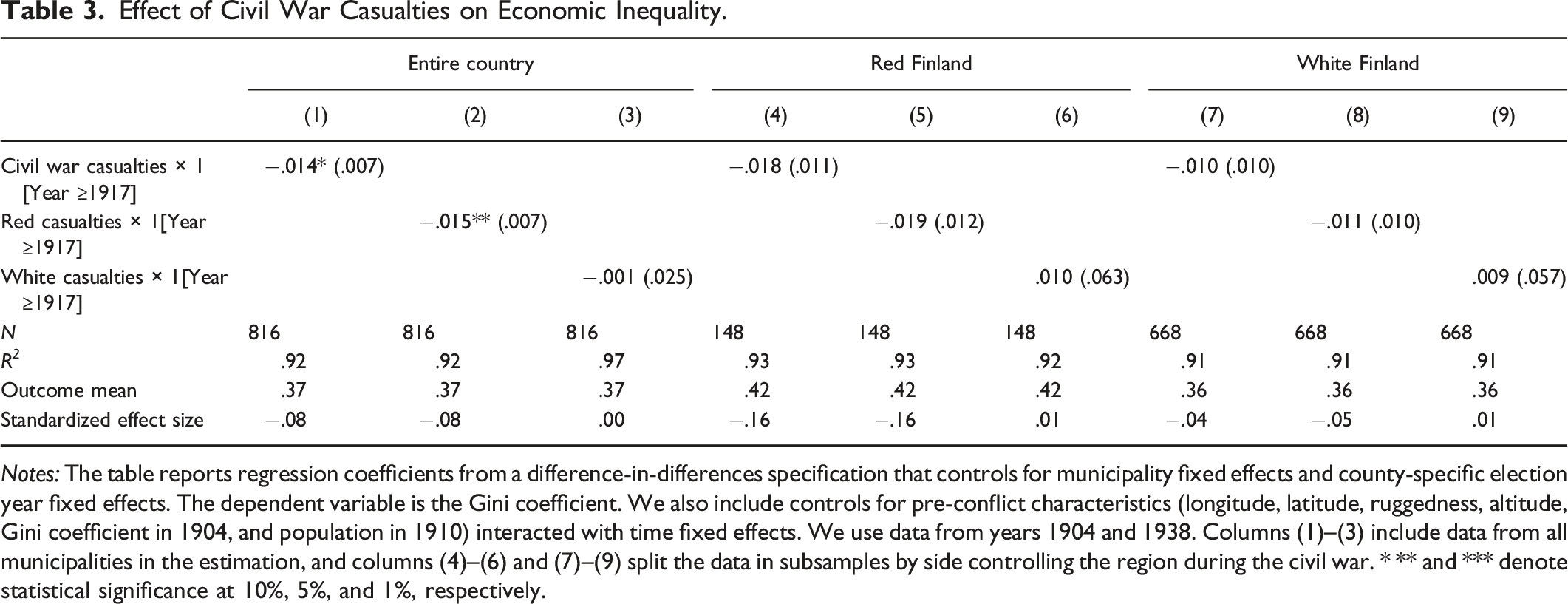
Notes: The table reports regression coefficients from a difference-in-differences specification that controls for municipality fixed effects and county-specific election year fixed effects. The dependent variable is the Gini coefficient. We also include controls for pre-conflict characteristics (longitude, latitude, ruggedness, altitude, Gini coefficient in 1904, and population in 1910) interacted with time fixed effects. We use data from years 1904 and 1938. Columns (1)–(3) include data from all municipalities in the estimation, and columns (4)–(6) and (7)–(9) split the data in subsamples by side controlling the region during the civil war. * ** and *** denote statistical significance at 10%, 5%, and 1%, respectively.
A closer look at the data reveals that the relationship is entirely driven by Red casualties and municipalities in Red Finland. The main takeaway from these findings thus is that changes in redistribution could have mattered also for voting behavior, but this ought to be only part of the story. If changes in redistribution had been the only driver of electoral change, we would have expected to see similar results also for White casualties and White Finland.
Conflict Exposure and Voter Turnout
There is a strong positive correlation between voter turnout and electoral support of the left-wing parties before the civil war in our data. Scholarship on the political consequences of civil conflict has widely documented that exposure to civil conflict affects voter turnout, although the direction of this effect is unclear. On the one hand, conflict could undermine trust which could have detrimental effects on turnout as well. For instance, Alacevich and Zejcirovic (2020) provide evidence from Bosnia and Herzegovina that is consistent with this argument. 12
Effect of Civil War Casualties on Voter Turnout.
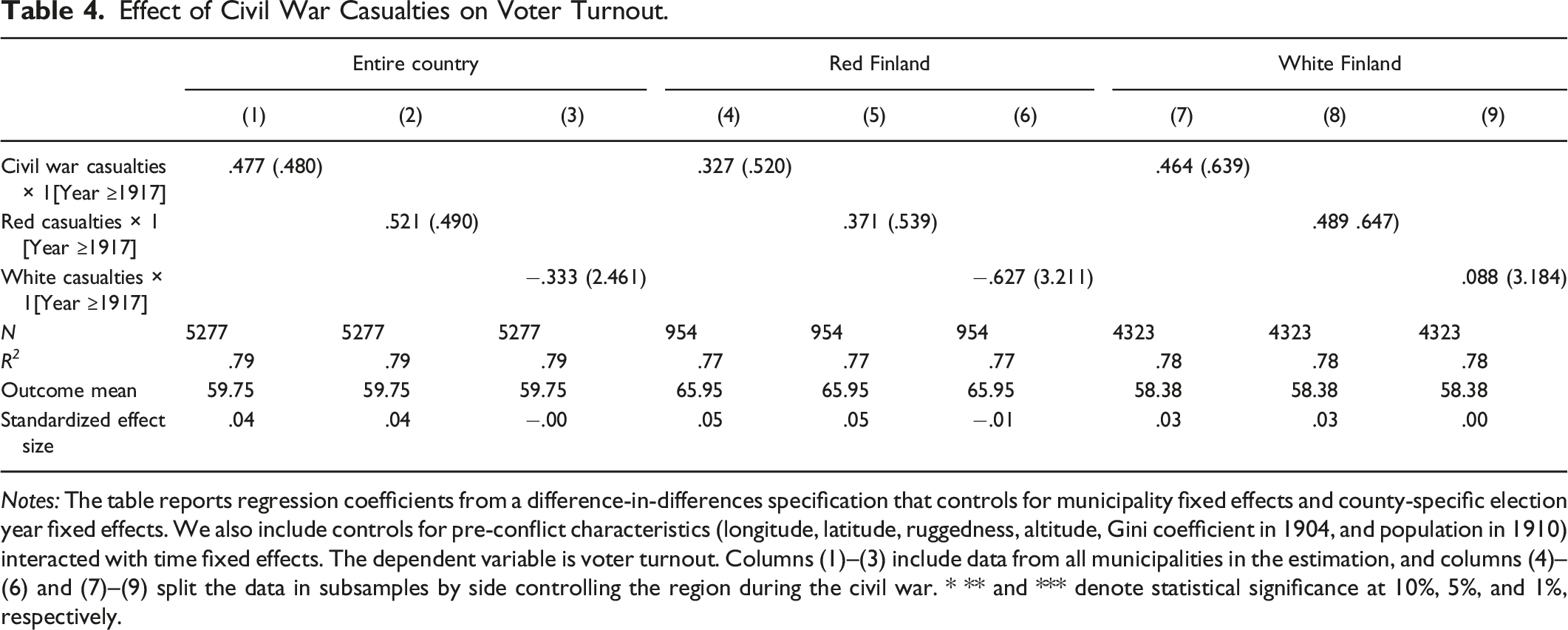
Notes: The table reports regression coefficients from a difference-in-differences specification that controls for municipality fixed effects and county-specific election year fixed effects. We also include controls for pre-conflict characteristics (longitude, latitude, ruggedness, altitude, Gini coefficient in 1904, and population in 1910) interacted with time fixed effects. The dependent variable is voter turnout. Columns (1)–(3) include data from all municipalities in the estimation, and columns (4)–(6) and (7)–(9) split the data in subsamples by side controlling the region during the civil war. * ** and *** denote statistical significance at 10%, 5%, and 1%, respectively.
Impact of Civil War Exposure on Disqualified Votes
Effect of Civil War Casualties on Disqualified Votes.
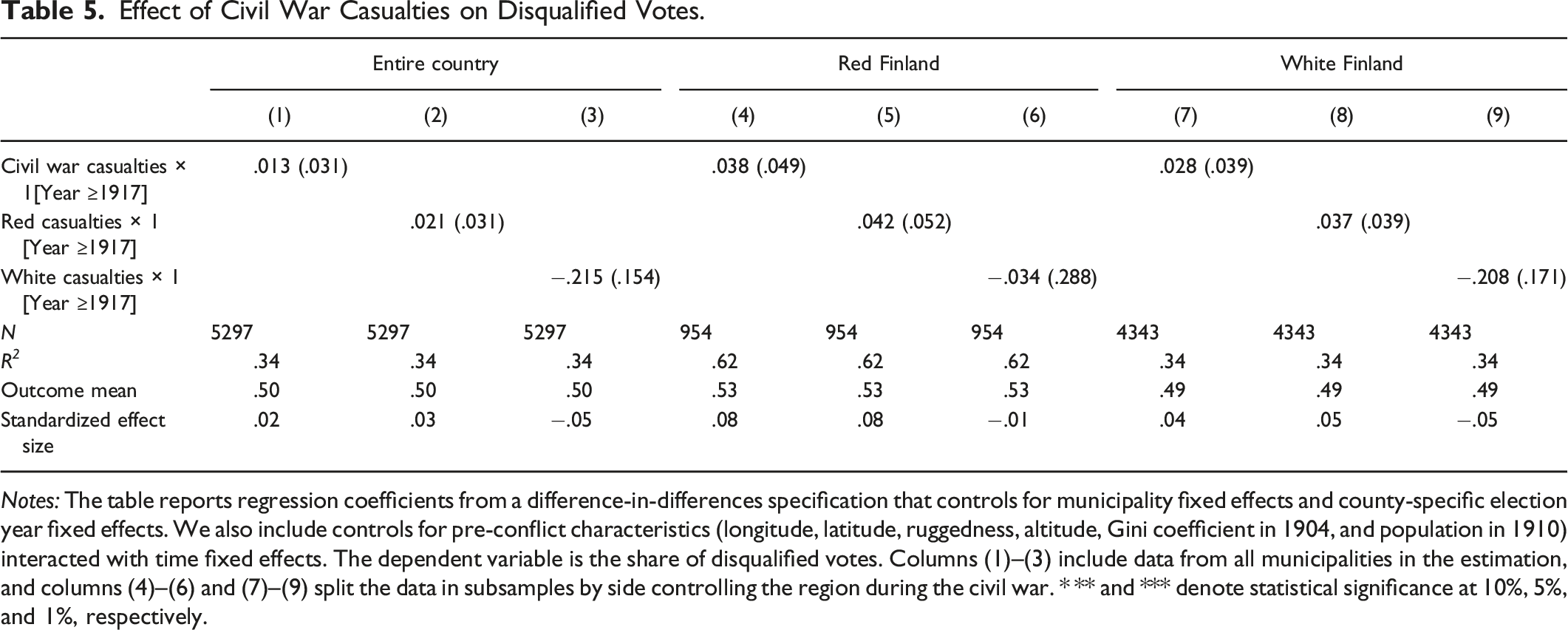
Notes: The table reports regression coefficients from a difference-in-differences specification that controls for municipality fixed effects and county-specific election year fixed effects. We also include controls for pre-conflict characteristics (longitude, latitude, ruggedness, altitude, Gini coefficient in 1904, and population in 1910) interacted with time fixed effects. The dependent variable is the share of disqualified votes. Columns (1)–(3) include data from all municipalities in the estimation, and columns (4)–(6) and (7)–(9) split the data in subsamples by side controlling the region during the civil war. * ** and *** denote statistical significance at 10%, 5%, and 1%, respectively.
Long-Term Consequences of the Finnish Civil War
Do the electoral consequences of the Finnish Civil War persist until today? We conclude our empirical exploration by presenting tentative answers to this question.
We compile municipality-level data on left-wing vote share in the more recent national election for years 1983–2019 and combine these with data from the pre-civil war era. 13 With these data, we can study the relationship between civil war casualties and the long-run change in left-wing parties’ vote share using the same parametric difference-in-differences approach as before. Here, we estimate the municipality difference-in-differences by civil war casualties from the 1910–1916 pre-period to the recent 1983–2019 post-period.
Long-Run Electoral Effects of Civil War Casualties.
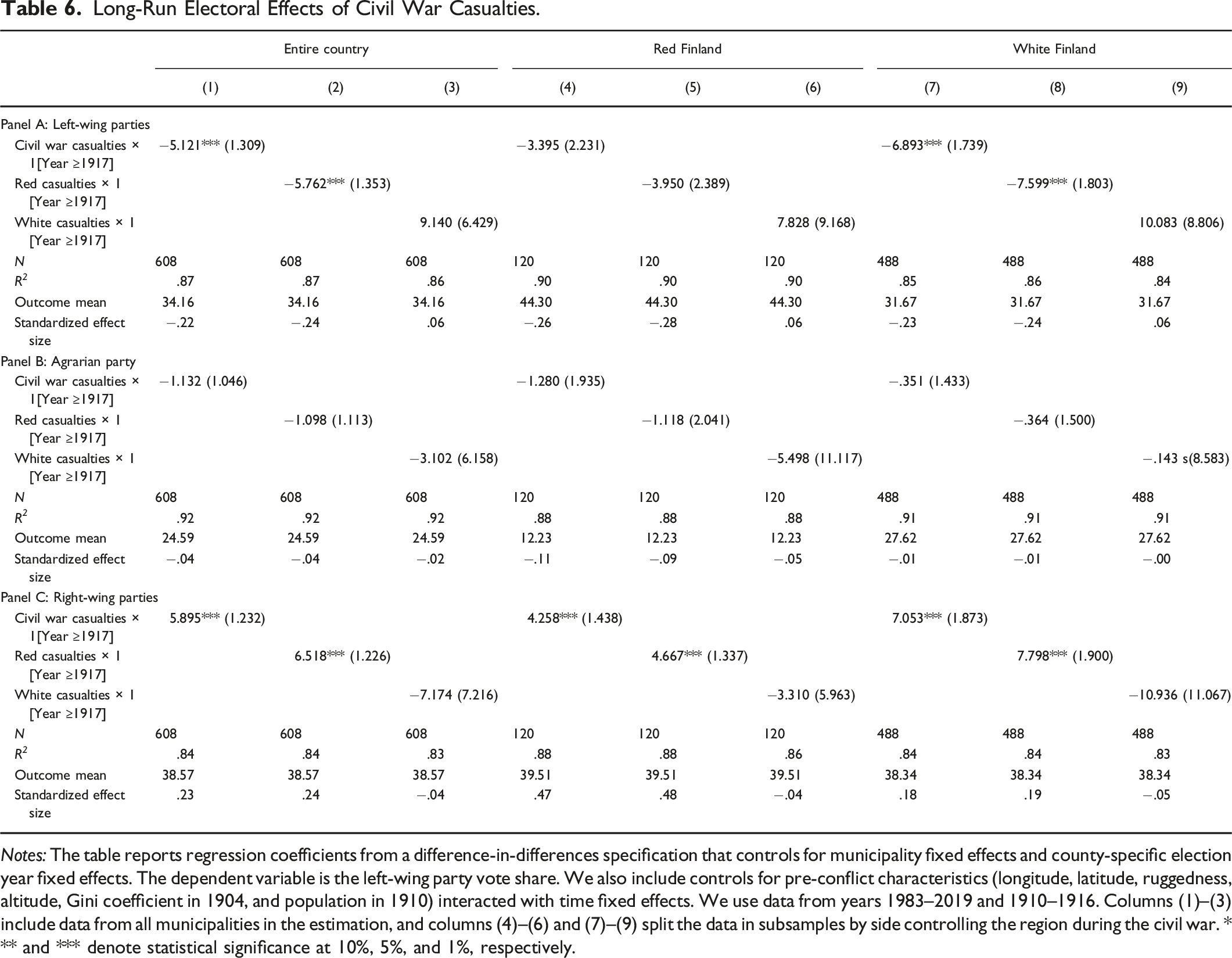
Notes: The table reports regression coefficients from a difference-in-differences specification that controls for municipality fixed effects and county-specific election year fixed effects. The dependent variable is the left-wing party vote share. We also include controls for pre-conflict characteristics (longitude, latitude, ruggedness, altitude, Gini coefficient in 1904, and population in 1910) interacted with time fixed effects. We use data from years 1983–2019 and 1910–1916. Columns (1)–(3) include data from all municipalities in the estimation, and columns (4)–(6) and (7)–(9) split the data in subsamples by side controlling the region during the civil war. * ** and *** denote statistical significance at 10%, 5%, and 1%, respectively.
It is likely that the long-term impacts are driven by different mechanisms than the short-term impacts, although the latter should certainly be indicative of what kind of effects we would expect to see over the course of time. For instance, it is well documented in the political science and economics literature that individuals can be socialized into having a set of stable attitudes and opinions which they may transmit to future generations (Alesina et al., 2013; Bisin & Verdier, 2000, 2001; Homola et al., 2020; Nunn, 2009). Uncovering the exact mechanisms behind the long-run effects warrants further work.
Concluding Remarks
This article presents new evidence of the political repercussions of exposure to class conflict. In particular, we have studied the lasting local impacts of the Finnish Civil War of 1918. Our findings echo the concerns that many insiders of the Social Democratic Party had prior to the revolution. For example, Edvard Gylling, one of the leading members of the working-class movement, spoke against revolting before the civil war (quoted in Upton, 1980, p. 517): “The revolution […] endangered all that the workers’ movement had accomplished so far; organizations, property, its status in the parliament, where new victories could be taken. […] The revolution should be avoided in all ways.” We find that the support of left-wing parties, which backed up the insurgent side of the civil war, was persistently and negatively affected by civil war casualties on both sides of the conflict. The evidence that we document in this article favors different mechanisms, and it is likely that no single mechanism alone explains the effects we find.
Our analysis engages with a prominent thesis stemming from the writings of Karl Marx and Friedrich Engels, which points toward asymmetric consequences of class conflict (Marx, 1867; Marx & Engels, 1848). While rebellion can cause major economic and political losses to the ruling classes, it also benefits the working classes by decreasing inequality and boosting political empowerment. Before the civil war, the major left-wing party, the Social Democrats, was the largest single party in Finland, but it was systematically left outside of the governing coalitions. This exclusion, however, ended after the conflict. We may speculate if this happened despite or because of its electoral decline. Namely, it possible that the party became a viable coalition partner after it became smaller, less extreme, and less powerful. In that regard—and given the redistributive changes that took place after the conflict—our findings align with the Marxist view on the societal change following class conflict. But, it is important to remark that these changes did not occur because exposure to the class conflict boosted the popularity of the left. The overall lessons from our article also speak to the thesis of Przeworski and Wallerstein (1982) about class compromise in democratic capitalist societies.
Finally, our example highlights that historical conflict can leave a more permanent mark on the political landscape of a country. In the Finnish case, this echoes the notion that the wounds of the conflict are still present in subtle ways in society, even with a seemingly swift recovery after the civil war. For instance, the Finnish public broadcasting company YLE surveyed a number of Finns one hundred years after the conflict in 2018, and 68% of respondents said the conflict still divides Finns at least to some extent. 14 Future work should aim at shedding more light on this divide; for instance, are individuals’ political preferences affected by family history or the local historical context? This would also illuminate the mechanisms underlying our long-term findings.
Supplemental Material
Supplemental Material - The Loser’s Long Curse: How Exposure to Class Conflict Shapes Election Outcomes
Supplemental Material for The Loser’s Long Curse: How Exposure to Class Conflict Shapes Election Outcomes by Jaakko Meriläinen, and Matti Mitrunen in Comparative Political Studies
Footnotes
Acknowledgments
We thank the editors, three anonymous reviewers, Antonella Bandiera, Andrei Gomberg, Andrea Ruggeri, and participants of the Institutional Legacies of Violent Conflict Workshop at the UNU-WIDER and EPSA Conference in Prague for helpful feedback.
Declaration of Conflicting Interests
The author(s) declared no potential conflicts of interest with respect to the research, authorship, and/or publication of this article.
Funding
The author(s) disclosed receipt of the following financial support for the research, authorship, and/or publication of this article: This work was supported by the UNU-WIDER.

Data Availability Statement
Meriläinen & Mitrunen (2023) provide the replication data and code.
Supplemental Material
Supplemental material for this article is available online.
Notes
Author Biographies
References
Supplementary Material
Please find the following supplemental material available below.
For Open Access articles published under a Creative Commons License, all supplemental material carries the same license as the article it is associated with.
For non-Open Access articles published, all supplemental material carries a non-exclusive license, and permission requests for re-use of supplemental material or any part of supplemental material shall be sent directly to the copyright owner as specified in the copyright notice associated with the article.
