



Abstract
How does emigration affect tax preferences in migrant-sending countries? Experiencing public services in a high tax-capacity destination may reduce support for tax increases by throwing fiscal failure at home into stark relief (the socialization hypothesis). Alternatively, migrants’ exclusion from certain public services may increase desire to fund these services in migrant origin countries (the exclusion hypothesis). We test these competing hypotheses with an online survey experiment in Mexico and explore variation in US healthcare access on fiscal policy preferences of migrant households. Migrant households, especially those with returned migrant members, are more supportive of taxation when tax revenue is earmarked for healthcare, a service to which many Mexican immigrants in the US lack access. It is migrants’ exclusion from, rather than their socialization into, the fiscal contract in destination countries that influences fiscal policy preferences in their countries of origin.
Keywords
Introduction
What drives individual attitudes towards tax and spending policies in developing countries? Previous research has emphasized the reciprocal ‘fiscal contract’: citizens will support higher levels of taxation if they believe that the state will provide public goods and services in return (Alm et al., 1992; Levi, 1989). Lack of trust, high levels of corruption and poor-quality public goods therefore critically undermine citizens’ willingness to pay taxes (Kouamé, 2021; Torgler, 2005) and give rise to the informal sector (Berens, 2020; Castañeda et al., 2020). Another important way to opt-out of the fiscal contract for citizens in developing countries is through emigration.
Emigration can be seen as an endogenous response to weak fiscal contracts: households decide to send members abroad to compensate for poor provision of public goods in their home countries and substitute government services with those bought on the private market with remittance income (Germano, 2018). Through this substitution effect, emigration might reduce support for government intervention in the economy, for example taxation and redistributive spending (Acevedo, 2020; Doyle, 2015). But emigration can also influence changes in social and political attitudes in origin countries as a result of migration experiences through ‘social remittances’ (Córdova & Hiskey, 2015; Crow & Pérez-Armendáriz, 2018; Krawatzek & Müller-Funk, 2020; Levitt, 1998). Exposure to a relatively high fiscal-capacity state that provides a concomitantly good level of public services through migration might increase support for greater government intervention in the economy (Meseguer et al., 2016).
Only recently have scholars begun to study how migration influences fiscal policy preferences in origin countries, and much of the focus has been on how financial remittances influence support for taxation (López García & Maydom, 2021; Tyburski, 2023). We contribute to this emerging field by developing and testing a theory about how current and return migration influence the fiscal policy preferences of those in origin countries. We propose two competing mechanisms: (i) positive socialization and (ii) the exclusion of migrants from the fiscal social contract in the destination country. Experiencing fiscal contracting in a high fiscal-capacity state (such as the US) can raise awareness of systemic weakness and failures of revenue extraction and public goods delivery in a low fiscal-capacity country of origin (such as Mexico), reducing support for taxation. This is the positive socialization pathway. Transnational experiences and ties can, however, work the other way: migrants’ experiences of exclusion from public goods in the destination context might increase their appreciation of and reliance on home-country state-provided services and hence their willingness to fund them through taxation. This describes the exclusion pathway.
We argue that both the positive socialization and the exclusion pathways operate through belief updating, by which migrants and their relatives adjust their pre-existing attitudes towards home-country institutions in light of comparisons with their experiences in the destination country (Bivand Erdal et al., 2022). The experience of migration provides information about taxes and public service provision in a very different political-economic system. These ‘social remittances’ can be brought home directly by returning migrants or transmitted to family members in the origin country through regular conversations about migrants’ lives in the destination country. Whether migrants’ experiences of accessing tax-funded services are positive or negative is crucial for understanding how beliefs about the benefits and costs of paying higher taxes for such services might be affected.
We therefore posit that the destination context plays a key role in mediating the effects of migration on the fiscal policy attitudes of return migrants and the family members of current migrants (Barsbai et al., 2017; Bivand Erdal et al., 2022; Kessler & Rother, 2016). Socialization or exclusion from social protection programs such as healthcare are likely to significantly influence both how migrants engage with the fiscal social contract in the destination country and how they view the fiscal social contract in the origin country. We pay close attention to how the accessibility of social protection programs to migrants, in particular the healthcare system in the US, conditions the fiscal policy attitudes of those living in current and returning migrant households.
To study the relationship between migration and fiscal policy attitudes, we employ a vignette experiment embedded in an original online survey of 2400 Mexican citizens fielded in December 2021 that purposefully oversamples migrant households. We analyse how respondents’ support for paying higher taxes to increase public spending is affected by randomly varying the form of taxation (personal income tax and consumption tax) and the specific policy areas for which tax revenue is earmarked (healthcare compared with non-distributive public policies). We focus on tax preferences when the tax revenue is specifically earmarked for healthcare. This area is relevant for fiscal reciprocity because it is a social protection policy that individuals at all ages and from all backgrounds require consistent access to due to the unpredictability of healthcare needs. Furthermore, access to government-funded healthcare for migrants varies substantially at state level in the US. We study heterogeneous treatment effects for current and returning migrant versus non-migrant Mexican households (HH hereafter) as well as state-level variation of access to public healthcare provision in the US. In a battery of robustness tests, we factor in a set of alternative explanations and also test differences in US immigration law enforcement in the states where migrants live.
We find substantial evidence that the spending preferences of migrant HH members in Mexico are heavily influenced by emigrants’ exclusion from accessing public goods in the destination country. In particular, members of returning migrant HHs are more supportive of raising taxes when they are earmarked for healthcare. Returning migrants and their HHs reveal a greater willingness to engage in the fiscal contract compared with current migrant and non-migrant HHs. This novel finding demonstrates the need to better understand migrant returnees and returning migrant HHs, groups which have received a paucity of attention in existing research. The subnational context in the US that migrants experience is also important: those with family members living in US states with a five-year Medicaid embargo, limited social assistance and stringent anti-immigrant measures are significantly more supportive of raising taxes when they are earmarked for healthcare. Our findings demonstrate the importance of paying attention to subnational variation in immigrants’ experiences in order to better understand the content of social remittances transmitted and brought home through migration.
Our study tackles a number of questions overlooked by existing scholarship on migrant transnationalism. Most studies find that migration experiences and cross-border ties increase political engagement and democratic attitudes through positive experiences abroad (Córdova & Hiskey, 2015; Crow & Pérez-Armendáriz, 2018; Pérez Armendáriz & Crow 2009). A large literature inspired by Levitt’s (1998) concept of ‘social remittances’ examines how migrants transmit cultural ideas and practices from destination to origin countries (see also Krawatzek & Müller-Funk, 2020). Yet very little is known about how (return) migration influences fiscal policy attitudes in origin countries. This gap in the literature is surprising considering that fiscal capacity is endogenous to political development; much research has explored the links between fiscal capacity and democracy (Gould & Baker, 2002). Our study also avoids the positive experience bias that characterizes much of the literature on the political consequences of migration in origin countries by examining how personal experiences of illegality, corruption, illness or hardship in advanced democracies circulate across borders and affect ideas, attitudes and practices around the fiscal contract in origin countries. 1 Specifically, we examine how experiences of exclusion from the fiscal social contract in the destination country influence the tax and spending attitudes of migrants and their families in their countries of origin.
Finally, our findings contribute to the scholarly debate about how to increase support for taxation in developing countries. Previous research has focused on interventions with an assumption that these will work across all individuals in society (Berens & von Schiller, 2017; Fairfield, 2013; Flores-Macías, 2018). Our research offers suggestions for policymaking to better incorporate migrant households specifically into the fiscal contract in origin countries.
Migration Between Mexico and the US
To study how emigration affects fiscal policy preferences, we focus on the case of Mexican migration to the United States. Mexico is a fairly typical example of a low fiscal-capacity democracy. Approximately 65% of the active working population work in the informal economy (Baker et al., 2020). Mexico has the lowest tax-GDP ratio in the OECD and one of the lowest in Latin America, collecting 17.9% of tax revenue as a share of GDP in 2020 (OECD, 2022). Although most Mexicans would prefer more tax progressivity (Bogliaccini & Luna, 2019), the regressive VAT is the largest tax revenue source in the country. VAT contributes 23.4% of tax revenue collected compared to 20.8% from personal income taxes and 13.5% from social security contributions (OECD, 2021).
Mexico has both a large emigrant population and a substantial number of returned migrants. Around 10.5% of the country’s citizens live abroad, of whom 98% reside in the US (BBVA Bancomer and CONAPO 2021). Moreover, Mexican immigrants comprise by far the largest nationality amongst the undocumented immigrant population residing in the US: 51% as of 2018 (Israel & Batalova, 2020). 2
For decades migrants had travelled back and forth between jobs in the US and families in Mexico, with the number of Mexican migrants soaring in the early 2000s (Office of Immigration Statistics, DHS, 2019). Today not only are more Mexican emigrants returning permanently to Mexico, but a significant number are being forcibly returned due to stricter border controls and harsher immigration policies in the US (Durand & Massey, 2019).
In contrast to Mexico, the US can be considered a high fiscal-capacity state, collecting 25.5% taxes as a share of GDP in 2020 (OECD, 2021). 41.1% of this tax revenue is collected through income taxes, 24.5% through social security contributions and 17.5% through consumption taxes. Tax rates vary substantially at state level. For example, California has the highest income tax rate of 13.3%, followed by New York (10.9%) and New Jersey (10.75%), while Alaska, Florida, Nevada, South Dakota, Tennessee, Texas and Wyoming do not collect any income taxes (Vermeer & Loughead, 2022).
Migrant access to social and healthcare assistance also differs at state level within a framework set by the federal government (Perreira & Pedroza, 2019). The 1996 Personal Responsibility and Work Opportunity Reconciliation Act (PRWORA) restricted access to non-emergency healthcare under Medicaid and the State Children’s Health Insurance Program (SCHIP) for undocumented immigrants. Documented immigrants are also denied access to these programmes for the first 5 years after their arrival (Watson 2014).
Healthcare coverage has increased over the past decade due to the Patient Protection and Affordable Care Act (PPACA) which was signed into law in 2010. Under PPACA, all documented migrants can purchase health insurance through the Marketplace independent of their years of residence and receive tax credits when they do so. Undocumented immigrants are, however, only eligible for emergency care under Medicaid and cannot purchase subsidized private health insurance.
The PRWORA welfare reform granted states extensive autonomy to enact assistance programs, replacing a nationwide social assistance program with state-financed programs. About half of the states decided to keep offering state-funded assistance to documented immigrants in their first five years of residence (Borjas, 2016; Watson, 2014). In addition to restricting healthcare access, several US states also have greater restrictions on formal employment for migrants. As of 2021, public employers and/or state contractors are required to verify the work authorization of potential employees via the E-Verify system in twenty states. In eight of these states (Alabama, Arizona, Georgia, Mississippi, North Carolina, South Carolina, Tennessee and Utah) the use of E-Verify is mandatory for private employers too. Collaboration agreements in immigration enforcement between local police forces and federal authorities (such as the 287(g) agreements of the Immigration and Nationality Act (INA) and the Priorities Enforcement Program) are also common at the municipal level. Under 287(g) the state police can investigate the immigration status of anyone who has been detained or arrested. Stricter local immigration enforcement has been associated with lower healthcare enrolment rates and poorer health outcomes by documented migrants (Perreira & Pedroza, 2019; Watson, 2014) as they raise the potential cost of coming into contact with state authorities. This even extends to US-born citizens of Mexican origin (Toomey et al., 2014).
Cross-Border Ties and Government Spending Preferences
The bulk of research on the political-economic implications of migration for origin countries focuses on effects of financial remittances sent by migrants. Financial remittances provide additional, difficult-to-tax income that recipient households can use to buy welfare goods on the private market, leading to increased autonomy from the state (Doyle, 2015; Germano, 2018).
In the Mexican context, migrant remittances are used by HHs to cover gaps in the provision and quality of public healthcare: Airola (2007) finds that remittance-receiving HHs in Mexico spend 44% more of their budget on healthcare than non-recipients. For many uninsured HHs in the country, emigration has long been a tool of social protection (Germano, 2018; López García & Orraca-Romano, 2019).
The receipt of financial remittances also opens economic opportunities for migrant HHs by increasing their earnings and assets and their expectations for social mobility. Acevedo (2020) and Doyle (2015) find that remittance recipients are less supportive of state-led redistribution because they feel more economically secure. Similarly, Tyburski (2023) shows that financial remittance inflows increase when origin-country governments have pro-market tax preferences.
Besides money, social remittances can have effects on spending preferences in origin countries. Levitt (1998, p. 926) describes ‘social remittances’ as the ‘ideas, behaviour, identities and social capital’ that migrants absorb while abroad are subsequently transmitted to their families and communities in their country of origin through both cross-border conversations and visits and return migration. Social remittances are formed through comparative assessments between the political and social life in the destination country with that in the origin country (Bivand Erdal et al., 2022). Through these comparisons, migrants update their beliefs, redefine their identity and change their attitudes and behaviour regarding state institutions in both the origin and the destination country. Those who remain in the origin country can therefore gain new perspectives from which they (re)cast their views and behaviours regarding both society and state institutions. Social remittances thus have important implications for political engagement (Córdova & Hiskey, 2015; Duquette-Rury & Chen, 2019) and political attitudes (Kessler & Rother, 2016; Krawatzek & Müller-Funk, 2020; Pérez-Armendáriz & Crow, 2009) in migrant origin countries. But, apart from Meseguer et al.’s (2016) finding that transborder conversations increase individual support for greater state intervention in creating jobs, reducing inequality and securing citizens’ well-being, there is an absence of research on how social remittances influence fiscal policy preferences in origin countries.
The Argument
Our argument rests on a core assumption that we can model fiscal policy preferences as a function of the costs and benefits of different forms of taxation and areas of public spending. Raising tax levels is generally unpopular; taxpayers usually prefer to shift the tax burden onto someone else (Hennighausen & Heinemann, 2015). We therefore posit that there will be greater support in the general population for increases in the forms of taxation that only certain groups pay (e.g. income taxes) than those forms of taxation that the vast majority pay (e.g. consumption taxes) and for tax increases to fund policy areas that they believe they will be likely to use (e.g. healthcare). Vertical reciprocity – that is, receiving public goods in return for paid tax contributions – is vital for sustaining the fiscal contract. Following Flores-Macías (2018), we expect that citizens in developing countries will be more willing to accept a tax increase when the tax is earmarked to finance a specific policy because earmarking reduces uncertainty in low fiscal-capacity contexts. 3
But fiscal policy preferences are not only driven by cost-benefit concerns (Alm et al., 1992). Relaxing the narrow rationality assumption of the interest-based model, we expect individuals to factor in the nature of experiences, emotions and norms and to update their beliefs when learning new information (Ajzen & Fishbein, 1975; Fischbacher & Gächter, 2010; Gerber & Green, 1999). Belief updating may be selective and not purely rational, as the Bayesian model suggests (Ajzen & Fishbein, 1975). In particular, negative emotions such as anxiety increase information-seeking behaviour and individual willingness to accept new information (Valentino et al., 2008). We assume that individuals are able to update previous beliefs when learning new information (see Fischbacher & Gächter, 2010) and that the type of experience, be it negative or positive, matters for the belief updating process (Marcus & MacKuen, 1993).
Thus, we posit that the effect of migration on fiscal policy attitudes in origin countries can work through positive socialization or exclusion experiences. More concretely, what migrants experience abroad may alter how they think about taxes and spending which is transmitted to families and friends in their country of origin, or brought home directly through return migration. The migration experience acts as a form of ‘resocialisation’ (White et al., 2008), and the experience of return migration will further reinforce belief updating as a result of direct comparisons between fiscal contracts in migration-origin and destination countries (Bivand Erdal et al., 2022).
On the one hand, we might expect that positive experiences (direct or indirect) in a better-serviced country will make migrants and migrant HHs more critical of public service provision in their home country (the positive socialization pathway). On the other hand, we might expect that negative experiences (direct or indirect) in the destination country will make migrants and migrant HHs more appreciative of public service provision in their home country (the exclusion pathway).
The Positive Socialization Pathway
Meseguer et al. (2016) find that cross-border conversations are positively associated with preferences for an enhanced role of the state in the economy through a process of ‘social learning’ through migration. There is also good evidence that migrating from poorer countries to richer countries makes individuals more critical of their home country’s tax and welfare system (Doyle, 2015; Tyburski, 2023).
Public service provision differs sharply between the Mexican and US healthcare systems. The first tier of the public healthcare system in Mexico (INSABI) provides universal insurance in theory, but quality is dismal and out-of-pocket expenses are high (Reich, 2020). 4 Many Mexicans have grown weary of insufficiencies in the public healthcare system. In 2012, average dissatisfaction with the healthcare system was 47.2%, rising to 49.4% in 2014, 52.6% in 2016 and reaching 55.8% in 2019 (LAPOP 2012–2019, item sd6new2).
While Mexican immigrants experience access limitations to the US healthcare system (especially undocumented migrants and their offspring who are categorized as DACA [Deferred Action for Childhood Arrivals]), coverage and quality of provision (e.g. through Medicaid, PPACA or SCHIP) for those who are insured is nevertheless significantly higher than in the Mexican system. Having access to public services such as healthcare thus creates positive experiences with the fiscal contract in a high fiscal-capacity state and provides experience of fiscal reciprocity. Comparisons with the Mexican healthcare system may reveal insufficiencies and policy failures through learning and belief updating. Members of migrant HHs would therefore develop even lower expectations of the efforts of the origin-country state to address healthcare needs. This would in turn reduce these individuals’ willingness to pay higher taxes. Healthcare needs of migrants may also become less salient or be framed in a positive way in cross-border conversations, as healthcare needs are met in the US. Moreover, anticipating a migrant family member’s return home in a good health condition further reduces the salience of healthcare provision and the expectation of healthcare costs among migrant HH members. Thus, if positive socialization into a better-serviced context is the main pathway through which migration influences the public spending preferences of those who remain in origin countries, we would expect that members of migrant HHs will be more critical toward spending in policy areas that disappoint in the Mexican system.
One could argue that positive socialization raises expectations and demands among migrants for what the state in the country of origin should provide. While demands for public goods might increase after experiencing sharp differences in the state’s fiscal and distributive capacity through migration from a low- to high-fiscal-capacity country, the willingness to pay for them in a low fiscal-capacity context is unlikely to increase because the government has proven to be an unreliable provider of public goods (Berens & von Schiller, 2017). Thus, we would expect the migration experience in a high fiscal-capacity context to lay bare the fiscal and distributive incapacity of the Mexican state for migrants and, through cross-border conversations, visits and migrant return, for their families and communities in Mexico too. Migration thereby influences citizens to be more critical and distrustful of the fiscal contract in the origin country.
If the positive socialization pathway holds, we would expect that both HHs with returning migrants and those with current migrants would be less supportive of tax increases to fund public goods. Any differences between returning and current migrant HHs are likely to be those of magnitude rather than direction in the effect of migration on fiscal policy attitudes. Returning migrants make comparisons between origin and destination countries on both the outward and return journeys (Cassarino, 2004), strengthening the effect. 5 As positive experiences are strongly influenced by immigrant access to public goods, US states’ access limitations will be key: positive socialization is more likely to occur when tax-funded healthcare services are more readily accessible to migrants.
Respondents living in migrant HHs with family members currently (or returned from) living in destination states with immigrant access to public goods will be less supportive of higher taxation than non-migrant HHs if the tax increase is earmarked for public healthcare. The migration experience should also reduce support for a tax increase via any kind of tax instrument, whether regressive (consumption tax) or progressive (income tax). Perceiving poor performance of the state to fulfil its core duties reduces citizens’ willingness to pay taxes (Flores-Macías & Sánchez-Talanquer, 2020). Becoming more aware of the origin state’s incapacity to provide public goods in comparison to the destination state thus reduces support for contributing to the fiscal social contract.
Respondents living in migrant HHs with family members currently (or returned from) living in destination states with immigrant access to public goods will be less supportive of higher taxation to fund public goods than those living in non-migrant HHs, independent of the type of tax instrument.
The Exclusion Pathway
A competing channel may work through migrants’ exclusion from public goods provision in the destination country. Recent scholarship shows that immigration has reduced solidarity and support for the welfare state in Western countries (Magni, 2022). How US citizens think about social policy is strongly influenced by attitudes toward immigration (Garand et al., 2017). Anti-immigration policies can heighten exclusionary experiences of migrants from the host country’s fiscal contract, which can make migrants (and their family members back home) both more appreciative of public service provision in their home country and in greater need of it. Immigrants (even those who are high-skilled or documented) often do not benefit from public services in the same way as natives due to restrictions based on migration status (Magni, 2022). These restrictions are common in the welfare domain (including healthcare) but less relevant in other public policy fields such as infrastructure from which exclusion is more difficult.
If the exclusion pathway is at work, we would anticipate that members of migrant HHs will have stronger preferences for earmarking taxes for funding those public services which are most restricted to immigrants in destination countries; in the US these are health services (Cheong & Massey, 2019). Regardless of the legal ability to use public and private healthcare providers, many Mexican migrants are less likely to use healthcare services because they fear interacting with public institutions or lack knowledge about their eligibility (Perreira & Pedroza, 2019). Although returning migrants often face difficulties accessing government-subsidized healthcare because their insurance has lapsed in Mexico, some of them return to Mexico when experiencing a major health episode (Arenas et al., 2015). Moreover, Mexican migrants in the US tend to take up jobs that natives do not want to perform because of the heightened risk of occupational injury and fatality (Orraca-Romano et al., 2023). 6 Hence, they face a greater likelihood of needing healthcare.
We would thus expect that members of Mexican HHs with family members (currently or formerly) living in US states that restrict access to public goods – essentially, an exclusion from fiscal reciprocity – will be more supportive of higher taxes when they are made aware of taxes being earmarked for public healthcare at home. Experiences of illness and difficulties in accessing healthcare in the US are distressing and likely to be communicated by immigrants to family and friends back home, who in turn will develop a greater sense of appreciation for the healthcare services that the Mexican state provides, even when the quality of healthcare services in the country is sub-optimal.
Finally, simple need for healthcare services (e.g. for postponed treatments after returning from migration experiences) might equally increase demand in the country of origin. Mexican migrants frequently return to Mexico in poorer health condition than upon their departure (Cheong & Massey, 2019). Hence, migration may pose a health penalty on individuals, both physically and psychologically through the mental stress of postponed treatments. Migrant families might anticipate these additional healthcare costs once the family member returns. Furthermore, negative experiences linger longer than positive experiences (Tversky & Kahneman, 1974), such that exclusionary events are more likely to be communicated through family networks and remain salient. Negative emotions such as anxiety are particularly likely to trigger the belief updating process (Valentino et al., 2008). In such circumstances, we anticipate that both returning and current migrant HHs will update their beliefs about the relative costs and benefits of paying taxes for healthcare. Migrant and returning migrant HHs with experiences in US states with access limitations should be particularly supportive.
Respondents living in migrant HHs with family members currently (or returned from) living in destination states which exclude immigrants from public goods will be more supportive of higher taxation if the tax increase is earmarked for public healthcare. Experiences of unfriendly migrant environments might also reorder the tax instrument preferences of migrants and their families. Exclusion abroad increases appreciation of home institutions and fuels a greater sense of identity as a Mexican citizen and feelings of patriotism. Xenophobic attacks against Latinos in the US have been shown to raise in-group identities (García-Ríos et al., 2019). Being excluded from social services might be interpreted as a threat against one’s core identity. Members of current and returning migrant HHs are thus likely to be more willing to engage with the fiscal contract in their origin country. HH members with close relatives living in a high fiscal-capacity but access-restricting state are likely to be more supportive of tax increases to fund public goods than members of non-migrant HHs. We would expect the effect to be even greater when the proposed tax instrument is a progressive income tax that shifts the tax burden onto higher-income earners to which returnees and migrant HHs less often belong (Kaestner & Malamud, 2014).
Respondents living in migrant HHs with family members currently (or returned from) living in destination states which exclude immigrants from public goods will be more supportive of higher taxation to fund public goods than non-migrants, especially when the tax instrument is income taxation. Alternatively, one could argue that exclusion from fiscal reciprocity in the high fiscal-capacity country could equally reduce support for taxation in the origin country by further deepening mistrust of all types of public authorities and promote withdrawal from fiscal contracting in general. However, because migrant exclusion in the US increases public-good needs, gives rise to feelings of appreciation of origin country institutions through belief updating, and a reinforced social identity as Mexican, we expect the exclusion channel to foster support for tax increases to fund public goods.
Data and Methods
We employed an original vignette experiment embedded in a survey conducted in Mexico in the winter of 2021 to test the competing hypotheses. 7 Survey responses were collected online via the Pollfish platform. This study was conducted when the global Covid-19 pandemic was still ongoing. Collecting data online was hence necessary to ensure the safety of participants and enumerators (see SM Section A for an extensive discussion of the sampling method).
The convenience sample consisted of 2401 Mexican citizens aged 18 or above who had one of Pollfish’s 140,000 partner apps installed on their mobile phone or tablet computer. A quota ensured that half of our respondents were female. Since we are particularly interested in migration, which is a rare event in the statistical sense, we used screening to oversample respondents from migration HHs: half of respondents replied positively to the question ‘Do you have close relatives who used to live in your household and now live in the US’? This strategy ensured equal representation of members of migrant and non-migrant HHs. Our research design thereby addresses key empirical limitations in nationally representative surveys in which there are often too few respondents from migrant HHs to draw robust conclusions about the effects of family migration on individuals’ policy preferences.
The survey experiment did not involve any potential physical or emotional risk of harm, and respondents gave informed consent prior to taking part. 8 Upon completing the survey, respondents received a small reward as indicated in the consent form. We implemented several quality control techniques before and during data collection, including pre-tests, attention checks and time stamps to identify straight-liners (see SM, section A). 9 We provide detailed statistics for migrant and non-migrant HHs in SM Section E (see also balance Table A5).
Using a convenience sample has both costs and benefits. The availability of internet access has massively increased in developing countries in the past ten years, in particular because of broader cell phone coverage. Online surveys are therefore becoming much more feasible as alternative modes of data collection to costly and sometimes dangerous face-to-face surveys. Because internet access is still unequal in Latin America, however, convenience samples over-represent more educated and wealthier citizens despite the availability of quotas and post-stratification and sample matching techniques (see Castorena et al., 2022). Compared to Mexico’s 2020 Census population, respondents in our non-random sample have attained a higher level of education, are more likely to be middle class and are more likely to have internet connection at home. They are also more likely to work in the formal sector. Educated and middle-class respondents are thus over-represented, while informal workers are underrepresented in our sample (see SM section D).
The online survey allowed us to oversample migrant HHs to an extent that would be overly costly for a nationally representative sample. Furthermore, the skew in the sample was towards the type of respondent who would be more likely to migrate or be a member of a migrant HH; poorer HHs often find it difficult to raise enough money to finance migration (McKenzie & Rapoport, 2007). We are therefore comparing migrant with non-migrant HH respondents for whom migration is more likely to be an available option.
We should, however, be aware of threats to external validity from the nature of the sample. We cannot assume that the same patterns found in our sample would be found across the entire Mexican population. Non-representativeness is less problematic for experiments than for observational surveys because we are interested in the causal effect of the randomized treatments (Mullinix et al., 2015). 10 In addition, while non-representative, the nature of our sample is biased against one of our theoretical arguments (the exclusion pathway). Those migrants who are more likely to face exclusion in the US are the less educated and poor, who are underrepresented in our sample, and yet we find empirical support for the exclusion pathway. The effects may therefore be more pronounced in a nationally representative sample.
Tax Vignette
Our experiment randomly varies the information respondents received about the type of taxes to be raised and the policy areas for which tax money was to be earmarked. We block-randomize by household migration status to ensure balance in treatments between migrant and non-migrant households. 11 Balance tests confirm that our randomization of treatments was successful (SM Tables A2-3). A survey question asking how far the respondent supports a tax increase provides our dependent variable. The main focus of our investigation is the heterogeneous response to the treatments according to whether respondents are members of current migrant HHs (those with a HH member currently living in the US but no returning migrants in the HH), returning migrant HHs (those with a HH member currently living in the US and a returning migrant in the HH, including the respondent) and the US state public goods environment where current migrant family members live or returning migrants previously lived. 12
Distinguishing migrant HHs into returning migrant and current migrant HH allows to provide a more nuanced empirical analysis and to provide evidence about return migration which has so far received limited scholarly attention. However, due to the design of the survey, returning migrant HH respondents also have a family member in the US at the time of the survey. This group is thus ‘double treated’. 13
We employ a variety of measures to identify more accessible versus less accessible public goods states in the US. We account for migrants’ access to public healthcare (Medicaid) in each state and to social assistance programs as a more general identifier. In addition, because provision of social benefit programs is influenced by the immigration law enforcement environment, we also classify states by the strictness of state enforcement of immigration laws in the robustness section. We create dichotomous identifiers of (i) more limited healthcare access (if the 5-year bar on accessing Medicaid applies) versus less limited healthcare access US state (if the 5-year bar does not apply) based on Borjas (2016) and (ii) more generous versus less generous US states (if two or fewer social assistance programs are offered to immigrants, from Borjas (2016), see Section F of the SM for the classification of US states).
For tax instruments, we distinguish between a more progressive tax (personal income tax, PIT) and a more regressive one (value added tax, VAT), to vary the extent of the tax burden. Poorer HHs are more heavily taxed when VAT rises, whereas higher-income HHs pay more when PIT increases. The control group receives no information about the tax instrument to be used for the tax increase (T1: PIT, VAT, no information). The tax is randomly earmarked to a redistributive (healthcare) and two regulatory public policies (infrastructure or public security). Vertical reciprocity (receiving public goods in return for tax contributions) is most visibly experienced through consumption of social protection policies such as healthcare. The control group receives generic information (T2: healthcare, infrastructure, security and ‘public policy’).
We chose healthcare as public policy area because it is differentially accessible by immigrants between US states; that is, experiences of exclusion from the fiscal contract vary. Using earmarking for healthcare also allows us to put our theoretical argument to a hard test against the theoretical expectation of financial remittances as driving forces of tax preferences (financial remittances raise the appeal to invest in private healthcare). Security and infrastructure serve as generic, regulatory public policies to which immigrants’ access is less likely to be restricted.
Specifically, we asked respondents ‘To what extent do you agree or disagree with you paying more taxes <variation T1> than you do now to increase public spending <variation T2>’? Respondents then expressed their willingness to pay higher taxes on a 5-point agreement scale (ranging from ‘strongly disagree’ to ‘strongly agree’), see section B in SM for original wording.
The orthogonal crossing of these two conditions T1 and T2 resulted in a vignette universe of 12 combinations which were randomly presented to respondents as text vignettes (SM Table A1). Respondents had the same probability of being assigned to any of these vignette combinations. Balance tests of experimental conditions (SM Tables A2-3) ensured that there was no bias in the way respondents were allocated to our two experimental manipulations. 14 Most respondents (56%) disagree with the idea of paying higher taxes to increase public spending; 25.4% neither agree nor disagree and 18.7% of respondents agree with the statement (see Figure A1, SM).
Model
We treat the response scale as a continuous variable and estimate a set of linear OLS regression models, in which we enter the experimental conditions and their interactions as factor variables. Our two experimental conditions (tax instruments and tax earmarking) are fully crossed. To estimate the main effects of an experimental condition in dimension 1 independently of the presence or value of the experimental conditions in dimension 2, effect-coding is used (for formal notations see SM section C). 15 In this case, coefficients denote whether there is a significant difference from the grand mean in terms of exposing respondents to a single experimental treatment (e.g. VAT) averaged across all other experimental conditions (e.g. generic information and PIT). The grand mean is represented by the constant in the regression models.
We conduct a set of robustness tests to analyse the sensitivity of our findings below (see also SM Sections J-L). Estimation results with alternative model specifications (ordered probit and logit regression for a dichotomized DV) are provided in the SM (Table A7). In addition to including a set of control variables (e.g. socio-demographic covariates, tax attitudes, informality, insurance status, use of the public healthcare system, Covid-19 infection and vaccination status), we also hold constant remittance receipt and emigration intentions, which could offer plausible competing mechanisms. While the US context analysis is empirically coarser, we employ a battery of robustness tests, such as accounting for US–Mexico state migration corridors, US and Mexican state fixed-effects, variation in Covid-19 death rates by US state, and partisanship of US governors, to ensure our results are not driven by other plausible factors.
Results
We start with the (subgroup) analysis of the indirect effect of return and current migration, looking at the average support for higher taxation between non-migrant HH, returning migrant and current migrant HH respondents.
16
We visualize the results based on the fully specified models in Figure 1 (see SM Table A15). Willingness to pay higher taxes by (returning) migrant status and information about (i) tax instruments (upper panels) and (ii) tax earmarking (lower panels).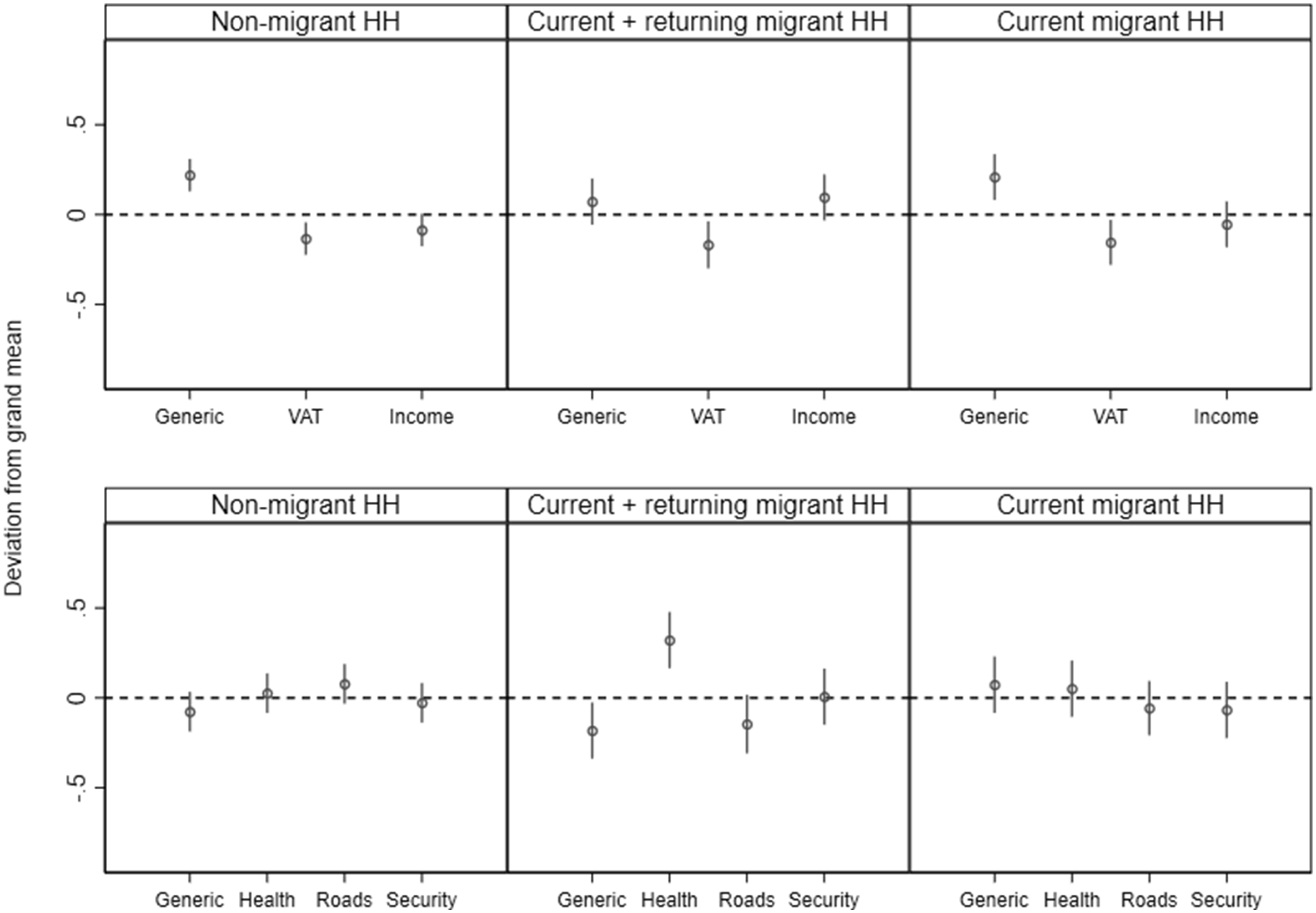
Our results corroborate the idea that return migration makes individuals more supportive of taxation. On average, we find that returning migrant HH respondents are .25 units more supportive of higher taxation than non-migrant respondents (mean by subgroup; Table A16 SM). This pattern holds, after adjusting for gender, age, education, income level and employment status of respondents. 17 Relative to current migrant HH respondents, those living in returning migrant HHs appear to be less critical of higher taxation. 18
As for spending preferences testing H1a and H2a, simple-effect tests indicate that the effect of the tax earmarking manipulation is significant for returning migrant HH respondents as opposed to both respondents from non-migrant and current migrant HHs (Figure 1, SM Table A15). When respondents from returning migrant HHs are told that the tax increase is generic – to ‘finance public spending’ – support for taxation does not vary from the grand mean. This result is expected. Previous research shows that citizens in developing countries will be more willing to accept a tax increase when the tax is earmarked to finance a specific policy, because earmarking reduces uncertainty in low-state-capacity contexts (Flores-Macías, 2018). Furthermore, individuals who have returned to Mexico, whether voluntarily or involuntarily, often come with specific public-good needs, as noted above. Knowing how tax revenue is spent is more salient for returning migrants and their HH members than to other individuals.
Indeed, we find that when returning migrant HH respondents are given information about earmarking taxes for healthcare, there is a .32 unit increase in the average willingness to pay higher taxes. Support for higher taxation does not vary from the grand mean when returning migrant HH respondents are made aware of earmarking taxes for infrastructure, nor when made aware of earmarking taxes for security (Figure 1, SM Table A15). That is, the experience of return migration boosts preferences for earmarking taxes for healthcare. Interaction contrasts furthermore confirm that reactions to the spending earmarks do differ across non-migrant and returning migrant HH respondents, but not between non-migrant and current migrant HH respondents.
Our analyses of the effect of tax instruments (H1b and H2b) indicate that the treatment effect of the tax instrument manipulations (vs. the grand mean) does not significantly differ between members of non-migrant and returning migrant HHs, nor between non-migrant and current migrant HH respondents (Figure 1). For all groups, when respondents are unaware of specific tax instruments, the mean willingness to pay higher taxes is greater than the grand mean. This is expected as the average respondent is likely to be affected with a higher tax burden when consumption is taxed more heavily. Specifying VAT as the tax instrument leads to a decrease in support for higher taxation by .13 units for non-migrant and by .16 units for both returning and current migrant HH respondents. No significant deviation from the grand mean is found in either of these groups when specifying income taxes (SM Table A15). Return migration does not influence preferences for tax instruments (Figure 1).
Local Context of Destination
Next, we explore how tax preferences vary according to migrants’ public-goods access at US state level. Those with household members living in US states with more limited healthcare accessibility for documented immigrants – where immigrants must wait five years to enrol in Medicaid – are on average .19 units more supportive of higher taxation than respondents from non-migrant HHs (Figure 2). But those with HH members living in US states without the five-year enrolment ban do not vary from non-migrant HH respondents in their support of higher taxation. This pattern remains after adjusting for respondents’ demographic and socioeconomic characteristics. These results thus support the idea that those in the origin country are more supportive of higher taxation when current or returned migrant HHs face healthcare restrictions (and hence a lack of vertical reciprocity) abroad. Willingness to pay higher taxes by immigrant welfare access in the US and information about (i) tax instruments (panels on the left) and (ii) tax earmarking (panels on the right). Note: Each panel presents estimation results for the respective vignette treatments from a regression model including basic socio-demographic controls. Migrant HHs are coded by currently or formerly living in US states classified by the respective healthcare policy Medicaid with 5-year bar versus no waiting period and less generous US state versus more generous US state (see Tables A21-A22 SM).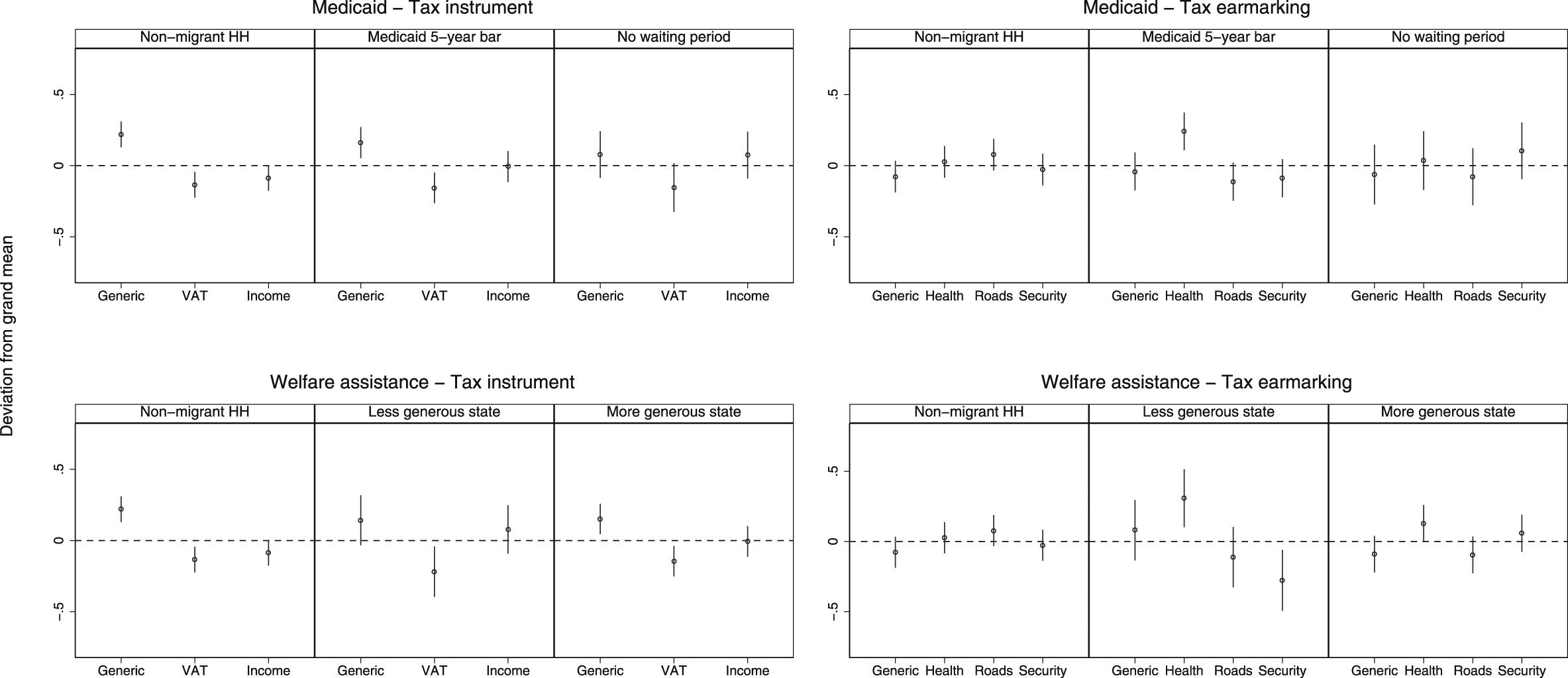
With regards to spending preferences, interaction contrasts indicate that non-migrant HH respondents do differ in their reactions to the spending earmark manipulation from those with HH members in US states with more limited Medicaid accessibility, but not from those with HH members in more accessible US states. Simple-effect tests furthermore reveal that the tax earmarking manipulation is significant only for those with HH members in (or having returned from) limited-accessibility US states (‘Medicaid 5-year ban’). 19 When these respondents are made aware of earmarking taxes for healthcare, support for higher taxation is +.24 units above the grand mean. But no significant variations from the grand mean are seen when these respondents are made aware of earmarking taxes for infrastructure and for public security (see Figure 2, SM Table A21). These results lend support to the exclusion channel (H2a): when migrants’ access to healthcare is restricted in the context of destination, those in the origin country have stronger preference for earmarking taxes for healthcare.
As for the tax instrument manipulation, our analysis indicates that reactions to awareness of specific tax instruments do not vary significantly with migrants’ access to healthcare (see SM Table A21). Restrictions to migrants’ access to healthcare in the context of destination thus do not seem to influence the tax instrument preferences in the origin country. This result speaks against both H1b and H2b.
Considering restrictions to access not only Medicaid but also food assistance schemes, TANF and SSI (SM Table A22), we test the robustness of the results (Figure 2). In 23 states of the US (in which 14% of our respondents had family members), immigrants have access to two or fewer of these social assistance programs. In contrast, the five-year bar to Medicaid is applied in 37 states of the US (34% of our sample); only 12 US states have refused to expand Medicaid (SM Table A6).
Again, our results indicate that support for higher taxation increases with the extent of welfare restrictions towards immigrants. Compared with respondents from non-migrant HHs, those with HH members currently living (or having formerly lived) in ‘more generous’ states of the US are more supportive of higher taxation (+.13), but those living in ‘less generous’ US states are even more supportive of higher taxation (+.27). These results confirm that migrants’ restrictions to access social assistance programs in the context of destination have no influence on the tax instrument preferences of those in the origin country (see Table A22, Figure 2). Turning to reactions to the spending earmark manipulation, we find once more that the effect of the tax earmarking manipulation is significant only for respondents with HH members living (or having formerly lived) in US states where welfare access is the most restricted for migrants (‘less generous states’). When these respondents are made aware that tax revenue would be earmarked for healthcare, average support of higher taxation is .31 points above the grand mean (see Table A22 SM). This supports the exclusion channel (H2a): restrictions on migrants accessing welfare translate into stronger preferences for earmarking taxes for welfare by those in the origin country. 20
Of particular interest is the unexpected finding that when respondents with HH members living in US ‘less generous’ states are made aware of earmarking taxes for public security, average support for taxation is −.28 units below the grand mean (see Sensitivity Analysis section). Exclusionary experiences hence do not raise support for taxation across the board but are policy specific.
Sensitivity Analyses
To ensure that our individual-level results are not driven by age (the elderly being more supportive of taxation when earmarked to healthcare because of greater need) or the resource effects of migration (remittance receipt and HH income), we conduct additional robustness tests (see discussion in Section J, SM). No heterogeneous effects are found when accounting for the age of respondents (Table A18, SM). At all levels of income, those belonging to returning migrant HHs have positive and significant reactions to the health earmarking treatment compared with members of non-migrant HHs and members of current migrant HHs (Table A17, SM). Importantly, reactions of current and returning migrant HH members to the tax earmarking manipulations do not vary with the receipt of financial remittances (Table A19, SM). Our results also remain robust when adding controls for tax attitudes, informality, insurance status and use of the public healthcare system, Covid-19 infection and vaccination status, emigration intentions, frequency of communication with migrants abroad, and individuals knowing someone who has experienced violence on their way to the US (SM, Tables A13, A15 and A21-23). We do not find a substantial change in either the direction or the statistical significance of the coefficients for the tax earmarking manipulation when accounting for respondents’ experiences of violent crime and bribery, perceptions of insecurity in the neighbourhood and experiences of police misconduct (Tables A21-25, SM).
At the context level, we check how results look like when distinguishing between mandatory E-Verify versus non-E-Verify US states (NCSL, 2022a) and local immigration enforcement versus no local immigration enforcement US states (by which Mexican immigrants can be stopped, asked about their immigration status and searched by state police forces; NCSL, 2022b, coding scheme is shown in Table A6 SM) to test for robustness. In all of these cases, respondents with current HH members living in (or returned from) more hostile immigrant environments in the US are more likely to support tax increases for healthcare (Figure 3, Tables A6, A25, SM). Willingness to pay higher taxes by local immigration enforcement in the US and information about (i) tax instruments and (ii) tax earmarking. Note: Each panel presents estimation results for the respective vignette treatments from a regression model including basic socio-demographic controls. Migrant HHs are coded by currently or formerly living in US states classified by the respective immigration policies E-Verify mandatory to all employers versus E-Verify non-mandatory and police involvement in immigration enforcement versus no police enforcement (see Tables A24-A25 SM).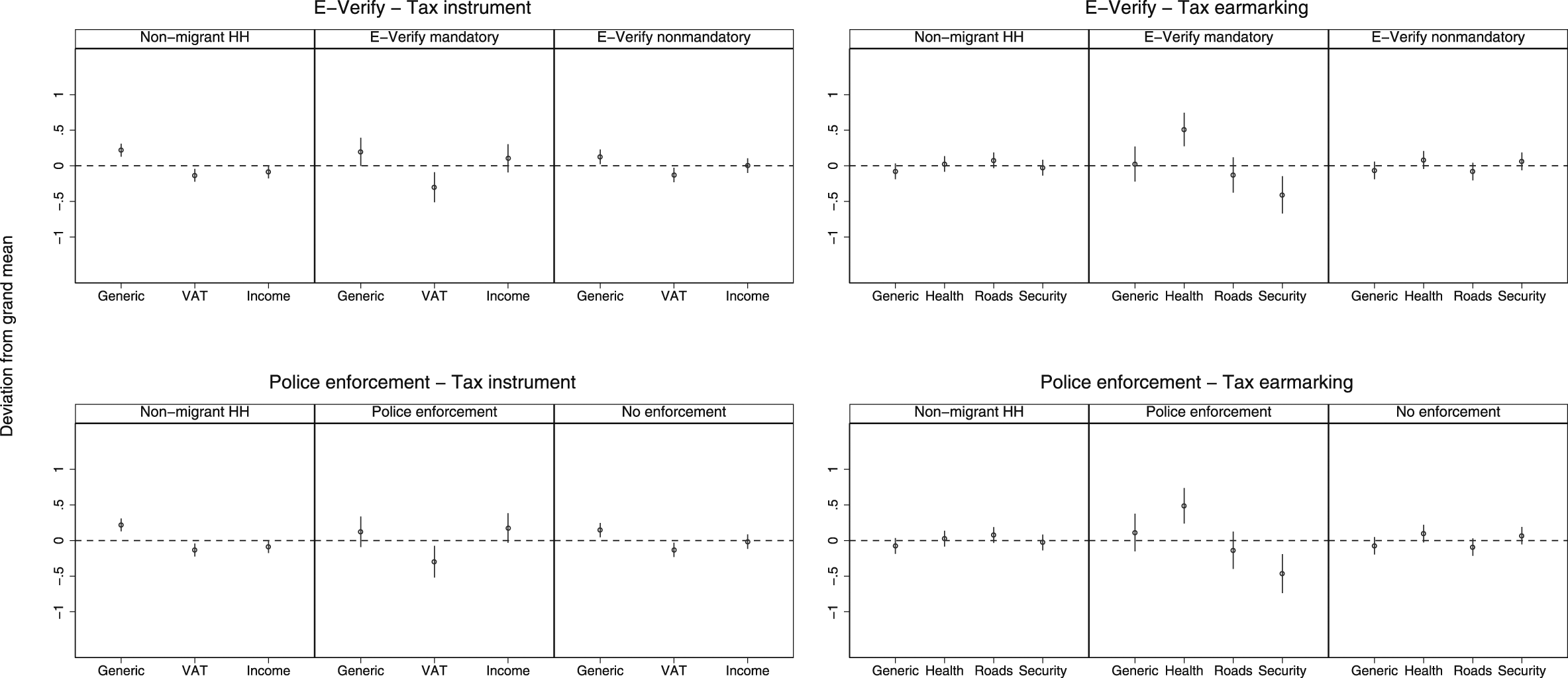
Among those with HH members living in US states where E-Verify mandates are mandatory to all employers, and in US states with local immigration enforcement, support for higher taxation is above the grand mean when awareness of healthcare spending is raised, for security it is below. These results are similar to those found when considering US states according to their generosity of social assistance towards migrants. Our evidence indicates that respondents with HH members living (or having lived) in hostile immigrant environments in the US are more likely to develop strong preferences for more funding for healthcare, but less funding for state security agencies. 21
We do not find a change in either the direction or the statistical significance of baseline results when including fixed-effects for US–Mexico migration state corridors and Mexican origin state (Tables A20, A28 and Section J.3 SM), nor when excluding those respondents from the sample with HH members living in California – the most liberal and progressive US state in terms of immigration with a high migrant intake (Table A26, SM) – and Texas – one of the US states where restrictive local immigration enforcement laws are in place together with a large Mexican migrant population (Table A27, SM).
Finally, to rule out the possibility that the healthcare earmarking finding is driven by extraordinary healthcare needs due to the global Covid-19 pandemic and the timing of our survey, we test whether differences in US state death rates affect our results. Respondents with family members living in US states with Covid-19 death rates above the national mean react positively to earmarking taxes for healthcare, but negatively to earmarking taxes for security (Table A30, SM). It should be noticed that the US states with Covid-19 death rates above the national mean tend to be those with stringent immigration enforcement laws and ruled by Republican state governors (Table A31, SM). Citizens in Republican-leaning states experienced a different pandemic than those in Democratic-leaning states. 22
However, considering the particularly strong impact of the Covid-19 pandemic in Mexico, non-migrant HH respondents’ experiences do not differ particularly strongly from current migrant HH respondents with family members in US states where the pandemic ravaged without government restrictions. In fact, when controlling for individual measures of Covid-19 infection and vaccination, the coefficient of the healthcare tax earmarking treatment increases (Tables 15, 21-23, SM). The evidence presented thus far not only robustly supports the exclusion pathway (H2a) but also suggests that migrant exclusion from the broader fiscal social contract (which goes beyond welfare and includes protection from private and state forms of coercion and violence) in high fiscal-capacity contexts is the main pathway through which emigration influences the spending preferences of those in the origin country.
To summarize, we provide substantial evidence that having connections with migrants in the US alters respondents’ support for allocating taxes to public policy areas to which Mexican immigrants have restricted access abroad, supporting the exclusion channel (H2a) and rejecting positive socialization (H1a). This holds even when accounting for a battery of alternative explanations. However, we do not find that ties with migrants in the US influence individual reactions to different tax instruments (H1b and H2b). This might be due to the less visceral nature of migrants’ experiences with tax instruments compared to their experiences of exclusion from public healthcare. Having more limited access to healthcare and living in fear of the police are experiences that are much more likely to affect migrants’ attitudes and the experiences they transmit back home than experiences of different tax instruments. 23
Discussion and Conclusion
Understanding citizens’ preferences towards taxation and their expectations about public spending can provide important insights into how governments in migrant-sending countries can build support for sustainable fiscal contracts. Our study addresses the question of how social remittances sent from the US, a high fiscal-capacity democracy, influence attitudes towards the fiscal social contract in Mexico, a low fiscal-capacity democracy. We find that social remittances have little effect on the preferences for different tax instruments of those remaining in the origin country. Social remittances – either transmitted or directly brought home – do, however, have a strong effect on the preferences of those left behind for raising taxes to spend on specific policy areas.
Experiencing fiscal vertical reciprocity in high fiscal-capacity contexts is restricted when immigrants are undocumented or when they live in hostile environments. Our analysis shows that those living in returning migrant HHs in Mexico are more supportive of earmarking taxes for healthcare, a service that is restricted to many Mexican immigrants in the US. Having connections with migrants living in immigrant-hostile US states not only increases support for earmarking taxes for healthcare but, unexpectedly, also reduces support for tax increases to support spending on public security.
Our analysis not only confirms that the context of destination matters but also suggests that public goods restrictions and punitive measures against immigrants have spillover effects on the fiscal policy attitudes of those who remain in migrant-sending countries. A positive externality of welfare restrictions and anti-immigration policies enacted in the US is increasing demands for healthcare spending among better educated migrant HHs in Mexico, keeping the nature of our sample in mind. But the preferences against tax increases for security we found, for example, are worrying in the context of Mexico, where the local police are underfunded and police ineffectiveness has been linked to growing demands for militarization (Flores-Macías & Zarkin, 2021). While migration raises support for taxation in some policy areas, such as health, negative experiences in the destination context can also raise opposition to taxation in other areas, such as security.
An optimistic conclusion of our study is that support for higher taxation among migrant communities increases when citizens are made aware of the areas to which tax revenue will be earmarked. Mexican authorities commonly court migrants abroad for electoral and investment purposes; our results suggest that they can do so more effectively by promising Mexican immigrants increases to public healthcare spending. Our results also build on Meseguer et al.’s (2016) finding that social remittances make citizens more supportive of greater state intervention in origin countries; we show that this is most likely when migrants are excluded from the fiscal social contract in the destination context and in policy areas where fiscal reciprocity is more likely felt.
Despite our battery of robustness tests, the analysis of the destination context is limited by migrants’ possible self-selection into US states and correlation of context variables (e.g. partisanship, immigration laws and social policy accessibility) as we cannot randomize migrants’ destinations. The context analysis is a first step toward better understanding how the public goods environment in migration destinations shapes policy preferences. Qualitative methods such as interviews with migrants, particularly those who are undocumented and hard-to-reach, would help to overcome these limitations. Our study is also bound by the extent to which we can isolate returning migrants, in particular those who are forcefully returned, as the associated stigma of deportation may reduce willingness to take part in public opinion surveys. Our findings shed light on the transformative process of return migration for policy preferences, but they also raise questions about the role of the return process, returnees’ re-integration into the home country’s civil society and the identity of returning migrants’ HHs for preference formation that future research can productively address.
Finally, we must remain cognizant of the convenience nature of the sample, which is not representative for the Mexican population. Our sample has an above-average level of education compared to the population. While it is valid to study causal effects from survey experiments, treatment effects need to be interpreted for Mexicans with higher socioeconomic status than average. We also have no direct measures of migrants’ experiences of exclusion in the USA. Paired research designs which examine migrants’ own experiences of inclusion and exclusion alongside fiscal policy attitudes amongst their household members in Mexico would allow us to connect exclusion more directly with attitude change. Information on migrants’ US city or county of residence could also help provide more precise tests of social policy and anti-immigration measures on tax attitudes because these can vary at the very local level in the US.
Beyond Mexico, it is not hard to envision similar dynamics among respondents living in other low fiscal-capacity contexts such as El Salvador, Guatemala and Honduras – all of which have a large share of their population living in the US. Although the migration corridor between the US and Mexico is unique in its size, we live in an age in which migration is fuelled by fiscally weak states (Germano, 2018) requiring further study of the conditions under which attitudes toward taxation and spending are influenced by global human movement.
Supplemental Material
Supplemental Material - Emigration, Social Remittances and Fiscal Policy Preferences: Experimental Evidence From Mexico
Supplemental Material for Emigration, Social Remittances and Fiscal Policy Preferences: Experimental Evidence From Mexico by Ana Isabel López García, Sarah Berens, and Barry Maydom in Comparative Political Studies
Footnotes
Author Notes
Previous versions of this paper were presented at the workshop on ‘Those Who Leave and Those Who Stay: The Consequences of Emigration for Sending Countries’, University of Cambridge, January 27-28; at the Latin American Centre Seminar, Oxford University, February 24th, 2022; at the Research Seminar at University of Miami, March 21st 2022; at the 2022 Midwest Political Science Association in Chicago; at the 2022 ECPR Joint Sessions, University of Edinburgh; at the 2022 EPSA Annual Conference in Prague; and at the 2022 IMISCOE Annual Conference.
Acknowledgements
We thank participants at the events noted below in addition to Néstor Castañeda, Chao-yo Cheng, David Doyle, Patrick Emmenegger, Calla Hummel, Katrina Maydom, Michael Paarlberg, Stefan Rother and Ilka Vari-Lavoisier for their comments. We also thank Clara Baues for excellent research assistance.
Declaration of Conflicting Interests
The author(s) declared no potential conflicts of interest with respect to the research, authorship, and/or publication of this article.
Funding
The author(s) disclosed receipt of the following financial support for the research, authorship, and/or publication of this article: This work was financially supported by the Young Scholar Fund within the Exzellenzinitiative at the Zukunftskolleg Konstanz, the German Research Foundation (DFG, project number 374666841 – CRC 1342) and Birkbeck College’s Research Innovation Fund.
Ethical Statement
IRB Approval
Ethics committee of the School of Social Sciences, History and Philosophy, Birkbeck College, University of London; approval number: BBKPOL2021/22-02

Supplemental Material
Supplemental material for this article is available online.
Notes
Author Biographies
References
Supplementary Material
Please find the following supplemental material available below.
For Open Access articles published under a Creative Commons License, all supplemental material carries the same license as the article it is associated with.
For non-Open Access articles published, all supplemental material carries a non-exclusive license, and permission requests for re-use of supplemental material or any part of supplemental material shall be sent directly to the copyright owner as specified in the copyright notice associated with the article.
