




Abstract
How does economic globalization affect regime support in non-democratic regimes? While we know a lot about how globalization affects politics in democracies, we know only little about its impact on political preferences in autocracies. I focus on FDI, which has increased considerably over the last decades and affects low- and high-skilled individuals differently. Material risks associated with FDI decrease regime support only among the poorly educated; economic gains from FDI bolster support for the incumbent regime for well-educated individuals. I present two analyses that corroborate these hypotheses. Study 1 uses Afrobarometer data and matches respondents with geo-located data on FDI. To mitigate selection problems, I only compare individuals that are exposed to FDI with individuals that are not yet exposed at the time the survey was administered. Study 2 utilizes cross-national survey data from 14 autocracies. My findings explain why some citizens favor the political status quo, even in autocracies.
Introduction
How does economic globalization affect autocratic regime support? While the answer to this question is crucial for autocratic governance in open world markets, we still only have a limited understanding of the micro-foundations of economic globalization in non-democracies. Nevertheless, prominent arguments assert that globalization supposedly undercuts autocratic regime stability. Such arguments on the macro-level usually rest on two different theoretical mechanisms on the micro-level. On the one hand, economic globalization increases market income, which ultimately strengthens and reinforces attitudes in favor of democracy among members of the middle class, which have long been described as drivers of democratization (Lipset, 1959; Rosenfeld, 2021; Welzel, 2007). On the other hand, economic globalization in developing countries reallocates market income from capital to labor, which causes democratization because the latter develop preferences for democracy and the former face fewer redistributive losses under democracy (Acemoglu & Robinson, 2006; Ahlquist & Wibbels, 2012; Boix, 2003).
This article sets out to put both micro-level mechanisms under scrutiny and thus contributes to two ongoing debates: First, in international political economy scholars disagree about the nature of the distributional consequences of globalization (Menéndez González et al., 2023), that is, it remains unclear who the most likely beneficiaries and losers from international openness are. Factoral or Heckscher–Ohlin models posit that skill-level is the only decisive factor to distinguish between winners and losers. Sectoral or Ricardo–Viner models arrive at predictions about distributional consequences based on actual exposure. In applying new insights from the trade literature (Helpman, 2014; Helpman et al., 2010; Melitz, 2003; Palmtag et al., 2020; Walter, 2017), I argue that the distributional implications are more heterogeneous than previously assumed. Whether an individual gains or stands to lose is contingent on both skill-level and actual exposure to international markets.
Second, in comparative politics scholars ascribe mass attitudes a crucial role in regime trajectories (Mainwaring & Pérez-Liñán, 2014; Neundorf et al., 2022; Przeworski, 2022), despite the institutional turn in comparative research on authoritarianism (Pepinsky, 2014). Yet, there is considerable disagreement as to how economic developments shape individuals’ attitudes toward political regimes. One strand of research argues that economic performance caused by modernization amplifies citizens’ beliefs in the legitimacy of the authoritarian rule, which increases the stability of autocracies (Gerschewski, 2013; Guriev & Treisman, 2020; Wintrobe, 1998), especially when the emerging middle class is dependent on the state (Bellin, 2010; Rosenfeld, 2021). Others contend that modernization strengthens demands for democracy, for instance, by enhancing education levels (Lipset, 1959; Sanborn & Thyne, 2014), reinforcing self-expression or emancipatory values (Inglehart & Welzel, 2005; Welzel, 2007), or via demands for income redistribution (Acemoglu & Robinson, 2006; Boix, 2003). A third group of scholars doubts that modernization has the potential to shape regime preferences, as they argue that people’s demands for specific regimes are biased toward the regime they currently live in (Dahlum & Knutsen, 2017; Hadenius & Jan, 2005; Seligson, 2002).
I focus on the globalization of production in the form of foreign direct investment (FDI). FDI has been on an astounding rise over the last decades—in democracies and in autocracies—and has become one of the most important facets of international economic openness (Pandya, 2016). Technological advances allowed countries to attract international sources of capital. And multinational corporations frequently exploited locational advantages outside their home countries to increase revenues (Jensen, 2006). Simultaneously, developing and developed countries have progressively granted multinational corporations access. As such, foreign investment has had and continues to have a tremendous potential to restructure the domestic economy of host countries (Feenstra & Hanson, 1997; Pandya, 2014). Unsurprisingly, studies have uncovered sizable political consequences. Scheve and Slaughter (2004) find that FDI increases feelings of economic insecurity. Owen (2019) argues and finds that FDI is mostly beneficial for the population and thus increases the probability of incumbent party re-election in local elections. Going a step further, Walter (2010) argues for heterogeneous effects. She shows that economic insecurity induced by FDI translates into preferences for redistribution and leads citizens to support those parties that tend to provide a generous social security net. In contrast, individuals benefiting from FDI turn to parties that aim at deepening international integration. 1
This paper goes one step further and assesses whether the economic consequences of FDI also translate into regime support in autocracies. I argue that, although beneficial in the aggregate, not all citizens benefit from FDI. Low-skilled individuals face downward pressure on their economic well-being the more they are exposed to FDI. To the contrary, highly skilled individuals’ wage levels increase when they work for multinational companies. Concerning market income, FDI thus widens the gap between differently skilled individuals. Exposure to FDI translates into regime support through its effect on satisfaction with the performance of the incumbent government. Seeing to overcome economic insecurity, low-skilled exposed individuals should be more likely to oppose the autocratic regime in place on economic grounds. Contrarily, economic gains from FDI increase perceived legitimacy, leading the high-skilled citizens to support the incumbent regime when they are exposed to FDI, especially because regime change raises the uncertainty whether current economic gains can be equally enjoyed under a different set of political institutions.
I find empirical support for this argument using two different sets of data. The first study uses rounds 4–6 of the Afrobarometer survey, which covers 20 African autocracies. Individual responses are geo-coded, making it possible to match respondents with geo-located FDI project data to measure exposure. This strategy allows me to compare political preferences of individuals that actually live in the vicinity of a multinational enterprise at the time the survey was administered with individuals that have not yet been exposed to FDI, thus mitigating problems of selective exposure to FDI due to multinational companies’ investment decisions. The second study complements this analysis using survey data from 14 autocratic regimes around the globe. To measure exposure to FDI, I utilize regional variation in survey recruitment and combine this with data on greenfield investments. Both studies examine whether differently skilled individuals exposed to foreign investment hold opposing views regarding economic insecurity. Furthermore, I investigate the political consequences of FDI on three dimensions: satisfaction with and trust in state institutions, perceived legitimacy of the functionality of political institutions in autocracies, and regime support for autocratic rule.
The remainder of the paper is structured as follows: The next section lays out the theoretical argument. Building on economic models, I explain how FDI affects individual regime support. The first empirical section presents the results of a study focusing on 20 African autocracies. The next empirical section presents the results of a second study investigating cross-national survey evidence. The findings from both studies support my argument: FDI increases economic welfare and consequently the probability of regime support for high-skilled individuals. Exposure to FDI leads to heightened economic insecurity and distrust in the autocratic institutions if respondents are poorly educated. The last section discusses the implications of these findings and outlines avenues for future research with regard to four areas: (1) the distributional consequences of economic globalization in developing countries, (2) the connection between economic globalization and regime change on the macro-level, (3) the importance of individuals’ material situation for their political preferences, and (4) the lower salience of the globalization backlash in autocratic countries.
Argument
Countries are able to realize aggregate welfare gains by opening up to international investment (Borensztein et al., 1998; Hansen & Rand, 2006; Li & Liu, 2005; Ram & Zhang, 2002). Yet, focusing solely on the aggregate effects of FDI disregards variation between citizens. I argue that international investment creates both winners and losers and that individual economic well-being varies with regard to exposure to FDI and skill-level. Individuals take these material consequences into account when evaluating the level of support for the incumbent regime. Individuals that benefit (lose out) from FDI on material grounds are more (less) supportive of the incumbent regime.
Distributional Consequences of Foreign Direct Investment
Economic models that differentiate between winners and losers of international openness have largely focused either on differences in the relative productivity between sectors or industries or on differences in the relative endowment with different production factors. According to the latter, either capital or labor receives increasing returns in an open economy, depending on its comparative advantage. Since most autocracies are developing countries, labor is the abundant production factor (Ahlquist & Wibbels, 2012; Li & Reuveny, 2003). Given that the comparative advantage of autocracies is in labor-intensive goods, this production factor receives higher earnings. Hence, international economic openness creates increasing income for production workers and decreases income inequality. I depart from these models on two grounds: In empirical terms, the suggested inequality-decreasing effect does not materialize, even though poverty rates have fallen. If anything, inequality rises the more countries open up to the international economy (Goldberg & Pavcnik, 2007; Menéndez González et al., 2023). Second, both models do not incorporate intra-industry developments, which have become an even more prominent feature in recent years (Helpman, 2014).
FDI arises because multinational corporations enter foreign markets to increase their return on capital and, as a consequence, their profits. In order to do so, MNCs make use of location advantages in host countries that either increase their market share or give them access to specific resources (Dunning, 1993; Jensen, 2006). In order to better understand the distributional effects of FDI, I build on insights from economic models of multinational production and a new generation of trade models. FDI affects national economies in two ways (Helpman, 2014): First, it directly reallocates economic resources between domestic firms and MNCs. Second, FDI raises the share of firms in the tradable sector that are competitive in world markets. Entry of MNCs thus reshapes the structure of the domestic economy.
Domestic businesses in autocracies are oftentimes not competitive, which leads to a major reallocation of domestic market shares if highly productive foreign companies enter the economy. Hence, domestic firms that have to compete directly with foreign firms face adverse effects on their revenues and, in turn, may need to lay off workers (Pandya, 2014; Aitken & Harrison, 1999). Yet, domestic firms also benefit from FDI in two ways: First, they may enter the supply chain of multinational corporations. If the overall supply of capital increases due to FDI, so does demand for production inputs. This widens the market share of domestic firms’ products resulting in higher profits (Görg & Strobl, 2002). Second, foreign investors incentivize (Haskel et al., 2007; Javorcik, 2004) or force (Godart & Görg, 2013) technology and knowledge spillovers. Those spillovers in turn increase the productivity of domestic firms, especially if they are able to act as suppliers to foreign companies (Görg & Seric, 2013).
Because FDI affects domestic business and simultaneously increases the share of companies that are able to enter export markets, it also has consequences for the working-age population. Given the fact that only a fraction of firms in each industry actually engages in export, new trade theory specifically focuses on firm-level heterogeneity in productivity to assess the effects of economic openness. Melitz (2003) argues that international openness partitions domestic firms into three types: the most productive firms export. Due to their high productivity, they are able to compete with other firms for market shares in foreign economies (Baccini et al., 2017). Both foreign multinationals and domestic firms that act as suppliers belong into this category. Second, although firms with a median productivity level are not able to compete internationally, they still have the capacity to serve the domestic market. Yet, because the size of the domestic market is fixed, they cannot reap the benefits of exporting. Third, competition for firms with a nonproductive labor force is highest forcing them to shut down their business.
Helpman et al. (2010) apply this logic to come up with individual-level predictions about the impact of firm sorting under conditions of economic openness. They assume that the initial productivity level of firms is the sum of the productivity levels of the workforce and that firms have incentives to strengthen their market position. Multinational corporations, because they are highly productive firms and rely on the production of goods that require a skill-intensive labor force (Bernard et al., 2007; Osgood, 2016; Wagner, 2007), demand workers with higher productivity levels than domestic firms (Lee & Wie, 2015; Tomohara & Takii, 2011). They do so by means of screening to improve the composition of their workforce. Because individual productivity is not directly observable, screening to overcome search frictions is a costly process that enhances the bargaining position of workers. Firm sorting due to the entry of foreign investors thus results in higher wages for high-skilled individuals (Feenstra & Hanson, 1997), either because MNCs pay better (Hijzen et al., 2013) or because foreign companies acquire domestic companies (Lipsey et al., 2013). Additionally, local firms producing in sectors exposed to international investors increase the wages of their workers in order to either compete with foreign companies or to serve as their suppliers (Görg & Seric, 2013). Hence, I argue that well-educated individuals benefit most from FDI. 2
Conversely, poorly educated workers increasingly fall victim to international competition and lose out economically. Given that MNCs hire skilled workers from domestic companies (Fortanier & Jeroen van Wijk, 2010), average wage levels in domestic firms tend to increase less or even stagnate (Girma et al., 2019). As a consequence, less-skilled workers are more likely to work for less productive domestic companies that offer lower wages (Chen et al., 2011). In addition, reallocation of resources in the domestic economy forces some firms to shut down their business entirely. Because those workers have lower average productivity levels, they face downward pressure on their wages and higher job insecurity relative to workers in non-exposed sectors (Menéndez González et al., 2023; Palmtag et al., 2020). Low-skilled individuals thus are less likely to be reemployed in an open economy, in which they are not able to meet the recruitment prerequisites of thriving firms.
These insights suggest that the effect of FDI on individual market income and perceived economic security is conditional on both exposure to MNC activity and individual skill-levels. Given the reallocation of resources due to multinational production, workers with high productivity levels earn higher wages than nonproductive workers. Exposure to foreign investment further increases the wedge between workers. 3 Highly productive individuals earn even higher wages when working for multinational corporations. Less productive workers in exposed firms face the highest probability of getting laid-off. Taken together, exposure to foreign direct investment induces both economic risks and opportunities and shapes economic insecurity.
FDI amplifies economic insecurity and grievances among poorly educated individuals. FDI reduces economic insecurity and grievances for the well-educated.
Foreign Direct Investment and Citizen Support for Non-Democratic Rule
In the next step, I argue that these material consequences of FDI translate into regime support in non-democratic regimes. Taking on a rational-choice perspective, I assume that economic self-interest is a major driver of political preferences (see, e.g., Meltzer & Scott, 1981) and contend that such preferences emanate more from a utilitarian rather than an instrumental or axiological conception of rationality (Sarsfield & Echegaray, 2006). 4 I also assume that individuals are able to assess their economic situation; for instance, whether they have enough money to buy food or are unemployed.
Even though modern autocracies control information flows to stay in power, dictators focus heavily on economic performance when addressing the public (Guriev & Treisman, 2019). Performance considerations—that is, whether the regime delivers economically—should thus affect the way in which citizens assess the incumbent regime, even in autocracies (Magaloni, 2006; Mauk, 2020a; Neundorf et al., 2022). There is, however, considerable disagreement as to how economic openness, such as foreign direct investment, shapes regime support. The modernization view contends that FDI leads to increasing income, which strengthens demands for democracy, for instance, by enhancing education levels (Lipset, 1959; Sanborn & Thyne, 2014) or by reinforcing self-expression or emancipatory values (Inglehart & Welzel, 2005; Welzel, 2007). In the following, I argue against this view. If the economic performance of the regime is congruent with individual preferences, citizens develop beliefs in the legitimacy of the regime in place. It is thus not surprising that economic performance is a crucial determinant of citizens’ evaluation of the government (Gerschewski, 2013; Guriev & Treisman, 2020). This is not confined to policy preferences alone but is relevant for political institutions in general. As such, I argue that economic satisfaction translates into institutional support.
If an authoritarian leader fails to provide basic economic welfare and security, citizens become increasingly dissatisfied. This notion forms the basis for the belief among the economically disenfranchised that the incumbent government and the institutions that keep the autocrat in power are not working to their advantage. It thus fosters distrust in the workings of state institutions and ultimately leads to dissatisfaction with the entire regime (Li, 2020). Low-skilled individuals who are exposed to FDI should thus face a stark discrepancy between the perception of how political institutions should work and the assessment how the regime’s institutions de facto operate. As a consequence, low-skilled individuals who are exposed to FDI lose out in material terms and offer lower levels of support toward the incumbent regime.
Economically well-off individuals, on the other hand, should prefer the autocratic status quo for reasons of economic stability (Bellin, 2010; Letsa & Wilfahrt, 2018). Highly skilled individuals benefit from foreign direct investment and thus support continuing or even deepening economic openness, including the abolition of foreign entry restrictions or trade barriers. Consequently, highly skilled individuals are most prone to demand even more far-reaching liberalization policies, especially if they work in exposed jobs (Pandya, 2010), and autocratic governments follow suit (Pond, 2018). Government satisfaction should further manifest itself in perceptions of legitimacy. FDI increases disposable income, which in turn amplifies citizens’ belief in the legitimacy of the incumbent regime and induces preferences for political stability (Bellin, 2010; Guriev & Treisman, 2020; Wintrobe, 1998). On purely material grounds, the winners from foreign direct investment should thus support stability and sacrifice the chance to obtain more participation rights.
While it is certainly possible that these individuals generally have a more favorable view of democracy as they receive a higher market income, a favorable (and probably abstract) image of democratic governance should not automatically amplify individuals’ willingness to act against the incumbent regime, as well. For one, any regime change includes direct costs to overthrow the incumbent government and demolishes current economic gains. Furthermore, there is uncertainty whether economic gains are equally distributed under alternative regimes. After all, other types of regimes might not continue to offer the highest revenues for the current beneficiaries of FDI. 5 Lastly, citizens have to take into account that any attempt to overthrow the incumbent regime might result in yet another form of autocratic rule (Geddes et al., 2014; Przeworski, 2022). I thus argue that individuals—when making a decision whether or not to support the non-democratic regime they live in—take into account both the current economic performance of the incumbent government and the probability that a potential other regime will deliver at least the same level of economic performance in the future (Mainwaring & Pérez-Liñán, 2014). Combining this notion with the argument about the distributional consequences of FDI, I arrive at the following expectation with regard to the relationship between FDI and regime support in autocracies:
FDI leads to lower levels of support for the incumbent regime for poorly educated individuals. FDI amplifies satisfaction with the autocratic status quo among well-educated individuals.
Research Design
In the following sections, I test these hypotheses against two sets of survey data. 6 In the first study, I use data from the Afrobarometer focusing on respondents in 20 autocracies. I selected these countries based on the following procedure: First, I include all countries from waves 4, 5, and 6. Importantly, individual responses are geo-coded, which allows a close match with equally geo-coded FDI data. My identification strategy compares respondents that live in an area that is already exposed to FDI at the time the survey was conducted with respondents that live in an area that will be exposed only in the future. 7 Second, I use a dichotomous indicator from Boix et al. (2013) to differentiate between democracies and autocracies. I check this classification with data from the Regimes of the World Dataset by Lührmann et al. (2018). 8 Table A-3 in the Appendix contains details for each coding decision.
The second study complements this analysis by broadening the scope of countries to autocracies around the globe using data from the 2007 Pew Global Attitudes Survey. I apply the same selection strategy, which leaves me with a total of 14 autocracies. Table A-13 in the Appendix contains details for each coding decision. Putting my argument to the test in two empirical settings at the same time not only showcases the robustness of my findings but also speaks to their generalizability. Given that FDI into African countries has only begun to pick up speed in the last two decades, the distributional impact should be less pronounced compared to other world regions. Hence, I have included a cross-national study which comprises a set of countries that includes different regime types (party-based, personalist regimes, and monarchies) from different parts of the world (Latin America, Asia, Africa, and Middle East) at different stages of economic development (Russia/Kuwait vs. Ethiopia/Bangladesh).
FDI and Political Preferences in 20 African Autocracies
I use individual-level data from the Afrobarometer survey (BenYishay et al., 2017) and focus on 20 non-democratic countries surveyed in waves 4–6 (administered between 2008 and 2015). 9 On a rolling cross-sectional basis, the analysis covers up to 22,000 responses from working-age individuals that have lived under authoritarian rule (see Table A-1 for descriptive statistics).
Outcome Variables
To assess the conditional effect of FDI on economic and political preferences, I measure three sets of dependent variables, each consisting of three survey items. Set 1 captures the direct economic consequences of FDI. The first survey question asks respondents to report the most important problem they think their country’s government should address. The answers to this open-ended question were grouped by the interviewers into several categories. I code respondents as self-reporting economic problems when they mention problems with regard to the “management of the economy,” “wages, income and salaries,” “unemployment,” and “poverty/destitution.” All other problems were coded as 0, that is, problems not directly related to individuals’ economic situation. The second item asks respondents to describe their own current living conditions, whereas the third item focuses on the state of the economy of the country respondents live in. The respondents in the analysis were provided with five answer categories, ranging from “very good” to “very bad.” All survey questions thus directly tap into the economic well-being of respondents.
Set 2 captures trust in state institutions and actors, that is, whether they “do what is right even in the absence of constant scrutiny” (Miller & Listhaug, 1990, p. 358). As such, political trust is a good proxy to measure how confident citizens are that their political system functions well (Mauk, 2020b). I focus on three important institutions/actors in autocracies. First, trust in the electoral commission, which is not an independent institution in most autocracies but is biased in favor of the incumbent government. Given the electoral commission’s important role in administering elections and recognizing the results, trust in the institution resembles trust in the political process, which I argue constitutes a good indicator for regime support (or the lack thereof). Second, trust in the president (or prime minister) who possesses a sizable amount of power to make policy in autocracies. Having confidence in a country’s leader is a good proxy whether respondents think that their leader uses power to their advantage. Third, trust in the ruling party. Authoritarian rulers usually do not exercise power in a vacuum but are constrained by their ruling coalition. Hence, trusting the ruling party means that respondents are confident that the ruling coalition uses its power to benefit the population. For all survey items, respondents were able to choose from the following list of answers: (1) “a lot,” (2) “somewhat,” (3) “just a little,” and (4) “not at all.” I excluded all respondents that mentioned not having heard enough about the respective actor or institution.
Set 3 aims at measuring regime support more directly focusing on three survey items that ask respondents about their attitudes toward democracy. The first question reads: “In your opinion how much of a democracy is [country] today?” Respondents were able to choose from the following answers: (1) “a full democracy,” (2) “a democracy, but with minor problems,” (3) “a democracy, but with major problems,” and (4) “not a democracy.” Of course, asking about attitudes toward the incumbent regime in autocracies is highly sensitive and might pose a significant social desirability bias. Therefore, respondents were given the opportunity not to answer. Nevertheless, the response rate to this question was about 92%, and about 55% of respondents in the sample indicated that their country’s democracy faces at least major problems. The second question reads: “Overall, how satisfied are you with the way democracy works in [country]?” The answers on a 4-point scale range from “very satisfied” to “not at all satisfied.” The last question asks respondents to choose one of the following statements: (1) “In some circumstances, a non-democratic government can be preferable” and (2) “Democracy is preferable to any other kind of government.” Survey participants were thus directly asked to choose between democracy and non-democracy. I coded respondents as strongly supporting democracy over non-democracy when they chose the second statement and did not indicate that the type of political regime does not matter for them.
Explanatory Variables
My argument implies that the effect of FDI on economic insecurity and citizen support for non-democratic rule differs between poorly and highly skilled individuals. As such, a valid test requires three independent variables on the individual level: skill-level, exposure to international investment, and an interaction term. I measure individual skill-levels using information on respondents’ educational achievements. To measure education, the Afrobarometer applies the same 10-point scale across all countries and waves, ranging from having received no formal schooling to a post-graduate degree. Of course, focusing on educational achievements does not measure other sources of skills training, such as on-the-job-training. But empirical research shows that education is positively associated with occupational skills and higher productivity levels (Jones, 2001) and thus approximates individual skill-levels well.
Individuals not only have different skill-levels but also vary in their exposure to FDI. To measure respondents’ exposure to multinational companies’ investments, I use data on greenfield investment, provided by The Financial Times Ltd (2018) which gathers data on investment projects carried out by international investors using official investment announcements. This project-level data also includes information on capital expenditure, number of jobs created, and the city where the investment takes place.
The geo-location of each project allows me to merge FDI data with the geo-coded respondents from the Afrobarometer survey data. To do so, I first identify all unique FDI project locations between 2003 and 2018, that is, any geographical location that was host to an MNC at least once in that period. 10 In total, I identify 637 FDI project locations in Africa; 426 of these are located in one of the 20 autocratic countries, for which the Afrobarometer provides survey data. Next, I draw a buffer zone with a radius of 20 km, a reasonable commuting distance, around each unique FDI location. In a third step, I identify all Afrobarometer respondents in waves 4–6 and match whether their place of residence lies within the buffer zone around each (active or future) FDI project location. I thus assume that living within 20 km of an FDI project exposes these individuals to the economic consequences of multinational corporations. 11 Figure A-1 in the Appendix displays this approach. Each gray marker represents a unique FDI location with a buffer zone of 20 km. A purple marker represents the place of residency of an individual surveyed in an autocratic country. Figure A-2 zooms in on Nigeria and showcases that some respondents are potentially treated by FDI, whereas it is unreasonable to assume that other respondents who live in remote areas are directly or indirectly affected by FDI.
In a final step, I first delete all respondents that have no potential of being treated. 12 Then, I measure to what extent the remaining potentially exposed respondents, that is, those that live in the vicinity of an already built or not yet existing project site, are actually exposed to FDI in the year they were surveyed. To do so, I focus on two indicators in the fDi Markets data: capital expenditure and the number of jobs created. For each individual, I identify the number of FDI projects to which an individual has been exposed at the time the survey has been administered and then add up either capital expenditure or jobs created. All individuals that have not yet been exposed to FDI are coded as not exposed. In light of diminishing returns, I use the natural logarithm of the amount of invested capital and the number of jobs created, respectively.
To capture the expected conditional effect of exposure to FDI and individual skill-level, I use an interaction term (Ai & Norton, 2003; Brambor et al., 2006). My argument makes clear predictions about the nature of this interaction. Since FDI induces downward pressure on low-skilled individuals’ economic well-being, they should be more likely to express feelings of economic insecurity and more reserved about autocratic rule. In contrast, high-skilled individuals face increasing returns the more they are exposed to foreign direct investment. The dependent variables are coded such that I expect a negative interaction term in all models.
Empirical Strategy
The geo-coding of both the Afrobarometer survey data and the FDI project locations not only allows me to match individual survey responses with data on FDI but also opens up a unique modeling strategy. For each dependent variable, I compare only those individuals that are already exposed to FDI with individuals that have not yet been exposed to FDI (see, for a similar approach, Brazys & Kotsadam, 2020; Palmtag, 2020). Multinational investors choose specific locations for investment, which, due to locational advantages, are not evenly spread across countries (e.g., mineral deposits and access to the sea). Individuals living far away from potential investment sites may thus be both not exposed as well as living in areas that are very different from areas with FDI. Because of this selection problem, I do not take into account respondents that do not have a realistic chance of ever being exposed to FDI. While doing so reduces the number of respondents, the remaining responses should offer more precise picture of the impact of FDI. In addition, this strategy also reduces a possible bias that arises because incumbents might strategically channel FDI to their strongholds (even though FDI is less fungible than foreign aid).
I employ multilevel linear probability models with country-level random effects and wave dummies as the baseline for estimation. 13 Because most dependent variables are dichotomous or ordinal, I test the robustness using probit or ordered probit models, respectively. In my baseline specification, I also control for respondent’s age (in years), gender, whether he or she is unemployed, is an urban resident, the level of political interest, and whether they regularly read a newspaper. Furthermore, I also take respondents’ ethnic background into account.
Findings
Does FDI create economic winners and losers and, as a consequence, alter attitudes toward autocratic rule? My findings indicate that citizens living under autocratic rule take their material situation into account when evaluating the legitimacy of and support for the incumbent regime.
Economic Grievances
Study 1: Conditional Effect of FDI on Political Preferences.
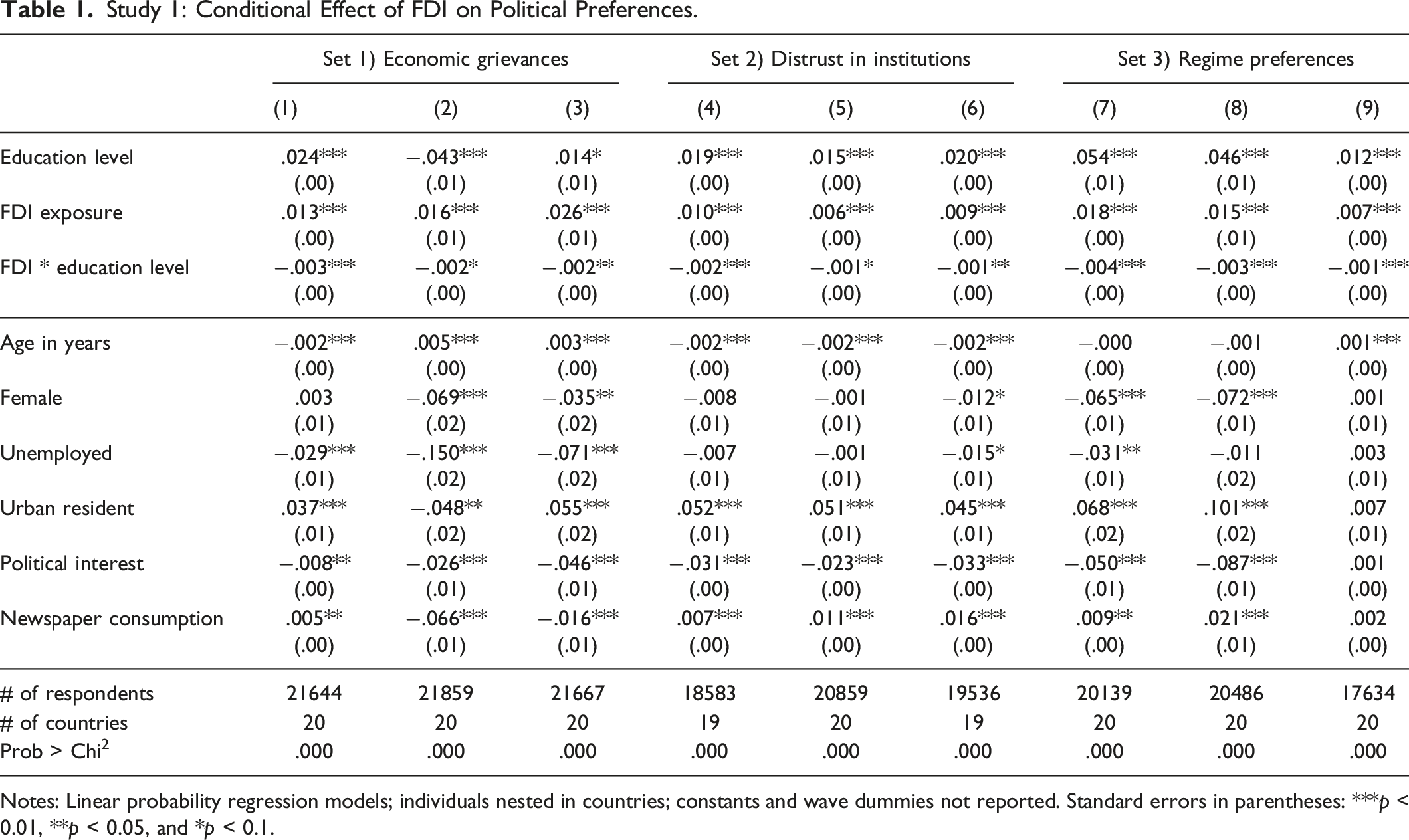
Notes: Linear probability regression models; individuals nested in countries; constants and wave dummies not reported. Standard errors in parentheses: ***p < 0.01, **p < 0.05, and *p < 0.1.
Figure 1 illustrates the marginal effect of foreign direct investment over different skill-levels. Exposing individuals with no formal or less than primary education to foreign investment increases their likelihood to feel economically insecure. On the other hand, exposing highly skilled people, that is, individuals with higher secondary or tertiary education, to foreign direct investment in fact lowers the probability that these people report problems regarding low wages and unemployment. I detect the same pattern for the probability that respondents assess their own living situation as being in an adverse shape (model 2) or whether they think that the economic situation in the country they live in is bad (model 3). Here too, the negative and statistically significant interaction term suggests that FDI has different effects on economic grievances for low- and high-skilled individuals (see also Figure A-3). Study 1: FDI exposure and self-reported economic problems. Notes: Results based on model 1 in Table 1.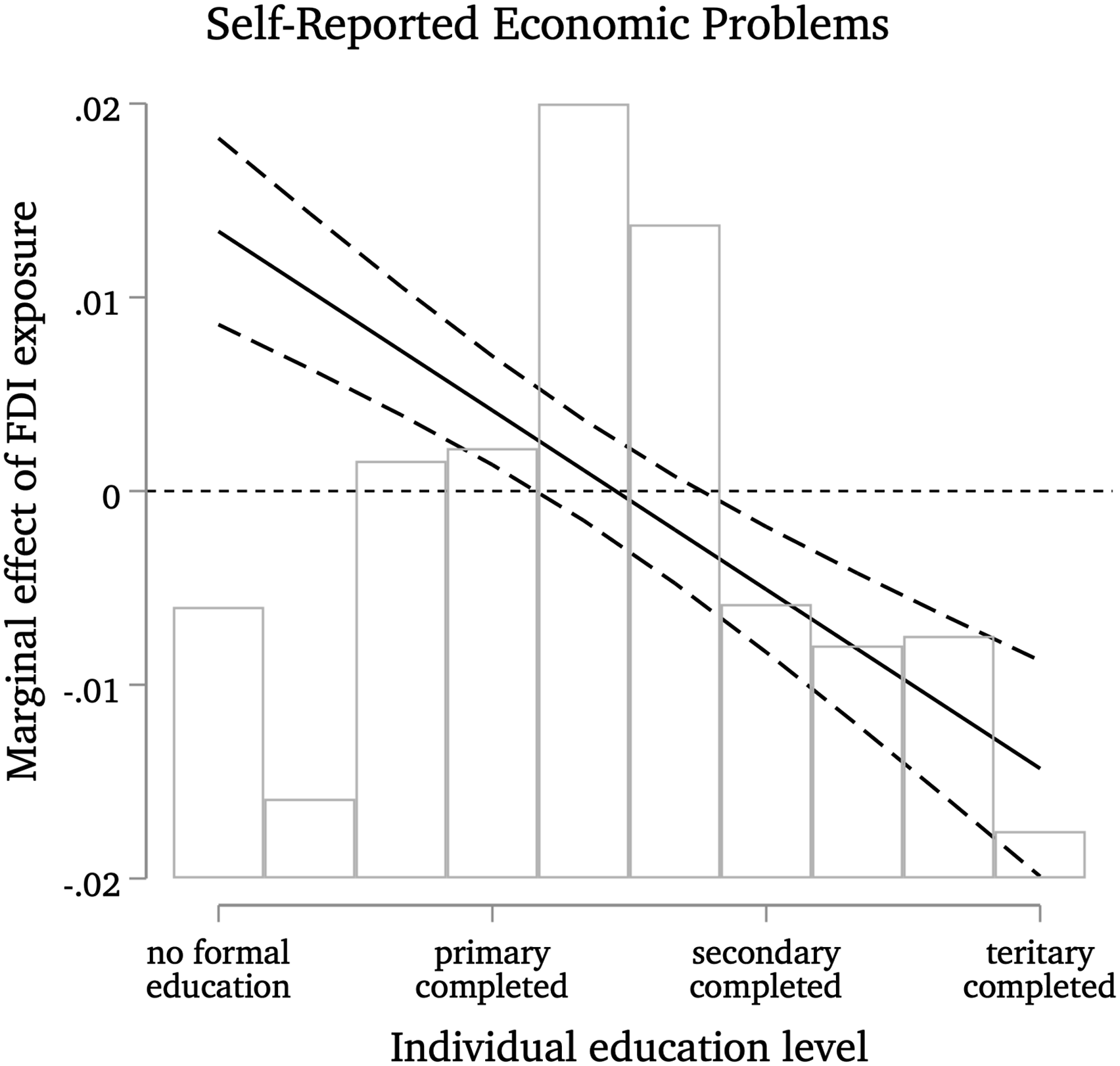
These results are robust to estimating (ordered) probit instead of linear probability models (see models 3, 6, and 9 in Table A-4) and are also robust to including fewer or more control variables as well as reducing the exposure radius to FDI from 20 km to 10 km (see Table A-5 in the Supplementary Appendix). My findings thus support Hypothesis 1 about the heterogeneous effects of FDI on material welfare of individuals. Even more, they cast serious doubt on theoretical models that identify winners and losers from globalization purely based on production factors (Heckscher–Ohlin trade models) or sectoral exposure (Ricardo–Viner trade models).
Distrust in State Institutions
In a next step, I analyze whether FDI-induced distributional consequences translate into differences in regime support. Initially, I focus on respondents’ trust and distinguish between three conceptually different state institutions/actors: the electoral commission, the country’s leader, and the ruling party. I expect that material consequences directly translate into distrust. Individuals that lose out from opening up to FDI should distrust state institutions more, whereas individuals that benefit materially should trust the authoritarian institutions more. The regression results reported in models 4–6 in Table 1 show that this is indeed the case (full set of models in Table A-6 in the Appendix).
FDI leads to less trust in the electoral commission among the poorly educated. Yet again, Figure 2 exemplifies that the effect of FDI weakens significantly the more educated respondents are. For those with tertiary education, being exposed of FDI implies that trusting the commission in charge of the administration of elections even exacerbates. Further regression models indicate that this conclusion also holds for distrust in the country’s political leader and the ruling party. These results are again robust to different sets of control variables and to reducing the exposure radius around investment projects to 10 km (see Table A-7 in the Appendix). As opposed to well-educated citizens, individuals with comparatively low education levels thus tend to offer less support for the authoritarian regime when exposed to foreign direct investment. Study 1: FDI exposure and distrust in electoral commission. Notes: Results based on model 4 in Table 1.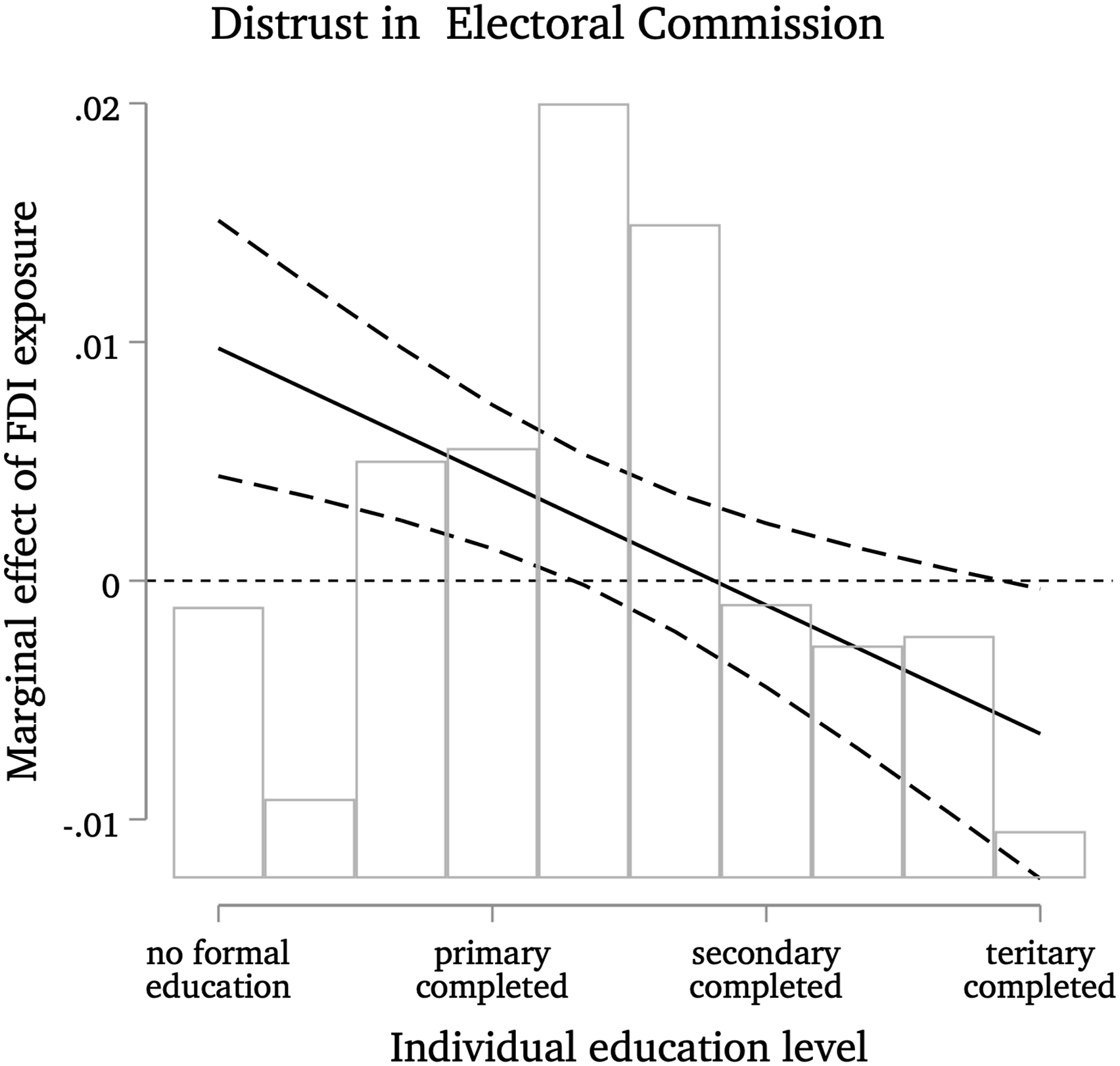
Regime Support
In a final step, I investigate how FDI shapes citizens’ assessment of the incumbent regime. I report results on three different indicators: models 1–3 focus on whether respondents explicitly say that the country they live in is in fact not a democracy, models 4–6 examine respondents’ satisfaction with the way democracy works, and models 7–9 explore whether respondents find democracy preferable to any other form of government. If respondents put a lot of value on democracy, I interpret this as less support for the incumbent regime. If, on the other hand, respondents think that the country they live in is in fact a democracy or are satisfied with the way politics is conducted, this shows higher levels of support for the authoritarian regime in place.
The results from models 7–9 in Table 1 (as well as the robustness tests in Tables A-8 and A-9) suggest that exposure to FDI indeed renders individuals more critical as to whether they think the incumbent regime is democratic and leads to lower levels of regime support if and only if individuals are comparatively low skilled. Due to the negative and statistically significant interaction term, the effect of FDI reverses the better educated citizens are. As exemplified in Figure 3 respondents have a lower probability of stating that their country is not a democracy as soon as they have completed at least secondary education. This is consistent with my theoretical argument. High-skilled individuals benefit from economic openness. Preferences for continued economic gains thus tend to outweigh demands for democratic participation. However, this must not mean that high-skilled citizens strongly prefer authoritarian rule but could also speak to a status quo bias. Study 1: FDI exposure and preferences for democracy. Notes: Results based on model 7 in Table 1.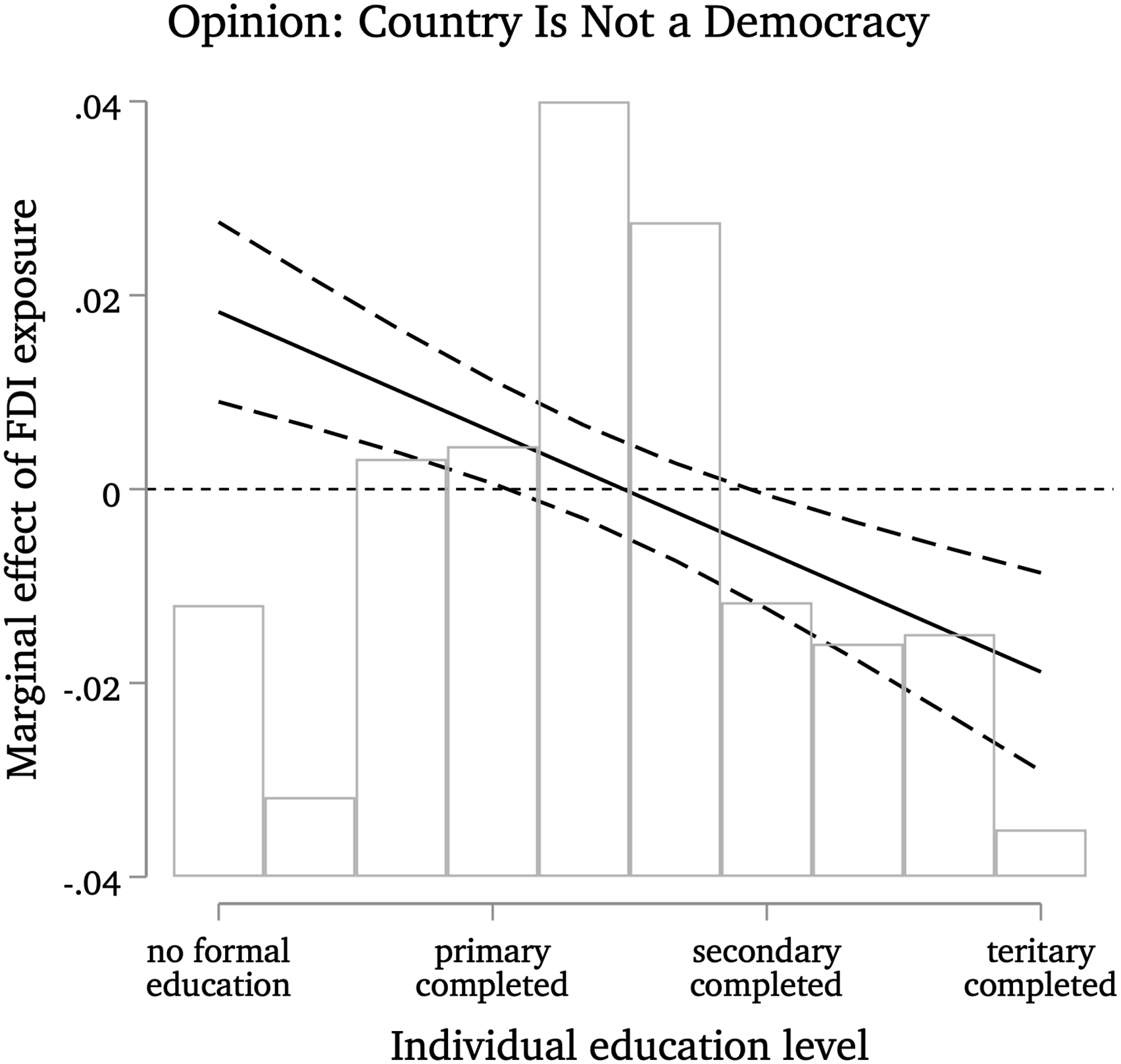
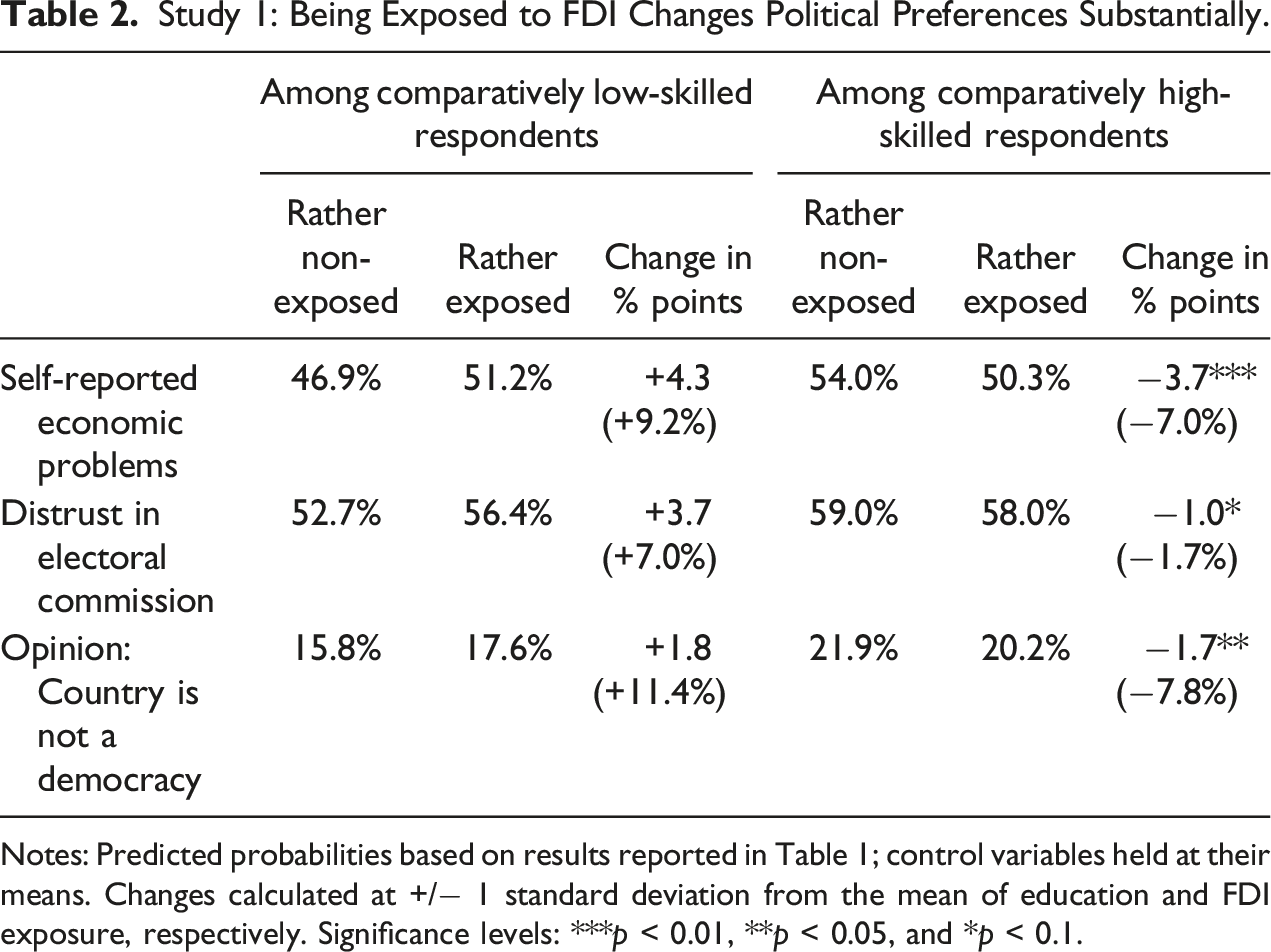
Study 1: Being Exposed to FDI Changes Political Preferences Substantially.
Notes: Predicted probabilities based on results reported in Table 1; control variables held at their means. Changes calculated at +/− 1 standard deviation from the mean of education and FDI exposure, respectively. Significance levels: ***p < 0.01, **p < 0.05, and *p < 0.1.
This pattern also travels to political preferences. Among the low skilled, FDI amplifies distrust in the electoral commission by about 3.7% points and bolsters respondents’ opinion that the country they live cannot be considered a democracy by about 1.8% points. Among the high skilled, however, being exposed to FDI has the opposite effect. The more such respondents are exposed to FDI, the more they trust the work of the electoral commission and the more they consider their country democratic. Even though the absolute changes in respondents’ political preferences are substantially smaller, the relative change compared to the baseline level is sizable.
In a last step, I trace the theoretical mechanism empirically. I follow the procedure outlined in Walter (2010) and estimate three sets of additional models (see Table A-10 in the Appendix). In models 1–3, I estimate the effect of economic grievances on distrust in state institutions; in models 4–6, I estimate the effect of economic grievances on regime support; and in models 7–9, I estimate the effect of distrust in state institutions on regime support. The results fully support the causal pathway outlined in the theoretical argument. Economic grievances lead to distrust in state institutions, which ultimately leads to lower levels of regime support.
Taken together, FDI has sizable consequences for political preferences across a wide range of indicators, ranging from self-reported economic problems to issues about trust in state institutions to support for the incumbent autocratic regime. The effect of FDI is not uniform. While it increases economic worries, amplifies distrust, and lowers regime support among low-skilled individuals, the effect of FDI reverses the more highly skilled respondents are.
FDI and Political Preferences in 14 Autocracies Around the Globe
In the second study, I complement the results from the Afrobarometer analysis and use data from a survey administered in 14 autocratic countries by the Pew Global Attitudes Project in 2007 (Pew Research Center, 2007). 14 The dataset covers roughly 10,500 working-age respondents that have lived under autocratic rule at the time the survey was conducted (see Table A-12 for descriptive statistics).
Outcome Variables
I use information on several dependent variables to examine the pathway from FDI exposure to citizen support for autocratic rule. Initially, I investigate perceived feelings of economic insecurity. I measure this variable with an open-ended question that asks respondents: “What do you think is the most important problem facing you and your family today?” Respondents’ answers were grouped into several different categories. As the distributional consequences of foreign investment directly affect wage development and unemployment, I code respondents to show realized feelings of economic insecurity, if they mention “low wages” or “unemployment” as the biggest or second biggest problem. Roughly one-third of respondents have experienced changes in personal well-being that lead to economic insecurity.
Second, I examine expected social decline that individuals might fear as a consequence of losing out economically using questions that ask respondents to rank themselves on a ladder. To arrive at the final measure, I subtract respondents’ expected standing in the future from their present assessment. Hence, positive deviations imply that respondents anticipate social decline. Third, I tap into regime support using a question that is closely related to satisfaction with the incumbent regime: “Please tell me what kind of influence the Prime Minister/President is having on the way things are going in [country]. Is the influence very good, somewhat good, somewhat bad, or very bad?” Higher values indicate dissatisfaction. Roughly one-third of the respondents indicate dissatisfaction with their political leadership.
For the last set of dependent variables, I measure citizens’ legitimacy beliefs in the incumbent regime with two questions that display whether respondents feel whether the functionality of political institutions is congruent with their needs. The first question refers to the de facto situation: “Does the following statement describe our country very well, somewhat well, not too well or not well at all? You can openly say what you think and can criticize the state or government.” The second question captures respondents’ ideal situation: “How important is it to you to live in a country where you can openly say what you think and can criticize the state or government? Is it very important, somewhat important, not too important or not important at all?” The difference between the answers to the former and the latter question gives a measure of congruence. A distance of zero implies that the amount of freedom of expression is exactly in line with the importance the respective individual places on it. 15 Conversely, a difference of three represents large-scale incongruence and corresponds to lower levels of legitimacy belief. I repeat this exercise for an assessment of the judicial system, where both questions refer to the statement “There is a judicial system that treats everyone in the same way,” and control of the military, where respondents were confronted with “The military is under the control of civilian leaders.” The resulting three measures thus refer to the belief in the legitimacy of the incumbent regime. All variables are coded such that higher values indicate incongruence.
Explanatory Variables
A valid test of my argument requires again three independent variables on the individual level. First, individuals differ with regard to the degree to which they are exposed to FDI. I rely on regional differences in survey recruitment and match this information with data on greenfield investments (The Financial Times Ltd, 2018). 16 As investment projects might need some time to unfold their consequences, I calculate the sum of investments over a five-year period (from 2003 to 2007) in each region and match this with the residence information of respondents. Regions for which there is no information are coded as non-exposed. This operationalization assumes that labor is mobile within but not across regions, which also implies that labor mobility is lower along regional than sectoral or occupational lines. Given that administrative regions are rather large, the bias arising from within-autocracy migration patterns should be small.
Individuals further differ according to the amount of occupational skills. I again measure individual skill-level using respondents’ educational background. In terms of operationalization, I use information on the highest level of education a respondent has received. The codings differ between countries, which is why I standardize them into six categories following the International Standard Classification of Education (ISCED). To capture the expected conditional effect of exposure to FDI and individual skill-level, I use an interaction term. The dependent variables are coded such that I expect a negative interaction term in all models.
Empirical Strategy
For the baseline specification, I use linear probability models and check the robustness by using probit and ordered probit regression models. Despite the limited number of countries, I use a random-effects multilevel model where respondents are nested within countries. I include a number of variables that control for alternative explanations. The baseline models include age in years, gender, whether a respondent is unemployed, the income level, newspaper consumption, urban versus rural residency, and the importance of religion. Income is measured by a self-classification into income classes. Unfortunately, countries differ to some extent with respect to the number of income classes provided in the questionnaire. To facilitate cross-national comparability, I recode this variable so that it represents the deviation of the respondent’s income-class from the country-specific median income-class. For reasons of limited data availability, I include further control variables in separate models. Here, I additionally control for whether respondents receive remittances, their marital status, the number of children, and whether the respondent has friends or relatives outside the country. 17
Findings
The findings obtained from 14 autocratic regimes around the globe support my theoretical argument and underscore the generalizability of the Afrobarometer analysis. Low-skilled individuals face adverse consequences from the presence of MNCs and form preferences that resemble less support for authoritarian rule. In contrast, well-educated individuals tend to believe more in the legitimacy of the incumbent regime because they benefit from FDI in material terms.
Material Consequences
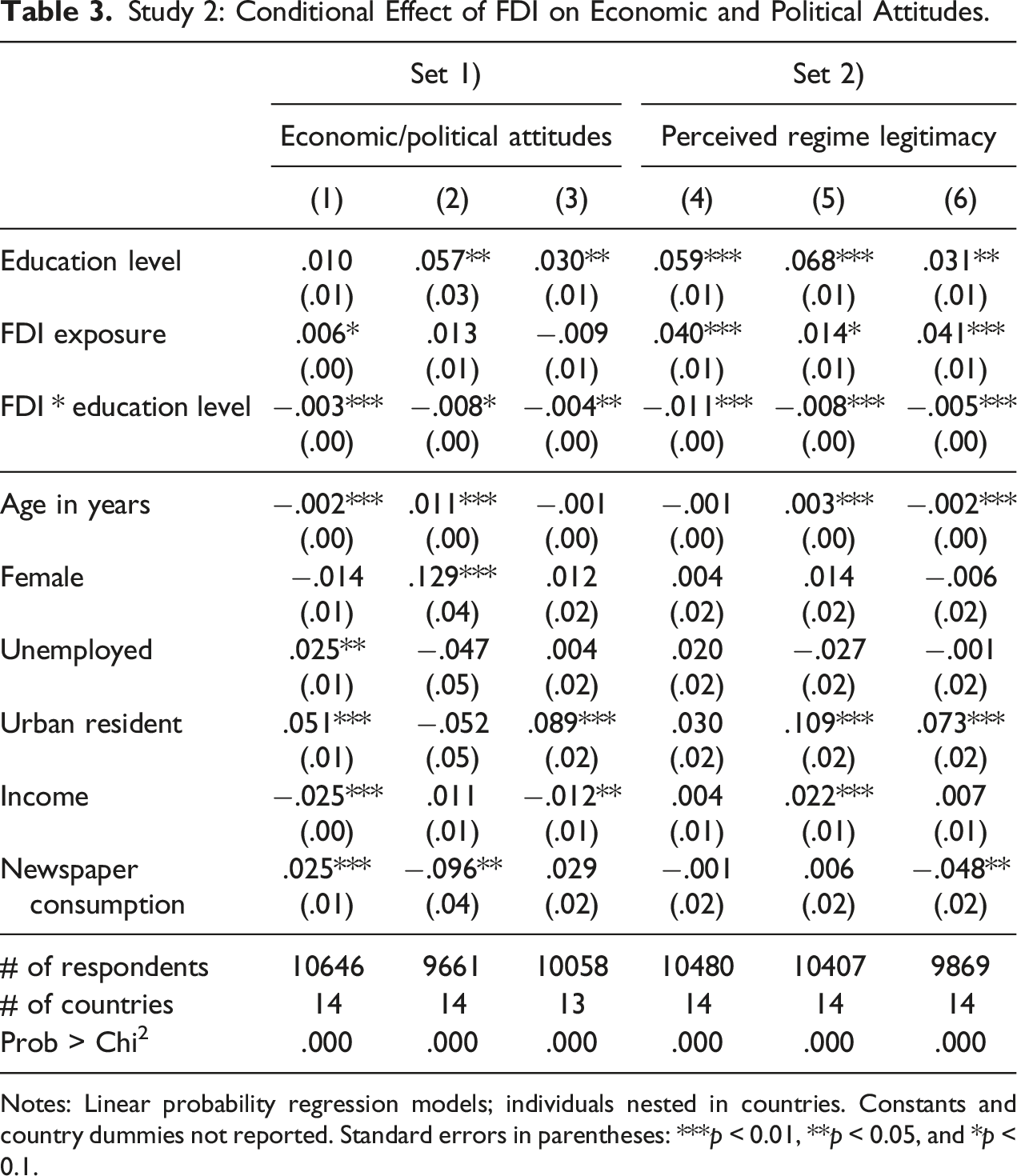
Study 2: Conditional Effect of FDI on Economic and Political Attitudes.
Notes: Linear probability regression models; individuals nested in countries. Constants and country dummies not reported. Standard errors in parentheses: ***p < 0.01, **p < 0.05, and *p < 0.1.
Regime Support
To gauge whether these material consequences translate into regime support, or the lack thereof, I examine leader satisfaction and whether citizens are more or less likely to report that the functionality of key political institutions is incongruent with their own view. Both dimensions serve as a proxy for the perceived legitimacy of the institutional setup of an authoritarian regime. I expect that the beneficiaries of FDI are less likely to report that the influence of the political leader is bad and have a stronger belief in the legitimacy of the incumbent government than losers of FDI openness.
The results on leader satisfaction are reported in model 3 in Table 3. The interaction term is negative and statistically significant, which means that the effect of FDI is dependent on how well individuals are educated. Whereas being exposed to FDI increases government dissatisfaction among the poorly educated, the well-educated are much more content with the way the president or prime minister leads the country. With regard to beliefs in the legitimacy of the authoritarian regime, models 4–6 in Table 3 report results on three important dimensions: freedom of expression, the fairness of the judicial system, and whether there is civilian control of the military. Across all models, the interactions term is negative and statistically significant (see Tables A-16 and A-17 for robustness checks). This exemplifies that poorly educated individuals are more likely to report incongruence between the importance they place on freedom of expression as a vehicle to overcome their dire economic situation, while at the same time they think that the actual level of freedom of expression is essentially meaningless in their country. Thus, FDI reduces the perceived legitimacy of autocratic rule for poorly educated citizens. In contrast, FDI does not change perceptions of the legitimacy of political institutions among those individuals that have received at least lower secondary education (see Figure A-5 in the Appendix). In essence, the beneficiaries are more satisfied with the institutional setup of the regime.
Conclusion
This paper has examined whether and how FDI exposure shapes citizen support for autocratic rule. I argue and find that the impact of international investment on both feelings of economic insecurity and regime support varies according to individual skill-level. High-skilled individuals evaluate both their personal economic situation and the status quo autocratic institutions and actors more positively if they are exposed to FDI. The opposite holds for the poorly educated who feel economically threatened; a dire situation that ultimately leads to more distrust in state institutions and lower levels of support for the incumbent regime. All in all, this analysis highlights that citizens’ political preferences are highly dependent on changes in material well-being induced by economic openness.
My argument and findings thus contribute to a couple of ongoing debates and open up avenues for further research. First, in international political economy scholars disagree about the distributional consequences of economic globalization. My results underscore the applicability of new trade theory to explain both economic grievances and political preferences in democratic (Walter, 2010, 2017) as well as in autocratic countries (Palmtag et al., 2020). The fact that FDI increases economic welfare for highly skilled individuals but at the same time leads to heightened economic grievances for the poorly educated also chimes well with recent research showcasing that globalization and economic inequality might be positively related (Goldberg & Pavcnik, 2007; Menéndez González et al., 2023).
A second debate, especially in comparative politics, is concerned with arguments that put the political demands of societal groups at the center of attention to explain regime trajectories. Redistributivist theories hypothesize that economic openness should increase the chances for democratization because individual demand for democracy increases in market income which is induced by economic globalization (Acemoglu & Robinson, 2006; Boix, 2003). My findings challenge the micro-foundations of these arguments, as FDI appeases a sizable part of the population by increasing satisfaction with the current regime. More generally, FDI affects a large share of both winners and losers in autocracies (see Table A-2 in the Appendix for exploratory estimates). Hence, to arrive at a better understanding of the macro-political consequences of the distributional consequences, future research should focus more on how FDI-related grievances and opportunities are aggregated into and map onto societal groups as well as the ability of the state to fine-tune economic openness.
Third, research that relies on the open economy politics paradigm generally assumes that people behave rational (Lake, 2009). My findings highlight that individuals are indeed able to form informed political attitudes based on their material situation and that people are generally aware of the consequences of large-scale economic developments. Future research should expand on this notion on two grounds. Despite my best efforts, this study only focuses on greenfield investment, which tends to produce higher growth rates (Harms & Méon, 2018), and only captures potential exposure to FDI. Studying directly exposed individuals would open up more opportunities to uncover the exact mechanism by which the material situation of individuals translates into political attitudes. Additionally, an important link that this study does not tackle is whether and how regime support can translate into specific demands for alternative regime types or democratization (see also, Gratton & Lee, 2023).
Lastly, my findings speak to the question of a possible backlash against globalization.
While we can observe a growing opposition to international market openness in developed countries, popular support for different forms of economic globalization is still relatively high in emerging and developing economies. My findings underscore the hypothesis put forward by Rudra et al. (2021) that the highly skilled beneficiaries of FDI are in a honeymoon phase and unlikely to act against international openness, while the widening gap between skill-groups has not yet manifested itself long enough for the low-skilled to oppose globalization at large. To arrive at a full picture of popular support or opposition for globalization across the globe, future research should explicitly expand this analysis and also analyze regime support for and in democracies. The fact that the low-skilled lose out might explain the backlash against international openness; yet the fact that FDI induces a status quo bias among better educated citizens might simultaneously offer an explanation for the stability of democracies.
Supplemental Material
Supplemental Material - Foreign Direct Investment and Political Preferences in Non-Democratic Regimes
Supplemental Material for Foreign Direct Investment and Political Preferences in Non-Democratic Regimes by Tobias Rommel in Comparative Political Studies.
Footnotes
Acknowledgments
I would like to thank Timm Betz, Daniel Bischof, Menna Bizuneh, Tim Büthe, Cindy Cheng, Fabian Engler, Søren Etzerodt, Chase Foster, Johannes Gerschewski, Lukas Haffert, Bastian Herre, Leo Hummel, Carl-Henrik Knutsen, Hannah Löffler, Irene Menendez Gonzalez, Luca Messerschmidt, Erica Owen, Tabea Palmtag, Katrin Paula, Amy Pond, Nils Redeker, Raphael Reinke, Paul Schaudt, Daniel Schulz, Rosalind Shorrocks, Svend-Erik Skaaning, Marco Steenbergen, Henrike Sternberg, Stefanie Walter, and the three anonymous reviewers for helpful comments and countless suggestions. I am grateful to the Department of Political Science at the University of Zurich, which generously offered funding to purchase data used in this study, and the members of the Chair for International Relations at the Hochschule für Politik München, led by Tim Büthe, for providing a highly supportive research environment.
Declaration of Conflicting Interests
The author declares no potential conflicts of interest with respect to the research, authorship, and/or publication of this article.
Funding
The author disclosed receipt of the following financial support for the research, authorship, and/or publication of this article: This work was supported by the Universität Zürich (internal grant, Department for Political Science).
Data Availability Statement
 are available from the CPS Dataverse. The original project-level FDI data that were used to generate the analysis datasets are available from The Financial Times, Ltd, but restrictions apply to the availability of these data, which were used under license for the current study, and so are not publicly available.
Supplemental Material
Supplemental material for this article is available online.
Notes
Author Biography
References
Supplementary Material
Please find the following supplemental material available below.
For Open Access articles published under a Creative Commons License, all supplemental material carries the same license as the article it is associated with.
For non-Open Access articles published, all supplemental material carries a non-exclusive license, and permission requests for re-use of supplemental material or any part of supplemental material shall be sent directly to the copyright owner as specified in the copyright notice associated with the article.
