



Abstract
It has long been established that the presence of the so-called “Ghent systems” of unemployment insurance greatly enhances unionization rates. This paper investigates the political determinants of the choice for and against the introduction and continuation of these systems. Based on a diachronic analysis of three paradigmatic cases, Belgium, the Netherlands, and Sweden, and two shadow cases, Germany and Britain, it shows that all major actors were well aware of their organizational effect during the first half of the 20th century. At the same time, it shows that long-term strategic thinking only played a major role in shaping party attitudes toward “Ghent” in countries where the prevailing party system ensured that its introduction produced clear partisan “winners” and “losers.” In all other countries, cost considerations were central in shaping party views on Ghent. The analysis shows how cost considerations can explain both bourgeois party support for its introduction and left-party support for its discontinuation.
Introduction
According to several decades of research, labor’s organizational strength has been a major factor determining the postwar direction of capitalist development, both through its impact on the partisan composition of government and because labor unions directly affect the development of welfare states and organization of labor markets (Arndt & Rennwald, 2016; Flavin & Radcliffe, 2011; Huber & Stephens, 2001). As a result, scholars have long discussed the causes of variation in the level of worker organization, both between countries and over time. As illustrated by a host of studies, one of the most important explanations for this variation lies in the absence or presence of the so-called “Ghent systems of unemployment insurance,” under which labor unions are responsible for the administration of state-subsidized unemployment insurance programs. According to these studies, the presence of Ghent systems greatly contributes to labor’s organizational strength (Ebbinghaus & Visser, 1999; Gordon, 2019; Rasmussen & Pontusson, 2018; Rothstein, 1990; Schnabel, 2013; Scruggs, 2002; Van Rie et al., 2011; Western, 1997). Since other types of unemployment insurance systems notably lack this organizational effect, the choice of unemployment insurance design has thus been of key importance for the postwar development of different “varieties of capitalism.”
At the same time, the political determinants of this choice are still not well-understood. While only three countries currently maintain “pure” Ghent systems, 1 with another, Belgium, operating a “quasi-Ghent system” that similarly works to boost union membership (Van Rie et al., 2011), nearly all European countries operated such systems at either the municipal or national level during large parts of the 20th century. Neither the introduction of these schemes nor their (dis)continuation at the national level can be explained easily through conventional partisan or class-based perspectives on politics. While the introduction and expansion of national-level Ghent systems in the three Nordic countries that still maintain these systems have already sparked some debate over the years (Rasmussen & Pontusson, 2018; Rothstein, 1990, 1992), their dissolution in other European countries poses as much of a puzzle, especially because it often occurred under conditions of left-party participation in government. As left parties are generally expected to benefit the most from institutions that are designed to promote worker mobilization (Arndt & Rennwald, 2016; Flavin & Radcliffe, 2011; Rothstein, 1992), their decision to support the dissolution of such institutions presents a major puzzle. So does the fact that in many countries, the introduction of national-level Ghent systems took place under Liberal and Christian Democratic rather than Social Democratic governments (Alber, 1982; Mares, 2003; Rasmussen & Pontusson, 2018; Rothstein, 1992).
When we turn to the role of labor unions in the development of unemployment insurance, another, even less well-known, puzzle arises: in many countries that dissolved existing Ghent schemes in the postwar period, all or major sections of the labor union movement, rather than fighting this dissolution tooth and nail, actually lent their support to it. These included countries, like Belgium and the Netherlands, where national-level Ghent systems had operated successfully for several decades before they were, respectively, partially and completely replaced by compulsory state-schemes under left-confessional governments in the postwar period (Oude Nijhuis, 2018; Vanthemsche, 1990). In other words, neither the union movement themselves nor their closest political allies seem to have been fully committed to the development of institutions that serve to boost the organizational strength of the working class. How are we to explain this lack of commitment? And how do we explain the introduction and continuation of Ghent systems of unemployment insurance in some European countries and their discontinuation in others?
Existing studies have suggested two types of answers to these questions. The first points to a major disadvantage of pure Ghent systems, which is their inability to offer unemployment protection for all workers, including the non-organized—a problem that derives from their voluntary nature. Even Rothstein in his classic work on the relationship between working class strength and unemployment insurance institutions, which attributes the introduction of the Ghent system in Sweden to the Swedish Social Democrats’ ambition to improve their long-term political prospects, for instance, noted that ideological considerations may have led left parties in countries other than Sweden to prefer mandatory—and thus state-administered—programs to voluntary union-run schemes (Rothstein, 1992: 44). More recently, Rasmussen and Pontusson (2018) have put forward a different explanation by downplaying the organizational benefits of Ghent systems for both the labor union movement and Social Democrats during their formative period of development.
While these claims certainly have some merit, this article qualifies them in an important way. Based on a comparative analysis of the introduction and (dis)continuation of national Ghent-based unemployment insurance systems in five European countries, the article confirms that the need to offer adequate protection to all workers was indeed of general concern to Social Democratic parties. Yet it also shows that this consideration was far from sufficiently salient to warrant a preference for mandatory, state-run systems. Similar to Rasmussen and Pontusson, it furthermore shows that long-term strategic thinking did not necessarily play a major role in shaping party attitudes toward the introduction and (dis)continuation of Ghent systems. Contrary to their account, however, the article does not attribute this to the absence of a perceived “Ghent-effect” during the first half of the 20th century. Instead, it shows that expectations regarding its impact on their long-term political prospects only played a major role in shaping party attitudes toward “Ghent” in countries where the prevailing party system had produced a clear dichotomy between a “pro-worker” left and “pro-business” right, and where its introduction was thus expected to produce clear partisan “winners” and “losers.”
A major purpose of the article is thus to provide a systematic analysis of the main determinants of party views on Ghent systems. To do so, it not only focuses on the importance of long-term strategic thinking but also illustrates the importance of a factor that has so far received very little attention in the political economy literature: cost considerations. It shows that in countries that lacked a strong dichotomy between a pro-worker left and pro-business right, these considerations were far more important in shaping party views on Ghent than were strategic considerations. Moreover, it argues that the importance of this factor among others lays in the normative understanding that groups who contributed to the financing of collective insurance should also be given some degree of control over its implementation. By showing how the salience of this norm ensured that Ghent systems were particularly difficult to reconcile with employer (co-)financing of unemployment insurance, the article not only offers a well-grounded explanation for the disappearance of Ghent systems under pro-worker governments, but it also explains instances of labor union support for the dissolution of policies that union leaders regarded as so important for their ability to organize and represent the working class.
The article consists of two main parts. The first part examines the two most important factors shaping partisan attitudes toward Ghent systems, cost and strategic considerations, and illustrates how their impact on the partisan politics of Ghent can be expected to have depended on, respectively, the economic circumstances and party systems under which political parties operated. The empirical part illustrates the claims put forward in the theoretical section and consists of three sections. The first two sections offer an in-depth comparative analysis of the introduction and (dis)continuation of Ghent systems in three important cases: Belgium, the Netherlands, and Sweden. While the Swedish case has been well-documented in the literature, the analysis of Belgium and the Netherlands rests on evidence from a variety of sources, including minutes of meetings and internal and public correspondence of labor unions, business groups, and political parties in the two countries. To test the argument’s degree of generalizability, the third section analyzes how cost and strategic considerations mattered for the failure of attempts to introduce Ghent systems in two shadow cases: Germany and the United Kingdom.
Revisiting the Partisan Politics of Ghent
Over the years, many studies have explained how Ghent systems of unemployment insurance create selective incentives for workers to join unions and remain union members during spells of unemployment (Ebbinghaus et al., 2011; Rothstein, 1990; Schnabel, 2013; Scruggs, 2002; Western, 1997). As a result, we now have a clear view of how these systems serve to boost the power resources of the working class and electoral prospects of “worker-friendly” parties. Whether and how labor’s power resources and partisan politics in turn mattered for the introduction and (dis)continuation of Ghent systems in different countries remains much less clear, however. In-depth comparative-historical analyses of partisan and union attitudes toward these systems are rare, and existing research has mostly focused on the Nordic countries—in particular on Sweden. As a result, and while often treated as conventional wisdom, Rothstein’s claim that party positions on Ghent were largely shaped by their assessment of its impact on labor’s organizational resources and by extension on their own political prospects (Rothstein, 1990, 1992) has not been systematically tested for countries other than Sweden.
In a recent study, Rasmussen and Pontusson (2018) have attempted to shed doubt on this claim. They have done so by showing that Ghent systems did not have noticeable effects on unionization rates until the 1950s or even 1960s, when many European countries had already abolished them. This article takes a different approach. In line with existing historical research (Führer, 1990; Harris, 1984; Nijhof et al., 1983; Toft, 1995; Vanthemsche, 1990), it confirms that Ghent systems were broadly regarded as highly effective instruments for union recruitment in all countries where their introduction was discussed during the first half of the 20th century. It nevertheless emphasizes that long-term strategic thinking did not necessarily play a major role in shaping party attitudes toward these systems. Whether it did arguably depended on the extent to which the prevailing party system was characterized by a dichotomy between a “pro-worker” left and “pro-business” right. In countries where this dichotomy was strong, the introduction of Ghent systems could logically be expected to result in clear partisan “winners” and “losers”; in countries where this dichotomy was weak, their introduction was by contrast not expected to lead to major shifts in the long-term political prospects of the main political parties.
Given that the industrialized countries differed significantly in the extent to which their party systems were characterized by the labor-capital cleavage (Kitschelt, 1994; Kersbergen & Manow, 2010), we can thus expect to see significant cross-national variation in the extent to which party views on Ghent were informed by long-term strategic thinking. On one extreme we can find countries with two-party systems, where pro-worker parties tended to compete with traditional Liberal-Conservative parties (Neto & Cox, 1997). The latter not only tended to display a deep skepticism of institutions that imposed constraints on market competition, in particular when these were disliked by employers, as seems to have been universally the case with Ghent systems (Alber, 1982; Führer, 1990; Harris, 1984; Heclo, 1974; Vanthemsche, 1989); as they generally lacked ties to the labor movement that were equally close as those of their left competitors, they also tended to have a strong electoral incentive to oppose the introduction of Ghent systems. Given the electoral strength of these Liberal-Conservative parties in countries with two-party systems, it is not surprising that none of these countries ever developed pure Ghent systems (Magnussen & Pontusson, 2018: 803).
At the same time, traditional Liberal-Conservative parties were by no means limited to countries with two-party systems. In fact, before the introduction of universal suffrage, they were a dominant force in most countries with multiparty systems as well. Moreover, for a variety of reasons, which have been discussed extensively in the literature (Grofman & Lijphart, 2002), Liberal-Conservative parties maintained considerable strength in the Nordic countries throughout the interwar period—although not to the same extent as their counterparts in countries with two-party systems (Moller, 2020). As a result, Rothstein’s finding that long-term strategic thinking played a major role in shaping the views of both the Swedish Social Democrats and (parts of the) Swedish bourgeois (read: non-socialist) block is not surprising: in the context of the Swedish party system, the Ghent option could be expected to have fairly strong electoral consequences.
Finally, we can find multiparty systems where the strength of non-economic cleavages prevented the coming about of a strong dichotomy between a pro-worker left and pro-business right. In these countries, Christian Democratic and other Centrist parties replaced Liberal-Conservative parties as the dominant bourgeois parties following the introduction of universal suffrage (Hanley, 1996). As a result, they not only tended to be characterized by a broad parliamentary majority in favor of regulatory labor market intervention and syndicalist organization; as the organizational benefits of Ghent were also shared more broadly, strategic considerations were much less important in shaping individual party views on their introduction and (dis)continuation. In Belgium and the Netherlands, for instance, the Christian Democrats—which together with Social Democrats consistently controlled over seventy percent of all parliamentary seats during the crucial second and third-quarters of the 20th century—had by the 1920s developed close ties with labor union movements that were also organized on a confessional basis (Pasture, 1992; Windmuller, 1969). In addition, the Belgian Liberal Party maintained close links with a separate liberal union federation (Brepoels, 2015). As Christian Democratic and other Centrist parties were relatively strong in many other continental European countries as well, it is therefore not surprising that Ghent systems were particularly prevalent there during the first half of the 20th century (Alber, 1982; Rasmussen & Pontusson, 2018).
An analysis focusing solely on variation in the salience of long-term strategic thinking can thus capture much of the partisan dynamics of Ghent. In countries where its introduction was expected to lead to major shifts in the political prospects of the main political parties, party views can be expected to have been overwhelmingly driven by long-term strategic thinking. In countries where such shifts were not expected, the bourgeois parties can consequently be expected to have displayed a much more positive attitude toward the Ghent option. At the same time, an approach that only focuses on strategic considerations has clear limitations. One such limitation is that it obviously struggles to explain the discontinuation of Ghent systems under distinctly pro-worker governments. As noted earlier, most of the twelve countries that operated either “pure” or “semi”-Ghent systems at some point during the 20th century no longer to do so today. The vast majority of these countries discontinued their (semi-)Ghent systems under governments that were clearly sympathetic to the labor union movement. 2 How are we to explain such instances? To do so, it is necessary to consider a factor that has been of neglected but arguably key importance in shaping bourgeois party views on the design of unemployment insurance: cost considerations.
While few studies have systematically explored how decisions on the financing of unemployment and other social insurance programs shaped discussions on the design of these programs, there can be no doubt that they did so in important ways. One of these can clearly be considered as favoring the development of Ghent systems: compared to the alternative of setting up a completely new state-run unemployment insurance program, the practice of providing subsidies to existing union-run unemployment funds was evidently much less costly to the Treasury. Given their preference for a frugal approach toward government spending, it is therefore not hard to see why bourgeois governments may have found the Ghent option attractive—provided that they held an at least somewhat favorable view of labor unionism and did not expect its introduction to worsen their political prospects.
In at least one crucial manner, however, cost considerations arguably also worked against the development of Ghent systems. As recently emphasized by Rasmussen and Pontusson (2018: 798), the selective incentives for union membership offered by Ghent systems heavily depended on the size of external funding. Yet the provision of external funds naturally led to demands for control. When subsidies were provided by the state, it often sufficed to make their receipt contingent on the acceptance of state oversight of the operation of union funds. While always disliked by the unions, such oversight did not necessarily undermine their central role in the administration of unemployment insurance programs (Nijhof et al., 1983; Rothstein, 1990; Vanthemsche, 1989). When employers were required to contribute to the insurance, however, it became politically far more difficult to defend a union monopoly over its operation. After all, the imposition of mandatory employer contributions obviously provided employers with a strong moral claim to shared control over the operation of the insurance. While parties that exclusively defined themselves as worker parties could possibly ignore this claim, the politically dominant bourgeois parties were naturally reluctant to do so—even when they held a favorable view of labor union organization and contained well-developed workers’ wings.
This reluctance arguably had two important implications. First, it potentially undermined support for the Ghent option among bourgeois parties and enabled strategic opponents of Ghent to propose employer (co-)financing in an attempt to obtain support for an alternative unemployment insurance design. Second, it placed the unions in the difficult position of having to choose between employer (co-)financing and their monopoly over the insurance’s administration. To appreciate the importance of this predicament, it is crucial to note that there were clear limits to the extent to which governments were able to subsidize unemployment insurance funds during the first half of the 20th century—even when these were dominated by the left (Alber, 1982; Heclo, 1974). The absence of employer contributions consequently had very real consequences for benefit generosity. These consequences were naturally felt most severely under economic conditions that produced high levels of unemployment. As a result, economic conditions can be expected to have played a major role in determining how labor unions solved this predicament: under conditions of high unemployment and severe austerity, they were considerably more likely to compromise on the administration of unemployment insurance in order to obtain employer (co-)financing than would be the case under more favorable economic conditions.
The Partisan Politics of Ghent
An analysis that focuses on the salience of the two most important factors shaping party views on Ghent, cost and strategic considerations, can thus explain cross-variation in both the initial choice for or against the introduction of Ghent systems and the subsequent choice to either discontinue or maintain these systems. The following two sections illustrate this by focusing on the introduction and (dis)continuation of Ghent in Belgium, the Netherlands, and Sweden. Their different party systems (a relatively strong dichotomy between a pro-worker left and pro-business right in Sweden and a much weaker dichotomy in Belgium and the Netherlands) and economic experiences in the pre-war period (with Belgium and the Netherlands experiencing extremely high levels of unemployment during the 1930s while Sweden did not) make a comparison of these three countries ideally suited to illustrate how the importance of strategic and cost considerations in shaping political discussions on Ghent depended, respectively, on party system types and prevailing economic circumstances.
Strategic Considerations and the Introduction of Ghent in Belgium, the Netherlands, and Sweden
The partisan politics of pre-war unemployment insurance reform in Sweden is well-documented and can therefore be presented in a compact manner. As evidenced by a number of studies over the years, up to the introduction of a Ghent-style unemployment insurance in 1934, the possible establishment of a public unemployment insurance system was one of the most hotly contested issues in Swedish politics. As extensively documented by Rothstein, the Social Democrats’ support for this model clearly resulted from the “union-friendly” nature of this system, a feature that was emphasized in various party pamphlets during the 1920s. This effect was deemed so important to the Social Democrats that when the largest union federation, the Landsorganisationen i Sverige (LO), suggested to strike a deal with the Liberals in favor of a state-run system in response to an increase in unemployment in the early 1930s; the Social Democratic Minister of Social Affairs, Gustav Möller, responded that they should continue to push for the introduction of a Ghent system, as such a system would “force workers into the unions” (Rothstein, 1992: 49). To obtain Liberal support for the Ghent-option, the Social Democrats were moreover willing to make major concessions. These included granting the National Board of Social Affairs the right to license and supervise unemployment funds, allowing non-affiliated workers to become members of these funds, lowering benefit levels and introducing stricter entitlement rules, and, crucially, removing the proposed obligation on the part of employers to assist in the co-financing of unemployment funds (Heclo, 1974: 102–105). As emphasized by Möller, the most important thing was that the principle of state subsidization of union-run unemployment funds was to be established; once this goal was achieved, its substance could be improved upon later (Rothstein, 1992: 48–49).
Strategic considerations clearly also played an important role in shaping bourgeois party views on the design of unemployment insurance in Sweden. For the Liberals, these were eventually trumped by their appreciation of the cost effectiveness of the Ghent system and the Social Democrats’ willingness to make concessions on matters such as the treatment of non-organized workers and employer (co-)financing (Heclo, 1974; Rothstein, 1992). Whether the Liberals’ eventual willingness to support the introduction of a Ghent system was to some extent influenced by the expectation that liberal-friendly unions would also benefit remains unclear. Yet, there can be no doubt that the Conservatives’ continued opposition was motivated by the realization that they stood to lose from it. After all, they specifically motivated their opposition to “Ghent” by emphasizing that its introduction would further the unions’ organizational strength and thus the political strength of the Social Democratic Party (Rothstein, 1992: 47). They managed to do so until the 1930s, when the Social Democrats obtained a definitive hold on power. After the coming about of the 1934 Social Democratic–Liberal compromise that led to the introduction of the Swedish Ghent system, the Conservatives continued to criticize its institutional principles, in particular the connection between union and insurance membership, but lacked the electoral strength to bring about reform (Rothstein, 1992).
As a result of the importance of long-term strategic considerations in shaping party positions on Ghent, it is not surprising that its introduction in Sweden came about relatively late: given the aversion of most bourgeois parties to this system, its introduction only became a viable option once the Social Democrats obtained firm hold on power and managed to strike a deal with the most moderate of the bourgeois parties, the Liberals. A very different situation could be found in Belgium and the Netherlands, where the Christian Democrats gradually replaced Conservative-Liberal parties as the dominant bourgeois parties during the first two decades of the 20th century, a process that was completed with the adoption of universal manhood suffrage at the end of the First World War. 3 This transformation ensured that the Ghent system became a viable political option during the first decade of the 20th century and could count on stable parliamentary support from 1918.
In the Netherlands, a progressive Liberal government supported by the Christian Democrats and Social Democrats was the first to speak out in favor of the Ghent principle. It did so in 1907, when various local municipalities, who were in turn partially subsidized by the state, had begun to provide financial support to union-run unemployment funds. When questions were raised about this practice in parliament, it responded by saying that there were “in principle no objections to these initiatives” (TK, Handelingen 1906-1907, Bijlage A, 34 der M.v.A.). To the unions’ disappointment, a government bill to provide direct state subsidies to union-run funds had to be revoked because of conservative opposition in parliament that year. However, following a major Christian Democratic victory during subsequent elections in 1909, parliament instituted an advisory committee to study the problem of unemployment. When this committee advocated the introduction of a Ghent system in 1914, its recommendations were enacted into law by a broad majority of Social Democrats, Christian Democrats, and Liberal parties in that year (Molenaar, 1958).
In as early as 1907, a Catholic-led government in Belgium similarly began to assist municipalities that already provided subsidies to union-run funds by adding state subsidies. Like in the Netherlands, there was significant conservative opposition to the Ghent option in parliament at the time, with various members lamenting that it would strengthen the labor union movement (Vanthemsche, 1989). As the share of Liberal-Conservative voices in parliament decreased in subsequent years, so did these concerns, however. After 1918, the notion of trade union organization was supported by a broad coalition of Social Democratic, Christian Democratic, and (progressive) Liberal parties in the two countries. When a Belgian national unity government replaced the system created in 1907 with a more permanent and well-regulated system in 1920, there was scarcely any parliamentary opposition to this decision (Vanthemsche, 1989).
Despite the absence of strong evidentiary statements along the lines provided by Möller in Sweden, the supportive stance of the Belgian and Dutch Social Democrats for state-subsidization of union-run funds likely related to the expectation that this practice would benefit the Social Democratic union movement. After all, in their view, Social Democratic labor unions and political parties merely constituted separate components of this movement (Van Haegendoren, 1992; Windmuller, 1969). On the part of the Christian Democrats, the situation was far more complex though. In Belgium at least, it had become clear by the 1930s that unions affiliated to the Confederation of Christian Trade Unions (ACV) actually benefited more from the practice of state subsidization of union-run funds than did those affiliated to the socialist Trade Union Commission (SC). By the middle of the decade, the ACV consequently began to defend the Ghent system by warning that its abolition would “lead to more revolutionary action” (KADOC, ACV Bestuursorganen, 1-6-1937). There is, however, no evidence that the Catholic Union of Belgium (KUB) had expected ACV unions to benefit more than SC-associated unions in the years leading up to the Ghent system’s introduction in Belgium. Nor is there any evidence that the Dutch Christian Democrats had expected the confessional unions to benefit more from “Ghent” than their socialist counterparts would.
There is by contrast ample evidence that Christian Democratic politicians in the two countries appreciated the practice of providing state subsidies to union-run funds for other reasons. These obviously included its cost-effectiveness: providing subsidies to existing funds was after all much cheaper than setting up a completely new state-run system (Nijhof et al., 1983; Vanthemsche, 1989). Yet crucially, the Ghent system also aligned well with Christian Democratic worldviews. One of these was that it rewarded workers’ personal responsibility—an effect that progressive Liberals also appreciated, with the Liberal minister who had introduced the Ghent system at the national level in the Netherlands, for instance, explaining his decision to do so by emphasizing that “it had been important to me […] to give those workers who had made sacrifices an advantage over those who had failed to take precautions” (Treub, 1917: 179). In addition, the Christian Democrats tended to view worker organization—as long as it took a moderate form—as a stabilizing factor in labor relations, which was to be promoted. For these reasons, the Christian Democrats vastly preferred a Ghent system to a mandatory state-run system. According to prominent Christian Democrats such as the Dutch Catholic Minister of Social Affairs Timotheus Verschuur and his counterpart in the city of Utrecht Hendrik Bekker, the Ghent system was to be appreciated because it “promotes order in our society” (NA-NL, Commissie-Zaalberg, 2.15.09, Brief Verschuur, 24-11-1931), whereas the alternative of a state-run system would “lower the appeal of the union movement and thus promote anarchy” (Nijhof et al., 1983: 30).
The only notable opposition to the Ghent-option in the two countries thus came from employers, who were clearly also well aware of its organizational effect. Evidence of this awareness can be found in their willingness to undergo a dramatic volte face on the matter of unemployment insurance: while initially opposed to any legislative initiative in this area, by the late 1920s employer groups in both countries had come to advocate the introduction of a mandatory insurance administered by either industry or the state. During internal deliberations, Dutch employers explained their change of heart in clear strategic terms, arguing that it was “essential” for employers to have “influence” over the administration of unemployment insurance funds (NA-NL, 2.19.103.04.2: Centraal Overleg Werkgeversverbonden, 15-9-1921). While some of them went so far as to offer employer co-financing, a majority of employers felt that this went too far (Ibidem, 11-8-1921). In Belgium, employer representatives did offer employer co-financing in exchange for involvement in the administration of unemployment funds during discussions in a 1920s study group on unemployment insurance reform, but this offer was flat-out refused by the unions (Vanthemsche, 1989: 30–31).
Nor did employer groups in the two countries receive much parliamentary support for their proposals. Ironically, the Social Democrats were the only major parliamentary faction that could be expected to feel some discomfort with the notion of some groups of unemployed workers receiving lower benefits than others (like in Sweden, union-funds that received government subsidies were not allowed to make benefit entitlement conditional on union membership in the two countries but were allowed to provide higher benefits to union members). This unease was not enough to prompt a preference for a mandatory system among the Belgian and Dutch Social Democrats, however. In fact, given their strong organizational ties to the labor union movement, it is difficult to conceive of either the Christian Democrats or Social Democrats in the two countries enacting any measure that they perceived to be detrimental to organized labor’s organizational interests (Oude Nijhuis, 2018; Pasture, 1992). And the latter left no doubt that they would perceive an attack on Ghent as such, with the powerful Belgian Metal Workers’ Central (CMB) for instancing warning that “on that day…we will all be lost”, as “a fourth, third, or even half of our members will leave us” (AMSAB, 135.00017, Nationaal Bestuur CMB, 18-5-1935).
In sum, in the absence of a strong dichotomy between a pro-worker left and pro-business right, the partisan politics of Ghent was strikingly different from those in the paradigmatic Swedish case. As a result of this absence, the Ghent option could count on rather broad levels of parliamentary support in Belgium and the Netherlands. The situation was very different in Sweden, where various bourgeois parties continued to criticize the institutional principles of the Ghent system for many years after its introduction. For obvious reasons, this makes it rather puzzling that the Belgian and Dutch Ghent systems were replaced by mandatory, state-run systems in the immediate postwar period, while the Swedish Ghent system continues to operate up to the present day. To solve this puzzle, a focus on strategic considerations is obviously of little use; instead, it is necessary to consider the extent to which both party attitudes and union positions on Ghent were shaped by cost considerations.
Cost Considerations and the (Dis)continuation of Ghent in Belgium, the Netherlands, and Sweden
In much of the political economy literature it is often assumed that the introduction of Ghent systems, by “strengthening the forces that have a positive interest in preserving the institution,” created political dynamics that made these systems relatively robust (Rothstein, 1992: 51. See also Gordon, 2019; Hallgren, 1986; Schnyder, 2012). The logic behind this assumption certainly makes sense; there can be no doubt, for instance, that the introduction of the Ghent system in Sweden contributed to the political strength of its main proponent, the Swedish Social Democrats, which in turn facilitated the party’s ability to fend of Conservative attacks on this system (Hallgren, 1986). At the same time, however, the view of Ghent systems as politically robust is clearly at odds with actual events: of the eleven countries that operated “pure” national-level Ghent systems at some point during the 20th century, only three do so up to the present day (Magnussen & Pontusson, 2018). Since the majority of the countries that discontinued these systems, as noted earlier, did so under governments that were clearly sympathetic to the labor union movement, a focus on strategic considerations alone is insufficient. And when we factor in the importance of cost considerations, it becomes clear that Ghent systems were often quite fragile, at least during the formative first decades of their operation.
To appreciate this fragility, we first need to take a close look at bourgeois party views on the operation of Ghent systems. The previous part illustrated how diverse bourgeois party positions on labor union organization and consequently the Ghent option were. In one crucial respect, these parties seem to have been in broad agreement, however: while quite willing to consider the introduction of the Ghent-option, even the Swedish Liberals, for instance, felt that it could not be combined with mandatory employer co-financing, thus forcing the Social Democrats to remove this demand from their proposal in 1934. For similar reasons, the Belgian and Dutch Christian Democrats were highly reluctant to accept union demands for the introduction of an unemployment insurance that was “managed by the labor unions, at the expense of the owners of the means of subsistence” (SK, 1928: 4). As evidenced by events in the United Kingdom, which are discussed in the following part, other bourgeois parties were just as reluctant to meet such demands. As a result, out of the eleven countries that operated “pure” or voluntary Ghent systems during the first half of the 20th century, only one country, Denmark, imposed mandatory employer (co-)financing before the War (Toft, 1995).
It is not hard to see how this placed labor unions everywhere in a difficult position. Both because employer contributions directly translated into either higher benefits or lower worker contributions (or both) and because they considered employers responsible for involuntary unemployment, it was an common practice for European labor union movements to demand employer (co-)financing of unemployment insurance programs (Alber, 1982; Heclo, 1974; Oude Nijhuis, 2019). Up to the 1934 compromise that enabled the introduction of the Swedish Ghent system, the Swedish LO had been just as insistent on employer (co-)financing as the Belgian and Dutch labor union movements had been—if not more so. Its willingness to drop this demand in 1934 was clearly strategically motivated: without this concession, the Liberals might simply not have agreed to the introduction of a system that was deemed so effective in boosting the organizational strength of the working class (Heclo, 1974). At the same time, it is crucial to note that relatively favorable economic conditions and the novel receipt of state subsidies also dramatically reduced the LO’s material stake in employer (co-)financing. In this respect, the LO crucially differed from its Belgian and Dutch counterparts.
The attitudes of the Belgian and Dutch labor union movements toward unemployment insurance reform were initially shaped by the same strategic considerations as those of the LO. Like the LO, both the socialist and confessional union federations in the two countries were strong proponents of employer co-financing. As best expressed by the socialist Dutch Association of Trade Unions (NVV) in a 1914 report, however, they also agreed that the key priority needed to be “to ensure that there are no doubts that the unions are the administrators of the insurance” (NVV, 1914: 6). As a result, they were obviously unwilling to sacrifice their central role in the administration of unemployment insurance funds in exchange for employer co-financing of these funds. Like their Swedish counterpart, the prewar Belgian and Dutch union movements lacked the political clout to achieve both aims. Unlike their Swedish counterpart, however, this inability eventually placed the Belgian and Dutch union movements in a very difficult position. This difference cannot be explained by variation in the level of state subsidies. On the contrary, the Swedish Social Democratic government was actually considerably more frugal in its support for the unemployed than were its Christian Democratic-led counterparts in Belgium and the Netherlands: by the end of the 1930s, the percentage of unemployment benefit outlays financed by the state equaled to 57% in the Netherlands, 40% in Belgium, and a mere 34% in Sweden (Korpi & Palme, 2007). To explain the more difficult position in which the Belgium and Dutch union movements found themselves in the 1930s, it is therefore necessary to look at the very difference economic circumstances in which the three labor union movements found themselves following the outbreak of the Great Depression.
Figure 1 illustrates how much more unfavorable economic conditions in Belgium and the Netherlands were compared to those in Sweden during the 1930s. In the first three years following the 1929 stock market crash, unemployment in Sweden increased roughly as rapidly as in the other two countries. This makes it unsurprising that the LO, as noted earlier, suggested striking a deal with the Liberals in favor of a state-run and thus partly employer-financed system during the early 1930s. Contrary to in Belgium and the Netherlands, however, unemployment levels had begun to decrease rapidly after 1933— a year before the introduction of the Swedish Ghent system. Only shortly thereafter, unemployment returned to between four and five percent. Under such conditions, it is not surprising that many unions could choose to reject—and could thus survive without—government subsidies through the decade (Heclo, 1974; Rasmussen & Pontusson, 2018). In Belgium and the Netherlands, on the other hand, where unemployment remained much higher, the unions were in a desperate need of additional financial sources to maintain benefit adequacy. The only other two countries with national-level Ghent systems where unemployment levels even came close to those in Belgium and the Netherlands during the 1930s were Norway, which notably replaced its Ghent system with a system based on tripartite financing in 1938,
4
and Denmark, the only country where the unions, as noted earlier, had succeeded in achieving their twin aim of combining employer (co-)financing with a union monopoly over the administration of the insurance (Grytten, 2009). Unemployment rate in Belgium, Sweden, and the Netherlands, 1929–1938 (% workforce).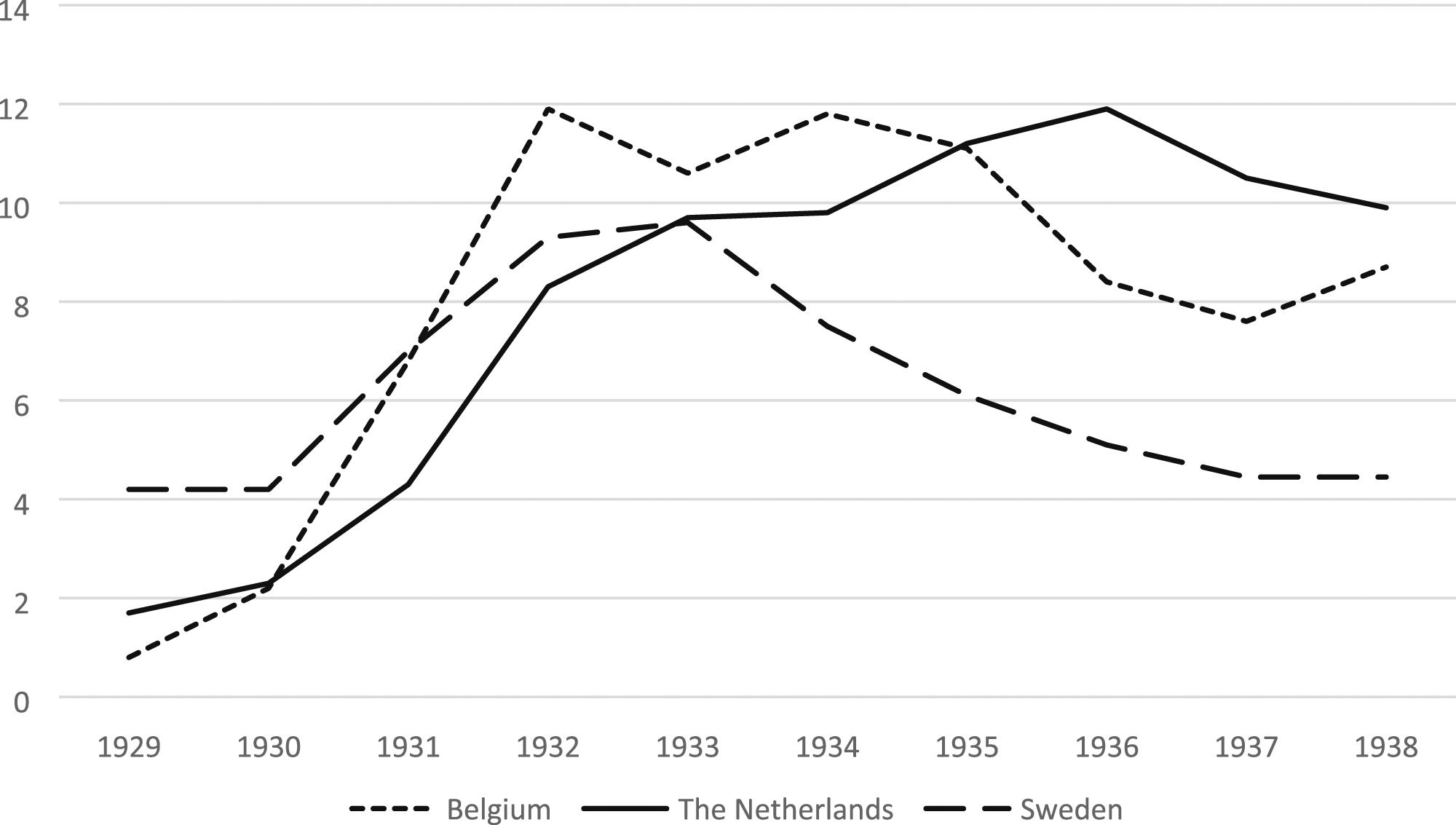
The consequences of the 1930s unemployment crisis for the operation of unemployment funds in Belgium and the Netherlands have been well-documented (De Rooy, 1979; Nijhof et al., 1983; Vanthemsche, 1989). In both countries, governments imposed austerity measures that forced union administrators to lower benefit levels, increase worker contributions, and tighten eligibility criteria—measures that led to considerable tension between union representatives and members and were thought to foster communist and fascist competition (SK, 1937; KADOC, Raadszitting ACV, 1-6-1937). While union leaders in both countries did their best to limit austerity, in an era when deficit-spending was unthinkable—including by Social Democratic governments (Blyth, 2002)—harsh benefit cuts were simply unavoidable.
Crucially, despite its severity, the crisis of the 1930s did not significantly alter the position of the main parties on the design of unemployment insurance in the two countries. Despite strong efforts to do so, employer groups did not succeed in persuading the Christian Democrats and Liberals to deprive the unions of their central role in the administration of unemployment insurance. The unions in turn did not manage to persuade parliament to expand employer liability for the financing of unemployment insurance—at least not without sacrificing their central role in its administration. At times, the unions came close. In the Netherlands, the Catholic Minister of Internal Affairs Ruys de Beerenbrouck in 1933, for instance, introduced a legislative proposal for the introduction of a tripartite system of financing that preserved the voluntary nature of the insurance as well as the central role of the unions in its administration. The proposal failed, however, after his protestant successor Jan Slotemaker de Bruine rejected it as too costly for industry in times of crisis (KDC, 370, Archief KAB, 790: MvT WW, 18-4-1947).
In Belgium, a Royal Committee in 1937 proposed the introduction of a mandatory system based on tripartite financing under which the role of the unions would be limited to the payout of benefits—and they would thus not also be responsible for the receipt of contributions and assessment of eligibility, as was currently the case. As the committee chairman, Henry Fuss, was a widely respected social security expert, his opinion carried much weight. Following a strong lobby by the ACV, which felt that the proposal amounted to “union suicide” (KADOC, Raadszitting ACV, 1-6-1937), the Catholic prime minister, Paul van Zeeland, eventually shelved the proposal, however, stating that “he would not support a design that would do damage to the Christian Democratic union movement” (KADOC, Bestuursvergadering ACV, 14-6-1938). Subsequent negotiations produced a revised proposal for a mandatory system with tripartite financing that preserved the unions’ central administrative role. The proposal naturally received ACV support and was equally naturally opposed by employer groups. The powerful Central Industrial Committee (CCI) responded by reconfirming its willingness to accept mandatory coverage as well as employer co-financing, but not in combination with union administration, which would in its view effectively amount to “compulsory syndicalisation” (Vanthemsche, 1989: 32). While the government sided with the unions on the matter, conservative forces in the senate, following a strong employer lobby, eventually blocked legislation out of concern over the initiative’s costs.
The crisis of the 1930s thus enabled neither the unions nor employer groups to alter the status quo through a parliamentary lobby in their favor. As unemployment rates remained intolerably high in both countries, union and employer representatives consequently increasingly came to the realization that they might have to compromise in order to break the status quo. In Belgium, the SC’s response to the original Fuss-initiative had already illustrated its inclination toward a compromise. The SC leadership had initially displayed considerable sympathy for the proposal, and it was only after a strong ACV lobby that the two found agreement against it “in broad terms” (KADOC, ACV Bestuursvergadering, 23-3-1937). As noted above, during negotiations on the Fuss-proposal, Belgian employer groups had also reconfirmed their willingness to accept employer financing in exchange for employer involvement in the administration of unemployment insurance funds. As a result, the only major actor to stand in the way of a compromise by the late 1930s was the ACV. The latter apparently required the experience of wartime occupation to become more amenable. Following clandestine negotiations with its confessional employer counterparts, the Federation of Catholic Employers (FEKAWE), the ACV agreed to a proposal that combined employer co-financing with “joint management” in late 1943 (FEKAWE, 1944).
In the Netherlands, the unions’ willingness to compromise on the matter of the administration of the insurance was in turn facilitated by the government’s inactive stance. Following the failure of De Beerenbrouck’s 1933 initiative, the government understandably proved quite reluctant to involve itself in the delicate matter of unemployment insurance reform. In the meantime, negotiations between labor unions and employer groups in the country’s largest corporatist body, the High Council of Labor, continued. It was not until 1938 that sufficient progress had been made to persuade the then minister of Social Affairs, Carl Romme, to request the Council’s advice on a new proposal. Romme’s proposal combined a mandatory insurance with tripartite financing and joint administration by employers and the unions. While clearly realizing that “the proposal will weaken the position of the labor union movement,” the NVV nevertheless took the position that “we should not vote against the proposal if…the benefits for the insured will be higher than under the current arrangement” (IISG, NVV, 496: HB, 1934-1938, 22-2-1938). The second-largest union federation, the Roman Catholic Worker Union (RKWV), expressed the reasons for its support even more clearly by emphasizing that “an arrangement, in which employers are also involved, will bring an important material improvement” (IISG, Archief SvdA, 60: Commissie van Advies werkloosheidsverzekering, 1-3-1939).
As Romme’s proposal also met the employer federations’ key condition, which was that “an insurance, of which the costs are partly born by the employers, may not increase the appeal of the union movement,” the High Council thus produced a unanimous report in favor of a mandatory insurance that was based on tripartite financing and bipartite administration in May of 1939 (KDC, 370, Archief KAB, 790: MvT WW, 18-4-1947). Romme’s successor, the Social Democrat Jan van der Tempel, subsequently set out to prepare a bill but failed to submit it to the parliament as a result of the German invasion of May 1940. As a result, actual legislative reform would not come about in the two countries until after the War. Yet because of the progress achieved in preceding years, reform would prove remarkably swift in the immediate postwar period. In Belgium, the new system came about by royal decree in December of 1944—just three months after the country was liberated. In the Netherlands, which was liberated later, it came about in 1949 under a red-roman administration.
Both the 1944 and 1949 reforms encountered significant internal union opposition, which is not surprising, as Belgian and Dutch union leaders realized quite well that “the new structure of the unemployment insurance will undermine our ability to attract members” and “our influence over the masses” (IISG, NVV, HB 16-3-1948, 337; KADOC, Raadszitting ACV, 14-2-1950). In Belgium, this resistance was so strong that the main employer and union federations had failed to include the matter of the administration of the unemployment insurance in their groundbreaking 1944 Social Pact, which explicitly stated that “the question of the institutions for the payment of benefits [for the unemployment insurance] is reserved for later” (Revue du Travail, 1945: 18). There can nevertheless be no doubt that the responsible minister Achiel van Acker, himself a former SC-representative, would not have pressed ahead with reform in the absence of considerable union support. Evidence of this support can be found in the ACV’s 1945 strategic program, which reconfirmed its support for bipartite administration (ACV, 1945). The main Dutch union federations reconfirmed their support for “sectoral administration” in the newly founded bipartite Labor Foundation in 1946 (IISG, SvdA, 352, Commissie Werkloosheidsverzekering, 13-11-1946).
Of crucial importance to this acceptance was undoubtedly that the unions realized that the position of the main political parties had not suddenly changed. Nor did the experience of the War and postwar economic situation change their assessment regarding the need for employer co-financing. On the contrary, the government’s renewed emphasis on austerity and the dissolution of union-run unemployment funds during the occupation can only have served to strengthen the perceived need for employer contributions. At the same time, the unions frantically looked for alternative means to prop up the organizational strength of the union movement. In the Netherlands, both the NVV and its confessional counterparts, for instance, played with the idea of maintaining the existing benefit differential between organized and non-organized workers but eventually rejected this option as a “dishonest way to support one’s own interests” that would moreover “not be understood by workers” (IISG, NVV, HB 16-3-1948, 340).
Much more importantly, both the Belgian and Dutch union movements insisted on being given the possibility of continuing to play a central role in the payment of unemployment benefits—at least for their own union members. They did so because they deemed it crucial to “preserve some means of contact, and the payout of unemployment benefits indisputably enables us to do so” (KADOC, Raadszitting ACV, 14-2-1950). In both countries, the left-confessional governments of the immediate postwar period were quite willing to grant these requests, and both the 1944 decree and 1949 Unemployment Insurance Act consequently contained specific provisions to ensure that individual unions could act as payment centers for their unemployed members. Yet whereas the Belgian union federations eagerly set out to make use of the opportunities provided to them by the 1944 decree, their Dutch counterparts expressed concerns that “the vast majority of the organized has insufficient insight into the limitations of the [unions’] competences under the law” and would thus be likely to “view the union movement as responsible for decisions, which will be taken by the industrial councils” (KDC, NKV, 1024: KAB-commissie werkloosheid, 7-10-1949 and 22-2-1950). Whereas the Belgian unions thus effectively created a “quasi-Ghent” system, the role of the Dutch unions remained mostly limited to appointing union members to the bipartite insurance councils. 5 The organizational consequences of this difference would gradually become clear in subsequent decades (Hancké & Slomp, 1994).
Shadow Cases: The Politics of Ghent in Britain and Germany
The following section offers a brief discussion of the failure of attempts to introduce Ghent systems in Britain and Germany during the first decades of the 20th century. The incorporation of these two countries into the analysis not only strengthens the validity of my claim that the importance of long-term strategic thinking in shaping party views on Ghent depended on the extent to which its introduction was expected to result in shifts in their political prospects perhaps more importantly, it provides further strength to my claim that cost considerations have been of more general importance in shaping party views on Ghent. It does so in two ways. First, it shows that in countries where its introduction was expected to result in shifts in the long-term political prospects of electoral rivals, as was clearly the case in Britain and Germany, cost considerations could also play an important role in shaping party views on Ghent. Second, it shows that the importance of cost considerations in shaping outcomes regarding the choice of unemployment insurance design was not limited to conditions of extreme austerity and high unemployment. As illustrated by the British case, union demands for employer co-financing could, for instance, also work against their demands for a union-managed system under more favorable economic conditions, especially in a political environment that was more hostile toward them.
Great Britain
In Britain, the Ghent system was seriously considered as an alternative to a mandatory, state-run system in the years leading up to the introduction of the 1911 National Insurance Act. Unsurprisingly, it was the preferred position of the Trades Union Congress (TUC) and Labour Party (Harris, 1984; Tillyard, 1949). While the Conservatives clearly opposed the Ghent option, the government was in the hands of the Liberal Party, which was able to govern with the assistance of the Irish Parliamentary Party. While Fulbrook’s remark that it was not necessarily part of Liberal political philosophy to “see an expanded role for the trade unions” (Fulbrook, 1978: 129) is factually correct, it is also slightly one-sided: at the time of the introduction of the 1911 Act, the Liberal Party maintained strong links with the TUC, could count on considerable support from individual unions (mostly from the powerful craft union movement), and several members of parliament had stood as “Liberal-Labour” candidates to prevent a split of the progressive vote. In other words, the Liberal Party was by no means an anti-union party. As a result, cost considerations were at least as important to the failure of the Ghent option in the United Kingdom as strategically motivated opposition was.
Of particular importance to the failure of the Ghent option in Britain seems to have been the insistence of the then president of the Board of Trade, Winston Churchill (who was still a member of the Liberal Party at the time), that employers contributed to the scheme as well (Harris, 1972: 304). While the TUC wholly supported this view (TUC, 1909), the insistence on employer financing proved problematic for the union movement when a majority of members of a Royal Committee on unemployment insurance reform in 1909 expressed their view that mandatory employer contributions could not be combined with a union monopoly over the administration of unemployment insurance funds (Royal Committee, 1909). In a move that illustrates the Liberal government’s overall positive stance on labor union organization, the 1911 Act did, however, allow “recognized unions” to hand out benefits to their members. As many unions eagerly took up this task, the United Kingdom was thus the first country to effectively create a semi-Ghent system. The result was a rapid increase in union members: in just two years following the introduction of the 1911 Act, the number of registered union members increased from roughly 1.6 to 2.6 million—an increase of 60% (Pelling, 1963: 129). Some nine years later, a less union-friendly government repealed the sections of the Act that enabled the development of this semi-Ghent system, however. As the Liberal government that took this action relied on the Conservative Party for a parliamentary majority at the time, there can be little doubt that its decision was partly motivated by the latter’s hostility to the unions—which, it should be noted, had also undermined their political position on the matter by failing to adhere to state rules (Whiteside, 1980).
Germany
In Germany, strategic considerations may have played a more important role in shaping the dynamics of early unemployment insurance reform than they did in the United Kingdom. From the late 19th century on, the German labor union movement had consistently called for a system of government subsidization of union-run funds as such a policy was expected to “provide an important impulse for trade union organization” (ADGB, 1896: 117). Given the Wilhelmine government’s hostile stance toward the unions, strategic considerations likely also played a major role in making sure that it did not consider a Ghent system a viable option when the outbreak of the war forced it to take action in the area of worker protection against unemployment in 1914 (Führer, 1990; Wermel & Urban, 1949). Moreover, the introduction of a social assistance scheme that year undoubtedly created political dynamics that subsequently made it more difficult for the labor unions to continue their push for a Ghent system under the pro-worker governments that emerged after the War. Yet so did the climate of extreme austerity that characterized this period. This climate among others ensured that unemployed workers were heavily dependent on employer co-financing to obtain benefit adequacy. And this in turn created a now well-known problem: while the reigning Social Democratic Party of Germany (SPD) may have possibly been willing to consider a system that combined mandatory employer (co-)financing with a union monopoly over its administration, key bourgeois allies such as the Catholic Center Party (Zentrum) undoubtedly would not have done so. As a result, the General German Trade Union Federation in 1918 merely demanded the introduction of a Ghent system as a transition to a permanent system and eventually dropped its support for a Ghent system altogether (ADGB, 1918). During subsequent negotiations on unemployment insurance reform, various individual unions as well as the Christian German Union Federation (Christlichen Deutschen Gewerkschaftsbundes) occasionally expressed their preference for a Ghent system, but the ADGB no longer did. As a result, these negotiations eventually produced a mandatory, state-led system instead (Führer, 1990).
Conclusion
As a result of their ability to boost the organizational strength of the working class, the political choice for and against the introduction and continuation of Ghent systems of unemployment insurance has been of immense importance for the postwar direction of capitalist development. This article has sought to explain the political determinants of this choice. It showed that expectations regarding the impact of Ghent systems on their long-term political prospects often played a major role in determining party attitudes toward these systems, but only in countries where the prevailing party system had produced a clear dichotomy between a “pro-worker” left and “pro-business” right, and where their introduction was consequently expected to produce clear partisan “winners” and “losers.” In other countries, cost considerations were of much greater importance in shaping party preferences on the design of unemployment insurance. The article furthermore showed that the absence of strategically motivated opposition to Ghent in many countries by no means meant that these systems were relatively robust; instead, the salience of cost considerations ensured that there were often quite fragile.
The article also showed that cost considerations were of such great importance to the partisan politics of Ghent because the question of who was to pay for insurance programs was closely tied to normative understandings of who was to be involved in their administration. Such non-material considerations often do not play a major role in scholarly accounts of politics and policy reform. In fact, scholars tend to shy away from the study of norms and beliefs, either because they deem these concepts unsuitable for rigorous analysis or because they regard them as mere tools that are advanced by actors to further their material self-interest. Yet material interests, however broadly defined, cannot explain why bourgeois parties such as the Belgian and Dutch Christian Democrats and Swedish Liberals were quite willing to defy employer positions by devising policies that supported the organizational strength of the working class, while simultaneously taking the stance that a union monopoly could not be combined with mandatory employer (co)-financing. This hesitance clearly rested on the moral principle that taxation requires presentation.
The political stalemate that this hesitance produced meant that union leaders were faced with a rather difficult choice: they could either obtain employer financing or maintain their monopoly over the administration of unemployment insurance. How they dealt with this predicament primarily depended on the economic circumstances in which they found themselves. Indeed, in the absence of record-breaking unemployment and the resulting desperate need to obtain additional sources of funding, it is hard to imagine the Belgian and Dutch union movements voluntarily surrendering control over an instrument that they clearly considered essential to their ability to attract members. The fact that they nevertheless did so thus serves as a powerful reminder of how periods of economic crisis can trigger large-scale institutional change: had economic circumstances in Belgium and the Netherlands been as favorable as they were in Sweden during the second half of the 1930s, then the outcome of unemployment insurance reform might have looked very different in the two countries.
Finally, while future research on social insurance reform needs to examine more systematically how choices regarding the financing of social insurance programs shaped discussions on the design of these programs, it is also important to avoid the trap of developing overly deterministic models. As noted earlier, Denmark did introduce a small employer contribution while maintaining its Ghent system under a Liberal government in 1921, although it was the only one of the eleven countries with voluntary Ghent systems to do so before the War. Moreover, as the Swedish Social Democrats’ hold on power expanded in the postwar period, they eventually also managed to introduce an employer contribution. 6 Finally, and as we have seen, in both Belgium and the Netherlands the unions came quite close to achieving this twin aim on at least one occasion during the mid-1930s. Examples such as these serve to highlight the contingent nature of reform and consequently the importance of uncertainty as a mediating factor in explaining political outcomes.
Footnotes
Acknowledgments
For their detailed comments on earlier versions of this article, I would like to thank Jonas Pontusson, Maximilian Kiecker, Joshua Gordon, Guy Vanthemsche, Magnus Rasmussen, Brian Shaev, and the three anonymous reviewers.
Declaration of Conflicting Interests
The author(s) declared no potential conflicts of interest with respect to the research, authorship, and/or publication of this article.
Funding
The author(s) received no financial support for the research, authorship, and/or publication of this article.