




Abstract
To what extent, and under what conditions, have workfare reforms shaped public opinion towards the unemployed? This article unpacks the punitive and enabling dimensions of the workfare turn and examines how changes to the rights and obligations of the unemployed have influenced related policy preferences. To do so, it presents a novel dataset on these reforms across a diverse set of welfare states and investigates potential feedback effects by combining our data with four waves of survey data from Europe and North America. Results suggest that while enabling measures generate more lenient attitudes towards the unemployed, punitive measures have no clear effect on public opinion – but they do accentuate the gap between the preferences of high- and low-income individuals. This leads us to conclude that the trend towards punitive and enabling measures since the 1980s has not broadly undermined solidarity with the unemployed, though it has increased income-based polarization.
‘if any man or woman, able to work, should refuse to labour and live idly for three days, he or she should be branded with a red hot iron on the breast with the letter V and should be judged the slave for two years of any person who should inform against such idler’. – An Act for the Provision and Relief of the Poor, 1552 (cited in Longmate, 2003, p. 14).
Given the political salience of policies focussed on the unemployed (Green-Pedersen & Jensen, 2019; Jensen & Wenzelburger, 2021; Rose & Baumgartner, 2013), workfare reforms that increase the conditionality of benefit access are likely to generate feedback effects on public support for the welfare state. In this article, we put the empirical implications of this argument to the test by asking: to what extent, and under what conditions, have workfare reforms shaped social policy preferences? By doing so, we aim to shed new light on a number of important and still outstanding conceptual, theoretical, methodological, and empirical issues and challenges in the comparative welfare state and public opinion literature – as well as in the policy feedback literature more generally (Béland & Schlager, 2019; Jacobs & Mettler, 2018; Larsen, 2019). We do so by combining insights from the literature on workfare with recent advances in the understanding of the direction (accelerating or self-undermining) and potential conditional factors of long-term feedback effects (see Busemeyer et al., 2021). 1
We contribute to existing literature in several ways. First, we move beyond the often crude and sometimes misleading conceptualization and operationalization of ‘policy’ in terms of public spending, instead focussing on policy legislation (c.f. Abou-Chadi & Finnigan, 2019; Kunißen, 2019). We do so because a policy’s rules and regulations can have a major impact on people’s lives without actually showing up in public spending data: indeed, introducing workfare measures may even cost money, suggesting a particularly strong disconnect between spending cuts and policy changes in this domain. It thus makes more sense to expect public opinion to be influenced by concrete measures that increase conditionality – and this is likely to be the case both egotropically (i.e. how a policy affects one’s self-interest) and sociotropically (i.e. how a policy is perceived to affect society at large, say ‘the nation’, ‘the economy’, or ‘labour market behaviour’).
Second, we build on existing conceptual debates in order to make new empirical contributions. On the one hand, we draw from Busemeyer et al.’s (2021) typology of feedback effects to explore the direct and conditional effects of workfare on related policy attitudes. On the other, we assess potential differences in the impact of punitive and enabling dimensions of workfare (see Dingeldey, 2007). While these two sets of measures have often been tied together politically as two sides of a carrot/stick approach to the unemployed, there are clear conceptual distinctions between them – making it crucial to investigate whether and how punitive and enabling conditionalities might have differential effects on public opinion (for a related discussion, see Ariaans & Reibling. 2022). Combined, this approach allows us to theorize and develop testable hypotheses on how the specific features of workfare policy might condition feedback effects in different ways.
Third, and relatedly, we present a new, comprehensive and nuanced database on enabling and punitive workfare reforms that covers a diverse set of welfare states for the period 1980–2017. This dataset improves on existing data (e.g. Knotz, 2018) by (1) taking into account all legislation that targets the unemployed – not simply unemployment insurance or assistance – and (2) incorporating both punitive and enabling measures, thereby allowing us to investigate their potential direct and indirect effects in the same analysis. It thus addresses issues with existing measures that have missed major shifts in conditionality, either by excluding certain programmes that target the unemployed or by only including punitive workfare measures.
Fourth, we merge our novel dataset with four waves of survey data, fielded between 1990 and 2018 and collected in 14 of our OECD countries via the World Values Survey (WVS, 2015) and European Values Study (EVS, 2015, 2018). This allows us to conduct multilevel model analyses on the relationship between workfare reforms and related policy preferences over the long-term, as each of these survey waves contains an item measuring the preferred level of restriction placed on jobseekers (what we refer to below as preferred strictness). We thereby add to existing studies, which tend to focus on a particular case and/or a specific type of workfare policy (Deeming, 2018; Garritzmann et al., 2018; Humpage & Baillie, 2016), by assessing the cumulative effect of punitive and enabling measures since the 1980s.
In what follows, we begin by reviewing research on the link between social policy and public opinion and theorizing a series of testable hypotheses on the workfare-opinion link. We then introduce our dataset and briefly summarize comparative and over-time trends. Our merged dataset and variables are presented in a data description section, while the subsequent empirical analysis section investigates the direct and indirect effects of punitive and enabling measures and explores questions around temporality and causal ordering. The conclusion draws out the implications of our study and highlights valuable avenues for further research.
Social Policy and Public Opinion
Policies shape politics by altering state capacity, social interests, incentives, and institutions – and this process can, in turn, then generate path dependencies for future policy development (see Béland & Schlager, 2019; Larsen, 2019). Underlying these dynamics is the argument that the policy context is a central factor shaping political attitudes; in short, that ‘policies make mass politics' (Campbell, 2012).
The welfare state offers a well-known example of how this relationship can play out in practice. Social policy feedback can affect the solidarity underpinning welfare state provisions and public support for collectively organized social protection and income redistribution (e.g. Ellis & Faricy, 2011; Kevins, 2017). Such feedback has been theorized to operate via a variety of mechanisms (c.f. Gingrich & Ansell, 2012; Jacobs & Mettler, 2018; Jordan, 2013). Most notably, however, policy legacies are expected to shape political attitudes via political learning: whether individuals are affected by a social programme directly (e.g. as benefit recipients) or indirectly (e.g. as taxpayers), they receive information (knowledge/experience about policies, the state, politics, etc.) that prompts them to update and revise their political opinions. The result may be a shift in attitudes that reinforces a policy shift – for example, by further undermining social solidarity – or undercuts similar future reforms – as citizens take note of the new policy context and adjust their preferences accordingly (cf. Busemeyer & Goerres, 2020; Soroka & Wlezien, 2005). This dynamic is a key process in democratic policymaking, as updated attitudes then provide a new political context to which policymakers respond with additional reforms, to which citizens respond by once again adjusting their preferences (e.g. Esaiasson & Wlezien, 2016).
Public Opinion and Workfare Reforms
A shift in policy frameworks may thus also go hand-in-hand with a shift in related policy attitudes – and one of the most striking social policy shifts in the last decades has been the turn from welfare to workfare (e.g. Clasen & Clegg, 2011; Rueda, 2015). The social right to benefits during unemployment has become increasingly restricted and conditional, while the obligation to accept a job and be active on the labour market has become more and more uncompromising (e.g. Deeming, 2015; Knotz, 2018). Governments have introduced both ‘sticks' (punitive measures, such as sanctions) and ‘carrots' (enabling measures, such as training and employment services) that together are meant to ensure that the unemployed quickly find and accept a job offer (e.g. Raffass 2017). Both types of reforms tend to attract greater public attention and backing relative to traditional, ‘passive' social transfers (see Garritzmann et al., 2018) – and given the deep connection between this approach and moral arguments around the deservingness of benefit recipients, a policy-opinion link in this issue area seems especially likely (e.g. Buss, 2019; Kootstra & Roosma, 2018; Roosma & Jeene, 2017).
These findings are backed up by the broader literature on comparative welfare state research, which suggests that: (1) public provisions for the unemployed are comparatively unpopular relative to other welfare programmes, such as pensions and health care (Jensen & Petersen, 2017; van Oorschot, 2006); (2) increasing conditionality tends to generate less opposition than tightening reforms elsewhere in the welfare state (Ebbinghaus, 2015; Knotz, 2019); and (3) workfare reforms are likely to undermine solidarity with the unemployed (e.g. Deeming, 2018; Fleckenstein & Lee, 2017). The result, as we lay out below, may be shifts in attitudes that play out over both the short- and long-term.
Yet these dynamics remain understudied, leaving important unanswered questions on the link between workfare reforms and related policy attitudes.
First, do punitive and enabling measures have similar effects on the preferred level of restrictions to be placed on the unemployed – and what might be the nature of any such attitudinal effect for either punitive or enabling measures? Existing research is unclear on this, as it provides little indication on whether punitive and enabling measures have similar or inverse effects to one another, or if these two measures have distinct effects (see Dingeldey, 2007).
One strand of the research suggests that growing conditionality may generate support for additional conditionality (e.g. Fossati, 2018). The logic implied here is typically that these reforms shore up the perceived moral divide between so-called ‘strivers' and ‘skivers' – in the process undermining solidarity with the ‘undeserving' unemployed (see, for example, Attas & De-Shalit, 2004). As the ‘deserving' unemployed get back into work with the help of enabling measures and the ‘underserving' fail to take advantage of these opportunities, the broader public may increasingly favour conditionality (see, for example, Deeming, 2018). If this is the case, then we would expect to find that workfare reforms are proceeded by slow-moving shifts in attitudes: such effects may well take years to manifest – with policy legacies and ratchet effects accumulating over a prolonged period of time, percolating into attitudes over the span of decades (see, for example, Huber & Stephens, 2001; Jæger, 2009; Pierson, 1996).
Other studies, however, suggest the exact opposite of this dynamic – with voters instead noting harshening or permissive reforms and updating their preferences in the opposite direction (e.g. Laenen, 2020). The logic here, perhaps most famously laid out by the ‘thermostatic model' (e.g. Soroka & Wlezien, 2005), suggests that preferences are relative to the status quo and are updated to reflect changes to the policy context. From this perspective, the introduction of punitive (enabling) obligations on the unemployed should reduce preferences for punitive (enabling) policies. In contrast to the slower moving institutional effects pointed to above, these effects would be expected to be more immediate, as ‘policy shocks' shift opinion in the immediate aftermath of the reform – for example, by ‘resolving' an issue that has previously been impacting attitudes (see, for example, Erikson et al., 2002; Kevins, 2017; Soroka & Wlezien, 2010). What is more, research on feedback effects also underscores that this interaction between policy and public opinion may itself be bi-directional, with policy shaping opinion, which in turn then shapes policy, ad infinitum. 2
Second, to what extent are feedback effects conditioned by existing attitudinal cleavages? Thus far, we have only considered the broad link between these reforms and related attitudes – reflected in, for example, the mean ‘policy mood' in societies at large (e.g. Stimson et al., 1995). Yet while these policies may be linked to shifts in public opinion at the aggregate-level, it seems likely that their effects will vary significantly across different societal groups – in the process potentially exacerbating existing differences in policy preferences across key cleavages (see Deeming, 2018).
Here, we focus on the possibility that income is a major determinant of the impact these measures have on attitudes, building on past work suggesting that higher-income individuals may be more supportive of both punitive and enabling measures than their lower-income compatriots (Achterberg et al., 2014; Garritzmann et al., 2018; Häusermann et al., 2021; Rossetti et al., 2020). From this perspective, the relevance of material self-interest vis-à-vis social policy financing and transfers may increase as the policy context becomes more or less favourable to the unemployed (Neimanns et al., 2018; Noureddine & Gravelle, 2020). We know from the broader comparative welfare state literature that public support for social policy has a steep income gradient, with higher-income groups tending to be less supportive of the welfare state than lower-income groups (see Jensen & van Kersbergen, 2017). Yet these dynamics tend to play out differently with social investment, which tends to disproportionately benefit wealthier, more educated individuals – in the process attracting higher levels of support from these groups (e.g. Bonoli & Liechti, 2018). These findings are robust across welfare state regimes and time-periods, and lead us to expect that while workfare reforms may accelerate support for more conditionality, income will be an important mediating factor – potentially generating different types of feedback effects across different income groups. We thus anticipate that policies targeting the unemployed with punitive – but not enabling – measures will reinforce the income divide, ultimately undermining cross-class solidarity and welfare coalitions (e.g. Deeming, 2018; Korpi & Palme, 1998).
Theorizing the Direction and Conditionality of Workfare Policy Feedback Effects
Existing research thus suggests that policy feedback effects might play out in a variety of different ways. Busemeyer et al. (2021), however, have recently sought to cut through existing conceptual confusion and theoretical inconsistencies in this literature by proposing a fine-grained typology of policy feedback effects. Most relevant for our purposes is the distinction between two different types of policy feedback: accelerating effects, whereby reforms generate support for further expansion in a policy domain; and self-undermining effects, whereby reforms reduce support for continued provision in a policy domain. As Busemeyer et al. (2021: 145) mention, there is no theoretical reason to limit accelerating effects to increasing support for further expansion, because the direction could just as well be opposite. In other words, accelerating effects might entail increasing support for further retrenchment or, in our case, for stricter conditionality of unemployment benefit access.
Combining this conceptualization with insights reported in our literature review above, we theorize that enabling and punitive workfare reforms might shape preferred strictness (i.e. generating specific feedback effects) in two direct ways.
Reflecting past research indicating that workfare reduces solidarity with the unemployed (e.g. Fleckenstein & Lee, 2017), punitive measures may engender an accelerating feedback loop that reduces support for unconditional access to unemployment benefits. Yet enabling measures have a more complex relationship to policy preferences: on the one hand, they represent an increase in conditionality, similar to punitive measures, and could therefore spur preferences for greater conditionality (as with punitive measures); but on the other, they also represent an improvement for the unemployed and a ‘carrot'-based approach to trying to move the unemployed into employment. As a consequence, we hypothesize that enabling measures are more likely to be associated with a lower level of preferred strictness. The result would thus be a dynamic where shifts towards enabling measures have self-undermining effects on preferred strictness.
In addition, based on the above two logics, we also expect workfare measures to condition policy preferences indirectly via their impact on the income gradient in preferences (see, for example, Garritzmann et al., 2018; Rossetti et al., 2020) – with punitive measures weakening cross-class solidarity and increasing the gap between the rich and the poor, and enabling measures having the opposite effect. Social affinity and perceived deservingness are likely to be key factors lying behind these dynamics (e.g. Im & Komp-Leukkunen, 2021; Rossetti et al., 2022): by underscoring the need to coerce the unemployed back into employment, punitive reforms may prime more affluent respondents to focus on individual agency, as well as the gap between those on benefits and those paying for them; whereas enabling measures, by contrast, place greater emphasis on structural factors and systemic failures (e.g. regarding the match between skills and the current needs of the labour market) – in the process potentially increasing cross-class social affinity. What is more, insofar as middle class and wealthier individuals are more likely to not only support enabling measures, but also to benefit from them once they are introduced (see, for example, Bonoli & Liechti, 2018; Häusermann et al., 2021), it seems probable that increases in enabling measures may reduce the income gap rather than widen it.
Drawing the points discussed above together, these expectations form the basis of two direct-effect hypotheses and two conditional ones:
Higher enabling tallies will be associated with lower preferred strictness.
Higher punitive tallies will be associated with higher preferred strictness.
Higher enabling tallies will be associated with a smaller gap between low- and high-income respondents.
Higher punitive tallies will be associated with a larger gap between low- and high-income respondents. In the empirical analysis, we therefore use the over-time accumulation of punitive and enabling measures (calculated using running tallies, i.e. sums) to investigate potential feedback effects. We then round out our analyses by taking temporal considerations and causal ordering into account, exploring: (1) the associated lag between legislative changes and preference shifts; (2) whether more recent reforms might have a stronger link to attitudes than earlier reforms; and (3) whether attitudinal changes appear to be a cause or consequence of policy change.
The Dataset
Our dataset is designed to measure the punitive and enabling demands placed on the unemployed. This data is based on an analysis of legislation between 1980 and 2017, carried out by research assistants who were supervised by, and collaborated with, the three authors of this article; the senior researchers also conducted part of the coding, offered guidance, confirmed coding choices, and ensured consistency. The countries included in the dataset were selected to incorporate a range of welfare state types in the analysis, while at the same time maintaining the necessary linguistic competencies. This study relies on data from 14 of these countries, all of which participated in EVS or WVS survey rounds: Austria, Belgium, Canada, Denmark, Finland, France, Germany, Ireland, Italy, Netherlands, Norway, Sweden, the United Kingdom (UK), and the United States (US). While our dataset does not assess countries’ reforms prior to 1980, punitive and enabling measures were uncommon in modern welfare states prior to the 1980s (see, for example, Lødemel & Trickey, 2001; Watson, 2015; Weishaupt, 2011). As we lay out below, however, our modelling approach nevertheless controls for cross-country differences in unemployment generosity at the start of our dataset in 1980.
The goal of the dataset is to build on existing research by simultaneously facilitating a broad comparative approach and incorporating a large range of social policy complexity. Two aspects of this complexity are key to this article’s intended contribution.
First, our dataset is more expansive than existing data, as we do not limit ourselves solely to analyzing measures that target unemployment insurance recipients (see Knotz, 2018). As research on welfare state dualization makes clear, governments have not reformed unemployment insurance and assistance programmes in similar manners (e.g. Emmenegger et al., 2012; Horn, 2018); it is therefore probable that existing measures have missed major shifts in conditionality. We thus set out to include all relevant reforms that target the unemployed, regardless of the type of programme being modified. We compiled data on these policy changes by examining laws listed in social security legislative repositories (e.g. the International Labour Organization’s Database of national labour, social security and related human rights legislation) and by consulting legislative archives and existing research on welfare state reforms. As a consequence, our measure can provide detailed insights on policy changes that have impacted the mix of rights and obligations experienced by the unemployed (i.e. above and beyond measures targeting unemployment insurance recipients).
Second, our dataset incorporates a wider range of reforms affecting the conditionality of benefits for the unemployed, taking into account not only punitive measures (i.e. negative incentives, as with activation), but also enabling ones (i.e. positive incentives, as with social investment in the unemployed). This is a crucial aspect of our attempt to provide a more complete picture of conditionality and programmatic change impacting the unemployed – especially given debates in the literature about the extent to which this policy turn has been towards either a ‘mean' workfare state or a more ‘genteel' social investment one (Hemerijck, 2018; Rueda, 2015). Such an approach is all the more pertinent given that punitive and enabling measures were often linked both ideologically (as under the ‘third way’ political project) and legislatively (with both sorts of measures often included in the same laws).
The general instruction for the dataset compilation was thus to distinguish between rights and obligations for the unemployed. Punitive measures capture the introduction of new duties and sanctions for the unemployed. Typically, such measures strengthen the quid-pro-quo-character of benefits (more job-search requirements, community work, etc.) via the introduction of ‘action plans', ‘[work] agreements', ‘activation plans', and often with the explicit aim to increase ‘incentives to work' via the introduction of sanctions (usually benefit sanctions). To illustrate, the 1986 change in the Dutch unemployment law redefined the concept of ‘unemployed' to include preparedness to work and accept a job, and introduced a host of other requirements as well; failing to live up to these requirements would result in the reduction and ultimately termination of the benefit (see Abbring et al., 2005; Eichhorst et al., 2008). Enabling measures, in turn, capture measures that emphasize the qualification and enablement of jobseekers. Such reforms can, in most instances, be conceived of as a subset of ‘social investment' legislation (e.g. family benefits, educational policies, and active labour market policies): while enabling and punitive measures share a common focus on activating the unemployed via conditionality, enabling measures set out to do so by improving the job prospects of the unemployed. As an example, the 1994 additional employment measure in the Netherlands introduced subsidized employment for long-term unemployed persons to help them attain work experience and training (so-called Melkert-jobs, named after the then minister of Social Affairs and Employment, Ad Melkert; see Van Berkel & De Schampheleire, 2001).
To assess these policy changes, we recorded, described, and coded every punitive or enabling measure present in a piece of legislation, assigning one of four potential (non-zero) codes: punitive measures received a score of either −1 or −2, while enabling measures received a score of either +1 or +2. The distinction between +/− 1 and +/− 2 reflected substantiveness – whether introducing a large programmatic reform or a series of smaller changes that together constituted a single broader measure – and justifications for +/− 1s or +/− 2s (as well as 0s) had to be provided in writing and greenlit by the senior researcher. As individual laws frequently contained more than one measure, punitive and enabling measures often (partly) compensated for one another. 3
In preparing the dataset, our first concern was to ensure cross-case comparability. To that end, the senior researchers began by having an extensive discussion, by way of country examples, with the research assistants regarding the application of the coding scheme. The senior researchers and research assistants then worked on cases in pairs, with countries assigned based on linguistic competencies. Following the information gathering stage, decisions about coding were initially determined within pairs and then, where appropriate, addressed by the senior researchers – who discussed and researched controversial cases (e.g. regarding substantiveness) until a consensus was established. Additional measures used to maintain common coding standards included monthly team meetings and a shared document with coding questions and answers. The end result of this process was a dataset incorporating 457 laws that either positively or negatively affected the rights and obligations of the unemployed. As an illustration, OA1 Table 2 in the Online Appendix (OA) presents two entries – including coding decisions, underlying information, and justifications – for well-known workfare reforms: The Welfare Reform Act 2012 in the UK (i.e. Universal Credit) and the German law Viertes Gesetz für moderne Dienstleistungen am Arbeitsmarkt (i.e. Hartz IV).
Changes and Trends in Punitive and Enabling Measures
For many observers, the mid-1990s marked the key transitionary moment towards workfare, with a shift to reduced protection and a greater emphasis on reciprocal social rights (Jahn, 2018; Van Kersbergen & Vis, 2014). This move towards a greater use of punitive and enabling measures vis-à-vis the unemployed is perhaps most commonly associated with the rise of ‘third way' social democracy (see, for example, Keman, 2011) – and in Europe, Tony Blair’s election as British prime minister in 1997 – and the data support this perspective. Comparing data from 1980–1996 to data from 1997 onwards, for example, we see a growth in punitive (mean increase from .38 to .61) and enabling measures (mean increase from .35 to .56). Similar results, with a broad increase in legislative activity and a shift towards punitive measures, are present regardless of the exact cut-off point used. Country fixed effects regressions confirm that there is a trend towards enabling and punitive workfare reforms. Analyzing the extent to which the trend variable (i.e. the year) postdicts policy changes suggests a significant trend towards more punitive and enabling measures. 4
Figure 1, in turn, presents legislative trends by country, with the annual sum of enabling measures in black and punitive measures in grey. (Note that these are raw scores, rather than the cumulative tallies that we assess below.)
5
Illustrating per-year tallies in this way (i.e. the sum of all punitive/enabling scores in a given country-year) highlights that, notwithstanding the overall pattern described above, trajectories have varied considerably across countries. We do, however, find some evidence of over time convergence: examining the coefficient of variation (i.e. the standard deviation divided by the mean) for both enabling and punitive measures shows that they have decreased from the mid-1990s onwards, indicating sigma-convergence (Holzinger et al., 2007, pp. 18–19). The data thus suggest that reform patterns across the cases in our sample have become increasingly alike. Enabling and punitive reforms.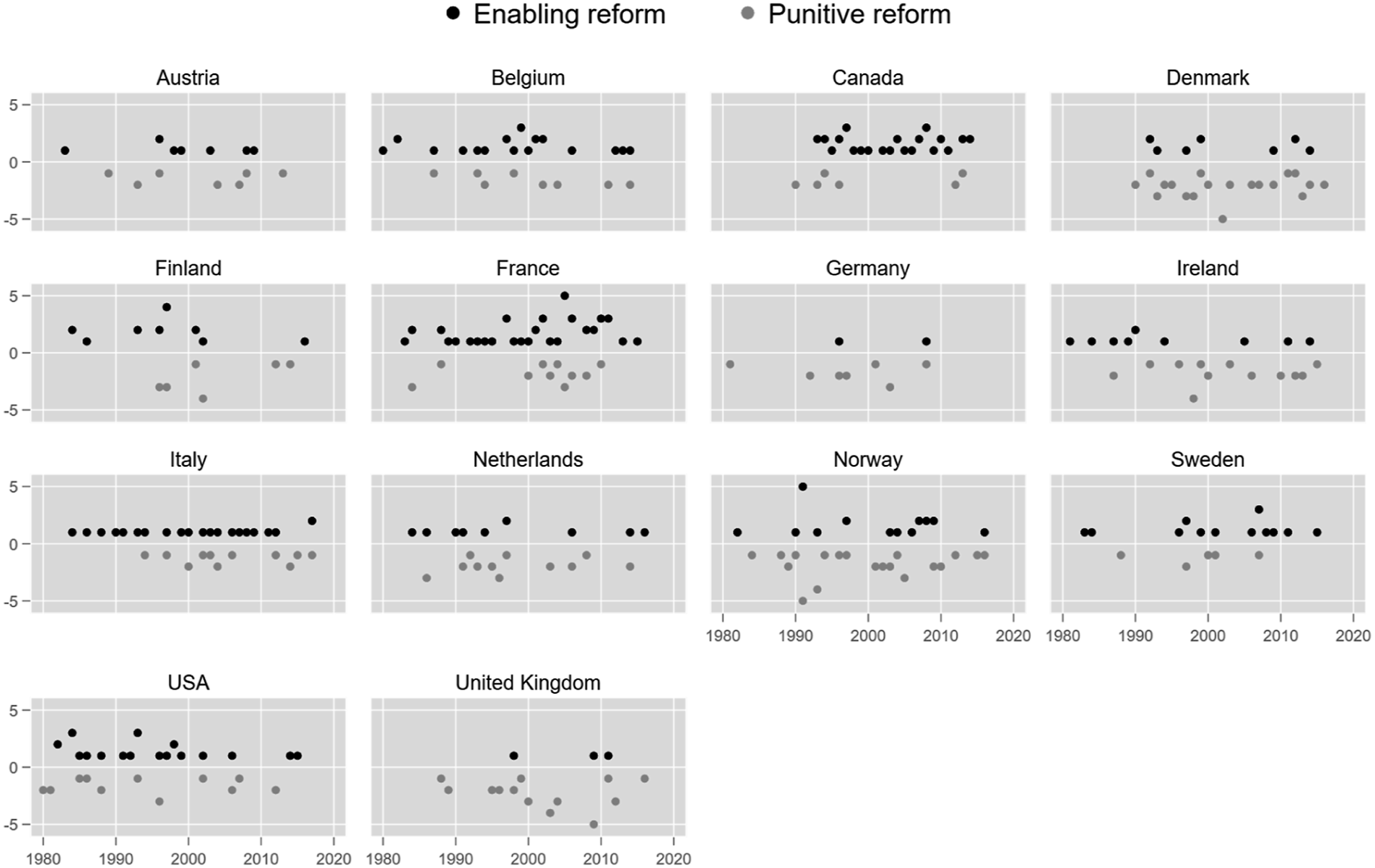
The figure also allows us to draw out several patterns – both within individual countries and across certain country groups – that reflect discussions in existing research. First, we can see that the UK, which has been at the core of debates around workfare (see, for example, Jordan, 2018), has been marked by a particularly severe turn to (uncompensated) punitive measures. Yet results also highlight that this trend has not been reflected across the rest of Europe. Instead, only the anglophone cases (Ireland and the US in our sample here) exhibit a similarly harsh trend. Canada is the sole exception, with its disproportionate number of enabling measures (largely due to our focus on the federal level).
Patterns across Continental Europe are more varied. First, we note that the trajectories in Belgium, France, and Italy have been marked by a large number of smaller enabling measures; close analysis of the data shows that these were primarily used to modify pre-existing programmes. Second, the figure reveals that although Austria and Germany were less active in introducing workfare reforms, they nevertheless turned more decidedly towards punitive activation measures in the 1990s and 2000s. Finally, Scandinavia has been home to cross-country differences rather than a shared trajectory, with Denmark and Sweden occupying opposite ends of the spectrum. In the Danish case, adjustments to the ‘flexicurity model’ (a combination of generous replacement rates for the unemployed, dismissal protection, and strong (re-)qualification measures) from the 1990s onwards entailed stricter eligibility criteria and a move away from de facto unconditional insurance benefits. In Sweden, by contrast, bourgeois and social-democratic cabinets reduced replacement rates, but these governments were more concentrated on implementing enabling rather than punitive workfare measures. This contrast is likely due to the fact that Sweden’s financial crisis in the early 1990s, unlike Denmark’s, was clearly unrelated to labour market disincentives.
Data
Our public opinion data is taken from the EVS and WVS, since for our purposes, these datasets provide the longest series of relevant cross-sectional survey data across the broadest set of countries. This allows us to analyze data from 14 countries between 1990 and 2018 – across a maximum of four survey waves – with 50,382 respondents in total (see OA1 Table 3 for full details on the sample size). In each instance, we are interested in the potential impact of measures introduced from 1980 up to the collection of the survey data. The enabling and punitive tallies are thus calculated as the sum of all relevant measures introduced from the start of our dataset until the year prior to a given survey fielding.
Our dependent variable is a repeated item measuring obligations that should be placed on unemployed persons, which we refer to as preferred strictness. This question has been used as a measure of attitudes towards workfare in past work (Buss, 2018) and provides the most closely related measure of policy preferences in the WVS/EVS data. As a repeated item in the waves, it also allows us to assess attitudes over a relatively long time horizon, from 1990 to 2018. The item reads as follows: On this card you see a number of opposite views on various issues. How would you place your views on this scale?… 1 People who are unemployed should have to take any job available or lose their unemployment benefits 2 3 4 5 6 7 8 9 10 People who are unemployed should have the right to refuse a job they do not want
For our analysis, we reverse code responses to this question so that higher scores equate to more restrictive attitudes towards the treatment of the unemployed.
Our key independent variable at the individual level is income decile, which is likely to be a major structuring factor shaping attitudes towards the welfare state (Kevins et al., 2019; Noureddine & Gravelle, 2020). The relevant survey question asks respondents to place their net household income with a country-specific income bracket (accounting for market income, transfers, taxes, and other deductions). In a few countries, the questionnaire included one or two additional income categories, which we collapse into the tenth bracket (given the left-skewing distribution of responses in the sample).
At the national level, our key variables are the cumulative total (i.e. tallies) of punitive and enabling measures. In each case, we use the workfare data up to the calendar year prior to fielding (e.g. 2017 data for a 2018 fielding). Figure 2 provides an overview of the relationship between our dependent variable (i.e. preferred strictness) and punitive and enabling measures over time, across all countries for which we have more than one wave of survey data (i.e. every country apart from the US and Canada). Mean preferred strictness and the punitive and enabling tallies over time. Note: Means in survey wave years are connected for illustrative purposes. Punitive and tallies are lagged, showing the value one year prior to survey fielding.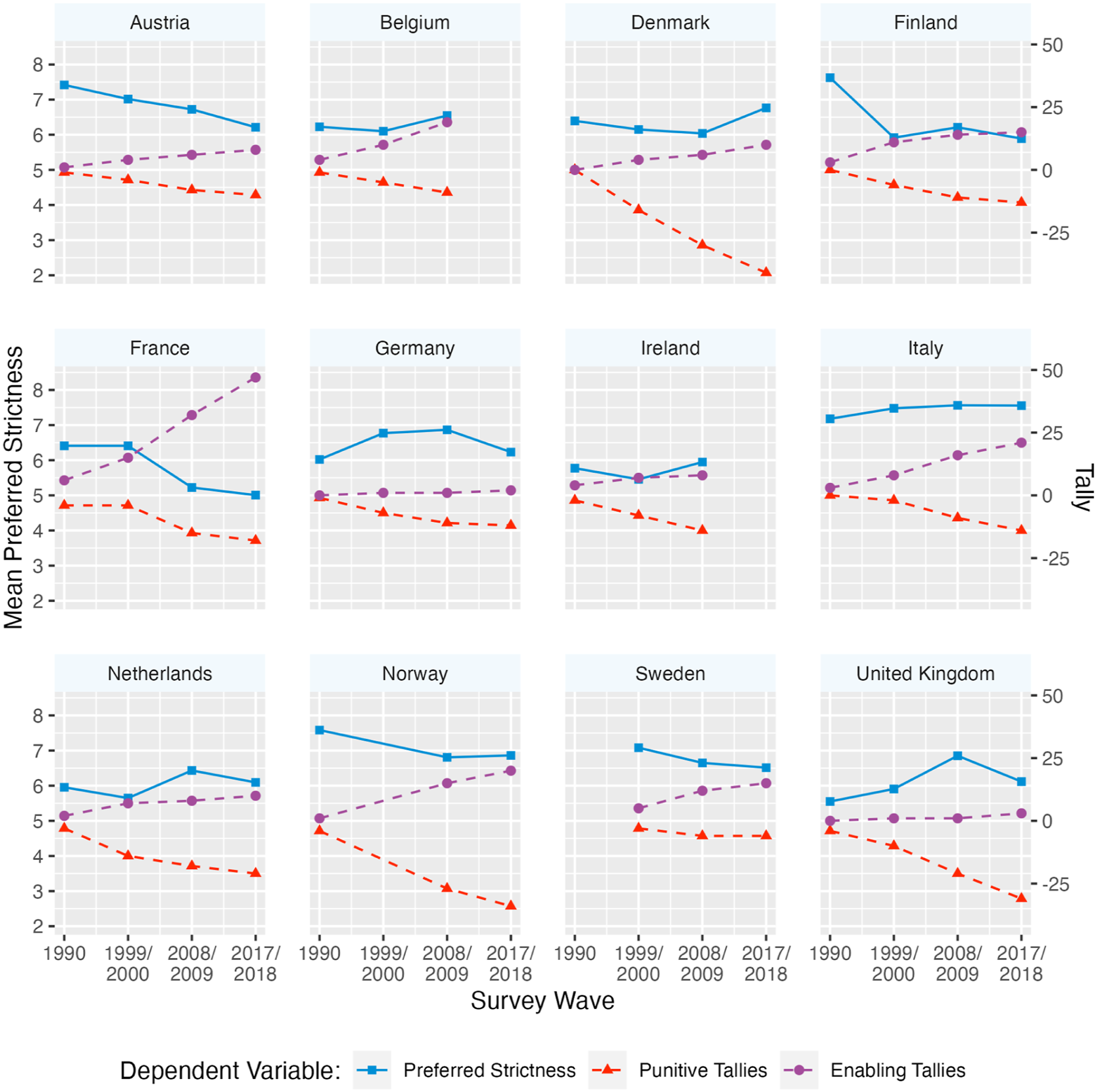
For the controls in the multilevel model analysis, we follow recent work (e.g. Buss, 2018) and include individual-level variables capturing: employment status (self-employed, full-time employment, part-time employment, and unemployment); education (with a binary variable capturing whether the respondent left education prior to their eighteenth birthday); 6 age and its square, to account for potential non-linear effects; union membership; gender; and marital status. At the country-level, we also include controls for: the national unemployment rate as a percentage of the civilian labour force – with data taken from the European Commission’s Annual Macro-Economic Database (Directorate General for Economic & Financial Affairs, 2018); and welfare state generosity vis-à-vis the unemployed, both in 1980 – to control for potential cross-country differences at the start of our workfare dataset – and in the survey-wave year – with data taken from the Comparative Welfare Entitlements Dataset (Scruggs et al., 2017). OA1 Table 4 outlines the descriptive characteristics of all variables included in our main analyses.
Analysis
Our main analysis is based on hierarchical analysis with respondents (n = 50,382) nested in country-years (n = 46), which are in turn nested in countries (n = 14). This nesting approach is widespread in the literature and provides a more conservative approach to assessing potential effects, with variance components included at all relevant levels (see Hox et al., 2017). Models use restricted maximum-likelihood estimators, in turn, to increase the reliability of our estimates; this specification is particularly important given that we have only 14 countries in the analysis (Elff et al., 2020) – though the nesting approach and relatively high number of within-country respondents should also improve reliability as well (see Mathieu et al., 2012). Finally, note that the analysis incorporates the absolute value of punitive tallies (i.e. as positive values) for ease of interpretation.
The regression tables build the models stepwise to reduce the risk that findings are artefacts of the choice of country controls, investigating direct (Model 3, excluding the interaction) and interaction effects (Model 5, including the interaction). All results are presented based on models for which our key variables have been mean centred, but we de-centre figure axes in order to facilitate interpretation. 7 Frequency plots are presented in the background of the top panels to illustrate the distribution of the data (via dotted lines), and extreme values of the tallies – under the 5th percentile and above the 95th percentile – are excluded from figures to focus attention on more representative values. 8
Effects of Income and Punitive and Enabling Measures on Preferred Strictness.
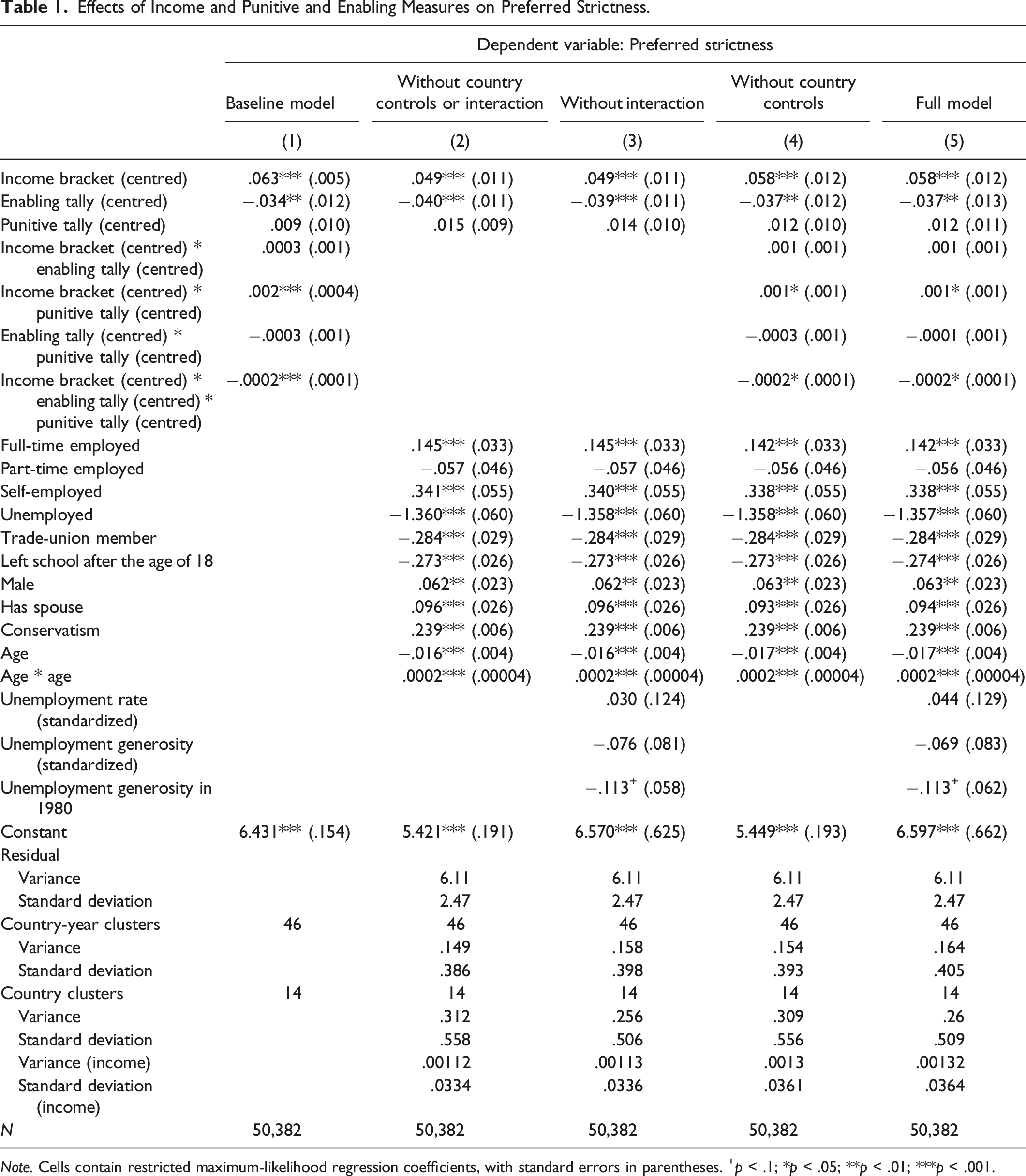
Note. Cells contain restricted maximum-likelihood regression coefficients, with standard errors in parentheses. +p < .1; *p < .05; **p < .01; ***p < .001.
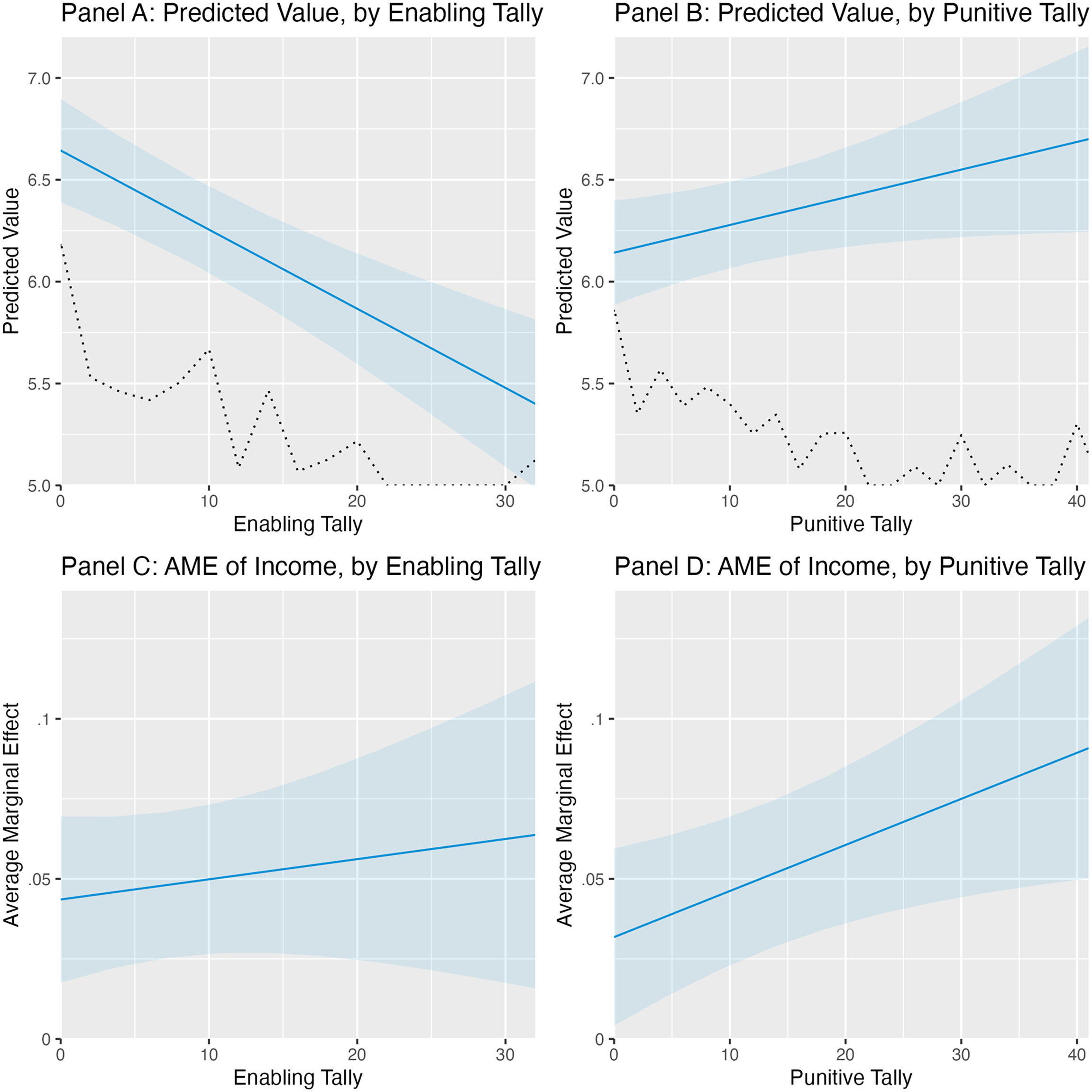
The impact of income, the enabling tally, and the punitive tally on preferred strictness. Note: Illustrations based on the regression results from Models 3 (Panels A and B) and 5 (Panels C and D) of Table 1. Frequency plots are illustrated in the background of Panels A and B with a dotted line.
We begin by considering the direct effects of the reforms, as illustrated in the Panels A and B. Results in Panel A suggest that a higher enabling tally is correlated with a decrease in preferred strictness (thus supporting H1): moving from the 10th to the 90th percentile of enabling tally scores (from 0 to 20; SD of enabling tally scores = 9.54), for example, would therefore be associated with a reduction in preferred strictness of .76. We find no real evidence, by contrast, that the punitive tally shifts responses in one direction or the other (contrary to H2), despite a modest upwards slope in Panel B. Turning to the interactive effects illustrated in Panels C and D, results suggest that the income gradient is affected by the opposite dynamic. On the one hand, the enabling tally has no clear structuring effect on the impact of income (contrary to H3). On the other, the effect of income on preferred strictness appears to become larger as the punitive tally increases (supporting H4). While the income effect is consistently distinguishable from zero, its average marginal effect at the 10th percentile punitive tally score (1) is .03, whereas at the 90th percentile value (30), it is .08 (SD of income brackets = 2.68; SD of punitive tally scores = 11.3).
Overall, then, enabling measures appear to be associated with a preference for a more lenient treatment of the unemployed – indicating that a shift towards greater social investment in the unemployed may have a self-undermining effect on preferred severity. We find no evidence to indicate, however, that punitive measures directly impact related policy preferences. Yet results from the analysis also suggest that punitive measures shape how income affects attitudes towards workfare, enhancing the impact of income on preferred strictness: although higher incomes are associated with pro-workfare preferences in general, the size of this effect is especially large in countries which have implemented more punitive measures. Contrary to the direct effects, however, these results are present only when we look at punitive measures – suggesting that enabling measures are not conditioning the impact of income on attitudes.
In order to shed further light on these results, we then carried out several follow-up analyses. To begin, two main sets of additional analyses were conducted to assess robustness. First, in the main models above, random slopes for income are included only at the country level in the main analysis to avoid overfitting – but we note that robustness checks in the Online Appendix (see OA2 Table 1 and OA2 Figure 1) suggest similar results when random slopes are included for income at both the country and country-year levels. Second, given that our dataset is constructed on the basis of individual pieces of legislation, we confirm that results are robust to controlling for variation in legislative ‘styles' – controlling for the total number of pieces of legislation passed in a given country 9 over the corresponding time period (see OA2 Table 2).
We then conducted three sets of additional analysis to investigate questions related to the temporality and causal ordering of the effects noted above. First, we assessed whether the temporal proximity of a legislative change matters, with earlier reforms perhaps having a more muted effect than more recent ones. 10 While the precise approach to temporal weighting necessarily introduces some arbitrariness, we confirm that results are unaffected by using, as our dependent variable, more complex ‘weighted tallies' that weight recent changes more heavily than earlier ones (see OA3 Tables 1–2, testing two different approaches to weighting the punitive and enabling tallies). 11 Second, comparing alternative models using a series of lags (see OA4 Tables 1–3) and leads (see OA5 Tables 1–3) up to 3 years before or after the survey wave reinforces the reading that reforms are shaping attitudes (rather than the other way around): the effect of enabling reforms on attitudes remains visible in the lagged models but drops away in the lead models. Finally, we also conducted further exploratory analysis to assess causal ordering (see Abou-Chadi & Finnigan, 2019; Soroka & Wlezien, 2005), regressing (1) punitive and enabling tallies on country-level mean preferences (see OA6 Table 1) and (2) changes in country-level mean attitudes on changes in the punitive and enabling tallies (see OA6 Table 2). Results suggest that while enabling reforms appear to have influenced aggregate public opinion, attitudes do not appear to have affected the reforms – though given that this modelling strategy severely limits the number of observations in the models (n = 32), we take these findings to be merely suggestive.
Conclusion
One of the most striking developments in recent welfare state development is the trend towards workfare: that is, the growing pressure placed on the unemployed to accept a job, via increasingly stringent obligations and – in case of non-compliance with the rules – harsh punishments. Based on the large social policy feedback literature (for an extensive review, see Larsen 2019), we know that legislative changes can shape public opinion – and such an effect seems especially likely when it comes to policies, such as punitive and enabling workfare reforms, that both engage the public and have major implications on the perceived deservingness of recipients (e.g. Buss, 2019; Kootstra & Roosma, 2018; Roosma & Jeene, 2017). Yet the impact of these measures on public opinion has remained underexplored. On the one hand, conceptual muddiness surrounding feedback effects has obscured variation in different kinds of effects (see Busemeyer et al., 2021 1 ). On the other, data limitations have prevented researchers from comprehensively studying these dynamics, with no pre-existing datasets incorporating the range of punitive and enabling measures targeting the unemployed.
To explore how the proliferation of workfare reforms may have impacted public opinion, we thus began by constructing a new dataset that contains a nuanced measure of this legislative trend that gauges both the rights and obligations of the unemployed, regardless of whether they are accessing unemployment insurance or assistance. Combining this dataset with EVS and WVS public opinion on the welfare state allowed us to examine how these reforms may have shaped related social policy attitudes since 1990.
Summary of the Workfare Measures’ Impacts on Preferred Strictness.
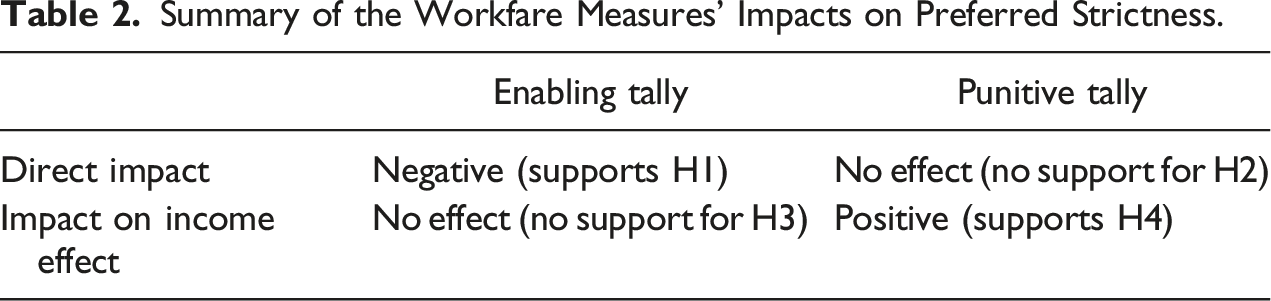
In sum, our dataset and analyses suggest that workfare has not straightforwardly and universally undermined social solidarity. Decades of workfare reforms have led to neither a clear convergence nor a generalized shift in social policy preferences towards or away from workfare. Crucially, the impact of social policy on related preferences depends on the mix of punitive and enabling workfare measures, with both a direct effect (shaping preferences themselves) and an indirect one (magnifying the impact of income on preferences). The concern that traditional (punitive) workfare reforms will generate support for ever more conditionality (e.g. Fossati, 2018) is not, therefore, reflected in our analysis – though we do find evidence to suggest that punitive measures may fracture cross-class solidarity, with a growing gap between the preferences of high- and low-income citizens (e.g. Deeming, 2018). Results also highlight the value of looking beyond punitive measures in isolation and investigating the consequences of the ‘workfare turn' in a more multi-dimensional manner (e.g. Dingeldey, 2007).
Important questions nevertheless remain. First, our analysis here only points towards the cumulative impact of policy changes on public opinion; yet other forms of policy feedback (e.g. Busemeyer et al., 2021) may well be occurring in the background. Additional work offering more in-depth tests of the bi-directional impact of these reforms (see, for example, Soroka & Wlezien, 2005) as well as any variation across different welfare cultures (see, for example, Jo, 2011) would therefore help to develop a fuller picture of these dynamics. Second, our investigation focuses on attitudes towards the constraints the public wants to see placed on the unemployed – a measure of preferences traditionally connected to workfare (e.g. Buss, 2018). Future research looking directly at attitudes towards ‘enabling' reforms, or indeed other commonly surveyed welfare state attitudes (e.g. spending on unemployment benefits and government responsibility for the unemployed) would therefore be especially valuable. Such research might also help, for example, to assess whether these sorts of reforms shape (positive) preferences for social investment in the unemployed and (negative) preferences for punitive measures in similar ways. Third, due to data limitations with the EVS and WVS, we are unable to assess other potentially important moderating factors, such as the likelihood of becoming unemployed – so further work using narrower and more nuanced measures of these variables would likely uncover additional nuances. Finally, given the observational focus of our analysis, studies focussed on uncovering causal mechanisms (if not causality per se) could offer especially important insights. Future research aimed at teasing out, for example, the short- and long-term effects of policy changes, the link between income and punitive versus enabling reforms, and the potential non-linearity of attitudinal effects would therefore be particularly instructive.
Supplemental Material
Supplemental Material - Workfare and Attitudes toward the Unemployed: New Evidence on Policy Feedback from 1990 to 2018
Supplemental Material for Workfare and Attitudes toward the Unemployed: New Evidence on Policy Feedback from 1990 to 2018 by Alexander Horn, Anthony Kevins and Kees van Kersbergen in Comparative Political Studies.
Footnotes
Acknowledgments
We would like to thank Marius Busemeyer, Jochen Clasen, Paul Marx, Kristella Trump, Tim Vlandas, Nadja Wehl, Georg Wenzelburger, our anonymous reviewers, as well as participants at the University of Konstanz Comparative Political Economy Working Group and the 2020 European Consortium for Political Research General Conference for comments on earlier drafts of this paper. We also thank Elissa Berwick, Peter Hall, Cathie Jo Martin, Friederike Römer, Peter Starke, and Kathleen Thelen for comments on the underlying data, as well as Jean-Philippe Gauvin for providing early access to data from the Canadian Agendas Project. Lena Hybschmann, Karoline Kolstad, and Mikkel Ylitalo provided invaluable research assistance.
Declaration of Conflicting Interests
The author(s) declared no potential conflicts of interest with respect to the research, authorship, and/or publication of this article.
Funding
The author(s) disclosed receipt of the following financial support for the research, authorship, and/or publication of this article: Aarhus University Research Foundation’s AU Ideas Programme (Grant Number: 16192).

Supplemental Material
Supplemental material for this article is available online.
Notes
Author Biographies
References
Supplementary Material
Please find the following supplemental material available below.
For Open Access articles published under a Creative Commons License, all supplemental material carries the same license as the article it is associated with.
For non-Open Access articles published, all supplemental material carries a non-exclusive license, and permission requests for re-use of supplemental material or any part of supplemental material shall be sent directly to the copyright owner as specified in the copyright notice associated with the article.
