




Abstract
What explains party polarization in multiparty systems? This study turns the spotlight to intraparty mechanisms, namely, the authorities and influence of party activists over the candidate selection process, as a potential source of party-system polarization. I hypothesize that parties in which activists possess more comprehensive selection authorities, the party elite will hold more extreme ideological positions, catering to activists' representation demands. Additionally, in such cases, the ideological gap between party elites and voters will be larger since more extreme actors overshadow the preferences of moderate party voters. Aggregating the intraparty effect of activists to the party-system level, I expect to find higher level of party polarization in countries where more parties allocate selection authorities to activists. Utilizing party-level data regarding candidate selection procedures as well as public opinion and elite position data from 19 countries and 93 parties between 2011 and 2017, I find support for my hypotheses.
The Intraparty Origins of Political Polarization
The rising tide of party polarization, or in other words, the ideological dispersion of parties within the political arena, is a major source of concern for Western democracies. Initially focused on the United States, research on polarization has now encompassed a wide range of countries, and comparative studies have demonstrated a consistent increase in polarization levels across Western democracies (Dalton, 2008, 2021; Lauka, McCoy, and Firat, 2018; Lupu, 2015; Rehm and Reilly, 2010). The growing ideological tension between political elites has given rise to a body of literature that seeks to identify the predictors of polarization. Since party polarization is an overarching characteristic of the political system, most studies have focused on broad, country-level factors (Andrews & Money, 2009; Curini & Hino, 2012; Dalton, 2021; Dow, 2011; Ezrow, 2008; Han, 2015; Golder, 2016; Norris and Inglehart, 2018; Reiljan, Kutiyski, and Krouwel, 2020). However, polarization can emanate from intraparty dynamics as well. Though party polarization reflects the party-system level of ideological dispersion, in practice, polarization increases when individual parties embrace more extreme ideological positions. Hence, party polarization can be perceived as a bottom-up process, which starts at the party level with an increase in party extremity and only then aggregates to the party-system level as a rise in polarization level. It follows that identifying intraparty factors that drive party extremity could uncover a pathway for party polarization.
The literature on party representation highlights the connection between the polarizing effect exerted by party activists and party extremism (Iversen, 1994; Katz 2014; May 1967). Parties are multilayered organizations composed of different actors with diverse interests. Typically, scholars identify four distinct groups within parties: elites, activists, members, and voters (Hazan & Rahat, 2010; Rahat & Hazan, 2001). Party activists are well known for their extreme leanings and uncompromising ideological stances, while the positions and preferences of members and voters tend to be more moderate (Iversen, 1994; Katz 2014; May 1967). There is constant tension within parties between the moderate and the extreme elements, all of which strive to steer the party in their preferred ideological direction.
The main arena for this struggle is the primary election, which offers partisans an opportunity to influence party elites' political identity and ideology (Jacobson & Carson, 2004; Katz & Mair, 1995; Mair, 1997). When preparing for national elections, parties must determine their candidates for all the key positions, including nominating a party leader, compiling a national/regional list of candidates, and endorsing constituency candidates. The methods parties employ to elect their nominees vary significantly between and within countries. Those candidate selection procedures affect the power struggle between moderate and extreme factions within parties. If party activists strongly influence the candidate selection process, they could use their power to push party elites to embrace a more hardliner ideological approach, leading to party extremity (Dalton, 1985; Hirschman 1970; May 1967).
On the rationale outlined above, a successful political action by party activists could have three empirical implications: (1) they impel party elites to adopt activists’ ideological positions, increasing party extremity; (2) to the extent that party voters’ preferences remain moderate, such an increase in party extremity could potentially lead to an ideological incongruence between parties and voters (Iversen, 1994); (3) since ideological polarization is an aggregation of parties' ideological positions, an increase in party extremity should lead to an increase in country-level party polarization.
The argument is developed in two steps: first at the party level and then at the party-system level. More specifically, I start by demonstrating a positive correlation between the extent of activists’ influence over the candidate selection process and party extremity on the one hand, and on ideological incongruence between elites and voters, on the other. I then proceed to examine the aggregated effect of party activists on party-system polarization. Based on data from 19 countries and 93 parties between 2011 and 2017 obtained in Waves three–five of the Comparative Study of Electoral Systems (CSES), as well as on data from the relatively new Political Party Database Project (Scarrow et al., 2017), I find empirical support for the theoretical expectations.
This paper contributes to the literature on political polarization and representation in three significant aspects. First, theoretically, party activists’ polarizing role is identified as a key explanatory variable for party extremity and, by extension, party polarization. This mechanism is proposed to account for a link between an intraparty factor (activists) and an interparty outcome (polarization). Secondly, by focusing on activists and primary elections, the study bridges two bodies of literature: party polarization and political representation. The theoretical argument to this effect conceives polarization as a phenomenon anchored in the ideological disparity between elites and voters. This rationale evokes the challenges for democratic representation posed by party polarization. Finally, the comparative perspective of the study expands the scope of the hitherto American-centered literature on polarization.
Party Polarization in Comparative Perspective
The distribution of parties' positions along the ideological spectrum has preoccupied political scientists for decades. Many studies have sought to reveal the forces that propel parties toward either the center or the extremes of this scale (Adams et al., 2005; Cox, 1990; Downs, 1957; Peters & Ensink, 2015; Rabinowitz & Macdonald, 1989; Westholm, 1997). However, in recent years, the scholarly debate was reframed under the influence of the growing American literature on polarization (Abramowitz, 2010; Abramowitz & Saunders, 1998, 2005; Fiorina & Abrams, 2008; Fiorina et al., 2008; Iyengar et al., 2012; Levendusky, 2009, 2010). What once was a discourse juxtaposing centrifugal and centripetal forces is gradually becoming a deliberation over party polarization.
Comparative studies on party polarization have focused mainly on two interlinked variables: (1) the electoral rule and (2) the number of parties (Andrews & Money, 2009; Budge & McDonald, 2006; Dalton, 2008; Dow, 2001, 2011; Ezrow, 2008; Han, 2015; Matakos et al., 2016). Both hypotheses suggest that countries with more parties in the political system will tend to have higher levels of ideological polarization. The logic underlying this claim is that a multiparty system encourages ideology-seeking parties to compete and enter the parliament, creating a more heterogeneous party system. Despite its compelling logic, however, empirical support for this theoretical argument is mixed (Andrews & Money, 2009; Curini & Hino, 2012; Dow, 2001, 2011; Ezrow, 2008; Matakos et al., 2016). At the same time, recent studies have found empirical support for hypotheses that connect party polarization to voters' expectations regarding coalition formation, the proportion of independent voters, and exogenous economic shocks (Curini & Hino, 2012; Dalton, 2020; Han, 2015).
Despite the extensive scrutiny, comparative studies on party polarization have focused on party-system variables. It can be plausibly argued, however, that a significant explanation for party polarization lies within the “black-box” of intraparty mechanisms and procedures. More specifically, the roots of polarization may be traceable to parties' decisions to embrace non-centric ideological stances. Heretofore, most comparative research has shied away from an intraparty perspective on party polarization. This paper seeks to fill this void by delving into the intricacies of intraparty politics and considering the political power of party activists as a potential source of party polarization.
Intraparty Candidate Selection Process as a Source of Party Polarization
Party polarization could emanate from parties' internal politics and, more specifically, from an intraparty conflict between extreme and moderate factions that struggle to tilt party elites' ideological attitudes in their favor. This political contest unfolds at the intraparty primary elections, where partisans can leverage politicians' eagerness to be (re)elected to promote their ideological agendas.
Party Activists as Polarizing Agents
Many of democracy’s normative aspects rest on the power of elections to establish a principal-agent relationship between voters and representatives. Such a connection is premised on the assumption of a single principal. In the event that one agent represents two principals with conflicting interests, one of these principals is likely to remain unrepresented (Miller, 2005). The emergence of a competing principal (e.g., primary voters vs. general election voters) for the same agent (representative) could be an artifact of the party’s candidate selection procedure. Thus, in practice, politicians are expected to represent both their general and primary election constituencies. These two competing constituencies, or “masters” as Katz (2014) puts it, might not always have the same interests or ideology. A pronounced conflict between the representation demands of the general and primary constituencies may undermine the principal-agent model.
A conflict of this kind can occur if party activists gain significant control over the intraparty nomination process. Comparative party-politics literature distinguishes between four factions within the primary electorate: elites, activists, members, and voters (Hazan and Rahat, 2001, 2010). As mentioned above, party activists usually espouse extreme agendas and uncompromising ideological stances (Hirschman 1970; Iversen, 1994; May 1967). Furthermore, May (1967) argues that activists' extreme ideological positions are formed before joining the party, and subsequently drive their modus operandi within it. Once an activist officially joins a party, he not only finds a supportive ideological environment in the persons of his fellow activists but is also subject to relatively weak oversight on the part of party members, whose attention is mainly focused on the performance of the party elites (May 1967). Therefore, when party activists dominate the candidate selection process, an ideological disparity will likely arise between the party’s two competing constituencies. In this situation, the party elites might be compelled to decide where to position themselves between the more moderate general election voters and the more extreme primary voters.
Empirical evidence from American politics shows that, when faced with such a dilemma, politicians usually opt to join the more extreme camp (Ansolabehere, Snyder, and Stewart, 2001; Burden, 2004; Gerber and Morton, 1998). However, there is an ongoing debate in the American literature regarding the empirical and theoretical validity of the putative effect of primary elections on party polarization (Brady et al., 2007; Hirano et al., 2010; Jacobson & Carson, 2004; Kujala, 2020; Sinclair, 2006). Considering the preoccupation of that literature with the U.S. political arena and the mixed empirical evidence presented, a thorough comparative investigation is in order.
Based on the American context, the “primary argument” posits a broad distinction between primary and general election voters, and between “open,” “semi-open,” and “closed” primaries (Gerber and Morton, 1998). However, America’s selection methods have less variance than those in European countries (Epstein, 1986). Outside the U.S., countries allow parties a wide legal maneuvering space to shape their selection mechanisms, resulting in a web of variegated and complex methods. Though such a multiplicity of institutional rules poses an empirical challenge, it also creates an opportunity to identify and isolate activists' effect on the selection process with a fair degree of precision.
Candidate Selection Methods: Opening the “Black Box” of Parties' Operating Practices
What factors account for the power structure within parties' candidate selection systems? Which institutional settings may favor extremists, and which could be more congenial to moderate factions? These questions are addressed in a large body of literature on comparative party politics, a product of the complex structure of candidate selection systems. To chart these turmoiled waters, one should follow two beacons: (1) Who participates in the selection process? (2) What role(s) do these actors perform? These questions determine the distribution of power in the candidate selection process. As party activists receive a broader and more influential role in the selectorate, party elites will be willing to meet their representational demands.
As regards the first issue, the selection process may involve five intraparty organs, or “selectorates”: the party leader, non-selected agencies, selected agencies, members, and voters (Hazan and Rahat, 2001, 2010; Tuttnauer & Rahat, 2022). The selection methods employed by parties can be classified as either exclusive or inclusive, based on the selectorates licensed to participate in the nomination process. Traditionally, selection procedures were something parties held close to the chest, as it were, and participation was open exclusively to party elites. However, in the last four decades, selection methods have gradually been democratized, enabling the participation of a broader range of partisans. Katz and Mair argue that this change has been propelled, in part, by parties’ initiative to curb activists' control over the nomination process (Katz & Mair, 1995; Mair, 1997).
However, capturing activists' role in the nomination process is challenging, since parties do not directly allocate selection authority to activists. Nevertheless, activists' effect can be identified indirectly. As mentioned above, activists are more ideologically motivated and usually participate more intensively in intraparty politics. At the same time, party politics literature usually relegates them to a mid-level position within a party, somewhere between the elite and the rank-and-file members. Thus, as shown in Figure 1, on the inclusiveness scale, party activists—as, for example, members of committees—are positioned midway, at a point labeled “Selected party agency,” with more inclusive bodies such as a congress or a convention on the right, and more exclusive, non-selected, agencies such as executive bodies on the left (Hazan, 2006). Inclusiveness scale.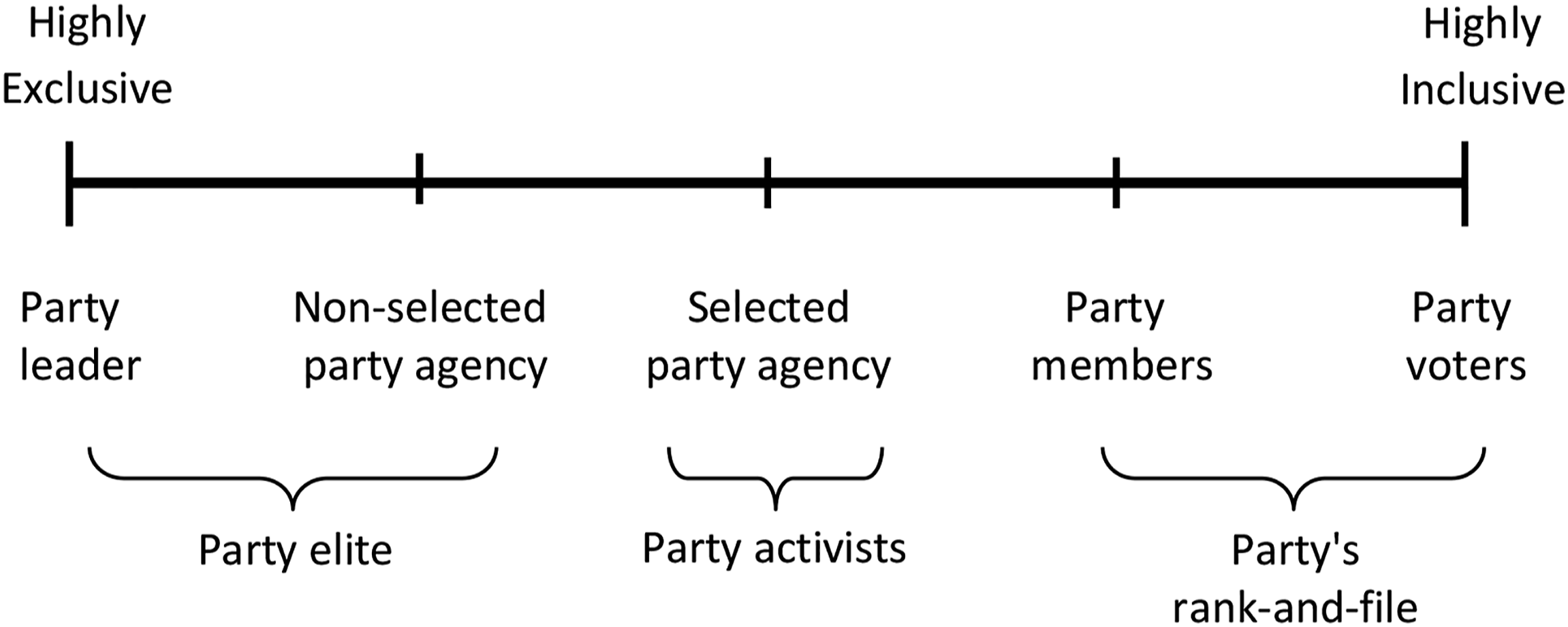
The second question taps the four different roles assigned to a selectorate in the selection process: (1) advice, (2) veto, (3) screen, and (4) vote (Tuttnauer & Rahat, 2022). Parties can allocate different roles (one or more) to each of the five intraparty selectorates that appear on the inclusiveness scale in Figure 1. The first role is advising. Some parties allow certain party factions, both low- and high-ranking, to voice their opinions before the relevant electing body, which, however, is not bound to follow their advice. Thus, the Communist party in Portugal and the French and Norwegian Socialist parties require the consult of some regional or national party organ before the final approval of the candidate list. The second role is the vetoing power. In some cases, senior party officials have the authority to disqualify a candidate approved or selected by lower-ranking party factions. Parties impose different stipulations regarding this role, which applies, in its various forms, in the selection methods of many parties in Western democracies, such as the Australian Labor party, the Irish Fine Gael, and the Netherlands Freedom Party. The third role is screening, such that a certain party organ is given the authority to vet the primary candidates' eligibility to run; these bodies draft a shortlist of eligible candidates from which the party will select its nominees. Such preliminary procedures are standard among British parties, known for their multi-stage selection systems (Denver, 1988). The last and uppermost role is voting, that is, choosing among the nominees by a majority decision. Almost every major party in Western Europe incorporates voting as part of its selection method. In recent years, parties have adopted more inclusive selection procedures, giving voting rights to a broader spectrum of supporters (Hazan, 2006; Hazan & Rahat, 2010; Pruysers et al., 2017).
The nature and intensity of intraparty struggle largely depend on the players' identity and respective roles in the nomination process. The argument advanced in this study concerns the authority given to party activists. When activists exercise considerable influence within a party’s internal power dynamics, elites tend to adopt a more hardline approach to issue positions. However, if the power is allocated to party elites, members, or voters rather than to activists, the party’s preferences are more likely to moderate. In other words, the stronger (weaker) the influence of party activists on the candidate selection process, the more (less) extreme, on average, the elites’ position will be.
Hence the “party extremity” hypothesis:
As party activists gain more control over the candidate selection process, parties will adopt more extreme ideological positions. Furthermore, the ideological pull that activists exert on the party elites distances the latter from the average party voter. In other words, as elites turn to more extreme politics, voters—typically displaying more moderate preferences—are left behind. Thus, activists' actions may drive an ideological wedge between parties and their voters, crippling a party’s ability to represent its constituency. If party activists have a strong position within a party, their effect could ideologically distance the party elite from the party voters, thereby precipitating an ideological gap. Hence the “ideological incongruence” hypothesis:
As party activists come to hold more control over the candidate selection process, the ideological incongruence between parties' elites and voters will increase. Combined, the “party extremity” and the “ideological incongruence” hypotheses encompass the divisive influence of party activists within parties. Activists can be regarded as responsible for the increasing levels of party extremity on the one hand, and the ideological gap between elites and voters, on the other.
Party Polarization: Activists' Intraparty Effect at the Party-System Level
One of the ramifications of activists’ influence within their respective parties on the political system is party polarization. All the measurements of party polarization proposed in the literature are based on some form of mathematical aggregation of the distances between parties' ideological positions (Andrews & Money, 2009; Dalton, 2008; Dow, 2001). It stands to reason, then, that shifts in parties' stances will affect the level of polarization in a party system. Thus, by increasing the ideological extremity of party elites, activists increase the party polarization level as well.
Hence the “party polarization” hypothesis:
With the rise of the aggregate power of party activists within a political system, party polarization will increase. Figure 2 models this study’s theoretical expectations regarding activists' effect on intraparty party extremity and interparty polarization. The upper row illustrates activists' influence at the intraparty level, that is, party extremity, and the lower row—their effect at the interparty level, that is, party polarization. The difference between the left and right columns is the level of activists' influence on the candidate selection process. When activists' power is checked (the left column), their ability to push party elites away from the center is limited; thus, we expect to see lower levels of party extremity and, consequently, lower polarization. However, when activists hold considerable sway in the selectorate, I expect to see higher levels of party extremity and polarization. The intraparty effect of party activists on party polarization is germane to the ongoing debate about mass polarization in the United States. Some scholars believe that America is amidst a culture war, in the sense that both the political elite and the general public are ideologically and culturally polarized (Abramowitz, 2010; Abramowitz & Saunders, 1998, 2005). Conversely, others argue that while the positions of political elites have come to be more polarized in the last four decades, the issue preferences of the average American citizen have remained more or less the same (Fiorina and Abrams 2012; Fiorina et al., 2005, 2008; Fiorina and Levendusky 2006). The argument advanced here supports the latter claim by proposing a mechanism whereby polarization stems from the ideological dissociation between elites and voters. This trend can be identified in Figure 2 as well. The theoretical model predicts that a higher level of activists' power is correlated not only with increasing party extremity and polarization but also with a growing ideological gap between parties and voters.
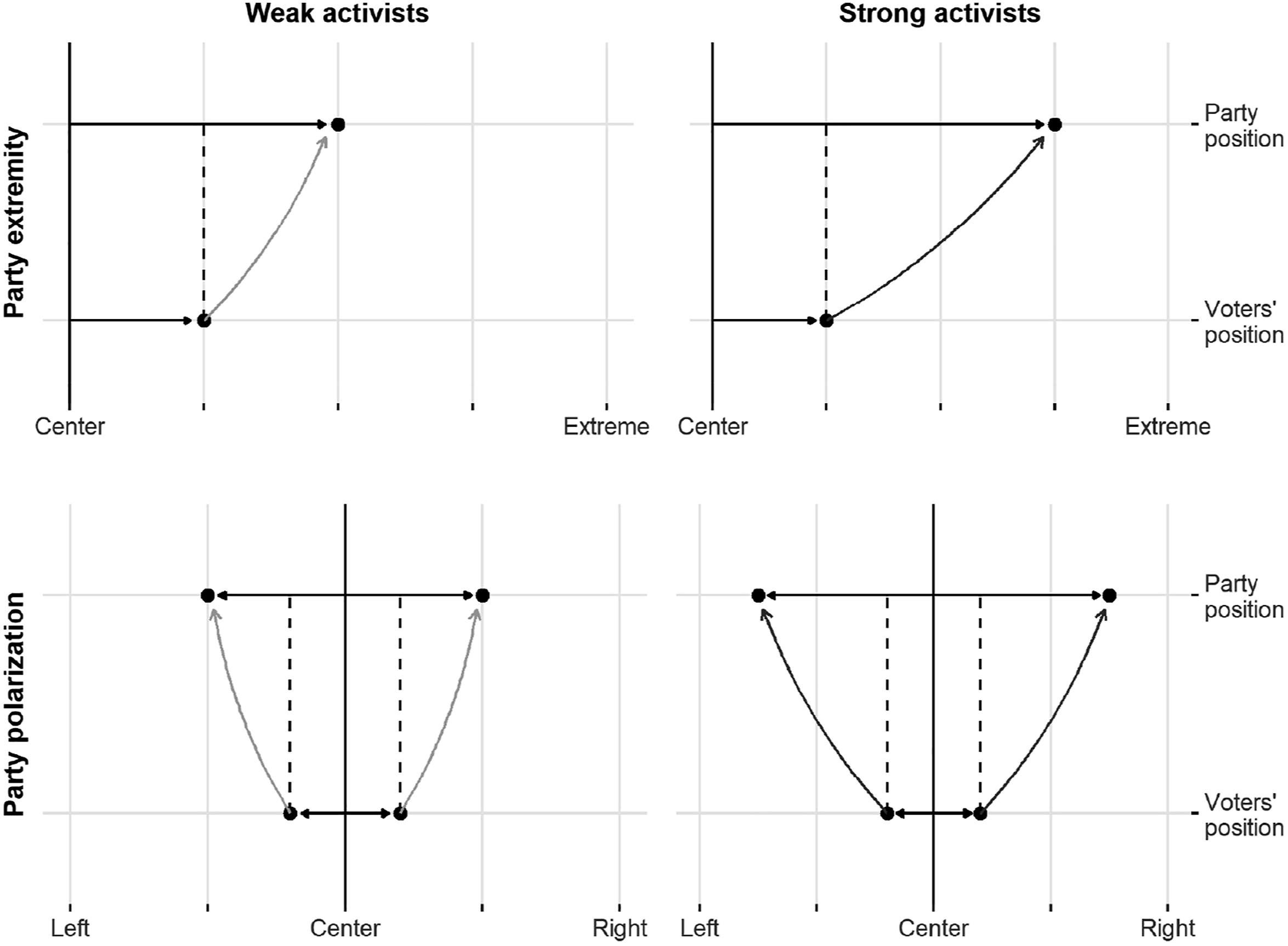
A model of party activists’ effect on party extremity and party polarization. The upper row illustrates activists' influence at the party level (party extremity), and the lower row–at the party-system level (party polarization). The party extremity scale is arranged from center to extreme and the party polarization scale from left to right. The columns distinguish between weak (left) and strong (right) power that activists wield in the nomination process. According to the graph, when activists' power is strong (weak), we will see higher (lower) extremity at the party level and higher (lower) polarization at the part-system level.
Data and Measurements
In this research, I utilize two different data sources. Party activists' control over the candidate selection process is measured based on rounds 1a and 1b (2010–2016) of the Political Party Database Project (PPDB), containing information on candidate selection methods for 122 parties in 19 democracies. The PPDB is a relatively new expert survey opened to researchers in 2017. The three dependent variables—party extremity, ideological incongruence, and party polarization—are measured using Waves 3–5 (2010–2017) of the Comparative Study of Electoral Systems (CSES).
The research hypotheses are tested in a broad comparative analysis, including the cases covered by both the CSES and PPDB surveys: all in all, 93 parties in 19 Western democracies. This sample enables a comprehensive comparative study, as the countries' political institutions included vary in several aspects, such as the electoral system, size and number of parliaments, party fractionalization, and level of ethnic conflict.
Measuring Activists’ Influence Over the Candidate Selection Process
Candidate selection methods vary widely both between and within countries. In most countries, the law does not set strict guidelines for candidate selection, and parties are free to devise their internal procedures. As a result, the selection methods employed by parties are diverse and complex. Until recently, data on intraparty candidate selection methods were hard to come by (Hazan & Voerman, 2006; Shomer et al., 2016; Tuttnauer & Rahat, 2022); however, this obstacle to empirical research has been mitigated by the publication of the comprehensive PPDB expert survey. The PPDB survey enables a nuanced and precise measurement of activists' influence over the candidate selection process in various settings.
This study aims to identify and measure party activists' power within the nomination process. Building on Tuttnauer and Rahat’s (2022) index for the inclusiveness level of candidate selection systems, I first identify all the selectorates and their role(s) in the nomination process. Then, to assess activists' relative power in the selectorate, the number of roles fulfilled by activists is divided by the sum of all the selectorates’ roles, where all the roles receive an equal value of one (this assumption is relaxed below). The PPDB survey allows implementing this measure by elaborating on each party who participates in the selection process as well as what role(s) they fulfill. Based on parties' bylaws, the expert survey assigns to each entity in the five categories of the inclusiveness scale (Figure 1) one or more of the following roles: none, advise, veto, screen, and vote. For every party k in the sample, a score for activists' relative power (ARP) was calculated. Let
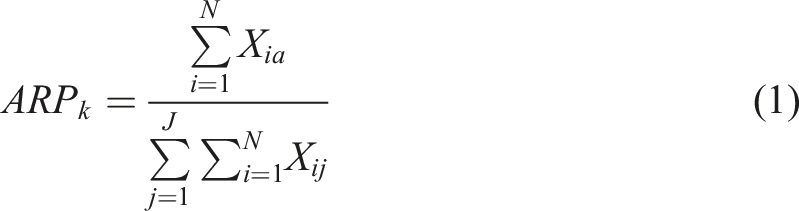
The main advantage of this index is that it allows for isolating activists' power and measuring it precisely, taking into account the broader context of the selection mechanism. Thereby aligning the empirical measure to the theoretical concept. Furthermore, this equation could be modified to isolate and measure the relative strength of other party selectorates for future research.
However, one might contend that not all roles are equal in their impact on the selection process. While, as a practical imperative, Tutenouar and Rahat assign equal power to all the roles, they acknowledge the possibility of a hierarchical relation between them (Tuttnauer & Rahat, 2022, p. 5). Such a scenario is highly plausible. As mentioned above, in most cases, voting is the key element of the selection process, as it has a dominant influence on its outcome. Accordingly, most research on elections focuses on voting power and voter behavior. On the other hand, advice is not binding on the recipient; therefore, the advisory role has the lowest effect on the selection process. The roles of vetoing and screening are somewhat similar, and both have some, albeit not decisive, effect on the candidate list. Still, one can argue that screening has precedence over vetoing. The screening takes place prior to voting, thus limiting the voting selectorate’s judgment before it even convenes; vetoing, on the other hand, occurs after all the votes have been cast. Furthermore, if a party chooses to assign a screening right to a certain selectorate, it must be exercised before the election. At the same time, however, a vetoing selectorate is free to decide whether to use its authority or not.
Taking into account the hierarchical relations between the different roles outlined above, I built an ordinal scale giving the following scores to each role: 0 “none,” 1 “advising,” 2 “vetoing,” 3 “screening,” and 4 “voting.” Therefore, I measured ARP once more; this time, instead of binary values, the roles' vector (x) takes different values for each role. This scale enables to evaluate the power wielded by activists based not only on the number of roles they perform but also on the effect size of each role. In the following sections, activists' relative power is measured using the roles' ordinal scale. Nonetheless, for robustness purposes, at every step of the analysis, activists' relative power was also measured by assigning all the roles an equal strength.
Based on the PPDB data, the activists' relative power index is marked by a high degree of variation. Figure 3 presents the data at the party level, where the horizontal axis classifies parties by party families, and the vertical axis plots activists' relative power within the selectorate. The index for British parties (in light grey), for example, ranges from .5 on the right side of the political map (Conservative) to .33 on its left side (Labour). Zooming in on the selection method in the Labour party reveals a three-tiered model. First, the Constituency Labour Committee shortlists approved candidates (screen) from which party members can choose their constituency candidate (vote). Then, the candidates must receive the National Executive Committee’s endorsement to be formally confirmed as the party candidates for the general elections (veto). Party activists’ relative power. The horizontal axis represents party families, while the vertical axis represents activists’ relative power within the selectorate. The observations on the graph are drawn from the PPDP data set and are at the party level. The light and dark grey dots mark British and Israeli parties, respectively.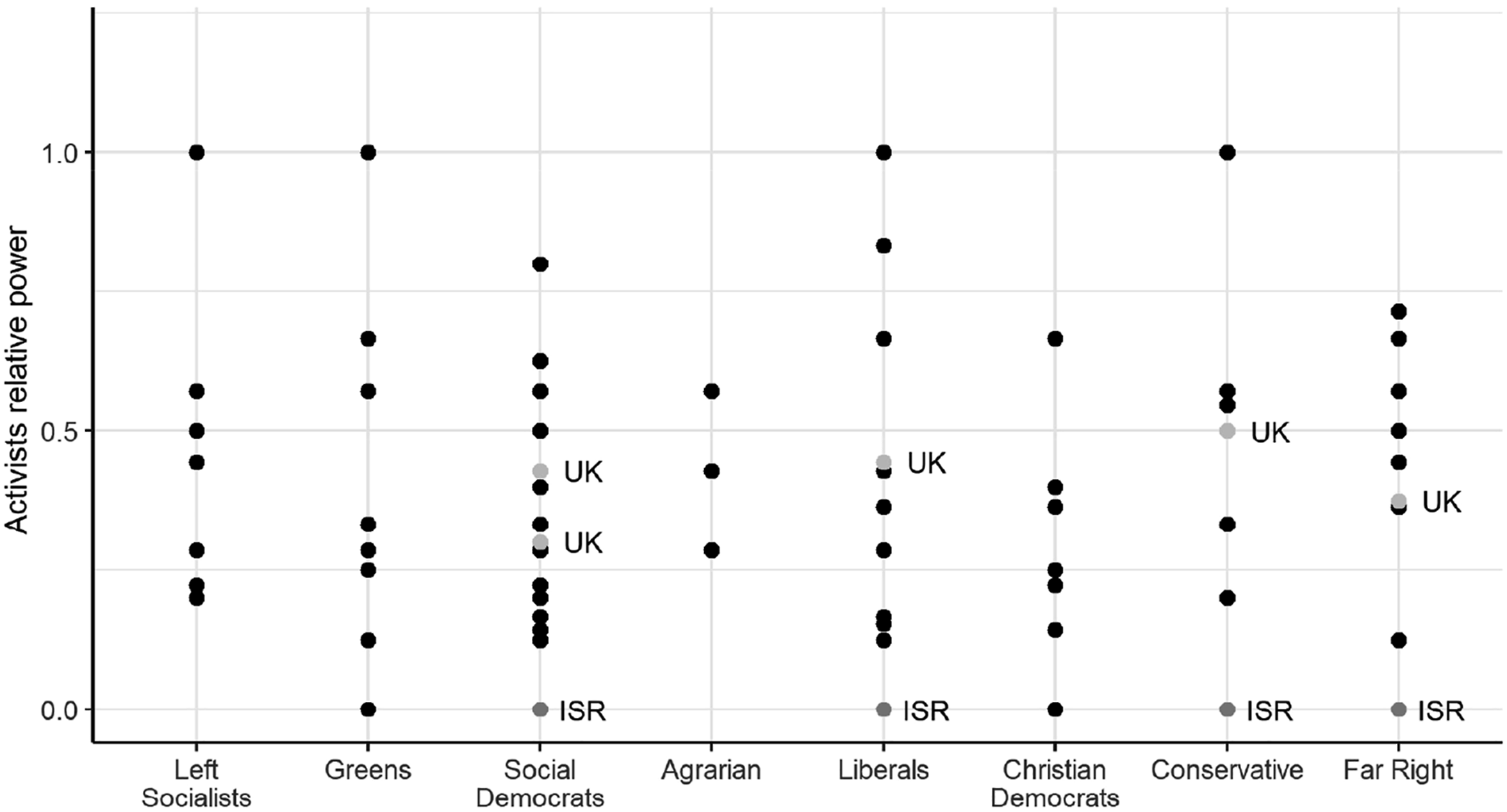
In contrast to the British pattern, Israeli parties (in dark grey) do not delegate power to activists, leading to an overall zero score on the activists' relative power scale. For example, the Israeli Conservative (Likud) or Labour (HaAvoda) parties follow a one-tier model, whereby all party members decide which candidates will run in a primary election. The diverging approaches of British and Israeli parties regarding the role of activists in the candidate selection process may be a consequence of contrasting attitudes to internal party democratization; they may also reflect the influence activists exert on the political process in the country as a whole.
Measuring Party Extremity and Polarization
This research conceptualizes party extremity as the cornerstone of party polarization. As the primary object of this research is party polarization, the measure for party extremity is derived from the party polarization measure.
Several well-established measures can be found in the comparative literature on party polarization. These indices differ on two counts: party positions are operationalized as either one- or two-dimensional, and the dispersion method employed is either Euclidean distance or weighted average (Andrews & Money, 2009; Budge & McDonald, 2006; Dalton, 2008; Dow, 2011; Ezrow, 2008; Han, 2015). This paper adopts Dalton’s method (2008), which uses a weighted average on one ideological dimension, compatible with a standard deviation dispersion measure

As mentioned above, this paper derives the party extremity measure from the party polarization measure. Thus, party extremity is measured using the core term of Dalton’s polarization measure that evaluates parties' distance from the ideological center. To maintain a standard measure, the accompanying arithmetic operations from equation 2 are preserved

To apply this method, I utilize three items from the CSES survey: (1) respondents’ self-placement on a single left–right issue dimension ranging from 0 to 10; (2) respondents’ vote choices; and (3) respondents’ perceptions of party placement on the same left–right scale. Thus, a party’s ideological position is calculated according to its voters' perceptions. This method prevents potential problems of differential item functioning (DIF). Based on the CSES survey, I can measure polarization using the same respondents and the same scale at the same time (Blais & Bodet2006; Golder and Stramski 2010).
Figure 4 displays descriptive statistics of party extremity and polarization. The figure contrasts parties' and voters' levels of extremity and polarization to show the disassociation between parties and voters. Voters' levels of extremity and polarization are measured using equations II and III by replacing the party position with the average position of the party’s voters. In panel A, Dalton’s formula is calculated for every country-year pair in the CSES Waves 1–5, encompassing 152 country-election observations between 1996 and 2017. Polarization levels are estimated for both parties (vertical axis) and voters (horizontal axis). The 45-degree and regression lines are marked in black and grey, respectively. Panel B shifts from the country to the party level, estimating party and voter extremity according to equation 3. The data are the same, but the analysis is at the party level, comprising 885 party-election observations. Party and voter levels of polarization and extremity. The vertical axes represent the party polarization/extremity levels calculated according to Equations 2 and 3. The horizontal axes refer to the voters' stratum and displays voter polarization/extremity levels, based on the same equations by supplementation party position by mean voter position. The plot is based on the CSES data, Waves 1–5 (1996–2017), and compiles of 152 country-election cases and 885 party-election cases. The grey and black lines represent the regression and 45° lines, respectively. (a) Party Polarization Index. (b) Party Extremity Index.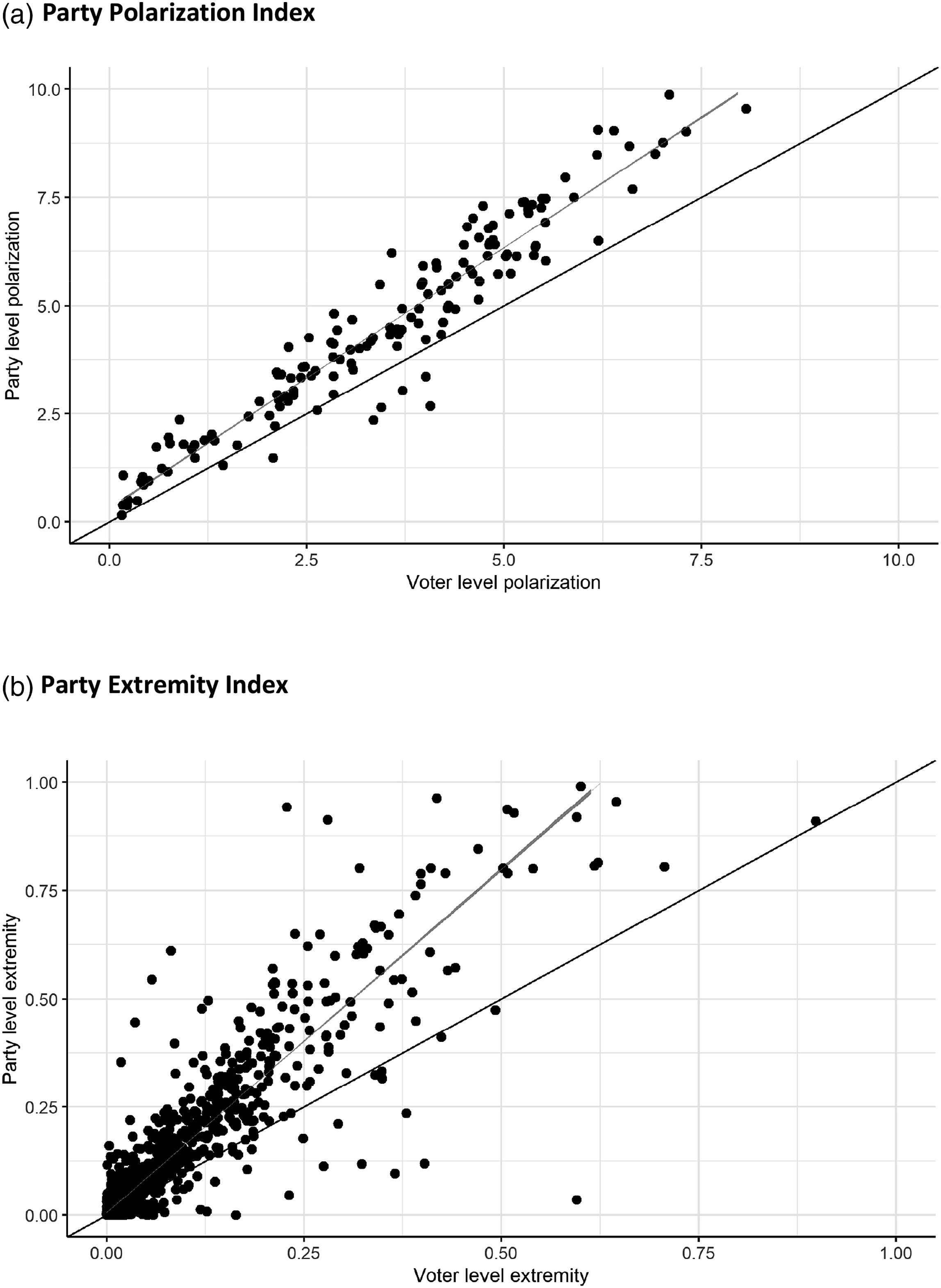
Three significant trends are evident in panels A and B of Figure 4. First, polarization/extremity levels vary significantly between countries at both party and voter levels. Second, the levels of party polarization/extremity are consistently higher than those of voters. This is compatible with previous findings regarding party-voter linkage in the U.S. (Bafumi & Herron, 2010), and in Western democracies (Ezrow et al., 2014). Third, as party polarization levels rise, the difference between polarization/extremity among parties and voters increases (as is evident from the funnel-shaped dispersion of the observations). These trends indicate that polarization undermines representation and that forces other than voters' preferences are at play when ideological extremity and polarization increase.
An Ideological Gap Underpinning Party Polarization
To examine polarization from the representational perspective, I analyze the ideological discrepancies between parties and voters. In measuring ideological incongruence, studies have customarily compared voters' ideological preferences (leveraging on the concept of average or median voter) with parties' platforms or policies (Achen, 1978; Blais & Bodet, 2006; Dalton, 1985; Mayne & Hakhverdian, 2017; Nasr, 2021). My approach in this regard follows Golder and Stramski’s (2010) “many-to-many” method, which gauges the ideological preferences of both the representatives and the represented using cumulative distribution functions (CDFs). Discrepancies between parties' CDF and voters' CDF indicate the presence of ideological gaps.
As in the previous analysis, I employed the same three items from the CSES survey to estimate parties' and voters' CDFs and calculate the ideological gaps between them. Golder and Stramski applied their method at the country level; however, this study requires the assessment of the ideological gap between each party and its voters. Thus, for each party, I calculate the CDFs of its voters' self-placement and party placement. Subtracting the party’s CDF from the voters' CDF provides the measurement of ideological incongruence. Positive (negative) values of incongruence mean that a party holds more left-wing (right-wing) stances relative to its voters. The advantage of this approach is that the CDF reflects the preferences of all survey respondents and thus yields a measurement of ideological incongruence which accurately targets representation. Furthermore, this method prevents potential problems of differential item functioning (Blais & Bodet2006; Golder and Stramski 2010).
Figure 5 plots the connection between the party family and ideological incongruence. The ideological gap takes on different values for leftist and rightist positions. A positive value on the vertical axis means that party positions are more leftist than its voters' preferences, and vice versa: the location below 0 indicates a discrepancy in the direction of the right pole. Figure 5 reveals a notable trend whereby left-wing parties tend to be located in the upper half, while right-wing parties are in the lower half of the graph. The ideological incongruence increases with the distancing of parties' positions from the moderate center. In other words, center parties tend to be more congenial to their voters, but even a slight shift toward either side of the ideological spectrum augments ideological incongruence. As mentioned, center parties tend to limit party activists' influence over the candidate selection process. It appears, then, that a connection exists between activists' influence and ideological incongruence. This connection will be tested empirically in the next section. The Ideological gap between parties and voters. The horizontal axis represents party families, and the vertical axis represents the level of ideological incongruence. The incongruence levels are the values resulting from subtracting the party’s CDF from the voters' CDF. Negative values on the vertical axis indicate that the party elites hold more rightist, while positive values indicates more leftist, positions relative to the party’s voters.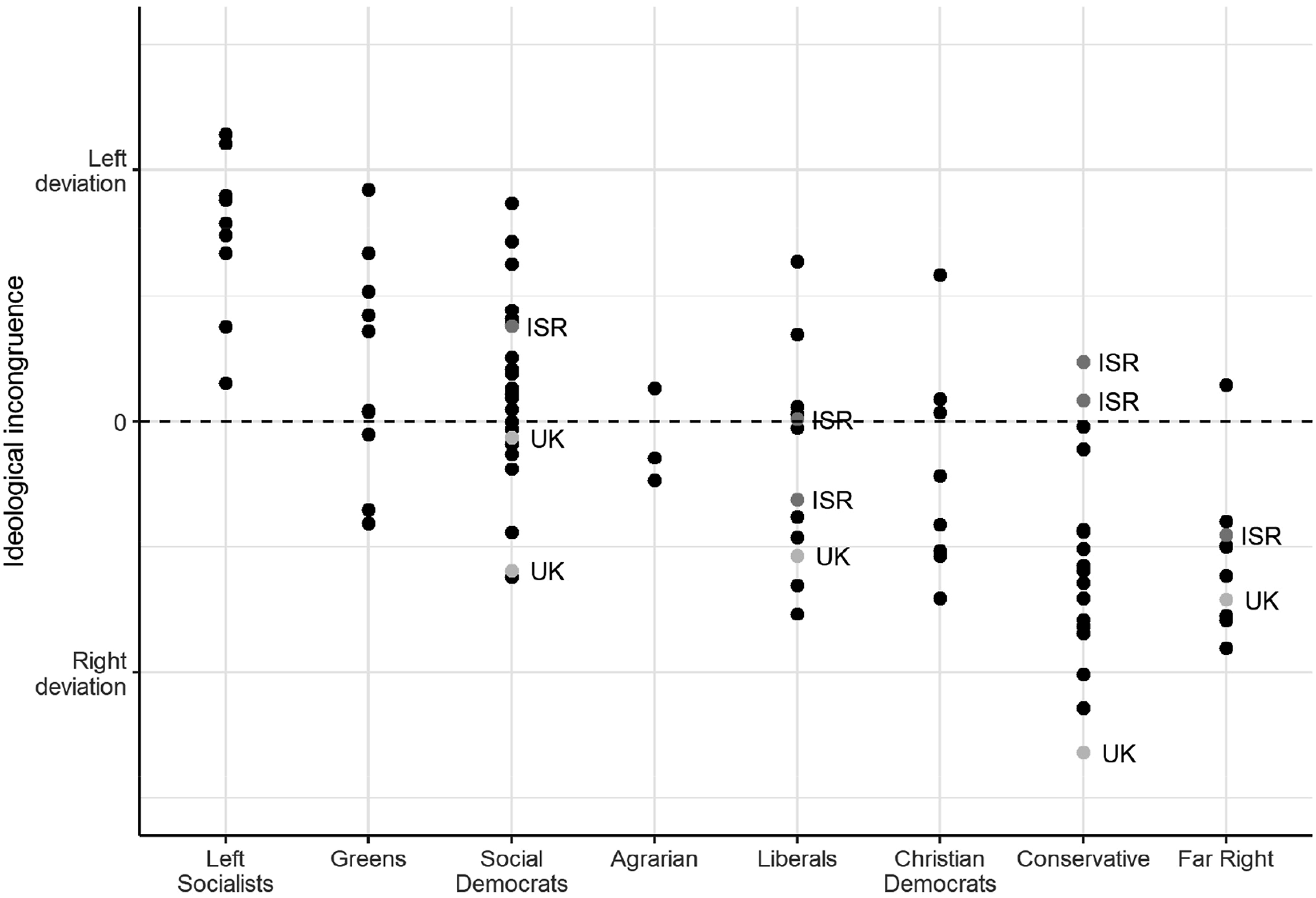
To highlight this trend, I once again color-marked the British (light grey) and Israeli (dark grey) parties. A comparison of Figure 5 reveals that the incongruence score is generally higher for British than Israeli parties. In specific cases, like the British and Israeli Labor parties, the incongruence level is the same despite the difference in the influence of party activists. However, on the right side of the political map, we can observe a sustained disparity between the conservative and far-right parties, spanning the selection method and the incongruence level. Furthermore, Britain is the only country where all parties are more rightist relative to their constituencies. This pattern may have evolved when Tony Blair reshaped the British Labor party as the New Labor, subsequently adopting Thatcher’s liberal economic reforms (Heath, Jowell, and Curtice 2001). Conversely, in Israel, the two conservative parties (Likud and Shomrei Sfarad) emerge as more leftist than their constituencies, albeit only slightly.
However, not every shift in the direction of either ideological pole entails an increase in ideological incongruence. An intriguing trend emerges at the country level, as per Figure 5. In some countries, like Sweden and England and, to some extent, Germany and Norway, far-right parties are more congruent with their voters' preferences than the traditional right or center-right parties. Comparing the British Conservative party (−1.3) to UKIP (−.7) or the Swedish Moderate party (−1.14) to Sweden Democrats (−.59), one observes a decline in ideological incongruence. This tendency might indicate a possible reason for the recent rise, in these countries, in the electoral power and popular support of the far right. Nevertheless, not all the observations attest to this correlation. In France, Austria, and Israel, the far-right parties display a higher level of incongruence. This trend’s significance is further accentuated by its presence only on the right side of the political map. With no exception, left socialist parties are less representative of their voters' preferences compared to the Green or Social Democrats.
This estimation of party–voter relations establishes the extent to which parties represent their voters' ideological choices in the eyes of these voters. The ideological gaps revealed by the analysis show how party extremity and polarization go hand in hand with ideological incongruence. This trend raises concerns about parties' ability to represent their voters in a polarized era.
Party Activists' Effect on the Political System
Activists’ Effect at the Party Level: Party Extremity and Ideological Incongruence
The theoretical argument of the present research regarding activists' effect on party polarization involves two stages: Activists increase party extremity by way of intraparty politics, and this change, in turn, leads to greater party-system polarization. Furthermore, activists’ influence on the elites also augments the ideological disparity between the party and its voters.
To test the “party extremity” hypothesis, I estimate a multiple regression model of activists' relative power on party extremity (Model 1). Model two adds the following control variables to the model: Gallagher disproportionality index at the country level; the effective number of parties (ENP); the electoral method, gauged through the district magnitude of the median legislature (MedD [lagged]); and the level of ethnic conflict (Elffrn). These control variables are well-known predictors of parties' and voters' ideological positioning (Andrews & Money, 2009; Budge & McDonald, 2006; Dalton, 2008; Dow, 2001, 2011; Ezrow, 2008; Han, 2015; Matakos et al., 2016). In addition, since party extremity can derive from voters' preferences (Ezrow et al., 2014), as well as activists’ influence, Models three and four control for the effect of voters' and parties' positions on party extremity. Model five examines the interaction between party activists' relative power and party position. This model’s rationale is that extreme parties are policy-seeking, thus drawing more vigorous activists, leading to a stronger activists’ effect.
Effect of Party Activists on Party Extremity.
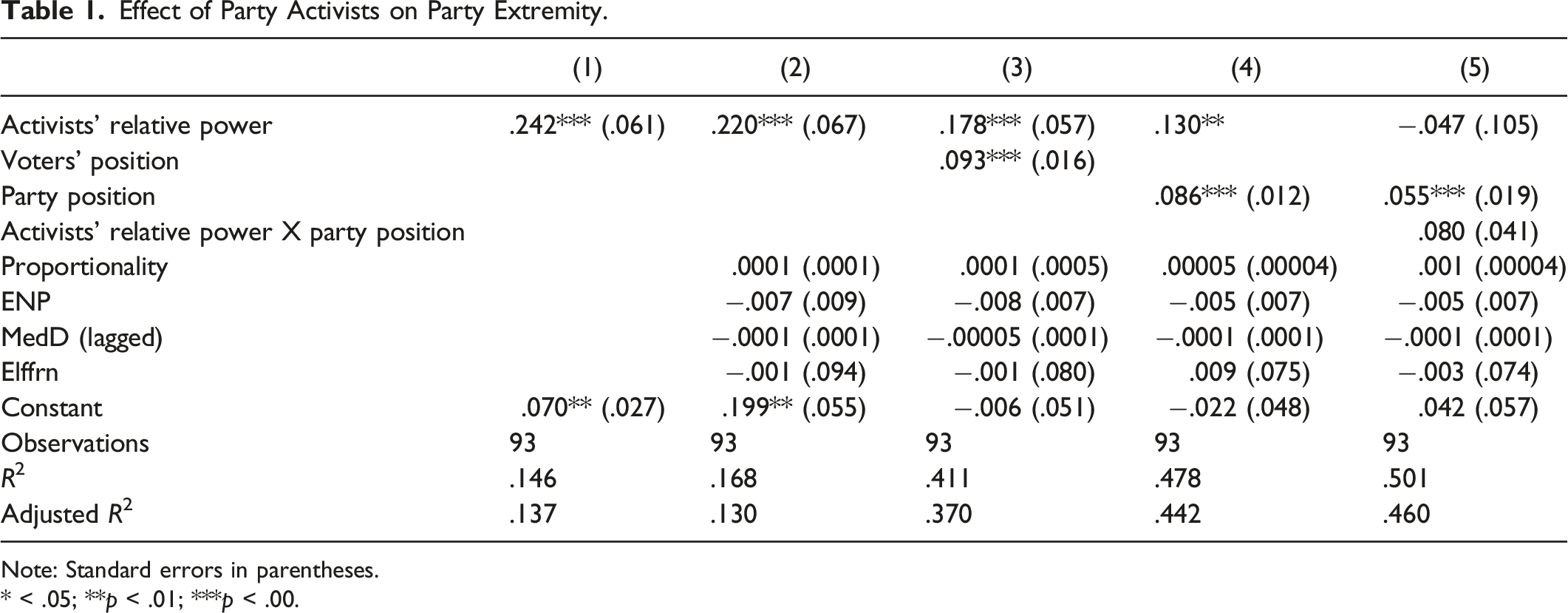
Note: Standard errors in parentheses.
* < .05; **p < .01; ***p < .00.
The effect of party activists on party extremity is evident in Figure 6. The horizontal axis displays party extremity, where moderate parties are placed at the center and extreme parties at the poles. The vertical axis presents the level of activists' power for each party. The vertical dashed line represents the mean score of party extremity, which is close to zero. Higher levels of activists' power are associated with higher party extremity values. Though the correlation between activists' relative power and party extremity is characterized by a high degree of variance, a Breusch–Pagan test showed no evidence for heteroskedasticity. Influence of party activists on party extremity. This figure presents data on 93 parties on two indices. The horizontal axis displays the ideological distance of each party from the respective countries’ average ideological position, and the vertical axis shows the level of activists’ power. The data are based on the CSES waves 3–5, and the PPDB waves 1a and 1b.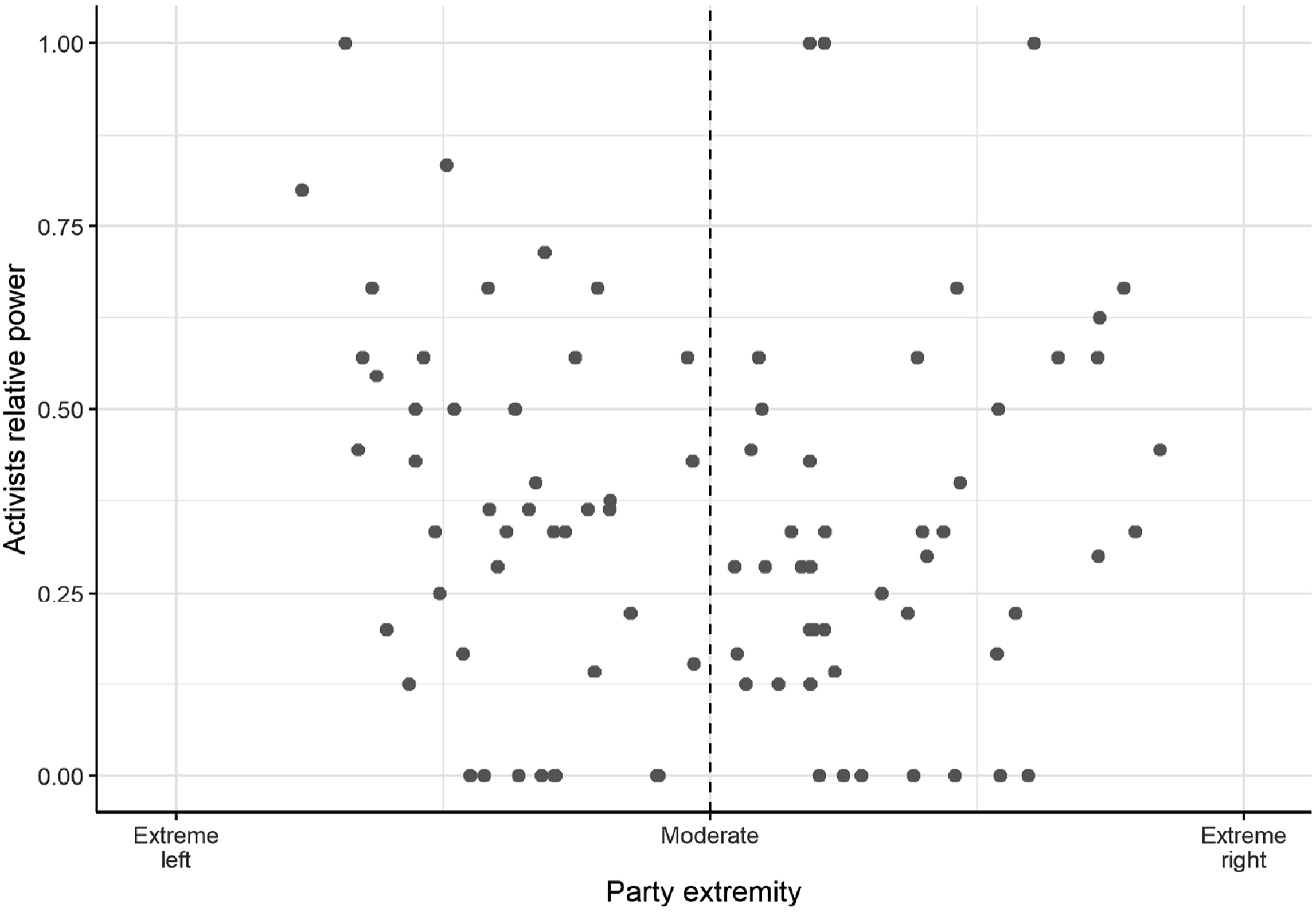
Does party extremity percolate to the general public and affect voters' attitudes? As mentioned above, this issue is at the center of an ongoing academic and public debate in America today. Some claim that ideological polarization is a top-down phenomenon, starting among political elites and spreading down to voters. (Abramowitz, 2010; Abramowitz & Saunders, 2005, 2008; Rogowski & Sutherland, 2016). On the other side of the debate are those who argue that voters' preferences remain moderate and are distributed normally along the ideological spectrum. Such a picture of the American society entails that party extremity leads to an ideological incongruence between parties and voters (Fiorina et al., 2005; Fiorina et al., 2008; Levendusky, 2009). My argument regarding the intraparty origins of party polarization supports the latter approach and demonstrates a mechanism through which countries may evolve extreme elites and moderate voters.
According to the “ideological incongruence” hypothesis (H1b), activists could have a negative effect on the ideological congruence between elites and voters. By estimating party activists' effect on ideological incongruence, I show that polarization manifests in an ideological discrepancy between extreme party elites and moderate voters.
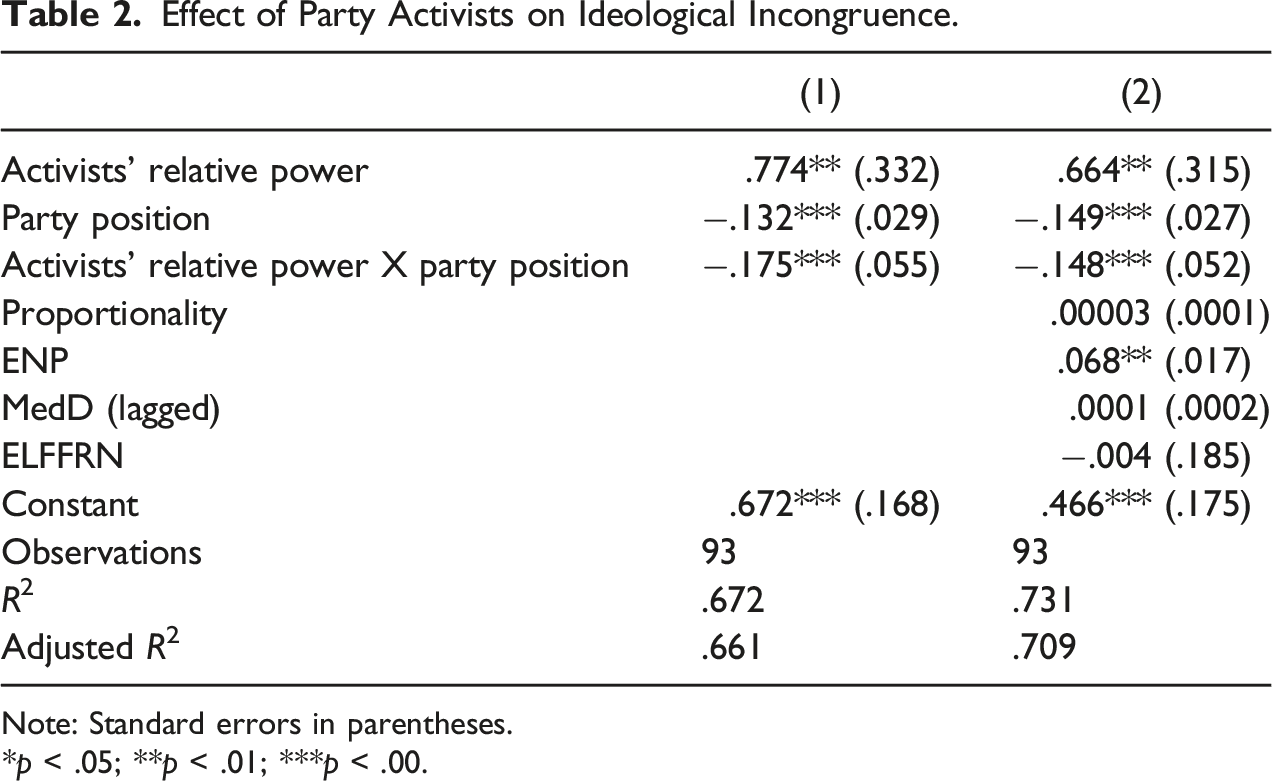
Effect of Party Activists on Ideological Incongruence.
Note: Standard errors in parentheses.
*p < .05; **p < .01; ***p < .00.
The regression indicates that higher power for activists is associated with a larger ideological gap between parties and voters. The model’s constant and activists' coefficients are positive, while the coefficients of party position and the interaction terms are negative. This means that when parties lean toward the left, activists' effect will lead them to adopt more leftist stances relative to their voters (higher positive values). This pattern changes when party positions reach the value of 4.08 and activists' power is kept at its mean (.35). From this point on, higher party position scores return a negative value of ideological incongruence, which means that parties embrace more rightist positions relative to their voters. These findings confirm the “representation” hypothesis (H1b), validating the positive correlation between activists' power and ideological incongruence.
The interaction effect of activists’ power and party position on party–voter ideological incongruence is more clearly evident in Figure 7. This graph follows the design of Figure 5, plotting the connection between ideological positions (horizontal axis), ideological incongruence (vertical axis), and activists' relative power (the observations' color). Two notable trends appear in the graph. First, as party activists' power increases, so does the ideological incongruence between parties and voters. Secondly, the ideological gap is larger between extreme parties and their voters than moderate parties. Effect of party activists on ideological incongruence. The horizontal axis represents party families, and the vertical axis represents the level of ideological incongruence. The incongruence levels are the values resulting from subtracting the party’s CDF from the voters' CDF. Negative values on the vertical axis indicate that the party elites hold more rightist, while positive values indicate more leftist, positions relative to the party’s voters. The observations' color marks activists' relative power.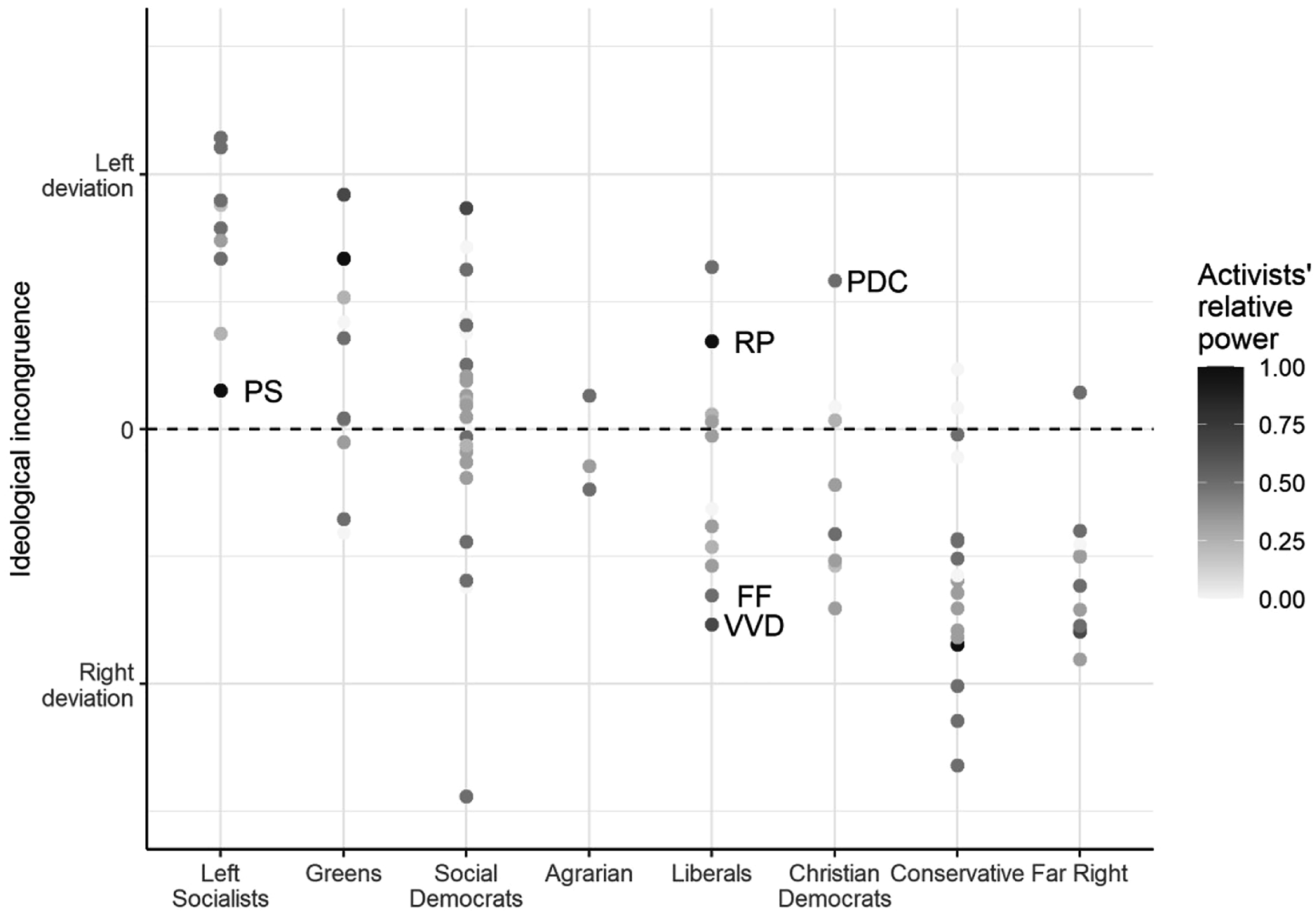
Several cases stand out. To begin with, two Chilean parties deviate from the general trend. First, the Chilean Socialist Party (PS) is characterized by a high activists’ power score and low incongruence level. The high activists' power is compatible with other policy-seeking parties' selection mechanisms. However, unlike most policy-seeking parties, PS is located at the moderate-left of the political spectrum. Furthermore, unlike other socialist parties, Chilean PS leads the center-left coalition and endorses candidates for the presidential elections—for example, former president Michelle Bachelet, who propelled PS toward the ideological mainstream. The second exceptional case is the Chilean Christian Democratic Party (PDC), which is considerably more leftist than its voters. PDC is regarded in the country as a bridge between political blocs and a proponent of social capitalist ideology. This role has driven PDC to form governing coalitions with left-wing parties—a move that accounts for its deviation from the general trend.
Additionally, I marked three Liberal parties whose indices do not align with the theoretical expectations. It is noteworthy, in this regard, that not all Liberal parties hold centric positions. My data encompass 12 Liberal parties with an ideological average of 5.9. However, the scores for the Irish Fianna Fail (FF), the Dutch People’s Party for Freedom and Democracy (VVD), and the Polish Palikot’s Movement (RP) diverge significantly from this mean (7.3, 7.6, and 4.7, respectively).
This section has demonstrated that party elites' move toward the ideological poles is not motivated by an urge to meet voters' preferences but is instead a response to party activists' considerable force within party institutes.
Activists’ Effect on Party Polarization: How an Intraparty Force Influences an Interparty Characteristic
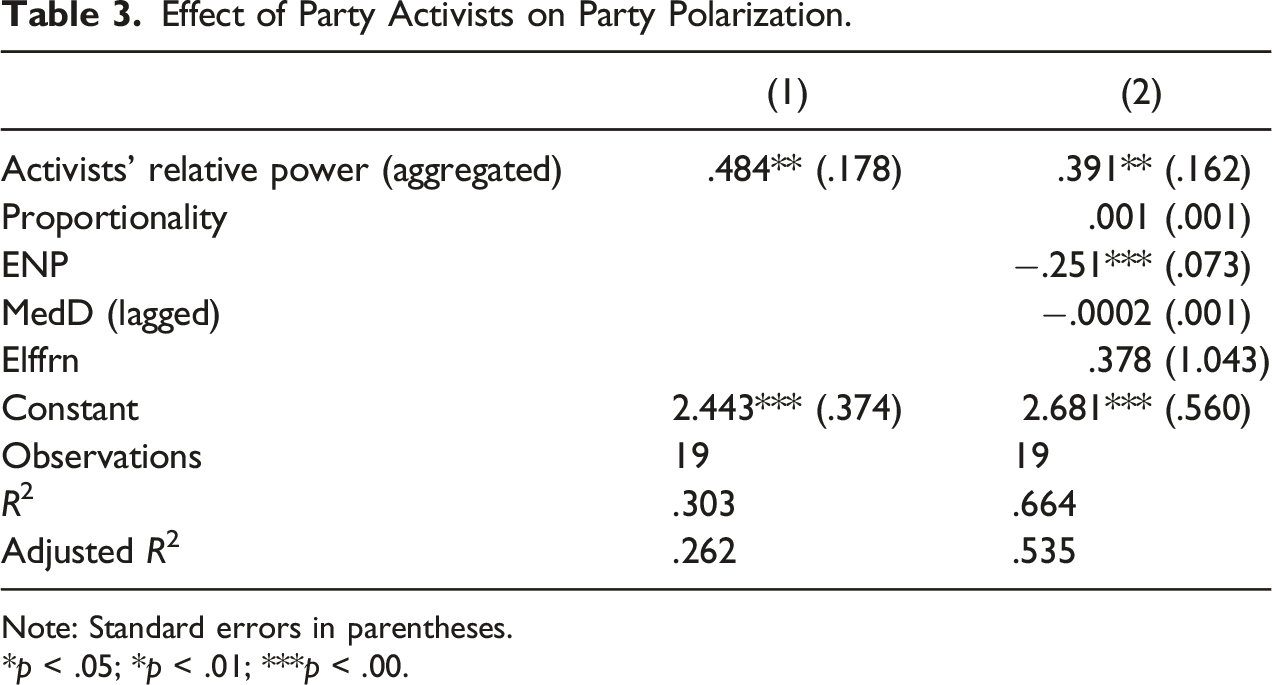
The intraparty effect of party activists can have implications for the party system as a whole. By propelling elites to adopt a more hardline ideology, activists increase party polarization at the country level. To capture the activists' country-level effect (i.e., party polarization), I summed up activists' intraparty power in each country to a general country score.
Effect of Party Activists on Party Polarization.
Note: Standard errors in parentheses.
*p < .05; *p < .01; ***p < .00.
This pattern is more clearly observable when plotting the connection between activists' power and party polarization, as in Figure 8. This graph’s hinges represent party activists' power, aggregated to the country level (horizontal axis) and Dalton’s measure for party polarization (vertical axis). The positive relationship between the variables is noticeable at first glance. However, a closer examination reveals the neutrality of country-level variables, such as, for example, the electoral method and the number of parties, as is evidenced by the similar polarization scores of England, Germany, Italy, and Romania (3.22, 3.12, 3.3, and 3.51, respectively). This analysis provides another indication that intraparty dynamics can precipitate polarization processes. Effect of party activists on party polarization. The horizontal axis displays party activists' power, aggregated to the country level by summing the relative power scores of all activists in all parties. The vertical axis represents the party polarization level, calculated according to Dalton’s formula (Equation 2). Every observation represents a country-election pair.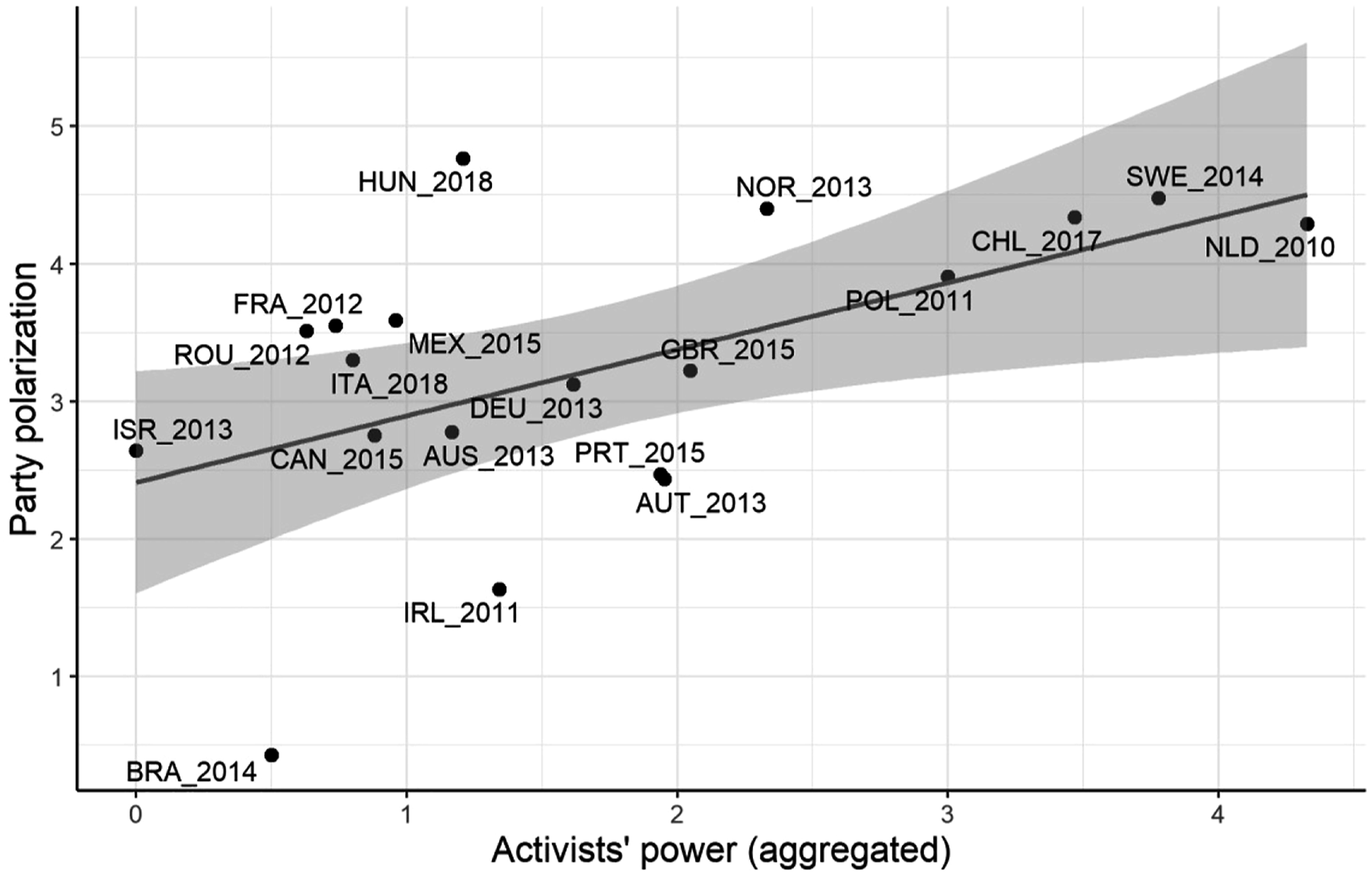
Robustness Checks
The analysis results were subjected to a series of robustness tests. First, the models were estimated using an ordinal scale for the different roles fulfilled by the selectorates in the candidate selection method. These models were reestimated using equal values for every role. Second, parties' positions in the analysis are estimated based on voters' perceptions—a measure that has significant advantages. However, the models were also reestimated such that parties’ positions were derived from the expert surveys of the Comparative Party Manifesto (CPM) and the Comparative Study of Electoral Systems (CSES). The results of the alternative models appear in tables A3–A8 of the Appendix. These models support the research hypothesis by attesting to the robustness of the findings to different measurements.
Discussion
This study has endeavored to examine the intraparty origins of party polarization. As a country-level phenomenon, party polarization has been associated chiefly with country-level attributes, such as the electoral method or the number of parties in the polity (Andrews & Money, 2009; Dow, 2011; Ezrow, 2008; Han, 2015; Matakos et al., 2016). This research has found evidence linking an interparty outcome, that is, party polarization, with an intraparty factor, that is, activists' internal power. Activists' influence over the political system percolates through the party level. Activists use the candidate selection process to demand that party elites cater to their extreme ideological tendencies. As activists' influence over the selection mechanism increases, so does also their influence on elites, resulting in increasing party extremity. In this way, activists contribute to the general polarization levels. Indeed, what is party polarization if not a centrifugal movement of individual parties to the outer confines of the political arena?
Results suggest that activists constitute a considerable intraparty force to be reckoned with. The typically extreme ideology of this group renders them keen and resolute participants in intraparty decision-making processes. As the findings of this research have shown, activists' influence over the party elites has a polarizing effect by drawing the latter closer to their own extreme agendas. It follows that, by mitigating activists' control, the elites could be more flexible in determining their party’s ideological placement, taking into account strategic and vote-seeking considerations as well as ideological ones. This conclusion dovetails with Mair and Katz’s theory regarding the causes of democratization processes within parties (Katz & Mair, 1995). Crucially, however, the outcomes of activists’ polarizing influence vary depending on the party’s placement on the ideological map.
Furthermore, the finding regarding ideological congruence strongly suggests that polarization goes hand in hand with developing an ideological gap between elites and voters. When activists’ power within a party is strong enough to push elites away from the mainstream, the party distances itself from its voters and becomes less representative. This effect is compatible with the theoretical works and empirical findings on this issue, specifically May’s law of curvilinear disparity (May 1967; Iversen, 1994).
For the analysis, I developed a method to gauge activists' influence over the candidate selection process. Drawing on cross-party (and cross-country) differences rather than changes over time carries obvious limitations in the ability of the study to determine causal relationship between activists' power and party polarization with greater certainty. Additional information regarding candidate selection methods could support future research that could better model this relationship. Furthermore, future research could apply this method to measure the relative power of other participants in a party’s candidate selection method.
Finally, in addressing the tension between activists' right to political participation and voters' right to political representation, this study takes count of two essential democratic values. In both logical and practical terms, a solution to this dilemma would lie either in limiting activists' direct participation in the political process, reducing their influence, or in encouraging political participation of more moderate elements. Far it be from me to suggest imposing additional restrictions on individual freedoms. Instead, I hope this paper might serve as a wake-up call for the general public to take a more active role in shaping local and national politics.
Supplemental Material
Supplemental Material - The Activists Who Divide Us: A Cross-Country Analysis of Party Activists’ Influence on Polarization and Representation
Supplemental Material for The Activists Who Divide Us: A Cross-Country Analysis of Party Activists’ Influence on Polarization and Representation by Yair Amitai in Comparative Political Studies.
Footnotes
Acknowledgments
I wish to express my deep gratitude to Prof. Orit Kedar and Dr. Noam Gidron, who have guided and helped me write this article.
Declaration of Conflicting Interests
The author(s) declared no potential conflicts of interest with respect to the research, authorship, and/or publication of this article.
Funding
The author(s) received no financial support for the research, authorship, and/or publication of this article.

Supplemental Material
Supplemental material for this article is available online.
Notes
Author Biography
References
Supplementary Material
Please find the following supplemental material available below.
For Open Access articles published under a Creative Commons License, all supplemental material carries the same license as the article it is associated with.
For non-Open Access articles published, all supplemental material carries a non-exclusive license, and permission requests for re-use of supplemental material or any part of supplemental material shall be sent directly to the copyright owner as specified in the copyright notice associated with the article.
