




Abstract
Comparative welfare research commonly assumes that women’s political demands were not a crucial factor in the early development of welfare legislation, given their limited access to political resources. This article argues that women contributed to enhancing their right to maternity protection once paid maternity leave was adopted. The early development of paid maternity leave was not only an outcome but also a cause of women’s influence in policymaking. Although paid maternity leave was invented by male policymakers in pioneer welfare states, the adoption of paid maternity leave generated political opportunities for women to push for further expansions. Utilizing an original historical dataset of paid maternity leave, I examine the adoption and extension of paid maternity leave in 20 Western countries from 1883 until 1975. I find that women’s political participation shaped the generosity of paid maternity leave but not the timing of its adoption.
Introduction
Feminist scholars criticize that comparative welfare research omits women from its analyses, emphasizing that women have been disadvantaged from the statutory provision of social protections given their limited access to paid labor (e.g., Orloff, 1993). Although these insights are helpful, the question of what determines the early development of welfare legislation for women has been widely neglected by comparative welfare state research and feminist studies (Htun & Weldon, 2010, p. 208; Orloff, 1996, p. 58). A few studies analyze the origin of women’s social rights as dependents (Misra, 1998, 2003; Pedersen, 1993; Skocpol, 1992). No study has yet systematically examined the question of when and how women were incorporated into the welfare system as workers. In other words, the origin of work–family policy has been largely unexplored despite growing attention on its contemporary development (e.g., Fleckenstein & Lee, 2014; Morgan, 2013). Notably, paid maternity leave, the first social policy for women workers, deserves more attention, as it became the underpinning of work–family policies (Daly & Ferragina, 2018).
Social policies for women are distinguishable from other social policies in which male workers’ political demands were recognized as one of the main explanatory variables since women lacked access to political resources. Women’s political demand for social protection itself was not a sufficient condition for the early development of social policies (e.g., Pierson, 2000, pp. 803–804). In the late 19th and early 20th centuries, their political influence was largely constrained by institutional contexts and political opportunity structures (Misra, 2003; Teele, 2018). Several scholars suggest conditions under which women could contribute to welfare system establishment, for instance, strong bureaucratic and financial capacities (Htun & Weldon, 2010) and the existence of women in government positions (Hernes, 1987; Hobson & Lindholm, 1997), based on their observations of a few countries. However, the lack of historical data hinders the development of a coherent explanation for the role of women as political actors in the emergence of social policies for women workers. I respond to this challenge by systematically examining the question of when women’s political influence matters in the formation of paid maternity leave, using a new historical dataset—the Historical Dataset on Maternity Leave (HDML)—with an extensive time series (1883–1975) in 20 Western countries.
Through the analysis of my original dataset, I propose that the early development of paid maternity leave was not only an outcome but also a cause of women’s influence in public policymaking. More specifically, I argue that the adoption of paid maternity leave generated opportunities for women as political actors to push for further expansions, although the timing of adopting paid maternity leave was shaped by the degree of welfare system establishment in each state. Paid maternity leave was invented by male policymakers in pioneer welfare states, such as Bismarckian Germany and France, to deal with prevailing concerns about depopulation and maternal and infant health problems. Although women demanded the adoption of paid maternity leave in latecomer countries, they had limited room to maneuver given the lack of institutional foundations of welfare system in these countries. Once paid maternity leave was adopted, women obtained better opportunities to exert their political power. The implementation of paid maternity leave incorporated various women’s groups into the state apparatus, which connected the women’s movement and traditional political institutions. Moreover, the inadequacy of the initial paid maternity leave, designed by male policymakers, increased solidarity among women, creating motivation and a collective will to enhance paid maternity leave. To test my argument, I first examine the determinants of the adoption of paid maternity leave using an event history analysis. Then, I go beyond the adoption of paid maternity leave and test the impact of women’s political participation on the generosity of paid maternity leave, employing OLS regression with panel-corrected standard error estimation (PCSE). The overall empirical evidence reveals that women’s political participation matters once paid maternity leave has been adopted.
Leveraging a novel dataset, this article makes several empirical contributions: First, I provide the first systematic examination of relationships between women’s political participation and the early development of social policies for women. While existing research has focused on women as political actors since the 1970s (Ferragina & Seeleib-Kaiser, 2015; Huber & Stephens, 2000; Iversen & Stephens, 2008; Kittilson, 2008; Morgan, 2013), I examine whether women played a significant role in public policymaking even when their access to political resources was limited. Second, I highlight that a distinctive logic and more disaggregated analysis are required when understanding the emergence of social policies for women, contributing to comparative welfare research that has ignored paid maternity leave (Esping-Andersen, 1990; Flora & Heidenheimer, 1981; Obinger & Schmitt, 2020b) or analyzed it as a placebo test, replicating the analysis of its main variable (e.g., pensions) in paid maternity leave to strengthen empirical findings (Knutsen & Rasmussen, 2018).
This article is organized as follows: in the next section, I briefly summarize the state of the art concerning women’s political influence on the early development of welfare legislation for women. This overview shows that there is hardly any agreement, as it may depend on institutional contexts. Given this uncharted territory, I discuss how the adoption of paid maternity leave would enhance the effectiveness of women’s political influence in 20 Western countries. I then present results from my empirical analysis that women’s political participation matters once paid maternity leave was introduced and discuss my findings suggesting that institutional contexts should be considered when studying the role of women as political actors in the emergence of social policies.
Literature
While the contemporary literature highlights a link between women’s political participation and the development of work–family policies (Ferragina & Seeleib-Kaiser, 2015; Huber & Stephens, 2000; Iversen & Stephens, 2008; Kittilson, 2008; Morgan, 2013), it is unclear whether this line of reasoning would apply to the late 19th and early 20th centuries when women lacked access to political resources, including the right to vote. Women tended to be marginalized within political parties and trade unions, even after the attainment of suffrage. Instead, they formed alliances with male political leaders in the legislative arena or promoted their interests in public debates.
In the literature on the early stages of welfare states, women are seen as recipients rather than contributors (Hernes, 1987, pp. 43–44; Pierson, 2000, pp. 803–804). Maternal and child welfare was one of the major social problems in the late 19th and early 20th centuries (Jenson, 1986; Wikander et al., 1995). For the most part, this was linked to concerns about (de)population in a context of inter-state competition shortly before both World Wars (Gauthier, 1996; Jenson, 1986; Klaus, 1993b; Obinger & Petersen, 2017). In addition, women and children tended to be perceived as weak, requiring special protection. A series of international conferences, such as the International Workers Protection Conference in Berlin in 1890, the Bern Convention in 1906, and the International Labour Organization (ILO) Maternity Protection Convention in 1919, put normative pressure on states to give more attention to working women’s maternity (Whitworth, 1994; Wikander et al., 1995). As a result, social policies for women were introduced, particularly by the states that played an important role in individuals’ welfare (Jenson, 1986; O’Connor et al., 1999; Orloff, 1996; Skocpol, 1992). More specifically, pioneer welfare states like Bismarckian Germany and France actively intervened in maternal and child welfare issues, while laggard welfare states like the United States treated them as a private realm.
There is case-based evidence that women were not influential political actors during the emergence of social policies that support women (Gordon, 1994; Koven & Michel, 1990; Lewis, 1992; Misra, 1998; Pedersen, 1993). First, no female political actors were involved in the adoption of paid maternity leave in Bismarckian Germany or Austria (Grandner, 1995; Kulawik, 1999). Women’s right to express their collective will was prohibited in these countries. Additionally, women’s philanthropic organizations in the United Kingdom and the United States initiated the voluntary and private provision of maternal and child welfare in the late 19th and early 20th centuries, extending their maternal role outside the family. However, the achievements of this maternalist movement were separated from the statutory provision of social protection (Koven & Michel, 1990). Jenson (1989) argues that the maternalist movements in English-speaking countries were able to flourish despite women’s marginalized positions within more traditional and established political organizations (e.g., labor unions and political parties) because these countries tended to assign the task of dealing with child and maternal health to private actors.
Other studies emphasize women’s contributions to the formation of social policies (Bock & Thane, 1991; Hobson & Lindholm, 1997; Koven & Michel, 1993; Kulawik, 1999; Misra, 2003; Sainsbury, 2001; van der Klein, 2012). Despite their severe underrepresentation, women participated in drafting legislation supporting maternal and child welfare using their personal and public networks within the political system (Bock & Thane, 1991; Hobson, 1993; Peterson, 2018; Sainsbury, 2001). For instance, Alva Myrdal in Sweden and Katti Anker Møller in Norway generated the main contours of social policies for women, in which their family and marriage ties played an important role. Women’s movements also formed alliances with other political actors to represent their interest in policymaking channels before having the right to vote (Ohlander, 1991) and presented legislative proposals for welfare reforms as a member of government committees (Beaumont, 2000; Hobson, 1993; Hobson & Lindholm, 1997).
Furthermore, women pressed for the enactment of social policies for women in public debates. Women’s movements in the United States prompted the introduction of mothers’ pensions in the early twentieth century by propagating them in women’s magazines and launching nationwide campaigns (Skocpol, 1992). European women supported the rights of working mothers and criticized existing maternity insurance systems in their magazines, which often coincided with the submission of reform bills (Dutton, 2002; Schievenin, 2016). Even in pioneer welfare states, women’s movements, such as Bund für Mutterschutz in Germany, arose around the issue of maternity protection and submitted petitions to the parliament—but only after the adoption of paid maternity leave (Allen, 1985; Wickert et al., 1982).
One reason for these ambiguous findings might be that women’s political demands are effective under certain conditions. First, women’s political demands for their social rights are more likely to be effective if a state possesses the capacity or institutional legacy to implement such policies. In a context where the implementation of social policies is not feasible, policies that are financially less costly, such as constitutional reforms or limitations on married women’s paid labor, are preferred (Htun & Weldon, 2010, pp. 211–212). Second, it is necessary to have figures who connect women’s movements with traditional political institutions, integrating women into public policymaking rather than pursuing separatism (Hernes, 1987; Hobson & Lindholm, 1997; Misra, 2003). Once more women enter the state apparatus as members of parliament or state employees, they become strong advocates of public policies for women and an important channel to ensure the implementation of such policies. Combining these insights, I clarify in the next section why women’s political demand for their social rights would become influential after the adoption of paid maternity leave.
Theoretical Arguments
Paid maternity leave originated from concern with solving child and maternity health problems in the late 19th and early 20th centuries. Initially, to tackle these problems, states introduced protective legislation that prohibited women from working before and after confinement. Since unpaid maternity leave did not stop low-income women from working, policymakers adopted a positive approach by introducing income compensation measures, particularly in pioneer welfare states (Koven & Michel, 1990, p. 1092). Seen from a historical institutionalist point of view, the adoption of paid maternity leave in pioneer welfare states reflects a certain path dependency: states that resolve labor and social problems by introducing social insurance systems are inclined to choose the same strategy for maternity protection. There was no strong opposition to the adoption of paid maternity leave in pioneer welfare states, despite their conservative stance on women’s paid labor (Wikander et al., 1995, p. 37). For instance, legislators in Bismarckian Germany converted voluntary maternity benefits of female factory workers (Fabrikkassen) into maternity insurance in 1883, arguing that they should not spoil the principle of social insurance that converted the voluntary aid funds (Hilfskassen) to publicly funded universal social insurance by making an exception out of women workers (Kulawik, 1999, pp. 141–143). Moreover, the establishment of other social policies provided institutional foundations of paid maternity leave, which reduced the cost of implementation. Paid maternity leave was initially funded by sickness or unemployment insurance. Laggard welfare states would face a much higher institutional cost to initiate maternity insurance, given the absence of other social insurance funds in these countries. The implementation of paid maternity leave also required bureaucratic capabilities to enforce legal standards in many workplaces and to cooperate with private actors such as doctors and midwives because paid maternity leave often included the prohibition of dismissing pregnant workers and free medical and midwifery services. Thus, bureaucratic capabilities are a predictor (Wilensky, 1974) as well as a direct effect of the establishment of social policies (Pierson, 1993; Skocpol & Amenta, 1986), which could be a good “bridge” from other types of social policies to paid maternity leave.
Paid maternity leave was initiated by male policymakers in pioneer welfare states and did not result from women’s demand for the policy. In contrast, women in laggard welfare states actively struggled to attain their right to maternity protection after they observed the adoption of paid maternity leave policies in pioneer welfare states. Paid maternity leave was one of the major policy agendas that female members of parliament advocated for in the early twentieth century (Lovenduski, 1986). It was also supported by a broad range of feminist groups that were otherwise in conflict due to their divergent focus on special protection or equal treatment. It is protective legislation that prohibits pregnant women from working before and after confinement, and at the same time ensures that women workers could return to work after the confinement period. For instance, as various authors have argued, diverse strands of feminists in the early twentieth century contended for setting the agenda that would be considered at the first International Labour Conference (1919) in terms of women workers’ rights. Some sought to protect women (e.g., by limiting the working hours of women workers) while others sought to advance their rights as workers. They could, nevertheless, agree on the necessity of paid maternity leave (Boris, 2019; Whitworth, 1994). 1
However, women’s political demand for the right to maternity protection was often ignored in laggard welfare states. Laggard welfare states tended to introduce paid maternity leave only in the presence of other social policies. The adoption of social policies geared toward working-class men took priority over social policies for women workers. For instance, Swedish feminists constantly lobbied the social-democratic party to adopt paid maternity leave from the 1900s, which was realized only in the 1930s (Ohlander, 1991). Male policymakers in Sweden refused to introduce maternity insurance before the establishment of general sickness insurance which was considered to be a more urgent task (Sainsbury, 2001, p. 135). Women’s political influence was also not strong enough to push the state to establish institutional foundations that were required to administer paid maternity leave without having already undertaken or planned administrative reforms for other social policies.
In other words, the absence of other social policies, such as health insurance, could be a critical obstacle to women’s struggle to establish paid maternity leave. The United States was known for relatively strong women’s empowerment at the time, establishing a Children’s Bureau, the first political institution that was organized by women’s movements in the world. Women in the United States consistently made efforts to promote paid maternity leave at the international and national levels: The Women’s Bureau ensured the adoption of the second ILO Maternity Protection Convention with higher standards than the first convention (ILO, 1952). It also organized conferences where women in trade unions addressed the necessity of statutory support for working women, including maternity leave and equal rights in the workplace (Woloch, 2015, p. 180). However, their attempts were not effective enough to overcome the absence of health insurance, in contrast to their success in other policy fields, such as mothers’ pensions (a non-contributory cash transfer). There were multiple attempts to introduce maternity benefits as an addition to the health insurance system in the early twentieth century, whose failure shaped its current policy development: it is the only state in the world that has not introduced paid maternity leave at the national level (White, 2017). 2
Overall, we should expect that states that have already institutionalized or are institutionalizing other social insurance programs are more likely to introduce paid maternity leave than states with less experience in welfare establishment. I also assume that the degree of women’s political participation did not determine the timing of the adoption of paid maternity leave: In pioneer welfare states, paid maternity leave was initiated by male policymakers, while laggard welfare states were not willing or able to accept women’s demands for the right to maternity protection until other social policies were established. This yields the following hypotheses:
Once paid maternity leave was established, however, women encountered fewer institutional constraints than before. Moreover, they attained a greater ability to exert their political influence on the extension of paid maternity leave. First, the introduction of paid maternity leave gave women opportunities to participate in the decision-making process. As Hernes (1987) observed from Scandinavian countries, the establishment of social policies for women increased their employment in the public service sector alongside their influence within political institutions. In the operation of maternity insurance, women workers became advocates in the insurance funds committee for increasing the effectiveness of maternity insurance (Buttafuoco, 1991). Female inspectors or bureaucrats, often educated middle-class women, were preferred over men when monitoring the implementation of paid maternity leave 3 or studying the uncovered needs for social policies, due to gender-specific assumptions about who would be adequate for enforcing policies in the field of maternal and child welfare (Quataert, 1993). Midwives were also incorporated into the state apparatus after states aimed to control reproductive activities through the adoption of paid maternity leave (Peterson, 2018). The emerging group of women in government actively inserted themselves in the implementation process, and their demands were often reflected in the revisions of paid maternity leave.
Second, the adoption of paid maternity leave policies would create “spoils,” a strong motivation for beneficiaries to mobilize in favor of programmatic maintenance or expansion, generating solidarity among beneficiaries (Pierson, 1993; Skocpol, 1992). In the case of paid maternity leave, it is likely that potential beneficiaries, namely, women workers, would not be satisfied by the initial paid maternity leave. Male policymakers tended to put minimal effort into enacting the first paid maternity leave without reflecting the needs of working women (Moss & O'Brien, 2019; Son, 2022). Sometimes, women’s movements also had to compromise to receive widespread support, for instance, reducing their demand for the length of paid maternity leave (Grandner, 1995, p. 168), or focusing on the maternity right of working mothers instead of all mothers (Beaumont, 2000, pp. 421–422; Cova, 1991, p. 129). Maternity benefits were often set at a relatively low level to the extent that it was not sufficient for working women to compensate for their income. More importantly, the first paid maternity leave entailed a large gap between the provision of benefits and the needs of potential beneficiaries. The entitlement principle of other social insurance programs that targeted mainly male workers in the manufacturing sector was simply replicated in the adoption of maternity insurance (Kulawik, 1999, pp. 146–147). The first paid maternity leave covered mostly factory workers, although the majority of working mothers in Europe were engaged in home-based work or the agricultural sector (Tilly & Scott, 1978). Few working mothers had access to maternity benefits—only 13% and less than 40% of factory workers in Germany and Norway were entitled to maternity benefits in the early phase of paid maternity leave development (Kulawik, 1999, p. 75; Peterson, 2018, p. 47).
The inadequacy of the first paid maternity leave contributed to the creation of solidarity among women and the mobilization of diverse groups of women around Europe. Even in Germany, where no women’s movement was engaged with the enactment of the first paid maternity leave, women’s movements and women in political positions actively lobbied parliament to increase the practicality of paid maternity leave by lowering eligibility criteria and extending coverage to the domestic and agricultural sectors, saying “at least the ice is now broken … We hope that great results will follow these limited ones” (Allen, 1985, p. 423). Norwegian women also pressured parliament to lower the eligibility criteria for paid maternity leave, and the union of midwives actively lobbied parliament to increase the rates of payments (Peterson, 2018). Combined with the fact that the visibility of women as a political constituency and experts is enhanced by the operation of paid maternity leave programs, I expect that women’s political participation would influence the extension of paid maternity leave once it is introduced. Hence, my final hypothesis is as follows:
Data and Methods
My empirical analyses are based on a new historical database on the early development of paid maternity leave in 20 Western countries over a period from 1883 (when Germany adopted the first paid maternity leave in the world) to 1975, * 1 year before Norway abolished paid maternity leave and introduced paid parental leave, signaling a new trend going beyond maternalism (Daly & Ferragina, 2018). The last paid maternity leave was introduced in Australia 2 years before, in 1973. I define paid maternity leave as maternity leave with payments, granted to working mothers and funded by states. This definition of paid maternity leave includes cases where unpaid leave and lump-sum cash benefits are provided to an identical group, which is functionally equivalent to paid maternity leave (e.g., France from 1913 until 1928 and the United Kingdom from 1911 until 1945). The Historical Database of Maternity Leave (HDML) was constructed using various sources, in particular, the ILO Legislative Series, the ILO reports to monitor the implementation of the three Maternity Protection Conventions (C3, C103, and C183), and the Social Policy and Law Shared Database (SPLASH), which are the major sources of information about the historical development of leave policies (Gauthier & Koops, 2018, p. 12). Existing databases were used to verify the validity and reliability of the HDML.
My hypotheses suggest that the impact of women’s political participation on the two phases of paid maternity leave development (i.e., before and after the adoption of the first law) would differ, which I test in two steps drawing on data from the HDML. First, I examine the determinants of the introduction of paid maternity leave policy using dichotomous measures of when paid maternity leave is adopted. Then, I go beyond the adoption of paid maternity leave and examine whether women’s political participation had an impact on extending paid maternity leave after the adoption of paid maternity leave. I omit observations without a program in the second stage of analyses to capture the impact of women’s political participation after the adoption of paid maternity leave. The standard measurement of leave policy generosity is used for the analyses, namely, full-time equivalent (FTE) entitlement, multiplying the wage replacement rate by the duration of paid weeks. If a country provides a flat-rate benefit, such as Switzerland (1911–1975) and the United Kingdom (1912–1952), I converted the flat-rate benefit to the replacement rate of the average wage of women workers, which was extracted from the ILO Yearbook of Labour Statistics Series and Monthly Labour Review. Due to the limitations of the average wage data, the second dependent variable’s period of observation is shorter than the first, starting from 1900. To enhance the validity and reliability of the calculation of the replacement rate, I compared the result with the Comparative Family Policy Database (Gauthier, 2011) which measures the generosity of paid maternity leave in all Western countries since 1950.
My key independent variable is the political participation of women in 20 countries. Due to their limited access to political resources, women in the late 19th and early 20th centuries sought various channels to influence the legislative process apart from representation in parliaments. Theoretical and empirical studies emphasize three types of activities in particular: launching petitions, publishing women’s magazines, and submitting legislative proposals to political parties or parliaments. Before attaining formal voting rights, women circulated petitions for political causes including maternity protection rights, which became an important foundation of the women’s movement by giving women the opportunity to develop their political rhetoric skills and build networks (Allen, 1985; Carpenter & Moore, 2014). Shortly after the extension of suffrage, a large proportion of women voters still did not exercise their rights because they lacked knowledge about their political rights and policy debates. The publication of women’s magazines was an important strategy to mobilize women, given that the coverage of policy agendas, parliamentary proceedings, and international conventions (e.g., ILO Maternity Protection Convention) in women’s magazines kept readers informed and therefore shaped their political preferences (Hobbs & Sangster, 1999; Hobson & Lindholm, 1997, p. 485; Skocpol, 1992). Lastly, elite women used their public and private networks to send their legislative proposals to political parties or parliaments. Women’s groups in political parties often organized conferences (e.g., The Social Democratic Women’s Conference) and forwarded the resolutions that they adopted in the conferences to political insiders, namely, male members of their political parties (Ohlander, 1991). Alternatively, they were appointed to committees on women-related legislation, where they presented their proposals for reforms (Beaumont, 2000).
Thus, I use two different indicators that measure women’s political participation. First, I use the women’s political participation index from the V-Dem project (Sundstrom et al., 2017), which calculates the average of indicators for the descriptive representation of women in the legislative process (i.e., the proportion of lower chamber female legislators) as well as power distribution by gender within the political system. Second, I built an original index ranging from 0 to 4 to capture the existence and activities of women’s movements: 0 indicates the absence of women’s movements pursuing paid maternity leave. Its existence is scored as 1 4 + number of activities (among three activities: launching petitions, publishing women’s magazines, and submitting legislative proposals). I set a 5 year period during which the effects of the three activities could unfold because it is expected that the effects of the activities would fade as the salience of the maternity protection issue, awakened by the activities, fades within a reasonable period. The indicator draws on historical accounts as well as encyclopedias of women’s movements (see Appendix 1 for data and sources).
Figure 1 and Table 1 provide descriptive evidence that the effectiveness of women’s political influence is contingent upon whether the social policy for women had already been established or not. Figure 1 includes information on the descriptive representation of women in parliament and the existence and activities of women’s social movements pursuing paid maternity leave. The blue vertical line indicates the year when paid maternity leave was introduced in each country, and the graphs are ordered by the timing of the introduction. Adoption of paid maternity leave in 20 Western countries, 1883–1975. Notes: The adoption of paid maternity leave in Ireland is omitted from the observation since the first paid maternity leave was introduced before its independence from the United Kingdom. Generosity of Paid Maternity Leave in 20 Western Countries, 1900–1970.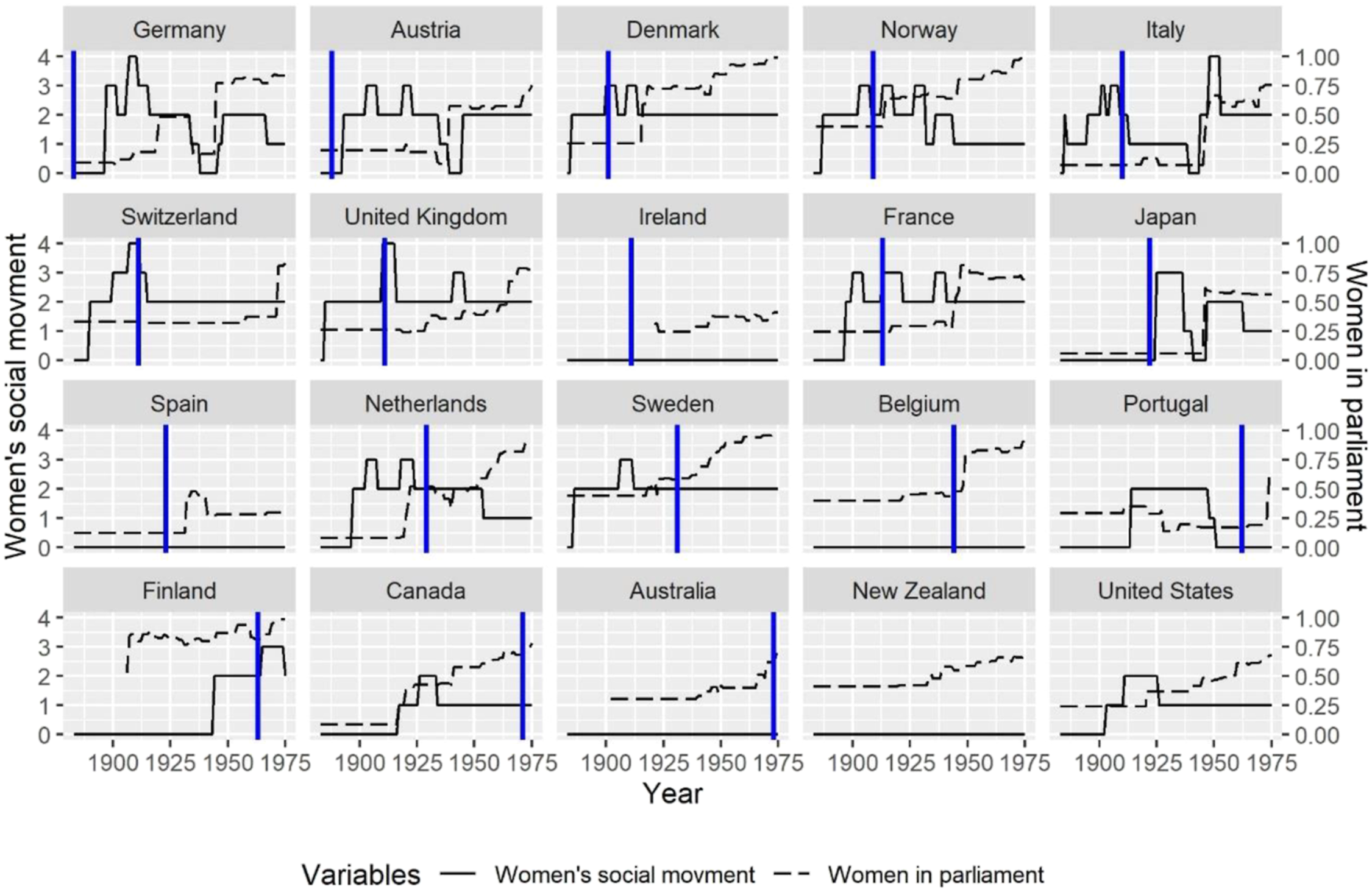
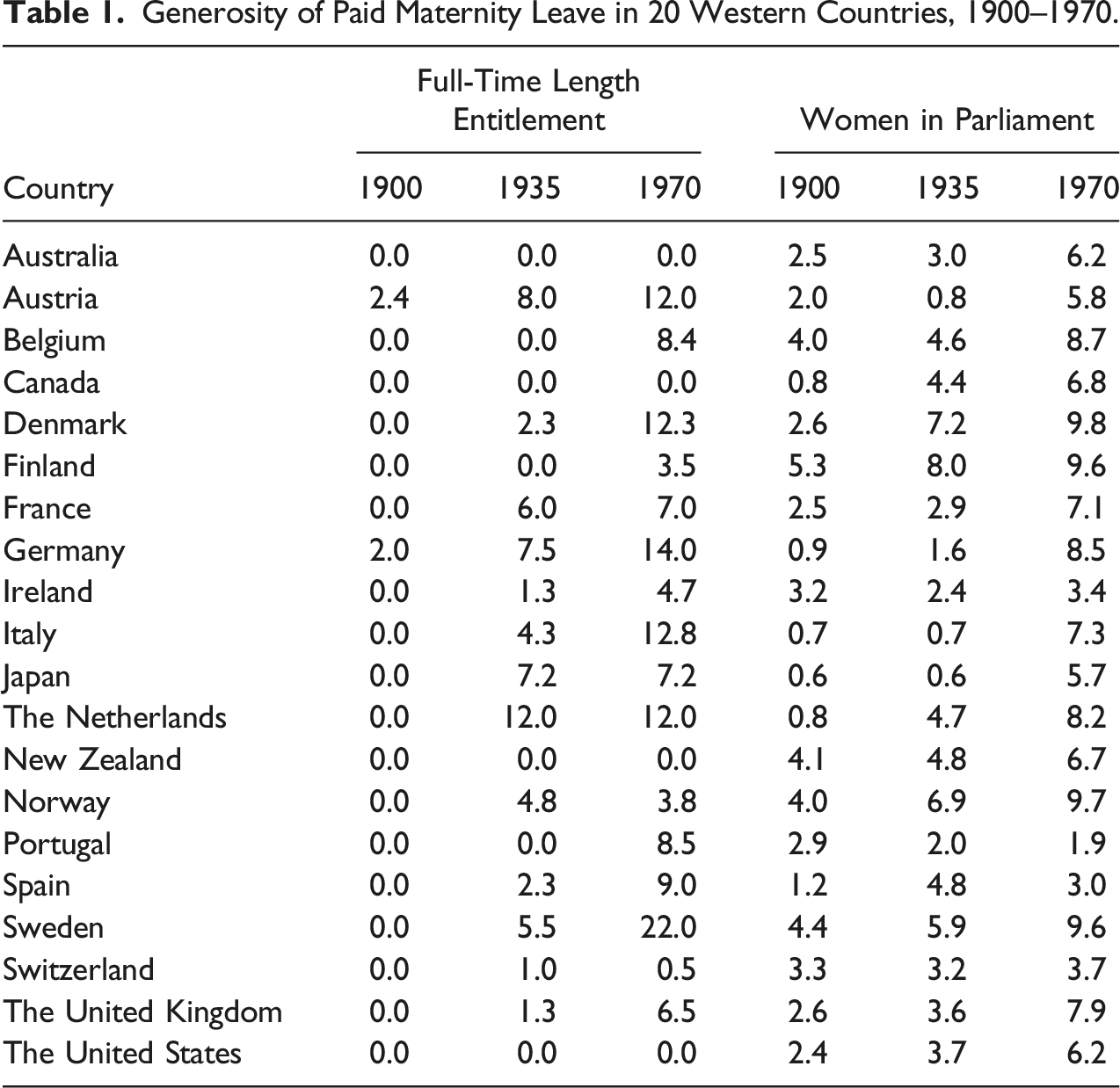
Figure 1 reveals that there is no clear nexus between the adoption of paid maternity leave and the degree of women’s political participation. Many countries including pioneers like Germany and Austria, as well as latecomers like Japan, Spain, and Belgium, institutionalized the statutory provision of maternity protection for working women between the late 19th and early 20th centuries when only a few women participated in the legislative process and no women’s movement focused on paid maternity leave. As expected, women’s movements often struggled to further extend maternity benefits, once paid maternity leave was introduced. In Scandinavian countries (e.g., Denmark and Norway), Italy, Switzerland, the United Kingdom, and France, paid maternity leave was introduced when women were pressing for enactment through various channels despite their marginalized position in parliaments. However, there was often a delay in translating women’s political demands into an ability to influence the passage of legislation (e.g., Norway, Italy, France, the Netherlands, Sweden, and Portugal). Liberal welfare states with relatively short histories as independent states remained laggards, despite their high representation in parliaments. A few women’s movements in Canada and the United States have supported paid maternity leave since the 1920s, which was not effective for a long time. The United States is the only country in the world that has never introduced paid maternity leave at the national level, and Canada introduced paid maternity leave only after 1970. Although scholars find that paid maternity leave was supported by diverse strands of feminists, it was not supported universally. Particularly, women’s movements in liberal welfare states (e.g., Australia and New Zealand) showed little interest in paid maternity leave in comparison to other countries.
Figure 1 also shows the transition of women’s channels to influence policymaking. Women in the late 19th and early 20th centuries overcame their lacking access to the legislative process by engaging in public debates or using their networks. However, once they attained formal rights to participate in the political arena, such activities tended to be less frequent than before (e.g., Denmark, Sweden, Canada, and United States after the mid-1920s; Norway, France, and the Netherlands after the 1950s). In the other words, if women’s political participation matters, as my last hypothesis suggests, women’s parliamentary presence would be correlated with the extension of paid maternity leave.
Table 1 shows that countries where women’s opportunity to participate in the legislative process was greater tended to extend women’s rights to paid maternity leave. More women in Scandinavian countries (e.g., Denmark and Sweden) became part of the decision-making process, and their right to paid maternity leave was extended. Similarly, Germany, Italy, and the Netherlands provided more openings to women following the introduction of maternity leave and increased the generosity of paid maternity leave more than other countries. English-speaking countries showed neither a rapid increase in women’s political participation nor the extension of paid maternity leave until 1970. Interestingly, women’s political participation in Portugal decreased between 1900 and 1970, which may have led to the late introduction of paid maternity leave. Portugal obliged employers to compensate for the income loss of pregnant employees during their leave until 1962, without establishing a statutory provision to maternity leave, which disadvantaged women by providing a disincentive to hire them.
The pattern described in Figure 1 and Table 1 provides hints that women’s political struggles may become influential after the adoption of paid maternity leave. In the next section, I test the relationship between women’s political participation and the early development of paid maternity leave in a statistical framework controlling for the degree of welfare development and other alternative explanatory factors.
Findings
Impact of Women’s Political Participation on the Adoption of Paid Maternity Leave
I use the measure of the year when a country introduced publicly funded paid maternity leave for working mothers as the dependent variable. I estimate Weibull models with standard errors, adjusted for clustering in countries since the probability of introducing paid maternity leave increases over time due to policy diffusion. States enter the dataset either in 1882, one year before the first paid maternity leave was introduced in Germany, or when they became independent or attained political autonomy (i.e., Finland, Ireland, and Norway). The countries are considered until paid maternity leave was introduced, or 1975 in the cases of New Zealand and the United States which have not introduced paid maternity leave.
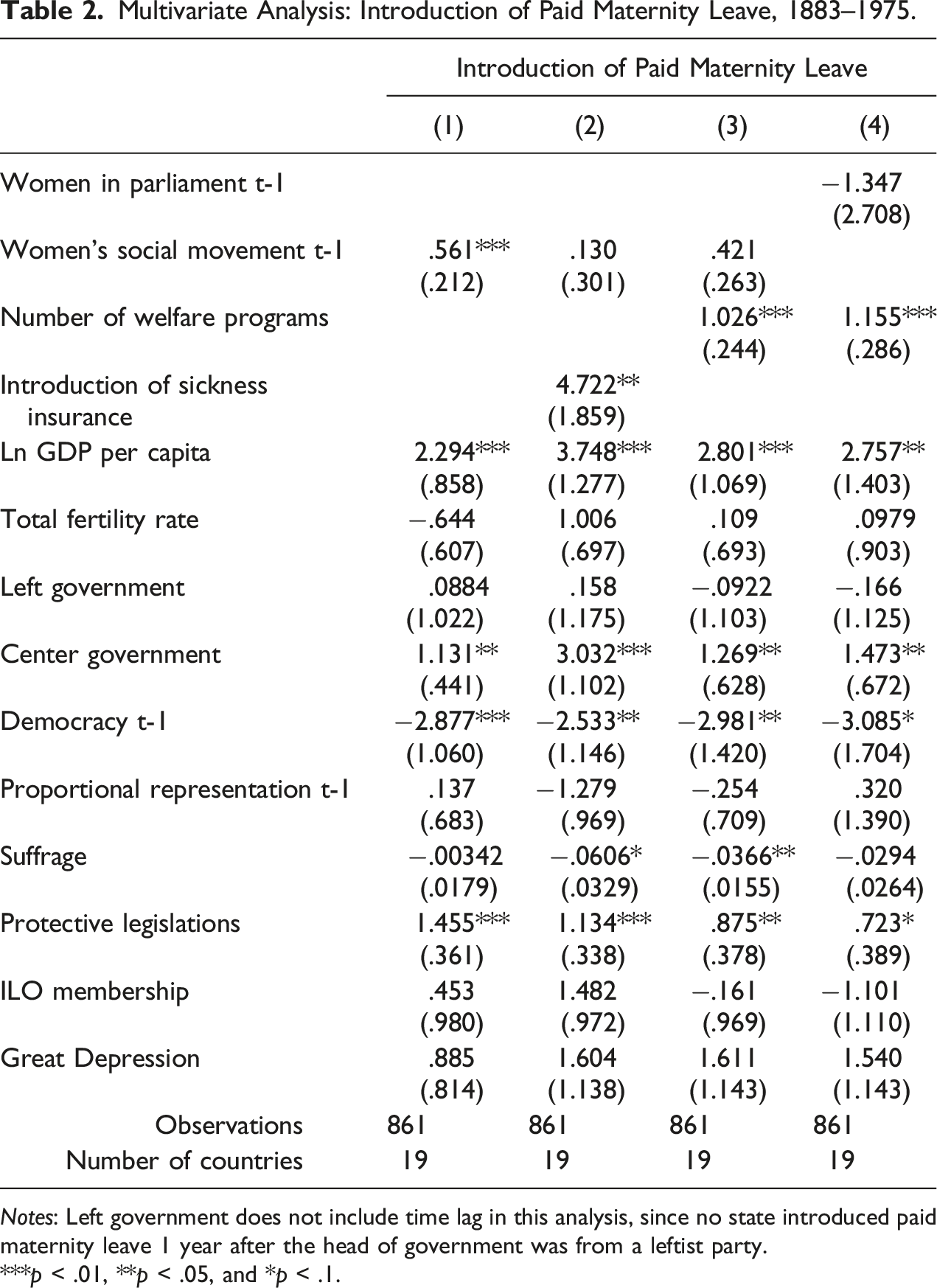
Multivariate Analysis: Introduction of Paid Maternity Leave, 1883–1975.
Notes: Left government does not include time lag in this analysis, since no state introduced paid maternity leave 1 year after the head of government was from a leftist party.
***p < .01, **p < .05, and *p < .1.
I control for partisan effect by including a factor variable that captures government ideology—1 in the case of a left-head of government, 2 in the case of a center-head of government, and 0 otherwise. The data are taken from Brambor et al. (2017). It is controversial whether leftist governments would promote the extension of social rights for working women. A group of scholars emphasizes that leftist governments tend to be more receptive to feminist ideologies and support social policies for women (Huber & Stephens, 2000; Misra, 2003), while others provide evidence that leftist governments and labor unions represented male workers’ will to avoid labor market competition with women workers whose wages were lower than theirs (Pedersen, 1993). In contrast, scholars consistently find that centrist governments supported social policies for women, for instance, in France, Germany, and Sweden (Cova, 1991, p. 129; Kulawik, 1999, pp. 133–134; Ohlander, 1991, p. 67). I include, furthermore, a measure of political regime type from Boix et al. (2013). The demographic obsession of fascist regimes often led to the introduction of pronatalist policies despite their conservative attitude to women’s paid labor (Cova & Pinto, 2002; Nash, 1991). A dummy variable that captures the proportional representation system is included, as it tends to amplify women’s political participation (Kim, 2019; Skorge, 2021), and thus may incentivize policymakers to introduce social policies for women. I also include a cumulative count of the years since women attained the right to vote to control for the effect of suffrage.
Additionally, I control for the number of protective legislations that the state had introduced, namely, the prohibition of women’s nightwork and unpaid maternity leave. This protective legislation variable equals 1 if a country has introduced one of two protective legislations, 2 if it has introduced both legislations, and 0 otherwise. I built this indicator from the HDML, the ILO reports to monitor the implementation of the two Night Work (Women) Conventions (C4 and C84) and various ILO reports about the working condition of women workers (Appendix 2 for the data). The inclusion of this variable would show whether paid maternity leave was indeed a positive approach to protective legislation evolved from a negative approach limiting women’s employment, which helps us understand why conservative and paternalistic states would introduce or extend paid maternity leave. I also control for the impact of the ILO on the early development of paid maternity leave. The ILO adopted the first Maternity Protection Convention (C3) at its very first conference in 1919 and has since updated the standards for maternity protection every three decades in two consecutive conventions (C103 and C183), in 1952 and 2000, respectively. In line with previous research, I expect that joining ILO membership would be followed by the adoption or extension of paid maternity leave (Son & Böger, 2021). I measure ILO membership with a dummy variable that codes 1 if a country is an ILO member and 0 otherwise. I also control for the effect that the Great Depression might have had on paid maternity leave by including a dummy variable that equals 1 for the years between 1929 and 1933. Even though the right of working women who were accused of taking men’s jobs came under attack during the Great Depression (Ohlander, 1991), I expect that women’s right to maternity protection would be extended. During the Great Depression, the employment pattern of working women changed rapidly from the predominance of young, single, childless women, to the increased employment of married women, since the high rate of male unemployment increased the necessity of married women to be engaged in paid labor to ensure their family’s survival and thus raised the demand of paid maternity leave (Klein, 1984, pp. 37–38).
The result demonstrates that welfare institutions would determine the timing of adopting paid maternity leave, outweighing the significance of women’s political participation. Model 1 shows that countries where women’s social movements struggled for paid maternity leave tended to introduce it earlier than other countries. However, once welfare institution variables enter Models 2 and 3, the coefficient of women’s movements fails statistical significance, implying two things: First, the existence of other social policies explains cross-national differences in the timing of paid maternity adoption more substantially than the existence and activities of women’s movements. For instance, the establishment of welfare institutions would explain the early introduction of paid maternity leave in the 1880s in pioneer welfare states, such as Germany and Austria, where women’s movements started to support paid maternity leave only after the 1890s (Grandner, 1995; Stoehr, 1991). Second, a weak association between welfare development and the degree of women’s struggle for paid maternity leave exists, although the correlation matrix of coefficients of the Weibull model reports no severe multicollinearity between these two variables. As Figure 1 shows, women’s movements in liberal welfare states paid little attention to paid maternity leave compared to other countries, suggesting that institutional legacy may shape women’s policy preference (Htun & Weldon, 2010). I will discuss the details in the discussion section.
In all model specifications, the coefficient of welfare institution variables is statistically significant at the 1% level. As expected, the existence of health insurance plays an important role in the introduction of paid maternity leave in particular, as shown in Model 2. The probability of adopting paid maternity leave is around 5 times higher in a country where health insurance exists than in a country without. Only health and unemployment insurances shape the emergence of paid maternity leave since it was often funded and administered by them (see Appendix 3 for the models including different types of social policies). Model 4 shows a statistically insignificant but negative correlation between women’s presence in political positions and the adoption of paid maternity leave, reflecting that paid maternity leave had been established in many countries when women still did not have formal access to the legislative process.
The results for the control variables also show interesting dynamics surrounding the adoption of paid maternity leave. In line with functionalist theory, more affluent states encounter fewer constraints in terms of bureaucratic capabilities and financial outlays to adopt paid maternity leave (Wilensky, 1974). Alternatively, more married women would be engaged in the manufacturing sector in industrialized states, generating a strong necessity for paid maternity leave. As expected, centrist governments were more likely to push for paid maternity leave while the impact of leftist governments is ambiguous. I find that autocratic regimes tend to adopt paid maternity leave earlier than democratic regimes, which confirms the speculation of feminist scholars about fascist regimes’ concerns of depopulation. The existence of other types of protective legislation also predicts the adoption of paid maternity leave, confirming that paid maternity leave is a positive approach to dealing with maternal and infant health. The total fertility rate is not significantly correlated with the adoption of paid maternity leave. It may be the case that the protective legislation variable absorbs the impact of the total fertility rate since depopulation concerns led to the enactment of protective legislation including paid maternity leave. Similar to women’s descriptive representation in parliaments, the suffrage variable shows a negative correlation with the adoption of paid maternity leave, reflecting that women’s right to maternity protection was established before the consolidation of women’s political rights. Other variables included in my models are not statistically significant.
Impact of Women’s Political Participation on the Extension of Paid Maternity Leave
Although women’s political participation would not be influential in the adoption of paid maternity leave, my argument also indicates that women would contribute to extending paid maternity leave once it is adopted. The second dependent variable to test this argument is the FTE of paid maternity leave in 16 Western countries from 1900 until 1970, calculated as the duration of paid weeks of leave multiplied by the wage replacement rate. Since I am interested in the extension of paid maternity leave after its adoption, countries that have ever adopted paid maternity leave are included (excluding New Zealand and the United States). Also, Australia and Canada are excluded from the analysis because each state would have less than 5 years of observations (Australia in 1973 and Canada in 1971), making it impossible to run diagnostic tests. The variable ranges from 0 to 23.
I test for endogeneity, panel heteroscedasticity, serial correlation, non-stationarity, and multicollinearity. A Dublin–Wu–Hausman test does not reveal any endogeneity problems for my variables of interest. However, the modified Wald test detects that error variances vary across countries. The Woodridge test for first-order autocorrelation also reveals that our data are serially correlated. To deal with these problems, I estimate my OLS regressions with panel-corrected standard error estimation (PCSE) using robust Eicker–Huber–White standard errors. I weight panel-specific autocorrelations by panel sizes since the sizes vary. The augmented Dickey–Fuller test for stationary indicates that the suffrage variable that measures the cumulative count of the year since women’s suffrage is not stationary. Thus, I exclude the suffrage variable from my main models while presenting error correction models (ECMs) including the suffrage variable in Appendix 4. The variation inflation factor does not indicate severe multicollinearity problems. The VIF values of the women’s descriptive representation index and the political regime index go beyond 2.5. However, the VIF values are still within the range of conventional thresholds. Furthermore, I check the robustness of my models by jack-knife analyses to ensure the results are not driven by individual cases or countries without indication for influential cases.
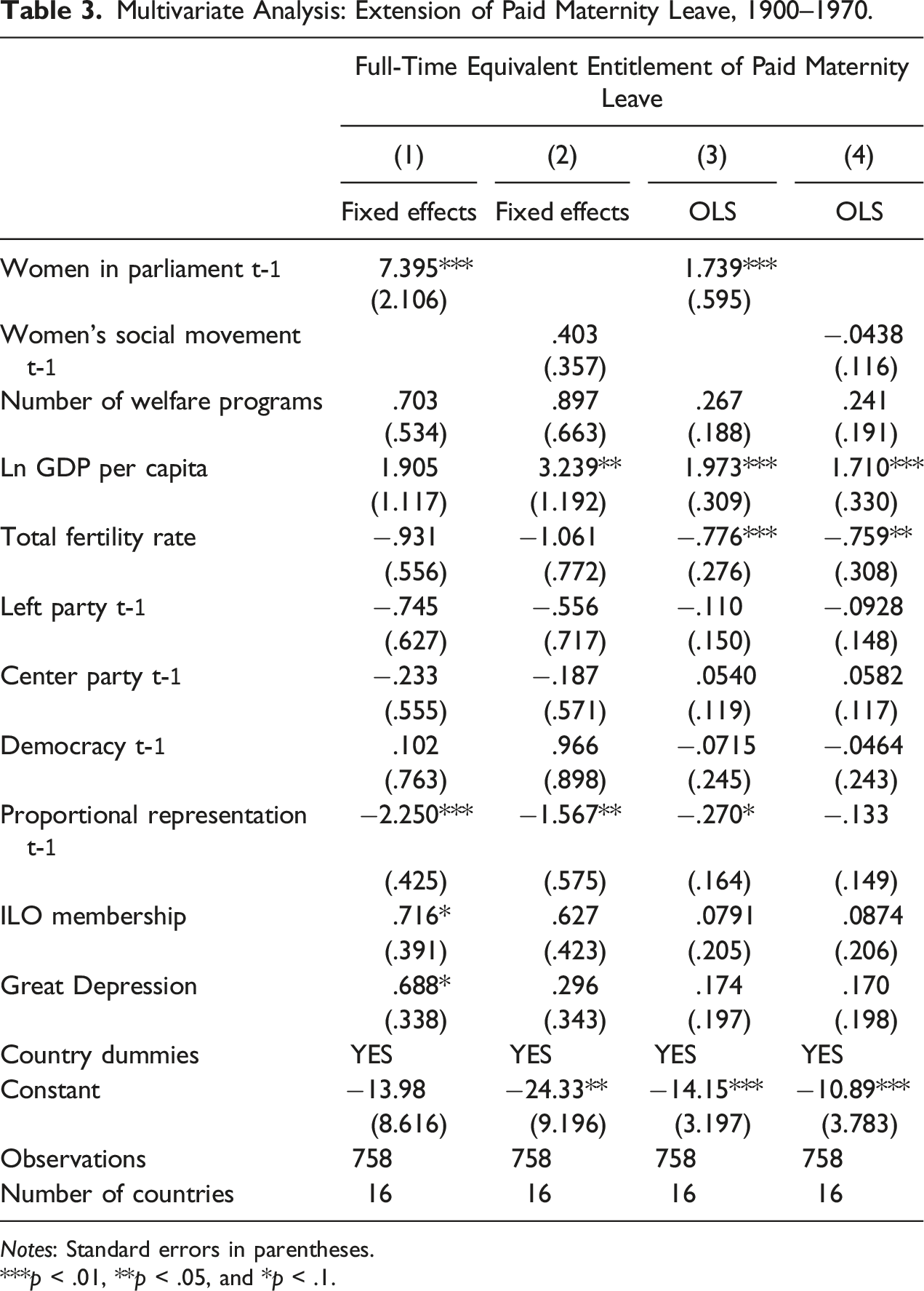
Multivariate Analysis: Extension of Paid Maternity Leave, 1900–1970.
Notes: Standard errors in parentheses.
***p < .01, **p < .05, and *p < .1.
The estimated coefficients of the control variables consistently show the theoretically expected signs. The logged GDP per capita is statistically significant, which is consistent with the findings on the adoption of paid maternity leave. In contrast to the first analyses, the total fertility rate seems to be influential in the extension of paid maternity leave. This may come from the omission of the protective legislation variable that absorbs the impact of the total fertility rate in the first analyses. The protective legislation variable is not included in the second analysis because the adoption of two types of protective legislation (i.e., the prohibition of women’s night work and unpaid maternity leave) preceded the adoption of paid maternity leave. Surprisingly, proportional representation (PR) countries are less likely to extend maternity benefits. Iversen and Rosenbluth (2008) provide a hint to understand this finding: female members of parliament in proportional representation systems are more motivated to extend work–family policies than other countries, as the career interruption for childrearing would be more critical for their legislative effectiveness and careers in comparison to candidate-based political systems where seniority is a crucial factor. The suffrage variable is statistically significant at conventional levels, but only if the women’s descriptive representation variable is not included (Appendix 4).
Robustness Checks: Extension of Paid Maternity Leave, 1900–1970.
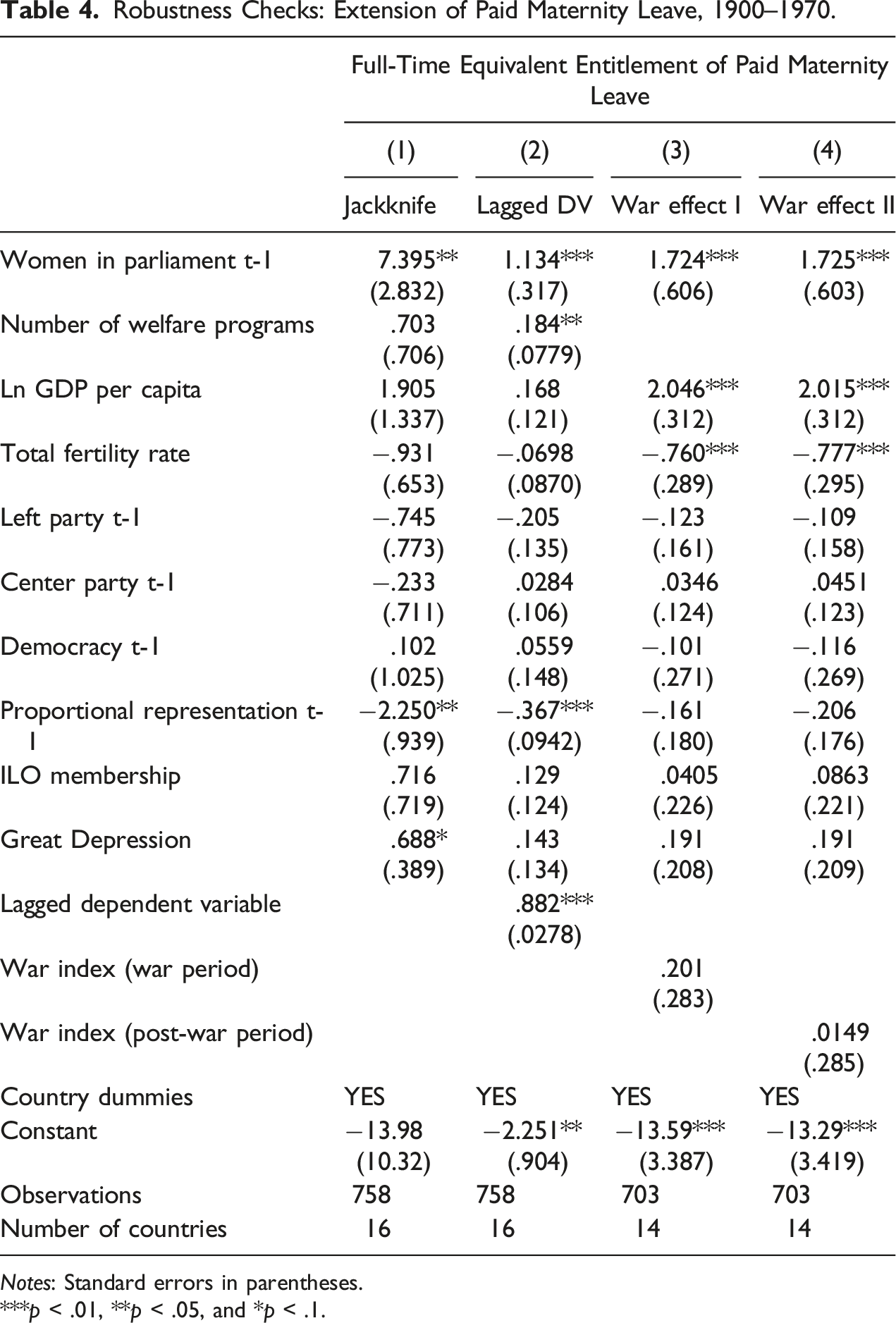
Notes: Standard errors in parentheses.
***p < .01, **p < .05, and *p < .1.
Discussion
My findings show that the effectiveness of women’s political influence on paid maternity leave was contingent upon welfare development. However, it is somewhat unexpected that there existed a weak association between welfare development and women’s struggle for paid maternity leave, given that existing literature emphasizes the support of diverse strands of feminists for paid maternity leave (Boris, 2019; Whitworth, 1994). More specifically, it turned out that in liberal welfare states, except for the United Kingdom, women’s movements had given little attention to paid maternity leave. Instead, they were actively engaged in pressing the enactment of endowments for low-income mothers, such as maternity allowances and mother’s pensions (Brookes, 2016; Ladd-Taylor, 1994; Lake, 1999; Skocpol, 1992).
I suggest that institutional legacy shaped the policy preference of women’s movements, not only policymakers. Women as marginalized political actors tend to eschew struggles for policies of which implementation seems unlikely (Htun & Weldon, 2010, p. 211). In the United States, advocates of social policies for women have been well aware of their limited room to maneuver in the absence of universal compulsory insurance. Some advocates of mothers’ pensions found social insurance systems to be more ideal, which, however, they expected to take too long to be established (Skocpol, 1992, p. 437). When seeking a policy model for the United States, proponents of paid maternity leave paid special attention to Italy, one of the few countries where maternity insurance had been introduced as a separate scheme in the absence of health insurance (Vezzosi, 2007). In Europe, institutional contexts shaped women’s preferences on maternity leave policy design. Despite their reluctance to equate pregnancy with sickness or their preference for maternity insurance for all mothers, they proposed incorporating maternity insurance into sickness insurance for workers to increase the chance of passing maternity legislation in parliaments (Peterson, 2018, p. 81; van der Klein, 2012, pp. 53–54). Yet, this does not imply that women pursued only plausible policies: my main findings show that many women’s movements strived for the enactment of paid maternity leave regardless of the existence of other social policies. It reveals that gender studies and comparative welfare studies should consider a significant interaction between women as political actors and institutional contexts in terms of the effectiveness of women’s political influence as well as their demands themselves.
Conclusion
As the first social policy for women workers, paid maternity leave became the underpinning of work–family policies (Daly & Ferragina, 2018). In Western countries, it was introduced between the late 19th and early 20th centuries when women still did not have the formal right to participate in policymaking. This paper aimed to answer the widely neglected question of whether women’s political demands were a crucial factor in the establishment of their social rights as workers in 20 Western countries. I argued that the early development of paid maternity leave was driven by women’s political struggles and provided better opportunities to exert women’s political power. Relying on a new dataset, I obtained consistent empirical evidence that women’s political participation mattered once paid maternity leave was introduced.
Three major findings stand out. First, paid maternity leave was invented by male policymakers to effectively limit pregnant women’s labor for depopulation concerns, as existing literature speculates (Jenson, 1986; Klaus, 1993b). Countries that already adopted other protective legislation or countries with low total fertility rates tended to provide paid maternity leave earlier and more generously than others. Second, the existence of other social policies outweighed the significance of women’s political participation in the adoption of paid maternity leave. In line with historical institutionalism (Pierson, 1993; Skocpol, 1992), the existence of other social policies increased the probability of adopting paid maternity leave, as it accompanied institutional foundations that were required to administer paid maternity leave. Countries without health insurance, such as the United States, were much less likely to introduce maternity leave than other countries. Women as marginalized political actors had limited room to maneuver. More specifically, they were not able to overcome the institutional constraints but preferred to push for other types of social policy for women, such as mothers’ pensions, in the absence of universal compulsory insurance. Third, once paid maternity leave had been adopted, women’s political influence on its extension became visible. Women’s parliamentary presence over women’s movements was crucial for the extension of paid maternity leave, which may reflect that leading figures of women’s movements often attained the opportunity to directly represent their interests in the legislative process after the 1930s, when paid maternity leave was expanding.
Overall, this paper provided the first systematic overview of the influence of women as political actors on the early development of social policies for women workers. While the empirical analyses in this paper investigated women’s political influence in which elite women played an important role, a growing literature highlights the significance of women’s direct representation as voters or their mass mobilization in the early 20th century (Kim, 2019; Skorge, 2021; Teele, 2018). Although such analyses would require immense efforts in data collection (e.g., turnout rate and the size of women’s movements), it is a highly promising avenue for future research, given that the extension of suffrage often coincided with the extension reforms of paid maternity leave. For instance, Denmark was more open to paid maternity leave once the attainment of women’s voting rights became certain (Ravn, 1995, p. 217).
Supplemental Material
Supplemental Material - The Origin of Social Policy for Women Workers: The Emergence of Paid Maternity Leave in Western Countries
Supplemental Material for The Origin of Social Policy for Women Workers: The Emergence of Paid Maternity Leave in Western Countries by Keonhi Son in Comparative Political Studies.
Footnotes
Author Note
The author thanks three anonymous reviewers, Rianne Mahon, Sonja Drobnič, and Danielle Pullan, and participants of Doctoral Conference at the Max Planck Institute for the Study of Societies for comments and Carina Schmitt, Herbert Obinger, and Joya Misra for generously sharing their data. This research project is funded by the Deutsche Forschungsgemeinschaft (DFG, German Research Foundation)—Project number 374666841 – SFB 1342. To the best of my knowledge, the named author has no conflict of interest, financial or otherwise. I also confirm that this manuscript has not been published elsewhere and not under consideration by another journal.
Declaration of Conflicting Interests
The author(s) declared no potential conflicts of interest with respect to the research, authorship, and/or publication of this article.
Funding
The author(s) disclosed receipt of the following financial support for the research, authorship, and/or publication of this article: This work was supported by the Deutsche Forschungsgemeinschaft (374666841).

Supplemental Material
Supplemental material for this article is available online.
Notes
Notes
Author Biography
References
Supplementary Material
Please find the following supplemental material available below.
For Open Access articles published under a Creative Commons License, all supplemental material carries the same license as the article it is associated with.
For non-Open Access articles published, all supplemental material carries a non-exclusive license, and permission requests for re-use of supplemental material or any part of supplemental material shall be sent directly to the copyright owner as specified in the copyright notice associated with the article.
