



Abstract
How do political parties shape state capacity? We argue that democratic leaders backed by personalist parties are more likely than other leaders to undermine impartial state administration. Personalist parties are those where the leader has more control over the party than other senior party elites. Elites in these parties have careers closely tied to the leader, are unlikely to normatively value an impersonal bureaucracy, and lack collective action capacity independent from the leader. Therefore, personalist parties are less likely than other parties to restrain leaders from undermining impartial state administration. Results from various designs for causal inference show that party personalism decreases impersonal state administration, particularly when the party controls a legislative majority. However, party personalism does not influence other dimensions of state capacity, such as fiscal capacity or territorial control. The findings have implications for how political parties enable democratically elected leaders to erode open-access societies and ultimately, democracy.
Even before the unsuccessful coup attempt in the summer of 2016 in Turkey, President Erdoğan’s party, the Justice and Development Party (AKP), attacked the Turkish state bureaucracy because it threatened his hold on power. Indeed the largely secular state had set a precedent, orchestrating the fall of an earlier government led by an Islamic party in 1997, four years prior to the AKP’s founding in 2001. Beginning with his own party, Erdoğan consolidated personal power and then proceeded to undermine the state bureaucracy (Lancaster, 2014, 1682–83). His attacks on the state included targets such as government ministries, internal intelligence agencies, the legislature, the judiciary, and even the central bank (Demiralp & Demiralp, 2019). In the wake of the 2016 coup attempt, Erdoğan’s government dismissed or detained perhaps as many as 100,000 public sector employees (Amnesty International, 2017, 4).
A similar story has unfolded in Hungary in the past decade. After Fidesz won parliamentary elections in 2010, the leader of the victorious party, Viktor Orbán, began attacking the institutions of the state. Shortly after coming to power, “the Orbán administration [introduced] laws that have made the immediate dismissal of public employees without cause possible, and so, too, the cleansing of the entire government apparatus. As a result, central and local public administration [were] quickly politicized” (Bozóki, 2011, 11). Indeed, after the 2010 election, “the top four hierarchical levels of central government bureaucracy were almost entirely purged,” cementing Orbán’s power over the state (Hajnal & Boda, 2021, 81). In the process, “[Orbán] has…made the public sector less accountable to citizens” (Comelli & Horváth, 2018). And perhaps most pernicious for impartial state administration, Orbán’s “party has quietly taken control of the boards that run many state institutions” to hedge against the possibility that Fidesz loses its legislative super-majority (Roth, 2021). Orbán “is creating foundations run by cronies that will control many state resources and operate beyond the oversight of the legislature” (Roth, 2021).
Erdoğan and Orbán were first elected in free and fair elections under democratic rule; and both quickly took aim at the state bureaucracy in the process consolidating their hold on power. However, even prior to politicizing the state, these leaders took control over the political party that launched their electoral careers, a process we refer to as personalizing their parties. Consequently, the personalized parties that backed these rulers proved unable to restrain their subsequent attacks on the state. Indeed, personalist parties were central to the process of eroding impartial state administration and consolidating the leader’s power over the state.
This paper asks how personalized political parties shape impartial state administrative and bureaucratic capacity in democracies. We argue that leaders backed by personalist parties undermine and politicize the state bureaucracy in an effort to consolidate power. All political leaders—those backed by personalist parties and those who lead non-personalized parties—have an incentive to politically align state bureaucracies with their policy priorities, to both help solve delegation problems and reduce bureaucratic constraints on their power. Politicizing the bureaucracy reduces state capacity, conceptualized as an impartial and impersonal administrative bureaucracy.
Parties where elites have better career prospects independent of the current leader restrain incumbents from politicizing the state because their careers depend more on the established, non-personalist party and its reputation, rather than on the current leader. Thus, they are more likely to pay future policy and electoral costs for politicizing the bureaucracy well after the current leader leaves office. In contrast, when leaders are backed by personalist parties, rulers select loyal elites with career fates tied to the leader, which aligns personalist party elites’ interests with their leader’s political career. And even if elites in personalist parties want to stop the leader’s politicization of the state bureaucracy, they may not have the collective action capacity to prevent the leader from doing so. Together, the leaders’ incentive to undermine impartial state administration and party elites’ lack of incentive or inability to stop this process mean that leaders backed by personalist parties should be more likely to politicize state bureaucracies than leaders who are not backed by personalist parties.
However, all leaders, even those backed by personalist parties, still require revenue from the economy to sustain their rule and prefer control over the state’s territory. They thus do not necessarily have an incentive to harm state fiscal capacity or the territorial reach and power of the state. Since Fidesz took power in 2010, Hungary saw no significant reduction in its public revenue relative to the size of its economy (World Bank, 2022). While Orbán used pre-election fiscal handouts to boost its popular support (Szakacs, 2022), his government looked for new revenues from tax increase on small businesses to new windfall taxes on big ones (Dunai, 2022; France-Presse, 2022). In Turkey, Erdoğan’s government asserted territorial control over its borders with growing repression against its Kurdish population (Butler, 2021) as well as military attacks on Kurds in Syria and Iraq (Burc, 2019; Jongerden, 2019). These cases suggest that personalist parties may undermine impersonal administrative and bureaucratic capacity without necessarily hindering other components of state capacity.
State bureaucratic capacity has been linked to better development outcomes (e.g., Evans & Rauch, 1999) and long-term economic growth and investment (e.g., Besley & Persson, 2010; Knack & Keefer, 1995; Knutsen, 2013) as well as public service delivery essential for boosting health and education and reducing poverty (e.g., Cingolani et al., 2015; Hanson, 2015; Henderson et al., 2007). Others note that bureaucratic quality enables “developmental states” to enact coherent growth-oriented policies (e.g., Johnson, 1982) and provides states with more policy options for dealing with macro-economic volatility (e.g., Franco Chuaire et al., 2017; Haggard & Kaufman, 1992). Further, state administrative capacity may promote democratization (e.g., Linz & Stepan, 1996); shapes how inequality influences democratization (Soifer, 2013); and has implications for whether ample natural resource wealth impedes democracy and long-run development (Harris et al., 2020). As importantly, the impartial exercise of bureaucratic authority by administrative agents is a key component of “quality of governance” (Rothstein & Teorell, 2008, 169–70).
Thus while understanding why leaders politicize state bureaucracies provides insight into the prospects of many development outcomes, we view impartial state bureaucracies as an important bulwark against democratically elected leaders who often seek to consolidate power and erode democracy. Bureaucratic agents who abide by established rules and implement policies in a non-partisan way hinder incumbent leaders’ attempts to suppress opponents and consolidate personal power, especially where the incumbent party is too weak to stand up to the leader.
What Is Party Personalism?
We conceptualize ruling party personalism as parties that leaders create or control as vehicles to advance their personal political careers. In stark terms, which do not capture the complexity of party personalism in the real world, we conceptually distinguish personalist parties as those where “the leader picks her/his party” from non-personalist parties where the “party picks the leader.” As such, personalist parties are those where the leader has more control over the party than do other senior party elites. 1
This concept of party personalism draws on prior work on parties, such as Janda (1980) and (Geddes et al., 2018). While Janda’s definition of a “personalist party” is the “extent to which party militants seem motivated by ‘personalism’ or the charismatic qualities of the party leader” (39), his concept of “outside origins” of the party more closely matches ours: a party “formed by the incumbent chief executive to legitimate his leadership or consolidate his support” (39). While we examine party personalism in democracies, Geddes et al. (2018) conceptualize a similar concept for dictatorships by recording whether autocratic leaders create their own party after assuming lea seize power through a pre-existing party.
Our definition and operationalization of party personalism is related to concepts, such as political “outsiders,” “anti-system candidates,” or “personalist parties” (Gunther & Diamond, 2003; Kostadinova & Levitt, 2014; Levitsky, 1999; Mainwaring & Torcal, 2006). However, the closest concept that political scientists have measured systematically is party institutionalization. Mainwaring and Scully (1995) and Mainwaring and Torcal (2006) offer four features of party institutionalization: stability in patterns of electoral competition; party roots in society; political actors conferring legitimacy on parties; and party organizations that acquire status and value of their own, independent of leader’s interests. Our conceptualization of party personalism comes closest to the last feature: parties with a status independent from the leader.
Finally, personalism is conceptually distinct from party system institutionalization. Measures of system institutionalization largely treat this concept as legislative seat (or electoral) volatility, separating the change in vote for existing parties from the entry (exit) of new (existing) parties (Powell & Tucker, 2014). Even Bizzarro et al.’s (2017) cross-national measure of party system institutionalization focuses on distinct concepts such as party branches and platforms, whether party members vote with the party, and whether the party’s linkage strategy is more clientelistic or programmatic. Bizzarro et al. (2017) and others measure institutionalization at the level of the party system; this approach does not distinguish ruling parties from opposition ones. We measure individual party personalism using data on each party for each election year.
This conceptualization of party personalism implies that leaders have more relative power within the party than other elites. The leaders of highly personalist parties are not only more likely to have created them, but these leaders also tend to control party nominations and funding resources. In Appendix F, we show that, even when comparing ruling parties within countries, personalist parties have leaders with more internal control over party nominations and funding.
Parties and State Capacity
Political leaders in democracies are elected chief executives; and these executives utilize the state bureaucracy to govern. Building on the assumption that all leaders want to remain in power (indeed very few leaders resign voluntarily) and pursue policy goals, we propose that leaders—irrespective of the parties that support them—have an incentive to politically align the state bureaucracy to, firstly, shape the composition of personnel; and, secondly, to implement their preferred policies and/or extract rents on their behalf (Lewis, 2008; Peters & Pierre, 2004). For example, political alignment between the leader and bureaucrats helps ameliorate delegation problems, while inducing greater bureaucratic effort towards pursuing the leader’s goals (Bendor et al., 2001; Dahlström & Holmgren, 2019).
While the bureaucracy literature largely conceptualizes “political alignment” as partisan alignment between the leader and the selected bureaucrats, where parties are based on an identifiable ideology that translates into policy preferences (e.g., Fiva et al., 2021; Peters & Pierre, 2004), personalist parties need not be particularly ideological, though party personalism does not preclude ideology. Instead, the concept of party personalism is conceptually distinct from standard economic or left-right ideologies (Frantz et al., 2022). Personalist parties are, however, based on the person of the leader: leaders create or control these parties to advance their personal political careers. Political alignment when the leader is backed by a personalist party is less about ideological alignment and more about selecting bureaucratic agents who are loyal to the leader, with career incentives tied to the fate of the leader.
Parties potentially constrain leaders’ behavior, particularly when the leader’s party controls the legislature, as we specify as a scope condition for our argument. Because leaders of personalist parties have more control over the party than other party elites—the careers of the latter are strongly tied to the leader—in personalist but not in non-personalist parties, party elites in personalist parties are unlikely to constrain the leader’s politicization of the bureaucracy.
To some extent, all leaders have an incentive to tamper with an impartial state administration because highly functioning and impersonal bureaucracies may impede the rulers’ policy choices and rent extraction. And in democracies where chief executives have partisan control of the legislature, state bureaucracies help constrain executive policy and personnel choices, particularly if the party backing the executive is relatively weak and unable to stand up to the leader.
Further, if some leaders have a preference for undermining democratic institutions, including the bureaucracy, to consolidate their own power, then, in expectation, some leaders will attempt to undermine an impartial state bureaucracy. We do not need to know ex ante which elected leaders have these (potentially idiosyncratic) preferences to undermine democracy, including the state bureaucracy, to observe some leaders undermining democratic institutions once in office. That is, elected leaders without democratic scruples may be “wolves in sheep’s clothing” (Chiopris et al., 2021). If some leaders backed by non-personalist parties prefer to undermine democracy and some backed by personalist parties also share this preference, but elites in personalist parties either prefer not to constrain a leader’s behavior in office or cannot constrain the leader, then personalist parties should, in expectation, increase the likelihood of observing a leader undermining an impartial state bureaucracy.
We posit that party elites care about their future career prospects (e.g., Samuels, 1999) and may possess normative beliefs about the value of impartial administrative bureaucracies (e.g., Aberbach et al., 1981, 81–82; Higley and Gunther, 1992, 30–31). Building on standard theories of parties, we assume that parties have varying potential to collectively mobilize elites to act in concert (e.g., Aldrich, 1995, 45–57). Our core argument is that personalist political parties enable leaders to undermine impartial state bureaucracies that constrain their behavior, for three related reasons: the careers of elites, including bureaucratic elites, in personalist parties are tied closely to the leader; bureaucratic elites in personalist parties are less likely to have norms that prioritize an apolitical bureaucracy; and party elites’ collective action capacity independent of the leader is weak in personalist parties.
Leaders with personalist parties are more likely to eschew appointments from the political establishment, including those with bureaucratic and administrative experience in government. Instead, leaders backed by personalist parties are likely to fill positions of high government office with individuals from personal networks, such as family members and loyalists who often lack government, and in particular bureaucratic, experience. 2 For example, El Salvador’s president, Nayib Bukele, “entrusts power mainly to members of his family. His wife, Gabriela, picked much of the cabinet. Mr Bukele’s uncle is commerce secretary. The father of his godson runs the export-promotion agency. Childhood friends control the port authority and the agriculture ministry. In March Mr Bukele’s party elected a new president – his cousin” (The Economist, 2020). 3
In Appendix G, we provide evidence from two cases—Benin and Ghana—that more personalist ruling parties are more likely to select ministerial leaders who lack independent political careers and who do not have professional competency in their assigned portfolio. This suggests that personalist ruling parties select elites who do not have careers independent of the chief executive to lead the administrative state. And in Appendix H, we provide evidence from 21 cases that personalist ruling parties are more likely to purge bureaucratic agency headers than more institutionalized ruling parties. This evidence is consistent with the proposition that personalist ruling parties select bureaucratic elites who are invested in the leader, not in the state or even in the ruling party.
Selection of elites from personal networks rather than established bureaucratic organizations has two consequences. First, partisan elites selected for personal loyalty to the leader are less likely to constrain incumbent efforts to undermine the state administrative bureaucracy because their future political positions are more closely tied to the fortunes of the incumbent leader and not to an established party and its reputation— a career concerns mechanism. This means that partisan elites have a stronger incentive to maintain the incumbent leader in power—even at the cost of politicizing the state’s bureaucratic capacity—than do elites from established parties, for two reasons related to career concerns. For one, current party elites in established parties are more likely to play politics in the future when an opposition leader controls the state and may pursue different policy goals. Thus, for current party elites, maintaining an impartial bureaucracy can insulate policy from future political changes should the opposition win power and current party elites are temporarily “out of power”. Politicization by the incumbent runs the risk, for current party elites, of losing policy power locked into an impartial bureaucracy.
In addition, the electoral fortunes and career prospects of elites in non-personalized parties are more likely to depend, in part, on the ability of politicians from those parties to make credible policy promises during future electoral contests (Keefer, 2007). 4 Because elites in non-personalized parties view a plausible career pathway that depends more on the party than the current leader, these elites have an incentive to block efforts by the current leader to undermine an impartial and non-politicized state bureaucracy that may be essential to credibly promising policy platforms in the future, thus bolstering their own prospective electoral fortunes.
Current party elites thus bear electoral costs when incumbent executives politicize the bureaucracy. While politicizing the state bureaucracy may improve political control in the near term by providing immediate policy changes and access to rents from the state, politicization imposes both future policy costs and future electoral costs on party elites—particularly those in non-personalized parties—once the current leader leaves office.
Second, selection of elites on criteria of personal loyalty means these individuals are less likely to have norms that prioritize an apolitical bureaucracy. In established, non-personalized parties, elites in government positions are more likely to be drawn from the pool of bureaucratic personnel—either those currently in the bureaucracy or those who once were part of the bureaucracy (Aberbach et al., 1981, 81–82). 5 Some scholars, for example, posit that civil servants face a trade-off between being politically responsive to elected principals while still maintaining impartial, neutral competence, including norms about correct behavior and professional standards (e.g., Aberbach & Rockman, 1994). This logic presumes that elites with current or prior bureaucratic experience are more likely than elites drawn from personal networks outside the state administration to normatively value and rationally understand the long-term benefits of an apolitical and competent state bureaucracy.
As a result of tied career fates and relative dearth of norms valuing apolitical civil administration, elites in personalist parties are not only less likely to block the leader’s moves to undermine state capacity, but are also incentivized to follow and support the leader’s attacks on bureaucratic impartiality. Both of these mechanisms suggest that we should observe personalist ruling parties are more likely than non-personalist parties to recruit bureaucrats from personal networks and to purge incumbent bureaucrats when personalist party first takes over the executive. Indeed, personalist appointees should be less likely to have independent political careers or even the basic professional experience appropriate for their portfolio. These appointees should be selected for loyalty rather than competency and should thus have less prior independent political experience. We provide evidence in Appendices G and H consistent with these mechanisms.
Finally, even if elites in personalist parties want to stop the leaders from undermining impartial state bureaucracy, these elites lack the collective action capacity to do so. Elites in personalist parties often lack sufficient organizational resources independent of the leader—including local power bases and control over resources and nominations—to mobilize resistance to incumbent leaders. For example, in Appendix F, we show that leaders in personalist parties are more likely than their counterparts in established parties to control party nominations and funding. Elites and senior office holders from established, non-personalized parties, in contrast, often have a history of repeated interactions with each other that facilitates cooperation necessary for them to act collectively. Indeed, an ideal-type stylization of established parties views their raison d’être as a vehicle to solve (elite) collective action problems (Aldrich, 1995, 45–57). Further, the organizational resources of established parties, including financial resources, human capital, and organizing knowledge, are less likely to be directly controlled by the chief executive and her/his personal network of family and friends. Again, this enables elites in established parties to more easily act in concert to counter incumbent attempts to subvert the state.
In short, we posit that personalist parties enable leaders to decrease impartial state bureaucratic capacity. Selection of loyal elites with career fates tied to the leader aligns personalist party elites’ interests with the leaders’, and selection on loyalty yields party elites who are unlikely to normatively value an apolitical bureaucracy. And even if elites in personalist parties wanted to prevent the leader’s subverting state bureaucracy, they lack the collective action capacity to do so. Our theory, based on the mechanisms of career concerns, norms, and collective action, suggests that party personalism undermines impartial state bureaucracies, yielding the following expected empirical relationship: Party personalism decreases impartial state administrative capacity.
Note that this theory and empirical expectation relate to a relatively narrow conceptualization of state capacity: an impersonal and impartial administrative state. The literature on state capacity offers a variety of concepts and definitions encompassing everything from territorial control and state penetration to legal and fiscal capacity as well as thicker concepts such as infrastructural power and “good government” (e.g., Geddes, 1994; Mann, 1984; Migdal, 1988; Soifer, 2008). 6 Our theory makes no claim about thicker conceptualizations of “state capacity” or alternative dimensions such as fiscal extraction or state penetration. Indeed, there are plausible reasons to believe that all leaders, even those who seek to undermine democracy and loosen constraints on their behavior, need revenue to rule and prefer to control domestic territory. Therefore, we do not necessarily expect party personalism to influence composite measures of state capacity or its alternative dimensions.
Many popularly elected governments, some backed by personalist parties, increase state capacity in an effort to deliver public services such as education and health care, and “accomplishing these ends certainly requires bureaucratic capacity” (Evans et al., 2017, 381). 7 For example, Grassi and Memoli (2016) find that left-wing governments in Latin America—including personalist parties such as Chávez’ Fifth Republic Movement (MVR) in Venezuela and Morales’ Movement for Socialism (MAS) in Bolivia—expanded state administrative capacity in an effort to target redistributive policies at poorer populations, often in places where the state has historically had little reach. Indeed, both Chávez’s and Morales’ parties targeted public service delivery at previously excluded populations—groups of voters who mobilized electoral support for the regime via a personalized party. Thus, mobilizing personal parties responding to popular demands for universal public services may create an incentive for leaders to augment state administrative capacity. If this logic is correct, then we would expect that party personalism could, in fact, increase effective and impartial state administrative capacity, particularly if these parties help leaders mobilize demands for a more responsive state.
While we find this alternative argument plausible, we note that it comes closer to conceptualizing state capacity not so much as an impartial, de-politicized, and impersonal administrative bureaucracy but more so as the power of the state “to get things done” (Lindvall & Teorell, 2016, 6). 8 Thus, an alternative logic suggests that leaders backed by personalist parties have a specific policy program they want to implement, such as public service delivery to previously excluded populations, and thus have an incentive, just as leaders backed by established parties, to boost state capacity to implement these policies. The more general intuition from this alternative “get things done” argument posits that leaders—indeed all leaders—have an incentive to boost impartial bureaucratic capacity that enables them to see through their preferred policies. If this perspective is correct, we should not expect party personalism to weaken impartial administrative capacity.
One way to synthesize the “get things done” perspective with ours is to focus on the different dimensions of state capacity: “get things done” incentives may still apply for fiscal extraction, expanding the territorial reach of the state and for expanding state power over society (Mann, 1984). Even if leaders want the bureaucracy to competently implement the leaders’ preferred policies, they may still have an incentive to politicize the bureaucracy if they view the present bureaucracy as an obstacle to pursuing that policy. As Grindle (2012, 6) notes, patronage systems embedded in bureaucracies—that is, a quintessential outcome of a personalized and politicized administration—can persist even as the bureaucracy adapts “to the demands of modern state administration.” Thus, personalized parties may politicize state bureaucracies without necessarily harming their capacity to extract revenue, control society, or even boost public service delivery, yielding a corollary expectation that might best be interpreted as a placebo test: Party personalism does
Scope Condition
Our theory implies an important scope condition, one based on legislative-executive bargaining. Democratically elected leaders, no matter the nature of the political party that supports them, face possible constraints from the legislature. 9 Indeed, legislatures are the most proximate institutional vehicles for both horizontal and vertical accountability: horizontally, the legislature passes policy legislation; and vertically, voters in all democratic political systems directly elect legislators, even if they do not directly vote for the chief executive position as in many parliamentary systems. Further, legislatures typically have some form of agenda-setting, veto, and investigative powers that alter leaders’ behavior once in office. Legislators thus present the primary governing constraint on democratic leaders.
If leaders have an incentive to politicize the bureaucracy and personalist parties pave this path for them, we should expect—as an equilibrium outcome of executive-legislative bargaining—that they may not be able to do so when their party lacks control of the legislature. When ruling parties control the legislature, however, opposition parties no longer have the legislative power to check leaders’ behavior, leaving either the leader’s party or the state bureaucracy as the main vehicles for executive constraint. 10
This logic suggests that party personalism may only shape bureaucratic outcomes when leaders do not face legislative opposition, namely, when the leader’s party holds a legislative majority. Democratic leaders may only have the opportunity to politicize the bureaucracy when their party controls the legislature.
11
This argument leads to the following scope condition: Party personalism decreases impartial state administrative capacity most strongly when the leader has a legislative majority.
Data
To test whether democratic leaders bolster or undermine impartial state administration, we use a sample of democracies updated from Geddes et al. (2018). The sample spans the period from 1991 to 2020, with data on personalist parties for those years. We first introduce the measure of impartial state administration, as well as measures of other dimensions of state capacity, and then discuss the treatment, party personalism.
Impartial State Administrative Capacity
We employ a latent variable to measure impartial state administration, using five variables from the Varieties of Democracy project (v.11.1) (Coppedge et al., 2021) listed below
12
: • Are public officials rigorous and impartial in the performance of their duties? (v2clrspct) • To what extent are appointment decisions in the state administration based on personal and political connections, as opposed to skills and merit? (v2stcritrecadm) • To what extent are state administrators salaried employees? (v2strenadm) • To what extent do public sector employees grant favors in exchange for bribes, kickbacks, or other material inducements, and how often do they steal, embezzle, or misappropriate public funds or other state resources for personal or family use? (v2x_pubcorr) • Are the laws of the land clear, well publicized, coherent (consistent with each other), relatively stable from year to year, and enforced in a predictable manner? (v2cltrnslw)
These items specifically address state administration: the questions identify actors within the administrative state, such as “public officials,” “state administration,” and “public sector employees.” 13 These items, crucially, do not identify other important political institutions or actors that comprise the government, such as the legislature, judiciary, military, or chief executive. Further, these questions do not prompt information about political parties. While each of these concepts are likely related to (and indeed positively correlated with) similar concepts and measures—such as executive corruption or merit-based appointments in the military—they are conceptually distinct from them because they identify different political actors from those in the administrative bureaucracy.
More broad concepts and measures, such as a general-purpose measure of state capacity or even measures of “rule of law,” contain information on both an impartial administrative state (as we define it) and alternative dimensions of state capacity or corruption. For example, perhaps the best aggregate measure of state capacity, from Hanson and Sigman (2021), includes information on extractive, coercive, and administrative dimensions of state capacity, only one of which might be appropriate to test our theory; but even administrative capacity is conceptually different from an impartial state bureaucracy. The “rule of law” index from the Variety of Democracy project not only includes some of the five variables we employ to measure impartial bureaucracy, but it also includes information about executive corruption and judicial independence.
The latent measure of impartial state administration we develop comes close to Weber’s ideal-type conceptualization of state bureaucracies as professionalized and routinized organizations with impersonal bureaucratic authority and Geddes’ (1994) conceptualization of the state as insulated public service bureaucracies that depend, in large part, on merit-oriented and impersonal administration. Thus, our measure of impartial state administrative capacity does not—and is not constructed to—capture concepts such as “bureaucratic discretion” or “discretionary authority” (Epstein & O’Halloran, 1994; Huber & Shipan, 2002). Neither does it necessarily capture state penetration or infrastructural power (Herbst, 2000; Mann, 1984; Soifer, 2008).
Measurement models provide a principled way of aggregating multiple measures of a similar concept, which may contain measurement error or temporal biases (Pemstein et al., 2010). 14 We use a generalized structural equation model (SEM) with a Gaussian link to aggregate five continuous items into a latent estimate, θ. This model estimates a slope coefficient, which can be interpreted similarly as a discrimination parameter or factor loading, indicating how much information each item contributes to the latent estimate over a smaller range of estimated θ values.
Impartial State Administrative Capacity Items.
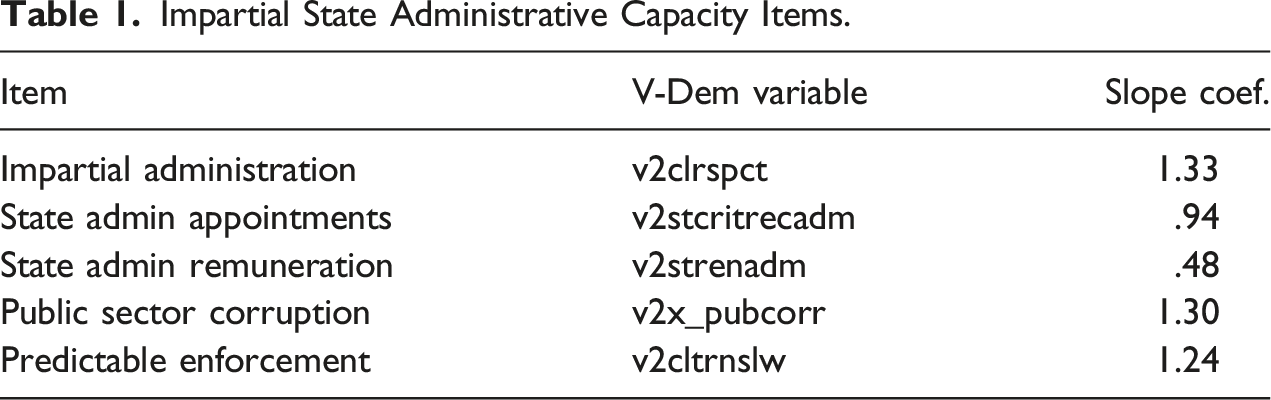
This latent estimate, which we call impartial state administrative capacity, serves as a measure for the extent to which the state bureaucracies are impartial and the administrative personnel are professionalized and not personalized. Although much of the variation in this measure is cross-sectional, it nonetheless tracks real-world events over time within countries. 15 For example, in Turkey, the latent estimate identifies steep declines in impartial state administrative capacity in 2008 (the start of the Ergenekon prosecutions), 2010 (a constitutional referendum that allowed the AKP to stack the judiciary), and again in 2013 when Erdoğan amended “personnel law to give legal immunity to intelligence officials and to introduce another amendment prohibiting moves against the MIT’s [internal intelligence agency] head without approval of the prime minister” (Lancaster, 2014, 1685). The estimate of impartial state administrative capacity drops again the following year, 2014, when the leader “expanded the powers of the intelligence agency, allowing it to operate without any significant judicial oversight” (Lancaster, 2014, 1685). By 2016, in the wake of a failed coup attempt, Erdoğan completed the deep politicization of the state, purging perhaps as many as 100,000 civil servants (Hincks, 2016).
To validate this data, in Appendix A, we show that the latent estimate of impartial state administration is highly correlated with the ICRG indicator of Quality of Government and the World Bank Statistical Capacity indicator. The correlations with these two external measures are positive and significant, even after partialing out country fixed effects (FEs). The within-country external validation suggests the variation in the data is substantial and corresponds to external data. Appendix A also demonstrates the internal reliability of the latent estimate: the latent construct is similar across geographic regions, across time, and for different levels of party system institutionalization.
Alternative Dimensions of State Capacity
We consider two alternative dimensions of state capacity, which we anticipate should not be shaped by party personalism: state fiscal capacity (v2stfisccap) and state territorial control (v2svstterr). 16 These dimensions are conceptually distinct from impartial state administrative capacity because they cover political actors and government purposes (revenue extraction and control over physical territory) that do not overlap with the our theoretical concept of an impartial, impersonal administrative state. If leaders backed by personalist parties are in a position to undermine impartial state administration, we should not necessarily observe an association between party personalism and state fiscal capacity or territorial control. These features may enhance the leader’s grip on power by extracting private rents and increasing state resources to be paid to the leader’s supporters.
A Measure of Party Personalism
To measure party personalism, we employ a variable that captures the extent to which the ruling party is “a vehicle for the personal will and priorities of one individual leader” (Lührmann et al., 2020). 17 This variable is coded by multiple country experts and aggregated across coders using a Bayesian item response theory measurement model, yielding a continuous measure of the concept.
To illustrate how this variable tracks changes in party personalism for the ruling party over time in democracies, consider examples from three democracies with vastly different party systems and democratic histories, as shown in left plot in Figure 1. In the U.S., where two long-standing parties have dominated national politics for well over a century, both parties had relatively low values of party personalism under four consecutive leaders from different parties (1988–2016). However, the measure increases after Trump is elected and again after the 2018 mid-term elections. In Venezuela, where the long-dominant two-party system imploded in the 1990s, party personalism was relatively low in the early 1990s under Carlos Andrés Pérez and the Acción Democrática but rises under Rafael Caldera—who, although a political insider, created to his own personal party as a vehicle to launch his candidacy and won the presidency in 1994. Party personalism rises further under Hugo Chávez, who also created a party as a personal electoral vehicle. In Hungary, where democratic rule came with the end of the Cold War, two of the first post-Communist leaders, József Antall and Gyula Horn, led very different parties (one the main anti-Communist party after the transition and the other the Communist successor party) but both had relatively low party personalism. During Viktor Orbán’s first stint as leader, party personalism for Fidesz rises substantially from 1999 to 2002; and during his second stint in power Fidesz ranks as one of the most personalist in the entire data set. Because our research design compares parties to other parties in the same country, we want this measure to accurately capture relative party personalism differences across leaders in the same country. Ruling party personalism in three countries.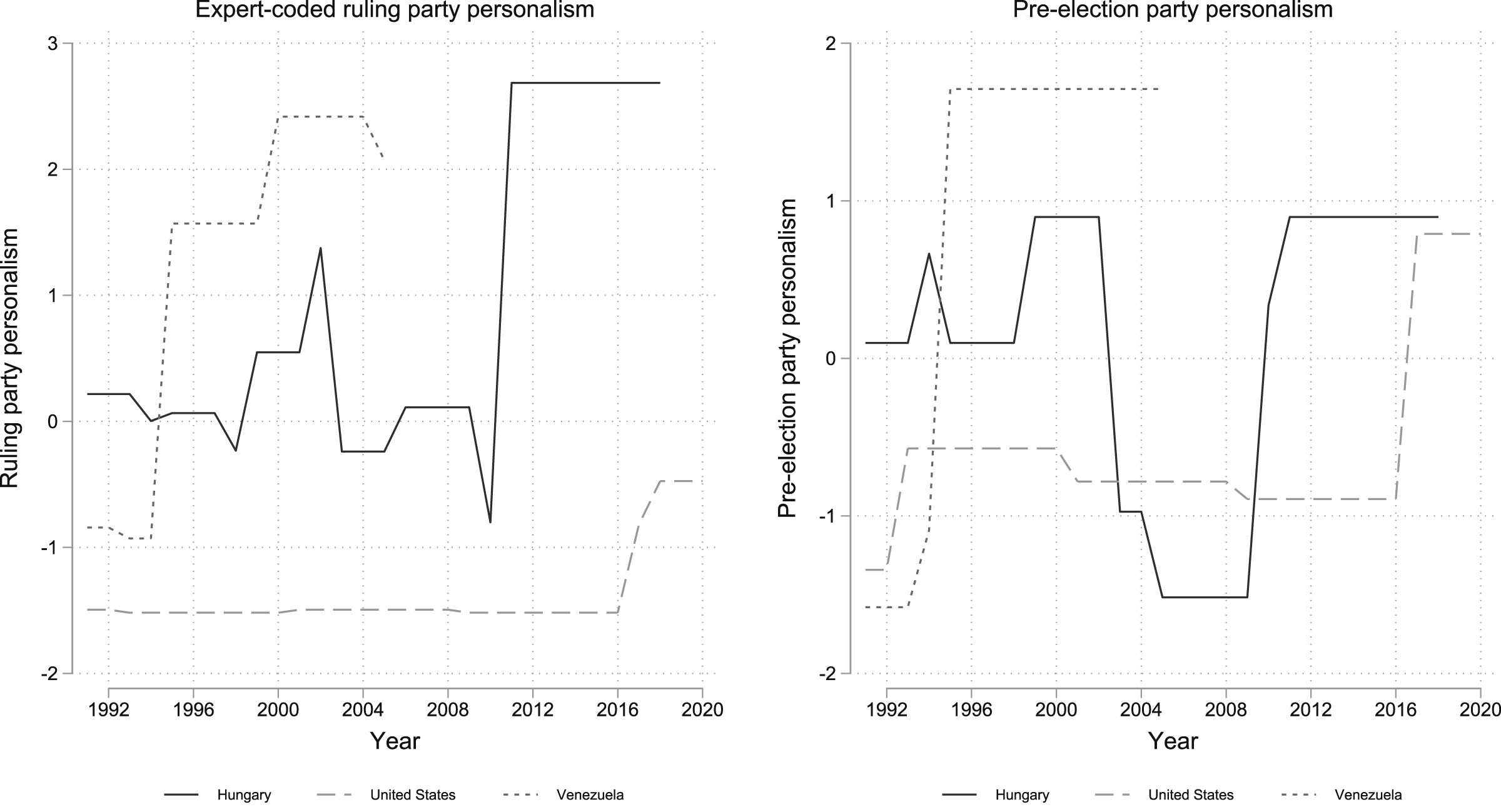
These cases illustrate that party personalism does not necessarily overlap with party ideology. 18 Many would categorize Fidesz as a right-wing party and various incarnations of Chávez’s party as left-wing, but both are highly personalist. In the U.S., both major parties had very low personalism scores until Donald Trump wins the Republican primary. Further, while the Republican party during the Trump presidency is more personalist than either U.S. party in the prior two decades, the Trump Republican party is nonetheless substantially less personalist than the ruling parties in Hungary and Turkey.
An Instrument
To instrument for personalism in political parties, we use data on democratic leaders and their relationship with the political party that supports their candidacy in elections (Frantz et al., 2022). This data identifies whether the leader created a new political party to campaign for national executive office as well as the political positions (elected or appointed) the leader held with the party at the local or national level prior to their candidacy in the executive election. The data capture the pre-electoral history of the relationship between the party and the candidate.
From this data, we utilize a pre-electoral party personalism variable pre-election personalism: Frantz et al. (2022) construct a latent measure of pre-electoral party personalism based on eight indicators, listed on Appendix page A-6. Each of these items records objective information from the pre-electoral history of the relationship between the leader and the support party: the information comes from prior to leader assuming office as the chief executive. Thus, the instrument does not contain information about how the leader behaves once in office, including the leader’s attempts to politicize the bureaucracy. That is, by instrumenting for party personalism using pre-election information, the estimate of interest cannot be biased by strategic behavior on the part of the leader once in office—behavior that might both shape party personalism and state administration. For example, the leader might use demonizing rhetoric to de-legitimize political opponents, unleash pro-incumbent militias, or shut down opposition media or assert de facto control over state owned media—all of which could plausibly augment personal control of the supporting party as well as pave the way for the leader to undermine impartial state administration. Relying on pre-electoral information as an instrument, however, circumvents endogeneity concerns that arise from strategic incumbent behavior once in office, including populist rhetoric and attempts to polarize citizens. Further, the instrument is coded using objective historical indicators and not subjective assessments by expert coders.
To illustrate variation in this instrument, we return to the three cases of Hungary, the United States, and Venezuela, in the right plot of Figure 1. In Hungary, pre-election party personalism is highest when Fidesz is the ruling party, in large part because Viktor Orbán helped create the party in the early 1990s. In the United States, pre-election party personalism remains low until Donald Trump’s presidency because he is an outsider to the party with no prior elected or appointed experience within the party. Republican party pre-election personalism is not as high under Trump as it is under Orbán because Trump did not create the Republican party. Finally, in Venezuela, pre-election party personalism is high for both the Caldera and Chávez presidencies because they both created their own parties as personal electoral vehicles just prior to their respective elections. This plot also demonstrates the substantial variation in the instrument over time within countries.
Design
We employ a linear estimator that accounts for cross-section heterogeneity with country FEs and adjusts for a common time trend. 19 This approach accounts for time-invariant factors that may influence both impartial administrative capacity as well as party personalism, such as geography, resource endowments, initial population density, colonial history, state infrastructural power, the legacy of former authoritarian bureaucracies and ruling parties, ethnic polarization, historical party system development, and how democracy was born in each country (e.g., multiparty election, revolution, and gradual franchise extension). Further, the country effect captures differences between electoral systems and rules that structure party systems and shape incentives to cultivate a personal vote.
This design draws inference from over-time (partial) correlations among variables during the democratic period in each country, from 1991 onward; it thus does not draw inferences by comparing outcomes in countries with personalized parties to outcomes in countries that lack them.
The specification follows, where α
i
are unit effects and ν
t
is a time trend.
Yi,t is the impartial administration outcome variable and di,t is the party personalism treatment variable;
Leaders in new democracies are more likely to be backed by parties they helped create—and thus more likely to be personalist—because new opposition parties created by ascendant opposition elites often won elections during and after democratic transitions, especially in the 1990s. And leaders of new democracies may be particularly keen on dismantling the state bureaucracies of the ancien régime. Similarly, the level of democracy in a country shapes both state bureaucracy and the election of more personalist ruling parties. Finally, ruling party seat share in the lower house of the legislature accounts for the fact that leaders backed by parties with super-majorities should have more room to politicize state administration; and personalist parties often come to power with large majorities in the wake of established party decline. Our baseline specification thus adjusts for democracy age and initial democracy as well as ruling party seat share.
While this specification accounts for time-invariant and slow-moving structural features of the economy that might influence both party personalism and impartial state administrative capacity, it cannot rule out the possibility of bias stemming from omitted time-varying factors. Appendix Figure B-3 takes a model adjustment approach by adjusting estimates (separately) for an additional 28, mostly time-varying, variables. We augment the FE estimator in three ways to address omitted time-varying factors and address one type of endogeneity by employing an instrument for party personalism.
First, we examine how party personalism shapes impartial state administrative capacity while adjusting for the initial level of impartial state administrative capacity when the leader first enters office (Yj,t = 0).
20
This approach asks: how does each leader change impartial state administrative capacity once in power, conditional on the level of capacity when they first enter office? As before, we partial out country effects (α
i
) so that we are estimating the marginal effect of changes over time in the level of capacity while still accounting for all differences across countries.
Second, we adjust for lagged dependent variables (LDVs)—the first- and second-lags (Yi,t−1, Yi,t−2) of the impartial state administrative capacity variable—to account for past outcomes, blocking the pathway by which past outcomes (or unobserved time-varying confounders that shape present capacity via past capacity) influence treatment assignment (and current outcomes).
21

Third, we test treatment effects models that allow for the effects of common time shocks to vary across countries (Bai, 2009) and check whether the key assumption of no-time-varying-confounder with a counterfactual estimator (Liu et al., 2021).
A fourth approach relies on an instrumental variable (IV) design. Frantz et al. (2022) develop a measure of party personalism using only information from the pre-electoral history of each leader and their party to capture the extent to which leaders create their own party rather than working their way up through the party apparatus to become party leader. Theoretically, leaders who create parties as a personal electoral vehicle should have more power over the party and elites, including power over policy and personnel appointments, than leaders who work their way up through an existing party to advance their careers.
Descriptive Patterns
Before moving to the econometric results, we examine the bivariate relationship between ruling party personalism and impartial bureaucratic administration. The left plot in Figure 2 shows a difference in means test where we group ruling parties into either “low personalism” (below the sample median) or “high personalism” (above the median) categories. The rescaled measure of the outcome is standardized with a mean of 0 and a standard deviation of 1. On average, ruling parties with low personalism score have a level of impartial state administration 38% of one standard deviation above the mean; in contrast, highly personalist ruling parties have an average level of the outcome 44% of one standard deviation below the mean. This difference of .82 standard deviations is statistically significant. Party personalism and bureaucratic capacity. 527 leaders in 97 countries from 1991 to 2020. N × T = 2165.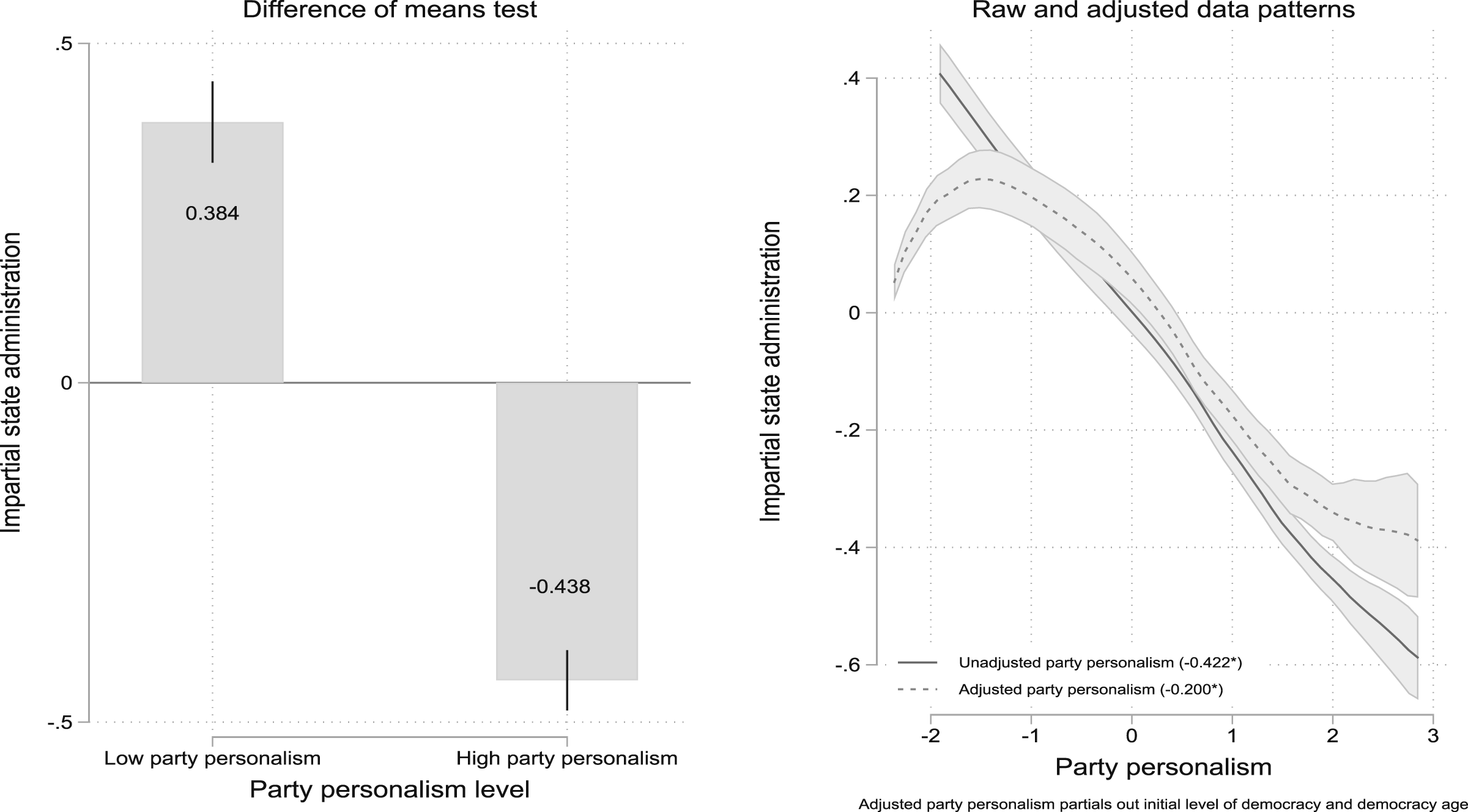
Ruling party personalism, however, is a continuous variable, so the right plot examines the full covariation between ruling party personalism and impartial administration, using a local polynomial (nonlinear) fit, shown as a solid line with a corresponding 95% confidence interval. A bivariate regression result summarizes this linear relationship with a coefficient estimate of −.44. Next, we adjust the measure of party personalism to partial out two key confounders that measure democratic consolidation: the level of democracy in the year each leader is selected to power; and the age of the democracy (log). After adjusting for these factors, the linear correlation drops in half, to −.20. The evidence from Figure 2 indicates that the raw data patterns are consistent with the expectation that ruling party personalism undermines impartial state administration.
Results
This section reports results from tests of equations 1 to 3, as well as a test of 1 but where the specification omits the observed confounders (xi,t). Figure 3 reports the results. The top estimate, from an FE model without covariate adjustment, for party personalism is negative (−.080) and statistically significant, indicating that party personalism decreases impartial state administration. The second estimate, an FE model with covariate adjustment, is almost identical (−.076). The third estimate is from equation 2, which adjusts for the initial level of bureaucratic capacity for each leader-spell, transforming the test into an estimate of party personalism on the change in capacity from the initial level when each leader takes office. The estimate is closer to zero (−.059) but still negative and statistically significant. The last estimate, from a test with FE + LDV in equation 3, is smaller (−.011) but still negative and significant. We note, however, that this last estimate only reflects the short-run effect.
22
The findings in Figure 3 suggest that party personalism decreases impartial state administration in democracies. Party personalism and bureaucratic capacity. Standard errors clustered on 527 leaders in 97 countries from 1991 to 2020. N × T = 2165.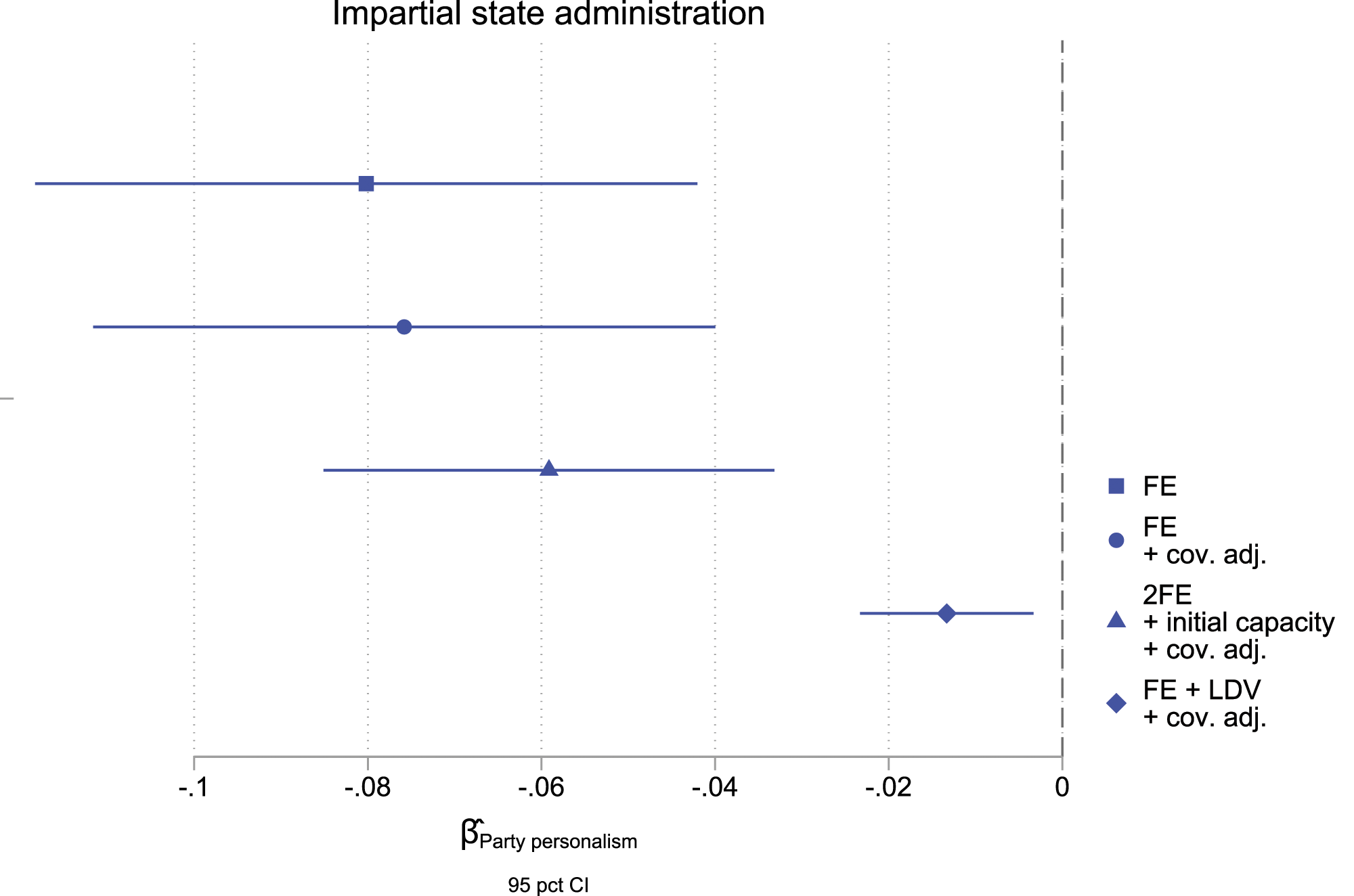
Causal Designs for TSCS Data
This section reports results from two types of tests that address concerns about causal interpretations of FE models. First, we estimate interactive fixed effect (IFE)s models (Bai, 2009) that allow for common time shocks (year effects) to have heterogeneous effects on the outcome across panel units (countries). For example, the end of Cold War had a profound effect on how states developed in the subsequent decades, but this time shock undoubtedly varied across countries. In post-Soviet countries, for example, economic “shock therapy” entailed shrinking states and mass privatization but also opened space for oligarchies to seize control of the state (Hellman et al., 2003). In Latin America, in contrast, democratization at the end of the Cold War did not entail substantial privatization of the state. Similarly, the extent to which Washington Consensus policies were implemented by developing states in the 1980s and 1990s and then supplanted by IFI “good governance” paradigms in the late 1990s varied considerably across countries and regions, such as Latin America and East Asia (Rodrik, 2006). An IFE estimator accounts for these and other possible ways in which time shocks shape state outcomes in different countries.
Second, we test dynamic treatment effects estimators: FEs counterfactual and interactive fixed effects (Liu et al., 2021). These estimators require a time-varying binary treatment variable, so we dichotomize the continuous party personalism variable at the median. 23
Party Personalism and Bureaucratic Capacity, IFE.
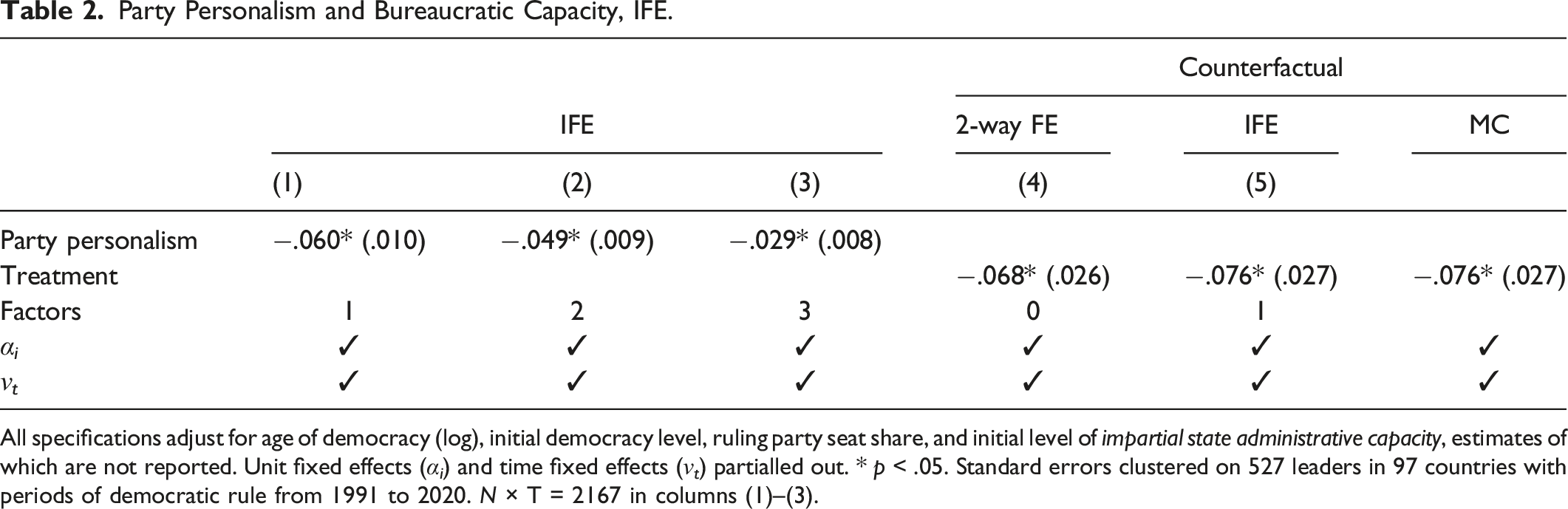
All specifications adjust for age of democracy (log), initial democracy level, ruling party seat share, and initial level of impartial state administrative capacity, estimates of which are not reported. Unit fixed effects (α i ) and time fixed effects (ν t ) partialled out. * p < .05. Standard errors clustered on 527 leaders in 97 countries with periods of democratic rule from 1991 to 2020. N × T = 2167 in columns (1)–(3).
IV-2SLS Estimates
Next we test an IV-2SLS estimator that relies on information about the elected leader and their relationship to the ruling party prior to being elected: whether the leader created the ruling party and their historical, pre-electoral political positions within the party. The instrument, pre-election personalism, is a continuous index that does not reflect the leaders’ behavior once in office, which addresses potential endogeneity from time-varying, unmeasured strategic behavior that shapes both the level of party personalism and the bureaucratic capacity of the administrative state. For example, the leader may use (unmeasured) polarizing political rhetoric to create popular support for their rule; this strategic behavior in office may both reshape incentives for candidate selection within the party (e.g., elites who do not align with the leader retiring and being replaced by new candidates whose political careers are aligned with the leader) and provide political cover and partisan support for purging the state bureaucracy of apolitical agents, replacing them with loyalists.
However, we still want to ensure that the prior level of impartial state administrative capacity at the time of the leader’s entry into office does not influence selection into party personalism. We therefore adjust for the initial level of bureaucratic capacity (Yt = 0, measured in the year the leader was first elected executive). Again, we employ a FEs estimator to account for all time-invariant factors such as state infrastructural power, authoritarian legacies, and electoral systems, that is, equation 2.
Party Personalism and Bureaucratic Capacity, IV-2SLS.
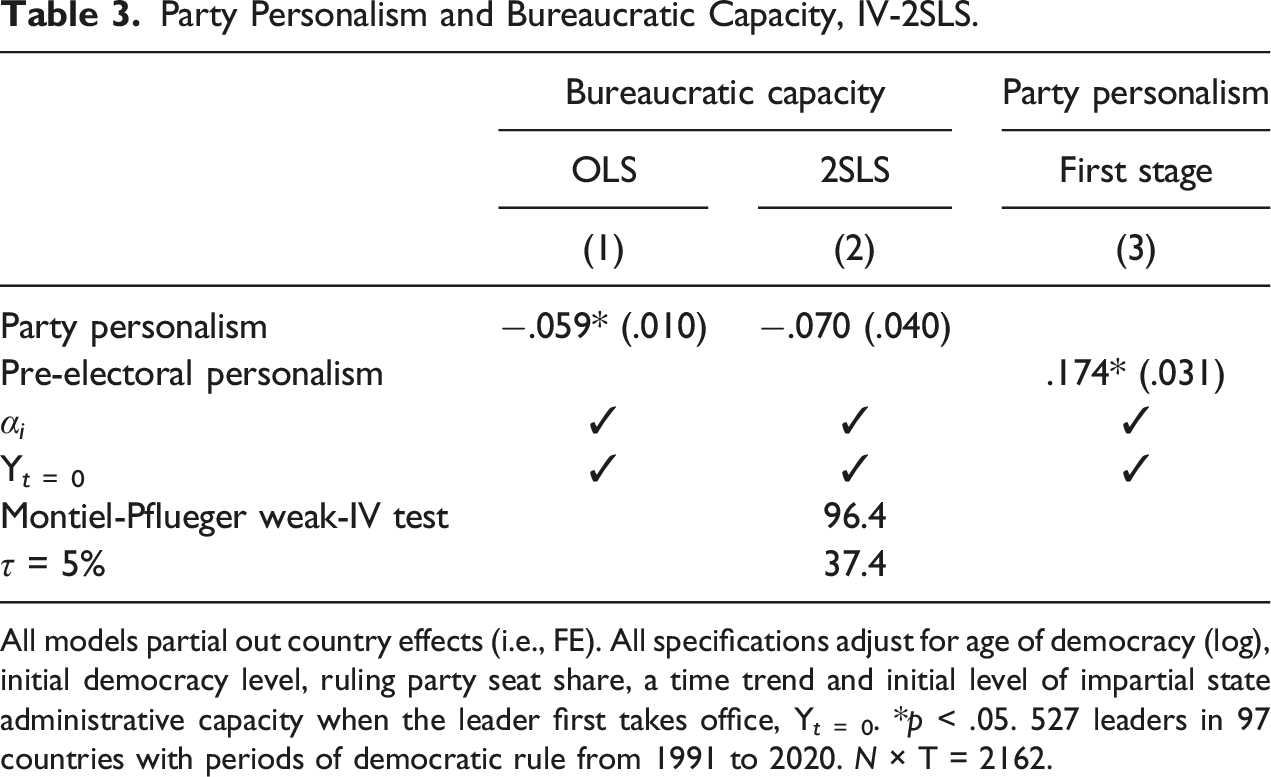
All models partial out country effects (i.e., FE). All specifications adjust for age of democracy (log), initial democracy level, ruling party seat share, a time trend and initial level of impartial state administrative capacity when the leader first takes office, Yt = 0. *p < .05. 527 leaders in 97 countries with periods of democratic rule from 1991 to 2020. N × T = 2162.
The exclusion restriction necessary for a causal interpretation may be violated if the instrument shapes the outcome through a causal pathway distinct from the treatment, namely, ruling party personalism. We see three possible alternative pathways—party system institutionalization, polarization, and parties undermining other state institutions such as the judiciary. Pre-electoral party personalism, especially whether the leader created the ruling party, may also lower party system institutionalization precisely because the former often entails a relatively new political party winning an election, which alters party system institutionalization. Second, pre-electoral party personalism may yield ruling parties that are more apt to polarize society; and this polarization may be a cudgel the leader uses to attack the state bureaucracy. Third, the instrument may simply correlate with leaders who are most likely to undermine other state institutions, such as the judiciary. In the robustness tests in Appendix D, we adjust for proxies for these concepts, with similar IV-2SLS results.
Kernel Regression
Next we estimate a kernel regression model of equation 2 that adjusts for country means for all explanatory variables, thus mimicking an FE approach. 25 Kernel regression relies less on strong parametric assumptions than linear regression and also provides a flexible way to plot (pointwise) marginal effects across levels of theoretically interesting variables (Hainmueller & Hazlett, 2014).
Recall that a theoretical scope condition suggests that the party personalism should be strongest when leaders’ parties have legislative control. In Figure 4, we examine how the estimated marginal effect of party personalism on impartial state administrative capacity varies when the leader’s party has a legislative majority. Figure 4 plots the marginal effect of a change from 25th to the 75th percentile in party personalism on one standard deviation of impartial state administration.
26
Substantive effect of party personalism on bureaucratic capacity.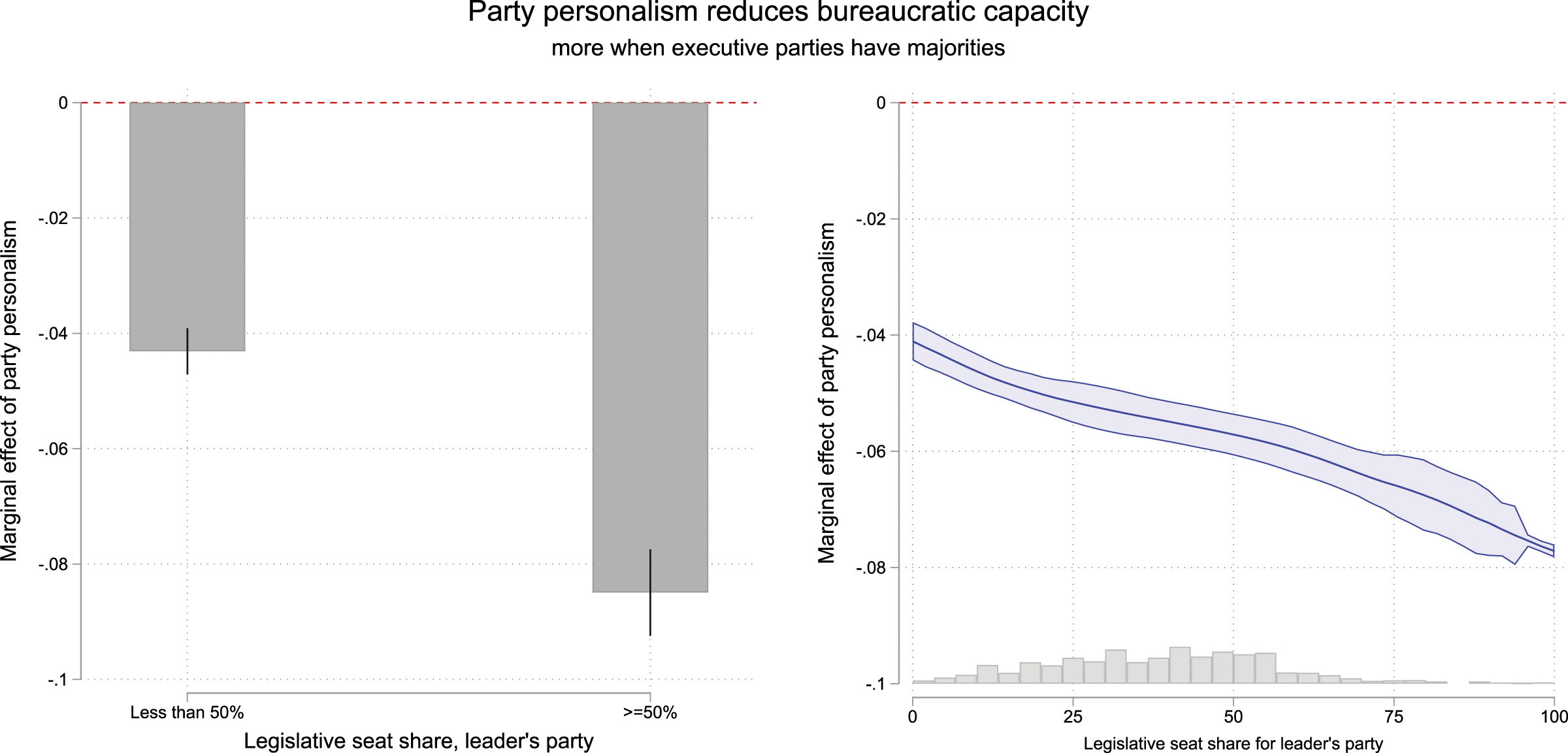
The left plot shows the estimated marginal effect of party personalism when the party lacks a majority (less than 50%) and when the leader’s party has at least a majority (
Alternative Dimensions of State Capacity
Last we test the models in equations 1 to 3 for each of the alternative dimensions of state capacity that differ from impartial state administrative capacity: fiscal and territory. These measures, from the V-Dem data, are described on Appendix page A-5. From a theoretical standpoint, we posit that party personalism enables democratic leaders to politicize the state bureaucracy and undermine its impartial administration, but these leaders have little incentive to use their party to undermine other aspects of state capacity, especially fiscal extraction and territorial control. With this view, tests where these alternative dimensions are the outcome provide additional support for this point. In a similar vein, we can view these tests as placebo tests: the treatment variable—party personalism—should not influence other related outcomes but rather only effects the more narrow conceptualization of state capacity as an impersonal administrative bureaucracy.
Figure 5 reports the results from tests of equations 1 (left plot) and 3 (right plot) for each of the two alternative dimensions of state capacity as well as for a composite measure of state capacity from Hanson and Sigman (2021) that encompasses all aspects of the concept. Estimates from the FE models in the left plot indicate that party personalism has a negative effect on fiscal extraction and territorial control but neither estimate is strong or statistically significant. However, the estimate for the Hanson-Sigman composite measure of state capacity suggests that party personalism reduces overall state capacity. Turning to the right plot, which reports estimates from FE models with lagged dependent variables (equation 3), we see that none of the estimates are statistically different from zero, even though they are all negative. While there may be some spillover to other facets of state capacity when leaders backed by personalist parties undermine impartial state administration—as suggested by the negative estimates in these tests—these spillovers are not strong enough to yield a negative and significant estimate for the effect of party personalism on these aspects of state capacity.
28
Party personalism and additional dimensions of state capacity.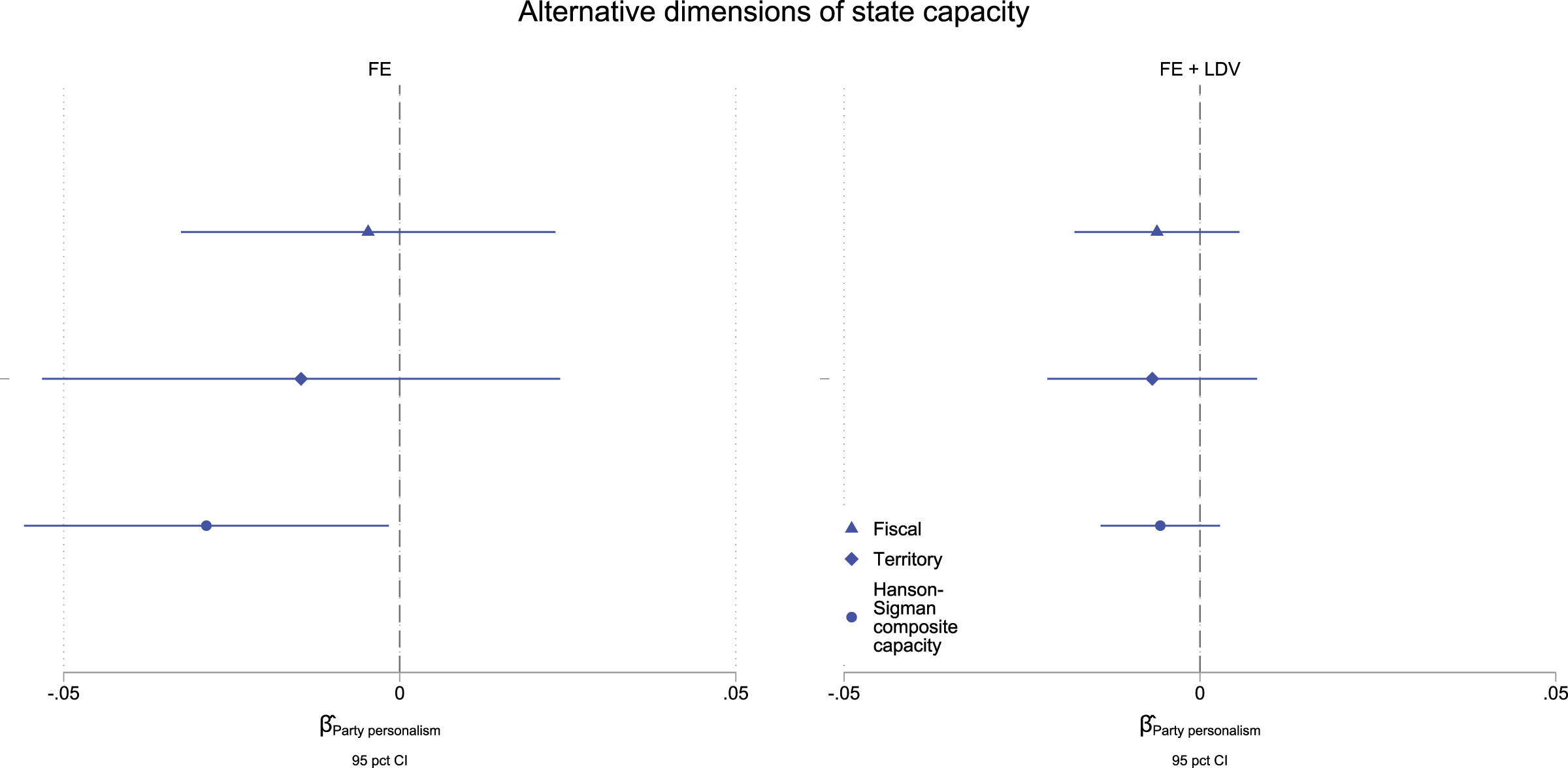
Discussion
North et al. (2009) (NWW) propose a conceptual framework for understanding the sweep political and economy history that focuses on the establishment of “open access societies”. While they highlight the importance of states possessing a legitimate monopoly on violence in societies, a prior crucial step for creating open access societies entails establishing impersonal, perpetually lived organizations, including the state administration (26). Impersonality, they note, implies equal treatment irrespective of personal identity; and similarly, perpetually lived organizations have an existence “independent of their members” (23). Social orders that foster impersonal organizations to compete against each other reduce rent-seeking from the state, with positive consequences for economic development and durable, peaceful political arrangements.
This paper examines how political party personalism undermines state capacity. We focus on a relatively narrow but essential aspect of state capacity: an impartial state administrative bureaucracy necessary for institutionalizing impersonal, perpetually lived private organizations in society, particularly private corporations that invest other people’s money to boost economic productivity (NWW, 152). Non-personalized political parties are not only essential private organizations in themselves—perhaps the most important political organizations necessary to compete away rents in NWW’s framework; but, as we show in this paper, non-personalized parties also help uphold an impersonal state, which, again, is essential for economically productive private organizations to thrive. From the outset, we framed our theoretical and empirical contribution as the converse—that personalist parties undermine impartial state administrative bureaucracy—to draw a distinction from the status quo of electoral democracy and to highlight the recent trends away from impersonal states and parties (Kendall-Taylor et al., 2017). However, for open access orders to remain equilibrium outcomes, political parties that compete with one another to reduce rent-seeking cannot, at the same time, undermine the impersonal state that upholds this open access order. If, as our analysis shows, personalized political parties undermine impartial state administration, this process can start the unraveling of the larger open access order, including beliefs about state impartiality and the perpetuality of impersonal private organizations, including corporations.
Understanding how political parties shape impartial state administration also has implications for studying additional, distinct outcomes that nonetheless have far-reaching consequences. For example, party personalism may shape the method of rent extraction from the state (Grzymala-Busse, 2008) and hence parties’ electoral strategies such as clientelism (Hicken, 2011; Kitschelt & Wilkinson, 2007; Stokes et al., 2013) and tolerance for political competition and executive corruption (Hellman et al., 2003; Pérez-Liñán, 2007). Further, while we know that dominant parties in autocracies endure, in part, because they win multiparty elections by deploying state resources to create “state dependence” (e.g., Fish, 2005; Greene, 2010; Magaloni, 2006), we have less traction on how dominant parties arise in the first place (Reuter, 2017), particularly as democracies erode. Personalization of parties, perhaps, is one pathway through which democratic leaders’ consolidate power and backslide into relatively stable autocratic equilibrium, underpinned by the parties they personally control, as may be the case in countries such as Cambodia, Russia, and Turkey.
Supplemental Material
Supplemental Material - How Personalist Parties Undermine State Capacity in Democracies
Supplemental Material for How Personalist Parties Undermine State Capacity in Democracies by Jia Li and Joseph Wright in Comparative Political Studies
Footnotes
Declaration of Conflicting Interests
The author(s) declared no potential conflicts of interest with respect to the research, authorship, and/or publication of this article.
Funding
The author(s) received no financial support for the research, authorship, and/or publication of this article.

Supplemental Material
Supplemental material for this article is available online.
Notes
Author Biographies
References
Supplementary Material
Please find the following supplemental material available below.
For Open Access articles published under a Creative Commons License, all supplemental material carries the same license as the article it is associated with.
For non-Open Access articles published, all supplemental material carries a non-exclusive license, and permission requests for re-use of supplemental material or any part of supplemental material shall be sent directly to the copyright owner as specified in the copyright notice associated with the article.
