




Abstract
Mass mobilization (MM) is an important driver of political change. While some citizens organize in favor of more democratic institutions, others take to the streets to support an authoritarian status quo. This article introduces measures of pro-democratic and pro-autocratic MM using expert assessments for 179 polities from 1900–2021. The data allow us to trace patterns in MM over time, across regions and regime types. We use this new data to systematically analyze the relationship between both types of mobilization and regime change. We confirm the findings of the literature on contentious democratic politics, and our analysis of autocratic mobilization allows us to make sense of the controversy in the literature on “bad actors” in civil society. We show that MM in favor of autocracy negatively affects democracy, making a case for specifying the goals of the actors involved in contentious politics to more precisely understand their impact.
Keywords
In August 2020, tens of thousands of Belarusians took to the streets demanding democratization following fraudulent elections. 1 Similar protests in Sudan and Armenia brought down dictatorships, whereas in Lebanon or Hong Kong their impact was limited. Recently, we have also seen citizens on the streets in support of dictatorships in North Korea, Syria, and Venezuela or in support of anti-democratic reforms in Brazil or Turkey. What is the role of mass mobilization (MM) in stabilizing or changing a political regime? Prior comparative research has produced conflicting answers to this question. Some scholars see citizen activism as crucial to democratization (Bratton & van de Walle, 1992; della Porta, 2016; Schock, 2005), whereas others have pointed out the role of the citizenry in democratic breakdowns (Berman, 1997; Riley, 2010).
From the authors cited above, we know that the character of popular mobilization is critical. The lack of nuance in prior comparative research and the focus on pro-democracy movements has made it difficult to detect those cases in which MM for autocracy has undermined democracy. As a result, the literature has had difficulty differentiating when MM threatens democracy or helps to promote it. Existing event data sets on MM are limited temporally and geographically and do not classify events as pro-democratic or pro-autocratic.
The V-Dem data set (Coppedge et al., 2022, V12) is the first to provide time-series cross-national data (1900–2021) on the degree of pro- and anti-democratic MM in almost 180 countries. 2 Based on the knowledge of local country experts, we build comparable latent measures of MM across space and time. We compare our measures with existing data on related phenomena and find substantial correlations where there is overlap. Our descriptive data analysis shows that pro-democratic MM has been increasing over the last century, reaching its peak in 2019. Pro-autocratic mobilization, by contrast, was highest during the Cold War and the heyday of communism in Eastern Europe. Whereas pro-democratic MM is most frequent in regimes with intermediate levels of democracy, pro-autocratic MM is common in closed and electoral autocracies.
Next, we use this expert-coded data to investigate the relationship between MM for different goals and subsequent regime change. Our analysis consists of two parts. In the first part, we analyze the effect of MM on changes in the level of democracy using V-Dem’s Electoral Democracy Index (Teorell et al., 2019) in a standard panel setting. In the second part, we examine the relationship between MM and discrete forms of regime change (democratic transition and breakdown) using data from Boix et al. (2013).
Our results show robust relationships between MM and regime change. Pro-democratic MM is associated with a significant albeit small increase in the quality of democracy. Moreover, we find that pro-democratic MM makes a successful transition more likely. By contrast, pro-autocratic mobilization reduces democratic quality and increases the risk of democratic breakdown. However, we do not find evidence for an insulating effect of pro-democracy mobilization on democratic breakdown. Our results add empirical evidence to ongoing discussions about the role of citizens in regime change.
The Centrality of Civil Society Mobilization in Regime Change
Civil society practices politics in two distinct fashions. First, civil society organizations engage in the routine politics of interest articulation—lobbying powerholders, organizing campaigns in support of interests, influencing public opinion, agenda setting, monitoring the state, and intervening in legislative and judicial politics. The second practice is more conflictual. It is when civil society organizations protest, demonstrate, coordinate large contentious events, and practice civil disobedience in pursuit of their goals. This is meant to mobilize support, publicize important issues, and impose audience and reputational costs on other actors. This is the part of civil society’s behavior with which we are concerned. The argument below is that the mobilization of partisans of authoritarianism and democracy in civil society is a common and consequential aspect of regime change. The balance of forces at junctures where the future of rule is at stake plays an important role in determining whether the outcome is change or stability. Therefore, we argue that the mobilization of civil society in support of democracy should enhance democratization and democratic stability, while mobilization for autocracy has the opposite effect.
What is the basis for our expectations on the micro-level? What mechanisms motivate citizens to take the kind of contentious actions that have the potential to lead to regime change? Participation in MM signals preferences to other members of the public, incumbents, and counterelites. Collective action directed towards regime change, no matter the regime in question, is inherently dangerous to participants because of the state’s monopoly on the (legitimate) use of violence. While peaceful protest is often less dangerous in democracies than in autocracies, it entails greater risks than other forms of political action, especially when it transcends the boundaries of legality. Under authoritarianism, especially when the state aggressively defends its monopoly on organization, any public expression of discontent is inherently dangerous.
A well-established theoretical literature shows how protest as a form of signaling reveals hidden preferences and changes the calculus of individuals on whether to engage in collective action because there is strength in numbers (DeNardo, 1985; Granovetter, 1978; Marwell & Oliver, 1993). It is more difficult and costlier for any regime to punish large numbers of protesters. Under conditions of uncertainty about the preferences of one’s fellow citizens, it takes bravery, a high level of moral commitment, or even recklessness to engage in protest, especially when a regime has an effective coercive apparatus. Each successful protest has the possibility to expand opposition to the incumbent by revealing new information to others who have been hiding their antipathy towards the regime (Kuran, 1991; Lohmann, 1994). Mass demonstrations of support for the regime can have a countervailing effect. One only needs to recall the 800,000-person demonstration called by the Gaullist Party on May 30, 1968, in Paris and the party’s subsequent victory in the National Assembly’s elections in June 1968, bringing that revolutionary May to an end.
Further, the size and intensity of protests raise the costs of repression for the regime, both materially and in terms of audience costs. Repression, when seen as excessive, works to create further pockets of antipathy towards the incumbents. When this occurs, reform as a response to popular disquiet may become the more attractive option for the incumbents. And with reform comes enhanced prospects for regime change (Przeworski, 1991). Finally, counterelites may become emboldened in terms of their demands and actions if collective action reveals greater disquiet with incumbent rule.
Moving to the macro level, the foundational work on democratic transition has demonstrated that civil society mobilization is intrinsic to regime change. The works that have shaped the discipline’s understanding of the wave of democratic transitions since the Portuguese Revolution of 1974 saw regime change as beginning with a process of liberalization growing out of the emergence of a reform faction in the authoritarian camp. Liberalization can lead to the stabilization of a broadened and reformed authoritarian regime. However, with the mobilization of civil society and the demand for more extensive reform, liberalization can lead to founding elections and democratic transition (O’Donnell & Schmitter, 1986; Przeworski, 1991). One limitation of this classic literature was that it only saw democratic transition as elite-initiated, originating in a division within the authoritarian camp. While this is understandable given the prevalence of this pattern in Southern Europe and Latin America in the 1970s and 1980s, subsequent analysis shows that such splits are often triggered from below (Adler & Webster, 1995; Bratton & van de Walle, 1992; della Porta, 2016; Hudáková, 2019; Johnson & Thyne, 2018; Kim, 2000; Schock, 2005). Civil society mobilization itself can precipitate splits in the regime over whether to repress or liberalize, and in the latter case, further civil society activism will help to complete the movement from liberalization to democratic transition. 3
Building on the comparative historical literature on how the creation and incorporation of new social classes impact regime outcomes (Collier & Collier, 1991; Rueschemeyer et al., 1992), a more recent literature explores and documents the downstream impact of civil society mobilization during transitions. There is now a substantial set of findings that argue that a more contentious transition from authoritarianism involving the mobilization of pro-democratic civil society forces leads to higher quality and more durable democracies in the post-transition era (Bernhard et al., 2017; Brancati, 2016; della Porta, 2014; Kadivar, 2018). Haggard and Kaufman (2016) note a similar effect for transitions that involves labor mobilization. In a paired comparison of Spain and Portugal, Fishman (2019) finds that the contentious events of the Portuguese Revolution led to higher quality democracy than the pacted transition in Spain. Pinckney (2020) is more measured and argues that moderate rather than maximalist contentious actions by civil society have a salutary effect on democratization.
There is also a new literature on how civil society can provide insulation against democratic backsliding and breakdown that goes beyond the tradition in behavioral research, which argues civic engagement helps to maintain values and attitudes congruent with democracy (Almond & Verba, 1963; Inglehart & Welzel, 2005; Norris, 2011; Putnam et al., 1994). Proceeding from an institutional point of view predicated on the notion that democracy functions as a self-enforcing equilibrium (North et al., 2000; Przeworski, 1991), some observers have argued that an active and engaged civil society provides a layer of social accountability (Cornell & Grimes, 2015; Smulovitz & Peruzzotti, 2000). Based on a V-Dem measure of civil society participation, strong empirical evidence supports the contention that civil society’s active participation works to deter democratic breakdown. In separate samples from 1900 to the present (Bernhard et al., 2020) and the interwar era (Cornell et al., 2020), a period where democracy was particularly fragile, recent studies have found that an active civil society made democracy more durable. In a related study, Bernhard and Edgell (2022) found that a novel measure of civil society stock was associated with higher levels of democracy, increases in the level of democracy, and made democracies more resistant to downturns in democracy scores. They also confirmed that their findings on civil society were congruent with older class coalition theory in the second wave of comparative historical democratization research (Luebbert, 1991; Rueschemeyer et al., 1992) in a much larger global sample of cases. And in other research focused on backsliding, Yarwood (2016) found that an active civil society deters power grabs from incumbent presidents in Africa.
From the material we have presented so far, it is tempting to conclude that civil society is not only necessary for democracy, but that it is the key to successful democratization and the durability of democratic regimes. However, civil society can develop problematically for democracy. Several observers have pointed out that civil society includes actors who are hostile to democracy and take an active role in trying to overthrow it (Chambers & Kopstein, 2001; Kopecký, 2003).
In the literature on the failure of democracy in interwar Europe, there is strong evidence in several cases that civil society played a critical role in democratic breakdown. In work on Weimar Germany, Berman (1997) argues that the Nazis were able to infiltrate and take control of substantial parts of the densely organized network of civic organizations in Germany, increasing their support and weakening the social basis of other parties. In a variation of this argument, Riley (2010) argues that the development of civil society abetted the rise of fascism in Italy, Spain and Romania. He claims that the dominant liberal parties in these societies were unable to effectively organize hegemony over emergent social constituencies and this opened them up to organization by the fascist movements.
In contrast, Bermeo (2003) argues that anti-democratic contentious political behavior in a large number of twentieth-century breakdowns was selectively orchestrated from above by self-interested elites despite grass-roots attitudes and activism that was more often pro-democratic. Despite her difference in emphasis from Berman and Riley, she does see that MM can play a role in justifying elite action directed at undermining democracy. This perspective is congruent with the literature on coups that pinpoint their origins with a “knock at the barracks door” by civilian politicians (Harig & Ruffa, 2022). Under such circumstances, civilian protest can serve as a precipitant or a justification for political intervention by the military. For example, the “march of empty pots and pans” by middle-class women and the strike of truckers both played a role in undermining the rule of Salvador Allende in Chile (Devine, 2014, p. 30–31) and demonstrations played a key role in justifying Sisi’s ousting of Morsi and the Islamic Brotherhood in Egypt (Ketchley, 2017, Ch. 5).
In contemporary research on democratic backsliding driven by populism, there are parallels to the interwar period. The ongoing episodes of autocratization in Poland and Hungary show that the ascension to power of populist parties has been abetted by the development of civil society organizations and protest activities by their followers (Gerő & Kopper, 2013; Graff & Korolczuk, 2021; Greskovits, 2020; Ślarzyński, 2018). From the large-n perspective, there is at least one confirmatory study by Bernhard and Edgell (2022) which finds that the V-Dem variable on anti-system organizations is correlated with an enhanced prospect of democratic deterioration.
In terms of the durability of dictatorships, popular mobilization has played a role in maintaining many regimes in power. The forms of state socialism that grew out of the Russian and Chinese revolutions have historically been the most stable and long-lived forms of modern dictatorship. At their core lay popular mobilization as a way for the rulers to compel the citizenry to publicly signal loyalty. Conventional authoritarianism, by contrast, was wary of mobilization and favored a depoliticized and demobilized population (Linz & Stepan, 1996). The salutary effect of mobilization on authoritarianism is also supported by Geddes (2003, p. 78–87) finding that mono-party rule is the most durable form of dictatorship. But across all types of authoritarianism, MM in support of the government is quite common, particularly when the regime’s survival is threatened (Hellmeier & Weidmann, 2020).
So, in parallel, to what we saw in the case of democratic regime change, and democratic survival, we do see popular MM also playing a role in authoritarian seizures of power and the defense of authoritarian regimes. However, we are less sure that authoritarian civil society mobilization is necessary for authoritarian transition. While substantial civilian backing is essential for the success of coups and other authoritarian seizures of power, majority support is not required (Geddes et al., 2018, p. 34–35). Often, authoritarianism’s origins lie with elites who feel their interests are threatened. We see this in Bermeo’s discussion of twentieth-century democratic breakdowns, as well as in the influential two-class models of democratic breakdown, which posit the threat of revolution or redistribution as precipitating elite defection and breakdown (Acemoglu & Robinson, 2005; Boix, 2003). Thus, sufficient levels of popular support, while intrinsic to durability, may be organized and shored up after coups, autogolpes, or other precipitating events. As for authoritarian durability, some dictatorships have become adept at organizing movements under state tutelage and mobilizing them in defense of the regime (Ekiert & Perry, 2020). We fully expect this to have a positive effect on regime survival, but again not to be necessary. For instance, many forms of authoritarianism navigate crises and persist in the short to medium term on the basis of loyal coercive state apparatuses (Skocpol, 1979). That would seem to be the case in contemporary Venezuela, where despite the loss of Chavez’s charisma and the resource wealth that fed patronage networks, the Maduro regime has maintained power by keeping a hold on the military (International Crisis Group, 2019).
To sum up, the preponderance of statistical evidence says, ceteris paribus, that a highly participatory civil society is supportive of democracy. And foundational work on democratic transition sequencing argues that whether as a precipitant or as a necessary phase in the move from liberalization to foundational elections, civil society mobilization is intrinsic to democratization. A host of other studies argue that the intensity of that mobilization leads to a higher post-transition quality of democracy. In contrast, a large body of in-depth casework points out that civil society actors and their mobilization can play a critical role in democratic breakdown and backsliding. There is also statistical evidence that the presence of anti-system groups contributes to democratic failure. Finally, the history of modern authoritarianism and an emerging cross-national statistical literature shows that dictatorships that can mobilize supporters are more durable.
Obviously, to adjudicate between these seemingly contradictory findings on the impact of civil society mobilization on regime outcomes, we need to understand more about mobilization itself. This is where the new V-Dem data on popular mobilization provides new leverage on these questions. We can now distinguish between pro-democratic and pro-authoritarian mobilization. This lack of nuance has made it difficult to square those cases in which anti-democratic civil society mobilization activism has helped to undermine democracy although an active civil society is intrinsic to democracy.
We will thus test the following hypotheses about the effect of different types of MM on regime transformations:
Finally, our models also introduce a new level of complexity into the study of the problem. We simultaneously incorporate the effects of pro-democratic and anti-democratic mobilization. This allows us to control for the efforts of regime supporters to mobilize in support of the incumbents when their rule is under active challenge.
The New V-Dem Mass Mobilization Data
In the next section, we introduce the data we use to gauge the impact of civil society’s mobilization. We describe the data and its collection process, but also engage in several exercises to substantiate the validity of the data, loosely following recent advice by McMann et al. (2022). We compare our data to similar data collection efforts and show how our measure differs from those. Where the data sets overlap conceptually, the values are correlated. We also look at the face validity of the data through the prism of regional and temporal variation, seeing if the data reflects what the literature tells us about variation over space and time. Finally, we discuss the potential limitations of the data.
The subsequent investigation of the substantive questions serves as a demonstration of the convergent validity of the data. We have documented that there are well-established theories with substantial bodies of evidence that argue civil society mobilization has effects that contradict each other (e.g., that it promotes democratization/autocratization). Our findings will make sense of these seemingly contradictory sets of findings, showing that civil society mobilization can do both and explaining why and when based on the new information on the quality of mobilization our data uniquely capture.
Operationalization and Data Generation
While there are numerous event data sets on MM, most are not well suited for our investigation for two main reasons. First, due to the scarcity of source material, such as media reports or social media posts, most protest data sets lack the temporal and geographic coverage needed to analyze regime transformations comprehensively. For instance, the MM (Clark & Regan, 2016) protest database covers the years from 1990 to 2020 and Brancati (2016) provides information on about 300 democracy protests between 1989 and 2011. If we limit our analysis to the post-Cold War period, we would have to exclude many regime transformations that occurred during the three waves of democratization described by Huntington (1993). Other comprehensive data sets like the Mass Mobilization in Autocracies Database (MMAD) (Weidmann & Rød, 2019) cover only dictatorships and exclude, for example, pro-autocratic mobilization in (electoral) democracies like Brazil or Poland.
Furthermore, most event data sets compile protest events with diverse claims and issues. For example, MM focuses on anti-state protests and defines protest “as a gathering of 50 or more people to make a demand of the government.” We are interested in a narrow set of protest events—those in favor of democracy or in support of authoritarianism. Although it is possible to identify a relevant subset of events by looking at protesters’ demands—one of the optional protest issues in the Social Conflict Analysis Database (Salehyan et al., 2012), for instance, is “democracy, human rights”—we are not aware of a data set that has information on both pro-democratic and pro-autocratic mobilization, and that covers a large number of countries over more than the last 30 years. 4
We, therefore, collected new data on pro-democratic and pro-autocratic MM. Given the lack of reliable and comparable source data on protest events for the period before the end of the Cold War, we surveyed experts and asked them to estimate the size and frequency of MM instead. Our survey was fielded as part of the annual cycle of the Varieties of Democracy (V-Dem) expert survey (Coppedge et al., 2022) that leverages the knowledge of country experts to collect information on a large number of political variables. 5 To measure mobilization for democracy and autocracy, we asked country experts to rate the frequency and size of events of political MM, such as demonstrations, strikes, protests, riots, and sit-ins for each year. The exact wording was “In this year, how frequent and large have events of MM for pro-democratic/pro-autocratic aims been?” (See Appendix A and the V-Dem codebook (Coppedge et al., 2022, p. 230–232)).
To ensure that experts have a shared understanding of what we mean by pro-democratic and pro-autocratic aims, we clarify these concepts in the survey: “Events are pro-democratic if they are organized with the explicit aim to advance and/or protect democratic institutions such as free and fair elections with multiple parties, and courts and parliaments; or if they are in support of civil liberties such as freedom of association and speech.” (Coppedge et al., 2022, p. 229) “Events are pro-autocratic if they are organized explicitly in support of non-democratic rulers and forms of government such as a one-party state, monarchy, theocracy or military dictatorships. Events are also pro-autocratic if they are organized in support of leaders that question basic principles of democracy, or are generally aiming to undermine democratic ideas and institutions such as the rule of law, free and fair elections, or media freedom.” (Coppedge et al., 2022, p. 230)
Our definitions emphasize the core elements of electoral and liberal democracy. Regarding mobilization for democracy, we focus on free and fair elections and civil liberties that make elections meaningful. We are well aware that many protests could be classified as pro-democratic (or pro-autocratic) depending on the underlying definition of democracy and whether their demands affect democracy directly or indirectly. For example, demands for more redistribution could lead to more egalitarian democracy. We chose this definition for theoretical and practical reasons. First, our aim was to obtain a set of comparative cases, so we decided to focus on widely accepted elements of democracy that citizens and their organizations pursue. Oftentimes, the aims we describe map directly onto protesters’ demands, for instance, in the case of mobilization against election fraud. Second, we wanted to make sure that coding MM is manageable for the country experts. Examining all instances of MM in light of multiple definitions of democracy was impossible, given the constraints of the survey. Our definition of mobilization for autocracy mirrors some elements of pro-democracy mobilization. Still, it comprises MM in favor of leaders that undermine core principles of democratic governance, such as free and fair elections. 6
Each expert was asked to rate the volume of this kind of MM on an ordinal scale from “virtually no events” (0) to “many large-scale and small-scale events” (4).
7
The expert ratings were then processed by a Bayesian Item Response Theory measurement model to account for different thresholds across experts and measurement error (Pemstein et al., 2021). Our final data set contains estimates of latent pro-democratic and pro-autocratic MM at the country-year level for around 180 polities from 1900 to 2021. To illustrate the data, Figure 1 shows the point estimates and credible intervals for Belarus between 2000 and 2021. The plot shows regular outbursts of pro-democracy mobilization around the presidential elections, with a spike in 2020 when hundreds of thousands took to the streets to denounce election fraud. Time-series plots for all countries in our sample are shown in Appendix C.
8
Mass mobilization data for Belarus (2000–2021). Mass mobilization for democracy (dots, blue) and mass mobilization for autocracy (triangles, red) over time. Point estimates and credible intervals are shown on the original scale (_osp).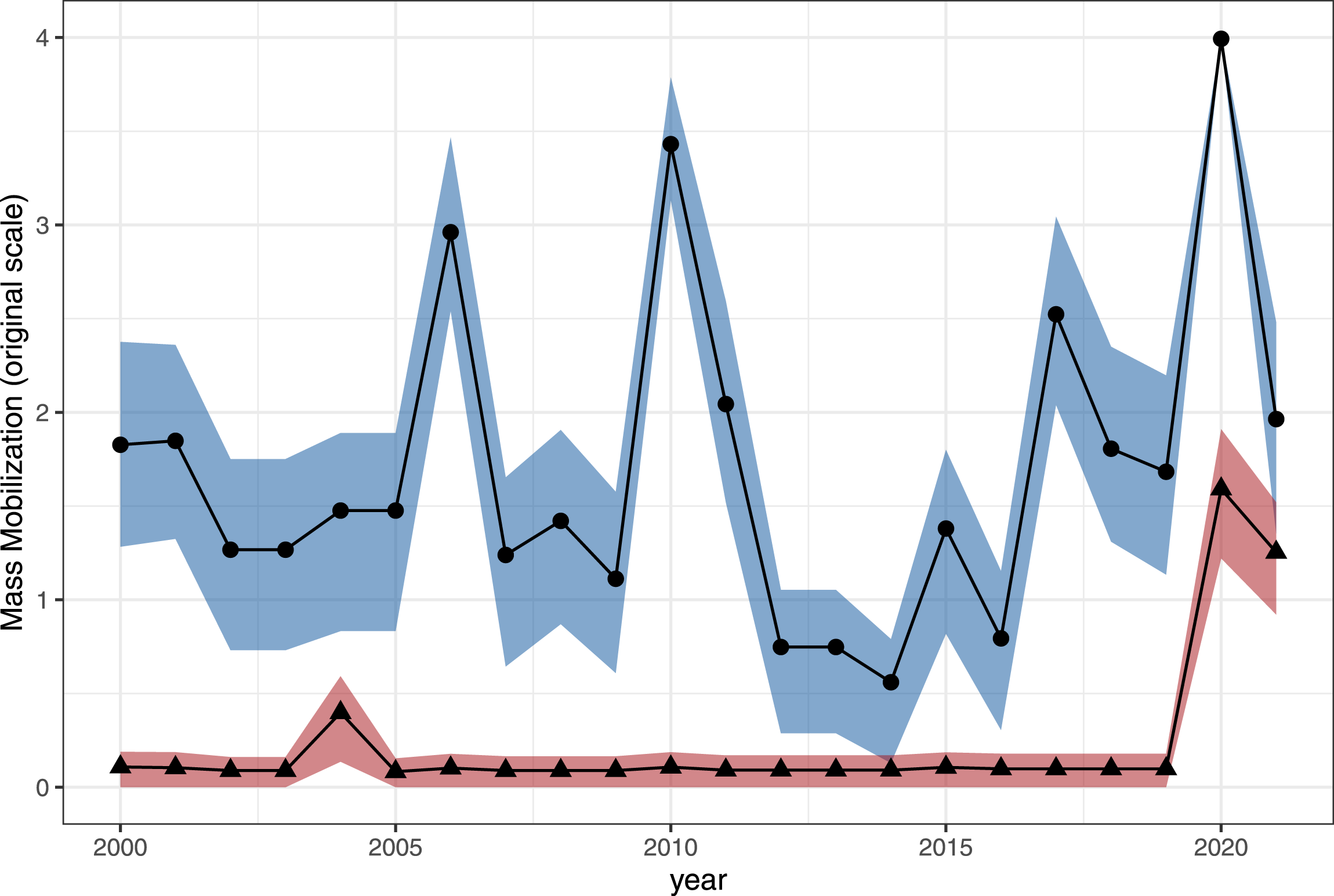
Data Validation
Next, we compare our measures of MM to existing data and examine disagreements between experts to assess data quality. We encountered two major challenges when comparing our data to alternative data sources on MM: there is (1) a lack of conceptual overlap concerning the type of mobilization and (2) disparate units of analysis. First, many data sets compile mobilization events with a broad set of claims, while we are only interested in a specific subset of demands (pro-democracy/pro-autocracy). Most do not record protests in favor of an authoritarian regime and focus on antigovernment activities. Even though these data allow for filtering based on claims made by protesters, there is no complete conceptual overlap between our data and existing data. Second, the unit of analysis varies across data sets. Many data sets contain individual protest events with information on actors, goals, and tactics. Others, such as the Nonviolent and Violent Campaigns and Outcomes (NAVCO 2) data project, operate at the campaign-year level (Chenoweth et al., 2018). Our expert ratings are available at the country-year level. 9
Despite the differences between our approach and other work, we benchmark our data against several related data sets.
10
Figure 2 shows the overlap between the occurrence of one or more pro-democracy protests in a given country year as compiled by Brancati (2016) and our expert estimates. On a conceptual level, her approach comes closest to our operationalization of pro-democracy events, although her definition is more restrictive and focuses mostly on elections-related events.
11
Both measures overlap to a large extent. We record at least some mobilization events for the 241 country years with pro-democracy protests in Brancati’s data. There are only 17 cases in Brancati’s data for which we record no events. Notably, we observe pro-democracy events in many country years (2268) where Brancati’s data does not register any event. We believe these differences are partially explained by our broader understanding of what counts as pro-democracy mobilization and what does not. We also find a substantial overlap with other data sets such as the NAVCO 2.1 (Chenoweth et al., 2018) on violent and nonviolent campaigns and the MMAD (Weidmann & Rød, 2019) protest event data that consists of more than 16,000 protest events against or in favor of authoritarian regimes. Additional figures summarizing this overlap are shown in Figures A.1, A.2, A.3, and A.4 in Appendix A. Overlap between mobilization for democracy (v2cademmob_ord > 0) and data by Brancati (2016). Mosaic plots with colors indicating significant departures of independence at the 90% and 99% level.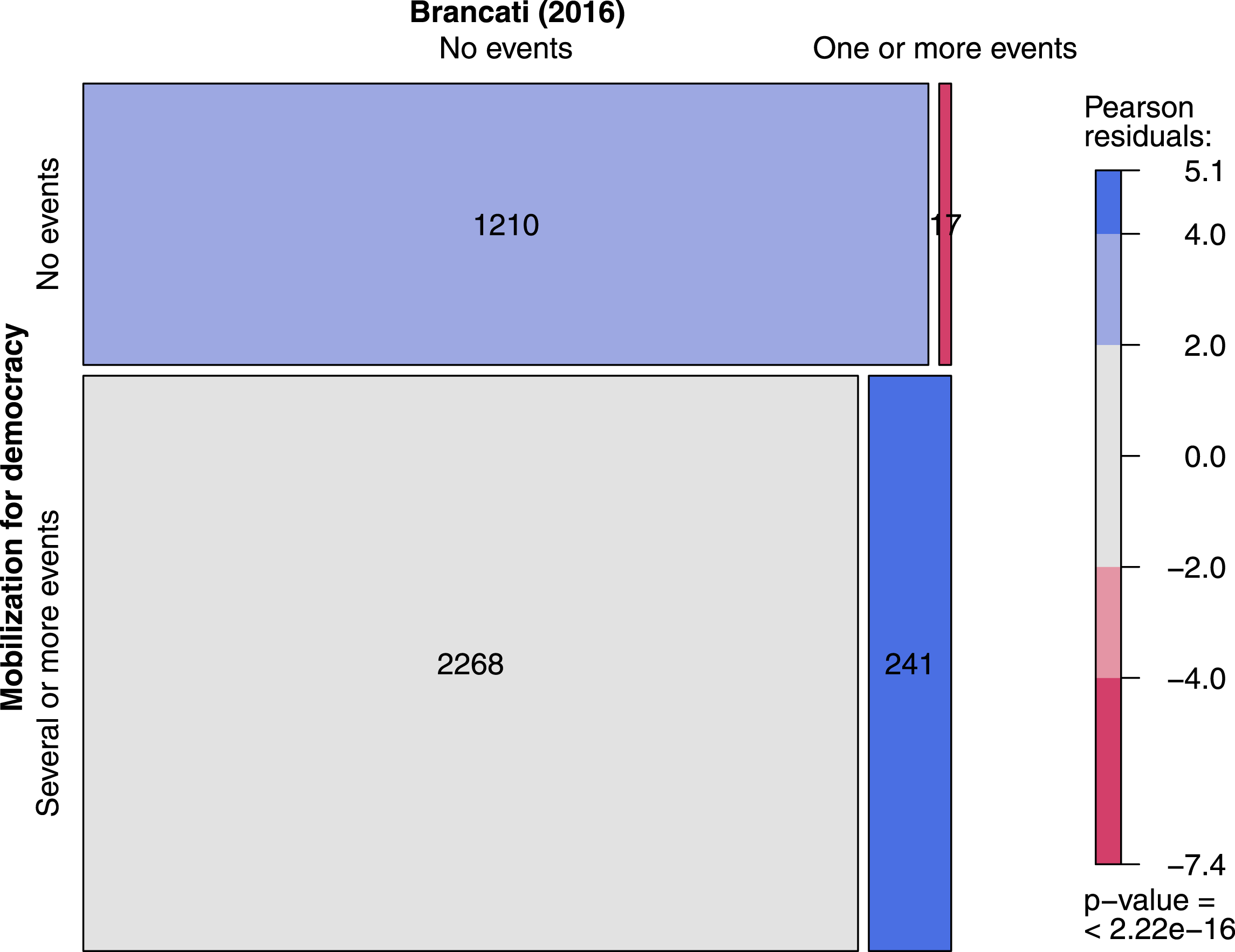
Second, we compare our data to two additional data sets to examine potential biases and check whether experts are able to distinguish protests against authoritarian regimes and mobilization for democracy. One potential concern is that experts are conflating anti-autocracy mobilization with pro-democracy mobilization. This would be the case if protests against an authoritarian regime were classified as pro-democratic, even if the masses do not pursue democratic change. To address this issue, we merged our data with a recently published data set on revolutions and their goals (Beissinger, 2022).
12
Figure 3 compares the level of mobilization for democracy in our data by different revolutionary goals. As the left panel shows, revolutions that Beissinger (2022) classified as pro-democratic show significantly higher levels of pro-democracy MM. By contrast, there is no difference for revolutions against the monarchy—which are anti-authoritarian but not necessarily pro-democratic. This comparison reduces the concern that experts do not conflate mobilization against authoritarianism and pro-democracy MM. Mass mobilization for democracy by revolutionary goals as recorded in Beissinger (2022). The data were merged at the country-year level.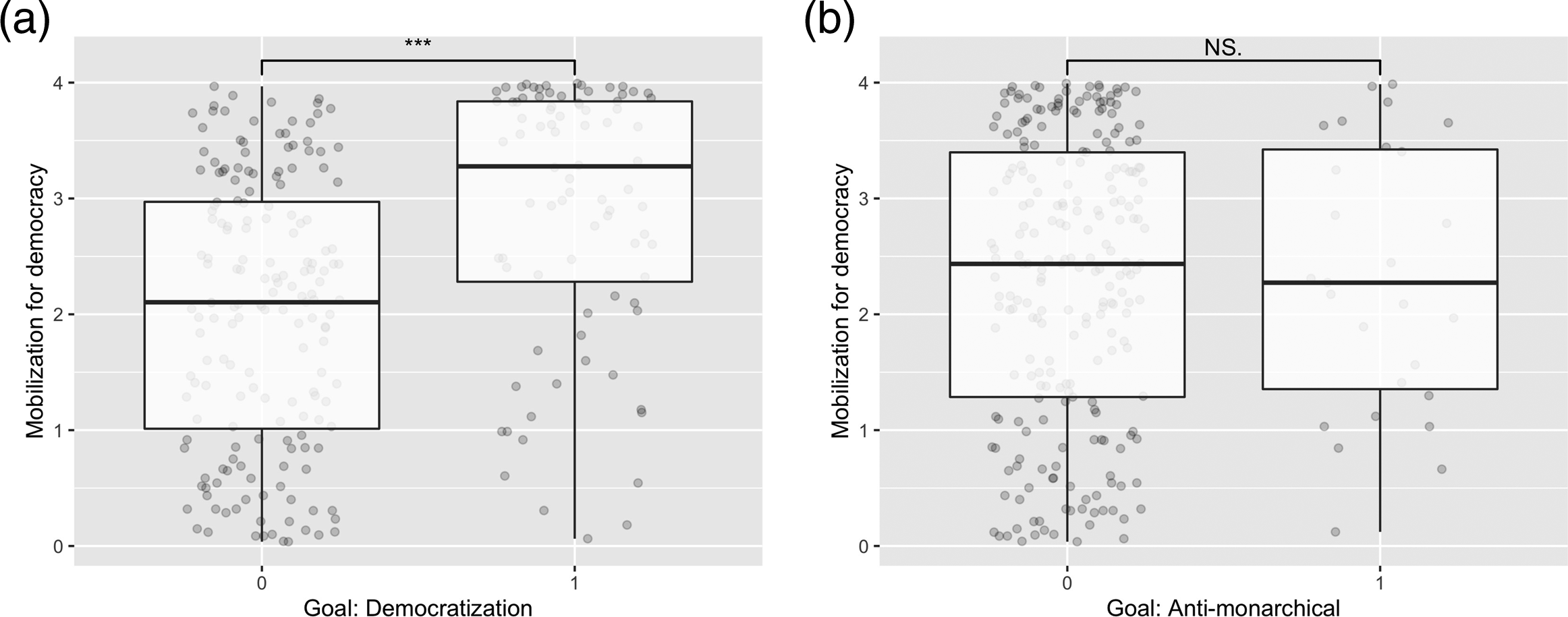
Next, we probe the experts’ understanding of pro-democracy mobilization given that our clarifications in the survey (see above) leave some room for interpretation. The main challenge is that the experts do not specify which movement or event they have in mind when coding MM. We have no information about the real-world events that underlie their assessment. Therefore, we merged our data set with the Global Protest Tracker by Carnegie (Carothers & Wong, 2020), which offers background information on major demonstrations, mostly against incumbent governments.
13
Figure 4 shows the 10 major protest events from Carnegie for which we record the highest (bottom panel) and lowest (top panel) estimates of mobilization for democracy.
14
Our data shows high values for the mass movement against Lukashenko in Belarus (2020), the Armenian revolution in 2018 and the major protests in Algeria that demanded the resignation of president Bouteflika. For all events, the experts agreed on the pro-democratic nature of MM, as illustrated by the small confidence intervals. Events listed in the Carnegie Global Protest Tracker (2017–2021) with lowest (top panel) and highest (bottom panel) scores for pro-democratic mass mobilization. X-axis cut off for visualization purposes.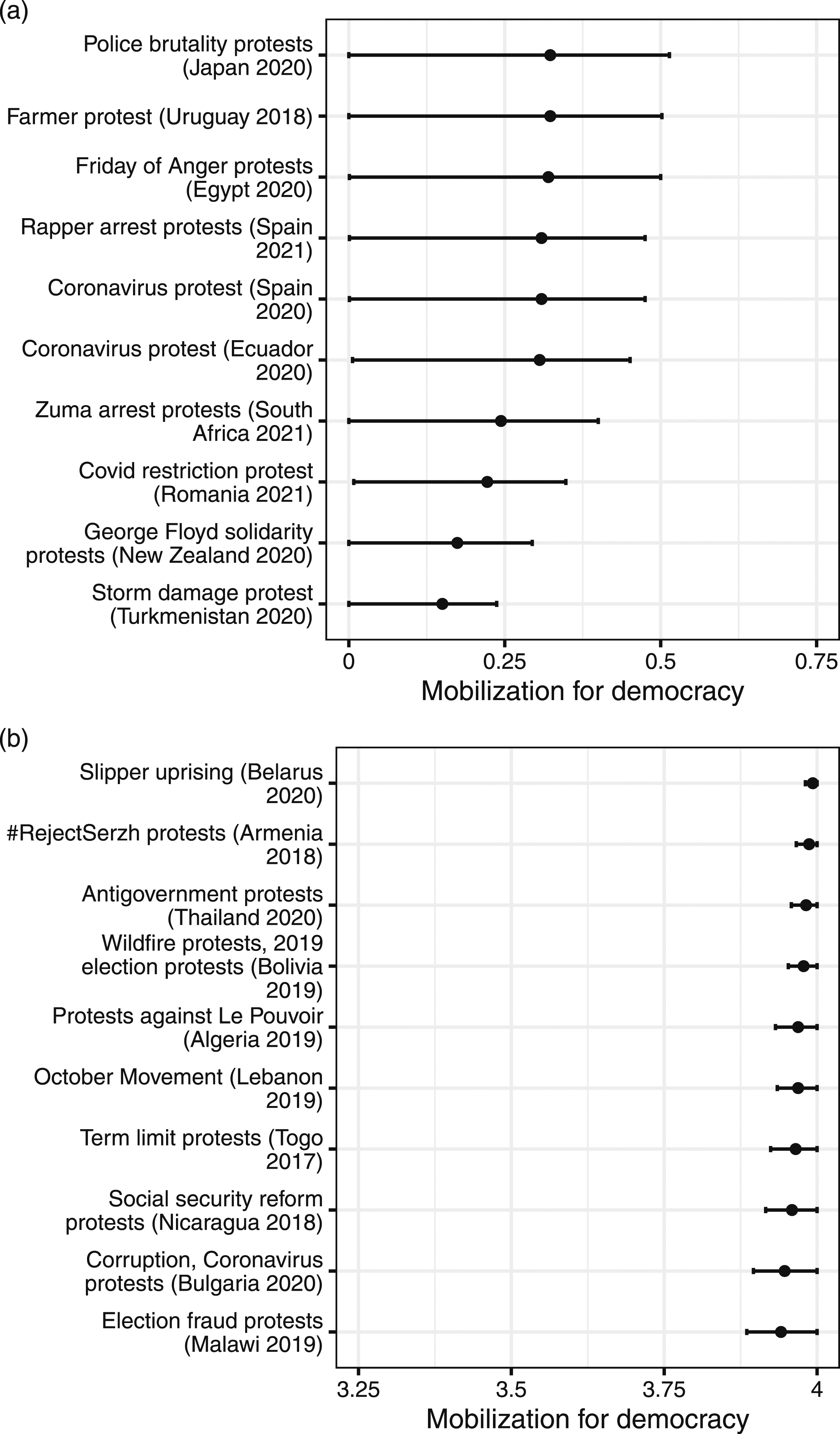
For other major protests in the Carnegie data, our data reports only low levels of pro-democratic mobilization (top panel). In these cases, the experts did not classify protesters’ aims as pro-democratic. The list shows events—mostly in already democratic countries like Spain, Japan or Uruguay—targeting specific policy areas such as corruption, corona measures and disaster relief. Such events do not meet our criteria for pro-democratic aims and should not be classified as such. However, there are cases where the main focus of protests is regime ambiguous, such as the George Floyd solidarity protests in New Zealand in 2020. The wider confidence intervals in Figure 4 suggest that experts did not fully agree on some of the cases.
Finally, we systematically analyze coder disagreement to identify potential biases in the data by looking at the standard deviation of the measurement model’s point estimate—a proxy for coder disagreement. We run an OLS regression with the standard deviation as the dependent variable and random intercepts for countries and years. The coefficients are summarized in Figure A.5 in Appendix A. The results suggest that expert ratings of mobilization for democracy do not differ more or less across political regimes. However, disagreement over mobilization for autocracy significantly increases the more democratic a country is; identifying pro-autocratic mobilization under authoritarianism is thus a more straightforward task. Our definitions can partially explain this finding. In democracies, experts have to assess whether a leader tries to undermine democracy. Since this leaves room for interpretation, we see more uncertainty in these cases. Moreover, the results show that higher levels of media censorship are associated with more uncertainty, probably because access to information about MM differs across experts. Thus, the expert codings show systematic variation depending on the information environment and the political regime. To mitigate these biases, the V-Dem data allows to incorporate measurement error into the analysis, for example, by using the measurement model’s posterior estimates.
Overall, the comparison with existing data conveys a substantial overlap with similar measures. These findings increase our trust in the experts’ understanding of our definition of mobilization for democracy and the measure as a whole. Furthermore, the lack of perfect correlation with existing data sets is not a cause for concern. Conceptually, geographically and chronologically, what we measured differs from prior work. This is precisely why we went to the effort. It contains new information not captured by the previous efforts of our colleagues and allows us to move the research agenda forward.
Data Description
After comparing our measure to existing sources, we now engage in a descriptive analysis of our data. The face validity of the description should be seen as evidence for the convergent validity of the data. For the year 2020, the data shows high levels of MM for democracy in several countries despite the Covid-19 pandemic (see Figure A.6 in the Appendix). Many pro-democracy events occurred in authoritarian regimes such as Belarus, Thailand, and Sudan. However, mobilization for democracy swept through democratic countries, too. In Nigeria, activists protested police brutality within the context of the #endSARS movement. Pro-democratic MM also took place in democracies like Poland, where citizens mobilized in opposition to autocratic tendencies. Compared to that, our data shows lower absolute levels of mobilization for autocracy (see Figure A.7 in the Appendix) during the first year of the pandemic. We observe the highest levels of mobilization in totalitarian North Korea and in Nicaragua, where supporters of an increasingly authoritarian Ortega attacked opposition activists.
Figure 5 summarizes the average size of both types of MM over time. What we find is highly congruent with what historical accounts tell us about the size and location of pro-democratic and pro-authoritarian mobilization, again increasing confidence in the validity of our data. Over the last century, we have observed an increasing trend in pro-democratic MM. Spikes in MM occurred after both World Wars, in the wake of the collapse of the Soviet Union and around the Arab uprisings at the beginning of the 2010s. Pro-democratic MM peaks in 2019, the year that, according to scholars, “may have been the largest wave of mass, nonviolent antigovernment movements in recorded history” (Chenoweth, 2020, p. 69). Pro-autocratic MM, however, has taken a different turn. While it steadily increased until the 1970s, our data shows a substantial downturn with the collapse of the Soviet Bloc. Over the past two decades, we have seen a slight but sustained increase in pro-autocratic mobilization. Overall, our data suggest that from a global perspective, except for the 1970s, pro-democratic MM was more frequent, especially since the late 1980s. Smoothed global levels of mobilization for democracy (solid blue line) and mobilization for autocracy (dashed red line) over time.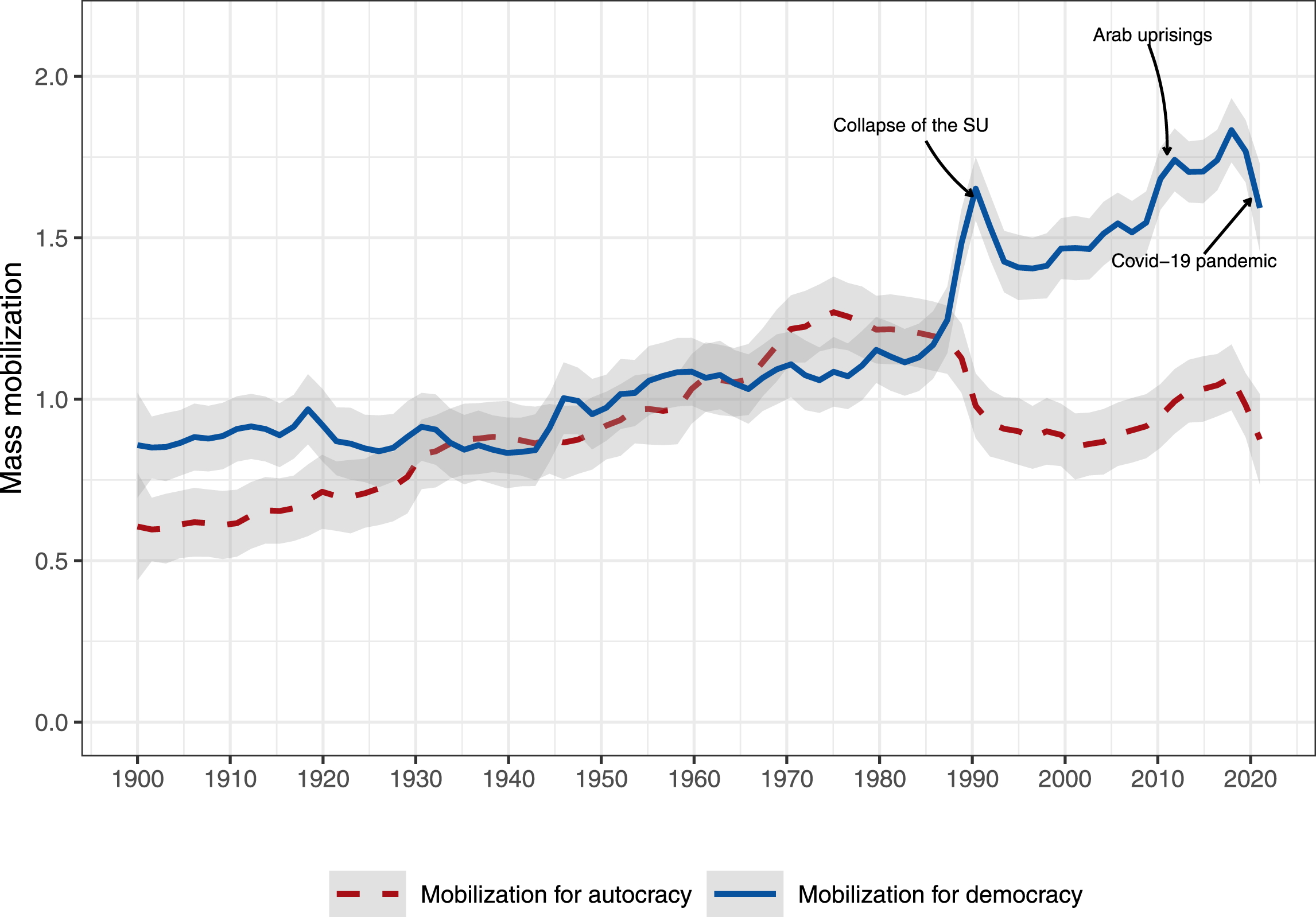
Figure 6 breaks down levels of MM by region from 1900 to 2021.
15
The plots reveal striking differences across regions. For instance, pro-autocratic mobilization was very high during the period of Soviet rule in Eastern Europe and Central Asia, and was finally overtaken by pro-democratic mobilization in the period 1989–91. In many socialist regimes, orchestrated demonstrations supporting the political system were a regular part of political life. In Latin America, the heydays of pro-democracy mobilization were in the 1980s when people rose against the military dictatorships in the region. In the Middle East and North Africa, the surge of pro-democratic protest around the Arab Spring is quite visible. In Sub-Saharan Africa, we see pro-democratic mobilization outstripping pro-autocratic mobilization in the 1990s in line with the upsurge in democratization in that region (Bratton & van de Walle, 1992). Our data also captures the high levels of pro-autocratic mobilization around the rise of fascism in Western Europe during the interwar period. Smoothed regional levels of pro-democracy (blue solid line) and pro-autocracy mobilization (red dashed line) over time.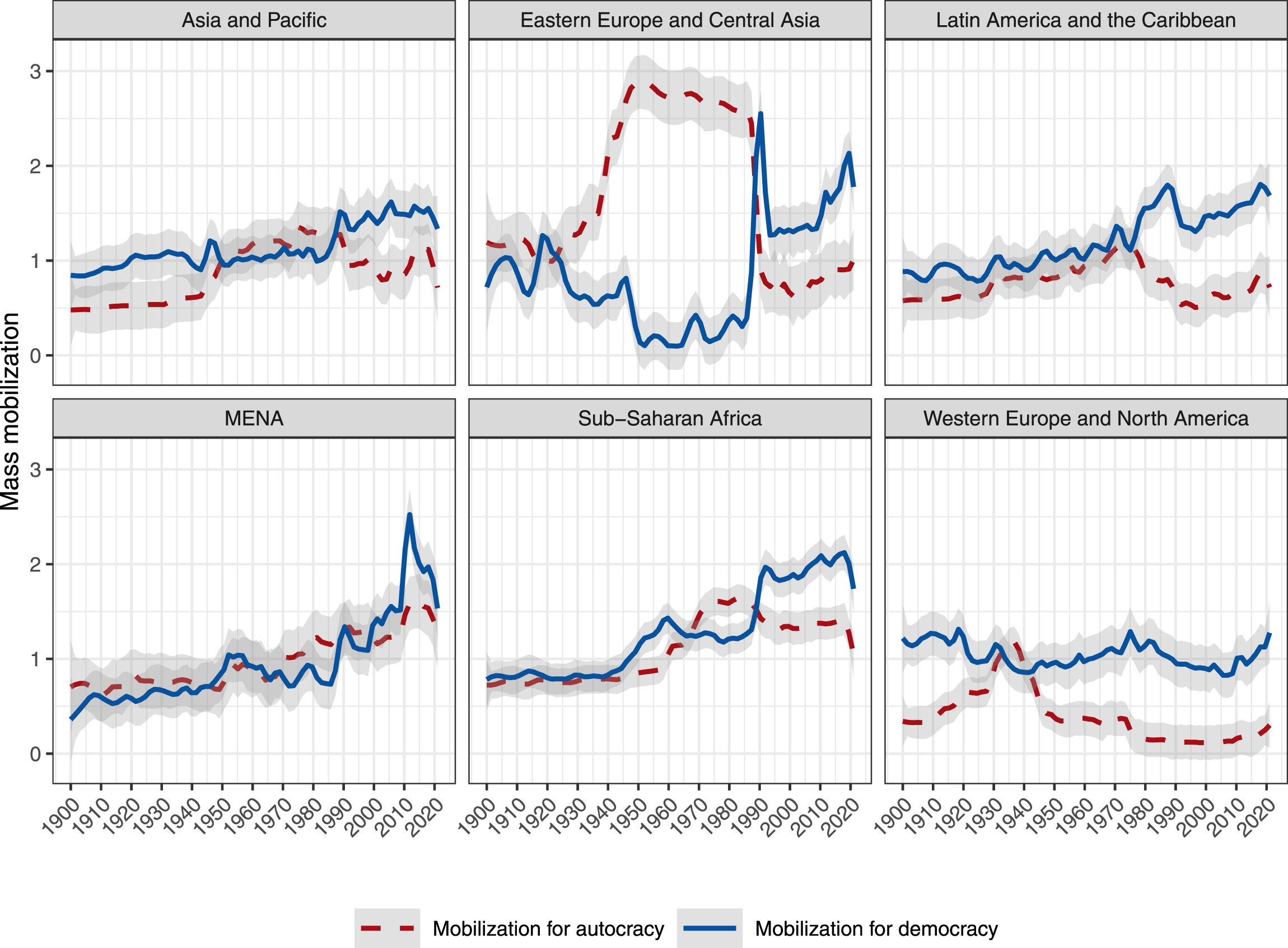
How does MM differ across political regimes? Figure 7 plots levels of MM against the quality of democratic institutions measured by the electoral democracy index (EDI), V-Dem’s operationalization of polyarchy (Dahl, 1971). Regarding pro-democratic MM, the plot supports the notion of the so-called “murder in the middle” (Fein, 1995) hypothesis: we observe the highest mobilization levels in countries with modest levels of democracy. In closed autocracies, civil society is usually repressed and there is little opportunity for protest. By contrast, in liberal democracies, citizens can use other participation channels to voice their political preferences. The relationship between mobilization for autocracy and democratic quality shows a similar inverted-U relationship, although more skewed to the right. It is most widespread in countries with low levels of democracy and becomes less frequent the more democratic a given country is. Relationship between pro-democracy (left panel)/pro-autocratic (right panel) mobilization and levels of democracy (low to high). Locally weighted smoothing. Shaded areas represent .95 confidence intervals.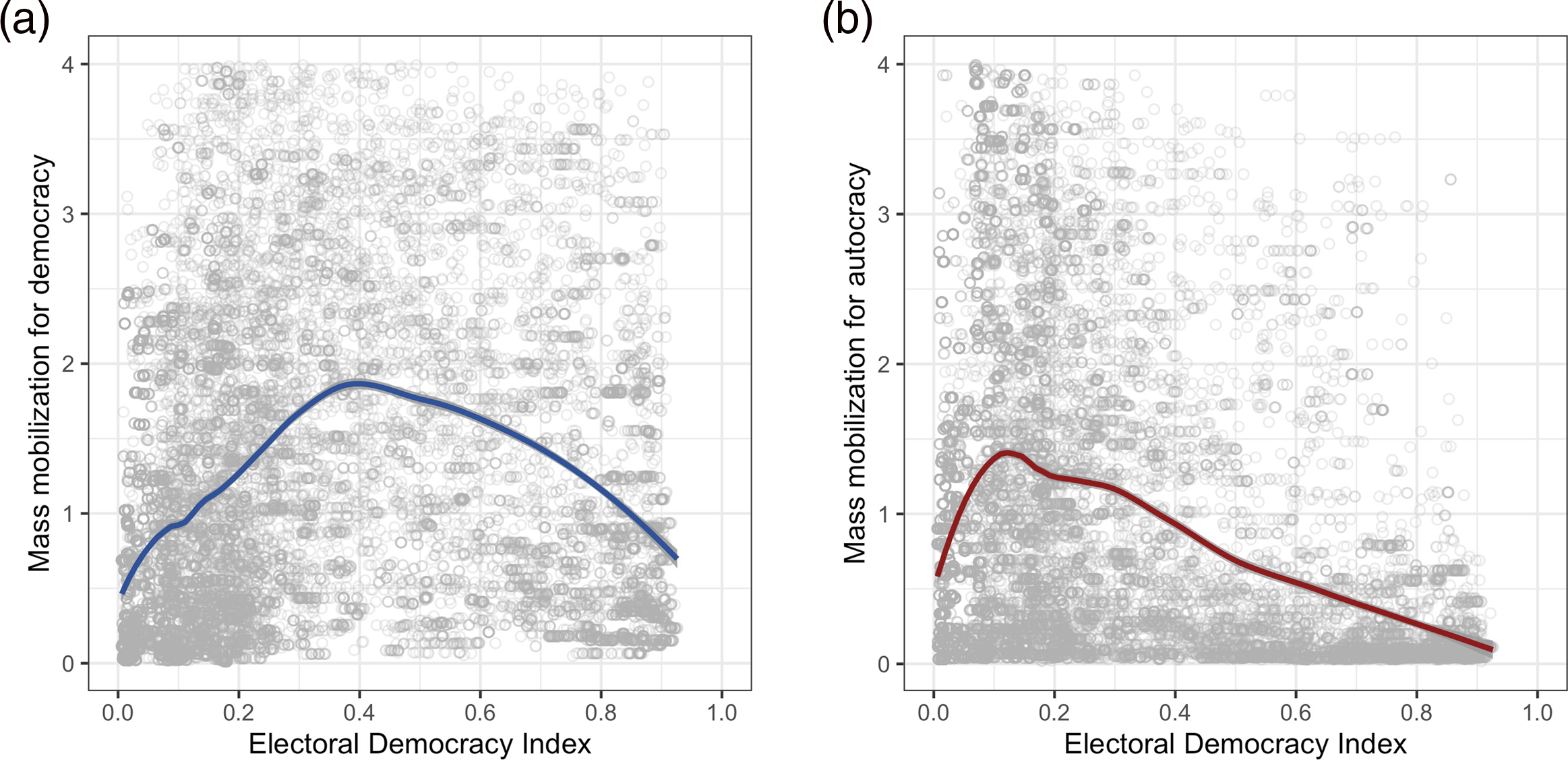
The descriptive analysis of the data yielded several insights. First, MM for democracy is more common than pro-autocratic mobilization. Over the last century, our data shows a trend towards increasing levels of pro-democratic mobilization. In contrast, pro-autocratic mobilization dropped markedly with the collapse of the Soviet bloc. While pro-democratic MM is highest in states with intermediate levels of democracy, pro-autocratic mobilization is most prevalent in closed and electoral autocracies.
Potential Limitations of the Data
Following our validity checks above, we highlight several potential data limitations. First, we do not provide exact measures of MM. The V-Dem point estimates, like all data generated by multiple expert opinions processed through Bayesian Item Response Theory models, are subject to measurement error. The point estimates are compiled from a series of posteriors. Thus, there is always a degree of uncertainty around the individual point estimates. The methods V-Dem uses has the advantage of creating time-series cross-sectional point estimates for a large number of countries over a long span of time where reliable indicators were not available in the past. Another potential issue has to do with the historical nature of the V-Dem data. Generally speaking, experts have thicker knowledge about proximal time periods than about the distant past. However, the regional levels of protest in Figure 6 match up nicely with historical narratives. For instance, the panel that plots levels of mobilization in Eastern Europe and Central Asia does pick up important regional events from time periods when many, if not most, of the coders were not yet born. It also picks up a wave of pro-democratic mobilization at the end of WWI, which corresponds to the Russian Revolution and the Wilsonian moment of democratic national liberation of many captive people from the Habsburg, Russian, and German Empires. The data also reflects the events of 1968 when there were attempts to humanize and democratize the communist systems in Czechoslovakia and Poland, as well as the massive mobilization of the Solidarity period in Poland around 1980. Thus, it is clearly picking up distal watershed events.
Moreover, there is the issue of ambiguity about the intentions of mobilized citizens, movements, and organizations, for instance, if mobilization is geared towards replacing one authoritarian form of rule with another. This seems to apply particularly to protests in favor of authoritarianism in democracies. While this issue cannot be fully resolved and discrepancies between a movement’s self-perception and expert codings may exist, we are confident that our coders can distinguish different goals even in periods of intense mobilization when there are competing ideas about what the preferred regime is. Again we see this in the plots in Appendix C. If we look at revolutionary Russia in 1917, when there were multiple democratic and authoritarian contenders for power mobilizing their followers, we see high levels of both types of mobilization. We see the same configuration in the country plot of Iran during its revolution in 1979. The same holds for Serbia during the Bulldozer Revolution of 2000, the Spanish Civil War (1936–39), the Orange (2004–5) and Euromaidan Revolutions (2014) in Ukraine, the anti-Morsi protests in Egypt (2013), or the United States during the Trump administration (2017–2021).
Another potential issue with our indicators is that the questions are written to capture both the frequency of protest and the size of participation. This was a function of budget constraints on the number of questions we could field in the survey. Thus, the question really gets at the volume of protest (a combination of frequency and size) rather than each dimension individually. Our data are not specific enough for any research question for which the specifics of size or frequency are essential elements of the hypotheses. Similarly, the data cannot be used to analyze subnational or short-term mobilization dynamics within a country. Nevertheless, we will demonstrate that it is well suited for studying regime transformations where the country year is the main unit of analysis in the next section.
Mass Mobilization and Regime Transformations
In the final part of the article, we use the data to shed light on the relationship between MM and regime transformations globally. 16 The data analysis consists of two parts. In the first part, we use standard panel models with MM (at time t) as the independent variable and the quality of democracy (at time t + 1) as the dependent variable. In the second part, we use data from Boix et al. (2013) to estimate the relationship between MM and substantive regime change in the form of democratic transitions and democratic breakdowns.
Mobilization and the Quality of Democracy
How does MM affect the quality of democratic institutions? To answer this question, we organize our data in a standard panel framework with country years as the unit of analysis. To measure democracy, we rely on V-Dem’s electoral democracy index (EDI). The EDI is built after Dahl’s (1971) concept of Polyarchy and captures de-jure and de-facto prerequisites for a democracy, such as functioning electoral institutions and media freedom. Figure 8 summarizes the bivariate relationship between mobilization and changes in the EDI. The horizontal axes show the size and frequency of mobilization events (t-1), and the vertical axes indicate EDI change in the following year (t). The different colors and line types represent regime types based on the Regimes of the World (RoW) coding scheme (Lührmann et al., 2018). As the plot shows, there is a positive relationship between mobilization for democracy and the quality of democracy in closed and electoral autocracies. Very frequent and large events are associated with a one to two percent improvement in democratic quality. We do not find this association in already democratic regimes. Conversely, mobilization for autocracy is followed by declines in democracy, as shown in the right panel in Figure 8. We observe steep declines of democracy in the aftermath of pro-autocratic mobilization in all regimes except for closed autocracies. Relationship between mass mobilization and subsequent quality of democracy across RoW (Lührmann et al., 2018) regime types.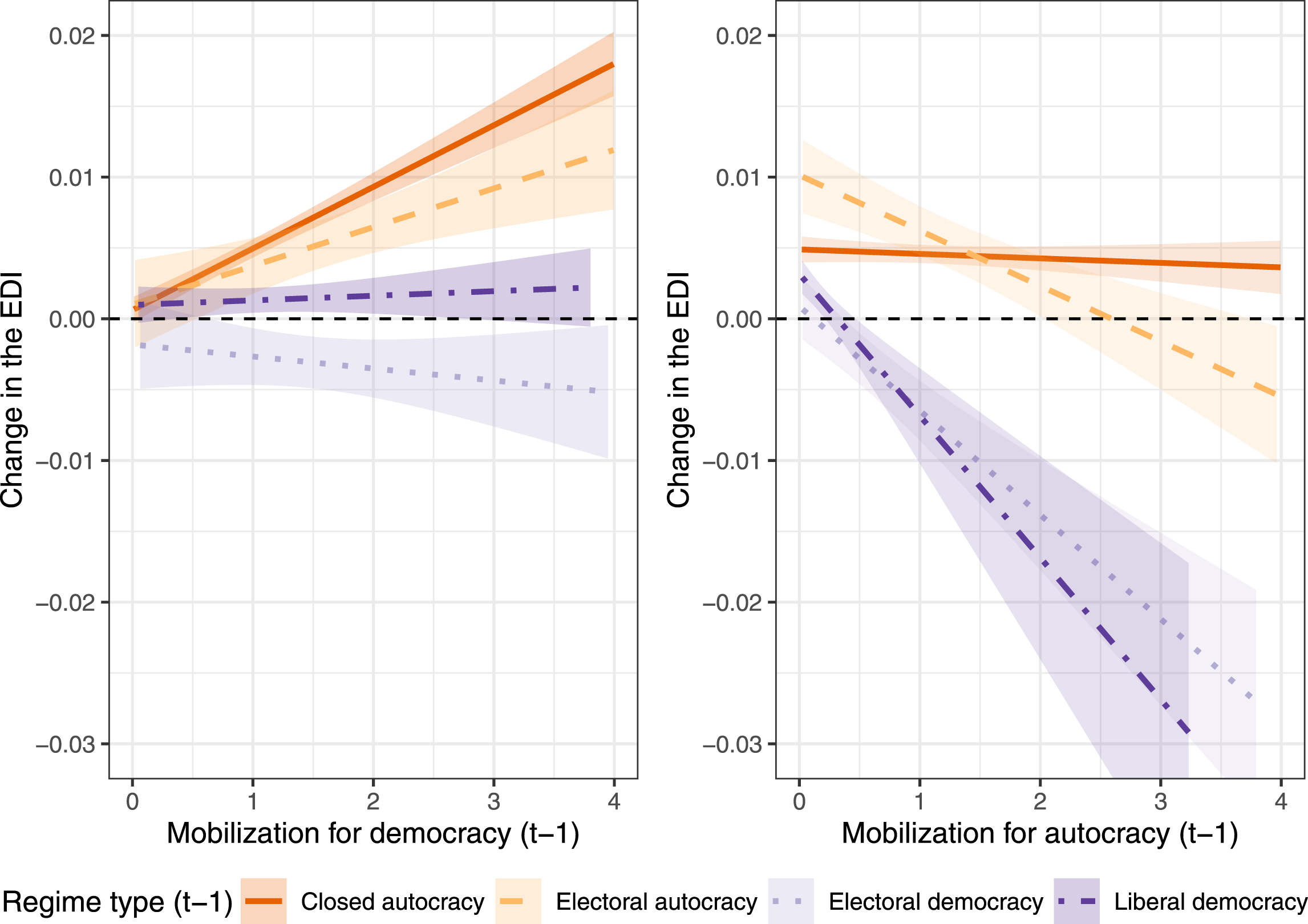
To substantiate these descriptive findings, we systematically investigate the relationship between mobilization and democracy in a regression framework. We include a comprehensive set of control variables in our models to reduce concerns of omitted variable bias. The controls comprise economic, social, and institutional variables that could be common causes of MM and regime transformations. With regards to economic factors, we include gross domestic product (GDP) per capita to measure economic development, the GDP growth rate (Fariss et al., 2022) and gas and oil production (Ross & Mahdavi, 2015) to capture a country’s resource wealth. In addition, we add information on the average years of education (Barro & Lee, 2013) and population size (Fariss et al., 2022). Since societies with ongoing conflicts are more likely to experience MM and are often governed by unstable regimes, we include binary indicators for civil conflict from UCDP (Gleditsch et al., 2002; Pettersson et al., 2019) as well as an index of ethnic fractionalization (Dražanová, 2020). Finally, we include measures for the incumbent leader’s power base (military, ruling party, monarchy) to account for fundamental structural differences between authoritarian regimes (Teorell & Lindberg, 2019). All variables are lagged by 1 year. 17
The results from four different panel models (Bergé, 2018) are summarized in Figure 9 (and Appendix Table B.1) and include pooled, two-way (country and year) fixed effects, first differences and lagged dependent variable models (left panel). All models show a statistically significant relationship in line with our theoretical expectations (H1a and H1b). MM for democracy is associated with higher subsequent levels of democracy, while mobilization for autocracy is associated with less democracy. As expected, the models that include lagged levels of democracy—a slowly changing variable—as a predictor yield smaller coefficients than the pooled or fixed-effects models. Main results: Model coefficients (left panel) including all control variables and effect plot (right panel). 95% confidence intervals. Dependent variable: electoral democracy index. All independent variables lagged by 1 year. Robust standard errors (Driscoll & Kraay, 1998). Full regression table is shown in the Appendix (Table B.1). Marginal effects (right panel) based on pooled models.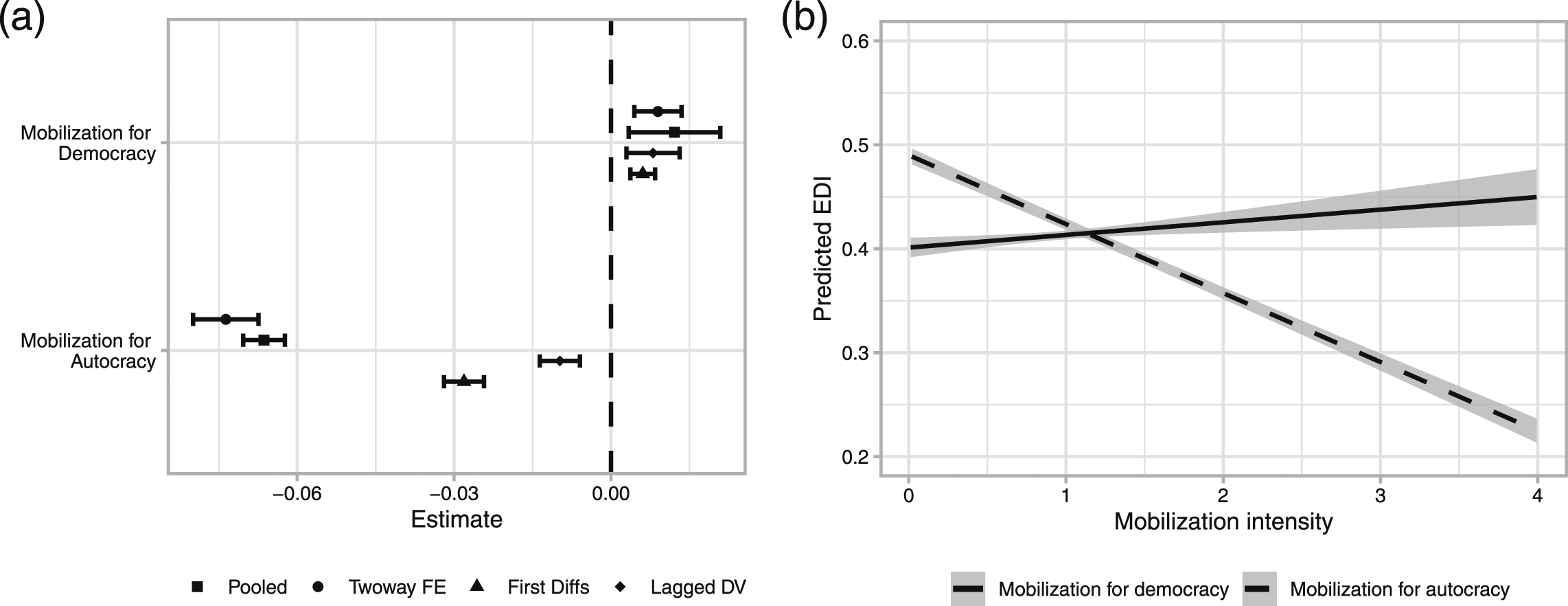
The marginal effect plots (right panel) suggest that the effect of MM is substantial for pro-autocratic mobilization and moderate for pro-democratic mobilization. A massive eruption of protest with frequent large and small events is associated with an increase of about 5% in democracy, or a decrease of up to 27%, respectively. Whereas effect sizes vary by model specification, all models show evidence for the relevance of MM for changes in the quality of democracy.
We run several additional tests to probe the robustness of these findings and rule out alternative explanations. First, we use the (revised combined) Polity score as the dependent variable instead of V-Dem’s EDI. By doing so, we ensure that dependencies between expert codings on both sides of the equation do not explain the relationship between MM and democracy. For all models, we obtain the same significant results (see Table B.2 in the Appendix).
Second, using the method of composition (Treier & Jackman, 2008), we incorporate measurement error into our models by running our model on 5000 draws of the posterior distribution estimated for the MM variables by V-Dem’s IRT measurement model. Figure B.8 in the Appendix summarizes the distribution of the coefficients from all models. The vast majority of the coefficients are above/below zero and thus confirm the coefficients we obtained in the main models. The results for autocratic mobilization are cleaner than those for democracy. Still, in that case, the vast preponderance of draws are in line with the estimates yielded with the point estimate.
Third, we introduce additional control variables for repression and watershed events like coup attempts or elections that we did not include in our main models due to multicollinearity concerns (see Table B.3 in the Appendix).
Fourth, we run separate regression models for each EDI component to better understand which elements of electoral democracy change in response to MM. The results are shown in Table B.4 in the Appendix. They suggest that pro-democracy mobilization helps to dismantle restrictions on organization and speech. In contrast, mobilization for autocracy makes the imposition of such restrictions easier and enables rulers to violate norms of free and fair elections.
Finally, we take further steps to probe the causality of the relationship. We are aware that our design (observational study) poses certain limits to the causal interpretation of our findings. For example, it is plausible that causality goes the other way if citizens mobilize in response to an anticipated decline in democracy. To increase confidence in our finding that MM is responsible for regime change, we build on recent advances in the analysis of time-series cross-sectional data and apply the interactive fixed-effects counterfactual estimator (Liu et al., 2022) that improves on the conventional two-way fixed effects approach. The results in Figures B.9 and Figure B.10 in the Appendix largely confirm our initial results. We find no evidence of pretrends for the MM variables. Moreover, we ran first difference models with additional lags of the MM variables and the EDI to adjust our estimates for short-term dynamics on both sides of the equation (see Table B.5). Our main results hold.
Mobilization and Regime Change
The first part of the empirical analysis has shown a relationship between mobilization and continuous measures of democracy. However, we do not know whether mobilization matters for discreet political change, such as democratic transition or breakdown. We now turn to such an analysis.
We use data from Boix et al. (2013) to construct two different samples, one that includes all democratic country years (n = 7582) and another one with all autocratic country years (n = 5336). In each sample, we flag instances of democratic breakdown and democratic transition and use the occurrence of these transformative events as binary dependent variables in event-history models. In this way, we can assess the relationship between both types of mobilization and the survival of democracies and autocracies. The overall survival probabilities are displayed in Figure B.12 and Figure B.11 in the Appendix.
This second analysis includes our MM variables and a similar set of controls as before. However, we substitute the three variables that measure the strength of the military, the party and the monarchy—three controls in our sample of democratic country years to take into account differences in the institutional design that could affect stability and the nature of MM. We include information on whether the country has an elected president (Hicken et al., 2022) instead. Moreover, we add the party institutionalization index and independence of the high court from V-Dem (Coppedge et al., 2022).
Survival Analysis: Cox Proportional Hazard Models With Time-Varying Covariates and Frailty Terms for Each Country.
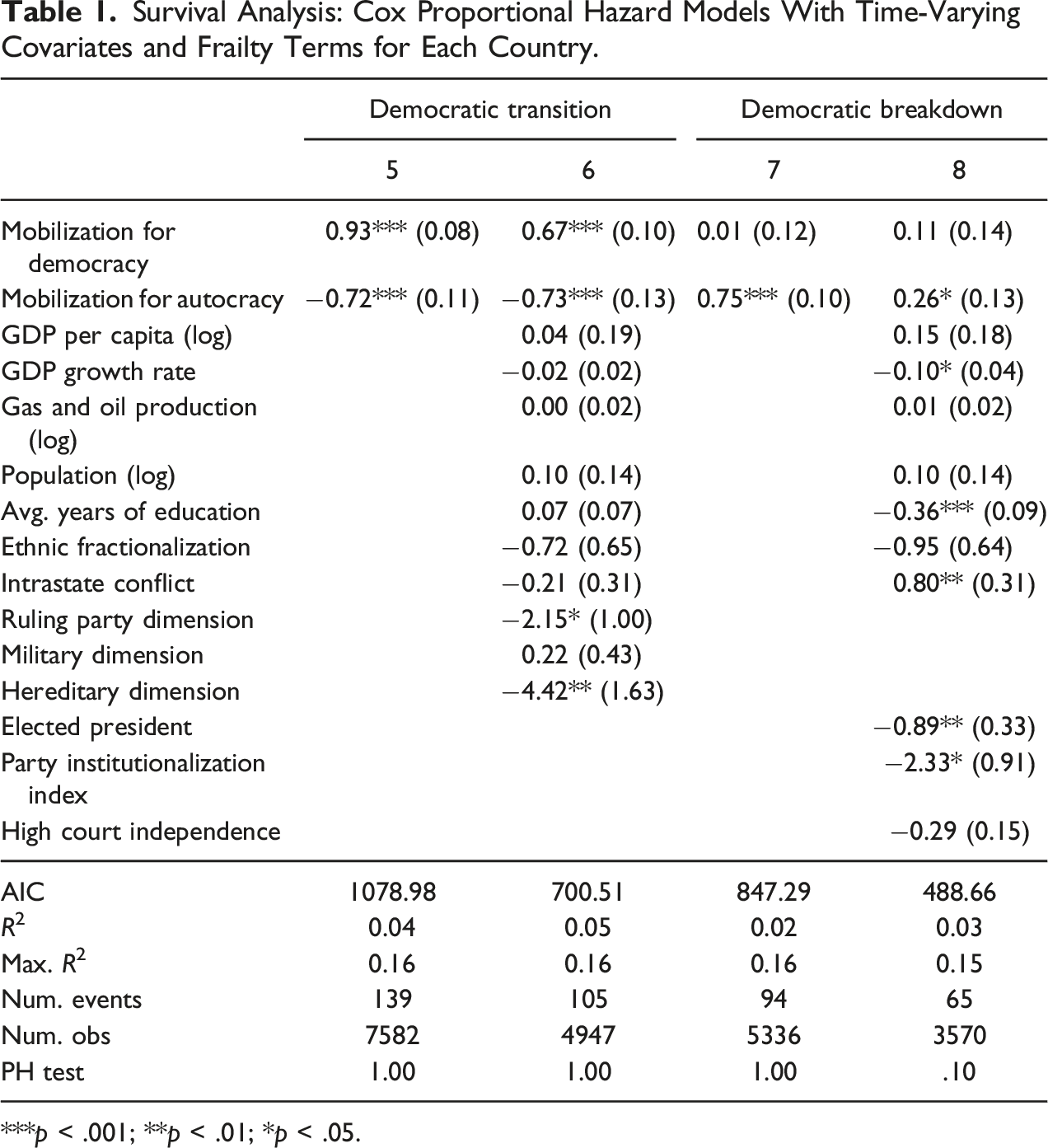
***p < .001; **p < .01; *p < .05.
The picture is less clear for democratic breakdown. MM for autocracy accelerates democratic breakdown by 2 years, comparing mobilization at the 75th and 25th percentile. However, we do not find an insulating effect of pro-democracy mobilization. We are cautious not to put too much emphasis on these findings due to the low number of cases. Given that several democratic regressions are currently ongoing, our analysis will provide more efficient estimates once we know the outcome of these episodes.
To summarize, our new measure of MM is related to democracy in several ways. Using a continuous measure of democratic quality, we find that pro-democratic MM is associated with an increase in democratic quality and that mobilization for autocracy is associated with a decrease in democracy. These results support our core hypothesis that MM is not per se good or bad for democracy. Instead, we need to pay attention to the goals put forward by different social movements and actors in civil society. While this observational study does not allow for definitive causal claims, the observed relationships are robust to several model specifications and the inclusion of many potential confounding factors.
Conclusion
Citizens play a critical role in regime change. MM has been shown to destabilize authoritarian rule and sometimes trigger democratization. However, mass movements do not always promote democracy. Citizens can also be mobilized in support of authoritarian regimes or in support of the overthrow of democracy. In this article, we clarify the relationship between MM and regime transformations. Our new data on pro-autocratic and pro-democratic MM showed considerable variation across time and space. Whereas pro-democratic MM has been steadily increasing over the last century until the Covid-19 pandemic, pro-autocratic mobilization has declined since the collapse of the Soviet Union. We record the highest levels of mobilization overall in regimes in the middle of the autocracy-democracy continuum.
Our empirical analyses showed several robust relationships between MM and regime transformations. Pro-democratic mobilization increases the level of democratic quality and raises the chance of a successful democratic transition. Pro-autocratic mobilization, by contrast, is associated with lower levels of democracy and makes a democratic transition less likely. The survival analyses also showed that pro-autocratic mobilization accelerates democratic breakdown. However, unlike other recent studies, we did not find that democratic activism insulates democracy against breakdown. Those other studies focused on civil society’s organizational dimension rather than its mobilization capacity. Our findings also shed light on controversies over the impact of civil society on regime change. Different literatures discuss its salutary effects for democracy, whereas others show that civil society actors sometimes play an important role in democratic breakdown. Our findings suggest that the nature of mobilization, whether the participants support democratic or autocratic aims, is essential for understanding its likely impact. Who protests and to what end is crucial for understanding whether popular participation and contention have a positive or negative impact on democracy.
Our data expands the possibilities for understanding how civil society and the contentious aspect of its politics affect important political outcomes. While we use the data to build on the recent interest in understanding how popular actors and their behavior impact regime change and durability, we hope that its broad temporal and geographic scope will have additional utility in investigating other subjects amenable to cross-national time-series research, as well as for those interested in understanding national and regional trajectories in political contention.
Supplemental Material
Supplemental Material – Regime Transformation From Below: Mobilization for Democracy and Autocracy From 1900 to 2021
Supplemental Material for Regime Transformation From Below: Mobilization for Democracy and Autocracy From 1900 to 2021 by Sebastian Hellmeier and Michael Bernhard in Comparative Political Studies
Footnotes
Acknowledgments
The authors are indebted to Anna Lührmann who initiated and led the data collection for the civil and academic space section in the V-Dem survey and who contributed to earlier versions of this paper. The authors thank Manuel Cabal, Amanda Edgell, Staffan I. Lindberg, Daniel Ziblatt, Palina Kolvani, Julian Brummer as well as participants at seminars at APSA 2020, the International Security Research Colloquium at Hertie School and the V-Dem researcher meeting for their helpful comments.
Declaration of Conflicting Interests
The author(s) declared no potential conflicts of interest with respect to the research, authorship, and/or publication of this article.
Funding
The author(s) disclosed receipt of the following financial support for the research, authorship, and/or publication of this article: This research was supported by Vetenskapsradet [grant number 2018-016114], PI: Anna Lührmann and European Research Council, Grant 724191, PI: Staffan I. Lindberg, V-Dem Institute, University of Gothenburg, Sweden as well as by internal grants from the Vice-Chancellor’s office, the Dean of the College of Social Sciences, and the Department of Political Science at University of Gothenburg. The University of Florida Foundation supported Michael Bernhard’s work on the project.

Supplemental Material
Notes
Author Biographies
References
Supplementary Material
Please find the following supplemental material available below.
For Open Access articles published under a Creative Commons License, all supplemental material carries the same license as the article it is associated with.
For non-Open Access articles published, all supplemental material carries a non-exclusive license, and permission requests for re-use of supplemental material or any part of supplemental material shall be sent directly to the copyright owner as specified in the copyright notice associated with the article.
