




Abstract
How do people respond to different decision-making processes in high courts? One long-standing view suggests that citizens expect courts to be neutral arbiters of legal controversies. Although the relevance of such “myth of legality” has been challenged, we know very little about the relationship between the portrayals of the motives of courts and justices and public attitudes in civil law countries. We explore this question in a pair of experiments in Norway and Portugal where we isolate the effects of different institutional frames from outcome favorability. We find that while partisan frames are detrimental to fairness perceptions and acceptance of decisions, depictions of judicial decision-making that emphasize policy goals do not adversely affect citizens’ responses in comparison with legalistic frames. The results suggest that, even in civil law systems, preserving the myth of legality may not be a necessary condition to elicit public support for judicial decisions.
High courts—those placed at the apex of a country’s legal system—are increasingly “directing the making of public policies” (Tate, 1995, p. 28) and becoming de facto “third chambers” in policymaking (Brouard & Hönnige, 2017; Sweet, 2000). However, this purported political strength hides an inherent vulnerability. Lacking “influence over either the sword or the purse” (Hamilton, 1788), high courts need to secure compliance with their rulings, including support from the general public (Gibson et al., 1998). Without ample public support for high courts, the elected branches of government will be less constrained in defying their rulings and undermining their institutional integrity (Arato, 2016, p. 221). In an age when courts have become the target of populist challenges to liberal democracy (Kovács & Scheppele, 2018; Mudde, 2013), investigating the conditions behind popular support for courts and their decisions has acquired a renewed relevance.
A vast literature in social and political psychology suggests that people’s compliance with authorities in general—and courts in particular—does not depend exclusively on obtaining outcomes that accord with their preferences. Instead, it also depends on the extent to which citizens perceive the decision-making procedures employed by those authorities as fair (Tyler, 1990, 2006). However, very few people have first-hand experience with judicial decision-making. Most citizens learn about how courts and judges decide from the media and elite discourses, which, in turn, inform interpersonal communication. This suggests the possibility of framing effects: that “a speaker’s emphasis on a subset of potentially relevant considerations causes individuals to focus on these considerations when constructing their opinions” (Druckman, 2001, p. 1042). In particular, public perceptions of judicial decision-making can be affected by institutional frames: alternative interpretations of the motives of courts and justices that result from highlighting some considerations over others (Nicholson & Howard, 2003, p. 677).
In this study, we ask how different institutional frames affect people’s perceptions of the fairness of judicial decisions and their acquiescence to them. One long-standing answer to this question is that citizens exposed to legal frames are more likely to support court rulings and perceive them as fair. To the extent that citizens adhere to a “myth of legality” about courts, they are more likely to see judicial decisions in a positive light when they are framed as resulting from “the application of legal rules formulated and applied through a politically and philosophically neutral process of legal reasoning” (Scheb & Lyons, 2000, p. 929). However, it has also been argued that this emphasis on legalism is overblown. Citizens may be more like “legal realists,” willing to accept the notion that judges inevitably exercise some amount of discretion when making decisions in high courts. The most consequential difference should lie, instead, in whether justices and courts are portrayed as being legitimately concerned with policy goals when using such discretion (Gibson & Caldeira, 2009, 2011; Gibson & Nelson, 2015) or, instead, as strategic and self-interested partisans, that is, as mere “politicians in robes.” Finally, others suggest that these considerations may end up being of little importance for the public in comparison with the actual outcomes of the decisions themselves and the degree to which they match people’s preferences (Badas, 2016; Christenson & Glick, 2015).
Although almost all research on this topic has been conducted in the United States, a system where judge-made law is an intrinsic feature of legal culture and practice, most of the world does not live under a common law system. We know very little about how public attitudes are affected by different institutional frames in civil law systems, where a Montesquieuan notion of the judge as a mere “mouth of law” is still thought to prevail (Dyevre, 2009, pp. 8–9). Is the perceived fairness of courts and the acceptance of their decisions undermined when media and elite discourses deviate from the “myth of legality” in civil law systems? Or can high court justices be more realistically depicted as considering policy goals when making decisions without endangering support for the courts?
We address these questions by providing, to our knowledge, the first study of the impact of institutional frames of judicial decision-making in civil law systems. We focus on the cases of Norway and Portugal. What makes these cases particularly interesting is the fact that their high courts epitomize the two main contrasting ways of ensuring constitutional supremacy within the European civil law context. The Norwegian Høyesterett (Supreme Court) is located at the apex of the judicial hierarchy, enjoying general and final jurisdiction in civil, criminal, and administrative cases, but also acting as the final national court of appeal in constitutional matters. In contrast, the Portuguese Tribunal Constitucional (Constitutional Court) is a specialized Kelsenian-type court, in charge of examining the conformity of legal norms to the constitution, including at the request of political authorities. Our study deploys two similar experiments embedded in surveys of nationally representative samples of the adult populations of both countries. One important innovation of our design is the way it elicits fairness perceptions while avoiding their contamination by the outcomes of a particular case. This allows us to examine how institutional frames affect perceived fairness irrespective of outcome favorability.
We find that perceptions of fairness in judicial decision-making in Portugal and Norway are sensitive to different ways of framing the motives of courts and judges. In comparison with a purely legalistic frame—that portrays decisions as being concerned with the extent to which scrutinized laws adhere to the Constitution and to past jurisprudence—judicial decisions depicted as being driven by partisan motivations undermine perceived fairness. However, the same does not occur when decision-making is depicted as being motivated by policy goals. Furthermore, although outcome favorability strongly drives the ultimate acceptance of high court decisions in both countries, frames still affect the willingness of citizens to acquiesce. Overall, the evidence is not compatible with the conventional wisdom about the historical and cultural emphasis on legalism in civil law countries. Instead, the results lend greater support to similar findings in the United States that propose that the “myth of legality” may play a less indispensable role in sustaining positive attitudes towards high courts and their decisions than previously thought.
The study draws attention to how public discourse about high courts affect citizens’ fairness perceptions and decisional acceptance in European civil law systems. In a context of increasing relevance of high courts as well as growing discussions about their role in European democracies, these findings allow a more nuanced understanding of when court rulings may or may not alienate citizens or be used instrumentally in anti-establishment rhetoric.
Framing Effects, Perceived Fairness, and Decisional Acceptance
How do people expect high courts to make decisions? What are the consequences of portraying judicial decision-making in different ways, emphasizing some considerations over others? There are at least three competing views on these questions.
Legalism
Public support for legal institutions and compliance with their decisions is thought to rest, at least partially, on the notion that they are neutral, impartial, and base decisions on facts and rules rather than personal opinions or preferences (Tyler, 1990). Accordingly, the “myth of legality”—the notion that “cases are decided by the application of legal rules formulated through a politically and philosophically neutral process of legal reasoning” (Scheb & Lyons, 2000, p. 929)—is thought to play a central role in citizens’ expectations about decision-making in high courts. In the United States, Scheb and Lyons (2001) found that, “in general, the public believes that original intent and precedent should have the greatest impact on the Court’s decisions. Partisanship and ideology should have the least impact” (Scheb & Lyons, 2001, pp. 184–185). The media plays a crucial role in the extent to which the “myth of legality” is kept alive and well, by stressing political conflict in the other branches of government while covering courts as fundamentally apolitical (Spill & Oxley, 2003). Ultimately, the more citizens believe U.S. Supreme Court decisions to be driven by such “legal” factors (Scheb & Lyons, 2000), and the less they think that judicial decision-making deviated from such norm (Scheb & Lyons, 2001), the better the evaluation they tend to make of the court.
Subsequent studies have supported and extended this notion. Some show that people’s perception of the fairness of judicial decisions tends to increase for those individuals exposed to stimuli describing judicial decision-making as being guided by precedent and other legal factors (Baird & Gangl, 2006; Ramirez, 2008). Similarly, support for particular court rulings, or even approval of judicial performance, has been shown to decrease as a result of exposure to non-legalistic frames. Hitt and Searles (2018) note how the decrease in overall support for the U.S. Supreme Court has been coterminous with an increase in the volume of “game-frame” media coverage, which increasingly “focuses on Court decision making as a political game with discussion of who wins and who loses” (2018, p. 9). Such framing also reduces agreement and compliance with decisions in comparison with exposure to messages that portray the decision “as bound by precedent and characterized by a righteousness that emanates from a close following of procedure” (Hitt & Searles, 2018, p. 9). Hansford and Coe (2019) similarly show that a judicial decision described using legal terminology is more likely to be accepted by the public, and the positive consequences of information stressing legal factors in judicial decision-making are even thought to extend to the very legitimacy of courts as institutions in the eyes of citizens (Farganis, 2012; Woodson, 2018).
Policy Goals
However, there are also reasons to question the importance of “legalism” as a sole source of support or compliance. First, some studies have failed to find any effects of perceived legalism or exposure to legalistic frames on public attitudes (Bonneau et al., 2017; Woodson, 2015). Second, the notion that legalism may be less relevant than previously thought is also suggested by studies examining how people react to the expression of dissent within courts. Conceivably, dissent might serve as a signal of ideological conflict between judges, contradicting the myth of legality and thus undermining support. However, although Zink et al. (2009) found a negative relationship between non-unanimous decisions and their acceptance by citizens, later evidence is much more mixed (Gibson et al., 2005; Parker & Woodson, 2020; Salamone, 2014). These findings can be interpreted as signaling that such considerations as being concerned with “strictly following the law” or “respecting precedent” are not necessarily at the top of citizens’ expectations about what makes for a “good” justice or a “good” court after all (Gibson & Caldeira, 2009, p. 81).
As Hibbing and Theiss-Morse (2002) had already noted, one of the reasons why the Supreme Court was the most appreciated institution in American politics was not so much the notion that the court is “apolitical” but rather the perception that justices did not engage in strategic decision-making: “Political conflict in and of itself is not despised by the people. Political conflict traceable to self-serving interests is” (2002, p. 159). It is possible that while most people recognize and accept that judges exercise some amount of discretion, what matters is how that discretion is used. Do they perceive it to be used in a partisan, strategic, self-serving way? Or in a way compatible with what can be called “principled realism”: grounded in different ideologies, worldviews, and policy goals, but nevertheless different from the strategic decision-making of ordinary politicians in ordinary political institutions (Gibson & Caldeira, 2009; Gibson & Nelson, 2017)? While the former is likely to damage support for the court, the latter may not.
Validation of this line of argument has come from studies showing that support for the court is highest among those members of the public who assert simultaneously that judges’ political views can be relevant for decision-making and refuse the notion that judges are mere “politicians in robes” (Gibson & Caldeira, 2011, p. 209). Similarly, Gibson and Nelson (2017) show that while those who perceive justices acting like ordinary politicians display lower levels of institutional loyalty, the same does not occur among those who perceive ideological beliefs and principles to play some role in judicial decision-making (see also Baird & Gangl, 2006). In sum, this suggests that the “myth of legality” might require amendment: citizens “support law and courts to the extent that the discretion is exercised in a principled, non-self-interested fashion” (Gibson & Caldeira, 2009, p. 123). The implication is that while information that portrays judicial decision-making as blatantly partisan is indeed likely to undercut support for high courts and their rulings, the notion that judges and courts consider ideological and policy aspects when deciding is not necessarily a source of perceived unfairness or non-compliance on the part of citizens.
Ideology, Partisanship, and Favorable Outcomes
There is, however, another possible interpretation of some of the previously discussed null findings about framing effects: that they are irrelevant in comparison with the ability of high courts to deliver rulings that accord to people’s political and ideological preferences. For example, Simon and Scurich (2011) show that the acceptability of court decisions is primarily driven by people’s agreement with the outcome, in comparison with the small effects produced by the different reasonings provided for the decisions. Some studies even suggest that the very legitimacy of high courts can be driven by the same factors (Bartels & Johnston, 2012; Christenson & Glick, 2019; but see Gibson et al., 2017). Party identification and party cues also play an important role in the acceptance of judicial decisions (Nicholson & Hansford, 2014; see also Clark & Kastellec, 2015; Badas, 2019; Armaly, 2020). Research outside the US is scarce but suggests comparable findings. For example, Dotan et al. (2015) show that disagreement with decisions by the Israeli High Court of Justice affects support, while Bartels and Kramon (2020) show that support for judicial power in African countries is partially driven by instrumental partisan motivations.
Some scholarship even suggests that findings emphasizing the importance of perceptions of how courts reach decisions fail to consider how such perceptions are largely endogenous to outcomes. Badas (2016) argues that people tend to view the Supreme Court as acting legalistically when the decisions accord to their preferences, but to believe that the court is motivated by extra-legal factors such as ideology, gender, religion, or partisanship when faced with an unfavorable ruling. If perceptions of process are indeed driven by agreement with outcomes, then the purported importance of procedural aspects and how they are framed can be largely overestimated (see also: Van den Bos et al., 1997; Esaiasson et al., 2019; Werner & Marien, 2020).
Framing Effects, Fairness, and Acceptance of Judicial Decisions in Norway and Portugal
There are therefore competing claims about whether different ways of portraying judicial decision-making are consequential for public opinion. What should we expect to find in European contexts? To answer this question, we conducted two similar survey experiments in Norway and Portugal. In both cases, we exposed individuals to hypothetical constitutional review cases brought before the countries’ high courts. In this section, we present the rival hypotheses to be tested, provide context about both courts, and describe the experiment. All hypotheses presented in this section were pre-registered prior to data analysis. 1
Hypotheses
How should we expect public opinion in Norway and Portugal to react to different ways of portraying judicial decision-making? There are reasons to believe that European publics expect judicial decisions to be motivated strictly by legal considerations, and that their reaction to those decisions should be less favorable when they are portrayed as motivated by any extra-legal factors. As Dyevre notes, “in most Western societies, the received standard of acceptable judicial behavior is still that of the judge ‘mouth of the law’: to many, judges are legitimate only when they stay outside politics and confine their action to applying – and not making – the law” (Dyevre, 2009, pp. 8–9). Similarly, Toharia notes that the prevalent social expectation in civil law systems remains that “the administration of justice is supposed to be ‘person-proof’—subject only to the tenets of statutes and laws” (Toharia, 2003, p. 27; see also Merryman, 1969; Damaška, 1986).
From this point of view, people exposed to reports framing judicial decisions as driven by legal factors (legalistic frame) should be more likely to perceive those decisions as fairer and to express acceptance of them than people who are exposed to institutional frames that emphasize that decisions resulted from non-legal considerations, such as the fulfillment of particular policy goals (policy frame) or the courts’ partisan make-up (partisan frame):
A legalistic frame increases the perception of fairness in judicial decision-making in comparison with a partisan frame.
A legalistic frame increases the acceptance of judicial decisions in comparison with a partisan frame.
A legalistic frame increases the perception of fairness in judicial decision-making in comparison with a policy frame.
A legalistic frame increases the acceptance of judicial decisions in comparison with a policy frame. However, it is possible that strict legalism is not the only frame likely to elicit public support for judicial decisions in Europe. European legal culture has not remained static since the 19th century, experiencing instead a “convergence” with American legal traditions and practices (Mattei & Pes, 2010; Merryman, 1981). This “radical change” (Hesselink, 2002, p. 37) consisted of a shift from “form” to “substance” and towards a non-positivistic understanding of the role of law and courts, largely a result of European integration and of the influence of American legal realism. Others argue that such a transformation may even have occurred earlier: the establishment of constitutional review of legislation in many post-war European systems has led to an “infusion of broad political considerations” that was “quite damaging to the ‘closeness’ of the logically legalist universe” (Damaška, 1986, p. 38). Empirical evidence of the implications of this alleged transformation is very scarce. However, a few recent studies suggest the possibility that public expectations about courts in Europe are not exclusively based on strict adherence to legal tenets. For example, in a study about the UK Supreme Court’s Brexit ruling, Gonzalez-Ocantos and Dinas (2019) show that stressing extra-legal considerations produced no damaging effects on citizens’ compliance. In Norway, Bentsen (2019) found no evidence that dissents—a potential cue about extra-legal considerations playing a role in decision-making—have a negative influence on people’s acceptance of court rulings and may even have positive effects in the context of higher-salience decisions. Finally, Engst et al. (2018) show that there are “degrees” in the level of “judiciousness” people assign to potential nominees to the (German) Constitutional Court: although federal judges are seen as most appropriate to serve in the court, nominees from outside the judiciary—such as lawyers or professors—still manage to obtain significantly more support from citizens than partisan politicians. Taken together, this suggests that the contrast between “legal” and “extra-legal” considerations in judicial decision-making may be insufficiently nuanced. At the very least, it is possible that portraying decision-making as being motivated with a concern with policy goals—“discretionary and grounded in ideology” (Gibson & Nelson, 2014, p. 211)—is likely to elicit more positive attitudes from citizens than portraying it as a result of purely partisan considerations:
A policy frame increases the perception of fairness in judicial decision-making in comparison with a partisan frame.
A policy frame increases the acceptance of judicial decisions in comparison with a partisan frame. We also expect that institutional frames, fairness perceptions, and acceptance of judicial decisions should be related in a way consistent with procedural fairness theory: “people experience an event and assess the fairness of their experience; these fairness assessments then generate reactions” (Esaiasson et al., 2019, p. 292). The “event” in our framework is provided by the extent to which a judicial decision on a salient issue is framed in a way that emphasizes legalistic, policy, or partisan considerations in decision-making. We assume these different frames will affect people’s assessments of the fairness of judicial decision-making, and that those assessments, in turn, affect their reaction to decisions (their willingness to accept the decision). In other words,
The relationship between frames and acceptance of judicial decisions is mediated by perceived fairness. Finally, irrespective of framing effects, we should also obviously expect people to care about outcomes. Our last hypothesis is that members of the public are more likely to express acceptance of those rulings in constitutional review that accord to their preferences:
Agreement with the decisional outcome increases acceptance of judicial decisions.
Context: Constitutional Review in Norway and Portugal
We conducted our experiments in Norway and Portugal. These cases exemplify the two most common but also most different ways of ensuring constitutional supremacy within the European civil law context. Our case selection thus allows us to examine the extent to which institutional frames influence public perceptions in legal systems and cultures that, although sharing broad commonalities as civil law systems, also reflect very different institutional designs of constitutional review of legislation.
The Norwegian system represents the modality that is closest to the Anglo-Saxon model. The country’s Supreme Court is the last court of appeal in the Norwegian legal system, with jurisdiction in civil, criminal, administrative but also constitutional matters (Grendstad et al., 2015). Supervision of executive and legislative powers in Norway was developed through court practice, and this control is exercised through concrete review of specific cases brought before the courts (Langford & Berge, 2019). Although the Norwegian legal system is a civil law system, it has some common law elements: new areas of law are codified, but the Supreme Court is also at liberty to establish legal precedents (Hirschl, 2011). The reforms of 1995 and 2008 gave the Supreme Court complete discretionary jurisdiction, allowing the institution to act as a court of precedent and to pursue its stated goals of legal clarification and development (Grendstad et al., 2015).
The case of Portugal exemplifies the alternative German/Austrian model of constitutional review, through which a specialized—Kelsenian-type—court is put in charge of examining the conformity of legal norms to the constitution. Cases concerning the constitutionality of laws and statutes can reach the court both through appeals from lower court decisions and at the request of several authorities, including members of parliament and the president (Amaral-Garcia et al., 2009; Hanretty, 2012). These latter cases represent “abstract” constitutional review, where the constitutionality of laws and statutes is scrutinized independently of concrete legal disputes between parties.
The members of the Norwegian Supreme Court and the Portuguese Constitutional Court are politically appointed, although rules for appointment and retention are also quite different in the two cases. The Norwegian Court is composed of 19 associate justices and a chief justice, who can serve until they complete 70 years of age. Historically, judicial appointments in Norway were handled in its entirety by the Ministry of Justice. Since 2002, however, an independent Judicial Appointments Board makes recommendations to the Minister, who in turn forwards the name of the successful candidate for formal appointment by the King in council (Grendstad et al., 2015, p. 77). While this still allows a considerable role for the government of the day, it has left the selection of justices today less prone to political influence.
In contrast, the mode of appointment of the Portuguese Constitutional Court and the shorter term of its 13 judges—9 years—requires a more direct and regular involvement of partisan actors. Parliament elects 10 of the court’s judges using a qualified (2/3) supermajority rule, who then proceed to elect the remaining three judges. The result is a de facto quota system, that allocates judicial appointments to the four major political parties in parliament. Consequently, the composition of the Constitutional Court broadly reflects parliamentary preferences, and the stability of the court thus very much relies on the stability of Portuguese party politics (Amaral-Garcia et al., 2009; Hanretty, 2012).
Finally, the Norwegian judiciary, together with other Nordic countries, ranks among the European judicial systems in which citizens have placed greater trust in the last two decades. Conversely, the Portuguese case is at the opposite extreme, together with Eastern European nations (Magalhães & Garoupa, 2020, p. 1749). From this point of view as well, Norway and Portugal represent two contrasting cases within the world of European civil law systems.
The Experiment
We test our hypotheses in two vignette experiments embedded in surveys of nationally representative samples of adult citizens in Norway (N = 1951) and Portugal (N = 1215). Data were obtained through the Norwegian Citizen Panel wave 19 (Ivarsflaten et al., 2021) and the European Values Study.
2
The surveys were fielded in 2020 and the experimental design was pre-registered prior to accessing the data. Figure 1 summarizes the steps of the protocol adopted in both countries. After a brief introduction, respondents were presented with a hypothetical scenario where each of their national high courts was to decide on the constitutionality of a particular piece of legislation. In Norway, the issue under consideration was the decision to continue searching for oil in the Barents Sea. In Portugal, the vignette described new legislation abolishing user fees for public healthcare services. We chose issues that were simultaneously salient and likely candidates for constitutional review in each country.
3
The specific policy and the grounds on which it is being reviewed are the only substantive elements that vary across studies. Research design. Black nodes describe steps in the study that were common to all respondents. Gray nodes describe different experimental conditions.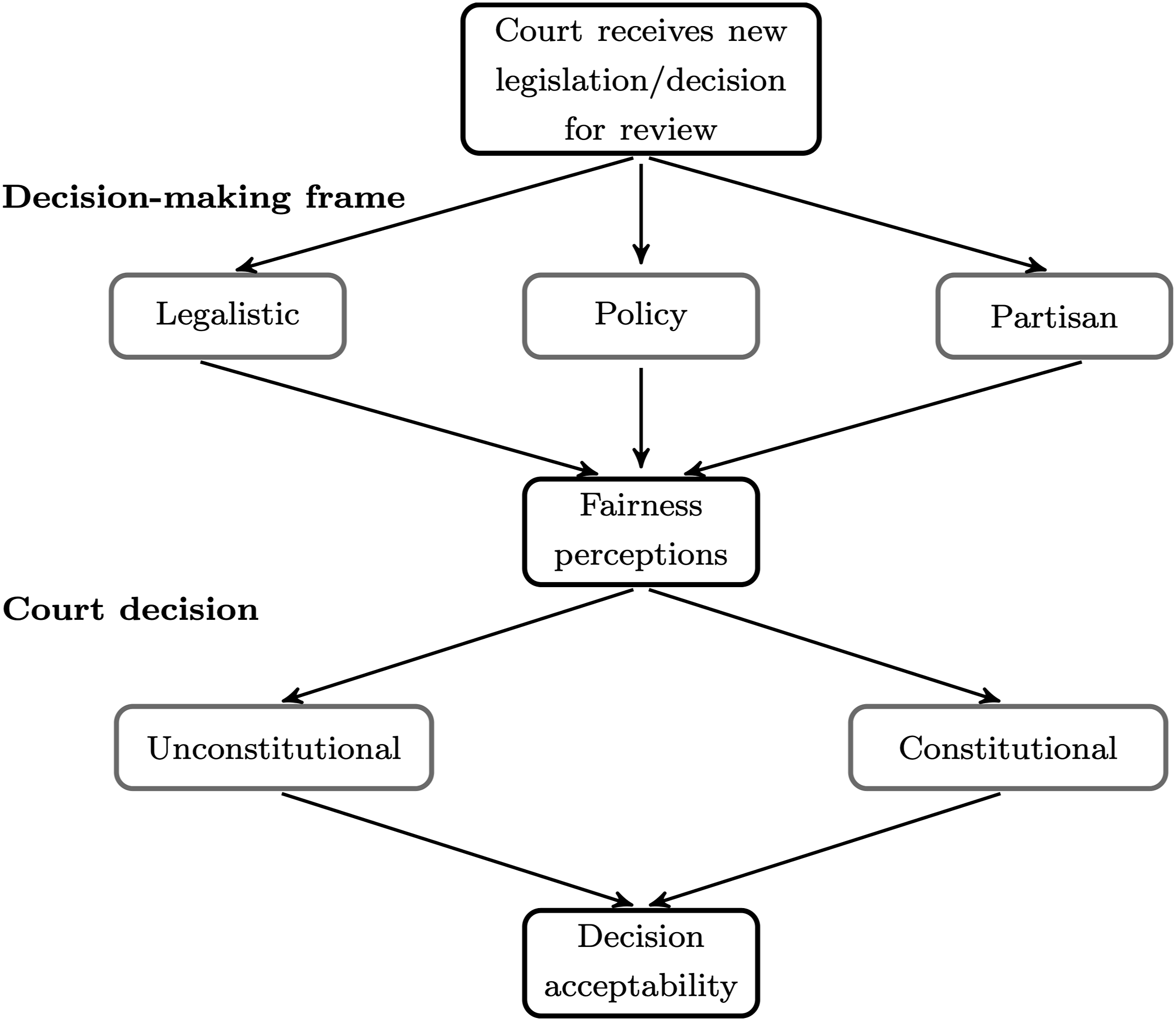
Disentangling the effects of institutional frames and agreement with decisional outcomes raises important difficulties. It is true that, in real-world contexts, individuals can be exposed to institutional frames in the absence of concrete decisional outcomes, as it often happens in media discussions about the appointment of judges or the courts’ composition. 4 However, there are also other circumstances when depictions of the motives of high courts and justices are entangled with coverage of specific decisions, constraining our ability to understand their separate effect on public reactions from observational studies alone. Experimental studies that gauge fairness perceptions after providing information about decisional outcomes may still fail to address the problem. Although the central claim in procedural fairness theory is that people care deeply about how decisions are made (e.g., MacCoun, 2005; Tyler, 2006), the outcome favorability of a decision—the extent to which the decision is in accordance with an individual’s preferences—can still taint people’s perceptions about the procedure as such (Badas, 2016; Esaiasson et al., 2019). Individuals are likely to evaluate an identical procedure differently depending on whether the outcome was favorable or unfavorable (Doherty & Wolak, 2012). Put simply: people who do not like the outcome also do not like the procedure.
Therefore, one important aspect of our research design is that the information about the substantive outcome of the court’s ruling is provided only after the presentation of different institutional frames and the measurement of procedural fairness perceptions. In this way, we can avoid contamination of fairness perceptions by evaluations of the decision (thus addressing the concern raised by Badas, 2016). With this manipulation, we further develop an experimental design proposed by Van den Bos et al. (1997) to systematically present the procedural treatment(s) before the outcome. However, whereas in the case of Van den Bos et al.’s design the post measures are presented after all treatments, we take the separation of procedure and outcome one step further, manipulating frames and measuring fairness perceptions before the experimental subjects are assigned to the outcome treatment. More specifically, to isolate the effects of (1) institutional frames and (2) outcome favorability on public responses to court rulings, randomization occurred in two stages.
First, we randomly assigned respondents to one of three institutional decision-making frames. Each frame described the decisive factors that had been behind each court’s ruling when scrutinizing the constitutionality of a particular law/policy: 1. Legalistic frame: whether the resolution/law respects the letter of the Constitution and how the court has previously dealt with similar cases. 2. Policy frame: whether the resolution/law takes into account [Norway: the principles that ensure protection of nature and the environment, but also the socio-economic benefits of the resolution/Portugal: the principles of guaranteeing health service for all but also a sustainable one]. 3. Partisan frame: whether [Norway: a conservative or socialist government appointed the majority of judges on the Supreme Court/Portugal: there is in the Court a majority of justices appointed by the parties that supported or opposed the bill in parliament].
Following this prompt, we asked respondents to evaluate the fairness of the decision-making procedure on a 10-point scale, from 1 (“Completely unfair”) to 10 (“Completely fair”). We use this measure to estimate the causal effect of different frames on perceptions of fairness in the court’s decision-making process, irrespective of the final decision.
Next, we randomly assigned the decision of the court. With equal probability, respondents learned that the court concluded that the law/policy was deemed to violate or not violate the constitution. To measure outcome favorability, we combined these treatment arms with the expressed preferences of respondents on the policy under consideration. 5 Subjects who supported (opposed) the policy were assigned to the favorable outcome group if the ruling was constitutional (unconstitutional).
Finally, we assessed the degree to which subjects found the decision of the court to be acceptable on a 10-point scale, from 1 (“Completely unacceptable”) to 10 (“Completely acceptable”). The question format is similar to post-treatment measures of decisional acceptance used in other studies of procedural fairness (e.g., Arnesen & Peters, 2018; Esaiasson et al., 2019; Grimes, 2006; Van der Toorn et al., 2011).
Following the pre-analysis plan, we relied on t-tests to text H1, H3 and H5, and linear models to test H2, H4, H6, and H8. For the mediation analysis necessary to test H7, we estimated structural equation models with the R package mediation (Tingley et al., 2014). All the analyses were conducted separately by country.
Results
We describe the main results of our experiments in three steps. First, we discuss the effects of different institutional frames on the perceptions of fairness of judicial decision-making. Next, we examine whether the effect of framing judicial decision-making in different ways on the acceptance of judicial decisions is mediated by fairness perceptions, as implied by procedural fairness theory. Finally, we describe how framing and outcomes shape the extent to which citizens are ultimately willing to accept the court’s ruling.
The Effect of Framing on Fairness Perceptions
We begin by examining the effects of frames on fairness perceptions. Figure 2 plots the average levels of perceived fairness of judicial decisions by type of frame in Portugal (left) and Norway (right) citizens. We refer to Figure 2 for mean fairness levels and we rely on t-tests of difference in means to evaluate our fairness hypotheses.
6
Mean fairness perceptions among (a) Portuguese and (b) Norwegian citizens exposed to partisan, policy and legalistic framings of judicial decision-making. 95% confidence intervals enclose the estimates.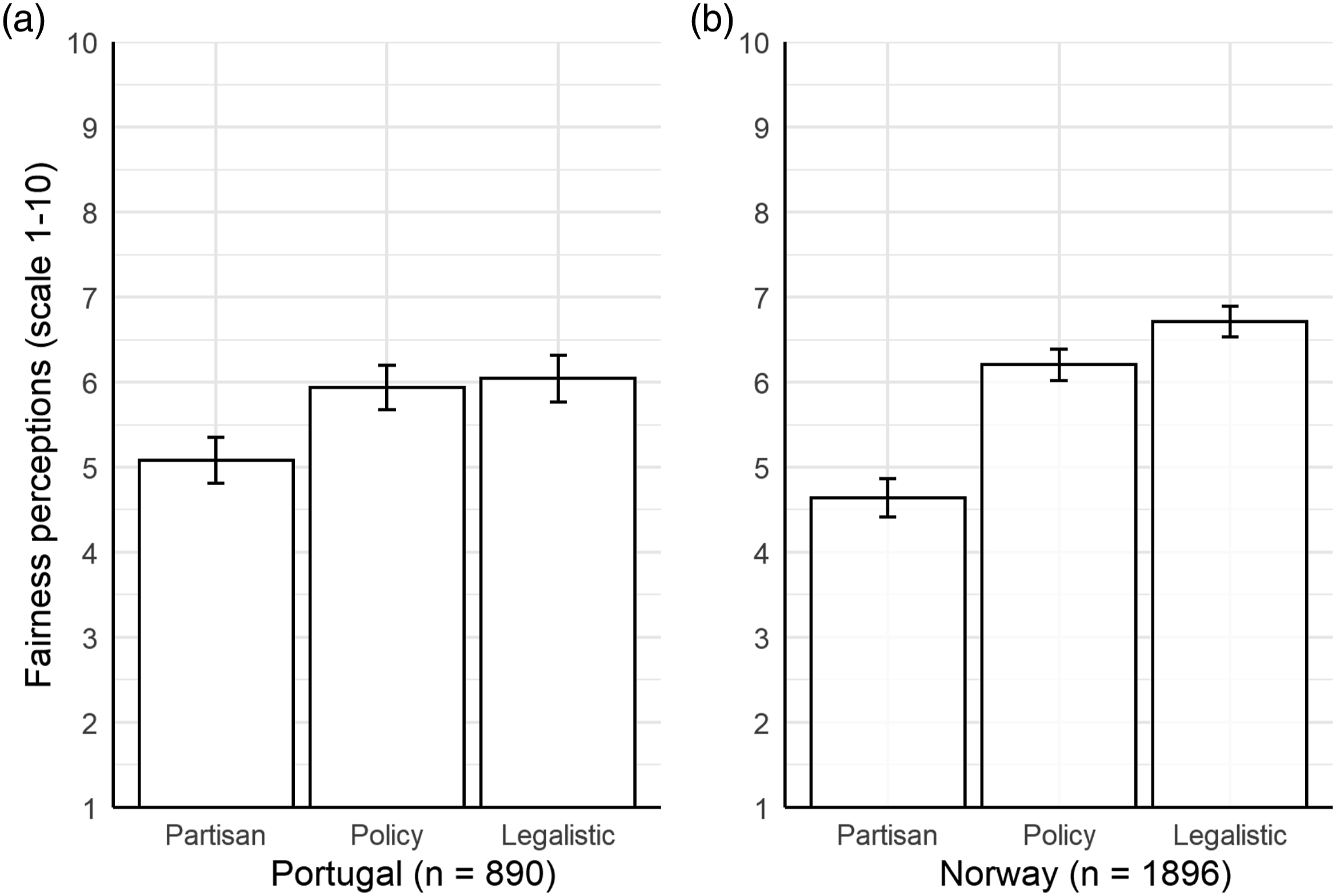
Hypothesis 1 stated that a legalistic frame should increase fairness perceptions in comparison with a partisan frame. This hypothesis is confirmed in both countries. Among Portuguese respondents exposed to the legalistic frame, fairness perceptions are .96 points higher, on the ten-point scale (CI: .57, 1.35; p-value < .01), when compared to citizens exposed to the partisan frame. Among Norwegian respondents, fairness perceptions are 2.08 points higher (CI: 1.78, 2.37; p-value < .01). These effects are substantively meaningful, representing a 16%–35% shift in fairness perceptions, relative to the sample mean.
Hypothesis 3 posed that a legalistic frame should increase perceptions of fairness in judicial decision-making in comparison with a policy frame. Here, the results are less conclusive. While subjects in both countries responded more positively to the legalistic frame than to the policy frame, this difference is only statistically distinguishable from zero in Norway (.51; p-value < .01). Our results therefore only provide partial support for H3.
Finally, Hypothesis 5 posed that a policy frame should increase perceptions of fairness in judicial decision-making in comparison with a partisan frame. The results are clearly supportive in both countries: respondents exposed to the policy frame, which emphasized how the court took into consideration the extent to which the scrutinized legislation pursued different policy goals, perceive decision-making as significantly fairer than respondents exposed to the partisan frame. Among Portuguese subjects, fairness perceptions are .85 points higher (CI: .48, 1.23; p-value < .01), while the equivalent difference in Norway is 1.57 points (CI: 1.27, 1.86; p-value < .01). In sum, in both countries framing judicial decision-making in a partisan fashion is detrimental to fairness perceptions in comparison with both a legalistic and a policy frame.
Perceived Fairness as a Mediator
After receiving randomized information on the outcome of the decision (constitutional/unconstitutional), respondents were then asked about the acceptability of the court’s decision. Hypothesis 7 posed that the perceived fairness of judicial decision-making would work as a mediator in the relationship between frames and outcome acceptability. For the purpose of testing H7, we use causal mediation analysis (e.g., Imai et al., 2011). This allows us to estimate (1) the average causal mediation effect (ACME), (2) the average direct effect (ADE), and (3) the total effect (i.e., both the direct effect of framing on acceptance and the effect of fairness perception on acceptance). We rely on the mediation package in R, which performs bootstrapping. We performed the analysis on Portuguese and Norwegian data separately. The details of the different steps of the analysis and the corresponding tables are provided in the section B2 of the Supplementary Appendix.
The results are consistent with H7: the relationship between frames and acceptance of judicial decisions is mediated by perceived fairness. The total effect of frames on acceptance is estimated at .51 points (CI: .11, .91) among Portuguese respondents and .60 points (CI: .29, .93) among Norwegian respondents. The portion of this total effect that is mediated through fairness perceptions (ACME) is .51 points (CI: .30, .70) in Portugal and .86 (CI: .71, 1.02) in Norway. The portion of the total effect that goes through the direct effect (ADE) is .001 points (CI: −.37, .38) in Portugal and −.26 points (CI: −.58, .06) in Norway. 7 These estimates strongly suggest that that the effect of framing on acceptance may be mediated through fairness perceptions. However, since the mediator—procedural fairness—was not itself manipulated, we cannot exclude the possibility that the mediation between institutional frames and acceptance of decisions is being performed by a different intervening factor (Bullock & Green, 2021).
The Effect of Framing and Outcome Favorability on Public Acceptance
Finally, we examine the hypotheses regarding the determinants of public acceptance of judicial decisions. To do so, we matched the randomly assigned court ruling with respondents’ pre-treatment attitudes towards the policy to generate a new variable measuring whether citizens received an outcome that is aligned with their preferences or not (favorable/unfavorable outcome). To test the relevant hypotheses, we used linear regression with acceptance as the outcome variable and frames and outcome favorability as the predictors. Figure 3 plots the main results for both countries. Gray coefficient estimates and confidence intervals show results among Portuguese respondents while black ones show results among Norwegian respondents. The effects of framing (partisan as reference group) and outcome (unfavorable outcome as reference group) on acceptance of the decision (1 = “completely unacceptable,” 10 = “completely acceptable”) among Portuguese and Norwegian citizens. 95% confidence intervals enclose the OLS estimates.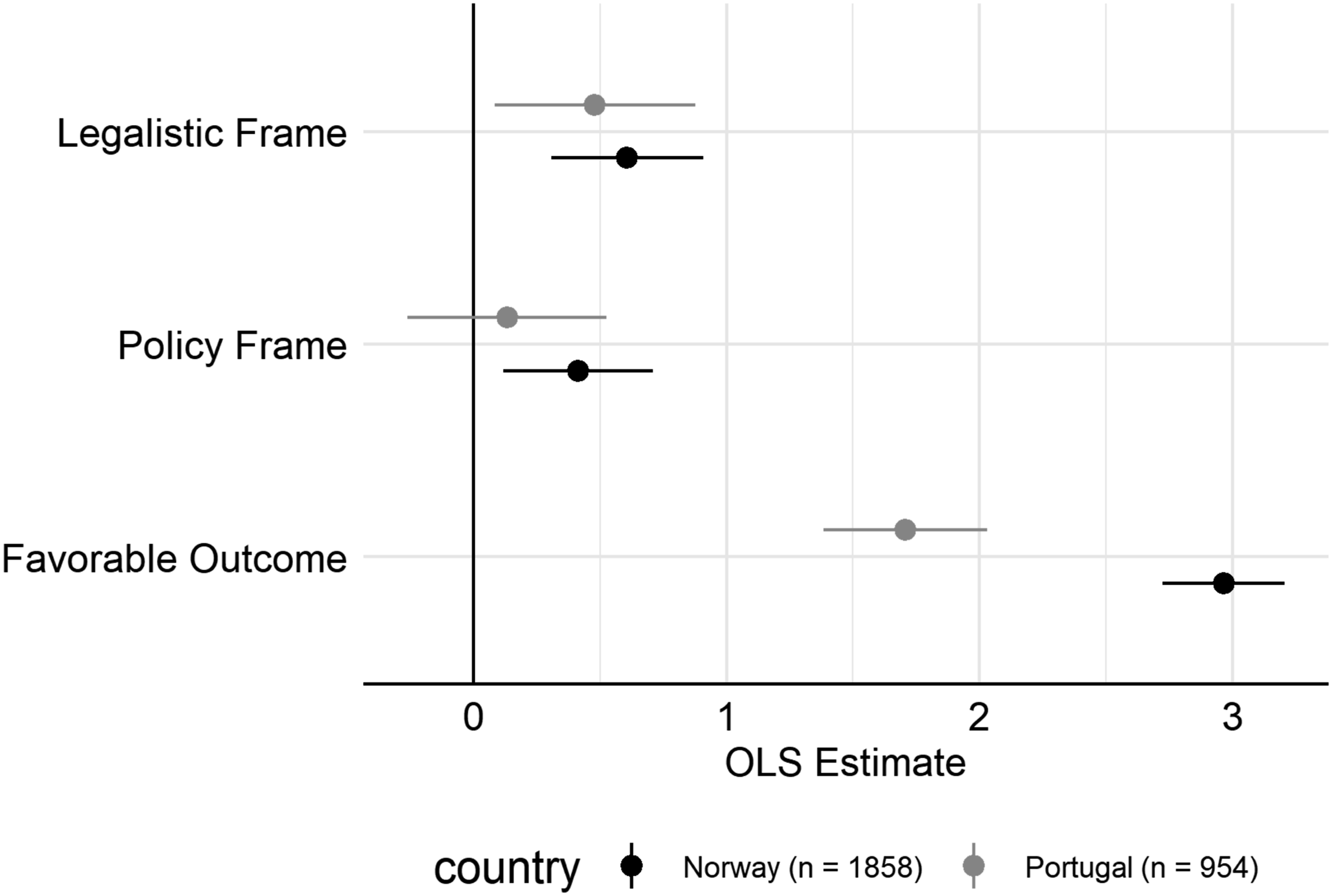
H2 posed that a legalistic frame should increase the acceptance of judicial decisions in comparison with a partisan frame. We find evidence for this prediction in both countries: independent of the outcome, those exposed to the legalistic frame express greater acceptance of judicial decisions than those exposed to the partisan frame. Among Portuguese respondents exposed to the legalistic frame, acceptance is .48 points higher on the ten-point scale (CI: .08, .88; p-value = .02) when compared to citizens exposed to the partisan frame. The corresponding estimate among Norwegian citizens is .61 points (CI: .31, .91; p-value < .01). These framing effects further suggest that acceptance of decisions, as measured in this study, is not equivalent to mere approval of, or ideological closeness to, the decision itself.
H4 posed that a legalistic frame should increase acceptance of judicial decisions in comparison with a policy frame. We find no empirical support for this prediction. While subjects who received the legalistic frame were, on average, more likely to accept the outcome than those exposed to the policy frame, the differences are small and unreliable in both Norway and Portugal (see Table B4 in section B of the Supplementary Appendix).
Third, our results lend partial support to H6, which stated that a policy frame should increase the acceptance of judicial decisions in comparison with a partisan frame. Among Norwegian respondents exposed to the policy frame, acceptance was .41 points higher (CI: .12, .71; p = .007) than among subjects exposed to the partisan frame. In Portugal, the same pattern is observed, although the difference is indistinguishable from zero at conventional levels of statistical significance (.13 points; p-value = .51).
Finally, we consider the effects of agreement with the outcome of the ruling on the latter’s acceptance. In both countries, H8—which posed that agreement with the decisional outcome should increase acceptance of judicial decisions—is supported: the results show statistically significant and substantively large effects of outcome favorability on decisional acceptance. Among Portuguese respondents in agreement with the court’s ruling, acceptance was 1.71 points higher on the ten-point scale (CI: 1.39, 2.03; p-value < .01) when compared to citizens who disagreed with the ruling. The corresponding estimate among Norwegian citizens is 2.97 points (CI: 2.73, 3.21; p-value < .01). This effect corresponds to a shift over nearly one third of the acceptance scale. To be sure, these large effects must be seen in the context of the experimental design we employed: in order to be able to avoid contamination of fairness perceptions by outcome favorability, the design imposed a sequence that is likely to have made decisional outcomes more present on respondents’ minds than frames when asked about acceptance of the decision.
In sum, we find that different frames elicit different levels of acceptance of judicial decisions, independently of the outcome. In both Norway and Portugal, exposure to a partisan frame decreases acceptance in comparison with the legalistic frame. However, in both cases, the effects of legalistic and policy frames are indistinguishable and, at least in Norway, the policy frame elicits significantly greater acceptance than the partisan frame.
In an exploratory analysis, we further examined whether outcome favorability and frames interact in the explanation of acceptance. On the one hand, Gibson et al. (2014) show that exposure to symbols that frame the context of court decisions as fundamentally different from those taken by political institutions tends to decrease the conversion of disappointment with decisions into unwillingness to accept them. On the other hand, Christenson and Glick (2015) show that legitimacy assessments were more affected by ideological proximity among those with prior legalistic views about judicial decision-making. Our results do not corroborate these findings. The exploratory analysis reported in the Supplementary Appendix (Table C1) suggests that the level of acceptance among those who received an unfavorable outcome are not meaningfully affected by decision-making frames. We discuss the implications of these ancillary findings in the concluding section.
Discussion
Whenever high courts are in the process of making politically consequential decisions, media coverage and elite discourse often provide the public not only with the content of the decision and its legal, political, and social consequences but also with “institutional frames” (Nicholson & Howard, 2003): depictions of the motives of courts and judges when making those decisions. We have considerable evidence that judges care about such portrayals and their consequences for public opinion. They do so by “going public” and engaging in a variety of communication strategies (Krehbiel, 2016; Staton, 2010) that include a careful management of the rhetoric employed to describe their role and what they do (Glennon & Strother, 2019). However, do those frames really matter, particularly in civil law systems? Are people’s procedural perceptions a mere by-product of getting the outcomes they want or not, or are they affected by the institutional framing of judicial decisions? If frames do matter, in what way do they matter? Are legalistic frames required to foster perceptions of fairness and acceptance among the public? Or are there ways to realistically depict high court judges’ as being concerned with policy in the exercise of their discretion in constitutional review cases without undermining fairness perceptions and decisional acceptance?
In this study, we addressed these questions in two high courts that represent different models of constitutional review in European civil law systems: Norway and Portugal. In two pre-registered experiments embedded in nationally representative surveys, we estimate the effects of exposure to different institutional frames about judicial decision-making on perceived procedural fairness. Additionally, we isolate framing effects from outcome favorability to measure the public’s propensity to accept judicial decisions. Whereas the experimental procedure-acceptance literature tends to expose respondents with procedures and outcomes at the same time, our piecemeal approach captures a process whereby people experience procedural elements first and outcomes later. On the one hand, this adheres to real-world scenarios where individuals are provided with information about the process prior to any outcomes, as when public debates emerge about the appointment of justices, the composition of courts, and their implications. Institutional frames can influence people’s fairness perceptions before they are exposed to specific favorable or unfavorable outcomes. On the other hand, by exposing respondents to the different frames and measuring their fairness perceptions before they are informed about the decision outcome, we can be more confident that framing effects on perceived fairness are not a mere by-product of outcome favorability. This is an important point considering existing discussions in the literature (Badas, 2016; see also Doherty & Wolak, 2012).
We show that depictions of decision-making process in high courts do matter for the perceived fairness of decisions and their acceptance by citizens. In both Norway and Portugal, people exposed to an institutional frame that emphasizes partisan considerations—the balance of forces within the court in terms of which parties and political actors appointed which judges—tend to perceive the courts’ decision-making process as less fair and to express lower acceptance of the ruling than people exposed to portrayals that emphasize respect for precedent and the letter of the Constitution. Furthermore, the results also suggest that a simple contrast between partisan and strictly legalistic frames may be insufficiently nuanced. We find evidence that when judicial decision-making is portrayed as being concerned with the policy goals pursued by the legislation under scrutiny, such decision-making is perceived as fairer than when decisions are depicted as driven by partisan considerations. Furthermore, at least in the case of Norway, this policy frame even increases people’s acceptance of decisions in comparison with a partisan frame, regardless of the actual direction of the ruling. And in both countries, responses to the policy frame were either indistinguishable or barely different from responses to the legalistic frame. This lends support to Gibson and Caldeira’s argument about the ability of portrayals that stray from the myth of legality to preserve positive responses from the public, provided they do not depict judges as mere “politicians in robes.” Finally, our results suggest the possibility that legalistic and policy framings can increase decision acceptance through fairness perceptions. This result is consistent with the proposed mechanism suggested by procedural fairness theory and implies that decision makers or news media can influence decision acceptance by emphasizing procedural elements that boost or hinder fairness perceptions in the pre-decision part of the process.
That said, the results also point to important threats to the public acceptance of judicial decisions. On the one hand, an exploratory analysis of the interaction between frames and outcome favorability suggests that when individuals are faced with a judicial decision that counters their preferences, decision-making frames have residual effects on acceptance. Furthermore, replicating studies in other domains (Arnesen, 2017; Esaiasson et al., 2019), we obtained comparatively large effects of decisional agreement on acceptance. Although, as argued earlier, our experimental design may lead to an overestimation of outcome favorability, these findings suggest that substantial damage to popular acquiescence can result when courts’ ideological composition causes them to become systematically one-sided, imposing recurring losses on particular constituencies. European institutions of constitutional review, by requiring supermajorities for appointments and/or term limits for justices, seem less prone to that scenario than American ones, where a majoritarian process of appointment of life tenured justices coupled with extreme party polarization risks generating ideologically immoderate and even partisan high courts (Ferejohn, 2002). Still, even European high courts must face the possibility that no amount of institutional framing may be sufficient on its own to preserve the acquiescence of “losers” vis-à-vis courts.
On the other hand, the fact that framing matters, even if mostly for “winners,” calls attention to how media and elites aligned with the “losing” side may undermine support for high courts by resorting to a partisan rhetoric about judicial decision-making. In the current context of growing illiberal threats to the role of courts (Arato & Cohen, 2021; Bugarič & Ginsburg, 2016), one of the strategies employed by populist leaders to diminish resistance to court-packing and institutional changes designed to neuter high courts is to operate at the symbolic level, portraying themselves as victims of partisan and politicized judicial institutions (de Ghantuz Cubbe, 2022, pp. 54–55). Our results suggest that the prevalence of such institutional frames can indeed undermine acquiescence to high court rulings, helping clear the way for deeper attacks on judicial authority.
Important limitations to this study should also be noted. First, concerns with statistical power prevented us from adding a control group that did not receive any information about the decision-making process. Therefore, our discussion about framing focuses strictly on the comparison between different ways of depicting the motives and concerns of courts when making decisions. Future scholarship could explore the default beliefs about the judicial decision-making process in different contexts. Second, although we chose policy issues that were both salient and susceptible of constitutional adjudication in each country, we cannot exclude the possibility that our results are specific to the policies used in the vignettes. Third, the advantage of obtaining fairness assessments before and independently of outcomes does not prevent two risks. On the one hand, that the frames were interpreted by at least some experimental subjects as hints about how the decision would turn out, allowing anticipations of a certain outcome to shape their procedural fairness assessments. On the other hand, the price to pay for having provided frames and elicited fairness perceptions before providing outcomes and measuring acceptance is the possibility that the role of the perceived fairness may be inflated among some respondents’ seeking to preserve consistency with their earlier responses. 8 Finally, our mediation results must be interpreted with additional caution. The notion that manipulating institutional frames affects fairness perceptions and that those, in turn, affect outcomes such as decisional acceptance is consistent with procedural fairness theory. However, in the absence of actual manipulation of the mediator, model-based mediation analysis relies on a strong and untestable assumption of sequential ignorability, which implies that there is no unmeasured confounding between the mediator and the outcome after conditioning on treatment and pre-treatment covariates. Future work could build on our design to address this issue by adding a second treatment arm that would induce exogenous variation in the mediator (Bullock & Green, 2021). Additionally, our design allows for many possible mediators, some of which are likely to interact with one another. Though some work addresses estimation under such conditions (Imai & Yamamoto, 2013), the existing results and computing packages are limited to two mediators at a time (Huff & Schub, 2018).
Still, we believe our study provides a valuable contribution to public debates about high courts and their role in the democratic process. Our results also establish a dialogue both with the literature on public opinion and courts in the US and with the broader literature on the role of procedural fairness and political support. We hope these questions will continue to be addressed in future studies about judicial politics and public opinion in other contexts.
Supplemental Material
Supplemental Material - Beyond the Myth of Legality? Framing Effects and Public Reactions to High Court Decisions in Europe
Supplemental Material for Beyond the Myth of Legality? Framing Effects and Public Reactions to High Court Decisions in Europe by Pedro C. Magalhães, Jon K. Skiple, Miguel M. Pereira, Sveinung Arnesen, and Henrik L. Bentsen in Comparative Political Studies
Footnotes
Acknowledgments
We are grateful all the comments we have received on previous versions of this article. Particular thanks go to James L. Gibson and to all the participants at the SPARC Research Seminar of the Institute of Social Sciences of the University of Lisbon. We would also like to thank Alice Ramos for her help in the collection of the Portuguese data.
Declaration of Conflicting Interests
The authors declared no potential conflicts of interest with respect to the research, authorship, and/or publication of this article.
Funding
The authors disclosed receipt of the following financial support for the research, authorship, and/or publication of this article: This article was supported by Research Council of Norway (project no. 262986) and by the Fundação para a Ciência e Tecnologia of Portugal (grants UIDB/50013/2020 & UIDP/50013/2020).

Supplemental Material
Notes
Author Biographies
References
Supplementary Material
Please find the following supplemental material available below.
For Open Access articles published under a Creative Commons License, all supplemental material carries the same license as the article it is associated with.
For non-Open Access articles published, all supplemental material carries a non-exclusive license, and permission requests for re-use of supplemental material or any part of supplemental material shall be sent directly to the copyright owner as specified in the copyright notice associated with the article.
