




Abstract
Tackling an important gap in the literature on political trust, this article focuses on politicians and the relevance of their other-to-self trust judgements for decision-making in public office. A unique quantitative dataset gathered from national politicians in the UK, Canada and South Africa is used to (1) examine descriptive levels of felt trust and distrust among politicians and (2) evaluate the impact of these feelings on politicians’ risky decision-making. To achieve outcome (2), this article presents the results of three survey experiments in which politicians were asked to make decisions in scenarios where both the presentation and the nature of risk varied. The results indicate that MPs’ perceptions of public trust and distrust do matter for risky decision-making, and that these variables moderate a reflection effect whereby MPs are otherwise more risk-averse in the face of gains and risk-taking in the face of losses.
Introduction
Despite the existence of an expansive literature attesting to the importance of political trust for public opinion, participation and policy compliance (for a detailed review, see Citrin & Stoker, 2018), it is astonishing that so little of it, if any, has focused upon how the existence of a low-trust, high-blame environment affects politicians’ decision-making and thus the quality of public governance. Given that political trust is routinely understood as a relational concept involving both citizens (the ‘trustors’) and politicians (the ‘trustees’), it is somewhat remarkable that there remains no knowledge of if or how the latter interpret and act upon political trust. These questions represent a missing piece in the trust puzzle as studied in political science and cognate disciplines.
Tackling this gap head on, I take a novel dialogic approach to vertical trust-based relationships that gives equal weight to politicians’ feelings of being trusted and distrusted within the principal-agent relationship that characterises representative democracies. 1 In this article, I focus on one particularly significant dimension of this research agenda: when, why and how these feelings might influence politicians’ risky decision-making. Risk is, of course, endemic to political life. By virtue of their office, politicians must constantly make decisions with very real and consequential personal and public risks attached. In turn, risks per se are interwoven with the psychological fabric of trust and distrust, which together represent an evolutionary response to ontological vulnerability and uncertainty (see Cai et al., 2020; Mackenzie, 2020). However, research on the trust-risk relationship has thus far overlooked an important question: do politicians’ perceptions of public trust or distrust in themselves impact their propensity to engage in risk-seeking or risk-averse behaviours? To theorise this link more precisely, I draw on the trust-as-heuristic tradition (see Hetherington, 2005; Rudolph, 2017), which takes political trust as a decision rule that assists citizens as they decide whether or not to support government action. Specifically, I flip this logic 180° to suggest that fluid and variegated perceptions of public trust and distrust act as a heuristic for politicians who not only occupy a job laden with risk but exist in an overwhelmingly complex informational environment (for a discussion of elites’ use of heuristics, see Vis, 2019).
In this article, I propose and test this thesis for the first time using original survey measures and experiments administered to more than 100 nationally elected politicians drawn from three major democracies (the UK, Canada and South Africa). I examine the relationship between politicians’ perceptions of public [dis]trust and their decisions in scenarios where the nature and presentation of risk differs. I find preliminary evidence that MPs’ perceptions of public trust and distrust do matter for risky decision-making, and that these variables moderate a reflection effect whereby MPs are otherwise more risk-averse in the face of gains and risk-taking in the face of losses. The contribution of this article is three-fold. Theoretically, I advance existing work on trust and governance by demonstrating the importance of politicians’ other-to-self perceptions of trust-related concepts. Methodologically, I add to a small but important research base that has used experimental methods with political elites (for a review, see Kertzer & Renshon, 2022) and I test a new battery of ‘felt’ trust and distrust with politicians in comparative contexts. Empirically, I use these methods to show that MPs are not only susceptible to well-researched biases in some risk-laden scenarios, but that these cognitive shortcuts can interact with [seemingly inaccurate] appraisals of public opinion to help MPs reach behavioural decisions in the presence of uncertainty.
What Does it Mean to be Trusted and Why Does it Matter?
As an essentially contested concept, there continues to be fierce debate about whether political trust is a unidimensional, holistically conceived attitude (e.g. Hetherington & Rudolph, 2008; Hooghe, 2011) or whether it is, as David Chan (2019, p. 3) argues, decidedly multi-level, multi-dimensional and malleable. The former interpretation has tended to dominate a relatively traditional and longstanding approach to the measurement of trust in mass surveys such as the American National Election Study (ANES), the General Social Survey (GSS) and Gallup, whilst the latter has informed a more nuanced, target-specific study of trust and distrust across politics as well as the organisational and psychological sciences (Devine et al., 2020; Hamm et al., 2019). Whilst it is neither necessary nor possible to explore this theoretical debate in detail in this article, it is worth clarifying my position by way of foregrounding later remarks.
I distinguish here between trust as an action (decisions or behaviours) and trust as a series of internalised psychological processes that inform those actions. This approach relies on a number of core assumptions: trust in all forms is relational, it depends upon reciprocal multi-faceted judgements about trustor and trustee, and it is interrelated to but distinguishable from distrust. On the first point, scholars such as Peter Nannestad (2008, p. 417) and Russell Hardin (2002) have advanced a sound understanding of trust as a ‘three-way relationship…where A trusts some specific B with respect to some specific x’. The important takeaway here is that trust must be conceived as something that is target-specific and granted contingently within a context-specific domain of action. On the second point, the contingencies implicit in this relational model are resolved by trust judgements about the trustworthiness of another. To be precise, people make cognitive, affective and behavioural-intentional judgements about potential trustees (e.g., about their ability, benevolence and integrity, see Mayer et al., 1995; Lewicki et al., 2006). These judgements reflect prior knowledge or experience and thus act as ‘psychological conduits’ (see Hamm et al., 2019, p. 2) for the behavioural execution of a trustor’s willingness to accept vulnerability. Finally, trust and distrust occupy independent yet parallel dimensions whereby trust allows for the possibility of harm and facilitates co-operative behaviours, whilst distrust invokes an expectation of harm or betrayal that elicits very different actions to manage risk. To clarify this distinction, it is worth considering the asymmetric properties of low trust and high distrust or alternatively high trust and low distrust:
‘[L]ow trust is not the same as high distrust; the former evokes a lack of hope, an unsure assessment of the other’s behaviour, and hesitancy, whereas the latter evokes fear, scepticism, and vigilance. Following similar but reverse logic, high trust does not necessarily translate into low distrust: The former suggests hope, faith, and confidence, whereas the latter suggests an absence of fear, scepticism, cynicism, and a need to closely monitor the other’ (Lewicki et al., 2006, p. 1002).
Both trust- and distrust-based judgements may be held simultaneously to varying degrees and, crucially, imply very different conclusions about a trustee that become salient in different contexts of cooperation or action (for a related discussion, see Bertsou, 2019).
In this article, I take these normative arguments and recast them dialogically insofar as I argue that political [dis]trust fluctuates as part of a perpetual dyad in which politicians’ actions affect public responses and vice versa. As trustees, politicians may feel or believe they are trusted by some specific audience to carry out or decide upon some specific piece of legislation (relational perceptions of trust). Politicians may believe, feel or assume that their constituents, voters or the broader public sees them as competent, honest, and loyal, or conversely self-interested, incapable or even indifferent (other-to-self trust judgements). And politicians might concurrently believe that a specific audience has faith in their technical expertise (e.g., perceptions of trust) whilst still questioning their moral compass (e.g., perceptions of distrust). Whereas the existing literature has focused almost exclusively on the public’s political trust or [to a lesser extent] distrust, this dialogic approach casts a lens on the important yet neglected subjective realities of those who exercise political power and rely on trust as political currency.
For the purpose of understanding elite decision-making (the core focus of this article), I suggest that these feelings or perceptions of ‘being trusted’ or ‘being distrusted’ may act as a powerful heuristic for politicians. In political science, the term ‘heuristic’ has taken on a broad and generalizable meaning for decision-making based on anything but full information (see Druckman et al., 2009). Under this conceptual umbrella, a specific trust-as-heuristic thesis has been developed with the supposition that decisions to support or oppose policies are reduced to questions of trust: ‘other things equal, if people perceive the architect of policies as untrustworthy, they will reject its policies; if they consider it trustworthy, they will be more inclined to embrace them’ (Hetherington, 2005, p. 51; see also Rudolph & Evans, 2005). In a dialogic model of trust relations, this thesis takes on added meaning. I argue that politicians may also draw on perceptions or feelings of trust and distrust to make prospective assessments about the consequences of legislative or other representative behaviours. In this respect, politicians are both ‘cognitive misers’ who rely on intuitive modes of information processing and ‘sufficient deciders’ who need confidence in the quality or appropriateness of their political choices. As with all questions of trust, the saliency of politicians’ felt trust or distrust will be most prominent in relationships or situations characterised by risk or vulnerability.
Feelings of Trust and Risk Preferences
In existing research, the trust heuristic is activated ‘under conditions of risk’ (Rudolph, 2017, p. 200) involving (a) uncertainty about the outcomes of any given policy, and (b) the possibility for policy outcomes to be desirable or undesirable (see also Rudolph & Popp, 2009). Where these circumstances present, high levels of political trust stimulate risk-seeking behaviour and high levels of distrust stimulate risk avoidance (for comparative examples, see Chanley et al., 2000; Cai et al., 2020; Tyler, 2006). As with studies of the public, I suggest that the trust heuristic may help to explain how and why politicians navigate risk in public office. To be a contemporary professional politician is, by necessity, to make risky decisions with high-stakes investment in outcomes where the probabilities of gain and loss, success and failure, are incredibly hard to estimate. Adapting the empirical and theoretical wisdom of existing research, I argue that politicians who feel or believe they are trusted will be more likely to underweight the personal or public risks attached to occupational choices. Conversely, politicians who feel or believe they are distrusted will be more likely to overweight those risks. Put another way, perceptions of trust or distrust will facilitate or mitigate risky decisions respectively by (1) providing a bellwether of the broader social or political consensus (which is especially important where, for example, legislative decisions may sacrifice the public’s short-term satisfaction for long-term gain), and thus (2) provide a blueprint of anticipated reactions.
Politicians do not, however, get their ‘choice of choices’ (Sniderman & Levendusky, 2009, p. 437). As a rule, political institutions (both formal and informal) delimit the options available to elected officials in decision-making scenarios (see Weinberg, 2020b, pp. 115–117). As such, politicians’ decisions and behaviours require multiple explanatory mechanisms that account for their internal preference formation and heuristic thinking as well as the external provision of choice. Put simply, there are very few scenarios in which politicians can avoid risk entirely. More often than not, politicians must choose between more or less risky options and, in turn, those options may be presented in ways that heighten or diminish heuristic thinking.
In Psychology, prospect theory describes the way in which individuals accommodate themselves to these moments of differential uncertainty (Kahneman & Tversky, 1979; Tversky & Kahneman, 1992). In particular, the ‘reflection effect’ is a well-researched behavioural regularity whereby people try to avoid risk when facing gain, but they embrace risk when facing losses. In contrast to rational choice models of behaviour, the reflection effect works on the basis of probability weighting: ‘Because probabilities are generally underweighted, the chance of a good outcome receives too little weight, making a gamble for gains look less attractive. The probability of a bad outcome is also underweighted, so a gamble over losses looks more attractive. Diminishing sensitivity strengthens this effect because this leads to a utility function that is concave for gains and convex for losses’ (Linde & Vis, 2017, p. 104).
Using hypothetical decision-making scenarios, Enrique Fatas et al. (2007) find evidence of a reflection effect among a sample of 32 ‘expert’ politicians drawn from multiple levels of Spanish politics. 2 Using a very similar design including standard lottery games and hypothetical policy-based scenarios, Linde and Vis (2017) also find evidence of a reflection effect among a more representative sample of 46 Dutch MPs. And using a much larger sample of local politicians from across the US, Sheffer and Loewen (2019) show that gain/loss frames alter the stated risk preferences of elected representatives. Together, this nascent research base suggests that politicians, like the rest of the population, deviate from expected utility theory to engage more or less in risk-seeking behaviour depending on the presentation of that risk.
I go beyond these studies to draw important links between politicians’ felt [dis]trust and their likely engagement in risky behaviour. Specifically, I suggest that the trust heuristic works with, rather than against or in place of, the inherent logic of the reflection effect. To be precise, felt trust and distrust will have either an additive or mitigating effect on risk preferences in the face of either gains or losses. On one hand, feelings or beliefs about being distrusted are likely to compound politicians’ risk avoidance when facing gains (i.e., reinforcing the reflection effect), but reduce risk taking when facing losses (i.e., countering the reflection effect). Theoretically, perceived public distrust may dampen a politician’s conviction in their ability to ‘make a difference’ and receive praise for doing so, whilst also heightening the saliency of anticipated punishment when things do go wrong (i.e., intense loss aversion). Thus, good outcomes are underweighted even further in gain frames and bad outcomes are overweighted more than usual in loss frames.
H1. The more distrusted politicians feel, the more likely they are to avoid risks when facing gains.
H2. The more distrusted politicians feel, the less likely they are to take risks when facing losses.
In contrast, feelings or beliefs about being trusted are likely to reinforce politicians’ risk acceptance when facing losses (i.e., reinforcing the reflection effect) and mitigate risk aversion when facing gain (i.e., countering the reflection effect). Perceived public trust (real or not) may facilitate bold or risky decisions on the basis that a reservoir of trust engenders forgiveness in moments of failure and increases the likelihood of positive character attributions in moments of success. In other words, failure may not be perceived as quite so disastrous and especially so where a solid justification can be provided. Thus, bad outcomes are underweighted even further in loss frames and good outcomes are overweighted more than usual in gain frames.
H3. The more trusted politicians feel, the more likely they are to embrace risks when facing losses.
H4. The more trusted politicians feel, the less likely they are to avoid risks when facing gains.
References Points for Risk
Originally conceived, the trust-as-heuristic thesis argues that the saliency of political trust is contingent on the nature of the sacrifice that is risked in any single decision (e.g., Hetherington, 2005; Hetherington & Globetti, 2002; Rudolph, 2017). Thus, it is not only necessary to consider whether an event or situation is construed as entailing risk in the first place, or indeed how that risk is framed (loss vs. gain), but also how the potential ramifications of loss are construed. In the interests of clarity and cognizant of academic contestation, I adopt a definition of such ‘reference points’ as the hypothetical construal of what may be gained or lost in a particular domain of thought or action relative to the status quo in that domain. In political office, there are two critical dimensions that may act as reference points for the construal of risk and sacrifice in a decision-making situation: the electoral dimension and the policy dimension (see also Müller & Strøm, 1999).
Political Dimensions of Risk Appraisals and the Saliency of Felt Trust and Distrust.
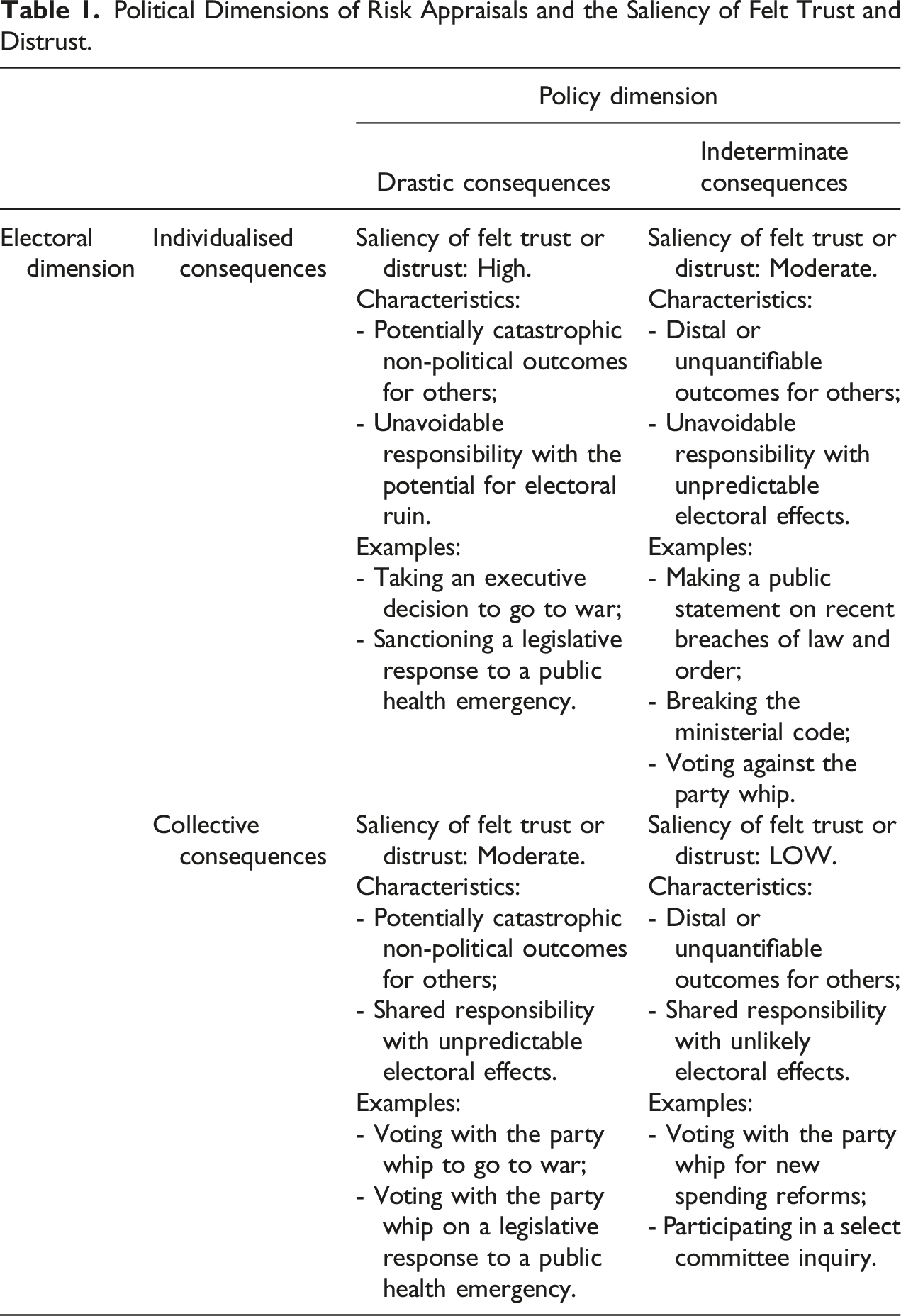
On the policy dimension, drastic consequences are those where the potential losses involved in a risky decision are likely to bring about definitive and disastrous results for other citizens. Such consequences may be more pertinent as reference points for politicians in the executive, who necessarily orchestrate or instigate policy on topics such as military intervention and natural disasters. However, drastic consequences may also act as reference points for backbench MPs in liberal democracies where, for example, emergency protocols require parliamentary consent. In contrast, indeterminate consequences are those where the potential losses involved in a risky decision are more opaque, diffuse, and less immediate. Such consequences may provide a reference point for all politicians as, for example, they vote on regular domestic policies or make statements about public affairs.
The electoral dimension pertains to the anticipated level of responsibility (and thus blame) that the individual actor might carry in the case of a risky decision going wrong. This reference point may be understood as individualized in instances where the actor is likely to take sole responsibility or the lion’s share thereof (e.g., voting against the party whip), or alternatively collective in instances where the responsibility for failure is shared with others (e.g., voting with the party whip). Together, these policy and electoral reference points characterize the sacrifices that politicians might make by entertaining risky decisions. In turn, they may influence the relevance of felt trust and distrust, which are more likely to inform heuristic thinking in scenarios where there is most to lose (see Table 1).
H5. Feelings or beliefs about being trusted or distrusted will have a stronger effect on politicians’ decision-making when risks are characterized by individualized electoral consequences and/or drastic policy consequences.
Research Design and Data
In order to test these hypothetical relationships between felt trust, distrust and risky decision-making, I conducted three randomised survey experiments with nationally elected politicians from the UK, Canada and South Africa. In what follows, I discuss the research design and data collection exercise in detail. 3
Data Collection
Descriptive Characteristics of MPs.*
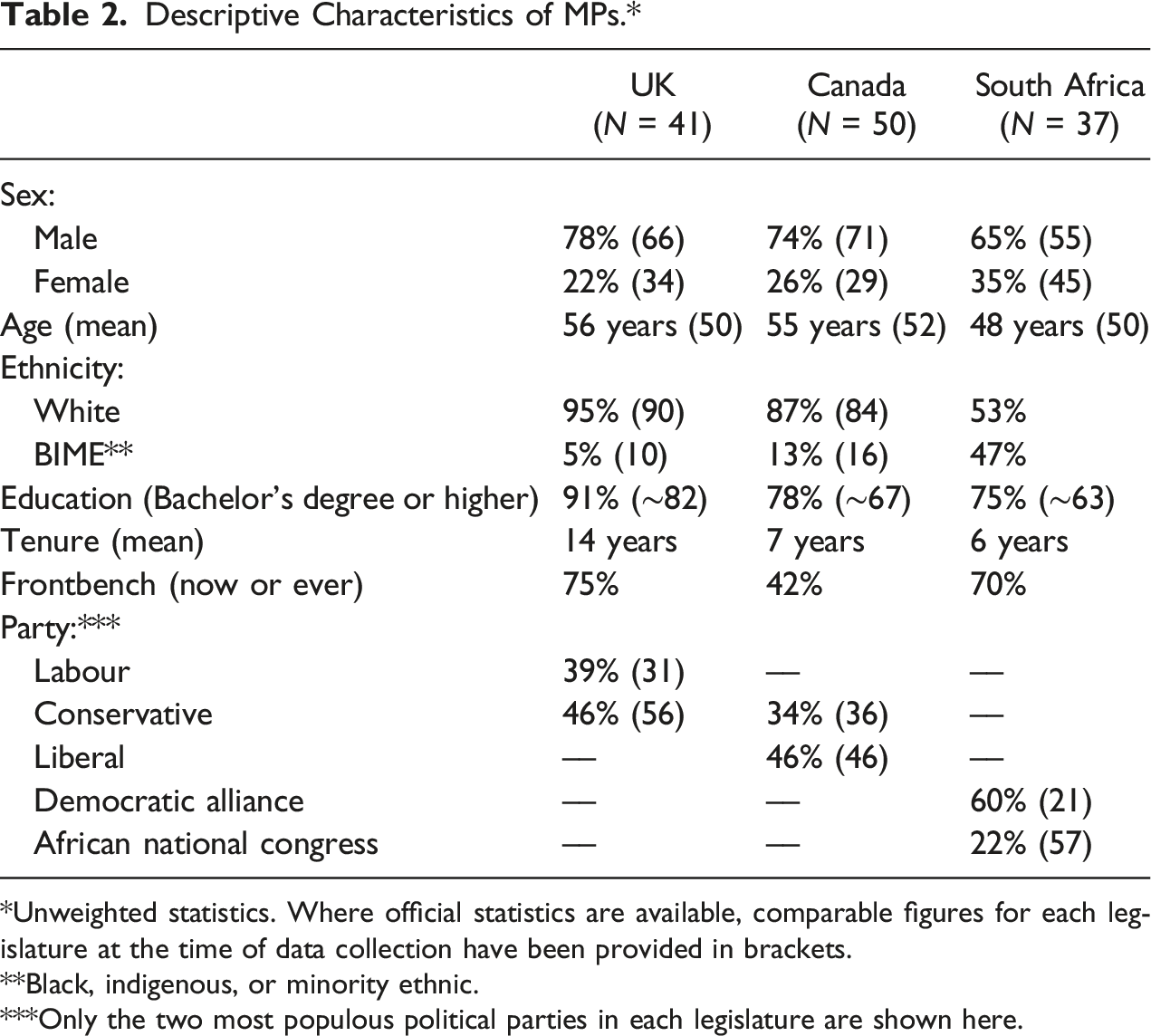
*Unweighted statistics. Where official statistics are available, comparable figures for each legislature at the time of data collection have been provided in brackets.
**Black, indigenous, or minority ethnic.
***Only the two most populous political parties in each legislature are shown here.
Country Selection
Canada, South Africa and the UK were chosen as comparative sites of study that have faced similar problems with political trust in recent years. Polling by Gallup and EKOS suggests that the proportion of Canadians who trusted the government in Ottawa to do the right thing ‘just about always’ or ‘most of the time’ dropped from almost 60% in the early 1970’s to a low of 22% in the mid-2010’s (Connelly, 2016). In 2022, Canadians’ trust in all levels of government was below 40% (Proof, 2022). In the UK, Will Jennings et al. (2017; Clarke et al., 2018) have drawn on a bricolage of longitudinal survey items to paint a bleak picture of declining trust (and rising distrust) in incumbent politicians, governments and political institutions between 1944 and present day. And in South Africa, declining levels of specific and diffuse political trust have been linked to worrying features of democratic deconsolidation (Booysen, 2015; Gouws & Schulz-Herzenberg, 2016). Between 2006 and 2021, Afrobarometer surveys documented a drop of 27% and 31% in the number of South African citizens who could claim to trust the Parliament and President respectively (Moosa & Hofmeyr, 2021). During the COVID-19 pandemic, these countries also saw similar ‘bounces’ in political trust as an initial rally-round-the-flag effect gave way to ‘business as normal’ (Edelman, 2021).
For comparative purposes, Canada, South Africa and the UK share in a number of strategic political similarities and differences. All three of the countries chosen here are, for example, representative democracies with bicameral national legislatures operating along the broad contours of the ‘Westminster model’. Yet, whilst Canada and the UK elect MPs to parliament using a first-past-the-post majoritarian voting system, South Africa employs party-list proportional representation. The UK and Canada are both large, open economies with longstanding democratic traditions, open elections and a culture of semi-regular turnover of the governing party. At the same time, the political tenor of the UK in recent years has been set by an incumbent right-wing Conservative Party (in government since 2010) whilst the political landscape in Canada has been dominated by the centre-left Liberal Party (in government since 2015). In contrast, South Africa is a third wave constitutional democracy that only transitioned to free elections in 1994 and has only been governed by one political party since. The UK, Canada and South Africa do, then, provide apposite democratic contexts in which to examine politicians’ perceptions of political trust and distrust, and to assess the impact of these perceptions on decision-making in otherwise varied systems of government and representation.
Experimental Design: Decision-Making and Risk Appraisal
Survey vignette experiments were administered to politicians containing hypothetical decision-making scenarios. Whilst vignette experiments cannot necessarily replicate the same contextual experience encountered in ‘real life’ (for a discussion, see Lohrke et al., 2010), they are well-tested across the social sciences and afford a high degree of control over the inclusion or exclusion of confounding factors relative to designs using observational data (see also Aguinis & Bradley, 2014; Grant & Wall, 2009). The stimulus materials were designed specifically to induce a reflection effect, whereby people are risk averse when outcomes are presented as gains and risk taking when they are presented as losses. In each experimental scenario, MPs had to choose between a relatively risky choice and a relatively safe choice in either a gain or loss treatment condition. Whilst all three experiments test for the reflection effect, they do so across different hypothetical settings that manipulate not only the type of decision that is made, but also the reference points against which risk might be appraised (e.g., policy vs. electoral dimensions). The treatment materials are presented in full in online appendix A.
The first experiment is an adaptation of the classic ‘Asian disease problem’ originally fielded to voters by Kahneman and Tversky (1984). In the face of a public health emergency, MPs must vote for one of two different response packages. Whilst the probability of mitigating the death toll is the same for each package, these probabilities are presented in terms of gains and losses in different treatment conditions. MPs were instructed to treat this as a free or ‘conscience’ vote in which their party had not provided instruction. As such, the risks inherent in this decision are primarily characterised by drastic policy consequences (i.e., public mortality rates) and, to a lesser extent, by individualised electoral consequences (i.e., MPs’ votes are entirely their own and may be recorded/publicised online). Therefore, experiment one falls into the top left quadrant of the organising perspective provided in Table 1.
Following the example of Kahneman and Tversky (1979, p. 273) as well as Linde and Vis (2017), the presentation of risk in the second and third experiments is manipulated by changing earlier expectations. Specifically, the current situation – as opposed to possible outcomes as in experiment one – is described as better (gain setting) or worse (loss setting). In experiment two, MPs must decide whether or not to appear on TV to speak in favour of, or against, a new protest movement. The treatment conditions set earlier expectations in terms of better or worse party performance in the polls, and outcomes from a risky decision (i.e., to speak in favour) are measured as an equal chance of improvement or deterioration in those same polling statistics. Experiment two is designed to induce risk appraisals with indeterminate policy consequences (i.e., there are no immediate policy outcomes from the hypothetical interaction) and collective electoral consequences (i.e., based on public opinion about the candidate’s party). Therefore, experiment two falls into the bottom right quadrant of Table 1.
The final experiment asks MPs to vote on new macroeconomic policies in light of varying earlier expectations about unemployment and the national budget deficit. These new policies have an equal likelihood of improving or deteriorating existing statistics. However, participants are also told that this is a whipped vote whereby the MP’s party has instructed them to vote against the package. Experiment three is designed to induce risk appraisals with indeterminate policy consequences (i.e., the impact on public welfare and the economy is distal and conditional) but individualised electoral consequences (i.e., MPs must also defy the party whip in order to introduce new fiscal measures). Whilst experiment three does not explicitly state the electoral consequences of choosing the risky option, party leaderships have the power to incentivise or punish legislators in ways that directly speak to their policy-, office- and vote-seeking motivations (e.g., Kam, 2009; Müller & Strøm, 1999). Therefore, experiment three falls into the top right quadrant of Table 1.
Following Linde and Vis (2017, p. 110), MPs were told to assume that (a) there are no other consequences than those mentioned in the question, (b) there are no better alternative proposals available and (c) their party is ideologically neutral towards these proposals unless told otherwise. To further diminish the confounding effects of ideology and increase common interpretations of each scenario, the content of policies and issues is never explained. Only the possible outcomes of each choice are presented. Whilst this may be somewhat of a simplification of reality, it is also a necessary consequence of balancing the delicate equilibrium between experimental realism and treatment control and validity.
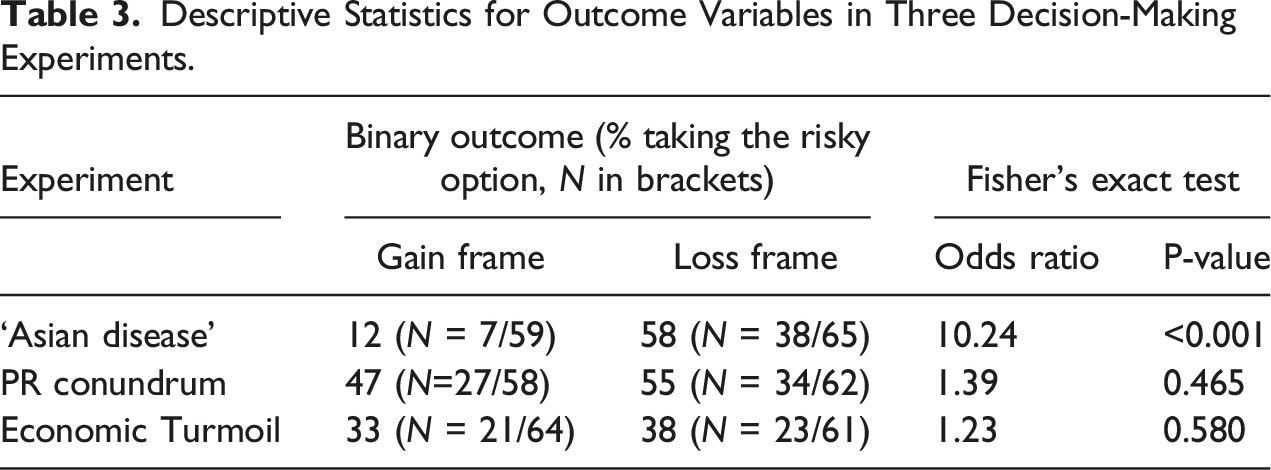
Descriptive Statistics for Outcome Variables in Three Decision-Making Experiments.
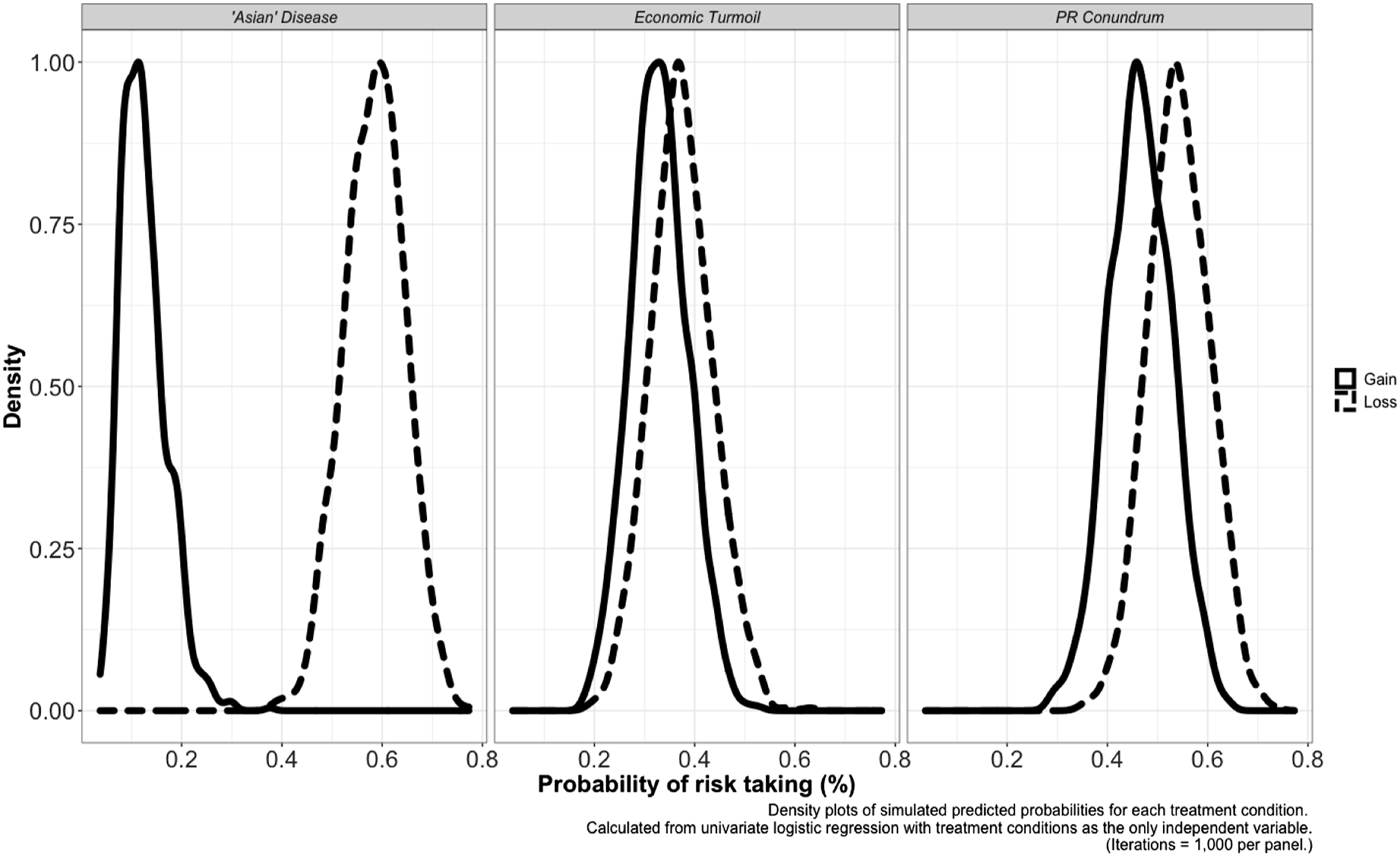
Reflection effects among politicians in three political decision scenarios.
As an additional check on treatment validity, participants were asked to provide qualitative reflections about each experiment. In total, 91 participants gave short written explanations of their decisions and, by implication, their reference point for risk in each experiment. These responses were stripped of standard English stopwords and the most frequently used terms were extracted using the Quanteda package in R. The five most common tokens referred to by participants were ‘party/parties’, ‘whip’, ‘outcome’, ‘risk’ and ‘people’. A keyword-in-context search for these terms confirmed, as anticipated, that policy considerations dominated in experiment one, whilst electoral considerations dominated in experiment three (specifically party loyalty and discipline). Experiment two elicited fewer coherent explanations. It was not obvious, for example, that MPs were able to isolate the reference point for electoral risk in experiment two or that they had enough information to make a considered decision. Exemplar responses include: Canadian MP: “For the sickness, I don’t like to gamble with people’s lives. On issues, it’s better to take a stand if you can than dodge it. For fiscal measures, I don’t like stimulus or bailout packages generally, so I’d just as soon follow party lines.” UK MP: “Q1: Probability of greater deaths; Q2: need to make an informed decision dependent on the subject; Q3: it is a whipped vote!” South African MP: “On [a] free vote I will try and follow my own value system. On whipped decisions, there is no choice, party discipline must be maintained.”
The primary purpose of this article is not, however, to examine MPs’ decision-making or reflection effects in contexts of risk per se, but rather to explore the differential relevance of felt trust and distrust in shaping decisions under such conditions.
Measures: Felt Trust, Distrust…and Mistrust
All participants answered an adapted 24-item battery of political trust (henceforth PTB-24; see also Weinberg, 2020a). The PTB-24 contains 12 items measuring cognitive trust judgements (i.e., what people ‘think’ about politicians; four each for politicians’ ability, benevolence and integrity, with two in each case measuring trust and two measuring distrust); six items measuring affective judgements (i.e., what people ‘feel’ about politicians; three each for positive/trusting emotions and negative/distrusting emotions); and six items measuring behavioural-intentional judgements (i.e., how people ‘behave’ towards politicians; three each for cooperative/trusting behaviours and monitory/distrusting behaviours). Participants respond to each item on a seven-point Likert scale running from ‘strongly disagree’ to ‘strongly agree’. In this study, the items were inverted to represent other-to-self judgements about each MP. A copy of the survey can be found in online appendix B. Exemplar items include: (1) The public think you are happy to make promises at elections, but then forget them afterwards (perceived cognitive distrust – integrity focused). (2) The public feel hopeful that you can improve their lives (perceived affective trust). (3) The public double-check what you tell them for misleading information (perceived behavioural-intentional distrust).
Items were presented in randomised order between participants to counter order effects and survey fatigue. As an exploratory test of construct validity, I conducted non-metric multidimensional scaling (NMMDS, for an explanation, see Elizur, 1991) of item responses using the ‘Vegan’ package in R with Euclidean distances and 30 random restarts. The results are presented in an ordination plot (Figure 2), which uses the computed distances to arrange the survey items depending on whether the values recorded for them were more similar (i.e., nearer each other in the plot) or more different (i.e. further from each other in the plot). The solution is considered acceptable based on a stress value of less than 0.20 (see Kruskal, 1964) and an average R2 score for non-metric fit between ordination distances and observed dissimilarity of 0.986. Multi-dimensional scaling of survey items measuring felt trust, distrust and mistrust. Note: Item labels can be found next to each question in online appendix B.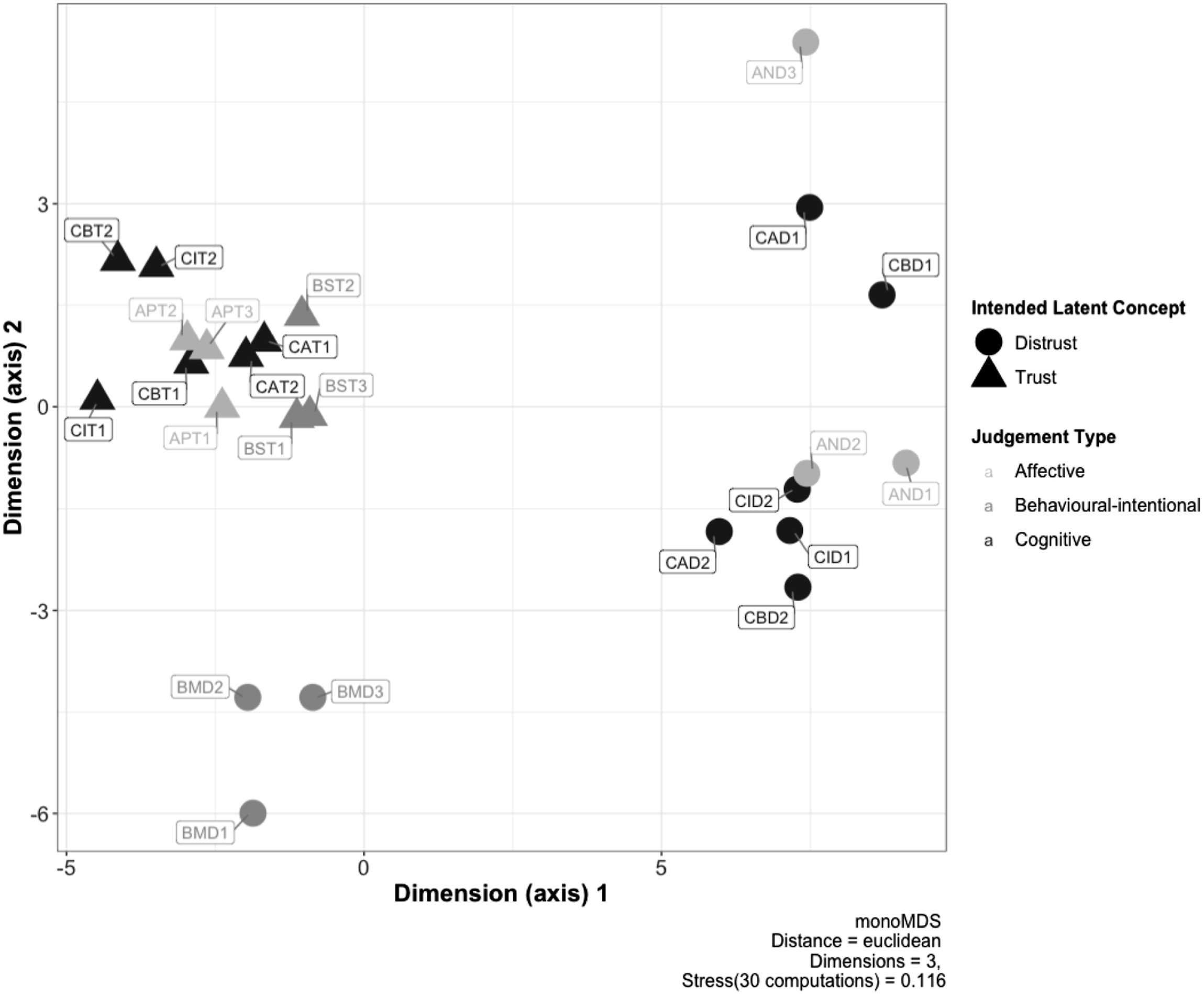
Three specific and worthwhile observations arise from this analysis. Firstly, item responses divide the geometric space in an axial fashion, which suggests that the theoretical separation of trust and distrust (implicit in the PTB-24) is powerful and makes sense when testing MPs’ other-to-self perceptions of public trust judgements. Secondly, there appears to be greater variance among participants’ responses to items tapping distrust as opposed to trust. Thirdly, and most importantly, behavioural-intentional distrust items appear to form a separate region of their own. This particular second order contiguity suggests that these items might tap a different theoretical construct that was also identified in an early test of the inverted PTB-24 with local councillors in the UK (see Weinberg, 2020a). Given that behavioural-intentional distrust is measured in the PTB-24 as a particular form of political scepticism, I suggest that these items might be better referred to as measuring perceptions of mistrust.
Mistrust has been debated at length as a key resource for critical citizens and central to political accountability (Dalton and Welzel, 2014; Van der Meer & Zmerli, 2017). Mistrustful intentions are those characterised by negative censorship and/or surveillance of a trustee and, in politics, these intentions and parallel actions are often highlighted as signs of ‘monitory’ democracy (for an extended discussion, see Keane, 2011). In evaluating public judgements of themselves, it is possible that politicians also distinguish between expressions of distrust and mistrust. In other words, politicians may hold varying ideas about (a) the extent to which they are scrutinised or monitored (i.e. felt mistrust) and separately (b) the prevalence of more cynical evaluations of their character (i.e., felt distrust).
Principal-Component Factor Analysis of Survey Items Measuring Felt Trust, Distrust and Mistrust.
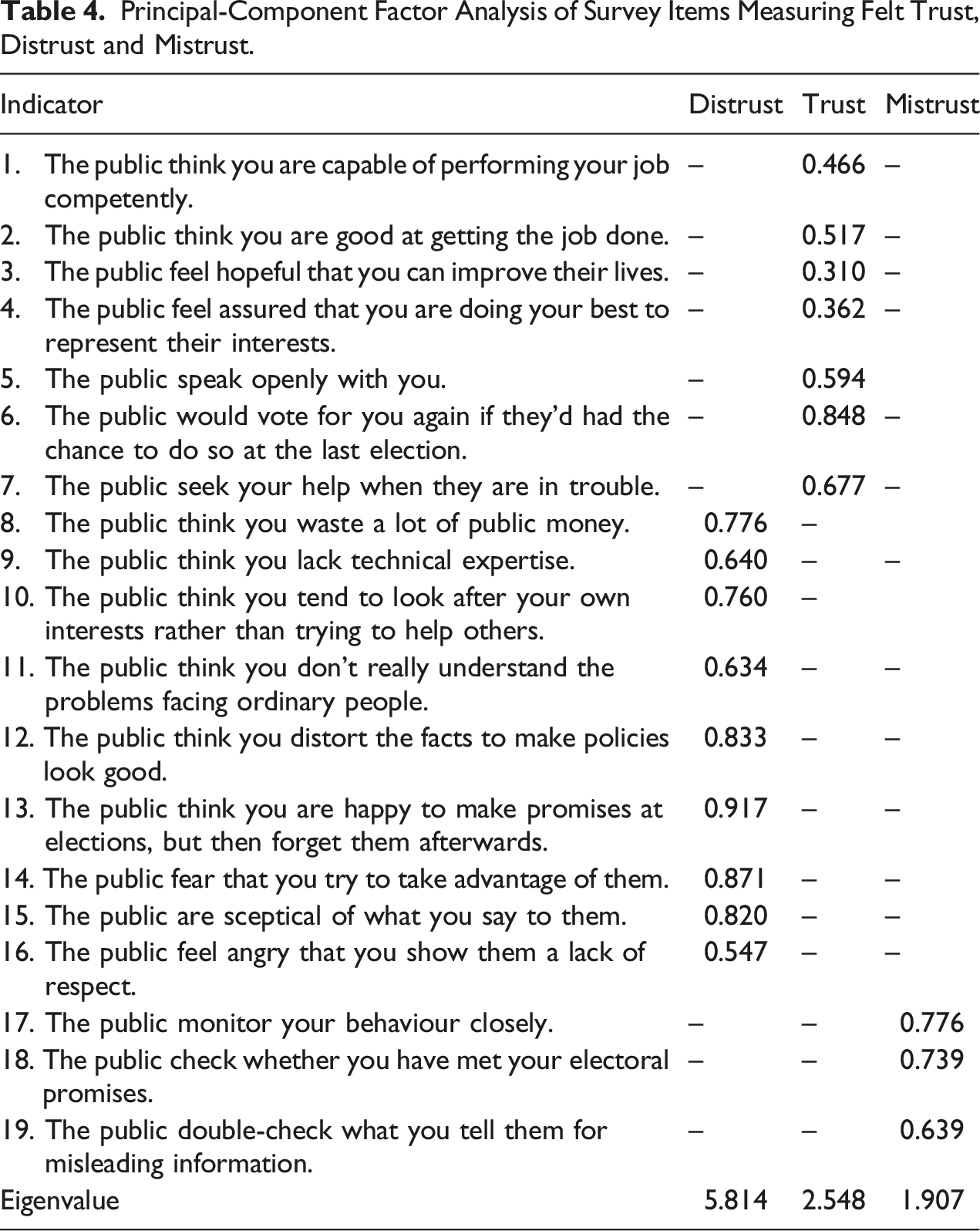
Given that factor scores are not easily interpretable, Figure 3 also presents mean scores for MPs’ felt trust, distrust and mistrust based on their original Likert-scale responses to the items comprising each variable. Three notable trends stand out. Firstly, MPs in all three countries feel more trusted than they do distrusted. This is surprising given the parlous state of the public’s political trust in each of these nations, discussed earlier, and suggests that politicians do not make accurate appraisals of a low-trust, high-distrust civic culture. This ‘trust gap’ has also been recorded previously between UK councillors and constituents using corresponding survey measures fielded at the same time (see Weinberg, 2020a). Secondly, UK MPs feel less trusted and more distrusted than their peers in either Canada or South Africa. This may say something about the political culture in the UK insofar as MPs and their offices are set up in a way that is renowned for developing close links between representatives and their constituents across multiple media and face-to-face (see Dobson, 2014, p. 171). The enhanced possibility for political contact may help to mitigate MPs’ misperceptions of public trust and distrust. Thirdly, South African MPs feel more mistrusted than MPs in either Canada or the UK. This is theoretically anomalous given that the South African electoral system is better designed to invite scrutiny of party platforms (as opposed to individual backbench MPs) than the majoritarian system in the other two nations. These findings are worthy of future research, but I am primarily concerned, in this particular article, with the explanatory purchase of felt trust and distrust when it comes to understanding MPs’ risky decision-making in political office. Average perceptions of trust, distrust and mistrust among elected politicians in Canada, South Africa and the UK.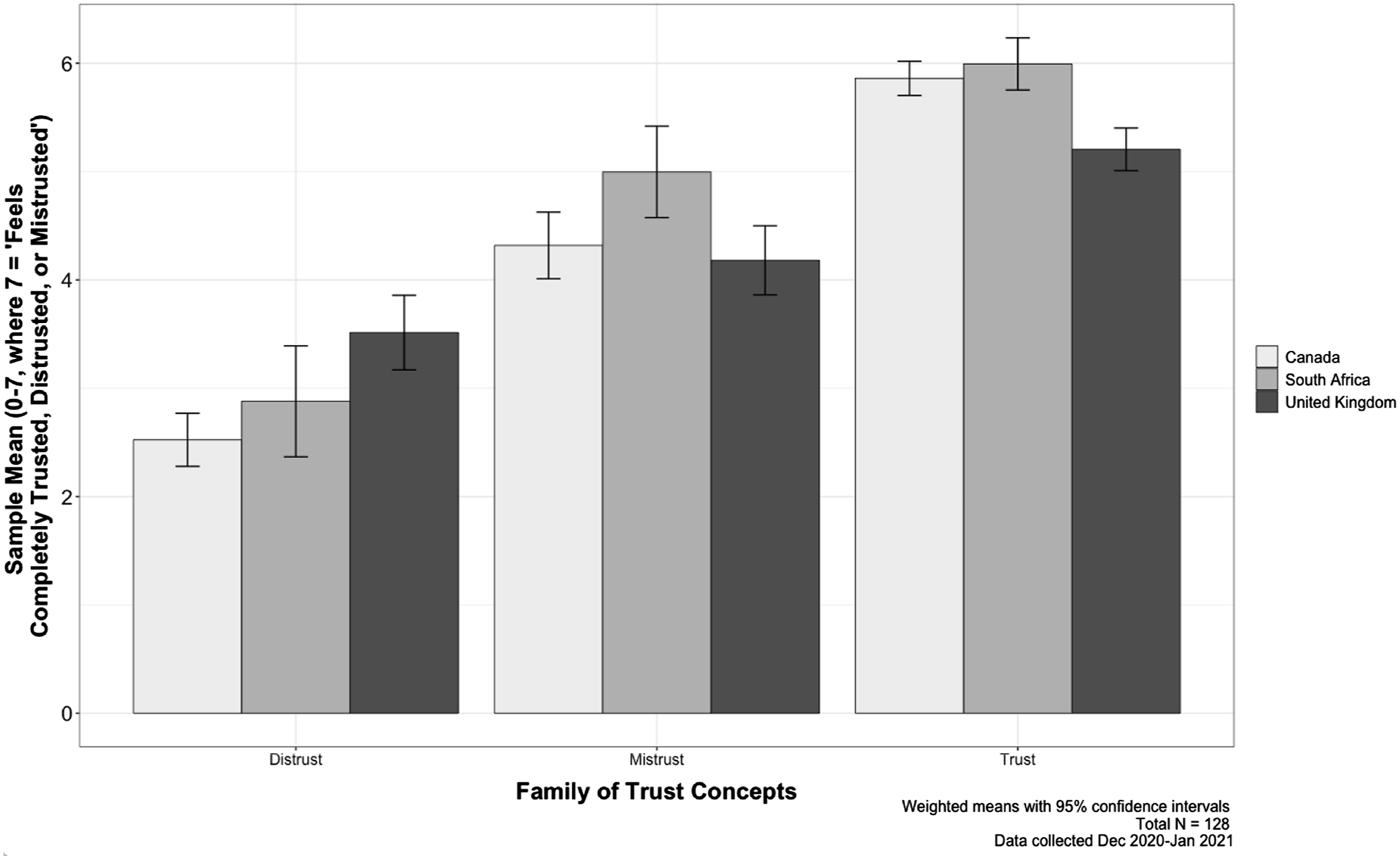
Analysis
MPs’ Risky Decision-Making: Estimates from Mixed Effects Logistic Regressions. 8
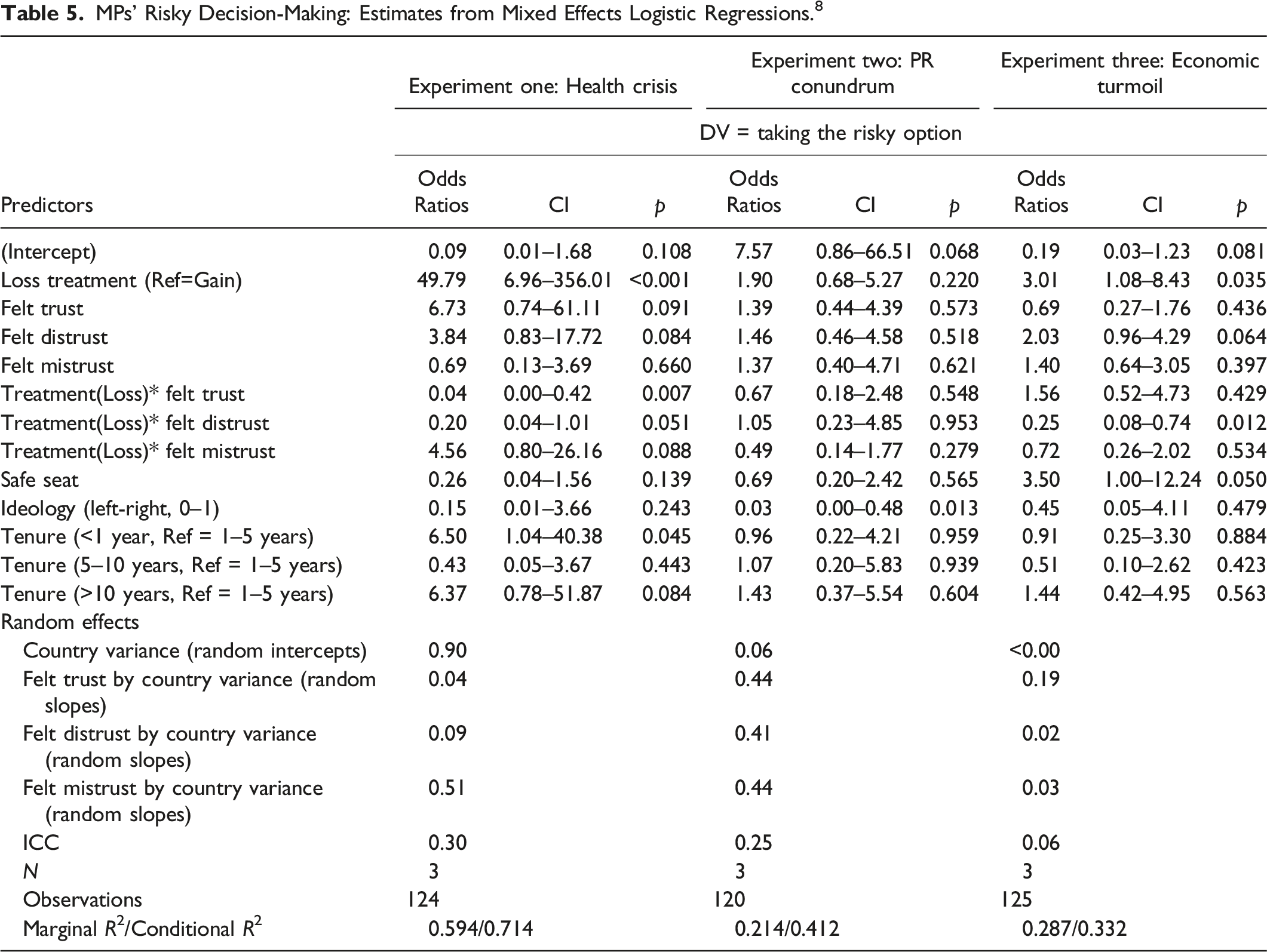
In the models reported in Table 5, I control for whether or not an MP holds a safe parliamentary seat, their ideology and tenure in political office. 7 Given sample size constraints, these controls are chosen selectively with parsimony in mind. All of these control variables may directly affect the way in which politicians interpret risk in their occupational lives. In this respect, it is worth remembering that the consequences of a risky decision may be contingent on a politician’s subjective appraisal of the status quo in their own policy or electoral context. For example, politicians in marginal seats may naturally anticipate greater electoral costs when risky decisions backfire, and especially so when those decisions are taken individually. In prior research, right-wing politicians have also been more likely to take risks (Linde & Vis, 2017). Finally, if rational choice scholarship on party discipline and elite behaviour is to be believed (e.g., Kam, 2009), then one would expect MPs’ behavioural patterns (and indeed their risk perception) to change significantly across the course of their careers. MPs nearing the end of their careers might be less risk averse because they have fewer incentives to appease party gatekeepers, to cultivate a personal vote among the electorate or to abide by the party whip.
The results of these mixed effects regressions provide nuanced support for the [felt]trust-as-heuristic thesis. I start with experiment one. In the ‘Asian disease’ experiment, the main fixed effects of felt trust and felt mistrust were significant in the reduced models (see Online appendix C). Precisely, higher levels of felt trust reduce rates of risk taking whilst higher levels of felt mistrust increase them. However, these associations drop out when interaction terms and control variables are introduced (Table 5). Instead, a strong interaction term between felt trust and the treatment conditions emerges. MPs who recorded higher levels of perceived public trust were actually less likely to choose the risky legislative package when it was presented through a loss frame (contra H3) and more likely to do so in the gain frame (support for H4). For ease of interpretation, the predicted probabilities of this interaction term are plotted in Figure 4. Interaction between treatment conditions and MPs’ felt trust in experiment one.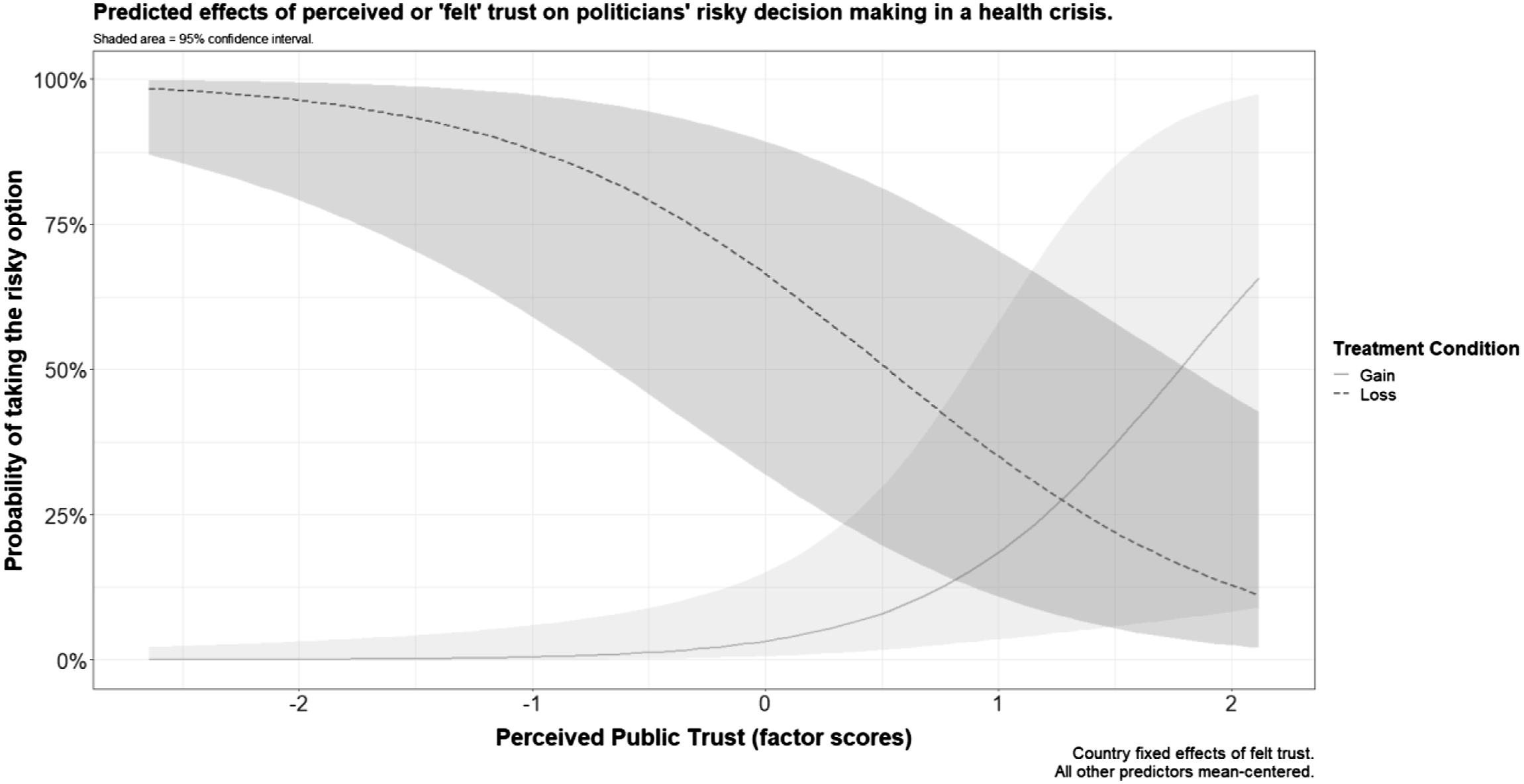
Both newly elected and long-established MPs were also more likely to take the risky option in experiment one than their mid-career colleagues. The random effects of mistrust also appear to vary at the country level. On inspection, Canadian MPs start from a higher probability of taking the risky option and show a sharp decline across the range of scores for felt mistrust. In contrast, MPs from the UK and South Africa were less likely to choose the risky option in the first place and showed very little variation according to levels of felt mistrust. However, these differential effects must be read with caution until tested with larger samples given that a likelihood ratio test of this model with and without random slopes produced a non-significant result (χ2(9) = 3.37, p = 0.947).
In experiment two – a PR conundrum – the trust-related variables exert little to no impact on whether politicians chose the risky option (i.e., to speak in favour of a new protest movement; H1-4 unsupported). As foreshadowed by Figure 1, the treatment effects are only significant at p < 0.10 and even then, only in the reduced models without control variables (models 2 and 3 in online appendix C). Ideology is the only meaningful predictor of MPs’ risk preferences in this experiment. Contra the pattern found among Dutch MPs by Linde and Vis (2017), right-wing MPs were significantly more risk averse. It is possible, however, that these effects are a function of the contextual set-up of experiment two and, precisely, the fact that left-wing politicians are more likely to be generally supportive of protest movements. It may be that this ideological preference also obscures the reflection effect (and thus the efficacy of the treatments). I return to this confound later in the paper.
Whilst the fixed effects of the trust-related variables are null, the random effects of felt trust, distrust and mistrust suggest that there may be meaningful variation across countries. For example, felt trust appears to suppress risk taking among South African MPs, but increases it among UK and Canadian MPs. Similarly, felt distrust and mistrust appear to greatly increase risk taking among Canadian MPs, marginally increase it among UK MPs, and suppress it among South African MPs. However, a likelihood ratio test of this model with and without random slopes is non-significant (χ2(9) = 5.97, p = 0.743) and, therefore, these differential effects must again be read as preliminary until tested with larger samples.
In experiment three, there is a significant interaction between MPs’ felt distrust and the treatment conditions (Table 5). Contra H1, politicians placed in the gain frame were actually more likely to take the risky option if they harboured higher levels of felt distrust (e.g., Figure 5). In line with H2, however, felt distrust does appear to mitigate risk taking in the loss frame. Put another way, MPs’ perceptions of being distrusted were negatively associated with voting for an economic package that had uncertain outcomes, at a time when the economy was already doing worse than expected, and against the express wishes of their party leadership. With individualised electoral considerations activated as a reference point, MPs in safe seats were also, on average, over three times more likely to vote against their party whip and for the risky legislative package. Interaction between treatment conditions and MPs’ felt distrust in experiment three.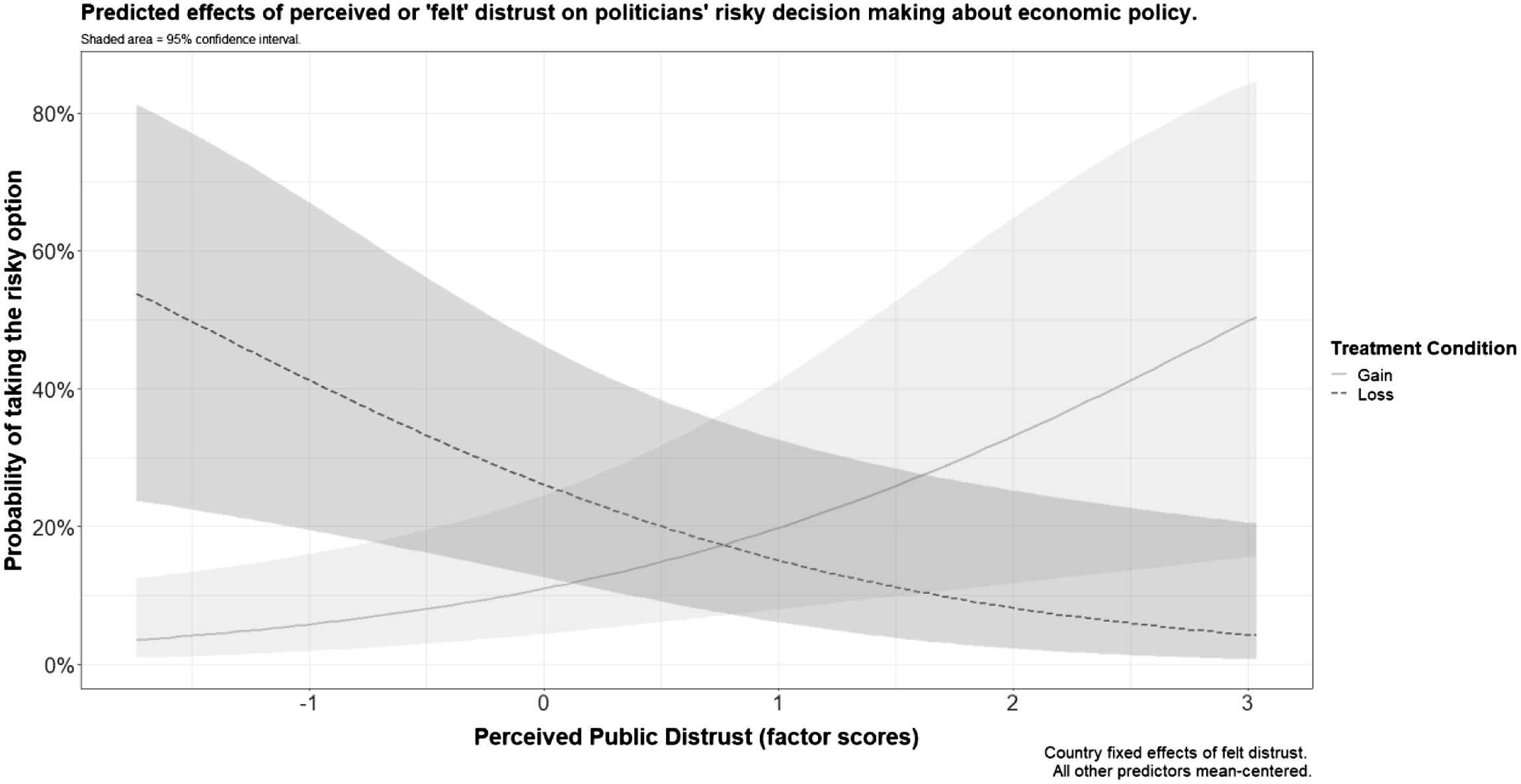
The intraclass-correlation coefficients indicate that very little, if any, variance is accounted for in experiment three by random effects at the country level. At the same time, it should be noted that the average treatment effects in experiment three became statistically significant once felt trust/distrust (and other controls) have been taken into account (models 2–4, online appendix C). It is possible, therefore, that politicians who are high or low in felt trust/distrust are not only more or less likely to take risks in different gain or loss frames, but they may also be more or less likely to appraise those frames in the first place. This proposition should be tested more explicitly in future projects.
As per H5, I expected that felt trust and distrust would have a greater effect on decision-making in experiment one (with drastic policy consequences as the main reference point) and experiment three (with individualised electoral consequences as the main reference point) than experiment two (with indeterminate policy consequences and collective electoral consequences as reference points). The fixed effects in Table 5 provide preliminary support for this supposition. Put simply, the effect of felt trust is meaningful in experiment one, whilst felt distrust exhibits a meaningful effect in experiment three. There is no concrete evidence to suggest that either of these variables (or felt mistrust) influenced decision-making in experiment two. Although not anticipated, these findings might suggest that MPs’ perceptions of trust and distrust become salient for different dimensions of political risk appraisal. In other words, felt trust may be relevant when MPs face risky decisions that are primarily defined by policy outcomes, whereas felt distrust may be more relevant for risky decisions that are defined by individualised repercussions in the electoral domain.
Discussion and Conclusion
Existing research on political trust has largely overlooked the thoughts and feelings of those who actually hold political office and operate professionally as the target of a low-trust, high-distrust climate. In this article, I argue that politicians’ perceptions or feelings of public trust and distrust impact the claim-and-response model of representative democracy upon which policy responsiveness and good governance are built. Moreover, I suggest that felt trust and distrust operate as a heuristic for decision-making under conditions of risk that are endemic to political life. Using new measures of felt trust/distrust and three survey experiments conducted with politicians in different national settings, I present preliminary support for these novel propositions. When elected MPs are randomly exposed to situations of risk that are framed in terms of either gain or loss, they not only exhibit a reflection effect, but there are occasions when such biased cognition may be reinforced or mitigated by beliefs about public trust and distrust.
These findings have important implications for existing and prospective work. Whilst public opinion polls and academic surveys measuring political trust or distrust as predictors of political outcomes are incredibly useful, they paint an incomplete picture. In contrast, a dialogic model of trust relations in politics acknowledges the importance of both principal (i.e. citizens, the trustors) and agent (i.e. politicians and policy-makers, the trustees). To understand when and why trust does or does not facilitate good governance, or distrust does or does not stimulate change, political scientists must also ask (a) whether politicians’ felt trust and distrust are contextually relevant and to what extent, and (b) whether politicians perceptions of public trust and distrust are accurate. On the latter point, MPs’ self-reports in this research project suggest that they are out-of-step with broader public opinion in all three countries studied. This is an important finding in and of itself. If, for instance, MPs feel more trusted and less distrusted than they actually are, what does this say about the state of contemporary democracy? A growing literature has already started to explore the perceptual [in]accuracy of politicians’ beliefs about public preferences (e.g. Pereira, 2021; Varone & Helfer, 2021) and the findings presented in this article suggest that there is room for conceptual travelling from that field of study to dialogic research on political trust.
When it comes to explaining politicians’ risk preferences, felt trust and distrust did not operate entirely as anticipated. Contra H1, high levels of felt distrust exacerbated risk-taking in the face of gains in experiment three, which suggests that negative perceptions of public opinion may lead politicians to upweight (rather than downweight) the probability of good outcomes in certain circumstances. As such, felt distrust appears to invert the reflection effect. And contra H3, high levels of felt trust mitigated MPs’ risk-taking in the face of losses in experiment one. Far from emboldening MPs in situations of risk, feelings of trust also appear to invert the reflection effect. It is possible that MPs with high levels of felt trust are aware of the political capital that they command and, in turn, how quickly they might squander it. Thus, positive appraisals of public trust judgements lead to cautious decision-making (i.e., over frather than underweighting the personal or public risks attached to occupational choices).
Although these findings partially violate the hypotheses offered in the early sections of this paper, they do resonate with parallel logics of elite decision-making found in a well-developed literature on Blame Avoidance Behaviour (BAB). At the heart of this research is the seminal work of Kent Weaver (1986) who famously argued that politicians display a systematic bias towards a ‘minimax’ strategy in the blame-credit trade-off (i.e., to minimize the maximum loss; see also Hood, 2002). Placed in a loss frame, politicians who feel trusted may be more likely to discount potential gains relative to additional losses that might result from a risky decision. In other words, they have more to lose in the first place and seek to protect their political capital. Conversely, politicians who feel distrusted may have less incentive to minimise blame than usual (given a starting point of perceived public cynicism) and more incentive to maximise credit where the positive outcomes of a risky decision are already upweighted (as in a gain frame). Thus, it seems that felt trust and distrust both have the potential to mitigate or invert reflection effects in politics (e.g., Figures 4 and 5) and prior work on BAB may help future research in this field to make more accurate predictions about when and why each does so.
Whilst felt trust and distrust both appear to moderate the reflection effect, the activation and saliency of these concepts appears to rely on different context-specific risk appraisals. Subject to further study, the experimental data presented here indicate that felt trust may be more relevant when MPs face risky decisions in the policy domain and felt distrust may be more relevant for risky decisions defined by [individualised] electoral consequences. These findings help to crystallise the dynamics of a dialogic approach to political trust or more specifically a [felt]trust-as-heuristic thesis, and they are deserving of more time and attention (in particular, complementary qualitative studies of politicians). In the theoretical setup to this paper, I also argued that politicians may feel or believe they are trusted by certain audiences to carry out or decide upon some certain actions but not others. Future research should now seek to test this assumption more accurately by digging deeper into the varying audiences or constituencies that sit behind politicians’ perceptions of ‘public’ trust and distrust.
For those interested in the study of elites and heuristics, it is worth noting that the standalone effects of the treatments in experiments two and three were much weaker than expected. Given that a strong reflection effect was found in experiment one, it is unlikely that this was due to a confound in the sample. Instead, it is possible that these experiments provided too much (experiment two) or too little (experiment three) context. 9 The explicit topic of the PR conundrum in experiment two (i.e. a protest movement) and the lack of detail about the ‘fiscal measures’ in experiment three (especially when read in the loss frame) may have primed ideological preferences or interpretations that confounded the anticipated effects of the gain- and loss-setting frames. In sum, the hypothesised reflection effect may have been harder to identify at an aggregate level due to an added layer of participant interpretation above and beyond the stated risk trade-offs. The hypothesised effects of felt trust and distrust in experiments two and three may also have been weaker than expected for this same reason. This is a consideration that has not featured in prior research on this topic, but it should inform future experimental designs of this type as well as more concerted scholarship on when and why the reflection effect is or is not pertinent in politics in the same way as other professions.
As with all studies of political elites, this research is also limited by sample size. As a result, conclusions about specific within- or between-country effects require validation with a larger pool of participants that can yield greater statistical power. However, the empirical findings presented here do show preliminary evidence of comparative trends (vis-à-vis felt trust/distrust and decision-making) in at least three democracies that share in a climate of political distrust but differ in their institutional arrangements and political culture. This is particularly interesting when one considers that South African MPs operate in a party-list proportional representation system that works against democratic accountability (for individual MPs) and increases MPs’ electoral bind to the party as opposed to the public. For this very reason, a Constitutional Court judgement in June 2020 (New Nation Movement NPC and Others v President of the Republic of South Africa and Others, 2020) concluded that South Africa’s existing electoral act was unconstitutional. Subsequent proposals for reform have demanded a new system of multi-member constituencies that increases the electoral link between MPs and voters (Inclusive Society Institute, 2021). Yet, the fact that South African MPs appear to draw upon perceptions of public opinion to make decisions about representative behaviours (albeit tested in hypothetical scenarios here) suggests that the responsiveness of trustee to trustor might not necessarily be wed to the electoral system in which both operate.
Supplemental Material
Supplemental Material - Feelings of Trust, Distrust and Risky Decision-Making in Political Office. An Experimental Study With National Politicians in Three Democracies
Supplemental Material for Feelings of Trust, Distrust and Risky Decision-Making in Political Office. An Experimental Study With National Politicians in Three Democracies by James Weinberg in Comparative Political Studies
Supplemental Material
Supplemental Material - Feelings of Trust, Distrust and Risky Decision-Making in Political Office. An Experimental Study With National Politicians in Three Democracies
Supplemental Material for Feelings of Trust, Distrust and Risky Decision-Making in Political Office. An Experimental Study With National Politicians in Three Democracies by James Weinberg in Comparative Political Studies
Supplemental Material
Supplemental Material - Feelings of Trust, Distrust and Risky Decision-Making in Political Office. An Experimental Study With National Politicians in Three Democracies
Supplemental Material for Feelings of Trust, Distrust and Risky Decision-Making in Political Office. An Experimental Study With National Politicians in Three Democracies by James Weinberg in Comparative Political Studies
Footnotes
Declaration of Conflicting Interests
The author(s) declared no potential conflicts of interest with respect to the research, authorship, and/or publication of this article.
Funding
The author(s) disclosed receipt of the following financial support for the research, authorship, and/or publication of this article: This work was supported by the Leverhulme Trust (ECF-2019-023).

Supplemental Material
Supplemental material for this article is available online.
Notes
Author Biography
References
Supplementary Material
Please find the following supplemental material available below.
For Open Access articles published under a Creative Commons License, all supplemental material carries the same license as the article it is associated with.
For non-Open Access articles published, all supplemental material carries a non-exclusive license, and permission requests for re-use of supplemental material or any part of supplemental material shall be sent directly to the copyright owner as specified in the copyright notice associated with the article.
