



Abstract
Clientelism, the exchange of selective rewards for votes, is fraught with commitment problems and questions remain regarding how it occurs in settings lacking strong parties. In such settings, we argue, bureaucrats can act as brokers using their own networks. Bureaucrats can use their discretionary power to cultivate reciprocal relations with voters and leverage this political capital in negotiations with politicians to secure career advancements. As brokering requires networks, we hypothesize that bureaucrats with connections to civil society are more likely to exhibit brokering behavior, and especially in localities with stronger civil society. Original survey data of bureaucrats (N=1300) in a context of weak parties, Peru’s 25 regions plus the city of Lima, show that bureaucrats with connections to civil society are more likely to exhibit brokering behavior. Political and party connections are weaker predictors of brokering. The paper thus shows how locally connected bureaucrats may aid in coordinating clientelism.
Introduction
How can candidates and parties seek to win votes with clientelistic strategies if they lack the organizational1 infrastructure of a stable party? Door-to-door efforts quickly become cost inefficient, and credibility problems escalate. This paper argues that including bureaucrats in the analysis helps to elucidate how clientelism can operate absent stable parties with strong base units. As Kitschelt (2000) and others have pointed out (e.g., Levitsky, 2003), the scale and effectiveness of clientelistic strategies depend on the organizational capacity and infrastructure of the political party. Party organization affects the number of voters that can be reached, the credibility of the promises of future targeted goods, and determines the extent to which the party can monitor voters’ behavior at the polls on election day. All told, the implication would seem to be that where parties have little or no organizational infrastructure, candidates will at best be able to engage in simple vote buying: handouts distributed at rallies or through door-to-door canvassing. Scaling up clientelism would seem difficult under such conditions, as parties inject credibility and predictability in these informal exchanges.
Bureaucrats, by merit of their discretionary power in the implementation of policies and allocation of government benefits, permits, and services, can direct the flow of government resources selectively. That bureaucrats do participate in partisan efforts using government resources to win elections is by now well-substantiated (Gingerich, 2013; Hicken & Nathan, 2020; Oliveros 2016, 2021; Robinson & Verdier, 2013). Our theoretical model, however, provides an account of why bureaucrats broker even when they are not strongly tied to a party organization. We argue that bureaucrats may at times play a more independent role using their own connections, and in particular connections to organized sectors of society. Civil society associations provide the organizational structure that can enhance efficiency in any efforts requiring coordination, including clientelistic exchanges (Cornell & Grimes, 2015; Holland & Palmer-Rubin, 2015; Rueda, 2015).
The argument builds on and adds to recent observations regarding the considerable variability in brokers (Hicken & Nathan, 2020). Conventionally construed as party loyalists, recent literature brings to light that brokers can also be entirely non-partisan (Gottlieb & Larreguy, 2020; Holland & Palmer-Rubin, 2015; Novaes, 2018). In some instances, non-partisan brokers have strong ties to a specific interest organization, but may also act independently, campaigning for a candidate on an ad hoc basis. We argue in a similar way that bureaucrats with brokering ambitions may have ties to parties, politicians, or to civil society organizations, and that these connections shape their capacity to broker.
We employ data from an original survey of 1300 bureaucrats in a weak party context: all 25 regional governments in Peru plus the city of Lima. Many bureaucrats have secure tenures but politicians have some degree of control over bureaucrats’ career advancements. The empirical analyses examine implications derived from our theoretical account of the incentives and strategies for brokering bureaucrats, and specifically whether bureaucrats with connections to parties, to civil society, or to politicians, are more likely to exhibit brokering behavior than those who do not have such connections. Parties are weak but regional variation exists and citizen involvement in civil society organizations also varies. The analyses thus also examine whether the party and associational landscape conditions brokering among bureaucrats.
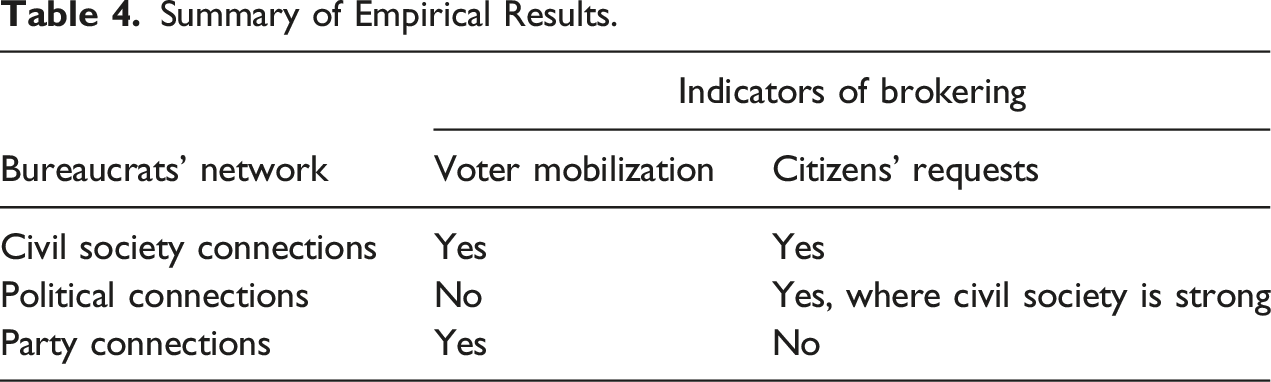
The empirical analyses indicate that bureaucrats with connections to civil society are more likely to exhibit brokering behavior than those lacking such connections; they are more likely to have been contacted by citizens with requests for targeted problem solving—a behavior observed as highly prevalent among brokers in other settings (Nichter, 2018)—and they also to a greater extent engage in voter mobilization. Party connections only predict voter mobilization. Bureaucrats’ political connections also predict brokering, but only in regions where civil society is strong. Our study thus suggests that bureaucrats play an instrumental role in clientelistic exchanges, and that the link between bureaucrats and civil society associations may structure these exchanges.
Brokering Bureaucrats and Connections to Politicians and Parties
Clientelism entails considerable moral hazard for all actors involved (Camp, 2017; Robinson & Verdier, 2013; Stokes, 2005; Stokes et al., 2013). Parties courting voters with targeted benefits risk that voters will vote for a competitor once in the booth. Similarly, voters have little recourse to hold incumbents accountable if benefits promised during campaigns do not materialize after elections. Nichter (2018) calls this the dual credibility problem. To complicate matters further, the politician-broker dyad entails similar enforcement problems since brokers can shirk as well (e.g., Larreguy et al., 2017; Stokes et al., 2013). If brokers have stable ties to voters, they can defect and back a different candidate (Holland & Palmer-Rubin, 2015). The solution to both problems pointed to in much previous research lies in the role of stable political parties with extensive grassroots manpower and organizational infrastructure. Parties reduce the costs and risks of clientelistic exchanges by providing credible promises to voters and either inducing loyalty or devising and deploying enforcement strategies that dissuade voters from reneging at the polls (Hicken & Nathan, 2020; Larreguy et al. 2016, 2017; Mares & Young, 2016; Nichter, 2008; Rueda, 2017; Stokes, 2005). Clientelistic parties develop relations of reciprocity, dependency and loyalty between politicians, brokers, and citizens, and amass the reputational capital that allows them to retain old and court new supporters (Auyero, 2000, 2001).
Yet clientelistic linkages between politicians, brokers, and citizens exist in contexts with relatively weak parties as well, for example, in Brazil (Nichter, 2018; Nichter & Peress, 2017; Novaes, 2018), Colombia (Holland & Palmer-Rubin, 2015), Peru (Muñoz, 2014; Szwarcberg, 2015), Philippines (Cruz, 2019; Cruz et al., 2020), Senegal (Gottlieb & Larreguy, 2020), Benin (Koter, 2013), and Liberia (Bowles et al., 2020). Recent work suggests that clientelism may rely heavily on non-partisan brokers in such settings. Non-partisan brokers may have various roles and positions in society, including being leaders of civil society organizations or simply an influential figure in the community (Hicken & Nathan, 2020).
Several studies argue that using public employees as brokers mitigates moral hazard between politicians and brokers, as politically appointed bureaucrats are strongly incentivized to mobilize voters to support their own patron. In Argentina, for example, bureaucrats sympathetic to the Peronist party, an enduring political machine, attend rallies, canvas voters, and use government resources to cultivate voter loyalty (Auyero, 2001; Gonzalez-Ocantos & Oliveros, 2019; Oliveros, 2016, 2021; Szwarcberg, 2015; Weitz-Shapiro, 2014). Studies from Romania and Bulgaria (Mares et al., 2018) as well as Colombia (Garcia Sanchez et al., 2015) also find that state employees perform political services for incumbents, brokering clientelistic exchanges. Given their discretionary power over the use of government resources—for example, aid, entitlements, or permits—combined with their access to citizens, bureaucrats are well-placed to act as brokers (Scott, 1972, 95).
That bureaucrats under some conditions have incentives to engage in brokering is well documented. Bureaucrats may broker out of a sense of party loyalty or obligation due to norms of reciprocity and wanting to help a person who gave them a job (Finan & Schechter, 2012; Lawson & Greene, 2014). They may face a threat of punishment from their political patron, as a politician who gave them a job can also take it away (Robinson & Verdier, 2013). Bureaucrats may also engage in clientelism because their fates are intertwined with the politician or party for whom they are campaigning, which makes bureaucrats’ brokering self-enforcing (Oliveros, 2021).
Two conditions suggest a need to extend the theoretical story, however. First, where parties are weak, patronage appointees would have incentives to broker only if their patron could stand for reelection and had a reasonable chance of winning. Incumbents in many developing democracies face election disadvantages, however, and are more often unseated than reelected (Klašnja 2015; 2016). Experienced bureaucrats may understand that aiding a viable challenger is a more promising strategy than aiding an incumbent with poor electoral prospects.
Second, while prior work on brokering bureaucrats focuses on political appointees (Geddes, 1994; Shefter, 1994), many bureaucrats have secure tenures and thus, at first glance, have weak incentives to broker. Comparative public administration research documents extensive variability in public sector personnel between countries (Dahlström and Lapuente 2017; Peters & Pierre, 2004) but also within countries and even within agencies (e.g., Bersch et al., 2017; McDonnell & Vilaça, 2021). Civil services often consist of a patchwork of contract types, ranging from temporary discretionary appointments to secure positions with legal protection. Legal provisions protect bureaucrats’ tenures explicitly to prevent politicians and parties from engaging in patronage and using state resources for political gain (Schrank 2020).
An important theoretical extension of this paper is to argue that bureaucrats with secure tenures still have incentives to broker even absent the strong negative incentive of the threat of dismissal. Politicians often still influence promotions, demotions, or transfers, which may induce willingness to serve them in ways that even involve illicit behavior. In Ghana, for example, politicians have power over transfers, and awareness of this power induces a willingness in bureaucrats to abet politicians in corruption (Brierley, 2020). Politicians’ discretionary power in personnel decisions thus varies considerably; where high, bureaucrats may be subject to coercive pressure to broker, but where low, bureaucrats may still have incentives to broker, but on a more voluntary basis.
In answering the question of why bureaucrats broker absent strong party loyalties, we thus argue that even given tenure security, if politicians can influence their employment conditions (responsibilities and remuneration), positive inducements remain. Moreover, drawing on insights on non-partisan brokering, we argue that bureaucrats may even broker for a viable challenger in an effort to curry favor with a future principal. Some brokering may be less self-enforcing than suggested in previous literature (c.f. Oliveros, 2021) and brokering among bureaucrats also a more variegated phenomenon than previously described.
In the next section, we develop a theoretical account of how bureaucrats may broker, that is, how they can demonstrate their credibility to both clients and potential patrons without the organizational infrastructure of a party. We argue that bureaucrats’ own connections and networks are key to effective brokering.
A Theory of Brokering Bureaucrats
Brokering effectively requires access to resources, knowledge of benefits of value to voters, and capacity to mobilize voters and influence vote choice. To receive a payoff, the broker also needs to credibly claim credit to the patron—or prospective patron—for votes mobilized. Being embedded in a stable party organization aids in overcoming these challenges. How might bureaucrats with brokering ambitions resolve these issues when stable parties are lacking?
Bureaucrats with professional or administrative functions have discretionary power over the use of state resources (Huber & Shipan, 2002). Bureaucrats regularly make decisions regarding the allocation of goods and services, most of which will be unknown to incumbent politicians, as it is beyond politicians’ ability to fully monitor all decisions. Moreover, bureaucrats have an informational advantage vis-à-vis politicians (Weber [1922] 1978, 991–994). They have expertise and experience of policies, programs, and local conditions accumulated over years. Bureaucrats with connections in the community may have valuable information about citizens’ needs and grievances. This knowledge can, if so desired, improve efficiency in the targeted allocation of state resources. Especially in a context of weak parties where political careers may be fleeting, bureaucrats are likely to be more experienced and more capable of forming long-lasting ties with the electorate than politicians. If bureaucrats succeed in cultivating ties and reciprocal relations with voters, they are well positioned to exert influence on voters come election day.
Recognizing their own potential to broker, bureaucrats may initiate contact with candidates who emerge as viable contenders during the campaign season, to signal their support and to offer to help the candidate’s electoral bid. A bureaucrat may in other words offer to mobilize voters to support a specific candidate in anticipation of career advancements once the candidate wins the election, provided they correctly predict the victor. In contrast to previous work on brokering bureaucrats, this account thus acknowledges that some portion of bureaucrats may act as independent brokers and may serve either challengers or incumbents.
Credibility Challenges
Autonomous brokers face credibility challenges with respect to politicians, as they need to be able to credibly promise to deliver votes or claim credit for having delivered votes in an election. Even if incentivized to do so, not all bureaucrats can broker efficiently. For both issues, mobilizing votes and credibly claiming credit for doing so, bureaucrats need their own ties to voters.
From the voter perspective, brokers must demonstrate credibility with respect to delivering goods of value, which are, implicitly or explicitly, provided in exchange for political support when the time comes. A primary way that brokers demonstrate credibility to voters is by continuously nurturing relations with clients, that is, relational clientelism, and not only during campaign periods, that is, electoral clientelism (Nichter, 2018). Voters test brokers’ credibility by making requests for help or benefits, and the ability to deliver builds trust (Nichter, 2018, 12). Voters, we also know, engage in broker-shopping, and find some brokers more credible and effective than others (Auerbach & Thachil, 2018). Thus, brokers may signal credibility to voters by showing a willingness to field requests for help and an ability to provide solutions and goods.
Scaling up: The Importance of Organizational Connections
From the politicians’ perspective, brokers’ credibility lies in their ability to deliver votes. Thus, one of the most important assets for a broker are connections to voters. Public employees, even with discretionary power over the use of government resources, face the same dilemmas of informal clientelistic exchanges as candidates and parties do. Thus, even though bureaucrats have both the resources and incentives to act as brokers, their ability to do so may vary.
We argue that bureaucrats’ own networks in society can enable them to broker efficiently, and that connections to associations can allow them to do so at a larger scale. This is especially true in contexts where parties are too organizationally weak to recruit members, maintain local offices, and sustain a web of connections to voters. Parties can cultivate brand recognition, social relations, bonds of loyalty, identification, and even dependence, all of which reinforce voters’ commitments. Public sector employees can achieve many of the same aims by, we argue, liaising with civil society associations be they neighborhood associations, peasant groups, market vendors’ associations, professional associations, or other types of associations. Cultivating relationships with civil society associations allows bureaucrats to overcome two dilemmas, the first related to information about voters’ needs and the second related to monitoring their behavior in the voting booth. A brief discussion of each point follows.
Associations can help to identify voters’ needs and preferences, or the problems of highest priority to a group of voters. Providing a benefit of value to an association can gain the sympathies of a block of voters, a more efficient strategy than individual level exchanges. Auyero (2000, 74) estimates that any single broker can manage a network of about 100 voters, not more. From the perspective of the individual voter, allowing an association to intermediate with candidates can also have benefits, as elections may result in larger scale and longer-term benefits to members, such as improvements in local infrastructure or services (Gay, 2010).
Second, associations, many of which routinely engage in projects that require the coordination and organization of members’ time and efforts, can also offer the social linkages and stable relations that facilitate efforts to mobilize and coordinate voters to cast their ballot for an agreed upon candidate. Social relationships among members may aid in ensuring that association members follow through and vote for an agreed upon candidate. A history of coordinated efforts in an association can foster trust that other members will act in accordance with commitments to a given plan, including to back a designated candidate.
That social networks fill these functions has been observed in different contexts. In Latin America, Schaffer and Baker (2015) find that even the weak ties of being an opinion leader in “informal conversation networks” increases a person’s attractiveness as a target of clientelism, as brokers hope for a “social multiplier effect.” Cruz (2019) shows that in the Philippines, two distinct indicators of social embeddedness—the number of social ties and past participation in volunteer community projects—both predict the likelihood of being targeted for vote-buying. Socially embedded individuals, she argues, are more attractive to brokers because targeting clusters of individuals increases the likelihood that voters will follow through, not least because they are likely to communicate with one another after the election about who they voted for, in effect reducing ballot secrecy. As Zarazaga (2014) observes in the Argentine context, a good broker knows voters’ needs, but also knows them socially well enough to be able to “read” them the day after election to know if they voted as promised. Social ties thus help to mobilize voters, monitor their choice at the polls, and articulate voters’ needs and interests.
Associations may fill these functions even more effectively than social networks since the aim of many associations is expressly to further the interests of members. Considerable empirical evidence exists indicating that civil society associations participate in clientelistic exchanges (Auerbach & Thachil, 2018; Levitsky & Zavaleta, 2016; Muñoz & Dargent, 2016; Palmer-Rubin, 2019; Szwarcberg, 2015; Zavaleta, 2014). Survey evidence from Latin America shows that individuals who report active membership in civil society associations are many times more likely to have been offered rewards for their vote (Holland & Palmer-Rubin, 2015, 1190). Heads of associations may act as intermediary brokers in facilitating these exchanges (Palmer-Rubin, 2019). Cultivating ties with associations and associational leaders may thus be a key to effective brokering among bureaucrats.
To sum up, the dual credibility problem between voters and politicians inherent in clientelism (Nichter, 2018) is compounded where brokers are loosely or not at all affiliated with parties. The dynamic exists between politicians and bureaucrats, and between bureaucrats and voters (or blocs of voters). Having connections to civil society may help a bureaucrat convince politicians that her own brokering work was instrumental in delivering a bloc of votes, thereby earning a promotion. The dual credibility problem between bureaucrats and voters is mitigated by continually servicing requests for help and liaising with associations increases efficiency in the allocation of public resources and minimizes voter defection.
A bureaucrat’s own networks and connections thus enhance efficiency in brokering. Figure 1 depicts the flow of bureaucrats’ exchanges with civil society associations and politicians, respectively. Connections, currencies, and credibility among brokering bureaucrats.
While connections to associations are central, connections to the political sphere can certainly affect bureaucrats’ brokering capacity as well. Auerbach and Thachil (2018) show that voters opt for brokers with more human capital in the form of education, but also brokers that are more connected to the bureaucracy and to party organizations. Ties to politicians can enable a bureaucrat to help voters gain access to government resources outside the scope of their own discretionary power. Political connections thus increase bureaucrats’ credibility in relation to citizens since it signals having greater influence in political decisions and thus allocation of resources.
We hypothesize that connections to each set of actors—politicians and parties on the one hand, and associations on the other—are associated with more extensive brokering. These connections structure the exchanges and may also enhance bureaucrats’ credibility along the chain. In other words, a bureaucrats’ connections to politicians and parties (“a” in Figure 1) enhance credibility in the eyes of citizens and association leaders, and connections to associations (“b” in Figure 1) enhance their credibility in candidates’ estimation.
Two extensions of the theoretical model depicted in Figure 1 relate to how characteristics of the setting—and specifically the strength of civil society and of political parties, respectively—might affect brokering behavior among bureaucrats. Bureaucrats’ opportunities to broker efficiently may depend on the degree to which citizens form and join associations. A dense civil society increases the opportunities for larger scale mobilization. We propose that bureaucrats’ connections to civil society and to the political sphere are even more important for brokerage in contexts with stronger civil society for the simple reason that the more voters belong to associations, the more bureaucrats can use these networks to broker efficiently. Similarly, in contexts where parties are at least moderately strong, they are likely to play a role in structuring clientelism, and bureaucrats with political and party connections are thus more likely to be brokers. Summing up, the implications we examine empirically are (1) Bureaucrats with connections to civil society associations are more likely to exhibit brokering behavior. (2) Bureaucrats with connections to parties and politicians are more likely to exhibit brokering behavior. (3) Bureaucrats with connections to civil society associations are yet more likely to broker in settings with stronger civil society. (4) Bureaucrats with connections to parties and politicians are yet more likely to broker in settings with stronger civil society. (5) Bureaucrats with political and party connections are yet more likely to broker in settings with stronger parties.
The overarching contextual precondition for any such behavior among bureaucrats is, however, that politicians can exert some influence over their employment conditions. The next section discusses this as well as other relevant conditions in the Peruvian context.
Politics and Public Administration in Peruvian Regions
Case studies on clientelism consistently confirm that the Peruvian context is a case of weak party structures and one in which voter outreach is not primarily carried out by political operatives. Both politicians and brokers act as free agents, forming temporary bridges between citizens and the political sphere (Muñoz, 2018; Szwarcberg, 2015; Tanaka & Meléndez, 2014; Zavaleta, 2014). Some authors even claim that clientelism does not exist in Peru as the needed party organizational infrastructure is lacking (Tanaka & Meléndez, 2014), while others stress that clientelism does transpire but operates through other types of brokers, such as community leaders, or dirigentes sociales (Muñoz & Dargent, 2016; Szwarcberg, 2015).
Parties are weak in Peru, even in national electoral contests, and few national parties (except Alianza Popular Revolucionaria Americana (APRA), and Keiko Fujimori’s Fuerza Popular) have managed to contest elections at the regional level. Party building has succeeded in some regions, with parties surviving over at least two electoral cycles (Muñoz & Dargent, 2016), but electoral volatility remains high in all regions. Our calculations show that the average levels of electoral volatility, that is, the net change within the electoral party system resulting from individual vote transfers, is 69%, which is high in a comparative perspective. 2 The lowest level in the Peruvian regions, La Libertad at 43%, is still higher than in any European party systems except for Turkey (Casal Bértoa, 2020).
The theoretical argument is premised on three additional conditions: That bureaucrats have discretionary power over government resources, that politicians have power to influence bureaucrats’ employment status and conditions, and that civil society organizations engage in clientelistic relations. All these conditions are present in the Peruvian case. With respect to the first, a study shows that top civil servants at the national level pursue their own policy goals over those of incumbents, despite being politically appointed (Dargent, 2015). Our own survey provides evidence, albeit indirect, of discretionary power among bureaucrats. On a question about the importance of political connections for citizens’ requests to be successful, 40% of respondents said that political connections were “not important at all.” These figures indicate that politicians do not dictate all bureaucrats’ decisions. Moreover, regional governments in Peru control considerable resources that can potentially be used for targeted allocation. Peru initiated a comprehensive process of decentralization after Alberto Fujimori’s fall in 2000, and reinstated elected regional assemblies in 2002 (Muñoz & Dargent, 2016). Sectors transferred to regional governments include agriculture, economic development and employment, tourism, education, energy and mining, social development, housing, transportation, and health (Contraloría General de la República, 2014, 12). A 2014 review carried out by the central government found that most functions intended to be decentralized had been transferred (over 90% for most regions, though only 17% in the capital city.
Regional government is a significant proportion of the public sector in Peru. Of the total 1.4 million public employees in Peru, 47% are employed in regional governments (Iacoviello, 2015, 11). Of the 559,800 public employees covered by civil service laws, 22% are employed by regional governments (SERVIR, 2012). Thus, while the regional governments have been described as lacking in administrative capacity (Eaton, 2017, 68–76), they hold elections and have both significant resources and manpower.
Regarding the second condition, that politicians exert considerable control over employment in subnational governments, thorough assessments are lacking. According to the Civil Service Law (2013), a maximum 5% of civil servants may be political appointments, but this includes public directors, of whom no more than 20% can be politically appointed (OECD, 2016, 199). An evaluation commissioned by the Inter-American Development Bank carried out in 2011 and again in 2015 reveals, however, that hiring based on connections rather than merit continues to be common practice in Peru (Iacoviello, 2015). Due to budget constraints, hiring, promotions and base salaries have been frozen since the 1990s, which triggered a 63% increase in hires on temporary contracts, as well as the use of bonuses and allowances to augment pay (OECD, 2016, 196). Such practices provide politicians extensive discretion in hiring and salaries. To date, there is no systematic evaluation of the prevalence of political interference in hiring and promoting of public employees in regional governments specifically. Our survey asked bureaucrats to estimate what proportion of the employees in their place of employment would be replaced or reassigned if elections resulted in a change of government, and 56% of respondents estimated that 50% or more of all employees in their office would be replaced or reassigned. That said, many public sector employees have protected tenures. In our survey, 52% of the respondents have permanent contracts with protected tenures. The overall picture that emerges is one of considerable volatility in staffing and assignments, with change in political leadership triggering major turnover. While greatest for those with temporary contracts, politicians invariably exert influence over those with permanent contracts as in the Ghanian context (Brierley, 2020), incentivizing bureaucrats to provide political services such as brokering on a more voluntary basis in the hope of being rewarded.
Finally, the theoretical argument presupposes that civil society associations engage in clientelistic exchanges. Research on civil society in Peru suggests that this is a plausible claim. Using extensive interview and survey data, Stokes (1995, 62) maps modes of political engagement in one urban settlement in Lima and identifies “…two distinct and conflicting patterns of belief and action, … clientelism and radicalism.” These distinct logics informed associations’ agendas, whether ad hoc problem solving or transformative, the role of community leaders, and citizens’ view of citizenship and the state (Stokes, 1995). Vásquez (2004) suggests that clientelism is a prevalent feature of political interactions between citizens, community leaders, NGOs, and politicians in rural settings, and Zavaleta’s (2014) study of regional level electoral campaigns finds that connections to civil society organizations are clearly important for political contenders. Zavaleta (2014, 72, 99) notes that a primary task of local campaign aides, operadores políticos, is to develop politicians’ connections with civil society associations. These findings together suggest that the logic of clientelism exists among association leaders in Peru.
Research Design and Data
The analyses employ original data from a survey of 1300 civil servants, 50 from each of the 25 regional governments plus the city of Lima (Lima Metropolitana). Our empirical strategy consists of examining whether patterns in bureaucrats’ behaviors are consistent with the empirical implications of the theoretical model: First, whether brokering behavior is more prevalent among bureaucrats with connections to civil society associations, parties, and politicians, and second whether these connections predict brokering more strongly in regions depending on the strength of civil society and parties. Respondents vary with respect to security of tenures, a factor theorized to affect the degree of susceptibility to political pressure to broker. If those with secure tenures broker, we argue, they are more likely to do so autonomously compared to those with temporary contracts. We assess whether there are differences in brokering behavior between those with and without secure tenures.
We add individual level controls to address omitted variable bias arising from selection bias; some bureaucrats may, for example, be more likely to broker due to their type of position. The individual level analyses include regional fixed effects to mitigate omitted variable bias due to regional differences. When modeling the moderating effect of regional factors, we instead include regional level controls.
The survey of public employees at the regional level in Peru
The survey was conducted by the authors with logistical assistance from Instituto de Opinión Pública (IOP), a research polling service. Enumerators were trained by the authors together with IOP and the survey ran between November 2015 and February 2016.
The sample frame included only bureaucrats with professional or administrative functions. These functions include citizen services as well as policy analysis, planning, and oversight. We excluded service labor (e.g., custodial staff, chauffeurs) and employees of schools, hospitals, and orphanages. The aim was to reach public employees with sufficient discretionary power to perform brokering services, in other words to provide targeted assistance to individual citizens or associations. To mitigate social desirability bias, we contacted bureaucrats directly rather than seeking approval from agency heads or the political principals (see Supplemental Online Appendix B1-B2 for enumerator script and letter of introduction). That said, since published rosters of employees were often out of date or did not include employees on temporary contracts, compiling the sample frame required contacting human resources departments in each region. 3
The polling institute drew a random sample of 50 bureaucrats and replacement names were drawn in smaller increments until there were 50 completed interviews in the region. The global rate of completed surveys to sampled individuals was 49%, (71% discounting individuals sampled but then found to no longer be employed or not located after three visits, see Supplemental Online Appendix B3 for response rates per region). To ensure anonymity, surveys were self-administered on paper, and respondents were instructed to fold and staple the questionnaire and place it in a large envelope. For two regions, enumerators had to resort to a different tactic. In Callao, a constitutional province near the city of Lima and where both the port and airport of Lima are located, corruption is more prevalent and criminal elements have made stronger inroads. The main government building can only be entered with security clearance, which would have alerted government leadership to the survey and potentially tainted responses. Many agencies were located in other premises, however, and only one agency had to be dropped. Employees in Callao were also both harder to locate and more reluctant to respond, and the survey company reported resorting to convenience sampling, that is, asking any available officials to participate. The same procedure was followed in Lima Metropolitana. We therefore replicate all multilevel models excluding these two territories. Moreover, other forms of bias may be unevenly distributed across regions; political administrative officials may, for example, have instructed employees to answer “correctly” in some regions but not in others. Such types of bias may introduce type II errors but not false positives, as respondents may, for example, underreport engagement in political campaigns in some regions making it more difficult to detect associations. Including regional fixed effects mitigates these concerns.
A lack of official statistics on public sector employees complicates assessment of representativity. ENAHO (Encuesta nacional de hogares sobre condiciones de vida y pobreza), a national representative household survey conducted by the national statistics bureau Instituto Nacional de Estadística e Informática (INEI, 2015a) includes questions regarding sector and type of employment contract (though not level of government), allowing for a comparison on some relevant parameters between our respondents and public sector employees in similar positions across all levels of government. About 33% of all public sector employees in the ENAHO data from 2015 have jobs like those included in our sample (e.g., administrators, policy experts; the remaining 67% are e.g., teachers, healthcare workers, manual laborers) (INEI, 2015a). Our sample is on par with the subset of ENAHO respondents with respect to gender, age, and years employed at the same position. Those differences that are statistically significant are nonetheless substantively small. Our respondents do, however, have higher levels of education (see Supplemental Online Appendix B4 for means and t-tests).
Measuring Brokerage Among Bureaucrats
The behaviors we treat as indicators of brokering are (a) whether the respondent had actively tried to influence citizens’ vote choice in the most recent electoral campaigns (voter mobilization), and (b) whether the respondent had been approached by citizens or civil society associations with requests for help or support (citizens’ requests). The advantage with our measurement strategy is that these questions are less sensitive than direct questions on informal exchanges with clientelistic aims, mitigating social desirability bias.
The voter mobilization measure is a mean index of five questions about activities during the previous regional electoral campaign: (1) meeting with citizens to provide information about a candidate’s program, (2) using digital technology to promote a favored candidate, (3) distributing campaign material, (4) meeting with citizens to try to influence their vote choice, (5) participating in rallies. The response scale ranged from “not at all” (1) to “to a great extent” (7) and the sample mean is 2.13, indicating a low overall level of voter mobilization.
The question used for the citizens’ requests indicator asks: “Have you been contacted by citizens, social organizations, NGOs or private institutions in the last 12 months with requests or demands for help, support or collaboration?” All those that answered “yes” are coded as 1 and those who answered “no, but my colleagues in my office have been contacted” or alternatively, “no, not at all,” are coded as 0. 4 A full 45% of respondents reported having been contacted with requests for help from citizens. The question was posed in an indirect form (rather than a more direct “Have you provided assistance to citizens upon request?”) to mitigate social desirability bias.
Considerable evidence attests to the fact that citizens and civic associations actively reach out to politicians and bureaucrats in contexts in which clientelism is prevalent (Nichter, 2018; Nichter & Peress, 2017; Oliveros, 2016). Requests from voters may relate to goods entirely outside the purview of social policy, such as a set of car tires (Nichter & Peress, 2017), or may relate to permits, services or programs to which citizens are formally entitled (Nathan, 2019; Nichter, 2018; Oliveros, 2016). In Brazil, a survey found that 21 percent of surveyed citizens reported contacting politicians for favors in conjunction with a mayoral election (Nichter & Peress, 2017), and in Argentina, 44 percent of local public employees reported having responded to requests for help in matters of private concern (Oliveros, 2016).
These indicators are indicative of brokerage, but they may also to some extent indicate that some bureaucrats are more active members of the community more generally, without them necessarily being involved in clientelistic brokering. However, we believe that when taken together, the observed patterns are consistent with the theoretical account, and strongly suggestive of brokering.
Measuring Bureaucrats’ Connections
We measure connections to civil society and politicians with questions on employment history. Previous employment in a sector sets the bar intentionally high—connections can be established through many other means—but has the advantage that it captures comparatively strong connections. The questions read “Before occupying the present position. How many years in total did you work in one of the following…?” Those with any work experience in civil society organizations are coded as having connections to civil society (1 = yes, 0 = no), and those who previously held elected office are coded as having connections to politicians (1 = yes, 0 = no).
Two separate questions ask about connections to parties; one refers to membership in political parties and another to regional movements. The Party connections variable is a dummy indicating whether the respondent is a member of either of these. Regional movements are the equivalent of parties and are equally or more important than parties in many regions (Zavaleta, 2014). An organization may only call itself a party if it contests national elections, which many regional parties do not.
Measuring civil society strength and party strength at the regional level
To measure civil society strength, we employ data on organizational membership from ENAHO 2015 (INEI, 2015a). This survey asks whether the respondent or any member of the household is a member or participates in any one of 18 different types of organizations and associations. We calculated the regional mean (percentage) of respondents that answered that anyone in the household is a member of or participates in any of 17 different types of organizations (“political group or party” was excluded).
Electoral volatility proxies for party strength. Lower levels of volatility indicate higher levels of party stability and thus stronger political parties. We employ data from Jurado Nacional de Elecciones, 2017 on electoral results from the past four regional elections prior to our survey, 2002, 2006, 2010, and 2014. We calculate the Pedersen index (Pedersen, 1979) of electoral volatility between two elections for each region. This implies that we first calculate the absolute difference between the vote share of a party from the election in year 2 and the election in year 1. We then calculate the sum of all absolute differences at the regional level and divide by 2. The resulting index ranges from 0 to 100 and can be expressed in percentages. For each region we compute three values, electoral volatility between 2002 and 2006, between 2006 and 2010, and between 2010 and 2014. We employ two different indicators, one which denotes volatility between the two last elections, 2010 and 2014, and thus proxies for party strength immediate to the survey, and one which takes the mean of electoral volatility from all three elections, capturing more enduring patterns.
Control Variables
The analyses control for factors at the individual level that may correlate both with bureaucrats being approached by citizens and having civil society and or political connections. The models include a dummy measure of whether a respondent works as a front-line bureaucrat with frequent direct contact with citizens, as they would be inherently more likely to be approached for help from citizens. We also control for gender (1 = male), whether a respondent has university education (1 = yes), the number of years a person has been employed in the regional government, and employment sector dummies (e.g., education, health, economic development). Research from Argentina suggests that sectors relating to social welfare are more subject to capture by clientelistic networks (Scherlis, 2013). We also control for type of employment contract by including dummies for different types of contracts, which indicate different formal degrees of permanency. 5
In the multilevel models we control for the natural logarithm of regional GDP per capita (INEI, 2015b) and population size in thousands employing data from the Peruvian national statistics bureau (INEI, 2015c). We also control for the regional budget (million soles per capita) for the year 2015 using data from the Contraloría General de la República (2016). Supplemental Table A1 in the Appendix shows summary statistics for all variables.
Results
Are bureaucrats with connections more likely to exhibit brokering behavior than those lacking connections? Using the two indicators for brokerage, voter mobilization and citizens’ requests, the first set of analyses examine the link between individual level ties to civil society, political parties or to politicians, each theorized to be an important resource in brokering. It is relevant to note that these types of connections do not correlate strongly with one another. The correlation between civil society connections and political connections is moderate (r = .31, p<.05) while the association between being a party member and having held office, that is, party connections and political connections, is weaker (r = .18, p<.05). In the second set of analyses, we test whether bureaucrats’ connections matter for brokering to different degrees depending on the nature of the organizational landscape in the region.
Individual Bureaucrats’ Connections and Brokering Behavior
The first set of analyses examine the first two testable implications, that is, whether bureaucrats with links to civil society, politicians, and parties, respectively, are more likely to engage in brokering behavior.
Individual Connections and Brokering Behavior.
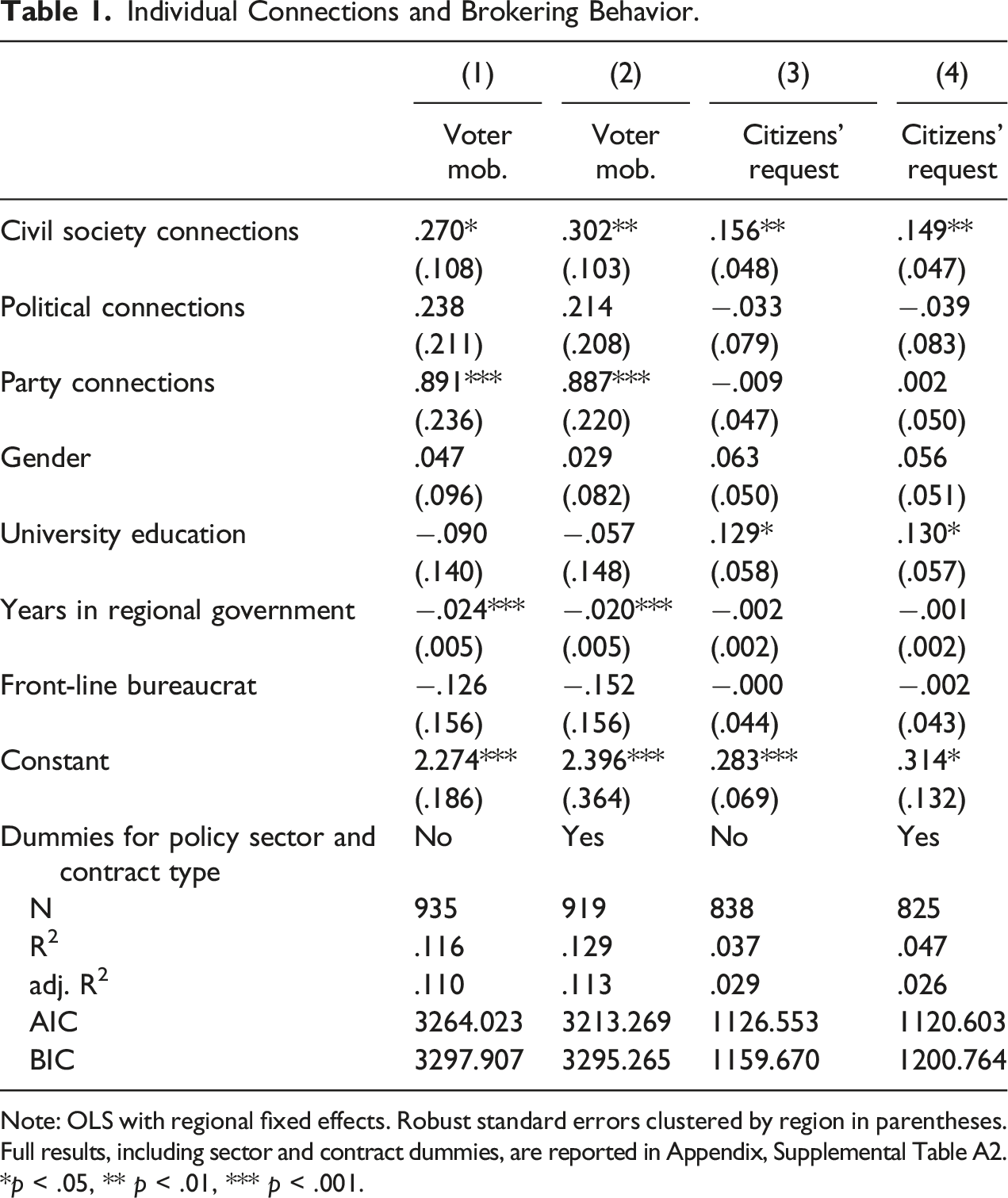
Note: OLS with regional fixed effects. Robust standard errors clustered by region in parentheses. Full results, including sector and contract dummies, are reported in Appendix, Supplemental Table A2.
*p < .05, ** p < .01, *** p < .001.
Figure 2 shows the predicted values on the voter mobilization index for all combinations of connections. The figure shows that the predicted value is the lowest for those bureaucrats without any of these types of connections, 1.8, while those bureaucrats that have all three types of connections have a predicted mean of 3.2. Bureaucrats with multiple forms of connections are thus more active in campaigning, potentially as brokers. Predicted values: Voter mobilization index.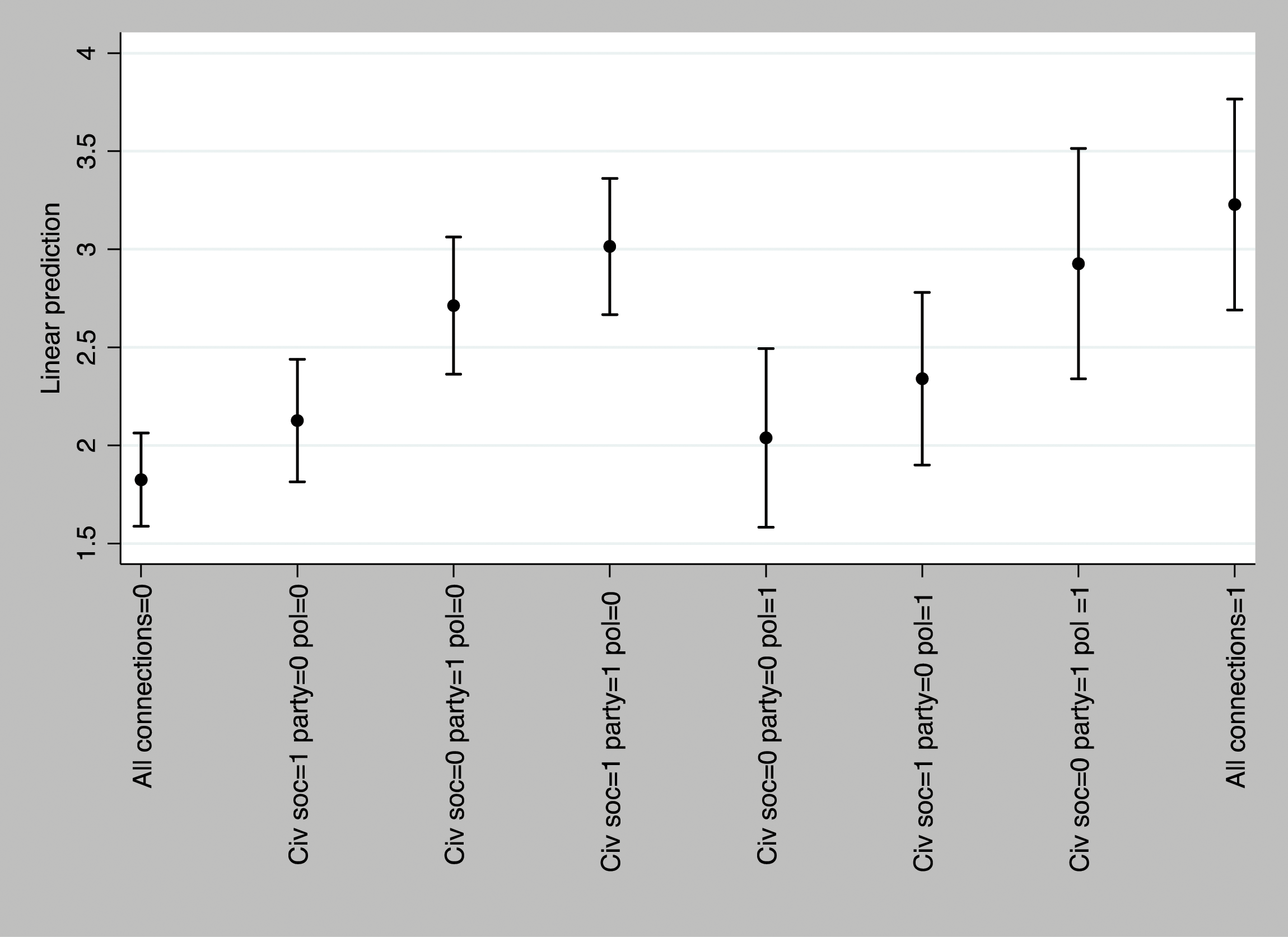
Turning to other individual characteristics we find that bureaucrats that have worked longer in the regional government were less engaged in voter mobilization efforts, and that bureaucrats with university education are more likely to be approached by citizens for requests. No other individual factors predict brokering. Somewhat surprisingly, front-line bureaucrats are not more likely to broker. Sector and type of employment contract do not matter. Bureaucrats with a contract with secure tenure are thus not more or less likely to broker than bureaucrats with other type of contracts (see Appendix, Supplemental Table A2 for full results with sector and contract dummies).
Since the citizens’ request indicator is a dichotomous dependent variable, we also run conditional fixed effects logistic regression models. These models generate similar results: The probability of having been approached by citizens with a request is greater for bureaucrats with connections to civil society, and political and party connections are not related to citizens’ requests (Appendix Supplemental Table A3). When all other variables are set at their mean, or as balanced, the predicted probability of citizens’ request is 65% among bureaucrats with no links to civil society and 78% among those who do have links to civil society (calculation based on model 3, Supplemental Table A3).
To assess if employment security affects brokering, in other words if only those with temporary contracts and thus, in theory, stronger incentives to broker do so, or if those with secure positions do so as well, we interact civil society connections with a dummy for contract type (Adm. Career 276 = secure tenure) (Supplemental Online Appendix Tables A4-A5). Bureaucrats with secure tenures who have connections are not less likely to broker. The only significant interaction results show, on the contrary, that bureaucrats with secure tenure and civil society connections are predicted to score higher on voter mobilization (2.85) compared to bureaucrats with civil society connections but temporary contracts (2.64) (calculation based on model 2, Supplemental Table A4, all other variables at their means or as balanced).
In an additional set of analyses, we combine voter mobilization and citizens’ request in a multiplicative index to see if connections are associated with bureaucrats doing both of them. The results are similar to the voter mobilization models (Supplemental Online Appendix Table A6). We also check whether bureaucrats who receive citizens’ request are more likely to engage in voter mobilization. These analyses show (Supplemental Online Appendix Table A7) a significant association between citizens’ request and voter mobilization. The predicted score on voter mobilization is about 2.3 for those bureaucrats that have been approached for citizens’ request while it is 2.0 for those bureaucrats that have not been approached (calculation based on model 2, Supplemental Table A7, all other variables their means or as balanced). Moreover, additional models show that voter mobilization is consistently related to citizens’ request. OLS regressions with region fixed effects and the conditional fixed effects logistic regression models show that bureaucrats that have a higher score on voter mobilization are more likely to be approached for request for help (Supplemental Tables A7 and A8). The predicted probability of citizens’ request is 68% at the lowest level of voter mobilization (1) while it is 81% at the highest level of voter mobilization (7) (calculation based on model 2, Supplemental Table A8, all other variables are set at their mean or as balanced). In sum, bureaucrats who engage in one form of brokering behavior also tend to do the other. Interaction models indicate, however, that the association between brokering behaviors is not stronger among bureaucrats with connections (Supplemental Table A9-A10).
Regional Organizational Landscape and Brokering
The preceding analyses suggest that bureaucrats’ individual level connections matter for whether they engage in behaviors consistent with brokering. The extent to which such connections matter for brokering may, however, depend on whether and what kind of organizational networks structure social and political life in a region more broadly (testable implications 3–5). An important implication of our theoretical argument is that the organizational landscape may determine which individual level networks matter for bureaucrats with brokering ambitions. Previous research has suggested that civil society associations may come into play in clientelistic exchanges. Links to civil society may be more important for brokering where civil society is comparatively stronger, since a broker’s ability to mobilize large numbers of voters may increase as more voters are organizationally affiliated. Similarly, we would expect that when parties are comparatively stronger, party connections and political connections should be important for bureaucrats’ ability to broker. The two dimensions of the organizational landscape, the strength of parties and of civil society, correlate only weakly (r = .17, p < .05).
Since we are interested in examining both regional and individual factors as well as cross-level interactions, we employ mixed effects multilevel models (linear or logistic regression depending on the type of dependent variable) in these analyses. In addition to the individual level controls, these models also include three regional level controls, population in thousands, the natural logarithm of GDP per capita, and the regional budget per capita.
Figure 3 reveals considerable variation in regional civil society strength, measured as the percentage members of any organization (except for political parties). It varies from Callao at approximately 15% to Huancavelica at 87%. Civil society strength by region.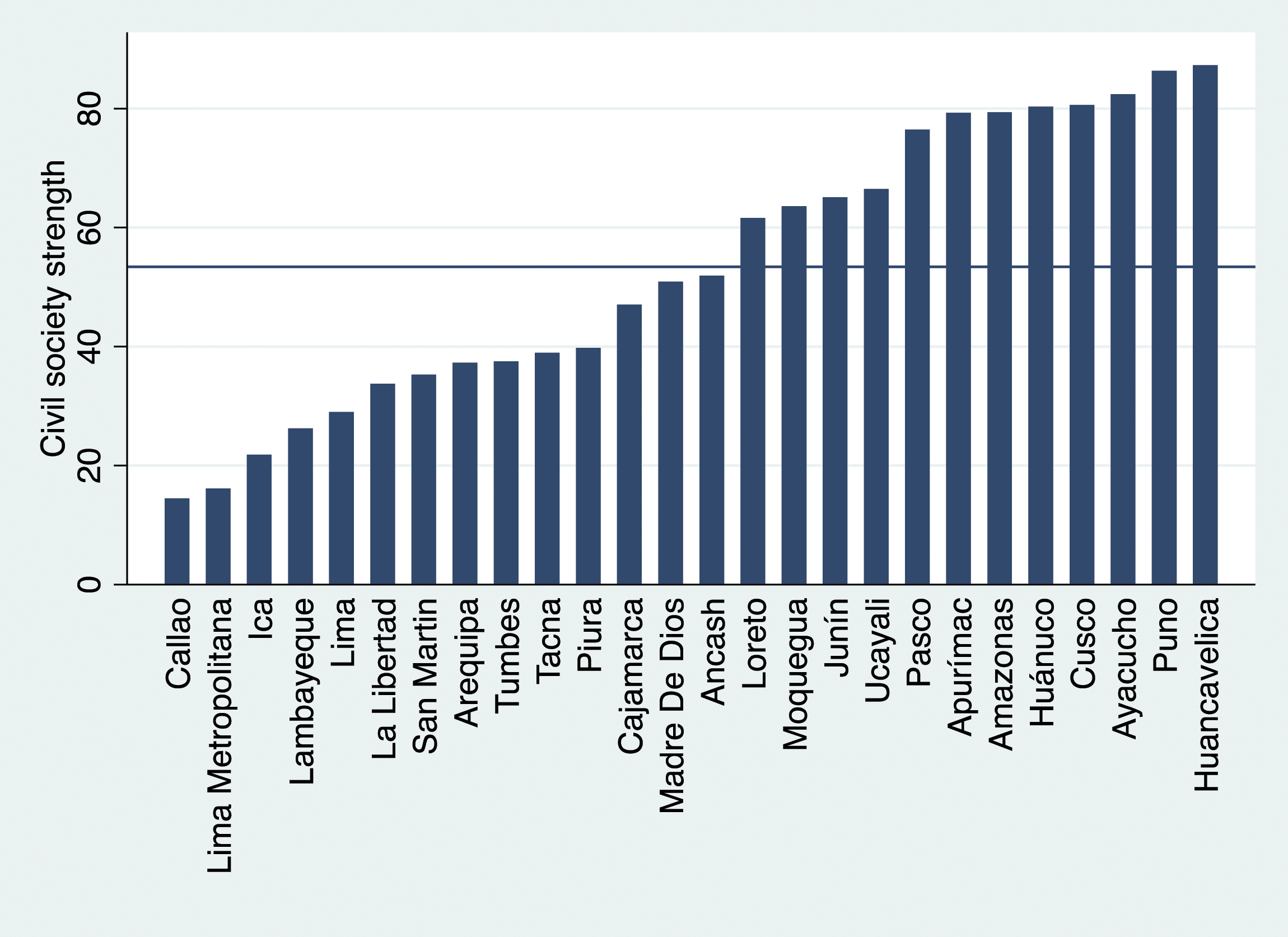
As discussed above, parties are notoriously weak in Peru, but parties are weaker in some regions than in others. This variation allows us to examine whether bureaucrats’ links to parties predict brokering where parties are comparatively somewhat stronger. We operationalize party strength both with mean regional electoral volatility between each dyad of consecutive elections (2002 and 2006, 2006 and 2010, and 2010 and 2014) and with the figure from the last dyad only. Figure 4 shows the regional variation in average electoral volatility. La Libertad has experienced the least volatility at 43%, whereas Puno has the highest electoral volatility at 82%. Regional variation in electoral volatility.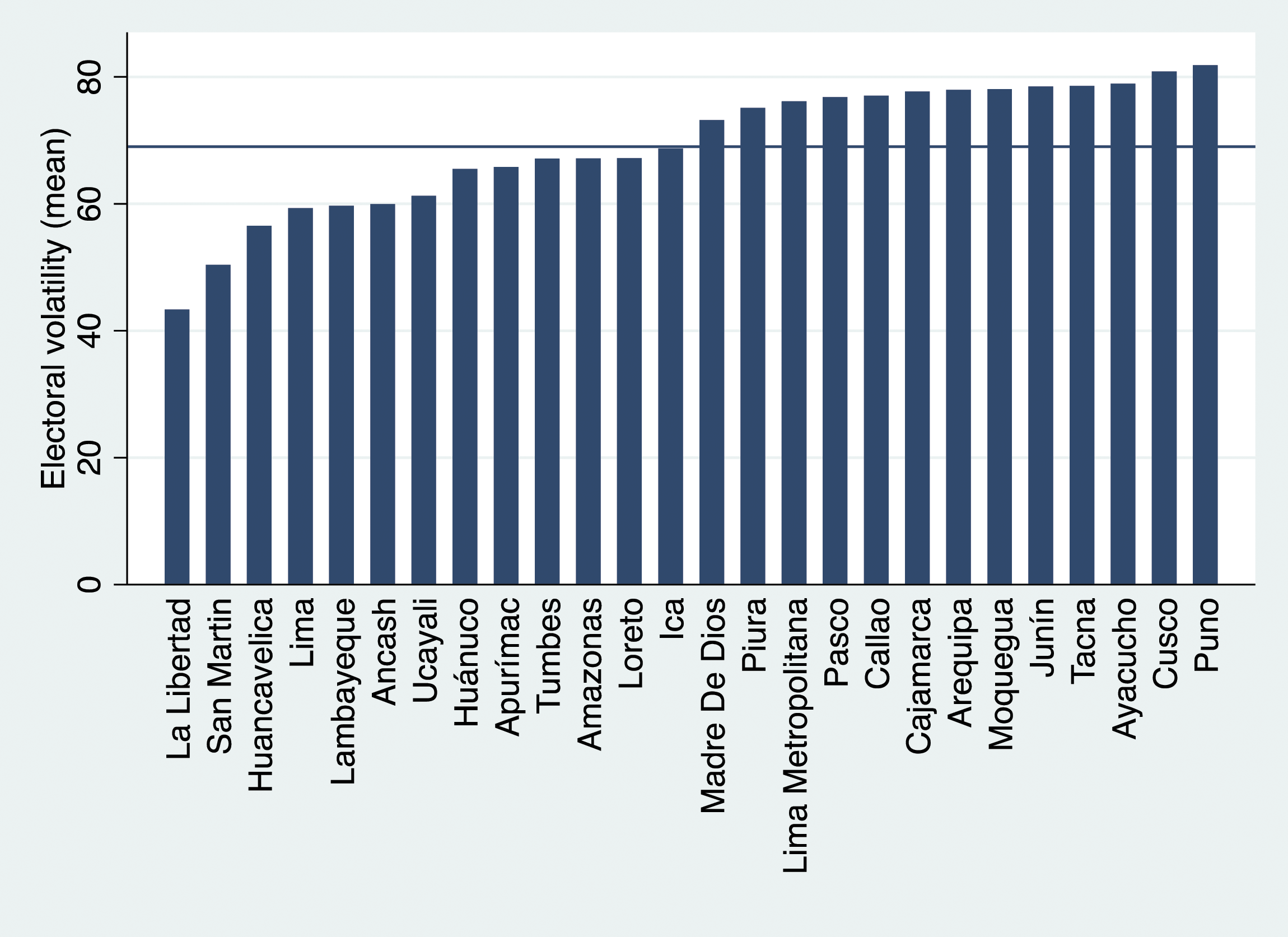
We first examine the conditional effect of regional civil society strength. The interaction analyses show that civil society strength does not moderate the extent to which bureaucrats with links to civil society engage in brokering behavior, voter mobilization or citizens’ request (Supplemental Appendix, Tables A11–A12). Counter to our third expectation, bureaucrats with civil society connections appear likely to engage in brokering behavior even where comparatively fewer residents are associational members. 6
Voter Mobilization and Citizens’ Requests: Political Connections, Civil Society Strength.
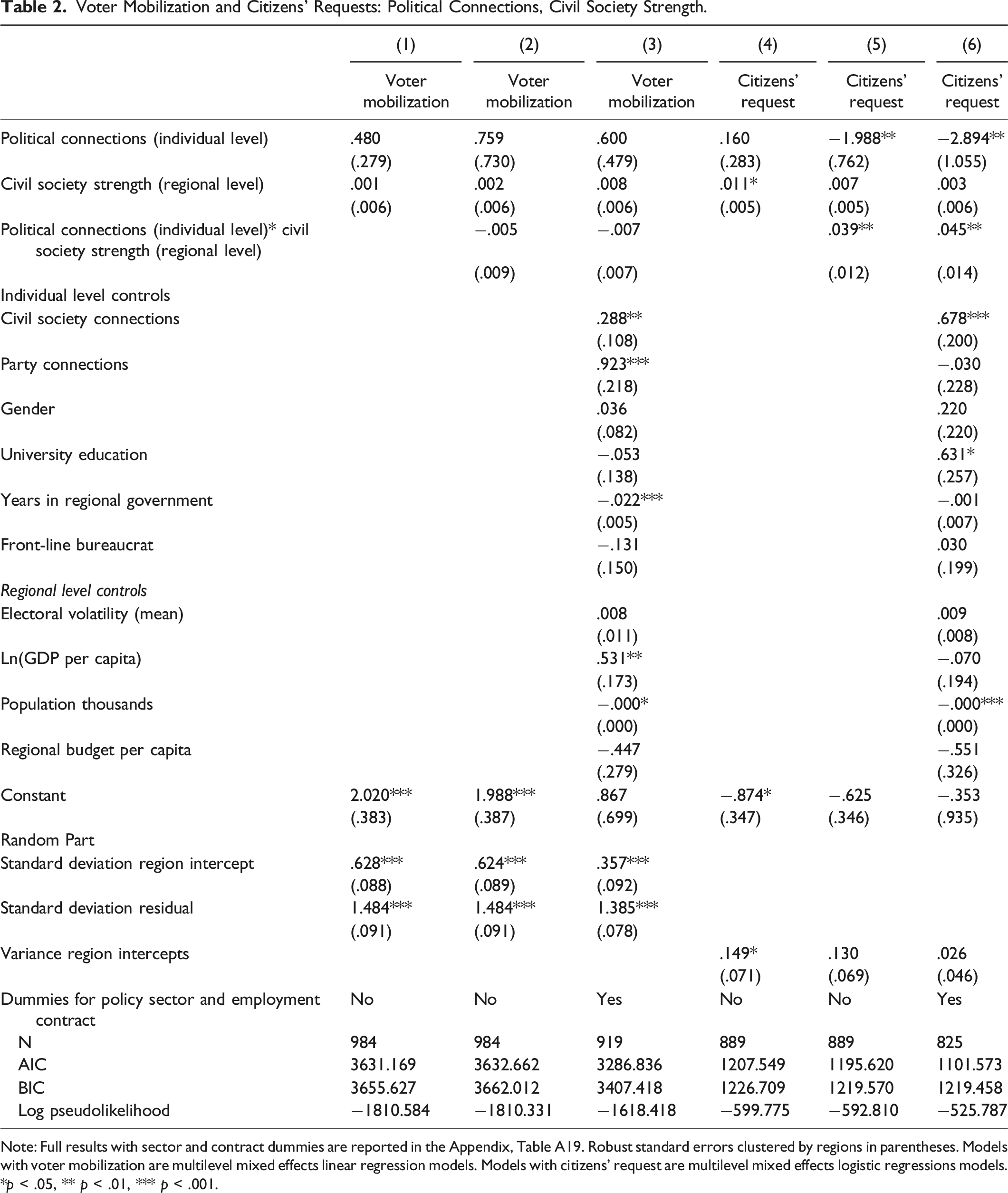
Note: Full results with sector and contract dummies are reported in the Appendix, Table A19. Robust standard errors clustered by regions in parentheses. Models with voter mobilization are multilevel mixed effects linear regression models. Models with citizens’ request are multilevel mixed effects logistic regressions models.
*p < .05, ** p < .01, *** p < .001.
In contrast, the salience of bureaucrats’ political connections for brokering behavior are sensitive to the strength of civil society with respect to requests from citizens. The analyses shown in Table 1 indicated that there was no average impact of political connections on citizens’ requests. Table 2 reveals, however, that in line with expectation four, politically connected bureaucrats are more likely to report being contacted with requests in regions where citizens are more involved in associational life (Table 2, models 5–6). 8 This may suggest that where citizens are more organized in associations, they seek out politically connected bureaucrats to secure benefits. Under such conditions, bureaucrats may not even need to actively cultivate connections with civil society to be able to broker. By merit of their political connections and the sway those connections afford, they are approached by well-organized citizens, and in providing support and assistance to those organizations, politicians cultivate the reciprocal relations that can potentially allow them to influence vote choice in future elections.
Predicted Probabilities of Citizens’ Requests.
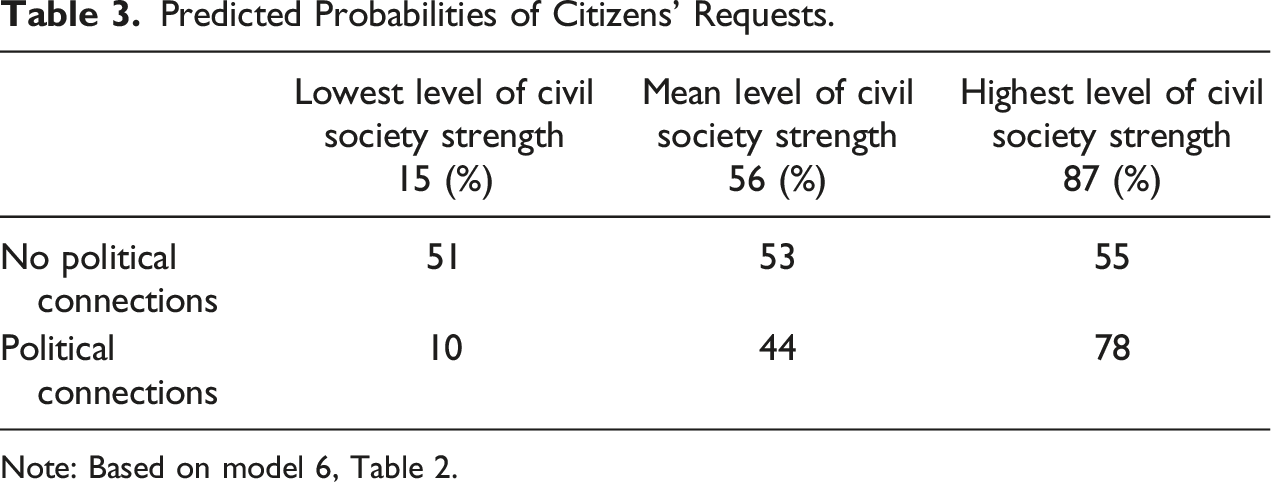
Note: Based on model 6, Table 2.
To further illustrate the pattern, Figure 5 shows the conditional marginal effects of political connections at different levels of civil society strength at the regional level. Political connections are much more important for citizens’ requests in regions in which civil society is stronger. Politically connected bureaucrats are more likely to be contacted with requests where civil society strength is higher than 75%, but when civil society strength is below 45% political connections are even negatively related to citizens’ requests. While conjectural, this may be because politically connected bureaucrats probably hold higher level positions in the bureaucracy. Individual voters are unlikely to turn to high level civil servants for help, and where civil society is weak, such bureaucrats may thus experience fewer clientelistic advances initiated by citizens. Conditional marginal effects of political connections on citizens’ requests.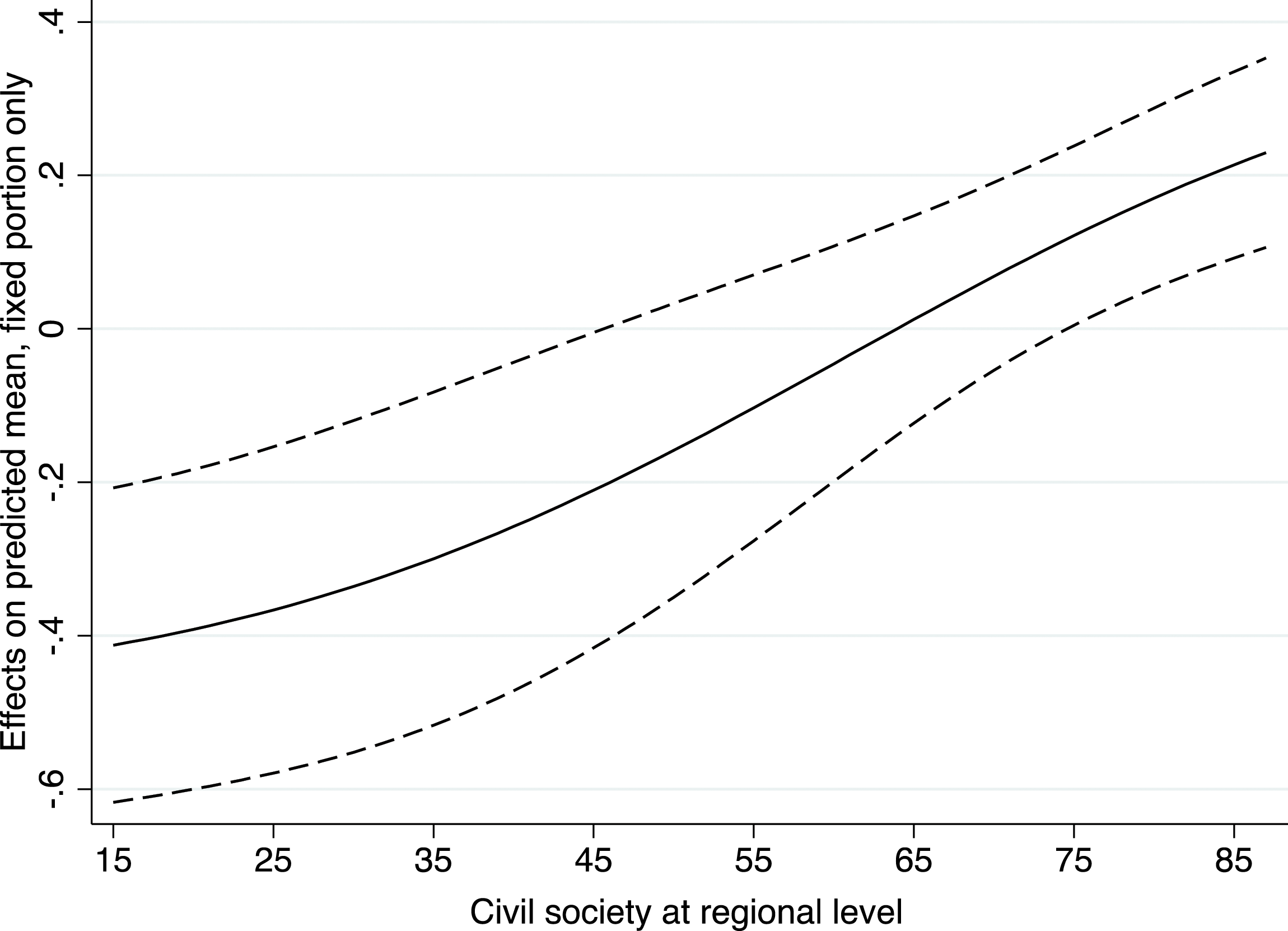
We now turn to the fifth and final implication of the theoretical model, that political and party connections may be more strongly associated with brokering where political parties are comparatively stronger. Counter to expectation, however, bureaucrats with party connections show no differences in brokering behaviors depending on the strength of parties in the region (Supplemental Tables A22-A24). Similarly, bureaucrats with political connections are no more likely to broker where parties are stronger (Appendix, Supplemental Tables A25-A27). It was only, as shown above, in regions with very strong civil society where some signs of brokering behavior became evident among politically connected bureaucrats.
Finally, we also explore whether connections to civil society play out differently on brokering depending on the strength of parties in a region. Though not specified as a testable implication of the theory, bureaucrats’ links to civil society may plausibly matter more where parties are weakest. The models show no significant interactions between civil society connections and electoral volatility on these two brokering behaviors, however, indicating that bureaucrats’ civil society connections matter equally in contexts with varying party strength (Appendix, Supplemental Tables A28-A30). We also run the main models with the regional interactions with the alternative composite measure of brokerage. The results show, like the results reported above, that the only significant result is the interaction with political connections and civil society strength (Appendix, Supplemental Table A31).
Summary of Empirical Results.
Conclusions
This paper argues that bureaucrats can be important actors in clientelistic linkages between voters and politicians, and that their role may differ from what is described in the literature. Rather than being party loyalists or entirely doing the bidding of their patrons as previous research has suggested, bureaucrats may broker for a candidate or party on their own accord, for their own ends, using their own networks. The analyses show that bureaucrats with secure tenures, whose fates are less dependent on incumbents, exhibit brokering behavior, suggesting that other incentives are at work. This may be especially prevalent where parties are weak, as in the Peruvian context. Bureaucrats can broker by developing reciprocal relations with, and therefore influence voters. Public sector employees have greater opportunities than candidates or campaign workers to engage in iterative exchanges with voters, building both credibility and a reciprocal sense of obligation that enhance the scalability and efficiency in clientelistic exchanges.
One striking finding is, in this vein, that bureaucrats who have connections to parties, who are even members of a party, do not fully behave as brokers. They tend to engage in voter mobilization to a greater extent than bureaucrats with no party connections but are not approached by citizens with requests for help more than other bureaucrats, and not even in regions with comparatively stronger parties. Additional research is needed to be able to explain these findings fully. It may be that parties in Peru even in regions with somewhat more stable parties, still lack the organizational capacity and base units needed to engage in relational clientelism. Parties may in other words be too fleeting and organizationally weak to scale up clientelism, and civil society associations may instead fill that function. That said, it is essential to point out that civil society associations by no means play only that role, or that all associations engage in the same manner.
While the findings substantiate the plausibility of the theoretical model, they cannot reveal what proportion of clientelistic exchanges are brokered by bureaucrats in Peru. Moreover, the data do not allow us to capture the contingent component of clientelism, that favors are granted in exchange for backing a specific candidate, and we cannot test what exactly shapes bureaucrats’ credibility as brokers in the eyes of voters and candidates. That said, many of those components of the argument rest on observations from previous research, and there are reasons to suspect that our data underestimate brokering and especially the importance of bureaucrats’ own connections. Our measures of connections to civil society and politicians reflect whether bureaucrats had previously been employed at a civil society association or held office, and connections can certainly be nurtured without having prior employment. We welcome more attention to these issues in future research.
The findings have policy implications. Introducing term limits is often seen as a means to reduce the use of patronage and clientelism (Ginsburg et al., 2010, 1820). A 2015 constitutional amendment in Peru prohibits reelection in regional elections as of 2018 (Article 191) in an attempt to contain corruption. Our findings suggest that clientelism may persist even if elected representatives are limited to a single term, as long as bureaucrats continue to have incentives to broker.
Civil service reform is widely regarded as a key to improving public service delivery and citizens’ trust in government. This paper contributes to the mounting evidence that public sector organization and personnel policies can also have extensive implications for how democracy works. When some proportion of bureaucrats assume behaviors such as those described here, it serves to further entrench more informal modes of engagement between citizens and the state. Restricting citizens’ possibilities of contacting bureaucrats with requests for favors would infringe on freedom of association and make government offices less accessible to citizens. In contrast, limiting politicians’ ability to influence the career trajectories of bureaucrats would, according to our argument, remove the primary incentive for bureaucrats to cultivate informal relations of confidence and reciprocity with the electorate. Depoliticizing civil servants’ careers would align bureaucrats’ incentives to a greater extent with their agency and less with individual politicians or parties, ultimately also helping to remove political considerations from citizens’ access to public goods and services.
Supplemental Material
Supplemental Material—Brokering Bureaucrats: How Bureaucrats and Civil Society Facilitate Clientelism Where Parties are Weak
Supplemental Material for Brokering Bureaucrats: How Bureaucrats and Civil Society Facilitate Clientelism Where Parties are Weak by Agnes Cornell, and Marcia Grimes in Comparative Political Studies
Footnotes
Acknowledgments
We are grateful for insightful and extremely helpful comments from three anonymous reviewers and the editors of Comparative Political Studies. We would also like to thank Victor Lapuente, Virginia Oliveros, Rune Stubager, Daniel Gingerich, and Sandro Macassi for invaluable advice in developing the survey, and to Diana González and Daniel Carelli for research assistance. We are grateful for insightful input on earlier drafts from Paula Muñoz Chirinos, Ezequiel González Ocantos, Rasmus Broms, Carl Dahlström, Jan P. Vogler, Milos Resimic, Kostas Matakos, Stephane Wolton, as well as the participants at the Political Science and Political Economy Research Seminar Series, London School of Economics, November 9, 2021, the Colloquium on Management and Public Administration, University of Konstanz, April 13, 2022, as well as those of the Joint ICSID/QoG institute workshop “Institutions and development: a sub-national perspective,” October 7–9, 2020.
Declaration of Conflicting Interests
The author(s) declared no potential conflicts of interest with respect to the research, authorship, and/or publication of this article.
Funding
The author(s) disclosed receipt of the following financial support for the research, authorship, and/or publication of this article: This work was supported by the Vetenskapsrådet (2012-872) and Vetenskapsrådet (2019-03044).

Supplemental Material
Supplemental material for this article is available online.
Notes
Author Biographies
References
Supplementary Material
Please find the following supplemental material available below.
For Open Access articles published under a Creative Commons License, all supplemental material carries the same license as the article it is associated with.
For non-Open Access articles published, all supplemental material carries a non-exclusive license, and permission requests for re-use of supplemental material or any part of supplemental material shall be sent directly to the copyright owner as specified in the copyright notice associated with the article.
