




Abstract
Existing literature highlights that constitutional courts influence lawmakers’ policy choices without actively intervening in the policymaking process. Lawmakers know that courts may scrutinize their acts and have incentives to amend their policies to pre-empt judicial interventions. However, evidence suggests that lawmakers are not always prepared to sacrifice policy objectives to avoid censure from courts. I develop a formal model showing how lawmakers who provoke confrontations with courts shape judicial decision-making. Drawing on an original dataset of German federal laws adopted between 1977 and 2015 that were reviewed by the German Federal Constitutional Court, I then show that the Court moderated its strike rate of laws when lawmakers had dismissed credible advice that their acts were unconstitutional. The theoretical argument and empirical evidence indicate that courts are more likely to show deference to lawmakers who push constitutional boundaries in their policy choices.
The existing literature on the separation-of-powers in advanced democracies has long recognized that courts reviewing the actions of the legislative and executive branches passively constrain governing majorities. Prudent lawmakers anticipate that their acts will be scrutinized by courts and are well-advised to amend (or auto-limit) their policy choices when a judicial veto is likely (see Stone, 1989; Stone, 2000; Vanberg, 1998).
But not all lawmakers are willing to sacrifice their preferred policies to pre-empt censure from courts. For instance, in December 2008, German lawmakers adopted an act allowing law enforcement agents to covertly monitor suspects’ online activities. Surprisingly, lawmakers flouted advice from constitutional lawyers, who had pointed out that the German Federal Constitutional Court struck a state law containing virtually the same provisions only a few months before and had noted that lawmakers’ plans would meet the same fate. 1
Why do lawmakers provoke confrontations with courts capable of striking their acts? How do courts respond when lawmakers pursue evidently unconstitutional policies? I offer a novel argument and original empirical evidence addressing these questions. In the Federalist 78, Hamilton (1961, 490) observes that courts are hamstrung by an enforcement problem and ‘must ultimately depend upon the aid of the executive arm even for the efficacy of [their] judgements’. Existing literature indicates that courts are attentive to signals of lawmakers’ future non-compliance with their judgements and try to avoid all too frequent tensions with the elected branches (see Clark, 2010; Vanberg, 2005; Whittington, 2003; Bailey & Maltzman, 2011). I develop a formal model, which shows that lawmakers’ choices during the policymaking process allow courts to anticipate whether or not lawmakers are prepared to challenge the authority of courts and evade compliance with unfavourable judgements. I argue that lawmakers who provoke confrontations with the judiciary by pursuing evidently unconstitutional policies induce courts to show deference to the elected branches.
I present evidence consistent with these expectations, drawing on original data from legislative proceedings in the German Bundestag and the German Federal Constitutional Court’s review of federal laws adopted between 1977 and 2015. The theoretical argument and empirical evidence presented in this article offer a new perspective on how well-established courts in modern democracies strategically choose when to pick a fight with the legislative and executive branches (Carrubba, 2009; Epstein & Knight, 1998; Epstein & Jacobi 2010). The insights offered here also tap into a long-standing normative debate revolving around the role of courts in democratic polities and their ability to judicialize the policymaking process (Tate, 1995; Stone, 2000; Hirschl, 2009). While existing research claims that ‘[t]he work of governments and parliaments is today structured by an ever-expanding web of constitutional constraints’ (Stone, 2000, 1), the article’s key implication is that lawmakers who push constitutional boundaries in their policy choices induce courts to loosen these constraints.
The article proceeds as follows. The next section briefly reviews the existing literature on legislative-judicial relations and presents evidence from interviews with German lawmakers on the elected branches’ anticipation of constitutional review. The third section introduces the formal model and discusses its comparative statics. The fourth section fields observational data from the German Federal Constitutional Court’s exercise of constitutional review to evaluate support for the theoretical model’s empirical implications. The article concludes with a discussion of the empirical findings and considers their normative implications.
Strategic Anticipation in Legislative-Judicial Relations
The existing literature on the separation-of-powers has highlighted an enforcement dilemma for courts lacking immediate control over the implementation of their own rulings. Vanberg (2001, 347) notes that ‘courts with the power to annul legislation or administrative acts must frequently rely on the willingness of other branches to implement their decisions because they may require a legislative or administrative response’. Courts themselves cannot coerce the legislative and executive branches into compliance with their decisions and lawmakers enjoy some discretion when it comes to implementing judicial decisions (see Carrubba & Zorn, 2010; Carrubba, 2009; Staton & Vanberg, 2008). Following a judicial veto, lawmakers may adopt a policy that is substantively equivalent to the one ruled unconstitutional, evade compliance through informal and non-statutory arrangements, or delay implementation indefinitely (Krehbiel, 2016; Fisher, 1993; Kapiszewski & Taylor, 2013).
Recurring non-compliance with their decisions is a concern for courts. Hall (2014, 354) notes that ‘[f]requent nonimplementation of the Court’s rulings might reduce its power and degrade its legitimacy over time’. Courts’ enforcement dilemma and motivation to protect their institutional integrity has spawned a literature expecting courts to anticipate lawmakers’ non-compliance and exercise constitutional review strategically (see Epstein & Knight, 1998; Bergara et al., 2003; Gely & Spiller, 1990). This literature offers evidence of courts seeking out information to mitigate their uncertainty about the likelihood of non-compliance (see, for example, Clark, 2009, 2010). Work by Vanberg (2001, 2005) suggests that the German Federal Constitutional Court evaluates the transparency of the political environment and self-restrains its exercise of constitutional review when it is unlikely that the public would observe (and hence, punish) lawmakers’ non-compliance. Hall and Ura (2015, 819) find evidence that the U.S. Supreme Court ‘is less likely to invalidate important statutes that enjoy greater support among current lawmakers’ (for similar findings, see Whittington, 2007; Segal et al., 2011; Harvey & Friedman, 2009; Bailey & Maltzman, 2011).
Uncertainty about the future and strategic behaviour is not limited to courts, however. Rogers and Vanberg (2007, 443) argue that ‘under the probabilistic threat of litigation (with the possibility of a judicial veto), legislative majorities draft statutory provisions to be immune to the judicial veto’ (for similar arguments, see Stone, 2000; Blauberger, 2012; Wasserfallen, 2010). Existing legal precedent provides clues to courts’ future decision-making, yet judicial interpretations of constitutional law may shift over time, particularly as the personnel on the bench changes (Hansford & Spriggs, 2006). Still, when alarm bells over the constitutional compatibility of policy sound, lawmakers are advised to amend their plans as judicial vetoes come with costs. Adding to the public humiliation of being censored by a court, lawmakers have to allocate typically scarce resources and floor time in legislatures to amend the acts objected by courts (see Vanberg, 1998).
Evidence from interviews with former members of the German Bundestag and federal government I conducted between May 2017 and April 2019 is consistent with this expectation and suggests that lawmakers anticipate the German Federal Constitutional Court’s review of their policy choices.
2
Lawmakers rely on evaluations of the Court’s existing jurisprudence and independent expert testimonies heard during legislative proceedings to gauge whether or not their policies are at risk of a judicial veto. However, anticipation of the Court’s review does not necessarily translate into the sacrifice of important policy objectives, with one senior lawmaker commenting: ‘In the end, I need to ask myself, how great is the risk that I am willing to take? And if I am not prepared to take any risks, then I am limited in my leeway to create policy. In the end, it is us who are in charge of politics, it is us who are tasked with designing policy. I have always maintained that if the justices want to get into politics, then they will have to get themselves elected to parliament’.
The statement emphasizes a tension inherent to systems of separation-of-powers and the constraints courts impose on lawmakers’ actions. We can reasonably expect that lawmakers rarely welcome courts striking their own favoured policies (for alternative scenarios, see Ward & Gabel, 2019). In the aftermath of a court strike, some types of lawmakers will – albeit grudgingly – return to the drawing board and comply with a court’s instructions. Others, however, will question the court’s choice to wade into political debates and straitjacket the policy choices of elected representatives. Where judicial decisions prevent lawmakers from achieving key policy objectives, such criticism may well spill-over into thinly veiled attempts to curb courts’ authority and pave the way for non-compliance with unfavourable judgements (see Whittington, 2003; Rosenberg, 1992). To protect their institutional integrity, courts then have an incentive to avoid clashes with the elected branches. Existing work on the U.S. Supreme Court by Clark (2009, 2010) suggests that justices turn to signals sent by lawmakers themselves, here in the form of court-curbing bills introduced in Congress, to anticipate which clashes with the elected branches would leave the Court bruised. When lawmakers feel comfortable enough to openly discuss court-curbing initiatives, justices recognize that they are operating in a political environment in which the public may not come to their aid when political branches exert pressure on the judiciary.
In the following section, I draw on the work by Clark and develop an argument suggesting that courts take cues from lawmakers’ choices at the policymaking stages to inform their expectations of what types of lawmakers they are dealing with – and therefore when to tread carefully in their exercise of constitutional review of policy.
A Signalling Game of Constitutional Review
I develop a formal model of incomplete and imperfect information that demonstrates how lawmakers’ choice to pursue an evidently unconstitutional policy affects the decision-making of a court concerned about protecting its institutional integrity and avoiding non-compliance. Prominent models of legislative-judicial relations capture lawmakers’ uncertainty about future judicial decisions and incentives to comply with courts’ orders. They show that lawmakers face incentives to auto-limit when a judicial veto of their policies is likely, as subsequent non-compliance is an unattractive option when lawmakers fear the public’s backlash for flouting courts’ decisions (Vanberg, 1998; 2005; Clark, 2010).
In the following, I make a simple yet consequential tweak to familiar models of legislative-judicial relations. I relax an implicit assumption that all lawmakers perceive the costs of non-compliance to be equally burdensome and let the valuation of a policy reviewed by a court vary across different ‘types’ of lawmakers. I distinguish between non-compliant lawmakers who value a policy enough to contest a court’s authority and evade compliance should a court strike it, and compliant lawmakers who believe that the costs of non-compliance outweigh the benefits of keeping a policy on the books against the court’s orders. Both types of lawmakers anticipate the court’s review but respond differently to information suggesting that the court will strike their policy. As we will see, lawmakers’ choices allow the court (albeit imperfectly) to update its prior beliefs about their types and whether or not a decision to strike policy would drive lawmakers to lash out at the court and risk non-compliance.
Model Primitives
The game involves three players, Nature (N), a lawmaker (L) deciding whether or not to adopt a new policy and a court (C) reviewing the policy. The sequence of play is shown in Figure 1.
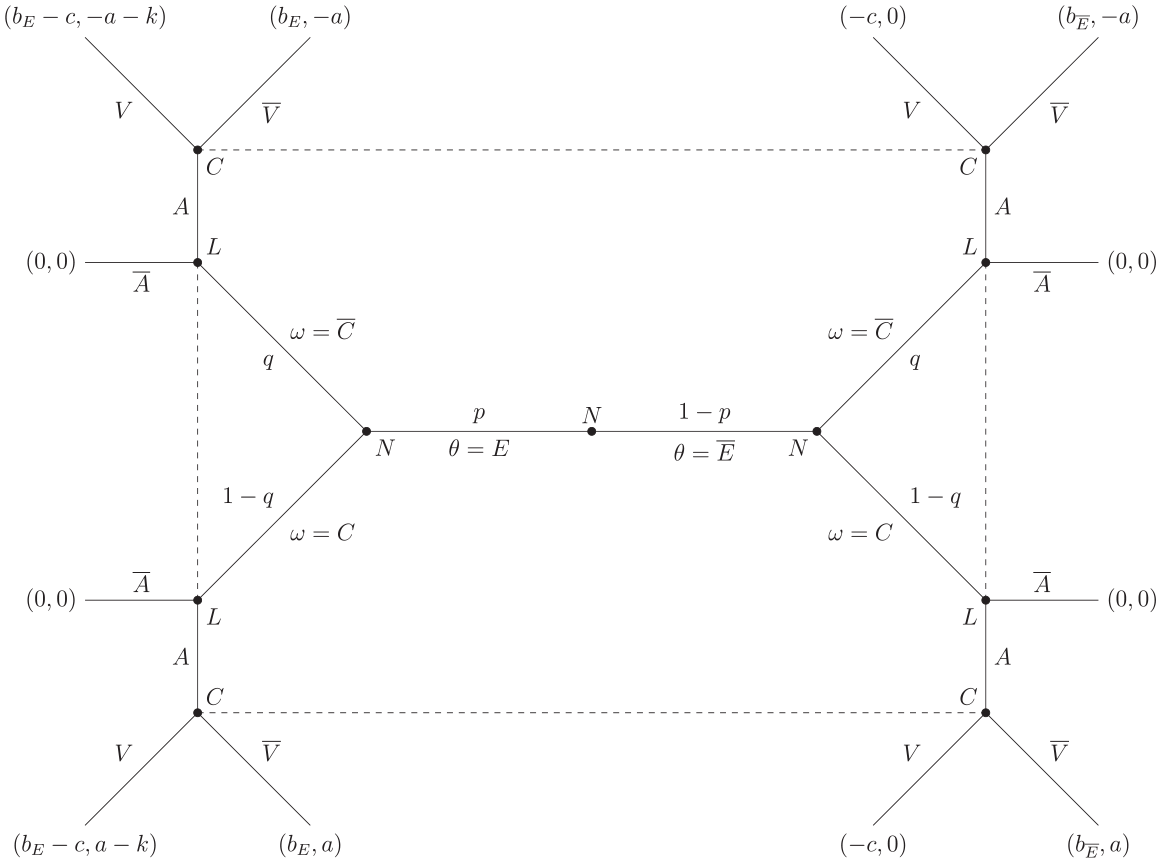
Payoffs for the lawmaker (L) are listed first, payoffs for the court (C) are listed second. Payoffs for L are subject to the condition bE ≥ c > bE > 0. Costs for legislators and the court are subject to the condition c > 0 and k > 0.
At the beginning of the game, Nature makes two independent moves. First, Nature picks the lawmaker’s type,
The lawmaker’s uncertainty about whether or not her policy would conflict with the constitution does not imply that she is uninformed. The model assumes that courts do not routinely diverge from interpretations of constitutional law found in existing legal precedent (see Hansford & Spriggs, 2006). Otherwise, where future court decisions are entirely unpredictable, lawmakers cannot assess the risks of unconstitutionality of their policies within reasonable degrees of uncertainty, and their policy choices therefore reveal no information about lawmakers’ types to the court. Anticipating court decisions becomes harder for lawmakers where little to no established legal precedent exists and where judges frequently or collectively leave the court to make way for new appointees to the bench. In contrast, where judges can draw on volumes of existing relevant precedent when reviewing policy and enjoy longer (or even lifetime) tenures at the court, lawmakers can form expectations about the constitutionality of their plans at the policymaking stages (e.g. via testimonies from independent experts and constitutional lawyers heard during legislative proceedings). The scope of the argument outlined below is therefore limited to the latter scenario.
In the model, in light of information on the expected (un)constitutionality of their favoured policy, the lawmaker then needs to make a decision of whether or not to adopt the new policy,
Regardless of her type, the lawmaker anticipates a cost c should the court strike her policy. The parameter c captures lawmakers’ costs of re-legislating after the court struck their policy and the political fallout of being perceived to be in conflict with the court (see Vanberg, 1998, 305). The court, on the other hand, expects to pay a cost k whenever it strikes the policy of a non-compliant lawmaker. The parameter k captures the assumption that confrontations with non-compliant lawmakers are costly, as the court’s institutional integrity suffers following non-compliance and lawmakers may further retaliate by curbing the court’s authority (see Hall, 2014; Vanberg, 2005; Clark, 2010).
Compliant and non-compliant lawmakers differ in their valuation of the policy. Whenever the adopted policy remains on the books after the game ends, either because the court chose not to strike it or because the lawmaker evaded compliance with the court’s decision, the compliant lawmaker receives a payoff of
A strategy for the lawmaker is a mapping from her type and prior beliefs about the constitutionality of the policy into a decision,
Analysis
I seek perfect Bayesian equilibria (PBEs) and describe equilibrium behaviour for the lawmaker and the court across all values of the model’s parameters. All formal proofs are gathered in the supplementary material. For simplicity, let the following critical thresholds for the lawmaker and court’s prior beliefs be defined as
Proposition 1: Given q < q* and p ≤ p*, a PBE exists in which the lawmaker plays d = A regardless of her type, and the court plays f = V if
This picture changes once the court’s prior beliefs p surpass the threshold p*. In these scenarios, both types of lawmaker again adopt the policy. However, given that it is now sufficiently likely that the court is facing a non-compliant lawmaker, the court is constrained in its decision-making and chooses to uphold policies it would otherwise prefer to strike.
Proposition 2: Given p > p*, a PBE exists in which the lawmaker plays d = A regardless of her type, and the court plays
This pooling equilibrium provides a formal representation of the non-compliance trap that motivates courts to avoid all too frequent instances of non-compliance with their decisions (see Carrubba et al., 2008; Vanberg, 2005; Staton & Vanberg, 2008). Once the norm of lawmakers’ compliance with the court’s decisions has lost its force, the court generally expects to face non-compliant lawmakers. Knowing that its decisions are at a high risk of non-compliance, the court then has an incentive to shy away from challenging lawmakers over their policies to avoid a further erosion of its institutional integrity, but simultaneously ceases to be an effective check on lawmakers’ actions.
The model’s final equilibrium captures scenarios in which the court generally expects the lawmaker to comply with its decisions, p ≤ p*, while the lawmaker now has sufficient reason to believe that the policy is unconstitutional, q ≥ q*.
Proposition 3: Given p ≤ p* and q ≥ q*, a PBE exists in which the lawmaker plays d = A if θ = E. If
In this partial-pooling equilibrium, the compliant lawmaker anticipates the court’s review and makes a probabilistic choice to auto-limit its policymaking as there is a relatively high likelihood that the policy is unconstitutional. Given the compliant lawmaker occasionally chooses to adopt the policy, the court can only imperfectly update its prior beliefs about the lawmaker’s type and makes a probabilistic choice of whether or not to strike the policy.
Comparative Statics
The formal model yields a variety of predictions characterizing the behaviour of both lawmakers and courts. Figure 2 summarizes the model’s predictions for equilibrium behaviour for the full space of both players’ prior beliefs, p and q.
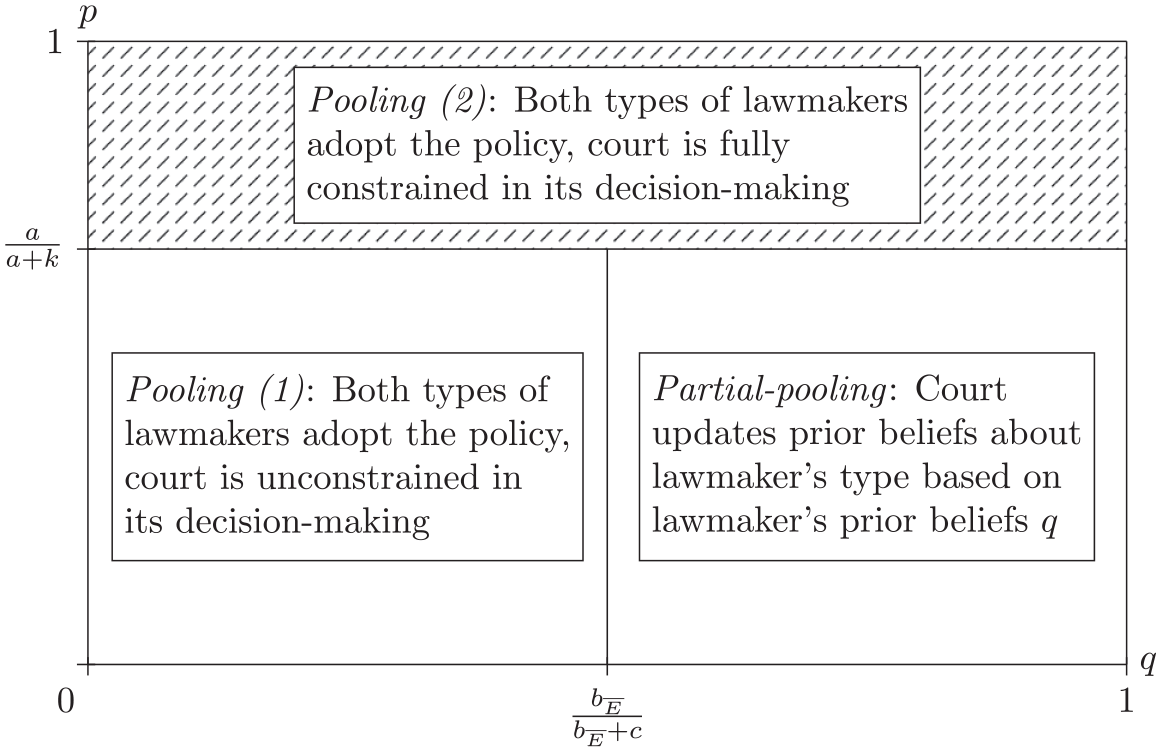
Equilibrium predictions. On the vertical axis, p denotes the court’s prior beliefs of facing a non-compliant lawmaker. On the horizontal axis, q denotes the lawmaker’s prior beliefs that the policy is unconstitutional. The parameter c denotes the lawmaker’s cost of having policy struck by the court. The parameter k denotes the costs of non-compliance to the court’s institutional integrity. bE– denotes the non-compliant lawmaker’s valuation of the policy.
The hatched space at the top of Figure 2 marks the equilibrium space in which the court is paralysed by its concerns about non-compliance. The threshold
The formal model’s novel implications are found in the bottom two quadrants of Figure 2. Here, the court’s prior beliefs that it is dealing with non-compliant lawmakers are relatively low (i.e. below the threshold p*). These scenarios are found in established democracies, where lawmakers’ compliance with court judgements is – albeit not guaranteed – the norm rather than an exception. Once a court tasked with reviewing the constitutionality of policy has ‘matured’ (see Carrubba, 2009, 68) and can draw on a comfortable reservoir of diffuse public support, challenging the court’s authority becomes a potentially politically costly endeavour and therefore generally less attractive for lawmakers (Vanberg, 2001; Gibson et al., 1998, see also Epstein et al., 2001). In other words, we can expect the inter-branch dynamics discussed below to play out in polities where lawmakers generally albeit not invariably respect the authority of courts.
In the following, I consider how the actors’ behaviour changes as we move from the pooling equilibrium in the bottom left quadrant of Figure 2 to the partial-pooling equilibrium in the bottom right quadrant. Recall that the parameter q captures the lawmaker’s prior beliefs (i.e. expectations at the policymaking stages) that her favoured policy is conflicting with the constitution. As q gradually increases from zero, it initially becomes more likely that the court will strike the policy. Yet, as long as q remains below the threshold
A different story emerges once q passes the threshold q* in Figure 2. Once the compliant lawmaker can reasonably expect that the court would strike her policy (i.e. her prior beliefs q fall above the threshold q*), she makes a probabilistic choice of whether or not to adopt the policy. Given the likelihood that the policy conflicts with the constitution is now sufficiently high and given she would ultimately comply with a judgement invalidating her policy, the compliant policy-maker is better off by at least occasionally auto-limiting her policy choices. 5 The non-compliant lawmaker on the other hand – true to her type – always presses ahead with her favoured policy. This difference in behaviour is critical and captures the dynamics of a classic signalling game (see Cho & Kreps, 1987). It allows the court (albeit imperfectly) to update its prior beliefs of whether or not it is facing a non-compliant lawmaker. A lawmaker’s choice to provoke a confrontation with the court by adopting an evidently unconstitutional policy (at times, falsely) signals a non-compliant type to the court.
The formal model’s main result, which motivates the empirical analysis in the following section, shows that the court’s response to this signal is tied to the lawmaker’s prior beliefs that her chosen policy is unconstitutional. Past the threshold q*, the court upholds any constitutional policy but strikes an unconstitutional policy with probability
The theoretical model harbours a counter-intuitive and empirically observable implication. In modern democracies allowing for constitutional review of policy, lawmakers are typically briefed about the risks that their favoured policy is conflicting with the constitution (e.g. via expert testimonies in committees or in-house legal counsel). When legal counsel sounds the alarm over constitutional concerns, we expect lawmakers to follow their advice and amend policy prior to adoption (Stone, 2000; Rogers & Vanberg, 2007). Where warning signs are ignored, policies are more likely to land in the dockets of courts, which then invalidate the acts that turn out to conflict with the constitution. While the likelihood of observing a court striking a policy should therefore steadily increase as the alarm bells ignored by lawmakers sounded louder (see dashed line in Figure 3), the model instead predicts that a court’s strike rate is moderated by its strategic response to lawmakers’ increasingly credible signal of a non-compliance threat (see solid line in Figure 3).
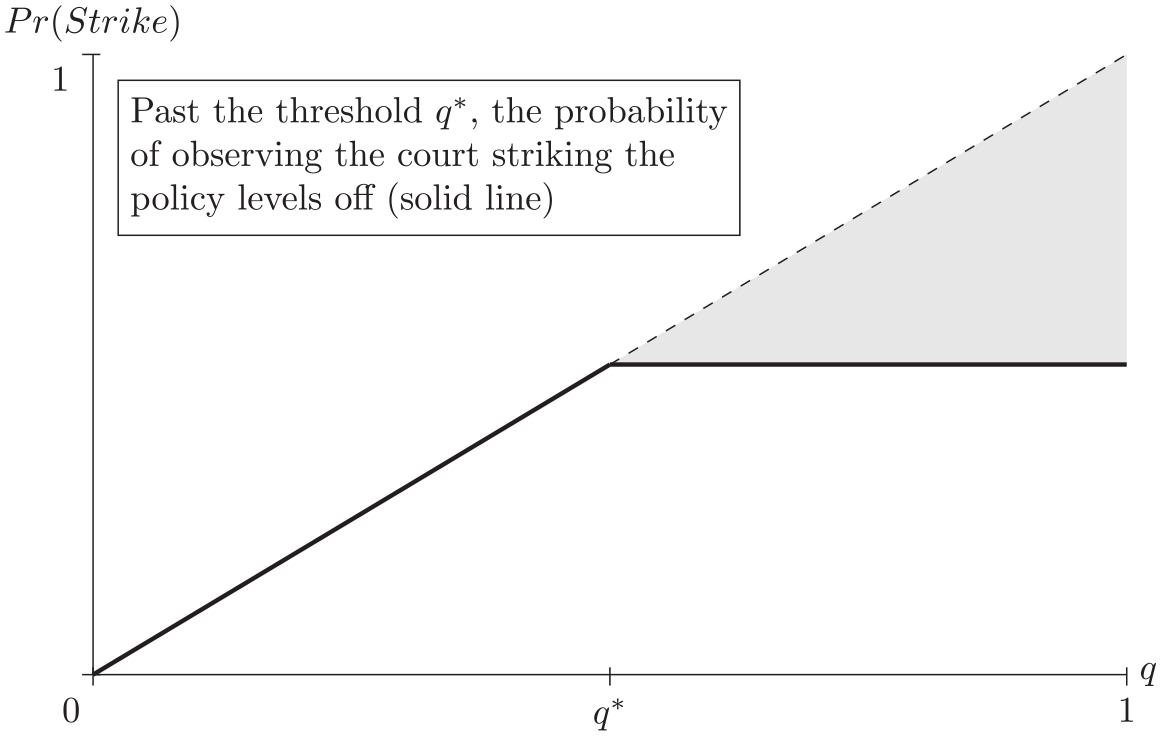
Illustration of comparative statics. The solid black line indicates the probability of the court striking any given policy as unconstitutional. The horizontal axis denotes the probability that any given policy is unconstitutional, q. Up until the threshold q*, the probability of a court striking increases with q. Past the threshold, the dashed line indicates the probability of an unconstrained court striking policy, which increasingly differs from the predictions by the model (see shaded area).
To summarize, the model shows how well-established courts exercising constitutional review of policy respond when lawmakers pursue evidently unconstitutional policies. Opting for highly controversial policies and flouting clear advice that their plans would conflict with the constitution, lawmakers credibly (if at times, falsely) signal to the court that they are unprepared to let constitutional constraints scupper their pursuit of policy. Courts concerned about protecting their institutional integrity and avoiding non-compliance then are expected to moderate the rate at which they strike these policies and leave policies on the books they would otherwise prefer to strike – effectively shifting the constitutional boundaries to lawmakers’ policymaking.
Application: Constitutional Review in Germany
The theoretical model introduced above offers new insights into the strategic interactions between lawmakers and courts that generally apply to systems of separation-of-powers where lawmakers routinely yet not invariably respect the authority of courts and comply with their judgements. In the following, I field observational data from a case that fits the theoretical model’s scope conditions, the German Federal Constitutional Court’s reviews of the constitutionality of federal laws. The GFCC can draw on a wealth of existing precedent defining constitutional boundaries to policy and has been described as one of the most powerful constitutional courts, enjoying comfortable reservoirs of institutional support among the German public (see, for example, Kommers, 1994; Stone, 2000; Landfried, 1995; Gibson et al., 1998). Based on the Court’s popularity, we have reason to expect that non-compliance with the GFCC’s orders is costly, and that elected officials typically face incentives to avoid confrontations with the Court (see Brouard & Hönnige, 2017).
However, quantitative and qualitative evidence presented in existing literature on the GFCC’s exercise of constitutional review of federal and state laws is consistent with claims that the Court is nonetheless concerned about non-compliance and backlash from the political branches (Vanberg, 2001; 2005; Krehbiel, 2016). German lawmakers’ evasion of compliance with the GFCC’s jurisprudence – while overall uncommon – is frequent enough for the GFCC to be attentive to signals of credible non-compliance threats. Accordingly, the German case reflects an environment in which the theoretical model would expect the GFCC to draw on lawmakers’ choices in light of information about the constitutionality of their policies to anticipate which of its decision may provoke lawmakers to lash out and fail to comply.
Data and Research Design
Cases heard by the GFCC involving the constitutionality of federal laws are almost always concerned with specific legislative provisions. The constitutional compatibility of a legislative provision can be challenged via three different routes. Lower courts may refer legislative provisions for review to the GFCC should they believe that their application in a dispute in court would be incompatible with the constitution. Further, the federal government, state governments or one quarter of the German Bundestag’s members can refer legislation for review to the GFCC even in the absence of a concrete dispute in court. Finally, individuals may challenge the constitutionality of legislation through constitutional complaints once they have exhausted all other legal remedies, provided the challenged law affects them personally, presently and directly.
To illustrate, in 2009, a group of prisoners filed constitutional complaints concerning a provision of the 1998 Act to Combat Sexual Offences and Other Dangerous Criminal Offences, which authorized the continuance of preventive detention even in the case of detainees whose originating criminal offences were committed before the act had entered into force. The Court then considered whether the challenged provision was compatible with the German constitution, the Basic Law, and eventually struck the provision in question. 6
The units of analysis in my data are the legislative provisions challenged at the GFCC. 7 These provisions are nested in federal laws, and different provisions from the same law may be challenged in different cases heard by the Court. Drawing on data provided by the Constitutional Court Database (CCDB, Engst et al., 2019), I identified the 417 legislative provisions contained in 275 federal laws adopted by the German Bundestag between 1977 and 2015, which were subsequently challenged at the GFCC.
Outcome Variable
For each legislative provision, I followed operationalizations employed by Vanberg (2001) and recorded whether or not the GFCC struck the provision in question. The outcome variable in my analysis is binary, with Strike = 0 indicating that the Court chose to uphold a provision, and Strike = 1 indicating otherwise. There is little indication that the GFCC generally exercises self-restraint when reviewing the acts of the elected branches. Of the 417 provisions adopted between 1977 and 2015 which were later referred for review to the GFCC, 213 provisions (51%) were eventually struck by the Court.
Explanatory Variables: Signalling Non-Compliance Threats
To evaluate support for the theoretical model’s empirically observable implications (see Figure 3), I require a measure that captures variation in lawmakers’ beliefs at the policymaking stages that their proposed policy conflicts with the constitution. Here, I turned to statements lawmakers issued during final parliamentary debates and in voting declarations, expressing concerns that a proposed policy would conflict with the constitution. Lawmakers often reference testimonies from constitutional law scholars heard during committee hearings and refer to unresolved constitutional issues with legislative provisions to justify their opposition to the latter. Consider the following illustrative example of a lawmaker voicing constitutional concerns about a federal government’s planned reform of inheritance tax law: Christine Scheel (Greens): For today’s vote, you submitted a highly complex piece of legislation, envisioning preferential treatment for some citizens and disadvantages for others. I’m predicting that owing to its unconstitutionality—this has been widely discussed in this chamber—this legislation will end up in Karlsruhe. It doesn’t bode well for parliamentary democracy if legislation is passed, despite knowing it fails to conform with our constitutional guidelines.
8
To identify such concerns, I accessed the transcripts of the final parliamentary debates of all 275 federal laws containing the challenged provisions in my data, available through the Bundestag’s documentation system. I restricted my attention to final plenary debates and voting declarations as lawmakers no longer had an opportunity to alter a provision’s text at this stage of the legislative proceeding. 9 I then defined a set of keywords to search these documents for lawmakers’ assessments of the constitutionality of legislative provisions. 10 Where lawmakers’ had voiced constitutional concerns, I assessed whether the provision in question matched the provision later reviewed by the Court and excluded concerns referring to provisions that were not part of the case at the GFCC. Lawmakers’ concerns recorded in my data are therefore tailored to specific provisions. 11
I then identified party affiliations of those lawmakers who had voiced constitutional concerns and determined whether they served as members of the current governing coalition or the parliamentary opposition. Figure 4 plots distributions of the numbers of legislative provisions which had been contested as unconstitutional by lawmakers of the parliamentary opposition and governing majority, respectively. Further, Table 1 provides descriptive statistics for the counts of lawmakers voicing constitutional concerns, again distinguishing between lawmakers of the governing coalition and lawmakers of the opposition, as well as concerns voiced in debate statements and voting declarations.
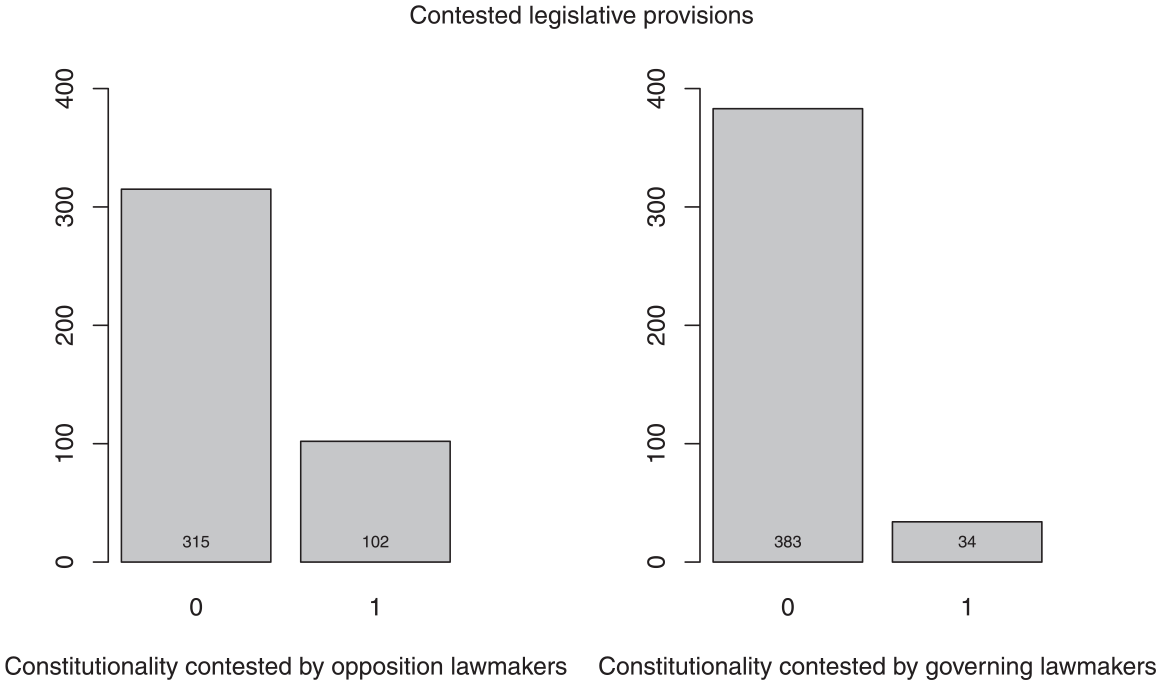
Numbers of legislative provisions contested as unconstitutional by lawmakers of the parliamentary opposition and governing majority, 1977–2015 (N417).
Descriptive statistics.
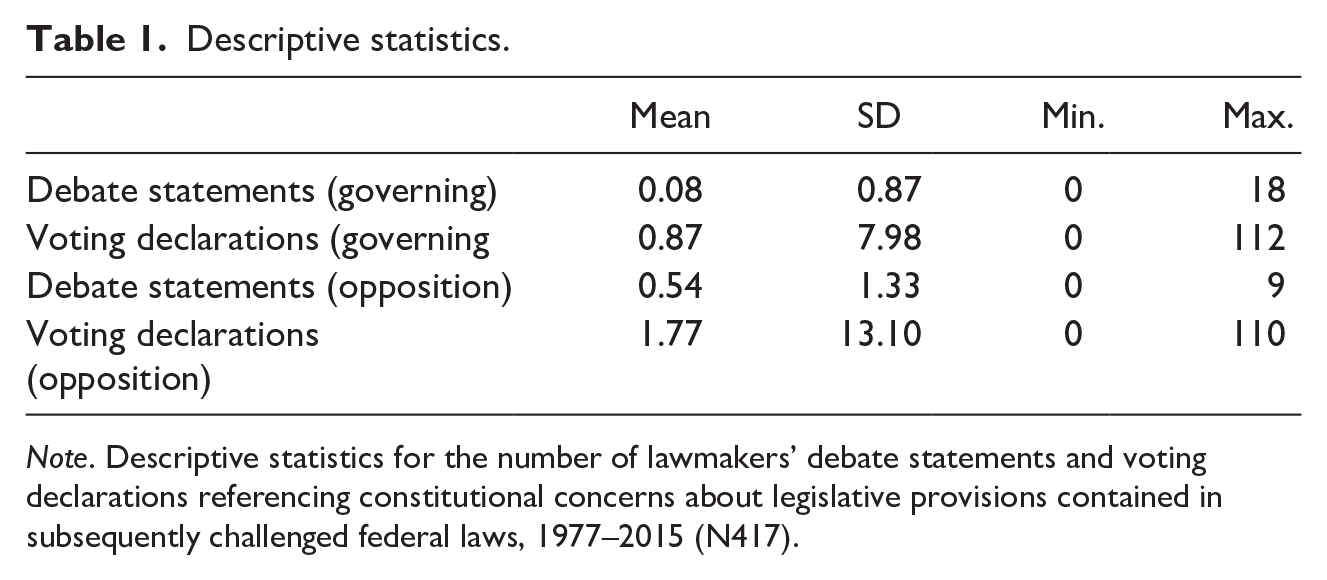
Note. Descriptive statistics for the number of lawmakers’ debate statements and voting declarations referencing constitutional concerns about legislative provisions contained in subsequently challenged federal laws, 1977–2015 (N417).
Unsurprisingly, Figure 4 and Table 1 show that lawmakers on the opposition benches tend to (at least publicly) voice their constitutional concerns more frequently than their colleagues of the governing majority. Out of the 417 legislative provisions challenged at the GFCC, 102 had been considered unconstitutional by lawmakers of the parliamentary opposition. In contrast, only 34 of these provisions had caused concern among members of the governing coalition. Ideally, a measure of lawmakers’ prior beliefs of the unconstitutionality of their policy would simply draw on the number of lawmakers who had voiced constitutional concerns at the final stages of policymaking. We may expect that higher values on lawmakers’ prior beliefs are captured by higher numbers of lawmakers voicing concerns.
However, the distributions of the counts of lawmakers voicing constitutional concerns (plotted in Section C of the supplementary material) present a challenge for this strategy. While there are generally few observations with more than three lawmakers voicing concerns, some of these observations show a substantial number of lawmakers contesting the constitutionality of a policy. For instance, in the early 1990s, more than 100 lawmakers of the Conservative-Liberal governing coalition objected that a law’s provisions limiting restitution claims against historic expropriations in Eastern Germany violated constitutional rights of the proprietors of expropriated assets – provisions the Court later upheld as constitutional. 12 In light of the already relatively small number of observations, excluding these outliers from the analysis altogether does not appear feasible either. As the next best alternative, I consider binary variables indicating whether lawmakers had contested the constitutionality of policy. To nonetheless capture variation in lawmakers’ prior beliefs of the unconstitutionality of their proposed policies, I leverage information on lawmakers’ political affiliations.
We can expect that lawmakers of the governing coalition are generally reluctant to break with party discipline and publicly accuse their political allies of violating the constitution. Public disagreement within governing coalitions over the constitutionality of policy provides the political opposition with opportunities to discredit the government in the eyes of the electorate, as voters ‘are likely to care not only about policy but, also about process, that is, they expect politicians and parties to play by the rules’ (Vanberg, 1998, 305). Accordingly, I expect that governing lawmakers – unlike members of the parliamentary opposition – are less likely to employ claims of unconstitutionality as instruments of political opportunism and voice concerns when they have sufficient reason to believe that a proposed policy is in fact incompatible with the constitution. 13
The credibility of the advice ignored by lawmakers then varies with the sources of the claims of unconstitutionality. While the risks of adopting an unconstitutional policy are lower when no lawmaker had voiced concerns relative to policies contested by members of the parliamentary opposition, lawmakers should be most concerned about the constitutionality of their policies when concerns are voiced on both sides of the aisle. The main explanatory variables of interest for the analysis below are Contested by opposition lawmaker and Contested by governing lawmaker. The variables are binary and take on the value 1 whenever at least one lawmaker of the parliamentary opposition and current governing coalition, respectively, contested a provision’s constitutionality, and take on the value 0 otherwise.
Note that these variables capture lawmakers’ public contestation of legislative provisions’ constitutionality. 14 As such, lawmakers’ choice to ignore (credible) advice can serve as a signal to other actors, including the GFCC. Justices at the GFCC are supported by a team of law clerks and are typically well-informed about the legislative proceedings that produced the provisions they review (see also McCubbins et al., 1992). Interviews conducted with former justices and law clerks of the GFCC between May 2017 and April 2019 highlighted that the Court carefully considers the parliamentary documentation of legislative proceedings for reviewed federal laws, as comprehending parliament’s motives for legislating forms part of the GFCC’s methods of interpretation. 15
To summarize, lawmakers who dismiss their political allies’ constitutional concerns about policies signal unwillingness to let constitutional norms constrain their policymaking, in turn allowing the GFCC to gauge the risks of future non-compliance when reviewing these policies. In the following, I employ standard econometric tools to evaluate whether signals of lawmakers’ non-compliant types induce the GFCC to self-restrain its review of federal laws.
Empirical Strategy
I estimate logistic regression models including the variable Strike as the outcome variable and the variables Contested by opposition lawmaker and Contested by governing lawmaker as the main explanatory variables of interest. To account for the hierarchical structure of the data, with challenged provisions nested in federal laws, all regression models include random effects, allowing intercepts to vary across federal laws. 16
Let N denote the number of observations (i.e. challenged provisions, N = 417), J denote the number of federal laws (J = 275) and K denote the number of explanatory and control variables included in the model, with the latter further discussed below. Let
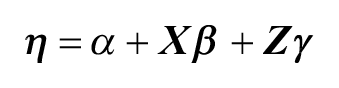

contains the log-odds of a court strike for each challenged provision. The probability of provision i being struck by the court is then defined as
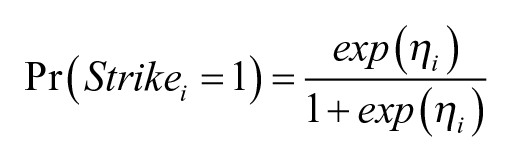
The regression allows for comparisons of the probabilities of observing GFCC strikes across provisions with and without lawmakers signalling a credible non-compliance threat, conditional on a variety of other observed characteristics (i.e. the control variables). The GFCC may choose to strike a provision either because it simply finds no violations of the constitution or because it exercises strategic self-restraint. While it is difficult to disentangle these motivations, the theoretical model’s comparative statics imply that the Court should moderate its strike rate when lawmakers had signalled a credible non-compliance threat.
Provisions contested by governing lawmakers are exceptional in several respects and potential outcomes are likely to differ for provisions with and without such signals. Most importantly, individual governing lawmakers may be more likely to contest government policy drafted by an ideologically heterogeneous coalition of political parties. At the same time, the Court is likely to tread more carefully when reviewing policy enjoying support from lawmakers of a variety of political colours. In such scenarios, evidence of the Court’s strategic self-restraint may as well be attributed to the Court refraining from challenging acts of a broad coalition of interests in parliament (see, for example, Hall & Ura, 2015), rather than a governing coalition signalling its unwillingness to sacrifice important policy objectives.
To mitigate selection bias on the coefficient for the explanatory variable Contested by governing lawmaker, I therefore control for whether the federal law containing the challenged provisions had been proposed by a coalition of parties including both the main centre-right CDU/CSU as well as the centre-left SPD (Cross-party proposal = 1) or not (Cross-party proposal = 0). 18
To further address the concern that the actual mechanism underlying any evidence of the Court’s self-restraint is the broad support among lawmakers for a legislative provision, an additional control variable would ideally consider the share of lawmakers eventually voting in favour of the law containing the challenged provision. Measuring lawmakers’ support for a provision based on voting records is difficult, as the Bundestag adopts the majority of its laws by a show of hands without an official tally of votes. Note however, that even if such a measure existed, it would not come without its own problems. Legislative provisions harbouring constitutional violations are simply less likely to garner broad support from lawmakers. Evidence of the Court generally upholding provisions that enjoy broad support in parliament may well be traced to the fact that these provisions are – at least constitutionally – uncontroversial. By relying on a measure of lawmakers dismissing constitutional concerns, my analysis sidesteps this source of selection bias.
While the theoretical model remains silent on possible changes in the make-up of governing coalitions between the adoption of a policy and the Court’s decision on the constitutionality of that policy, we can expect that the effect of the signal sent by lawmakers is conditional on who controls a governing majority at the time of the Court’s decision. If a governing coalition had signalled a credible non-compliance threat, yet no longer controls government when the Court hands down its decision, the effect of the signal should weaken. Similarly, had lawmakers of the opposition voiced constitutional concerns and assumed control of government office once the Court reviews the policy, the Court should be less constrained by non-compliance concerns. Related to this discussion, we should also expect the effect of signals sent by lawmakers to weaken over time. In the German context, it can take years following a policy’s adoption before the GFCC reviews its constitutionality, and the composition of party factions in parliament may well have changed by then. To account for these factors, I include the control variables Author of policy in government (1 if the governing coalition which had authored a policy was still in office at the time of the Court’s review and 0 otherwise) and Days passed since adoption of policy (standardized by centring and dividing by two standard deviations) in the models estimated below. 19
Finally, an additional concern is that governing lawmakers tend to contest legislation in particular policy areas, while the GFCC’s decision-making likewise varies systematically across these areas. Lawmakers may be more likely to identify ostensible constitutional violations in policy areas where an extensive body of GFCC jurisprudence already exists, while the GFCC may be less likely to add further constitutional constraints on lawmakers’ leeway to create policy when it had detailed these constraints in numerous previous cases. I therefore control for the Policy area the challenged provision concerned, by recording which parliamentary committee drafted the provision in question. 20
Results
I follow advice by Gelman and Hill (2007) on estimating multilevel regression models with small datasets and employ a Bayesian approach to estimate the models’ parameters via Markov Chain Monte Carlo sampling. I rely on the rstanarm package for R (Goodrich et al. (2020)). I specify rstanarm’s weakly informative default prior distributions and run four chains with 1000 warm-up iterations and 5000 sampling iterations, yielding 20,000 draws from the parameters’ posterior distributions. None of the parameters’ R̂ values exceed 1.005, well below critical thresholds defined by Gelman and Rubin (1992).
I begin my analysis by estimating the effects of the variables Contested by governing lawmaker and Contested by opposition lawmaker on the Court’s decision to strike a policy. Table 2 reports the means of the estimated coefficients’ posterior distributions, along with their 95% highest probability densities (HPDs). For now, Model 1 and Model 2 include the control variables Author of policy in government and Days passed since adoption of policy, respectively, albeit without interaction effects. Table 2 shows that the coefficient for Contested by governing lawmaker is negative in both models (yet not clearly distinguishable from zero in Model 1), while the coefficient for Contested by opposition lawmaker is positive (with its 95% HPD slightly overlapping zero in Model 2). The results indicate that the Court increases its strike rate when lawmakers of the opposition had voiced constitutional concerns at the policymaking stages, yet moderates its strike rate when lawmakers of the governing majority had questioned a law’s constitutionality.
Regression coefficients.
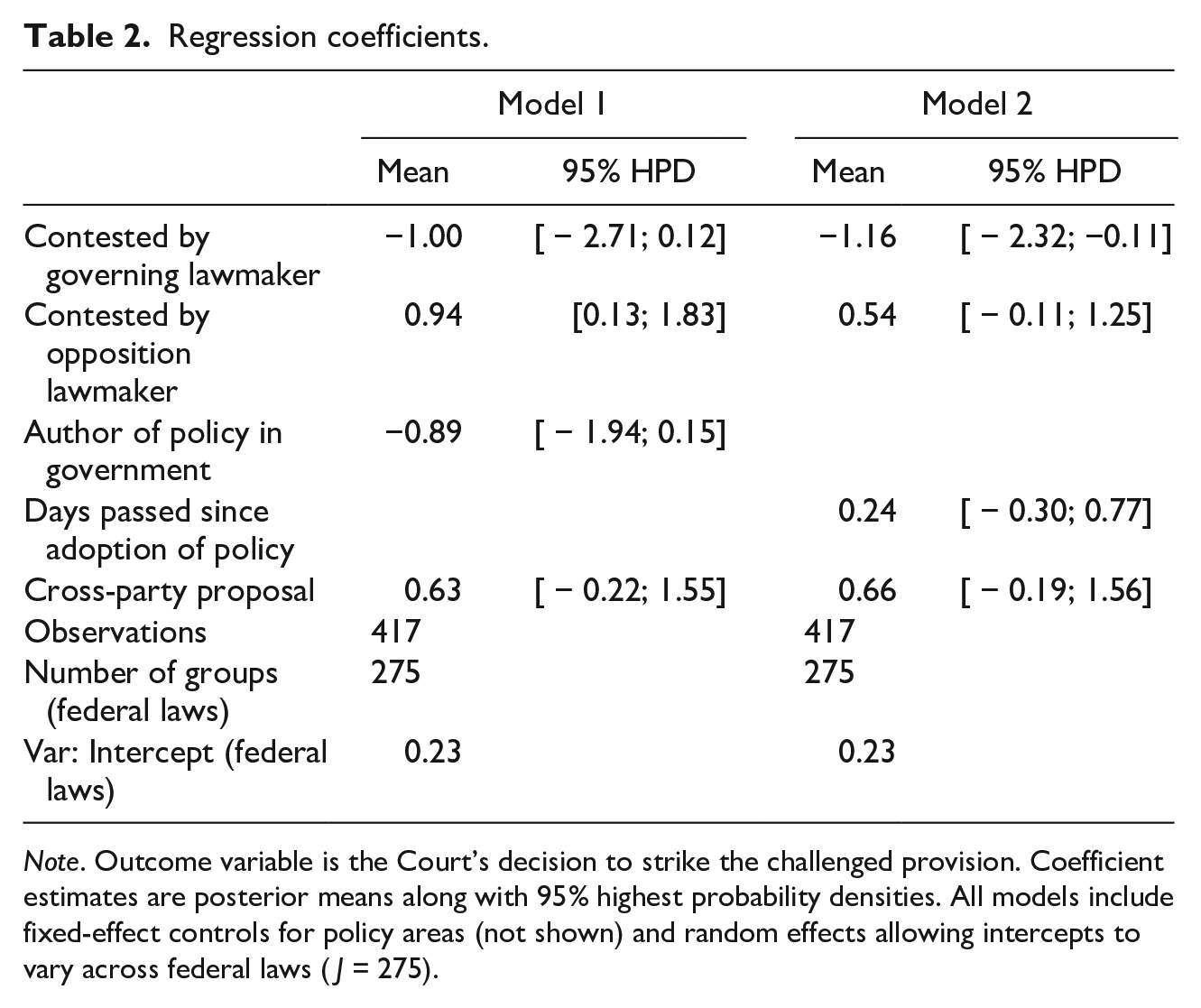
Note. Outcome variable is the Court’s decision to strike the challenged provision. Coefficient estimates are posterior means along with 95% highest probability densities. All models include fixed-effect controls for policy areas (not shown) and random effects allowing intercepts to vary across federal laws (J = 275).
In the following, I illustrate this pattern by calculating predicted probabilities and first differences across three scenarios of interest that are also found most commonly in the data. First, I calculate the predicted probability of a Court strike when neither opposition nor governing lawmakers had voiced constitutional concerns (Scenario 1). I then compare this prediction to a situation in which only opposition lawmakers had voiced concerns (Scenario 2). Finally, I calculate the predicted probability of a Court strike when both opposition and governing had contested the policy’s constitutionality (Scenario 3, note that instances of only governing lawmakers voicing concerns are relatively uncommon in the data). Given the random effects bear on the results, I calculate average marginal predicted probabilities indicating the average change in the probability of observing Strike = 1 across all groups (i.e. federal laws) while manipulating values on the explanatory variables of interest. 21
Figures 5 and 6 show that the probability of observing the Court striking a policy is on average 10 percentage points higher in Scenario 2 relative to Scenario 1 – the Court is more likely to strike policies when a political majority had ignored constitutional warnings by opposition lawmakers relative to policies which had not been contested by any lawmaker. Turning to the comparison between Scenario 3 and Scenario 2, Figures 5 and 6 show that the Court is on average roughly 21 percentage points less likely to strike a policy when a policy had been contested by both opposition and governing lawmakers relative to a policy contested by opposition lawmakers only.
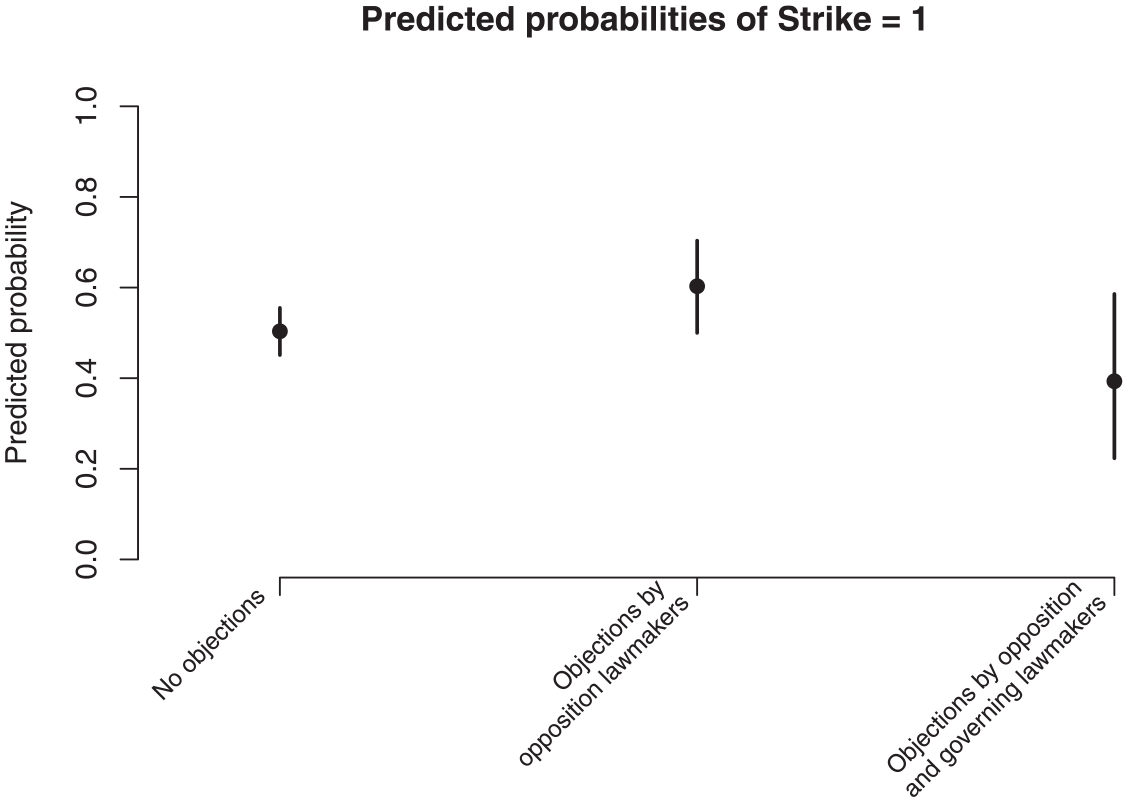
Predicted probabilities of court strikes across scenarios with varying values on the variables Contested by opposition lawmaker and Contested by governing lawmaker. Predictions are based on coefficients of Model 2 (N417).
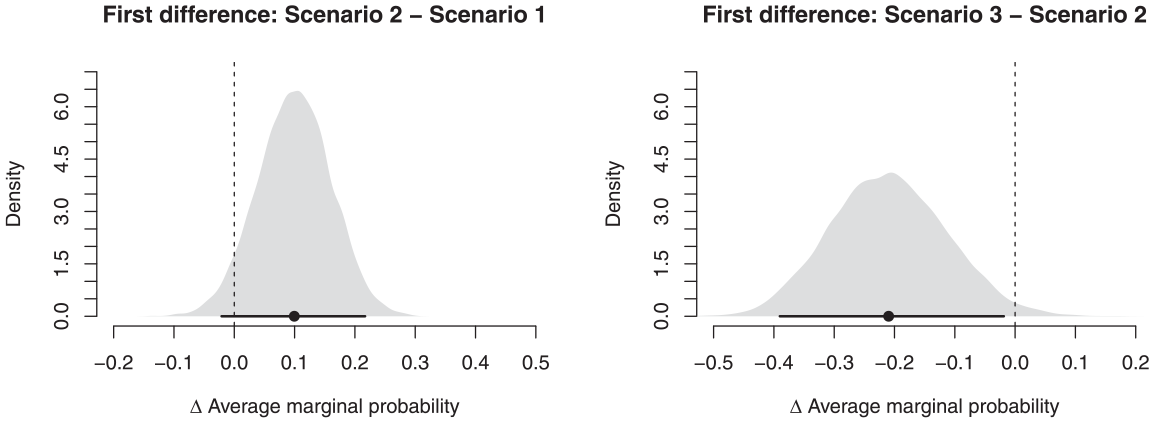
Distribution of the first differences in average marginal predicted probabilities.
The results of the empirical analyses reported here are as substantively interesting as they are counter-intuitive. Assuming that governing lawmakers had expressed genuine, well-founded concerns about a provision’s constitutionality, we would expect the Court to be even more likely to strike it as unconstitutional. Instead, the evidence suggests that the Court moderates its strike rate when lawmakers from both sides of the aisle had voiced constitutional concerns about a policy.
The theoretical model introduced above provides an explanation for this pattern: Lawmakers dismissing advice that their policies are unconstitutional signal a credible non-compliance threat to the Court. Knowing that confrontations with the judiciary may turn out costly for themselves as well, lawmakers’ choice signals that they are prepared to bear these costs and unwilling to sacrifice policy objectives despite anticipating the Court’s constitutional review. Consistent with expectations that courts seek to avoid frequent clashes with lawmakers prepared to challenge their authority (Carrubba et al., 2008; Carrubba & Zorn, 2010; Clark, 2009; Larsson & Naurin, 2016), the empirical evidence presented here suggests that the GFCC then strategically self-restrains its exercise of constitutional review.
Interaction effects
In the final part of the analysis, I consider extensions of Models 1 and 2 presented above. I now interact the variables Author of policy in government (Model 3) and Days passed since adoption of policy (Model 4) with both main explanatory variables Contested by governing lawmaker and Contested by opposition lawmaker. As described above, the intuition here is that the effect of the signal on the Court’s (strategic) decisions should be conditional on whether the lawmakers who had signalled a non-compliance threat still control government office at the time of the Court’s review.
In light of the relatively small number of observations, in particular observations with Contested by governing lawmaker = 1, including interaction effects is not without issues. Inferences for some scenarios will now be based on an even smaller number of observations. Nonetheless, the analyses provide at least exploratory insights into empirical patterns we should observe if the theoretical model accurately captures the strategic behaviour of courts and lawmakers.
Figure 7 and Figure 8 plot the logistic regression coefficients for Models 3 and 4. Figure 7 shows that the only coefficient in Model 7 that is positive and distinguishable from zero is the main effect for Contested by opposition variable. When a governing majority which had ignored the parliamentary opposition’s constitutional concerns no longer controls government office once the Court issues its decision, the Court is more likely to strike a policy as unconstitutional. The coefficient for the interaction between Author of policy in government and Contested by opposition lawmaker is difficult to interpret given it is based on only five observations.
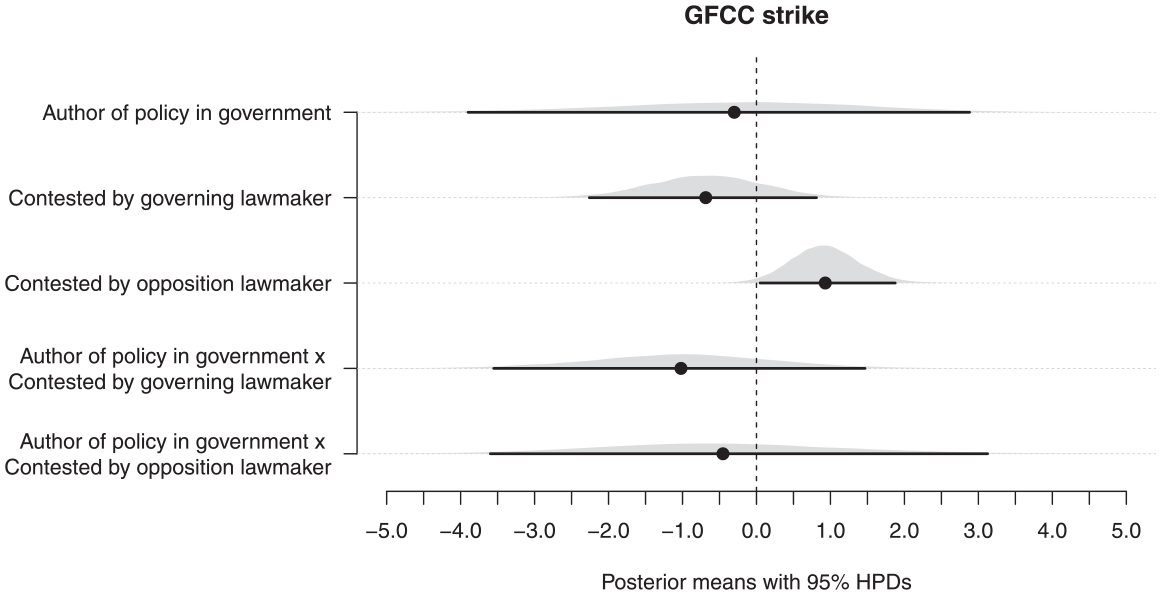
Coefficients for Model 3 (N417). The model includes fixed-effect controls for Policy area and Cross-party proposal as well as random effects across federal laws.
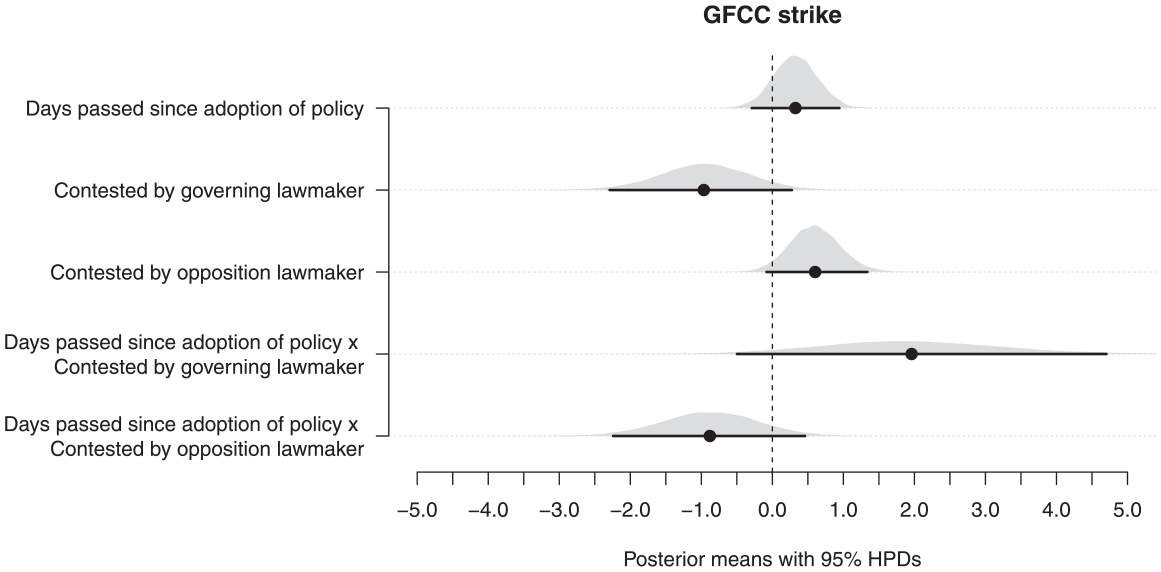
Coefficients for Model 4 (N417). The model includes fixed-effect controls for Policy area and Cross-party proposal as well as random effects across federal laws.
Turning to the interaction between Author of policy in government and Contested by governing lawmaker, the coefficient for the interaction term is negative, which would suggest that the moderating effect of lawmakers ignoring credible constitutional warning signs on the Court’s strike rate is stronger when the signal’s senders are still controlling a governing majority. However, uncertainty in the coefficient estimate is very high, which is unsurprising given that governing coalitions which had ignored political allies’ constitutional concerns were still in office at the Court’s review in only 18 instances.
A somewhat clearer picture emerges for Model 4. Figure 8 plots the coefficients for Model 4, showing that the main effect for the variable Contested by governing lawmaker is negative, while its interaction with the variable Days passed since adoption of policy is positive. The reverse pattern holds for the interaction between the variables Contested by opposition lawmaker and Days passed since adoption of policy: The main effect is positive and the coefficient for the interaction is negative. While the wide uncertainty intervals for the coefficients are again unsurprising given the relatively small number of observations for some of the scenarios, results from Model 4 provide tentative evidence suggesting that the signalling effects of lawmakers’ choices at the policymaking stage weaken over time.
Discussion and Conclusion
Existing literature has shown that courts reviewing the acts of the legislative and executive branches are hamstrung by an enforcement problem and concerned about maintaining their institutional integrity when they come under pressure from the elected branches (Carrubba, 2009; Vanberg, 2005; Hall, 2014; Clark, 2010). In this article, I show that this feature of systems of separation-of-powers allows lawmakers to push constitutional boundaries to their policymaking. Not all lawmakers are risk-averse and prepared to sacrifice important policy objectives out of concerns that their policies will be struck by a court. The formal model introduced in this article shows that lawmakers who pursue evidently unconstitutional policies credibly signal their resolve to challenge judicial authority and constitutional boundaries to their policymaking. Because courts are keen to avoid all too frequent bruising clashes with the elected branches, we should expect to see courts show deference when lawmakers signalled their resolve. The evidence from the German Federal Constitutional Court’s review of federal law presented here is consistent with the formal model’s comparative statics. The empirical analysis suggests that the Court moderates its strike rate of federal laws when lawmakers had previously dismissed their political allies’ constitutional concerns.
Despite covering more than three decades of the German Federal Constitutional Court’s jurisprudence on the constitutionality of federal law, key findings of the empirical analysis are driven by a relatively small number of legislative provisions, which had been contested by governing lawmakers. The small number of such observations in itself is neither unexpected nor is it inconsistent with the empirical implications of the theoretical model. We have reason to expect that lawmakers are prepared to flout constitutional constraints on their actions only when the value of their pursued policies outweighs the costs of evading compliance with court decisions. In the German case, where the Court enjoys widespread support among the public (and hence, the electorate), it is reasonable to expect that these instances are limited to a smaller number of key policy objectives. For instance, lawmakers of the governing majority unsuccessfully contested the constitutionality of reforms of asylum regulations in the early 1990s in the wake of the conflict in former Yugoslavia, the strengthening of law enforcement’s competences to combat modern international terrorism after the bombings in Madrid and London in 2004 and 2005, and authorizations to grant financial aid to ailing EU member states to preserve the stability of the EU’s currency union during the euro-crisis.
Further, neither the theoretical model nor the empirical evidence presented here imply that courts will always shy away from challenging lawmakers over such significant yet constitutionally controversial policy reforms. However, just as prudent lawmakers anticipate constitutional review, courts are well-aware that the faithful implementation of their decisions relies on the cooperation of the elected branches and that frequent intervention on key policies increases the likelihood of backlash and non-compliance. The article’s central claim is that lawmakers’ dismissal of advice on the unconstitutionality of their policies helps courts to solve their dilemma of knowing which of their decisions will push lawmakers to lash out and risk non-compliance and thus to effectively manage their reliance on the elected branches for the efficacy of their judgements (Hamilton, 1961).
This claim has implications for an ongoing normative debate on the judicialization of policymaking. Some scholars have cautioned against a government through all-powerful courts, ‘thwarting the will’ of the representatives of the people (Bickel, 1986; Friedman, 2002; Stone, 2000). In this article, I show that courts’ compliance dilemma allows lawmakers to pursue – and implement – policies courts would otherwise prefer to strike. This dynamic is born out of the institutional design of systems of checks and balances. Madison (1961) observed that to ensure the functioning of such systems, ‘ambition must be made to counteract ambition’, and this logic applies to courts as well. In other words, what may appear as lawmakers’ provocation of confrontation with courts is ultimately an observable implication of a system of separation-of-powers at work, albeit one that raises questions to what extent courts can stop lawmakers determined to prioritize policy over constitutional concerns in their tracks.
Supplemental Material
sj-pdf-1-cps-10.1177_00104140221089649 – Supplemental material for Pushing Boundaries: How Lawmakers Shape Judicial Decision-Making
Supplemental material, sj-pdf-1-cps-10.1177_00104140221089649 for Pushing Boundaries: How Lawmakers Shape Judicial Decision-Making by Philipp Schroeder in Comparative Political Studies
Footnotes
Acknowledgements
I am thankful for thoughtful feedback on earlier versions of this manuscript from Christine Reh, Lucas Leemann, Tim Hicks, Tom Clark, as well as the attendees at UCL’s Political Science Departmental Research Seminar and the research seminar at PluriCourts, University of Oslo. I would also like thank the two anonymous reviewers and editors for their useful suggestions on how to improve the manuscript.
Declaration of Conflicting Interests
The author(s) declared no potential conflicts of interest with respect to the research, authorship, and/or publication of this article.
Funding
The author(s) received no financial support for the research, authorship, and/or publication of this article.

Supplemental Material
Supplemental material for this article is available online.
Notes
Author Biography
References
Supplementary Material
Please find the following supplemental material available below.
For Open Access articles published under a Creative Commons License, all supplemental material carries the same license as the article it is associated with.
For non-Open Access articles published, all supplemental material carries a non-exclusive license, and permission requests for re-use of supplemental material or any part of supplemental material shall be sent directly to the copyright owner as specified in the copyright notice associated with the article.
