




Abstract
Do voters follow the preferences of foreign mass collectives? Despite the growing research on policy diffusion and theoretical debates on the emergence of transnational public spheres, we know little about the impact of foreign votes on domestic public opinion. Yet, the results of elections and referendums may provide a signal to people in other countries and trigger a process of contagion. This study leverages the coincidence of the 2005 French referendum on the European Constitution and the fieldwork of two surveys to analyze the causal effect of cross-national social influence. Results show that the French rejection increased public opposition to the Constitution abroad. A process of cognitive activation explains why knowledgeable voters also grew Eurosceptic after the vote. These findings attest to the interdependence of national publics and contribute to our understanding of mechanisms of social contagion.
Introduction
With the virtual erasing of costs of worldwide communications, the results of elections and referendums are increasingly reported abroad. Thus, the possibility that voters could follow the lead of foreign citizens has attracted considerable interest in the public debate and has gained some attention in social science research. In the last years, for example, the Brexit vote and the election of Donald Trump sparked fear of contagion among both pundits and political elites. In an interview released before the British referendum, the German finance minister expressed concerns that a British exit from the European Union could trigger a domino effect in other member states. 1 Similarly, many reporters suggested that the two electoral events that shook the United States and Britain in 2016 could activate a process of international contagion. 2
There is some evidence that collective opinions and behaviors can be imitated abroad. Studies on revolution waves, for example, show that certain “iconic events” represent powerful lessons for subsequent democratization episodes in neighboring countries (Beissinger, 2002; Capoccia & Ziblatt, 2010; Weyland, 2010). Similarly, previous studies have shown that public support for a policy increases when that policy is adopted in other countries (Linos, 2011; Pacheco, 2012). Individual interests, as measured in internet searches, have also been found to diffuse albeit more rarely (Bail et al., 2019).
Given these findings, we may expect that election and referendum results could also influence the opinions of citizens abroad. The increased policy interdependence among countries, especially in the context of institutionalized forms of cooperation, makes foreign votes an important source of information for voters who have to make up their minds on similar issues. Indeed, scholars of international cooperation have suggested that referendums that reject international agreements may resonate among the public in other countries and bolster integration-skeptics abroad (Walter, 2020; Walter et al., 2018). However, most empirical studies have so far documented deterrence effects rather than contagion processes (Delis et al., 2018; De Vries, 2017; Minkus et al., 2018). It is, thus, still unclear under what conditions people follow the opinion of foreign mass collectives and what mechanism can account for it.
Combining theories of social influence with studies on transnational public spheres, this study offers a theoretical framework to understand when and how foreign popular votes can affect public opinion. It proposes three conditions under which election and referendum results can influence the opinions of citizens in other countries—proximity, newsworthiness, and scope—and three mechanisms that can explain why citizens follow the opinions of people abroad: a bandwagon effect, a cognitive response, or a legitimization process. This framework is then tested in the case of the 2005 French referendum that rejected the European constitution.
The coincidence of the French referendum and the fieldworks of two surveys, the Eurobarometer and the British election panel study, provides a quasi-experimental setting to study how people’s perception of the opinions of a foreign mass collective affects their own beliefs. The availability of many relevant questions in the Eurobarometer survey and the panel structure of the British survey allow me to provide some evidence for the mechanism at work. Results show that the French rejection decreased public support for the Constitution abroad by 11 percentage points. Support declined especially among supporters of the European project, thus suggesting a persuasion effect rather than a legitimization effect. Moreover, a process of cognitive activation may explain why knowledgeable voters also grew Eurosceptic after the vote.
These findings bear important implications for the comparative study of public opinion. First, this study contributes to a growing literature on the feedback effects of electoral results (Bischof & Wagner, 2019; Bursztyn et al., 2020; Valentim, 2021). While previous work has mostly focused on domestic public opinion, this study shows that elections can trigger a process of social influence also beyond the borders of nation states, and not just by altering the acceptability of previously hidden opinions (Giani & Méon, 2019). These results provide empirical support to political theories that have pointed to the emergence of transnational public spheres (Castells, 2008; Fraser, 2007). The growing interconnections of public opinions also has broader significance for scholars of comparative political behavior, who tend to compare public preferences across countries while assuming the absence of any cross-country interactions, and for scholars of policy diffusion, who tend to see public opinion as a constrain to electorally concerned party elites (Gilardi, 2010), but not as an independent channel of transmission.
That referendum results can affect public opinion abroad is of particular relevance for students of international integration, especially in the context of the European Union. On the one hand, these findings provide evidence of a nascent European public sphere that could provide a stronger social underpinning to the construction of a political Europe (Risse, 2010). At the same time, they question the viability of international cooperation at a time when referendums on international cooperation increasingly have disintegrative outcomes (De Vries et al., 2020). The international effects of changing support for international agreements may also explain why foreign leaders have an incentive to take a position in other countries’ elections and referendums (Walter et al., 2018).
The paper is structured as follows. The first section reviews the literature and available evidence on cross-national social influence. The second section specifies the conditions that can enable it and the mechanisms that can account for it. The third section introduces the case study and explains why EU referendums provide a good case to study instances of contagion in public opinion. I then describe the identification strategy, the data, and the methods used in the analysis. The presentation of the results is followed by a discussion of their implications and their scope conditions.
Social Influence Beyond National Borders?
There can be two reasons why people at a given time hold similar beliefs. People may either respond to similar conditions or influence each other. The study of public opinion usually focuses on common causes. Yet, people do learn from the opinions and behaviors of others (Banerjee, 1992; Bikhchandani et al., 1998; Sunstein, 2019). They learn about the political preferences of others from daily conversations with associates or strangers (Huckfeldt & Sprague, 1995; Lazarsfeld & Katz, 1955; Noelle-Neumann, 1993), from critical public demonstrations (Kuran, 1997; Lohmann, 1994), and frequently from polls (Boudreau & McCubbins, 2010; Mutz, 1998). Do people learn as well from the preferences and behaviors of other people abroad? Although political theorists increasingly discuss the emergence of transnational public spheres (Castells, 2008; Fraser, 2007), there is little empirical evidence that processes of social influence can occur beyond national borders.
The prolific research on cross-national diffusion of public policies tends to focus on the rational decision making of political elites (Elkins & Simmons, 2005; Gilardi & Wasserfallen, 2019). However, public opinion matters in policy diffusion processes, and not just as a constrain to electorally concerned party elites who learn about the potential popularity of policy decisions and electoral strategies (Böhmelt et al., 2016; Gilardi, 2010; Rydgren, 2005). Voters directly respond to the adoption of a policy in foreign countries and to foreign elites’ discourse. For example, state-level support for antismoking legislation in the United States increased when the policy was adopted in neighboring states (Pacheco, 2012). Similarly, results from an experimental survey reveal that American voters who were informed about the adoption of paid maternity leave by a foreign government were more likely to support such a policy (Linos, 2011). Further evidence of diagonal cross-national links from foreign elites to voters can be found in the study by Hayes and Guardino (2011), who show that foreign elite communications reduced support for the Iraq War among US citizens.
Evidence of transnational horizontal linkages at the mass level is instead limited and contested. Some scholars suggest that public opinion in one country may follow changes in foreign preferences with regard to left–right identification or party family support (Caramani, 2015; Jerôme & Jerôme-Speziari, 2010; Kim & Fording, 2001). On the other hand, Kayser (2009) has convincingly shown that these international comovements in public opinion along partisan lines tend to arise from common responses to the international business cycle rather than from short-run diffusion effects.
Scholars of international cooperation have recently suggested that voter-endorsed disintegration bids, such as referendums that reject international agreements or the election of leaders with markedly nationalist agenda, may indeed trigger a domino effect by encouraging integration-skeptic voters in other countries (Walter et al., 2018). However, empirical studies on the contagion potential of the Brexit referendum vote have reported a deterrence effect on the disintegration ambitions of other EU member states (Delis et al., 2018; De Vries, 2017). On the other hand, scholars that have focused on the global reverberation of the election of Donald Trump have reported mixed findings. The uncovering of the 2016 US election results seems to have, at the same time, strengthened support for international cooperation in the EU (Minkus et al., 2018) and legitimized the expression of racist attitudes across the pond (Giani & Méon, 2019).
These conflicting results highlight the need for a theory of cross-national social influence that could clarify both the conditions under which popular votes can reverberate abroad and the individual-level mechanisms that account for this process of contagion.
Cross-National Social Influence: Conditions and Mechanisms
Cross-national social influence is defined as the change in an individual’s attitude or behavior that derives from information about the opinions or experiences of a foreign mass collective. Elections and referendums are aggregators of private opinions that may carry tremendous credibility as trustworthy source of information (Bursztyn et al., 2020). The uncovering of the results of popular votes in one country can provide information to voters abroad about the popularity of a policy or a campaign pledge and lead them to update their own opinions. In this sense, foreign popular votes may represent “iconic events” with a powerful “demonstration effect” for citizens in neighboring countries, similarly to contentious episodes in democratization processes (Beissinger, 2002; Capoccia & Ziblatt, 2010; Weyland, 2010). Referendums may be especially conducive to cross-national influence due to their issue-specific character. Likewise, the electoral success of political leaders whose campaign platform centers on a specific message could produce a strong signal for voters abroad.
Mass media operate as a crucial transmission belt in a process of cross-national social influence. In order to affect the opinions of citizens abroad, election results need to be salient in the public debate of the receiving country and be discussed with similar frames of references. Drawing on studies of international news coverage and transnational public spheres (Shoemaker et al. 1991, 2007; Risse, 2010), this article posits that three conditions are necessary for a popular vote to trigger a process of cross-national social influence: (1) proximity, meant here both as the geographical distance and as the strength of cultural, political, and economic ties between countries. Interconnected countries are more likely to report on each other’s elections. (2) newsworthiness, defined as the perceived statistical or normative deviance of an electoral event, as well as its broader social significance. The results need to be perceived as different from others because they are unusual, because they challenge the status quo or break norms, or because they are in themselves important or consequential for the receiving country. (3) scope, defined as the relevance of voter-endorsed policies or campaign pledges in other contexts. Cross-national social influence can only emerge when electoral results can be discussed using similar frames of reference in the receiving country.
When it comes to identifying the mechanisms of social influence processes, the classical explanation refers to the innate tendency of human beings to conform (Deutsch & Gerard, 1955; Festinger, 1957; Noelle-Neumann, 1993). Yet, the persuasive power of collective representations does not derive from the attractiveness of the collective’s identity so much as its sheer existence as a large-scale collective (Mutz, 1998). This is especially true when social influence comes from the opinions and behaviors of people abroad. In the absence of any group identification that may push people to conform to foreign mass preferences, cross-national social influence can be only understood as an informational process.
Three mechanisms can be at the base of a process of cross-national social influence: a bandwagon effect, whereby people use the information of foreign preferences as a consensus heuristic; a cognitive response, that generates a process of self-persuasion; or a legitimization effect on the acceptability of previously hidden opinions.
First, impersonal influence can be explained with reference to the belief that imitation is a useful strategy for obtaining valued positions or resources. Studies on self-fulfilling prophecies (Merton, 1968), network diffusion processes (Coleman et al., 1966), threshold-based behavior (Granovetter, 1978) or informational cascades (Lohmann, 1994) are all based on a simple mechanism: one individual’s belief in the value or necessity of performing a certain act depends on the number of other individuals who have already performed that act (Hedström, 1998). Thus, a consensus heuristic is in use when information indicating the preferences of a collective cues people into assuming that the more popular option in the collective is the better option (Axsom et al., 1987; Giner-Sorolila & Chaiken, 1997).
A second reason why people may respond to information about the opinions of distant, impersonal others is because of the thoughts that people generate in response to learning what others think. According to cognitive response theory, people who are exposed to information about levels of support for a candidate, party or policy are led to think about reasons for and against the position of the mass collective (Mutz, 1998). People’s attitudes may shift when they learn of others’ views because knowing the opinions of others induces them to think of arguments that might explain those others’ positions (Petty & Cacioppo, 1986). By rehearsing these arguments, people engage in a process of self-persuasion whereby their own attitudes move in the direction of the arguments that have been primed by others’ views, arguments that would not otherwise have come to mind.
Finally, the reporting of foreign election or referendum results may increase only the acceptability of a policy position or a campaign pledge. The aggregation of the private opinions of foreign citizens can affect individuals’ perception of what other people think, while leaving their opinions unaffected (Bursztyn et al., 2020). Some people may oppose a certain policy while believing that the majority in their country supports it. The fear of being stigmatized would bring them to hide their true opinion (Katz and Allport 1931). In such a context, the electoral victory of a candidate or a referendum proposal in another country may suggest that the likely number of individuals supporting a certain opinion may be larger than previously expected also in one’s own country. 3 Rather than changing preferences, the reporting of foreign elections and referendums would make it is easier for citizens to reveal their true preference. In this way, even persistent social norms may break down when a majority of voters in another country disowns them (Giani & Méon, 2019).
These three mechanisms may be operating at the same time for different people. People with higher levels of political awareness are more likely to produce a cognitive response than less knowledgeable people (Mutz, 1998), who may instead use the results of foreign elections as a consensus heuristic (Boudreau & McCubbins, 2010; Rothschild & Malhotra, 2014). A legitimization effect may only occur among people who have hidden their true preferences (Bursztyn et al., 2020). In the absence of experimental measures of preference falsification, I expect a legitimization mechanism to occur among people with less extreme attitudes.
Case Study: The 2005 French Referendum
European integration has long been a fundamentally international and elite-driven process, conceived to take place among countries, but not within them. The internal legitimacy of the member states and discourses of economic efficiency were sufficient to prevent any serious outbreak of popular opposition (Lindberg & Scheingold, 1970). Since the beginning of the 1990s, the delegation and pooling of national competences at the EU level increased demands for public justifications and provoked resistance from certain social groups, thereby triggering a process of politicization (De Wilde & Zürn, 2012; Hooghe & Marks, 2009).
Integration steps have been a key driver of politicization, especially when combined with ratification via referendum (Hutter et al., 2016). Referendums introduce a popular element into the ratification process that is out of the control of governmental elites, and can have elite-defying consequences (Hobolt, 2009). The consequences of a negative referendum outcome, however, extend well beyond the domestic arena. The failure of popular ratification in one country can generate negative spillovers for the other ratifying countries, “sparking fears of contagion and even disintegration” (Walter et al., 2018: 970). Although the EU is a multilevel polity without a common language or a common media system, instances of peak politicization such as referendums on integration steps have the potential to break into the news of other countries (Hutter et al., 2016; Vliegenthart & Boomgaarden, 2007).
The ratification of the Constitutional Treaty (TCE) represents a crucial case study. The high symbolic profile of the text and the sequential nature of the ratification process make it a fertile ground to test the hypothesis of cross-national social influence. Although the EU’s legal system had already conceived of all previous treaties as an evolving set of constitutional norms, European institution had thus far lacked a single pouvoir constituant (Weiler, 1999). The twenty-five Heads of State that signed the Treaty in June 2004 intended to provide a long-lasting legal framework to EU institutions. The highly symbolic profile of the text pushed British Prime Minister Tony Blair to promise a referendum on the Constitutional Treaty. His decision was soon followed by other member states, including Denmark, France, Ireland, Luxembourg, the Netherlands, Spain, and Portugal.
Despite the emphasis of European elites on the historical ambition of the Treaty, the ratification process received relatively little media coverage until the French referendum (Cross, 2017). By that time, some member states had already approved the treaty through parliamentary vote. Among old member states, the parliaments of Austria, Belgium, Germany, Greece, and Italy had ratified the Constitution. Spain alone had already approved the treaty in a popular referendum with an overwhelming majority. European elites had hoped that the Spanish vote would show the way to the other ratifying countries. However, there was little mention of the Spanish referendum in news coverage outside of Spain (Atikcan, 2015).
On May 29, 2005, when a majority of French voters (54.8%) rejected the Treaty, the event topped the news in all European countries. 4 Three days later, the Netherlands followed suit, with 61.5% of “No” votes. If anything, the results of the Dutch referendum reinforced the message sent by French voters. France is not an ordinary EU member. It is a founding member state and, historically, a key actor in driving the European integration project further. When President Chirac set the date for the referendum in March 2005, the “yes” side was enjoying a 20% lead in the polls. Within a mere 2 weeks this lead had been reversed to a 4% lead for the opponents of the constitution. Attitudes toward the Constitution were multifaceted and the no votes reflected concerns over specific aspects of the European project that were primed in the two campaigns rather than simply anti-EU sentiments or protest voting (Hobolt & Brouard, 2011).
Although most polls were predicting the outcome in advance, given the low levels of political knowledge about national politics, let alone international affairs (Clark and Hellwig 2012; Carpini and Keeter 1996; Gilens 2001), most people outside of France were most likely not informed of the polls, and some did not even know about the upcoming referendum, if not about the constitution (see Figure 2 in the results section). Moreover, polls were so close that there still was a high uncertainty about the outcome. 5 The publication of the results produced a sharp increase in the salience of the issue in other countries. The extensive coverage produced an uneven pattern of Europeanization of national public spheres, a sort of “Frenchification” (Statham and Trenz 2012: 160). The unexpected nature of the event for citizens abroad is confirmed by the sharp increase in internet searches. Figure 1 summarizes the relative frequencies of Google searches for the words “referendum” and “European constitution” over a 2-year period (2004–2005). Data is available only for six countries. Five countries show a clear peak in the week between 29 May and 4 June. In the United Kingdom, another peak occurred in June 2004, when the final text of the TCE was agreed. More interesting is the case of Spain, where a referendum on the EU Constitution was held on 20 February. Compared to that national event, the salience of the French (and Dutch) rejection is about twenty percent. As mentioned above, the Spanish referendum went rather unnoticed in the other countries.
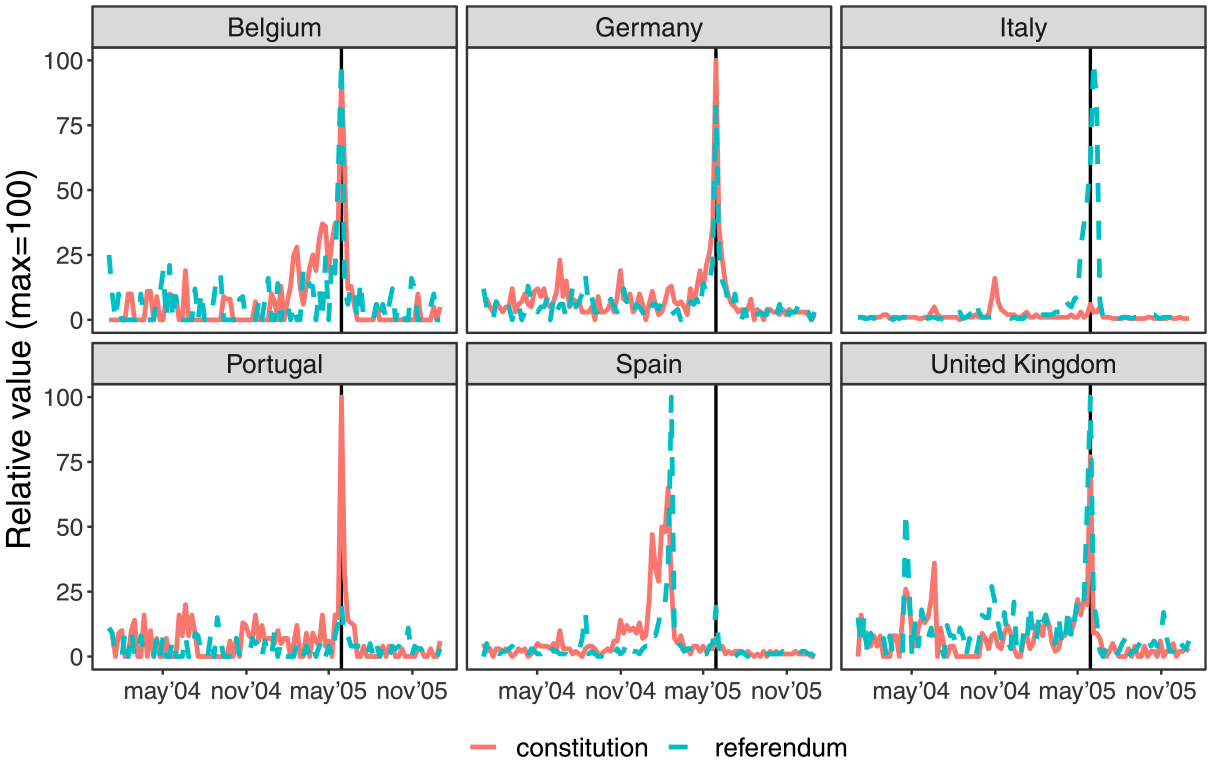
Internet search data, 2004–2005. Note. Relative weekly searches for the terms “referendum” and “European constitution” in the respective national language (French for Belgium), 2004–2005. Source: Google Trends.
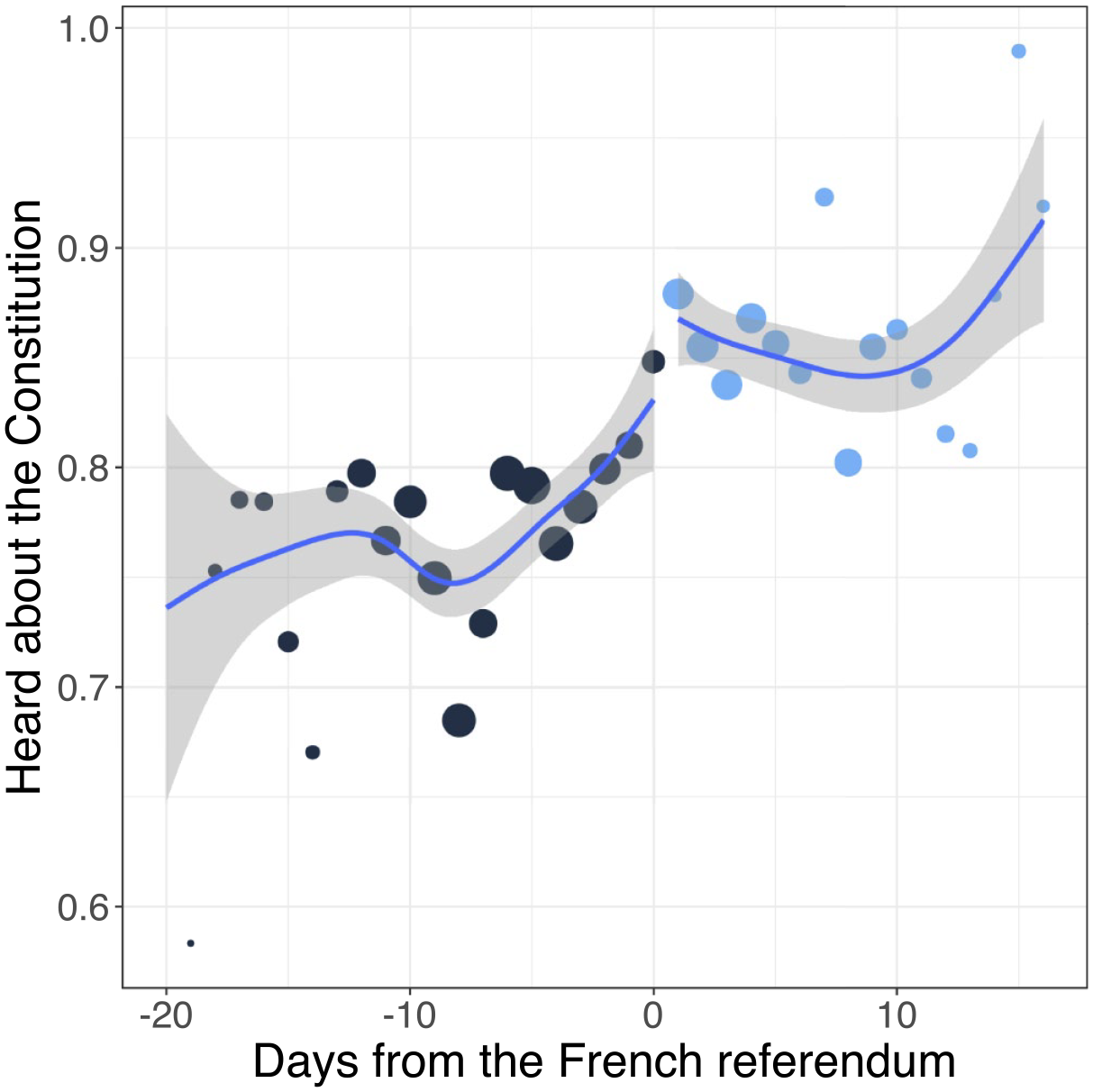
Share of respondents who had heard about the Constitution (LOESS). Data: Eurobarometer 63.4. Note. The graph shows local polynomial regression lines. The size of the points reflects the daily number of respondents.
Identification, Data, and Methods
Studies of contagion effects, similarly to studies of diffusion processes, face what is usually referred to as Galton’s problem, after the famous scientist, statisticians, and cousin of Charles Darwin, or problem of “umbrella” causation, following the metaphor used by Max Weber: individuals in a street may open their umbrellas either because they start to feel the rain (a common cause) or because they see other people opening their umbrellas (a contagion effect). In a more formal treatment of the problem, students of social networks have highlighted that homophily, or the presence of similar individual traits, and social contagion are generically confounded in observational studies (Shalizi & Thomas, 2011).
To address the observational equivalence of diffusion and covariation, this study leverages the coincidence of the 2005 French rejection of the European constitution and the fieldworks of two surveys: the Eurobarometer 63.4 and the British Election Study. 6 This coincidence provides a quasi-experimental setting to test our hypotheses. Given that the day at which survey interviews were conducted is supposedly independent of other third variables that can affect EU attitudes, I compare people interviewed before the referendum and people interviewed afterward. The uncovering of the results represents an exogenous variation that can yield valid causal estimates (Muñoz et al., 2019).
The analysis of the Eurobarometer 63.4 includes twelve countries. The Netherlands, where a referendum took place 3 days later the French vote, are excluded along with France. The day of the French referendum represents the selected cut-point. Accordingly, those respondents who were interviewed after 29 May 2005 are identified as treated, while those interviewed on the referendum day or before are identified as control. 7 The treated group represent one third of the sample in both the Eurobarometer and the British Election Study.
Cross-Sectional Survey
In the analysis of the Eurobarometer data, several dependent variables are employed. The main analysis relies on a survey question that asks respondent about their attitudes toward the European Constitution (specific support).
8
“According to what you know, would you say that you are in favor of or opposed to the European Constitution? Totally in favor, rather in favor, rather opposed, totally opposed.”
In the main text, I show results from linear probability models with a dichotomized dependent variable, while results from ordinal models can be found in the Supplemental Information.
The second outcome variable is an index obtained from the first principal component of thirteen survey questions about the respondent’s attitudes toward European integration and its institutions (diffuse support). The inclusion of a summary index may address concerns of multiple hypotheses testing and reduce noise (Broockman et al., 2017). The questions were asked in all twelve countries under study. The exact question wording of each item is reported in the Supplemental Information.
Two other questions asked in the Eurobarometer survey can contribute to test whether the referendum generated a process of cognitive activation. The question that asks “What does the European Union mean to you personally?” provides information on whether a respondent associate the EU with positive or negative consequences of European integration. Each respondent is offered thirteen meaning items that have a clearly positive or negative connotation: seven items are positive (peace, economic prosperity, democracy, social protection, freedom to travel, cultural diversity, and stronger say in the world) and six items are negative (unemployment, bureaucracy, waste of money, loss of cultural identity, more crime, and not enough control at external frontiers). The second question asks what personal feeling the European Union induce in the respondent: three feeling items are positive (enthusiasm, hope, and trust) and three are negative (anxiety, mistrust, and rejection). In both questions, a respondent can choose any one of these items or a combination of them because there is no upper limit to how many items a respondent can pick.
I first estimate four Poisson count models, where the dependent variables are the number of positive and negative associations, and the number of positive and negative feelings picked by the respondent. Second, I run several linear probability models on each item to uncover what associations and what feelings the French referendum activated in people’s mind.
The Eurobarometer 63.4 is a face-to-face survey with random multi-stage sampling design. In the first stage, primary sampling units (PSU) were selected from Eurostat NUTS regions and stratified by degree of urbanization. In the next stage, a cluster of starting addresses was randomly selected from each sampled PSU. Further addresses were chosen systematically using standard random route procedures. In each household, a respondent was drawn at random following the closest birthday rule. In this procedure, the randomness of the sampling design may still be biased by a geographical pattern. Any correlation between subject location and time of the interview will lead to a violation of the ignorability assumption (Muñoz et al., 2019). In other words, respondents’ treatment status may not be independent of their potential outcomes. A similar threat to causal identification may derive from different levels of reachability of the sampled units.
To focus the attention on those citizens that are most comparable (Ho et al., 2007), all analyses were run after “entropy balancing,” a data preprocessing method to achieve covariate balance in observational studies with binary treatment (Hainmueller, 2012). The analyses adjust inequalities in means with respect to age and its squared term, gender, education, social class, community type, personal financial situation, and country (cfr. Figure A2, in the SI for a balance plot). 9 All analyses include country fixed effects. The analyses are also replicated after the exclusion of respondents in countries with high treatment-control imbalance, that is, Denmark, Greece, Portugal, and Spain (see Table A4-A6 in the SI).
Panel Survey
Studies that rely on events occurred during the fieldwork of public opinion surveys need to rely on several assumptions to estimate a valid causal effect. This study follows several best practices suggested by Muñoz and colleagues (2019) in the form of different estimation strategies and robustness checks. However, an important feature of this study is the occurrence of the French referendum during the fieldwork of a second survey, the 2005 British Election Study. This is a two-wave panel survey, and the referendum occurred during the fieldwork of the second wave. This coincidence allows the estimation of both a fixed-effect (FE) and a lagged dependent variable (LDV) model to control for unobserved time-invariant confounders. FE and LDV estimates have a useful bracketing property, to the extent that they can be thought as “bounding the causal effect of interest” (Angrist & Pischke, 2009: 246).
The two dependent variables here concern support for the European Constitution and support for Britain’s accession to the Eurozone. While the Eurozone survey item is a 4-point scale and was identically asked in both waves, the question on the Constitution was unfortunately asked with different response options in the two-waves. While in the first wave, people could choose between “yes,” “no,” and “don’t know,” in the second wave, two more options were included—“undecided” and “will not vote.” “Undecided” people have been added to the “don’t knows” and treated as same middle-of-the-road preference, while declared non-voters have been coded as missing. The analyses are replicated on dichotomized dependent variables for support and opposition in the SI.
The 2005 British Election Study is a face-to-face survey (CAPI) based on a random sample of the British adult population living in private households. The sampling method involved a clustered multi-stage design, with three separate stages of selection. In the first instance, 128 constituencies were sampled at random, using stratification on marginality of election results, geographic regions and population density. Within each constituency, two wards were sampled at random, giving 256 sample points. At each sample point (ward), addresses were selected with equal probability across the sample point. Using random methods, the interviewer then selected one person for interview at each address.
The panel structure allows me to test for heterogenous treatment effects by conditioning on variables measured during the first wave that, therefore, cannot be affected by the treatment. I will present interaction effects by factual political knowledge and by previous attitudes toward European integration to provide some evidence of the mechanism at work.
Empirical Analysis: Cross-National Evidence
The analysis of the effect of an event occurred during the fieldwork of a survey must necessarily start from a test of the actual exposure of survey respondents to the treatment. Figure 2 provides a tentative test for compliance. The local polynomial regression lines show that the share of respondents who had heard of the Constitution, which started to increase already in the days leading up to the referendum, rises significantly right after the French referendum. The sudden increase in the salience of the debate around the Constitution (cfr. Figure 1) had a direct impact on citizens. However, the uncovering of the results represents an intention-to-treat rather than a treatment. Respondents who were interviewed after the referendum but who never heard about the Constitution may bias estimates downward.
Were people also more likely to oppose the Constitution after the French rejection? Figure 3 shows the local polynomial regression lines of respondents’ support for the Constitution on the interview day. The graph shows that support for the Constitution, which is substantially flat before the referendum, decreases considerably after the uncovering of the results. While respondents were already more likely to oppose the Constitution at the cut-off, support further decreased in the following days. As these results may still be due to heterogeneity in the sampling process, I test whether they hold in a regression framework after matching the distribution of relevant covariates in the control and in the treatment group via “entropy balancing.”
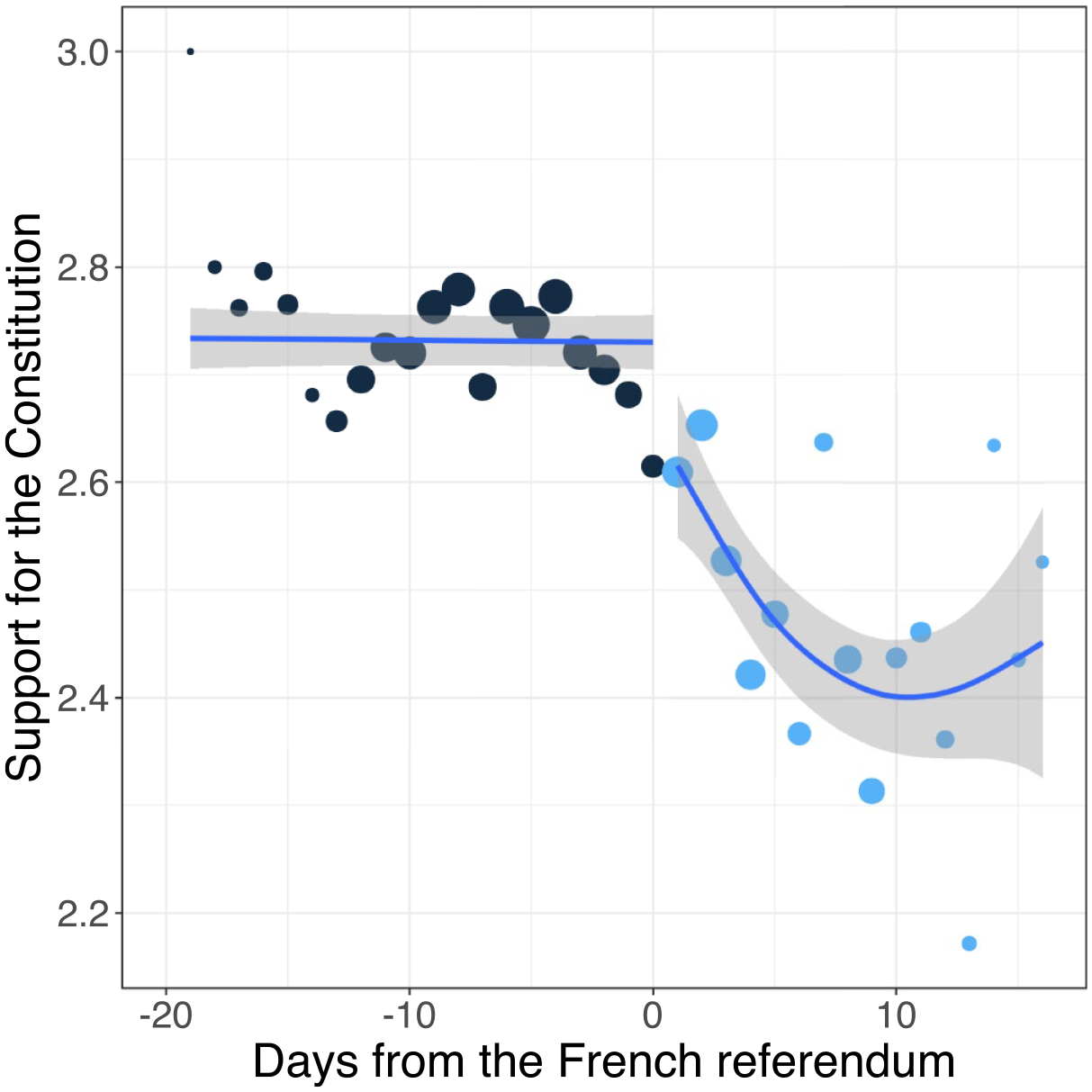
Support for the Constitution (LOESS). Data: Eurobarometer 63.4.Note. The graphs show local polynomial regression lines. The size of the points reflects the daily number of respondents. The dependent variable is a four-item scale. See Figure A2 in the SI for a replication with dichotomized dependent variable.
Table 1 presents the results of three linear regression models. While model 1 considers the full sample, the other models restrict the sample around the cut-off to further account for heterogeneity in the sampling process. The shorter bandwidth gives a higher plausibility to the as-if random assumption, by reducing covariate imbalance between treatment and control. Results show that after the French referendum, people were significantly more likely to reject the Constitution. The drop in support is equal to 11 percentage point. Models 2 and 3 confirm the size and the significance of this effect also for people that were interviewed in a period between 10 days before and 10 days after the event, and for people interviewed not earlier and not later than 5 days from the referendum.
ATT on support for the Constitution.
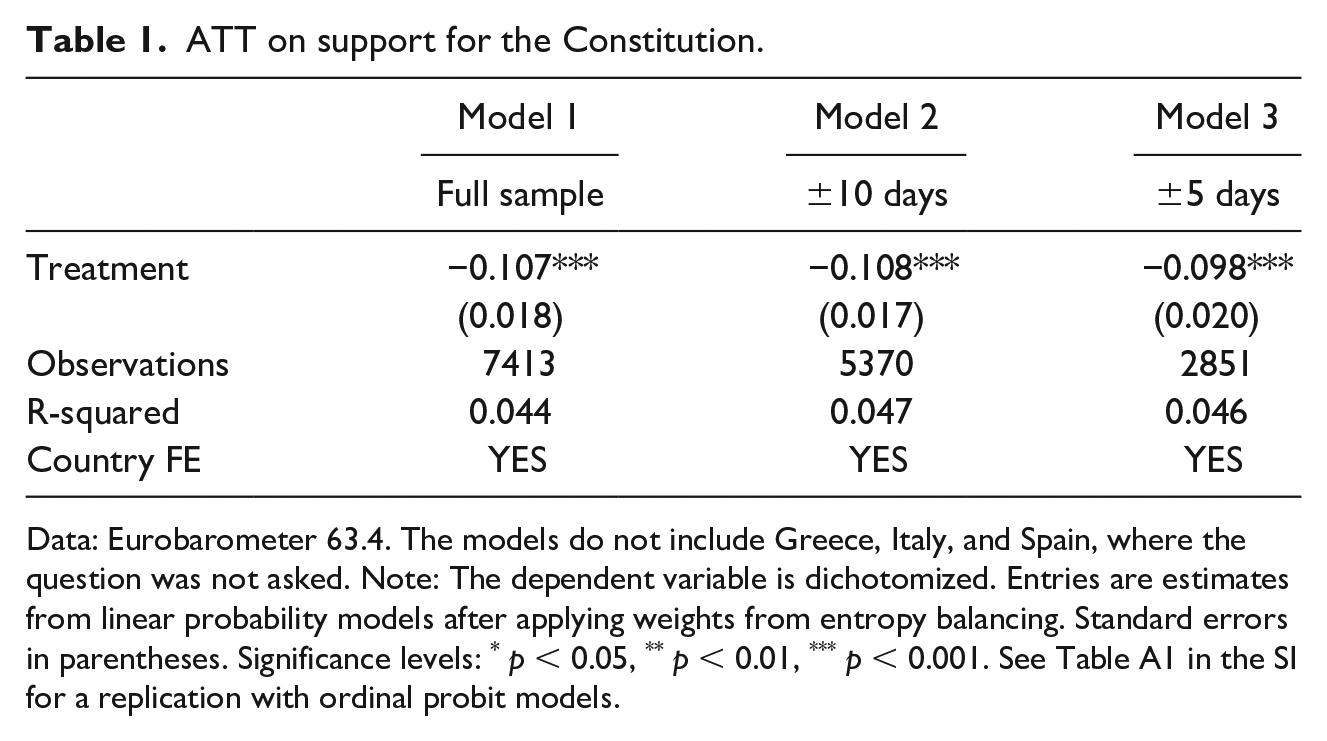
Data: Eurobarometer 63.4. The models do not include Greece, Italy, and Spain, where the question was not asked. Note: The dependent variable is dichotomized. Entries are estimates from linear probability models after applying weights from entropy balancing. Standard errors in parentheses. Significance levels: * p < 0.05, ** p < 0.01, *** p < 0.001. See Table A1 in the SI for a replication with ordinal probit models.
The French referendum may have had an impact not just on people’s support for the Constitution, but also on general EU attitudes. I have included all the relevant questions from the Eurobarometer and constructed an index via a principal component analysis. Figure 4 shows the estimated coefficient and confidence intervals for all the survey items and for the summary index. The results suggest that the French “No” pushed other Europeans toward more negative attitudes toward the EU, as I detect a significant decline in trust and policy support for 10 out of 13 items. I detect the strongest effect not only on people’s support for a political union, a core feature of the rejected Constitution, but also on public trust in the European Commission and Council. These results suggest that the French vote might have operated as a “valence shock,” thus affecting people’s perception of the top EU institutions that had sponsored the constitutional text. In tandem with a decline in support for core integration processes such as the monetary union or the enlargement, these results lend some evidence to the “cognitive activation” mechanism. 10
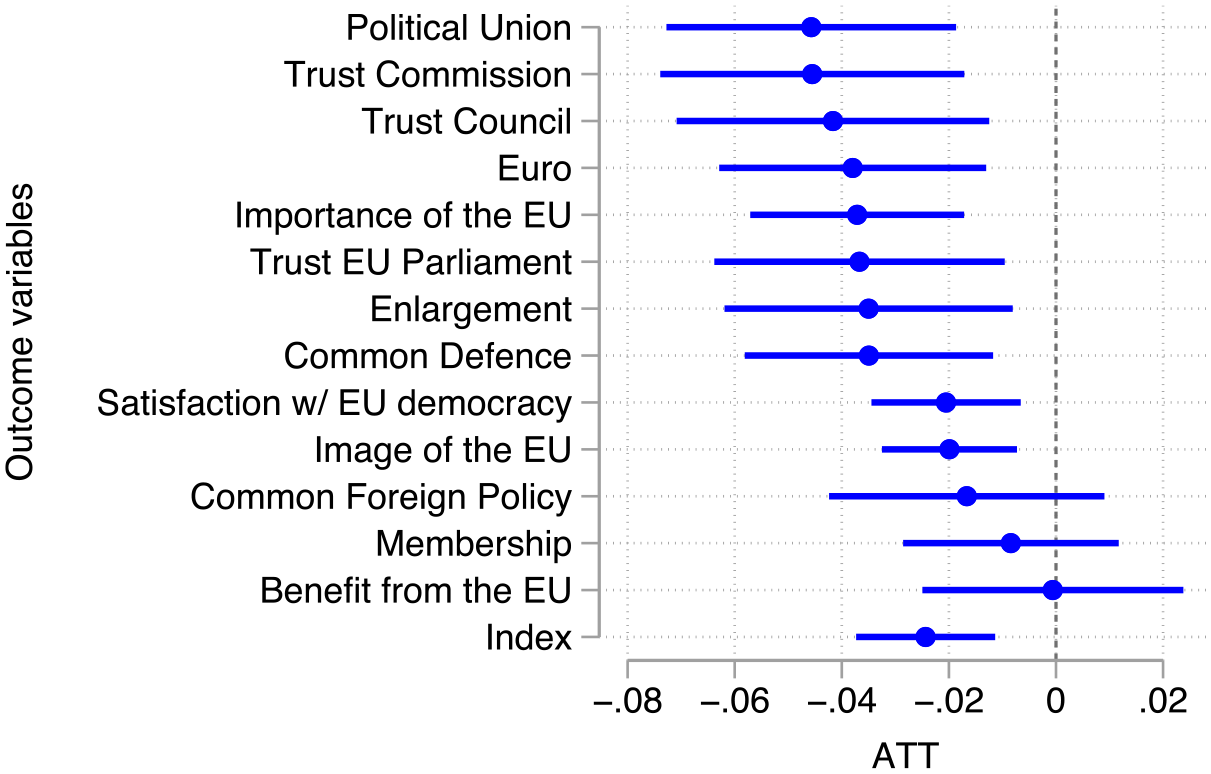
ATT on attitudes toward the EU (coefficient plot). Data: Eurobarometer 63.4. The models include all twelve countries under study. Note. Entries are estimates from linear regression models after applying weights from entropy balancing. All variables are rescaled from 0 to 1 for comparison. The lines show the 95% confidence intervals.
General EU support, as measured by the summary index, declined of around 2.5 percentage points. Models 5 and 6 in Table A2 in the SI confirm the size and the significance of this effect also for people that were interviewed in a period between 10 days before and 10 days after the event, and for people interviewed not earlier and not later than 5 days from the referendum.
Table 2 presents the results from four Poisson regression models on the number of positive and negative meanings, and on the number of positive and negative feelings that each respondent associates to the EU. The results suggest cross-national social influence may be the result of a cognitive response. After the French vote, people in other member states were more likely to associate the EU with negative consequences, more likely to experience negative feelings, and less likely to experience positive feelings.
ATT on mental associations and feelings.
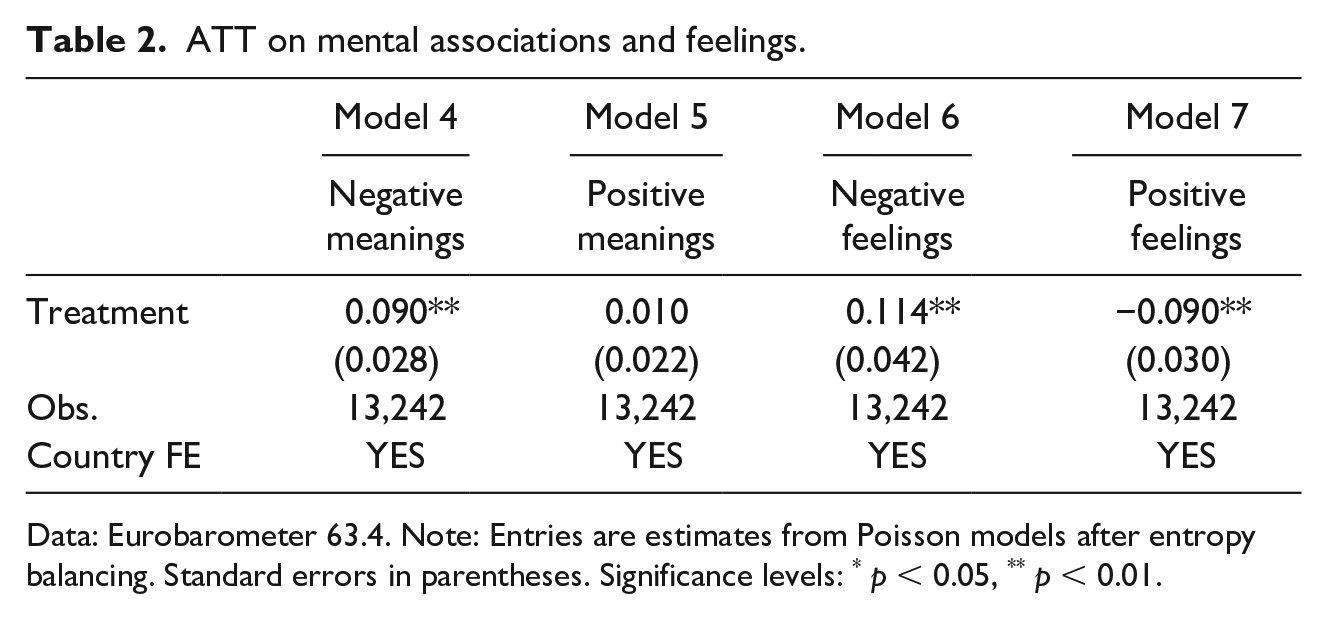
Data: Eurobarometer 63.4. Note: Entries are estimates from Poisson models after entropy balancing. Standard errors in parentheses. Significance levels: * p < 0.05, ** p < 0.01.
Figures 5 and 6 show the coefficients of several linear probability models on every single item representing associations and feelings. After the French rejection, people were more likely to associate the EU with more bureaucracy, with waste of public money, with unemployment, and with a loss of national identity. In addition, they were more likely to experience feelings of anxiety and less likely to feel trustful.
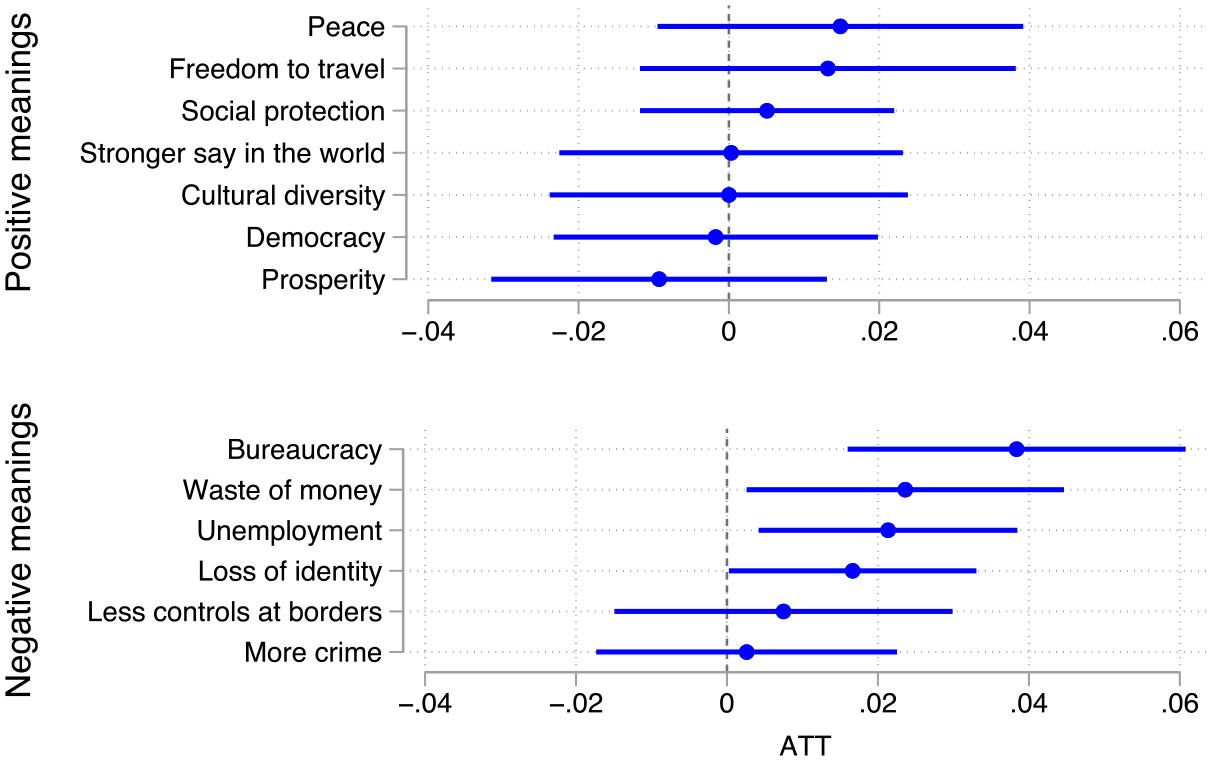
ATT on mental associations (coefficient plot). Data: Eurobarometer 63.4. Note. The graph shows the coefficient of several linear regressions of the probability of picking each item on treatment. All analyses are run after “entropy balancing.”
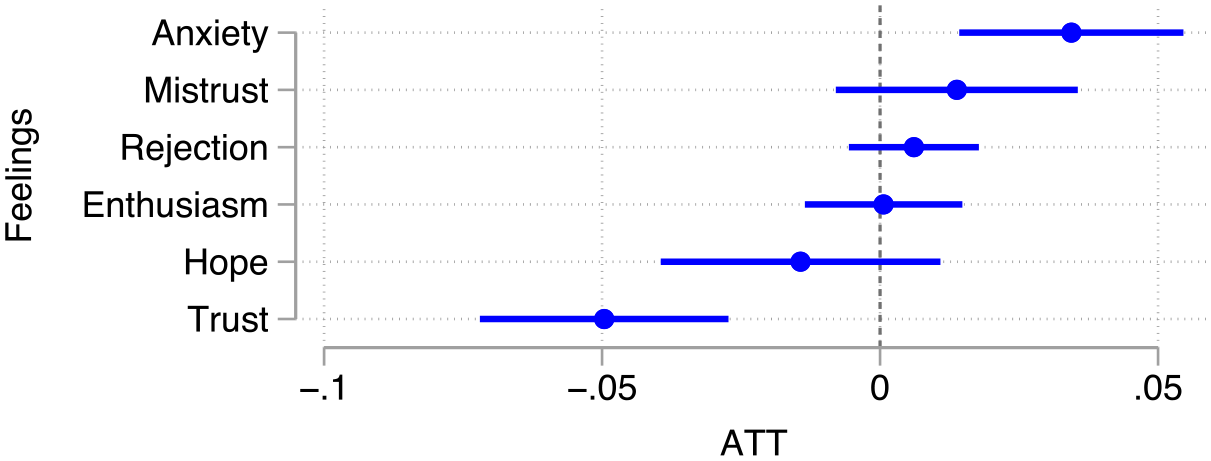
ATT on feelings (coefficient plot). Data: Eurobarometer 63.4. Note. The graph shows the coefficient of several linear regressions of the probability of picking each item on treatment. All analyses are run after “entropy balancing.”
Empirical Analysis: Panel Evidence
The 2005 British Election Study allows us to test whether the results detected above are due to the presence of unobserved confounders. The panel structure of the British data may, thus, allow for a causal interpretation of the observed opinion change. Figure 7 shows the local polynomial regression lines of change in support for the Constitution on the day of interview. All respondents have a less favorable view of the new treaty compared to the previous wave. However, the decline in support is much stronger for people interviewed after the French referendum.
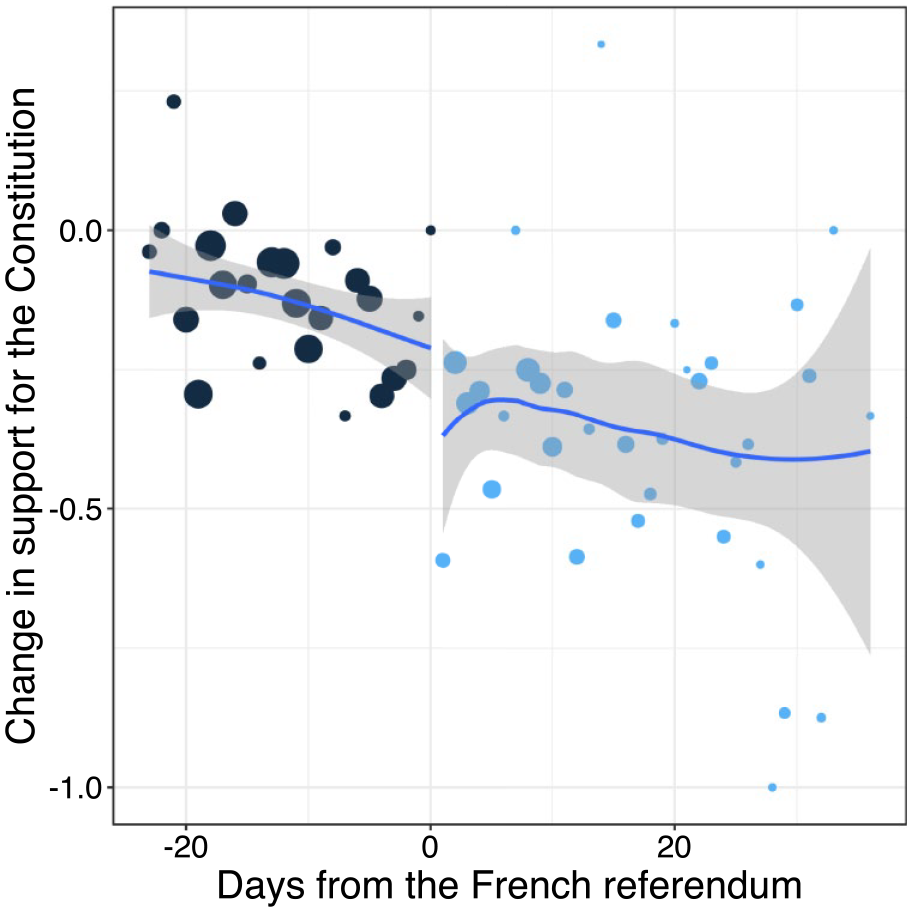
Change in support for the Constitution (LOESS). Data: 2005 British Election Study. Note. The graphs show local polynomial regression lines. The size of the points reflects the daily number of respondents. The dependent variable is a three-item scale. See Figures A4-A5 in the SI for a replication with dichotomized support and opposition.
Table 3 presents the results from a linear fixed-effect model and a lagged dependent variable model. Models 8–11 offer clear evidence that, after the French referendum, British citizens were more skeptical both about the European Constitution and about an eventual accession of the United Kingdom in the Eurozone. The lagged dependent variable models and the fixed-effect models estimate, respectively, the lower- and upper-bound effect. The size of the coefficient is between nine and seventeen percentage points for the drop in specific support, and between two and three percentage points for the drop in diffuse support. 11 In the SI, I restrict the bandwidth around the cut-off to provide further evidence that the estimated effects are due to the referendum outcome rather than to other events happened during the fieldwork. These models confirm the causal interpretation of the estimated decline in support for the constitution (see Table A11). Instead, I do not find a significant decline in support for the Eurozone when I restrict the bandwidth around the referendum day (see Table A12). This suggests that the debates that follow an election or referendum outcome may play a key role in reinforcing or moderating the impact of cross-national social influence on issues that are related only indirectly to the vote.
ATT on specific and diffuse support.
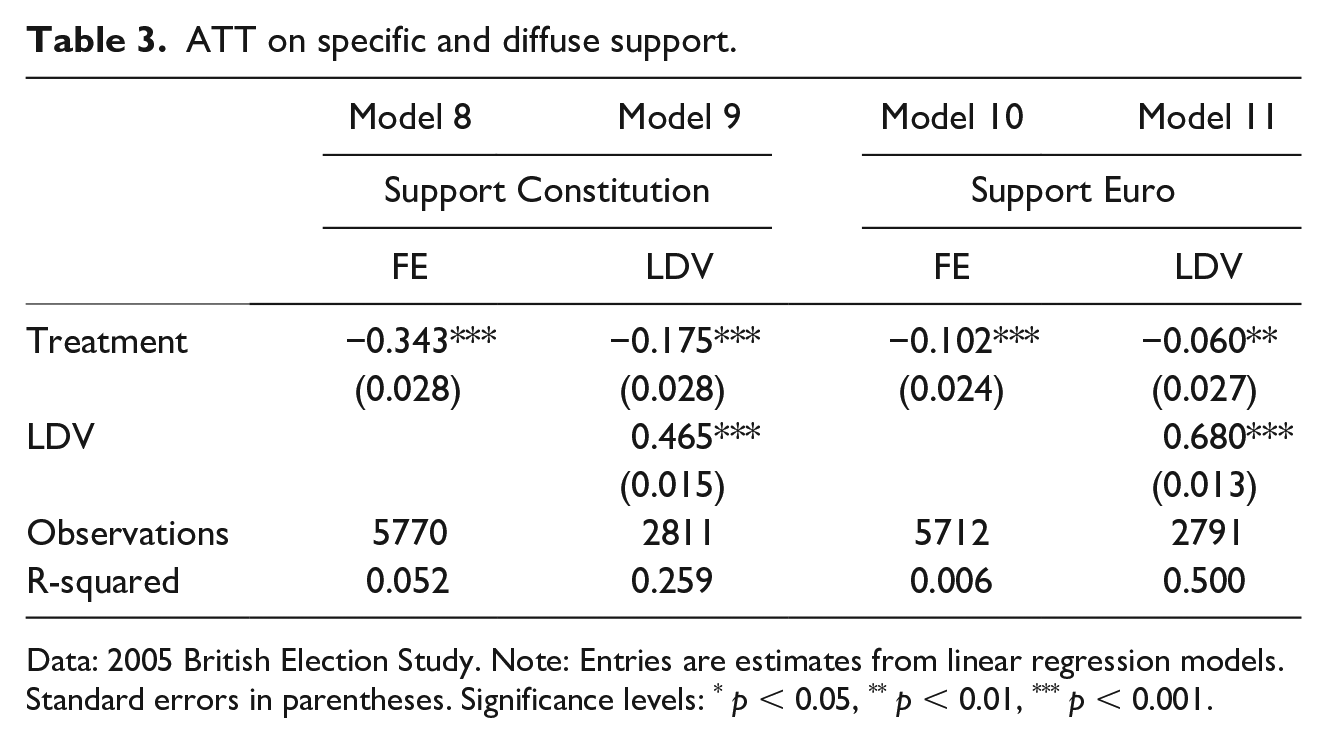
Data: 2005 British Election Study. Note: Entries are estimates from linear regression models. Standard errors in parentheses. Significance levels: * p < 0.05, ** p < 0.01, *** p < 0.001.
The panel structure of the British survey allows us to test whether the French referendum had a differential impact on British citizens depending on their previous general attitudes toward the EU and their general level of factual political knowledge (cfr. Table 4). Both variables are measured in the first wave. Results from model 12 reveal that British support for the Constitution declined especially among voters with stronger favorable attitudes toward the EU. The significant interaction lends support to an interpretation of the results as caused by a process of opinion change rather than by the increased acceptability of previously hidden preferences. Model 13 shows a significant interaction between treatment and factual knowledge. This result suggests that a process of cognitive activation pushed more knowledgeable people to think about the reasons that brought French voters to reject the Constitution. As a result of this process of self-persuasion, support for the UK’s accession to the Eurozone dropped as well. Figure 8 displays the interaction effects computed via a binning estimator to test the linearity assumption (Hainmueller et al., 2019).
Heterogenous treatment effects.
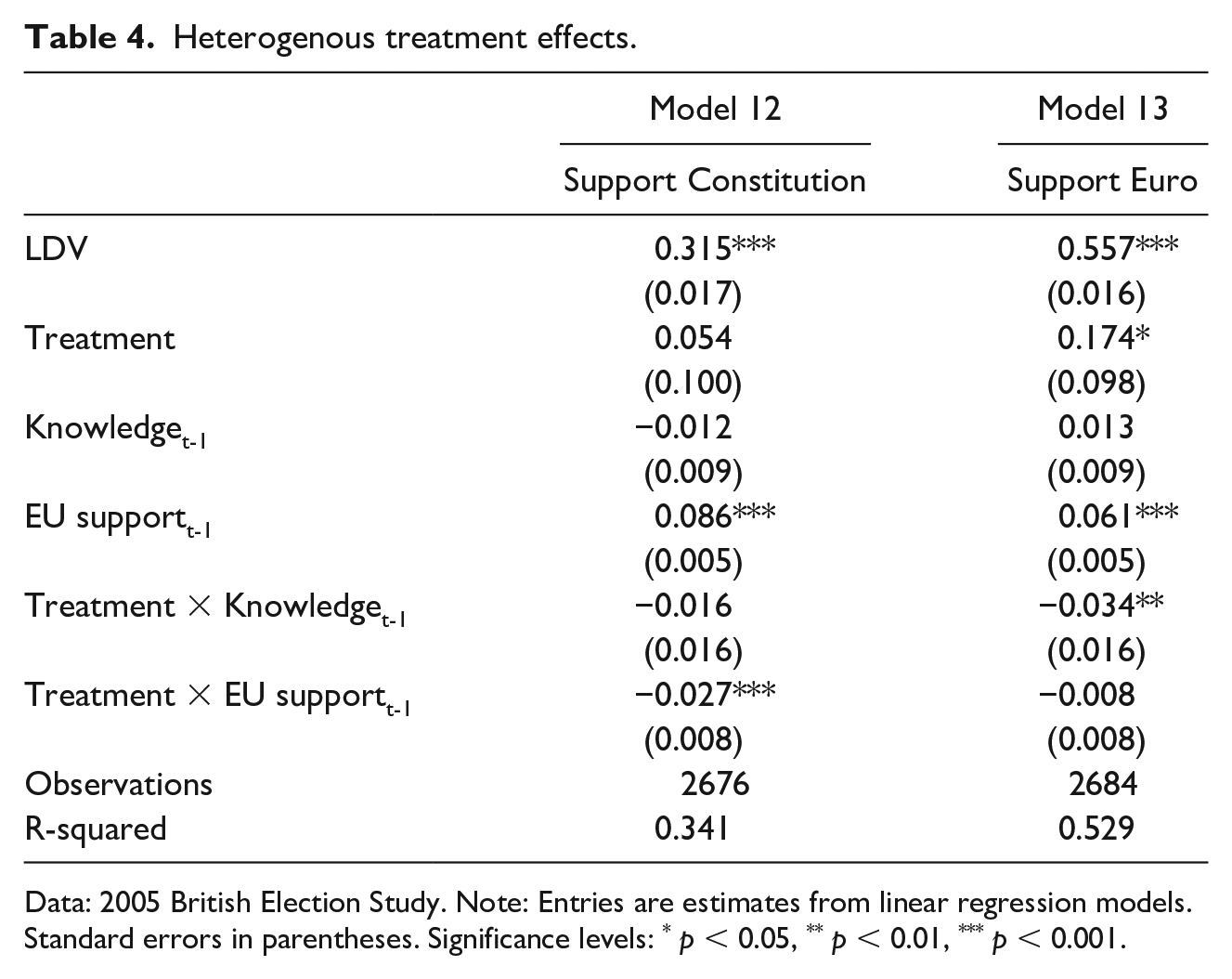
Data: 2005 British Election Study. Note: Entries are estimates from linear regression models. Standard errors in parentheses. Significance levels: * p < 0.05, ** p < 0.01, *** p < 0.001.
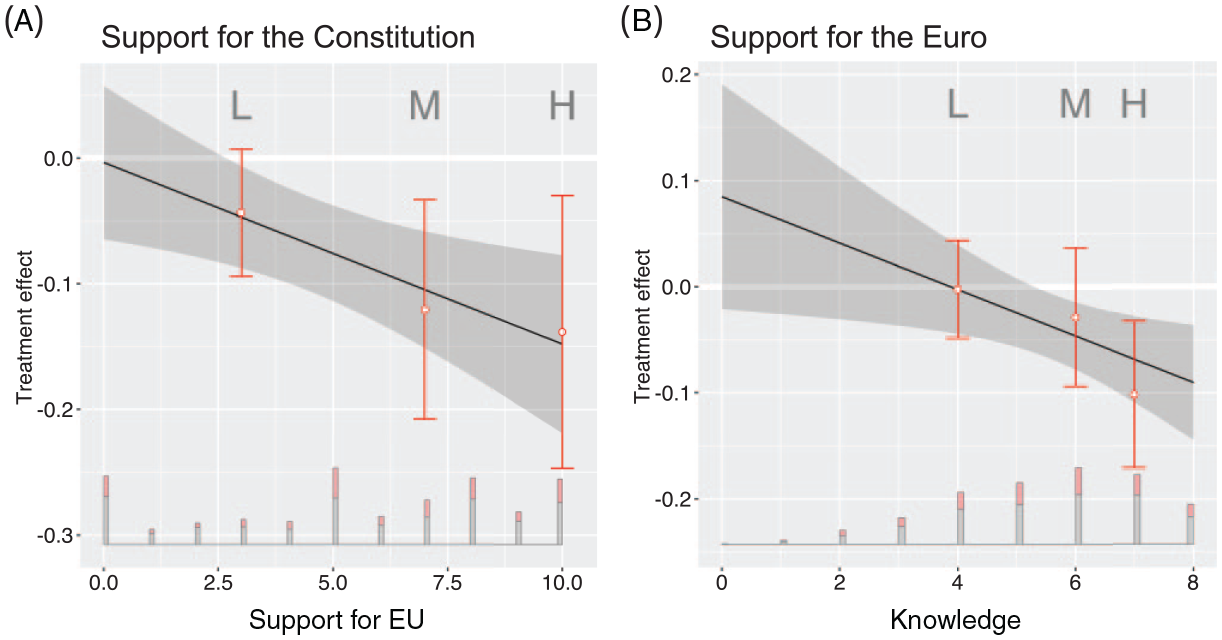
Interaction effects (binning estimator). Data: 2005 British Election Study. Note. The graph on the left (A) shows the treatment effect on support for the Constitution by previous EU support. The graph on the right (B) shows the treatment effect on support for the Euro by political knowledge. The binning estimates are positioned at the median value of the moderator within each tercile.
Robustness Tests and Alternative Hypotheses
This section reports some robustness tests of the findings presented above. First, I test other potential violations of the ignorability assumption, that is, the assumption that respondents’ assignment to treatment and control group is independent of their potential outcomes. Model 7 in Table A3 in the SI tests whether the event generated attrition in the response pattern. This does not seem to be the case. On the contrary, people in the treated group are a bit more likely to provide an answer about their attitudes toward the Constitution after the French referendum. The size of the effect is, however, rather small (2.2 percentage points).
Models 8 and 9 in Table A3 test for the existence of pre-treatment trends in the control group, a potential violation of the exclusion restriction. I simulate the occurrence of an event on the day of the median observation of the control group (Imbens & Lemieux, 2008). The results exclude the existence of hidden trends during the fieldwork of the survey. Further cross-sectional evidence that the treatment effect detected above can be attributed to the referendum, and not to other events, is presented in models 10 and 11 (Table A3). These models show no difference between treatment and control on two placebo outcomes (satisfaction with national democracy and support for free trade). Similarly, I have run some falsification tests using the British panel data. Models 51–55 in Table A13 show no significant treatment effect on five placebo outcomes (propensity to vote for Labour or the Conservative party, ideology, attention, and support for the Iraq war). These results exclude selection into treatment also in the British case.
Finally, I discuss two alternative explanations for the results detected above. First, we should consider the possibility that the decrease in support for the Constitution and the EU more generally might be due to the referendum per se rather than an effect of its outcome. Citizens may have learned more about the EU and the new treaty in the days around the referendum, and may have updated their preferences in light of the new information irrespectively of the French results. Some evidence presented above may already exclude such possibility. A comparison of Figures 2 and 3 shows that while in the days leading up to the referendum, respondents were already more likely to having heard of the Constitution, support for the new treaty was nonetheless unaffected. Moreover, when we compared respondents who were interviewed in the 5 days before the referendum—respondents who are thus more likely to have heard of the Constitution but cannot know about the referendum outcome—with respondents who were interviewed in the 5 days after the referendum, the estimated coefficient remains essentially unaffected (see Table 1, and Table A2 in the SI). The fact that in the analysis of the British panel the decrease in support for the Euro occurs among most knowledgeable voters further contradicts an interpretation of the results as the effect of information generated by the referendum rather than by its outcome. To rule out this hypothesis, I also test whether the debates generated by the French rejection increased the factual knowledge of citizens about EU affairs. Results of model 12 in Table A3 show no significant effect.
A second possibility to consider is that the increased salience of the issue generated by the referendum made citizens more prone to take cues from their parties. The British data allows to test the alternative hypothesis of partisan cue-taking. Models 56–58 in Table A14 present the treatment interaction with the position on European integration of the party voted by the respondent in the previous general election. Party positions are obtained from the 2006 Chapel Hill Expert Survey (Hooghe et al., 2010). The interaction is not significant for both specific and diffuse support. Moreover, there is no heterogeneous treatment effect conditional on party identification or voting choices (not shown). Finally, I test whether the event affected the distance between voters’ positions on European integration and the expert-based position of the party they had previously voted for. The coefficient in model 58 is not significant. These findings rule out the hypothesis that the increased salience of Europe produced by the French referendum made people more prone to take cues from political parties.
Discussion and Conclusions
While scholars have extensively studied processes of social influence, there is mixed evidence on how expressed mass opinions can affect people’s attitudes abroad. This study shows that social influence can occur beyond the borders of nation states. People take cues from people in other countries when they receive a clear and relevant signal. The 2005 French rejection of the European Constitution provided such a signal for citizens of other European countries. The analyses have further shown that by priming the perceived negative consequences of integration, the French vote produced a process of cognitive activation. People were more likely to associate the EU with negative meanings, and their feelings toward the integration process turned more negative. The analysis of the British panel survey revealed that the decline in support occurred among people with stronger pro-EU attitudes. This finding suggests that rather than legitimizing previously hidden attitudes, the referendum results persuaded people abroad to withdraw their support for the Constitution. The fact that more knowledgeable people also grew Eurosceptic provides further evidence in favor of a cognitive response mechanism.
This study opens new grounds in the study of the feedback effects of electoral results (Bischof & Wagner, 2019; Bursztyn et al., 2020; Valentim, 2021). Not only does it demonstrate that elections can trigger a process of social influence beyond national borders, it also shows that this process may be not limited to a legitimization effect (Giani & Méon, 2019). These findings provide empirical support to political theories that have pointed to the emergence of transnational public spheres (Castells, 2008; Fraser, 2007). While empirical studies have focused on the international convergence of national news reporting (Curran et al., 2017; Risse, 2010), this study highlights an important and neglected consequence of the global integration of news, namely, the growing interconnections of public opinions. This has broader significance for scholars of comparative political behavior, who tend to compare public preferences across countries while assuming the absence of any cross-country interactions. At the same time, these findings are relevant for scholars of policy diffusion, insofar as public opinion may function as an independent channel of transmission, and not just as a constrain to party elites (Böhmelt et al., 2016; Gilardi, 2010).
The politicization of the integration process has produced a significant interdependence of European national publics. This is a positive finding for scholars and practitioners in search of a European public sphere as a precondition of a political union. However, considering the recent increase in number and scope of “non-cooperative referendum outcomes” (De Vries et al., 2020), this interdependence questions the viability of further international cooperation vis-à-vis popular demands for reclaiming national sovereignty. At the same time, the mechanism detected suggests that voters do not just blindly follow the preferences of people abroad.
The findings of this study may also be relevant for our understanding of opinion dynamics in other referendums, especially if we consider that a referendum on the European Constitution was being planned in the United Kingdom at the time of the French vote. The rejection across the Channel pushed pro-EU British voters to think about the “other side” of the issue and planted the seed of doubt among the most informed voters. While previous studies have shown that the potential for unidirectional campaign effects is stronger among the least knowledgeable (Chong and Druckman 2003; Goodwin et al., 2020; Schuck and De Vreese 2006), this paper suggests that arguments that come from non-partisans sources of information, such as a foreign electorate, may even persuade the most politically aware citizens.
While this study has the merit to identify the existence of cross-national social influence and its mechanisms, more research is needed to test the generalizability of these findings with respect to the three conditions highlighted in the theoretical framework. First, the fact that the EU is the top tier of a multilevel system of governance implies that the case studied in this paper is marked by a high level of institutional proximity. Yet, different types of proximity such as cultural or economic ties may also make foreign votes a salient and relevant signal for domestic public opinion. Future research could uncover what types of connections make voters more likely to follow the opinions of foreign citizens.
Second, in order to affect the opinions of citizens in other countries, election results not only need to be salient, they also need to be discussed with similar frames of reference—the scope condition for cross-national social influence. For example, when a foreign election or referendum is perceived as an external threat, the public may rally around the flag (Minkus et al., 2018) rather than perceiving the results as a source of information. In the medium term, the debates following the referendum results may be decisive in framing the issue. In this respect, the Brexit referendum, with the high levels of political and institutional uncertainty it generated, is likely to have had an opposite effect in the rest of Europe (De Vries, 2017; Malet & Walter, 2021; Walter, 2021).
In a world where national political events are increasingly reported and discussed abroad, the diffusion of mass opinions is a topic that certainly deserves further attention.
Supplemental Material
sj-pdf-1-cps-10.1177_00104140221088846 – Supplemental material for Cross-National Social Influence: How Foreign Votes Can Affect Domestic Public Opinion
Supplemental material, sj-pdf-1-cps-10.1177_00104140221088846 for Cross-National Social Influence: How Foreign Votes Can Affect Domestic Public Opinion by Giorgio Malet in Comparative Political Studies
Footnotes
Acknowledgements
I would like to thank Tarik Abou-Chadi, Daniel Bischof, Björn Broemer, Catherine De Vries, Elias Dinas, Julian Garritzman, Sara Hobolt, Hanspeter Kriesi, Laura Stoker, Elisa Volpi, Stefanie Walter, as well as seminar participants at EUI, LSE, ECPR Joint Session, ECPR SGEU, and the IPZ Publication Seminar for very helpful comments and discussions.
Declaration of Conflicting Interests
The author(s) declared no potential conflicts of interest with respect to the research, authorship, and/or publication of this article.
Funding
The author(s) disclosed receipt of the following financial support for the research, authorship, and/or publication of this article: This project has received funding from the European Research Council (ERC) under the European Union’s Horizon 2020 research and innovation program grant agreement No 817582 (ERC Consolidator Grant DISINTEGRATION).

Supplemental Material
Supplemental material for this article is available online.
Notes
Author Biography
References
Supplementary Material
Please find the following supplemental material available below.
For Open Access articles published under a Creative Commons License, all supplemental material carries the same license as the article it is associated with.
For non-Open Access articles published, all supplemental material carries a non-exclusive license, and permission requests for re-use of supplemental material or any part of supplemental material shall be sent directly to the copyright owner as specified in the copyright notice associated with the article.
