




Abstract
How can incumbent governments benefit when they control the timing of elections? The conventional wisdom is that incumbents gain an advantage by timing elections to coincide with favorable economic conditions. An alternative mechanism that has received less attention is the element of surprise: the incumbent’s ability to exploit the opposition’s lack of election preparedness. I theorize and empirically test this surprise mechanism using candidate-level data from Japanese House of Representatives elections (1955–2017). The results show that in surprise elections, opposition parties recruit fewer, lower-quality candidates, spend less money campaigning, coordinate their candidates less effectively, and ultimately receive fewer votes and seats. Evidence from fixed effects models and exogenously timed by-elections further suggest that surprise matters more in shorter, competitive election campaigns and helps incumbents more with confronting inter-party as opposed to intra-party electoral competition. These findings add to our understanding of how strategic election timing can undermine electoral accountability.
Keywords
In most parliamentary systems, the incumbent government can choose when it wants to hold elections. This feature of parliamentary democracy has led to much debate about the extent to which incumbents can strategically time elections to their benefit. In cases when incumbents do benefit, the mechanism is nearly always thought to be economic opportunism. By timing elections to coincide with peaks in the economy, incumbents can signal competence to voters and boost their reelection prospects (Alesina et al., 1993; Chowdhury, 1993; Inoguchi, 1979; Ito & Park, 1988; Kayser, 2005; Roy & Alcantara, 2012). Yet, not all studies find that incumbents benefit from economic opportunism (Smith, 2004), while others suggest that incumbents can benefit from strategic timing even independent of economic conditions (Schleiter & Tavits, 2016). More broadly, there are good reasons to believe that control over timing can provide a much wider set of strategic options for incumbent governments than taking advantage of economic conditions.
One alternative mechanism that has received less attention is the element of surprise. Apart from projecting strength in handling the economy, incumbents can also use their control over election timing to exploit the weakness of the opposition by catching them off guard and unprepared for an election. Compared to fixed-term elections, opposition parties in many parliamentary systems with flexible terms are given little advance notice of the election date—sometimes as little as 1 month, as is common in Japan. This information asymmetry creates a distinct disadvantage for opposition parties, who already must make up for the inherent disadvantages they face relative to incumbents. Without firm knowledge of when the next election will be held, it is difficult for opposition parties to know how best to allocate their scarce resources between different activities such as legislating and electioneering, which candidates to support, or which other parties to coordinate with and form electoral coalitions.
Elections offer voters a means to hold representatives accountable, and thus it is important to know whether incumbent governments can gain an unfair advantage by surprising the opposition with an early election. If incumbents can manipulate expectations about election timing to extend their own survival in office, then perhaps electoral accountability is not working as it should. The issue has received significant debate in countries such as the United Kingdom and Canada, and members of parliament in both countries recently passed legislation to limit the executive’s control over election timing in favor of fixed terms. 1
In Japan, however, the incumbent government continues to wield the power to call an election whenever they feel the timing is right. For almost the entire postwar period, this power has belonged to members of the Liberal Democratic Party (LDP), who ruled nearly uninterrupted for over 50 years from 1955 to 2009, and then returned to power in 2012. 2 To what extent does the power over election timing help to explain the LDP’s long-term dominance in Japan?
The results in this article, which draw on candidate-level election data from Japan’s House of Representatives (HOR) from 1955 to 2017, reveal that the LDP gains a significant advantage in elections that are more surprising for the opposition. These elections lead to a vote share bonus for the LDP of about 4 percentage points in the average HOR district compared to more expected elections, even when controlling for economic conditions. The results further indicate that opposition preparedness is a key mechanism. When caught by surprise, opposition parties recruit fewer, lower-quality candidates, spend less money in their campaigns, and lose out on seats that they should have been able to win by coordinating inefficiently with other parties.
To delve more deeply into the effects of surprise elections on incumbent and opposition performance, I adopt two identification strategies that have not previously been used in the election timing literature. 3 The first approach analyzes whether surprise elections can have a differential effect across districts depending on institutional and contextual factors. Focusing on characteristics that vary within the same election allows me to include two-way fixed effects to help account for other invariant characteristics across districts or in given years that could affect LDP performance and opposition coordination. By leveraging this variation as well as legal changes over time, I provide evidence that surprise is most effective in shorter, competitive election campaigns. I also find that surprise elections are more useful for LDP prime ministers and their cabinets in confronting inter-party electoral competition as opposed to challenges from intra-party rivals within the highly factionalized LDP.
The second identification approach explores whether the LDP and opposition parties differ in their capacity to respond to surprise elections. Measuring differential capabilities across parties, however, is complicated by the fact that the act of calling a surprise election is asymmetric—with LDP governments choosing to dissolve parliament and opposition parties forced to react—and endogenous to LDP expectations about opposition performance in the election. To help address these concerns, I exploit a feature of Japanese electoral law wherein the timing of a by-election is exogenously determined when a seat becomes available midterm. I then look at parliamentarians who pass away while in office, arguing that this provides random variation in the districts that receive an early election—an election that importantly comes as a surprise to both the LDP and opposition parties. By comparing districts where the legislator passes away with other similar districts, I find further evidence that surprise disproportionately harms Japan’s fragmented opposition parties compared to the well-organized and long-ruling LDP.
This article offers three contributions. The first is to move beyond the current literature’s focus on economic opportunism to theorize and test an alternative mechanism by which incumbents can benefit in strategically timed elections: the element of surprise. This is not to suggest that the economy is unimportant for election timing, or that surprise is the main determinant of electoral outcomes in all early elections. But it does suggest that endogenous election timing can allow incumbents to not only emphasize their own strengths, but also exploit the weakness of opposition parties.
The second contribution relates to data and measurement. This is the first study, of which the author is aware, to analyze the consequences of early elections at the candidate and district level rather than the national level. The focus on subnational electoral outcomes allows us to better measure how the effect of surprise elections can be conditioned by contextual factors, such as variation in the level of competition. Moreover, the use of within-country, exogenously timed by-elections enables better identification of the effect of surprise while holding institutional and cultural factors specific to Japan constant.
The third contribution is to offer an alternative, institutional explanation for long-term LDP dominance in Japan that gives greater credit to prime ministers and their cabinets. Most explanations as to how the LDP managed to maintain control of government for more than 50 years have stressed the importance of clientelism, which emphasizes the role played by individual legislators in securing pork for their districts (Scheiner, 2006). Japanese prime ministers have historically been viewed as weak and ineffective (Hayao, 1993; Mulgan, 2002; Shinoda, 2000), but this study shows that their influence over election timing has had a considerable effect on the party’s fortunes over time.
The Consequences of Endogenous Election Timing
Early elections can occur in nearly every parliamentary system. Governments are typically constrained to hold an election at least once within a set number of years, but can choose exactly when to call an election within this window. This aspect of parliamentary government has attracted significant scholarly attention. Yet, until recently existing theories focused almost exclusively on the conditions under which incumbents are likely to dissolve parliament and call new elections. Comparative institutions scholars have explored how variation in cabinet type, constitutional rules, and political environment can constrain the incumbent government’s ability to determine the timing of elections (Goplerud & Schleiter, 2016; Huber, 1996; Lupia & Strøm, 1995; Strøm & Swindle, 2002). A large political economy literature also considers whether governments strategically call elections during periods of strong economic performance (Alesina et al., 1993; Cargill & Hutchinson, 1991; Chowdhury, 1993; Inoguchi, 1979; Ito & Park, 1988; Kayser, 2005).
While the determinants of election timing are a well-researched topic, the electoral consequences of the timing decision are typically assumed, but rarely empirically tested. The assumed mechanism by which incumbent governments stand to benefit from strategic election timing is generally thought to be economic opportunism. This proposed mechanism is grounded in a large body of literature that argues that voters hold governments accountable for past economic performance (Duch & Stevenson, 2008; Rose & Mackie, 1983). Voters use elections as a sanctioning mechanism to either reward incumbent governments for a healthy economy or punish them for economic downturns (Fiorina, 1981; Key, 1966). Governments therefore have a strong incentive to time elections to coincide with peaks in the economy and reap the associated electoral rewards from voters. Evidence for this strategy—known as “political surfing”—first came from studies of Japan (Inoguchi, 1979; Ito & Park, 1988), and later found support in India (Chowdhury, 1993), Canada (Roy & Alcantara, 2012), and cross-national work (Palmer & Whitten, 2000). In nearly all of these studies, however, the empirical focus is on whether early elections are more likely during economic booms. The subsequent connection to gains in votes or seats at the polls is assumed to naturally follow from the health of the economy, but is not explicitly tested.
Part of the reason for the absence of studies on electoral consequences may lie in the difficulty of establishing a causal link between endogenous election timing and outcomes. If incumbent governments call elections when they expect better outcomes, and both expectations and outcomes are driven in part by a stronger economy, then it becomes challenging to estimate the independent effect of early elections on incumbent performance. Recent work by Schleiter and Tavits (2016) addresses this inferential challenge. The authors use an index of the constitutional powers of governments to call early elections (Goplerud & Schleiter, 2016) as an instrumental variable for opportunistic elections. Their cross-national study in Europe finds that incumbents can benefit significantly in strategically timed elections. As Schleiter and Tavits acknowledge, however, their main contribution is in measuring the cumulative effect of opportunistic elections independent of economic conditions. They conclude by noting that future work should investigate the individual mechanisms contributing to this overall effect.
The lack of a more well-developed literature on consequences is further surprising given that some studies suggest that incumbents might not benefit, but instead be punished by voters for opportunistically timed elections. In much of the political economy literature, voters seem to take early elections at face value and make their decisions based solely on past economic performance. Other studies, however, depict a more sophisticated voter who observes the early dissolution and uses it to update their beliefs about the competence of the incumbent government. Smith’s (2004) work in the United Kingdom argues that voters interpret early dissolutions as signals that the economy is likely to worsen in the future, and subsequently downgrade their assessment of the incumbent government’s performance. 4 Again, Schleiter and Tavits (2018) offer a methodological contribution to studies of this mechanism. Using a series of survey experiments, they find that British voters do discount the future performance of the incumbent government following early elections, and also show that these elections raise considerable concerns among voters about procedural fairness. However, voter antipathy toward opportunistic election calling seems to be modest in their study. Voters are still happy to support incumbents during periods of good economic performance even if they dislike the early dissolution.
Apart from economic opportunism and voter reactions, a third mechanism that has received significantly less attention—and the focus of this article—is the ability to use early elections to catch opposition parties by surprise. Many studies make a brief note of this potential mechanism in a sentence or footnote (Roy & Alcantara, 2012; Schleiter & Tavits, 2016, 2018; Smith, 2004), often mentioning that it seems an apt descriptor of government behavior prior to many real-world early elections, but the idea is not developed further or directly tested. Smith (2004: 58) devotes the most attention to it; however, in his conception, in these cases it is “weak governments” going up against “ill-prepared challengers,” and he still expects the government to suffer at the hands of savvy voters.
This is the first study to emphasize the potential for surprise in early elections and empirically test the effect on opposition preparedness and coordination. A critical, yet under-emphasized element of strategic election timing is the tendency of governments to keep their decision to call an early election secret until the last possible moment. If all that matters is timing elections to coincide with favorable economic conditions, then there is little reason to keep the dissolution decision private. Governments could instead talk openly about the election date and spend more time emphasizing the health of the economy or downplaying concerns about its future decline. Moreover, if governments suffer because voters view opportunism negatively from a procedural fairness standpoint, then incumbents should see an incentive to be open about the election date to mollify voter concerns about equity. Yet, this is not what we empirically observe. Instead, governments often keep the election date close to the chest, not announcing anything in public until just before the dissolution. Clearly, leaders see an incentive in not sharing this information too widely—such as with opposition parties.
The Element of Surprise
I consider strategic election timing from the perspective of information asymmetry. In parliamentary systems, the prime minister is the direct agent of the parliament and the indirect agent of the voters (Strøm, 2000). Constitutions that vest the dissolution power with the prime minister or their cabinet essentially allow incumbent governments to form private information about when the next election will occur. It is up to the government to decide whether to share this information (and with whom) or keep it secret until the dissolution date. This asymmetry creates a risk that incumbent governments will use their informational advantage to benefit themselves at the expense of parliament or the voters. Once the parliament is dissolved, the date of the election becomes fixed and common knowledge, and all sides have equal time to prepare. Prior to the dissolution, however, parliamentarians and voters can estimate the likelihood of an election based on observing the government’s behavior, as well as the health of the economy, but their uncertainty about the election date is almost certainly larger than that of the government.
Preparation is important for elections and knowledge about the date of an impending election greatly affects both party and candidate strategies. As the election date approaches, parties shift from legislative priorities to nominating candidates, coordinating with electoral coalition partners, and writing election manifestos to inform voters about their policy positions. Newcomer candidates ready themselves to contest incumbents or open seats, such as by leaving their current jobs to focus more wholly on campaign activities. Legislators seeking reelection similarly turn their attention from policymaking in parliament to campaigning and fundraising. In fact, several studies of chambers with fixed-term elections show that incumbents often begin to shirk their legislative duties—such as by skipping committee meetings, abstaining from plenary votes, and introducing fewer bills—to focus on their districts even before the legislative session ends and official campaign period begins (Fukumoto & Matsuo, 2015; Titiunik, 2015).
The challenge presented by endogenous election timing is that the incumbent government has greater certainty about the election date than the opposition, giving them an advantage in knowing how best to allocate their time and resources. Moreover, while preparation is important for everyone, it arguably matters more for the opposition than the incumbent government in terms of its organization, candidate recruitment, and coordination with other parties. At the candidate level, it is well known that the perquisites of office tend to give incumbents an electoral advantage via their name recognition, staff, fundraising, and constituency services (Fiorina, 1977; Mayhew, 1974). A surprise election poses a significant obstacle for potential challengers: they have less time to fundraise, hire staff, or publicize their candidacy to make up for their inherent disadvantage. Other studies find that shorter official campaign periods benefit incumbents in this regard (McElwain, 2008). Surprise elections can exacerbate this effect by disrupting expectations about when the campaign period will even begin. At the party level, opposition parties by definition tend to have fewer incumbent candidates than the parties controlling government, which presents a larger aggregate challenge. The opposition needs to recruit quality candidates if it hopes to unseat the incumbent government, yet uncertainty about the election date complicates this process as the opposition is unsure of when to shift its focus toward candidate nomination. 5 A surprise election can also inhibit candidate coordination, both within the same party, as in the case of multi-member districts, and between parties in coalitions, as in multi-party systems where the opposition is fragmented.
There are two institutional elements in particular that can influence the government’s ability to surprise the opposition. The first is the ease with which the government can dissolve parliament once it has decided the time is right for an election. This institutional factor is the main focus of most studies (e.g., Goplerud & Schleiter, 2016), as it also dictates the incumbent’s capacity to take advantage of favorable economic conditions. The second factor is the time between the dissolution and election dates. This factor is considerably less studied, yet is critical for the element of surprise as it governs the length of the common knowledge period for both sides following a dissolution. Depending on the country, this period can range from less than a month to more than 3 months. We should think that the potential for surprise will be greatest in parliamentary systems where incumbent governments have the most flexibility to dissolve parliament and the period between the dissolution and election date is shortest.
Hypotheses
In institutional settings conducive to surprise elections, my first expectation is that incumbent governments will benefit from elections that are more surprising relative to those that are more expected.
In addition to testing for an overall effect of surprise elections on incumbent performance, this article tests specific mechanisms through which surprise can exploit the opposition’s lack of readiness for an election. I focus in particular on three dimensions to preparedness: candidate recruitment, campaign spending, and inter-party coordination.
First, if an election catches opposition parties by surprise, then we might expect fewer opposition candidates to enter the race. Elections are expensive for both parties and candidates, which means that both political actors must weigh the likelihood of winning a given seat against the costs of contesting that seat (Harada & Smith, 2014). In surprise elections with greater uncertainty, parties and candidates may find it too financially risky to enter the race, as they may be unable to mount the type of competitive campaign that would justify the high costs to entry. This deterrence effect may be strongest for higher-quality candidates, who other studies have found are often most sensitive to factors affecting candidate entry (Box-Steffensmeier, 1996; Jacobson, 1989). Higher-quality candidates typically risk the most by leaving their prestigious jobs or elected positions to contest elections, which may make them less likely to enter the race in surprise elections.
Second, surprise elections may hurt the opposition’s ability to fundraise and subsequently spend money in election campaigns. While parties and candidates devote some energy to fundraising throughout the electoral term, they also pursue other goals such as their policy objectives. The opposition’s uncertainty may hurt their ability to expend the same amount of time and effort to fundraising as they otherwise would do if they had firm knowledge about the election date. This fundraising disadvantage is especially important for opposition candidates, who often need to spend more in campaigns if they hope to overcome the advantages enjoyed by incumbents (Jacobson, 1980). My expectation, therefore, is that opposition parties will spend less when caught by surprise in an early election.
Finally, surprise elections may inhibit coordination between opposition parties. In each election, opposition parties have to weigh the costs and benefits to backing their own candidate for a given seat against cooperating with another party to jointly back a single candidate. It is possible that the effect of reducing candidate entry (H2 and H3) might ease inter-party coordination in some cases (Smith, 2016). However, making the correct strategic decision still requires both adequate information about voter preferences and time for opposition parties to coordinate their strategies, both of which are made more difficult by the compressed electoral calendar following an early dissolution. In surprise elections, I expect coordination failures will be more likely: that is, instances where the opposition loses out on seats that they might have been able to win by jointly backing a candidate together.
Surprise Elections in Japan
To test for an effect of surprise elections, this article turns to the case of Japan, where the literature on strategic election timing first began. Japan makes for an ideal test case for three reasons. First, Japan’s institutional setting is conducive to surprise elections. The government has great freedom in choosing the election date and the maximum time between dissolution and election is short at just 40 days. Early elections are common and there is significant variation in election timing. Second, the long-term rule of the LDP allows us to empirically analyze the use of the dissolution power while controlling for party status in government. Cabinet portfolios have long been allocated among members of the LDP, and thus we can study surprise elections without having to account for complicating factors such as coalition bargaining (Lupia & Strøm, 1995; Strøm & Swindle, 2002). 6 Third, Japan has experience both with multi-member districts and a multi-party system. This means it is a country where both intra- and inter-party coordination is important, allowing us to better measure whether surprise elections can lead to opposition coordination failures.
Japan places few formal constraints on the incumbent government’s capacity to use the dissolution power to surprise the opposition. As in most parliamentary systems, it is the lower house, the House of Representatives (HOR), that is the more powerful chamber, has discretion over appointing and removing prime ministers, and that the prime minister can dissolve for an election. The constitution technically entrusts the power to dissolve the HOR to Japan’s head of state, the Emperor, but he must do so with the “advice and approval of the cabinet.” 7 In practice, the Emperor’s powers have been limited to ceremonial functions since the end of World War II and he does not weigh in on political matters such as dissolutions. The dissolution power thus formally belongs to the cabinet. However, given that cabinet members are themselves the agents of the prime minister and can be dismissed at will, most studies on Japan tend to treat dissolution as the prerogative of the prime minister. 8
While the constitution thus vests the dissolution power with incumbent governments, two other means of triggering an election still serve as constraints on the government’s freedom to decide the election date. The first is the end of the term. The maximum term for the HOR is 4 years. If the prime minister does not dissolve the HOR earlier, then an election must be held no later than 4 years after the last election. The second constraint is the no-confidence motion. If HOR members pass a no-confidence motion against the government by majority vote, then the entire cabinet must resign unless the HOR is dissolved within 10 days. While it is possible that a prime minister could respond to a no-confidence motion by resigning, in practice they have always chosen instead to dissolve the HOR and take their chances with the voters. No-confidence motions are rare in Japan, however, given the long-term dominance of the LDP. 9
With relatively few constraints on their dissolution powers, incumbent governments have considerable leverage to call an election at their discretion and can do so with little advance warning. When the HOR is dissolved, the constitution stipulates that an election must be held within just 40 days. 10 Within this window, the prime minister is free to select the specific day of the election, with the caveats that it must be a Sunday and there must be enough time for the 12-day official campaign period. Historically, the period between dissolution and election has ranged from as little as 23 days to as long as 40 days, with an average of 29 days. This does not give opposition parties much time to prepare. While there is typically some speculation about timing among politicians and in the media, interviews with HOR members after the surprise election in 2017 suggest that they have little to no formal warning of an impending election, often finding out just a day or two before the dissolution itself. 11
The idea that incumbent governments can use surprise elections to take advantage of opposition parties matches well with qualitative accounts of past elections. While these studies note that LDP prime ministers did at times negotiate directly with opposition party leaders concerning the timing of the next election, they also document how sudden dissolution announcements often came as a shock to opposition parties. In the 1960s and early 70s, for example, LDP prime ministers called several surprise elections in an attempt to exploit internal divisions within the main opposition Japan Socialist Party, which splintered into two parties in 1960 and struggled to coordinate with other parties (Christensen, 2000; Scheiner, 2006). In 1986, Prime Minister Yasuhiro Nakasone suddenly called for an early double election with the House of Councillors, making it much more difficult for opposition parties to form coalitions since the district boundaries differed between the two houses of parliament (Kohno & Nishizawa, 1990). Perhaps the most famous surprise election occurred in 2005, when Prime Minister Junichiro Koizumi expelled members of his own party who opposed his efforts to privatize the postal system, dissolved the HOR, and recruited new candidates to run against his former party members. The unexpected election came as a shock to the opposition Democratic Party of Japan (DPJ) and led to the largest LDP victory in decades (Estévez-Abe, 2006). Finally, after the LDP returned to power in 2012, Prime Minister Shinzo Abe found great success in calling two surprise elections in 2014 and 2017. In both cases, established opposition parties found it difficult to recruit candidates, while newly formed, potential “Third Force” parties such as Toru Hashimoto’s Japan Innovation Party and Yuriko Koike’s Party of Hope struggled to coordinate with existing opposition parties and gain a foothold in the HOR (Pekkanen & Reed, 2018).
Distinguishing Between Surprise and Expected Elections
I distinguish surprise elections from more expected elections for the HOR by considering how the two constraints on the dissolution power in Japan—the end of the term and no-confidence motions—shape opposition expectations about the timing of the next election. The first condition for my coding of a surprise election is that it must be triggered by an early dissolution rather than the end of the term. Elections held at the end of the constitutional inter-election period should not come as a surprise. As the term limit approaches, all candidates and parties can safely expect the government to call an election. While in principle it may sound easy to distinguish between early and regular elections, in practice governments rarely hold elections on the absolute last day of the term. As the deadline approaches, the political calendar can influence incumbent decisions over the specific election date for a variety of reasons including the schedule of legislative sessions, budget passage, fiscal year, concurrence with other elections, and national holidays. To account for these scheduling considerations, I rely on qualitative accounts of elections held in the final months of the term to determine whether they can be considered as regularly scheduled elections. The consensus from these reports is that only two elections (1976 and 2009) since 1955 have been clearly caused by the end of the term, and both of these are coded as expected elections.
The second condition for my coding of surprise elections is that the opposition plays no role in triggering the election. The most direct example of this is that we should not expect the opposition to be surprised if they initiate the election themselves through a no-confidence motion against the incumbent prime minister. However, there are also more indirect ways that the opposition can influence election timing. For example, the incumbent government may dissolve parliament in response to an imminent no-confidence motion or significant opposition pressure that suggests failure is coming soon. Incumbent governments may also agree to opposition demands for an election in exchange for some kind of policy concession.
I determine whether the opposition had any influence over election timing by reading through historical accounts of past elections by Japanese newspaper reporters, academics, biographers, and other researchers. Cases where there is clear evidence that the opposition played a direct or indirect role (through imminent failure or bargaining) in the prime minister’s dissolution decision are not coded as surprise elections. For example, in 1967, Prime Minister Eisaku Sato only called an early election after he faced significant pressure to do so from opposition parties, who had boycotted all HOR meetings and demanded a dissolution in the wake of a corruption case implicating several LDP politicians. Likewise, in 2012, DPJ prime minister Yoshihiko Noda only agreed to dissolve parliament a year early in order to get support for his consumption tax reforms from the LDP, then an opposition party. Examples such as these are coded as expected elections given the opposition’s influence in determining the dissolution date.
Together, these coding rules identify 9 of the 21 elections held since 1955 as elections that contained an element of surprise for the opposition. All of the elections coded as surprise elections occur well before the end of the term: they range from 1.0 to 2.2 years early, with an average of 1.4 years early. Both types of elections are generally distributed over time, and the coding rules are able to cleanly separate nearly all elections into either being a surprise or expected election. However, the decision of whether the opposition played an indirect role in the dissolution does allow for some ambiguity. In the Supplemental Appendix, I discuss the reasoning behind my coding of each election (Supplemental Table A1) and present descriptive differences between surprise and expected elections (Supplemental Table A2). 12
An alternative strategy to qualitative coding is to explicitly model the timing of elections. We could, for example, create a dataset where each observation is a quarter of the year since the LDP came to power, the dependent variable is whether an election is held in a given quarter, and the independent variables are all the factors that might influence the timing of an election, from the LDP’s popularity to economic conditions. After fitting this model, we could then use the residuals as our measure of a surprise election, as we might expect surprise elections to have larger, positive residuals suggesting their timing was unexpected compared to other elections.
There are at least two challenges to this approach. The first is that it is difficult to have confidence in a model fit with only 21 elections over more than 60 years. The second is that we would be measuring the relative surprise of elections held earlier in Japan’s postwar history using post-treatment data from decades after the election itself took place. In this case, I argue that qualitative coding is most appropriate, which is the strategy used by most studies of endogenous election timing. However, as a robustness check in the Supplemental Appendix, I show that my surprise election coding correlates strongly with the residuals from a fitted model and that the main results hold if the residuals are used instead as the key independent variable (Supplemental Table A3).
The differentiation between surprise and expected elections for the opposition offers a contribution in itself in that most studies of early elections focus solely on the incumbent government’s perspective and whether an election is held before the end of the term. The qualitative content analysis of the conditions surrounding early elections shares some similarities with the classification rules used by Schleiter and Tavits (2016). The key difference is that Schleiter and Tavits code elections from their reading of whether incumbent governments engage in opportunistic behavior. This approach instead codes elections from the perspective of the opposition in distinguishing whether an election comes as a surprise or is more expected.
Data
To test the relationship between surprise elections, opposition preparedness, and the electoral performance of the LDP, I use a recently updated dataset that includes all candidates who ran in an election for the HOR from 1947 to 2017 (Reed & Smith, 2018). 13 The LDP formed in 1955, so I begin my analysis with the first election whose timing was determined by an LDP prime minister (1958) and continue until the most recent election as of this writing (2017). One election, 2012, is excluded from the empirical tests because it is the only election called by a non-LDP prime minister. 14 This provides a dataset of 20,789 candidates competing in 20 general elections. 15 I aggregate the data up to the district level for a total of 3,636 district-year observations. 16
Over the period in this study, the opposition parties challenging the LDP changed at times, as did the rules governing electoral competition. From 1955 to 1993, the HOR’s electoral system consisted of multi-member districts with the single non-transferable vote and the largest opposition party was the Japan Socialist Party (JSP). Following electoral reform in 1994, the Democratic Party of Japan (DPJ) emerged as the largest opposition force under a mixed electoral system of single-member districts and proportional representation. Despite these institutional and party changes, the opposition camp remained fragmented into several smaller parties and largely failed to coalesce into a force that could replace the LDP in government. 17 In the analyses that follow, I first consider all elections together, and then test whether the effect of surprise elections on incumbent performance differs before and after electoral reform.
To measure the LDP’s overall electoral performance in surprise elections, I use an OLS model where the dependent variable is equal to the vote share (
The models to test opposition preparedness are similarly organized, albeit with four different dependent variables. The first, Recruited Candidates, captures the number of non-incumbent candidates recruited by opposition parties to run in district i in election t. High-Quality Recruits, by comparison, measures only the number of high-quality opposition challenger and open-race candidates that entered the district election. While studies in the U.S. context typically operationalize a “high-quality candidate” as anyone with elected experience, here I follow work on the Japanese context (Scheiner, 2006; Smith, 2018) and extend this definition to also include candidates with experience in the bureaucracy, as a secretary for a member of the HOR, or those who are part of a political dynasty with at least one previously elected family member. 18 For Campaign Spending, I aggregate all declared expenditures (in Japanese yen) by opposition candidates and then divide this number by the number of eligible voters in the district. Data on candidate backgrounds are available for all elections prior to 2017, while spending data are available for all elections since 1967. 19
To code failures in inter-party coordination (Coordination Error), I follow the methodology developed by Cox and Rosenbluth (1994). This method treats each party’s vote share in a given district as exogenous and then calculates the optimal number of representatives that the opposition could have elected if their vote share had been efficiently distributed among potential candidates (holding the LDP’s candidates and vote share constant). A coordination error (or nomination error) is defined as any time that the opposition wins fewer than the optimal number of seats because of inefficient vote splitting among candidates. In other words, Cox and Rosenbluth only focus on errors that, at least theoretically, cost the opposition seats that it should have been able to win. 20
For control variables, I first include the LDP’s vote share in the previous election to capture a baseline measure of LDP strength for each district. For the later analyses of opposition readiness, I similarly include a lagged version of each dependent variable from the previous election. Second, I add a group of variables related to the timing of the election, from an overall linear time trend to controls for the number of quarters since the previous Upper House and unified local elections. 21 Third, to account for other political factors that could influence the LDP’s vote share, I control for the LDP’s seat share from the previous election and the support rating of the LDP from the previous quarter. 22 Fourth, to address the typical explanations by which early elections are thought to influence electoral outcomes, I account for economic cycles by including variables for changes in inflation and GDP growth in the quarter that preceded the election. 23 Finally, the models are estimated with district and quarter fixed effects to control for other time-invariant characteristics of districts or particular quarters of the year that might predict LDP performance or opposition preparedness. All models include standard errors clustered at the district and year level. 24
Results
Table 1 shows the results of the linear regression models for surprise elections and LDP performance. Model 1 presents the bivariate results, Model 2 adds district and quarter fixed effects, Model 3 includes the time controls, Model 4 accounts for political controls, and Model 5 controls for economic trends. While the results in Table 1 show all of the covariates, subsequent tables in this section show only the main quantities of interest for space reasons.
The LDP Receives More Votes in Surprise Elections.
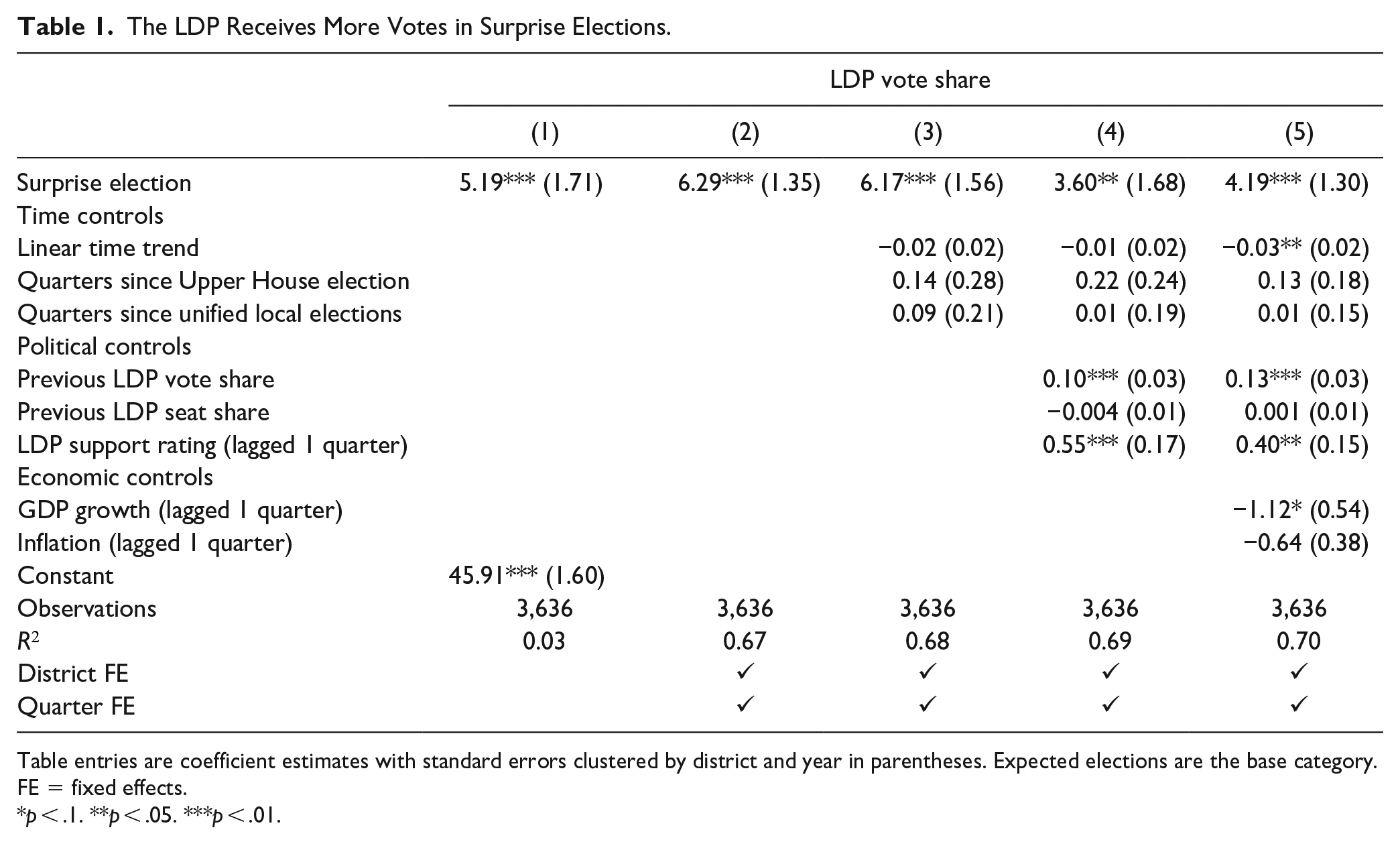
Table entries are coefficient estimates with standard errors clustered by district and year in parentheses. Expected elections are the base category.
FE = fixed effects.
p < .1. **p < .05. ***p < .01.
Across all five models, I find that the LDP gains a significant advantage in surprise elections over the opposition. In the average HOR district, the LDP receives a vote share bonus of about 4 percentage points (Model 5) in surprise elections relative to expected elections. The magnitude of this effect is similar to the 5 percentage point bonus found by Schleiter and Tavits (2016) in their cross-national study of opportunistic elections and holds even when controlling for district characteristics, past party strength, time trends, and economic conditions. In the Supplemental Appendix, I test the robustness of these findings to other operationalizations of the control variables. Supplemental Table A4 shows that the results hold if I instead use the quadratic or cubic forms of the time controls, as well as if I include a cubic time spline. Supplemental Table A5 likewise finds similar results if I use alternative time lags for the LDP’s support rating and economic trends of two, three, or four quarters. 25
To unpack the mechanisms that are driving LDP success in surprise elections, Table 2 presents results for my four measures of opposition preparedness. In each case, I first present the results with only the key independent variable (Surprise Election), lagged dependent variable, and fixed effects, and then with the full slate of control variables from Table 1. 26
Surprise Elections Undermine Opposition Preparedness.
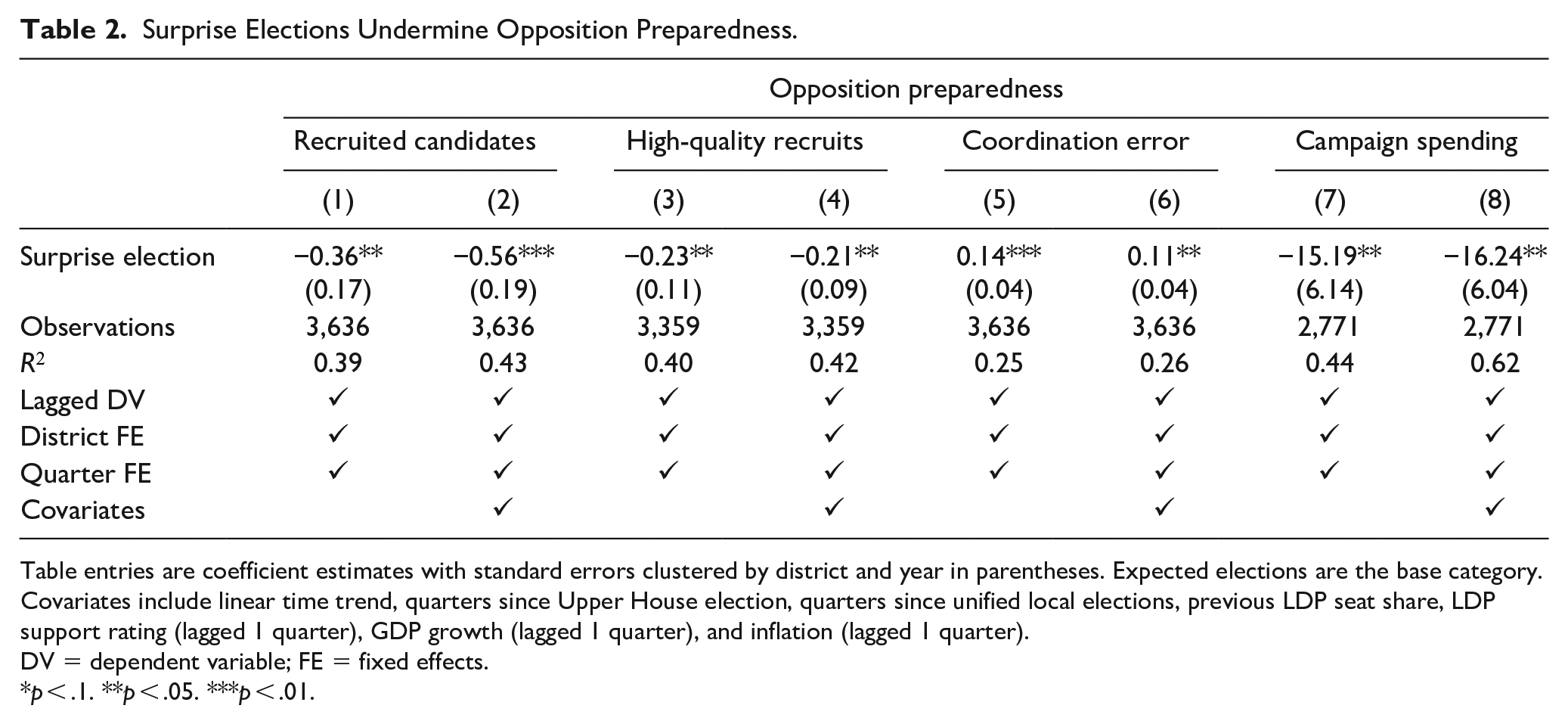
Table entries are coefficient estimates with standard errors clustered by district and year in parentheses. Expected elections are the base category. Covariates include linear time trend, quarters since Upper House election, quarters since unified local elections, previous LDP seat share, LDP support rating (lagged 1 quarter), GDP growth (lagged 1 quarter), and inflation (lagged 1 quarter).
DV = dependent variable; FE = fixed effects.
p < .1. **p < .05. ***p < .01.
Looking first at candidate entry, I find that surprise elections can have a deterrence effect on opposition candidates. Compared to more expected elections, parties recruit significantly fewer candidates in surprise elections (Models 1 and 2). Moreover, the results from Models 3 and 4 suggest that nearly half of this effect is driven by the smaller number of high-quality opposition recruits that contest seats in surprise elections. The magnitudes of the effects suggest that for every two to three districts, there is roughly one less opposition candidate in surprise elections compared to expected elections. For every five districts, there is one less high-quality opposition candidate.
Apart from candidate recruitment, Models 5 and 6 provide evidence that opposition parties are more likely to commit coordination errors in surprise elections. This result may seem surprising when coupled with the deterrence effect, as we might otherwise expect a smaller number of candidates entering the race to make it easier for opposition parties to coordinate. Instead, Model 6 shows that opposition parties are about 11 percentage points more likely to lose out on an HOR seat that they should have been able to win due to inefficient coordination in surprise elections. 27
Finally, I find in Models 7 and 8 that opposition parties spend significantly less money in campaigns for surprise elections compared to expected elections. While the coefficient in Model 8 may appear small at just 16.2 yen (15 cents) per eligible voter, in the average HOR district this difference corresponds to opposition candidates spending roughly 7.1 million yen ($67,800) less in total. This number is substantial given that in the average district election during this time period, opposition parties spent 38.6 yen (37 cents) per eligible voter and 17.1 million yen ($163,000) in total. 28
Heterogenous Effects of Surprise
To further test the argument that surprise elections benefit incumbent governments, I examine how the effect of surprise on the LDP’s electoral performance changes depending on six theoretically important institutional and contextual factors. The first three factors consist of district-level characteristics that vary within the same election, which allows me to include year fixed affects in the regression models to help control for other factors specific to a given year apart from surprise that might affect the LDP’s fortunes. 29 The latter three factors include two election reforms, implemented at specific points in time, as well as a measure to test whether the relative earliness of a surprise election is important.
First, surprise may matter more in competitive electoral races than uncompetitive ones. In districts that are traditionally safe for either the LDP or the opposition, opposition parties and candidates likely know much more about what the nature of electoral competition will look like in the next election. By comparison, opposition parties know less about what to expect during an election for competitive districts, such as those that often switch hands between LDP and opposition control. Surprise elections may therefore have their greatest impact in these battleground districts.
Second, surprise elections may be most effective in districts with a history of inefficient coordination among opposition parties. In constituencies where opposition parties have long had informal or formal agreements regarding their cooperation, or where the number or balance of power among opposition parties makes coordination less important, we should expect surprise to have less of an impact on election outcomes. In other words, I expect surprise to have a larger effect on LDP vote share in districts where the opposition committed a coordination error in the previous election.
Third, the dissolution power gives the prime minister and their cabinet a potential informational advantage not only over opposition parties, but also over their rivals within the LDP. Since its formation in 1955, the LDP has been characterized by well-institutionalized factions, which played an especially important role during Japan’s period of multi-member districts and intra-party competition prior to the 1994 electoral reform (Krauss & Pekkanen, 2010). With each election, LDP leaders hope to not only increase the party’s share of seats in the HOR, but to also increase the relative size of their faction within the LDP. Cabinet members may be able to leverage their insider knowledge about election timing to give their faction members an edge over other party members in surprise elections. If this is the case, then we should expect to see the LDP perform better during surprise elections in districts where candidates share factional ties with members of the cabinet.
Fourth, I leverage reforms to Japan’s official campaign period over time to analyze whether surprise elections benefit the LDP more when the campaign period is shorter. While the LDP has never revised the constitution to alter the 40-day maximum period between dissolutions and elections in Japan, McElwain (2008) documents how the LDP has gained an advantage over opposition parties by shortening the official period for campaign activities over time. The length of the election campaign was originally set at 25 days but was shortened to 20 days in 1958, 15 days in 1983, and 12 days in 1994. We might therefore expect surprise elections to benefit the LDP more when the campaign length is shorter, as this gives the opposition less time to use campaign activities to try and make up for any initial advantage that surprise gives the LDP.
Fifth, the expected effect of electoral reform on surprise elections is less clear. On the one hand, the move from multi- to single-member districts may have made preparations easier for opposition parties, lessening the effect of surprise as parties only needed to make strategic decisions about a single seat per district. On the other hand, the number of majoritarian districts more than doubled under reform from 129 to 300 (later reduced to 289), which may have complicated opposition election strategies. The creation of a parallel proportional representation tier of 200 seats (later reduced to 176) further encouraged the continued survival of several smaller parties, rather than a convergence to a two-party system as predicted by Duverger (1954). Moreover, the concurrent change in party system that accompanied electoral reform, and with it the major parties challenging the LDP in elections, make the effects of this contextual factor more difficult to predict.
Finally, surprise elections may be more surprising when they are held earlier in the term. Intuitively, if opposition expectations about the timing of an election are shaped by the 4-year term limit between elections, then it makes sense to expect that surprise elections held 2 years early are more surprising than elections held a year before the end of the term. If so, then we should expect surprise to benefit the LDP more in earlier elections. Conversely, the benefit that the LDP gains from surprising the opposition may not have a linear relationship with the electoral calendar. Elections held a year early may be significantly more surprising than regular elections, but elections held 2 years early are not necessarily twice as surprising for the opposition as those that come a year before the end of the term.
To test for these six potential heterogenous treatment effects, I use linear regression models that include interaction terms between Surprise Election and the independent variable of interest. Previous Vote Margin measures electoral competition by looking at the previous election in the district and then taking the absolute value of the difference in vote share between the LDP and opposition parties. A smaller value of this variable thus denotes greater competition in the prior election. Previous Coordination Error similarly captures whether the opposition committed a coordination error in the district in the previous election. Cabinet Faction Ties accounts for the percentage of LDP candidates that are members of the same faction of at least one cabinet minister who served in the term prior to the election. 30 Campaign Length is set to be the official length of the campaign period (in days). Electoral Reform is equal to 1 for elections from 1996 to 2017, and 0 otherwise. Finally, Years Early accounts for the earliness of each election relative to the end of the four-year term.
The results are divided across Tables 3 and 4 and suggest several important findings. First, Table 3 shows that surprise elections appear to be a more useful tool for LDP prime ministers and their cabinets in confronting inter-party as opposed to intra-party electoral competition. The LDP as a party benefits more from surprise in more competitive districts (Models 1 and 2) and constituencies where the opposition committed a coordination error in the previous election (Models 3 and 4), although the latter effect is only positive and significant when year fixed effects are included. Conversely, LDP candidates who share faction ties with the cabinet do not perform any better than their party rivals in surprise elections (Models 5 and 6). In the Supplemental Appendix, I further show that this null finding of surprise elections for intra-party competition holds if we look at faction ties to the prime minister rather than the cabinet (Supplemental Table A6, Model 2), analyze the results at the individual rather than the district level (Supplemental Table A6, Models 3–4), or focus only on elections held prior to electoral reform when factions played a greater role in Japanese politics (Supplemental Table A7).
Surprise Matters More in Competitive Districts.
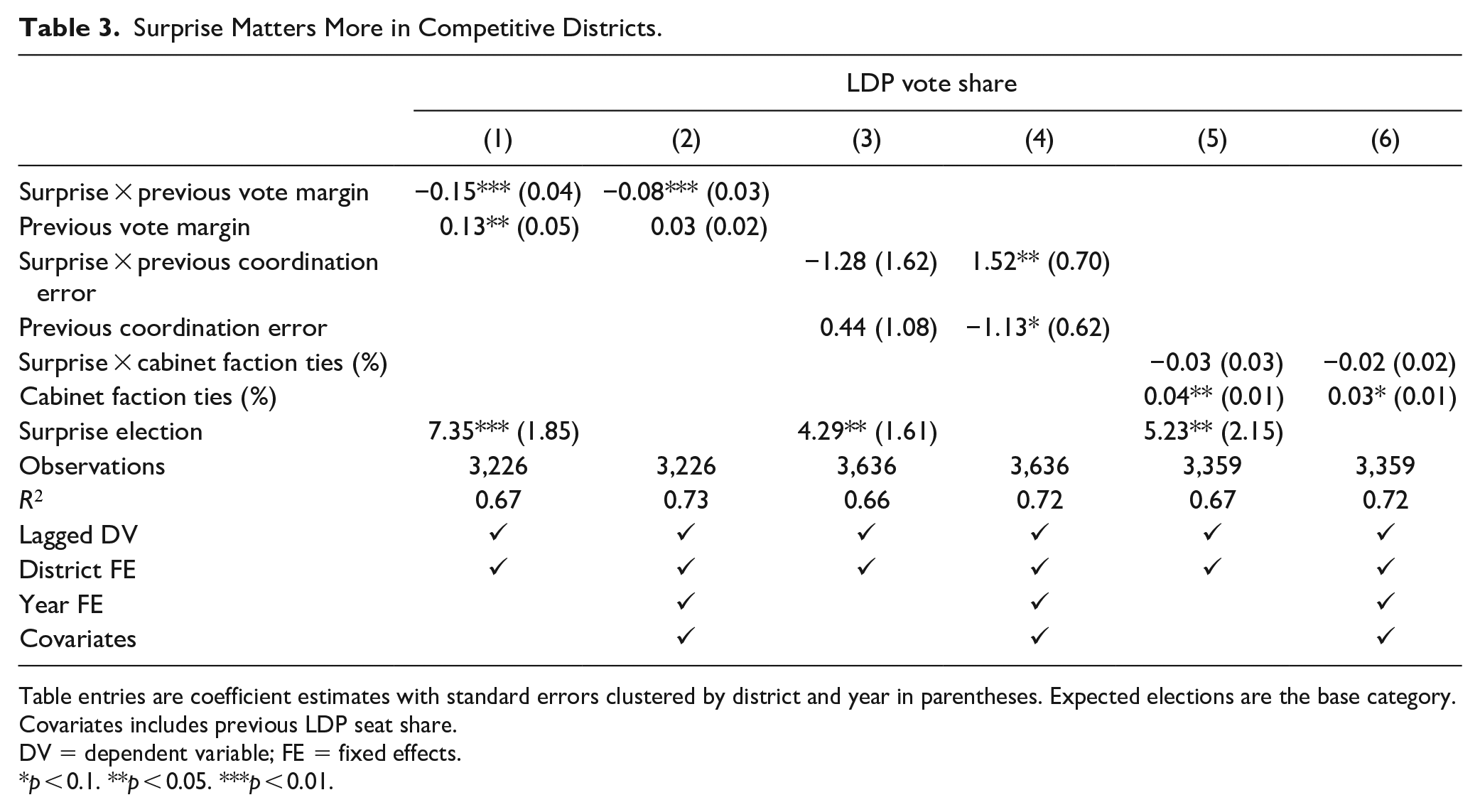
Table entries are coefficient estimates with standard errors clustered by district and year in parentheses. Expected elections are the base category. Covariates includes previous LDP seat share.
DV = dependent variable; FE = fixed effects.
p < 0.1. **p < 0.05. ***p < 0.01.
Surprise Matters More in Shorter Election Campaigns.
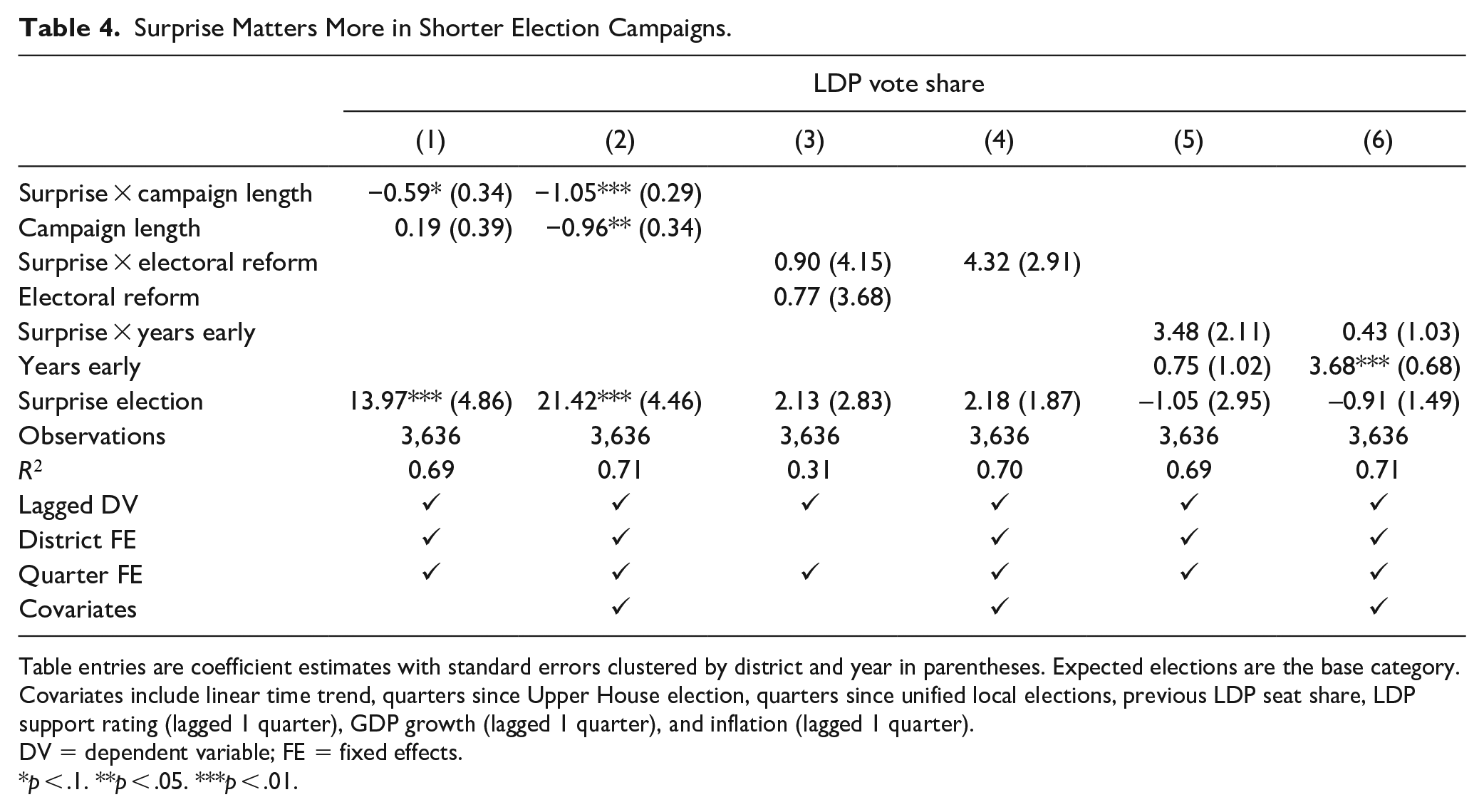
Table entries are coefficient estimates with standard errors clustered by district and year in parentheses. Expected elections are the base category. Covariates include linear time trend, quarters since Upper House election, quarters since unified local elections, previous LDP seat share, LDP support rating (lagged 1 quarter), GDP growth (lagged 1 quarter), and inflation (lagged 1 quarter).
DV = dependent variable; FE = fixed effects.
p < .1. **p < .05. ***p < .01.
Second, the results in Table 4 suggest that the length of the official campaign period influences the effectiveness of surprise elections more than the relative earliness of the surprise election compared to the end of the term. Models 1 and 2 show that the LDP receives significantly more votes from surprise elections when the campaign period is shorter. 31 By contrast, the number of years early that parliament is dissolved does not appear to affect the relationship between surprise elections and LDP performance (Models 5 and 6). I instead find that surprise elections held a year early can benefit the LDP just as much as those called 2 years before the end of the term.
Finally, Models 3 and 4 do not find a connection between electoral reform and the impact of surprise elections on LDP performance. As suggested earlier, it is difficult to predict whether electoral reform should ease or complicate the coordination problem for opposition parties. While I do not find significant effects here, future research is needed to further unpack how different electoral systems affect the ability of incumbent governments to benefit from surprise elections.
Surprise By-Elections
The results presented thus far provide evidence that LDP prime ministers and their cabinets have been able to take advantage of surprise elections to benefit their party at the expense of the opposition. In this last section, I consider a second, related question, which is whether parties differ in their relative capacity to respond to surprise elections. While the LDP is an institutionalized and well-organized party that has largely competed in district elections on its own or, in recent years, with the help of the much smaller Komeito as part of a stable coalition, opposition parties in Japan have long been fragmented into several smaller parties with changing coalition agreements. The LDP may therefore benefit from surprise both because of their informational advantage and because coping with surprise elections is much more difficult for the multiple opposition parties compared to the LDP.
Testing whether opposition parties are more susceptible to surprise than the LDP, however, is complicated for two reasons. First, every surprise election since 1955 has been initiated by an LDP prime minister, which means that we lack counterfactuals to compare how the LDP responds when it is surprised by an early election. Second, the asymmetric nature of dissolving the HOR means that the decision of LDP governments to call a surprise election is endogenous to LDP expectations about the opposition’s electoral performance. In other words, it is difficult to disentangle whether surprise disproportionately affects opposition parties, or whether anticipation of opposition weakness drives the calling of surprise elections. While both may be problematic from a normative standpoint, the challenge is to try and isolate the effect of surprise independent of anticipated performance.
To address these two issues, I analyze by-elections in Japan, which are held when a vacancy occurs for an HOR seat in the middle of the term. Important for this analysis is the fact that the timing of these by-elections is exogenously determined by law. By-elections thus differ from general elections in that the government cannot choose the specific election date. Moreover, I focus in particular on by-elections for districts that are triggered when a member passes away while in office. The sudden, midterm passing of a representative arguably provides random variation in the districts that receive a surprising early election. Comparing these by-election districts to similar districts during more expected elections for the HOR can thus allow us to test whether surprise elections disproportionately harm opposition parties relative to the LDP without the need to be concerned that the results are driven by LDP expectations about opposition performance.
Initially, by-elections had to be scheduled within 40 days of a seat becoming vacant. By-elections tended to be less common under Japan’s multi-member district system as they typically only took place when at least two seats in the same district became vacant during the term. However, as the number of by-elections increased after the move to single-member districts, the HOR revised the Public Office Election Act in 2000 to specify two times per year for by-elections. If a vacancy occurs between September 16 and March 15, then a by-election is scheduled for the fourth Sunday in April. If a vacancy occurs between March 16 and September 15, then a by-election is held the fourth Sunday in October. 32
While a by-election that follows a member passing away in office is not a perfect, random assignment of the surprise election treatment, it is plausible that the timing of the election comes both as a surprise and is exogenous to incumbent expectations about opposition readiness for an election. Previous studies have exploited the as-if random occurrence of a legislator passing away in Japan to study the impact of losing a representative on government transfers to that representative’s district (Hirano, 2011; Hirano & Ting, 2015). However, these works focus only on representative deaths prior to electoral reform that created a single vacancy in the district and thus did not trigger a by-election. My work here extends this identification strategy to pre-reform member deaths that caused a second district vacancy (and a by-election) as well as member deaths post-reform that led to by-elections. 33
In total, the HOR held 57 by-elections from 1955 to 2017, of which 27 occurred as a result of a member passing away. 34 I compare these exogenously determined by-elections with expected elections, following the same setup as past analyses but instead using a binary variable to denote surprise by-elections.
Table 5 shows the results, which provide further support for the connection between surprise elections, LDP electoral performance, and opposition readiness. 35 Candidates from the LDP are significantly more likely than opposition candidates to gain votes (Models 1 and 2) in surprise by-elections following a member’s death compared to more expected elections for the HOR. Moreover, I find that surprise by-elections can deter high-quality opposition candidates from entering the race (Models 5 and 6) and lead to more inter-party coordination errors than in expected elections (Models 7 and 8). The results for the overall number of recruited candidates (Models 3 and 4), by contrast, are not significant. Thus, surprise by-elections do not reduce overall candidate entry, which could contribute to the greater likelihood of coordination errors, as discussed earlier. 36
Surprise By-Elections Benefit the LDP and Inhibit Opposition Preparedness.
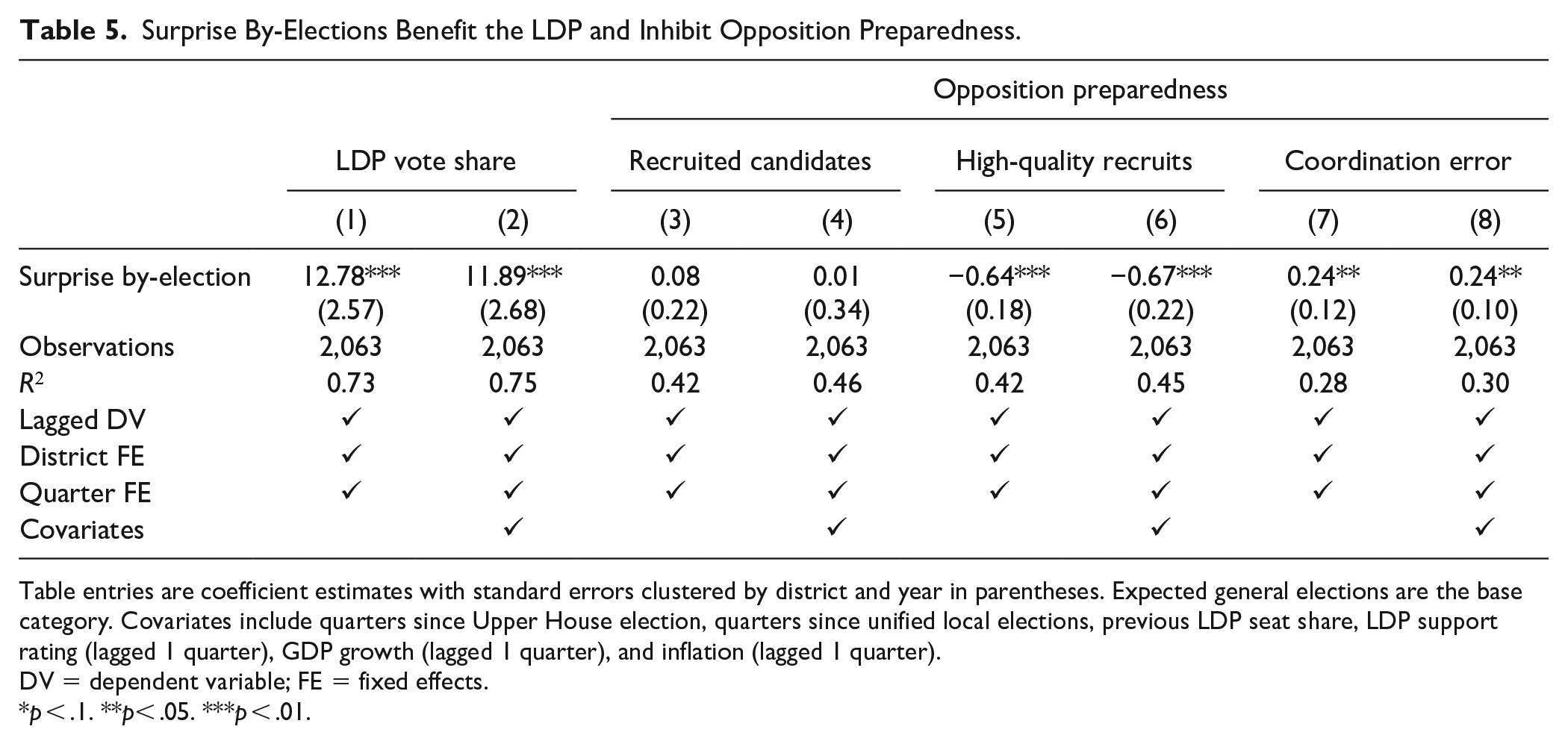
Table entries are coefficient estimates with standard errors clustered by district and year in parentheses. Expected general elections are the base category. Covariates include quarters since Upper House election, quarters since unified local elections, previous LDP seat share, LDP support rating (lagged 1 quarter), GDP growth (lagged 1 quarter), and inflation (lagged 1 quarter).
DV = dependent variable; FE = fixed effects.
p < .1. **p< .05. ***p < .01.
Finally, although the focus of this article is on opposition readiness, it is important to note that surprise elections do not similarly undermine the preparedness of the LDP. In the Supplemental Appendix, I replicate Table 2 for the LDP to show that the incumbent party is not hurt in its candidate recruitment (including high-quality candidates), likelihood of making coordination errors, or campaign spending by surprise elections (Supplemental Table A10). 37 In addition, I find evidence that surprise by-elections can actually benefit the LDP, as the party on average recruits one more high-quality candidate in these races compared to expected elections (Supplemental Table A11). Thus, while opposition parties struggle to coordinate and recruit quality candidates for a sudden by-election following the midterm passing of a legislator, it is often easier for the LDP to recruit a quality candidate who previously served in elected office, worked in the bureaucracy or parliament, or is a member of a political dynasty. 38
Conclusion
The central finding of this article is that when incumbent governments control the timing of elections, they can use the element of surprise to their electoral advantage. Uncertainty about when the next election will be held hinders the ability of opposition parties to adequately prepare for elections. When caught by surprise, these parties recruit fewer, lower-quality candidates, spend less money in campaigns, coordinate with other parties less effectively, and ultimately receive fewer votes and seats compared to expected elections. Surprise is most effective in shorter, competitive election campaigns, helps the LDP more with inter-party as opposed to intra-party electoral competition, and can benefit the LDP even in elections where all parties are equally surprised. Evidence from Japanese candidate-level data in general elections and exogenously timed by-elections all support the same conclusion: Surprise elections can influence electoral outcomes and undermine democratic accountability.
Given the effectiveness of surprise elections, one might wonder why LDP prime ministers do not always try to surprise the opposition with an early election. While the results in this article show that surprise, on average, benefits the incumbent party in government, it is not the only factor influencing electoral outcomes. The LDP likely faced many moments where it knew that it could surprise the opposition, but did not dissolve parliament because the costs it expected to face from other factors (e.g., economic conditions, political scandals) outweighed the potential benefit of a surprise election.
Another question is why opposition parties could not simply learn over time to avoid being surprised by incumbent governments. Yet, there are several reasons why endogenous election timing is not an easy challenge for the opposition to overcome. First, it is difficult (and not necessarily desirable) for the opposition to dedicate itself fully to preparing for an election too early in the term. If it did so, its policy goals would likely suffer and the incumbent government could always choose to simply wait and call an election later. Second, when there is large variation in election timing, as in Japan, it can be tough for opposition parties to predict the date of the next election. There is no single pattern to early elections, and the ease with which incumbent governments can dissolve parliament makes it harder to detect early warning signs that a dissolution is imminent. Third, avoiding surprise may be especially challenging in countries such as Japan, as its experience with multi-member districts and a fragmented opposition may exacerbate the difficulty for opposition parties in preparing for surprise elections.
This last point raises an important question about the generalizability of the argument presented in this article. If Japan’s experience can be generalized to other cases, then we should expect surprise to be an important component of strategic election timing in other countries that similarly have institutions conducive to surprise elections such as Denmark and Ireland. Governments in Canada and the United Kingdom also used to have great freedom over election timing and short periods between their dissolution and election dates, but both countries recently enacted laws to limit the power of leaders to dissolve parliament in favor of fixed-term elections. We might therefore expect the incumbency advantage to decline in both countries under fixed terms, as governments no longer have the ability to benefit by surprising the opposition with an early dissolution.
There are two other factors, however, that may act as scope conditions on the effectiveness of surprise elections and raise questions for future research. The first is the power imbalance in Japan between the long-ruling LDP and opposition parties, which may be a critical factor in determining their relative capacity to respond to surprise elections, as suggested by Table 5. An important question for future work is whether the element of surprise is more potent in single-party dominant countries than in countries with more balanced party systems. Japan’s history of single-party dominance is quite different from the United Kingdom, although Canada also experienced long stretches of single-party rule under the Liberal Party of Canada. 39 The second factor is that the argument developed in this article is tested in a majoritarian electoral setting, rather than in a proportional representation system. Other studies could explore whether surprise differentially affects candidates across the majoritarian and proportional components of Japan’s current mixed system, or test the effect of surprise on electoral outcomes in countries with variants of proportional representation such as Ireland (single transferable vote), Denmark (open list), and Israel (closed list).
Finally, the focus in this article is predominantly on incumbent governments and opposition parties, but future research should investigate the role of other political actors in surprise elections. For example, how do legislators within the ruling party or coalition view the power of the executive to suddenly force them to defend their seat in an election? Do individual members of the parties in government largely trust the executive to determine election timing, or are there internal divisions within the same party over their response to surprise dissolutions? Can prime ministers use the threat of dissolution to ensure party discipline? Moreover, how do voters view surprise elections? While we have some evidence that British voters prioritize economic conditions over concerns about fairness (Schleiter & Tavits, 2018), other researchers could study how voters perceive the disadvantages surprise elections can create for opposition parties in other country contexts. Addressing these questions in future work can deepen our understanding of the impact that uncertainty over election timing can have on democratic accountability.
Supplemental Material
sj-pdf-1-cps-10.1177_0010414021997172 – Supplemental material for The Element of Surprise: Election Timing and Opposition Preparedness
Supplemental material, sj-pdf-1-cps-10.1177_0010414021997172 for The Element of Surprise: Election Timing and Opposition Preparedness by Charles T. McClean in Comparative Political Studies
Footnotes
Acknowledgements
The author is grateful to Angela McClean, Kenneth McElwain, Megumi Naoi, Margaret Roberts, Luke Sanford, Cameron Sells, Daniel Smith, Kaare Strøm, Yiqing Xu, and participants at the annual Midwest Political Science Association conference for their invaluable feedback on earlier drafts.
Declaration of Conflicting Interests
The author declared no potential conflicts of interest with respect to the research, authorship, and/or publication of this article.
Funding
The author disclosed receipt of the following financial support for the research, authorship, and/or publication of this article: The research for this article was generously supported by the Joseph Naiman Graduate Fellowship at the University of California, San Diego.

Supplemental Material
Supplemental material for this article is available online.
Notes
Author Biography
References
Supplementary Material
Please find the following supplemental material available below.
For Open Access articles published under a Creative Commons License, all supplemental material carries the same license as the article it is associated with.
For non-Open Access articles published, all supplemental material carries a non-exclusive license, and permission requests for re-use of supplemental material or any part of supplemental material shall be sent directly to the copyright owner as specified in the copyright notice associated with the article.
