




Abstract
Public evaluations of the economy are key for understanding how citizens develop policy opinions and monitor government performance. But what drives economic evaluations? In this article, we argue the context in which information about the economy is distributed shapes economic perceptions. In high-quality information environments—where policies are transparent, the media is free, and political opposition is robust—mass perceptions closely track economic conditions. In contrast, compromised information environments provide openings for political manipulation, leading perceptions to deviate from business cycle fluctuations. We test our argument with unique data from eight Latin American countries. Results show restrictions on access to information distort the public’s view of economic performance. The ability of voters to sanction governments is stronger when democratic institutions and the media protect citizens’ access to independent, unbiased information. Our findings highlight the importance of accurate evaluations of the economy for government accountability and democratic responsiveness.
Keywords
In a representative democracy, citizens require access to information to select, retain, and sanction representatives effectively. Just how much information they need is unclear, however. Some scholars set a low bar, asserting that citizen control over politicians requires little more than the capacity to observe “changes in their own welfare” (Fiorina, 1981, p. 5). Less optimistic researchers argue that “very considerable logical and informational difficulties faced by retrospective voters” make performance assessments exceedingly hard (Achen & Bartels, 2017, p. 92). Although true for most policy areas, this debate is particularly relevant to mass evaluations of the government’s economic performance. The economy is a highly salient benchmark. Citizens observe it directly, through personal experience, and indirectly, through public and private information channels. But despite its relevance, we still know little about how citizens form economic assessments. Do economic perceptions closely track economic indicators, or does the public hold a biased view of the national economy? In particular, do systemic barriers to information skew citizens’ evaluations the state of the economy?
In addressing these questions, this article builds on evidence that citizens’ economic perceptions do not simply mirror economic outcomes but are also influenced by political factors (De Boef & Kellstedt, 2004; Duch & Stevenson, 2011; Duch et al., 2000). We advance this agenda in new directions, however, by showing how the political climate in which information is disseminated, or the information environment, structures the connection between macro-economic activity and economic perceptions. A simple observation motivates this study: in many of the world’s democracies, formidable barriers hinder the public’s access to economic information. In most advanced democracies citizens can acquire the information needed to make financial and political decisions. While not beyond reproach, economic data in these countries tend to be reliably collected and widely disseminated. As a result, public economic sentiment tends to track, if not exactly parallel, objective economic conditions (Anderson & Hecht, 2014; Duch & Stevenson, 2011).
However, these information-rich environments are the exception, not the rule. In many countries where neither liberal democracy nor the market economy has become fully established, governments can more easily withhold, or manipulate the public’s access to, high-quality, unbiased information about the economy. In these low-information contexts mass economic sentiment is more likely to deviate from objective economic conditions. This incongruence between reality and perceptions arguably damages the public’s capacity to assess policy outcomes, hold leaders accountable, and serve as “critical citizens” (Norris, 1999). The availability of economic information can affect levels of corruption, government spending, and even the stability of the political regime itself (Hollyer et al., 2018; Islam, 2007; Lindstedt & Naurin, 2010). In short, an open and dense information environment is an essential prerequisite for a healthy democracy.
This article provides the first investigation of the formation of mass economic sentiment outside industrial democracies. Below, we test a novel argument about how the information environment shapes the connection between the real and the subjective economies using original measures of aggregate economic sentiment and the information environment in eight Latin American countries. Results suggest publics can discern the state of economic affairs with some accuracy. Yet the transmission from economic indicators to subjective assessments is not inevitable. It hinges on a high-quality information environment, 1 characterized by government transparency in data dissemination, a free press, and robust political competition. Further analysis suggests the slippage between economic perceptions and conditions is due mainly to the strategic manipulation of data rather than the quality of the data itself.
We make several important contributions. Most immediately, we extend the literature on accountability by showing how limits on access to information impede citizens’ capacity to develop accurate and reliable assessments of government performance. While previous research shows how institutions (e.g., Hellwig & Samuels, 2008), exogenous shocks (e.g., Campello & Zucco, 2016), and individual attributes like partisanship (e.g., Tilley & Hobolt, 2011) impede attribution of responsibility for policy outcomes, our work identifies elite-engineered barriers to the information citizens need to form evaluations of policy performance in the first place. Citizen evaluations of the economy are causally prior to, but no less important than, responsibility attribution in the accountability chain. Consistent with our informational theory, we show that the connection between economic conditions and perceptions sharpens where the political context allows the dissemination of comprehensive and unbiased economic information.
A key implication of our study is that a low-friction information environment is a prerequisite for democratic accountability. In classic models of retrospective voting, voters can effectively sanction government performance when their evaluations correspond to real economic fundamentals. But these models say little about whether the economy in people’s heads actually tracks conditions “on the ground.” If, as our evidence suggests, evaluations are systematically biased in low-quality information environments, this could harm the public’s ability to sanction or reward elected officials and, thus, call into question the least demanding way by which democracy can fulfill its ideal of popular sovereignty (cf. Achen & Bartels, 2017). More optimistically, our results imply that bolstering channels of information access—through government and the media—and limiting the concentration of power can bring democracy closer to its representative ideals.
What Moves Economic Sentiment?
Given its many political and economic consequences, scholars have long asked how well mass economic sentiment, the subjective economy, reflects fluctuations in economic indicators, the objective economy (e.g., Duch & Stevenson, 2011; Erikson et al., 2002; Krause, 1997). On average, optimism about the economy tends to increase when indicators suggest it is performing well; in fact, there is substantial evidence that economic sentiment moves in tandem with multiple economic indicators including growth, interest rates, and share prices (De Boef & Kellstedt, 2004; Duch & Kellstedt, 2011; Hollanders & Vliegenthart, 2011; Vuchelen, 2004).
This correspondence, of course, is imperfect. Citizens vary in their capacity to seek out and accurately process economic information and are often ill-informed on matters of politics (Carpini & Keeter, 1996; Converse, 1964) and policy (Chappell & Keech, 1990). Perceptions of economic conditions also vary systematically with demographic characteristics, political sophistication, and partisanship (e.g., Bartels, 1996; Bisgaard, 2015; Duch et al., 2000; Gerber & Huber, 2009; Tilley & Hobolt, 2011). More recent work also suggests that individuals’ capacity to process economic information is shaped disproportionately by recent events (Healy & Lenz, 2014), and that negative shocks (e.g., price hikes or currency crises) influence perceptions more than positive ones (Bovi, 2009).
Beyond individual influences on perceptions, economic sentiment reflects features of the political system, as well. According to De Boef and Kellstedt (2004), consumer confidence in the United States responds to major political events, such as wars and scandals, but also to aspects of “politics as usual,” such as fiscal and monetary policy, confidence in the president’s economic management, and media coverage (see also Goidel et al., 2010; Hetherington, 1996). Duch and Kellstedt (2011) extend this work to four advanced capitalist economies and confirm, like others, that a good deal of the “subjective” economy remains unexplained after accounting for “objective” economic conditions.
In short, contrary to assumptions of classic models of retrospective voting, citizens clearly face steep barriers to accurately monitoring and evaluating economic outcomes. We take this work in a new direction by explaining how systemic barriers to information weaken the correspondence between objective economic indicators and mass economic sentiment. In line with recent contributions to the literature on political sophistication, we recognize that individuals face important cognitive barriers to accessing and processing the high-quality information they need to play their role as democratic citizens. However, we break new ground by identifying and assessing a set of critical characteristics of the political system that shape the incentives and capacity of governments to manipulate the dissemination of information for political gain.
An Informational Theory of Economic Perceptions
A basic premise of representative democracy is that citizens can evaluate the performance of politicians and punish or reward them accordingly, typically through voting. To judge the government’s economic performance accurately, citizens must be able to access reliable and unbiased information on the government’s policies and outputs (e.g., Fraile, 2013; Leeson, 2008). Accessing valid and reliable information, however, is rarely straightforward and requires citizens to overcome significant challenges. One such challenge stems from individual’s own selective information perception, or the notion that political dispositions, like party attachment or group memberships, can bias the kinds of information individuals seek and how they process it (e.g., Green et al., 2004). In the case of the United States, for instance, evaluations of the president’s job performance more closely track the economy among independent voters than among partisans (Donovan et al., 2019; also see Kayser & Wlezien, 2011).
Explanations linking economic evaluations to selective perception, however, are likely less valid in many of the world’s democracies, where partisan attachments are weaker than in the United States or, for that matter, in other advanced capitalist democracies. Even where parties are well established, these explanations largely ignore the increasingly impenetrable structural barriers to information (Kellam & Stein, 2016) that often create biases in the production or dissemination of information. The first of these occurs when statistical agencies responsible for producing economic data lack the capacity to collect accurate information or cannot do so completely or in a timely fashion. This problem may be pervasive in large, increasingly diverse economies such as China, Russia, India, and Brazil, where data collection and aggregation costs may exceed available resources (e.g., Bradsher, 2018). Yet even where state agencies have the requisite capacity to generate economic data, governments can erect barriers to its dissemination. In the first scenario, the quality of information itself is reduced; in the second, citizens’ access to this information, regardless of its quality, is manipulated.
Our emphasis is on how structural barriers to the dissemination of information affect economic perceptions. We argue that distortions in the dissemination of data are essential for understanding how strongly economic sentiment tracks objective economic indicators. Given the high costs of generating and disseminating economic information, in most countries this burden falls on the government (Dawes, 2010). Unfortunately, governments have incentives to limit or otherwise steer information access to make it work in their favor. Come election time, governments want to take credit for a strong economy. But the incentives to hide, misrepresent, or limit access to information go beyond electoral calculations. During economic crises, for example, countries might want to avoid negative reactions from investors (Michalski & Stoltz, 2013). Secrecy or manipulation also provides policymakers with cover for potential mistakes and corrupt dealings and places government outsiders at a significant competitive disadvantage (Stiglitz, 2002).
While incentives to distort the flow of economic information are pervasive, the extent to which they impede public access to information varies across political systems. We argue that an overlooked explanation for this variation is the information environment, or the context in which citizens access economic information (Marinova, 2016). We focus on three distinct characteristics of the information environment that can systematically distort citizens’ understanding of the state of the economy: transparency in the dissemination of data, the existence of alternative information sources, and robust political competition. Holding constant the quality of the economic data produced by the government, we argue that the information environment shapes the government’s incentives to manipulate the supply of data for political gain. This manipulation should obstruct citizens’ access to crucial information about the economy. We expect subjective economic perceptions to track objective conditions more closely in cases where an open and transparent institutional framework exists, where diverse sources of information are available, and where strong electoral competition makes it hard for the government to limit, control, or hide relevant economic information.
Transparency in the Collection and Dissemination of Economic Information
One way governments manipulate access to economic or financial information is by deliberately withholding it from the public (Williams, 2015). Institutions guaranteeing transparency in the collection and flow of information can safeguard against this type of manipulation (Stiglitz, 2002). Recognizing the potential for abuse, some states have established independent agencies designed to insulate the collection of economic data from political pressures or have passed laws enabling citizens to access public information (Cain et al., 2003). Advances in information technology have further contributed to making governments more transparent, mainly by granting citizens access to government data that might otherwise be difficult to obtain (Dawes, 2010).
Other countries, however, lack such an institutional framework for transparency. Where legal protections are non-existent or weakly enforced, governments can block access to reliable economic information. Consider the example of Argentina. Starting in 2007 the government captured the independent statistical agency, the Instituto Nacional de Estadisticas y Censos (INDEC), in order to mask price level rises that threatened the electoral prospects of Cristina Fernández de Kirchner, the sitting president’s anointed successor. 2 Denied access to reliable economic information, private firms, universities, and even Congress struggled to provide citizens and organizations the data they needed to plan public policies, set salaries, and calculate rent alimony increases, among other things. In 2013, the International Monetary Fund (IMF) censured the government of Argentina for failing to provide accurate economic data that the Fund could use to monitor the country’s compliance with its international obligations. 3
A second example involves the willingness of countries to make publicly available the data generated through the IMF’s Article IV consultations, which assess countries’ economic situations. Edwards et al. (2012) find great inconsistency in countries’ willingness to release the executive summary communicating the Fund’s top-line findings (known as the Public Information Notice, PIN) and the much more detailed “staff notes”: Venezuela has released no information; Brazil has released all of the PINs but none of the detailed staff reports; and Chile has released practically all the information generated by these consultations. Though the public is unlikely to read these reports directly, their conclusions are often featured in major news stories about the state of the economy. In October 2019, for example, almost every major Mexican news outlet ran stories on the IMF’s “alarming” assessment of the Mexican economy under new president Andrés Manuel López Obrador. 4
The Media and Access to Unbiased Information
Beyond the legal framework, a series of “information institutions” such as universities, think tanks, private firms, and the media, distribute economic information to the public. Of these, the media can most powerfully constrain the government’s ability to manipulate information by reducing the asymmetry of information between the government and citizens, by checking the government’s economic claims, and by providing an alternative source of information (Gao et al., 2018; Hiaeshutter-Rice et al., 2019). But media outlets are also gatekeepers, deciding which economic news to report and what light to present it in (De Boef & Kellstedt, 2004). Evidence from advanced democracies suggests that the media shapes the public’s economic perceptions, preferences (Druckman, 2004; Goidel et al., 2010; Hetherington, 1996) and voting decisions (DellaVigna & Kaplan, 2007; Hollanders & Vliegenthart, 2011).
The media’s impact can be even more pronounced outside consolidated democracies, where it is commonly “regulated, captured, or repressed” (Besley et al., 2002, p. 46; Gunther & Mughan, 2000). Limits on access to unbiased information are typically higher where citizens depend on a small number of outlets (Islam, 2002) and where the media is controlled by private individuals who “systematically favour the incumbent party” (Djankov et al., 2002; Lawson & McCann, 2005, p. 5). Concentrated ownership itself produces pro-government bias by enabling media owners and politicians to exchange favors with impunity. Moreover, poor information environments are typically supported by a legal framework that protects media concentration, inhibits independent reporting, and obstructs citizen access to information (Hughes & Lawson, 2005).
Unfortunately, examples of media restrictions across fledgling democracies abound. In Ecuador, a 2008 constitutional reform gave the government the right to regulate media content. More recently, the government its media holdings and banned public agencies from advertising in media critical of the government (Mason, 2012). Elsewhere, governments have used slander laws to quiet government critics (Boas, 2013; Hughes & Lawson, 2005). Notoriously, Peruvian president Fujimori paid media owners to promote his reelection in their outlets (Conaghan, 2002) and the Venezuelan government under Hugo Chavez refused to renew the licenses of opposition-friendly radio and television stations (Atwood, 2006). Across the board, limits on press freedom stymie citizens’ access to the information they need to judge economic conditions.
Political Competition and Incentives to Manipulate Information
Lastly, political competition structures the information environment by raising the costs of the government misrepresenting the state of the economy. In the limit, the absence of competition allows governments to monopolize rents and exert broad control over access to information. By contrast, a strong political opposition provides important checks on the executive’s capacity to control the message (Carlin et al., 2015). Two mechanisms are at work. First, opposition parties can contribute competing narrative frames. This makes it harder for the government to send a unified, positively-biased message, economic or otherwise (Ceka, 2013). For some voters, the credibility of the opposition’s claims can detract from the government’s message. For others, countervailing frames increase noise, rendering all economic signals less credible. 5 Either way, competing frames tend to reduce individuals’ susceptibility to any single frame (Druckman, 2004). The second mechanism is that political competition increases opposition politicians’ incentives to monitor the incumbent’s actions and raises the electoral costs to the government of misrepresenting the state of the economy. Moreover, institutions that promote transparency are more likely to exist in the first place where competition is more robust and parties expect alternation in power (Grzymala-Busse, 2006).
Again, Argentina is illustrative. After the government intervened in the country’s statistical agency (INDEC), several private consulting firms began publishing their own measures of inflation. In 2011, the government moved to impose fines on these firms, claiming they spread false information. In response to the government’s censorship, the Radical Civic Union-led opposition in Congress released figures produced by these firms under the banner of IPC Congreso or Congressional Consumer Price Index (Lury & Gross, 2014). Although the Supreme Court eventually declared the fines unconstitutional, the opposition continued to publish the IPC Congreso, providing a widely-publicized counterweight to the government’s official numbers—to the public’s benefit. 6
In summary, the context in which economic information is distributed should shape economic perceptions, especially outside consolidated democracies. We focus on a set of characteristics that shape citizens’ access to unbiased information, including robust dissemination of information and checks on the state’s capacity to manipulate information for political gain. In the next section, we test the observable implications of our informational theory of economic perceptions.
Data and Measurement
Assessing our theoretical expectations connecting economic conditions, subjective economic assessments, and the information environment in which both are realized requires variation on these dimensions, both over time and across national contexts. To guarantee this variation, we employ aggregate time-series data from eight Latin American countries between 2001 and 2010. By selecting cases in Latin America, we incorporate a wide range of information environments while limiting other sources of variation stemming from constitutional design. Issues of data availability aside, our macro-design allows us to place objective and subjective indicators on a common level of analysis; it also facilitates our focus on differences in economic sentiment attributable to structural factors rather than individual political dispositions. 7 Below we describe our measures; we report summary statistics in the Supplemental Information (SI) file. 8
Economic Perceptions
The dependent variable is aggregate economic sentiment, or Economic Perceptions. Data come from surveys of consumer confidence in Argentina, Brazil, Chile, Colombia, Costa Rica, Mexico, Peru, and El Salvador. While surveys on consumer confidence exist for most of Latin America, only in these countries do they meet four crucial criteria that allow appropriate tests of our theoretical expectations: (1) surveys are administered by government agencies or reputable firms with well-documented methodologies; (2) surveys are fielded at no less than quarterly intervals and time series are of sufficient length for dynamic hypothesis testing (Keele et al., 2016); (3) surveys use similar question wordings; and perhaps most importantly, (4) indices are available in disaggregated components. 9
Apart from our substantive interest in economic perceptions, disaggregating consumer sentiment is key for practical measurement reasons. Based on reliability and validity tests of the well-known University of Michigan’s Index of Consumer Sentiment (ICS), Kellstedt et al. (2015) advise against the uncritical use of the index and recommend analysts use a more narrowly-defined and theoretically-informed subset of its component indicators. Following this recommendation, and because retrospections should hue most closely to past performance, we employ only retrospective economic perceptions rather than an index that combines retrospections and prospections. Each of the eight national surveys analyzed here employs a battery of items very similar or identical to the ICS. To construct quarterly series of Economic Perceptions for each country we combine two items: “Do you think now is a good time for people to buy major household items?” and “Would you say that you are better off or worse off financially than you were a year ago?” 10 Supplemental Table A2 in the SI describes country-specific sources and measures.
Figure 1 charts economic perceptions over time (black lines). Note that in some countries (El Salvador, Costa Rica, Chile) perceptions swing from economic optimism to pessimism. However, in other places (e.g., Brazil, Mexico, and, to some extent, Peru) economic perceptions appear relatively flat. What accounts for these different dynamics? Do aggregate public perceptions reflect a more volatile business cycle in Chile than, say, in Brazil? Or do these differences reflect variation in the capacity of national publics to observe and assess trends in real economic conditions?
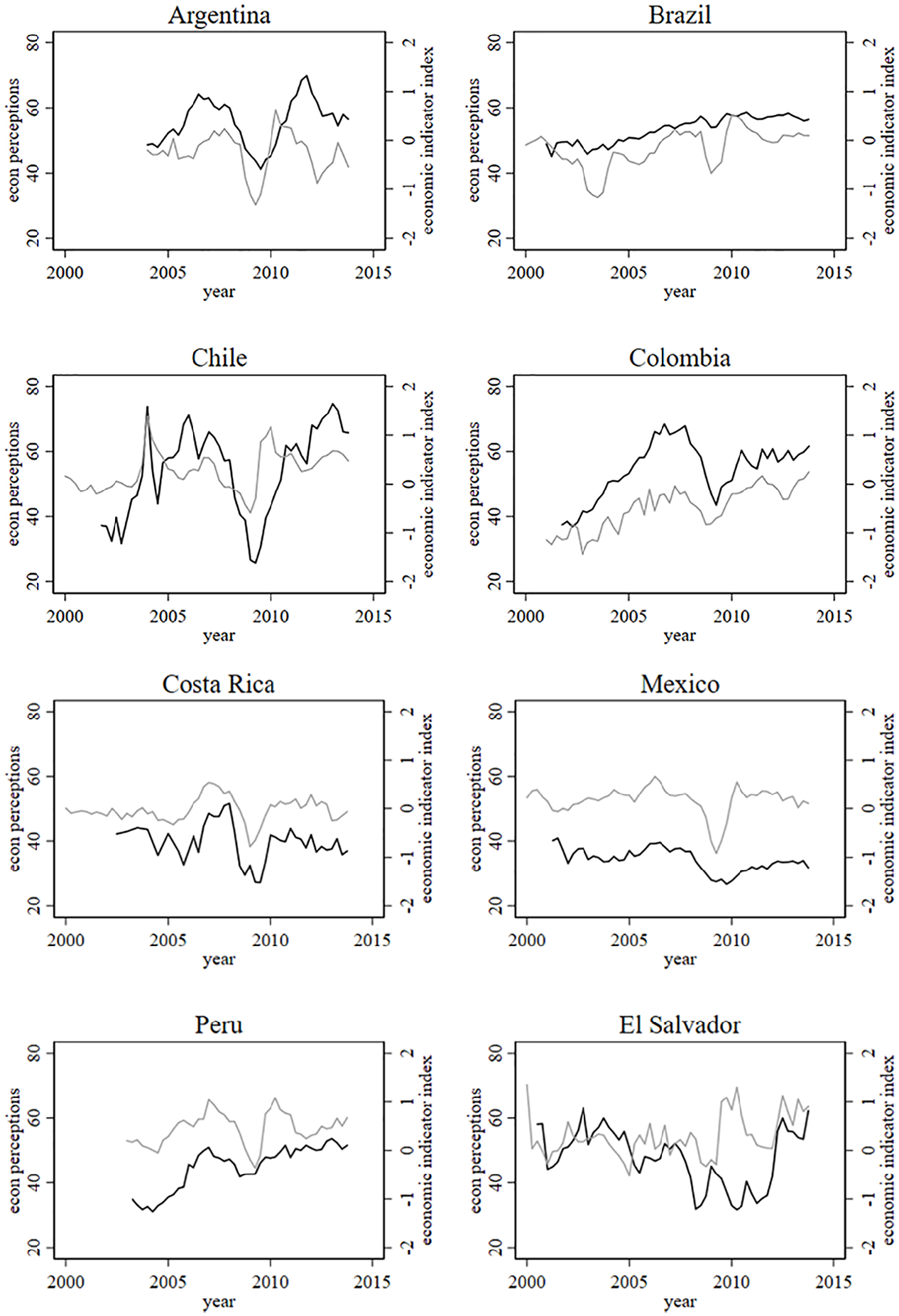
Economic perceptions and Economic Indicator Index in eight countries.
As a first attempt to address these questions, Figure 1 also displays trends in economic conditions, measured as a composite Economic Indicator Index that combines growth, inflation, and unemployment (in grey lines, graphed on the right-hand axis). Together, these three indicators summarize the breadth of economic conditions in these countries (Remmer, 1991; Singer, 2013; cf Campello & Zucco, 2016). 11 We observe an association between economic conditions as reported by the government, and citizens’ perceptions of the economy. For example, the economic downturn of 2008 to 2010 is matched—albeit in muted form—by a decline in economic optimism across the region. The degree to which economic perceptions track economic indicators, however, varies noticeably from country to country and over time. Contemporaneous correlations range between nearly 0.8 and virtually zero. 12 It is clear from Figure 1 that economic perceptions are not driven solely by economic performance. Moreover, heterogeneity in the link between perceptions and actual economic trends is even more apparent when we unpack the latter into its components. In some countries, perceptions most closely track growth (e.g., Chile), in others inflation (e.g., Brazil), and in still others unemployment (e.g., Peru).
The Information Environment
Our baseline expectation is that national economic conditions drive public perceptions of the economy. The models below include three measures of economic conditions: growth, inflation, and unemployment. 13 Positive growth shocks should push up perceptions of economic performance, while increases in prices and joblessness should contribute to more pessimistic assessments. Our central argument, however, is that the public’s capacity to receive and use economic information depends on the quality of the information environment, gauged in terms of government transparency, press freedom, and strength of the political opposition. Our analysis provides strong evidence that where these conditions exist, the link between citizens’ economic perceptions and objective conditions tends to be stronger.
First, we claim the information environment improves where an institutional framework for government transparency exists. We capture this aspect of the information environment using Hollyer et al.’s (2014) Transparency, a measure based on an item-response model of government collection and dissemination of aggregate economic data applied to the World Development Indicators. This measure has two distinct advantages. First, it is objective whereas most competing measures rely on perceptions. This property is especially attractive since our outcome of interest is aggregated subjective assessments. Second, it directly reflects the disclosure of economically relevant information by the government to the public. This makes Transparency a near-ideal measure for our purposes. We code it so that high scores represent more transparency. As argued above, we expect a closer relationship between subjective assessments and economic conditions when governments are more transparent.
A free press also provides a reliable check on the dissemination of unbiased information. Our measure of media freedom comes from Freedom House, an independent watchdog organization that monitors press freedom worldwide. This measure assesses whether the “‘enabling environment’ in which the media operate” is restricted and whether print, broadcast, and internet-based media can operate freely and without fear of repercussions. 14 For our measure, Press Freedom, we invert the original scale so that higher values connote greater media freedom. Importantly, Press Freedom is not necessarily associated with more democracy. Rather, elected leaders may choose to limit media access to protect information, especially in competitive political environments (VonDoepp & Young, 2013). In Latin America, the mean score declined 10 points (on a scale form 0–100) from 1993 to 2013 (Kellam & Stein, 2016). 15
Third, a credible political opposition can blunt the government’s capacity to bias or manipulate information about economic conditions in the government’s favor. To approximate the opposition’s influence, we create a variable, Opposition Percent, equal to the proportion of seats held in the legislature by the largest opposition party, with changes recorded during one quarter reflected in the subsequent quarter. 16 The government is less likely to manipulate information about the state of the economy when a large opposition party serves as a credible governing alternative.
Lending support to our pooled time-series research design, we note that each of these series varies across countries as well as within them over time. To see this, we decompose the variance into its cross-national and time-serial components. For the case of Press Freedom, 90% of the variance is across our eight country cases, with ten percent captured over time. For the other two series, the portion of the variance captured over time is greater, at 47% for Transparency and 30% for Opposition Share. Accordingly, we create a composite indicator that combines the standardized scores for Transparency, Press Freedom, and Opposition Share into a single measure we label the Information Environment. This composite score offers a more complete indicator of the wider environment for information dissemination than any single measure of its component characteristics. The Information Environment index varies in our sample from a low mean of −0.59 in Argentina and Colombia, to a high of 0.73 in Chile, with a sample mean of 0.04.
Trends in Figure 2 show a clear deterioration of the quality the information environment across in a wide cross-section of Latin American countries over the last 15 years. The cause for this decline, however, varies across national contexts. Some countries have suffered worsening conditions for independent journalism. Mexico is illustrative. Throughout the 71 years of PRI (Institutional Revolutionary Party) rule, the government’s relationship with the press was marked by manipulation, collusion, and corruption (Lawson, 2002). As the PRI’s dominance slipped, however, media competition and independence improved. By 2003, the country’s Press Freedom score had reached a high of 64; the country’s overall Information Environment followed, peaking at 1.07 at the beginning of 2004. Under these conditions, economic sentiment should reliably track economic indicators, as shown in Figure 1. Unfortunately, in recent years journalists and media outlets across Latin America have increasingly faced harassment, intimidation, and physical attacks (Freedom House, 2016; Kellam & Stein, 2016). By 2010, Mexico’s Press Freedom score had fallen to 38, with the composite Information Environment score declining sharply as well to −0.45, a level at which economic perceptions once again have become delinked from economic reality.
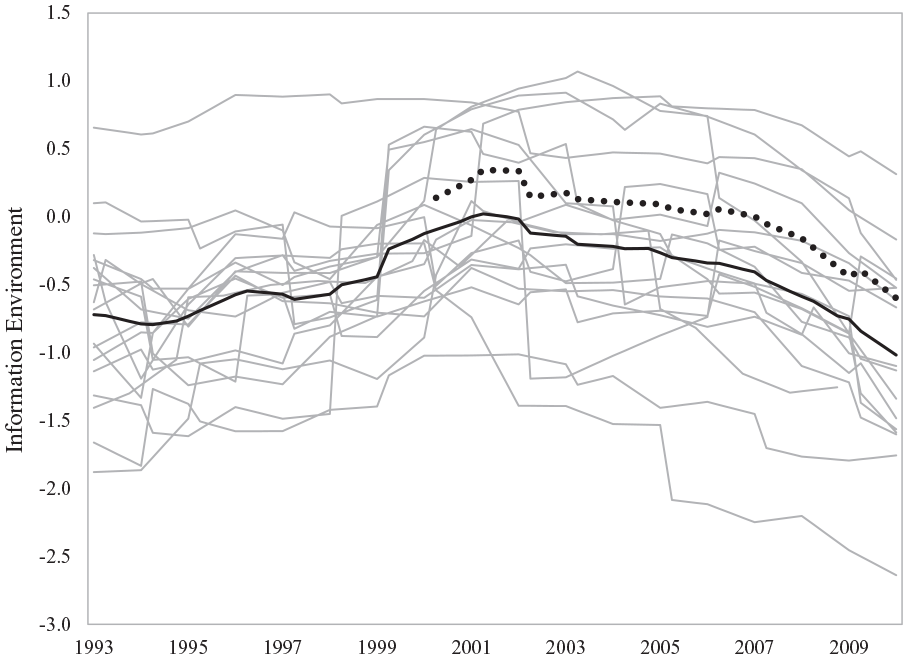
The information environment in 18 Latin American countries.
Reductions in the quality of the information environment in other cases reflect declining standards of government transparency. Consider the case of Brazil. In 2002, left-leaning Luiz Inácio Lula da Silva won the presidency. To assure jittery markets and signal a commitment to improving economic transparency in the collection and dissemination of information, his administration launched the federal government’s Transparency Portal in 2004 (OECD, 2012). Brazil’s Transparency score increased from 3.4 in 2001 to 4.4 in 2004, driving an improvement in the Information Environment index from −0.49 to −0.23 in the same period. By the end of Lula’s tenure, however, concerns about data transparency had given way to allegations of scandal, and Brazil’s Transparency score and overall Information Environment score dropped to 1.6 and −1.3, respectively—their lowest values in sixteen years and very well below the sample means of 3.9 and 0.0.
In other places, like Colombia, deterioration of the information environment can be traced to a process of consolidation of political power. We have argued that greater opposition in the legislature strengthens the relationship between subjective perceptions and objective indicators. Although on average, political competition in most of the countries in our sample has generally been robust, in places like Argentina, Brazil, and, especially, Colombia, we observe periods in which the largest opposition party’s proportion of legislative seats is in the single digits, a situation that weakens citizens’ ability to assess the economy.
Methods
We model economic perceptions using single equation general error correction models (GECMs). To ensure that our time series do not produce spurious regression results (Banerjee et al., 1993), we test for stationarity and integration using unit root tests for unbalanced panels (Im et al., 2003). Results, which appear in the SI section IV, indicate many of our series are integrated. Tests further confirm that cointegration is present between our integrated dependent variable and the integrated explanatory variables, a finding which justifies the use of the GECM as an appropriate solution to the spurious regression problem (Supplemental Tables A5–A6). 17
Besides addressing barriers to statistical inference, an error correction set-up is theoretically appealing: if the public’s perceptions of the economy varies in lockstep with the business cycle, we should expect a close association between the dependent variable and the series on the right-hand side of the equation. Shocks to growth, unemployment, and price levels should amount to temporary deviations as the public absorbs new information and updates their perceptions. The error correction rate represents the speed with which Economic Perceptions returns to its equilibrium relationship with the regressors following a shock. Similarly, the public’s evaluation of political leaders, Political Approval, may closely inform the public’s assessment of economic conditions.
We begin with a general baseline specification to assess the direct influence of economic and political conditions on economic sentiment and then assess our expectations about how these relationships change under different information environments. The general model is of the form:

where y is economic perceptions, x is a measure of objective economic conditions, ∆ is the difference operator, t indexes time and i countries. In this unrestricted form of the model each x has two estimates:
Equation (1) represents our baseline specification. Our argument, however, is that the information environment conditions the influence of economic performance on perceptions. With

We provide further discussion of this specification in the SI, section VII.
To address excess serial correlation and to allow for inter-panel differences in residual autocorrelation we estimate panel specific AR(1) terms. 19 We accommodate the panel structure of the data by including panel fixed effects that account for unmeasured sources of country-level heterogeneity and panel-corrected standard errors that address heteroscedasticity. 20 We also test individual series for co-integration (see SI).
While our focus is on the measures of economic performance and the information environment, our analyses control for non-economic factors that are likely to shape economic evaluations (De Boef & Kellstedt, 2004). First, to capture unmeasured cyclical changes and political shocks, we estimate quarterly time series of presidential approval using the Executive Approval Database 1.0 (Carlin et al., 2018). The EAD uses a measurement strategy that combines approval series from multiple polling firms into quarterly time series that are comparable across administrations, countries, and time (Stimson, 1991). To avoid contaminating the direct effects of our economic series on perceptions, we isolate the component of presidential approval attributed to non-economic factors by regressing Approval on Growth, Inflation, and Unemployment, for each country separately. Then, we use the unexplained component from these models, or residuals, to create a measure of Political Approval. Second, following research on economic perceptions and partisan bias, in the supplemental appendix we also control for Aggregate Partisanship. To do this, we use survey data from several sources, including the Latin American Public Opinion Project (LAPOP) and the Latinobarometer, to calculate the proportion of survey respondents in each country who identify with a political party. 21 This confirms that the differences across information environments do not reflect differences in party system attachments.
Analysis
We present evidence for our theoretical arguments in Table 1. Our baseline model clearly shows an immediate effect of economic conditions on perceptions. Results further provide evidence that, as the information environment improves, connections between the objective and subjective economies tighten. We show this both by using a composite indicator of the information environment (Model 2) and by separating it into its component parts: transparency, freedom of the press, and political competition (Models 3–5). The following paragraphs describe these results in detail.
Modeling Economic Perceptions in Eight Latin American Countries.
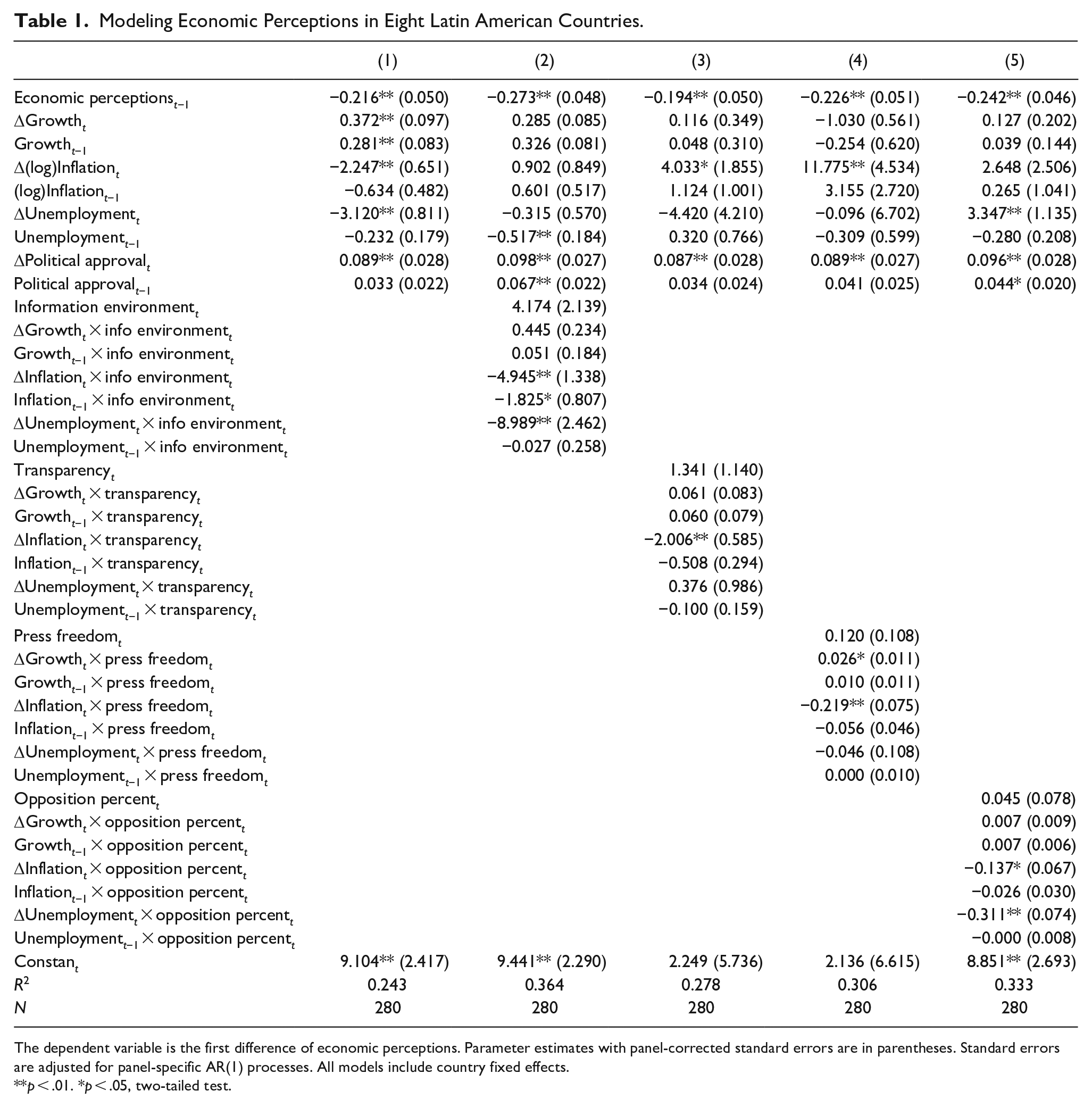
The dependent variable is the first difference of economic perceptions. Parameter estimates with panel-corrected standard errors are in parentheses. Standard errors are adjusted for panel-specific AR(1) processes. All models include country fixed effects.
p < .01. *p < .05, two-tailed test.
The first model of Table 1 includes Growth, Inflation, Unemployment, and Political Approval in first differences and lagged levels, as described in equation (1). As noted, all three covariates have an immediate effect on economic perceptions with estimates signed in the expected direction. While perhaps not surprising, this is the first evidence that the real economy informs economic evaluations in Latin America: positive shocks to growth improve public perceptions, hikes in prices and joblessness depress them. With respect to the economy, it appears that Latin American publics on average “get it right” (Duch & Stevenson, 2011). Moreover, economic perceptions also reflect political factors, proxied here by Political Approval of the president, as they do in advanced industrial democracies (De Boef & Kellstedt, 2004; Duch & Kellstedt, 2011). Additionally, Supplemental Table A3 in the SI suggests economic evaluations also track Aggregate Partisanship, although these results should be taken as preliminary given limited data availability and variation across countries in question wording and timing of surveys.
The effect of economic indicators on public sentiment, however, is considerable in magnitude but short-lived. Only one of the three economic series, Growth, has a statistically significant long-term parameter. 22 The error correction rate provides insight about the memory of public sentiment. The parameter estimate of −0.216 on Economic Perceptionst-1 implies that between a fifth and a quarter of the covariates’ total effect on perceptions dissipates after 3 months. Aggregate perceptions thus fully account for economic shocks in about a year’s time. This implies Latin American publics quickly update their views of the economy, rendering older information less important to current assessments of the economy.
We next assess our main argument by conditioning the effects of the economic indicators on the information environment.
Model 2 of Table 1 conditions the economic performance measures—Growth, Inflation, and Unemployment—on the Information Environment. Coefficients on all interaction terms are in the expected direction: stronger information environments strengthen the positive influence of growth rates on economic perceptions and weaken the negative effect of inflation and unemployment. To illustrate these effects, Figure 3 plots the marginal effect of a one-unit change in growth, inflation, and unemployment across the range of the information environment. 23 For most observations in our sample, objective economic conditions—measured in terms of growth (left panel), prices (middle), or jobs (right)—register the expected effect on economic sentiment. The magnitude of these effects, however, depends on the nature of the information environment. These results support our argument that the ability of citizens to accurately assess the state of the economy is conditioned by the quality of the environment in which they receive and process information. A stronger information environment strengthens the link between performance and perceptions
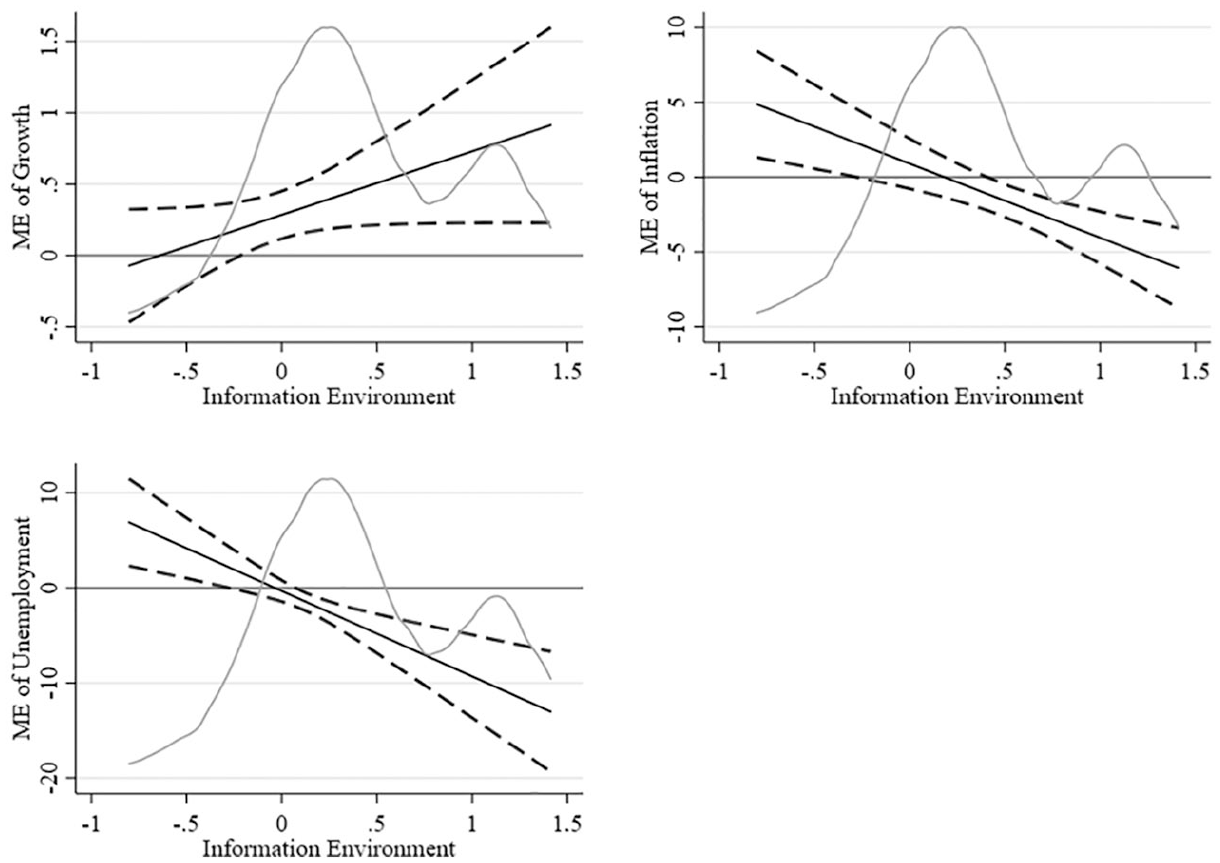
The effect of economy on economic perceptions conditioned by the information environment.
To examine these effects further, the remainder of the models in Table 1 disaggregate the information environment into its three components—Transparency, Press Freedom, and Opposition Percent—and assess how a shock to the economic indicator—growth, inflation, or joblessness—produces a change in economic perceptions as each component changes. As expected, the coefficient on each of these interaction terms carries the same sign as the main economic measure: positive in the case of Growth and negative for Inflation and Unemployment.
Model 3 conditions economic effects on Transparency. Findings are consistent with our expectations for growth and inflation, attaining statistical significance for the latter only. Model 4 considers Press Freedom and reveals that, like transparency, having an independent and accessible press strengthens the impact of inflation levels on the public’s economic perceptions. 24 With respect to the level of political competition, Model 5 shows that the effects of Opposition Percent are sharpest for unemployment, rather than growth or inflation. As above, we illustrate these effects graphically in Figure 4. The first column displays the contemporaneous marginal effects of a one-percentage point change in growth, inflation, and unemployment on Transparency, the second column on Press Freedom, and the final column on Opposition Percent. The estimates reported in Models 3–5 and Figure 4 provide additional evidence of the effect of the information environment on the link between economic conditions and perceptions.
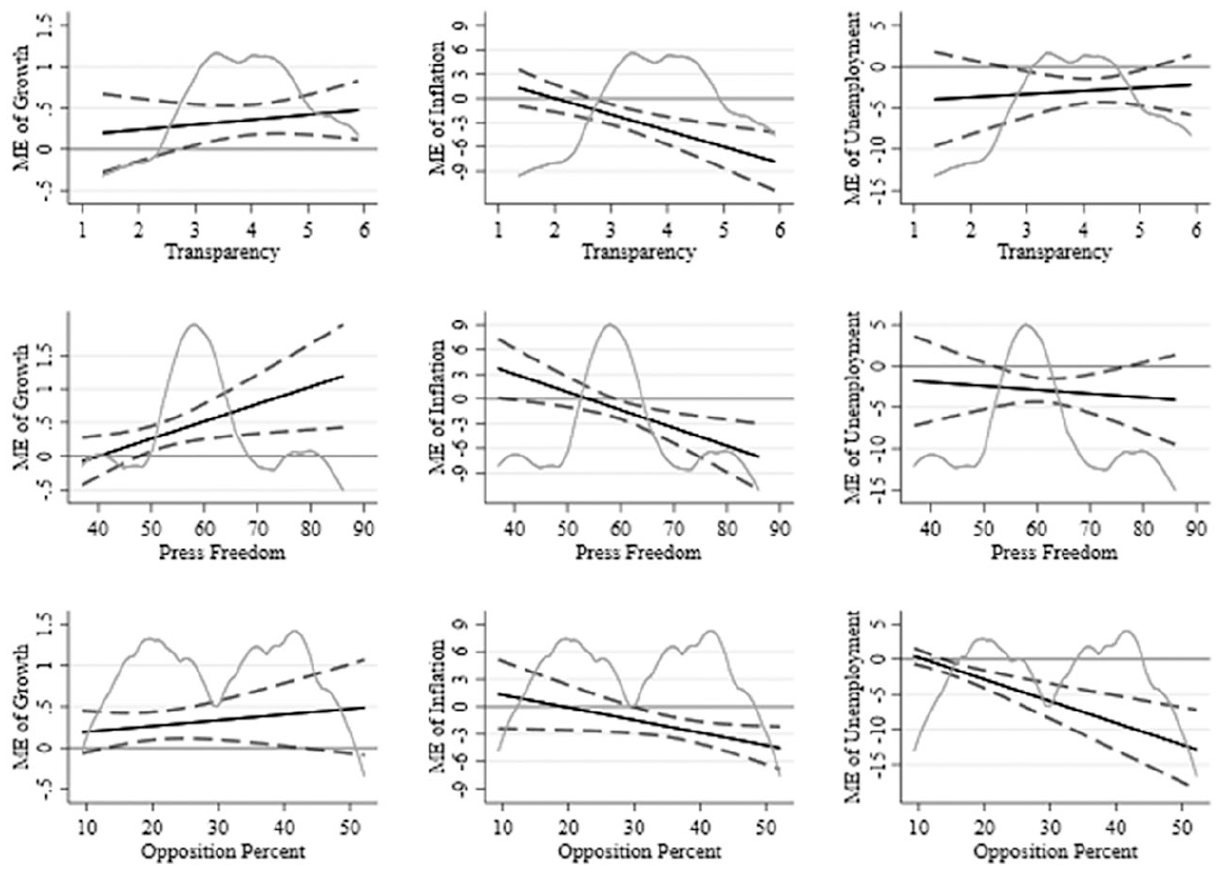
Effects of economy on economic perceptions conditioned by transparency, press freedom, and opposition percent.
Linking Economic Perceptions to Indicators: Access or Quality?
Results reported above indicate that a richer information environment helps citizens access the information they need to make reasonable inferences about the state of the economy. Thus far we have been agnostic about the quality of the information produced in the first place. As we acknowledge at the outset, differences between economic conditions and the economy in the public’s mind may come from one of two sources: biases in data dissemination or deficiencies in data collection and quality. This section reports results from a pair of analyses designed to discern which of these processes accounts for observed differences between objective and subjective perceptions. 25
The first analysis re-examines our regression models separating the quality of information from its availability. Employing data from a wide range of sources, Williams (2015) creates a composite indicator of informational transparency that combines measures of the quantity of economic and financial information released by governments and the quality of that information. Contemporaneous correlations show that, as our theory would predict, our Information Environment measure is positively associated with Williams’ measure of informational quantity, but inversely related to informational quality (SI Supplemental Table A16). Yet his measure of information quality has no conditioning impact on growth, inflation, or unemployment in our models of economic perceptions (Supplemental Table A17). These analyses support our claim that the distance between economic conditions and perceptions comes mainly from biases in the dissemination of data, and not its quality. 26
As a second robustness test, we test whether the informational context affects how citizens respond to objective economic dynamics, estimated using data from satellite-recorded images of nighttime light. Nighttime lights are increasingly used by researchers as a proxy for economic activity or development, especially where data from statistical offices are not available or suspected to be unreliable (Besley & Reynal-Querol, 2014; Bruederle & Hodler, 2018; Michalopoulos & Papaioannou, 2015). In the context of our analysis, nighttime light allows us to compare changes in economic conditions—as reported by state agencies—with changes in a measure of economic health or activity that is unlikely to be subject to political manipulation. Importantly, we can use the measure of nighttime light to test whether economic perceptions are driven by publicly-reported official government statistics, as our theory would imply, or by outcomes, like the amount of light, that are also objective but are not publicly disseminated (see Rosenfeld, 2018 for a related argument).
To test this conjecture, we collected data on nighttime light from PRIO (Tollefsen et al., 2012). Since these data are available annually, we created annual series with our Economic Indicator Index and Economic Perceptions series (see Figure 1). We then regress the economic indicator series on nighttime light in a panel of eight countries, both in levels and in first differences. Table 2 reports results. 27 To establish a connection between nighttime light emissions and the objective economy, the first pair of models show that Nighttime Light has a positive and precisely estimated influence on government reported economic indicators in our sample. This suggests that official economic statistics are based to a degree on objective performance measures.
The Effect of Nighttime Light on Economic Indicators and Economic Perceptionsff.
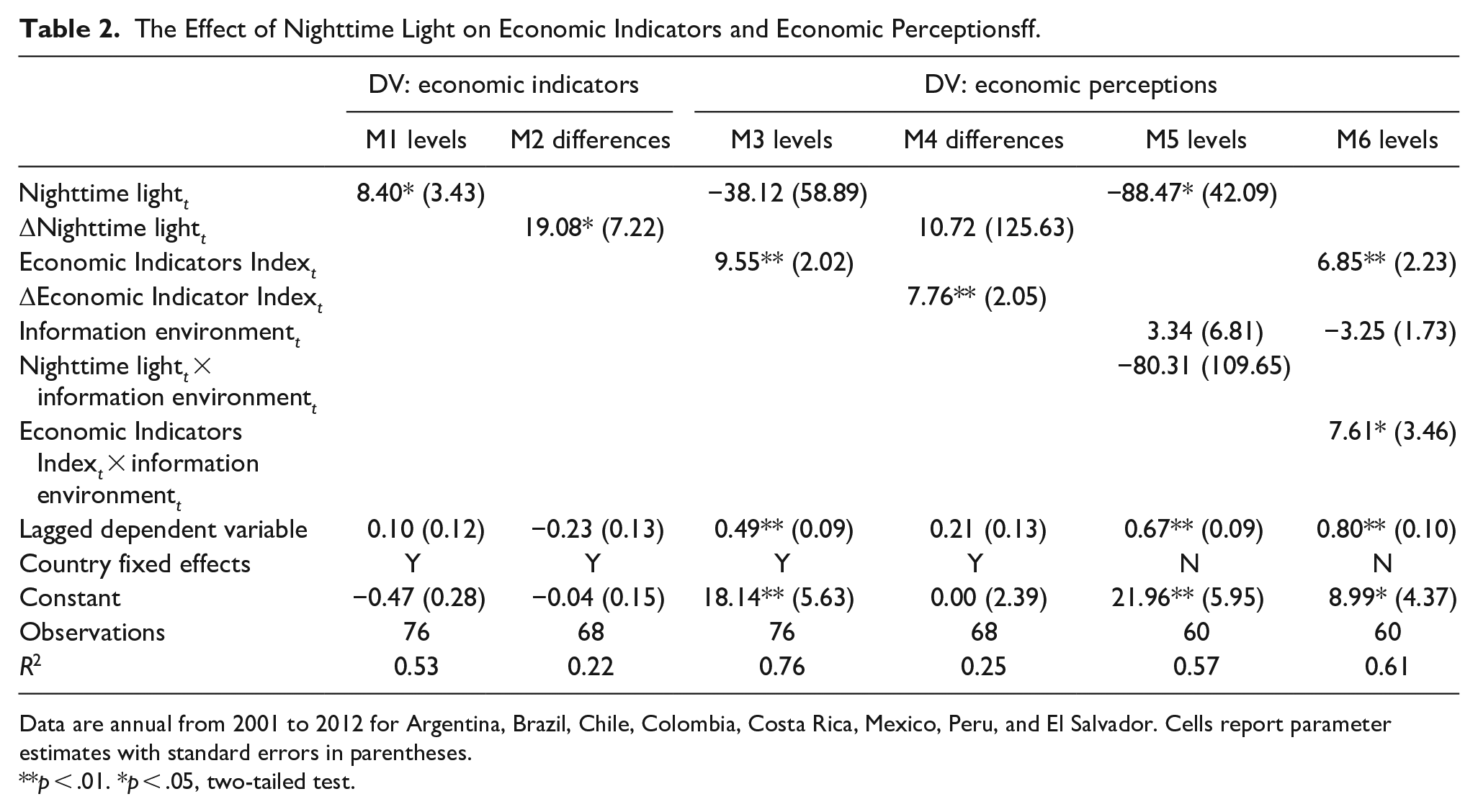
Data are annual from 2001 to 2012 for Argentina, Brazil, Chile, Colombia, Costa Rica, Mexico, Peru, and El Salvador. Cells report parameter estimates with standard errors in parentheses.
p < .01. *p < .05, two-tailed test.
The remaining models in the table examine Economic Perceptions. Models 3 and 4 show—in levels and differences—that mass Economic Perceptions do track government-generated economic indicators but are not correlated with wholly objective performance indicators, as proxied by nighttime-light. The final pair of models estimate the effect of nighttime light and economic indicators on perceptions, conditioned on the information environment. Given data limitations, we emphasize that results should be taken as suggestive rather than conclusive. 28 Model results nonetheless suggest that the information environment strengthens the link between the objective and subjective economies (Model 6), just as we saw in Table 1, but has no bearing on the link between nighttime light and perceptions (Model 5). In other words, it would seem that the information environment primarily conditions the effect of the subjective component of the economy.
Overall, models in Table 2 further strengthen our contention that mass perceptions deviate from objective conditions due to biases in the dissemination of information rather than inaccurate or biased data collection.
Conclusion
In representative democracies, citizen-principals are charged with selecting agents who will channel their preferences into policy and with rewarding or sanctioning these agents for their performance. These twin tasks are difficult under the best of circumstances. To hold incumbents accountable, citizens must assign responsibility for policy outcomes, evaluate the performance of elected officials, and select between candidates based on their programmatic stances. The informational requirements of democratic accountability are considerable, as are the obstacles citizens face to meet them.
Building on this insight, we argue that the efficacy of citizens’ economic evaluations depends on the quality of the environment in which they acquire and process information. We focus on the characteristics of the information environment most likely to limit the government’s incentives and ability to manipulate economic information for political gain: an institutional framework promoting transparency, free media that can act as an alternative source of economic information, and robust political competition that raises the costs to the government of misrepresenting the state of the economy. Our analysis of economic outcomes and economic sentiment in Latin America shows that economic perceptions track economic reality more closely where the quality of the information environment is higher. Additional analyses imply that deviations of opinion from reality are due to systematic biases introduced by the government in the official statistics, rather than to low-quality data.
Beyond expanding our understanding of the bases of economic sentiment, these findings also make important contributions to the study of democratic accountability. First, they inform the debate on the importance of information for economic voting. A central assumption of this research agenda is that “significant portions of the electorate judge a government’s record based on what occurs in actuality” (Anderson, 2007, p. 281). Though the details might escape them, citizens are assumed to know whether things are going well or badly and act accordingly. At the individual level, scholars have long cast doubt on citizens’ access to, and ability to process, the requisite information for evaluating incumbents’ performance. In this paper, we advance the debate by showing that limits on access to information are due not only to individual capacity or interest, but also to structural conditions. Whether economic perceptions track economic conditions depends on the information environment. In contexts bereft of multiple alternative sources of information, the public’s ability to base its economic evaluations on objective conditions is much reduced. We leave it to further research to explore the next step in the accountability chain and establish the connection between a sturdy information environment and economic accountability through voting.
Study results also highlight the connection between horizontal and vertical accountability. Although these two dimensions are typically studied in isolation, we find that a free media and a strong opposition are essential for disseminating accurate information about policy outcomes when governments fail to provide it themselves or when citizens (rightfully) mistrust official figures. An implication, therefore, is that a key function of horizontal accountability is to facilitate vertical accountability by protecting citizens’ access to the independent, unbiased information they require to form judgements of the government’s economic policy performance.
Finally, while the present study focuses on economic outcomes, the tasks of monitoring and evaluating government performance are likely to be even more arduous in other policy areas. The salience and immediacy of the economy means that voters can extrapolate their own personal economic experiences, or those of their extended networks, to the larger economy. This localized information might help citizens mitigate the effects of a low-quality information environment. Likewise, there are a myriad of private firms (banks, multinationals, investors, etc.) and individuals with substantial economic stakes in accessing valid and reliable economic data. This is often not the case in other issue areas. Thus, we expect further work to show that a poor information environment has an even greater effect on performance perceptions in policy areas in which government effort and outcomes are harder to judge, for which citizens can rely on fewer heuristics, or which receive less attention from the media or opinion leaders.
Supplemental Material
sj-pdf-1-cps-10.1177_0010414021989758 – Supplemental material for When Does the Public Get It Right? The Information Environment and the Accuracy of Economic Sentiment
Supplemental material, sj-pdf-1-cps-10.1177_0010414021989758 for When Does the Public Get It Right? The Information Environment and the Accuracy of Economic Sentiment by Ryan E. Carlin, Timothy Hellwig, Gregory J. Love, Cecilia Martínez-Gallardo and Matthew M. Singer in Comparative Political Studies
Footnotes
Acknowledgements
We have received help, comments and suggestions from many colleagues and friends in numerous seminars, conferences, and conversations. We would like to thank all of them, especially Despina Alexiadou, John Bartle, Sebastián Dellepiane, Patrick English, Peter Enns, John Freeman, Armen Hakhverdian, Marc Hetherington, Paul Kellstedt, Nate Kelly, Ore Koren, Anthony McGann, Cecilia Hyunjung Mo, Thomas Mustillo, Pablo Pinto, Graeme Robertson, Luis Schiumerini, Jim Stimson, and Steven Van Hauwaert. We also want to acknowledge seed funding from the Center for International Business Education and Research at GSU’s J. Mack Robinson’s School of Business.
Declaration of Conflicting Interests
The authors declared no potential conflicts of interest with respect to the research, authorship, and/or publication of this article.
Funding
The authors received no financial support for the research, authorship, and/or publication of this article.

Notes
Author Biographies
References
Supplementary Material
Please find the following supplemental material available below.
For Open Access articles published under a Creative Commons License, all supplemental material carries the same license as the article it is associated with.
For non-Open Access articles published, all supplemental material carries a non-exclusive license, and permission requests for re-use of supplemental material or any part of supplemental material shall be sent directly to the copyright owner as specified in the copyright notice associated with the article.
