



Abstract
We examine the role of societal modernization and women’s political empowerment in generating support for women politicians amongst citizens. Using a global analysis of 116 countries with a new dataset of micro- and macro-level longitudinal data, we show that societal modernization and women’s political empowerment only have positive effects on support for women in politics when the other is also present. For citizens who experienced either societal modernization or women’s political empowerment, but not both, we do not see this positive relationship. Crucially, these patterns hold when analysing the current social and political context, as well as the context experienced by citizens during their formative years. We argue that both social and political changes are required to develop supportive attitudes towards women in politics.
Introduction
Support for women in politics is an important component of democratic political culture. Moreover, citizen support for women politicians exerts positive pressure on progress towards gender equality in political institutions (Alexander & Welzel, 2011; Inglehart & Norris, 2003; Paxton and Kunovich 2003; Ruedin 2012) and beliefs about appropriate gender roles can affect voters’ willingness to elect women to political office (Campbell & Heath, 2017; Stewart et al., 2019). Negative attitudes towards women in politics can thus be a cultural barrier to increasing women’s political inclusion, and it is therefore crucial to understand how and why social and political contexts can foster (un)supportive attitudes towards women in politics.
Previous research has largely focused on societal modernization and the effect of women’s descriptive representation independently of each other (e.g. Alexander, 2012; Allen & Cutts, 2017; Inglehart & Norris, 2003; Morgan & Buice, 2013; Ruedin 2013), coming to mixed conclusions as to how such contexts are associated with attitudes towards female politicians. We argue that to fully understand the extent to which context matters we must investigate the interaction between the social and political environment that citizens experience, rather than considering them in isolation. In this paper, we develop a unified theoretical framework to explain the relationship between context and citizen support for women in politics. We focus on how societal modernization (in terms of developments such as rising living standards, increasing education rates and urbanization) and women’s political empowerment (defined as reaching equality with men in terms of political influence and authority) interact in shaping citizen attitudes towards women politicians. We empirically test our theory using a new dataset of 116 countries and approximately 400,000 respondents from around the world. We explicitly acknowledge that the relationship between these social and political contexts and individuals’ gender attitudes is reciprocal (Alexander, 2012). Nevertheless, we focus on one crucial direction – the effect of context on attitudes. Empirically, we test this relationship using two approaches. Firstly, we use lagged context variables in country fixed effects regression models to account for the time sequencing of our postulated relationship. Secondly, we leverage the well-established findings of political socialization theory that political attitudes are formed early in life (Krosnick & Alwin, 1989) and therefore conduct cohort analyses where context is measured not contemporaneously but during a cohort’s formative years as a robustness test.
We show that societal modernization is positively associated with support for women in politics, but only where there is also a high level of women’s political empowerment. Where women’s political empowerment is lower, increasing modernization leads is associated with lower levels of support for women politicians. We argue that this is because countries that modernize without also increasing women’s political advancement are often autocratic countries that disempower and undermine women within political institutions, ‘breaking’ the link between modernization and women’s political empowerment. On the other hand, we find a positive association between women’s political empowerment and support for women in politics, but only at higher levels of societal modernization. At lower levels of societal modernization, there is instead no association between women’s political empowerment and support for women politicians. We attribute this to the incongruity between women’s social position and their political position in such societies. Overall, our findings show that social and political contexts interact to foster support (or disapproval) towards women in politics, and that both social and political changes are required for citizens to develop supportive attitudes.
Our findings demonstrate that societal modernization and women’s political empowerment do not have uniform effects across all contexts. This is a novel and crucial finding, and it means we cannot assume that gains for women in one arena will have a positive effect on support for women in politics without gains in the other. In particular, the negative effect of societal modernization at lower levels of women’s political empowerment shows the importance of advancing gender equality and women’s rights across many domains to foster attitudinal support for women in politics amongst citizens. We also contribute to debates about the extent to which women’s social and political advancement brings about an attitudinal ‘backlash’ (e.g. Clayton, 2015; Morgan & Buice, 2013; Rudman and Glick 2001); we do see this, but only in certain contexts. Furthermore, studies which only focus on subsets of countries are likely to come to findings which are not generalizable to other social and political contexts. Our findings hence help to reconcile previous contradictory studies, which are often only based on one country or region, and which do not test for the interactive nature of societal and political context.
These findings have important implications for the development of gender-egalitarian political cultures. Countries that modernized earlier and have seen strong gains in women’s political empowerment will continue to see increases in support for women in politics. However, countries that have experienced lower levels of modernization or lower levels of women’s political empowerment will have publics that are less supportive of women’s political participation and inclusion, regardless of whether they have experienced other developments with respect to gender equality. Interventions which focus on just one domain may produce undesirable attitudinal effects amongst citizens. Attention thus needs to be paid to gender equality across social, economic and political dimensions to foster a supportive political culture for the full inclusion of women in political life.
Previous Literature and Theoretical Expectations
In this section, we review the relevant literature relating to societal modernization, women’s political empowerment, and their distinct and joint impact on individuals’ gender attitudes. Based on this review, we further develop our novel theoretical expectations regarding the interactive effect of social and political contexts.
Modernization, Women’s Political Empowerment and Support for Women in Politics
The socio-economic contexts within which citizens find themselves are often theorized to have an impact on their attitudes. Drawing on Inglehart’s theory of post-materialism which linked socio-economic development and especially postindustrialization to attitudinal change (Inglehart, 1990, 1997), Inglehart and Norris (2003) argue that societal modernization has particular consequences for gender attitudes. For Inglehart and Norris, modernization is a process whereby societies move though ‘agrarian’, ‘industrial’ and ‘postindustrial’ phases. These shifts include increased urbanization and education levels, rising living standards, a decline in the role of religion and the development of the welfare state. Importantly, they also see this process as including declining fertility rates, the movement of women into the labour force and education, and shifts in the division of labour in the home, so that socio-economic gender equality rises as societies move through agrarian, industrial and post-industrial phases.
Whilst gender inequalities such as sex-segregation in the labour force (Charles, 2011) and inequality in care responsibilities (Craig & Mullan, 2011) remain, the developments noted by Inglehart and Norris have nevertheless challenged traditional societal structures and changed the respective social roles of men and women. As a result, they argue, public opinion on gender issues has shifted and become more gender-egalitarian, including more supportive of women’s suitability for public life and elected office. As evidence, they show strong descriptive correlations between gender equality attitudes and a range of indicators of societal modernization, including Gross Domestic Product (GDP), the Human Development Index (HDI) and urbanization, as well as gender-specific societal developments including the UN’s Gender Development Index (GDI, measuring gender disparities in life expectancy, education and income), women’s labour force participation and fertility rates.
Other studies have tested the relationship between societal modernization and support for women in politics using a limited range of indicators. There is evidence that the current level of GDP (Allen & Cutts, 2017; Glas et al., 2019), female labour force participation (Allen & Cutts, 2017) and development as measured by the HDI (Alexander & Jalalzai, 2020) have a positive relationship with current attitudes towards women in politics. Alexander (2012) conducted a longitudinal study and found that change in the GDI over time was positively associated with change in support for women in politics in a sample of 25 countries from the mid-1990s to mid-2000s. However, Morgan and Buice (2013) found that in Latin America, neither current GDP nor women’s labour force participation had an effect on women’s support for women in politics. Amongst men, GDP had the expected positive effect on support for women in politics, but women’s labour force participation had a negative effect, which Morgan and Buice attribute to a ‘backlash’ effect amongst men when presented with women’s societal advancement. In general, studies find a positive relationship between socio-economic context and support for women in politics, supporting Inglehart and Norris’ theory, although relatively few studies test this relationship and Morgan and Buice’s Latin American study is an exception. We thus test the expectation that societal modernization should be associated with greater support for women in politics with our more comprehensive dataset, and specify our first hypothesis as:
Modernization Hypothesis (H1): Citizens experiencing higher levels of modernization are more supportive of women politicians than those experiencing lower levels of modernization. A second key factor identified in shaping attitudes towards women in politics is the symbolic effect of women’s political empowerment. Women’s political empowerment is defined as ‘the enhancement of assets, capabilities, and achievements of women to gain equality to men in influencing and exercising political authority worldwide’ (Alexander et al., 2016, p. 433) and takes place within national political institutions, civil society and at the level of the individual, for example, in terms of political participation. Alexander et al. (2016) also emphasize that women’s political empowerment is related to something that women do, rather than something that they have. Theories of symbolic representation argue that women’s political empowerment will have a positive effect on attitudes towards women politicians because this demonstrates that women can occupy non-traditional, political roles and perform as well as men and erodes the perception that politics is a ‘male domain’ (Mansbridge, 1999; Matland, 1994; Sapiro 1981). Once they occupy political positions, women can ‘prove themselves effective’ (Matland, 1994, p. 273), and this challenges stereotypical views about the political roles of men and women. Whilst women’s political empowerment, measured narrowly through women’s descriptive presence in legislatures, is positively associated with modernization (Stockemer and Sundström 2016; Tripp and Kang 2008), theories of symbolic representation offer a different theoretical mechanism linking contextual factors to attitudes towards female politicians than that put forward by the modernization perspective. In this paper, we limit our understanding of women’s political empowerment to political spaces, acknowledging that whilst others (see, e.g. Ertan et al., 2017), may conceive of, for example, women’s life expectancy, fertility rates, or access to education as elements of women’s political empowerment, we argue that such factors are more correctly seen as components of societal modernization, which may hinder or help women’s political empowerment but is conceptually distinct from it. Most studies testing the relationship between women’s political empowerment and citizen attitudes focus on the effect of women’s descriptive representation on citizens’ political engagement and participation. Studies across a variety of country contexts have found that women’s descriptive legislative or executive representation encourages greater participation in politics amongst women, indicating a symbolic representation or ‘role model’ effect (Barnes & Burchard, 2013; Liu & Banaszak, 2017; Wolbrecht and Campbell 2007) although these effects may only be temporary (Gilardi, 2015; Hinojosa & Kittilson, 2020) and conditional on the extent to which women’s descriptive presence is sufficiently visible to citizens (Atkeson, 2003; Hinojosa & Kittilson, 2020). Some have also found negative effects on women’s political engagement. For example, the presence of quota-elected women representatives in Lesotho was found to have a negative effect on women’s political engagement because of the perceived preferential treatment women received as a result of the quota policy (Clayton, 2015). Liu (2018) also found that women’s political engagement was lower where women’s descriptive representation was high in East and Southeast Asia and attributes this to the lower levels of social rights held by women in these countries. Finally, others have found negative effects of women’s political inclusion on men’s attitudes, rather than positive effects for women. Dassonneville and McAllister (2018) found that experiencing women leaders in the formative years depressed men’s political knowledge, perhaps because seeing fewer (in relative terms) men reduced their interest in politics, and Gangadharan et al. (2016) found that men had lower levels of political engagement in Indian villages with female leaders, although they also found that this was mitigated by more prolonged exposure to women leaders. The literature specifically examining support for women politicians is much less extensive than that examining symbolic effects in terms of political engagement and further focuses narrowly on the impact of women’s descriptive presence in formal political institutions. Here, there is also mixed evidence about the relationship between women’s presence in political institutions and support for women in politics, although fewer studies have investigated this relationship and no study has found a negative association. Field experiments in India have found that the presence of women in politics can reduce stereotypical views on the role of women and increased perceptions of the effectiveness of female leadership (Beaman et al., 2009), a finding attributed to a reserved seat design which allowed women to demonstrate that they are ‘capable leaders’ (Beaman et al., 2012, p. 586). However, using the same field experiment in Lesotho as mentioned above, Clayton (2018) found that the exposure to women politicians did not alter citizens’ attitudes towards women representatives – perhaps because, unlike the Indian case, they were elected through an unpopular quota system. Observational cross-national survey research also comes to mixed conclusions. Allen and Cutts (2017) find a positive effect of gender quotas on support for women in politics and similarly Alexander (2012) finds that change in the presence of women in institutions over time is positively associated with change in support for women politicians. However, Ruedin (2013) also conducts a longitudinal analysis on the same dataset as Alexander (the World Values Survey) and finds no evidence for this relationship. Some studies also highlight the conditionality of the relationship between women’s descriptive representation and public opinion towards women in politics, again focusing on how strong a signal is sent to citizens. In Latin America, Morgan and Buice (2013) find that women’s presence in the cabinet is positively related to men’s support for women politicians, but women’s presence in the legislature has no effect for either men or women, and argue that this is because cabinet ministers are more likely to be noticed by the public and that including women in the cabinet is a stronger cue from political elites that women are able to perform well in political office (see also Liu & Banaszak, 2017). Similarly, Alexander and Jalazai (2020), in a multi-region study, find that having a female president or prime minister increases men’s and women’s support for women politicians. They argue that female executives are more well-known and receive more media attention than legislators, and so have particularly pronounced effects on citizens’ attitudes. The literature thus comes to mixed and nuanced conclusions about whether women’s political empowerment should matter for citizen support for female politicians. Taken together, extant research largely suggests that the ways in which women are included in the political process are important, and women’s descriptive presence may be necessary, but ultimately insufficient, to bring about wide-reaching symbolic attitudinal effects. Thus, in this paper, we focus on women’s political empowerment as defined above. This concept measures women’s political inclusion across a range of domains, women’s capacity to act in political spaces, and forms of women’s political empowerment that may be more visible to citizens because they take place across society and not just in formal legislative institutions. It is important to note that women can be descriptively present without being politically empowered, although vice versa is unlikely to be the case. Our central expectation is that the relationship between women’s political empowerment and support for women politicians will be positive because women’s political empowerment should have stronger symbolic effects than women’s descriptive presence alone. This leads us to our second hypothesis:
Women’s Political Empowerment Hypothesis (H2): Citizens who experience higher levels of women’s political empowerment are more supportive of women politicians than those who experience lower levels. We argue, in the next novel step, that societal modernization and women’s political empowerment should not be analysed independently, and we should instead consider the inter-relationship between these two contextual factors. The next two sections advance our theoretical arguments with respect to this interactive relationship.
Women’s Political Empowerment Without Societal Modernization
Although societal modernization and women’s political empowerment are positively related, some country contexts may see women’s political empowerment without high levels of societal modernization. Gender quotas have been implemented in many countries with low levels of societal modernization (Bush, 2011), and armed conflict and links to international organizations have been found to facilitate women’s descriptive representation in low-income countries (Hughes, 2009). Although these studies focus on descriptive representation, rather than women’s political empowerment broadly defined, they suggest that low societal modernization is not necessarily always associated with women’s exclusion from the political sphere. Drawing on role congruity theory (Eagly & Karau, 2002), we argue that where societal modernization is low, women’s political empowerment will not have the positive effect expected by H2. Eagly and Karau (2002) argue that prejudice occurs when members of a social group hold roles which are thought to be incongruent with stereotypes about that group. Most relevantly for our purposes, leadership is thought to be inconsistent with stereotypes of femininity and womanhood (Koenig et al., 2011), leading to negative attitudes towards women who hold (political) leadership positions. Empirical evidence is found for this theory across a range of domains (e.g. Garcia-Retamero & López-Zafra, 2006). Women are found to experience a ‘backlash’ from both men and women when they take on ‘counter-stereotypical’ roles such as agentic leadership; in particular, they are perceived as less likeable and can face more discrimination (Bauer, 2017; Bock et al., 2017; Rudman & Glick 2001).
This theory thus suggest that women’s political empowerment may have a negative impact on citizen support for women in politics since stereotypes about women and about leadership might be perceived as incongruous. Importantly, the theory suggests that it is particularly where gendered stereotypes are strong, and beliefs about gender-differentiated roles are widespread, that this incongruity should be most strongly perceived. Thus, women’s political empowerment likely appears most incongruous where societal modernization is low. On the other hand, in contexts where women’s social and economic position is more equal to men’s, women’s political empowerment will appear less incongruous and so should have a positive effect on citizen support for women in politics.
This argument is consistent with Liu’s (2018) finding that women’s descriptive representation is associated with levels of women’s political engagement in East and Southeast Asian countries. She argues that this negative relationship holds because women enjoy far lower levels of social rights, such as marriage and property rights, than they do political rights in these countries, which makes women in such countries feel disconnected from the political sphere even as they are descriptively represented in it. As a result, Liu concludes that ‘the impact of women’s political representation… is not generalizable across contexts’ (Liu, 2018, p. 255). However, she does not empirically test this suggestion. We argue that Liu’s findings are in line with role congruity theory: in contexts where women’s social and economic position is more equal to men’s, women’s political empowerment appears less incongruous and so will have a positive effect on citizen support for women in politics. In contexts where there is more socio-economic gender inequality, women’s political advancement will appear incongruous and this may undermine any positive symbolic effects of women’s political empowerment.
Existing cross-national studies, whilst paying attention to political variation across contexts (e.g. Hinojosa & Kittilson, 2020), still implicitly assume that the association between women’s political inclusion and citizen support for women in politics is the same across socio-economic contexts (e.g. Alexander, 2012; Ruedin 2013) or rely on single-country case studies (Beaman et al., 2009; Clayton 2018), and thus do not examine how modernization and women’s political empowerment interact in shaping attitudes towards women in politics. Moreover, as we argued above, the existing literature tends to rely on a limited measure of women’s inclusion – their descriptive presence – whilst we argue that women’s political empowerment more broadly should also be important. We thus test this novel expectation with an interaction between level of modernization and level of women’s political empowerment, as described in H3:
Incongruity Hypothesis (H3): The relationship between women’s political empowerment and citizen support for women in politics will be weaker when societal modernization is low.
Societal Modernization Without Female Political Empowerment
The section above argues that we cannot expect women’s political empowerment to have a positive association with support for women in politics across all socio-economic contexts. In this section, we argue that societal modernization in the absence of women’s political empowerment is insufficient for the expected positive effect on support for women in politics as expected by the modernization hypothesis (H1). As noted above, modernization is positively associated with women’s descriptive presence in political institutions (Rosen 2013; Stockemer and Sundström 2016), although gender quotas tend to have a stronger effect (Tripp and Kang 2008; Paxton et al., 2010). However, women’s political empowerment may be undermined even where modernization is relatively high, for example, through informal practices within political institutions that disadvantage women (Chappell & Waylen, 2013; Lowndes, 2019), which occur across democratic regimes. A situation of higher modernization and lower women’s political empowerment is even more pronounced in some autocracies because such regimes generally actively and overtly disempower women politically to a greater extent than democracies (Tripp 2013).
Whilst autocratic regimes do have similar levels of women’s descriptive representation to democracies (Stockemer 2009), this is often attributed to the use of reserved seat quotas. Such mechanisms increase women’s descriptive representation in legislative bodies (Tripp and Kang 2008), but do not necessarily confer real political power (Fallon et al., 2012). As a result, women may be physically present in legislatures in (semi-)autocratic regimes, but since political power is often held in non-legislative institutions, women’s physical presence equates even less to their political empowerment in these regimes. Whilst the men in autocratic legislative institutions are also disempowered, men overwhelmingly occupy the positions of power outside the legislature.
In state socialist regimes, for example, quotas gave women political positions, but men dominated the true leadership positions within the politburos and wielded most of the political power whilst women were still expected to fulfil domestic and family roles (Pop-Eleches and Tucker 2017). More recently many (semi-)autocratic regimes have used reserved seats to ensure women’s numeric representation in legislatures, usually to serve regimes’ strategic aims of shoring up domestic and international support for the regime, co-opting citizens, and providing more legislative power for dominant parties (Bjarnegård & Zetterberg, 2016; Donno & Kreft, 2019; Muriaas & Wang., 2012; Tripp and Kang 2008). Although women in such contexts, which include, for example, Rwanda, Uganda, Tanzania and Morocco, have been found to advocate for certain issues on the political agenda, they are also heavily constrained by loyalty to the dominant party and the prevalence of male-dominated political power structures outside the legislature, usually the dominant party and/or executive (Bauer & Burnet, 2013; Burnet, 2011; Sater 2007). Similarly other regimes, such as Russia, have ‘fast-tracked’ women into legislative institutions without using quotas, but their capacity to act remains constrained by male-dominated, informal political institutions (Johnson, 2016). Finally, women are less likely to be present in executives in autocracies than they are in democracies (Jalalzai, 2016), further indicating their lower levels of political empowerment in such regimes. Through these mechanisms, some autocratic regimes can to a large extent ‘break’ the link between women’s social and political advancement.
We illustrate these points by showing the relationship between regime type and women’s political empowerment empirically in Figure 1. Women’s political empowerment is measured using the Varieties of Democracy (V-Dem) dataset (Coppedge et al., 2018) and encompasses multiple political dimensions including women’s representation in formal political positions, but also women’s participation in civil society and a de facto assessment of the distribution of power by gender. AsFigure 1(b) shows, there is little difference between the percentage of women in the lower chamber in autocracies and democracies, but democracies register much higher levels of women’s political empowerment when measured more expansively than autocracies (Figure 1(a)). As argued above, autocracies are much more likely to suppress the political empowerment of women, and just focusing on women’s descriptive presence does not show the extent to which women’s political empowerment is associated with regime type. Women’s descriptive legislative representation and empowerment by regime type. (a) Women political empowerment and (b) lower chamber female legislators. Note: Data taken from V-Dem, v. 8 (Coppedge et al., 2018). Data is pooled over 180 countries from 1920 to 2017. We measure whether the regime was a democracy or not based on the V-Dem variable ‘regimes of the world’ (v2x_regime), which classifies countries as liberal or electoral democracies and electoral and closed autocracies (Coppedge et al., 2018: 219). For our purposes, we collapse the categories to only distinguish between democracy and autocracy.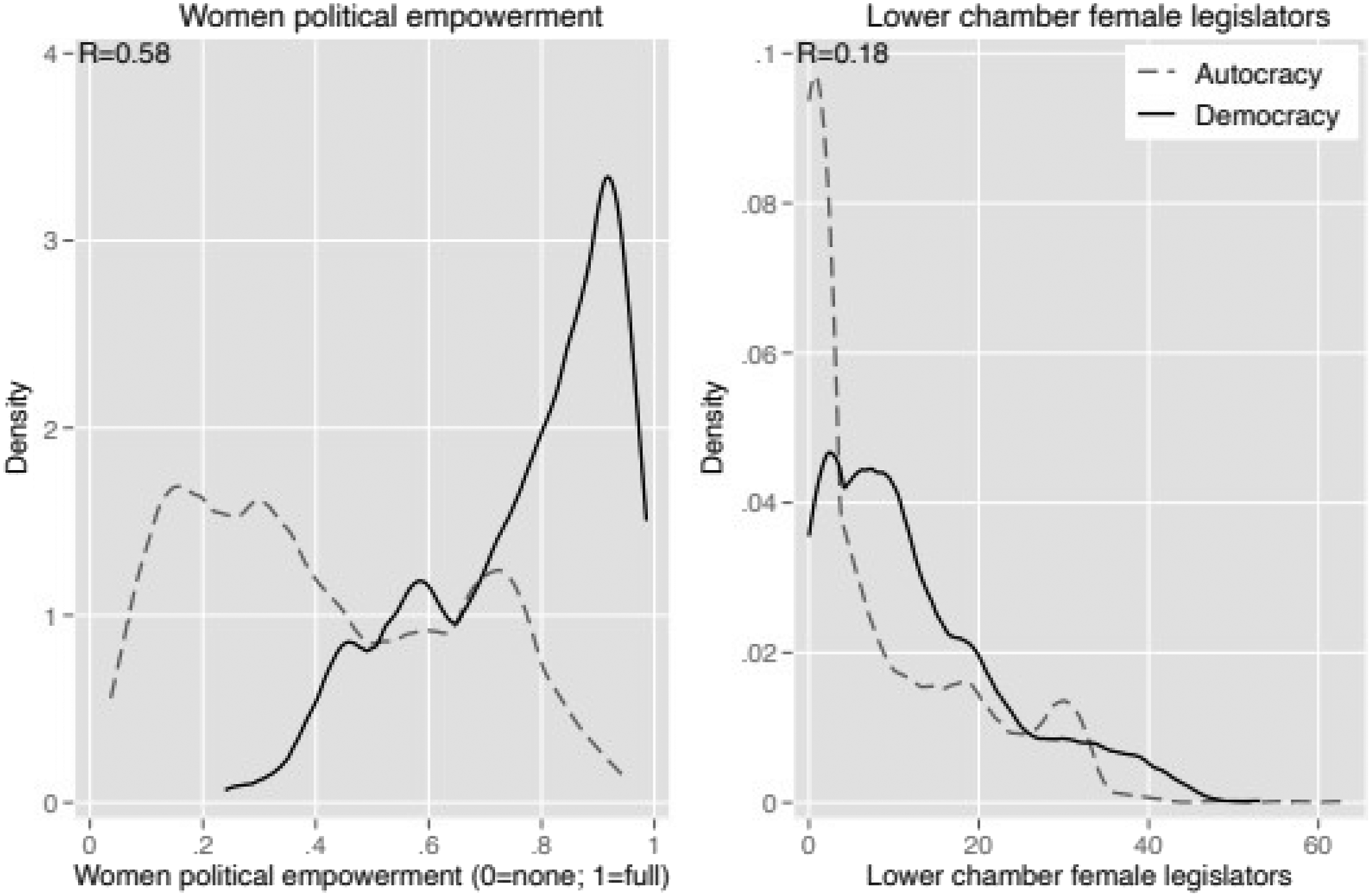
Importantly, Figure 2 shows that this is the case at all levels of modernization, measured using a composite index that includes levels of literacy, urbanization, infant mortality, fertility, life expectancy and educational enrolment. There is a positive relationship between modernization and women’s political empowerment in both democracies and autocracies, and this relationship is somewhat stronger in autocracies than in democracies, but the level of women’s political empowerment is always significantly lower in autocracies than in democracies regardless of the level of modernization. Regimes that have higher levels of modernization and lower levels of women’s political empowerment (bottom right quadrant) are much more likely to be autocratic. Autocracies also vary much more than democracies in the extent to which women are politically empowered, with some autocracies much less exclusionary to women than others. Modernization and institutional female empowerment by regime type. Note: Data taken from V-Dem, v. 8 (Coppedge et al., 2018). We describe the measurement of these variables in detail below. Data is pooled over 180 countries from 1920 to 2017.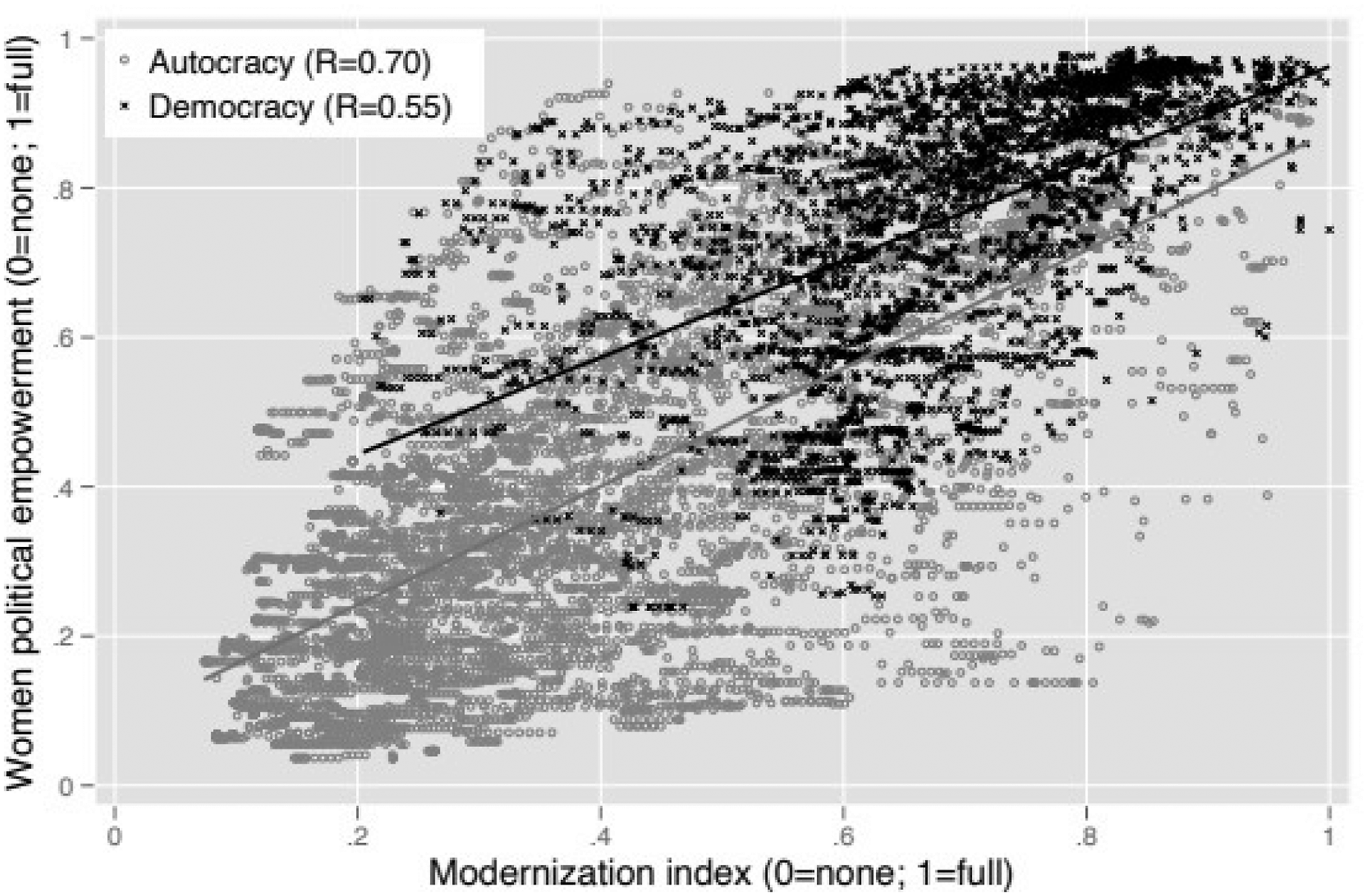
We argue that the disempowering way that women are incorporated into some, especially autocratic, regimes should depress the positive relationship between modernization and support for women in politics in these regimes. Women might be experiencing greater societal advancement and equality in such contexts, but their lack of political empowerment can be expected to suppress the effect of modernization on citizen attitudes. In such a context, citizens who experience higher levels of modernization also often observe few, ineffective and powerless female politicians and will not observe a strong female presence in civil society and political discussions. We argue this undermines the attitudinal effects of modernization. Without women’s political empowerment, the positive relationship between modernization and citizen support for women in politics (H1) cannot be realized. We illustrate that it is autocracies that are especially likely to see a context of high modernization/low women’s political empowerment, and this is consistent with previous research finding a positive relationship between democracy and support for women in politics (Alexander, 2012; Alexander & Jalalzai, 2020). Our argument suggests that the key mechanism is women’s political empowerment, rather than regime type itself, and we thus formulate our fourth hypothesis as follows:
Disempowerment Hypothesis (H4): The relationship between modernization and citizen support for women in politics will be weaker when women’s political empowerment is low.
Research Design
To test our hypotheses, we conduct a comprehensive analysis of 116 countries. 1 We identify the roles of societal modernization and women’s political advancement for citizen attitudes towards women in politics by comparing respondents within the same country and across countries that were exposed to varying social and political contexts. We describe the data and outline the methodology used below.
Individual-Level Data
We rely on existing, publicly available survey data from numerous countries around the globe. In total, we have data on 116 countries included in this study, which are on average observed at three time points between 1995 and 2014.
2
We include all countries for which data on attitudes towards women in politics is available, allowing us to maximize the variation in political and social contexts to which different respondents are exposed to by covering many different regions and time periods. Using population data from 2000, our sample of countries represents 84% of the world’s population. The data included is based on academic studies that have been designed to be comparative and to adhere to certain standards. We harmonized data from the following public opinion surveys fielded in the following years
3
: 1. World/European Value Survey (WVS), 1994–2014; 2. Latinobarometer (LB), 2004, 2009; 3. Afrobarometer (AFB), 2005–2015; and 4. Americas Barometer (AB), 2008–2014.
Pooling all these datasets together gives us about 400,000 respondents for which we have valid data on the dependent variable and all control variables. The different survey questions included in the diverse datasets were harmonized in terms of response categories so that a joint analysis is possible. More details on the question of harmonization decisions can be found in Supplemental Appendixes 3 and 4.
Dependent Variable: Women as Political Leaders
In the datasets that were harmonized for this study, respondents were asked whether they agree or disagree that ‘men are better political leaders than women’. The various surveys used four or five response categories, and so the variable was standardized from 0 to 100, where lower values mean respondents believe that men are better leaders, and higher values indicate that men and women are equally good as political leaders. We use this question because our interest is in citizen support for women in politics specifically as this has been found to be important for facilitating women’s political representation (Paxton and Kunovich 2003; Ruedin 2012). On a practical level, this question is the only one measuring gender-egalitarianism that is asked consistently across many datasets covering a sufficient set of countries and time points. Our conclusions thus might not hold for other dimensions of gender-egalitarianism, for example, attitudes towards the division of labour within the family.
Individual-Level Control Variables
At the individual level, we control for gender, education level (primary or less, secondary amd post-secondary), 4 denomination (none, Christian, Muslim and other), and a dummy variable for whether a respondent is working as opposed to being unemployed, retired or any other reason why people do not work. Unfortunately, it is not possible to control for a person’s income or economic well-being beyond their working status, as the measures were too diverse to be harmonized. We do not however expect these to be crucial control variables, as these will be highly correlated with a respondent’s education, which is accounted for in the model.
Measuring Societal and Political Context
In this paper, we are interested in the relationship between two socio-economic modernization and women’s political empowerment on the one hand and support for women in politics on the other, In this section, we outline how the contexts of modernization and empowerment were measured.
Modernization
Modernization is measured using a newly created composite index of the general level of socio-economic development per country-year. 5 We estimated the modernization index using the average standardized scores from nine items that tap into the modernization level of a country. 6 The final index ranges from 0 to 1, where higher values indicate more socially modern societies. Modernization is calculated using the following indicators: proportion of the population that is literate (based on Vanhanen 2003), urbanization rate, proportion of the population that is non-agricultural, fertility rate (reversed), infant mortality rate (reversed), life expectancy rate (all based on Coppedge et al., 2018) as well as primary, secondary and tertiary education enrolment (based on World Bank Education Statistics Database and Barro & Lee, 2013). The use of the latter three indicators is based on the expectation that as education systems expand, women’s educational enrolment will increase. Our measure of modernization answers calls to appreciate the multifaceted nature of modernization (Stockemer and Sundström 2016). We have chosen these measures because they encompass societal developments that have particular relevance to gender roles and are explicitly discussed as important for gendered attitudes by Inglehart and Norris (2003) (e.g. fertility rate and infant mortality rate) and because they cover factors identified as particularly central aspects of modernization, especially when considering it from a gendered point of view (e.g. urbanization rate and measures of education) (Stockemer and Sundström 2016).
We refrain from including direct measures of economic development, as the correlation between our modernization index and logged GDP per Capita is .82 for our sample of countries. Nevertheless, we replicated our main results including GDP per capita and the results do not change (see Supplemental Appendix 7).
Women’s political empowerment
To test our second hypothesis, we measure women’s political empowerment in a country. We combine two indices included in Varieties of Democracy (V-Dem) 7 version 8 (Coppedge et al., 2018) which measures how politically empowered women are. Firstly, we use an index that measures women’s open discussion of political issues and participation in civil society organizations (v2x_gencs), and secondly, we use an index that captures the descriptive representation of women in formal political positions, including representation in the legislature and cabinet, as well as a more de facto assessment of the power distributed by gender (v2x_genpp) (Coppedge et al., 2018, p. 231). Including women’s descriptive representation in the measure is appropriate because this is still part of women’s political empowerment, but as we have outlined in more detail above, women’s political empowerment is a broader concept than descriptive presence alone.
Both original indices and our final index are measured from 0 to 1, where higher values indicate more extensive women’s political empowerment. To create our women’s political empowerment index, we weighted both indices equally, calculating the average score for every country-year.
Exploring Socio-Economic and Political Context Descriptively
Before we present our main results, we examine the trends in the two independent variables in Figure 3 – modernization (solid line) and women’s political empowerment (dashed line) – over time for 30 out of 116 of the countries in the analysis.
8
Modernization mostly increases over time or remains stable. However, the level of women’s political empowerment in each country does not necessarily increase and exhibits considerable fluctuation over time. Moreover, countries with high levels of modernization do not necessarily experience high levels of women’s political empowerment at the same time point. This is most clearly the case in Libya, Turkey and Saudi Arabia.
9
Lastly, some people live in circumstances where women have a considerably stronger political position than might be expected from the level of societal modernization, for example, in Costa Rica, India and Sub-Saharan Africa. Modernization and women pol. empowerment (selected countries). Data: V-Dem v8, 1990–2017.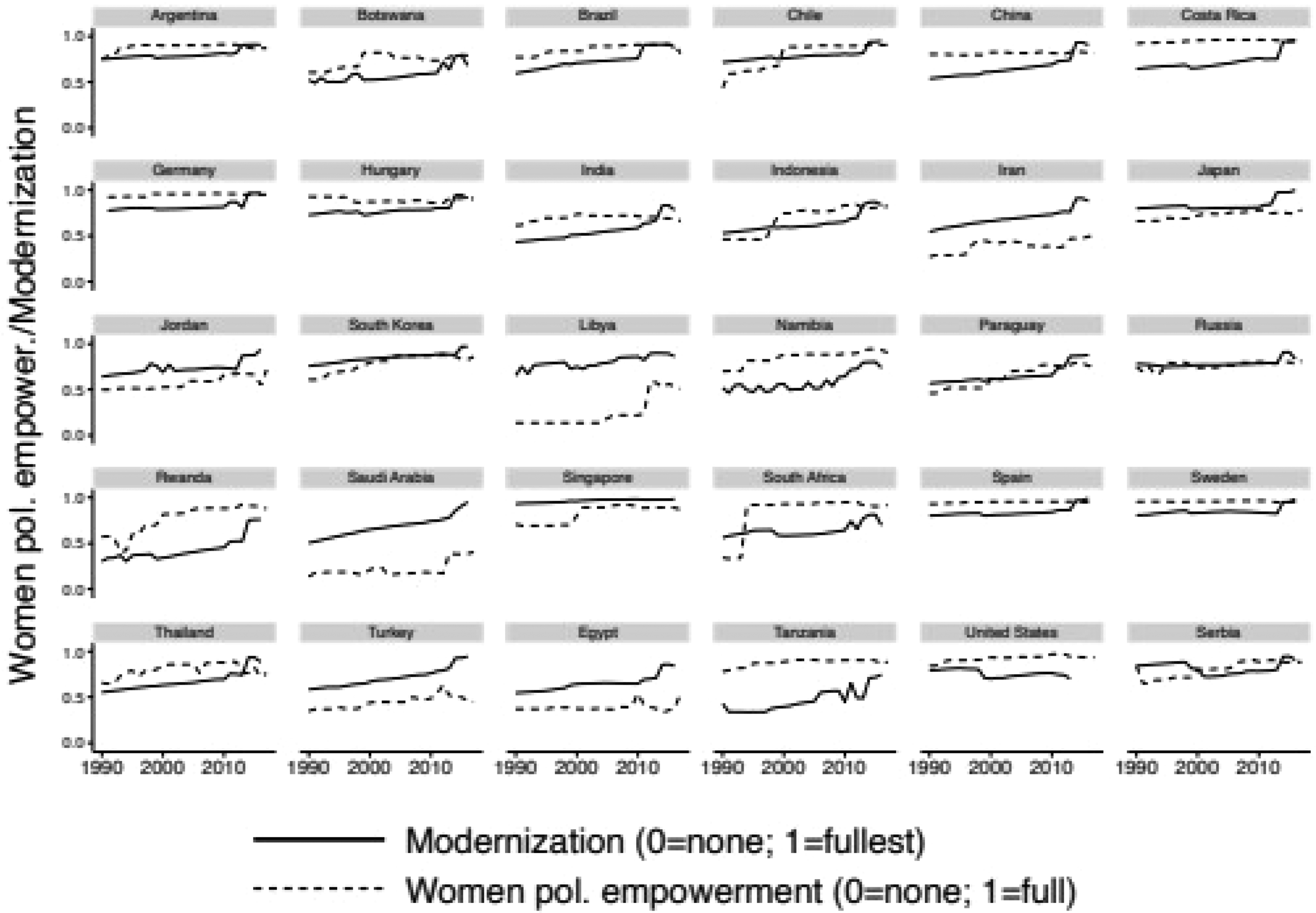
Figure 3 illustrates that the current socio-economic and political context varies across countries and time substantially. Some live under both societally and politically modern contexts, while others lack both. We also find cases where only societal modernization is present without women’s political empowerment or vice versa. Below, we leverage this variation to test the interactive relationship between these two contexts in shaping attitudes towards women in politics.
Model Estimation
We explicitly acknowledge that the relationship between social and political contexts and individuals’ gender attitudes is reciprocal (Alexander, 2012). Nevertheless, in this paper, we focus on one crucial direction – context affecting attitudes. Empirically, we test this relationship using two approaches. Firstly, we use lagged context variables in country fixed effects regression models to account for the time sequencing of our postulated relationship. The models include the context variables lagged by 1 year before the time of the survey, when respondents were interviewed. Lagging the current context helps us to account for potential endogeneity between the macro variables and the level of support for female politicians in the population. Further, using country fixed effects models ensures that all country-specific unobserved factors, for example, culture or historical legacies, are accounted for. Instead, the models focus on the within country, over-time shifts in social and political modernization, as depicted in Figure 3. In a second step, we leverage the well-established findings of political socialization theory that political attitudes are formed early in life (Krosnick & Alwin, 1989) and conduct cohort analyses as a robustness test. More details on this estimation are provided below.
Results
Linear Regression, Predicting Agreement That Women Are Equal Political Leaders.
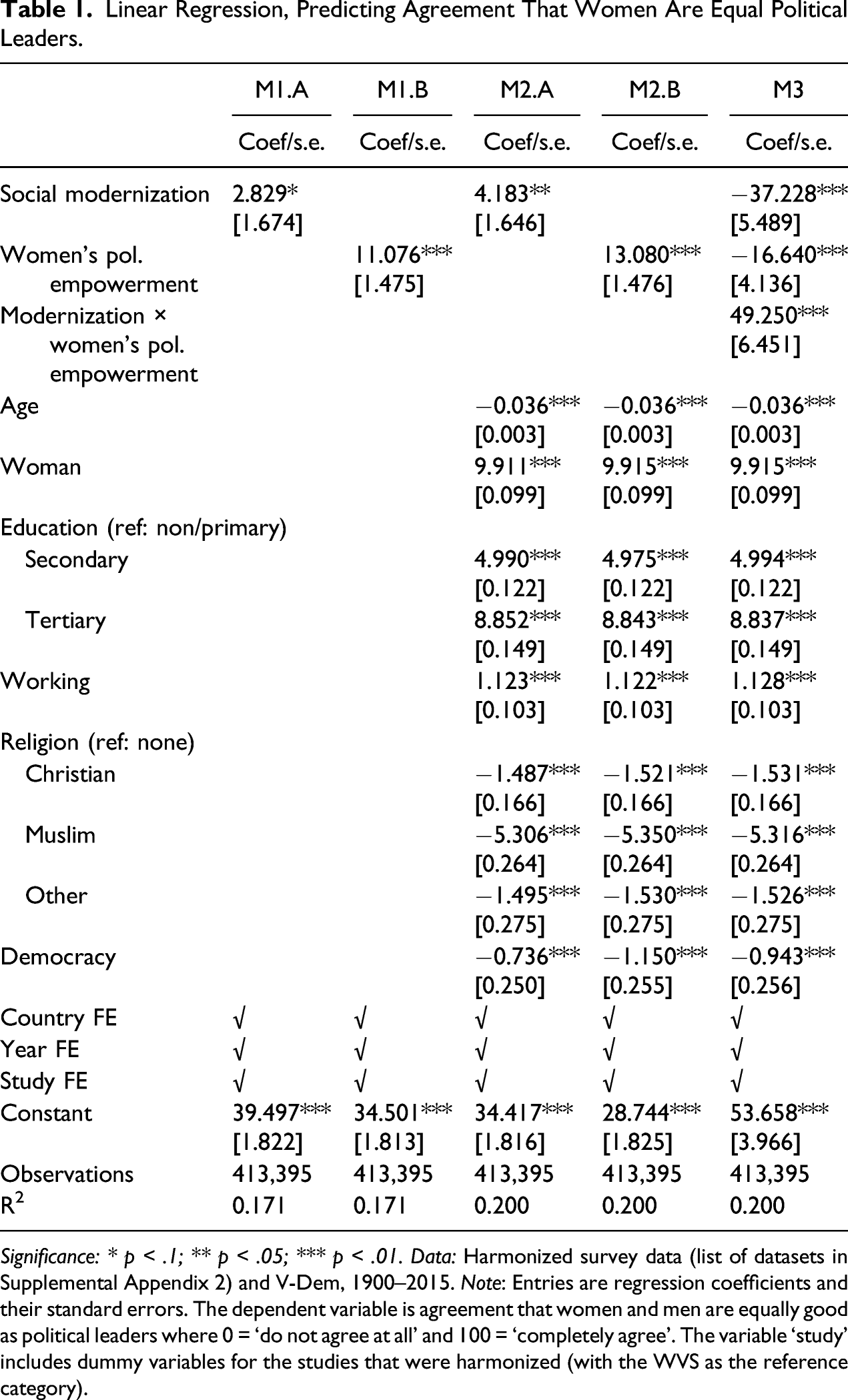
Significance: * p < .1; ** p < .05; *** p < .01. Data: Harmonized survey data (list of datasets in Supplemental Appendix 2) and V-Dem, 1900–2015. Note: Entries are regression coefficients and their standard errors. The dependent variable is agreement that women and men are equally good as political leaders where 0 = ‘do not agree at all’ and 100 = ‘completely agree’. The variable ‘study’ includes dummy variables for the studies that were harmonized (with the WVS as the reference category).
Turning first to modernization, M1.A demonstrates there is a borderline positive relationship between modernization (b = 2.829, p < .1) and support for female politicians. The size of this relationship becomes stronger and significant once we include individual-level controls in M2.A (b = 4.183, p < .05), indicating that the role of societal modernization holds above and beyond the individual-level characteristics held by respondents in these contexts. We thus have evidence supporting H1, confirming the findings from the existing literature. Turning to women’s political empowerment, Model 1.B confirms a strong, positive association with gender-egalitarian attitudes (b = 11.076, p < .01), supporting H2. This is slightly increased once we include control variables in M2.B (b = 13.080, p < .01). As we include country-fixed effects here, this implies that as a country’s level of female empowerment increases, overall support for women politicians increases in that country. For example, if a country moves one standard deviation up in women’s political empowerment, we expect support to increase by 1.73 points (on a 0 to 100 scale), which is a comparable effect size to the difference between Christians and those without a denomination.
In sum, Table 1 presents evidence of a direct relationship between the social and political context and support for female politicians. However, as we have argued above, it is further important to explore the inter-relationship between these two contexts, which we present in the next section.
Investigating the inter-relationship between socio-economic and political modernization
Next, we test H3 and H4 with an interaction between our two context variables. The coefficients of this model are reported in Model 3 in Table 1. Figure 4 plots the marginal effects for modernization and women’s political empowerment, conditional on the value of the other, using the values that are observed in the country-years studied here (values above .3 on both indices). Figure 4(a) plots the marginal effect of women’s political empowerment by the level of social modernization, investigating the relationship expected by H3. The Figure demonstrates that positive developments in women’s political empowerment only have a strong and significant relationship with support for women politicians at higher levels of socio-economic modernization, while it becomes insignificant at low levels of social modernization. This finding supports H3. For example, at the highest level of social modernization, a one standard deviation increase in political empowerment of women increases support for female politicians by 4.27 points, which is a comparable effect size to the difference between the lowest and middle education groups (see Table 1). Marginal effects of modernization on support for female political leaders by female political empowerment and vice versa. (a) Marginal effort of women pol.empower (H3) and (b) marginal effect of modernization (H4). Notes: The estimates are based on a linear regression of M3, presented in Table 1.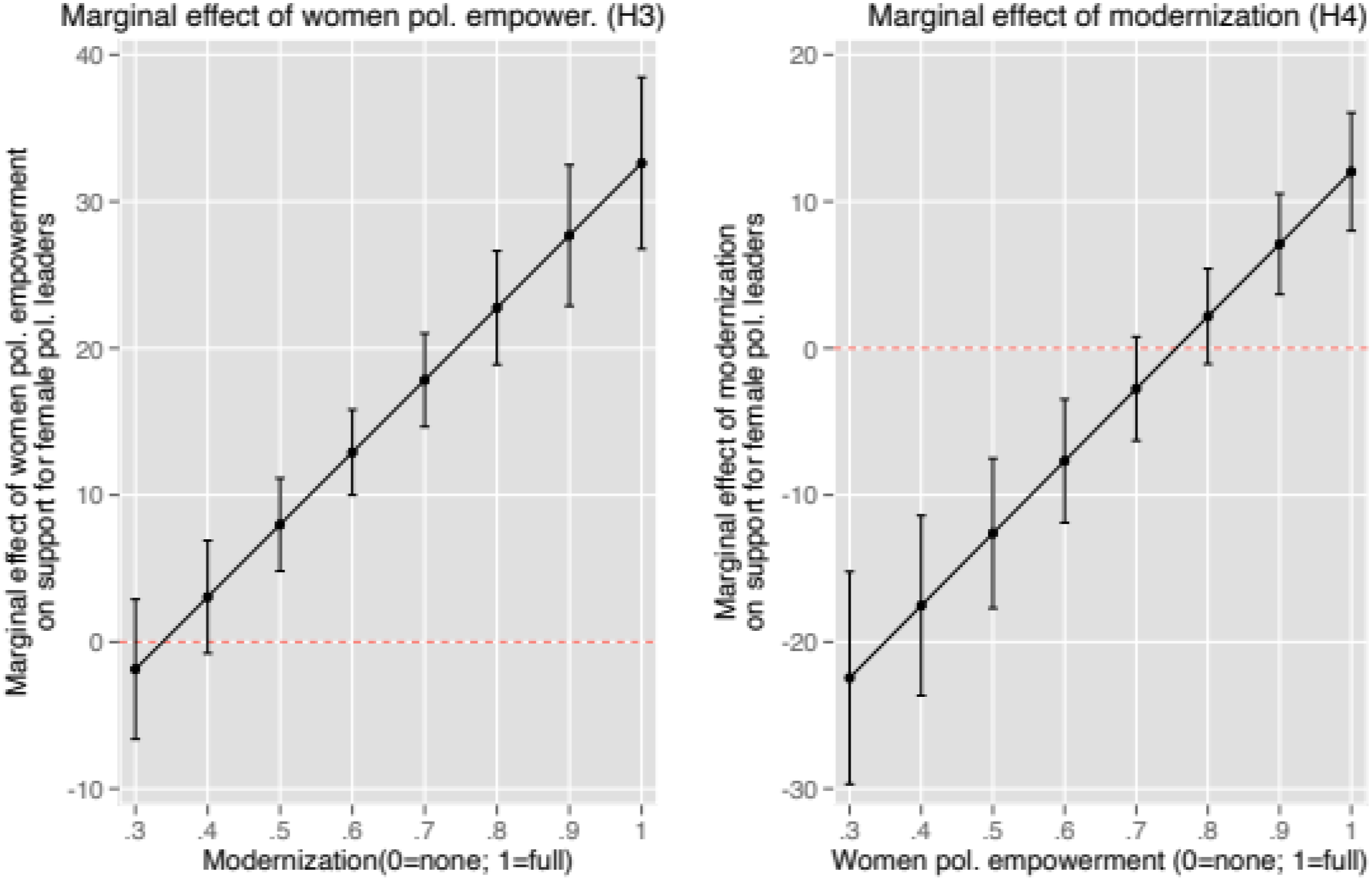
Figure 4(b) plots the marginal effects of modernization across levels of women’s political empowerment. The results support H4: Modernization is associated with support for women politicians if women are also politically empowered, but modernization has a negative relationship with citizen attitudes at lower levels of women’s political empowerment. For example, at the lowest level of political empowerment of women, a one standard deviation increase in social modernization decreases support for female politicians by 2.98 points. This supports the argument that socio-economic advancement needs to go hand-in-hand with the political advancement of women to result in a positive impact on (long-term) attitudes.
Going Back in Time: Social and Political Socialization
In a second identification strategy, we replicate the results utilizing cohort analysis, whereby we ascribe the social and political context to every respondent when she was socialized. Here, we leverage the well-established findings of political socialization theory that key political attitudes – such as gender attitudes – are formed early in life and then remain relatively unchanged. Even if these attitudes are updated – as is certainly the case with attitudes towards women, which became more liberal over time in many countries – each generation will follow this liberalization from a different intercept, which we assume was formed by the societal and political context in which she grew-up. Our socialization models are based on exactly this assumption and investigate the level differences in gender attitudes, which are ascribed to these intercept differences between cohorts. The advantage of these models is the time dimension between the observed context (during a person’s formative years) and the reported gender attitudes (at the time of the survey), where several decades can lie between the two events, which helps to address the potential endogeneity between context and attitudes.
To estimate these cohort models, we need to account for three co-linear time trends: age, period and cohort (APC) effects. A person could have positive or negative views of female politicians because she is young – the so-called life-cycle or ageing effect – or because she lives in a country that presently is led by a female leader – the so-called period effect that affects everyone no matter their age or birth year – or because she was socialized at a certain point in history – the cohort effect. The analyses presented below include generations that were born from 1910 to 1990 (cohorts) and that were interviewed between 1994 and 2015 (period), so we observe cohorts repeatedly at different points of time (periods) and at different points in their life-cycle (age).
To capture the socialization context, modernization and female empowerment were averaged across five-year intervals from 1920 to 2015 and matched to the corresponding national generation that came of age during a particular five-year period. 11 These variables are used as proxy variables to capture the cohort effect, which is a common approach in cohort analysis (Rodgers 1982). We define socialization context as the time when respondents were between 15 and 20 years old, assuming that this is the time of socialization when the social and political context have a strong and lasting impact on citizens (Bartels & Jackman, 2014). 12 To avoid conflating the socialization period and the current context, we only include respondents that are older than 20.
In Supplemental Appendix 6, we report the results, replicating the models presented in Table 1, but instead of using lagged context variables, we use the (country) cohort-specific measures. Using this approach, we replicate the findings to support H1, which posts that higher levels of social modernization during someone’s formative years have a positive association with their gender attitudes today. However, the direct relationship between women’s political empowerment and support for female politicians during a respondents’ youth is negative, which contradicts H2. Further exploration of this effect reveals that this relationship is highly conditional on the level of societal modernization at the time a cohort came of age. In Figure 5, we plot the marginal effects of an interaction between the social and political context during a cohort’s formative years. The pattern is the same as presented in Figure 4, using contemporary (lagged) context measures, giving us confidence in the robustness of the identified relationships and in the hypothesized causal direction from context to attitudes (whilst acknowledging that we cannot fully examine causality here). Only two differences between the contemporary and the cohort analyses emerge. Firstly, women’s advances in political power can have a negative relationship with support for women politicians if these advances occur at low levels of social modernization; in the contemporary analysis with lagged measures there is no relationship between women’s political empowerment and support for women in politics at lower levels of modernization. Secondly, comparing the size of the marginal effects, the effect of the socialization context is weaker than when focusing on contemporary measures, which is not surprising as current context will be more present in people’s lives. Marginal effects of modernization on support for female political leaders by female political empowerment and vice versa during formative years. (a) Marginal effort of women pol.empower (H3) and (b) marginal effect of modernization (H4). Notes: The estimates are based on a linear regression of M3, presented in Supplemental Appendix Table A6.1.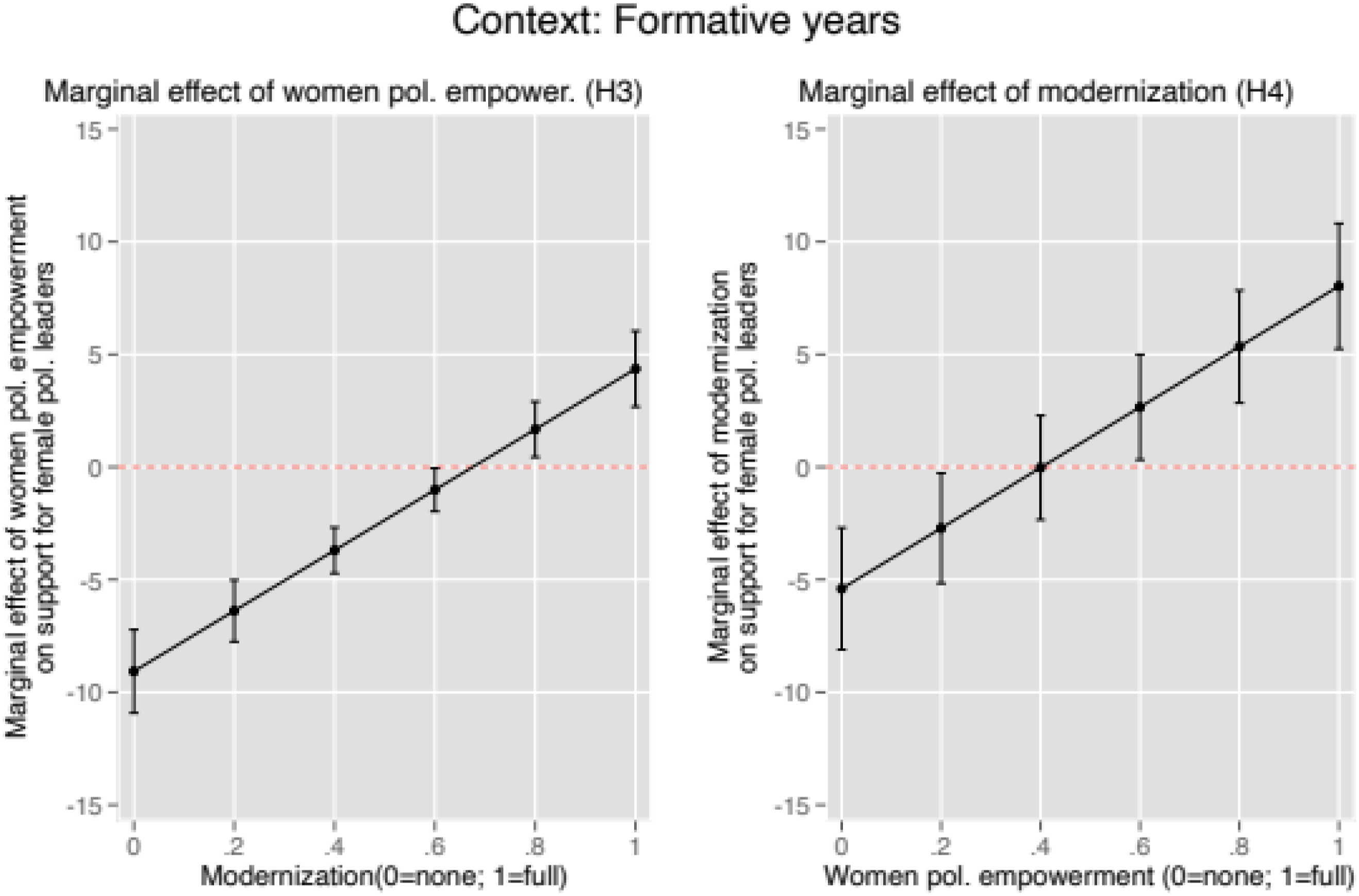
Robustness Tests
We ran a series of robustness tests on the above findings. For the interaction effect testing H3 and H4 – the most striking of the findings presented above – we first scrutinized our two key variables: (1) using GDP per Capita instead of our modernization index and (2) using the proportion of female legislators instead of our women’s empowerment index. The results are presented in M4 and M5 in Supplemental Appendix 7 and confirm the strong inter-relationship between the socio-economic and political context. Descriptive representation alone has a significantly weaker association with the outcome than using the more encompassing index used above, which supports our argument that descriptive representation might be necessary but not sufficient to fully capture the extent to which political influence and power are held by women.
Secondly, we repeated the analysis of the interaction of the socialization context (presented in Figure 5), varying the age of the formative years for which we measure socialization context. As alternative specifications, we use the following ages as the impressionable years: (1) 5–10; (2) 10–15; (3) 20–25 and (4) 25–30. The results are presented in Supplemental Table A6.2 and confirm our findings. If anything, later socialization increases the impact of socialization context, which confirms the strong impact of more recent experiences.
Thirdly, we ran the models separately for men and women to test whether they react differently to the social and political context. Some research has shown diverging findings for men and women (e.g. Morgan & Buice, 2013). As presented in Supplemental Appendix 8, the main findings, presented in Figure 4 above, are confirmed for both sexes. Similar to Morgan and Buice’s findings, men appear to react more strongly to the socio-economic and political context. It is possible that women’s attitudes are less responsive to context because they are already on average more supportive of women in politics than men.
Conclusion
Our analysis shows that social and political context matter for the formation of citizen attitudes towards women in politics. In accordance with modernization theory, experiencing higher levels of societal development either contemporaneously or in the formative years is associated with positive support for women in politics, but crucially only when women’s political empowerment is also high. Similarly, women’s political empowerment, both contemporaneously and during the formative years, has a positive relationship with support for women in politics, but only when the society is also sufficiently modernized. If citizens experience either societal development without women’s political advancement, or vice versa, these positive attitudinal effects are not realized. Our findings thus indicate that both social and political changes are required to produce publics that are supportive of women in politics.
Our paper has several implications. Firstly, existing theoretical approaches and empirical findings are conflicted on the extent to which women’s political advancement leads to positive attitudinal change. We show through a unified theoretical framework and analysis encompassing a variety of contexts that social and political contexts interact to shape citizen attitudes. We identify the complexities of the relationship between context and support for women in politics by using a much larger dataset – in terms of cross-national and over-time coverage – than previous studies. Studies that concentrate on one region, especially if that region is comprised of countries that have relatively high levels of modernization and women’s political empowerment, may fail to identify the nuances we show here.
Secondly, our findings have implications for the development of support for women politicians. We show that it is only where both societal modernization and women’s political empowerment are high that citizens will be supportive of women in politics. In contexts where societal modernization is low, but women’s political empowerment is increasing, we see no positive relationship between women’s political advancement and supportive attitudes. We argue that this is because of the incongruity perceived between women’s social, economic and political statuses in such contexts. Contexts where societal modernization is increasing without women’s political empowerment are even more concerning, as here we see a negative relationship between societal modernization and support for women politicians. We link this to citizens’ experience of unempowered women in the political sphere, often because of autocratic exclusionary practices, which undermine any positive attitudinal effects of societal modernization. Thus, women’s political empowerment is an important pre-requisite for ensuring that women’s social and economic advancement can change citizens’ minds about appropriate roles for women. Additionally, a context of low societal modernization and increasing women’s political empowerment is not equivalent to a context of low women’s political empowerment and increasing societal modernization in terms of the attitudinal consequences amongst citizens, but nonetheless neither context will foster supportive cultures towards women in politics.
Thirdly, our findings are important given the reciprocal nature of women’s political empowerment and citizen attitudes towards women in politics (Alexander, 2012), which can positively (or negatively) reinforce each other. We focus in this paper on the extent to which citizen attitudes are related to women’s political empowerment, making use of lagged indicators and our cohort analysis in an attempt to isolate this side of the reciprocal relationship. Our findings show that the ‘virtuous cycle’ (Alexander, 2012) between women’s political empowerment and support for women politicians only occurs where societal modernization is also already relatively high. In other contexts, we may instead see a ‘vicious cycle’, where citizen support for women politicians is undermined by the interaction between the social and political context, which can then have negative effects on women’s political empowerment in the future (Alexander & Welzel, 2015; Inglehart & Norris, 2003; Paxton and Kunovich 2003). Thus, in contexts where there is modernization without women’s political empowerment, or vice versa, we may see a decline in women’s political empowerment in the future as supportive public attitudes fail to develop.
Fourthly, our analysis points towards both barriers and facilitators in the development of supportive attitudes towards women in politics. Interventions and strategies which aim to increase women’s inclusion in political institutions – such as quotas – might succeed in representing women within political decision-making, but without societal change as well they may not produce change in citizen attitudes and thus could be detrimental to women’s political empowerment in the long-run. Moreover, our theory and descriptive evidence suggest that autocratic regimes where women are purposefully excluded from political institutions might particularly undermine citizen support for women in politics – but this does not mean that democratic reforms will be sufficient to bring about attitudinal change either. Despite previous research finding a positive relationship between democracy and support for women in politics (Alexander, 2012; Alexander & Jalalzai, 2020), we find a negative relationship in our models which also include measures of modernization and women’s political empowerment. This suggests that it is women’s political empowerment, rather than democracy itself, which has a positive relationship with citizen attitudes towards women politicians. In democracies where women’s political empowerment is lower, such as newer democracies (Fallon et al., 2012), this positive relationship may not materialize. Future research could usefully investigate the interplay between women’s political empowerment, democratic transition and the development of gender-egalitarian attitudes more fully than we have space to do here. Finally, it should also be noted that interventions and developments taken now might not immediately over-ride the legacy of socialization experiences which we find also produce lower levels of support for women in politics amongst certain generations. Attitudinal change in countries with such legacies might be slow, even if current conditions seem favourable for the development of support for women politicians amongst the public.
Supplemental Material
sj-pdf-1-cps-10.1177_00104140211066214 – Supplemental Material for Revisiting the Impact of Modernization on Support for Women Politicians: The Role of Women’s Political Empowerment
Supplemental Material, sj-pdf-1-cps-10.1177_00104140211066214 for Revisiting the Impact of Modernization on Support for Women Politicians: The Role of Women’s Political Empowerment by Anja Neundorf and Rosalind Shorrocks in Comparative Political Studies
Footnotes
Declaration of Conflicting Interests
The authors declared no potential conflicts of interest with respect to the research, authorship, and/or publication of this article.
Funding
The authors disclosed receipt of the following financial support for the research, authorship, and/or publication of this article: This work was supported by the Economic and Social Research Council (ES/N012127/1).

Supplemental Material
Notes
Author Biographies
References
Supplementary Material
Please find the following supplemental material available below.
For Open Access articles published under a Creative Commons License, all supplemental material carries the same license as the article it is associated with.
For non-Open Access articles published, all supplemental material carries a non-exclusive license, and permission requests for re-use of supplemental material or any part of supplemental material shall be sent directly to the copyright owner as specified in the copyright notice associated with the article.
