




Abstract
Political science has long viewed education as an instrumental factor in developing support for democracy and beneficial for democratization. However, governments, both democratic and authoritarian, have substantial control over the curriculum and develop education institutions with the specific aim to instill in students the norms and values that underpin the regime. With this in mind, this study asks, does the effect of education vary by the political regime in which education was undertaken? We use a quasi-experimental approach exploiting European compulsory schooling reforms, implemented under both democratic and authoritarian regimes, to answer this question. We find that education has no effect on principle and functional support for democracy, but that education’s effect on satisfaction with democracy is conditional on regime type. For those educated under a democratic regime, education led to greater satisfaction with democracy, whereas those educated under an authoritarian regime became less satisfied with democracy.
Keywords
Introduction
Political parties advocating populist and anti liberal-democratic platforms are realizing electoral gains throughout the democratic world. While these parties have found some success in the established democracies of Europe such as Sweden (Sweden Democrats), Denmark (Danish People’s Party), and France (National Rally), some of the greatest achievements have been marked in countries with more recent authoritarian legacies, such as Poland (Law and Justice) and Hungary (Fidesz). However, while nationalist policy is a salient feature of some of these parties, other anti-democratic aims such as the removal of judiciary freedoms in Poland, and infringements on the media and academia in Hungary, are equally present, supporting the notion that these advances are part of a wider disconnect from liberal democracy (Foa and Mounk, 2016; Freedom House, 2018). Understanding what leads individuals to support broad notions of democracy, and how these factors can be contextually driven, is therefore paramount.
Political science has long viewed education as an important factor in developing support for democracy. The conventional view is that education—even if under authoritarian rule—enlightens students, inducing one to endorse democratic norms. A large body of empirical evidence seemingly supports this claim; it has been consistently shown that countries with high average levels of education are more likely to be governed democratically (Alemán and Kim, 2015; Barro, 1999; Glaeser et al., 2007; Lipset, 1959; Murtin and Wacziarg, 2014; Sanborn and Thyne, 2014), and there is extensive individual-level research from around the world that finds education to be positively correlated with support for democracy (Chong and Gradstein, 2015; Glaeser et al., 2007; Nie et al., 1996). Nevertheless, quite contrary to this expectation, authoritarian regimes throughout the world, both past and present, invest heavily in education (Chen, 2004; Manzano, 2017; Paglayan, 2021). In some manner, the authoritarian’s hand is forced—education can be a tool to stimulate economic growth, generate support from the poor through redistribution, to forge a national identity, or to build military strength (for an overview, see Paglayan, 2021). Naturally, regimes have substantial control over the curriculum used in education, and time spent in education is time spent directly within an institution of the state. As such, when investment in education is made, the intention is to foster cognitive abilities and use education as a tool for the socialization of citizens in accordance with regime principles (Diwan and Vartanova, 2020; Kwong, 1997; Lott, 1990). With this in mind this study asks, is there a universal positive effect of education on support for democracy—or is the effect conditional on regime type?
Existing studies of the relationship between education and support for democracy across democratic and authoritarian regimes have come to mixed conclusions. Chong and Gradstein (2015) find a positive relationship between education and support for democracy that is independent of regime type. Similarly, surveys launched immediately after the fall of communism found greater support for democracy among the educated in Russia (Gibson et al., 1992) and Malawi (Evans and Rose, 2007). However, Diwan and Vartanova (2020) conclude that there is a much stronger positive effect of education on democratic values and political behavior in democracies than in autocracies. Moreover, cross-country comparative studies have shown that liberal attitudes are more strongly connected to education in countries with long histories of democracy (Coenders and Scheepers, 2003; Frølund Thomsen and Olsen, 2017). However, these studies rely on correlational evidence that makes it hard to identify causal effects of education and separate conditional effects of regime type from differences in the selection into education across regimes. As we have learned from the extensive debate about the causal effect of education on political participation, with respect to education, it is imperative to take seriously the truism that correlation is not causation (Berinsky and Lenz, 2011; Kam and Palmer, 2008; Persson, 2015; Sondheimer and Green, 2010).
While the field of political particiation is quite rich in quasi-experimental studies, far less work has included authoritarian contexts. Quasi-experimental studies outside of Western democracies have found that education negatively impacts political participation in competitive-authoritarian Zimbabwe (Croke et al., 2016); it positively affects political concern and voting in authoritarian Vietnam (Dang, 2019); and it increases political engagement in the nonconsolidated democracy of Nigeria (Larreguy and Marshall, 2017). There is, however, no effect of education on democratic attitudes in Kenya (Friedman et al., 2016); and curriculum reform in China is argued to lead to greater ideological convergence with the ruling regime in China (Cantoni et al., 2017). The field is still nascent, but taken together this paints a very mixed picture, and to the best of our knowledge, no study has yet examined support for democracy in its multidimensional sense (Easton, 1965; Norris, 2011).
To sum up the state of knowledge, many studies in the field of democratic support have examined the effect of education cross-nationally, thereby prioritizing generalizability. Others have used case studies and quasi-experimental research designs that allow for greater claim for causal inference. But the combination of these aims is distinctly absent, which this study aims to address. We also employ a broad approach to measure support for democracy, recognizing the complexity of these attitudes and that the diverging results of previous research may depend on different ways of defining and measuring democratic support.
We thus aim to add to the literature by studying the regime-conditional effect of education on support for democracy with a cross-national, quasi-experimental design in which we leverage 17 education reforms implemented throughout the latter half of the twentieth century in 13 European countries. The sample of reforms all extended compulsory schooling, and were enacted in countries with varied forms of political systems at the time of implementation—but all have since transitioned to democratic rule. Our set of countries under authoritarian rule at the time of education reform includes Hungary, Poland, Portugal, and Spain. This set of countries is admittedly limited to one geographical area and time period, but it does provide some variation in the form of authoritarian rule—from communist rule in the East to military rule in the West. Furthermore, while limited, this sample and research nevertheless give good ground for causal inference across a relatively large number of countries, thus giving better support for generalization than previous quasi-experimental research on single countries.
We use individual-level survey data from the Integrated Values Survey. Our analysis finds that education, both democratic and authoritarian, has no effect on principle or functional support for democracy, but that the effect of education on satisfaction with democracy differs by regime type. Education leads to satisfaction with democracy only when obtained under democratic rule, whereas past authoritarian education has a negative effect. We also find similar regime-conditional effects of education on political interest and institutional trust. These results are striking because they are in stark contrast to the conventional, enlightening view of education.
Education and Support for Democracy
The conventional view of education presumes universal positive effects; education has been deemed the “universal solvent” (Converse, 1972) for which its effects are “universally good” (Campbell, 2006). Nie et al. (1996) argue that in education one develops their verbal capacity and the ability to think critically and analytically, both of which are skills that can be generalized beyond the context of one’s study. These skills are of particular importance to political value formation as they allow one to make sense of a vast amount of political information and update beliefs accordingly (Nie et al. 1996). As such, so long as the goal of education is to develop the cognitive ability of students, one should expect a positive association between education and support for democratic rule (Glaeser et al., 2007; Lipset, 1959). Building on this logic, education is argued to be an essential factor in the democratization of countries—it leads to the development of democratic norms, which in turn lead to citizen demand for democratic institutions.
In spite of the prominence of this conventional view in political science, there is good reason to question the expectation of universal positive effects (Diwan and Vartanova, 2020; Lott, 1999). In education, students are placed into institutions of the state, where teachers and administrators are public employees and are therefore constrained in behavior and in the expression of attitudes (Frølund Thomsen and Olsen, 2017). As a participant in the education system, a student’s primary environment outside of the home is a politicized institution that specifically aims to mold one’s values and ideology (Kwong, 1997). Perhaps the most pertinent method through which this occurs is the curriculum. Democratic education aims to shape the values of students and encourage engagement with the political system through courses on civics (Galston, 2001; Sunshine Hillygus, 2005) and teaching “grounded in freedom of thought and democracy” (Danish Ministry of Education, 1975, translation by Haas, 2015). On the contrary, authoritarian political systems aim to instill in students an ideology consistent with the founding principles of their rule (Cantoni et al., 2017; Stoer and Dale, 1987; Szczepański, 1962; Szebenyi, 1992). In former Soviet states, this entailed a curriculum that aspired to create “socialist man” (Szebenyi, 1992); in Salazar’s Portugal, the aim was to develop a strong sense of nationalism to preserve colonial power (Stoer and Dale, 1987); and in modern China, the curriculum intends to develop a rejection of the free market economy and Western democracy (Cantoni et al., 2017). Given such differences in the curriculum of education systems, if curriculum is instrumental in defining what values students embrace and internalize, the outcome of democratic and authoritarian education should be quite opposite with respect to support for democracy.
Time spent in education may have a direct effect on students’ values, but the potential for regime-conditional socialization is not strictly related to curriculum and the institution. A central hypothesis in the study of education is that social networks mediate the effect of education on political attitudes (Nie et al., 1996; Persson, 2011), thereby providing an indirect pathway through which education affects political attitudes. Such mediation can be the result of peer groups in education (Harris, 1995), or education affecting individuals’ social network centrality (Nie et al., 1996). Indeed, many student groups have been ardent supporters of authoritarian rulers (Glaeser et al., 2007); in one-party states, party membership provides access to social networks used to gain access to certain jobs (Dickson and Rublee, 2000); and some form of higher education is all but necessary to gain access to positions of political influence in non-democracies (Kryshtanovskaya and White, 1996). As such, a conditional effect of education would be expected given an indirect effect via social networks as well.
The education-as-a-proxy hypothesis offers a contrasting perspective to the view of education as a causal factor in the formation of values. This literature instead argues that the correlation between education and political values is spurious, and education only acts as a proxy variable for pre-adult factors such as family background and personality (Kam and Palmer, 2008). These characteristics have been argued to confound the relationship between education and voting (Berinsky and Lenz, 2011; Kam and Palmer, 2008) as well as education and social trust (Oskarsson et al., 2017). There is, however, also a set of studies with strong research designs that supports a positive effect of education on political participation in consolidated democracies (Dee, 2004; Milligan et al., 2004; Sondheimer and Green, 2010) and nonconsolidated democracies (Larreguy and Marshall, 2017) as well as in authoritarian states (Dang, 2019). Croke et al. (2016) exploit an educational reform in Zimbabwe and find that increased education is negatively connected to political participation but has positive effects on the support of democratic institutions. The authors argue that education, even under authoritarian rule, results in support for democracy, which in turn leads to political withdrawal in nondemocratic Zimbabwe to not legitimize an authoritarian regime.
The discussion above demonstrates the complexity of the relationship between education and support of democracy, in particular under different regime types. There are contrasting theoretical expectations and diverging empirical results from previous research. There is also the possibility that education may just act as a proxy and that the causal effect on support for democracy is null. Ultimately the effect of education on support for democracy thus amounts to an empirical question. Nevertheless, our theoretical expectation is that education has the potential to affect support for democracy but that this effect is conditional on regime type as the curriculum and the context of education typically differs substantially. We thus expect a positive effect of education on support for democracy when education has taken place under a democratic regime, but a negative effect of education on support for democracy when education has taken place under an authoritarian regime. We rely on educational reforms expanding compulsory education to test this expectation empirically, and in the following section, we describe the background of these reforms.
Education Reform
The twentieth century was a time of intense educational reform across the world. In particular, following the Second World War, most European countries thoroughly reformed their education systems, which subsequently resulted in a rapid expansion of educational enrollment (e.g. Ramirez and Boli, 1987). An archetypal reform, implemented in almost all countries, was to increase compulsory education. These reforms offer an interesting opportunity to causally test the effect of education, one which researchers have exploited in order to study the effect of education on outcomes such as income and attitudes toward immigration (e.g. Brunello et al., 2009; Cavaille and Marshall, 2019; d’Hombres and Nunziata, 2016).
A primary motivation for the introduction of comprehensive schools and the extension of education throughout this time period was to reduce class inequalities. In democratic Europe, reforms were seen as democratizing, as the intention was to create equality of opportunity. For example, in Sweden, the focus was on eliminating the elitist nature of the existing tracked system (Lindgren et al., 2017). In communist regimes, on the other hand, increasing the education levels of children from low-education backgrounds was seen as a manner of empowering the peasant and working classes (Szczepański, 1962). In Hungary, reducing inequality was a means to ensure that the children of peasants and workers gained access to education in striving to populate the bureaucracy and professional class with individuals of working class backgrounds (Simkus and Andorka, 1982).
The second influential factor which drove countries to reform their education systems was economic. As countries modernized and industrialized, the labor market demanded greater skills. In Ireland, reform was implemented as part of a wider economic shift which aimed to bolster industrial growth and entice foreign investment (Raftery and Hout, 1993). Similarly, in Great Britain, the 1947 reform came about as a means to “improve the future efficiency of the labour market” (Halsey et al., 1980: 126). International organizations also encouraged education reform to foster economic growth. In the case of the 1964 reform in Portugal, for example, the Organisation for Economic Co-operation and Development (OECD) was instrumental in promoting reform (Stoer and Dale, 1987). Indeed, in the 1960s, the OECD tended to issue “blanket fashion” prescriptions to member states heavily influenced by the discourse on human capital (Stoer and Dale, 1987: 408).
From this era, we leverage 17 education reforms implemented between 1947 and 1991 in 13 Western- and East-Central European countries. All reforms extended compulsory education at the primary or secondary level by a minimum of one year and were implemented such that they started to affect children born a certain year. However, the reforms only prolonged schooling for children who would have quit school at the end of compulsory schooling. Some children continued beyond the statutory level of schooling before the reforms, and they were thus not directly affected by the reforms (Oreopoulos, 2006).
We exclude reforms that occurred in conjunction with regime changes, such as those enforced immediately after the fall of communism in the Czech Republic, Slovakia, Hungary, and East Germany.
Estimation and Data
We exploit the education reforms as a set of natural experiments. In line with a large body of empirical research on education, we assume that the timing of reform implementation was as-if random with respect to the birth cohorts (Brunello et al., 2009; Cavaille and Marshall, 2019; d’Hombres and Nunziata, 2016). In other words, it is assumed that reform implementation induced exogenous variation in educational attainment, which allows for unbiased estimates of the causal effect of education. Exogenous variation further alleviates concerns of reverse causation as pre-education attitudes cannot determine whether someone was affected by a reform or not. However, whether someone was exposed to an authoritarian or a democratic reform was not as-if random. Rather, we assume that the individual reform effects can be cautiously interpreted as causal estimates which we then aggregate and compare across regime types. As such, the identifying assumption for testing the regime-conditional effect of education is that our sample of authoritarian reforms provides a counter-factual case for our sample of democratic reforms.
An overview of the reforms is presented in Table 1. A more detailed account, including data sources, is found in Supplemental Appendix I. Out of the seventeen reforms, thirteen were implemented under democratic rule and four under authoritarian rule. The authoritarian reforms were carried through in Hungary, Poland, Portugal, and Spain. In the latter two countries, we are also able to study education reforms that were implemented under democratic rule, which allows us to test whether the conditional effect of regime type is the same within countries as across countries. This relaxes our assumption that the authoritarian reforms represent a counter-factual case to the democratic reforms as country-level factors are held constant.
Reform Overview.
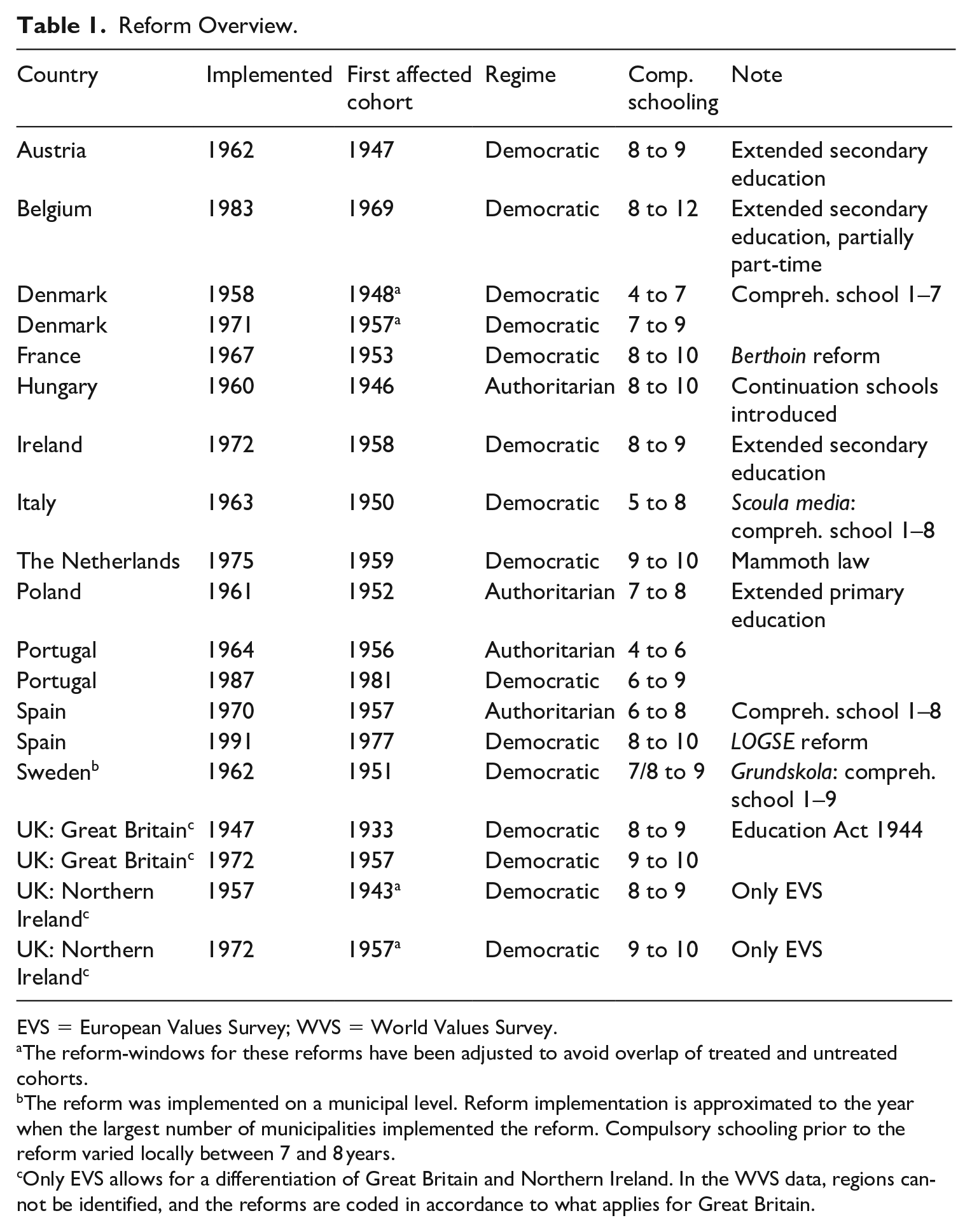
EVS = European Values Survey; WVS = World Values Survey.
The reform-windows for these reforms have been adjusted to avoid overlap of treated and untreated cohorts.
The reform was implemented on a municipal level. Reform implementation is approximated to the year when the largest number of municipalities implemented the reform. Compulsory schooling prior to the reform varied locally between 7 and 8 years.
Only EVS allows for a differentiation of Great Britain and Northern Ireland. In the WVS data, regions cannot be identified, and the reforms are coded in accordance to what applies for Great Britain.
While each reform extended schooling, increases in compulsory schooling were often implemented in conjunction with the establishment of a new school system or curriculum. For example, the Hungarian reform of 1960 increased compulsory education from eight to ten years, but for those that did not wish to continue with regular school, the so-called “continuation school” was developed (UNESCO, 1963). Such schools focused on agricultural or industrial labor education. Similarly, in Sweden, a seven year primary education followed by an elite junior secondary school was replaced by a nine year compulsory comprehensive school (Lindgren et al., 2017).
The reforms were de jure implemented nationally for nearly all countries; however, realities on the ground often prevented such a sharp introduction. For example, the Polish reform of 1961 increased compulsory schooling from eight to nine years, but in reality, the reform was phased in over the course of several years because of a lack of teachers and classrooms (UNESCO, 1962). Similar forms of varied implementation were found in several countries, but it has been argued that such variations in timing of reform implementation do not correlate with overall levels of education (Brunello et al., 2009). In these cases, we treat the countries as having a single implementation date defined as the year for which the largest number of regions enacted the changes (similar to Brunello et al., 2009; Cavaille and Marshall, 2019; Österman, 2021).
Estimation
We regress our measures of democratic support on a dummy, Reform, which indicates if an individual was affected by the reform or not. To identify the causal effect of the reforms, we have to assume that the cohorts affected by the reforms are comparable to the unaffected cohorts in relation to pre-reform factors and only differ in educational attainment as a result of the reforms. To make this assumption more credible, we restrict the number of cohorts included before and after reform implementation. In the main specifications, we compare seven “untreated” birth-year cohorts born such that they were unaffected by reform implementation, to seven “treated” birth-year cohorts born immediately on the other side of this threshold (similar to Brunello et al., 2009; Croke et al., 2016; Österman, 2021). We refer to the cohort frame as the “reform-window”. The width of the window, plus/minus seven years, is chosen to try to balance sample size while avoiding other time-dependent changes that may affect the estimates. However, we also test the robustness of the results when narrowing the width of the reform-window. We drop the first potentially affected birth-year cohort, which often is only partially treated, due to the fact that school-start dates do not coincide with the calendar year (and we do not have access to birth dates). This also helps alleviate concerns of weak implementation in the first year of reform. The model can be formally described as follows:

where Yij is the support for democracy for individual i in reform-window j, where each individual can either be part of the untreated or treated cohorts. α is the intercept, Rij the reform dummy, and Aj a dummy indicator for whether a reform was implemented under democratic (0) or authoritarian rule (1). Thus, β1 and β2 are our main coefficients of interest as these describe the education effect on democratic support under different regimes. X ij is a vector of individual controls for birth year, gender, and age. δ j denotes reform-fixed effects (adding dummy variables for each reform-window), which are also interacted with birth year and age, Z ij . The latter allows each reform unique cohort- and age-based trends in democratic attitudes. Controlling for reform-specific birth-year trends is important to avoid that the reform indicator picks up average differences in education due to general trends of increasing education; educational differences that in turn may be related to democratic attitudes. λ i is a set of survey wave dummies.
The most important aspect of this specification for the interpretation of the results is that the models include reform-fixed effects and reform-specific cohort trends. Therefore, we do not directly rely on the between-reform variation by comparing, for instance, an individual subject to the 1960 authoritarian education reform in Hungary to an individual subject to the 1991 democratic education reform in Spain. All average differences in education and democratic attitudes across the different reforms are absorbed by the reform- fixed effects. Rather, the estimates should be viewed as the expected difference in democratic support among individuals on either side of a specific reform, aggregated over all of the reforms in our sample. Furthermore, since the reforms are assumed to induce exogenous variation in education, we use a limited set of individual-level control variables. In fact, to include any post-education variables, such as income or occupation, in the model, would be a case of “bad controls” (Angrist and Pischke, 2009).
We do not include the lower-order authoritarian dummy variable (Aj) as is typically standard when modeling an interaction term because of the inclusion of reform-fixed effects. Since each individual reform was either conducted under an authoritarian or democratic regime, the variation in the lower-order authoritarian dummy is captured by the reform-fixed effects.
For reasons of precision and statistical power, it would have been advantageous if we could identify the children who actually were affected by the reforms. That is, children who would have quit school at the earliest possible time point prior to the reforms. However, we lack variables to discriminate this group, such as parental education (Österman, 2021), and thus have to accept that the reform effect on education will be smaller than the formal change in compulsory schooling (Oreopoulos, 2006).
Our model is a type of difference-in-difference model where we mainly rely on the variation in whether different cohorts within countries were affected by the reforms, but also on the variation in reform exposure of a cohort across countries. The standard identifying assumption of a difference-in-difference model is the so-called parallel trends assumption (Angrist and Pischke, 2009). In other words, there should not be any systematic differences in trends in education and democratic attitudes at the individual level when comparing affected and unaffected cohorts, and no differences when comparing reforms implemented under authoritarian or democratic rule, apart from that induced by the reforms themselves. It is also against this backdrop we add reform-specific birth-year trends. We test the parallel trends assumption in two ways (details presented in Supplemental Appendices F and G). First, we apply a placebo test relying on Monte Carlo simulations manipulating reform implementation. Reassuringly, all of the results of the placebo tests are centered on zero. Second, we run an event study specification which shows the trends in democratic attitudes before and after reform implementation. There are no clear differences in the pre-reform trends.
Figure 1 demonstrates the effect of the reforms on school-leaving age as well as trends in education before and after reform implementation. The jump in school-leaving age at reform implementation is quite distinct in all three cases, amounting to about half a year. The general trend of increasing education is also clear, and the patterns look reasonably similar across reforms. However, the school-leaving age among the reform-affected cohorts in authoritarian reforms tends to show more variation. This may be a result of that the smaller sample is more exposed to random variation but also implementation issues.
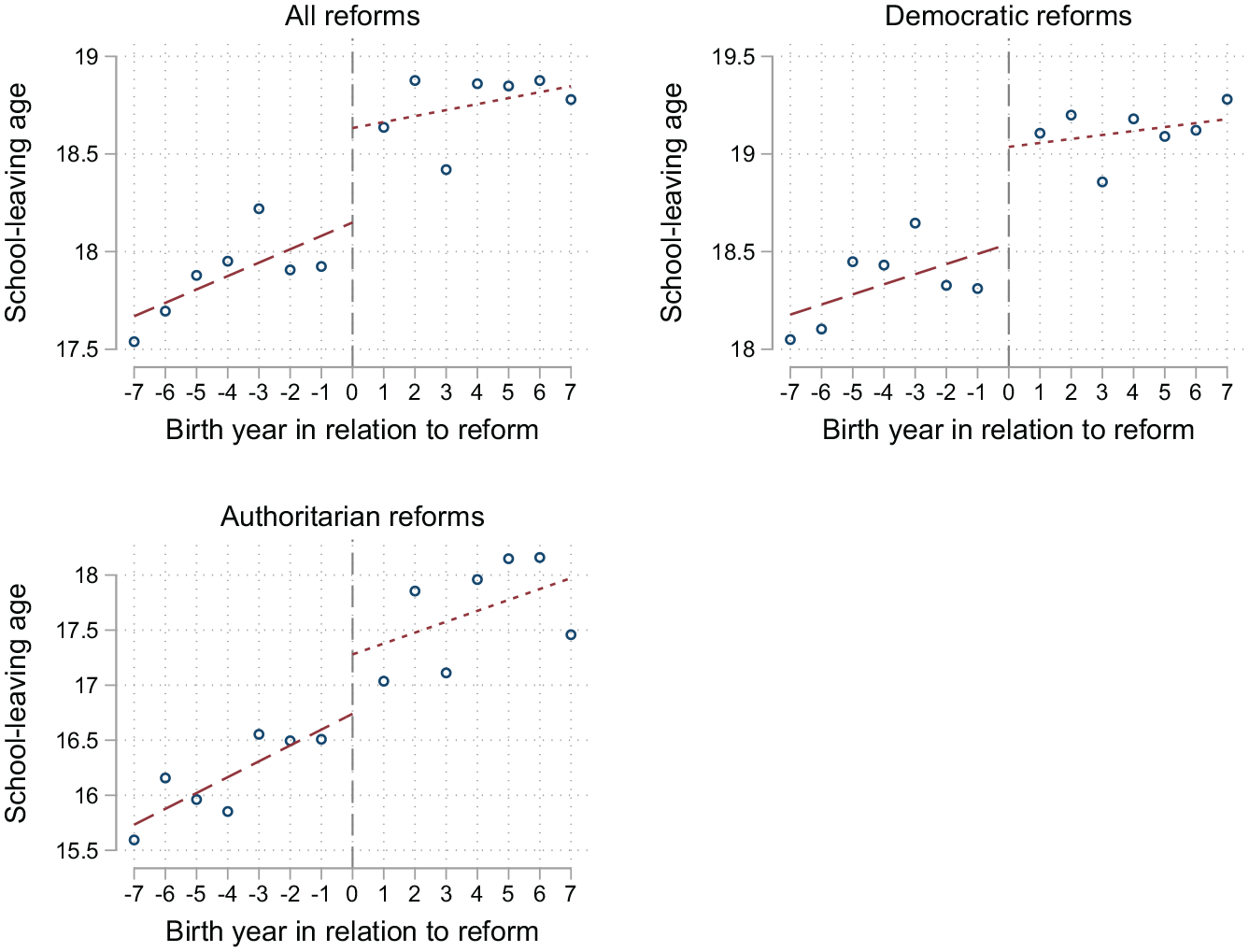
School-Leaving Age Before and After Reform Implementation.
In contrast to the common approach in similar studies exploiting compulsory schooling reforms (e.g. Cavaille and Marshall, 2019; Croke et al., 2016), we do not use the reforms as an instrument for education in an instrumental variable (IV) framework. Our main reason for this modeling choice is that an IV approach would assume that the full effect of the reforms on support for democracy is mediated via educational attainment (the exclusion restriction, Angrist and Pischke, 2009). However, since effects, at least partly, may be the result of changes of the curriculum (Cantoni et al., 2017) and other contextual factors, especially when comparing democratic and authoritarian reforms, such an approach would be problematic. Our estimation model is instead the equivalent of the reduced form model in an IV framework. This modeling aspect points to a shortcoming in the design in that we cannot adequately separate effects of prolonged education from curriculum and other contextual effects. However, this is a dilemma that we share with all other studies exploiting similar reforms and using an IV approach would rather exacerbate the problem by relying on a questionable assumption.
We use country-by-cohort clustered robust standard errors as treatment varies across countries and cohorts. It can be argued that clustering by country would be preferable, but the number of countries are too few for this to be a viable alternative (Cameron and Miller, 2015). However, we present results using the wild cluster bootstrap procedure in Supplemental Appendix H, which allows for significance testing using clustered data with few clusters.
Measuring Support for Democracy
In consistency with prior work, we view support for democracy through the lens of system support (Easton, 1965; Norris, 2011). This literature differentiates along the lines of what is termed “diffuse” and “specific” support, which can be viewed as representative of a continuum of abstraction; diffuse support represents support in the most abstract of terms, whereas specific relates to the more concrete aspects of a given regime (Easton, 1965). More recent work in the topic has identified five dimensions which range from support for the nation state and underlying regime values at the diffuse end, to support for regime performance, confidence in institutions, and approval of incumbents as more specific forms of support (Norris, 2011).
The measurement of these dimensions of democratic support has been a topic of much discussion in previous research (Inglehart and Welzel, 2005; Magalhães, 2014; for an overview, see Ariely, 2015). We have chosen a broad empirical approach, using a number of different measures of democratic support, with the aim to adequately measure both diffuse and specific support. This broad approach also serves the purpose of studying if the relationship between education and support for democracy differs between different expressions of democratic support. We use the combined longitudinal versions of the European Values Survey (EVS) and World Values Survey (WVS), collectively known as the Integrated Values Survey (IVS). Whereas there are other surveys that have a larger number of observations, there are few alternative cross-national surveys covering the countries we study that offer such a wide array of theoretically relevant variables on democratic attitudes. However, we encounter some limitations given that not all variables are included in each wave of the survey, nor for each country of a given wave. For our main results, we rely on EVS 3–4 and WVS 3–4 collected between 1995 and 2009 (see Supplemental Appendix A for further details).
We use six survey items to measure support for democracy, which map to the diffuse-specific continuum. The wording of these items is presented in Table 2. On the diffuse end, the first two items are intended to capture the dimension “support for regime values,” or support for democracy in principle. The focus is on support for democracy that is independent of performance, specific institutions, or incumbents, thereby making these measures appropriate for the study of Principle regime support.
Dimensions of Democratic Support and Survey Items.
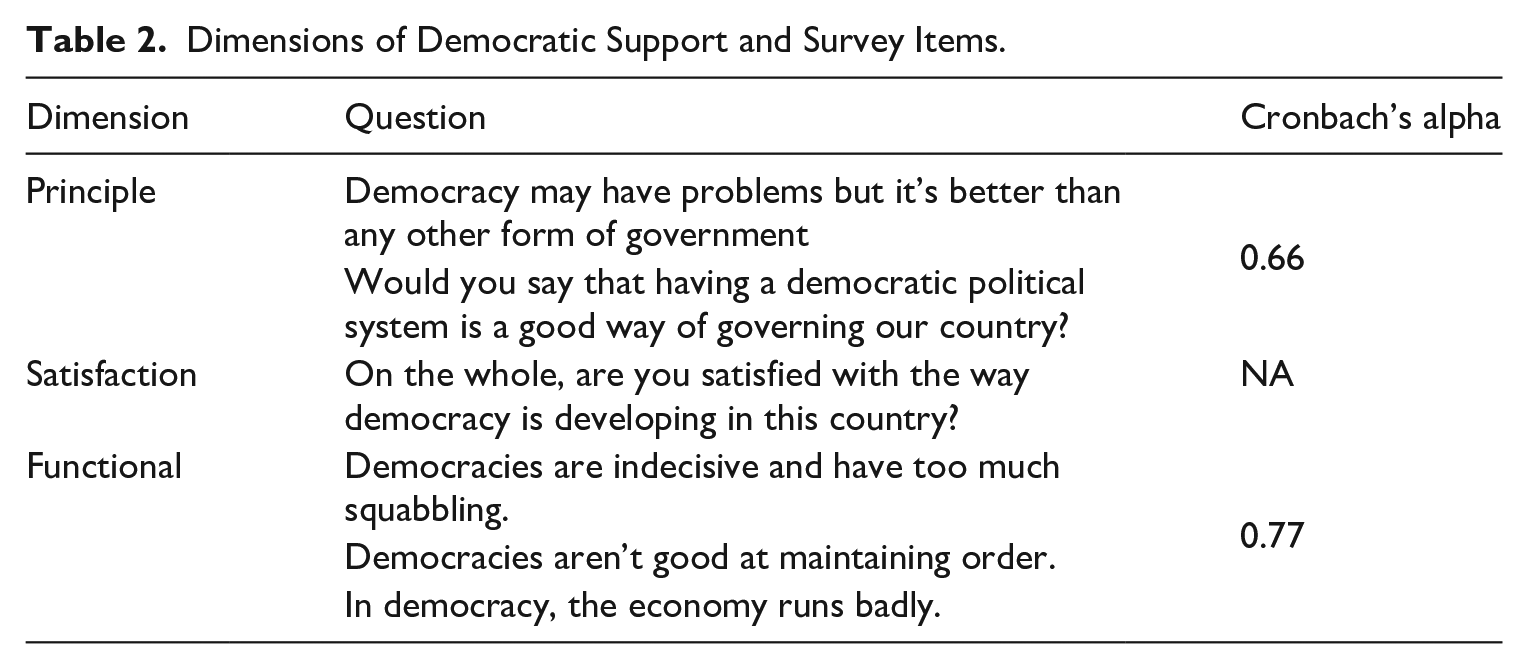
Support for regime performance is measured along two subdimensions: satisfaction with democracy in a general sense, and functional support for democracy in a specific sense. The first dimension, which we term Satisfaction, is measured with the widely used “Satisfaction with democracy” item. This item has been subject to extensive debate as to whether it should be interpreted as support for regime performance or regime values (Canache et al., 2001). We agree with Linde and Ekman (2003) and Norris (2011) in that it is best viewed as a measure of overall performance. Nevertheless, Satisfaction is distinct from the three remaining measures of regime performance that probe for support for more concrete, functional aspects of democratic governance. These type of measures make up our second subdimension of regime performance, Functional support for democracy. Such a differentiation between two levels of regime performance has been identified in prior research as well. In the words of Kostelka and Blais (2018: 370), “Satisfaction with democracy is best understood as an indicator of regime performance, situated between more diffuse support for political community and regime principles and more specific support for regime institutions and political actors.” Satisfaction should tap into sentiments of the resulting overall output of a democratic system, whereas the measures of the functional index should probe for support for specific operational aspects of the system.
Each item may be answered on a 1–4 point scale, typically ranging from “strongly disagree” to “agree strongly” (see Supplemental Appendix A for the exact wording). We calculate additive indices for the dimensions consisting of multiple items. These also range between 1 and 4. All items are coded such that higher values represent stronger support for democracy.
In order to assess the validity of these dimensions, we perform three empirical tests: we measure internal reliability with Cronbach’s alpha, we perform bivariate correlation analysis, and we conduct a principal components analysis (PCA). The Cronbach’s alpha scores for the principle and functional dimensions are shown in Table 2. Both indicate that the scales are reasonably reliable. We present the results of the correlation analysis and PCA in Supplemental Appendix C, both of which support the theoretical dimensions outlined above. This division of survey items also goes in line with results from other studies using WVS data (Ariely and Davidov, 2011; Magalhães, 2014).
To make sure that most of the respondents have finished their education, and to avoid selection effects among the oldest birth cohorts, we restrict the sample to individuals aged 25 to 80 years. 1 This gives us a maximum of somewhat more than 10,000 observations with the main model specification.
Results
The Effect of Education Reform on School-Leaving Age
In order to substantiate the claim that observed effects of education reform are the result of education itself, it must be empirically verified that extensions of compulsory education laws engendered actual differences in educational attainment. To ensure that this is the case, we regress school-leaving age on education reform in accordance with our main model specification in equation (1). The regression table of these results is presented in Supplemental Appendix B. In summary, education reform led to a statistically significant increase in years of schooling of around 0.6 years across our sample of reforms. This is a relatively large effect on education stemming from compulsory schooling reforms (cf. Cavaille and Marshall, 2019; d’Hombres and Nunziata, 2016). We find no evidence of a difference in the effect of education reform on years of schooling by regime type. However, for countries that implemented education reform under democratic rule after having implemented prior reform under authoritarian rule, the democratic reforms had a weaker effect.
The Effect of Education Reform on Support for Democracy
Table 3 presents our main results. The left panel, Models 1 and 2, represents the estimated effect of education reform on the principle index. In Model 1, we estimate equation (1) with the full sample of reforms. On average, the treated cohorts of the democratic education reforms report no difference in principle support for democracy than do the control cohorts. The point estimate is effectively zero and statistically insignificant. Furthermore, the interaction term, Ref × Auth is similarly small and insignificant, which indicates that the estimated effect of authoritarian education on principle support for democracy is also null. In Model 2, we restrict the sample of reforms to only those that were implemented in countries with a recent authoritarian legacy. That is, we use the sample of reforms from Hungary, Poland, Spain, and Portugal to address concerns that the effect of the reforms differ across countries for other reasons than regime type. The point estimates derived are slightly larger than in the full sample specification but are far from achieving conventional levels of statistical significance.
Reform Effect on Support for Democracy.
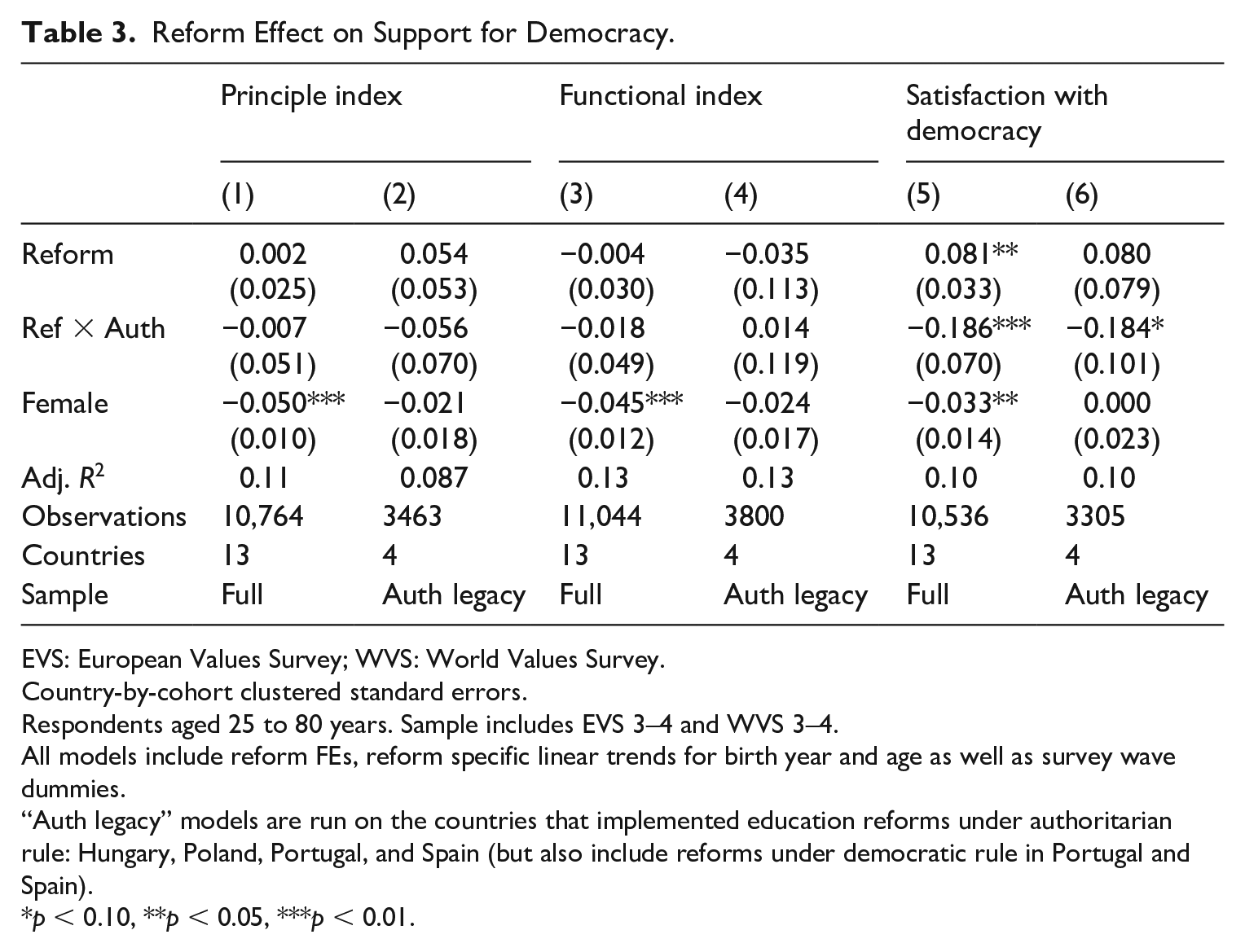
EVS: European Values Survey; WVS: World Values Survey.
Country-by-cohort clustered standard errors.
Respondents aged 25 to 80 years. Sample includes EVS 3–4 and WVS 3–4.
All models include reform FEs, reform specific linear trends for birth year and age as well as survey wave dummies.
“Auth legacy” models are run on the countries that implemented education reforms under authoritarian rule: Hungary, Poland, Portugal, and Spain (but also include reforms under democratic rule in Portugal and Spain).
p < 0.10, **p < 0.05, ***p < 0.01.
The middle panel of Table 3 reports the results of our investigation into functional support for democracy as measured by our functional index. Again, model specifications are in accordance with equation (1) for which Model 3 includes the full sample of reforms, and Model 4 restricts the sample to only those countries with an authoritarian legacy. In Model 3, we find no evidence that education reform, democratic or authoritarian, has any effect on functional support for democracy. Similar to the principle index results, the point estimates are nearly equal to zero, and no difference in the effect of education by regime type is detected. The magnitude of the Reform term estimate increases slightly in Model 4 compared with Model 3. Nonetheless, estimates are highly imprecise.
Finally, the right-side panel of Table 3 reports the results of the study of the effect of education on satisfaction with democracy. With this outcome, the results differ substantially from the principle and functional indices. Model 5 reports the results of the full sample where we find that the lower-order Reform term, the effect of education reform in democratic countries, is 0.081 and statistically significant at the 95% level. Furthermore, the interaction term, Ref × Auth, equals −0.186, significant at the 99% level. This implies that the individuals who were exposed to the reforms in democratic countries, and thereby were mandated to stay in school for a longer period of time, are more satisfied with democracy as a result. However, the exact opposite is true of those that were exposed to authoritarian education reforms. In this case, the cohorts that were born just after an education reform threshold, and therefore were obliged to study longer in an authoritarian context, are substantially less satisfied with democracy. In effect, past democratic education has resulted in greater satisfaction with democracy today, but past authoritarian education has resulted in less satisfaction with democracy. The marginal effects of democratic and authoritarian reforms, based on Model 5, are shown in Figure 2. The point estimate for the effect of democratic education on satisfaction with democracy is 0.081, significant at the 95% confidence level (p = 0.013). The marginal effect of education reform on satisfaction with democracy among authoritarian reforms is −0.104, significant at the 90% level (p = 0.095).
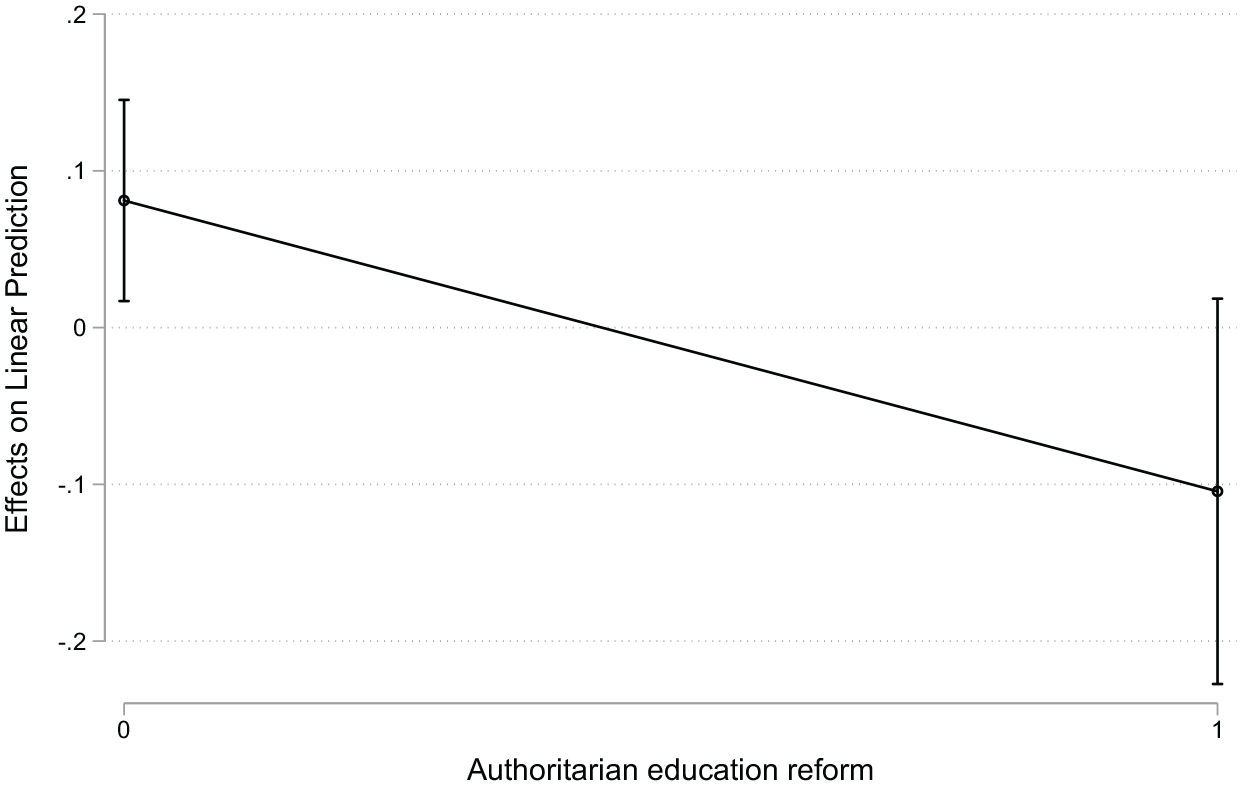
Marginal Effects Plot: Differentiating the Effect of Democratic and Authoritarian Reforms on Satisfaction With Democracy.
Model 6 repeats the analysis of Model 5 with the subset of authoritarian legacy countries. The results are consistent with the main specification in that a conditional effect is found. Indeed, both point estimates are effectively equal in magnitude to Model 5, even though the smaller sample implies more imprecise estimates. Nonetheless, the difference in effect between democratic and authoritarian reforms is still significant. We also limit the sample even further to only include Spain and Portugal and thus rely on the within-country variation in authoritarian and democratic education reforms. The estimates remain similar to Models 5 and 6 (see Supplemental Appendix D). The consistency of the point estimates offers support for our assumption that the authoritarian reforms provides a counter-factual case for the democratic reforms. That is, considering that effectively the same point estimates are found in the countries with an authoritarian legacy as in the full sample, it is unlikely that the conditional effect in Model 5 would depend on unobserved differences between countries with democratic and authoritarian legacies.
One possible interpretation of these results is that the governments in the countries with an authoritarian legacy simply perform worse compared with the countries with continuous democratic rule. That is, the difference in the effect of education on satisfaction with democracy reflects differences in institutional quality, of which the more educated are better informed. Given that the four authoritarian legacy countries have had less time to develop robust institutions and that they rank low in quality of government 2 (QoG), this would seem a plausible explanation. However, we argue that this interpretation is untenable for two reasons.
First, such an interpretation is inconsistent with the findings of Model 6 in which we restrict our sample to countries with an authoritarian legacy. As argued above, since these results are largely equivalent to the full sample results in Model 5, it is improbable that Model 5 results are driven by some other systematic difference between our sample of democratic and authoritarian states, including QoG. Second, we subset our sample of reforms to only include the countries belonging to the bottom half of the distribution of institutional quality. This sample consists of our four authoritarian legacy countries together with Italy, France, and Belgium. We then re-run Model 5 from Table 3 on this subset of the data to test the Satisfaction result. This test produces the same results—those individuals educated in a democratic system are more satisfied with democracy, whereas those educated in an authoritarian system are less satisfied. The fact that the results look similar in this subset of countries with a consistent level of QoG refutes the proposition that differences in institutional quality would account for the different effects of education conditional on regime type. See Supplemental Appendix D for these results.
We run additional robustness checks, which are also presented in the Supplemental Appendix. First, we limit our sample to reforms implemented before 1973 to test whether the timing of the reforms could confound our results, as all of the authoritarian reforms were implemented between 1960 and 1970. Reassuringly, the conditional effect is effectively unchanged (Table A.7). Second, we interact the authoritarian reform indicator with all other independent variables to test for any other conditional relationship with type of educational reform, which could confound the interaction between education reform and regime type. The results remain robust Table (A.8). Third, in order to test the sensitivity of our results to the width of the reform-window, we test to narrow these. Results are consistent with the main findings but less precise (Figures A.3–A.5). Fourth, we conduct Monte Carlo placebo tests for our first stage and main estimates for both democratic and authoritarian countries, which result in distributions centered on zero (Figures A.6–A.9). This finding should be interpreted as support for the assumption that the reforms produce exogenous variation in education; thus, it strengthens the causal interpretation of the results. Finally, we allow for country-clustered standard errors using the wild cluster bootstrap procedure. The coefficients in Model 5 in Table 3 remain significant (Figures A.14–A.19).
Mechanisms
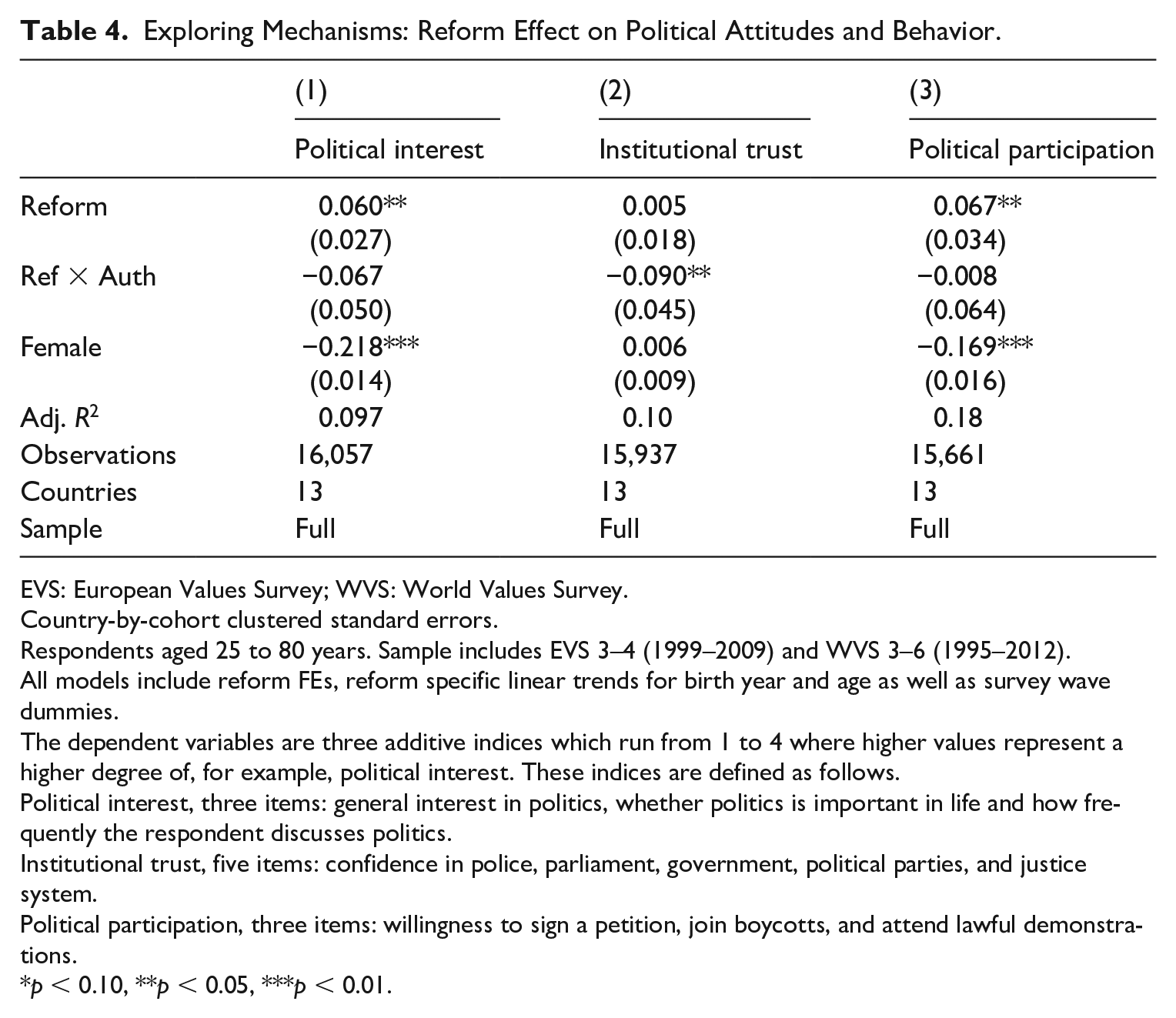
Our research design prioritizes causal inference and offers more limited opportunities for studying mechanisms. However, by exploring how the education reforms affect political attitudes related to democratic support as well as political participation, we may cast some light on the causal pathways. We do this by employing the same model specification as in Table 3 but exchanging the dependent variables for three indices on political interest, institutional trust, and political participation. Because of data limitations, the political participation index focuses on protests. The details of these indices can be found in Supplemental Appendix A, but they are also shortly described in Table 4 where we present the results of these models.
Exploring Mechanisms: Reform Effect on Political Attitudes and Behavior.
EVS: European Values Survey; WVS: World Values Survey.
Country-by-cohort clustered standard errors.
Respondents aged 25 to 80 years. Sample includes EVS 3–4 (1999–2009) and WVS 3–6 (1995–2012).
All models include reform FEs, reform specific linear trends for birth year and age as well as survey wave dummies.
The dependent variables are three additive indices which run from 1 to 4 where higher values represent a higher degree of, for example, political interest. These indices are defined as follows.
Political interest, three items: general interest in politics, whether politics is important in life and how frequently the respondent discusses politics.
Institutional trust, five items: confidence in police, parliament, government, political parties, and justice system.
Political participation, three items: willingness to sign a petition, join boycotts, and attend lawful demonstrations.
p < 0.10, **p < 0.05, ***p < 0.01.
We start by studying the reform effects on political interest in Model 1. These effects demonstrate a similar pattern as for the results for satisfaction with democracy in Table 3. Prolonged education under a democratic regime has a significant positive effect on political interest, whereas the similarly sized negative Ref × Auth interaction term implies that the effect of authoritarian education is null. Model 2 on institutional trust finds no positive effect of democratic education but a quite strong negative interaction, implying that authoritarian education has a considerable negative effect on institutional trust (marginal effect: −0.085, p = 0.04). Last, Model 3 shows that the effect of education reform on political participation is positive both for democratic and authoritarian education. However, the imprecise character of the interaction coefficient implies that the marginal effect of authoritarian reforms does not reach statistical significance (marginal effect: 0.059, p = 0.28).
The identified reform effects in Table 4 give some guidance in how to interpret our main results on democratic support. First, the negative effect of past authoritarian education on satisfaction with democracy cannot be related to that such education would lead to stronger political interest, as no such effect is found in Model 1. That is, this model lends no support for the interpretation that authoritarian education stimulates political concern and the attention paid to politics—in the same way as democratic education—but that such interest in the political process in countries with an authoritarian legacy would make individuals dissatisfied with democracy because of that they are disappointed with the democratic development in their countries (similar to the argument by Croke et al., 2016). Second, the negative effect of authoritarian education on institutional trust in Model 2 indicates that such education decreases trust in essential democratic institutions. It is in this context worth noting that the data in this study are collected before Hungary and Poland embarked on a route involving the dissolution of democratic institutions. In other words, the negative effect of authoritarian education on satisfaction with democracy and institutional trust cannot be a response to this development. A more likely interpretation is instead that authoritarian education leads to mistrust in democratic institutions, which in turn make persons less pleased with the general performance of the regime relying on these institutions. Nevertheless, both democratic and authoritarian education stimulate political participation, at least in the form of protests. It could be that this type of political participation, which is not directly connected to the traditional political institutions, is less affected by decreasing trust in these institutions than institutionalized political participation such as voting and engagement in political parties.
Discussion and Conclusion
The results of this study yield mixed support for the conditional hypothesis, which argues that the effect of education, for reasons of curriculum and context, should be conditional on regime type. The most definitive conclusion that we are able to draw from our findings is that we find no support for the modernization claim that education should positively impact support for democracy in a universal fashion. In fact, in neither democratic nor authoritarian countries do we observe that education reform led to greater principle support for democracy, notwithstanding that the reforms, relative to similar sets of reforms, had relatively substantial effects on education. On the other hand, in our examination of the effect of education on evaluations of regime performance, we find that the effect of education on satisfaction with democracy differs with the political context, much in line with the conditional hypothesis. Education under democratic rule leads to significant increases in satisfaction with democracy, but those educated under authoritarian rule become significantly less satisfied. With regard to specific measures of democratic performance, however, captured by our functional index, education again has no impact regardless of regime type.
The findings of this study diverge in several ways from what has been found in recent contributions, and thus have important implications for future research. The positive effect of authoritarian education on support for democracy and political interest found by quasi-experimental studies in single countries (Croke et al., 2016; Dang, 2019; Larreguy and Marshall, 2017) does not generalize to this set of thirteen European countries. Our results are also considerably less positive about the potential for education to generally promote support for democracy than are recent large cross-country comparative studies (Chong and Gradstein, 2015; Diwan and Vartanova, 2020). A possible explanation for this difference is that these studies rely on correlational evidence in identifying the effect of education. Future research should investigate whether these differences between the present study and recent research depend on factors such as the country context, the nature of specific education reforms, or the applied empirical approach.
Our results also have more general implications for both theory and politics of current and former authoritarian countries. The modernization theory has been one of the most influential theories of comparative politics, and the claim that education in particular is a modernizing force has been somewhat steadfast in the political science literature. However, at the individual-level this claim finds no empirical support. This implies that we should not expect education to cause support for democratic principles, regardless of the political context. It must be noted that this study focuses on compulsory schooling only and it may be the case that higher levels of education impact upon democratic values (Kennedy, 2009). Nevertheless, modernization theories focus primarily on mass education. As such, we should not expect to see increased demand for regime change when compulsory schooling is lengthened and average levels of education rise in the non-democratic world. Nor should we expect the educated to be the most ardent supporters of democracy after a transition to democratic rule. The implications of this finding are potentially large for the politics of countries that have undergone democratic transitions. As education obtained under past authoritarian rule leads to less satisfaction with democracy and decreases trust in democratic institutions, past authoritarian education could impede democratic consolidation.
Low satisfaction with democracy has also been linked to electoral support for anti-establishment parties of the political extremes—parties which are often opposed to liberal and representative forms of democratic rule found in Western European nations (Lubbers et al., 2002; Oesch, 2008). These forces have been present throughout much of Europe in recent decades, but their greatest success has arguably been found in some of the former communist states of Eastern and Central Europe such as Poland and Hungary. While authoritarian education has previously been championed as a major factor which led to the fall of the communist regimes (Nie et al., 1996), the results presented here show that authoritarian education may rather be acting as a brake on democratic development in the states of the former Soviet bloc.
We build upon prior research that has examined education and support for democracy cross-nationally or quasi-experimentally, but which has thus far yet to combine both of these design features. The combination of these two aims is precisely the strength of our study. It is, however, not without its limitations. First, it could be questioned whether the increase in education induced by the reforms is large enough to expect an impact on democratic attitudes, although we find effects on satisfaction with democracy. While the effect on education is bigger than what has been found in many similar studies that have identified effects on attitudinal and economic outcomes (e.g. Brunello et al., 2009; Cavaille and Marshall, 2019; d’Hombres and Nunziata, 2016), it is still relatively marginal compared with, for example, the difference between graduating from secondary or tertiary education. Hence, future research should try to find ways to credibly investigate the causal effect of larger educational increases—also on higher levels of education, including tertiary—to see whether such increases could have more substantial effects on democratic support.
Second, the sample for our main models is arguably quite small, and the data were collected long after respondents had undertaken their education, and in some cases, decades after transition from authoritarian to democratic rule. While some theories of socialization would argue that values are formed in pre-adult years and remain largely constant thereafter (Inglehart and Welzel, 2005; Sack, 2017), theories of lifelong learning argue that our preferences are shaped throughout our life span (Neundorf, 2010). In relation to the potential mechanisms for socialization that we discussed earlier, the former perspective would imply that if socialization in education is due to the influence of the curriculum, teachers, and administrators, or peer groups, the length of time from education to data collection should not matter—the values formed should largely remain. However, if education has a socializing effect on students because of the social and professional networks they end up in after education, this would imply that it is possible that our measures of democratic support are too far removed from the respondents’ time in education to capture any effect. But this raises further questions as to the validity of socialization theories with respect to education. If education effects are only visible in the short- to medium-term, is it reasonable to expect micro-level education to have an impact on macro-level outcomes? In spite of the possibility that values may have converged as a result of lifelong learning, we nevertheless find a regime-conditional difference on satisfaction with democracy. The fact that we find a significant effect, notwithstanding this possible convergence in values, should instill greater confidence in our conclusions. Another limitation with our empirical approach is that we focus on Europe and especially that our sample only includes four different authoritarian regimes. Further study is needed to verify whether the effects are similar in other contexts.
Finally, while our results with respect to regime performance are consistent with the conditional hypothesis, it remains unclear what specific aspect of education, or the context in which it is undertaken, acts as the causal mechanism. Our design prioritizes causal inference but hinders us from the study of the mechanisms to explain why—and why not—education under different circumstances affects support for democracy. Our study of the mechanisms is preliminary and warrants further research into the specific context-based mechanisms that are at work.
Supplemental Material
sj-pdf-1-psx-10.1177_00323217211067385 – Supplemental material for Educating Democrats or Autocrats? The Regime-Conditional Effect of Education on Support for Democracy
Supplemental material, sj-pdf-1-psx-10.1177_00323217211067385 for Educating Democrats or Autocrats? The Regime-Conditional Effect of Education on Support for Democracy by Marcus Österman and Darrel Robinson in Political Studies
Footnotes
Acknowledgements
The authors are grateful for comments from Sven Oskarsson, Mikael Persson, Johanna Söderström, Peter Thisted Dinesen, Katrin Uba, and Pär Zetterberg as well as two anonymous reviewers..
Declaration of Conflicting Interests
The author(s) declared no potential conflicts of interest with respect to the research, authorship, and/or publication of this article.
Funding
The author(s) disclosed receipt of the following financial support for the research, authorship, and/or publication of this article: This work was supported by the Department of Government at Uppsala University.

Supplementary Information
Additional Supplementary Information may be found with the online version of this article.
Content A. Descriptive statistics and notes on data. Table A1: Descriptive statistics for democratic reforms, main models in Table 3. Table A2: Descriptive statistics for authoritarian reforms, main models in Table 3. Table A3: Descriptive statistics for democratic reforms, mechanism models in Table 4. Table A4: Descriptive statistics for authoritarian reforms, mechanism models in Table 4. Table A5: Observations per survey wave for items on support for democracy. Figure A.1: Distribution of Dependent Variable Responses B. First stage. Table A6: IVS-data: reform effect on school-leaving age. C. Empirical analysis of dimensions of democracy support. Figure A2: Empirical evaluation of dimensions. D. Robustness checks. Table A7: Reform effect on satisfaction with democracy, alternative specifications. Table A8: Reform effect on democratic attitudes, full/flexible interaction models. Table A9: Reform effect on democratic attitudes, split sample models. E. Bandwidth tests. Figure A3: Changing reform-window bandwidth: estimates of the reform × authoritarian regime interaction coefficient. Based on Models 1, 3, and 5 in Table 3. Figure A4: Changing reform-window bandwidth: estimates of the effect of authoritarian reforms (split-sample model). Figure A5: Changing reform-window bandwidth: estimates of the effect of democratic reforms (split-sample model). F. Placebo tests Figure A6: Placebo test: distribution of the reform × authoritarian regime interaction coefficient, 10,000 simulations. Based on Model 1 in Table 3. Figure A7: Placebo test: distribution of the reform effect of authoritarian reforms (split sample model), 10,000 simulations. Figure A8: Placebo test: distribution of the reform effect of democratic reforms (split sample model), 10,000 simulations. Figure A9: Placebo test: distribution of the reform effect on school-leaving age/first stage estimates (split-sample model), 10,000 simulations. G. Event study. Figure A10: Event study: school-leaving age. Figure A11: Event study: support for Democracy—Principle index. Figure A12: Event study: support for Democracy—Functional index. Figure A.13: Event study: Support for Democracy – Satisfaction with democracy H. Wild cluster bootstrap. Figure A14: Wild cluster confidence interval for the Reform coefficient in Model 1 in Table 3 in the article. The reform effect in democratic regimes on principle support. 95% confidence. Figure A15: Wild cluster confidence interval for the Ref × Auth coefficient in Model 1 in Table 3 in the article. The regime-conditional reform effect on principle support. 95% confidence. Figure A16: Wild cluster confidence interval for the Reform coefficient in Model 3 in Table 3 in the article. The reform effect in democratic regimes on functional support. 95% confidence. Figure A17: Wild cluster confidence interval for the Ref × Auth coefficient in Model 3 in Table 3 in the article. The regime-conditional reform effect on functional support. 95% confidence. Figure A18: Wild cluster confidence interval for the Reform coefficient in Model 5 in Table 3 in the article. The reform effect in democratic regimes on satisfaction with democracy. 95% confidence. Figure A19: Wild cluster confidence interval for the Ref × Auth coefficient in Model 5 in Table 3 in the article. The regime-conditional reform effect on satisfaction with democracy. 95% confidence. I. Reform overview and sources. Table A10: Reform overview.
Notes
Author biographies
References
Supplementary Material
Please find the following supplemental material available below.
For Open Access articles published under a Creative Commons License, all supplemental material carries the same license as the article it is associated with.
For non-Open Access articles published, all supplemental material carries a non-exclusive license, and permission requests for re-use of supplemental material or any part of supplemental material shall be sent directly to the copyright owner as specified in the copyright notice associated with the article.
