



Abstract
How do organized criminal groups (OCGs) respond to military interventions intended to weaken and subdue them? In many cases, such crackdowns have proven counterproductive as OCGs militarize, engage in violence, and confront state forces directly. Existing studies have pointed to several explanations: inter-criminal competition, unconditional militarized approaches, and existing criminal governance arrangements. Much of this work, however, has focused on national, regional, or even municipal level variation and explanations. This article takes a micro-comparative approach based on 18 months of ethnographic research in a group of Rio de Janeiro favelas (impoverished and informal neighborhoods) divided between three drug trafficking gangs and occupied by the Brazilian military from 2014 to 2015. It argues that an active territorial threat from a rival is the primary mechanism leading OCGs to respond violently to military intervention. It also demonstrates that geographic patterns of recruitment play an important role in where OCG rivalries turn violent during intervention.
Keywords
Following Latin America’s transition to electoral democracy in the 1980s, the active role of the region’s armed forces in the domestic sphere was thought to be coming to an end. Over the ensuing decades, however, numerous countries in the region experienced an explosion of violence due in large part to the emergence and expansion of organized criminal groups (OCGs), including drug trafficking cartels, smuggling networks, militias, vigilante groups, death squads, and prison and street gangs. 1 Latin America now accounts for roughly a third of the world’s violent deaths (Muggah & Tobón, 2018) as the region’s police forces, in which citizens have little faith (Pion-Berlin & Carreras, 2019), have proven largely ineffective. As a result, many Latin American countries have increasingly called upon their militaries to intervene.
Examples are not hard to come by. The Colombian military has engaged in decades of operations against drug trafficking insurgents and cartels, among other targets. Since 2006, tens of thousands of Mexican military soldiers have been deployed to confront dozens of regionally concentrated drug trafficking organizations (Shirk & Wallman, 2015). Military involvement in domestic policing can also be observed in the various Mano Dura (Iron Fist) and Super Mano Dura campaigns to combat street and prison gangs in El Salvador, Honduras, and Guatemala (Holland, 2013; Wolf, 2017). Since the 1990s, the Brazilian military has engaged in a series of targeted interventions to combat drug trafficking gangs (Samset, 2014). Today, more than a dozen countries in the region maintain the active involvement of the military in domestic policing operations (Flores-Macías & Zarkin, 2021). Roughly four decades after the transition to electoral democracy, Latin America’s armed forces are once again a permanent fixture of domestic policing in the region (Muggah & Sullivan, 2018).
And yet, the effectiveness of the military in combating OCGs has increasingly come into question. Numerous scholars have found that instead of weakening OCGs and reducing violence, military interventions encourage many OCGs to further militarize, engage in violence, and, in some cases, confront state forces directly. These behaviors remain a puzzle for social scientists because, unlike Latin America’s guerrilla and insurgent movements of the past, OCGs are not motivated by larger political transformation and have no intention of taking over or breaking away from the state (Barnes, 2017; Kalyvas, 2015; Lessing, 2015; Phillips, 2018). Moreover, by militarizing and engaging in outright violence, criminal groups forego their desire for secrecy, increase the likelihood of further crackdowns, and, at least in the short-term, sacrifice profits. Why, then, do some criminal groups respond to military intervention with violence and confrontation?
Drawing on 18 months (June 2013 to November 2014) of ethnographic research in a group of Rio de Janeiro neighborhoods divided between three drug trafficking gangs and occupied by the Brazilian military, this article provides the micro-foundations of violent OCG responses to military intervention. I argue that the fear of losing territory to a rival is the primary reason OCGs respond violently to military interventions. I distinguish between active, latent, and absent territorial competition among criminal groups, then show how these different threats shape criminals’ decision to fight, hide, or flee during military intervention. Where OCGs face an active threat from a rival, they will fight to defend their territory at all costs, including confronting military forces directly. OCGs that face only a latent rival threat will hide by demilitarizing and maintaining low profiles to avoid military enforcement. Finally, OCGs which are unconcerned with losing their territory to a rival are more likely to flee, displacing to other territories where they can wait out military intervention. I also find that patterns of recruitment and OCG member connections to specific territories and communities determine when and where existing rivalries turn active during military intervention.
Overall, this article develops a generalizable theory of criminal territorial control and competition while demonstrating the utility of micro-level ethnographic research in adding causal depth and specificity to existing bodies of research within comparative politics. This article also intervenes in current policy debates concerning the use of the military to combat OCGs. First, by better understanding how OCGs respond to military intervention, we can identify contexts in which such militarized strategies are likely to be especially ineffective. Second, holding militaries accountable for their behavior during intervention will require closer documentation and examination of the on-the-ground tactics of military forces. And third, I find that even “softer” versions of military intervention (e.g., “hearts and minds” or developmental approaches), are insufficient in gaining the support of marginalized communities in which interventions often occur. While there is perhaps a role for the military to play in combating some OCGs (see Pion-Berlin, 2017), this study finds military interventions woefully unprepared and ill-equipped to provide longer-term solutions to the presence of OCGs in Latin America.
The rest of the article is organized as follows. The first section evaluates existing explanations for violent OCG responses to military intervention. Section two develops a theoretical framework concerning the logic of criminal territorial control and the consequences of military intervention. In the third section, I summarize the research design and methods employed during ethnographic fieldwork in Complexo da Maré, Rio de Janeiro. I then describe the territorial control and competition between Maré’s three drug trafficking gangs prior to the arrival of the military and outline Maré’s occupation and the various strategies the Brazilian military employed to combat the local OCGs. In section six, I analyze how and why each of Maré’s three drug trafficking gangs adapted to occupation. Section seven then discusses these findings in light of the theory and explores several alternative explanations. The conclusion considers the possibilities and limitations of military interventions to combat OCGs, more generally.
Evaluating Existing Explanations
There are three prevalent explanations for why Latin American OCGs respond violently to military intervention. First, some scholars have found that they exacerbate inter-criminal competition. A series of articles focusing on the Mexican Drug War have argued that the decapitation (arrest or death) of OCG leaders by military forces leads to increased violence between and within cartels due to succession struggles, fragmentation, and infighting (Calderón et al., 2015; Guerrero-Gutiérrez, 2011; Phillips, 2015; Pion-Berlin, 2017; Rios, 2013). Beyond decapitation, other scholars have pointed to various mechanisms through which military interventions can produce increased inter-criminal violence, including the loss of state protection (Snyder & Duran-Martinez, 2009; Trejo & Ley, 2018), shifting drug trafficking routes and territories (Dell, 2015), the weakening of incumbent criminal territorial control (Dell, 2015; Osorio, 2015; Rios, 2013), as well as the increasing profitability of the drug trade (Castillo & Kronick, 2020). Although they point to slightly different causal mechanisms, these works highlight the importance of inter-criminal competition in how OCGs respond to military intervention.
A related literature explains the violent response of OCGs by focusing on the nature of the intervention itself. According to Lessing (2017), unconditional militarized crackdowns (i.e. when state forces attempt to repress OCGs irrespective of their violent behavior) incentivize these groups to confront the state directly. They do so to demonstrate to state actors—both low-level enforcement agents as well as policymakers—the cost of repression and to try to reduce the price of ongoing bribery schemes. Alternatively, Durán-Martínez (2018) argues that the involvement of the military in domestic operations fragments the state security apparatus and, without a reliable source of protection or enforcement, drug trafficking organizations are more likely to militarize and engage in highly visible forms of violence.
A final explanation concerns the role of criminal governance arrangements in how OCGs respond to military intervention. Trejo and Ley (2021) argue that Mexican cartels seek control over local governments, populations, and territories because it provides them with better information, higher levels of security, and more illicit revenue streams. Especially amid intense crackdowns by the state and conflict with rivals, the authors find OCGs will ramp up their violence to gain or regain control over populations and territories. In their study of Rio de Janeiro, Magaloni et al. (2020) argue that militarized interventions against OCGs which maintain a local monopoly of violence and cooperative relations with residents tend to backfire because they undo a stable form of order. In cases where the OCG does not already collude with public security actors, this may even lead to direct confrontations between the state and OCGs.
Together, all of these studies have expanded our understanding of OCG behavior amid military intervention by demonstrating the strategic considerations of these organizations and their members. And yet, nearly every one of these studies has approached this phenomenon from either the national, regional, or municipal level. 2 While some dynamics and mechanisms can only be tested at these higher levels of analysis, there are several issues with such approaches. For one, OCGs seldom operate at these higher levels of analysis but are mostly confined to smaller areas within municipalities—either marginalized and impoverished urban neighborhoods or along rural drug trafficking routes. While it is true that some OCGs can span multiple sub-national regions, they are often highly decentralized organizations, comprised of a patchwork of smaller gangs and cells, not acting under the direction of a centralized leadership (see Calderón et al., 2015; Durán-Martínez, 2018; Trejo & Ley, 2018). Instead, most OCG behavior is shaped by much more local factors and can vary significantly across and within these overarching organizations.
Second, to evaluate the impact of military interventions, scholars conducting research on this topic have mostly used off-the-shelf public security data of overall homicides, “drug-related homicides,” or other aggregate categories because they are considered the most reliable measures of violence. Such public security statistics should be used with caution. They seldom accurately differentiate between types of victims or delineate the motivations behind the violence (Albarracín & Barnes, 2020; Shirk & Wallman, 2015). Criminal groups are also known to hide their violence and victims (Durán-Martínez, 2018). Aside from the possibility of spurious results, such aggregate statistics also mean that many of the various causal mechanisms listed above are observationally equivalent. For instance, imagine a municipality that experiences an increase in homicides following a military intervention. We cannot automatically assume that OCGs are responsible for this violence as existing studies have shown that, in some cases, much of the violence can be attributed to the military (Flores-Macías, 2018) or other sources (Vilalta & Muggah, 2014). Even if OCGs do become more violent, however, does this mean that all of the OCGs within that territory became uniformly more violent? Could it be that some but not all engaged in more violence? Or could it be that one OCG became much more violent while others became less or were equally violent as before? By using aggregate statistics at even the municipal level, it is impossible to know.
Third, because existing studies have mostly taken a birds-eye view of this phenomenon, they seldom analyze the on-the-ground military tactics and operations intended to combat criminal organizations and reduce violence. Aside from overarching policies or structures, such as decapitation (Calderón et al., 2015; Phillips, 2015), conditional versus unconditional (Castillo & Kronick, 2020; Lessing, 2017), or cohesive versus fragmented (Durán-Martínez, 2018), it is still unclear what military intervention actually entails. Do soldiers use overwhelming force to occupy neighborhoods or villages where criminal groups operate or do they engage in more targeted operations? Do they maintain manned checkpoints, conduct house-to-house searches, or engage in more indiscriminate forms of violence? Do they seek to interdict drugs and other illicit goods or are they focused on capturing and possibly killing OCG members? What are their rules of engagement if and when criminals resist? Existing studies of militarized intervention seldom capture such variation and treat them as mostly uniform across space and time. Further work must document and analyze the various activities of military troops so that we can better understand their impact on OCGs and the communities in which they operate.
The Logic of Criminal Territorial Control
This article advocates for a greater analytical focus on the micro-level behaviors and calculations of OCGs. 3 Most OCGs throughout the world operate in areas where the state is either unable or unwilling to enforce its rule of law due to difficult geography, the prohibition of certain markets and activities, or the ethnic or social distance between marginalized populations and the state (Skaperdas, 2001). The size of these territories varies wildly. Most are no larger than a prison wing, street corner, or city block, though some can grow to the size of entire urban neighborhoods or rural municipalities. A wide variety of groups with very different origins and motivations can exist within these spaces. “What holds them all together,” according to Arias, “is a willingness to seek to control and defend a particular territory as an operational base for illicit activities” (2017, p. 20). However, unlike territorial control established by insurgent or rebel groups, criminal territorial control does not necessarily come at the expense of the state. In fact, criminal groups are perfectly content to exist within and even work with the state so long as they can continue their illicit activities. Instead, criminal territorial control is almost entirely focused on ensuring their exclusive access and activities vis-à-vis other criminal groups. 4 Such control allows them to monopolize illicit markets, multiply their economic interests, and expand their political and social influence within those areas (Arias, 2017; Gambetta, 1993; Skarbek, 2014; Venkatesh, 1997). It also offers members higher levels of security by allowing them to monitor and prevent residents from collaborating with either state authorities or their enemies (Arjona, 2017). 5
Existing work on OCGs has yet to fully conceptualize territorial control of this type. Scholars have mostly differentiated between contexts in which one OCG has consolidated exclusive territorial control and those in which multiple groups are competing for it: low or high consolidation (Arias, 2013), low or high coordination (Moncada, 2016), monopolistic or competitive relations (Durán-Martinez, 2015), and monopolized or contested territories (Magaloni et al., 2020). While such dichotomous frameworks are useful for mapping the broad contours of criminal territorial control and competition, there are two lingering issues with such understandings.
First, existing conceptualizations have mostly assumed that where territories are divided between multiple criminal groups, violent contestation is inevitable. However, like other armed groups the world over, OCGs are known to negotiate, make peace, forge alliances, and develop arrangements to divide territory amongst themselves even as they retain their autonomy (Aspholm, 2020; Idler, 2012; Skarbek, 2014; Vargas, 2016). High degrees of criminal territorial control can, therefore, co-exist with the presence of multiple OCGs and otherwise competitive environments. Second, the relationship between control and contestation remains unclear. Does contestation mean that multiple groups are operating in and fighting to consolidate control of the same territory? Or are groups located in two or more distinct territories engaged in campaigns of territorial conquest? 6 Is one group the primary aggressor while the other is playing defense or are both equally engaged in efforts to conquer territory? Such nuances have mostly been left out of existing conceptualizations.
Building on these insights, I advocate for an OCG-centered approach. I conceptualize criminal territorial control as the degree to which an OCG faces a threat to their exclusive access to a delimited geographic area. I differentiate between three types of threat: active, latent, and absent. An active threat is when a criminal group faces a rival that is intent on taking over a territory in which they operate. Active competition, therefore, can include everything from all-out invasions, skirmishes, and drive-by shootings to targeted kidnappings and assassinations, as well as more subtle attempts to infiltrate and take over a territory. Active competition always involves the use or threat of violence. A latent threat, by contrast, applies to contexts where an OCG does not currently face a rival that is actively trying to take over and exclude them from a territory but due to their proximity or a history of conflict and territorial turnover, the possibility of territorial contestation is high. Although violence may continue to occur in these contexts, it is not related to territorial conquest. Finally, absent threat means an OCG faces no competitors for territorial control. This is often due to a group having successfully defeated and absorbed all local rivals or due to their relative geographic isolation. Another possible reason for the absence of territorial threat is due to stable alliances or arrangements with surrounding criminal groups or with the police. Any violence which occurs in these areas is also unrelated to territorial disputes. While I do not theorize the underlying sources of these competitive dynamics, I assume that they vary across space and time. Criminal groups can face multiple threats from different groups, just one, or none at all. Each type can persist for long periods or shift rapidly from one to another.
Military interventions occur in any of the preceding scenarios. States can call on their militaries to confront multiple OCGs in the midst of violent battles for territorial superiority, in areas divided between rival groups but in which territorial contestation is not ongoing and against a single dominant OCG without any rivals. We can assume that military intervention is an attempt by the state to reassert its monopoly of violence by eliminating criminal territorial control. And yet, even the most well-designed military interventions are incapable of fully accomplishing this goal. While the military may arrest or kill numerous criminal group members, crack down on illicit markets and behaviors, and reimpose the state’s ostensive control within an area, criminal territorial control is seldom directly threatened by state intervention of this type. Why?
For one, because the military never attempts to take over existing illicit markets, an OCG’s source of revenue and, thus, its raison d’être remains intact even though it may be diminished in the short-term. In addition, criminal groups are often deeply embedded in the marginalized communities where military interventions occur. They maintain lasting connections to residents through familial and social connections and may even have their outright support against a state that is viewed as abusive and illegitimate (Felbab-Brown, 2010). Finally, military crackdowns are always short-term interventions and, thus, do not constitute a permanent and lasting solution to the problem of the lack of state enforcement in these areas.
While not a direct threat to criminal territorial control, military interventions have been known to fracture criminal organizations, upset local balances of power, and destabilize existing alliances and arrangements between criminal groups and with the police. The military’s ostensive control also complicates an OCG’s ability to maintain their exclusivity by preventing them from effectively monitoring and defending their territory against rivals. Thus, military crackdowns have significant consequences for criminal territorial control and competition. If a territorial threat becomes or remains active following a military intervention, an OCG is presented with a dilemma. They can flee, in which case they have likely lost their territory for good. They can hide and hope that the military prevents the takeover by their rival. Or they can fight, in which case they not only risk their lives confronting their rival but are more likely to be arrested or killed by military forces as well.
I argue that an OCG’s decision to fight, hide, or flee in response to a military crackdown is dictated by the nature of the territorial threats they face. An OCG which confronts an active territorial threat post-intervention will fight even if it means confronting the military. They have to respond this way because a rival OCG is very much capable of accomplishing what the military cannot. They will take over existing illicit markets, embed themselves in local networks, and incorporate, kill, or expel all rival OCG members and, if necessary, their families and social networks. They present a very direct and existential threat to an OCG and its members in a way that even the world’s most powerful militaries do not. Thus, OCGs must fight to defend their territory or they are likely to lose it for good. Alternatively, OCGs that only face latent threats post-intervention will go into hiding to avoid enforcement by the military. They will stay in their territory because they need to be ready if and when a latent threat turns active, which may or may not occur during intervention. A criminal group which faces no threats to their territorial control following intervention are likely to flee to avoid enforcement by the military. Due to the absence of a territorial threat, they can wait to return until the military leaves.
Research Design and Methodology
This article employs a comparative ethnographic research design. By ethnography, I refer not just to interviews and long-term fieldwork but the use of participant observation and “immersion in the place and lives of people under study” (Wedeen, 2010, p. 257). Many ethnographers have focused on single case studies to highlight complexity and contextual meaning while mostly ignoring case comparisons and explicitly refuting claims of generalizability. In a recent innovation, however, Simmons and Smith have argued that ethnographers can better engage with broader theoretical debates by conducting “ethnographic research that explicitly and intentionally builds an argument through the analysis of two or more cases” (2019, p. 341). This article takes just such an approach by comparing how three separate drug trafficking gangs responded to the exogenous shock of military occupation with an eye toward understanding the behaviors and rationales of OCGs more broadly. To further elucidate and support the causal mechanisms, it also leverages within-case temporal and spatial variation in how each of the gangs responded to military intervention.
This article draws on 3 years of ethnographic fieldwork in Rio de Janeiro, Brazil and 18 months of participant observation in Complexo da Maré, a sprawling complex of 16 favelas (impoverished and informal communities) and housing projects, in which three separate drug trafficking gangs operate. In June of 2013, I moved to Nova Holanda (see Figure 1), one of three contiguous neighborhoods, controlled by a gang affiliated with the Comando Vermelho prison-based faction (referred to here as CVNH).
7
Although I resided in this one gang’s territory, I traveled extensively throughout Maré, spending several days a week in each of the other gang territories, one of which was also affiliated with the CV faction and located in an adjacent neighborhood named Parque União (thus, CVPU) while the third gang was connected to a rival faction, Terceiro Comando Puro (TCP). For the first 9 months I resided in Maré, I engaged in extended participant observation activities in each gang territory while interviewing gang members, community leaders, and a variety of local residents. Map of organized criminal group territories in Complexo da Maré.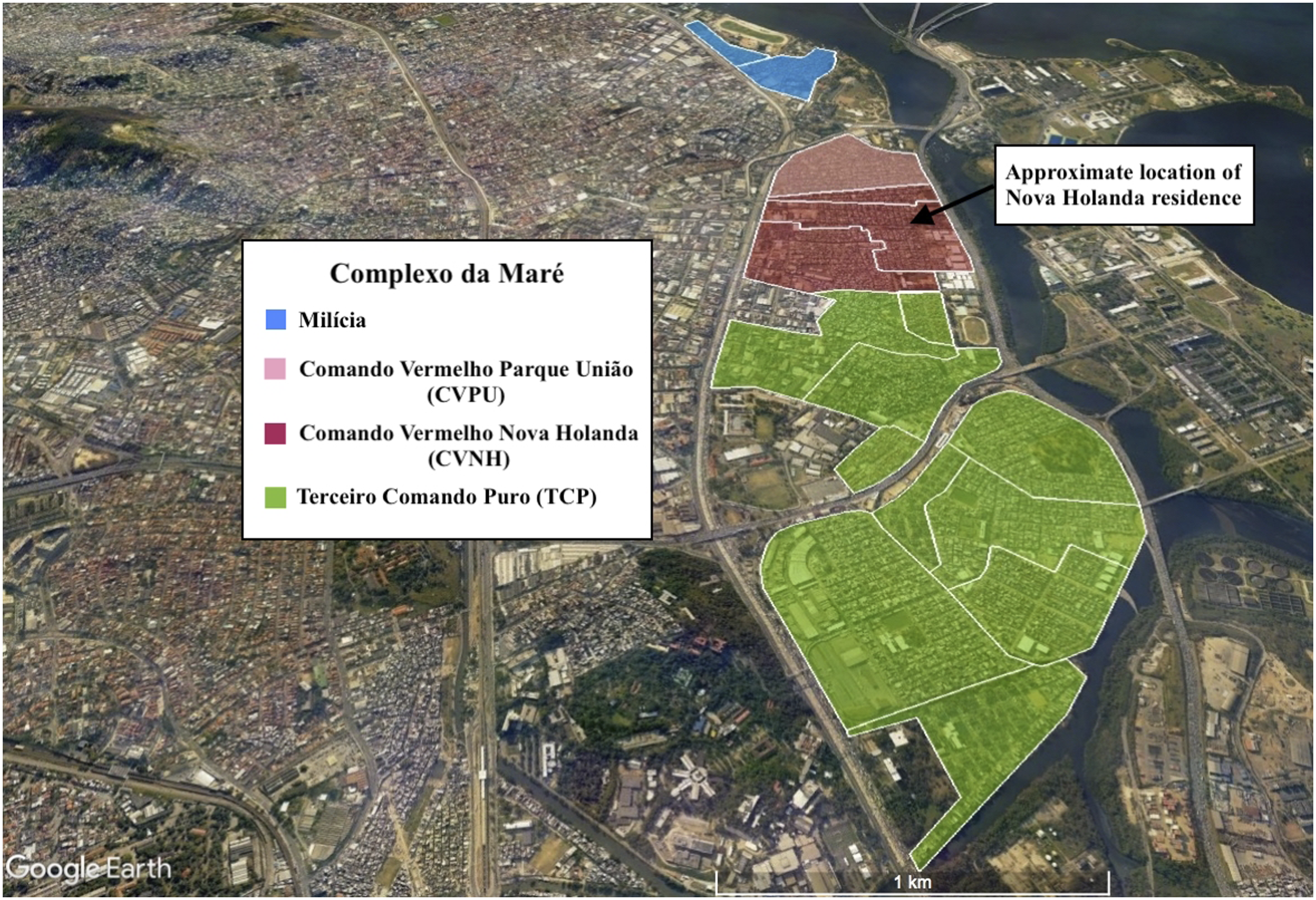
On April 5th, 2014, nine months after I moved to Maré, 2500 Brazilian army and marine troops invaded and occupied the entirety of Complexo da Maré. The intervention represented the culmination of Rio’s once-heralded Police Pacification Units (UPPs), a public security program intended to recapture the state’s monopoly of violence from drug trafficking gangs in hundreds of favelas throughout the city. According to Rio’s public security apparatus, the military’s occupation was intended to be short-term—just four months—to weaken gangs and build local capacity before the installation of four community policing units. 8 This would never come to pass. Instead, the military occupied Maré for 15 months, during which time they conducted frequent searches and seizures, around-the-clock patrols, and installed fixed and mobile checkpoints combined with “hearts and minds”-style counterinsurgency tactics. I continued my fieldwork during this period, living in Maré for another 9 months, concluding initial data collection in November of 2014. I returned in July and August of 2015, immediately following occupation, and again in 2017 and 2018 for several more months of follow-up research.
During the original fieldwork period, I spent 24 hours a day, seven days a week in my field site. To the extent that a gringo (white foreigner) could, I lived like other favela residents. I shopped at local supermarkets, ate at Maré’s restaurants, used local forms of transportation, and attended numerous music performances, sporting events, and other cultural events. I became intimately familiar with each of Maré’s 16 neighborhoods by walking or biking through the labyrinth of streets and alleyways. Prior to military occupation, I attended dozens of gang-organized concerts (bailes), birthday parties, and holiday celebrations while subjecting myself to gang control and authority. During military occupation, I attended numerous meetings and events organized by the military and was subject to their daily operations. 9 Such an immersive and participatory methodology allowed me to document how each of Maré’s gangs reacted to military occupation, including their illicit activities, territorial presence, and use of violence. A supplementary appendix provides further information and transparency about the ethical, logistical, and methodological choices I made during and after fieldwork.
Given Maré’s large size (more than one square mile) and population (approximately 140,000 residents), a comprehensive accounting of occupation through participant observation alone was not possible. Therefore, I also collected several other forms of data. I conducted 205 semi-structured interviews, 73 of which were with current and former gang members, 62 with community leaders, 58 with a cross-section of residents, and 12 more with scholars, researchers, and police. 10 I identified most of these research subjects through a “snowball sampling” of the various social networks in which I became embedded. Interviews were conducted in private and lasted from 30 minutes to more than 3 hours. I did not record the interviews due to security concerns but instead took copious notes during the interviews, which I immediately typed up afterward. 11 The names and dates of these interviews can be found in the endnotes. All names are pseudonyms and I have avoided using any specific information in the text which could be used to identify these individuals. Beyond these semi-structured interviews, I also engaged in hundreds of less formal conversations and thousands of daily encounters and interactions across all three gang territories that I wrote up in more than 400 pages of field notes. Finally, I supplement all of these personal observations and interviews with data collected from local newspapers as well as studies conducted by local NGOs. 12
Criminal Territorial Control in Complexo da Maré prior to Military Occupation
To fully understand how Maré’s gangs responded to military occupation, we must first delve into the nature of gang territorial control and competition prior to the arrival of the military. Maré’s gangs first emerged in the 1960s and 1970s as loosely organized groups of young men that engaged in armed robberies and/or the sale of marijuana. By the early 1990s, several local gangs were integrated into two separate prison-based factions, Comando Vermelho and Terceiro Comando, which had emerged during Brazil’s dictatorship (Amorim, 1993; Arias, 2006). 13 Through these affiliations, Maré’s gangs gained access to Andean cocaine, more powerful weaponry, and, like other gangs throughout the city of Rio, expanded from small groups of men to much larger, younger, and more militarized organizations. 14 They also began to more violently compete with one another and gradually consolidate their dominant position within these neighborhoods. Over the next two decades, inter-gang violence and competition was a near-constant in Maré and led to significant territorial turnover, especially during the 1990s. By the late 2000s, however, Maré’s criminal territories had stabilized and, despite some ongoing violence and competition, three drug-trafficking gangs as well as a milícia held consolidated control of their turfs prior to military occupation in 2014 (see Figure 1). 15
Maré’s gangs maintain a constant and militarized presence within their territories. During the first 9 months of fieldwork, I observed gang members ostentatiously displaying their semi-automatic weapons and riding motorcycles up and down the streets of their turf every day. All three of the gangs had placed numerous olheiros (lookouts) and fogueteiros (firecrackers) to monitor the entrances to their territories for police and rival gangs members. Each gang sold drugs at roughly three dozen open-air markets called bocas de fumo (literally, mouths of smoke), which were little more than small plastic tables with bags of different quantities of marijuana, cocaine, and crack. One or two gang members called vapores (sellers) were responsible for the exchange of money and drugs while gerentes (managers)—with the help of endoladores (packagers)—cut the drugs into different quantities, packaged them, and then collected the profits that were eventually passed onto the Dono (gang leader). Several heavily armed soldados (soldiers) were always located around the bocas, providing security. 16 Prior to occupation, most of Maré’s bocas operated 24 hours a day with the exception of a few hours in the early morning. All of these bocas were stationary and several had been located in the same place for more than two decades. 17 During my fieldwork, the three gangs also sold significant quantities of drugs at massive street parties, called baile funks, held on weekend nights and attended by thousands of local youth. 18
While much of gang control is derived from their militarized presence and ability to prevent rivals from entering their territory, they also maintain more intimate relations to local populations. First, all three of Maré’s gangs had significant familial and associational networks within these communities. Most gang members were born and raised in these neighborhoods and many of the more senior members have several girlfriends with whom they had multiple children. Each of Maré’s gangs also implemented an informal though highly effective form of social order. For the most part, gang members refrained from abusing or predating on residents unless they suspected them of collaborating with their rivals or the police. Gang members were also often involved in the arbitration of disputes between residents and prohibited interpersonal violence, theft and robbery, as well as some cases of domestic or sexual violence. Gang punishments for such transgressions included threats, beatings, expulsion, or even death depending on the severity of the infraction and the specific persons involved. 19 The gangs also offered some residents access to informal and illicit markets and, to varying degrees, engaged in limited forms of welfare. Some of the poorest families received a cesta básica (monthly food basket) from gang affiliates and members of all three gangs were known to distribute small sums of money or other forms of economic assistance. Although some residents overtly supported, collaborated with, or received benefits from the gangs, I found that most of Maré’s 140,000 residents tried to avoid any direct involvement while remaining obedient of their rules. 20 A small minority were either overtly critical or willing to denounce the gangs through an anonymous hotline (Núcleo Disque Denúncia, 2010).
Comparison of OCG Territories in Complexo da Maré.
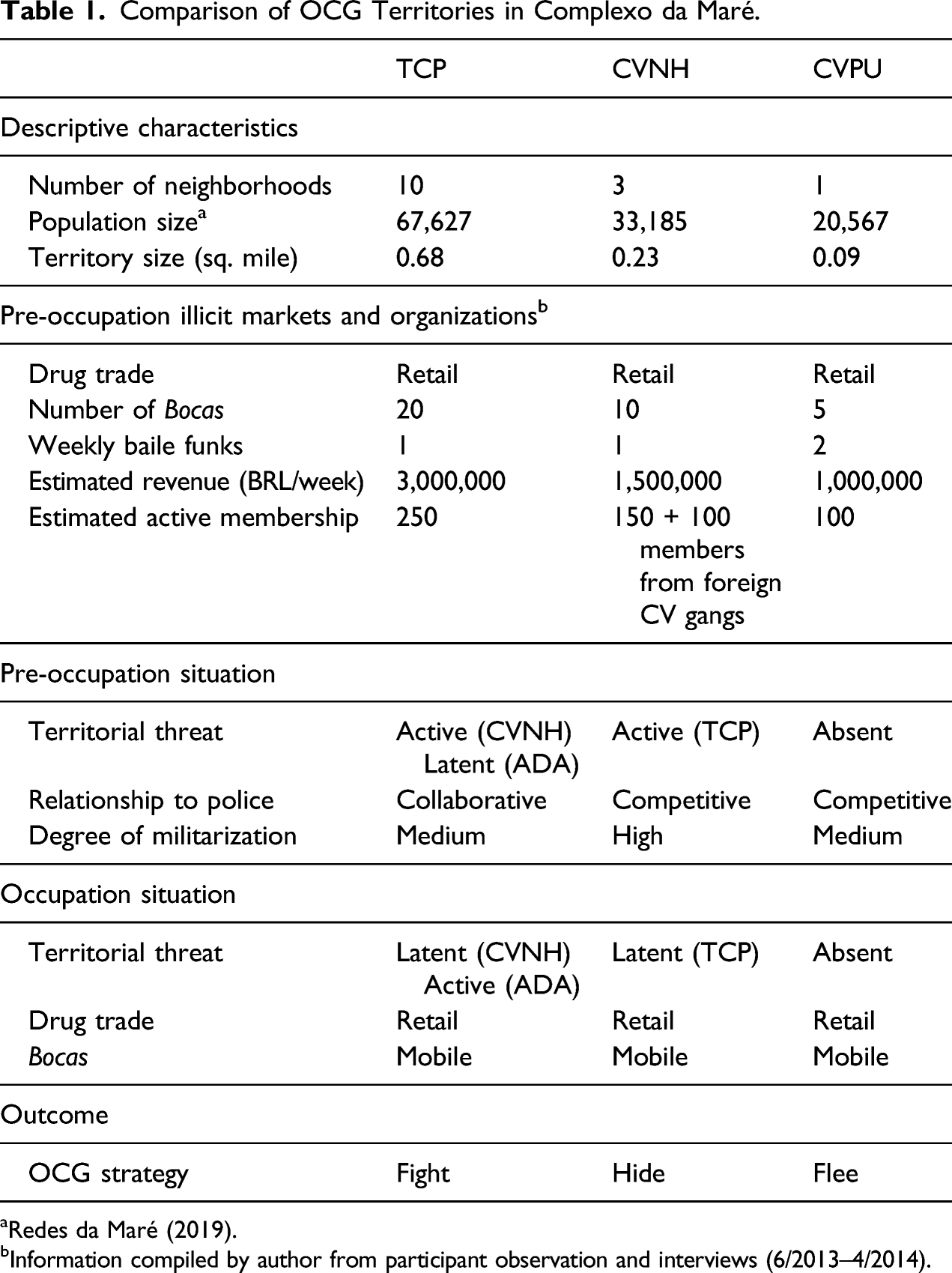
bInformation compiled by author from participant observation and interviews (6/2013–4/2014).
TCP: Conquest and Collusion
In the years leading up to military occupation, TCP was the largest and most profitable gang in Maré. It controlled 10 of Maré’s neighborhoods, home to roughly 68,000 residents. This was not always the case. In early June of 2009, the TCP gang, which at the time only controlled four of Maré’s neighborhoods (see Figure 2(a)), mounted an all-out invasion of their Amigos dos Amigos (ADA) rival’s turf, managing to gain a small foothold in the area (Figure 2(b)).
21
Over the course of the next several weeks, in extremely violent gun battles, TCP slowly—block by block—conquered the rest of ADA’s territory.
22
While some low-level members were absorbed into TCP, ADA’s leaders and more senior members fled and found refuge in Complexo do Caju, another set of favelas located less than a mile from Maré, from which they would mount several unsuccessful attempts to retake their former turf in the subsequent years.
23
(a) Complexo da Maré Territorial Control in 2009. (b) Terceiro Comando Puro conquest of Amigos dos Amigos in June of 2009.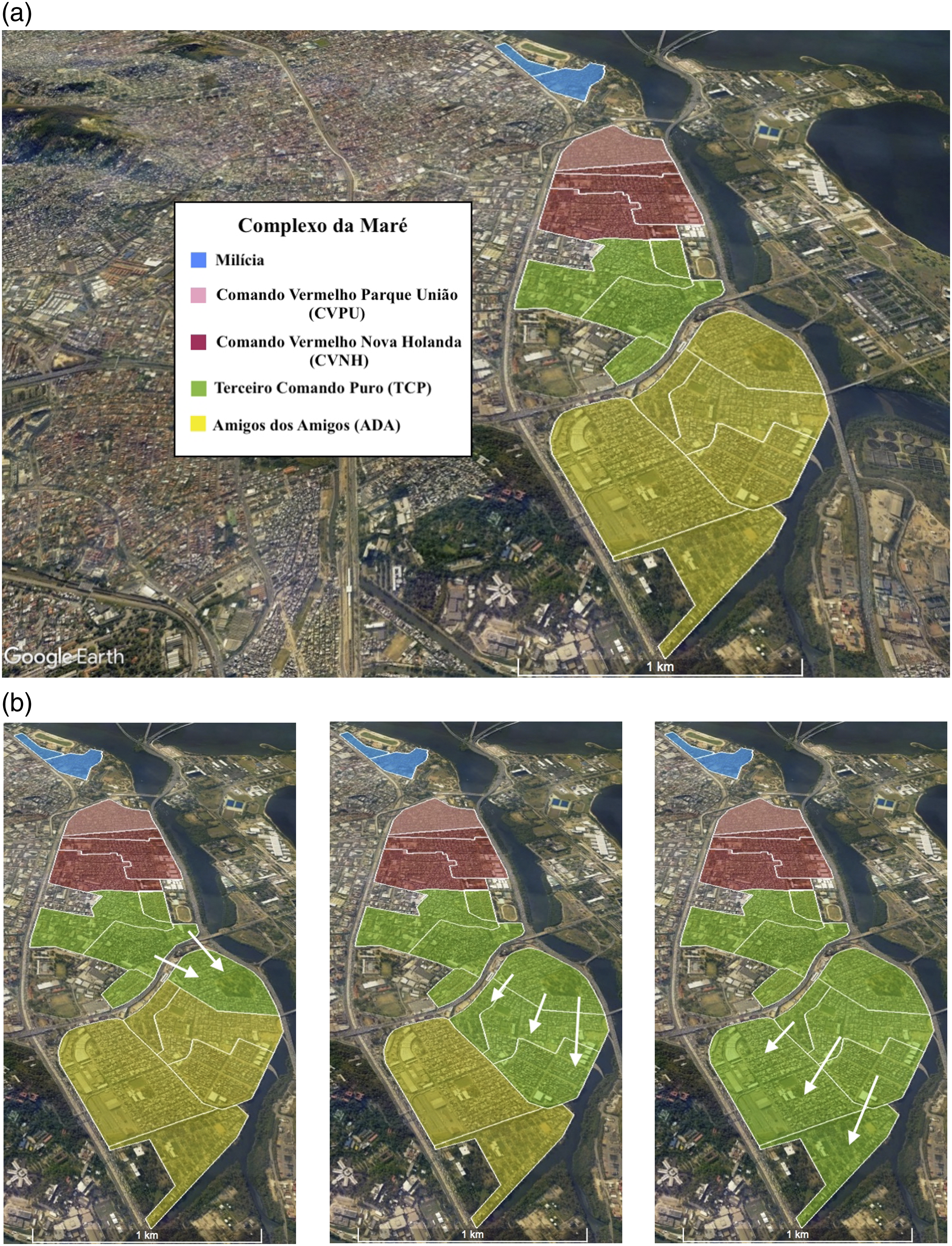
Immediately following TCP’s conquest, they installed more than a dozen new bocas and the gang’s weekly revenue ballooned to an estimated R$3 million. 24 With these expanded drug profits, TCP purchased more weapons and hired more than 100 local youth to defend their territory, effectively tripling the size of the gang to an estimated 250 members. 25 The leader of the TCP gang and many of the most senior members also moved their homes to these neighborhoods, further consolidating their presence within the area. 26 In addition, the gang sought to cleanse their new territory of “informants” who may have provided support to the ADA gang. 27 Josué, in charge of TCP’s security at the time, told me the gang had killed roughly 30 residents suspected of such behavior in the years after the takeover. “We killed the men but if it was a woman, it depended on what they said.” 28 I asked how they knew who was an informant. “The other residents denounced them,” he told me. 29
After 2009, the TCP gang also developed a more collaborative relationship with the public security apparatus. In interviews with several TCP gang members, they described how the gang paid an estimated 20% of their total revenue, to the local Police Battalion and another R$100,000 to the Special Police Operations Battalion (BOPE), an elite trained counter-gang unit akin to the SWAT in the US, which had moved their headquarters to an adjacent military base in 2011 (see Figure 3).
30
According to Josué, “The bribe (arrego) was usually paid under the Yellow Line (Linha Amarela) bridge. Their car would pull up and a mototaxi would make the dropoff. We paid a bunch of the shifts (plantões) that way. The [police] commanders were even in on it.”
31
Internal investigations later revealed that several BOPE members were, in fact, receiving regular bribes from TCP and at least 10 police inside the local Police Battalion were suspected of involvement as well.
32
Map of Complexo da Maré with BOPE headquarters (installed August of 2011).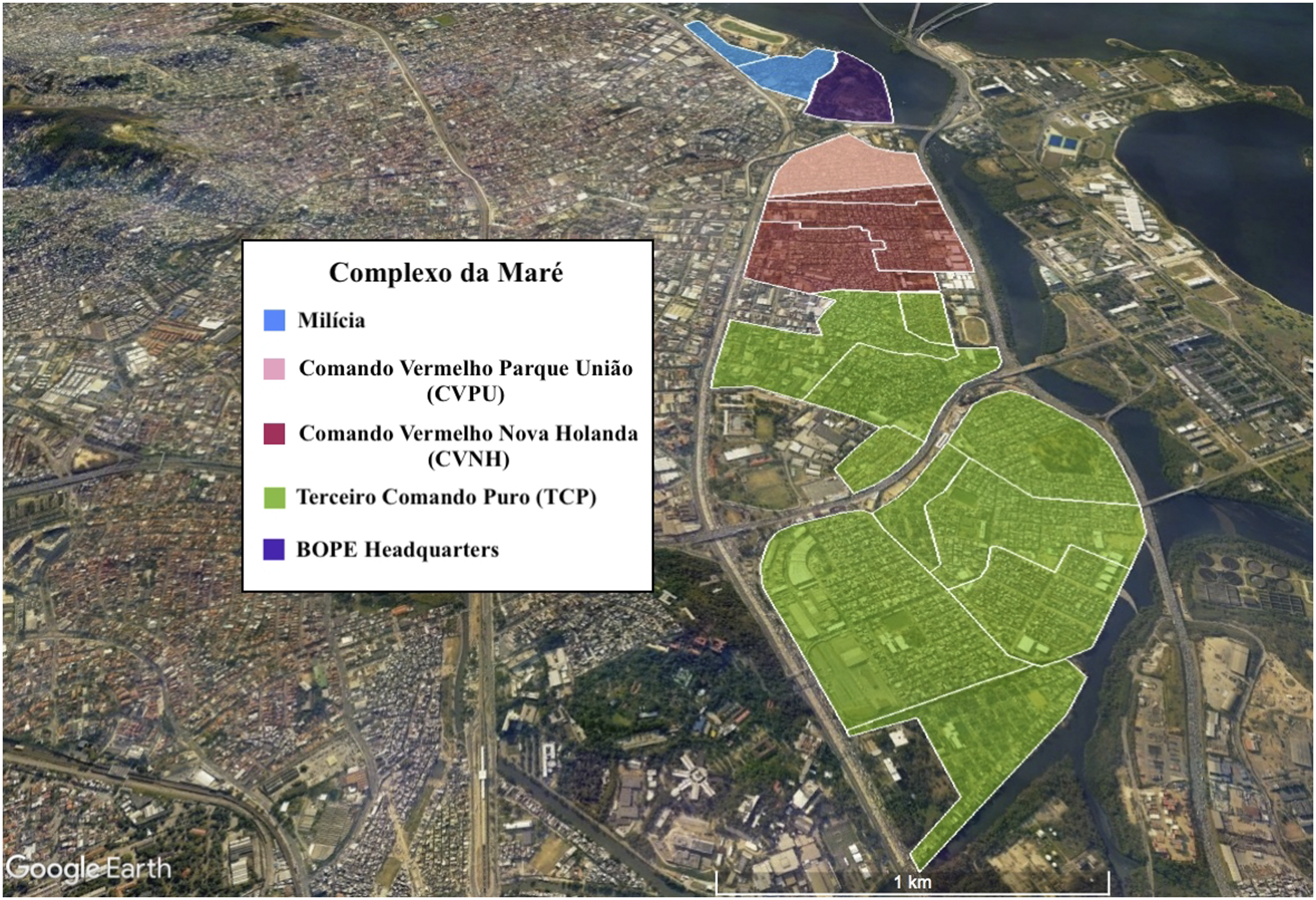
In the months leading up to Maré’s occupation, however, TCP’s close connection with these local police units did not prevent the state’s public security administration from taking a stronger hand in preparing the entire area for its occupation. A variety of special police units began to engage in more frequent operations, eventually surrounding, then occupying the entirety of Maré including the TCP area several weeks prior to the arrival of the military. 33 By the time the military arrived on April 5th, police had reportedly arrested 162 individuals suspected of involvement with Maré’s gangs. 34 Many of the remaining TCP members initially fled or went into hiding, leaving only the youngest gang members on the streets.
CVNH: Playing Defense amid Frequent Enforcement
The CVNH gang existed within a very different security environment in the years leading up to military occupation. First, they maintained a more antagonistic relationship to Rio’s public security apparatus. As mentioned above, in August of 2011, the public security apparatus moved BOPE’s headquarters to an abandoned military base on the outskirts of Maré to prepare the area for its eventual Pacification (see Figure 3). Unlike TCP, however, neither CVNH nor CVPU developed collusive arrangements with BOPE and intensive police operations were a regular part of life in the two CV-controlled territories. 35 BOPE operations always included several armored vehicles and helicopters, which flew low over the community to prevent gang members from using rooftops to escape. Despite their highly militarized nature and frequency, only rarely did BOPE operations result in arrests or outright violence. 36 Instead, CV gang members shot off fireworks as a warning to gang members (and residents) of an incoming BOPE operation. Gang members would immediately find hiding places and wait until BOPE had left before reemerging and resuming the drug trade. 37
In addition to the increased attention from BOPE and the public security apparatus, CVNH also faced an active threat from their TCP rival. Since their conquest of the ADA area in 2009 until occupation by the military in 2014, TCP made periodic attempts to invade and conquer CVNH’s territory. Longtime CVNH gang members described how they often had to rush to defend their territory in these cases. 38 On one occasion in 2011, TCP even managed to take over the CVNH area for several days before being forced to retreat due to lack of ammunition and support. 39 In October of 2013, several months after moving to Maré, I witnessed another such invasion attempt when dozens of well-armed TCP members tried to cross the border into CVNH territory. The ensuing shootout between the gangs in and amongst the homes and business of these tightly packed streets lasted for more than an hour during which time gang members discharged more than a thousand high-caliber rounds. As a result of these invasion attempts, the CVNH gang ramped up their militarized presence within their territory and placed a series of around-the-clock security checkpoints along the border. 40
Finally, beginning in 2013, the CVNH gang received a large influx of CV-affiliated gang members from around the city. As other CV-affiliated gang favelas in the Northern Zone (notably, Jacarezinho, Manguinhos, and Lins) were swallowed up by UPPs, hundreds of CV members fled their home territories. Some of them found refuge in Nova Holanda as it remained one of the last “unpacified” CV strongholds in the city. By the end of 2013, the number of gang members in the CVNH area had nearly doubled to more than 250. 41 This massive influx of gang members allowed CVNH to better defend its territory and even make several incursions into TCP territory. Skirmishes and continued violence along the border persisted until occupation. However, as occupation approached and the intensity of police operations increased, the foreign CV members fled along with many of CVNH’s most senior members. As in TCP’s territory, the only CVNH gang members that remained on the streets when military occupation began were adolescents.
CVPU: Low Violence amid Frequent Enforcement
Finally, the CVPU gang, much like their CVNH counterparts, faced significant police attention and enforcement in the years preceding the arrival of the military. BOPE and other police units conducted frequent militarized operations like the ones described above. Oftentimes, a BOPE operation which began in the CVNH territory would make its way into CVPU’s area or vice versa. Like CVNH, the CVPU gang mostly refrained from engaging directly with the better armed and trained BOPE, instead preferring to melt into the population and wait for the short-lived operations to conclude before retaking the streets. Unlike their CVNH allies, however, this gang experienced no rival threat or violence. According to interviews with CVPU gang members and residents, no one could remember any invasion attempts or shootouts between gang members in their lifetime. 42 As such, the presence of the CVPU gang on the streets of their turf was considerably less militarized than the CVNH gang and, notably, the gang’s leader did not allow foreign CV gang members to use the area as a base of operations in the lead up to occupation. 43 Despite ongoing BOPE operations, the CVPU turf continued to be the most stable and least violent of Maré’s three gang territories in the years preceding occupation. Nonetheless, like the other two gangs in Maré, with the arrival of the military, CVPU was no longer present on the streets save its youngest members (12–14-year-olds).
Military Occupation: A New Form of Order
On April 5th of 2014, Brazil’s military was given direct authority over the entirety of Complexo da Maré, what has legally been termed “a Guarantee of Law and Order” (Samset, 2014). At dawn, 2050 soldiers from the Army’s Airborne Infantry Brigade, 450 Marines, 200 military police, and an advanced tactical police squad from Rio’s 21st Police Battalion invaded and occupied Maré.
44
Within an hour, dozens of tanks, trucks, jeeps, and other militarized vehicles, as well as hundreds of heavily armed and camouflaged soldiers were stationed on the streets in all 16 of Maré’s neighborhoods. Troops immediately began search and seizure operations in the numerous homes and buildings for which they had warrants.
45
Even before the actual occupation of the territory, the military had constructed a large base camp on the military grounds of the Center for Preparation of Reserve Officials, just outside of Maré (see Figure 4), where barracks were constructed for all 2500 troops. Map of Complexo da Maré with the Center for Preparation of Reserve Officials military base.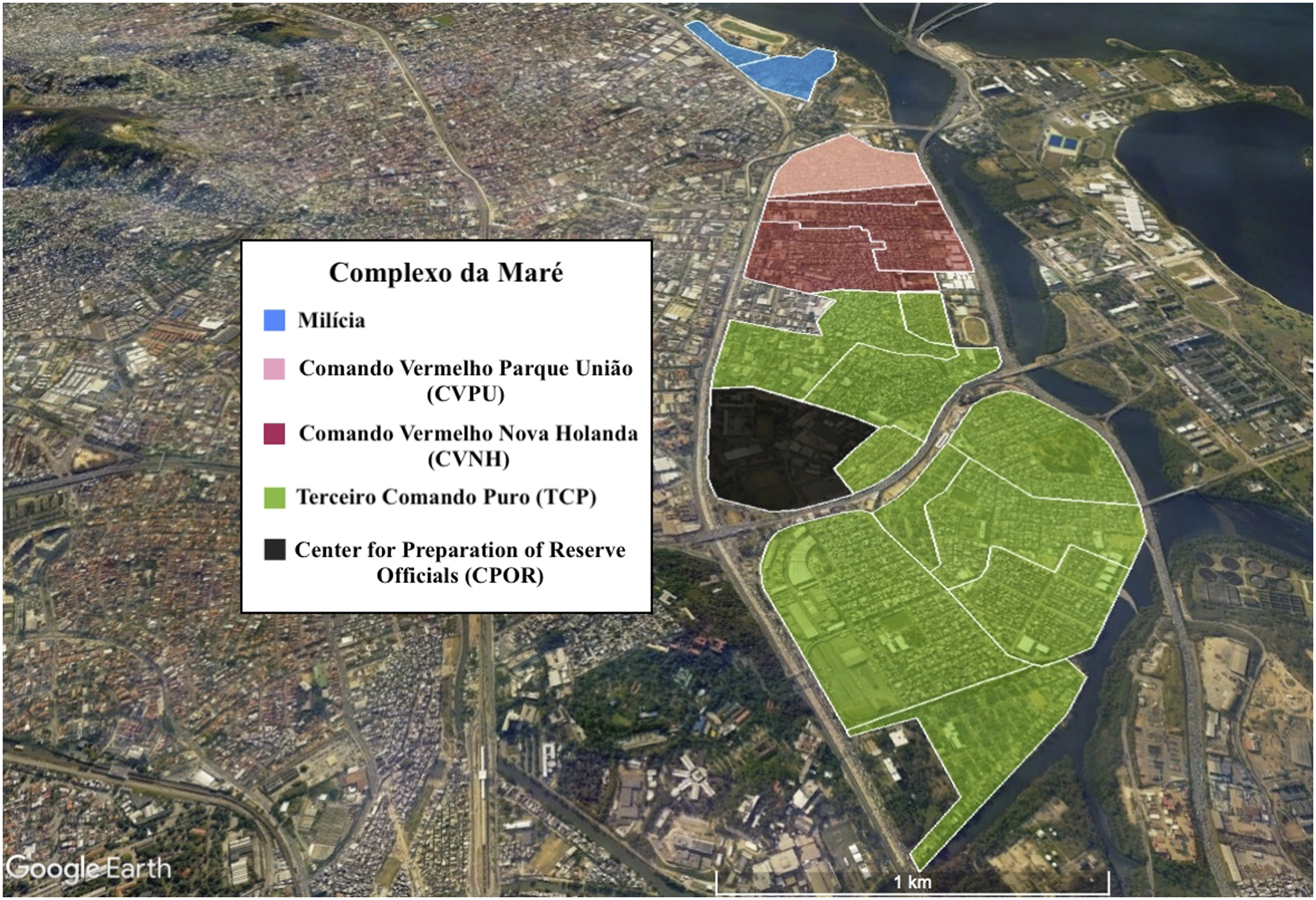
The military quickly imposed a new and very different form of order throughout Maré. Roughly a third of the soldiers were on-duty at any given time. Of these, 400–500 were assigned to mobile patrol units from which soldiers monitored each of the gang territories. During the day, these mobile units also conducted on-foot patrols in many of the narrow streets and alleys through which the larger vehicles could not pass. At night, soldiers stayed on the main thoroughfares with tanks replacing trucks and jeeps. According to the Commanding General Roberto Escoto, this “saturation patrolling” strategy, in which units were constantly moving through Maré’s streets 24 hours a day, was necessary to avoid patrols becoming “static” and allowing the gangs to operate in areas where the military was not. 46
The military also set up 24-hour checkpoints around Maré, many of which were strategically placed along the major thoroughfares, entrance points, and, along the border between the TCP and CVNH territories. At these checkpoints, soldiers stopped and searched cars, motorcycles, and persons for weapons and drugs. The nature of these searches were highly targeted and racialized. Darker skinned adolescents and young men were disproportionately stopped and searched, a strategy the military assured residents was necessary. 47 Some of my interlocutors were searched dozens if not hundreds of times during occupation and regularly expressed frustration and anger over these methods. 48 “They [the soldiers] can treat us like that cause they’re wearing the fatigues but you take them off and you’re just another guy like me from a poor family,” one gang member told me. 49
In addition to their imposition of force, the military borrowed a series of measures used by the American military in Iraq and Afghanistan. First, they organized a company of roughly 140 soldiers to gather intelligence about Maré’s gangs and to identify their members. 50 They also created a hotline, Disque Pacificação, the number for which was emblazoned on the sides of every military vehicle, which they encouraged residents to use to denounce the gangs. 51 The military also implemented what can be termed a “hearts and minds” approach to combating the gangs. They allowed for significant upgrades to local infrastructure including the construction of 18 new schools. 52 They organized dozens of public and private meetings with local NGOs, representatives of Residents’ Associations, as well as state service providers. 53 They held cultos (worship services) for the soldiers at local congregations and promoted a series of ações sociais (social actions), including maternal health, painting, and music classes, Luta Livre (Jiu-jitsu) training sessions, school presentations, and music concerts. They even organized an event where they offered formal identification documents to residents. 54
To say that military occupation transformed life in Maré is an understatement. Some of Maré’s residents’ lives improved dramatically as they and their families were no longer subject to the security and health concerns that corresponded to gang violence and the drug trade. Gone were the numerous bocas de fumo, the massive baile funk parties, and the hundreds of well-armed gang members hanging out at corners and riding their stolen motorcycles up and down Maré’s streets. The benefits of military occupation, however, were not felt evenly across Maré’s population. As referenced above, the freedom and movement of young men and adolescents, in particular, was curtailed. Moreover, impromptu parties and family events, forms of recreation and leisure common in most favelas, diminished significantly because the military made the bureaucratic process for organizing them so difficult. As a result, many residents spoke nostalgically of gang control. “There was a lot more freedom before. There were a lot of motos and parties. I miss it,” one young mother told me. 55
Some residents also lost access to forms of economic assistance and governance upon which they had previously relied. A variety of informal economies vanished. Streets once lined with shacks and carts selling all manner of food and household item were no longer allowed and hundreds of families lost the income they made at the baile funks. In addition, the military imposed a more regularized building code under which many residents bristled. The military even bulldozed several dozen informal huts and shacks (family homes). 56 The military was also less effective in resolving interpersonal disputes and lower-level crimes. One gang member reported that a lot of boys and adolescents were using the opportunity of occupation to steal and break laws because they knew the gang was not going to punish them. 57 Although anecdotal, such evidence supports findings from other “Pacified” favelas, where increases in theft, domestic and sexual abuse, and interpersonal violence were reported (Cano et al., 2012; Savell, 2014).
Gang Response and Adaptation to Military Occupation
For the first couple of weeks of occupation, all but the youngest gang members (12–14-year-olds) were in hiding or fled. 58 And yet, the gangs were able to quickly adapt to their new reality. First, all three gangs shifted their drug-selling techniques. Instead of stationary bocas de fumo located near all of the entrances and on all of the major thoroughfares, the retail drug trade moved deeper within Maré and became mobile. I immediately observed young gang members carrying backpacks and placing themselves in the alleyways along the major streets. Initially, they were careful to not call attention to themselves but eventually, they more openly advertised their product by shouting: “Craque, maconha, pô!” (Crack, marijuana, powder!). The gang members with backpacks were always accompanied by several other unarmed youth that served as lookouts, watching for any sign of the military on the surrounding streets. If and when a military truck or foot patrol came by, the boys would scatter, quickly ducking into a side street or turning down one of the many alleys which crisscross Maré’s neighborhoods. In most cases, the mobile bocas went unnoticed by the troops but on several occasions I watched soldiers pursue these young men. When this happened, the boys would throw their backpacks onto awnings or rooftops after turning a corner so that, even if caught, the soldiers would find no contraband. The mobile bocas became a permanent aspect of the occupation period in each gang territory. 59
This method of drug sales allowed the gangs to maintain at least some of their revenue. The loss of their open-air drug markets and baile funk parties, however, cost them significantly. According to CVNH gang members, drug revenues decreased by roughly 75% from between R$1,200,000 to R$1,600,000 each week to just a few hundred thousand while TCP reported that their revenues were just one-tenth of what they were before occupation. 60 That said, the cost of maintaining the gang also diminished. TCP’s costly bribery schemes were gone as police were, for the most part, no longer actively operating in the area. At least initially, the gangs no longer had to supply their members with the same quantity of weapons and ammunition as before. Moreover, the salaries of a huge number of gang members which formerly provided security, served as lookouts, or made money in the drug trade (either through sales, transportation, or production) were no longer paid or were significantly diminished. 61 According to gang members, many of these members were left to fend for themselves. Some found formal or informal work while others attempted to leave gang life (more on this below). Senior gang members continued to earn reduced amounts from the drug trade or from salaries paid by the gang leader. 62
While all three of Maré’s drug trafficking gangs lost their ostensive control of the streets and each implemented the mobile boca strategy of retail drug sales, it quickly became apparent that the dynamics of territorial control and competition had shifted as a result of occupation. As occupation progressed, I observed how each gang shifted its structures and activities according to the security environments in which they found themselves.
TCP: Active Threat and Fighting
Although most TCP members initially went into hiding, within a couple of weeks, it was clear that they had decided to take a different approach. Visiting these neighborhoods each day, I noticed multiple TCP gang members were openly carrying pistols and providing armed security for the mobile bocas. While not as ostentatious as before occupation, their armed presence was noticeably different from both of the CV gangs where few if any weapons were observed for the duration of occupation. It was also apparent that TCP members were willing to engage military soldiers directly. Over the first month of occupation, TCP members were involved in several shootouts and confrontations with soldiers that resulted in the deaths of a couple of innocent bystanders. 63 In a series of public and private meetings 1 month into occupation, both residents and military officials commented on the volatile situation in the TCP-controlled area. 64
The primary reason why TCP shifted from a hiding to fighting strategy was due to the active territorial threat of their longtime rival, ADA.
65
Quickly after occupation, ADA gang members began infiltrating the area from which they had been expelled in 2009. Many of these ADA members, including one of its leaders, had been born and raised in Maré and, since TCP no longer controlled the streets and could not monitor the numerous entrances to the area (see Figure 5), ADA was able to surreptitiously infiltrate their former turf. During a massive public audience in Maré, Rio’s Public Security Secretary, Mariano Beltrame, refuted the possibility of territorial contestation between gangs in the midst of military occupation.
66
In a private meeting with NGO officials, however, the Commanding General of the Occupation Forces, Roberto Escoto, admitted that ADA members had, in fact, managed to infiltrate the area. Despite military checkpoints and vehicles being placed at all of the entrances, they could not check the many thousands of residents crossing over these borders every day.
67
According to the General, ADA’s presence had already resulted in a series of confrontations between the gangs and with soldiers. In further interviews and public meetings, numerous residents corroborated the General’s admission, remarking on the presence of gang members they did not recognize and describing confrontations between the rival gangs and with soldiers.
68
According to Thiago, a resident of one of these neighborhoods, “They [TCP] had to get back on the street. They retook their posts, monitored the entrances that the army didn’t, and started carrying guns to defend their community.”
69
Close-up of the Terceiro Comando Puro territory.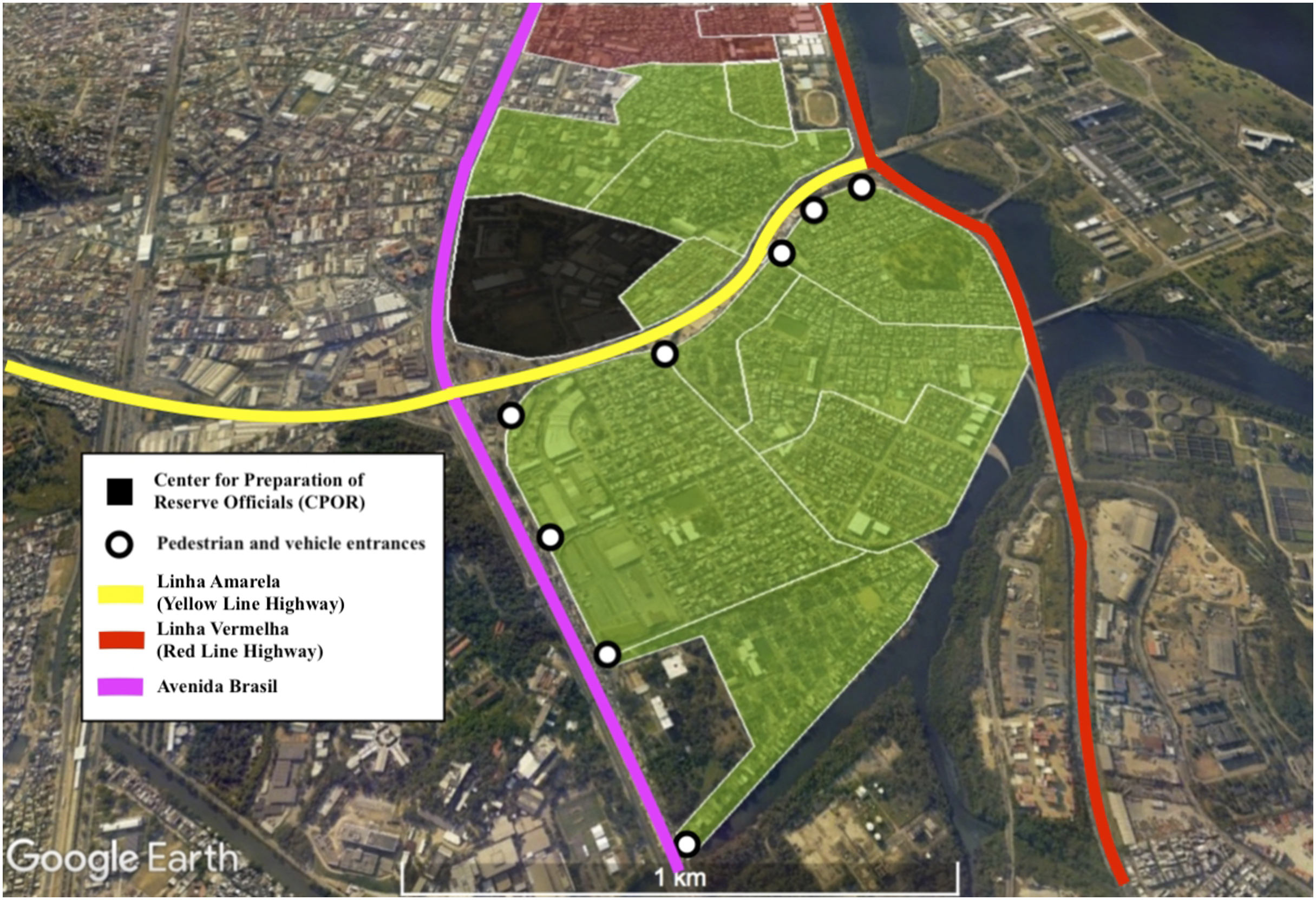
The details of these inter-gang dynamics also became known to me through my involvement with an NGO project designed to rehabilitate gang members. 70 Nearly 30 TCP members would eventually enroll in the program and, over the course of 6 months, I accompanied the project while conducting dozens of interviews with them. Many of these men described their frustration that the military was either unwilling or incapable of preventing ADA from making incursions into their territory. They feared their rival would manage to take back the territory, which would mean they and perhaps their families would be expelled or killed even if they were no longer formally involved with the gang. In one memorable interview, Josué, described how ADA had been searching for him, “They went to my house and grabbed my wife. They pointed a pistol in her face and asked where I was. They told her they were going to kill me. My kids were there too.” 71 Other former TCP gang members reported that ADA had been searching for them as well and that their situations were becoming similarly insecure. 72 The coordinators of the rehabilitation program told me they were having a difficult time keeping some these men in the program. 73 By the end of occupation, nearly half of the TCP members had dropped out or were suspected of rejoining the gang.
Despite the military’s efforts to quell the violence, as occupation progressed into its sixth and seventh months, ADA gang members continued to make incursions into the area. Confrontations intensified as the two rival gangs as well as the military engaged in daily shootouts. 74 “The situation is horrible!” Olívia, an NGO worker and resident of ADA’s former territories, decried. “The streets are totally empty after 2 pm because everyone knows that ADA is hiding in some of the houses.” 75 Local schools, which serve more than 7000 students, were closed for several weeks. 76 Even after ADA’s leader was arrested in Maré in late September, invasions, skirmishes, and shootouts between the gangs and with military soldiers continued through the end of the year and into January, 77 sometimes spilling out onto Avenida Brasil and stopping traffic on the city’s busiest highway. 78 Riding my bike through these areas in the mornings and early afternoons, I observed TCP members armed with semi-automatic weapons congregating in several areas. When army patrols came near, these men ducked into houses, waited for the patrol to pass, before reemerging to monitor the streets. 79
For TCP gang members, the imperative to defend their territory against a rival outweighed the possibility of arrest or even death at the hands of the military. In several cases, TCP members even initiated confrontations with military personnel in what appears to be purposeful efforts to provoke them. 80 According to Valdemir, “TCP was shooting at the army to call attention to the fact that they were still strong. They were also preventing ADA from invading because there would be more soldiers on the streets.” 81 In this way, confronting state forces can actually help a criminal group preserve their territorial control. This logic matches a phenomenon Lessing has theorized, in which anti-state violence sends “a signal not to the state but to members of the drug trade itself” (2017, p. 84). Such a strategy, however, can be costly.
In response to the growing levels of violence, the military implemented even more aggressive tactics. They closed parts of Avenida Brasil to mount massive operations involving dozens of tanks and militarized vehicles. Hundreds of soldiers went house to house searching for gang members. 82 They broke down doors and entered homes and buildings without warrants. After a number of soldiers were injured and one killed in an encounter with TCP members, the military ramped up their coercive presence even further. 83 They installed permanent bunkers with machine guns at strategic points in the community and placed snipers and lookouts on the rooftops of schools and apartment buildings. Finally, in early 2015, TCP scaled back their fighting strategy. According to Valdemir, “the leader (chefe) has ordered to stop shooting at soldiers because the army was gaining the upper hand.” 84 Confronting the military had taken its toll on TCP but, by then, ADA had ended their takeover attempts as they had also suffered the consequences of months of fighting. The threat presented by ADA once again reverted to a latent one. TCP was able to relax their confrontational tactics without the possibility of losing territorial control.
For their part, residents of the TCP area became increasingly frustrated with the behavior of the military and began protesting, which occasionally brought them into direct conflict with the military. 85 Several residents with no known gang involvement were allegedly shot and killed by soldiers. 86 In a public meeting with the press, numerous residents and civil society leaders described dozens of violations and episodes of violence and abuse in this area. 87 Survey results confirm these qualitative findings. Residents of the TCP area reported twice as many violations by soldiers and twice the number of bad or terrible evaluations of the military (Silva, 2017, pp. 75–79). Some sporadic confrontations between TCP gang members and military soldiers would occur until the very end of occupation on June 30th, 2015, 88 likely the result of these much more aggressive tactics. By the end of occupation, 23 soldiers had been injured and one killed in confrontations with OCG members, nearly all of them in TCP territory. 89 Of the 12 civilian deaths that the military was responsible for in Maré, 11 of them occurred in the TCP territory, 8 of which were alleged gang members. 90 Nevertheless, when the last of the troops vacated Maré, TCP quickly reasserted its full control over the area and their bocas de fumo were up and running within a matter of hours.
CVNH: Latent Threat and Hiding
The response of the CVNH gang was very different than their TCP rival. Although the CVNH gang can be described as the most heavily militarized and antagonistic towards the police prior to occupation, CVNH chose a very different strategy for the duration of occupation: hiding. During the 9 months I lived under military occupation, I only observed CVNH gang members carrying a pistol once. 91 During 15 months of occupation, local newspapers only reported two incidents involving gunshots in the CVNH area and it is unclear whether CVNH members were even involved in these episodes. 92 CVNH’s hiding strategy occurred largely because the active threat from TCP reverted to a latent one for the duration of occupation.
The violent confrontations and shootouts between CVNH and TCP along the border, which had characterized the period leading up to occupation, ended immediately. Neither of the two gangs would attempt to invade or infiltrate their rivals’ territory during occupation. This was partially because the military had strategically placed around-the-clock checkpoints and militarized vehicles at several places along the border where the gangs were accustomed to invading each other’s territory (see Figure 6). Similar checkpoints, however, had been unable to prevent ADA from infiltrating TCP’s territory. Why did neither TCP nor CVNH try to infiltrate each other’s territories? Unlike ADA, neither of these gangs had members that were born and raised in their rival’s territory and, therefore, neither group was motivated to “retake” their home turf. Moreover, their members lacked the intimate knowledge and social connections that would have allowed them to remain undetected in enemy territory amid a military occupation. Thus, the TCP-CVNH rivalry remained latent for the duration of occupation. Close-up of the CVNH territory.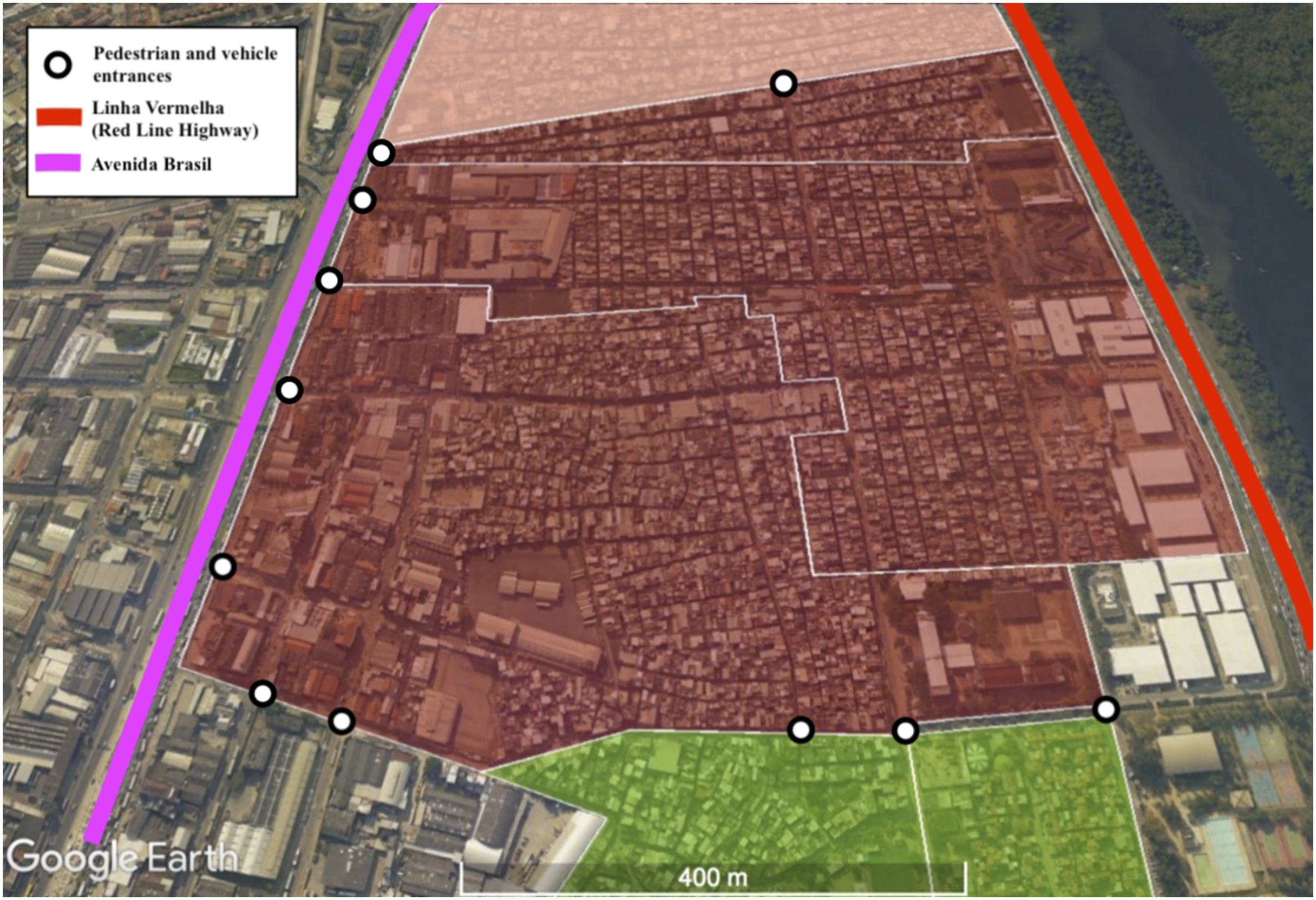
The lack of active territorial competition between CVNH and TCP was most visible along their shared border, an area referred to by residents and gang members alike as the Faixa da Gaza (Gaza Strip) because of the amount of violence which had occurred there over the years. Quickly following occupation, numerous shops and stores appeared where none had existed before. Residents were able to move through this area without being concerned about shootouts or being questioned by gang members though they were often stopped by the military. In a public meeting held in early July, nearly 3 months into occupation, numerous residents from the area remarked on the lack of shootouts and greater calm that occupation had brought to their lives. 93
Nearly 20 CVNH members would eventually join the gang rehabilitation program mentioned above. I accompanied this group as well. The former CVNH members did not describe the same difficulty with the occupation like their TCP counterparts. In fact, many of them believed occupation to be an improvement over the previous era of gang control, suggesting that the need to defend their territory against an aggressive rival had caused a lot of problems. In fact, nearly every one of CVNH’s members had participated in or been present during at least one shootout between the gangs while several reported being involved in more than 20. 94 Such long-term and frequent violence had clearly taken its toll on many of the CVNH members. Severino, for instance, thought “it would be better for everyone if there weren’t territories.” 95 Inácio, a former senior member, even hoped that the drug trade would eventually become more like the United States where “you just call someone and they bring the drugs to your house.” 96 Former CVNH gang members also believed the military to be less violent and aggressive than Rio’s military police, which, given BOPE’s focus on the CV areas in the lead up to occupation, is unsurprising. 97 While many of the CVNH members also complained of a lack of parties and entertainment during occupation, they found military occupation a much less stressful environment and, according to the coordinators of the program, the CVNH members did not have the same issue with recidivism at least during occupation. 98
Although many of the senior CVNH members initially fled the area at the beginning of occupation, after less than a month, I heard reports that they had returned and were hiding out. 99 In the subsequent weeks and months, I occasionally observed these men, unarmed and unaccompanied by the large security details which had surrounded them prior to occupation. They maintained low profiles. Inácio, a close friend of the gang leader, said he had returned because “he doesn’t want to lose his territory which can happen if you spend too much time outside.” 100 Several other CVNH gang members agreed that it was important for the gang leader to not be absent, especially when occupation ended, and police operations and violence with TCP resumed. 101
Although territorial threat remained latent and CVNH members stayed in hiding for the duration of occupation, conflicts between residents and the military nonetheless emerged. For one, the military, responding to the increasing violence within the TCP area, began to engage in more aggressive practices throughout the entirety of Maré. In public meetings, residents described increasingly hostile interactions between residents and the military. 102 I personally witnessed several occasions in which soldiers pointed their rifles at local youth and shouted racial slurs and insults at them. 103 Frustrated youth began to harass and provoke the soldiers. Large groups of 20–30 youth would congregate on the main streets of CVNH’s territory late at night, shouting obscenities, and throwing rocks and bottles at the soldiers. 104 Troops used rubber bullets and tear gas to disperse the crowds. 105 According to CVNH gang members, these boys and adolescents were not gang members but wannabees and hangers-on. 106 Confrontations between unaffiliated youth and the military continued until the end of occupation on May 1st, 2015, two months before they would leave the TCP area. 107 Within a matter of hours, the CVNH gang had resumed their heavily armed presence, disbanded the troublesome youth groups, and reestablished their open-air drug markets.
CVPU: Absent Threat and Displacement
Like Maré’s other two gangs, the mobile bocas were the only visible aspect of the CVPU gang immediately following the military’s occupation. Despite this similarity, the CVPU response was distinct from either of the other two gangs. I never observed pistols or rifles on the streets and, aside from several mobile bocas, more senior gang members did not return to this neighborhood like in CVNH’s territory. Residents also complained that the absence of the Dono and senior gang members made resolving problems within the community very difficult. 108 CVPU’s choice to remain outside their territory during military occupation was the result of the relative absence of a territorial threat.
Despite spending significant amounts of time and maintaining numerous contacts in this area, I had a difficult time finding CVPU members to interview during occupation. While both the CVNH and TCP gangs had a large number of members join the gang rehabilitation program, not a single CVPU member enrolled. Why? First, I noticed that many of the TCP and CVNH gang members that did enroll were older—the average age was 25—and most had experienced significant violence during their tenures.
109
All but four of the gang members in the program reported that they had lost at least one if not several friends to violence.
110
Many of them were disillusioned with gang life and described the cumulative effects of stress from the fear of victimization and death.
111
Although the CVPU gang had suffered intensive policing operations following BOPE’s arrival to the area in 2011, neither residents nor gang members could ever remember shootouts between gangs. In fact, the gang had no territorial threat (latent or active) from any rivals for the past several decades largely because CVNH provided them a buffer against their closest rival, TCP (see Figure 7). The relationship with CVNH, although not always harmonious, had never involved any violence and the two gangs had remained allies and part of the same overarching faction for more than two decades. This more stable environment meant that CVPU gang members were less likely to be traumatized by their gang tenure and, therefore, the draw of rehabilitation and leaving the gang life less attractive. Close-up of the CVPU territory.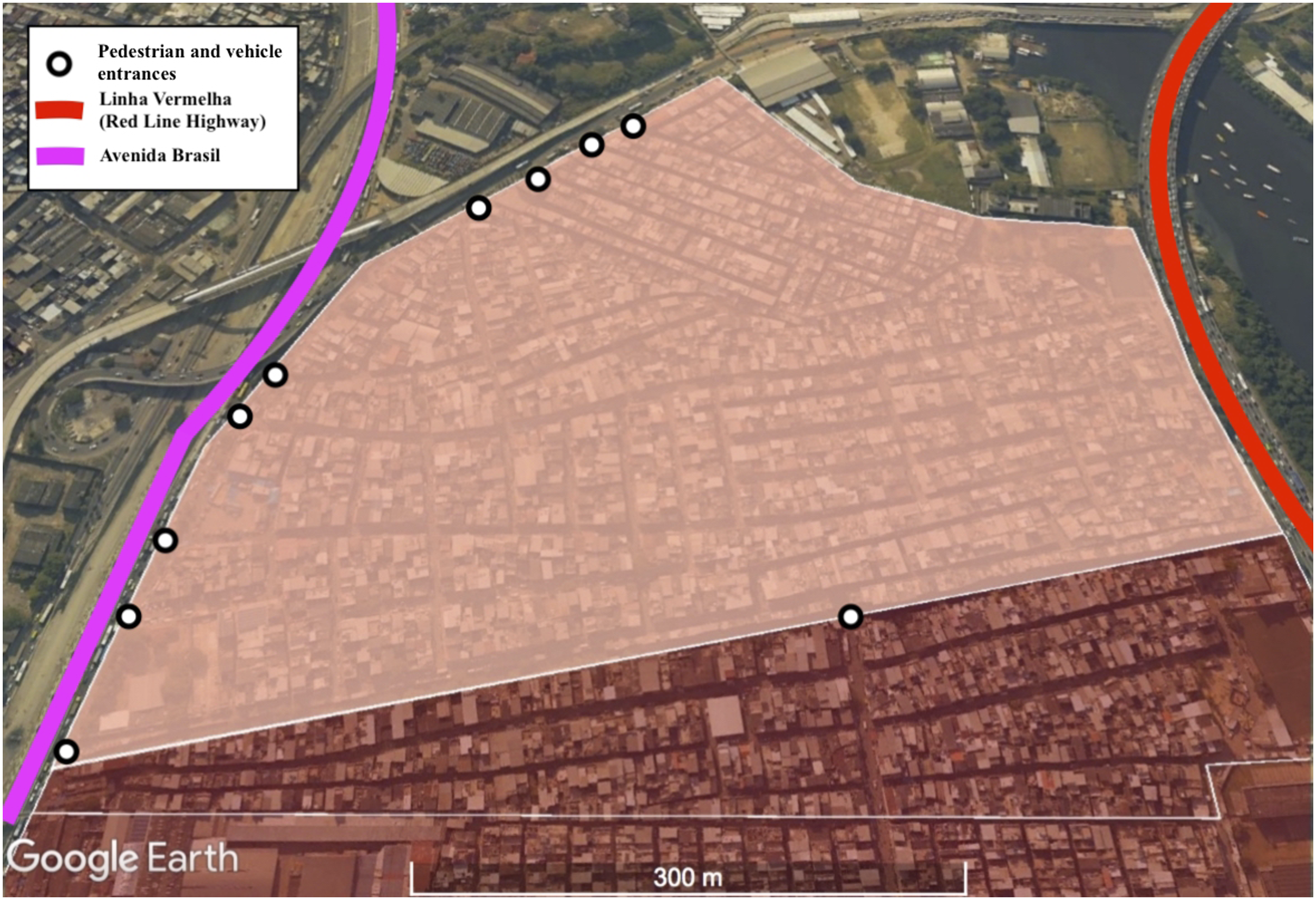
Another explanation for the lack of CVPU members in the rehabilitation program is that some of the TCP and CVNH gang members used the program as a way to stay in their respective communities during occupation given the higher levels of threat and their possible need to defend their territory. CVPU members, by contrast, could stay away, avoid possible enforcement and harassment by the military, and still be unconcerned that their territory would be there for them when occupation ended. Either way, the lack of territorial competition (prior to and during occupation) likely shaped the willingness of CVPU gang members’ to enter into the rehabilitation program.
Finally, the antagonisms and confrontations between the military and members of the community were neither observed personally nor described in interviews with residents in this area. In public meetings, nearly all of the denunciations and complaints came from other areas of Maré. Again, part of the reason may be that Parque União had been a less violent and unstable area for quite some time and, consequently, more economically secure. In fact, this neighborhood has many of Maré’s most expensive shops and restaurants and receives many visitors from outside. Parque União is even referred to by local residents as the Zona Sul (Southern Zone) of Maré, a reference to the wealthy and touristy neighborhoods surrounding Rio’s iconic beaches. This less socially disorganized context likely helped contribute to a more pacific occupation. And yet, despite the CVPU gang being little present in their territory for the duration of occupation, when the military left for good on May 1st of 2015, CVPU gang members quickly returned to the area, reasserted their presence on the streets, and resumed the open-air drug trade.
Discussion of Findings and Alternative Explanations
From the case studies above, it is clear that the military’s occupation of Maré meant that all three gangs could no longer effectively monitor and defend their borders. In the case of TCP, ADA used this opportunity to infiltrate their former turf which precipitated TCP’s fighting strategy. Violent contestation between these gangs also led to direct confrontations with the military. This finding corroborates existing work that points to the weakening of incumbent territorial control as a key mechanism driving violent OCG responses to military intervention (Dell, 2015; Flores-Macías, 2018; Osorio, 2015; Rios, 2013). However, weakening incumbent control alone does not account for why only the ADA-TCP territorial rivalry became active during occupation.
Drawing on the work of Daly (2016), I argue the geography of recruitment is key to understanding why some OCG rivalries turn violent in the midst of a crackdown. In her seminal book, Daly finds that the dynamics of territorial control and competition between Colombia’s paramilitaries were shaped by patterns of recruitment leading some of these groups to remilitarize after signing peace agreements in the early 2000s. While the context investigated in this article differs in important respects, recruitment patterns clearly mattered for where rivalries turned violent during Maré’s occupation. The information and social networks available to ADA members were instrumental in both their desire and ability to attempt to retake their former turf.
First, having grown up in these neighborhoods, ADA members were intimately familiar with the local geography. They knew how to infiltrate the area without being detected and could easily navigate the area’s labyrinthine streets and alleyways. In addition, because of their continuing connections to some residents in these neighborhoods (which TCP had unsuccessfully attempted to eradicate), ADA had places to hide and likely obtained information from residents about military and gang positions and behavior. Even if they were ultimately unable to retake the territory, ADA’s more than 6-month campaign to reconquer this area in the midst of an intense military crackdown is a testament to the importance of local information and social networks in territorial battles between Rio’s gangs.
The ADA gang also clearly had the desire to reconquer their former territory. Beyond any material motivations, “turf possesses a symbolic value that often trumps its economic value. Turf is typically the setting of a group’s collective memories, a meaningful geographic space for young men as they transition from childhood into adulthood” (Papachristos et al., 2013, p. 420). In this light, ADA’s gambit, although incredibly risky, was an opportunity for their members to return “home.” Overall, the geography of recruitment and the personal connections of OCG members to particular territories offers one plausible mechanism for why inter-criminal competition gets activated in the midst of a military crackdown.
The very different responses by Maré’s other two gangs demonstrate how even non-violent OCG strategies are also shaped by territorial considerations. Most senior CVNH gang members returned to their territory quickly after occupation and maintained a noticeable though low-profile presence. CVPU, on the other hand, mostly stayed away. I argue that this difference is also related to territorial imperatives. For more than two decades, CVNH had fought an on-again off-again war with their TCP rival. Even if that threat was diminished during occupation, they were not going to quickly forget about their longtime rival. CVNH needed to be prepared for the reactivation of this territorial threat whenever occupation ended. 112 Meanwhile, CVPU’s grip on their territory was never in doubt. The gang has been led by members of the same family since the 1990s and has never faced any territorial competition. 113 Returning to the community during occupation was unnecessary and would have only put them in danger of being discovered and arrested.
There are several plausible alternative explanations which must also be addressed. First, could the violent reaction of TCP be the result of some other internal gang process? For instance, TCP’s leader was arrested by Federal Police in a luxury apartment in the Western Zone of the city several weeks prior to occupation. 114 Perhaps TCP members became violent due to the lack of control of the rank-and-file or because of internal conflicts rather than the threat from ADA. However, in interviews with TCP members, they all maintained a clear idea of the leadership structure of the gang, never once mentioning any internal fighting or conflicts. In addition, because Rio’s gangs are thoroughly connected through prison-based networks, gang leaders retain their leadership and continue to dictate some gang-level policy in spite of incarceration. It is more likely that the arrest of TCP’s leader prior to occupation further reinforced ADA’s belief that they could take back their territory.
Another possible explanation is that the various gang responses were the result of the military’s different approaches to confronting them. The troops, at least initially, were divided into three bases, called “strongholds” (pontos fortes), a strategy the military had developed to combat Port-au-Prince’s gangs as part of Brazil’s deployment in the United Nations Stabilization Mission in Haiti (Harig, 2019). Perhaps each stronghold varied their tactics to produce different gang reactions. However, the military’s strongholds did not match up with the borders of the gangs but overlapped them significantly. 115 Moreover, the entire troop contingent, from the General down to every soldier, were rotated out of service every 2 months. By its end, 23,500 troops eventually took part in Maré’s occupation. 116 While the strategies of the military certainly evolved over time, the differences between Maré’s gangs were observed across multiple troop deployments. The military’s behavior does not account for the different gang responses.
Next, following the work of Lessing (2017), perhaps TCP remilitarized and confronted the state in their effort to return to a corrupt equilibrium, from which they benefitted before occupation. Brazil’s military, however, has no history of corruption like Rio’s police and, by all accounts, soldiers did not engage in any corrupt behaviors while in Maré. In fact, part of the reason why the military decided to rotate their entire personnel every 2 months was to prevent the emergence of such corruption schemes. It is unlikely that the TCP gang would have engaged in a yearlong campaign of violence and confrontation if they had little hope of developing durable corruption schemes.
Finally, Magaloni et al. (2020) argue that we should observe CV-affiliated gangs responding to state intervention more violently than the other factions (ADA and TCP) due to CV’s greater organizational capacity (it is the largest of the three factions) as well as its longstanding antagonistic relationship with the state. The results from Maré’s military occupation were quite the opposite, suggesting that micro-level territorial imperatives outweigh overarching faction affiliations and policies. Magaloni et al. also argue that preexisting criminal governance regimes determined the outcomes of Rio’s Police Pacification Units (of which Maré’s occupation was technically a part though UPPs were never installed). They hypothesize that Pacification interventions should reduce violence and improve security in territories where gangs maintain abusive relations with local populations while deteriorating social order where they cooperate with residents.
Overall, I found Maré’s gang-resident relations preceding occupation to be neither wholly abusive nor cooperative but considerably more complex, multi-faceted, and variable. That said, in the period leading up to occupation, the most abusive gang-resident relations were in the CVNH territory due to the large number of foreign gang members which had been allowed to reside in the area. These men were much more likely to threaten and abuse residents than native gang members.
117
Vinicius, a local teacher described the importance of gang members being cria (born and raised in the neighborhood) in this way: Guys from outside create problems in the community because no one knows them. I don’t know them! It’s different when you know someone from infancy. The conversation is different. You ask how their kids are, you talk about family. The community will always seek out the gang members from here to resolve problems.
118
For many residents in the CVNH territory, occupation improved the security environment dramatically because they no longer had to deal with abusive foreign gang members or the violent confrontations between CVNH and TCP. Thus, Magaloni et al.’s predictions seem to be borne out in this case. However, the less abusive relations between CVPU and residents also resulted in a more pacific occupation period. Overall, governance dynamics preceding occupation do not seem to determine the outcome of such interventions. Rather, I would argue that both governance dynamics and OCG responses to state intervention are subservient to territorial imperatives vis-à-vis rival groups. Such a finding is reminiscent of civil war contexts, where the need for territorial control trumps all other considerations (Arjona, 2016; Kalyvas, 2006; Metelits, 2010).
Conclusion
By the time the last of the troops left Maré on June 30th, 2015, the Brazilian military had conducted an estimated 83,000 operations, arrested 674 individuals, apprehended 255 minors, and made 1356 seizures of guns, ammunition, drugs, and stolen vehicles. 119 And yet, within hours of the military’s departure, each of the three gangs had reestablished their presence on the streets and dozens of bocas de fumo were open for business. The four Police Pacification Units which had been planned for Maré never came to fruition and none of the military’s development or security initiatives remained in place. If the goal of military occupation was to permanently weaken the gangs in the area and reestablish the Brazilian state’s monopoly of violence for the long-term, it had failed.
That said, according to Rio’s Institute of Public Security, the homicide rate in Maré did decrease from 21 to 6 homicides per 100,000 during occupation. 120 From this perspective, it might seem like occupation was a success. 121 And yet, this number obfuscates the frequent confrontations and shootouts between TCP and ADA that shut down schools and major thoroughfares, as well as the numerous human rights abuses by the military. 122 A myopic focus on the homicide rate also ignores the increase in low-level crime and public disorder in some areas of Maré, yet another reminder that social order can actually deteriorate when OCG control and authority are removed (Arias & Barnes, 2017; Magaloni et al., 2020). The falling homicide rate also masks the fact that 2500 military troops with all of the resources of the Brazilian state never really threatened the long-term presence and viability of Maré’s gangs. Their divergent experiences during occupation further demonstrate the OCG capacity to adapt to wildly different environments. Like other OCGs throughout the world, they do not require a specific organizational form or leadership structure to operate and can effectively reproduce themselves without significant revenue streams for extended periods of time. The absence of violence does not necessarily signify the underlying effectiveness of these operations. Public security policy must understand that these groups are incredibly resilient to such militarized operations, whether or not they engage in outright violence.
In this regard, perhaps the biggest failure of the military in Maré was its inability to garner resident support in their efforts to combat the gangs. This is not for lack of trying. The Brazilian military had spent several decades developing just such a methodology from existing counterinsurgency policy and stabilization missions (Harig, 2015a; Hoelscher & Norheim-Martinsen, 2014; Siman & Santos, 2018). In fact, an estimated 60–90% of the Maré troop contingent had already been deployed to Haiti, where they used an almost identical set of development tactics and militarized operations (Harig, 2015b). In Maré, the military made significant upgrades to the infrastructure, collaborated with local civil society, and engaged in 24,000 social actions, spending an estimated R$ 350 million in the process.
123
Despite these efforts, less than 50% of 1000 surveyed residents said the military had had a positive impact in Maré (Silva, 2017, p. 87). According to one community leader: The ‘Pacification’ of Maré’ was a lie and an abstract term that doesn’t reflect the reality. …They haven’t implemented more responsive institutions and although they have sought out civil society to develop relationships, this is more in theory and serves as subterfuge for them to control the space.
124
Overall, the use of military interventions to combat OCGs needs to be dramatically rethought. Even community-oriented policing and “hearts and minds” approaches have mostly failed to gain the long-term support of these communities and truly weaken the long-term presence of criminal groups. Although development projects and building relationships with local organizations are important, they often do little to address the more urgent sources of precarity and violence in these communities. In particular, young men and adolescents from marginalized areas cannot be merely controlled through arrest, detention, and stop and search procedures. They must be engaged, reincorporated into community structures, and offered viable economic and social alternatives. As long as gangs and other OCGs have such a constant and unending source of expendable labor, their influence and control will not wane.
Perhaps the best we can hope for in the short-term is to limit criminal territorial competition. Contexts of latent and absent criminal territorial competition, especially, could open space for these less repressive and violent public security policies and more positive, longer-term relationships with marginalized communities to emerge. These dynamics may even allow for criminal groups to further demilitarize while gang rehabilitation programs—similar to the one described in this article—and other transitional justice mechanisms can be offered to young men and women to bring them back into these communities. Maré’s local civil society organizations have been demanding these more accountable, responsive, and restrained public security policies for decades. Such a shift, however, depends on the willingness of public security actors, political coalitions, and the general public to seek a way out of the cycles of militarization that have thoroughly overwhelmed Rio de Janeiro and much of the rest of the Americas.
Supplemental Material
sj-pdf-1-cps-10.1177_00104140211036035 – Supplemental Material for The Logic of Criminal Territorial Control: Military Intervention in Rio de Janeiro
Supplemental Material, sj-pdf-1-cps-10.1177_00104140211036035 for The Logic of Criminal Territorial Control: Military Intervention in Rio de Janeiro by Nicholas Barnes in Comparative Political Studies
Footnotes
Acknowledgments
I would first like to thank all the current and former gang members, community leaders, and other residents of Complexo da Maré that agreed to participate in this project and generously shared their time, opinions, and memories. I am forever indebted to my research collaborators and the numerous social movements, non-governmental organizations, and political institutions in Maré and the rest of Rio de Janeiro that opened their doors to me and supported this project. I also thank Juan Albarracín, Rawan Arar, Ned Littlefield, Lucía Tiscornia, Richard Snyder, the editorial team at Comparative Political Studies, and three anonymous reviewers for their insightful criticisms and questions. A special note of gratitude goes to Roxani Krystalli who provided excellent comments and much needed encouragement on the supplementary appendix. Earlier drafts of this article were presented at LASA 2019 in Boston, MA, and APSA 2020 virtually. The fieldwork on which this article is based received generous funding from the Social Science Research Council, the National Science Foundation, and the U.S. Department of Education Fulbright Program. All mistakes are my own.
Declaration of Conflicting Interests
The author(s) declared no potential conflicts of interest with respect to the research, authorship, and/or publication of this article.
Funding
The author(s) received no financial support for the research, authorship, and/or publication of this article.

Supplemental Material
Supplemental material for this article is available online.
Notes
References
Supplementary Material
Please find the following supplemental material available below.
For Open Access articles published under a Creative Commons License, all supplemental material carries the same license as the article it is associated with.
For non-Open Access articles published, all supplemental material carries a non-exclusive license, and permission requests for re-use of supplemental material or any part of supplemental material shall be sent directly to the copyright owner as specified in the copyright notice associated with the article.
