



Abstract
How do nationalist parties attract votes? This article develops a novel supply-side explanation centered on status, arguing that nationalists succeed by combining group appeals to the nation with policy promises to improve the nation’s political and cultural status and the socio-economic status of its median member. Drawing on several original datasets, this expectation is tested on Imperial Austria in 1907, where multiple nationalist parties competed in first-time mass elections. We find that group appeals to the nation and promises to improve its political and cultural status resonate very well with agricultural workers, whose economic sector was declining, but not with industrial workers, whose sector was on the rise. By contrast, offering social policy helps nationalists among industrial workers, but less clearly so among agricultural workers. This article shows that nationalist mobilization is not a mere distraction from class politics; rather, the politics of nationalism, class, and status are closely intertwined.
Introduction
Far from being relics of the past, candidates and parties running on nationalist platforms currently celebrate significant electoral successes globally. In 2016, slogans expressing national pride and self-determination were at the heart of both Donald Trump’s presidential campaign (“Make America Great Again”) and the campaign in favor of Brexit (“Let’s Take Back Control”). In 2017, Alternative for Germany (AfD) became Germany’s leading opposition party by rallying against immigration and propagating an exclusionary ethnic national identity (“New Germans? We make them ourselves”). Finally, in 2019, the world’s largest democracy, India, witnessed the Hindu nationalist Bharatiya Janata Party’s (BJP) landslide victory.
Political scientists studying the radical right have long debated whether cultural fears related to group identity or economic concerns make these campaigns so attractive to voters. This article argues that it is both. Numerous recent demand-side studies show that the key to understanding why people vote for nationalist and radical right parties lies in the notion of status anxiety, which can be interpreted in both cultural and economic terms. Large-scale societal transformations (e.g., industrialization, globalization, immigration, or changing cultural values) challenge the existing social hierarchy. This can trigger fears about a decline in relative status, fears that consistently have been shown to make voters prone to vote for the radical right (Blum & Parker, 2019; Gest et al., 2018; Gidron & Hall, 2017, 2020; Kurer, 2020; Major, Blodorn & Major Blascovich, 2018; Mutz, 2018). These arguments are also consistent with the political economy literature on inequality and nationalism. Authors in this field have argued for some time that the effectiveness of nationalist mobilization depends on voters’ perceptions of the relative status of their national and class identities (Penn, 2008; Shayo, 2009; Solt, 2011)—nationalists succeed if the latter is lower than the former.
We complement these recent insights about voters with a supply-side account of nationalist parties’ electoral strategies. Our theory of status-improving nationalism argues that successful nationalist parties address voters’ status concerns through both identity appeals to the nation and substantive policy promises. Positive appeals to national identity influence perceptions of the current social order. They make voters feel good about being a member of the nation and distract them from their class identities. Substantive policy offers, by contrast, influence expectations about future changes in the social order. Through nationalist policies, nationalists promise to improve the cultural and political status of their nation. Through social policies, nationalists promise to improve the socio-economic status of the nation’s median member (who most often will be working-class).
While adopting important insights about the significance of relative status from the two previously discussed literatures, our approach addresses a weakness common to both. Although correctly observing the importance of voters’ cultural and economic status concerns, the literature on contemporary radical right parties does not provide a supply-side theory of how nationalist electoral platforms explicitly address those concerns. Similarly, although the political economy literature on nationalism recognizes that political elites play a key role by priming national identity, its empirical analyses do not actually measure the content of campaign platforms, opting instead to correlate economic inequality with either nationalist identification and attitudes (Shayo, 2009; Solt, 2011) or ethnic voting (Huber, 2017).
Our unique empirical focus offers additional, significant advantages over previous studies, in that it ameliorates concerns about endogeneity and unobserved heterogeneity. Identifying the causal effect of party appeals on electoral success is challenging, because the relationships between these appeals, voters’ preferences and identities, and socio-demographic structure evolve endogenously through electoral competition. Furthermore, current studies examine either the success of different nationalist parties across countries, thereby introducing unobserved heterogeneity at the contextual level (e.g., Golder, 2003); or the success of a single nationalist party across subnational territorial units, thereby holding party appeal constant (e.g., Coffé et al., 2007). By contrast, we select a case in which competing nationalist parties tried different electoral strategies to mobilize new district electorates in first-time mass elections: the 1907 election that followed the full implementation of universal manhood suffrage in Imperial Austria, the “Western” half of the multinational Austro-Hungarian Empire. 1 Only a minority of these parties had won seats under the previous electoral system, whereas all of them now competed for votes in brand new constituencies, with limited knowledge of what might attract a mass electorate. These elections therefore provide better conditions for identifying the causal effect of nationalist appeals on electoral success than do contemporary settings. Imperial Austria’s great ethno-national diversity further provides a unique opportunity to analyze the effect of varying nationalist appeals made by different parties competing to represent the same nationalities within the same electoral districts. Furthermore, as industrialization expanded the industrial working class, while driving the relative decline of the agricultural sector, class cleavages crosscut the national one between Czechs and Germans, the two nationalities studied here. This allowed socialists and nationalists to mobilize workers with competing appeals to their multiple identities and interests.
Though historically distant, Austria’s nationalist parties shared their core ideology of exclusionary nationalism with today’s radical right parties. Whereas contemporary radical right parties draw a sharp distinction between included autochthones and excluded immigrants—which is why their core ideology is termed “nativist” in the literature (e.g., Gest et al., 2018; Inglehart & Norris, 2016; Mudde, 2007)—Austria’s nationalists drew a line between the nation they sought to represent and other national groups. The main national opponent denounced in Czech election manifestos was the large German-speaking population, with whom they shared the Lands of the Bohemian Crown, and to a lesser extent Hungarians. Because German speakers were scattered throughout the Monarchy, German nationalists tended to vilify Slavs more generally, in various combinations with Hungarians and Jews. 2
As they do now, nationalists focused primarily on maintaining or raising their nation’s political and cultural status. However, they also experimented with varied economic and social policy positions. Imperial Austria’s nationalists were concerned with the initial establishment of social security, public education, and health care, whereas the dominant concern in contemporary post-industrial democracies is protection from welfare state retrenchment (Rathgeb, 2020). From the socio-psychological perspective adopted here, however, nationalists address concerns about the status of their nation relative to other groups. Relative status differentials are independent of the absolute size of public spending, or of whether the welfare state is expanding or shrinking. That being said, there is one important consideration regarding comparability. The industrial working class was on the rise in our historic case, whereas it faces decline in contemporary post-industrial democracies. We therefore assess the impact of nationalist appeals separately for the (historically declining) agricultural and the (historically rising) industrial working classes.
Our empirical analysis strongly confirms that nationalist parties succeed by addressing voters’ status concerns through both group identity appeals and policy offers. Nationalists gain from priming national identity and from offering nationalist policies. That strategy resonates particularly well in districts with a higher share of agricultural workers, but less well in districts with a higher share of industrial workers. Furthermore, they increase their vote share to the extent that they also offer social policies, conditional on the industrial working class’s share of the district electorate. Such policies have a similar but weaker effect on agricultural workers. Nationalist mobilization clearly goes beyond simple appeals to identity; rather, the politics of nationalism and the politics of class are closely intertwined. Nationalists address voters’ national- and class-based status concerns directly. By offering social as well as nationalist policies, they confront class-based parties within the latter’s own policy domain.
The remainder of this article is structured as follows. The “Theory and Hypotheses” section develops a theory of status-improving nationalism, from which we deduce hypotheses about the effect of nationalist parties’ appeals on their success. The “Imperial Austria: Historical Background and the Logic of Case Selection” section justifies the case selection and introduces the societal and institutional context of the 1907 Imperial Austrian elections. As described in our discussion of data and empirical strategy (“Data, Operationalization, and Empirical Strategy” section), we have assembled a novel, district-level dataset for the 1907 elections, along with data on the electorate’s socio-demographic characteristics. Additionally, we have collected and coded historical election announcements to construct a unique dataset on parties’ group identity appeals and policy offers. 3 The “Analysis” section presents regression analyses predicting the success of nationalist parties at the district level in the 1907 election. The “Conclusion” section summarizes our main findings, assesses our contributions to existing literatures, and suggests directions for future research.
Theory and Hypotheses
In this section, we define the core concepts of nation, nationalism, and class and develop our theory of status-improving nationalism. Following Anderson (1983, p. 5), nations are defined as “imagined communities…imagined as both inherently limited and sovereign.” These communities can but need not be imagined in terms of descent-based attributes, the defining characteristic of ethnic identity (Chandra, 2006). Nationalists in Imperial Austria typically did use ethnicity as the basis for imagining national communities, as is also frequently the case in post-colonial, post-communist, and other contemporary democracies. Salient nationalisms in Austria were sub-state nationalisms, typically directed towards its many officially recognized nationalities. They tended to conflict with the transnational, dynastic character of the Habsburg state and the internationalism of the Social Democratic movement. As detailed below, Austria’s nationalities were largely defined by language, an attribute commonly associated with descent (Chandra, 2006).
Following Gellner (1983, p. 35), nationalism is an ideology that seeks congruence between the boundaries of the political unit and those of national identity groups. This definition applies to both majority and minority nationalism; the difference lies in the strategies used to attain such congruence. Majority nationalists strive for their group to dominate the state as a whole; minority nationalists strive to create an autonomous region or a newly independent state (Szöcsik & Zuber, 2015). 4
For Marx, class membership is defined by individuals’ relationships to the means of production, whereas for Weber it is defined by their positions in the labor market (Wright, 1994, pp. 102–103). Income is often used as a proxy for class, prominently in the political economy literature discussed here. However, to assume that all poor or rich individuals identify as members of the same organized social entity on the mere basis of similar income stretches the concept of class too far (Manza & Brooks, 2008). We therefore assume that the basis for class identities is occupation. Parties forging deliberate appeals to voters as members of social classes therefore should take the distribution of sectoral occupations within the electorate into account.
We can now theorize how nationalist parties succeed in elections. In doing so, we draw on the political economy literature, in particular Shayo’s (2009) and Solt’s (2011) accounts of nationalist voting and social status, along with similar contributions from the literature on radical right voters (Blum & Parker, 2019; Gest et al., 2018; Gidron & Hall, 2017; Major et al., 2018). Building on their work, we develop our theory of status-improving nationalism, arguing that nationalist parties do not succeed by appealing to national identity alone; rather, they also succeed through substantive nationalist and social policy offers.
Shayo (2009, p. 147) develops a theory of status-based nationalism. Drawing on social identification theory, he argues that individuals seek positive self-esteem and evaluate the status of their groups relative to other groups. They identify with a social group if they desire its status and want to resemble its members. Whether members of the lower class identify predominantly with their class or their nation therefore depends on the “extent and salience of common national attributes compared to income and class-specific attributes” (Shayo, 2009, p. 148). The poor are (a) more likely to identify with their national group if their class has low status (due to high inequality) and (b) more likely to resemble the prototype features of the national stereotype (because any nation includes more poor than rich people). These social psychological mechanisms make poor people more likely to be nationalist and less likely to emphasize their class affiliation (conceived in terms of income). 5
Shayo (2009) assumes that national identity has more positive connotations than class identity; however, he does not theorize how this comes about, thereby taking national and class statuses to be exogenous. By contrast, Solt’s (2011) theory of diversionary nationalism explicitly models this mechanism, emphasizing that elites influence how voters think about the relative status of nation and class by positively priming national identity. Elites use nationalism to distract the poor from class politics, allowing themselves to retain high levels of economic inequality without being punished electorally, and to generate solidarity among economically diverse constituencies. However, he neither measures nationalist discourse empirically nor examines whether nationalist elites acquire support through group appeals or substantive policy offers.
Based on these arguments, positively priming national identity should resonate particularly well among working class voters: H1a (priming national identity * working class). The larger the working class’s share of the district electorate, and the more a nationalist party appeals positively to national identity, the larger its vote share.
The recent literature on radical right parties’ electoral success agrees that voters’ perceptions of relative status are crucial for explaining why people are attracted by nationalist campaigns. However, by emphasizing the specific anxiety about future relative status decline, this literature offers an important refinement to the baseline political economy expectation. Nationalist campaigns should not resonate equally well among all working-class voters; they should resonate more among working-class voters who fear status decline due to large scale societal and economic transformations (Gidron & Hall, 2017; Kurer, 2020). This leads to the following hypothesis: H1b (priming national identity * status anxious workers). The positive effect of priming national identity on a nationalist party’s vote share becomes stronger with the share of workers in declining sectors of the economy in the electorate and weaker with the share of workers in rising sectors of the economy.
Our theory of status-improving nationalism takes these arguments an important step further. Although nationalists do strive to make people feel good about their national group by positively emphasizing national identity in their electoral campaigns, there is no reason why they should be limited to this. Nationalist parties can also promise concrete policies which, if implemented, would effectively change the status of the nation and its median member in the social order. We therefore expect nationalists to shape their success not only by influencing voters’ perceptions of the current status of the nation through identity appeals but also by influencing voters’ expectations about its future status through policy offers.
Which specific policy offers can be expected to contribute to a nationalist party’s electoral success? As our definition of nationalism implies, nationalists promise to promote self-government within a territorial unit congruent with the national group. Majority nationalists therefore should promise to control the political center of the state and to assimilate peripheral identities, and minority nationalists should promise either territorial and cultural autonomy or the creation of new nation-states through secession (Alonso, 2012; Lipset & Rokkan, 1967). By making concrete promises to protect and improve the nation’s status, nationalists can effectively address voters’ status anxiety by giving them a sense of self-esteem as members of a nation with a positive future. Analogous with the arguments underlying H1a and H1b, promises about the nation’s future status should therefore resonate among working-class voters (H2a), especially among workers in declining economic sectors (H2b). H2a (nationalist status promises * working class). The larger the working class’s share of the district electorate, and the more a nationalist party offers policies to protect or improve the nation’s status, the larger its vote share. H2b (nationalist status promises * status anxious workers). The positive effect of nationalist policy offers on a nationalist party’s vote share becomes stronger with the share of workers in declining sectors of the economy in the electorate and weaker with the share of workers in rising sectors of the economy.
However, there is no theoretical reason why nationalists should restrict themselves to promises that concern the cultural and political status of the nation (Elias et al., 2015). Rather, in trying to maximize their chances of winning, they should also address their co-nationals’ socio-economic status. Successful nationalists therefore should promise social policies that improve the status of the nation’s median member. Empirically, which policies might do this depends on the socio-economic context in which nationalists are competing. We therefore model the success of nationalists’ socio-economic policy offers as being conditional on the class composition of the given constituency
6
: H3 (socio-economic status promises * working class). The larger the working class’s share of the district electorate, and the more a nationalist party offers policies to protect or improve the socio-economic status of the nation’s median member, the larger its vote share.
Imperial Austria: Historical Background and the Logic of Case Selection
The Austro-Hungarian Monarchy, the final constitutional form taken by the Habsburg Empire, emerged from the 1867 Austro-Hungarian Compromise (Ausgleich) and survived until its defeat and dissolution at the end of World War I. It comprised two constitutional monarchies that shared the person, but not the office, of the monarch, as well as joint institutions and policies concerning foreign affairs, defense, the customs union, the common currency, and railways. Both Austria and Hungary maintained elected parliaments, but universal manhood suffrage was fully implemented only for elections to the lower house (Abgeordnetenhaus) of the Austrian Parliament (Reichsrat). 7 The lower house represented lands and peoples extending far beyond the borders of today’s Austrian Second Republic. In terms of current geography, its territories spanned from northwestern Romania and southwestern Ukraine through southern Poland, the Czech Republic, most of present-day Austria, northeastern Italy, Slovenia, and down the Croatian coast. This article focuses on district-level outcomes in the 1907 elections, the first to be held after the full implementation of universal manhood suffrage.
Contrary to common perceptions, it is not possible simply to write off Austria-Hungary as an archaic “Cage of Nations” that the rising, modern forces of nationalism inevitably swept aside. Rather, historians have long acknowledged the Monarchy’s modernity, including the role of parties, elections, legislatures, and the press in its Austrian half (Adlgasser et al., 2015; Howe et al., 2016; Rumpler & Urbanitsch, 2000, 2006). Although Austrian parties were less institutionalized than their present-day counterparts, this was changing rapidly with the rise of mass politics. All but the most minor of the new mass parties showed a great degree of longevity and typically maintained an organizational structure, held party conferences, and published party-affiliated newspapers (Höbelt, 2000, 2006; Luft, 2012, pp. 95–97, 147–157, 468–472, 481–492, 520–540; Sekera, 2006).
Although Austria-Hungary was by no means a democracy, it was democratizing, in that it was evolving in the direction of democracy (O’Donnell & Schmitter, 1986, p. 8). Following several electoral systems which combined tax restrictions with voting through four socio-economic curiae, the 1896 reform created a 5th curia, in which adult male citizens could elect 72 of the lower house’s now 425 members, although in some provinces they could only vote indirectly through electors. Finally, the 1907 electoral reform eliminated the curia system, indirect voting, and tax requirements entirely, creating a 516-seat lower house elected exclusively through universal manhood suffrage. Elections were held using an absolute majority runoff formula in single-member districts. 8 Although constrained by an unelected dynastic monarchy, an aristocratic upper house, and the constitutionally defined powers of the provincial diets, the lower house could effectively veto legislation and at times was capable of significant legislative activity (Höbelt, 2000, 2002; Sutter, 2000). Elections to that body were therefore not merely symbolic.
Several attributes make Imperial Austria an ideal case for studying how nationalists succeed in elections. First, it was a highly plural society, its population being divided not only by religious, class, and regional identities, but also by nationality. As defined by self-declared “language of everyday use,” 9 Austria’s population consisted of two large groups (Germans 36% and Czechs 23%), two smaller groups (Poles 17% and Ukrainians 10 13%) and a number of much smaller groups (Slovenes 4%, Serbo-Croatians 3%, Italians 3%, and Romanians 1%). 11 These groups were officially recognized nationalities, which held special legal status under Austrian constitutional law. 12 Although Jewish nationalist parties did form, Jews, who made up about 5% of the population, were officially recognized as a religious group but not as a nationality (Wandruszka & Urbanitsch, 1980b, Table 3). Our analysis examines nationalist parties competing for the votes of Czech and German speakers, Austria’s two largest linguistic groups. Under the 1907 electoral system, 233 single-member districts had a German and 107 a Czech majority or plurality, encompassing 2/3 of the 516-seat lower house.
Second, Imperial Austria was industrializing rapidly and therefore had great potential for the political mobilization of industrial workers. Simultaneously, the full introduction of universal manhood suffrage presented a new challenge to nationalist parties, who now faced an electorate that included substantial industrial and agricultural working-class populations. The degree of industrialization varied significantly among and within geographic regions, nationalities, and electoral districts. Czechs and Germans, along with Italians, were the most industrialized of Austria’s peoples (Urbanitsch, 1980, Table 16). Averaging 27% across districts, the industrial working class’s share of the electorate was almost identical for Czech- and German-majority districts. As shown in Figure 1, it also actively participated in the 1907 election. Share of industrial workers and district turnout in the 1907 elections.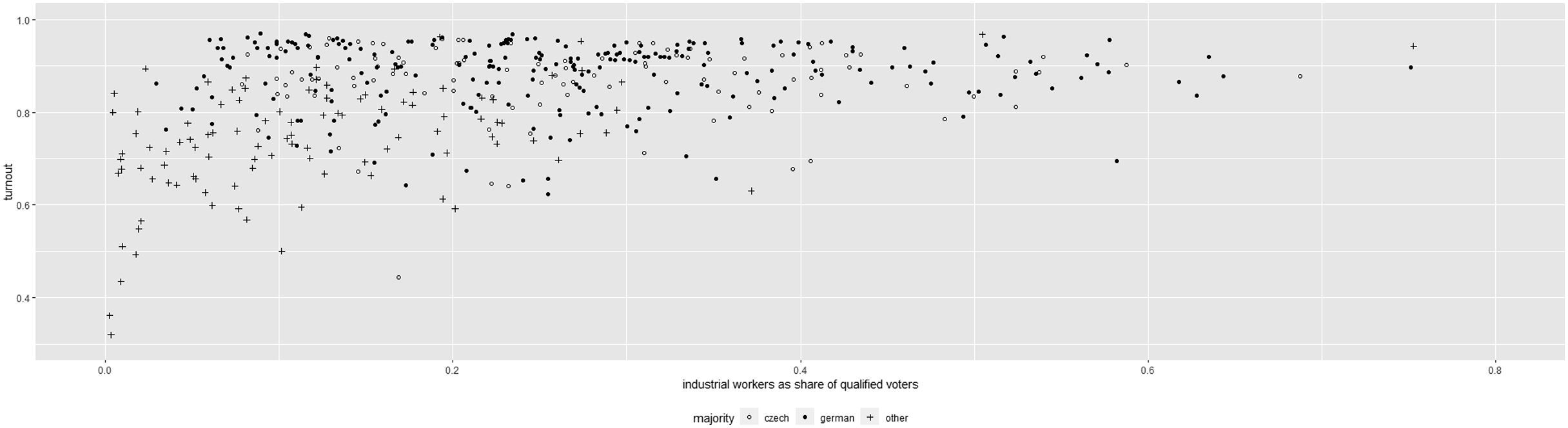
The ongoing secular decline of the agricultural sector in Austria through industrialization (Bartolini, 2000, Table 3.2) meant that Czech and German agricultural workers likely were motivated more by the fear of status decline than by the hope of status improvement. Industrial workers, after all, might view themselves as exploited but at least could claim to be building the future. The multi-national Social Democrats strove to cultivate that perception: “Who desires Austria’s rebirth in the spirit of freedom and democracy and wants to fulfill the need and will of the working masses should come to us. Voters who want to secure the future of the peoples, assemble under the banner of Social Democracy!” (Die Parteivertretung, 1907, p. 2). By contrast, agricultural workers were more prone to identify with traditional agrarian social structures. Domestic workers (“Knechte” and “Mägde”) and farm laborers paid in-kind (“Deputatisten”) often maintained close personal ties to the prominent households for which they worked, while day laborers (“Taglöhner”) and cottagers (“Häusler”) clung to the hope of becoming small landowners themselves while fearing being reduced to receiving charity or begging (Bartolini, 2000, p. 151, Table 8.5; Kořalka, 2010, p. 814–818, 844–845). 13
Third, the available electoral data are highly reliable. By law, balloting was observed by delegates of the participating parties and could be appealed to parliament’s Legitimation Committee. With the exception of those held in Galicia, which are not included here, historians consistently recognize these elections as having been free from significant fraud (Jenks, 1950, p. 178).
Importantly, the 1907 elections offer better conditions for valid causal inference than contemporary ones. Because most of the electorate was voting for the first time, parties experimented with a variety of appeals without knowing which would be most effective. The 1907 electoral reform created constituencies that had not existed previously, providing significant new opportunities to mobilize voters. Parliament’s Electoral Reform Committee, whose membership comprised a broad cross-section of parties, nationalities, and social classes, created these new districts in 1906–1907 (Jenks, 1950, p. 53; Rumpler, 2007, p. 879). Although this gave parties already in parliament direct influence on districting, the subsequent elections were competitive. The Social Democrats and German Christian Socials, who had been only a small fraction of the committee, were by far the most likely to win seats in the first round in 1907, and many of the parties which had been dominant under the previous electoral system were much less successful under the new one. 14 In short, the process of electoral reform did not pre-determine future party success.
The 1907 constituencies were effectively new despite previous elections through the 5th curia. Because that curia had only elected a small fraction of seats, the new constituencies were significantly smaller and demographically less diverse than those under the 1896 electoral system. Lower Austria, for example, went from a mere nine districts under the previous system to 64 after 1907. Districts which previously had encompassed entire provinces were now divided into four to 12 districts. The new districts typically consisted of a city (e.g., Klagenfurt), part of a larger city (e.g., one of Trieste’s five residential districts), or a cluster of smaller communities (e.g., the towns Bregenz, Dornbirn, Feldkirch, and Bludenz). The practice of explicitly distinguishing urban from rural districts produced further social homogeneity, relative to the previous system. Networks of neighboring towns formed territorial but non-contiguous urban districts separate from their surrounding rural areas. For the first time, the people of each newly created district were in the position to decide collectively which parties and candidates best represented them.
These constituencies were also new in that most voters had not participated under the previous system. In 1900/1901, the last election held under the curial system, 28.9% of 500,422 qualified voters cast ballots in the 5th curia. In 1907, following the full implementation of universal manhood suffrage, 84.6% of 5,526,203 qualified voters cast ballots (k.k. statistische Centralkommission 59.3 1902, Tables VI & XIII; 84.2 1908, Tables V & VII). In short, the overwhelming majority of the electorate had not been mobilized before 1907. 15
Most importantly, the nationalist parties had a minimal mass electoral presence before 1907. Of the 12 such parties analyzed here, only four—the German Agrarian, German National, German People’s, and Young Czech parties—had won at least one seat in the 5th curia in either 1897 or 1900/1901.
Data, Operationalization, and Empirical Strategy
Data collection
Our analysis combines the following datasets: data on parties’ identity appeals and policy offers, district-level election results, census data on the linguistic composition of each district’s population, and data on the occupational structure of each district’s electorate.
To assess party appeals, we created the Habsburg Manifesto Dataset (HMD), for which we collected programmatic documents issued by all Czech and German parties that won at least 1% of seats in Czech- or German-dominated districts, either in the two 5th curia elections that followed the 1896 electoral reform (1897 and 1900/1901), or in the two elections that followed the 1907 reform (1907 and 1911). The complete HMD contains 150 documents issued by 25 parties between 1897 and 1911 (see Supplementary Appendices D3 and D4).
This article analyzes a subset of the HMD consisting of the election announcements issued by six German and six Czech nationalist parties for the 1907 elections. Election announcements were typically published on the first page of party-affiliated newspapers and aimed to mobilize voters (see Supplementary Appendix D1). Patterns of contestation in 1907 were highly regionalized. Parties frequently ran in a single province, although the Social Democrats competed in most constituencies. The highly localized nature of parties and their affiliated newspapers therefore produces fairly close correspondence between party appeals and local constituencies.
Widespread literacy among Czechs and Germans and the high circulation figures of party newspapers bolster confidence that voters read parties’ electoral announcements. Male literacy rates in the 10 provinces that encompassed 98% of German and Czech districts ranged from 85.7% in Styria to 97.6% in Vorarlberg (k.k. statistische Centralkommission 63.2 1903, Table XXXII). 16 The newspapers that published electoral announcements, often repeatedly and for months before the election, would have been widely distributed throughout these provinces, due to Austria’s highly developed railway infrastructure (Rumpler & Seger 2010, p. 247–256). The late-19th and early-20th centuries witnessed an explosion of newspaper publication in every language of the monarchy—by 1910, 78.8 newspapers were published per 1000 inhabitants of Imperial Austria (Melischek & Seethaler, 2006, Table 3). Between 1869 and 1910, the Oesterreichische Kronen-Zeitung, a popular, non-political German-language newspaper, achieved a maximum circulation of 170,000 issues daily (ibid., 1670). The circulation of party newspapers, though inevitably lower, was nevertheless impressive. For example, the major Czech- and German-language Social Democratic papers, Právo lidu and Arbeiter-Zeitung, had maximum daily circulations of 60,000 and 54,000, respectively, and the circulation of nationalist newspapers was comparable (see Supplementary Appendix D1). The close ties between newspapers, parties, and partisan civil associations produced a strong positive correlation between circulation and political participation, at a time when the press played a leading role in developing a modern public sphere (ibid.: 1601–1616).
Following standard practice in party politics research (e.g., Dancygier & Margalit, 2020; Volkens et al., 2018), we measured parties’ campaign strategies through qualitative content analysis. We developed a coding scheme that accounts for historical context and contains both issue (policy) and group (identity) categories (see Supplementary Appendix E2). Each category has directional sub-categories (e.g., social security positive is paired with social security negative). Residual categories allowed coders to classify segments containing no issue or group claims. Including sub-categories and residual categories, the coding scheme has 194 categories. We trained three German and two Czech coders until they achieved an acceptable level of inter-coder reliability. After training, the average Cohen’s kappa for German coders was 0.63, and for Czech coders it was 0.55 (see Supplementary Appendix E5), very satisfactory values, given the complexity of the coding scheme (Neuendorf, 2002). In addition to coding each segment, coders classified each document holistically, according to the core issue which a party embraced, the core group to whom it appealed, and the core enemy it disparaged (see Supplementary Appendix E3). 17
The remaining datasets draw on electoral and demographic data collected by Austria’s Imperial-Royal Statistical Central Commission. District-level data on the number of qualified voters; the number of valid, empty, spoiled, and split ballots; and the number of ballots cast for each party in 1907 were compiled from the official tallies submitted by each polling station’s Electoral Commissioner (k.k. statistische Centralkommission 84.2 1908). To combine party appeals with electoral results, we matched the party names under which candidates ran, as recorded by local election officials, to those in the election announcements.
The share of Czechs and Germans in each district was based on “language of everyday use,” as self-declared on the 1900 census (k.k. statistische Centralkommission 84.2 1908). In cases where census data were only available for an entire city, we assigned the city-wide values to every district within it. The Commission did not provide district-level linguistic data for provinces with largely homogeneous German-speaking populations (Lower Austria, Salzburg, Upper Austria, and Vorarlberg). We treated these districts as 100% German-speaking. Finally, the province Moravia was divided into two sets of territorially overlapping SMDs whose voters self-registered on separate Czech and German voter lists. We therefore treated Moravian districts as 100% Czech and German, respectively.
Our occupational data draw on a 1912 Central Commission study of the 1907 electorate. That study provides the occupational profile of all qualified voters in each district, and of those who actually turned out (k.k. statistische Centralkommission 91.1, 1912). Data include how many voters worked in each sector (industry, agriculture, etc.) and held a specific occupational status (self-employed, public employee, or worker). According to these data, the share of voting-age males employed in industry was 36.8%, and the share employed in agriculture was 49%. To assess which voters were industrial workers, we follow Bartolini (2000, p. 153), totaling those classified as “workers” (“Arbeiter”) within the sectors “Industry and Commerce,” “Post, Telegraph and Telephone,” “Railways and Tramways,” and “Other Commerce and Transport companies.” To count the voters who were agricultural workers, we added those classified as “workers” or as “cottagers” (“Häusler”) in the agricultural and forestry sector. 18
Sample, Empirical Strategy and Operationalization
Our hypotheses predict nationalist parties’ electoral success at the district level. We classified a party as nationalist if the coders identified nationalism positive as either the first or second core issue in the majority of its 1907 election announcements. We validated this against a classification by historians (Rumpler & Urbanitsch, 2000, Table A3, see Supplementary Appendix E6). This led to a sample of six Czech and six German nationalist parties. The 1907 elections took place in 480 districts. Excluding Eastern Galicia’s two-member districts reduced this to 444 single-member districts. From these, we selected the 294 districts in which at least one Czech or German nationalist party gained at least one vote, resulting in 429 total observations of nationalist parties’ vote shares at the district-level, our unit of analysis. Given the highly personalized and localized nature of Austrian party competition, the hurdles for electoral entry were extremely low. Based on the reasonable premise that every candidate received at least his own vote, we can confidently equate zero votes for a given party with it not having fielded a candidate in that district. In other words, our data include every instance of German or Czech nationalist party entry.
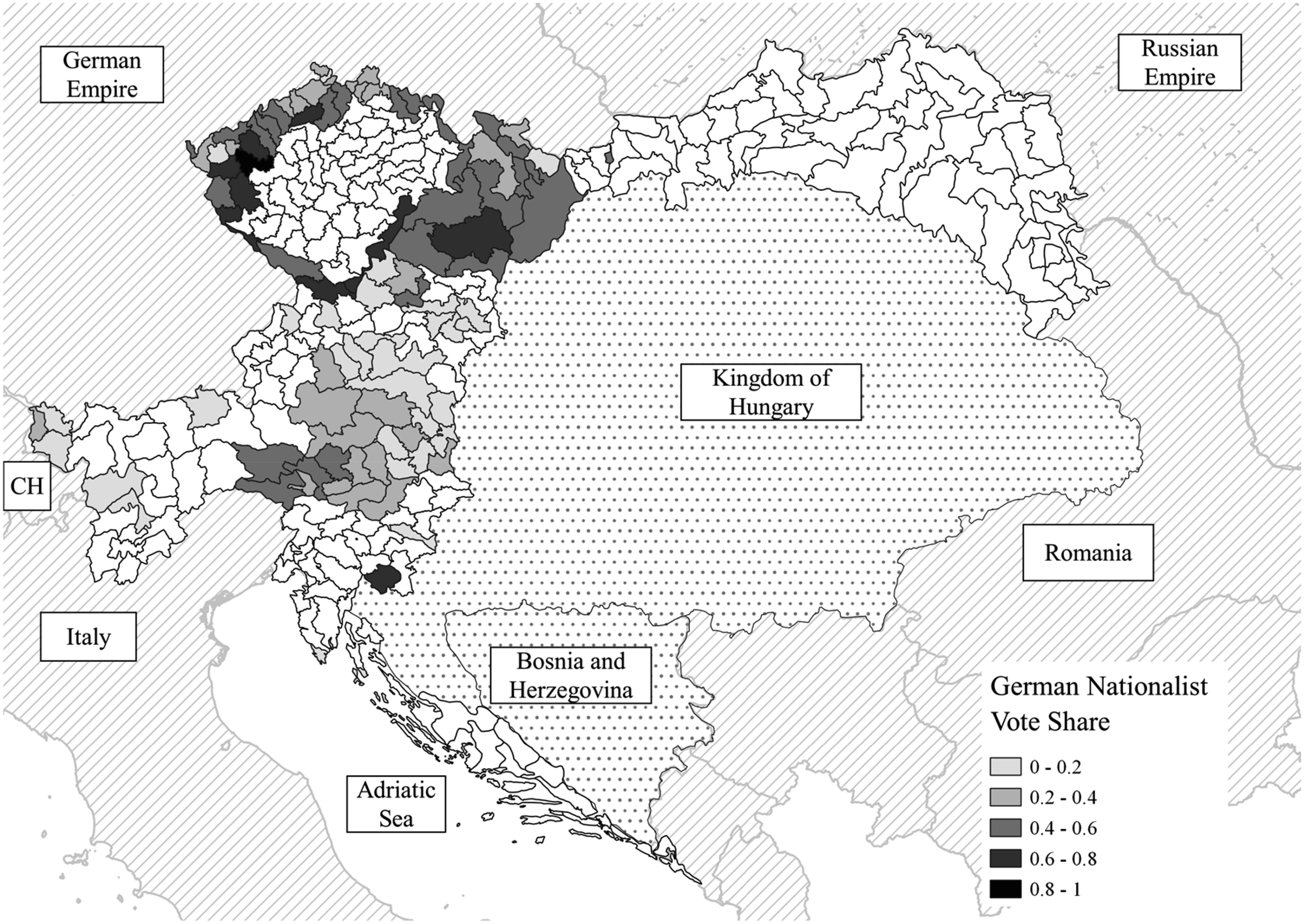
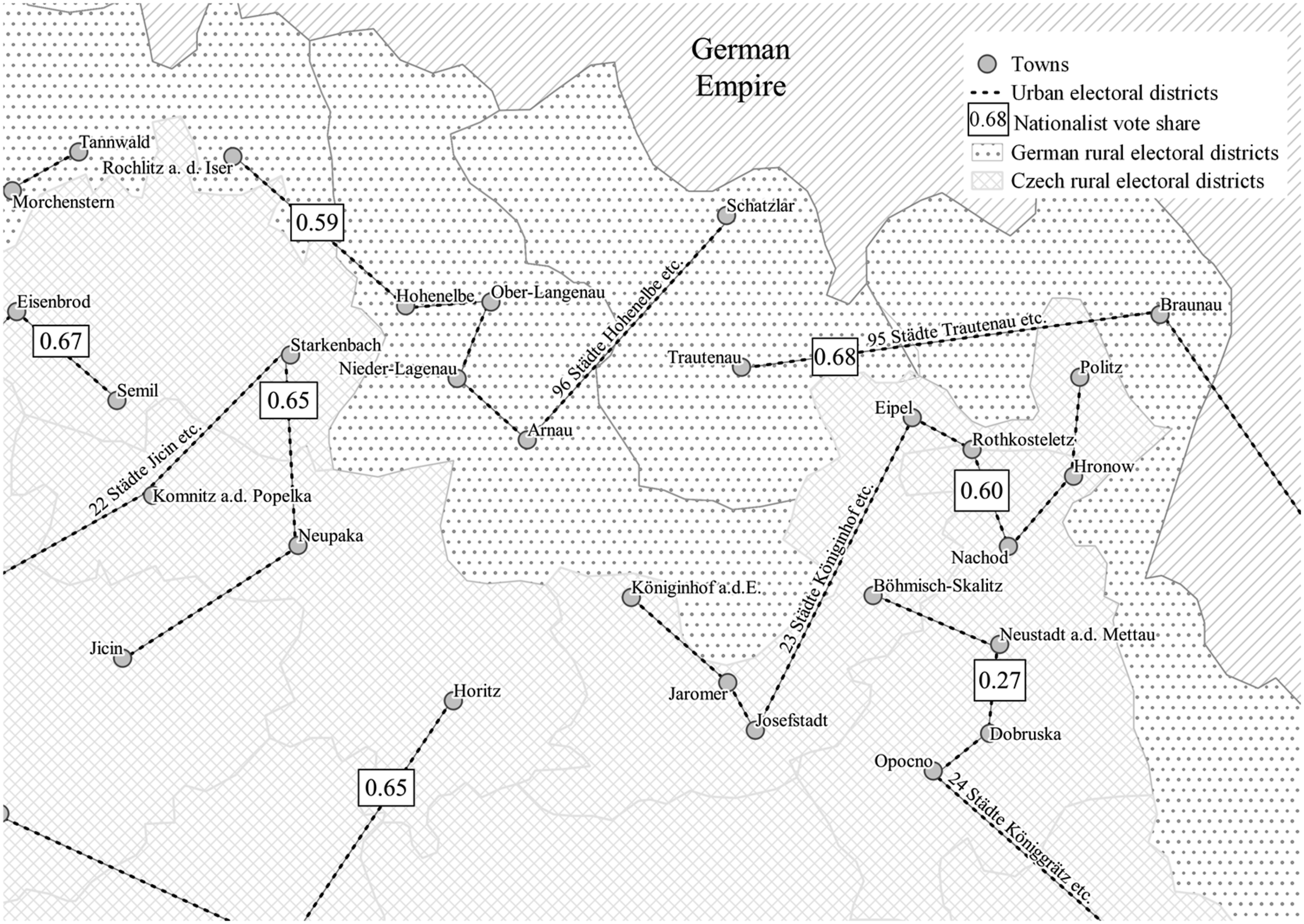
Maps 1 and 2 display the aggregate district-level vote shares of Czech and German nationalist parties in rural districts in 1907, while Map 3 provides examples of nationalist voting in several Czech- and German-dominated urban districts.
19
Combined district-level vote shares of Czech Nationalist parties – rural districts. Combined district-level vote shares of German Nationalist parties – rural districts. Combined district-level vote shares of Czech and German Nationalist parties –Examples from Urban districts in Bohemia (1907).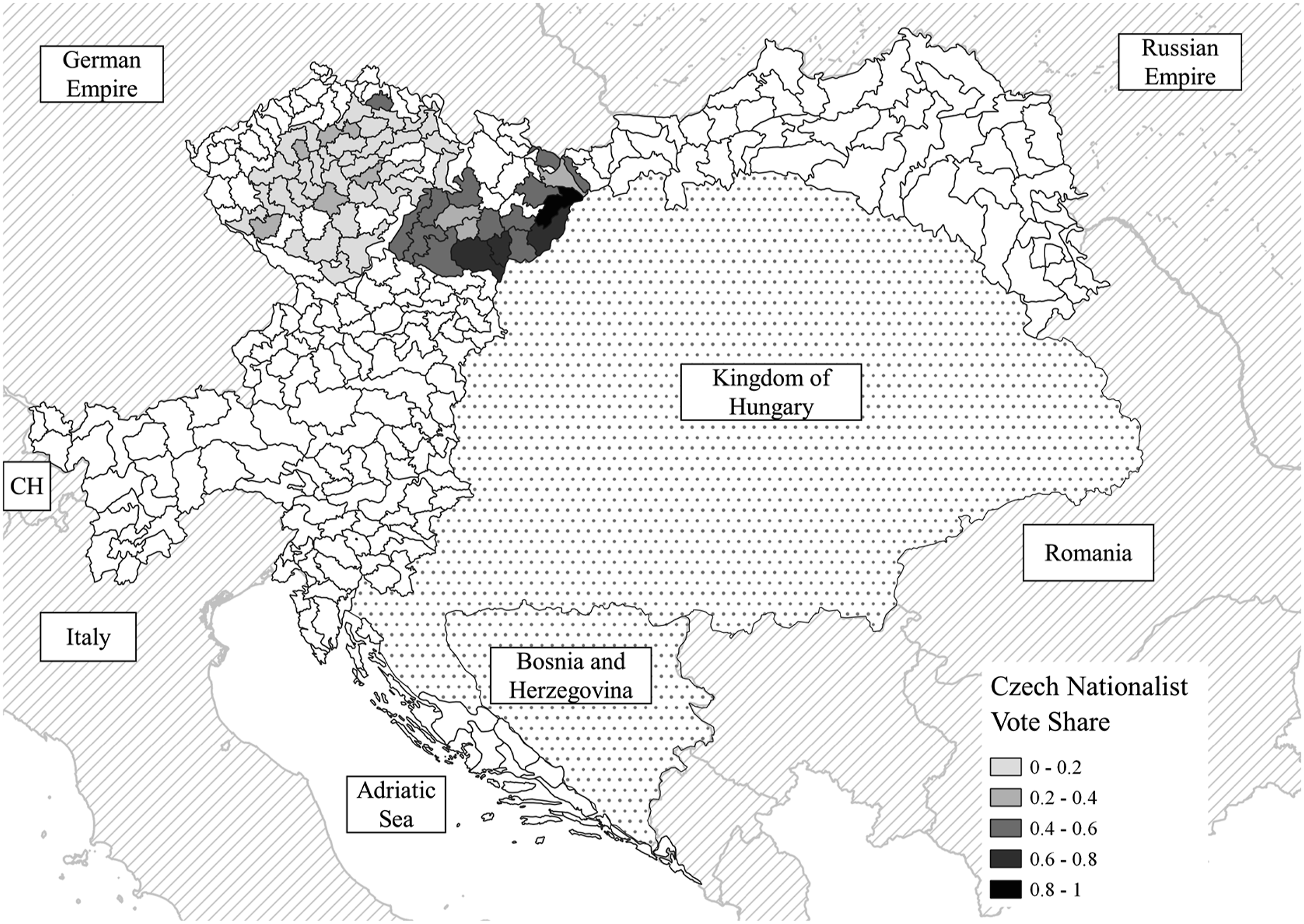
We tested our hypotheses by regressing the nationalist parties’ district-level vote shares in the first round of the 1907 elections on their policy offers and group appeals, as well as on district class composition.
Parties’ vote shares within each district are not independent from each other. We therefore use a random intercept linear hierarchical model, in which parties’ election results are modeled as nested in electoral districts (e.g., Magni & Reynolds, 2018). The regression equation is presented in the “Analysis” section. Because our theory predicts that the socio-demographic context of districts conditions the effect of parties’ electoral appeal, we use random rather than fixed effects. District-level fixed effects would control away class composition, since demography varies between but not within districts, whereas random effects allow us to model the effect of variables that vary within and between districts (cf. Bell et al., 2019). 20 Our dependent variable, parties’ district-level vote share, is measured as the number of votes cast for that party, divided by the total ballots cast.
To measure parties’ campaign strategies, we draw on our codings of the 1907 election announcements. Following Lowe et al. (2011) and Franzmann (2015), we measure parties’ policy offers and group appeals using the following formula

In this formula, Pj denotes the number of times policy/group category j was coded positive in an electoral announcement, while Nj indicates the number of times it was coded negative. The logit function takes into account that each additional policy or group claim’s marginal effect presumably decreases, depending on how often that document has already mentioned it (Lowe et al., 2011, p. 130). If we analyzed multiple election announcements for a party, we averaged their values. To measure parties’ nationalist promises, we plug the coding category nationalism positive/negative into Formula (1). Following our coding instructions, this category includes claims that either favor or oppose: (1) nationalism as an ideology; (2) promoting the identity, consciousness, culture, or interests of a specific group; (3) a group’s right to govern its own affairs and protect its autonomy and status within the state; and (4) institutions that promote a group’s cultural autonomy.
Because parties’ individual social policy offers are highly correlated, we use a generic social policy dimension comprising four individual coding categories: socio-economic equality positive/negative, social security positive/negative, public health positive/negative, and public education positive/negative.
21
The following statement, from a joint electoral announcement issued by three Czech nationalist parties, the Radical States Rights Party, the Radical Progressives, and the National Socialists, illustrates how nationalists made socio-economic promises. The sentence was coded as “public education, positive”: The requirements of an independent Czech business university and a Czech high school specializing in textiles fit squarely within the framework of our progressive efforts regarding the national economy (Radikální listy, 1907, p. 2).
We proceed with parties’ group appeals as with policy offers, measuring parties’ appeals to their national group using the categories Germans/Czechs positive/negative.
Figures 2 and 3 plot nationalist parties’ appeals to Germans and Czechs, and their nationalist and social policy offers (see Supplementary Appendices B1 and B2 for the Czech and German names of parties). They also include the Social Democrats as the main working-class party. Figure 2 shows that the Social Democrats avoided appeals to national groups and spoke negatively about nationalist policies. All nationalist parties spoke positively about their nation and offered nationalist policies (though to varying degrees). There is also a strong association between national group appeals and nationalist policies. Parties’ identity appeals to the nation and nationalist policy offers (1907). Parties’ social and nationalist policy offers (1907).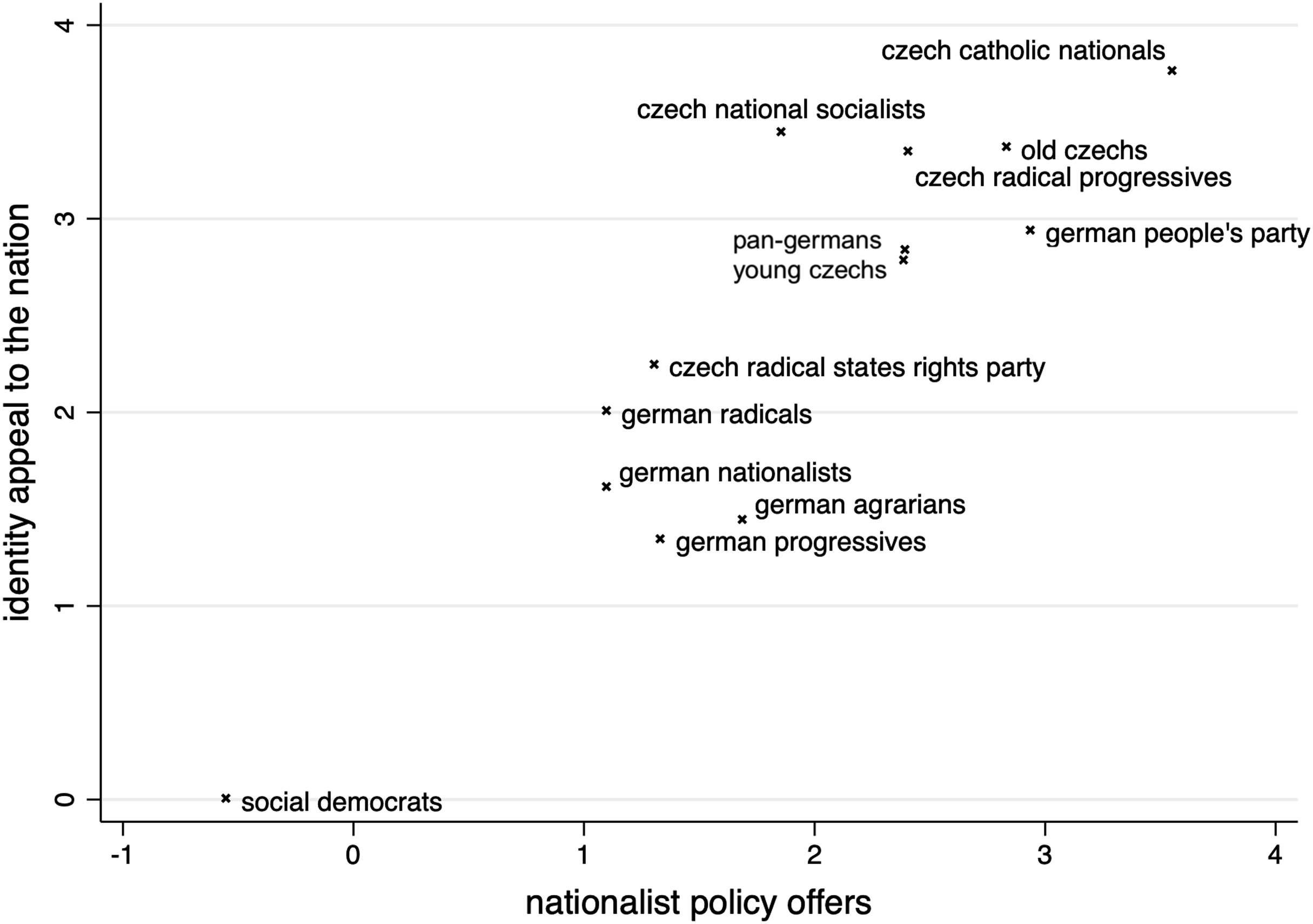
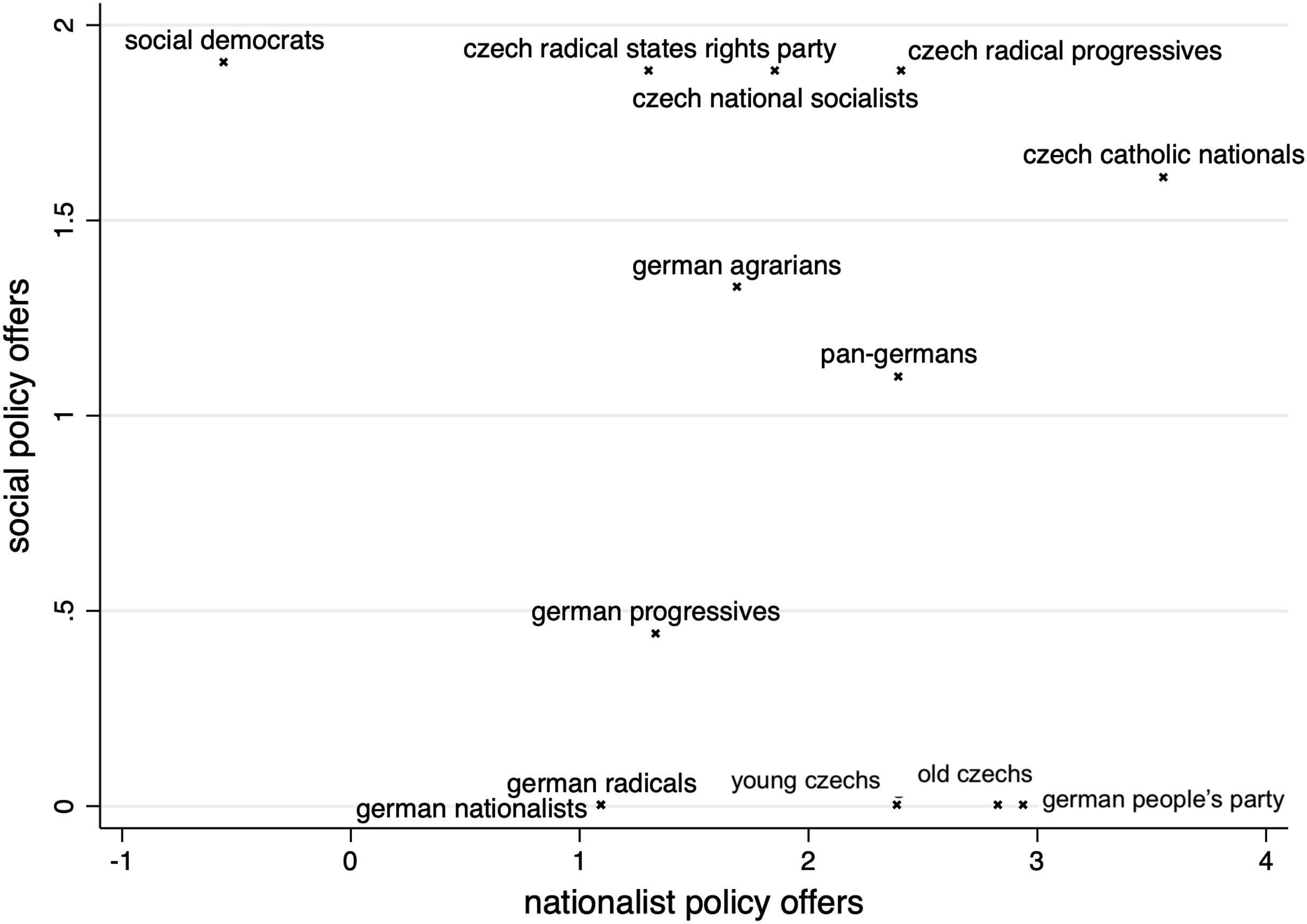
Figure 3 shows that the Social Democrats clearly favored social policy. It also reveals variation within the nationalist camp. Whereas several of these parties were either neutral towards or moderately favored social policy, three Czech nationalist parties advocated for it almost as strongly as the Social Democrats, thereby confronting them on their own core issue. This provides a first indication that some nationalists addressed both national and socio-economic status.
To test whether the effectiveness of party appeals is moderated by an electorate’s class composition, we draw on our occupational data to calculate the proportion of industrial and agricultural workers among qualified voters in each district (share of industrial workers; share of agricultural workers).
Five covariates ensure that the conditional independence assumption is met and that our regression estimates for party appeals can be interpreted causally (Angrist & Pischke, 2009, p. 53). First, some provinces used mandatory voting, which would have affected the sociological profile of participating voters there. Specifically, the Christian Social Party pushed strongly for and the Social Democrats against mandatory voting, under the shared expectation that the industrial proletariat was already highly mobilized, and that it therefore would increase the relative share of rural, conservative, agrarian, and middle-class voters within the electorate (Kouba, 2021, p. 5–6). Parties competing primarily in those provinces might have adjusted their campaign strategies accordingly. The dummy variable mandatory voting equals one for districts in provinces using compulsory voting (k.k. statistische Centralkommission 84.2, 1908, Table VIII).
Second, both Shayo (2009) and Solt (2011) operationalize the status of the lower classes through country-level economic inequality. To account for the possibility that the status of a nation’s median member might be a function of inequality as well as class structure, we draw on Pammer (2013; 2019) and include the variable Gini coefficient, which measures income inequality at the provincial level, based on 1911 income tax statistics. 22
Third, the variable number of parties counts parties winning at least one vote in each district. Parties might have anticipated who their competitors were in deciding where to run and on which platform and the number of parties directly affects the outcome variable of district-level vote shares. 23
Fourth, even though we emphasize parties’ agency, social structure limits the kinds of appeals that will resonate with voters, as the ethnic voting literature has emphasized (Huber, 2017; Huber and Suryanarayan, 2015). Obviously, seeking votes for a Czech nationalist party would be pointless in a district where no one speaks Czech. We therefore control for the ethno-national composition of the electorate. The variable share of national group measures the share of Czech or German speakers within each district for Czech and German nationalist parties, respectively, drawing on census data.
Finally, we include a nationality dummy for German parties (German) to ensure that the effects we find are not driven by unobserved differences between Czech and German nationalism. For an overview of these operationalizations, see Supplementary Appendix F; for summary statistics, Supplementary Appendix G.
Analysis
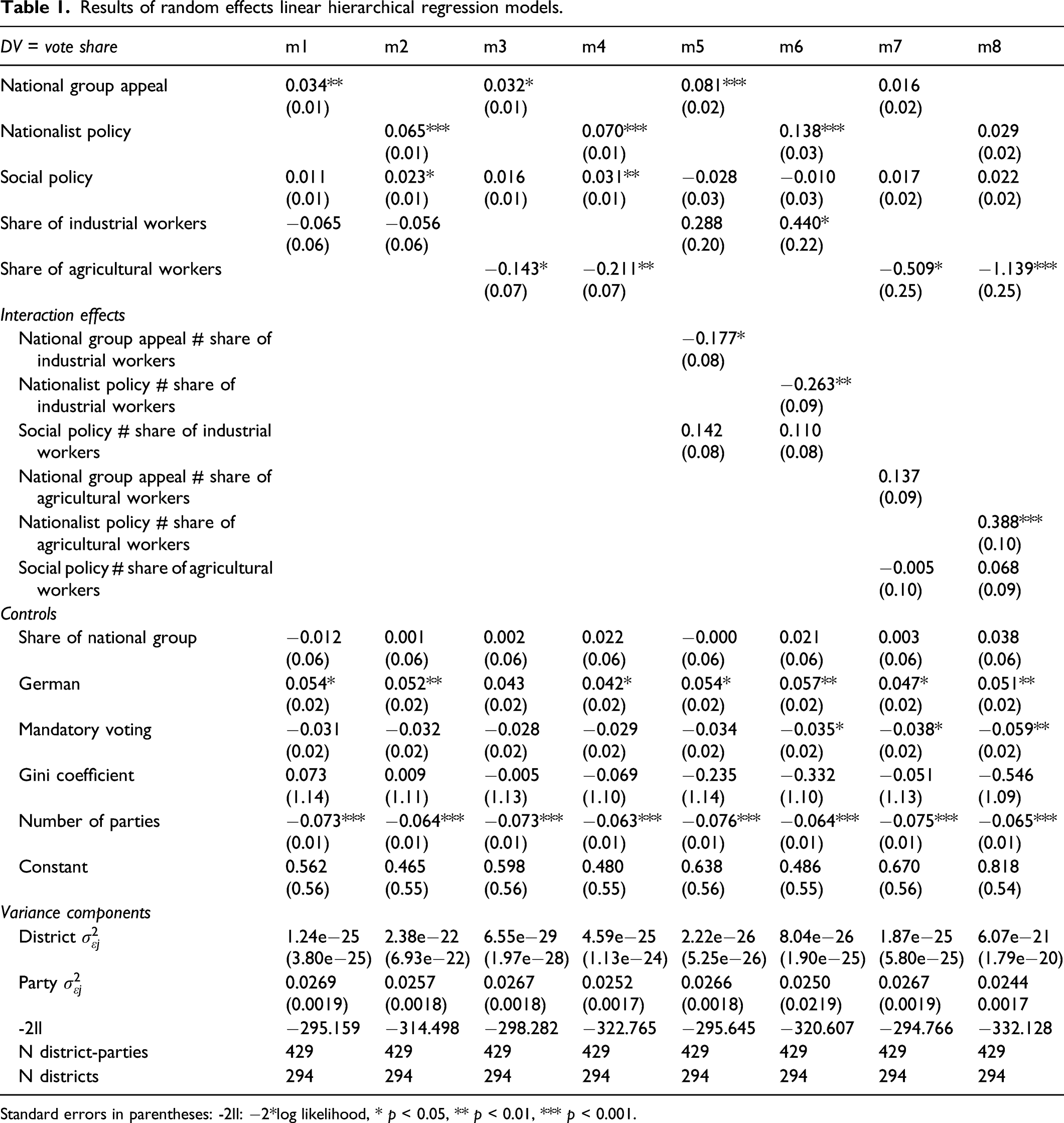
Results of random effects linear hierarchical regression models.
Standard errors in parentheses: -2ll: −2*log likelihood, * p < 0.05, ** p < 0.01, *** p < 0.001.
Level-1 Model
Level-2 Model
Substitution of β
0j
yields the following formula
In this formula, i indicates party; j district; Yij dependent variable; xij explanatory variable at the party-level; and zj explanatory variable at the district-level. The effects of p control variables at the party-level are denoted by ∑βpj xpij; the effects of q control variables at the district-level are denoted by ∑ γ qzqj; rij is the error term at the party-level; and u0j is the error term at the district-level. The other models in Table 1 have been estimated analogously.
Models 1–4 prepare the ground by estimating the direct effects of nationalist parties’ group appeals and policy offers on their electoral success. Models 5–8 proceed to test our theoretical predictions by adding interactions between parties’ electoral platforms and the class composition of the district electorate. Because parties’ national identity appeals and nationalist policy offers are highly correlated (Pearson’s r = 0.77), these two variables are included alternatingly in the models; the same goes for agricultural and industrial workers’ share of the district electorate (Pearson’s r = −0.55).
The models without interaction terms show that group appeals to national identity increase nationalist parties’ vote shares; however, this is not the whole story. Promises to improve the nation’s political and cultural status also have a significant positive effect on electoral success—in fact, the effect is twice as large as that of group appeals. Social policy also has a positive effect on nationalists’ vote shares, but that effect is only significant in the models that include nationalist policy (m2 and m4), not in the models that include group appeals (m1 and m3).
Our theory expects the politics of nationalism, class, and status to be closely intertwined, predicting that the effect of nationalists’ electoral platforms is conditioned by the electorate’s class composition. Models 5 through 8 support this. Whereas the interactions between group appeals/nationalist policy offers and the share of industrial workers negatively affect vote share (m5 and m6), the interactions between group appeals/nationalist policy offers and the share of agricultural workers have positive coefficients. The interactions between social policy and the share of industrial workers have a positive effect on vote share (m5 and m6), whereas the direction of the interaction effect between social policy and the share of agricultural workers is unclear (compare m7 and m8).
Among the control variables, the number of parties per district and mandatory voting have the expected negative effect on parties’ vote shares (although the latter is not always significant). Furthermore, German nationalists tended to gain higher vote shares than Czech nationalists. The log likelihood measure for model fit (-2ll) indicates that the models that include substantive nationalist policy offers are generally preferable to those that include national group appeals.
These findings call for visual inspection of the relationship between nationalist parties’ electoral strategies, class structure, and electoral success. Figures 4–6 show the electoral effects of each of the three components of nationalists’ electoral platforms—group appeals, nationalist policy offers, and social policy offers—conditional on industrial and on agricultural workers’ share of the district electorate (m5-8).
25
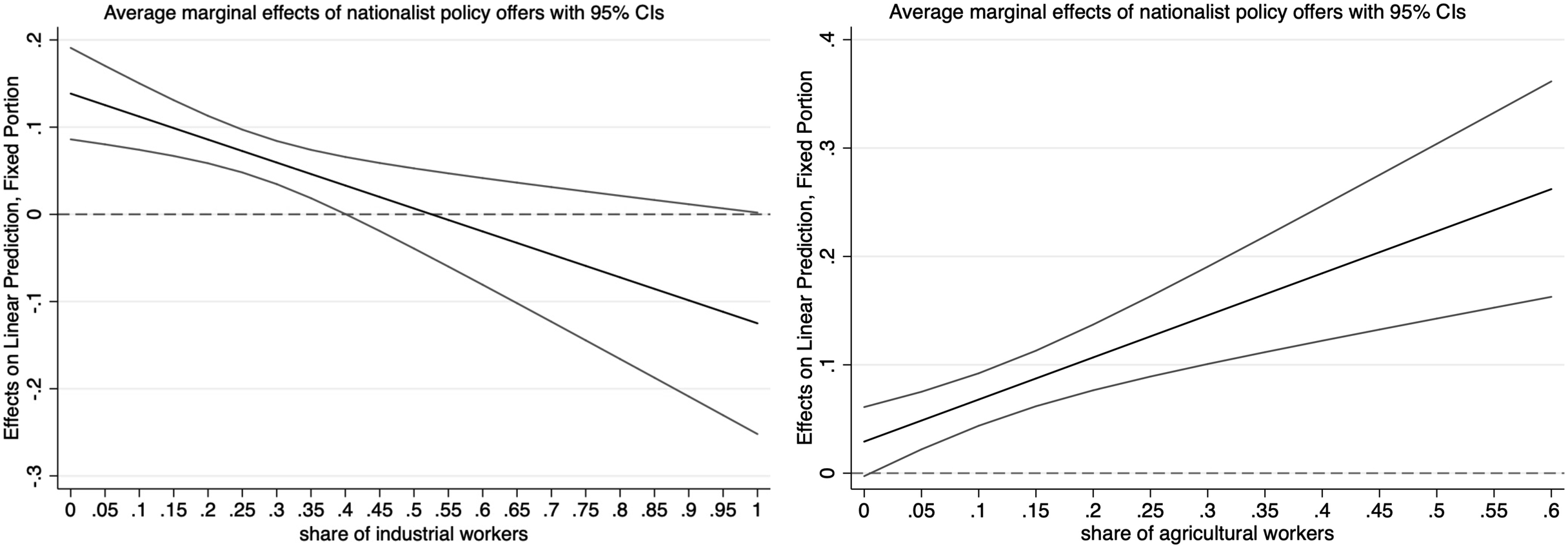
Figures 4 and 5 provide clear evidence in favor of hypotheses 1b and 2b, which predicted that nationalist platforms would be particularly successful in districts with a high share of agricultural working-class voters. Furthermore, both nationalist group appeals and nationalist policy offers cease resonating in districts where industrial workers are more than about 1/3 of the electorate. Though economically precarious, industrial workers had reason for optimism about the future status of their class and therefore were less susceptible to messages addressing their national identity. Interactions between parties’ group appeal to the nation and the district-electorate’s share of industrial workers and agricultural workers (based on m5 and m7). Interactions between parties’ nationalist policy offers and the district-electorate’s share of industrial workers and agricultural workers (based on m6 and m8). Interaction between parties’ social policy offers and the district-electorate’s share of industrial workers and agricultural workers (based on m6 and m8).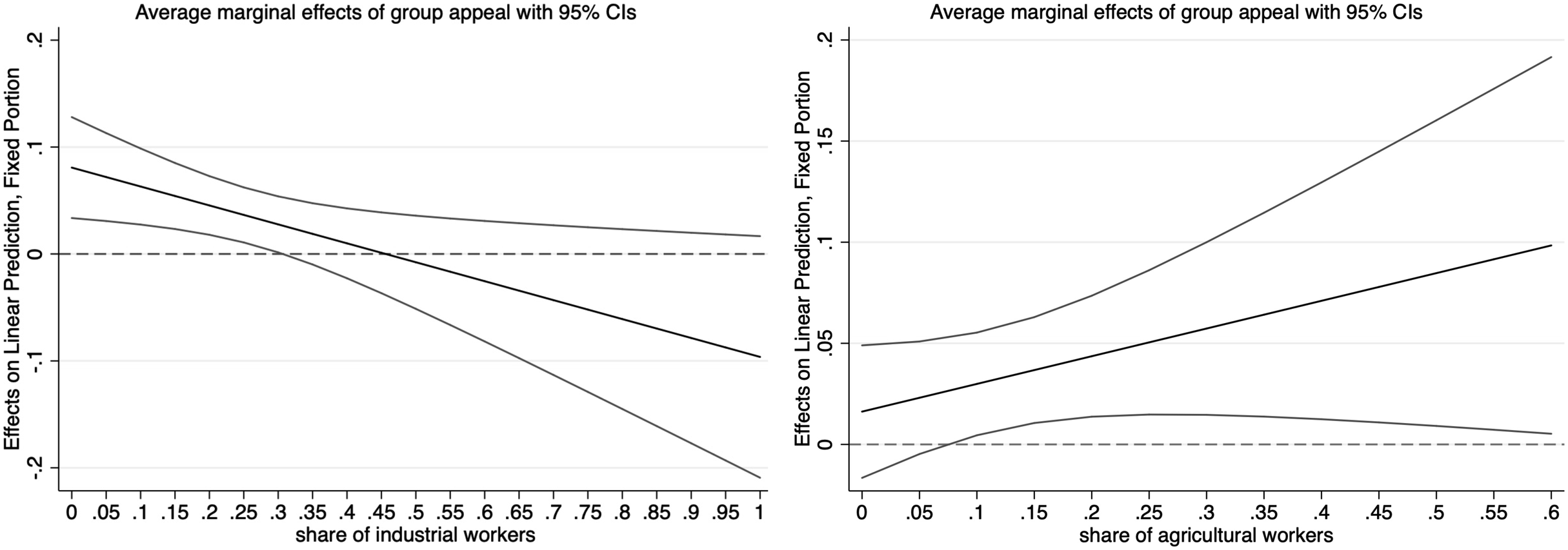
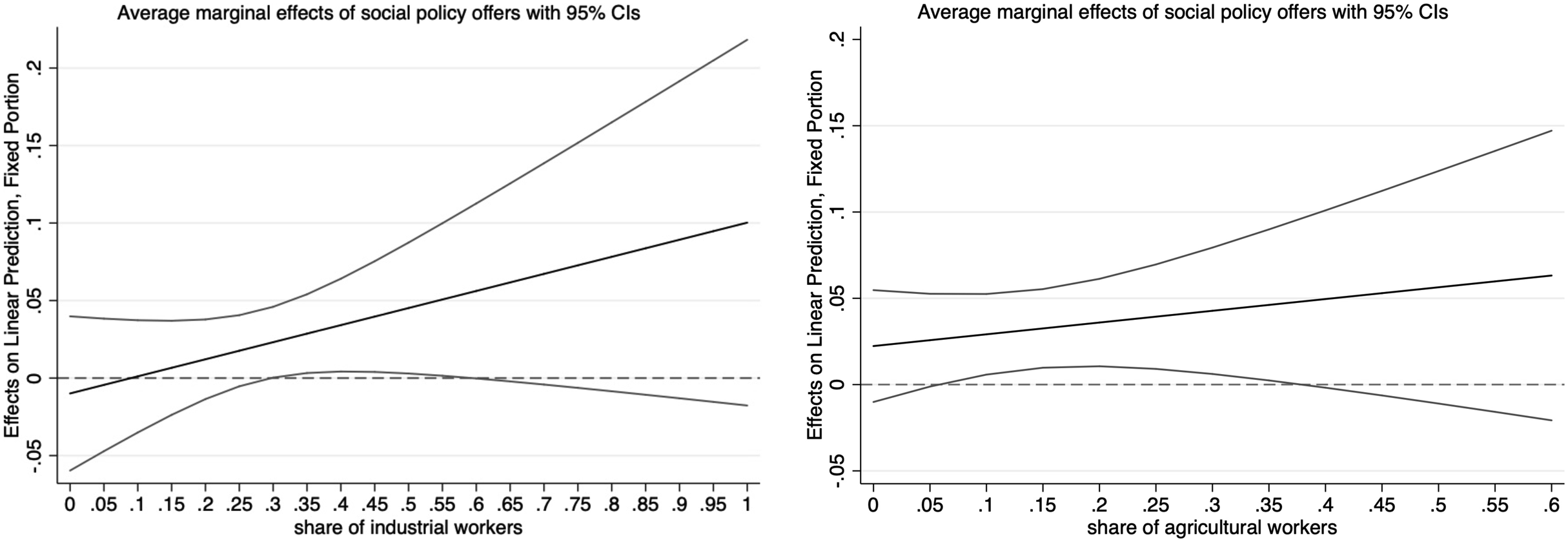
Aside from priming national identity and offering nationalist policy, our theory predicts that nationalist parties can also increase their vote share by promising to raise the socio-economic status of the nation’s median member. Figure 6 shows that these promises indeed yielded more positive electoral returns where there was a higher share of working-class voters. This occurs independently of whether we consider agricultural or industrial workers. However, because the confidence intervals include zero for higher shares of agricultural and industrial workers alike, we can conclude with certainty only that social policy has a positive effect on nationalists’ electoral success for districts in which 10–40% of voters are agricultural or 30–60% are industrial workers.
A recurring feature of all interactions that include the share of industrial workers is that ca. 1/3 of the electorate appears to be an important threshold. At that point, group appeals to the nation and nationalist policy promises cease increasing nationalists’ vote shares, whereas the effect of social policy offers becomes positive. This 1/3 threshold is suggestive in its own right. Given the logic of the M+1 Rule in the context of majority runoff elections (Cox, 1997, p. 123–138), a party needs to win around 1/3 of the vote in order to enter the second round. A district in which workers are about 1/3 of the electorate is therefore one in which working class mobilization is a viable strategy, if not for winning the district, then at least for increasing one’s bargaining power between rounds.
We estimated additional regressions to assess robustness. These included estimating the impact of public education policy alone instead of parties’ combined social policy offers (Supplementary Appendix H1); estimating an OLS regression with standard errors clustered at the district level (Supplementary Appendix H2); replacing the share of industrial workers with that of all workers (Supplementary Appendix H3); using an alternative measure of parties’ electoral platforms based on their emphasis on nationalist policy relative to other issues (Supplementary Appendix H4); controlling for male illiteracy and district-level turnout (Supplementary Appendix H5); interacting appeals to the nation/nationalist policy offers with the German dummy to assess possible differences in how majority versus minority nationalists’ platforms resonate (Supplementary Appendix H6); and controlling for the size of the urban middle class (Supplementary Appendix H7). The large majority of these tests confirm the robustness of our findings. There are two exceptions: First, the effect of offering social policy on electoral success does not increase with higher shares of agricultural workers across all models. Second, when using the alternative, relative emphasis measure, the interaction between nationalist policy and the share of agricultural workers is no longer significant (cf. H4).
In summary, we emphasize three main findings. First, increasing the number of positive appeals to national identity indeed helps nationalists increase their vote share. This confirms standard political economy theories, which argue that nationalist parties win support by positively priming national identity. Second, modeling interactions between nationalist group appeals and industrial and agricultural workers’ share of the district electorate confirms the relevance of newer political behavior findings about the importance of status anxiety: nationalist identity appeals resonate better the higher the share of agricultural workers. However, they no longer yield electoral returns where industrial workers are more than 1/3 of the electorate. Third, nationalist parties campaign on more than identity appeals. Offering policies that promise to improve the political and cultural status of the nation and the socio-economic status of its median member clearly influences nationalists’ electoral success. In fact, the effect of nationalist policy offers outweighs that of national identity appeals. Furthermore, just like identity appeals, nationalist policy offers resonate strongly with agricultural workers, the class group facing status decline, but become ineffective where industrial workers, whose economic sector was on the rise, make up more than ca. 1/3 of the district electorate.
Conclusion
The first parliamentary election to take place exclusively through universal manhood suffrage in the multinational, industrializing, Austrian half of the Austro-Hungarian Monarchy provides an excellent opportunity to test explanations for nationalist parties’ electoral success. Estimating how parties’ appeals resonate conditional on societal structure is notoriously difficult when studying contemporary party politics. Such studies examine environments in which cleavages are already established, and therefore parties’ appeals stand in a dynamic, endogenous relationship with voters’ preferences and identities. By contrast, analyzing an election held using universal manhood suffrage for the first time allows us to draw clearer inferences about the effect of party appeals and societal structure on electoral success. The results provide strong support for our theory of status-improving nationalism, which expects parties to succeed by positively priming national identity and by promising to improve the nation’s political and cultural status and the socio-economic status of its median member. They show that a nationalist agenda indeed appeals specifically to class groups threatened by economic decline, while being less effective among lower-class voters in rising sectors of the economy. Furthermore, nationalist parties do not simply distract voters’ from their material preferences; rather, they address working-class voters’ economic concerns directly through social policy, a strategy that is particularly effective among industrial workers.
In making these findings, we have brought the recent literature on radical right parties into conversation with the political economy literature on inequality, nationalism, and ethnicity. By doing so, we address existing limitations within these literatures, particularly by emphasizing the agency parties exhibit by priming group identities and addressing both cultural and economic status concerns through their platforms. Our approach improves on these literatures in several other ways as well. First, we introduce a novel explanation of nationalist success that is based on the notion of social status, thereby providing a needed supply-side complement to the demand-side status-based explanations that have become the state of the art in the radical right voting literature. Second, we introduce a model that encompasses both majority and minority nationalisms. Finally, we place the general phenomenon of nationalist mobilization in a much broader historical context. After all, contemporary scholars of radical right parties, as well as the parties themselves, are now rediscovering strategies that Austria’s nationalists pursued over a century ago. Between the 1990s and the 2010s, the Danish People’s Party, the Party of Freedom in the Netherlands, the Front National in France, the Northern League in Italy, and, last but not least, the Freedom Party of Austria all became more pro-welfare (Afonso & Rennwald, 2018). We thereby offer a new, broader perspective on European radical right parties’ recent turn away from Kitschelt and McGann’s (1995) “winning formula” (cultural authoritarianism plus economic neoliberalism) and towards either welfare chauvinism (Mudde, 2007), trade protectionism (e.g., Colantone & Stanig, 2018), or a generally more leftist economic agenda (e.g., Afonso & Rennwald, 2018; Lefkofridi & Michel, 2017; Minkenberg & Pytlas, 2012; Rathgeb, 2020; Rovny & Polk, 2020; Röth et al., 2018). These recent contributions attribute these shifts to contingent exogenous pressures, such as globalization, automation, economic and financial crises, or a growing working-class support base. We offer a more general theoretical argument centered on the notion of status anxiety: nationalists will succeed if they offer economic and social policies that address the status anxiety of the nation’s median member.
There are larger theoretical implications to these findings. By emphasizing interactions between nationalist parties’ appeals and social structure, we show that the politics of class and nationalism are closely intertwined. Contrary to a dominant view in the political economy literature, nationalism is no mere distraction from class politics. This insight resonates with the literature on sub-state nationalism and social policy, which argues that there is a strong connection between nationalist mobilization and the provision of social welfare in cases as diverse as Scotland (McEwen, 2002) and sub-state nations in India (Singh, 2015).
Furthermore, the scope and quality of our electoral, party, and demographic datasets will allow scholars to pursue additional compelling questions about the nature and evolution of party competition in Central and Eastern Europe. Areas for further exploration include the ways in which parties modified their campaign strategies over time; nationalist appeals to a wider variety of class identities (e.g., farmers and merchants) and their diverse range of nationalist policy offers; the role played by overarching, non-national identities (e.g., Austrian, loyal subject); the strategies pursued by nationalists among Imperials Austria’s other, less economically developed linguistic groups; and the striking fact that the two most successful parties, the German Christian Socials and the Social Democrats, both downplayed nationalism.
Finally, our findings underscore the need for a general model of party competition, one that takes into account both identity appeals and competition over policy. Such a theory would have to endogenize the types of social identities that we have taken here to be exogenous, in order to model: how party appeals themselves lead voters to identify more strongly with their national, class, or other group identities over time; how parties frame particular issues as being a matter of class or other group conflict; and how this affects voters’ perceptions of their own identities and preferences. Such a theory promises to reconnect empirical research on electoral behavior to the normative literature on representation. The latter is increasingly focusing on constituency definition through representation, seen as a dynamic relationship of claim-making and claim-acceptance (Disch, 2011; Saward, 2010; Urbinati & Warren, 2008), rather than as a unidirectional relationship whereby the representative “acts in the interest of the represented” (Pitkin, 1967). Such issues are especially pertinent, given growing concerns about the significance of identity politics and right-wing populism in early-21st century elections world-wide.
Supplemental Material
sj-pdf-1-cps-10.1177_00104140211036033 – Supplemental Material for Nationalism, Class, and Status: How Nationalists Use Policy Offers and Group Appeals to Attract a New Electorate
Supplemental Material, sj-pdf-1-cps-10.1177_00104140211036033 for Nationalism, Class, and Status: How Nationalists Use Policy Offers and Group Appeals to Attract a New Electorate by Philip J. Howe, Edina Szöcsik and Christina I. Zuber in Comparative Political Studies
Footnotes
Acknowledgments
We would like to express our heartfelt thanks to our research assistants, Karel Boruvka, Yelda Grönlund, Romy Hansum, Teuta Kallco, Stefan Kebekus, Michaela Křiklánova, Maximilian Kutzner, Tomáš Marik, and Johanna Washington, whose help in collecting and preparing data, and in analyzing party documents, was crucial. We would also like to thank Franz Adlgasser, Peter Urbanitsch, and the staff of the Österreichische Nationalbibliothek for their assistance in locating electoral district maps, and Johanna Washington for digitizing and GIS coding them; Jakub Beneš for advising us on the history of the Czech Social Democrats; Pavel Cibulka for providing us with the text of several crucial Czech party documents; Daniel E. Miller for assistance with Czech translations, and for advice regarding the Czech press and parties; and Michael Pammer for generously sharing his data on income inequality. Earlier versions of this paper have been presented at the 114th Annual Meeting of the APSA (Boston, 30 August 2018), the 27th DVPW-Kongress (Frankfurt a.M., 25-28 September 2018); the IPSA conference “Diversity and Democratic Governance” (Sarajevo, 12-14 June 2019); the 27rd International Conference of Europeanists (Madrid, 22-24 June 2019); and the Research Seminar of the Political Science Department at UCL (London, 13 May 2020). Very helpful comments by participants on these occasions, and in particular by Christian Breunig, Zeynep Bulutgil, Volha Charnysh, Alexandra Cirone, Sarah Engler, Laurenz Ennser-Jedenastik, Anselm Hager, Michael Koß, Bogdan Popescu, James Pow, Saskia Ruth-Lovell, Valentin Schröder, Henry Thomson, Manuel Vogt, and Julian Waller, as well as by three anonymous referees, are very gratefully acknowledged. All authors contributed equally to the article.
Declaration of Conflicting Interests
The authors declared no potential conflicts of interest with respect to the research, authorship, and/or publication of this article.
Funding
Generous financial support was provided by the Zukunftskolleg and Ausschuss für Forschungsfragen at the University of Konstanz, and the Matching Funds of the University of Basel. Philip J. Howe would also like to thank the Adrian College Association of Professors, the Hungarian Fulbright Commission, and the Hungarian Academy of Sciences’ Institute for Political Science for their generous support throughout much of this project.

Notes
Author Biographies
References
Supplementary Material
Please find the following supplemental material available below.
For Open Access articles published under a Creative Commons License, all supplemental material carries the same license as the article it is associated with.
For non-Open Access articles published, all supplemental material carries a non-exclusive license, and permission requests for re-use of supplemental material or any part of supplemental material shall be sent directly to the copyright owner as specified in the copyright notice associated with the article.
