




Abstract
Combining individual-level with event-level data across 25 European countries and three sets of European Election Studies, this study examines the effect of conflict between parties in coalition government on electoral accountability and responsibility attribution. We find that conflict increases punishment for poor economic performance precisely because it helps clarify to voters parties’ actions and responsibilities while in office. The results indicate that under conditions of conflict, the punishment is equal for all coalition partners when they share responsibility for poor economic performance. When there is no conflict within a government, the effect of poor economic evaluations on vote choice is rather low, with slightly more punishment targeted to the prime minister’s party. These findings have important implications for our understanding of electoral accountability and political representation in coalition governments.
Competitive elections offer citizens the opportunity to hold the government responsible for its past actions, with voters punishing incumbent parties for poor performance while in office. For the retrospective voting mechanism to work, however, voters need to be able to identify parties’ achievements or failures while in office (Manin et al., 1999). As discussed by Tavits (2007), if lines of responsibility are not clear, the ability of voters to evaluate and punish politicians declines.
The assignment of responsibility has been the subject of an extensive literature, which shows that responsibility attribution is particularly problematic when the government is formed by a coalition of parties sharing power during their term in office (Powell & Whitten, 1993). Under these circumstances, clarity of responsibility is obscured because voters are unsure about who is responsible for policy making, and their ability to use the vote to sanction politicians can be hampered (e.g., Anderson, 2000; Nadeau et al., 2002; Whitten & Palmer, 1999).
Coalition governments, however, vary considerably, with some made up of parties with similar policy goals, and others consisting of heterogeneous if not litigious majorities (Strøm et al., 2008). Conflict within the government has been found to have significant consequences for coalition management, policy outputs, and government stability (e.g., Müller & Strøm, 2003). Yet, as of today, the type of relation between coalition parties—conflictual versus consensual—on the working of the accountability mechanism has not been fully investigated. In this article, we argue and then show that the features of the policy-making process in coalition governments are related to responsibility attribution and clarity of responsibility, and thus retrospective voting. Specifically, by connecting coalition politics with retrospective economic voting, we test the argument that repeated conflictual behavior by coalition parties provides important information on government parties’ actions that voters can use to assign responsibility for poor performance to the party in the coalition mostly in charge of the economy.
To test our claim, we couple data from three European Election Studies (EES) (2004, 2009, and 2014) with a novel measure of government conflict. Our measure of intra-coalition conflict is based on the Integrated Crisis Early Warning System (ICEWS) project (Boschee et al., 2013). The ICEWS produces data on an almost continuous basis from media reports, press releases, parliamentary speeches, and politicians’ statements using machine learning. The data document cooperative and conflictual public interactions among politicians of government parties, and we rely on these data to create an overall index of intra-coalition conflict that spans the entire legislative term.
Although the economy is not the only area to which electoral accountability should and seems to apply, for most voters the economy is among their main priorities (Singer, 2011), and its valence character—the agreement on policy outcomes—renders evaluations of the actual performance of the government easier for a majority of voters (Ferejohn, 1986; Fiorina, 1977). Empirical analyses have found with great regularity that “when economic conditions are bad, citizens vote against the ruling party [government]” (Lewis-Beck, 1991, p. 2). Hence, following the existing literature on retrospective voting, which has mainly focused on electoral accountability in terms of the economic performance of incumbent parties (Anderson, 2007), in this study we investigate retrospective voting focusing on the economy.
The findings from this study show that while conflict between coalition parties per se has no effect on voting for government parties, it has a substantial negative effect in interaction with poor economic retrospective evaluations. In addition, the results indicate that the degree of retrospective voting due to intra-coalition conflict is similar for the main governing party, which is usually the prime minister’s (PM) party, as well as its junior coalition partner when they share responsibility for perceived poor economic performance. While the prime minister’s party is often considered within the existing literature to be mainly affected by bad economic performance, we furthermore show that the junior partner will be punished as well if conflict is high and this party is responsible for economic affairs.
The current study contributes to the existing literature in several important ways. First, we show that while parties may have strategic incentives to diffuse political responsibility when performance is suboptimal, certain types of government constellations and the conflict they experience make it harder for the government to escape punishment. Second, this study improves our understanding of the accountability mechanism by investigating the impact that the policy-making process under coalition governments has on responsibility attribution. In particular, this study sheds light on an important yet forgotten aspect of retrospective voting: how voters gather information on parties’ actions while in government. Our results indicate that visibility emerging from conflict between coalition partners plays an essential role in keeping voters informed on coalition government performance, as conflict may lead to increased media attention and thus to greater information (e.g., Hobolt & Tilley, 2014). Overall, our results suggest that while parties governing together have incentives to differentiate themselves in the eyes of voters, their disagreement while in office cannot be exploited for positive cues toward voters (Fortunato, 2017) when at the same time voters perceive that all coalition parties preside over and are responsible for a poorly performing economy. Given recent trends in government formations across multiparty settings, which increasingly bring polarized constellations of parties together to share power (e.g., Austria, Ireland, Italy, Spain, and Sweden), understanding the effect of intra-coalition conflict on electoral accountability has become an even more salient topic.
Coalition Governments and Electoral Accountability
The theory of retrospective voting (e.g., Fiorina, 1977; Lewis-Beck, 1988; Manin et al., 1999) argues that electoral accountability occurs when voters retrospectively judge whether incumbent governments have performed well while in office and then reward or sanction them accordingly. A large literature has shown that the retrospective voting mechanism works for many issue areas, including corruption (e.g., De Vries & Solaz, 2017), natural disasters (e.g., Healy & Malhotra, 2009), and especially the economy (e.g., Lewis-Beck & Stegmaier, 2000). However, Powell and Whitten (1993) provided an important specification to this argument by showing that voters are more likely to punish or reward incumbents for the state of the economy when “clarity of responsibility” for outcomes is high (Nannestad & Paldam, 2000; Whitten & Palmer, 1999).
Clarity includes two main dimensions. The first dimension pertains to more stable institutional features of the country, such as the division of power between different levels of the government, federalism, and so forth. A second dimension includes a more dynamic aspect, that is, the cohesiveness of the incumbent government. Hobolt et al. (2013) showed that the latter matters the most in explaining contextual variation of retrospective voting. Cohesion refers in the existing works mainly to the complexity and ideological setup of the government. In particular, complexity has been studied in terms of a simple count of parties in the government. Since sharing power with other parties in a coalition government makes it easier for incumbent parties to blame each other or attempt to share responsibility for bad economic performance, the lower the number of parties, the more clarity of responsibility is enhanced (Anderson, 2000; Bellucci, 1991; Duch & Stevenson, 2008). Complexity has also been analyzed in terms of power concentration: the more dispersed the control of the government (Anderson, 2000), or the more widely economic responsibility is shared across parties (Debus et al., 2014), the harder it becomes for voters to assign responsibility for the country’s economic well-being.
Two main conclusions can be drawn from this existing literature: (a) parties in coalition governments are held less to account compared to single-party governments (e.g., Fisher & Hobolt, 2010; van der Brug et al., 2007), and (b) with “an ideologically cohesive coalition dominated by one large party, voters will find it relatively easy to reward or punish that particular party” (Hobolt & Tilley, 2014, p. 127).
In this article, we build on this existing line of work and argue that another dynamic moderator of retrospective voting in coalition governments should be taken into account when studying retrospective voting, namely whether or not the governing parties are in a conflictual partnership. There are in fact many different types of coalition governments, some, for instance, composed of parties with polarized preferences and different policy priorities, resulting in coalition governments with conflictual behaviors, others characterized by parties with overlapping policy agendas and strategies that can be considered more consensus oriented (e.g., Strøm et al., 2008). By focusing on the conflictual nature of coalition governments, we discuss below the effect of coalition politics on the working of electoral accountability at the electorate level.
Intra-Coalition Conflict and Electoral Accountability
Certain government coalitions represent rather consensual majorities in which parties compromise on and coordinate their policy making with little intra-coalition dispute and public debate (Miller & Müller, 2010). In contrast, when parties forming coalition governments find it difficult to compromise, policy making in the cabinet is typically accompanied by discussions on policy views of each individual government party, both in the parliament and in the media. Previous research has argued that when parties govern together, misperceptions about the individual parties’ policy positions may increase (Adams et al., 2016; Fortunato & Stevenson, 2013), but Spoon and Klüver (2017) clarified that this happens only when parties govern consensually, while conflict between government parties positively influences voters’ knowledge of parties’ positions. This is due to the fact that conflict between government parties provides voters with important information about the policy priorities of the individual government parties (Lupia & McCubbins, 1998; Sniderman & Stiglitz, 2012). Conversely, when parties govern more consensually, policy making is usually presented to the public as the result of governmental compromise, with less if any subsequent distinction about the preferences and actions of each coalition partner. Thus, “[P]arties may consciously seek conflict” (Fortunato, 2017, p. 61) to show on which issue areas they are competent and how credibly they implement the policies they campaigned on, especially toward the end of the legislative term before they face election (Damgaard, 2010; Sagarzazu & Klüver, 2017). Such behavior is based on the assumption that voters prefer parties that stand on principles to achieve what they have promised (Hibbing & Theiss-Morse, 2002). However, intra-coalition conflict will also make coalition partners’ (economic) actions more visible compared to situations when conflict is low. So, in case of bad economic performance,
1
which attracts even more media attention (e.g., Soroka, 2006), we expect that the greater the conflict in the cabinet, the more likely voters are to hold the government to account as they can update their beliefs accordingly (see also Lupu, 2015). Following this line of reasoning, while parties may consciously look for conflict, conflict itself will also help voters to hold coalition parties to account for their poor performance on the economy. Hence, we expect the following:
Although all parties in a ruling coalition have some responsibility for formulating policy in all areas (Martin & Vanberg, 2014; Müller & Strøm, 2003), specific responsibility in terms of which ministries each party controls can also make a difference when parties are judged retrospectively (Debus et al., 2014). Several existing studies have indeed shown that when it comes to the performance vote, voters home in on the party in control of specific ministries (Narud & Valen, 2008; Plescia, 2017). As conflict helps to clarify responsibility attribution, conflict should also clarify whether one party is more responsible for economic conditions, and hence this would facilitate the punishment for this specific failing. Thus, “competence signaling” through conflict on issues where government performance is bad could have negative implications for the party responsible for this issue, resulting in a greater likelihood to be sanctioned.
If so, when conflict is high, we expect voters to punish the party in charge of the ministries that deal with economic issues, and not necessarily to punish the prime minister’s party solely in virtue of the fact that it is the head of the cabinet or simply the party that controls more ministerial posts (Anderson, 2000; Duch & Stevenson, 2008; Fisher & Hobolt, 2010; Fortunato & Adams, 2015; Plescia & Kritzinger, 2018). In other words, the observed outcome in the literature that the prime minister’s party gets punished more for poor economic performance might not be observable once portfolio allocation is considered. Conflict reveals the power allocation on the issue of the economy between the prime minister’s party and the junior coalition party, and the actor responsible for it might in the following election be sanctioned to a larger extent for poor economic performance. In cases where the prime minister’s party and the junior coalition partner share responsibility—for instance, in cases where one party controls the ministry of the economy and the other heads the finance ministry—punishment for poor economic performance should be shared more equally among the government parties even in circumstances of high conflict. In cases of balanced power allocation on the economy, competences, and thus also blame, are assigned to all parties. This leads us to our second hypothesis:
Research Design and Data
To test our hypotheses, we used individual-level data from the EES conducted right after the European Parliament (EP) elections. We used the 2004 (Schmitt et al., 2009), the 2009 (Van Egmond et al., 2011), and the 2014 (Schmitt et al., 2016) EES studies. 2 The sample size in the EES data is roughly 1000 interviews in each member state of the European Union (EU). Data collection is mostly done by CATI phone interviews, although distinctions exist in some countries where representative phone sampling is not feasible. There, parts of the interviews are conducted in face-to-face mode, with the remaining being done by phone. 3 There are several good reasons why EES surveys are appropriate to test our hypotheses. First, unlike other comparative studies, they cover all countries in the EU using identical questions during the same time period, which offers an excellent opportunity to examine how cross-national variations in the political context—in our case conflict between coalition parties—shape individual-level performance evaluations and voting behavior. Second, EP elections are organized on a strictly national basis and are (still) contested by national parties (e.g., van der Brug et al., 2008), thus they present “a combination of country differences and cross-national context uniformity that can be seen as providing appropriate laboratory-like ‘windows’ into national political processes” (De Sio & Franklin, 2012, p. 1370). 4
In our models we included countries in which a coalition government was in place before the respective EP election. Our hypotheses deal with conflict at the government level, and by definition a government formed by only one party has no intra-coalition conflict. Moreover, the existing literature has already shown that single-party governments are held to account more compared to coalition governments, and the aim of this study is to add to this existing literature by focusing on coalition governments. Given that effects are probably smaller when focusing exclusively on coalition governments, our test can be considered conservative. The full list of countries included in our study is provided in the Supplementary Appendix A.
Because we are interested in the sanctioning of an incumbent in the national context, we followed the literature (e.g., Hobolt et al., 2013) and measured our dependent variable using a question on national vote intention: “If there was a general election tomorrow, which party would you vote for?”.
We present the results in two steps. First, we look at vote choice for government parties versus voting for the opposition without distinguishing between the different coalition partners. In these logit models, the dependent variable takes a value of 1 if the respondent intends to vote for a government party and 0 for an opposition party. Second, we look separately at vote choice for the prime minister’s party and the largest junior coalition partner (versus voting for an opposition party). As for the junior coalition partners, in the empirical models below we focus on the largest junior coalition partner. The overwhelming majority of countries included in our sample do not have a third actor in the coalition government (see Supplementary Table 2), but when this exists, it does not control a salient portfolio, and the number of respondents intending to support it is so small that it does not allow for any meaningful analysis of its vote support.
Variables
The first of our two key independent variables is economic performance. This is measured using a standard question that asks respondents, “Compared to 12 months ago, do you think that the general economic situation in the country is ‘a lot better,’ ‘a little better,’ ‘stayed the same,’ ‘a little worse,’ or ‘a lot worse’.” 5 We use perception of the economy instead of real economic conditions following Duch et al. (2000, p. 649), who stated that “how people view economic performance is shaped by their political predispositions, personal financial experiences, socioeconomic situation, and level of understanding about the political economy.”
Moving to our second key independent variable, intra-coalition conflict has usually been measured in the existing literature by deducing conflict from the ideological range of parties in governing coalitions (e.g., Spoon & Klüver, 2017; Tsebelis & Chang, 2004). The (untested) assumption is that the ideological diversity reasonably anticipates the conflict coalition parties are likely to experience once in office. Yet such a measure does not provide information on actual conflict over issues on the government agenda, and it is rather insufficient to study the electoral ramifications of intra-coalition conflict we aim to test (for a similar argument see Miller and Müller (2010)). Indeed, to test our hypotheses, we need a measure of actual conflict among the parties in the government coalition during the legislative period, and we need this conflict to be publicly visible to have an impact on voters.
To this end, we created a measure of conflict using the publicly available event data from the ICEWS project (Boschee et al., 2013). The aim of the ICEWS project is to collect events related to the activities of the countries’ main sociopolitical actors as accurately as possible. The ICEWS data repository contains worldwide news stories (in English, Spanish, and Portuguese) and news from international, regional, national, and local publishers. The source material is the universe of news reports and information generated through both Factiva and the government Open Source Center, resulting in a publicly available data set with each row representing a date-stamped and geolocated event triple that recounts the source, the target, and the intensity of the event type. The event type is classified using the categorical coding scheme developed by the Conflict and Mediation Event Observation (CAMEO) project (Gerner et al., 2009). CAMEO consists of 20 top-level verb categories (with a total of around 350 subcategories) that classify the nature of the reported events, such as “make optimistic comment,” “express intent to settle dispute,” or “accuse of aggression.” 6
There are two important features of the data set that are particularly important for this study. First, the ICEWS project collects information on the activities of both politicians and parties on an almost day-by-day basis. Second, it captures interactions between politicians and parties in government reported by the media that take place via press releases, parliamentary speeches, interviews, campaign events, and so forth, thereby not restricting the data collection to one single data source. The media aspect is particularly relevant as it provides the basis for the visibility of the conflict to the public (see also Schuck et al., 2011).
We used all reported events in the ICEWS database for the countries under investigation. The time frame in each country spanned from the day after the formation of the coalition government to the day right before the subsequent EP election. Among the events included in this time frame, we differentiated between two types of actors: government parties or affiliated politicians versus all other actors, e.g., opposition parties, nonpartisan political actors, and societal actors. We retained statements only from parties or politicians in government. We then differentiated between the party or the politicians affiliated with the prime minister’s party and those affiliated with the junior coalition partner. We also retained events that had as their source the coalition government as a whole but then targeted only one of the coalition partners.
Each event has an intensity attached to it as defined in the CAMEO code, with all neutral statements having an intensity of 0. To turn the cooperative and conflictual event intensities into a “measure of conflict,” we simply took the mean of the intensities of all conflictual and cooperative events. 7 The result is a measure for which larger values indicate larger cooperation, and vice versa. 8 Detailed information on the event codes and frequency tables by country is provided in the Supplementary Appendix B.
Some important limitations with these data exist. First, the number of news stories we are able to cover varies per country given the language foci of the ICEWS data, with some countries being covered to a larger extent. However, based on the insight of intermedia agenda-setting, which is defined as “a dynamic and routinized process of news diffusion, where coverage of one media outlet is influenced by the agenda of other outlets” (Vonbun et al., 2016, p. 1055: see also Vliegenthart & Walgrave, 2008), we argue that conflict frames are even more largely distributed in the public compared to what we cover. Hence, our intra-coalition conflict measure is a rather conservative measure of conflict, biasing the results against our hypotheses. Second, while intra-coalition conflict is likely to not be constant across the entire electoral cycle (e.g., Sagarzazu & Klüver, 2017), given the relatively low number of events available for each month in each country, the ICEWS data set did not allow us to take into consideration the dynamic aspect of intra-coalition conflict. 9 To face this limitation, and to account for the fact that governments enjoy a honeymoon period at the beginning of their mandate while losing support at later stages, we controlled for the number of days passed since the formation of the coalition government and the subsequent EP election. Third, the measure of conflict is not issue-specific, as the ICEWS data do not provide enough event entries to differentiate between issues. This means that our empirical tests rely on a summary measure of intra-coalition conflict to examine whether conflict in the government clarifies party priorities and achievements while in office. Given that the economy is usually among the most discussed topics in parliamentary and public debates (Singer, 2011), this general measure of conflict provides a good application of the intra-coalition debate we aimed to test with our hypotheses. Fourth, the precision of data collection may vary across countries: we addressed this challenge by accounting for potential unobserved cross-national differences by relying on multilevel models (see below).
To test Hypothesis 2, we took into account the economy-relevant portfolio allocation within the coalition. While responsibility for economic performance is not easy to capture, we followed Debus et al. (2014) and measured responsibility by party control of key portfolios linked to the economy. We considered as key economic portfolios the economy and finance plus the labor ministry if it controls unemployment. We distinguished countries in which the prime minister’s party and the junior coalition partner share responsibility over the economy—for instance one controlling the economy and one the finance ministry—compared to those where key economic portfolios are either fully controlled by the prime minister’s party or vice versa. Among our 49 cases—resulting from the combination of country-year—we found 25 cases of shared responsibility, 19 cases in which the responsibility is fully in the hand of the prime minister’s party, and five in which the junior coalition party controls all ministries related to the economy. Supplementary Table 2 presents in full the time frame, the coalition government, and the classification of responsibility for all countries in our sample.
Relying on the existing literature on retrospective voting, we identified potential confounding variables. At the individual-level first and foremost, we controlled for party identification, which is likely to shape vote choice. We used the question of closeness to a specific party, and differentiated between identifiers with parties in the opposition, with the prime minister’s party or the junior coalition partner versus nonidentifiers (see also below). Second, at the institutional level, we included three measures of clarity of responsibility (Hobolt et al., 2013). The first measure is an index that takes into account four country-level features: power structure in bicameral systems, committee structures, type of government, and party cohesion. The second index measures institutional clarity and includes a variable measuring the degree to which a country is a unitary state, a dummy variable for parliamentary systems, and a dummy variable for unicameralism. Both indices are taken from Hobolt et al. (2013). The third index is a measure of government clarity. This includes a measure of the ideological cohesion of the government which, following Tsebelis and Chang (2004) among others, considers the ideological range of parties using expert data and the dominance of the main governing party, operationalized by the share of its cabinet posts. To produce this third index, we simply added the different items, divided them by their numbers, and rescaled the indices to run from 0 to 1. We included these three measures in our models simultaneously because they are only weakly correlated among themselves and only weakly correlated with our measure of intra-coalition conflict. 10 Finally, we added two standard demographic variables in the economic voting literature—age (in years) and gender (dummy for female)—as well as political sophistication which, following the works of Highton (2009) and Zaller (1992), represent an additive index of political interest (0–3), attentiveness to the election campaign (0–3), and level of formal education (0–3). 11 The inclusion or exclusion of control variables did not change our substantive conclusion (see Supplementary Material), yet it allowed us to examine the effect of intra-coalition conflict on vote choice “net” of the effect of those variables that the existing literature has shown to influence economic voting.
To appropriately consider the two-level nested structure of the data set with individuals nested in countries, and countries nested in years, multilevel modeling was applied to test the two hypotheses (package lme4 in R; Bates et al., 2015). 12 Results are based on full maximum likelihood estimators. All variables, except for the binary variables, were standardized by centering and dividing by two standard deviations (Gelman, 2008). 13
Empirical Findings on Intra-Coalition Conflict and Retrospective Voting
Figure 1 displays the standardized scores of levels of conflict within coalition governments measured using the ICEWS data. The figure shows variation both across countries as well as within countries between two EP elections. These values largely meet face validity.
14
For instance, in Finland, conflict is lower in 2009 compared to 2014: the prime minister, Matti Vanhanen, skillfully held together a coalition of Centre Party, Conservatives, Swedish People’s Party, and Greens formed after the 2007 general election with a legislative record far from exiguous up until 2010. After that, the coalition government experienced high conflict due to a series of scandals involving different ministers (Arter, 2011). In the Dutch case, the tensions in the government coalition started only after the 2009 EP election and led to an early election in June 2010 and the fall of Cabinet Balkenende IV (van Holsteyn, 2011). Intra-coalition conflict across EU countries. Notes: The figure shows the standardized conflict scores as measured using the ICEWS data. The years – 2004, 2009, and 2014 – refer to the relevant EES study.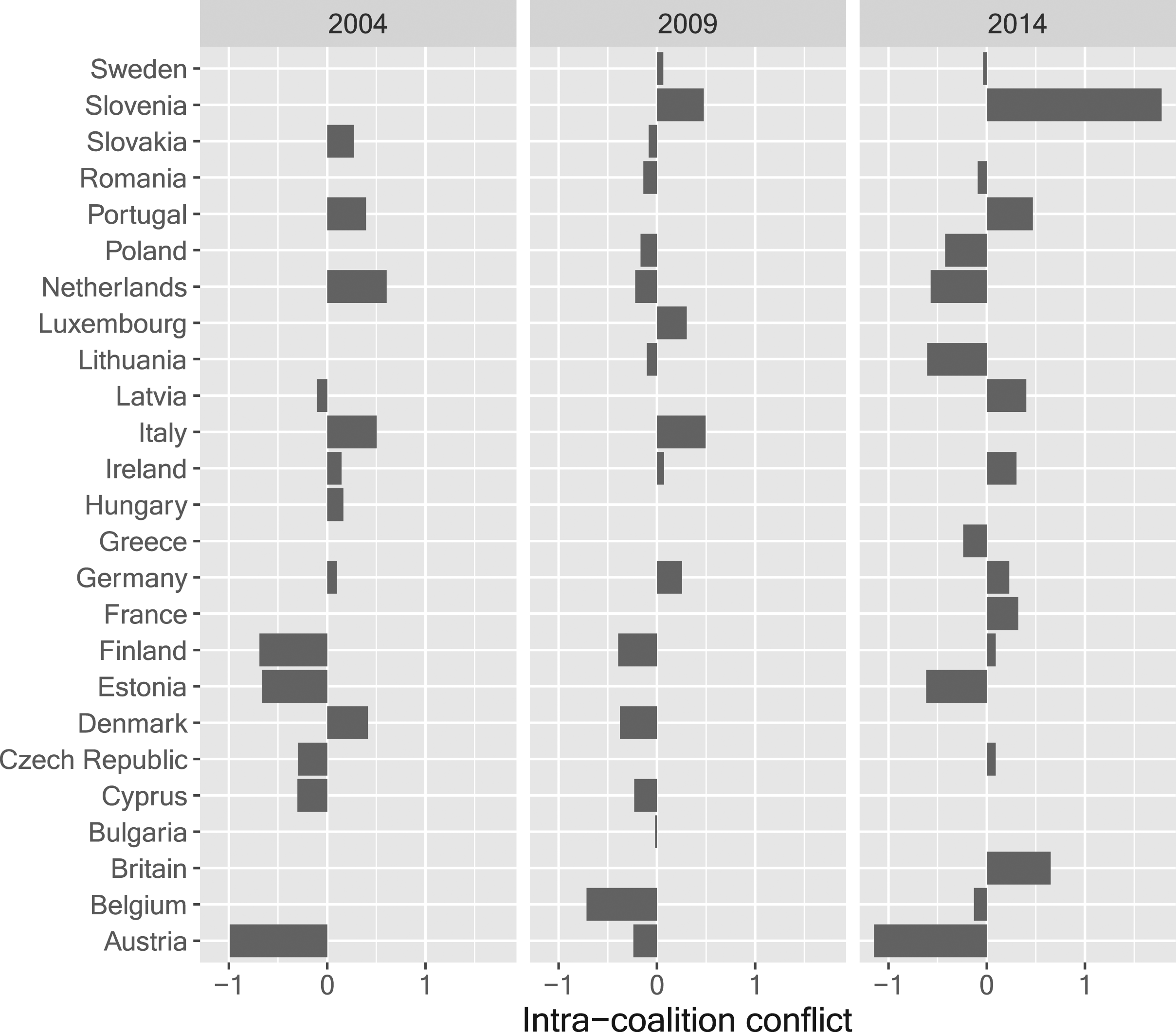
In Austria, conflict was lower in the ideologically more coherent ÖVP-FPÖ—conservative People’s Party and right-wing populist Freedom Party—government in 2004, while in 2009 the grand coalition led to substantially higher intra-coalition conflict between the government parties of ÖVP and the social democratic SPÖ. This is also the case for Germany in 2009, where the grand coalition between CDU-CSU and SPD featured lower cooperation efforts than the SPD-Green government in 2004. Intra-coalition conflict was rather high in Slovenia in 2014. The first government in the history of Slovenia to be headed by a woman started with a very unstable economy and had to introduce a series of urgent and intensely debated economic measures to stabilize the banking sector.
To further validate our measure of intra-coalition conflict, we checked its correlation with four variables: (a) early coalition termination, (b) ministerial resignations from ministries with economic and financial portfolios, (c) significant government reshuffles, and (d) prime ministerial resignations. These dummy variables considered only those cases where either the coalition termination or the two types of resignation or the reshuffle is due to internal government issues. For example, we did not consider in this validation cases in which the prime minister resigned after presidential elections due to a constitutional requirement (Kubilius II in Lithuania). The correlation tests reported a weak but positive and significant correlation (p < .001) between our measure of intra-coalition conflict and (a) early coalition termination (Pearson’s r = .22), (b) resignation of the finance or economy minister (Pearson’s r = .24), (c) significant government reshuffles (Pearson’s r = .20), and (d) prime ministerial resignations (Pearson’s r = .18).
The Effect of Intra-Coalition Conflict on Vote Choice: Multilevel Logit Models.
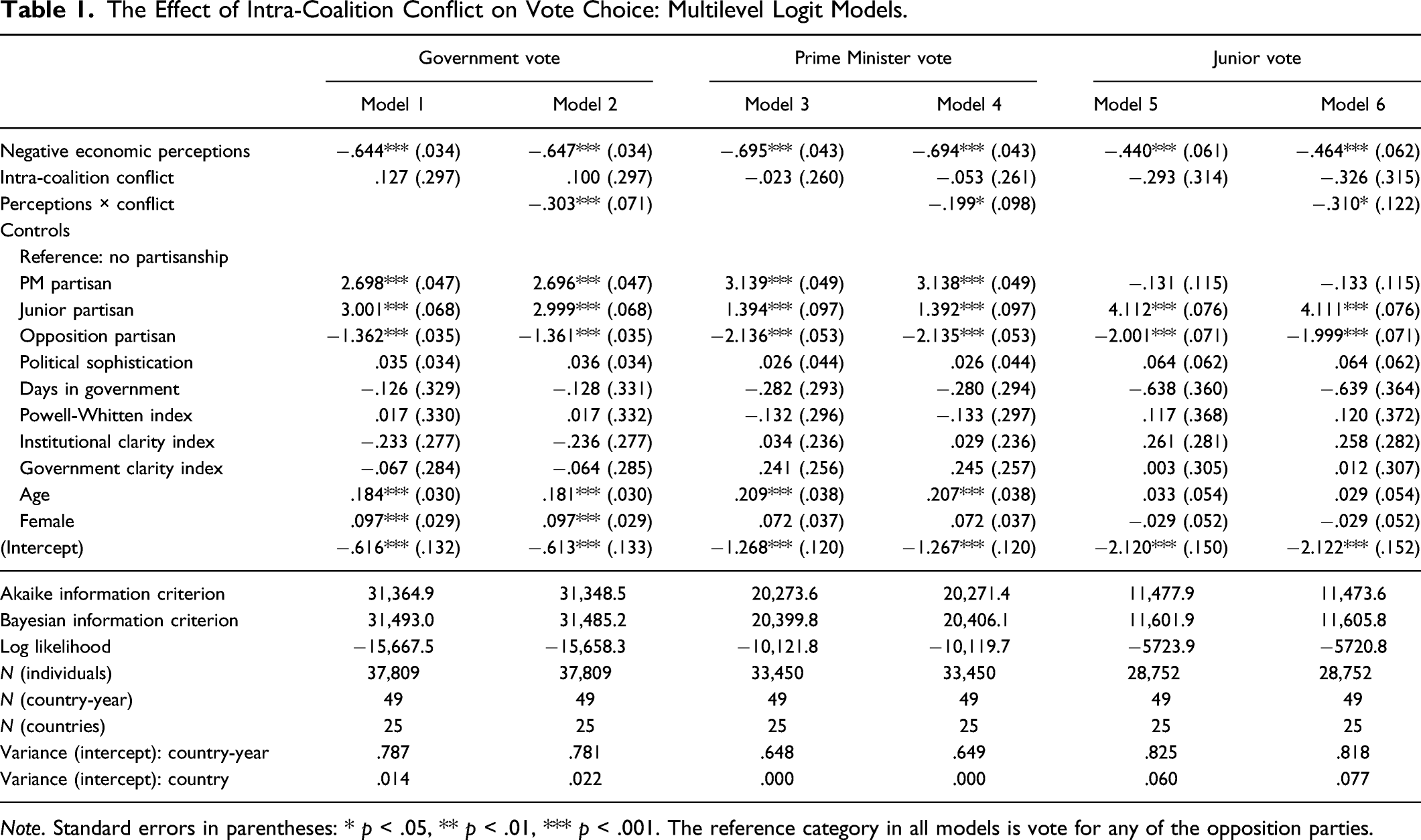
Note. Standard errors in parentheses: * p < .05, ** p < .01, *** p < .001. The reference category in all models is vote for any of the opposition parties.
To test our first hypothesis, we ran Model 2 adding an interaction term between intra-coalition conflict and retrospective economic perceptions. The results in Table 1 indicate a significant negative coefficient of the interaction. This means that the effect of poor economic perceptions is stronger as conflict increases, confirming Hypothesis 1. To better understand the nature of the differential responses to negative perceptions and their effect sizes, Figure 2 illustrates the marginal effects of retrospective evaluations on vote choice for varying levels of intra-coalition conflict, holding constant all other variables in the model (package interplot in R; Solt et al., 2015). As Figure 2 shows, punishment for negative economic perceptions is higher when intra-coalition conflict is high compared to when it is low. Figure 2 also indicates that the (negative) effect of poor economic evaluations is rather low when conflict is low, while it increases as conflict becomes stronger (moving along the x-axis). The effect sizes are relatively large. At very low levels of intra-coalition conflict, the probability of voting for the government parties is about 38% for those who hold positive perceptions of the economy and about 31% for those who hold negative views. However, when intra-coalition conflict is high, the probability of voting for the government parties is almost 58% for those who hold positive perceptions of the economy, suggesting that parties may in those circumstances consciously look for conflict, and it is only about 26% for those who hold negative views. Marginal effect of negative perceptions on vote choice for government parties. Note: Based on Model 2 in Table 1.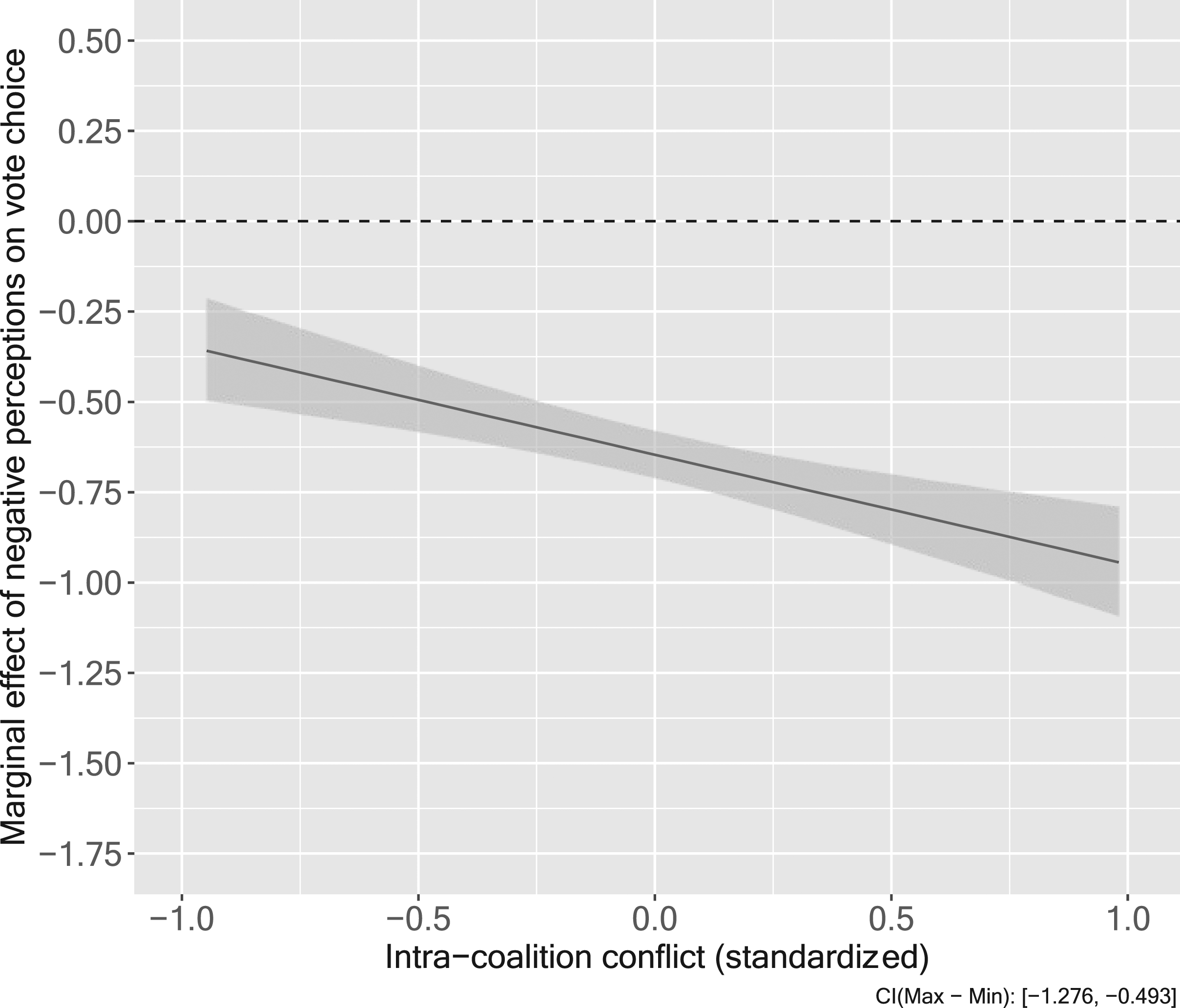
Together with the results obtained from our baseline model, these results suggest that intra-coalition conflict better informs voters about responsibility for perceived economic performance. When voters evaluate positively the economic performance of the government, conflict seems to help them to evaluate parties’ competence and credibility, resulting in a higher probability to vote for the incumbent parties (see Fortunato, 2017). If the economic perception is negative, however, conflict seems to signal that government parties are not able to deal with pressing economic issues the country is facing, resulting in lower probability to vote for government parties.
We then reran our models separately for the different coalition partners. In Table 1 we see that negative economic perceptions have a consistently negative effect on vote choice for all coalition partners. Again, the direct effect of intra-coalition conflict on vote choice does not reach the level of statistical significance. Moving to Models 4 and 6 in Table 1, in contrast, the interaction between economic perceptions and intra-coalition conflict is negative and significant for both sets of parties, thus also for the junior coalition partner.
The effects are clearer to observe in Figure 3: we see that for both parties the probability of being punished for bad economic performance increases with conflict (negative slope), but the overall effect is somewhat stronger for the junior coalition partner. At very low levels of intra-coalition conflict, the probability of voting for the prime minister’s party is about 28% for those who hold positive perceptions of the economy and about 20% for those who hold negative views. However, when intra-coalition conflict is high, the probability of voting for the prime minister’s party is almost 33% for those who hold positive perceptions of the economy and less than 15% for those who hold negative views. When it comes to the junior coalition partner, at very low levels of intra-coalition conflict, the probability of voting for this party is around 15% for both those who hold positive and negative perceptions of the economy. However, when intra-coalition conflict is high, the probability of voting for the junior coalition partner party is about 10% for those who hold positive perceptions of the economy and less than 3% for those who hold negative views. Thus, for the junior partner the effects are only felt at higher levels of conflict, while there is almost no punishment for the junior coalition partner when conflict is relatively low. These results add to recent findings claiming that junior coalition partners tend to suffer more when entering coalition governments compared to larger parties (Klüver & Spoon, 2020)—particularly when voters’ perceptions of the economy are negative. Marginal effect of negative perceptions on PM and Junior vote choice. Note: Based on M4 and M6 in Table 1 respectively. The left plot refers to PM parties while the right plot refers to junior coalition parties.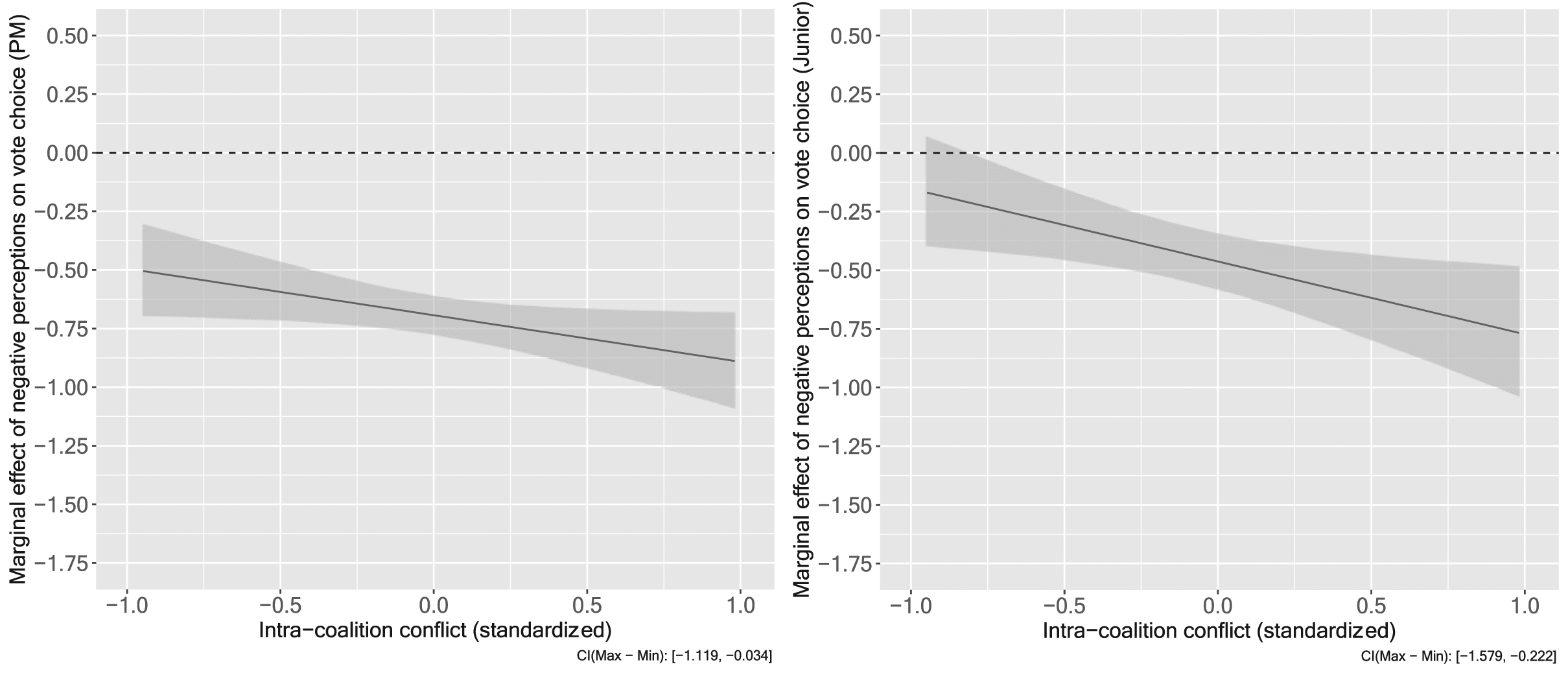
Overall, these results show that the greater the conflict in the cabinet, the more likely voters are to hold government parties accountable for a poor economic performance, confirming Hypothesis 1. In addition, the results suggest that conflict is particularly dangerous for the junior coalition partner if economic perceptions are negative specifically when conflict is low. 16
Empirical Findings on Conflict and Clarity of Responsibility
Assessing Hypothesis 2 requires a three-way interaction among portfolio allocation, conflict among coalition parties, and (negative) economic perceptions. Hypothesis 2 predicts a negative sign for the coefficient of the three-way interaction; that is, negative economic perceptions have a larger negative effect on vote choice when conflict is high and the main governing party controls the economy (compared to situations when there is shared responsibility or the junior coalition party controls the economy). The same effect is expected for the junior coalition partner when it controls portfolios connected to the economy.
Starting with the prime minister’s party, we plot the results of the three-way interaction in Figure 4. The figure shows the effect of economic perceptions on vote choice for the prime minister’s party when conflict is low, average, or high separately for situations when there is shared responsibility (left panel) and when the prime minister’s party controls the economy (right panel). Figure 4 reveals that as economic perceptions become more negative (moving right on the x-axis), the likelihood of voting for the party of the prime minister decreases. This is true both when responsibility is shared and the junior party controls the economy and when the prime minister’s party controls all ministries relevant for shaping the economy. The differentiation, however, between punishment at different levels of conflict is larger when the prime minister’s party holds exclusive responsibility over economic affairs compared to when there is shared responsibility. In other words, in the case of solely the prime minister’s party controlling the economic portfolios (right panel), the negative economic performance translates into punishment at higher rates when conflict is high (solid line in right panel) compared to when conflict is low (gray dotted line in right panel). Full results are presented in the Supplementary Table 5 and show a negative but nonsignificant three-way interaction. Simple slopes for moderation models: Prime minister party. Note: Full model results are available in the Supplementary Table 5.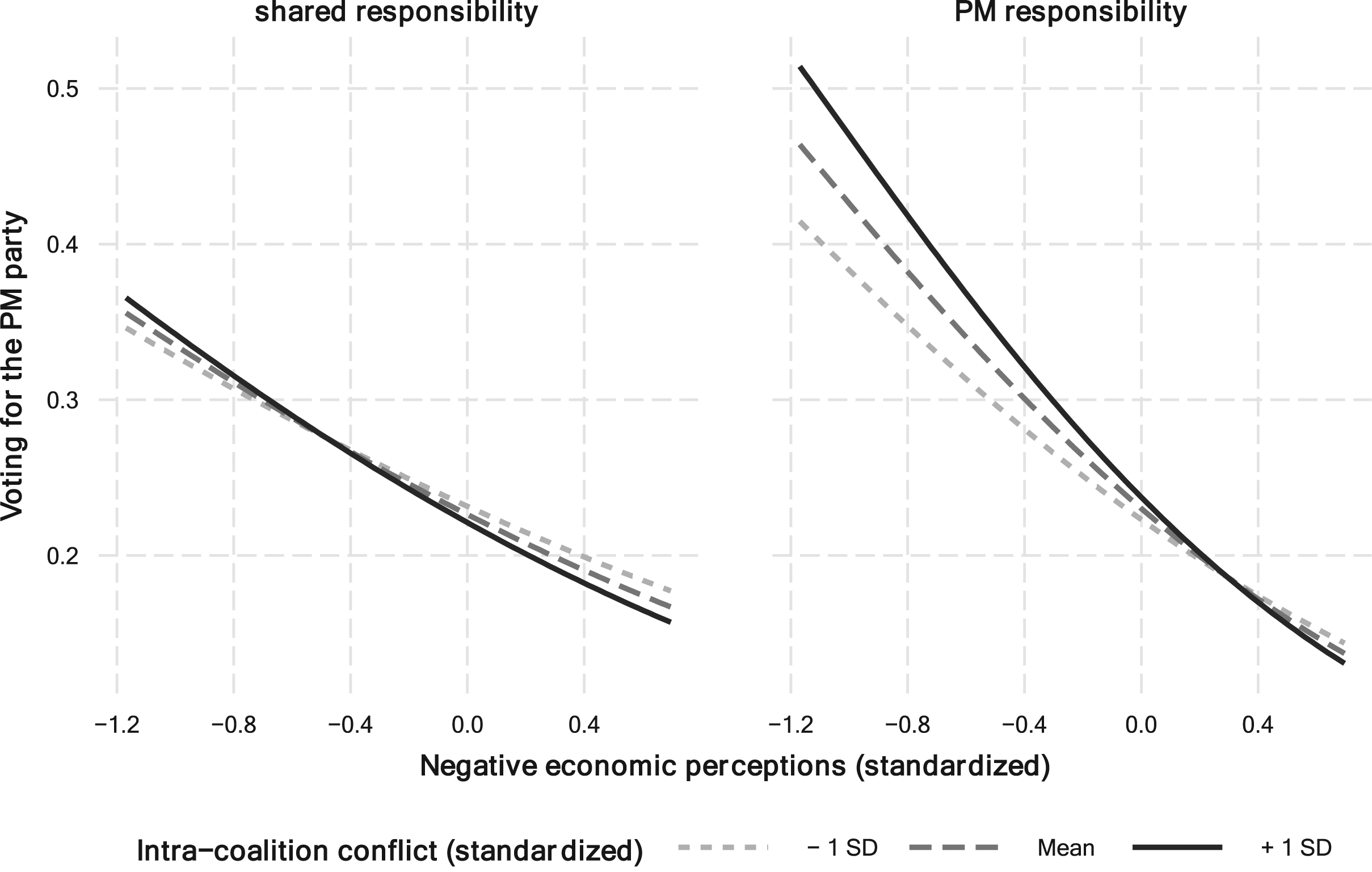
We arrive at similar conclusions analyzing Figure 5 for the junior coalition partner although with one important distinction. The left panel in Figure 5 shows that when responsibility is shared or the prime minister’s party controls the economy, there is little punishment for the junior partner at lower levels of conflict. However, when the junior partner controls economic portfolios (right panel), there is much more punishment for this party at higher levels of conflict compared to situations when conflict is low. Actually, it seems that the junior coalition party is able to get away with a bad economic performance at low levels of intra-coalition conflict (gray dotted line in right panel). Full results are presented in the Supplementary Table 5 and show a negative and significant three-way interaction. Thus, in line with Hypothesis 2, the greater the conflict in the cabinet, the more likely voters are to hold accountable the party/parties responsible for the poor economy. Still, we need to be cautious in the interpretation of the findings with regard to junior coalition partners because there are only five instances of junior coalition parties being “fully responsible” for the economy. In pooling three EES studies, we certainly ensured that the number of voters behind this estimation is large, but one can end up drawing the incorrect inferences if one or two of those instances are unusual in some sense.
17
Simple slopes for moderation models: Junior coalition party. Note: Full model results are available in the Supplementary Table 5.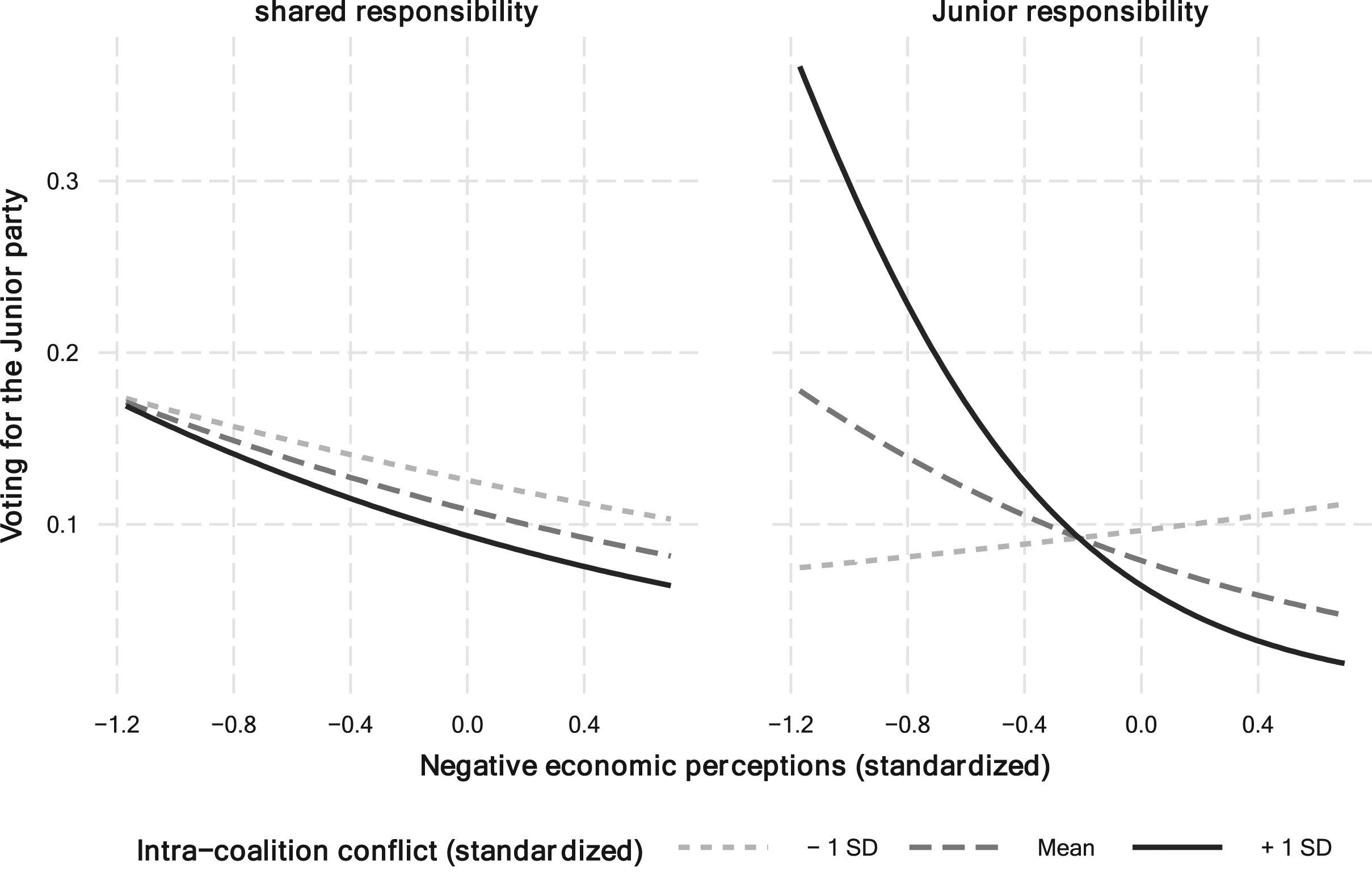
Modeling responsibility allocation by controlling for intra-coalition conflict clarifies that the observed severe punishment of the prime minister’s party seems to a large extent due to its overall higher visibility. The importance of intra-coalition conflict is also visible when considering our findings for the junior coalition partner. As before, the negative effect of information offered by conflict is large for the junior coalition partner, if it holds the responsibility on economic affairs. Taken together, the results suggest that coalition partners presumably have a much stronger incentive to draw attention to responsibility for economic outcomes when things go well, and it is rather the opposite when the economy is not going well at all.
Among our control variables, the most consistent effect on vote choice is, unsurprisingly, that of party identification: Partisans are much more likely to vote for their party compared to nonpartisan voters. We devote particular attention to this variable given its importance in the existing literature on economic voting. Some have argued that people’s perception of the government’s performance is shaped almost entirely by their partisanship, even if others have questioned this argument or have found no evidence for endogeneity (e.g., Duch & Stevenson, 2008; Lewis-Beck et al., 2008). Although we used an “un-cued question” for retrospective evaluation, asking respondents about the economy without mentioning the government, it is still possible that identifiers with government parties tended to have on average more positive evaluations of the economy compared to nonidentifiers or identifiers with opposition parties. To address this issue, we ran additional models in which retrospective evaluations were “corrected” for endogeneity using a method proposed by Duch and Palmer (2002). This method first “purges” economic evaluations of the systematic influences of variables like partisanship, and then uses these purged evaluations in vote choice models. The findings (presented in the Supplementary Tables 12 and 13) support our substantive conclusions by showing that the practical impact of endogeneity on our results is rather small.
Conclusions
On election day, rational voters hold incumbents accountable for their past performance—if voters are satisfied with the government’s record, they are likely to reward it, while a performance that fails to meet voters’ standards jeopardizes re-election (Ferejohn, 1986; Fiorina, 1977). A foundational insight from the literature on retrospective economic voting is that government complexity inhibits voters’ ability to clearly assign responsibility for policy performance, thereby reducing electoral accountability. In this regard, an extensive literature has focused on the difference between single and multiparty governments: the argument goes that clarity of responsibility is hindered under coalition governments because power is dispersed among coalition partners. Yet, little is known about how voters assign responsibility, thereby punishing or rewarding the incumbent parties, when the government is formed by more than one party. This omission in the existing literature is puzzling, given that coalition governments are a fact of politics in nearly every European democracy, they are consequential in terms of policy output (Müller & Strøm, 2003), and voters are not oblivious to government politics (Fortunato & Stevenson, 2013).
This study zooms into the specific features of coalition policy making, examining intra-coalition conflict and its impact on retrospective voting and responsibility attribution. Our findings show that even after controlling for several individual-level and country-level institutional factors, conflict in general helps in assigning responsibility, with intra-coalition conflict exercising a consistent impact on electoral behavior. Overall, conflict increases visibility for government performance, and it is a factor contributing to the clarity of responsibility attribution in countries with coalition governments where in fact clarity of responsibility is usually lower compared to single-party governments.
This study’s findings have implications for how coalition governments supposedly reduce clarity and economic voting: certain features of the policy-making process in coalition governments can help voters navigate the intricacies of party politics and make it harder for coalition partners to escape punishment. Importantly, while it is often suggested that it is the prime minister’s party that suffers the most from voters’ retrospective evaluations, we find that under conditions of conflict, all coalition partners may suffer. Actually, as conflict uncovers responsibility and reminds voters who holds the key to economic policy making, the junior coalition partner may be held equally accountable when it is responsible for ministries able to shape economic decisions. Some of the more recent electoral losses of junior coalition partners, such as the Free Democratic Party in Germany in 2013 or the Progressive Democrats and Labour in Ireland in 2009 and 2016, respectively, can be considered from this perspective (see also Klüver & Spoon, 2020).
We find no support for the arguments that conflict leads to perceptions of confusion or incompetence. In the case of a confusion argument, we should have found that conflict leads to less punishment for bad economic performance, as voters are less likely to evaluate government performance and attribute blame. We find the exact opposite, namely more punishment. In relation to an incompetence perception argument, we should have found evidence for a direct effect of conflict on voting for government parties. Instead, we find consistently nonsignificant direct effects of conflict on government parties’ vote. When testing the direct impact of intra-coalition conflict on perceptions of economic performance, we find that such impact is negligible, meaning that intra-coalition conflict works to enhance accountability without influencing how citizens see the economy per se.
Our findings also have important implications in terms of party strategies. The recent literature suggests that parties have a substantial motivation to differentiate themselves from their partners in government, especially in times of election campaigns (Fortunato, 2017; Sagarzazu & Klüver, 2017). This study provides a slightly more nuanced picture to this argument. When considered retrospectively, while intra-coalition conflict may render a party more credible in terms of devotion to specific electoral promises and policy priorities, we show that it also highlights failures while in office. In times of crises and economic downturns, it might be particularly wise—especially for junior coalition parties—to avoid conflicts. Overall, this speaks to recurrent events of recent government coalitions that have been characterized by heated conflict, such as in Ireland in 2016 or in Austria in 2013, with coalition parties being severely punished by the electorate. This highlights an important tension faced by government parties of no easy solution: while on the one hand they may have incentives to fight over policies to advocate their interests, our analysis shows that conflict makes it clearer to voters when interests have not been defended, with consequent increased punishment. In this regard, blaming strategies may become a better approach, and the effectiveness of these strategies will depend on whether the government party holds responsibility over the policy issue in question and on the capacity of government parties to convince their supporters—a line of investigation that surely deserves attention. An additional line of research should look into the impact of the conflict between government and opposition parties on vote choice if the economy is not going well, and whether and how this also influences the perceptions of electoral performance of opposition parties (see also Plescia & Kritzinger, 2017).
Future studies should devote careful attention to the conditional impact that intra-coalition conflict plays on citizens’ capacity and competence to evaluate the performance of incumbent parties specifically, and politics more generally. In particular, future attempts should investigate carefully where voters gather information on past government performance, which, as shown in this article, has important consequences for electoral accountability.
Supplemental Material
sj-pdf-1-cps-10.1177_00104140211024307 – Supplemental Material for When Marriage Gets Hard: Intra-Coalition Conflict and Electoral Accountability
Supplemental Material, sj-pdf-1-cps-10.1177_00104140211024307 for When Marriage Gets Hard: Intra-Coalition Conflict and Electoral Accountability by Carolina Plescia and Sylvia Kritzinger in Comparative Political Studies
Footnotes
Acknowledgments
An earlier version of this article was presented at the Internal Seminar Series, Department of Government, University of Vienna, at the European Political Science Association (EPSA), Milan, June 2017, and at the SPiRE Seminar at UCD, Ireland. We thank all the participants and in particular the discussants Heike Klüver and James Cross for their helpful comments. We also thank Dani Marinova and Heiko Giebler for useful feedback on previous versions of this article. We would also like to thank the editors and the reviewers for their valuable feedback.
Declaration of Conflicting Interests
The authors declared no potential conflicts of interest with respect to the research, authorship, and/or publication of this article.
Funding
The authors received no financial support for the research, authorship, and/or publication of this article.

Notes
Author Biographies
References
Supplementary Material
Please find the following supplemental material available below.
For Open Access articles published under a Creative Commons License, all supplemental material carries the same license as the article it is associated with.
For non-Open Access articles published, all supplemental material carries a non-exclusive license, and permission requests for re-use of supplemental material or any part of supplemental material shall be sent directly to the copyright owner as specified in the copyright notice associated with the article.
