




Abstract
This paper studies the effects of economic distress on support for radical right parties. Using Swedish election data, I show that one layoff notice among low-skilled native-born workers increases, on average, support for the Swedish radical right party the Sweden Democrats by 0.17–0.45 votes. The relationship between layoff notices and support for the Sweden Democrats is stronger in areas with a high share of low-skilled immigrants and in areas with a low share of high-skilled immigrants. These findings are in line with theories suggesting that economically distressed voters oppose immigration as they fear increased labor market competition. In addition, I use individual-level survey data to show that self-reported unemployment risk is positively associated with voting for the Sweden Democrats among low-skilled respondents while the opposite is true for high-skilled respondents, echoing the aggregate-level findings.
Introduction
The increase in support for radical right parties (RRPs) is one of the largest changes to the European political landscape in the last few decades. What makes voters abandon mainstream parties and instead cast their votes for those that call for closed borders, increased barriers to trade, and leaving the European Union? Which changes in socioeconomic factors lie behind these altered voting patterns? A large strand of theoretical and empirical research aspires to answer these questions. Given the variation in parliamentary representation of RRPs across Europe, researchers are struggling to find uniform explanations that speak to most European countries. However, a consensus has formed on which type of voters are most likely to support the extreme right, namely, native-born low-skilled workers, mostly of male gender (Arzheimer & Carter, 2006; Kitschelt, 2007; Lubbers et al., 2002; Rydgren, 2004b). One popular explanation for the overrepresentation of these groups is that their members support anti-immigration and anti-globalization parties in the fear of their jobs or high wages due to technological changes, immigration, or international trade (Kitschelt, 1995; Rydgren 2004a, 2005; Norris, 2005a). Therefore, negative shocks to employment or income are believed to raise the support for RRPs.
This paper studies the effect of economic distress on support for the radical right. Specifically, it examines how much of the increased vote share for the Swedish RRP the Sweden Democrats (SD) can be explained by economic distress among low-skilled native-born workers. To answer this question, I combine detailed precinct-level data on the number of workers receiving layoff notices with precinct-level election outcomes for the SD in the 2006 and 2010 national elections. The resulting data set differs from those used in previous studies that try to estimate the link between economic factors and support for RRP. First, my data use the number of layoff notices at the precinct level received by workers, instead of changes to employment shares or sectoral differences of import penetration that interact with the sectoral composition of the geographic unit (cf. Autor et al., 2020; Colantone & Stanig, 2018a, 2018b; Dippel et al., 2015). Using layoff notices allow me to measure economic distress among workers who had their employment terminated, and among those who are at risk of losing their job. The latter group of workers is overlooked in studies that only consider unemployment rates or number of job separations. Second, the underlying individual-level data provide layoff notice numbers conditional on skill level and origin. This allows me to estimate the effect of layoff notices on support for the SD, by skill level and country of origin combinations.
I find that the change in SD votes is positively affected by layoff notices among low-skilled native-born workers. For every low-skilled native-born worker receiving a layoff notice, the SD gain on average 0.17–0.45 votes. For other social groups, such as high-skilled native-born, high-skilled foreign-born, and low-skilled foreign-born workers, the estimates are not statistically different from zero, or in some specifications negative. I use Swedish survey data to study the individual-level relationship between unemployment risk and SD support, and the evidence point in the same direction as the aggregate-level results.
A threat to empirically measuring the causal effect of layoff notices is that the notices are simultaneous with SD support. This would lead to biased OLS estimates. To overcome the potential threat of endogeneity, I supplement the OLS analysis with an instrumental variable (IV) approach using a Bartik instrument that predicts the number of layoff notices by the national trends in notices within each industry, and the sectoral composition in each election precinct. Instrumental variable methods are employed with the number of layoff notices instrumented by the Bartik instrument.
Why does economic distress among low-skilled native-born workers increase support for RRPs? One potential explanation can be found in the literature on the economic effects of immigration. Native-born workers are expected to be adversely affected by immigrants with similar skill sets as they compete for the same jobs (Borjas et al. 1996, 1997). Moreover, low-skilled workers might oppose low-skilled immigration for fear of increased competition for welfare services (Facchini & Mayda, 2009; Hainmueller & Hiscox, 2010). It therefore seems plausible that the fear of competition for jobs and welfare services intensifies as low-skilled workers experience economic hardship, particularly if the native-born workers are exposed to immigrants.
To introduce this possibility, I construct a measure of precinct-level visibility of immigrants, which I interact with the number of layoff notices. The IV results from these specifications show that a one standard deviation increase in the share of low-skilled immigrants increases the effect of notices received by low-skilled native-born workers on support for the SD by 37%. The effect is smaller in areas with larger than the average share of high-skilled immigrants. The estimated negative effect on SD voting of layoff notices among high-skilled native-born workers is smaller when the share of high-skilled immigrants is high, and more negative in areas with a high share of low-skilled immigrants. In other words, the effect that layoff notices among natives of a particular skill level has on support for the SD is more positive in areas with a high share of immigrants of the same skill level, and less positive in areas with a high share of immigrants of the opposite skill level.
An alternative explanation is that voters are attracted to RRPs due to their anti-globalization stance. Voters that experience worse job prospects due to firms being exposed to import competition or off-shoring are more likely to oppose international economic integration and free trade agreements, such as the Transatlantic Trade and Investment Partnership (TTIP) or the European Union. To test the validity of this explanation at the Swedish setting, I examine the relevance of anti-EU sentiment and voting behavior. I demonstrate that candidates and voters of the SD and the Left Party (Vänsterpartiet) take almost identical positions on issues related to the European Union. Despite these similarities, increased layoff notices do not raise the vote share of the Left Party, casting doubt on the validity of this particular channel.
My paper contributes to two strands of literature. First, it adds to the growing literature on economic factors behind the electoral success of the radical right. In particular, it measures the extent to which layoff notices explain support for RRPs. A number of studies rely on survey data on respondents’ self-perceived unemployment risk and attitudes on immigration (Dustmann & Preston, 2007; Hainmueller & Hiscox, 2010; Inglehart & Norris, 2016; Mayda, 2006; Malhotra et al., 2013), while others link regional unemployment rates or predicted job separation caused by import competition to actual election outcomes (Autor et al., 2020; Colantone & Stanig, 2018a; Dippel et al., 2015; Knigge, 1998; Lubbers et al., 2002). Most of these studies find that economic distress affects voting for RRPs, either through its effect on anti-immigrant attitudes or on opposition to trade liberalization. My findings suggest that economic distress among low-skilled native-born workers leads to a higher support for RRPs.
Second, the paper contributes to the literature on visibility of immigrants and radical right voting. By interacting immigration with economic distress, I find that the positive effect of layoff notices—only among low-skilled native-born workers—on voting for RRPs is higher in areas with a high share of low-skilled immigrants. Numerous studies examine the relationship between radical right voting and immigration (see Golder, 2003; Rydgren & Ruth, 2013; Halla et al., 2017; Steinmayr, 2020). When immigrants become visible, ingroup voters—usually native-born—fear that their economic status is threatened, which makes policies that restrict immigration more attractive. The next section discusses some of these theories more in detail.
Background and Related Literature
In 1988, the Sweden Democrats were founded by former members of the racist and radical right party, the Sweden Party. The party describes themselves as nationalistic and socially conservative and their early policy platform included calls for a ban on non-Nordic adoptions, forced repatriation of all immigrants entering Sweden after 1970, and re-introducing the death penalty. For the first decade of their existence, the party had limited electoral success, winning only a few seats in local governments in rural municipalities (Widfeldt, 2008). In the late 90s, the SD focused on re-branding themselves in order to appeal to broader constituencies. Notably, the party toned down its opposition to immigration, such as, by no longer demanding repatriation of non-Western immigrants. This ideological change came with some electoral success, as the party received 1.4% of votes in the 2002 national election.
Since the end of the Second World War, the Swedish Social Democrats have, with few exceptions, received enough votes in every national election to form a single party government. When a majority was not secured, they were able to govern as the largest minority through the support of other parties, such as, the Left Party. Before the 2006 elections, four conservative and liberal parties formed a coalition, called “Alliansen” (the Alliance), and campaigned together in order to break the dominance of the Social Democrats. They succeeded and formed a coalition government after the 2006 national election. In response to the formation of the center-right coalition, an opposing bloc was organically formed comprised of the Social Democrats, the Left Party, and the Green Party. This center-left bloc was known as the “Left bloc.” In the 2006 elections, the SD did not receive enough votes to get past the 4% national threshold for entering parliament, but did obtain more than 250 seats in local councils (Rydgren & Ruth, 2011).
Similar to many other European countries, Sweden was hit hard during the Great Recession, with an unemployment rate that rose from 6.1% in 2007, to 8.6% in 2010. 1 The center-right coalition lost their majority in the national parliament but managed to stay in power since they still received more seats than the Left bloc. The big losers were the Social Democrats and the Left Party, where the latter lost 3 of their 22 seats.
Why was the Left Party unable to capitalize on the recession following the financial crisis? According to the compensation hypothesis (see Cameron, 1978; Walter, 2010), voters are likely to demand more redistribution following economic hardship, and are thus more likely to support left parties. As the party furthest to the left on the socioeconomic dimension, the Left Party seemed like an obvious candidate to attract voters who were experiencing economic distress. There are several potential explanations to why the Left was unable to attract these voters. For instance, the Left Party was, through its association with the Left bloc, considered a part of the political establishment. The party had also supported the formation of minority governments held by the Social Democrats following the national elections between 1994 and 2002. Although the party was never formally included in any of these governments, their support allowed the Social Democrats to remain in power, and they, too, were therefore blamed for the inability to handle the emerging problems following the financial crisis. Thus, distrust towards mainstream political parties was also directed at the Left Party. 2
Another important factor is that the convergence of mainstream parties on the socioeconomic dimension left said dimension depoliticized in favor of, for instance, the sociocultural dimension (see Kitschelt, 1995; Rydgren & Meiden, 2018). On this dimension the Left party’s liberal position, characterized by feminism, multiculturalism, and internationalism, did not attract the relatively large numbers of laid off native-born low-skill workers (Lipset, 1981; Rydgren, 2007, see also Kriesi et al., 2008; Kriesi et al., 2012). Instead, as the analyses in this study show, layoff notices following the financial crisis increased support for the SD. The party received a vote share of 5.7% in the 2010 national election and entered the Swedish parliament for the first time. 3
The rest of this section discusses the many theories related to the emergence, and rise, of RRPs. This literature has used various measures of socioeconomic and sociodemographic outcomes, such as unemployment risk and influxes of immigrants. These relate to one of two main categories of theories that explain the increased support for the radical right discussed by researchers and mentioned in the political debate: (i) issues concerning the visibility of minorities, and (ii) changes to voters’ personal economic circumstances.
Visibility of Minorities
The first family of explanations relates to how opposition to immigration can be explained by the presence of immigrants. As natives are exposed to minorities, they fear that their social status and economic status are challenged. The group positioning theory states that a high presence of minority groups is perceived as threatening to the majority group’s social position, while the ethnic competition hypothesis predicts that natives’ fear of competition for employment, housing, and general social welfare between ingroup and outgroup members intensifies when there is a high presence of immigrants. According to these theories, natives in areas with a high share of immigrants are more likely to support anti-immigration parties.
On the contrary, the contact hypothesis predicts that a high share of immigrants allows inter-group interactions, which undermines prejudices and decreases support for xenophobic parties (Allport, 1954). In these neighborhoods, RRPs are predicted to receive less support from native voters. Evidence for the contact hypothesis is provided in a number of studies, for instance, in McLaren (2003); Schneider (2008); Biggs and Knauss (2012); Steinmayr (2020); and Andersson & Dehdari (2021). 4
The share of immigrants is shown to be positively correlated with anti-immigration attitudes and with support for the extreme right in Becker et al. (2016); Colussi et al. (2016); Hangartner et al. (2018); Knigge (1998); Lubbers et al. (2002); and Rink et al. (2009). Norris (2005b) finds no correlation between the presence of minorities and support for anti-immigration parties, while Valdez (2014) shows that areas with a non-Western population beyond a certain threshold exhibit lower support for the SD. Strömblad and Malmberg (2015) show that exposure to minorities is only associated with increased voting for the SD in areas plagued by high unemployment, while areas with low unemployment instead have low support for the SD. 5
Changes to Economic Circumstances
The second category of explanations emphasizes economic distress as the cause of the electoral success of RRPs. These theories offer three different channels through which voters’ discontent with the mainstream parties and their policies arise. The first channel is that unemployment, resulting from exposure to import competition from low income countries, creates calls for more restrictive trade policies. In recent years, a number of studies have linked exposure to trade competition with support for RRPs and found that increased import competition has a positive effect on voting for RRPs (Autor et al., 2020; Colantone & Stanig, 2018b; Dippel et al., 2015).
The second channel, which sociologists call the social marginalization hypothesis, argues that residents of economically deprived areas feel let down by the established parties, which makes them more likely to vote for anti-establishment parties. Several studies using Swedish data support this hypothesis, for instance, Rydgren and Ruth (2011, 2013) and Valdez (2014). 6 Lubbers et al. (2002) and Coffé et al. (2007) provide evidence of a positive correlation between voting for RRPs and unemployment, while a negative correlation is found in Knigge (1998). In this study, I will hold a set of variables commonly included as proxies for local economic deprivation constant, such as median income and employment shares. Since the estimated parameters of these variables have no causal interpretation, I will not be able to formally test this channel.
The third channel suggests that voters attribute changes to their personal economic circumstances to immigration. These changes include, for instance, job separation, loss of access to welfare services, or a pay cut. Natives blame immigrants for changes to personal economic circumstances based on concerns about the consequences of immigration. The literature on these concerns can be partitioned into two parts: (i) competition for employment, and (ii) increased strain on provision of welfare services. The consequences for natives related to the first part are dependent on the type of immigration the domestic economy is exposed to. According to the factor-proportions analysis model (Borjas et al. 1996, 1997), we should expect factors which immigrants are considered good substitutes for to be relatively worse off. Low-skilled immigration is believed to lower relative wages for native-born low-skilled workers as a result of higher supply of this particular factor. 7 At the same time, relative wages of high-skilled workers will rise. If this was the only concern, we would expect natives to oppose immigrants with a similar skill level while being in favor of immigration of the opposite skill level.
Labor market competition and welfare concerns.
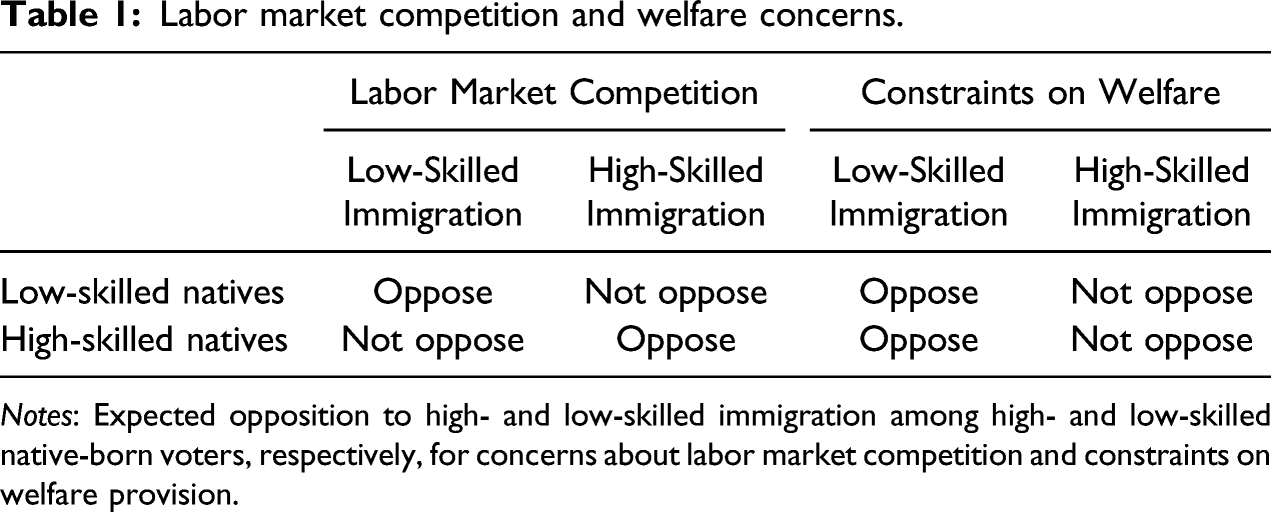
Notes: Expected opposition to high- and low-skilled immigration among high- and low-skilled native-born voters, respectively, for concerns about labor market competition and constraints on welfare provision.
Recent immigration to Sweden has been characterized by low-skilled immigration, as shown in Figure 1. The share of natives with no more than a high-school diploma has been falling steadily for the past 15 years, while this share among immigrants has increased. Given the theories discussed above, low-skilled native-born workers are expected to be more likely to oppose immigration to Sweden. Share of low-skilled, 2000 to 2014. Notes: The lines represent the share of low-skilled among native-born (solid) and newly arrived immigrants (dashed), respectively. Low skill is defined as high-school education or lower as highest attained education level. Based on administrative individual-level data.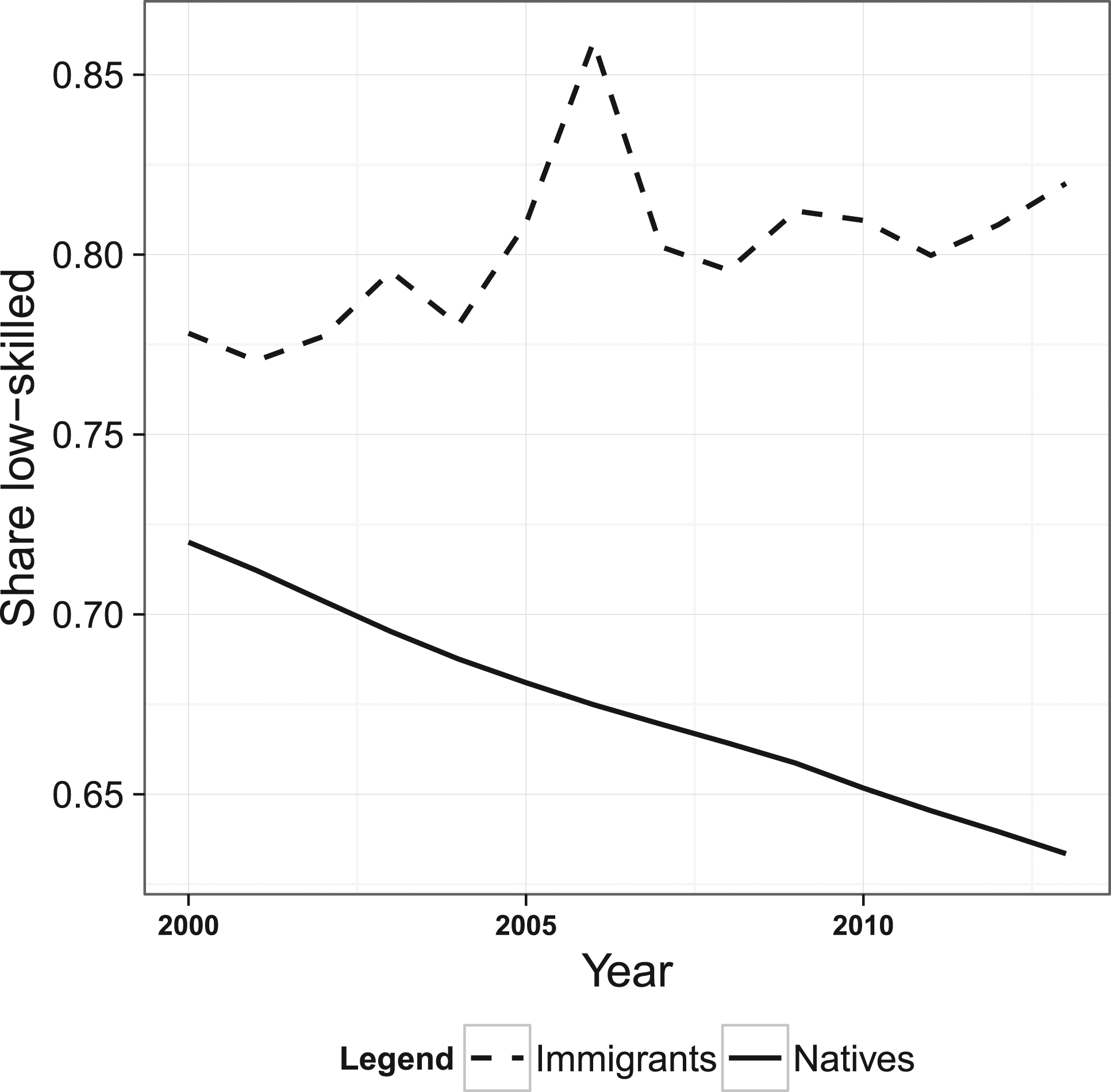
Another important aspect of how local economic conditions affect support for RRPs is whether said support is due to a short-term shock, long-term economic decline, or both. Changes to personal economic circumstances could have a direct short-term effect on voting for RRPs through increased opposition to immigration: workers losing their jobs or seeing their wages go down might immediately support more restrictive immigration policies in order to protect future employment opportunities or immediate access to welfare services. Conversely, residents of areas experiencing long-term economic decline might feel marginalized and let down by mainstream parties, leading to higher support for anti-establishment parties.
Recent scholarship has focused on how long-term decline leads to increased opposition to immigration and, in turn, support for anti-immigration parties or restrictive immigration policies. For instance, Fetzer (2019) shows that UK’s austerity-induced welfare reforms in 2010 predict local variation in Brexit votes in 2016. Similarly, Carreras et al. (2019) provide evidence of how long-term economic decline correlates with support for Brexit. One could imagine that similar long-term effects from firm disclosures in Sweden, in the wake of the financial crisis, could lead to permanently higher support for the SD, even after the initial shock has passed. Due to data limitations, I am unable to test the link between layoff notices and long-term economic conditions and, in turn, their effect on future election outcomes. However, it is important to keep in mind that short-term economic shocks can have both immediate and long-term consequences on the electoral success of RRPs.
The data and the empirical methods employed in this study are described in detail in the next section. Data on layoff notices and election outcomes are used to estimate the effect of economic distress for different social groups on their support of RRPs. To examine how this effect is influenced by immigration, measures of immigrant visibility are interacted with the number of layoff notices. By separating immigration into high- and low-skilled immigration, the relative importance of labor market competition vis-a-vis welfare concerns is studied.
Data and Methodology
This section describes the precinct-level geographical data on election outcomes, the individual-level data on layoff notices based on Swedish register data, and the estimation methods. A list of all variables used in the study can be found in the Online Appendix, Supplementary Table A5. 8
Geographical Data
There were 5668 election precincts in the 2010 election with the number of eligible voters in each precinct ranging from 121 to 2809, with a mean of 1257. 9 The number of precincts was higher for the 2006 election, which had 5783 election precincts. Using population weights, based on the 2006 population numbers, I match 2006 vote numbers into 2010 election precincts. The difference in election results for each party is then calculated for all precincts. The administrative data provide geographical information for all individuals, where each individual belongs to a Small Area for Market Statistics (SAMS). There are close to 9500 SAMS and many of them coincide with election precincts. For those that do not coincide, I match SAMS to 2010 precincts using the same method as the one used to match the 2006 and 2010 election precincts. The matching process is described in the Online Appendix. 10
By matching individuals to election precincts, I am able to take advantage of the spatial variation in economic distress and election outcomes across precincts. Although elections are held at the municipal level, aggregating the data to the precinct level gives approximately 20 times more observations than using aggregated data on municipal level. Municipal fixed effects and clustered standard errors at the commuting zone level are employed to account for municipal-specific factors and conditions related to local labor markets.
Individual-Level Data
Statistics Sweden provide individual-level data for the Swedish population with information on, for instance, income, skill level, and layoff notices. The layoff notice variable includes all events where at least five workers receive a layoff notice (Seim, 2019). According to Swedish law, companies have to inform the Swedish Public Employment Service in advance if five or more workers are affected by a possible downsizing. This means that I will not be able to capture layoffs from firms laying off less than five workers. However, this limitation might actually be beneficial: it reduces potential endogeneity regarding layoffs resulting from the local economic environment, in particular, local factors that might also be correlated with support for RRPs, such as local crime directed against local shops and other small businesses.
The benefit of using layoff notices instead of, for instance, job separations or changes in employment numbers as a proxy for economic distress is twofold. First, it captures shocks to unemployment risk among workers who do not necessarily lose their jobs. About two-thirds of all workers receiving a notice are laid off, and one would expect the workers that are not laid off to also perceive their labor market situation as less secure. Second, it only includes (potential) separations where the workers were laid off, and not those were workers voluntarily quit their jobs. If a worker is quitting her job for employment in another sector, it is unclear whether this is associated with a higher experienced unemployment risk for that particular worker. Layoff notice data from 2007 to 2010 are aggregated on precinct level, based on where the workers reside, and vote, in 2010. Individual-level data on origin and skill level (based on highest attained education level, see Supplementary Table A2) allow me to create measures of the total number of workers receiving a layoff notice within a precinct, divided into four social groups based on skill level and birthplace (inside or outside Sweden). 11 Supplementary Figure A3 shows the increase in SD votes and the number of low-skilled native-born workers receiving a layoff notice, 2007–2010, for all election precincts. These indicate that high number of notices and large increase in SD votes occurred in various different parts of Sweden and are not clustered around any particular location.
The individual-level data allow me to make two important contributions to the literature on the relationship between economic factors and radical right voting. First, my measure of economic distress captures job insecurity among workers who lose their jobs, and among those who are at risk of losing their jobs. This latter group of workers is overlooked when only considering unemployment rates or job separations. Second, data on workers’ skill level and country of origin allow me to estimate separate effects for different social groups. According to the theories discussed in the previous section, members of different social groups might react differently to increased job insecurity. In addition, the register data contains information that show where workers live, which means that the layoff notices are associated to where workers vote, rather than where they work.
This study also uses a couple of surveys on both voters and political candidates. The Riks-SOM survey (Göteborgs universitet SOM-institutet, 2016) includes questions on self-perceived unemployment risk, voting intentions, and anti-EU attitudes among voters, while Valpejl2010 covers a 5% sample of all candidates running for office in 2010. The candidates are asked about their positions on close to 50 different political issues, such as, immigration, EU, congestion taxes, and conscription. 12
Empirical Strategy
The main outcome of interest in this study is the change in votes for the SD between the national elections 2006 and 2010. This outcome is separately regressed on the number of layoff notices received by members of each social group and a set of control variables, according to the following regression model.
If the included controls are not sufficiently absorbing factors that are related to both the number of layoff notices received by workers and the election outcome, the OLS estimates will be biased. 15 An alternative to the OLS specification in (1) is to construct a measure of economic distress that relies on exogenous variation in the number of layoff notices. To obtain this, I construct a Bartik instrument relying on the sectoral composition of each election precinct, and industry-specific national trends in layoff notices (see Bartik, 1991). More specifically, the exposure of each precinct to the national trends depends on the sectoral composition of the labor force in that precinct, as well as the number of layoff notices in each sector in all other precincts, effectively removing any precinct-specific shocks. I construct measures of predicted exposure to layoff notices due to national shifts for each social group, where the predicted shocks are separately estimated for high- and low-skilled workers (cf. Autor et al., 2020).
By focusing on layoff notices following the financial crisis and during the Great Recession, the national trends used for the Bartik instrument are plausibly exogenous to the local economy. Figure 2 shows the number of workers receiving layoff notices from 2005 to 2014. From a yearly average of about 25,000 total layoff notices in 2005 and 2006, the number increased to almost 40,000 in 2008 and close to 100,000 in 2009, with nearly 70,000 of these received by low-skilled workers. Yearly layoff notices, 2005 to 2014. Notes: Solid black line represents all layoffs notices, dashed line represents low-skilled layoffs notices, and dotted line represents high-skilled layoffs notices. Based on administrative individual-level data.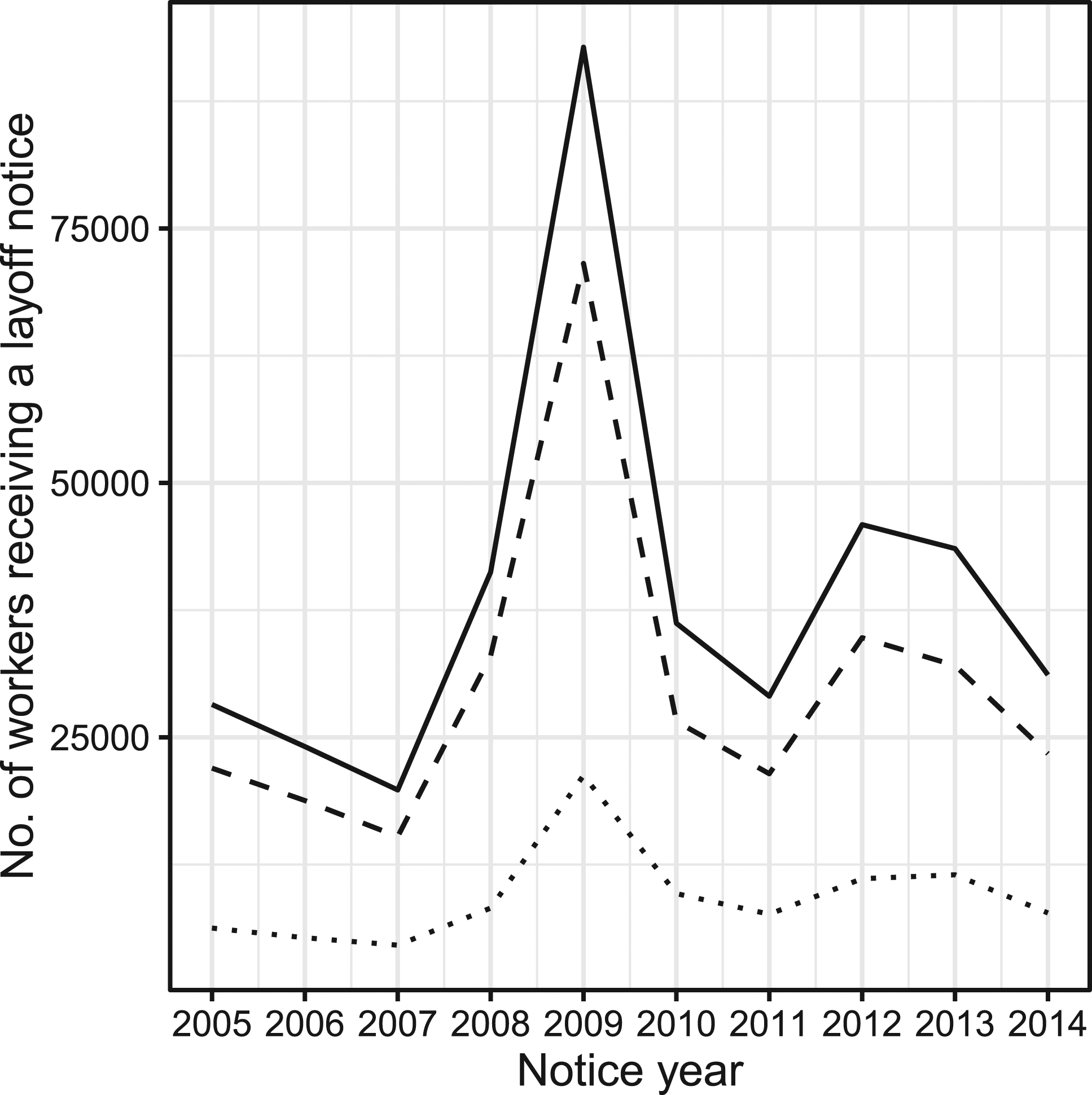
The measure is constructed as follows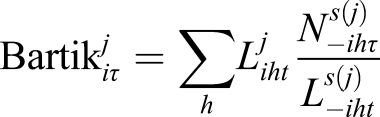
The effect of layoff notices on SD votes are estimated using 2SLS, where 
The underlying identifying assumption is based on the sectoral composition of each precinct.
17
In order for the Bartik instrument to allow a causal interpretation, the sectoral composition must only affect the outcome through its effect on layoff notices. To address this, I control for the variables frequently used in studies that estimate the correlations between socioeconomic factors and support for RRPs, as mentioned above.
18
These controls are included in
The parameters in (1) are estimated using OLS as well as 2SLS. The validity of the OLS estimates relies on the assumption that the number of notices is exogenous to local conditions, and accurately measures precinct-level economic distress. If any, or both, of these assumptions are violated, the OLS estimator will be biased. It is possible that the 2SLS and OLS estimates differ even if layoff notices are, conditional on the controls in
Results
ΔSD and layoff notices (2SLS).
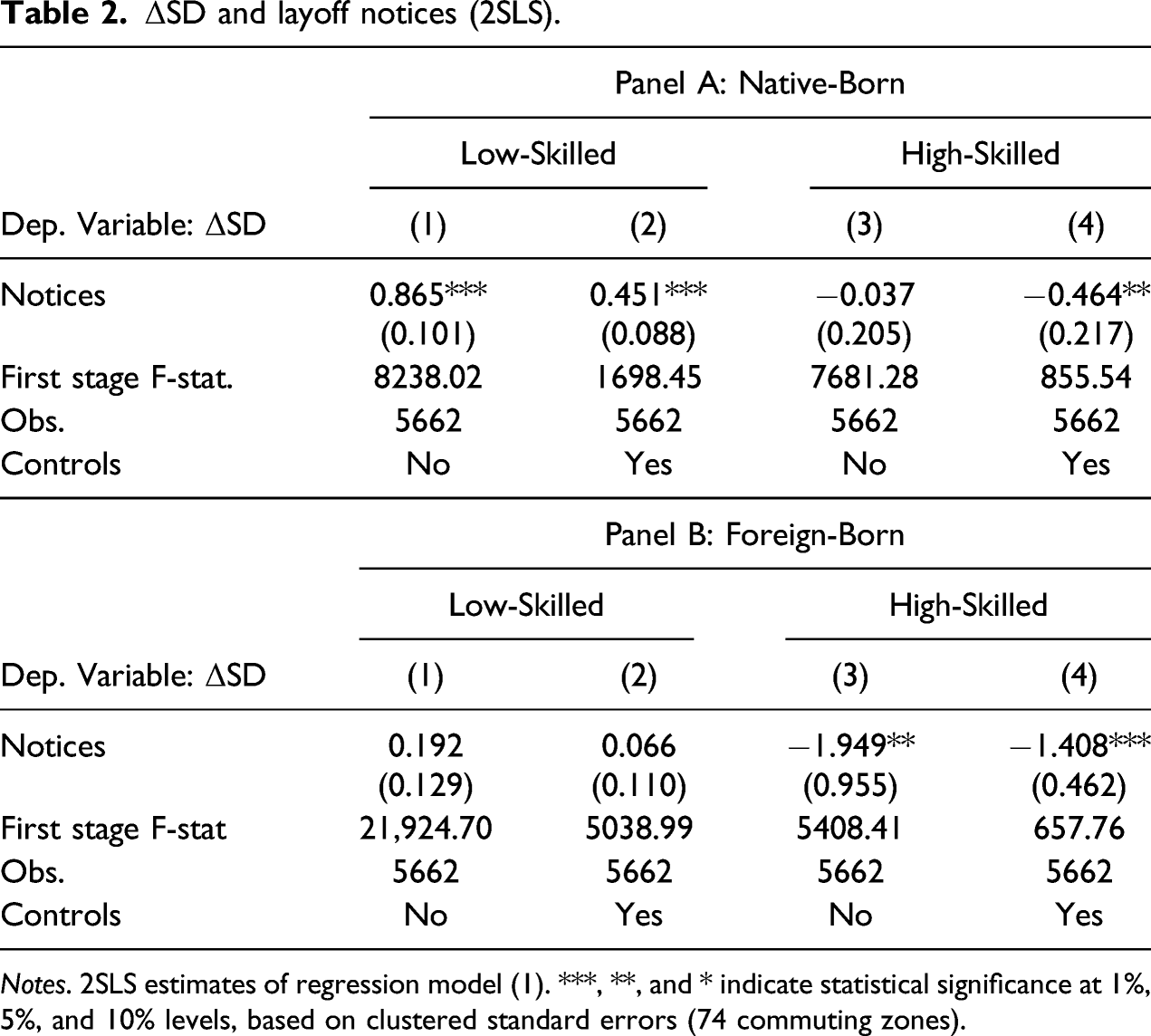
Notes. 2SLS estimates of regression model (1). ***, **, and * indicate statistical significance at 1%, 5%, and 10% levels, based on clustered standard errors (74 commuting zones).
Since the outcome is measured as change in the number of votes and the measure of economic distress is the precinct-level number of layoff notices, the slope coefficient in Table 2 can be interpreted as the increase in the change in SD votes from one additional worker receiving a notice. The slope coefficient for column (2) in Panel A suggests that for every second low-skilled native-born worker receiving a notice, the SD gained one additional vote. The total number of layoff notices for low-skilled native-born workers in the years 2007–2010 is 121,000, and together with the estimated slope coefficient of 0.45 (column (2), Panel A), this yielded 55,000 additional votes for the SD. Between 2006 and 2010, the SD gained more than 177,000 new voters. This means that the new votes resulting from layoff notices account for almost 31% of the increase in votes for the SD. 20
Another way to interpret the results is to compare the standard deviation of layoff notices for 2007–2010 with the standard deviation in the change in SD votes. 21 The change in ΔSD from a one standard deviation increase in the number of notices among low-skilled native-born workers accounts for 33% of a one standard deviation in the change in SD votes. This is similar in magnitude to the interpretation we get from comparing SD votes due to layoff notices among low-skilled native-born workers to the total increase in SD votes.
One drawback of matching aggregated individual-level data with election precinct-level election outcomes is that changes in vote shares do not tell us anything about which group of voters are actually changing their voting behavior. For instance, layoff notices among high-skilled native and foreign-born workers do not necessarily influence voting for members of same groups. The negative estimated slope coefficients in Table 2 could be resulting from, for instance, low-skilled native-born workers decreasing their support for the SD, as economic distress among other groups means that they experience less relative deprivation (Rydgren, 2005). Another potential explanation is that members of the high-skilled social groups are more in favor of low-skilled immigration, as this decreases the cost of goods and services produced by low-skilled workers, without increasing their labor market competition.
Between 2007 and 2010, 38,000 high-skilled native-born workers received layoff notices. Based on the estimated effect of layoff notices among high-skilled native-born workers in column (4) of Table 2, this decreased SD votes by almost 18,000. Together with the increased SD votes resulting from layoff notices among low-skilled native-born workers, the net effect of layoff notices among native-born workers account for 22% of the total increase in SD votes.
ΔSD and layoff notices (OLS).
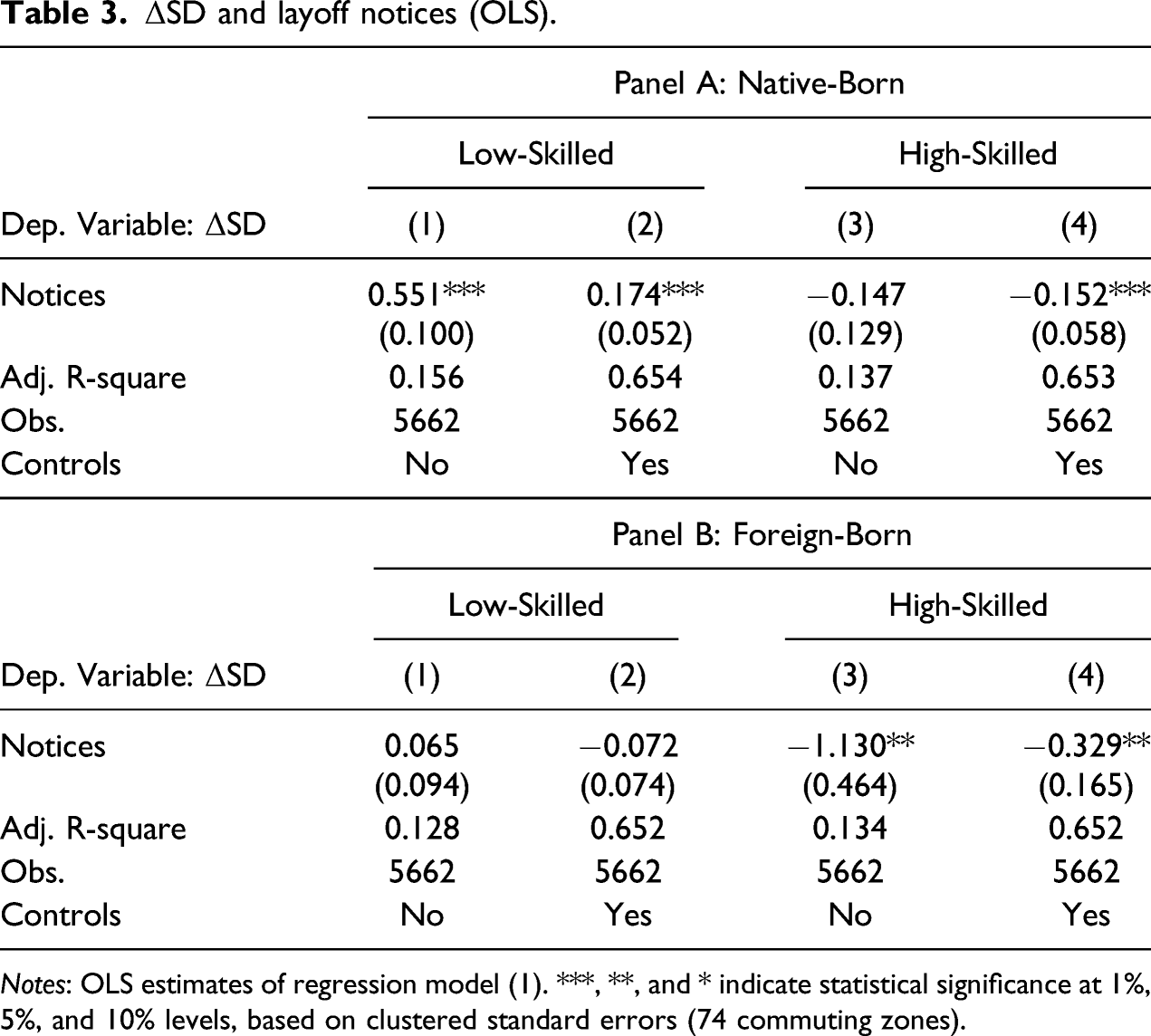
Notes: OLS estimates of regression model (1). ***, **, and * indicate statistical significance at 1%, 5%, and 10% levels, based on clustered standard errors (74 commuting zones).
The 2SLS and OLS estimates of the effect of layoff notices among low-skilled foreign-born workers are close to and not statistically different from zero. For high-skilled foreign-born workers, both 2SLS and OLS estimates a negative and statistically significant slope coefficient. However, a very small number of layoff notices were received by high-skilled foreign-born workers (less than mean of one layoff notice per precinct for the whole time period), which makes the estimated effect on SD support for this group rather unreliable and quantitatively insignificant.
Survey Evidence and Sensitivity Analysis
The use of precinct-level layoff notices and election results has one major drawback: the estimated relationship does not necessarily say anything about whether those who received layoff notices are actually changing their voting behavior. For instance, individuals might be motivated to vote for the SD when a family member or a close friend is likely to be laid off, or when their neighborhoods are negatively impacted by economic shocks (see, for instance, Hays et al., 2019). To examine the individual-level relationship between unemployment risk and voting for the SD, I use data from the Riks-SOM survey for 2010. The survey asks respondents to name their most preferred party and to report their self-perceived unemployment risk.
One drawback of using survey data is that the responses capture stated preferences while the aggregated precinct-level data use both actual layoff notices and election results. Instead, the survey respondents are asked to report their experienced unemployment risk and which of the political parties they prefer the most. Another caveat is that the results from the survey data have no causal interpretation. With the survey data, I can only test correlations between self-reported unemployment risk and stated preferences for the SD.
Survey data results.
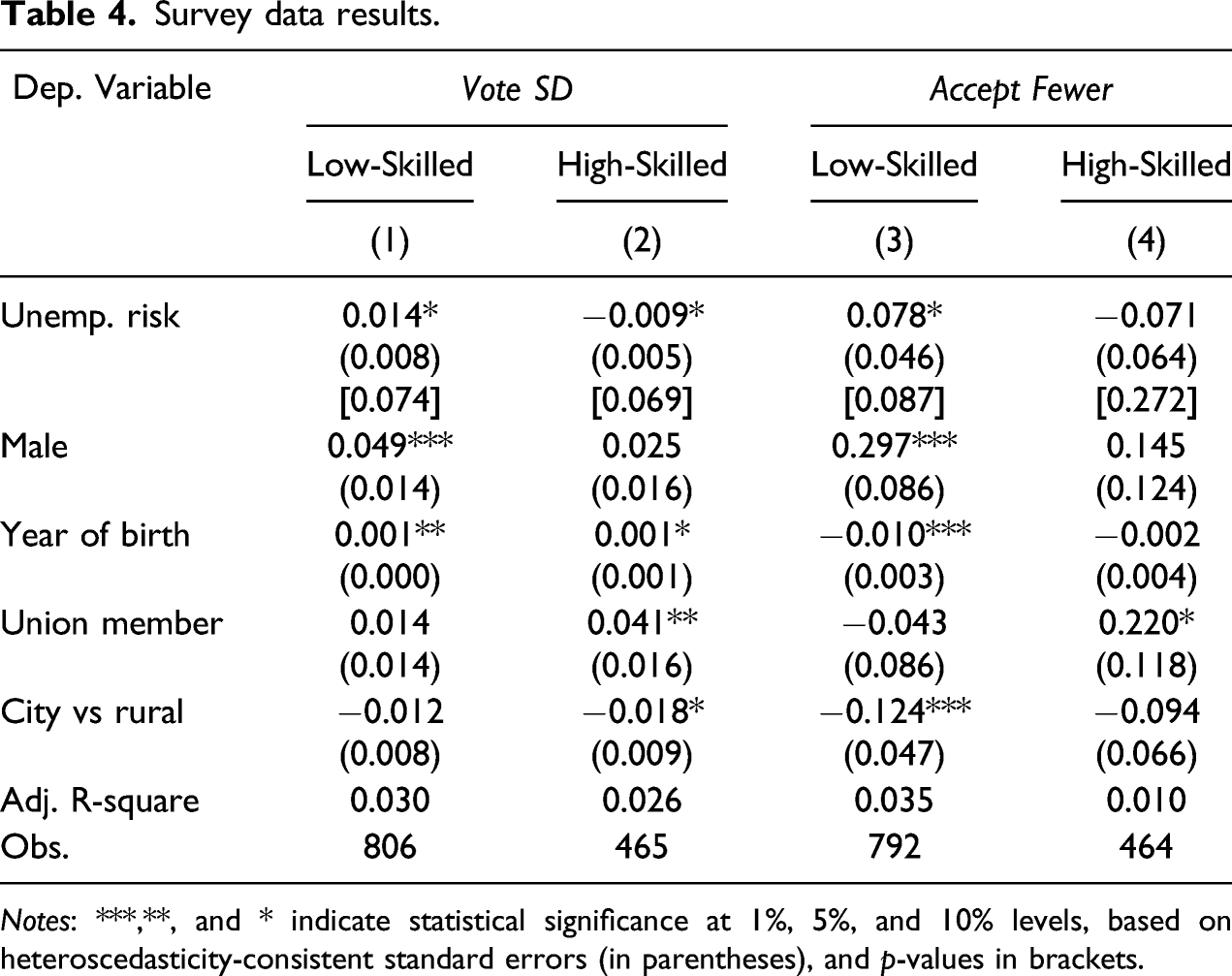
Notes: ***,**, and * indicate statistical significance at 1%, 5%, and 10% levels, based on heteroscedasticity-consistent standard errors (in parentheses), and p-values in brackets.
The precinct-level analysis shows that support for the SD increases in areas where low-skilled native-born workers receive a high number of layoff notices. The theories discussed in the literature section argue that economic distress leads to fear of increased competition with immigrants for access to jobs and welfare services, which affects opposition to immigration. However, the precinct-level analysis is unable to capture this particular link. Ideally, one would like to directly match individual-level attitudes towards immigration with changes to their personal economic circumstances, or, as second best, to measure these attitudes on the precinct level. Unfortunately, the available surveys on attitudes towards immigration are only available at the municipal level and the number of respondents at each municipality is very low. For instance, the survey data used in Table 4 comprise about 800 low-skilled participants, which would give less than three respondents per municipality (for 290 municipalities).
However, the same survey contains a question on refugee immigration, where respondents are asked to agree or disagree with a statement on whether Sweden should accept fewer refugees. The respondents reply by rating the statement on a 1 to 5 scale, where 1 corresponds to “strongly disagree” and 5 corresponds to “strongly agree.” To determine whether economic distress is associated with opposition to immigration, I estimate a model where the response to the statement on refugee immigration (Accept Fewer) is regressed on the same self-reported unemployment risk variable used in columns (1) and (2) in Table 4.
The OLS estimates are presented separately in columns (3) and (4) in Table 4 for low- and high-skilled respondents and show that unemployment risk is (negatively) positively associated with opposition to refugee immigration among (high-skilled) low-skilled respondents. For high-skilled respondents, the estimated slope coefficient is not statistically distinguishable from zero, but the estimates for low and high skill are statistically different from each other. The results using the survey data have no causal interpretation. Still, they suggest that low-skilled respondents with a high (self-reported) unemployment risk are more likely to oppose immigration. Due to imprecisely measured estimates, we cannot conclude that the opposite is true for high-skilled respondents.
The Online Appendix presents additional results from several robustness checks for both the precinct-level and the individual-level analyses. These include the inclusion of a larger set of control variables, modified versions of the outcome, as well as using different definitions of skill level. The estimates from these different specifications are in line with the main results.
Mechanism
What has been shown so far is that exogenous shocks to economic distress, unrelated to immigration, increase support for anti-immigration parties. However, this applies only to low-skilled native-born workers, which could potentially imply that members of this group are more likely to oppose immigration following changes to their personal economic circumstances. This could, for instance, be motivated by fear of increased competition for high wages, employment, or access to welfare services with immigrants. If this is the case, we can expect the effect of layoff notices on voting for RRPs to be even greater in areas with a large presence of immigrants, as this increases the salience of immigration (Rydgren & Meiden, 2018; Strömblad & Malmberg, 2015; Valdez, 2014). This section presents evidence of immigration influencing the effect that layoff notices have on support for the SD. I also show that notices do not increase voting for other anti-EU parties. This section focuses on the 2SLS estimates for native-born workers, while the OLS estimates for all groups and the 2SLS estimates for foreign-born are presented in the Online Appendix.
Immigration and Economic Distress
To examine how immigration influences the effect that layoff notices have on SD support, I create a precinct-level measure of the share of immigrants in the years leading up to the financial crisis. 22 These shares are constructed as the number of foreign-born individuals divided by the total number of eligible voters in each precinct, and are separated into shares of high- and low-skilled. There are two important limitations to this measure. First, the administrative data only comprise Swedish citizens or others with a permanent or temporary residence permit and exclude asylum seekers. Thus, the measure of immigration most likely underestimates the true visibility of minorities in each precinct. Second, this measure does not capture exogenously given exposure to minorities. As immigrants with a residence permit are allowed to settle anywhere in the country, exposure is potentially correlated with local conditions. The estimated main effect of this measure when included in the regression model in (1) therefore does not necessarily have a causal interpretation.
ΔSD, native-born layoff notices, and share of foreign-born (2SLS).
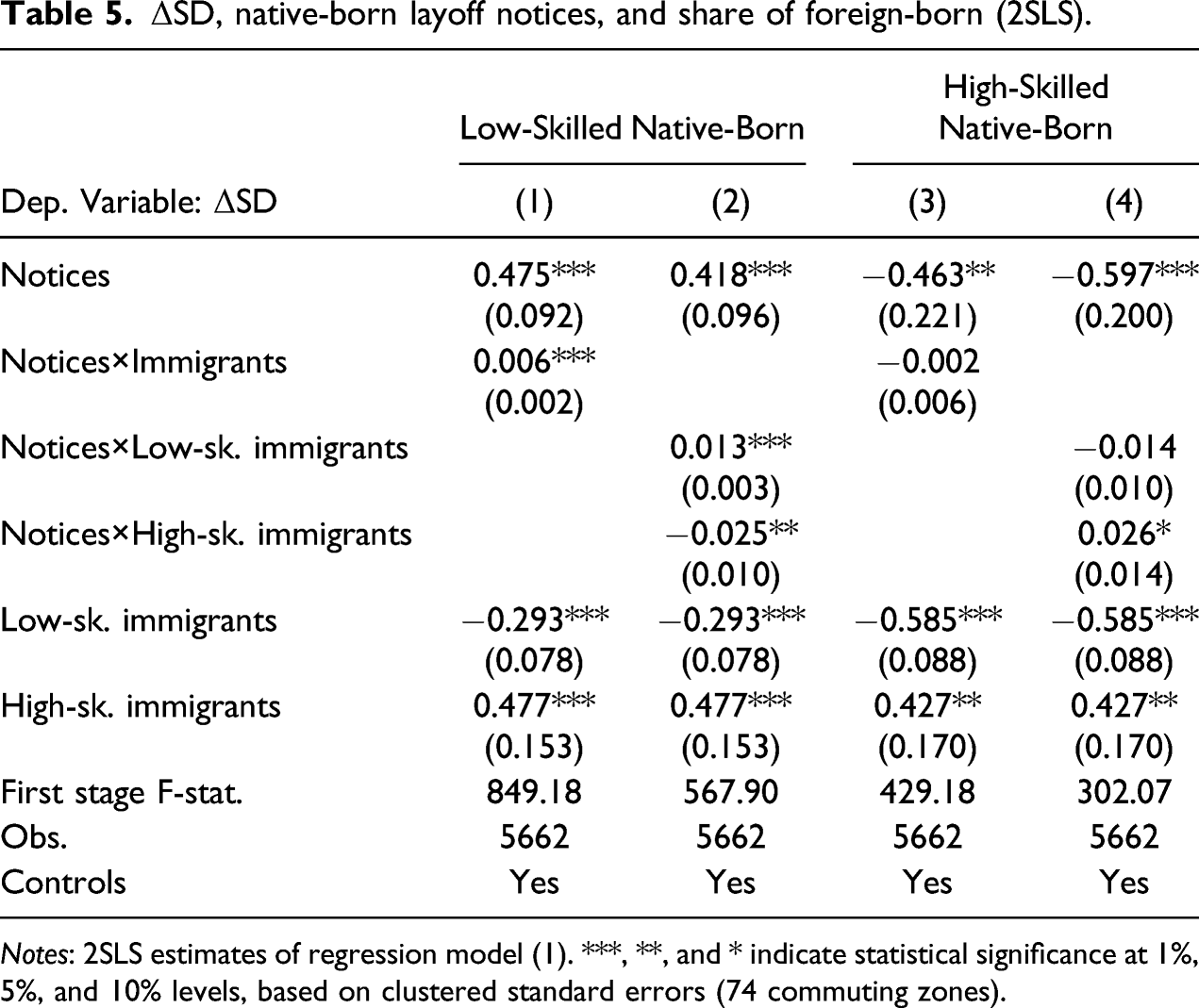
Notes: 2SLS estimates of regression model (1). ***, **, and * indicate statistical significance at 1%, 5%, and 10% levels, based on clustered standard errors (74 commuting zones).
For layoff notices among high-skilled natives, the estimate for the interaction with high-skilled immigrants is positive, while it is negative for low-skilled immigrants with a p-value close to 0.1 (column (4)). 25 The main effect of layoff notices among high-skilled native-born workers is negative and becomes less negative in neighborhoods with a large share of high-skilled immigrants and more negative where the share of low-skilled immigrants is high. Similar to the estimated interaction effects for layoff notices among low-skilled native-born workers in column (2), these estimates suggest that notices received by native-born workers of a particular skill have a larger effect on support for the SD in areas with a larger concentration of foreign-born workers of the same skill.
The estimates for the interaction terms suggest that visibility of immigrants increases the likelihood of natives supporting anti-immigration parties due to economic distress, however, only when natives and immigrants are of the same skill level. The different signs of the two estimates for the interaction terms of the share of high- and low-skilled immigrants with the number of layoff notices received by low-skilled native-born workers lend support to theories predicting that workers of a particular skill level are likely to expect increased competition from immigrants with the same skill (cf. Borjas et al., 1996, 1997).
At the same time, these results are also in line with theories suggesting that natives are less likely to oppose high-skilled immigrants that are expected to make net contributions to the welfare state (Facchini & Mayda, 2009; Hainmueller & Hiscox, 2010). Instead, natives resist low-skilled immigrants that are believed to put pressure on the welfare system. This concern receives additional attention when the threat of unemployment increases. However, the predictions from theories on welfare concerns apply to both high- and low-skilled natives, meaning that the interaction term between layoff notices among native workers and high-skilled immigrants should be negative for both high- and low-skilled natives (see Table 1). This is not the case, as indicated by the results in column (4) in Table 5, which instead suggest that layoff notices received by high-skilled native-born workers has a more positive effect on support for the SD when the share of high-skilled immigrants is high. This further supports theories on expected labor market competition from immigration. 26
The Bartik instrument predicts the number of layoff notices by the local sectoral composition and is exogenous given observable local characteristics. One of these characteristics is the share of immigrants, which means that the variation in layoff notices is not caused by immigration. Nevertheless, economic distress among low-skilled native-born workers increases support for anti-immigration parties. Job insecurity among members of this group leads to a higher opposition to immigration, particularly in areas with a higher presence of low-skilled immigrants. Conversely, economic distress is less likely to affect anti-immigration attitudes where minorities are less visible. These results are in line with similar findings in Strömblad and Malmberg (2015).
The Online Appendix presents results for layoff notices among foreign-born workers interacted with immigrants (Supplementary Table A19), as well as OLS estimates for all four social groups (Supplementary Table A20). The OLS estimates are in line with the 2SLS estimates and smaller in magnitude.
Other anti-globalization Parties: The Left Party
Related to ethno-nationalism and social conservatism is economic nationalism, specifically protectionism and opposition to supranational organizations. Globalization is believed to limit state-level decision making and to only benefit economic and political elites. If voters blame their impaired economic situation on international political and trade agreements, they could potentially be attracted to RRPs based on their anti-trade and anti-EU stance (Dippel et al., 2015; Colantone & Stanig, 2018b). As noted by Zaslove (2004), left-wing parties have traditionally been known for opposing globalization, and in Swedish politics, this role has been taken on by the Left Party. Supplementary Figure A5 shows that both voters and candidates for the Left Party and the SD have similar views on many issues related to the European Union. If economic anxiety leads to anti-globalization sentiment, we would expect the Left Party to increase their vote share in areas with high number of layoff notices.
ΔLP and native-born layoff notices (2SLS).
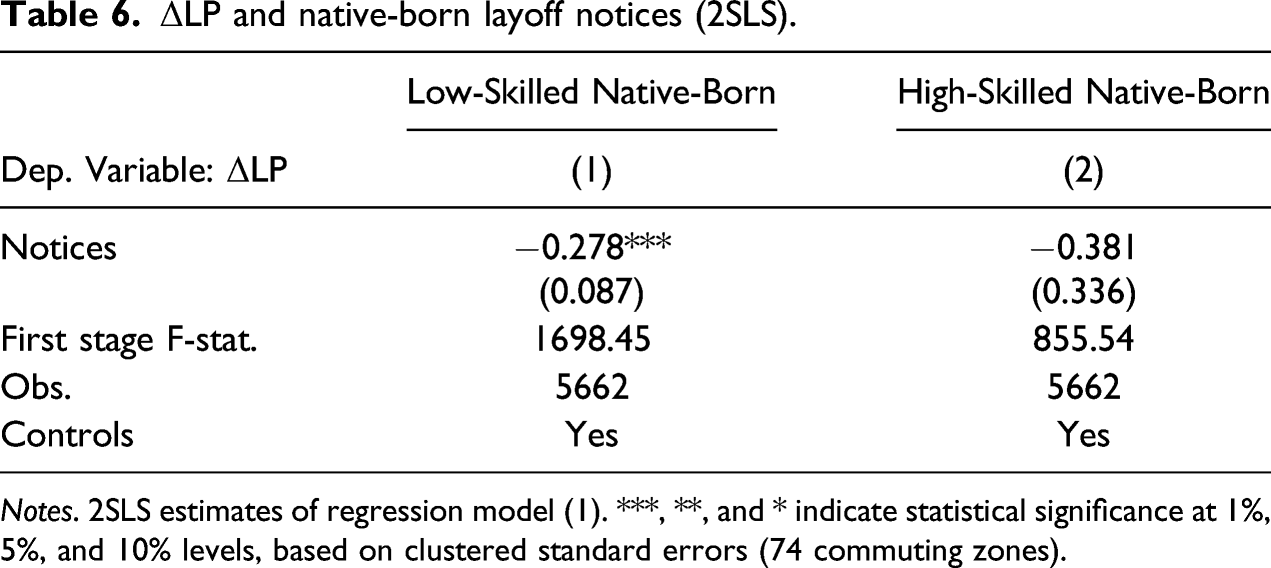
Notes. 2SLS estimates of regression model (1). ***, **, and * indicate statistical significance at 1%, 5%, and 10% levels, based on clustered standard errors (74 commuting zones).
Another potential explanation is that the Swedish Left party has taken a liberal position on many issues on the sociocultural dimension. Contrary to the SD, the Left Party is in favor of multiculturalism and internationalism, where the latter can be perceived as being in stark contrast to the opposition of globalization. 27 In addition, the survey evidence in Supplementary Figure A5 uses questions related to support for the European Union, and are not necessarily good proxies for attitudes towards globalization. Unfortunately, the surveys do not include any questions related to globalization or international trade agreements.
In the Online Appendix, 2SLS estimates for layoff notices among foreign-born workers are presented (Supplementary Table A21), as well OLS estimates for all social groups (Supplementary Table A22). 28
Conclusion
With the recent electoral success of RRPs in many European countries, a growing literature in different fields of social science is trying to explain their success. Most studies focus on the causal link between immigrant visibility and anti-immigrant sentiment while a recent wave of papers in economics instead emphasizes the role of job displacement and insecurity. This study examines the economic factors behind the increased support for the radical right by using detailed election precinct-level data on the number of layoff notices as a proxy for economic distress, and election results for the 2006 and 2010 national elections in Sweden.
The results in this paper show that layoff notices among low-skilled native-born workers increase support for anti-immigration parties. Theories on the effects of immigration state that native workers of a particular skill are expected to oppose the immigration of workers with the same skill due to fear of labor market competition. In addition, concerns regarding the strain on public finance and competition for access to welfare services make both high-skilled and low-skilled natives more likely to oppose low-skilled immigration. Estimates of the interaction between layoff notices and the share of high-skilled and low-skilled immigrants in each precinct suggest that the effect of changes to economic status on votes for the SD is influenced by the presence of immigrants, as a result of labor market concerns. In areas with a high share of low-skilled immigrants, the effect of layoff notices among low-skilled native-born workers on support for the SD is larger, while the opposite is true for the effect of layoff notices among high-skilled natives.
The opposite estimated signs of the interactions between low- and high-skilled immigration and economic distress among low- and high-skilled natives suggest that concerns related to constraints on welfare by immigration are of lesser importance, as depicted in Table 1. An alternative explanation to why low-skilled native-born workers are more likely to support RRPs is that they are attracted by the anti-globalization and anti-trade policies proposed by these parties. In this paper, I show that layoff notices among low-skilled native-born workers do not increase voting for the anti-globalization and anti-EU Left Party.
The effect of layoff notices estimated in this study is exacerbated by the presence of low-skilled immigrants, which suggests that the opposition to immigration following changes to economic conditions is influenced by the visibility of minorities. This interpretation is based on results from aggregated precinct-level data, and future research on when, and why, the presence of immigrants matters for the consequences of economic distress could enhance our understanding of why RRPs are successful.
Supplemental Material
sj-pdf-1-cps-10.1177_00104140211024301 – Supplemental Material for Economic Distress and Support for Radical Right Parties—Evidence From Sweden
Supplemental Material, sj-pdf-1-cps-10.1177_00104140211024301 for Economic Distress and Support for Radical Right Parties—Evidence From Sweden by Sirus H. Dehdari in Comparative Political Studies
Footnotes
Acknowledgments
I am grateful to the journal’s editors and three anonymous reviewers for excellent comments. Previous versions of this paper was presented at the Workshop on the Consequences and Causes of Populism (Bocconi University), Gothenburg University, IAS, APSA 2018, BI Norwegian Business School, MPSA 2018, RES 2018, ASEN 2018, University of Munich, the RES PhD Meetings 2017, SAEe 2017, EWMES 2017, Advances in Political Economy and Public Finance Workshop, University College London, the Institute for International Economic Studies (Stockholm University), 6th Annual Lithuanian Conference on Economic Research, and the Politics and History Network (NYU). I thank Sascha Becker, Carles Boix, Konrad Burchardi, Olle Folke, Nikhar Gaikwad, Sven Oskarsson, Torsten Persson, Jon de Quidt, Johanna Rickne, Jens Rydgren, David Strömberg, and Robert Östling for helpful comments. I am grateful to David Seim for providing me with data, Nelson Hernandez, Martina Maximovich, and Cathy Zhang for proofreading, and Hulda Lif Hardardottir for expert research assistance. I am indebted to Victoria for her endless support.
Declaration of Conflicting Interests
The author declared no potential conflicts of interest with respect to the research, authorship, and/or publication of this article.
Funding
The author(s) disclosed receipt of the following financial support for the research, authorship, and/or publication of this article: The author acknowledges financial support from the European Research Council (grant number 683214), Jan Wallander and Tom Hedelius Foundation, the PII-project in the NORFACE DIAL program, and Lars Hiertas Minne Foundation.

Supplemental Material
Notes
References
Supplementary Material
Please find the following supplemental material available below.
For Open Access articles published under a Creative Commons License, all supplemental material carries the same license as the article it is associated with.
For non-Open Access articles published, all supplemental material carries a non-exclusive license, and permission requests for re-use of supplemental material or any part of supplemental material shall be sent directly to the copyright owner as specified in the copyright notice associated with the article.
