




Abstract
An influential explanation for the persistent political underrepresentation of minorities in elected office is that minority candidates are discriminated against by voters of the dominant ethnic group. We argue, however, for the need to distinguish between two forms of discrimination: ingroup favoritism and outgroup hostility. We measure the impact of each by using an extensive data set drawn from Swiss elections, where voters can cast both positive and negative preference votes for candidates. Our results show that immigrant-origin candidates with non-Swiss names incur an electoral disadvantage because they receive more negative preference votes than candidates with typically Swiss names. But we also find that minority candidates face a second disadvantage: voters discriminate in favor of majority candidates by allocating them more positive preference votes. These two forms of electoral discrimination are critically related to a candidate’s party, whereas the impact of the specific outgroup to which a minority candidate belongs is less pronounced than expected.
Keywords
Introduction
Equal rights among citizens to vote and run for office are at the core of democratic theory and practice (Dahl, 2006). Yet neither of these principles prevent the problem of the political underrepresentation of citizens belonging to minority groups that haunts most contemporary democracies (Bird et al., 2011; Bloemraad, 2013; Dancygier et al., 2015). One fundamental assumption has been that while there are potential obstacles along any candidate’s path to victory, electoral discrimination may be a decisive factor in disfavor of minority candidates (see, e.g., Fisher et al., 2015; Highton, 2004; Thrasher et al., 2017). According to this thesis, a considerable number of voters of the majority group penalize minority candidates at the ballot box.
While the focus in the Americas has been on Black candidates and other “visible” minorities (e.g., Boudreau et al., 2019; Highton, 2004), studies in European countries have mostly examined the electoral (mis)fortunes of immigrant-origin citizens, that is, individuals who have either immigrated themselves or who are linked to immigration via their parents (Fisher et al., 2015; Martin & Blinder, 2020; Portmann & Stojanović, 2019; Street, 2014; Thrasher et al., 2017). Most of these studies reveal evidence of discrimination (for exceptions, see Black & Erickson, 2006; Highton, 2004), but offer different explanations for the phenomenon. Common to these studies, however, is that—implicitly or explicitly—they treat discrimination in elections as a behavior directed against minority candidates (e.g., Moskowitz & Stroh, 1994; Sears & Kinder, 1971; Tesler & Sears, 2010).
The core argument of the present article is that by combining social psychological literature with research on electoral behavior we can get closer to the nature of electoral discrimination. Specifically, we focus on one aspect highlighted in social psychology but largely ignored in research on voter behavior: the role of ingroup favoritism and discrimination in favor of majority candidates. More than 60 years of research in social psychology has established that the problem of discrimination is not simply hostility or resentment toward outgroups. It is often rooted as well in peoples’ “favorable feelings, judgments and actions” toward members of their own group (Greenwald & Pettigrew, 2014: 669; for an overview, see Brewer, 2017; Greenwald & Pettigrew, 2014; for meta-analyses, see Balliet et al., 2014; Fischer & Derham, 2016). According to this literature, ingroup favoritism and outgroup hostility are distinct concepts that are not simply inversely related. They are rooted in different underlying motivations and tend to exist independently from one another (Brewer, 2017; Hewstone et al., 2002). For instance, when people can choose between an option that benefits their ingroup (e.g., by providing monetary endowments) and one that, in addition, harms an outgroup (e.g., by withdrawing such endowments), a notable majority of individuals choose the first option (Halevy et al., 2008).
In the electoral arena, this analytical distinction suggests that minority candidates start with a disadvantage even in the absence of hostility from voters of the majority group; a pervasive preference for ingroup candidates is sufficient to hinder their success. This said, in most countries voters cannot express through their ballots both explicit support and disapproval of individual candidates. A notable exception is Switzerland. The key feature of its free-list PR electoral system is that it allows voters to allocate to individual candidates positive preference votes and negative preference votes (see Selb & Lutz, 2015). This provides us with the unique opportunity to distinguish the behavioral expression of ingroup favoritism from that of outgroup hostility; that is to say, we can observe the allocation of both positive and negative “resources” to ingroup majority and outgroup minority candidates (Greenwald & Pettigrew, 2014; Hewstone et al., 2002; Mummendey & Otten, 1998; Portmann, 2021). 1 In fact, Switzerland presents the ideal setting for which social psychology literature has advocated to explore the two biases separately (Greenwald & Pettigrew, 2014: 676). The advantages of Switzerland as a setting are further amplified by the fact that it contains a great degree of cultural diversity, both domestic and immigration-driven, with a large number of minority groups (Helbling & Traunmüller, 2016; Strijbis, 2014).
Our study extends a small but growing body of literature which considers ingroup favoritism in the explanation of electoral behavior (Jardina, 2019; 2020; Petrow et al., 2018). This recent work suggests that a common ingroup identity among white majority voters in the US plays an important role in the evaluation of candidates and thus has an impact on vote choice. Our contribution to this literature is that we can disentangle the behavioral expression of ingroup favoritism (“discrimination in favor of”) from the one of outgroup hostility (“discrimination against”). 2
To empirically distinguish these forms of discrimination, we analyze the results of the 2015 elections to the Swiss National Council, the first chamber of the parliament, and focus on immigrant-origin candidates. Our analysis is based on an original data set that has not been explored by researchers to date, due to bureaucratic obstacles and inaccessibility of raw data. It stems from the electoral software of Swiss municipalities and cantons and provides an unparalleled opportunity to observe, for each ballot that voters modified by hand, which candidates were added to and/or crossed off the respective party list. The data includes about 687,000 modified ballots, which we collected from nearly all Swiss cantons. 3 It includes more than 1000 municipalities and 3500 candidates.
Given that voters were faced with a large number of candidates, we expect that they tended to apply “low-information rationality” (Lupia & McCubbins, 1998), for instance, by using easily available ballot cues to obtain information about candidates (Conroy-Krutz et al., 2016; Matson & Fine, 2006). It is according to these premises that we use candidates’ names on the ballot (“Swiss” vs. “non-Swiss”) as a proxy for their migration background, by relying on a detailed database of Swiss family names. 4
Our article yields four main results. First, candidates with non-Swiss names receive, ceteris paribus, more negative preference votes than those with Swiss names. We see this as an effect of outgroup bias. Second, candidates with Swiss names also receive more positive preference votes than candidates with non-Swiss names. This shows the impact of ingroup favoritism on the electoral chances of immigrant-origin candidates. In fact, the disadvantage for candidates with non-Swiss names that results from receiving fewer positive preference votes (i.e., ingroup favoritism) is even more pronounced than that incurred by receiving more negative preference votes (i.e., outgroup hostility). Third, we confirm the findings of recent studies (see Besco, 2020; Portmann & Stojanović, 2019; Street, 2014), demonstrating that candidates with foreign names tend to be discriminated against primarily on party lists of the Right. However, we do not find clear evidence that discrimination in favor of majority candidates is driven by right-wing voters. Fourth, differences among candidates with non-Swiss names are less pronounced than expected, especially with regard to the distinction between Western and non-Western names. This finding is surprizing given that prior research in the Swiss context (Auer & Fossati, 2019; Hainmueller & Hangartner, 2013) has shown that immigrant-origin citizens from non-Western countries (e.g., former Yugoslavia and Turkey) are more subject to discrimination than citizens with roots in Western Europe and other developed countries.
Our findings are corroborated by various robustness checks. These include results from a supplementary survey to verify the accuracy of our coding by name, analyses of fine-grained municipal-level population data, and a discussion of possible selection effects that could result from parties’ nomination strategies.
Whether voters discriminate against minority candidates or in favor of majority candidates (or both), the end result is the same: a systematic descriptive underrepresentation of minorities in elected office. Nevertheless, the distinction between the two forms of electoral discrimination still has both theoretical and practical relevance. From a theoretical perspective, the distinction points to different underlying drivers: while discrimination against minority candidates suggests an outgroup negative bias (i.e., hostility), discrimination in favor of majority candidates indicates an ingroup positive bias (i.e., favoritism). From a practical point of view, such a distinction has implications regarding the selection of strategies to effectively combat discrimination (see, e.g., Brewer, 2017; Lai & Banaji, 2020). If discrimination exists primarily in the form of outgroup hostility, the main concern will be to prevent negative perceptions of immigrant-origin candidates among voters. However, this strategy will not be sufficient to tackle ingroup favoritism, which usually requires that majority voters change their categorizations of individuals into social groups (see Brewer, 2017; Gaertner et al., 1993; Lai & Banaji, 2020). Hence, we conclude by discussing the implications of our findings for measures to address discrimination and with respect to the evaluation of electoral systems.
To sum up, we present an innovative approach to distinguishing between discrimination in favor of majority candidates (ingroup favoritism) and discrimination against candidates with a migration background (outgroup hostility). The key contribution of our study is a clear demonstration that ingroup favoritism is a crucial factor in understanding electoral discrimination. We further contribute to the literature by showing the extent to which various outgroups are affected by the two forms of discrimination, and how discrimination varies with the candidate’s party and local contexts. Our study has important implications for how we think about discrimination in elections and points to new research agendas.
Theoretical Framework
The dominant theoretical approaches to discrimination are concerned with behavior that is oriented against certain individuals. For example, one influential explanation of what makes discrimination wrong posits that “to discriminate against someone is to treat that person disadvantageously relative to others on grounds that are irrelevant to how this person should be treated” (Lippert-Rasmussen, 2018: 5).
This perspective, oriented toward outgroup bias that results in discrimination against minorities, is evident in research on electoral discrimination. An early established argument in the literature assumes that majority voters are reluctant to vote for minority candidates because they perceive them as a threat (Bobo, 1983; Citrin et al., 1990). Another considerable body of research argues that voters use simple cues such as sociodemographic characteristics of candidates as cognitive shortcuts to infer information about candidates (Huddy & Terkildsen, 1993; McDermott, 1998). Such shortcuts can serve low-information voters as useful heuristics to approximate a candidate’s ideology, policy positions and expected behavior in office without processing a large amount of political information (Cutler, 2002; Lupia, 1994; Lupia & McCubbins, 1998; Popkin, 1991). Cognitive shortcuts, however, can also lead to severely biased electoral decisions. An example is negative stereotyping—that is, voters attributing unfavorable character traits or ideological positions to outgroup candidates—which has been considered an important explanation for discrimination at the ballot box (Campbell & Cowley, 2014; McDermott, 1998; Piston, 2010). Proponents of this approach see voters’ (likely biased) perceptions of minority candidates as the cause of discrimination. Furthermore, a number of scholars emphasize the role of “subtle” and covert forms of prejudice (Pettigrew & Meertens, 1995: 57; see, e.g., also Payne et al., 2010). Symbolic racism has emerged as a prominent theory under this rubric, particularly in the US context. For example, Sears and Kinder (1971) argue that an anti-Black affect among whites—a cultural assumption that Blacks are fundamentally out of step with traditional American values of the “Protestant ethic”—is at the root of prejudice and discrimination against African American candidates (Moskowitz & Stroh, 1994: 309; Tesler & Sears, 2010). Finally, hostility toward outgroups may emanate from individual personality orientations, namely a desire for conformity or a preference for hierarchy and the dominance of one’s group (Adorno et al., 1950; Sibley & Duckitt, 2008).
Several of these theoretical approaches suggest that discrimination against minority candidates varies according to the sociopolitical profile of voters. For instance, studies have shown that symbolic racism, a need for conformity, the perception of an outgroup threat, and negative stereotypes about minorities are more common among conservative or right-wing voters (Homola & Tavits, 2018; Jost et al., 2003; Van Hiel & Mervielde, 2002). Furthermore, right-wing parties can foster hostility toward immigrant-origin individuals with specific rhetoric that targets them (Norris & Inglehart, 2019). In line with these theoretical arguments, recent literature shows that electoral discrimination against immigrant-origin candidates is driven by voters of the Right (Besco, 2020; Street, 2014; Van Trappen et al., 2020).
In short, while these approaches take divergent paths to explain discrimination against minority candidates, in particular among right-wing voters, their theoretical arguments all yield, with respect to our focus on immigrant-origin minority candidates, the following hypothesis: H1: Voters discriminate against candidates with a migration background relative to majority candidates.
Yet discrimination can also result from ingroup favoritism. The main driver of this form of discrimination is a bias in favor of ingroup members (Brewer, 2017). Indeed, experiments with randomly selected groups of students show that individuals prefer to allocate resources to members of their own group (Tajfel, 1970). This empirical observation has sparked a shift in perspective in the social psychology literature. Social identity theory offers a possible psychological explanation for the phenomenon of ingroup favoritism. The main tenet of this theoretical approach is that an individual’s memberships in social groups are fundamental to his or her sense of self. In order to achieve or preserve a positive self-valuation, individuals are motivated to positively evaluate other members of their group (Brewer, 1979; Tajfel & Turner, 1979). Moreover, voters’ use of cognitive shortcuts may also explain ingroup favoritism: voters may prefer candidates who embody their own demographic characteristics in the expectation that such candidates will understand and represent their interests (Arnesen et al., 2019; Cutler, 2002). Furthermore, voters may use sociodemographic characteristics to estimate candidates’ ideology. For example, they often attribute ideological positions that are more aligned with their own to ingroup candidates (Arnesen et al., 2019). Finally, stereotypes common to a group may not necessarily feature negative assumptions about outgroups (and thus an outgroup bias) but simply express positive assessments of one’s own group (i.e., ingroup bias) (Hamley et al., 2020; Hewstone et al., 2002; Portmann, 2021). There is evidence that African Americans are not ascribed negative attributes more often than white Americans, but that the latter are more strongly associated with positive characteristics (Gaertner & McLaughlin, 1983; Hewstone et al., 2002).
The finding that ingroup favoritism is a fundamental aspect of discrimination is also important for political science literature. Although it has remained largely unexplored regarding the electoral behavior of the majority, three recent studies include the phenomenon of ingroup favoritism in their explanations of voting behavior among white Americans (Jardina, 2019; 2020; Petrow et al., 2018). The core of their theoretical argument is that a white ingroup identity—activated when white voters see their status as a dominant group threatened—contributes significantly to explaining whites’ attitudes toward policies and candidates. Specifically, voters with a strong white ingroup identity tend to support (white) candidates who they believe will contribute to maintaining the status quo of the white population in the racial hierarchy. In our study, we apply these considerations to the phenomenon of electoral discrimination toward immigrant-origin candidates and focus on the behavioral component of ingroup favoritism: discrimination in favor of majority candidates. From this we derive our second hypothesis: H2: Voters discriminate in favor of majority candidates relative to candidates with a migration background.
To sum up, most research on voter behavior has focussed on net discrimination, treating the two forms of discriminatory behavior as interchangeable. We argue that it thereby neglects the ramifications of their different theoretical underpinnings and the insights from social psychology that discrimination for the ingroup and discrimination against the outgroup are not reciprocally related (Brewer, 2017). That said, we do not assume that these two forms of discrimination occur entirely in isolation from one another. To some extent, “discrimination in favor of” and “discrimination against” may be interdependent—for instance, if losses for the outgroup are seen as gains for the ingroup. Also, although identification and attachment to ingroups is conceptually and theoretically distinguishable from outgroup bias, it can, under certain conditions, result in outgroup hostility (Brewer, 1999: 430; Brewer, 2001; De Figueiredo & Elkins, 2003).
An Inviting Context
Switzerland is an outstanding case for scholars whose research focuses on minority groups related to migration. Apart from a couple of micropolities such as Liechtenstein or Luxembourg, no other European country has as high a share of immigrant-origin population: about four out of 10 people living in Switzerland are officially classified as “persons with a migration background” and an estimated one-third of these are Swiss citizens. 5 Seen from another perspective, 30% of people currently living in Switzerland were born in other countries. In comparison, the share of foreign-born individuals in countries such as Austria, Belgium, France, Sweden and the United Kingdom ranges from 12 to 20%. 6
Approximately a quarter of naturalized Swiss citizens come from the former Yugoslavia, followed by Italy, Turkey, Germany and Portugal. While most naturalized citizens are white, a notable share (7.5%) have their origins in Sri Lanka, India and sub-Saharan Africa (see Table 1 in the online appendix).
In addition to the diversity of its population, Switzerland offers another feature highly relevant to our analysis: its electoral system. Compared to other electoral systems, the Swiss system allows us to delve much deeper into the impact of both ingroup favoritism and outgroup hostility on the electoral fortunes of immigrant-origin candidates.
The free-list PR employed in Switzerland belongs to the group of open-list PR systems, where voters can cast preference votes for individual candidates (IDEA, 2005: 118, 155). The 200 seats in the Swiss National Council are allocated proportionally to population size across 26 electoral districts that correspond to the Swiss cantons.
Every enfranchised citizen receives the voting material at home. It contains a ballot with at least a dozen party lists. 7 On the ballot the voter can find candidates’ names, years of birth, their places of residence and, depending on the canton, additional information (e.g., profession and membership in associations). We note as well that in any given canton every enfranchised citizen, regardless of her of his municipality of residence, receives the same voting material. All major parties field candidates in all cantons, but on different, canton-specific ballots. For example, the candidates who run for the Social Democratic party in the canton of Ticino are different from those running for the same party in the canton of Geneva.
Having chosen one party list on the ballot, the voter has the following options: She can cast the ballot without allocating any preference votes to single candidates (unmodified ballot). When a voter casts an unmodified ballot, all candidates running on the party list of her choice receive one vote each. She can modify the ballot by hand to allocate preference votes to individual candidates (modified ballot). The options available for modifying the ballot are quite unique compared to other countries. First, the voter can cast as many positive preference votes as there are seats to be filled (between 2 and 35, depending on the size of the electoral district), for any candidates running in her electoral district, both for (a) candidates running on the party list of her choice (“cumulation”) and (b) candidates from other party lists, by writing in their names by hand (“panachage”). Every candidate can receive up to two votes from a single voter. Second, the voter can cast negative preference votes, by crossing candidates off the party list she has chosen. In that case, the candidate loses the vote that he or she would have automatically received via the party list.
8
Empirical Strategy
We measure electoral discrimination by looking at negative preference votes and positive preference votes separately. Since data on negative and positive preference votes is not directly available, we opted for an elaborate strategy. For our study, we sought and gained access to raw data from the electoral software of the cantonal and municipal administrations. Bearing in mind that negative and positive preference votes are generated only when the voter, having opted for a party list of her choice, modifies the pre-printed ballot by hand, we collected data exclusively on the modified ballots. Disentangling positive from negative preference votes allows us to draw important conclusions about the behavior of individual voters that studies based on aggregate election results are not able to detect. Our approach thereby allows us to better address issues that arise from ecological inference in studies using data from real elections.
We also take into account the role of party gatekeepers both in the selection of candidates and on the support that certain candidates receive via list ranking. For this purpose, in the section “Robustness” we present the number and origin of candidates with non-Swiss names by party and estimate models with the list position as a dependent variable, among other things.
Data
Our data shows, for each modified ballot, which candidates received negative preference votes. The measure for negative preference votes is built by aggregating the number of times a candidate was crossed off on his or her party list. The data also shows which candidates were added to the ballot by voters of their own party (“cumulation”) and/or by voters of other parties (“panachage”). This information allows us to measure the impact of a candidate’s name on positive preference votes. 9
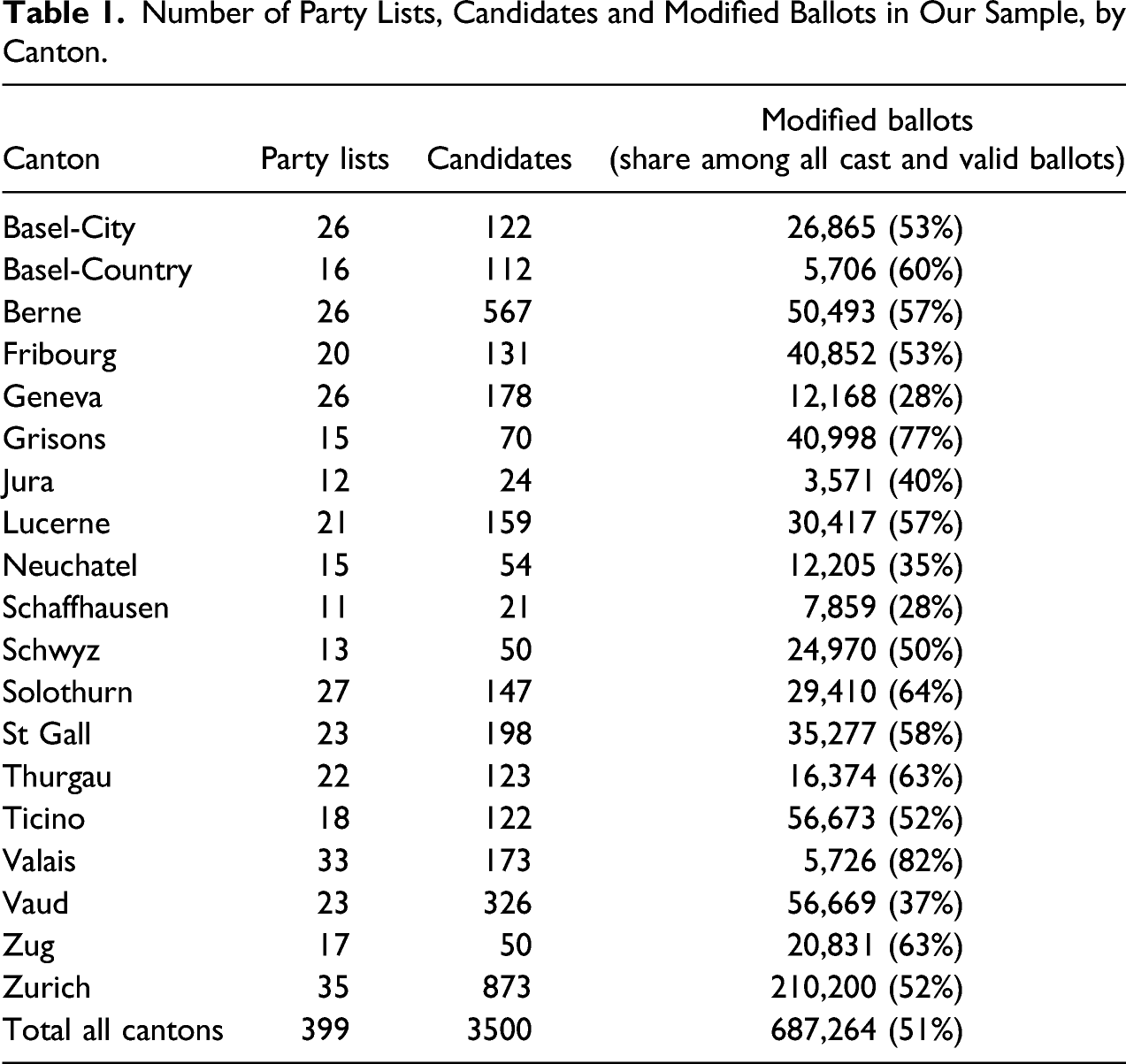
For our study, we rely on the modified ballots from 19 (out of 26) electoral districts (i.e., cantons). 10 In 11 cantons, we were able to gather a sample of positive and negative preference votes for all candidates, in every municipality. In the remaining eight cantons, for various reasons, it was not possible to achieve full coverage of municipalities, especially in places where the data could be collected only at the municipal level, where cantonal administrations were unable to provide data for all municipalities, and where we were required to extract data on the spot. Hence, in these eight cantons we had to restrict our data collection to a random sample of municipalities. 11 For a detailed description of our data gathering procedure and sample, see Sections B.1 and B.2 in the online appendix.
Number of Party Lists, Candidates and Modified Ballots in Our Sample, by Canton.
Dependent Variables: Positive and Negative Preference Votes
To calculate the negative preference votes, we construct a relative measure that indicates how many times a candidate was crossed off relative to the average number of cross-offs for candidates on the corresponding party list. Specifically, we measure negative preference votes as follows:
To calculate the positive preference votes, we proceed in a similar way
14

The values of the dependent variable “negative preference votes” span from 0 to 2.3 (mean = 1, SD = 0.27), whereas those of the dependent variable “positive preference votes” range from 0 to 11.8 (mean = 1, SD = 1.08). Conceptualizing our dependent variables as relative measures is reasonable because negative and positive preference votes are difficult to compare directly across party lists, as their number reflects to a large extent the strength of the respective party lists.
Explanatory Variable: Candidate Names
Our main explanatory variable captures the origin of candidates’ names. This method of coding candidate names is often applied in studies of electoral discrimination and/or political underrepresentation of minorities (see, e.g., Dancygier et al., 2015; Portmann & Stojanović, 2019; Street, 2014; Thrasher et al., 2017; Van Trappen, Devroe, and Wauters 2020). 15 We use an extensive and openly accessible database—the Register of Swiss Surnames (RSS)—which contains all family names registered in a Swiss municipality with their year of registration up through 1962. 16 This allows us to divide names into (0) Swiss (registered before 1940), and (1) non-Swiss (registered in or after 1940). We set the boundary at the year 1940, because of the migration flows sparked by the Second World War.
In the Swiss context, studies have shown that people with foreign-sounding names—that is, names which give rise to a presumption of immigrant origin—are less likely to find a job or an apartment to rent (see Auer et al., 2019; Zschirnt, 2019). Moreover, one study finds that certain categories of names (e.g., those of Albanian, former Yugoslav, and Turkish origin) are discriminated against more than non-Swiss names of Western origin in the context of naturalization decisions (see Hainmueller & Hangartner, 2013). We therefore further refine the coding in order to identify the origins of the “non-Swiss” names, by using the databases “forebears” and “worldnames.” 17 On the basis of these codes, another refined explanatory variable distinguishes between (0) Swiss names, (1) non-Swiss names from Western countries, and (2) non-Swiss names from non-Western countries. In a similar vein, given the multilingual context of Switzerland, we created a variable that indicates the linguistic region of origin of the name, ranging from (0) Swiss, (1) non-Swiss from a German-speaking country, (2) non-Swiss from a French-speaking country, (3) non-Swiss from Italy, or (4) non-Swiss from any other country.
Control Variables
We include a series of controls regarding those candidate characteristics typically listed on a ballot. 18 As control variables at the candidate level, we include incumbency, list ranking, sex, age and pre-cumulation. Incumbency is a dummy variable indicating if a candidate is (0) non-incumbent or (1) incumbent. List ranking is a relative measure that we build by dividing a candidate’s ranking on his or her party list by the number of candidates on that list. Regarding sex we distinguish between (0) female and (1) male candidates. We measure age by differentiating between the following categories: (0) 18–29, (1) 30–50, and (2) 50 and older. Finally, pre-cumulation takes the value (0) if a candidate appears only once and the value (1) if he or she is listed twice on the party list. The position of the party on the left-right axis and the number of candidates on the respective party list are considered as control variables that capture list attributes. The former variable can be either (0) for the Right (Swiss People’s Party, FDP-Liberals), (1) for the Center (Green Liberal Party, Conservative Democratic Party, Christian Democrats), or (2) for the Left (Social Democratic Party, Green Party). 19 The latter is a numerical variable that reflects the number of candidates running on the same party list. We provide descriptive statistics of all the variables that we include in our models in the online appendix in Section B.3. 20
Estimation
Candidates are nested within party lists (and cantons) in our data and we take this into account by estimating hierarchical models (see Gelman & Hill, 2007; Steenbergen & Jones, 2002). Specifically, we include in our models a random intercept for party lists and specify the random intercept model as follows
We explain the variance of the dependent variables “positive and negative preference votes” (y ij ) with the following fixed effects: β0 stands for the general intercept, z j corresponds to a list-level variable (with estimate β1) and x ij is a variable at the candidate level (with estimate β2). In our models, we have a random effect at the list level (U j ) and an error term at the individual level (R ij ). We include a cross-level interaction zjxij (with estimate β3) that captures the difference in the coefficient of the variable “non-Swiss name” along different levels of the macro variable measuring the ideological position of the candidate’s party (see Snijders & Bosker, 2012: 81).
Candidate Names and Electoral Performance
In the 2015 elections to the Swiss National Council, 12.6% (n = 477) of candidates had non-Swiss names. And of the 200 elected representatives, an even smaller percentage have non-Swiss names: just 5.5% (n = 11). Figure 1 shows that the shares of candidates and representatives with names that we have identified as non-Swiss vary considerably among cantons. Candidates and elected representatives (Swiss/Non-Swiss name), by canton. Source. Swiss Federal Statistical Office and our own name coding based on the RSS.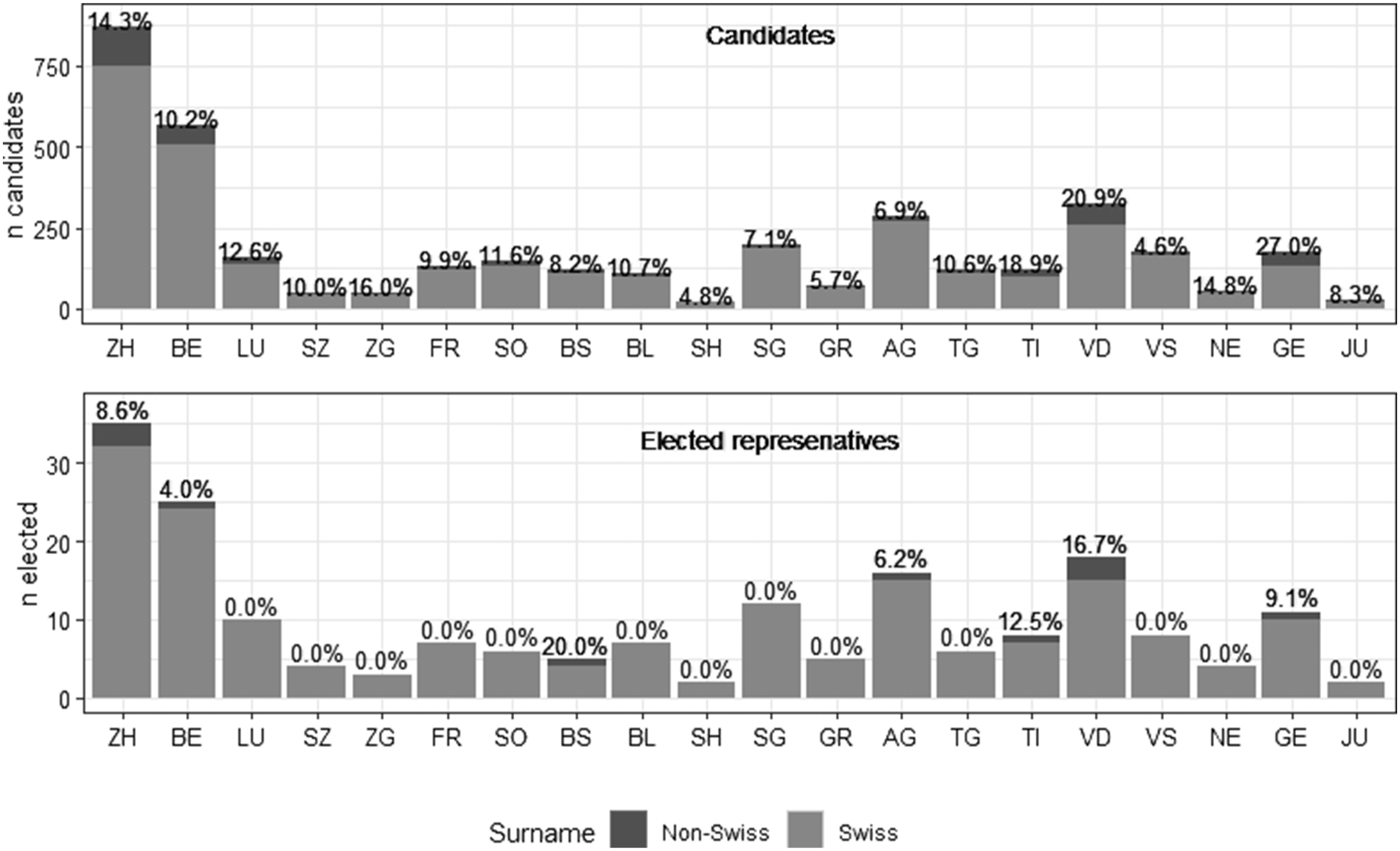
Name Origins of Candidates and Elected Representatives, 2015 Swiss Elections to the National Council.
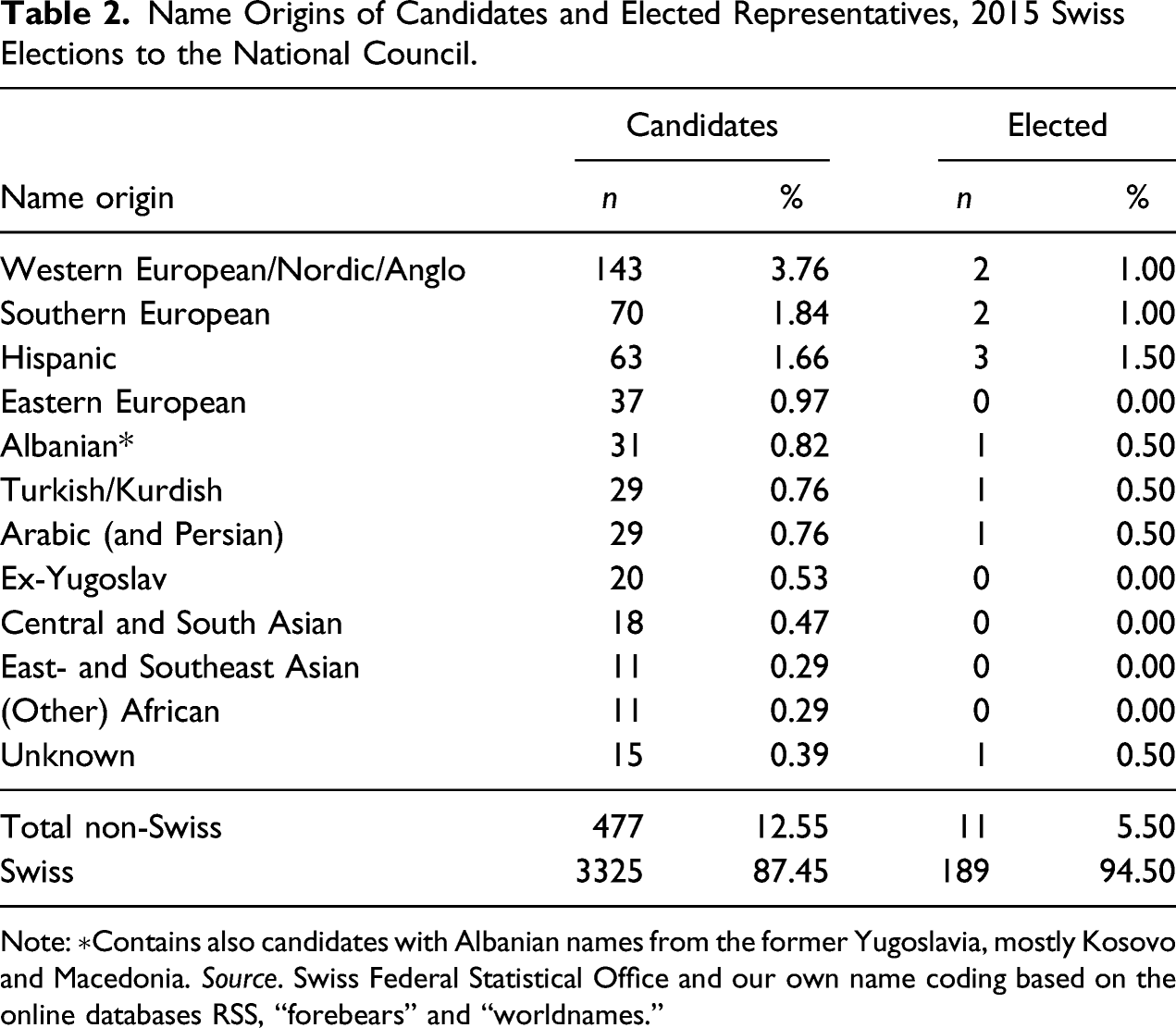
Note: ∗Contains also candidates with Albanian names from the former Yugoslavia, mostly Kosovo and Macedonia. Source. Swiss Federal Statistical Office and our own name coding based on the online databases RSS, “forebears” and “worldnames.”
Is descriptive underrepresentation of parliamentarians with foreign-sounding names a result of a tendency among voters to cross them off their ballots and/or to allocate them fewer positive preference votes in comparison to candidates with Swiss names? We address this question in the next section.
The Effect of Candidate Names on Preference Votes
Negative Preference Votes
Estimating the Relationship Between Candidate Name (Swiss vs. Non-Swiss) and Negative Preference Votes.
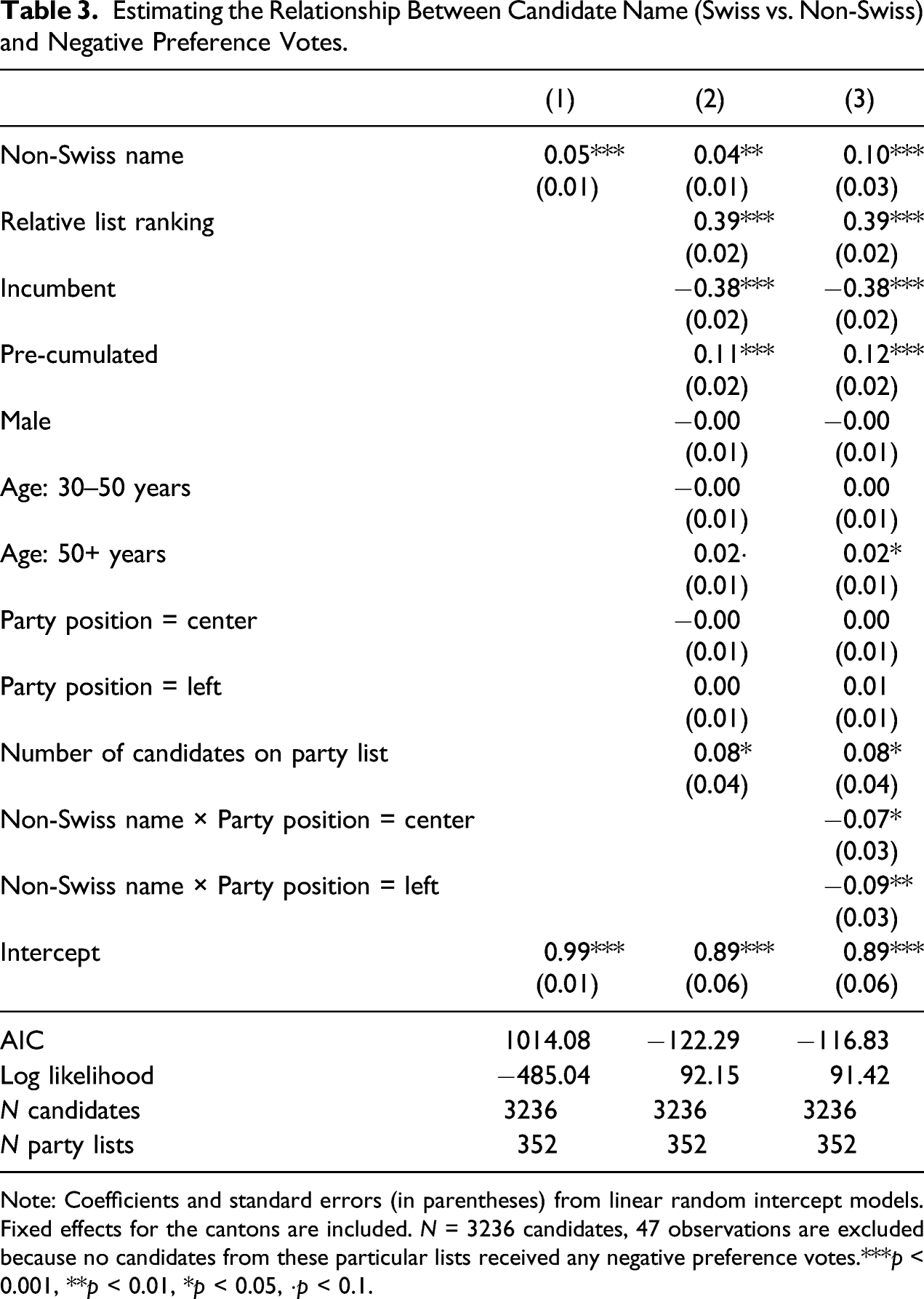
Note: Coefficients and standard errors (in parentheses) from linear random intercept models. Fixed effects for the cantons are included. N = 3236 candidates, 47 observations are excluded because no candidates from these particular lists received any negative preference votes.***p < 0.001, **p < 0.01, *p < 0.05, ⋅p < 0.1.
In line with the thesis that voters discriminate against immigrant-origin candidates, the effect in Model 1 is positive and significant, indicating that candidates with non-Swiss names receive significantly more negative preference votes compared to candidates with Swiss names. That is to say, candidates with foreign-sounding names are disadvantaged because voters cross them off more often than they do similar candidates with Swiss names running on the same party list. The effect in Model 2, to which we added control variables, is slightly smaller than in Model 1 but still statistically significant.
Overall, our results provide strong evidence that voters disproportionately cross off candidates with non-Swiss names. In other words, we find evidence that voters discriminate against candidates with non-Swiss names, which, based on our theoretical argumentation, can be seen as an expression of outgroup hostility or at least negative bias against outgroup candidates.
Based on the theoretical discussion and empirical research, we expect that the discriminatory effect will be stronger among voters with conservative, right-wing attitudes (Besco, 2020; Street, 2014; Portmann & Stojanović, 2019; Van Trappen, Devroe, and Wauters 2020). The interaction effect in Model 3 in Table 3 confirms our expectation that a foreign-sounding name is less of a hindrance to candidates on left-wing or centrist party lists than those of the right-wing parties, the latter being the reference category.
While candidates with non-Swiss names clearly receive more negative preference votes on the party lists of the Right, we do not find evidence that a candidate’s name origin similarly correlates with negative preference votes on the lists of the Center and of the Left (see Figure 2).
22
Interaction effect of candidate name (Swiss, non-Swiss) and ideological position of the party on negative preference votes. Note: Mean predicted negative preference votes surrounded by 95% confidence intervals. Predicted values are derived from a linear random intercept model. Control variables and fixed effects for the cantons are included. N = 3236 candidates.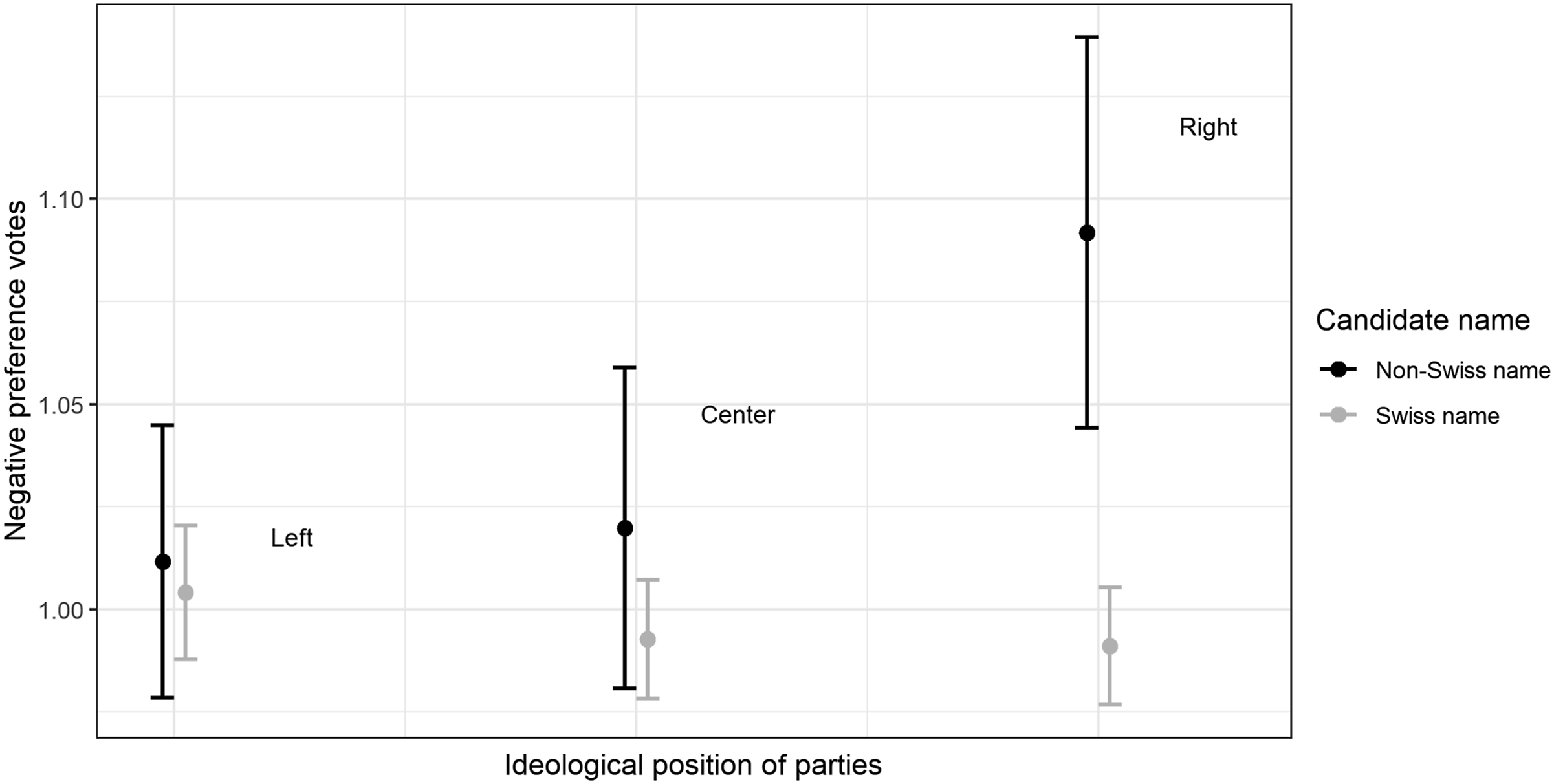
In sum, our results yield strong evidence for the thesis that voters discriminate against candidates with a migration background. A candidate with a non-Swiss name faces higher barriers to electoral success in that she or he has a higher likelihood of being crossed off their party list by voters. While the effect of a candidate’s name is rather modest in comparison to the effect of other factors such as their relative list ranking or incumbency status, we must stress that the value of the relative negative preference votes decreases by 0.036, dropping from 1.031 for candidates with foreign-origin names to 0.995 for candidates with Swiss names (see Table 10 and Figure 2 in the online appendix). This difference might appear quite small, but it can be decisive for entry into parliament in the Swiss electoral system, since once seats have been distributed among parties and electoral districts, preference votes alone determine which candidates are elected.
Is every candidate with a non-Swiss name (on any given party list) equally affected by discrimination in terms of negative preference votes? In order to examine this question more closely, we further break down the category of candidates with non-Swiss names.
We find that, among candidates with non-Swiss names, the effect of name origin on negative preference votes is slightly more pronounced for those whose names are non-Western (see Table 11 in the online appendix). However, these differences do not reach the level of statistical significance in the chi-square test (p-value = 0.498). Our results thus corroborate the findings from a recent study by Portmann and Stojanović (2019). But they are in contrast to the study by Hainmueller and Hangartner (2013), who investigated discrimination in naturalization referendums held in Swiss municipalities and provided evidence that applicants with non-Western names incur an additional penalty. Specifically, they show that applicants from the former Yugoslavia and Turkey received on average about 40% more “no” votes than comparable applicants from Northern and Western European countries.
Positive Preference Votes
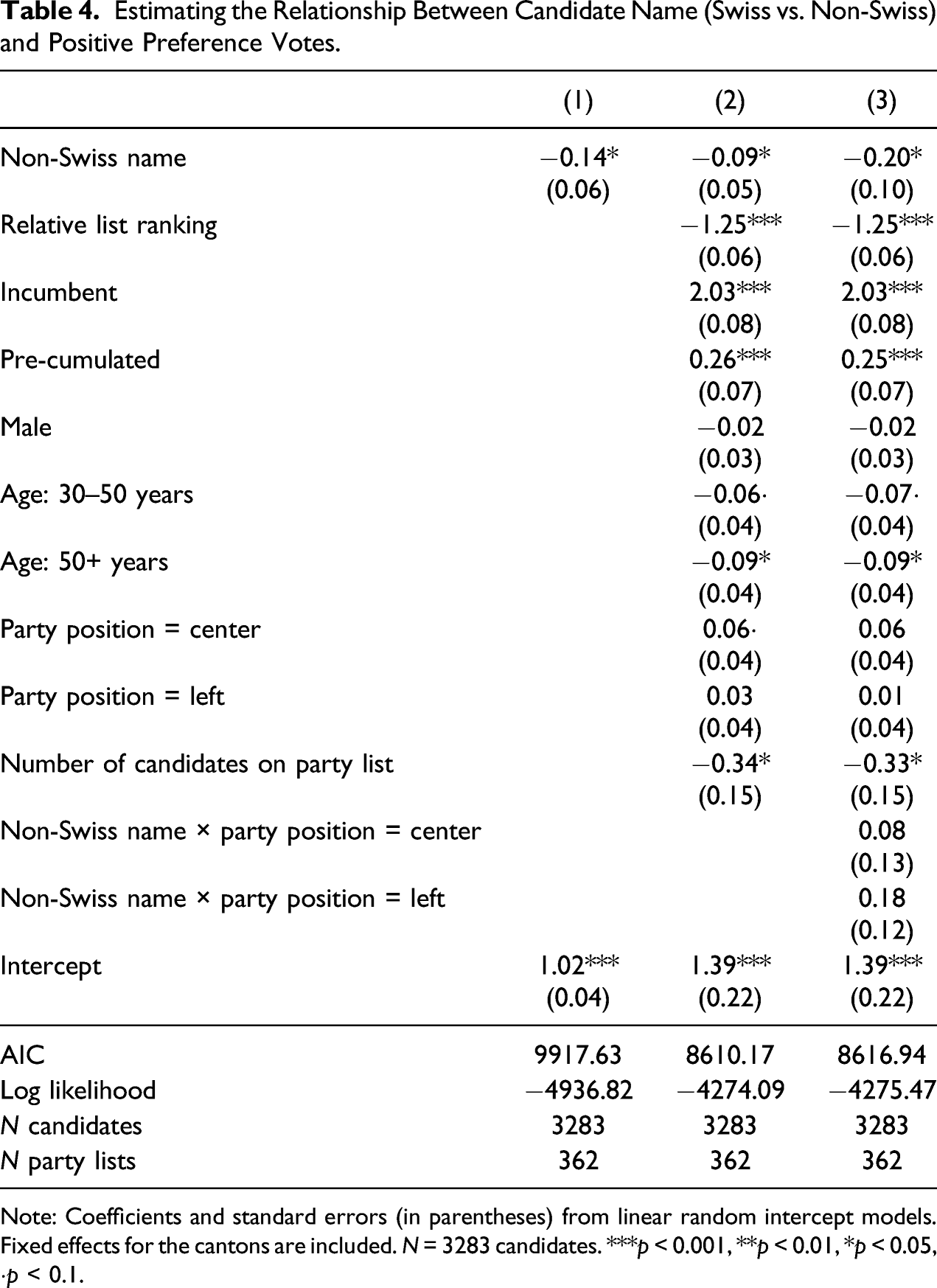
Estimating the Relationship Between Candidate Name (Swiss vs. Non-Swiss) and Positive Preference Votes.
Note: Coefficients and standard errors (in parentheses) from linear random intercept models. Fixed effects for the cantons are included. N = 3283 candidates. ***p < 0.001, **p < 0.01, *p < 0.05, ·p < 0.1.
Table 4 shows that there is no evidence of a cumulation-advantage for candidates with foreign-sounding names resulting from “positive electoral discrimination.” Rather, our results highlight the fact that candidates with non-Swiss names are disadvantaged not only by the share they receive of negative preference votes (see Table 3) but by the distribution of positive preference votes as well (Table 4). Hence, in line with our theoretical assumptions on ingroup favoritism, we find evidence that voters discriminate in favor of candidates with Swiss names.
Having a foreign name decreases the value of the relative positive preference votes by 0.093. On average, candidates with Swiss names have a predicted value of 1.012 positive preference votes, while candidates with a foreign name average a value of 0.919 (see Table 13 and Figure 2 in the online appendix). In fact, the influence of a non-Swiss name on positive preference votes is even more pronounced than it is on negative preference votes. But we should bear in mind that the range of values is considerably larger for the variable measuring positive preference votes. Further analyses show that candidates with non-Swiss names are disadvantaged in terms of both internal (cumulation) and external (panachage) positive preference votes (see Table 14 in the online appendix).
Figure 3 indicates that candidates with non-Swiss names receive fewer positive preference votes on right-wing lists, but voters of the center also show a tendency to allocate disproportionately more positive preference votes to candidates with Swiss names. However, and in contrast to our analysis of negative preference votes, we could find no statistically significant interaction effects between positive preference votes and the candidate’s party (see Table 4). The differences in effect size between the voters of the Right and those of the Left (and, to a smaller extent, also those of the Center) is even slightly larger if the focus is on positive rather than negative preference votes. However, standard errors are larger in the analysis of positive preference votes and we must therefore assume—given that the sample and the degree of multicollinearity are comparable in both estimations (with negative and positive preference votes as a dependent variable)—that the influence of candidates' names on positive preference votes can be determined less precisely, compared to negative preference votes, when we control for the information on the party lists.
23
Interaction effect of candidate name (Swiss, Non-Swiss) and ideological position of the party on positive preference votes. Note: Mean predicted positive preference votes surrounded by 95% confidence intervals. Predicted values are derived from a linear random intercept model. Control variables and fixed effects for the cantons are included. N = 3283 candidates.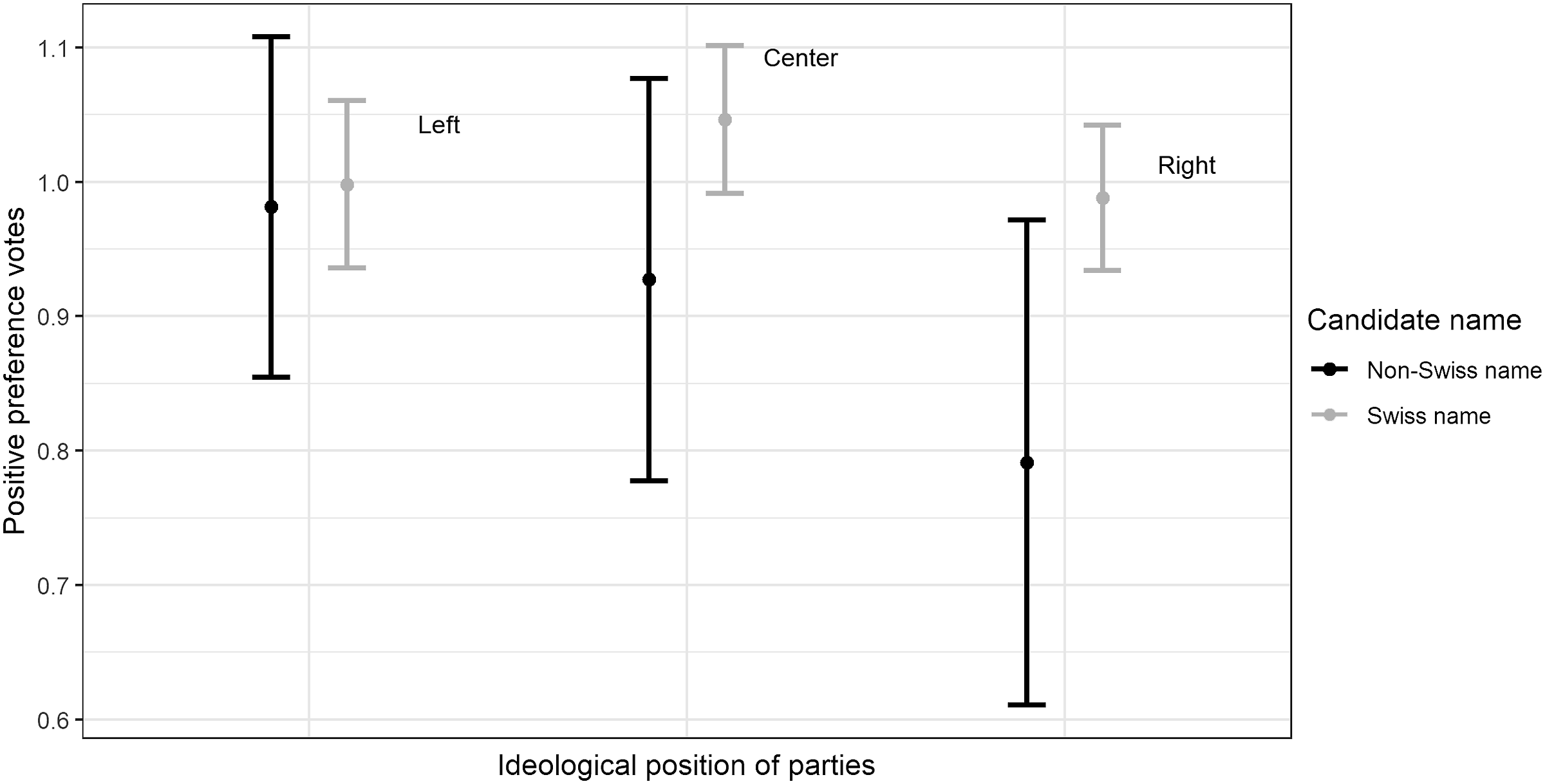
In a next step, we again split up the category of non-Swiss names according to origin. In contrast to our findings in the section on negative preference votes, here we find that candidates with Western non-Swiss names—particularly those with German names—tend to be slightly more disadvantaged, receiving fewer positive preference votes than candidates whose names have roots in non-Western countries (see Table 15 in the online appendix). However, the difference between these two name categories is not statistically significant (p-value = 0.475).
Robustness
In this section, we assess the robustness of our results in various ways. First, we examine to what extent the coding of non-Swiss names allows us to identify candidates who really have a “migration background” in the Swiss context. Given that the definition and measurement of the population with a migration background varies across countries, 24 we use the official definition provided by the Swiss Federal Statistical Office. 25 Applying this definition, in Autumn 2018 we conducted a survey of candidates who took part in the 2015 federal election. We contacted all candidates whose names we coded as non-Swiss (n = 477) as well as the same number of candidates (randomly drawn) whose names we coded as Swiss (n = 477); 22.1% of them replied. The results of this survey show that, indeed, a majority (59%) of the candidates with foreign-origin names have a migration background and another 27% have extended roots abroad (i.e., they or at least one of their parents, were born abroad), whereas only 8% of those with Swiss names are of immigrant-origin (see Table 16 in the online appendix). Overall, although a certain degree of inaccuracy remains, our coding based on family names is a good proxy to estimate the effective number of immigrant-origin candidates. Moreover, it is worth restating that our primary aim was to identify candidates who are perceived by voters as having immigrant roots.
Second, according to our theoretical assumptions there should be a relationship between the ethnic composition of the electorate and electoral discrimination against immigrant-origin candidates: the higher the share of immigrant-origin voters, the weaker the electoral discrimination. To test this hypothesis, we included in our models the share of the population who became naturalized between 1991 and 2015, in relation to the overall population in each municipality, as well as the interaction of this variable with candidates’ names (Swiss vs. non-Swiss). The models show, in line with our theoretical expectations, that indeed discrimination decreases with a municipality’s increasing proportion of naturalized residents (see online appendix Table 17 and Figure 4). This finding holds with regard to both discrimination in favor of candidates with Swiss names and discrimination against candidates with foreign names. 26
Third, we have not included candidates’ professions in our models, since, depending on the canton, they do not figure on all ballots. Table 19 in the online appendix confirms, however, that our findings are robust when we estimate models that include all the candidates who list their profession on the respective party list (n = 2865) and control for occupation (high-, medium-, and low-skilled).
Fourth, it bears repeating that the exclusive focus of this article is electoral discrimination on the part of voters. Given that parties decide the composition of their electoral lists, selection effects in the process of candidate nomination may to some extent impact our findings. If, for example, it were found that right-wing parties tended to nominate candidates from outgroups who face the most severe discrimination, this could go some way toward explaining the more pronounced discrimination observed on party lists of the Right. Table 20 in the online appendix shows that in the 2015 Swiss National Council elections, right-wing parties nominated substantially fewer candidates with non-Swiss names (8%) than center (12%) or left-wing parties (19%). In particular, candidates with names from Albania, Turkey and the Arab region are underrepresented on right-wing lists in comparison to left-wing lists. So in fact, based on the composition of party lists in terms of candidates with a migration background, we would expect voter discrimination against immigrant-origin candidates to be less—not more—pronounced on right-wing party lists than on others.
Another relevant point: in Swiss elections the candidates’ list rankings are typically decided by their party. It is thus conceivable that party gatekeepers use list ranking to either impede or promote minority candidates. If they tend to promote minority candidates by placing them higher on the party list, one could argue that our results may be flawed: voters might be crossing off such candidates not because of their names but due to a perceived deficit in skill and experience. Our results using list ranking as a dependent variable, however, show that candidates with non-Swiss names are actually placed a bit lower on party lists than candidates with Swiss names if we control for other characteristics provided on the ballot, including profession (see Model 2, Table 21 in the online appendix). Furthermore, there are no clear differences regarding the effect of candidate names on list ranking across party lists (see Model 3, Table 21 in the online appendix).
One might also argue that the higher proportion of candidates with non-Swiss names on the party lists of the Left and Center might per se contribute to explaining why minority candidates running on such lists receive fewer negative preference votes than comparable candidates running on the party lists of the Right. The assumption here would be that a typical voter with an outgroup bias tends to cross off only a very limited number of candidates. We have checked that assumption, and in Figure 6 of the online appendix we show the interaction effects between candidate names and the proportion of candidates with non-Swiss names on the party lists, with respect to both negative and positive preference votes (Tables 22 and 23 in the online appendix provide regression outputs). This visual illustration suggests that, indeed, candidate names become less important with respect to negative preference votes as the share of candidates with non-Swiss names on the respective party list increases. However, this finding does not hold if we focus on positive preference votes. And our finding that candidates with non-Swiss names are more discriminated against on the party lists of the Right holds even if we control for the share of candidates with non-Swiss names on the party list, and its interaction with candidate names (see Model 3, Table 22 in the online appendix).
Finally, an additional result highlights the electoral relevance of our findings. We show that our results hold even when we focus only on candidates who run on promising party lists, that is, on lists where at least one candidate was elected in the 2015 elections (Table 24 in the online appendix).
Conclusion
People with a migration background represent a significant proportion of the population in many Western democracies. They are increasingly granted citizenship in their countries of residence and thereby full political rights to vote and to run as candidates in elections. But are voters willing to elect immigrant-origin candidates to political office?
Our study contributes to a burgeoning body of literature that explores discrimination against immigrant-origin candidates in elections. Drawing on social psychology literature, in this article we have argued that ingroup favoritism (here discrimination in favor of majority candidates) is conceptually and theoretically distinct from outgroup hostility (here discrimination against minority candidates). As an empirical matter, this phenomenon is expected to apply to all human societies. But with regard to electoral contexts, there are few places where it can be tested. The ideal set-up for empirical analysis is an electoral system where voters can allocate both positive preference votes (allowing us to test the hypothesis of ingroup favoritism) and negative preference votes (allowing us to test the hypothesis of outgroup hostility). This is a peculiar feature of the Swiss electoral system and explains our focus on the Swiss case in this article.
Based on a unique data set derived from about 687,000 individual ballots, our study finds that, indeed, immigrant-origin candidates, identified as such by their non-typically Swiss surnames, incurred an electoral penalty in the 2015 elections to the lower house of the Swiss Parliament. Specifically, voters showed a tendency to discriminate against such candidates by allocating them more negative preference votes than they did comparable candidates with typically Swiss names. This pattern of discrimination, however, is predominantly performed by voters of the Right. In addition, we find evidence that voters tend to discriminate in favor of majority candidates by allocating them more positive preference votes. This form of discrimination has been largely ignored in political science to date. We also show that, in this second respect, it is less evident that voters’ position along the left-right ideological spectrum correlates with differing behavior. Moreover, our results indicate that, among candidates with non-Swiss names, the burden of electoral discrimination is more evenly distributed than we expected. In other words, having a Western name (e.g., French, German, or Scandinavian) is not necessarily less electorally disadvantageous than having a name from a region such as the Balkans or Turkey.
Our findings have implications for both the literature and the practice of fair elections; most importantly, they show that discrimination in favor of majority candidates—in addition to and distinct from discrimination against minority candidates—plays an important role in explaining the overall effect of electoral discrimination. As this form of discrimination has been largely overlooked in previous research, our study has significant implications for how we think about voter behavior in ethnically diverse democracies. We also expect that our findings may speak to other underrepresented social groups, for example, women, language minorities, or racial minorities. And although this study provides fine-grained evidence of both discrimination against minority candidates and bias in favor of majority candidates, future studies, employing different methods, should help us understand the psychological processes that underpin these forms of electoral discrimination.
Our results indicate that strategies to level the electoral playing field will need to address both ingroup and outgroup biases. Whereas outgroup bias can be tackled by changing negative attitudes toward immigrant-origin candidates, strategies aimed at “ingroup inclusiveness”—that is, an inclusive definition of who belongs to the “we”—may effectively address ingroup favoritism (Brewer, 2017). Means to combat ingroup favoritism may consist of “individuating members of the outgroup by revealing variability in their opinions,” which would require that candidates with a migration background not be reduced to their (real or assumed) expertise in the field of migration issues, but rather be provided (in the media and party electoral campaigns) opportunities to stake out positions on a broad variety of topics (see Gaertner et al., 1993: 5; Brewer, 2017). Furthermore, intergroup contact in society and politics has been proven effective in reducing not only outgroup bias but also the “salience of ingroup-outgroup distinctions” (Brewer, 2017: 104; see also Lai & Banaji, 2020). Finally, parties could adopt a strategy of “targeted outgroup helping” by placing immigrant-origin candidates on higher ballot positions in order to counteract both forms of discrimination (Greenwald & Pettigrew, 2014: 680).
To what extent are our results generalizable to elections in other countries? First, we note that anti-immigrant attitudes, support for right-populist parties that propagate anti-immigration rhetoric, and discrimination in other areas (e.g., education, housing, and job markets) are clearly not phenomena unique to Switzerland. Furthermore, social psychology mechanisms that underpin the ingroup and outgroup biases we report in this study are, we believe, a universal tendency (Brewer, 1999, 2001). It is therefore not immediately apparent why we would expect to find substantially different psychological tendencies and behaviors if voters in other countries were provided the same framework as Swiss voters to express their preferences for individual candidates. Indeed, the extent to which outgroup hostility and ingroup favoritism translate into actual voting behavior depends critically on the electoral system that defines the electoral playing field, and the opportunities it offers voters. Another way, then, to assess external validity is to examine how the Swiss electoral system compares to voting systems employed in other countries. On the one hand, it is quite unique; there are only a few other places where voters have such a wide range of options. On the other hand, we can find electoral systems that offer comparable expressive freedom to voters. For instance, in the Single Transferable Vote electoral system (used in Ireland, Malta and Scotland), voters rank candidates in order of preference, which could be considered a functional equivalent of positive and negative preference votes. Furthermore, in majoritarian electoral systems, where voters may face a trade-off between voting for their preferred party or for a specific candidate they want to support, electoral discrimination may occur within parties in the pre-electoral stage.
To sum up, we believe that our findings will be relevant to the literature on the impact of electoral systems on the electoral prospects and, more generally, the political representation of minority candidates in liberal democracies. Determining more precisely how the extent of electoral discrimination differs between contexts and across different electoral systems is an important endeavor—one that awaits another occasion.
Supplemental Material
sj-pdf-1-cps-10.1177_00104140211024293 – Supplemental Material for Are Immigrant-Origin Candidates Penalized Due to Ingroup Favoritism or Outgroup Hostility?
Supplemental Material, sj-pdf-1-cps-10.1177_00104140211024293 for Are Immigrant-Origin Candidates Penalized Due to Ingroup Favoritism or Outgroup Hostility? by Lea Portmann and Nenad Stojanović in Comparative Political Studies
Footnotes
Acknowledgments
We thank Corine Truxius and Eva Granwehr for their assistance in coding, Luca Gambazzi for his support with data processing, and Peter Cook for careful editing. We are grateful to Barbara Perriard from the Swiss Federal Chancellery for providing the legal recommendation on data handling, as well as to collaborators from the various Swiss cantons for kindly giving us access to their electoral software data. We also thank Georg Lutz and Riccardo Primavesi from the University of Lausanne for their collaboration in collecting the information about candidate profiles. We gratefully acknowledge the initial assistance and insights by Anja Giudici and Philippe Koch on a pilot study of the 2014 municipal elections in the canton of Zurich, as well as the generous support from the Centre for Democracy Studies in Aarau. Earlier versions of the article were presented at the Swiss Political Science Association 2018 Annual Congress, the ECPR 2017 General Conference, and the 2017 Neuchâtel Graduate Conference of Migration and Mobility Studies. We are grateful to the participants of these events for their constructive feedback. We also thank Andrea De Angelis, Nathalie Giger, Simon Hug, Lucas Leemann, Rune Slothuus, Isabelle Stadelmann-Steffen, Oliver Strijbis, Denise Traber, Alexander Trechsel, and Thomas Willi for their constructive comments and helpful suggestions on the previous drafts of the article.
Declaration of Conflicting Interests
The authors declared no potential conflicts of interest with respect to the research, authorship, and/or publication of this article.
Funding
The authors disclosed receipt of the following financial support for the research, authorship, and/or publication of this article: This research was supported by the Swiss National Science Foundation (grant number: PZ00P1_154983) and the National Centre of Competence in Research (nccr–on the move) funded by the Swiss National Science Foundation (grant number: 51NF40-182897).

Notes
Author Biographies
References
Supplementary Material
Please find the following supplemental material available below.
For Open Access articles published under a Creative Commons License, all supplemental material carries the same license as the article it is associated with.
For non-Open Access articles published, all supplemental material carries a non-exclusive license, and permission requests for re-use of supplemental material or any part of supplemental material shall be sent directly to the copyright owner as specified in the copyright notice associated with the article.
