




Abstract
Despite recent attention to the economic and political consequences of automation and technological change for workers, we lack data about concerns and policy preferences about this structural change. We present hypotheses about the relationships among automation risk, subjective concerns about technology, and policy preferences. We distinguish between preferences for compensatory policies versus “protectionist” policies to prevent such technological change. Using original survey data from Spain that captures multiple measures of automation risk, we find that most workers believe that the impact of new technologies in the workplace is positive, but there is a concerned minority. Technological concern varies with objective vulnerability, as workers at higher risk of technological displacement are more likely to negatively view technology. Both correlational and experimental analyses indicate little evidence that workers at risk or technologically concerned are more likely to demand compensation. Instead, workers concerned about technological displacement prefer policies to slow down technological change.
Introduction
Digital and automation technologies are disrupting labor markets and rekindling fears about technological unemployment. The question of whether robotization, automation, and artificial intelligence (AI) will make current jobs disappear has been the subject of increasing mainstream and academic attention (e.g., Acemoglu & Restrepo, 2018). These fears have grounding in recent studies that find a net negative impact of specific technologies, such as industrial robots, on the number of jobs and wages in local labor markets in the United States (Acemoglu & Restrepo, 2020). There is growing concern among labor economists that many occupations and workers are being threatened by rapid advances in technology that will, absent policy interventions, pose a massive threat to the wages and job security of some workers (IMF, 2019). These trends may be intensified with the covid-19 crisis and the extension of teleworking.
Despite the importance and controversy of this topic, we still know little about the perceptions and demands of workers concerning technological change. Are workers worried that the adoption of new technologies in the workplace will have negative consequences for their jobs? Is this concern more common among workers at a higher risk of substitution by technology? Do perceptions of technological risk generate demand for different policies, and if so, which ones? Understanding public concerns and preferences is necessary as they can affect government responses to the structural challenge of accelerating technological change. The relative inattention to these questions in political science contrasts with the ample and instructive literature on how other sources of job risk affect social-policy preferences, such as deindustrialization (Iversen & Cusack, 2000), international trade and globalization (e.g., Walter, 2010, 2017), general occupational insecurity (Rehm, 2016), and the deregulation of labor-market contracts (e.g., Häusermann et al., 2015).
This article examines which workers are concerned about the introduction of new technologies in the workplace and which policies they support to address labor-market risks related to the introduction of technology. We make two main contributions. We first propose and test a set of hypotheses relating objective risk of displacement due to the introduction of new technologies (based on occupational characteristics) to subjective concern about the impact of technological change in one’s workplace. Subjective concern is often assumed as a key mechanism for why exposure to job-downgrading risks affects preferences, but such preoccupation is infrequently directly measured regarding technological risk.
Our second contribution is to analyze how objective risks and subjective concern affect policy preferences to address job consequences related to technological change. We distinguish between two categories of policy preferences. First, we consider policies to compensate for unemployment risks via redistribution. Second, using the terminology regarding openness-based risks, we categorize policies to prevent change (such as slowing down the pace of technological change) or preserve the occupational status quo as “protectionist” policies. These two policy categories to respond to economic structural changes are often kept separate in studies of public preferences for policies. Differentiating these policy preferences is relevant because such policies may have different levels of support, regardless of their efficiency consequences. Although slowing down workplace technological change could be more growth-reducing than redistribution, politicians may emphasize the former if it gains popular support.
We test our hypotheses using a large survey from Spain, an economically developed democracy where technological change has recently produced transformations in the labor-market structure, where there are still large numbers of workers at risk, but where these issues are not yet strongly politicized. We measure individuals’ occupation-based vulnerability to technological displacement using two main approaches proposed in the literature, adapted to a survey context. These are the standard measure of routine task intensity (RTI) (Autor et al., 2003) and a measure about how frequently workers perform tasks at low risk of automation (TLRA) (Arntz et al., 2017). We field one of the few surveys that include both these occupation and task-based measures of automation risk. After assessing if people at higher objective risk have higher subjective concern, we test if either objective indicators or subjective concern correlate with policy preferences. To assess if the effects of subjective concern on policy preferences are plausibly causal, we use a priming experiment to test if individuals primed to think about technological change in the workplace adjust their policy preferences, relative to a control group and to individuals primed with other labor-related concerns.
We obtain the following main findings. First, people view the consequences of the introduction of new technologies in the workplace as positive, on average, and there is little support for adopting measures to decelerate the adoption of technology in the workplace. Second, we find that task-based measures of automation risk are more strongly correlated with subjective concern than routine-task intensity measures. Third, the correlational and experimental analyses indicate that individuals who are concerned about technology support slowing down the pace of technological innovation. Fourth, we find little evidence that either objective risks or subjective concerns correlate with greater demand for compensation policies.
Combined, our results find little evidence of technological “alarmism” among workers. But they also suggest that a potential reaction to feeling threatened by technology is to demand that governments prevent technological change rather than compensation. The first section presents relevant motivation literature. The Theoretical Expectations section presents hypotheses. The Data section presents the design. The Result section presents results from both observational data and the survey experiment. The Summary and Conclusions section discusses reasons for and implications of these findings.
Motivation and Relevant Literature
Even though technological innovation is the main driver of economic growth, periods of rapid innovation have historically raised concerns about its capacity to eliminate occupations and their distributive consequences (e.g., Mokyr et al., 2015). There is a renewed fear that job disruption and unemployment will substantially increase due to rapid advances in new technologies in the workplace, such as computerization, automation, robots, and AI. The prediction that 47% of current jobs could be lost to automation in the next 20 years has garnered much scholarly and media interest (Frey & Osborne, 2017). 1 Concern about rising technological unemployment is partially supported by recent studies by Acemoglu and Restrepo (2020), who find that the introduction of robots had negative employment and wage impacts in local US labor markets. Illustrative of the media sentiment, a news article on the ambitions of businessmen who congregated at the Davos World Economic Forum concluded that many firm executives are “…racing to automate their own work forces to stay ahead of the competition, with little regard for the impact on workers” (Roose, 2019). Recent theoretical work argues that the prospect of large numbers of displaced workers being unable to find new jobs is possible, even if historically this situation has been rare (Acemoglu & Restrepo, 2018).
There is little doubt that technological change has strongly reshaped occupational structures over the last 30 years in advanced industrial democracies (Goos et al., 2014; Jaumotte et al., 2013). Most labor economists agree that digital technologies such as computers and robots have increased the productivity and salaries of more educated workers, creating new high-skilled jobs in the service industry, but also, that such digital technologies have accelerated automating repetitive tasks. In the last two decades, they have substituted large numbers of workers in routine jobs, often in manufacturing and administration (e.g., Acemoglu & Autor, 2011; Autor, 2015; Autor & Dorn, 2013; Goos et al., 2009; Michaels et al., 2014; Oesch, 2013). In Spain, the source of evidence for this article, these processes have produced job polarization in the employment structure, with reduced employment in middle-income and high routinization jobs such as retail banking and certain manufacturing sectors (Sebastian, 2018). More abstract and cognitively demanding tasks (e.g., managerial, interactive or problem-solving tasks) have expanded between 1994 and 2014 (Sebastian, 2018). Like many OECD countries, Spain has experienced a large increase in the importance of abstract tasks in the occupational structure from 2005 to 2015, but lower demand for occupations with routine tasks (Biagi & Sebastian, 2017). The few longitudinal studies that trace the work trajectories of routine workers (those most at risk of being displaced by digital technologies) (Cortes & Guido, 2016; Kurer & Gallego, 2019) find that job changes are a common experience among routine workers (see also Sebastian, 2018 for the Spanish case), and that a sizable number of job changes (especially downgrades) are caused by technological change. 2 This literature suggests that automation represents a large chronic threat to the possibility of workers retaining their occupations.
While the employment and wage effects of automation are being extensively studied, the political consequences have so far received less attention. A small literature asks how technological change affects vote choice, but there remain few studies of worker concerns about technological change and preferred policies to address it. 3 In terms of voting, some studies find that workers more vulnerable to automation are more likely to support radical right wing parties in Europe (Anelli et al., 2019; Im et al., 2019; Kurer, 2020) or shifted to support Trump in the United States (Frey et al., 2018), while workers who benefit from digitalization maintain support for incumbent and mainstream parties (Gallego, Kurer, et al., 2021). Boix (2019) links the ICT revolution to increasing voter abstention. In terms of specific policy views, one study finds that workers who are more vulnerable to technological substitution, measured by RTI in occupations, support government reduction of inequality using the European Social Survey (ESS) data (Thewissen & Rueda, 2019). 4 Few political science studies to date examine if workers are concerned that technology is a risk to their jobs or which types of intervention workers support. This inattention is largely due to the scant public opinion data regarding concerns about technological change itself. The most systematic survey evidence remains limited to studies conducted by Pew Research Centre in the United States and a few questions included in the Eurobarometer in Europe in 2014 and 2017, but these designs lacked objective measures of vulnerability and relevant policy preferences.
In the field of comparative political economy, there has been much research on how other structural challenges to employment stability affect support for redistribution and compensation. These challenges include deindustrialization, globalization (prominently trade openness and offshoring), deregulation of labor markets, and aggregate occupation-based unemployment risk. The now standard theoretical claim is that labor-market risk affects preferences for redistribution and compensation because workers at higher risk are at some level aware of their higher probability of unemployment or of potentially longer unemployment spells, and support more generous compensation policies to insure against income loss. 5 Much empirical evidence finds a correlation between measures of risk that are principally based on features of a worker’s job, and demand for greater compensation and redistribution. 6 In this article, we examine whether technology-related risks generate similar demands for compensation.
In addition, we also assess whether such risks affect workers’ demands for preventing the introduction of new technologies in the workplace. The option of preventing a structural change from happening in the first place has been mostly studied in the literature about international trade, a policy area that is more clearly amenable to interventions such as trade barriers to prevent, rather than compensate for, globalization-related risks. This literature offers more mixed evidence about the importance of trade-related risk and corresponding protectionist preferences. For example, Hainmueller and Hiscox (2006) find that the less educated in much of the world are more opposed to free trade, while Owen and Johnston (2017) find that task routinization is correlated with support for trade protectionism. We note that policies to simply stop or decelerate broad structural economic changes may not be possible for many sources of labor-market risks, but such policies regarding technological innovation in the workplace have been discussed in the literature and in public debate, including the taxing of labor-substituting innovations such as robots, more directly regulating innovations, or increasing worker protections from substitution by automation (Abbott & Bogenschneider, 2018).
In summary, while there has been ample research on how other types of job threats affect policy preferences, there remains little research on whether automation risk affects support for compensation and for protection (policies to slow down such change) in the same way. This article addresses this gap in the literature.
Theoretical Expectations
Subjective Concern
As reviewed above, an extensive literature in economics documents that the introduction of new technologies poses a risk for some workers and benefits others. Individuals who perform routine tasks in their jobs are more likely to be substituted by technology because repetitive tasks are easier to codify and automate, and thus routine workers are more threatened by new technologies. Workers who perform tasks that cannot be easily substituted are at lower risk, and if they have skills that complement technological innovation, they can economically benefit following the introduction of new technologies in their workplace (Acemoglu & Restrepo, 2018; Autor et al., 2003).
A basic unaddressed question is whether workers are optimistic or pessimistic about the consequences of technological change on their job prospects. Are those at higher risk of substitution actually more concerned about the introduction of technology? Whether objective risk and subjective concern are correlated is not obvious because workers are not always well-informed about future labor-market risks; this may be likely for structural threats that are not as strongly politicized as in the case of technology.
7
However, the introduction of new technologies and automotive processes in workplaces could also pose more salient changes or threats. If there is a correlation between objective risk and subjective concern, we expect that individuals who are at higher risk of substitution by automation will hold more negative perceptions about the effects of technology in the workplace. Those at lower risk might perceive the impact of technology as largely positive due to their ability to benefit from or complement various technologies. Measuring subjective concern about the introduction of technological change in the workplace is necessary to address this basic question, but few studies have measured it in this domain. Our first hypothesis is that what we term objective automation risk is positively correlated with subjective views (concern) about the impact of technology in the workplace.
Types of Policy Preferences about Technological Change
We now discuss how objective automation risk should affect policy preferences. We build on both the recent empirical literature on technological change and findings from other labor-market risks to organize hypotheses and derive simple expectations. In different contexts, occupational risk has been found to lead workers to demand more redistribution, to demand other policies, or to demobilize politically. We distinguish between two types of policies that individuals might support to address risks derived from structural change: compensation for economic losses or risks associated with labor-market threats, and prevention of (or protection from) structural change. 8
The policy response more frequently studied in the literature about labor-market risks is compensation and redistribution. The core theoretical claim is that workers at higher risk of unemployment or losing income should be more likely to support redistributive policies to insure against risk (Iversen & Soskice, 2001; Moene & Wallerstein, 2001; Rehm, 2016). In one of the few studies about automation risk and preferences for redistribution, Thewissen and Rueda (2019) find that workers in more routine jobs are more likely to support government reduction in inequality, controlling for a wide variety of covariates. Building on this and related work, we hypothesize a similar prediction regarding automation risk and demand for redistribution.
9
We thus have the following straightforward hypothesis:
But compensation and redistribution is just one class of interventions that governments can use to address the economic consequences of structural changes. A second class of policies can broadly “protect” workers by either stopping or preventing (further) market disruptions. 10 Colantone and Stanig (2018) note in relation to trade that policies to preserve the status quo have been perceived as a more viable or politically appealing proposal as welfare-states have become strained and the limits and costs of redistribution have increased. Potential losers from openness may prefer protection to compensation, even if the former is more economically costly for society, because it allows affected workers to preserve their jobs, identities, and social environments.
In the case of technology, policies to prevent or accelerate the introduction of new technologies in the workplace include greater regulation of technology, requiring worker approval before introduction of technologies (Dauth et al., 2021), and various tax mixes to disincentivize robots or other forms of technological substitution of workers (Abbott & Bogenschneider, 2018).
11
We expect that individuals who are at a higher risk of experiencing technological substitution should be more supportive of policies to reduce adoption of new technologies in the workplace.
Subjective Concern and Policy Preferences
The next set of hypotheses discuss the relationship between subjective concern about automation and policy preferences. Awareness of being exposed to a specific structural risk is a basic micro-foundation for the process through which being at risk should lead workers to prefer that governments implement policies that either compensate affected workers or prevent the structural change from happening. Thus, subjective concern is a key mechanism linking objective risk and policy preferences (e.g., see Walter, 2010, for the case of international trade, applying this logic).
A more specific version of this claim is an explicit mediation model in which objective automation risk causes concern or pessimism about the impact of technological change, and this concern in turn affects support for policies to stop change or seek redistribution. This mediation relationship is implicitly assumed in existing accounts that focus only on objective risk indicators. 12 But subjective concern is not the only mechanism connecting objective risk to policy preferences, as there are other plausible reasons why indicators of objective risk could affect policy views. For example, workers in occupations threatened by technological change may perceive that their skills are less demanded or valued than in the past, even if they are not aware of the exact cause of this change. Alternate mechanisms related to policy views may thus be psychological, such as lower self-esteem; another could be general concern about their economic prospects. Such mechanisms might operate in the absence of or in addition to subjective concern about workplace technological change.
Despite this caveat, those who are concerned about change should have different policy views to address this structural threat. To understand the likely impact of accelerating technological change, it is relevant to examine if, independent of their actual objective risks, those workers who are more worried about the negative impact of automation on their jobs demand different policies than those who are more optimistic about the implications of this change. In the case of technological change, it remains untested whether in fact subjective concerns correlate with preferences for prevention or compensation policies. We make explicit this distinction and hypothesize that subjective concerns about the occupational consequences of technology should also affect policy preferences in the same direction as the objective risks noted above.
13
Thus, we specify:
Finally, we also consider that individuals may have different levels of support for protectionist versus compensatory policies. Though few studies analyze both policies and measure objective and subjective risks, we suggest possible differences in policy support, and hypothesize that compensation may be a relatively less supported policy choice than protectionism. This could be due to multiple reasons. First, workers on average may prefer to keep their occupation and maintain the status quo, as opposed to become recipients of redistribution. Second, theoretical and empirical studies have shown that support for redistribution measures can be hampered due to sensitivity to tax increases required to pay for redistribution (e.g., Citrin, 1979; Naumann, 2018). The third reason is motivated by the empirical reality that automation and digital technologies have thus far more intensively disrupted employment prospects of mostly middle-skilled workers in routine (manual and non-manual) jobs, who are more likely to be clustered in the middle of the income distribution. For such workers, the income effect could dominate the insurance logic regarding redistribution preferences, and thus they may be less supportive of such policies due to their relative income position. 14 Fourth, related to arguments about whether at-risk individuals would benefit from redistribution, they may accurately or not perceive that other individuals in society will be more likely to be beneficiaries of redistribution programs (Cavaillé & Trump, 2015).
Thus, while we expect both objective risks and subjective concerns to highly correlate with both policies, we expect a higher positive correlation between both measures and support for protectionist policies to decelerate workplace technological change, relative to support for redistribution. It is beyond the scope of this study to arbitrate which of the above reasons may best account for such differential support, but overall, we hypothesize that “slowing down” workplace technological change may be considered a more effective and direct policy to maintain job security than redistribution, the latter of which implies a worker accepting the possibility of job insecurity and receiving uncertain compensation or accepting being a net payer in case of an unrealized risk.
Data
To test our hypotheses, we fielded an online survey in Spain to a sample of 3100 individuals in the workforce between 18 and 64 years old in November and December 2018. This section discusses the case study, data, measures, and experimental design. To approximate representativeness of the working-age population, the survey sample was stratified by gender, age, and level of education (lower secondary or less, secondary, and any university). 15
Spain is a useful case for our study because it is a fairly typical advanced economy in some respects, but still has a significant number of routine workers who are at high risk of substitution. As with other advanced economies, the country has experienced a large increase in the importance of abstract tasks in the occupational structure from 1994 to 2014 as well as a reduction of jobs in middle-income occupations that score high in routine-task intensity measures, such as office clerks or metal, machinery and related trade workers (Sebastian, 2018). Regarding increases in robotization, the number of robots per 1000 workers has steadily increased since 1995, from a little over .5 to over 1.3 (IFR, 2016); similar trends are observed in France, the US, and UK (with the latter country having actually much less robot growth).
A second relevant feature is that at the time of conducting our survey we could expect to find large numbers of workers in occupations at high risk of substitution according to current measures of risk. Spain still has a relatively high percentage (compared to other OECD countries) of workers in routine jobs (De la Rica & Gortazar, 2016), who will be at significant risk of unemployment as companies adopt available technologies. Because Spain still is in the “earlier stages of de-routinization” (De la Rica & Gortazar, 2016, 10), one could sample a sufficient number of workers with varying degrees of occupational risk. We return to the implications of choosing this case study in the conclusions.
Measures of Automation Risk
The survey included two measures of automation risk which to our knowledge have not been previously jointly assessed in a survey that also assesses policy preferences. The most widely used measure of risk codes the RTI in an occupation-based on occupational dictionaries from 1990. This method builds on the claim that routine tasks are easier to codify and automate (Autor et al., 2003). To measure RTI in a survey context, we asked all respondents about their employment situation and, to workers or unemployed respondents, which occupation at the 2-digit ISCO code level best describes their current or previous job. We then assigned the RTI score calculated by Sebastian (2018) for occupations in Spain based on the method described in Autor et al. (2003), with higher values of RTI indicating higher routinization and thus automation risk (the variable is rescaled 0–1 with higher values indicating higher RTI). 16 The question about occupation at the 2-digit level was placed at the start of the survey and it was generic enough that it should not have primed concerns about automation.
Second, we estimate vulnerability to automation based on a more detailed question about tasks performed in occupations. To construct this alternative measure, we gather information on how frequently the job requires 10 specific tasks that are unlikely to be automated according to recent projections from the OECD (Arntz et al., 2017). We term this “tasks at low risk of automation” (TLRA) (for details of this measure see the supporting information (SI), part A). 17 The questions were placed toward the end of the questionnaire to avoid priming respondents with risk. We use the responses to construct an index (we label the variable automation risk) from 0 to 1 in which higher values indicate higher vulnerability to automation.
Subjective Risk and Experimental Design
We test our hypotheses using detailed observational data and, where possible, we assess causality using an experiment. To test a causal version of H3-H4 (which link subjective concerns to policy preferences), an experimental design primed a subsample of respondents with thoughts about technological change in the workplace. The prime was placed after generic questions about the labor-market situation of respondents. We randomly divided the sample into four experimental groups. In three of the four groups, we asked respondents a short set of questions designed to make a specific concern salient. We made salient concerns about the labor consequences of technology by priming views about technology for a random subset of 1/3 of the respondents. For another 1/3 of respondents, we primed concerns about trade with similarly worded questions about trade. For 1/6 of respondents, we assessed views about a placebo treatment issue, and in a pure control group for 1/6 of respondents we included no prime.
For those within the “technology priming” condition, we measure the subjective concerns about technological risk in the individual’s workplace. We asked respondents in this condition if the consequences of technological change on their own job prospects are positive or negative. The question read, “New technologies at work can destroy jobs and reduce wages if computers or machines perform work previously done by people. They can also create jobs and increase wages if they lead to new products and make workers more productive. Thinking about your future job opportunities (imagine yourself 5 years from now), do you think that technological changes at work will have negative or positive consequences?” The response options are very negative, mostly negative, neither negative nor positive, mostly positive, and very positive. The text was purposely two-sided to make respondents think about the positive and negative aspects in order to reduce demand effects. 18 We code this variable as five categories according to the response options, with higher values indicating more concern. We followed up with an open-ended question asking which thoughts and emotions come to mind when thinking about change in the workplace due to technology. Individuals in the trade-priming and placebo conditions were asked similarly worded questions about trade and environmental threats to job security in the workplace, respectively. 19
Measures of Policy Preferences
For all respondents, we measure support for both “protectionist” and compensatory policies (preventing or stopping technological change versus redistribution). These questions were placed just after the experimental prime and are the dependent variables. The first policy dependent variable is support for the government to adopt measures to slow down or accelerate technology adoption in the workplace. The text of this policy question reads, “Some people believe that the government should take measures to accelerate the pace at which new technologies are incorporated in workplaces. Other people think that the government should slow down the pace of adoption of new technologies. What do you think?” The response options were: accelerate a lot, somewhat accelerate, neither accelerate nor slow down, somewhat slow down, and slow down a lot. This variable is recoded 0–1 with higher values indicating greater support for slowing down technology.
For views about compensation policies, we measure support for two types of policies: unemployment insurance and general social service expansion (this question is frequently used in Spain to measure preferences for redistribution). The text of the question on unemployment support read, “Are you in favor of or against increasing public spending on unemployment benefits if it means raising taxes? (Please answer on this scale from 0 to 10).” Answers were coded such that 0 indicated least support and 10 highest support. The text of the question on generic redistribution, read “Some people think that spending on public services and social benefits should be increased, even if more taxes have to be paid. Others think it is more important to pay less taxes, even if that means reducing public services and social benefits. Where would you place yourself?” Response options were coded 0–10, with higher values indicating greater support. 20
Other Variables
The survey also involved collection of baseline demographic variables, including gender, age, education, employment status, and income. Male gender is coded as 1, age is recoded as nine categories between 18 and 64, education is coded into six categories, employment contract status is coded as four separate binary indicators (indefinite, fixed-term, self-employed, and unemployed), and household income is recoded into seven categories. 21 We also use 1-digit ISCO occupational dummy variables. Part B of the SI presents descriptive statistics for the main variables of interest.
Results
To recapitulate, our measures of objective occupation-based automation risk coupled with assessment of the consequences of technology allow us to test if there is a correlation between objective technological risk indicators and subjective concerns about technology (hypothesis 1) and whether there is a correlation between objective risk and policy preferences (hypothesis 2).
The experimental design allows us to assess a plausible causal version of hypotheses 3–4, which is that priming technology concerns affect policy preferences, by comparing policy preferences among groups where workplace technological concerns was primed (the treated group) or not primed (control group). Our design provides us measures of subjective concern about technology (assessed only asked in the technology prime group) for a subset of the sample, around 1000 respondents. For the entire sample (3100 individuals), we have direct measures of objective vulnerability and policy preferences.
Objective Technological Risk and Concerns about Technological Change
In descriptive analyses, we find that only a minority of individuals believe technology has negatively consequences for their own occupation. Almost 19% believe that the consequences are mainly negative, 24% report neither positive or negative consequences, and 53% report positive or very positive views (for descriptive statistics see in SI part B). 22
But, while most respondents are optimistic about the effects of technological change in the workplace, are those who are at risk more concerned about technology? A basic test of H1 is to examine concern among individuals at high and low automation risk. If we consider the binary variable of who is concerned about technology versus not, concerned individuals have a higher RTI score (.56 vs. .45), and a higher TLRA score (.61 vs. .55). 23 If we consider a decomposition by quartile of objective risks, the RTI quartile gap for those who are technologically concerned, versus those who are not, is 2.8 versus 2.3, and for the measure of the quartile gap is TLRA, 2.7 versus 2.4. This simple test indicates that while objective automation risks are initially positively correlated with concern about such risks, the magnitude is not particularly high, as the baseline differences in these measures of risk are within the same quartile of risk.
Risk of Automation and Subjective Concern About the Effects of Technology.
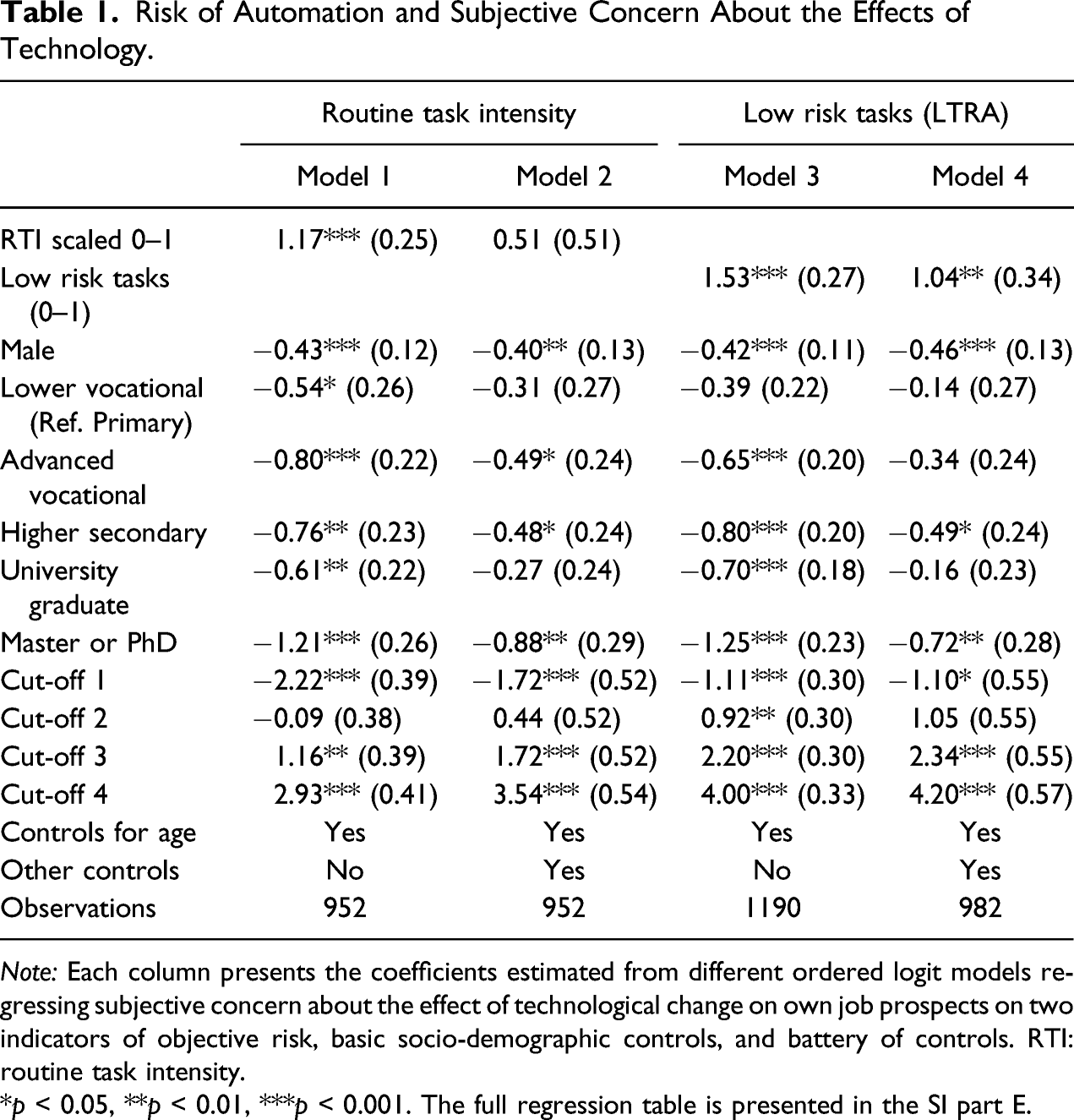
Note: Each column presents the coefficients estimated from different ordered logit models regressing subjective concern about the effect of technological change on own job prospects on two indicators of objective risk, basic socio-demographic controls, and battery of controls. RTI: routine task intensity.
*p < 0.05, **p < 0.01, ***p < 0.001. The full regression table is presented in the SI part E.
As the table shows, the relationship between objective measures of technological vulnerability and views about the effects of technological change depends on the measure in question. For the task-based automation risk index (models 3–4), there is a positive relationship between this type of risk and subjective concern as hypothesized. Model 4 shows that this relationship holds even when controlling for many standard covariates (male gender, age categories, and education categories); this relationship also holds controlling for the battery of dummies for different occupations, income, and employment situations. The magnitude of the effects of moving from the minimum to the maximum value of this risk measure is sizeable, at about a half standard deviation of subjective technological concern (one standard deviation in this variable is 1.07). In particular, we find that risk of automation based on occupation tasks (model 3 and 4) is associated with a decrease of 1.53 (1.04 in the full model). In terms of predicted probability of different categories of concern based on the coefficients estimated in model 4, moving from the lowest to highest quintile of this risk measure reduces the probability of being “very optimistic” about workplace technology from .24 to .10, and increases the probability of being “somewhat concerned” from .10 to .20. We note though, that increasing from the lowest to largest quintiles of this form of automation risk only slightly increases the probability of being “very concerned” about technology, from about .02 to .05. Our interpretation of this substantive effect is that it is moderately sized, given that maximum values of such risk do not strongly correlate with the probability of being in the highest concern category.
By contrast, as models 1-2 show, the most frequently used indicator of vulnerability, the occupation-based measure of RTI, is less robustly associated with subjective concerns about automation; model 2 shows that the associated coefficient is not precisely estimated when we include the occupational category and income controls. This may indicate that RTI is a poorer measure of vulnerability. Overall, we find that for the task-based measure of occupational risk, this risk of technological substitution is correlated with subjective concerns in the expected direction, providing partial confirmation of H1 (as the RTI measure is not consistently correlated with such concern).
In addition to objective vulnerability, some demographic and socio-economic characteristics are correlated with subjective concern about technology in expected directions. We note that in terms of benchmarking the task-based automation measure that is positively correlated with concern, this risk variable has a larger substantive effect than having university experience. Table 1 also shows that men are consistently less concerned about the effects of technological change on their own job prospects than women. Workers with low education levels are more concerned about technology, but the correlation is significantly reduced with controls for income, employment situation, and occupational categories. Table E1 of the supporting information shows that concern about workplace technology increases with age and reaches a maximum among 55 to 59 years old workers, before slightly declining as workers approach retirement age. This suggests that older workers who are not yet about to retire feel the highest levels of threat. Table E1 also shows that the employment status of individuals is weakly associated with perceptions of threat, and that workers who receive higher salaries are less concerned about technology. Finally, there are strong differences in perceptions of risk between workers in different occupations, with workers in elementary and less skilled occupations significantly more pessimistic about the impact of technological change on their job prospects compared to managers, professionals, and technicians.
Technological Risk, Concern, and Policy Preferences.
Next, we examine if automation risk is correlated with the different policy preferences to address technological change (H2a-H2b). Further, is subjective concern about workplace technology also correlated with policy preferences (H3a-H3b)? Before we turn to regression results, we flag the key descriptive patterns of policy preferences from the pure control group. Regarding the policy to slow down technological adoption in the workplace, we find overall strong opposition to this, and in fact strong support for a policy of technology acceleration. 66% of respondents believe the pace of technology adoption should be increased in the workplace. 29% support neither accelerating nor deceleration, and less than 5% support slowing down technology. This indicates little support for policies to decelerate technological change. Regarding the two redistribution policies, consistent with previous literature on support for redistribution in Spain (and in much of Western Europe generally), support is moderate and above the midpoint at 6.1 (for unemployment assistance) and 5.1 (for general social service expansion).
Looking at whether individual support for slowing down adoption of workplace technology varies with their risk level of RTI, we see that the average RTI score for those who do not support technological slowdown is .47, whereas for those who do support such slowdown it is .54. Regarding the task measure TLRA, for those who do not support measures of slowdown, the risk score is .57, and again, the risk score is higher for those who do support such measures, at .62. If we consider quartiles of each of these objective risks, the RTI quartile gap between supporters is 2.4 versus 2.7, and for TLRA, 2.5 versus 2.7 (thus relatively small quartile differences between individuals who are opposers and supporters of slowing down workplace technology). For the variable of subjective concern about technology, the difference between opposers and supporters of slowing down workplace technology is .36 versus .63, preliminarily indicating that subjective concern about technology is more correlated with support for policies to slow down workplace technology, compared to objective risk measures.
Technological Risk, Optimism, and Policy Preferences: RTI Results.
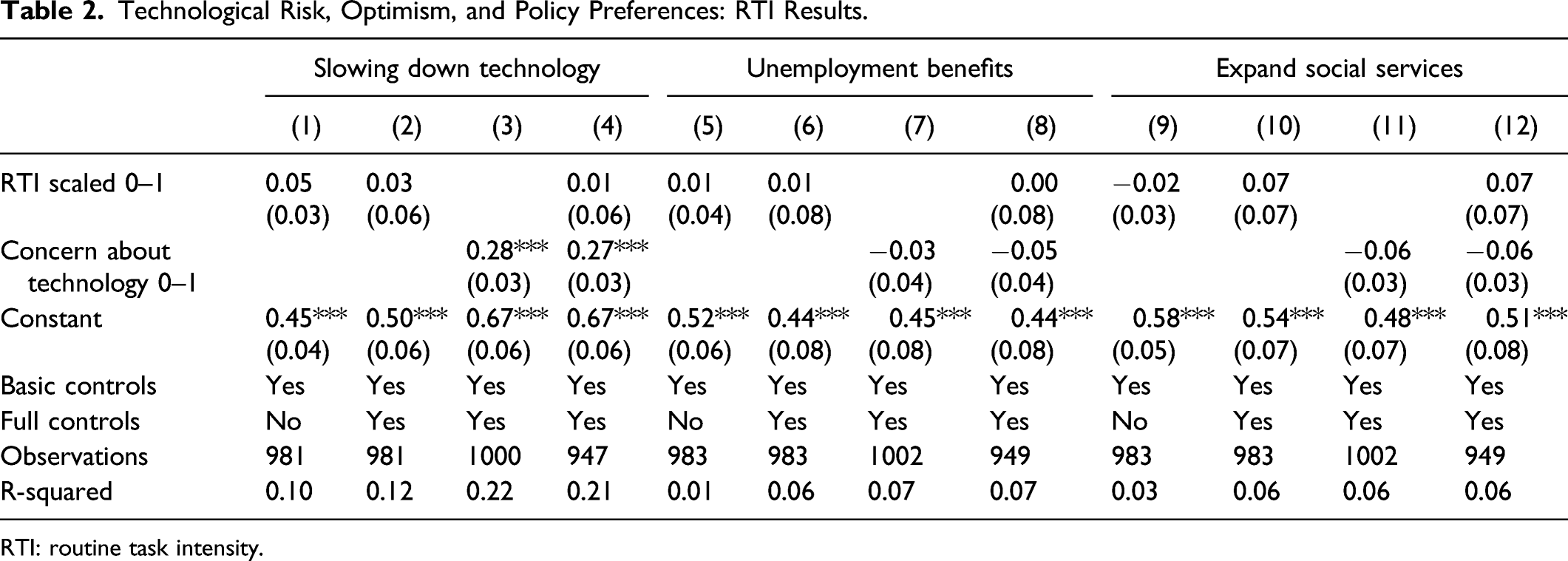
RTI: routine task intensity.
Technological Risk, Optimism, and Policy Preferences: Task-Based Automation Risk Results.
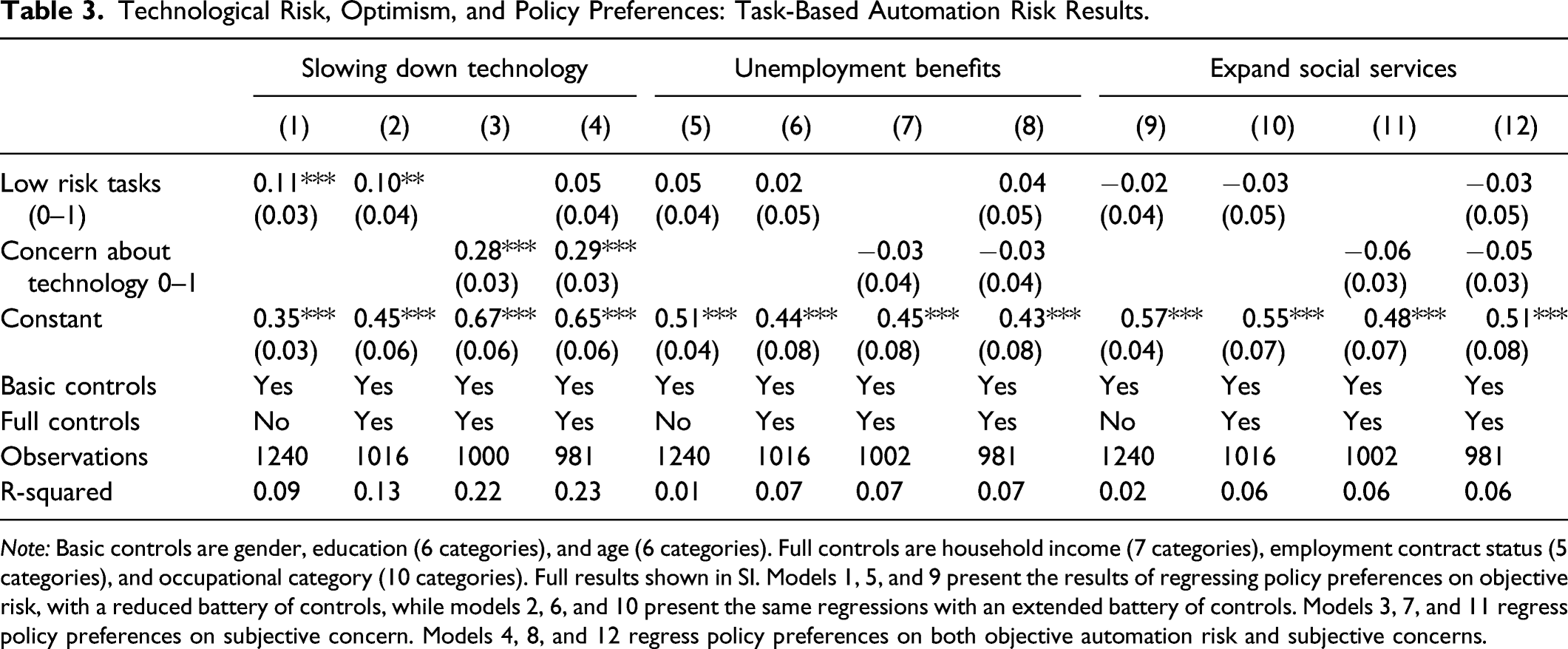
Note: Basic controls are gender, education (6 categories), and age (6 categories). Full controls are household income (7 categories), employment contract status (5 categories), and occupational category (10 categories). Full results shown in SI. Models 1, 5, and 9 present the results of regressing policy preferences on objective risk, with a reduced battery of controls, while models 2, 6, and 10 present the same regressions with an extended battery of controls. Models 3, 7, and 11 regress policy preferences on subjective concern. Models 4, 8, and 12 regress policy preferences on both objective automation risk and subjective concerns.
In Table 2, the measure of objective risk is RTI. Quite simply, the table shows that RTI is uncorrelated with support for any policy. 25 By contrast, Table 3 suggests that the risk measure based on tasks (TLRA) is correlated with support for the policy of slowing down technological change. It is difficult at this stage to establish why the task-based measure of risk is correlated with both subjective concern and support for slowing down technological change, while RTI is not correlated, but we suspect that the task-based measure is more precise and it is superior to RTI at capturing objective risk.
Across all specifications, our measure of technological concern is strongly positively correlated with support for slowing down the pace of technological change; the coefficient’s magnitude is large, as moving from minimum to maximum technological concern increases support by a large 28 percentage points (this coefficient is precisely estimated at conventional levels across all models). This coefficient is larger than those for objective risk measures, consistent with the claim that negative technological concerns increases demand for slowing down the pace of change. For this measure, we find strong support for hypothesis 3b.
Overall, the results show a consistent and sensible correlation between technological concern and opposition to slowing down technological adoption in the workplace. TLRA does not correlate with preferences over technological slowdown once technological concern is accounted for. 26 Further, any direct effect of the TLRA measure is much smaller than that of technological concern itself, suggesting that subjective concern plays an important role in understanding preferences for protectionist policies independently of objective risks. By contrast, we do not find support for hypotheses 2a and 3a regarding social-policy compensation. Table 3 shows that the TLRA measure is not correlated with support for either type of redistribution policy.
We conclude from these results that once subjective concerns are accounted for, the role of objective automation risk variables, even as measured by the possibly more accurate TLRA measure, are minimal in explaining these two categories of policy preferences. Our evidence also indicates that subjective negative views about technology are correlated with support for policies to slow down workplace technological change, but not with demand for redistribution. Subjective concern seems to affect policy views independently of the objective risk indicators. In the conclusion, we discuss possible reasons for these findings. 27 Thus we find overall mixed support for H4, in that occupation-based risk measures do not show the hypothesized strong differential relationship regarding technological “protectionism” and redistribution, but subjective concern does.
Priming Concerns and Policy Preferences
Thus far, we have established that individuals on average are largely positively disposed toward technological change, but that concern is increasing in automation risk (confirming H1). We find limited support for hypotheses 2a and 2b about the correlation between objective risk and policy preferences. The results suggest that subjective technological concern correlates with support for policies to slow down technological adoption in the workplace (H3b), although this does not extend to support for redistribution as compensation (H3a). In this section, we provide a separate, more rigorous test with the goal of assessing if subjective technological views have a plausibly causal effect on policy preferences.
As noted, our design included a priming experiment that makes the occupational consequences of technological change salient to a random subsample of respondents. To avoid demand effects, the priming treatment entailed asking three non-directional questions that made respondents think about both the positive and negative consequences of technological change in the workplace. We compare the preferences of individuals primed with technology to the preferences of individuals either not primed or primed about other workplace concerns (related to international trade and a placebo group).
We are particularly interested in the changes in policy views among the minority of people who are worried, or negatively primed, about the implications of technological change, but we first conduct a baseline test for any average priming effect on policy preferences. Figure 1 shows the coefficients (and confidence intervals) of OLS models that regress preferences for the three policies described above on treatment assignment. The coefficients of the control group are normalized at 0 (represented by the vertical gray line in the graph) and the other coefficients show the effect of being treated by each priming statement on political attitudes compared to the control group. Average effect of priming treatments and policy support. Note: The graphs present the marginal effects of being in each of the three groups primed with different sources of change in the workplace (technology, trade, or the reduction of species), compared to the control group. The policy preferences are support for policies to slow down technological change in the workplace; increasing spending on unemployment benefits; and expanding social services.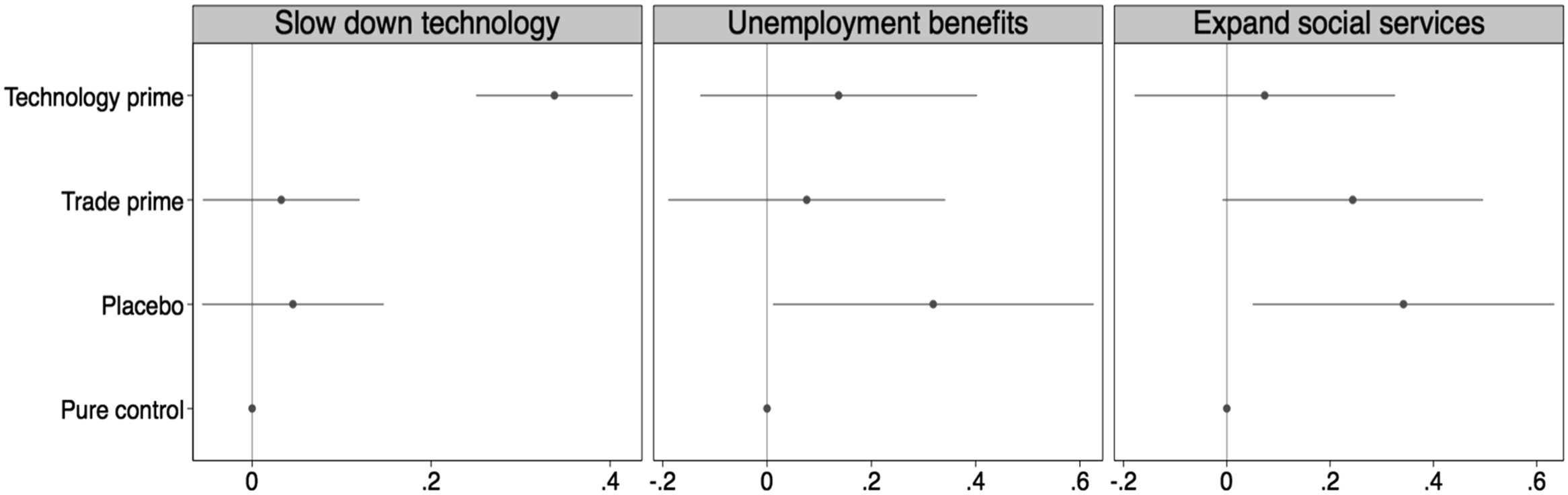
The figure shows that individuals who received the technology priming treatment tend to be more supportive of government actions to decrease the pace of workplace technological change compared to the control group (which, as discussed above, is on average less opposed to such policies). Regarding government redistribution through unemployment assistance or expansion of general social services (at the cost of increasing taxes), the figure shows that the technology prime does not greatly affect support for redistribution, measured specifically or generally. 28
Our deliberate non-directional prime should have heterogeneous effects on demand for policies depending on whether individuals are optimistic or pessimistic about the effect of technological change on their job prospects. When they are primed, people who are pessimistic about this impact should be more likely to demand either protectionist or compensatory policies than people who have more optimistic beliefs. A feature of our design is that we only measure perceptions among individuals in the technology prime. To assess if priming concerns about technological change causes different policy demands among people who have underlying optimistic or pessimistic beliefs about technology, we require a measure of the underlying propensity of all individuals to be optimistic or pessimistic, regardless of their actual assignment to the priming treatment or the control groups.
To achieve this, we use a machine learning approach to predict subjective concerns about technology for all respondents. The absence of data in the non-treated groups can be viewed as a prediction problem. We select variables that we expect to correlate with subjective perceptions about the impact of technology, including all socio-economic and socio-demographic variables, and political ideology. We then divide the data for people in the technology prime, for whom we measured subjective concern, into a training and a test set, and fit a series of random forest algorithms in the training set to predict subjective perceptions based on all variables included in the model. The out-of-sample prediction capacity of the resulting algorithms or models is tested in test data separated from the primed subsample (for whom actual responses are observed). Then, we compare the accuracy of predictions in the test set against the actual responses to the survey question. To achieve stable solutions, the calculations are performed 30 times and the results are averaged. 29
Predicting the propensity of individuals to be concerned or not about technology is a sensible way to recover underlying attitudes in a priming experiment in which such attitudes are, by design, only measured in the subsample assigned to receiving a prime. Our use of a machine learning approach to generate such predictions offers two advantages over alternatives such as fitting a linear model to impute data based on responses in the treatment group. First, a data-driven approach to model responses does not impose strong assumptions on the data such as functional forms. Second, and more importantly, the division of the primed sample into a training and a test set reduces concerns about choosing a model that overfits the data. Choosing the model that maximizes out-of-sample prediction allows us to be more confident that the correlations between subjective concern and the variables used to feed the model are not idiosyncratic to the sample of respondents who was randomly assigned to receive the prime. Because in the final step we use predicted subjective concern for all respondents (i.e., those who were primed with technological concern and those who were not), the underlying propensity to be concerned should be estimated with a similar degree of accuracy for both treated and untreated groups.
Figure 2 shows results of these estimations, where we compare the predicted subjective concern about technology of respondents primed to think about technology (positively or negatively) to such predicted concern in the control group.
30
The vertical axis for each graph is the difference in the dependent variable of interest between the treatment and the control group, that is, the treatment effect. The horizontal axis displays the value of our key moderator, that is, predicted technological pessimism (individuals with high values of the moderator are more concerned). The leftmost panels show the causal impact of priming technology on demand for policies related to technological deceleration, depending on whether individuals have a propensity to be positively or negatively primed. The other two panels show the causal effect of priming technology concerns on redistribution preferences. Effect of the technology prime on political preferences. Note: The graphs present the marginal effects of being exposed to the technology prime (compared to the control group) on different preferences. The moderator is the predicted value of subjective concern about the impact of technology on the job prospects of the respondent, calculated through a machine learning prediction.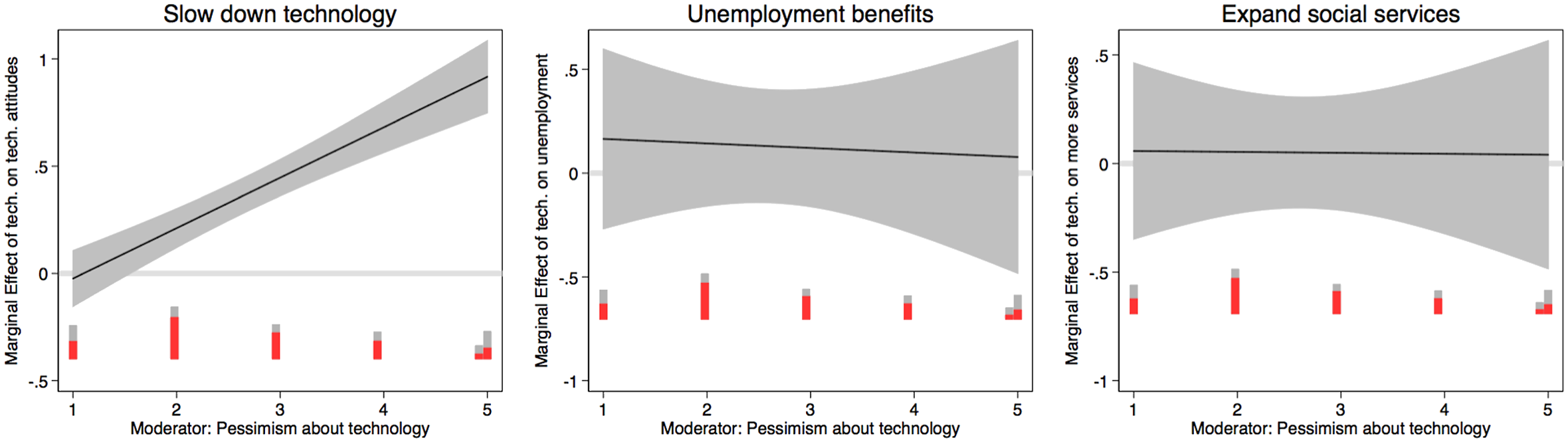
The results suggest that priming the effects of technology generates demand to slow down technology among individuals with negative underlying attitudes (that is, with a high predicted propensity to be pessimistic about technology), but it does not generate more demand for redistribution. These findings closely mirror the observational results. The left panel shows that individuals who are predicted by our model to have negative views about the effect of technology on their own job prospects become more likely to support slowing down technological change when they are primed to think about such change. We do not observe any effect of the prime among those who are predicted to have optimistic views about it. We also do not find strong evidence that priming technology views affects support for redistribution policies. As the plots show, there is no effect of making such concerns salient on support for increased social services and unemployment transfers than the control group.
Overall, these results reinforce the observational evidence from the previous section that concerns about technological substitution are correlated in expected directions with preferences for slowing down technological change, but not support for social policies. This indicates support for the idea that those who view themselves as more e technologically vulnerable are more interested in stopping change as opposed to seeking compensation, again providing partial confirmation of H4.
Summary and Conclusions
While there is much concern among economists that automation is a key cause of change in the occupational structure and of rising income inequality, and there is increasing evidence that automation is a predominant priority among many large companies, a cross-country analysis indeed confirms that this phenomenon remains a marginal issue at elections (König & Wenzelburger, 2019). Perhaps as a consequence of this lack of public discussion, research on workers’ concerns about automation and related policy preferences remains scarce.
Our study provides one of the few assessments of the relationship between vulnerability to automation, subjective concerns, and policy preferences. We find that workers are on average optimistic about the impact of technological change and automation in the workplace. Only a minority of workers is concerned with workplace technological change and a very small minority wishes to stop such change. Our hypothesis tests overall indicate limited support for popularly used objective risks of automation as substantively important predictors of the theoretically related outcomes of subjective concerns and corresponding policy preferences. Regarding our first hypothesis between objective technological risk and subjective concern, using two key occupational-based measures of objective risk in our survey, we find that a common task-based measure (what we term TLRA) is correlated with subjective concern, though the magnitude is not especially large. By contrast, the most frequently used RTI measure is not correlated with concern.
Turning to automation risks and policy demands (hypothesis 2), we find that objective risks do not correlate strongly with policy demands to slow down change or with redistribution. Regarding the posited relationship between subjective concern and policies (hypothesis 3), however, subjective concern or pessimism about workplace technology is associated with demand for policies to slow down technological adoption, but there is not strong evidence from either the experimental or observational data that technological concerns strongly affect support for redistribution. By extension, then, we find partial support for hypothesis 4, which posited that stopping technology would be more correlated with our risk measures than redistribution—although this was only true for subjective concern, and further, there is no evidence that such concern mediates any relationship between objective risks and policy preferences.
We focus on two questions that are results suggest. First, additional research might consider both alternative arguments for subjective concern about automation, and mechanisms that link objective risks to such concern. While current literature either conflates the two concepts or does not account for the role of concern, and we find a sensible correlation between occupation-task risks (as opposed to RTI) and such concern, further exploration of potential causes is warranted. If such concern is caused by other factors than occupational risk, then policies to address such risk could be insufficient in easing automation or technological anxiety. Related, if there is some overlap in automation and openness concerns, then worries about globalization may dominate given the salience of out-groups associated with this risk. 31
Second, we speculate why we do not find posited relationships regarding support for redistribution; there are many plausible explanations which future work should disentangle. The relative absence of political entrepreneurs who make the connection between automation and the need for compensatory or activation policies may be part of the explanation why workers at risk do not demand different policies. In addition, we suggest that the type of workers doing routine tasks or tasks at high risk of automation may be averse to change and prefer keeping the status quo rather than being forced to adapt to change. Further, support for redistribution in response to automation risk could vary due to country-specific labor-market regulations and existing redistribution policies. In the Spanish context, while there is strong support for inequality reduction generally, there is evidence that individuals vary in how much they benefit from various government redistribution programs or whether individuals perceive that due to related tax increases, that they would be less likely to be net beneficiaries (Fernández-Albertos & Manzano, 2016). As many workers in at-risk jobs are in the middle of the income distribution, tax aversion may play a role in skepticism of redistribution. The particular conditions of automation risks mattering may depend on the institutional features of the existing welfare state and the degree to which such risks are already addressed by existing policies (Dauth et al., 2021; Gingrich & Ansell, 2012). Finally, it may be more fruitful to examine redistribution preferences along different dimensions, especially regarding specific social-investment policies that also can have more long-term preventive job-disruption effects and broader appeal (e.g., Garritzmann et al., 2018; Hemerijck, 2012).
However, the fact that subjective concern as well is not strongly correlated with redistribution merits further attention. The finding that workers concerned about automation threats do not necessarily prefer more compensation for potential losses, but more aggressive policies to prevent change in the first place, has relevant policy implications and should be further investigated. Workers might prefer to maintain the status quo, even if at the expense of lower economic growth, instead of redistribution. Policy packages addressed to preserving the status quo or even going back to an idealized part are arguably favored by more populist parties (Colantone & Stanig, 2018). While such policies would reduce economic growth, they may be desirable for individuals concerned about their capacity to adapt to rapid change. Even though anti-technological movements are rare, if technological change accelerates and enough individuals become concerned about such change, it is possible that associated policy demands emerge in the future.
Supplemental Material
sj-pdf-1-cps-10.1177_00104140211024290 – Supplemental Material for Technological Risk and Policy Preferences
Supplemental Material, sj-pdf-1-cps-10.1177_00104140211024290 for Technological Risk and Policy Preferences by Aina Gallego, Alexander Kuo, Dulce Manzano and José Fernández-Albertos in Comparative Political Studies
Footnotes
Acknowledgments
We thank Henning Finseraas, Timothy Hicks, Thomas Kurer, Linna Martén, Sarah Sokhey, Erica Owen, and Laura Lungu for helpful comments on previous versions. Participants at seminars held at the University of Barcelona, Uppsala University, UNU-MERIT, the Nordic Workshop on Political Behavior at the University of Gothebörg, WESSI conference at NYU-Abu Dhabi, the annual meetings of the American Political Science Association, European Political Science Association, Midwest Political Science Association, and Council for European Studies all provided useful feedback. We thank Noel Johnston and Erica Owen for sharing data and Alba Huidobro, Javier Beltrán, and Giorgio Farace for excellent research assistance. Three anonymous referees and the editors provided extremely helpful comments. We thank the NORFACE Joint Research Programme, project file number 462.19.336.
Declaration of Conflicting Interests
The authors declared no potential conflicts of interest with respect to the research, authorship, and/or publication of this article.
Funding
The authors disclosed receipt of the following financial support for the research, authorship, and/or publication of this article: This research was made possible by funding from the Spanish Economic Ministry, State Program of Research, Development and Innovation Oriented to the Challenges Society, grants numbers CSO2013-48451-R and CSO2017-87597-R.

Notes
Author Biographies
References
Supplementary Material
Please find the following supplemental material available below.
For Open Access articles published under a Creative Commons License, all supplemental material carries the same license as the article it is associated with.
For non-Open Access articles published, all supplemental material carries a non-exclusive license, and permission requests for re-use of supplemental material or any part of supplemental material shall be sent directly to the copyright owner as specified in the copyright notice associated with the article.
