




Abstract
When do radical parties gain support? Previous studies cite the economy and mainstream party ideological convergence as important. Responding to earlier inconsistent findings, I provide evidence for an interactive approach. Anti-system parties succeed when mainstream parties are simultaneously presiding over an ailing economy and failing to provide the diversity of political opinion for the electorate to meaningfully challenge the policies associated with this malaise, through which dissatisfaction with the status quo could otherwise be channeled. Two studies support this “crisis and convergence” model. At the aggregate-level, the anti-system vote is strongest during times of negative economic growth and widespread mainstream party ideological de-polarization. At the voter-level, the link between negative economic evaluations and radical party voting is stronger during establishment convergence and, vice versa, personal perceptions of convergence are themselves more closely related to support for these parties when the macroeconomy is sickly. Mainstream party homogeneity radicalizes the economic vote and strengthens anti-system challengers.
Introduction
In recent decades the once high institutionalized party systems of the West have begun to unravel. Relative to their mid-twentieth century predecessors, contemporary voters are less likely to identify with a single political party (Dalton & Wattenberg, 2000; Dassonneville et al., 2012; Fieldhouse et al., 2020, pp. 51–55; Mair, 2013, p. 35), more likely to switch between parties at successive elections (Bischoff, 2013; Drummond, 2006; Fieldhouse et al., 2020, pp. 9–14; Mair, 2013, p. 33), and more prone to negative evaluations of government as a whole (Armingeon & Guthmann, 2014; Catterberg & Moreno, 2006; OECD, 2017).
Who has benefited from these patterns of distrust and dealignment? The exact answer varies from country-to-country. From populist mavericks in Italy, to the nativists of northern Europe, from secessionists in Scotland and Belgium, to the resurgence of the radical left in southern Europe, from Eurosceptic challengers in the United Kingdom, to the insurgent Icelandic Pirate Party. Recent elections have been punctuated by the successes of a heterogenous mix of “anti-system parties” who stand outside the governing establishment, and fundamentally challenge the legitimacy of the dominant norms, values, practices, actors, or boundaries of their political community (Zulianello, 2018). While the specific ideology or character of these parties might differ, nearly every advanced Western parliamentary democracy has witnessed the rise of some form of radical political entrepreneur exploiting the growing coolness toward the establishment in the past few decades.
What determines the popularity of such parties? Most previous studies have two notable limitations. First, they tend to only focus on one particular ideological party family or another. In particular, there is an overwhelming publication bias toward the so-called “radical right” (Mudde, 2016, p. 2). This does not reflect the true range of alternatives available for voters looking to express their disillusionment with the establishment (Abedi, 2002, p. 557). Second, and more importantly, there is a tendency to focus on demand- and supply-side factors as separate phenomena (Golder, 2016, pp. 490–491). The former are the grievances that stimulate desire for radical shifts in policy or modes of representation, the latter are the political opportunity structures that determine whether these latent sentiments actually coalesce around a viable anti-system party, get co-opted by a pre-existing party, or simply go unrepresented (Eatwell, 2003). Looking at either of these factors in isolation is problematic.
For example, a demand-side grievance that is often linked to the spread of political radicalism is a weak economy. Recessions are likely to be associated with many unpleasant experiences for the electorate, most notably mass unemployment and declining real incomes (Hurd & Rohwedder, 2010; Singer, 2018). These problems may have the potential to undermine the legitimacy of the established constitutional order in the eyes of more output-oriented citizens (Przeworski et al., 1996). Conversely, increasing prosperity mitigates against defection to untested outsiders by raising the opportunity-costs of political uncertainty (Brückner & Grüner, 2010, pp. 2–3).
However, it is somewhat unclear why downturns should produce mass defection to radical anti-system challengers, rather than the simple rotation between mainstream incumbent and opposition parties described in conventional models of economic voting (Duch & Stevenson, 2008, p. 50; Key, 1966; Kramer, 1971; Lewis-Beck & Stegmaier, 2000; Whitten & Palmer, 1999). In severe recessions, parties without a prior history in government or the constraining likelihood of actually having to carry out their promises can more credibly claim non-responsibility for current hardships and be more radical in proposing resolutions (Hobolt & Tilley, 2016, pp. 972–974). However, it seems equally plausible that, given the gravity of the situation, risk-averse voters simply re-elect established parties with substantial governing experience, rather than leap into the unknown. Research linking radical party fortunes to fluctuations in the macroeconomy has yielded mixed results. While some studies find a positive association (Arzheimer, 2009; Brückner & Grüner, 2010; Hobolt & Tilley, 2016; March & Rommerskirchen, 2015; van der Brug et al., 2005), many others uncover null or even negative findings (Abedi, 2002; Arzheimer & Carter, 2006; Knigge, 1998; Lubbers et al., 2002; Spies & Franzmann, 2011).
These inconsistencies suggest the influence of supply-side factors, and the role of the political opportunity structure in denying anti-system candidates the opportunity to exploit latent anti-establishment sentiment. An obvious example is mainstream party behavior. Radical parties may find it easier to mobilize their support when the mainstream parties have become more similar ideologically. The classic statement comes from Downs (1957). When established parties of the left and right converge on the median voter, who is usually assumed to be a centrist, they create a vacuum of unrepresented political preferences that can be usurped by parties positioned at the extremes (Hainsworth, 1992, p. 11). However, the evidence that mainstream party de-polarization facilitates anti-establishment breakthroughs is, once again, inconclusive. Some demonstrate a positive association (Abedi, 2002; Carter, 2005; Hino, 2012; Kitschelt & McGann, 1995; Spies & Franzmann, 2011; Spoon & Klüver, 2019) others do not (Arzheimer & Carter, 2006; Bustikova, 2014; Ignazi, 2003; Lubbers et al., 2002; Norris, 2005).
Contradictory findings for both variables could suggest a degree of contingency surrounding the relationship between the economy, mainstream party positions, and the rise of anti-system challengers; however, so far, this link has not been clearly identified. This article addresses these constraints. Support for anti-system candidates is a response to an underperforming and irresponsive political system characterized by an ailing economy and the absence of the diversity of political opinion needed for the electorate to meaningfully challenge the policies associated with this malaise. If a downturn occurs in a polarized party system, dissatisfaction with incumbent policy paradigms could be channeled through a mainstream opposition party rather than boosting an outsider. If de-polarization occurs against a backdrop of vigorous economic growth, there will probably be less desire to punish mainstream parties for reaching a consensus on a “winning formula” for raising living standards. This interaction of demand and supply must be appreciated in order to fully distinguish the conventional economic vote (rotation between established mainstream alternatives) from the widespread “fleeing of the centre” (Hobolt & Tilley, 2016) witnessed in the aftermath of the recent economic and financial crises.
I test this “crisis and convergence” model in two different studies. The first models the aggregate anti-system vote in 393 elections in 22 advanced parliamentary democracies in the post-Second World War era. The second analyses the behavior of individual voters interviewed in four waves of national election surveys overseen by the Comparative Study of Electoral Systems project between 1996 and 2016 using multilevel regression. At the aggregate-level, the relationship between low and negative growth in per capita gross domestic product [GDP] and the anti-system vote share is much stronger where mainstream parties have converged ideologically (measured using manifesto data). At the individual-level, those who view mainstream parties as more similar are more likely to vote for an anti-system alternative when the national economy is doing badly. It does not matter whether one measures macroeconomic health or mainstream convergence objectively or subjectively: the pattern and link to anti-system support is the same.
The two studies are complementary. The first highlights the broad applicability of my theory. The proposed relationship is not restricted to a specific time-period, sequence of events, or select few countries. The second provides supporting evidence for the robustness of its assumptions by scrutinizing the individual-level motivations assumed to be driving the relationship. I find strong evidence for the plausibility of the “crisis and convergence” hypothesis, and conclude with a discussion of its normative implications more generally. First, however, I give a brief discussion of what I mean by “anti-system party” and spell out the assumptions of my theory in greater detail.
What are “Anti-System Parties”?
I operationalize detachment from the political mainstream using Zulianello’s (2018) typological revision of Sartori’s (1976) “anti-system party”. Zulianello has two independent criteria for “anti-systemness”: “ideological radicalness” and a lack of “systemtic integration.” That is, seeking changes to the dominant norms, values, practices, and selection criteria for government, rather than merely a change in that government per se (Sartori, 1976, pp. 132–133), and never having undertaken visible cooperative interactions with mainstream parties.
This definition is a combination of what parties believe and how they behave. Both properties are important for allowing a party to profit from economic malaise and mainstream convergence. Tangible opposition to widely-held political norms creates an anti-establishment aura about a party, allowing it to reap the benefit of a disillusioned public. The absence of government participation boosts the ability of parties to credibly offer these appeals and present themselves as agents of change (Barr, 2009, p. 44), while also emphasising “the degree to which a party has (non-)responsibility for (negative) political outcomes for which they can be held to account” (Hobolt & Tilley, 2016, p. 974). In contrast, mainstream parties are ideologically “pro-system”—they have conventional anti-incumbent and policy-oriented ideological profiles—and demonstrate systemic integration.
I coded “systemic integration” as participation in national government, or making a pre-electoral pact or confidence-and-supply bargain at the national level with any mainstream party. “Ideological radicalness” was identified using discussions in the secondary literature following the work of Abedi (2002, p. 576) and Powell (1986, pp. 361–363) 1 . “Anti-system parties” are, therefore, both the classic mid-century Communist and neo-fascist examples, as well all unintegrated parties that are also secessionists (e.g., the Scottish National Party, Sinn Fein, Basque nationalists etc.), populists, (e.g., the French National Front, Italian Five Star Movement or Spain’s Podemos), religious fundamentalists (the Dutch Reformed Political Party), or else fundamentally question the conventional institutions and procedures of their respective representative democracies (e.g., certain “Pirate” or more radical “Green” which promote direct- or ‘e’-democracy respectively) .
Given that a party might have one of these criteria but not both (as with fully mainstream parties), there are two other types of party. Those that lack systemic integration but are not ideologically radical are “complementary parties.” These may also be able to exploit anti-incumbency sentiment due to their obvious lack of culpability (past or present) for government outcomes, but their ability to do this may be undermined by a lack of any fundamental critique of dominant norms, values, and practices of their political system. In contrast, “half-way house” parties are indeed ideologically radical, but have entered government on occasion. The rhetoric and policies of these parties offers vociferously opposition to aspects of the status quo, but they are still willing to cooperate with other mainstream parties, meaning that they do not pose the threats to cabinet formation or government stability that true anti-system parties do. They may also be seen as equally culpable for any unfavorable political outcomes produced. Conflating either with fully mainstream or anti-system parties either artificially inflates the amount of ideologically diversity among traditionally governing parties or underestimates the degree to which “outsider” radical parties might benefit in response to bad government performance. 2 Accordingly, party convergence is only measured using the positions of fully mainstream parties, and support for anti-system parties likewise excludes those described as “complementary” or “halfway-house.” Figure 1 summarizes this four-category typology.
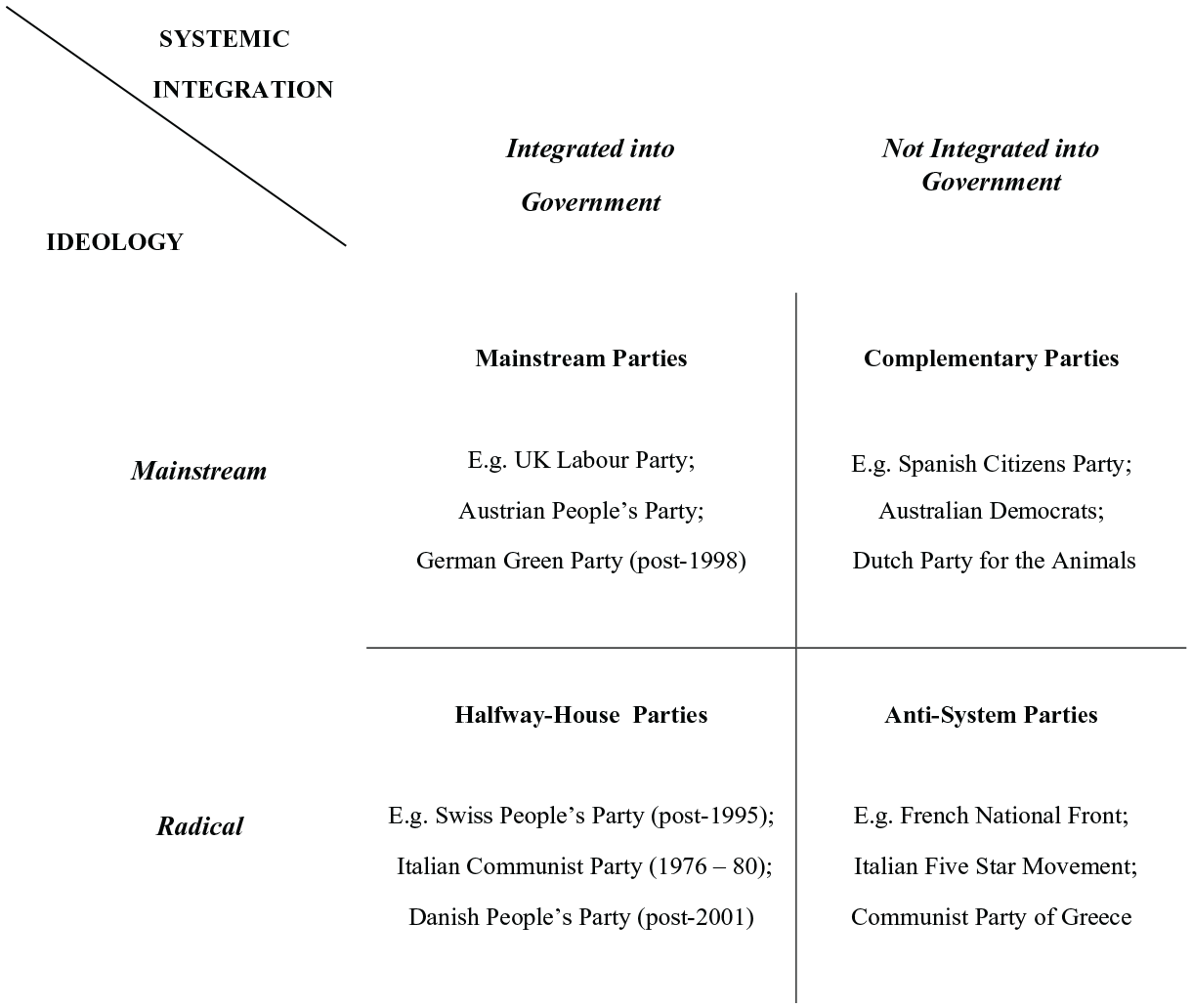
Anti-system party typology.
Figure 2 plots the vote share for the latter in 393 general elections in advanced Western parliamentary democracies, 1950 to 2016. 3 Election results were primarily sourced from Dieter Nohlen’s compendiums for North America (2005), Europe (Nohlen and Stöver 2010), and Asia and the Pacific (Nohlen et al., 2001), with official national parliament websites consulted for more recent elections. Results refer to the percentage gained of all votes cast in first-round elections in the decisive electoral tier. The first few elections following an authoritarian interlude were omitted to better distinguish the reformation of older “mainstream” parties after the restoration of democracy from genuinely “new” parties. 4
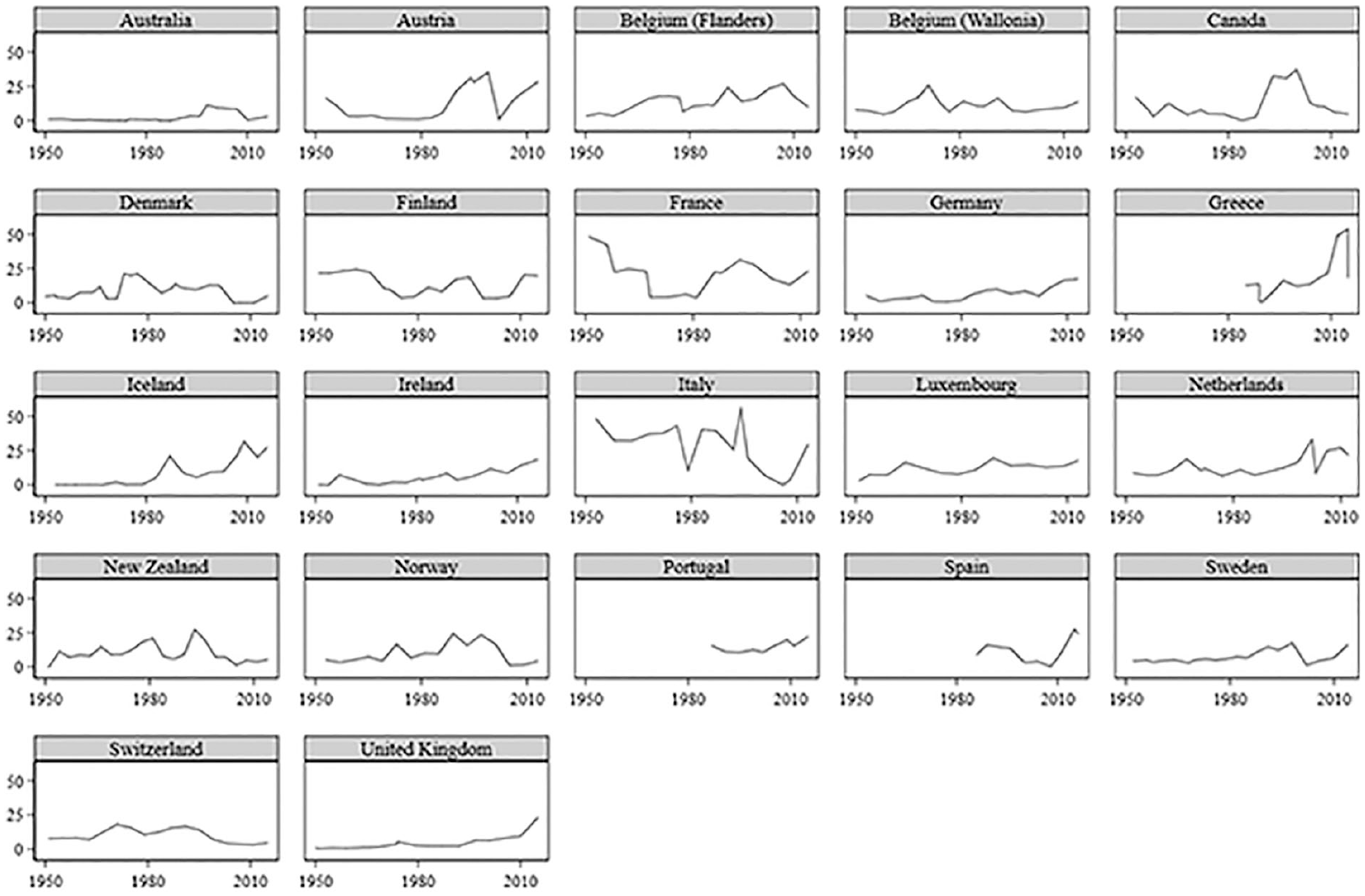
Vote shares (%) for anti-system parties in 22 advanced democracies, 1950 to 2016.
While a few countries have a long-standing anti-system party presence, their current popularity in many other national political systems is historically unprecedented. Combined anti-system party vote shares of greater than 10% (and occasionally 20%) have become the norm rather than the exception in several countries. However, significant variation remains even when taking this broad view of “anti-systemness.” How can we explain this?
When are Anti-System Parties Successful? The Crisis and Convergence Model
I argue that the combination of economic hardship and the de-polarization of mainstream parties has an effect on anti-system support that is greater than the sum of its parts. My case for an interactive effect rests on two premises.
The first is that, by undermining close emotional attachments between voters and their parties, ideological convergence makes incumbent parties more likely to be held accountable for any economic downturns that occur under their watch. In this sense, party convergence magnifies the effect of the economy. The second assumption, and the one which makes voters more likely to defect specifically to anti-system parties, is that a reduction in the quality of the “output” provided by a government, makes voters reconsider the “inputs” that have caused this malformed product. Where no mainstream party is offering convincingly different policies to those which are believed to have caused (or at least failed to alleviate) the current crisis, a door is opened for anti-system parties to capitalize by presenting themselves as the only party offering fresh solutions to the problem. In this sense, the economy magnifies the effect of party convergence.
These patterns are evident in the political experience of Latin America. To summarize very briefly, the 1980s were a time of severe economic turmoil for virtually all of the continent’s democracies. A global recession led to a spike in interest rates for the credit that had fueled industrialization programs in the region, as well as a decline in demand for the primary sector exports which local economies depended on to pay back these loans (Sims & Romero, 2013). An agreement on debt restructuring was struck with the International Monetary Fund, however, this was contingent upon substantial reforms designed to increase economic competitiveness and reduce the possibility of the crisis recurring. In practice, this meant cuts to infrastructure, consumer subsidies, and social expenditure programs, the elimination of export duties and import tariffs and the freezing of public sector wages, combined with layoffs in many cases (Agarwal & Sengupta, 1999; Carrasco, 1999).
Importantly, while a number of established parties in the region collapsed during or immediately after this period of economic reform (for example, in Venezuela, Bolivia, and Argentina), many others survived (e.g., in Uruguay, Chile, and Brazil). A key explanation for this variation, according to several regional experts (Lupu, 2016; Morgan, 2011; Roberts, 2013; Seawright, 2012; Stokes, 2001), is that while in some countries these reforms were ushered in by traditionally populist or “workers” parties, in others the responsibility fell to parties of the center-right (or even military dictatorships) in the face of left-wing opposition. In the former instances of “brand dilution” (Lupu, 2016), there was a decline in partisan attachment to leading parties. However, where these reforms were more “programmatically aligned” with the long-standing ideology of the incumbent, and visibly contested by the established left, party systems suffered much less political instability (Roberts, 2013).
That said, the cause of mainstream party breakdown was not solely due to convergence between the established left and right, but also due to the moderating impact of recurring economic shocks and stagnation. Lupu states that it was the combination of brand dilution with continued poor economic performance that led to party collapse as “without the assured support of a partisan base, parties became more susceptible to voters’ short-term retrospective evaluations. Voters who now had no party attachments deserted incumbent parties when they performed poorly” (Lupu, 2016, p. 3). We are looking at a two-step process of political change. First, the implementation of policies that are inconsistent with those which supporters have come to expect depletes partisan sentiment. Support becomes more instrumental and conditional on performance than when voters felt clearer emotional connections to the party. Second, continued economic problems or an unforeseen downturn occurs, which loyal supporters may previously have excused, and the party suffers massive defections as punishment.
Lupu’s theory is corroborated by findings made by other political scientists who show that the salience of a party’s performance in office rises when ideological convergence takes place. Green and Hobolt (2008) demonstrate evidence to this effect from the United Kingdom from 1987 to 2005 (an era of convergence for the two major parties). In their words, “voters who cannot determine which party is closer to them in policy terms, because parties offer similar policies, will more likely choose between parties on the basis of which can deliver” (2008, p. 461). In turn, partisans are much more likely to view their preferred party as the most competent when the political environment is polarized (Vegetti, 2014). The lessons from Latin America can also be applied to more established Western democracies (Roberts, 2017). Karreth et al. (2013) use a very similar logic when seeking to explain the poor recent performance of social democrats in Germany, Sweden, and the UK. They argue that the gains that these parties made from right-ward (centripetal) shifts in the 1990s were short-lived, as they were premised on effectively trading the more ideological voters who strongly identified with them for more numerous, but less invested, swing-voters who were happy to defect when these parties presided over later economic downturns. Simply put, de-polarization shatters the so-called “partisan lens” through which many voters learn to view the political world and economic outcomes (Campbell et al., 1960), and voters become less inclined to find scapegoats to explain away the failings of their favored party in office.
That said, while these ideas can explain why the combination of brand dilution and poor economic performance generally might lead to an uptick in electoral volatility and swings from incumbent parties to opposition, they do not really explain why it should be anti-system parties in particular that profit. Though in the 2008-14 European financial crisis, both incumbent and mainstream opposition parties lost ground to challenges from the radical right and left (Hernández & Kriesi, 2016), this does not always happen. As Bermeo and Bartels (2014, p. 7) note, previous economic downturns such as Europe’s “Long Recession” during the 1970s were not matched by similar political upheavals. Why is this?
My argument is that this occurs when the political mainstream as a whole has converged, rather than just one or two parties (alone) moderating their rhetoric and policies. While a poor economy might normally incriminate incumbent parties and prompt a simple rotation to a mainstream alternative waiting in opposition (the “classic” economic vote), if the opposition is unlikely to implement substantively different policies, the whole mainstream establishment becomes implicated and anti-system challengers are gifted an opportunity to mobilize. Why merely defect to an opposition mainstream party if they are unlikely to meaningfully change the policies that one believes created, exacerbated, or at least did not alleviate the current crisis? To quote Jana Morgan (2011, pp. 53–54) on the collapse of Venezuela’s two-party system during the 1990s, “without programmatic differentiation between incumbent and opposition . . . all the parties are implicated in the failed status quo, and programmatic discrediting infects the entire system.”
This is the sort of environment that I predict anti-system parties will be most likely to profit in, given that their two fundamental features—relative absence of history in government, and an opposition to the shared norms, institutions and values that mainstream parties take for granted—should appeal to voters suffering from economic hardship, and frustrated by the lack of mainstream alternative avenues to alleviate these problems. Anti-system parties are, therefore, products of a crisis of legitimacy surrounding both the inputs (quality of representation and political choice) and outputs (favorable policy and macroeconomic conditions) of political systems (Hobolt, 2012; Scharpf, 1997, p. 19). Both factors are needed to understand when and where radical outsiders can succeed.
The diagrams in Figure 3 summarize this theory, and compare it to the expectations of the conventional economic voting or party convergence models (those in the tradition of Kramer (1971) and Downs (1957), respectively). The diagram shows the effect that each factor (“economic crisis” and “mainstream convergence”) is expected to have on the distribution of votes in a party system. Thick black arrows indicate large effects, or large movements of voters, thin arrows indicate small effects or small movements, dashed arrows indicate interactions between variables.
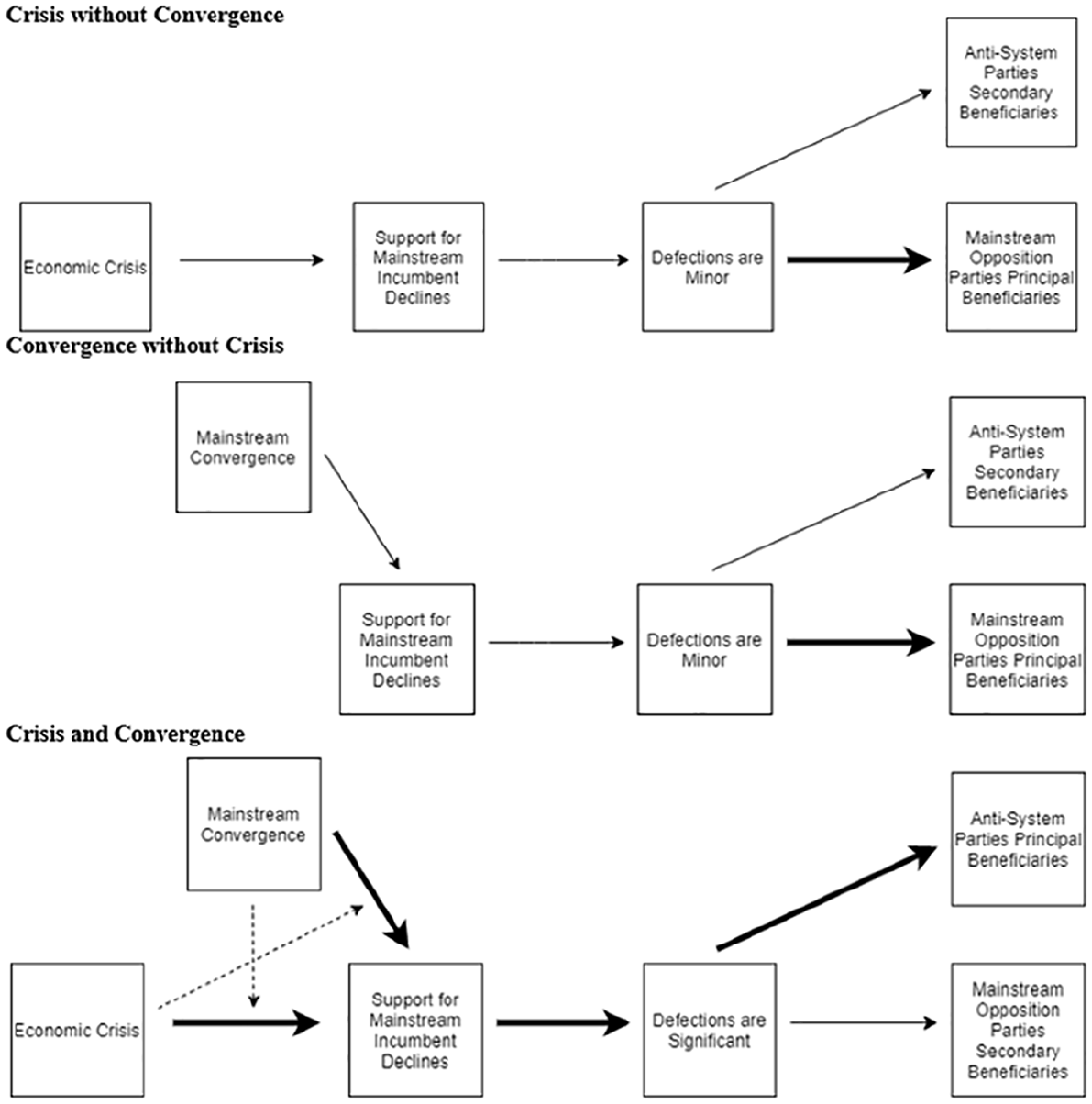
The crisis and convergence model of anti-system party success.
The first two flow charts are additive models where mainstream party convergence and an ailing economy exert separate effects. Economic crisis and mainstream convergence are expected to decrease levels of support for incumbent mainstream parties (though not by huge amounts) when they occur separately, as the desire to sanction incumbent performance and general electoral volatility increases, respectively. Without both of these factors in tandem, however, defections are expected to be relatively minor, and those defections that do occur are expected to principally benefit mainstream opposition parties. Where there is only economic hardship, simple anti-incumbent voting (which should benefit the mainstream opposition, given their name recognition and extensive governing experience relative to smaller parties) should predominate, but even this will be restricted by long-standing ties of partisanship. Where there is only convergence, volatility may rise as the “pull” that parties have on their supporters is weakened but, ceteris paribus, the “push” to an anti-system alternative will not be there.
In contrast, the bottom flow chart outlines my alternative “crisis and convergence” model. Here mainstream party convergence and an economic downturn have an interactive and mutually reinforcing effect. The desire to sanction the incumbent party is there and, as a consequence of the declining uniqueness of that party’s ideological position (Downs, 1957) or socio-political “brand” (Lupu, 2016), willingness to punish is far more widespread than in contexts of party polarization. This leads to more significant defections from the incumbent party, however, unlike in the previous models, mainstream opposition parties are not expected to be the primary beneficiaries. In fact, they will probably lose some of their own supporters to more radical challengers given that their “solutions” to the crisis will not seem credibly different to those of the incumbent. Frustration to the existing state of affairs can no longer be channeled through conventional political channels (Roberts, 2017), allowing anti-system parties, with their “clean hands” and aura of novelty, to capitalize.
For the avoidance of any doubt, Figure 4 explicitly lays out the expected observable implications of this model. I use a two-by-two table to represent my hypothesis for the distribution of votes in a party system where there is economic hardship, or ideological convergence, or both, or neither. To be clear, my main hypothesis is that anti-system parties should be most successful when there is both (meaning that they can win votes from both incumbent and opposition mainstream parties), they should be least successful when there is neither. 5 Incidents of entirely robust center parties with similar stances during an economic downturn, or rampaging anti-system parties against a backdrop of a growing economy and a polarized establishment, must be counted as a partial falsification of my hypotheses. In what follows the results of two studies designed to test this theory are reported and discussed. The results provide corroborating evidence for the validity of the “crisis and convergence” model.
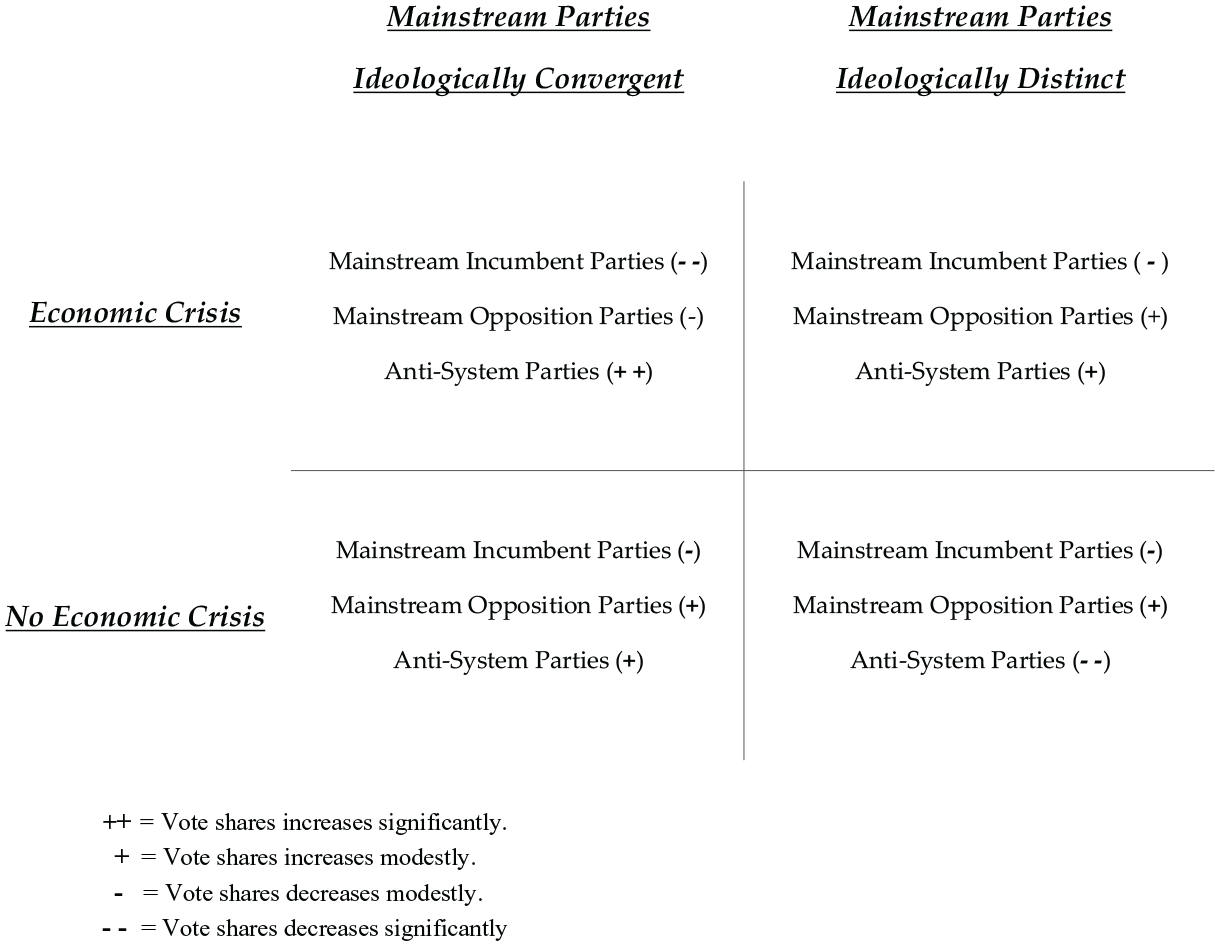
Crisis and convergence model hypotheses.
Study 1
Here I use the aforementioned dataset of aggregate anti-system party vote shares in 393 elections in 22 advanced democracies from (mainly) 1950 to the end of 2016. The dependent variable is, accordingly, combined anti-system party general election vote shares (%) in the lower house (decisive tier).
To measure “economic crisis” I use per-capita-GDP growth rate. GDP is preferable to (say) inflation or unemployment as it is easily comparable between countries and time periods, measured with considerable precision, and serves as a more holistic indicator of the state of the economy (Norpoth et al., 1991). I use growth in the year before an election as previous research shows voters act retrospectively and evaluate the economy in this period (Lewis-Beck & Stegmaier, 2000), but also to reduce concerns of reverse causality. These figures are for real GDP in constant 2011 national prices and were sourced from the Penn World Table [Version 9.1] (Feenstra et al., 2015).
Measuring mainstream party “convergence” entails controversial decisions about which parties to include, how to place them on an ideological continuum, and how to combine these individual positions into an overall index of polarization (or lack thereof). I improve on previous attempts in several ways. First, I take only the positions of mainstream parties. Including the positions of all parties within a system (e.g., Hino, 2012, p. 148) makes the measure of polarization partly endogenous to anti-system party success. Supplemental Appendix A categorizes all parties by election. Second, I apply Prosser’s (2014) validated scaling approach to identify the (L)eft-(R)ight content of party electoral programs (on a 11-point spectrum) using data from the Manifesto Project on Political Representation [MARPOR] (Volkens et al., 2019). Supplemental Appendix B further details the workings of MARPOR and lists Prosser’s “left” and “right” manifesto positions.
Thirdly, I use a modified version of Dalton’s (2008) formula for polarization. Essentially, rather than just taking the simple ideological range of mainstream parties, Dalton collects parties’ deviations from the “average” left-right position in their country, and weights those deviations by vote share before aggregating them. This method represents the whole range of mainstream parties available to voters, while still reflecting the importance of the major parties for determining potential shifts government policy. However, given that Dalton’s original formula was intended to measure polarization in the party system as a whole (rather than just between mainstream parties), it was necessary to adjust it slightly so that resultant values would be independent of the size of the overall mainstream party vote share. I did this by dividing the weighted contribution of each party to the total level of polarization by the overall sum of mainstream party votes. 6 This produces a single variable that theoretically ranges from 0 (maximum convergence) where all mainstream parties occupy the same L-R position, to 10 (maximum polarization) where two equally large mainstream parties are at opposite ends of the spectrum.
The interaction of GDP growth and the extent of mainstream party convergence is of primary interest, however, a number of variables that have been linked to both levels of party system polarization and radical party success are included as controls. Firstly, a dummy variable indicating a grand coalition government (i.e., a coalition of the largest left and right-wing mainstream party) which, though a potential cause of de-polarization, may provide a different mechanism to voter dissatisfaction (i.e., a lack of effective parliamentary opposition) rather than convergence per se. Additional controls are the electoral system’s proportionality, the degree of institutional federalism, the overall size of the party system as well as the economy, and exposure to economic globalisation. 7 They are measured, respectively, by the effective electoral threshold (Bormann & Golder, 2013), the Regional Authority Index [RAI] (Hooghe et al., 2016), the lagged effective number of electoral parties (Bormann & Golder, 2013; Laakso & Taagepera, 1979), the level of real GDP, and merchandize imports plus exports as a percentage of GDP (Feenstra et al., 2015). All of the non-institutional variables are lagged by 1 year, all variables bar the RAI were logged due to their skewed distribution. I include decade period dummies to account for any potential time-heterogeneity. For presentation purposes these variables are not displayed, but apart from party system size (positive) and overall size of the economy (negative) none have a statistically significant association with the anti-system vote. Supplemental Appendix C displays descriptive statistics for all variables in this study.
Given that election-years are not independent but clustered within countries, and certain countries (for any number of historical, geographic, or cultural reasons) might be consistently more hospitable for anti-system parties, modeling strategies should account for unobserved heterogeneity that could bias one’s standard errors. In the interests of robustness, I adopt a plural approach and use a pooled dataset with clustered standard errors (by country), fixed-effects (by country) and random-effects. The latter strategy makes most efficient use of the data but relies on the assumption that the independent variables are not correlated with underlying country-specific heterogeneity (which is also assumed consistent over time). The former approaches make no such assumptions but are less efficient. The fixed-effects model only observes “within-country” variation in the effects of my variables, whereas the random effects model considers both this and variation between different countries (Wooldridge, 2002). A Hausmann test revealed that my random-effects model is indeed a consistent estimator, however, all models display essentially the same results.
These effects are also all robust to a wide range of alternative modeling strategies or variable measurements. 8
In each model in Table 1, variables are entered sequentially: first the main products of the interaction alone, then with the interaction, then with controls, and finally with the time-period fixed-effects. 9 In all models, the coefficients demonstrate the same basic trend. The further apart that mainstream party election manifestos’ are located from each other on the left-right dimension, the weaker the performance of anti-system parties. Likewise, the more vigorous that pre-election year per-capita-GDP growth is, the lower the average anti-system vote share. Most interestingly (and importantly for my study) the effects of both factors are magnified when an interactive equation is specified. That is, the effect of negative economic growth on fueling support for anti-system parties is much greater when mainstream parties are ideologically convergent, and the impact of mainstream de-polarization is increased when the economy is doing badly. This interaction effect is strong and statistically significant in all models, regardless of controlling for potential confounding variables or time trends.
Modeling Variation in Aggregate Anti-System Party Electoral Support in 22 Advanced Parliamentary Democracies, 1950 to 2016.
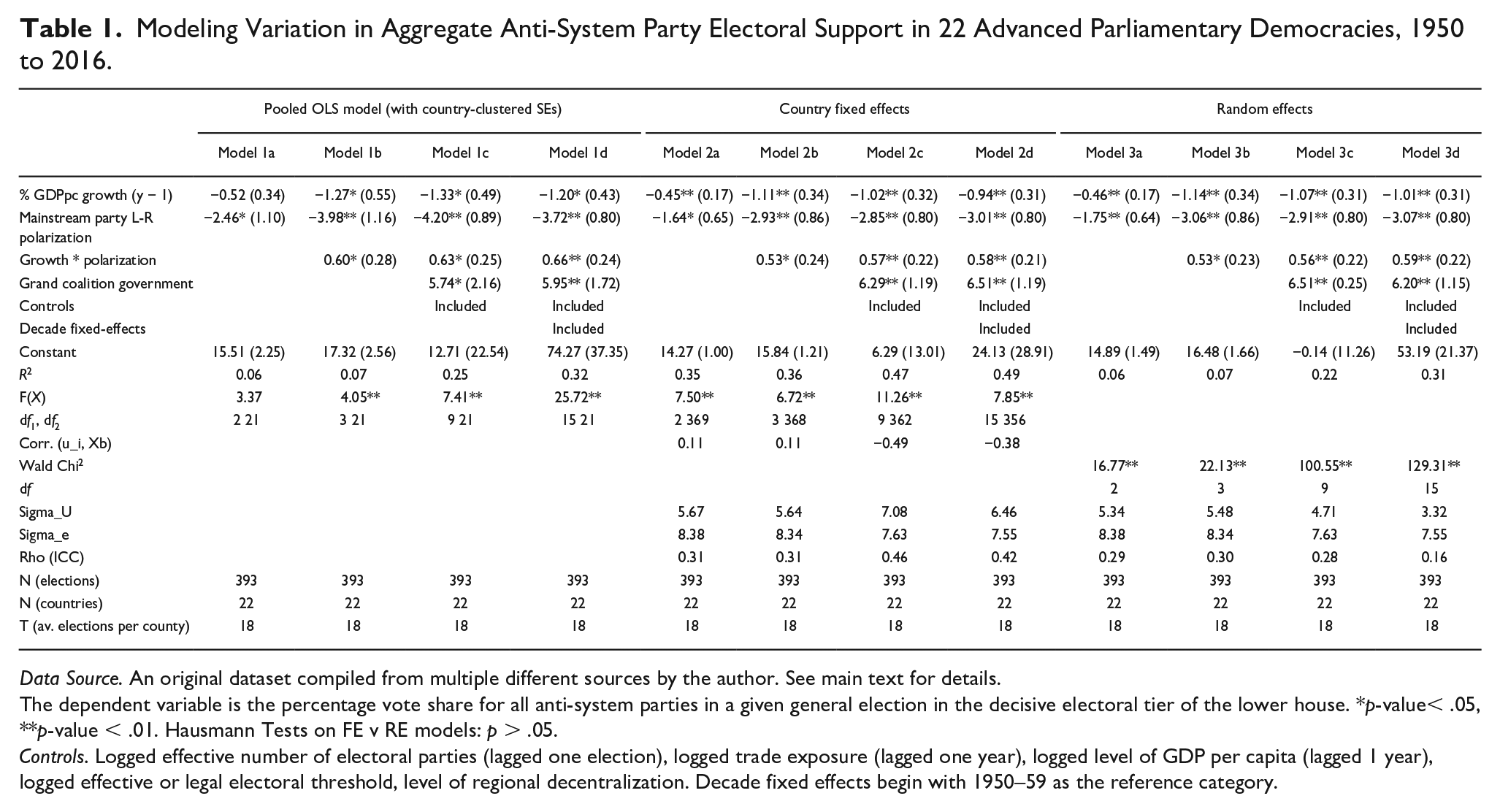
Data Source. An original dataset compiled from multiple different sources by the author. See main text for details.
The dependent variable is the percentage vote share for all anti-system parties in a given general election in the decisive electoral tier of the lower house. *p-value< .05, **p-value < .01. Hausmann Tests on FE v RE models: p > .05.
Controls. Logged effective number of electoral parties (lagged one election), logged trade exposure (lagged one year), logged level of GDP per capita (lagged 1 year), logged effective or legal electoral threshold, level of regional decentralization. Decade fixed effects begin with 1950–59 as the reference category.
How large are these effects? Figure 5 demonstrates this. Here, using the values of my pooled-OLS model with country-clustered standard errors and period fixed-effects (Model 1d), the predicted anti-system party vote is plotted for different levels of mainstream party ideological convergence and economic growth (all other variables are set at their means). The two lines indicate the predicted vote share (with the shading indicating the associated 95% confidence interval) for anti-system parties when mainstream parties are either relatively similar (one deviation below the mean level of polarization) or differentiated (one standard deviation above the mean), for different values of per capita GDP growth.
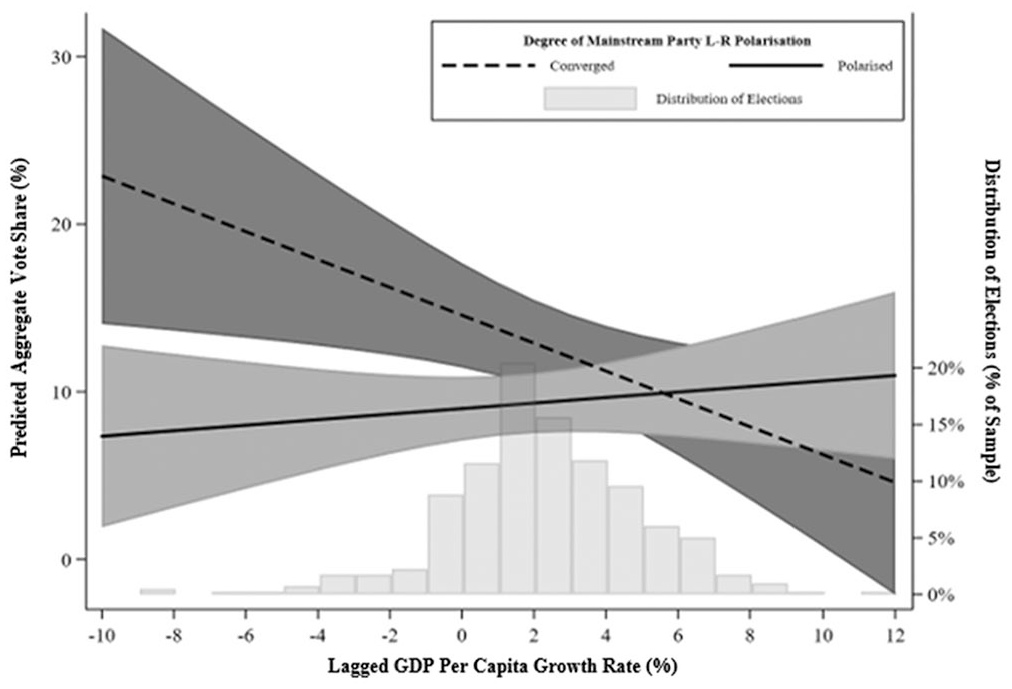
Predicted anti-system party vote share (%) by lagged economic growth rate and mainstream party polarization.
The mediating impact of mainstream convergence of the relationship between the economy and the anti-system vote is palpable. Where mainstream parties have converged, during a recession (I use –0.4% growth, as it is one standard deviation below the sample mean) anti-system candidates receive, on average, just over 14% of the vote, were they more polarized the estimated total would be about 9%. The effect of the economy increases by over 50% due to the particular political supply-side that voters face. The impact of mainstream convergence on pushing voters toward anti-system parties reduces thereafter as the economy improves. Interestingly, the association between convergence and anti-system party success essentially disappears at average levels of economic growth (the confidence intervals overlap close to the mean level of 2.3%). This may reflect the reluctance of voters to punish parties from converging on what could be credibly presented as a “winning economic strategy.” Alternatively, it may just reflect the inability of anti-system parties to effectively mobilize (regardless of supply-side factors) once a major demand-side grievance has effectively “dried up.”
This first study has clearly corroborated the “crisis and convergence” model. Compare the hypotheses presented in Figure 4 with the predicted anti-system vote shares in Figure 6 (again, taken from Table 1, Model 1d). Anti-system parties have clearly performed strongest, on average, when the economy is doing worse and the mainstream parties have converged: but especially when these two factors are simultaneously present. Aggregate-election returns in many countries over a long period of time therefore reveal a striking relationship between the macroeconomy, the political supply-side, and the anti-system vote. However, while this type of data allow us to say something about the generalisability of the theory beyond a few recent elections, it potentially obscures the individual-level motivations assumed to drive the theory. Are individual negative economic evaluations really more closely linked to radical party support political when the mainstream converges? Conversely, are individual perceptions of mainstream party convergence more reliably linked to a rejection of those parties when the economy is doing badly?
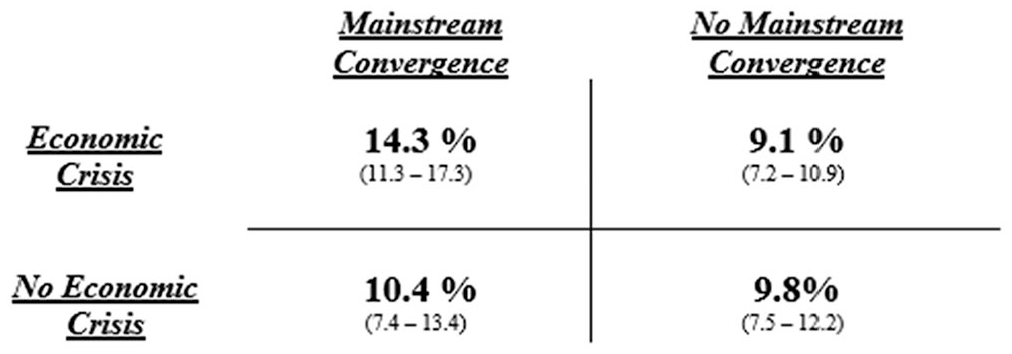
Crisis, convergence, and the predicted anti-system vote share (%).
Study 2
To answer these questions I turn to a long-running series of post-election voter surveys: the Comparative Study of Electoral Systems (CSES, 2018). CSES surveys pose identical questions about vote choice, demographic background, and variety of political and economic attitudes to representative samples of national electorates at each election that they cover. Focusing once again on advanced western parliamentary democracies, I use this data to test two assumptions of my crisis and convergence theory. Firstly, those who view mainstream parties as more similar should be particularly likely to vote for an anti-system alternative when the economy is doing badly. Secondly, those who view the national economy as performing badly should be more likely to punish the entire political mainstream by choosing an anti-system party when that cluster of parties have de-polarized.
Throughout this study, I evaluate these assumptions by attempting to predict individual vote choices using a series of multilevel multinomial logit models. These models are “multinomial” as the coefficients represent each variable’s impact on the log-odds of different types of vote choice vs a particular reference category. I divide an individual’s vote choice into six categories, based on the typology presented in Figure 1. An individual can therefore opt for an incumbent mainstream party (the reference category), an opposition mainstream party, a complementary party, a half-way house party, or an anti-system party. They can also abstain altogether. For reasons of space I only display the coefficients relating to voting for an opposition mainstream party, an anti-system party, or abstaining. I model non-voting because research has suggested that abstainers tend toward lower levels of satisfaction in democracy and government performance (Dassonneville et al., 2015; Tillman, 2008), and turnout is considered negatively correlated with party polarization (Dalton, 2008). To some extent, anti-system parties are therefore competing with “staying home” as much as with mainstream parties (Allen, 2017). Incumbent and opposition mainstream parties are distinguished because economic dissatisfaction should lead one to punish the former and reward the latter according to classic theories of the economic vote (Lewis-Beck & Stegmaier, 2000). These models are also “multilevel” because a) voters are clustered within different country-election years, and b) in each case I measure one factor (whether the health of the economy or the extent of mainstream polarization) “objectively” using the same aggregate-level data as in Study 1, and interact this with whichever of these variables is being measured “subjectively” from the point of view of the individual voter.
First, I take individual perceptions of the extent of mainstream party de-polarization and interact these with the health of the macroeconomy (i.e., GDP per capita growth in the year prior). According to my theory voters who see the mainstream parties as more similar should be more likely to defect to anti-system alternatives, but this should be particularly true when the economy is performing badly. The macroeconomy provides the incentive to punish the incumbent, the convergence disincentivises simply switching to the mainstream opposition.
Individual perceptions of mainstream party convergence are derived from votes placement of mainstream parties in their country on an 11-point (L)eft-(R)ight scale. Such placements were available in 72 country-election surveys throughout waves 1 to 4 of the CSES (1996–2016). Using the same method described in Study 1 the placements were gathered, weighted by party size, expressed as deviations from the mean weighted mainstream position, and finally converted into an overall sum of ideological variation that, again, varies theoretically from 0 (absolute convergence) to 10 (maximum polarization). A cross-level interaction with GDP per capita growth was specified to see whether the effect of this variable on pushing voters toward anti-system parties is magnified in times of economic crisis. A standard set of demographic controls (not displayed) related to political preferences are also specified, including age (16–24, 25–44, 45–64, or 65+), gender, national income quintile, and level of education (leaving school pre-16, post-secondary but pre-university, or post-university). In addition, I also controlled for partisanship (dummy variables indicating whether a respondent is at least “somewhat” close to one of the five types of party discussed above or none at all) and self-placed distance from the ideological center (i.e., 6 on an 11-point L-R scale). This is important given that anti-system partisans and those who are themselves are quite ideological radical are more likely to push all other parties closer together and away from themselves (Granberg & Brown, 1992). As before, these variables are entered sequentially. 10 Descriptive statistics, the original question wordings, and any subsequent recoding for all these variables are provided in Supplemental Appendix E.
The cross-level interaction in Table 2 provides more evidence for the “crisis and convergence” model. While a poor national economy is consistently associated with increases in the probability of a voter choosing an anti-system party, this effect is magnified for those voters who perceive mainstream parties to be ideologically homogenous. This relationship does not markedly decline in strength once demographic, attitudinal, and partisan controls are added to the model. Even in the most conservative model, Model C, a personal belief in mainstream party convergence and a context of weak to negative GDP-growth both independently increase the probability of supporting anti-system parties, and the incentive to engage in this “radical economic vote” only increases when the two factors are coincident. Importantly, there is no such effect for simply voting for mainstream opposition party. Rather than rotating to an established mainstream opposition party, a voter who views mainstream parties as more similar than different is more likely to go beyond punishing the incumbent for presiding over an economic downturn and move to a truly radical alternative. The likelihood of abstaining also increases in an electoral context of “crisis and convergence,” albeit not by the same extent.
Modeling Variation in Individual Anti-System Party Voting in Four CSES Survey Waves, 1996 to 2016—Model A.
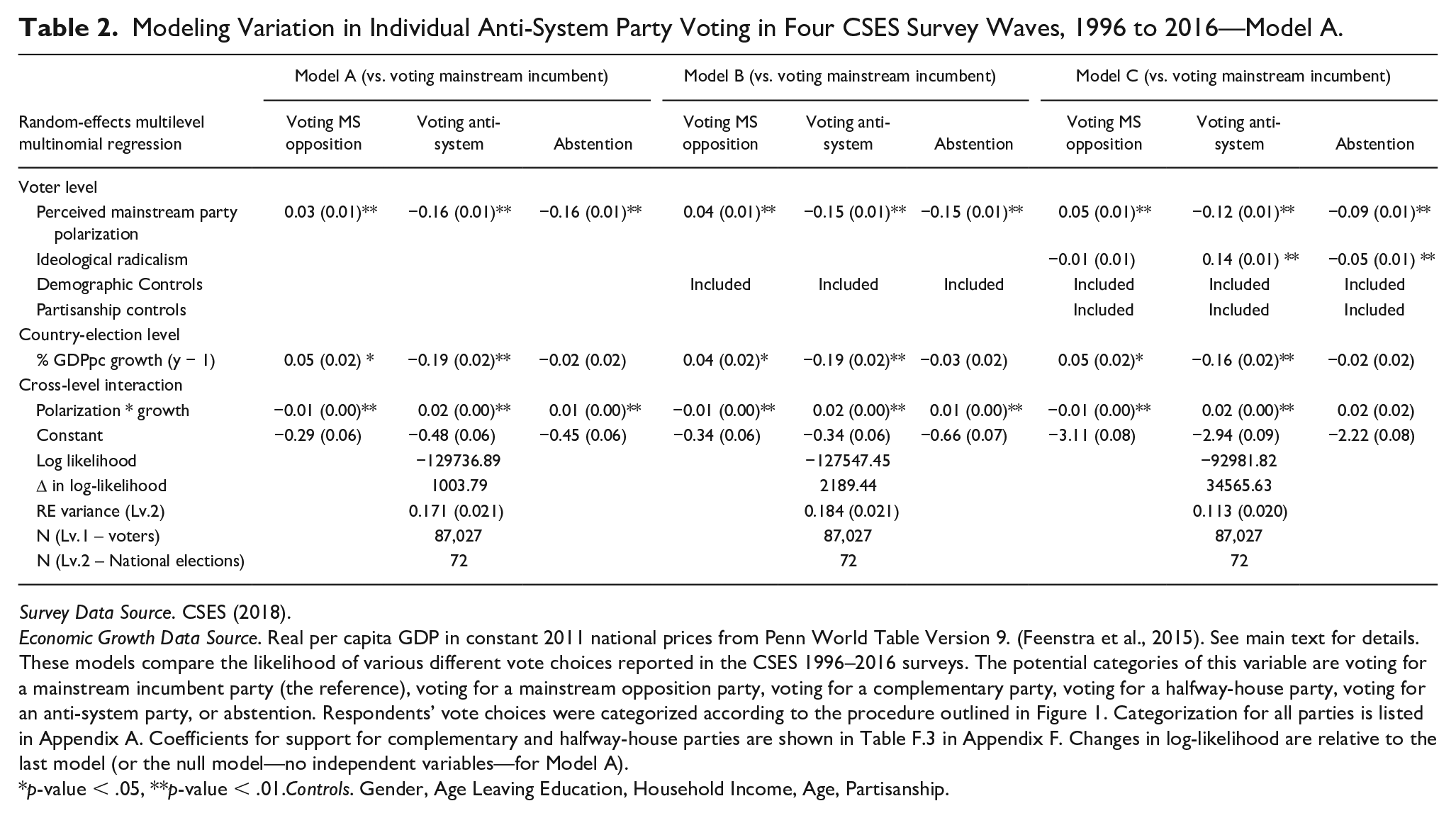
Survey Data Source. CSES (2018).
Economic Growth Data Source. Real per capita GDP in constant 2011 national prices from Penn World Table Version 9. (Feenstra et al., 2015). See main text for details.
These models compare the likelihood of various different vote choices reported in the CSES 1996–2016 surveys. The potential categories of this variable are voting for a mainstream incumbent party (the reference), voting for a mainstream opposition party, voting for a complementary party, voting for a halfway-house party, voting for an anti-system party, or abstention. Respondents’ vote choices were categorized according to the procedure outlined in Figure 1. Categorization for all parties is listed in Appendix A. Coefficients for support for complementary and halfway-house parties are shown in Table F.3 in Appendix F. Changes in log-likelihood are relative to the last model (or the null model—no independent variables—for Model A).*p-value < .05, **p-value < .01.Controls.
The size of these effects are demonstrated in Figure 7, which converts the raw coefficients from Model C of Table 2 into more easily interpretable sets of predicted probabilities (where 100 would equal certainty of a particular vote choice). GDP growth is varied from one standard deviation (SDs) below (-0.4%) and above (3.6%) the sample mean (1.6%), “converged” refers to a perception of mainstream party polarization that is one SD below the mean, “polarized” one SD above. The figures in each graph are for a highly typical voter: a middle-aged (45–64) male with a middle income (3rd quintile in their country), an average level of education (some post-16 schooling but no degree), and an average distance from the ideological center, as well as no particular partisan lean toward any given party.
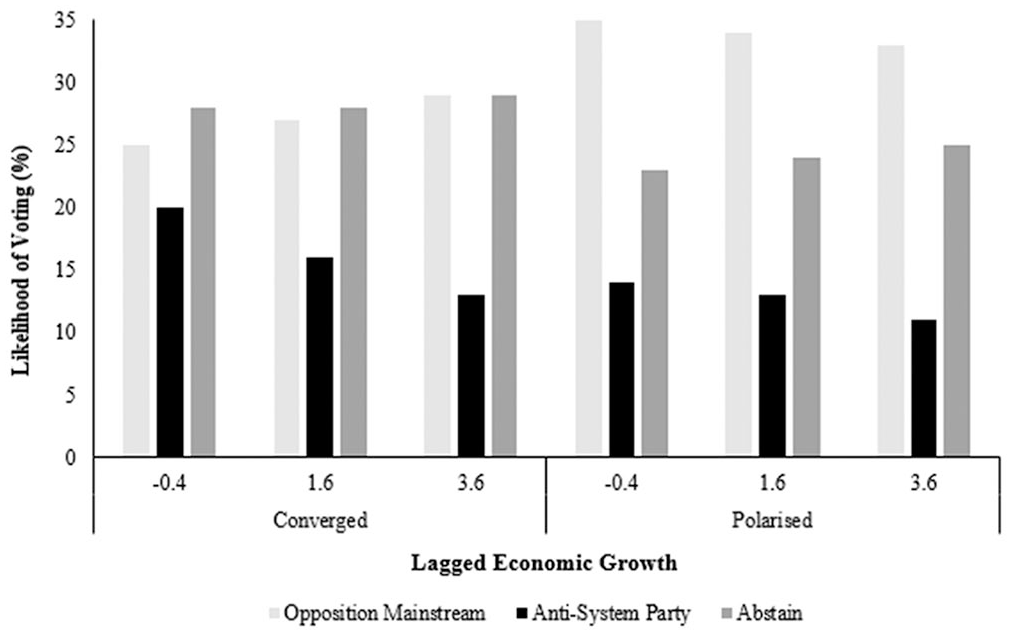
Predicted likelihood of different types of anti-incumbent voting (%) by objective economic performance and subjective mainstream party polarization.
One can clearly see the interaction effect. A voter is more likely to shun mainstream incumbents when the economy is doing poorly. However, mainstream opposition parties are only likely to be the main beneficiary of this anti-incumbent sentiment when they can clearly differentiate themselves from the former in ideological terms. A poor national economy will not seriously boost the likelihood of anti-system voting unless the respondent also perceives establishment parties to be highly similar in ideological terms. Perceptions of convergence exert practically no influence on support for anti-system parties when the economy is performing strongly. Abstention is also clearly more likely when there is less ideological choice on offer from mainstream parties, and (surprisingly) when growth is stronger.
Subjective perceptions of mainstream party convergence are more strongly linked to support for anti-system candidates when the economy is objectively doing badly. However, is the converse true? Are negative subjective perceptions of the national economy more likely to be associated with radical party voting when mainstream parties can (objectively) be said to have de-polarized? While classic economic voting models suppose such retrospective evaluations of the macroeconomy should redound to the benefit of either the incumbent (when they are positive) or opposition (when they are negative), I have argued that negative evaluations actually benefit non-mainstream (and particularly anti-system) candidates more than the mainstream opposition during times of ideological convergence.
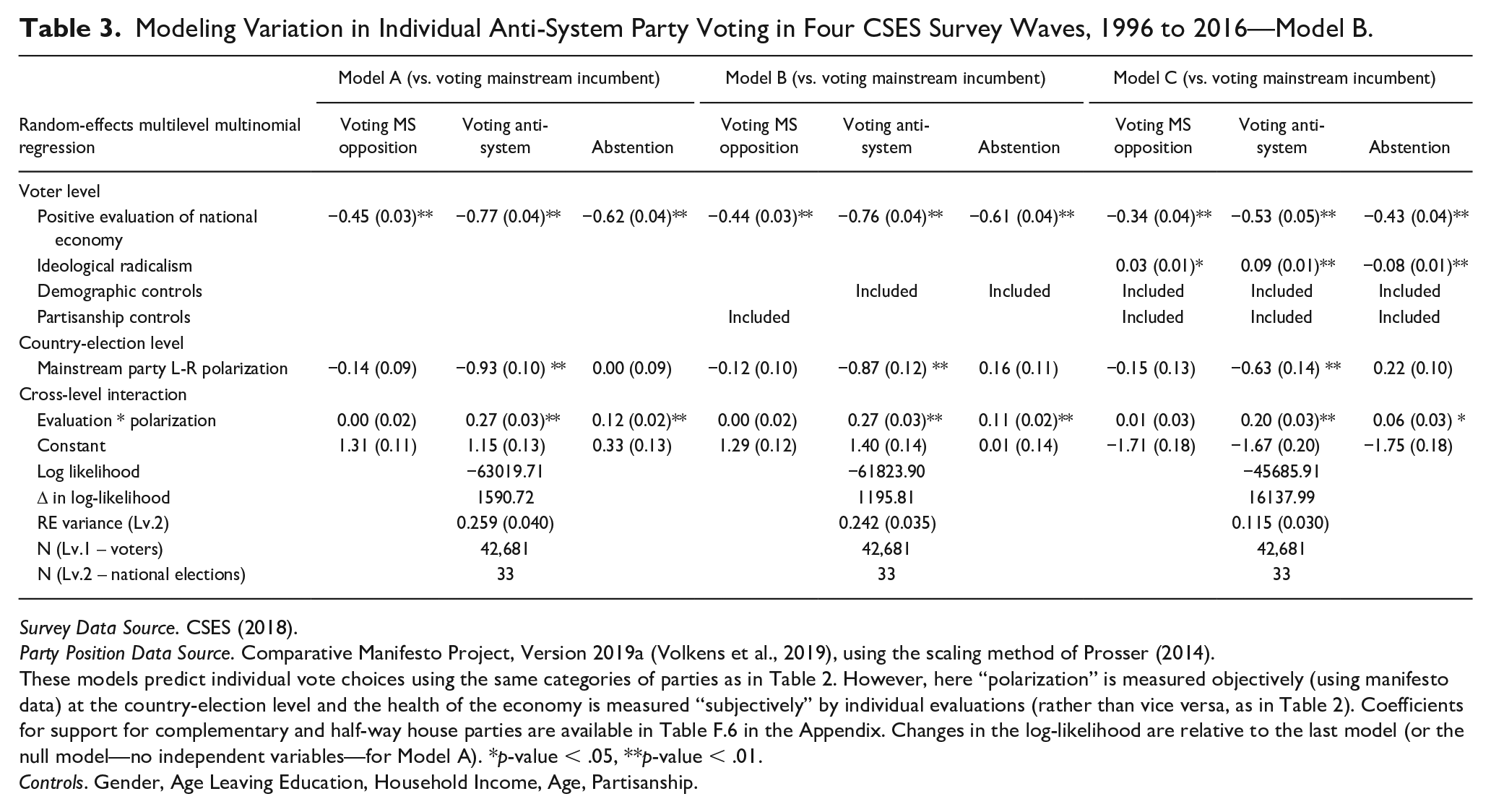
To test this hypothesis, a series of similar models to those in Table 2 were implemented that interacted respondents’ personal evaluation of the national economy with the same manifesto-based measure of mainstream party polarization that I introduced in Study 1. Economic opinion was captured using a question asking each respondent “Would you say that over the past twelve months, the state of the economy in [Your Country] has gotten better, stayed about the same, or gotten worse?.” A subsequent question asked those who answered better or worse whether this was “much” so or just “somewhat,” so these variables were combined to great a single 1 to 5 indicator where higher values indicate greater approval. Given that this question was only asked in 33 national elections during the 1996 to 2016 CSES waves, these models have notably fewer cases than their predecessors. All of the other controls from the previous model remain the same. The models are presented in Table 3. 11
Modeling Variation in Individual Anti-System Party Voting in Four CSES Survey Waves, 1996 to 2016—Model B.
Survey Data Source. CSES (2018).
Party Position Data Source. Comparative Manifesto Project, Version 2019a (Volkens et al., 2019), using the scaling method of Prosser (2014).
These models predict individual vote choices using the same categories of parties as in Table 2. However, here “polarization” is measured objectively (using manifesto data) at the country-election level and the health of the economy is measured “subjectively” by individual evaluations (rather than vice versa, as in Table 2). Coefficients for support for complementary and half-way house parties are available in Table F.6 in the Appendix. Changes in the log-likelihood are relative to the last model (or the null model—no independent variables—for Model A). *p-value < .05, **p-value < .01.
Controls. Gender, Age Leaving Education, Household Income, Age, Partisanship.
Once again, the “crisis and convergence” hypothesis appears vindicated by the data at hand. While negative economic evaluations are consistently linked to support for anti-system candidates, this link is strengthened considerably during times of mainstream party ideological convergence. The strength of this association does decline once adjusting for voter demographics, left-right self-placement and partisan sentiment, however, it never disappears completely. Interestingly there is a similar (albeit much smaller) interaction effect associated with abstaining. A voter holding a dark image of the national economy is more likely to sit out the contest entirely when mainstream parties have a collectively narrow ideological appeal. This can be interpreted in a similar way to the anti-system finding: why bother to use the ballot box to alleviate a perceived national crisis at all if the parties most likely to form the resulting government are unlikely to make substantial changes to the current course? In contrast, there is no such interaction effect for voting for a mainstream opposition party.
Figure 8 presents another set of predicted probabilities for various vote choices derived from the raw coefficients in Table 3, Model C. Here, “converged” refers to levels of polarization within mainstream party manifestos that are one standard deviation below the sample mean, “polarized” one standard deviation above. The figures in each graph are for the same “average voter” as described in Figure 7. The interaction effect is highly visible. Anti-incumbent voting is always more likely when the respond believes that the economy has gotten a lot worse, however, these evaluations are much more likely to lead specifically to anti-system support when mainstream parties (whether in opposition or not) are ideologically convergent. A voter with the most negative perceptions of the economy (1/5) has around a 1 in 4 chance of supporting an anti-system party where mainstream parties have converged, but only around a 1 in 7 chance where those same parties are polarized. Interestingly, in this model voting for a mainstream opposition party is more likely when there is greater ideological convergence (contra my expectations and the data from the previous models), however, the difference is not huge, and is clearly smaller than the effect of economic perceptions. The impact on abstentions also differs from Figure 7. Personal perceptions of polarization are actually more likely to lead to abstention, especially when the economy is doing badly. That said, the main take-away, that the most likely anti-system voter is someone who thinks that the economy is doing very badly and is making their choice against a restricted mainstream party ideological choice set, is fully compatible with the hypothesis that I laid out in Figures 3 and 4.
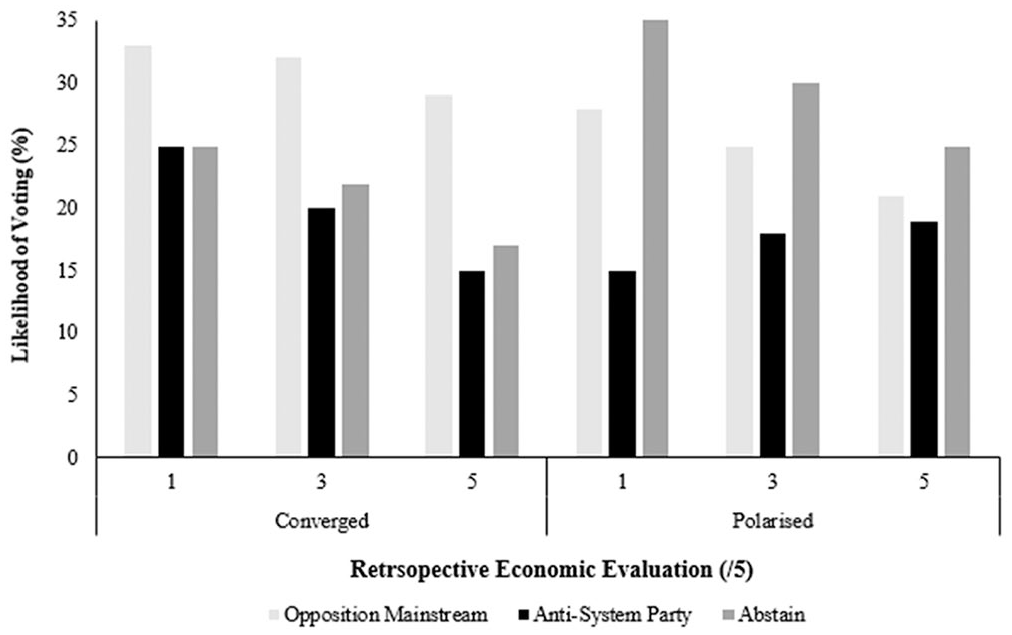
Predicted likelihood of different types of anti-incumbent voting (%) by subjective economic performance and objective mainstream party polarization.
Discussion and Conclusion
This article identified a significant amount of national and temporal variation in the success of “anti-system” parties. That is, an ideologically heterogenous group of radical anti-establishment actors outside of national government who all challenge the legitimacy of some aspects of the dominant norms, values, actors, and institutions of their political systems. I argued that a combination of supply- and demand- side factors were necessary for understanding why people are more apt to support anti-system candidates in certain times and places. Simply put, the coincidence of both economic crisis and the ideological de-polarization of mainstream parties (that is, the process of becoming more similar) can be expected to generate a backlash against established political actors and the values, norms, and practices that they adhere to. At its most basic, my argument is that under these conditions voters shall perceive the political mainstream to no longer be providing either a valued policy output (a healthy economy) nor the quality of representation (i.e., alternative opinions or strategies) required to adequately check, reverse, or alleviate the problems facing society. This breaks the bonds between voters and established mainstream parties, and consequently leads to an uptick in support for anti-system parties.
Evidence for this set of hypotheses was demonstrated at both the aggregate- and individual-level. Regression modeling of the average anti-system vote in 22 advanced democracies over several decades revealed a robust and substantively large association between the interaction of lagged GDP-per-capita growth, mainstream party ideological convergence, and the vote share for these radical parties. While low growth was associated with stronger anti-system performance irrespective of convergence, it appears that the relationship between convergence and anti-system party performance is mostly relevant during times of economic hardship. Multilevel analysis of data from four waves of the Comparative Study of Electoral Systems corroborated these findings. When the economy is objectively doing badly, individuals who think that mainstream parties are more similar become even more likely to punish those mainstream parties by voting for anti-system alternatives. Similarly, when there is objective evidence that mainstream parties have converged, those who hold more negative perceptions of the national economy are also more likely to “flee the center” and opt for a radical party.
Previous studies on the success rates of radical parties in advanced democracies have tended to separately analyse the role of demand- and supply-side factors. I have added to this literature by demonstrating that, in advanced democracies, it is the combination of both that radicalizes the economic vote and increases the incentives to punish mainstream parties for convergence. Without appreciating these contingencies, we cannot properly distinguish such phenomena from “regular” economic voting, and further mixed findings are likely. My findings corroborate the recent assessment of Golder (2016), that any future contribution to our knowledge in this field will come through an unraveling of causal mechanisms and the investigation into the synergy of demand and supply.
Considering the “real world” implications of my findings, perhaps we should reconsider both the relationship between political polarization and the health of a democracy. Polarization is generally problematized in the literature on democratic consolidation and functioning. In the United States, where unlike many other Western democracies the major parties have become more distinct in the past few decades, polarization is blamed for declines in political civility, legislative productivity, and trust in government (Lee, 2015, pp. 263–267). In developing democracies, the effects can be even more critical. For example, Sartori (1976, pp. 173–192) links excessive ideological divides to the destabilization and collapse of the Weimar and French Fourth Republics as well as Chilean democracy in the 1970s. The benefit of compromise, consensus, and bargaining has been linked to a variety of other positive political outcomes more broadly (Lijphart, 2012). In contrast, this article suggests that a certain healthy distance between mainstream parties may be necessary to stave off an anti-system challenge. Establishment party convergence, after a point, may actually be penalized by an alienated electorate (particularly if it corresponds with poor economic conditions). Meaningful differences between major parties are linked to the quality of political representation (Dalton, 2008), and their dilution could lead to an effective “hollowing out” of democracy (Mair, 2013). To be sure, government has the responsibility to maintain a good standard of services for its people—what Scharpf (1997) refers to as “output democracy”—but the procedures that allow meaningful contestation and representation of the various wishes and hopes of the citizens themselves, so-called “input democracy,” are also important. Elections must be meaningful. This suggests the possibility of a non-linear relationship between polarization and democratic functioning, and the existence of a “sweet point” at which voters’ hopes and frustrations can be channeled through the political mainstream without recourse to defection to anti-system candidates.
Supplemental Material
sj-pdf-1-cps-10.1177_0010414020970222 – Supplemental material for Crisis and Convergence: How the Combination of a Weak Economy and Mainstream Party Ideological De-Polarization Fuels Anti-System Support
Supplemental material, sj-pdf-1-cps-10.1177_0010414020970222 for Crisis and Convergence: How the Combination of a Weak Economy and Mainstream Party Ideological De-Polarization Fuels Anti-System Support by Zack P. Grant in Comparative Political Studies
Footnotes
Acknowledgements
I would like to thank the anonymous reviewers of this article for their valuable insights and suggestions, in addition to Nancy Bermeo, David Doyle, Andy Eggers, Jane Gingrich, Jim Grant, Jane Green, Ilona Lahdelma, Sergi Pardos-Prado, and James Tilley, who all provided very useful comments on earlier drafts. Previous versions of this manuscript were presented at the 2018 Elections, Public Opinion, and Parties annual conference as well as a 2018 Nuffield College graduate seminar. I am grateful for the thoughtful comments of those who attended either event. Finally, I would like to thank Chris Prosser for sharing with me his code for generating party positions from MARPOR data.
Declaration of Conflicting Interests
The author declared no potential conflicts of interest with respect to the research, authorship, and/or publication of this article.
Funding
The authors disclosed receipt of the following financial support for the research,authorship, and/or publication of this article: Zack Grant’s doctoral research is funded by an Economic and Social Research Council (ESRC) studentship [grant number ES/J500112/1] and the St John’s College Lamb and Flag scholarship.

Supplemental Material
Supplemental material for this article is available online.
Notes
Author Biography
References
Supplementary Material
Please find the following supplemental material available below.
For Open Access articles published under a Creative Commons License, all supplemental material carries the same license as the article it is associated with.
For non-Open Access articles published, all supplemental material carries a non-exclusive license, and permission requests for re-use of supplemental material or any part of supplemental material shall be sent directly to the copyright owner as specified in the copyright notice associated with the article.
