




Abstract
One underexplored aspect of Sinn Féin is its position as an electorally competitive party that operates simultaneously in two separate jurisdictions. Sinn Féin’s operation (i.e. one centralised party, two jurisdictions) allows for a Most Similar Systems Design which can help determine how – and to what extent – its policy preferences differ between North and South. This also provides a test of issue competition and agenda-setting theory, which assumes that policy preferences must adapt to the unique vote and office-seeking incentives operating on political parties within states. This article draws upon new datasets from the Irish Policy Agendas Project and the Public Policy Agendas on a Shared Island project which have coded party manifestos (North and South) based on the Comparative Agendas Project coding scheme. The results support the assumptions made by issue competition and agenda-setting theory. Sinn Féin in the North tends to prioritise the representation of nationalist concerns, while Sinn Féin in the South focuses on more typical social democratic issues. But when nationalist interests are secure in Northern Ireland, Sinn Féin’s policy focus shifts to bread-and-butter issues that resemble its policy preferences in the Republic of Ireland.
Keywords
Introduction
Issue competition and agenda-setting theory builds on the assumption that political parties adapt to the varying vote and office-seeking incentives operating in different countries. The policy preferences of electorally competitive parties must react to the incentives created by contrasting party systems, institutional contexts, electoral systems, and party support bases (e.g. Green-Pedersen, 2019a; Green-Pedersen and Mortensen, 2015; Seeberg, 2017). These vote and office-seeking incentives explain why parties pay attention to some issues more than others and why party system agendas differ across cases (Green-Pedersen and Little, 2023b: 17). Sinn Féin’s position as an electorally competitive party that operates simultaneously in two separate jurisdictions offers a unique opportunity to test these institutional and structural explanations: to see if Sinn Féin’s cross-border policy preferences involve continuity or adapt in line with the expectations of the issue competition literature. Importantly, this theory-testing research design may provide answers as to how – and to what extent – Sinn Féin’s policy preferences differ between North and South? In this context, policy preferences refer to a party’s policy aspirations: they are the positions parties take on issues and the priority they accord to these issues.
Sinn Féin’s electoral strategy – North and South – combines relatively mainstream social democratic policy solutions with left-wing populist rhetoric (O’Boyle, 2023). This has brought cross-border electoral success for the party, with a plurality of voters choosing Sinn Féin in both the North (Northern Ireland Assembly election 2022) and South (General Election 2020) of the island. In the North, Sinn Féin has become a ‘catch-all’ party for the nationalist community (Whiting, 2016: 549–550). It is attempting to become the same in the South, although its popular support has been erdoded by the rise of immigration as a salient issue for voters (Arlow and O’Malley, 2024). Sinn Féin’s centralised and disciplined party organisation would lead us to expect similar cross-border policy preferences, as part of its goal of bringing North and South closer together and facilitating Irish reunification. But does the overarching goal of Irish reunification lead Sinn Féin to pursue similar policy preferences in Northern Ireland (NI) and the Republic of Ireland? Or does Sinn Féin strategically adapt its policy preferences to cater to the differing vote and office-seeking incentives influencing the party in each jurisdiction? To what extent do institutional context and varying public attitudes determine party policy preferences, as outlined by issue competition and agenda-setting theory?
First, this article will explain the evolution of Sinn Féin’s all-island policy platform before situating this research within issue-competition theory. Second, it will analyse Sinn Féin’s evolving policy preferences based on coded party manifestos by comparing Sinn Féin to its competitor parties on the island of Ireland, and to other left-wing European parties. This section will utilise novel datasets from the Public Policy Agenda on a Shared Island project and the Irish Policy Agendas Project (IPAP). Finally, this article will analyse the findings which show that Sinn Féin’s policy preferences differ significantly between North and South, specifically when Sinn Féin acts as a ‘tribune’ party defending nationalist interests in the North during critical periods (Tilley et al., 2021). However, when nationalist interests become more secure, Sinn Féin reverts to a social democratic policy agenda that resembles its policy preferences in the South. These findings support the theoretical assumptions made by the issue competition and agenda-setting literature.
Explaining Sinn Féin’s policy platform, North and South
Much of what we know about Sinn Féin suggests that it should have a similar social democratic platform, North and South, albeit with some key differences. Sinn Féin is a party of the left, but scholars have claimed that the party in the South tends to be more left-wing than the party in the North (Bean, 2007: 177). These ideological divergences among the membership have the potential to influence the policy agenda of the party. For instance, Allen (2014) provides a radical left critique of Sinn Féin by claiming that the party opposed austerity in the South but implemented it in NI. Sinn Féin’s moves to the centre – and office-seeking compromise – have been more pronounced in the North due to the power-sharing structures of the Good Friday Agreement (GFA), which means that Sinn Féin must govern with parties that are ideologically unsympathetic to Irish nationalist aims, such as the Democratic Unionist Party (DUP; Murray and Tonge, 2005: 254). The policy autonomy of Sinn Féin in government is further reduced by the limited fiscal powers of the NIA; in fact, NI is reliant on the revenue raising ability of Westminster (Doyle, 2021). But even where Sinn Féin had ministerial autonomy – such as when Martin McGuinness was Minister of Education (from 1999 to 2002) – the radical left critiqued the party in the North for implementing neoliberal policies such as the Public Private Partnership funding model for school building projects (McCabe, 2013: 10). Again, this shows the policy constraints placed on Sinn Féin through the structure of NI, as it is unlikely that the UK’s Treasury would have replaced the private funding for schools if McGuinness had refused to utilise a public finance initiative (PFI). Party policy documents from that time demonstrate how reluctant Sinn Féin was to use PFIs to deliver public services in health and education (Sinn Féin, 2003: 19). So, like other West European parties, coalition dynamics and institutional constraints influences Sinn Féin’s policy agenda in NI, especially as it is a party of government (Green-Pedersen and Krogstrup, 2008).
In its early years, Provisional Sinn Féin tended to be more green (Irish nationalist) than red (Moloney, 2007: 68). But younger Provisional Irish Republican Army (PIRA) volunteers became radicalised in prison, which led the movement to situate itself as part of a revolutionary and anti-imperial left (Ferguson and McAuley, 2020: 225). Despite this radical lineage, Sinn Féin is remarkable for its tactical flexibility in respect of its policy preferences, which has led it to move to the centre on policy to garner votes and facilitate their overarching goal of reunification (Maillot, 2005: 3). This pragmatism and ideological flexibility – which is also a modus-operandi of another mainstream Irish Republican party, Fianna Fáil (FF; O’Malley and McGraw, 2017) – suggests that any potential ideological divisions between North and South are unlikely to result in significant divergences in policy outcomes. In effect, Sinn Féin has principles, which can be adapted to suit events and electoral purposes, but only one main ‘ideological objective’, which is a United Ireland (Frampton, 2009: 19). To this end, the party views the GFA as an ‘evolutionary process of transition’ leading to eventual reunification (Bean, 2007: 189). Furthermore, Sinn Féin has used the power-sharing structures of the GFA to reassure Northern middle-class Catholics that they are a responsible party of government, this enabled them to overtake their nationalist competitors in the Social Democratic Labour Party (SDLP), who were viewed as too ‘old and middle-class’ and unable to effectively defend nationalist interests (Murray and Tonge, 2005: 212 and 254). This electoral success was solidified through a policy focus on social democratic issues such as housing, jobs, education, and civic equality (Tonge, 2022: 526), rather than a policy agenda that was reduced to simply representing one side of the ethno-national divide.
This electoral strategy was replicated in the South, where following a disappointing general election in 2007, the party invested in policy development and the advancement of a politically sophisticated front bench, who had no links to IRA violence (Ó Broin, 2009: 298–301). The party was thus well placed to take advantage of the political fallout caused by the Great Recession and the housing crisis, which disrupted the previously stable – and conservative – Irish party system and made space for a left-wing populist party like Sinn Féin (Elkink and Farrell, 2021: 529). This matters because electoral success in the South is part of Sinn Féin’s long-term strategy for achieving reunification (Whiting, 2017: 60–61). But Sinn Féin’s road to electoral success in the South was slow and uneven. The party had to again adapt their electoral tactics after a poor performance in the 2019 local and European elections. Maillot (2022: 132–133) shows that this was done through a focus on policy solutions rather than economic grievances, and a greater utilisation of their skilled front bench TDs in the media. This tactical agility helped them to gain the highest vote share (24.5%) of any party in the subsequent General Election of 2020. This breakthrough election for Sinn Féin involved relatively mainstream social democratic policy solutions, combined with an anti-systemic narrative, which helped it to appeal to a newly emerged centre-left voting bloc in the South, which tends to be younger (Muller and Regan, 2021). The average age of a Sinn Féin voter in 2020 was 42, they also tended to be well educated, but lower earning (Cunningham and Marsh, 2021: 219).
Sinn Féin’s long-term political aim has shifted from a socialist 32 county Republic towards a United Ireland that resembles Denmark more than Cuba. But it still retains a hierarchical command structure that discourages internal dissent on policy decisions (McGlinchey, 2019: 201), which is more typical of the democratic centralism employed by parties of the radical left. Importantly, with the adoption of an expansive social democratic policy platform, Sinn Féin has maintained its traditional voter base while garnering new middle-class voters, North and South. However, it is important to note that this all-island electoral success for the party has been predicated on the peace process and the end of PIRA violence (Maillot, 2022: 86–87).
Sinn Féin’s aim of forming governments both sides of the Irish border is a realistic – if uncertain – prospect, especially given disappointing results in the 2024 local and European elections in the South (Kelly, 2024). But this strategy would lead us to expect that Sinn Féin’s policy preferences should be remarkably similar between North and South, as it prepares for reunification. Consequently, while Sinn Féin’s issue focus in the North is likely to concern itself with regional issues around civil equality and the GFA that are not a feature of politics in the South; in general, the literature on Sinn Féin suggests we should see party policy preferences (North and South) converge on a consistent social democratic policy platform.
Sinn Féin’s policy preferences from an issue-competition perspective
Conversely, the issue-competition literature suggests that Sinn Féin’s policy preferences between North and South should diverge as the party adapts to separate institutional and party systems. Issue-competition theory argues that political parties have preferred issues: policy areas in which they have a comparative advantage over other parties (Green-Pedersen, 2023: 212). This is the concept of ‘issue ownership’ through which parties can build a reputation for competence in specific policy areas in the minds of voters (Budge, 2015). Political parties will choose to focus on these preferred issues to maximise their voter appeal and win elections. In fact, the ‘issue ownership’ of political parties remains remarkably stable over time, and specific party types tend to ‘own’ certain issues (Seeberg, 2017). For instance, parties of the left have issue ownership over social security and environmental issues, while right-wing parties tend to own immigration and crime (Seeberg, 2017: 484). Issue ownership becomes most electorally rewarding when parties can own a policy that delivers the greatest ‘issue yield’: an issue that allows parties to retain their voter base while broadening their appeal to new voters (De Sio and Lachat, 2020; De Sio and Weber, 2014). Housing being an example of an issue with a high yield for Sinn Féin in the South (Moore, 2023: 266).
However, parties are unable to solely focus on policies in which they retain issue ownership or where they can gain the greatest issue yield, inter-party competition will influence their policy agenda (Green-Pedersen and Mortensen, 2015). The agenda-setting literature argues that political parties do not engage with voters in a vacuum. Instead, their policy agenda is shaped through issue competition with other parties (Green-Pedersen, 2023: 213–214). For instance, parties will sometimes attempt to steal issue ownership, and out-compete a party on an issue preferred by their opponents (Holian, 2004). Or political entrepreneurs can launch ‘niche parties’ that compete on specific grievances held by a sub-set of voters and thus shape the overall party system agenda (Green-Pedersen, 2019a: 19). It is through this type of inter-party issue competition that the ‘party system agenda’ is established (Green-Pedersen and Mortensen, 2010). The ‘party system agenda’ views issue attention as a finite resource: parties must choose to give priority to some issues over others. Therefore, the party system agenda is determined by an agenda-setting process influenced by the political agenda, which are policy problems determined by policymakers, and the public agenda, which is shaped by problems representing voters’ day-to-day policy concerns (Bevan and Jennings, 2019: 219). Importantly, the media’s agenda also helps to reaffirm these intrusive policy problems in voters’ minds (Bevan and Jennings, 2019).
So, parties must pay attention to issues that are high on the party system agenda, but they will also try to shape that agenda by attempting to shift the focus onto issues that the party prefers (Green-Pedersen and Little, 2023a: 37). Parties therefore are sometimes forced to pay attention to issues they would rather avoid (Green-Pedersen, 2019a: 28). This form of agenda-setting theory is, by its very nature, a top-down approach to issue attention: it is party elites who must strategically adapt their issue attention to capture voters’ support and frustrate the ambitions of their political opponents (Green-Pedersen, 2019a: 22–25). However, this elite competition approach to agenda-setting is appropriate for Sinn Féin, which is a party known for its authoritative leadership (McGlinchey, 2019: 201).
In sum, both issue-competition and agenda-setting theory suggests that Sinn Féin’s policy agenda should differ between North and South, as the party adapts to the incentives acting upon it in two different party systems. Issue competition theory allows us to analyse the development of Sinn Féin’s policy preferences over time, across jurisdictions, and through a framework that enables comparison to its competitor parties on the island of Ireland (Green-Pedersen and Little, 2023a: 36).
Case selection
A focus on the policy preferences of Sinn Féin, North and South, facilitates a most similar systems design (MSSD) due to its unusual electoral position (i.e. one electorally competitive party, but two jurisdictions). This is all the more the case given its centralised party organisation and its ideological commitment to all-island politics. However, despite assessing the same party organisation, and despite broad historical and cultural commonalities between the North and South of Ireland, there are clearly different office and vote-seeking incentives operating on Sinn Féin in each jurisdiction.
Coalition incentives in the North involve mandatory power-sharing within the NI Executive, while in the South there is a traditional coalition model, although some establishment parties refuse to countenance coalition with Sinn Féin (e.g. Fine Gael (FG)). On one hand, this means that Sinn Féin can expect to be in government in Northern Ireland, and so must pay attention to the issues devolved to the NI Executive and Assembly. But these issues are likely to differ from the wider policy remit of government in the South, where Sinn Féin did not have a viable path to power until the 2020 general election. Also, as a national parliament, Dáil Éireann has significantly more legislative power than the North’s regional assembly. Therefore, if the assumptions behind issue competition and agenda-setting theory are correct, then the office and vote-seeking incentives resulting from these coalition and institutional constraints should influence the party’s policy preferences.
Voter attributes in the form of cleavages may also result in varying policy preferences between Sinn Féin, North and South. Cleavages in the North are both ethnic (i.e. nationalist versus unionist) and class based, with a party system dominated by a binary ethnic divide. The South has a class cleavage, as evidenced by Sinn Féin’s working class base, but a conservative party system – dominated by Fianna Fá and FG – that has never had a left-led government. Sinn Féin is a mainstream party that competes for votes from both the centre-right and the left, so there is a vote-seeking incentive for Sinn Féin to represent ethnic nationalist interests in the North (while retaining their base within the Catholic working class) and to moderate their policy in the South towards a catch-all centre-left policy position. This MSSD selection provides a ‘theory-confirming’ basis for comparison, which will help us to test if the issue competition perspective is correct in predicting that Sinn Féin should embrace differing policy preferences between North and South, based on the differing vote and office-seeking incentives detailed above (Lijphart, 1971: 691).
Data
The comparative agendas project (CAP) has been at the forefront of generating data that can be used to analyse both evolving policy agendas and issue competition in party systems (Baumgartner et al., 2011; Bevan, 2019). This research draws upon two new datasets – the IPAP and the Public Policy Agendas on a Shared Island project (PPASI) – that have coded quasi-sentences of party manifestos on the island of Ireland based on national adaptations of the master codebook used by the CAP (see: http://irishpolicyagendas.eu). Previous research has utilised data from the IPAP to assess the party system agenda in the Republic of Ireland (Green-Pedersen and Little, 2023a), but this is the first research to compare the party system between North and South, and from the perspective of a single cross-border party.
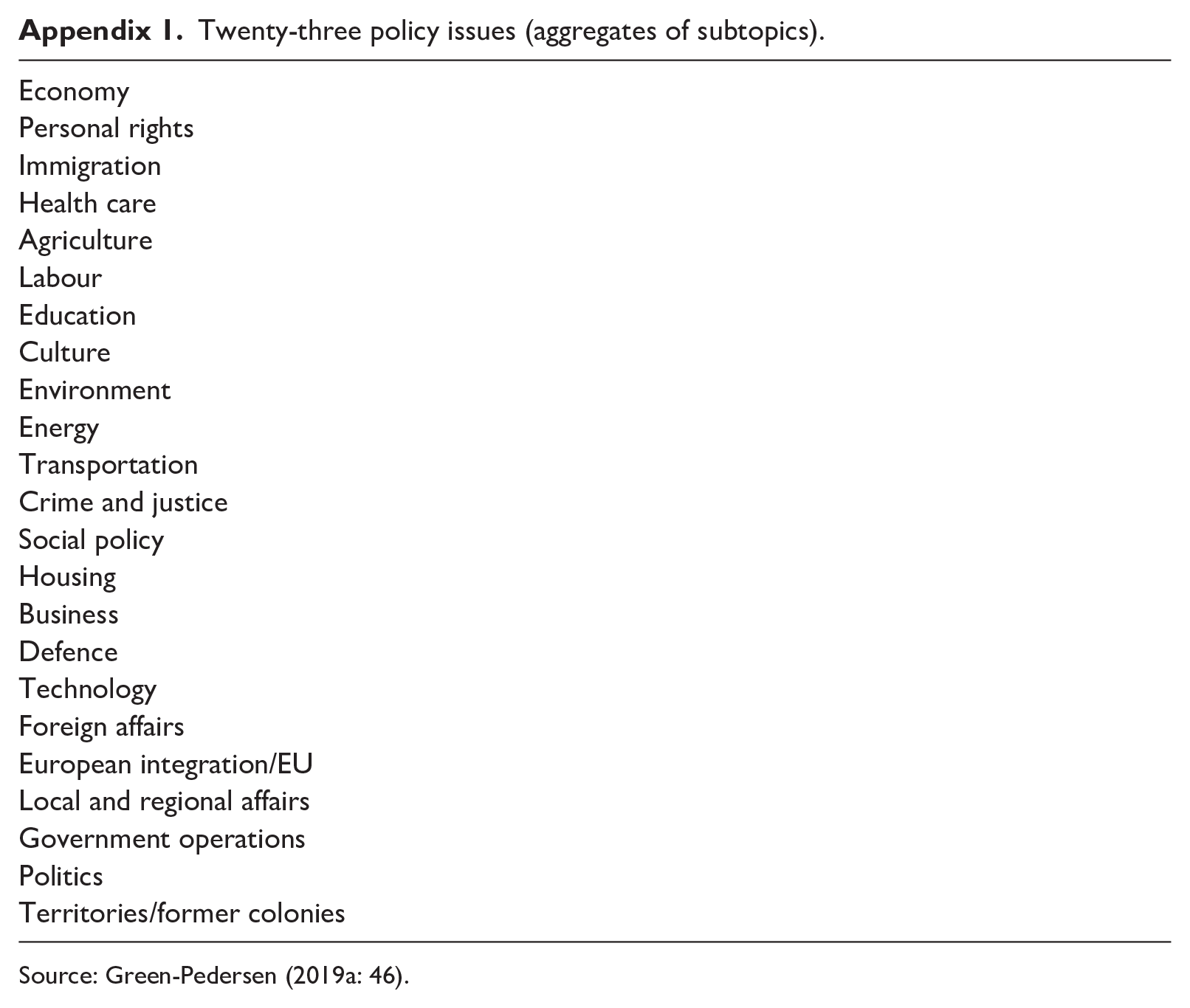
These data draw upon the CAP master codebook: an effective issue coding system that allows comparison over time and countries (Bevan, 2019). But the analysis is based on an aggregate of related sub-topics into 23 clearly defined public policy issues, such as personal rights, the economy, crime and justice, and government operations (see Appendix 1 for a full list of these issues). To aid comparison this approach mirrors the research design employed by Green-Pedersen (2019a: 46) in his analysis of changing party system agendas in West European politics, and recent research on the party system agenda in Ireland (Green-Pedersen and Little, 2023a). In addition, this research utilises Sigelman and Buell’s (2004) measure for issue convergence which can determine the extent of overlap (or similarity) between Sinn Féin’s manifestos, North and South, and between their competitor parties in each jurisdiction.
The CAP coding is focused on detailed policy issues and the attention they receive in party manifestos, but it does not assess the ideological positioning of these issues. For instance, housing is coded the same, even if the proposed policy solution involves increased social housing or private-sector provision. Therefore, CAP data will be supplemented with data from the Manifesto Research on Political Representation project (MARPOR), which has become the most established tool for assessing ideological positions (Klingemann et al., 2007). Also, scholars have argued that MARPOR works well in conjunction with CAP data (Green-Pedersen, 2019b). MARPOR avoids the potential for bias found in expert surveys, but it has been criticised for using a coding scheme that lacks empirical validation and a hand-coding process that can be unreliable (Gemenis, 2013: 8). To counteract these problems data from the Chapel Hill Expert Survey (CHES), which has been widely tested for validity and reliability, will also be used to determine ideological positioning (Jolly et al., 2022). CHES provides detailed party position data on European integration and ideology from 1999 to 2019, including political parties in all EU countries (Jolly et al., 2022).
Sinn Féin’s ideological positioning
This article examines two key aspects of policy preferences, the extent of their issue attention and their ideological position. In this context, it is appropriate to assess Sinn Féin’s changing ideological positioning and to compare these changes to similar European political parties. The literature on Radical Left Parties (RLPs) regularly includes Sinn Féin in cross-national studies and considers it part of the radical left family (e.g. Gomez and Ramiro, 2019, 2023). There is an acknowledgement that Sinn Féin may not be a ‘real’ RLP – partly due to its nationalism and relatively moderate economic policies – but its working-class support base, militant past, and anti-systemic threat to the status quo (North and South) mean that it can be safely compared to more typical RLPs (Gomez and Ramiro, 2023: 28). Figure 1 uses CHES data to compare Sinn Féin’s ideological position on a Left-Right continuum to similar European parties: SYRIZA (Greece), Podemos (Spain), Die Linke (Germany), and the French Communist Party (PCF). 1 These RLPs all share left-wing populist policy preferences, and they share membership of the radical left group within the European Parliament: The Left in the European Parliament – GEU/NGL (Kelly, 2023). Furthermore, all these parties exhibit a shared affinity for revolution and a political lineage that celebrates militant resistance to oppression (Arlow, 2020: 129–131). Although not a RLP, the UK Labour Party is included because under Jeremy Corbyn’s leadership it was viewed as being especially sympathetic to Irish Republicanism (Weerawardhana, 2018).
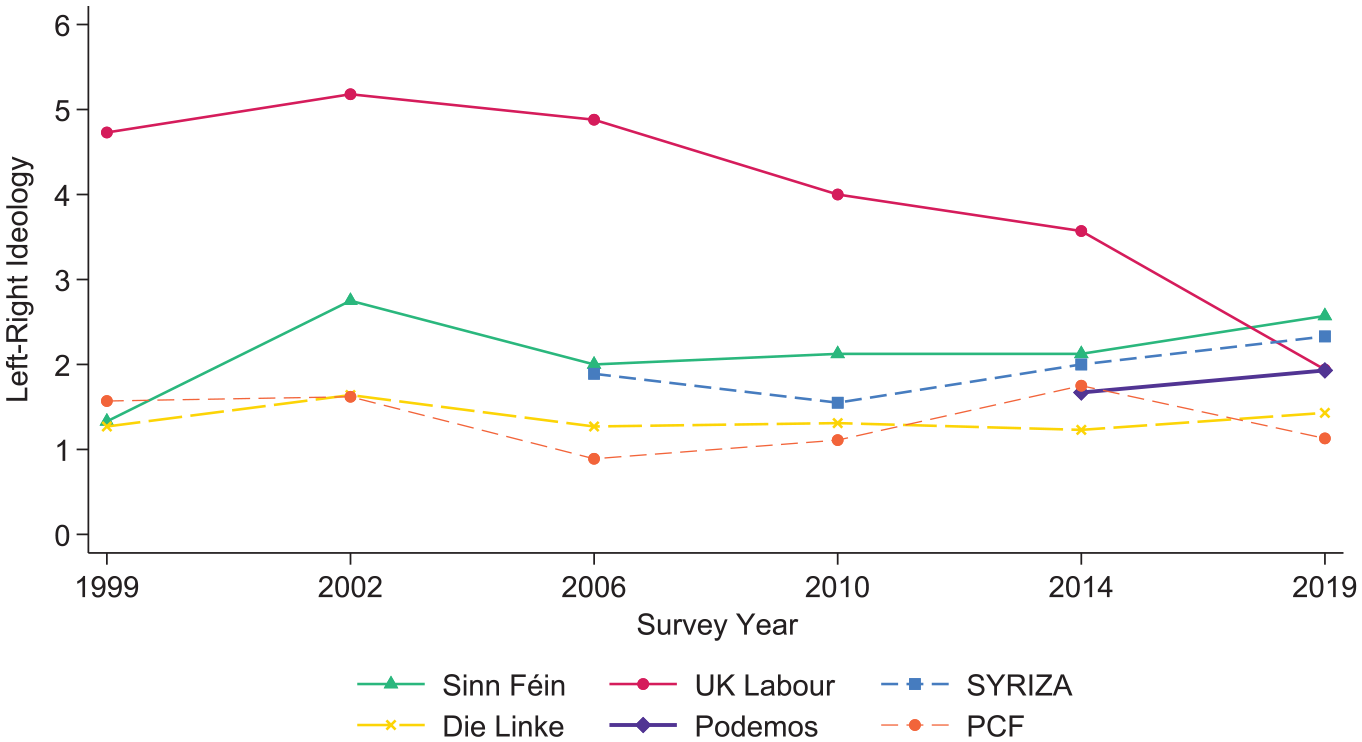
Sinn Féin’s ideological position compared to European left-wing parties.
Figure 1 shows Sinn Féin as generally to the right of Die Linke and the PCF; after all, Die Linke is a party that directly descends from the East German communist party and the PCF remains a revolutionary Marxist party. 2 Unsurprisingly, Sinn Féin is to the left of Blair’s New Labour but to the right of the Corbyn project, due to his policy shift to a more radical version of social democracy. Podemos is also to the left of Sinn Féin, even in the lead up to it first entering coalition government in 2019. SYRIZA’s trajectory is slightly more left-wing than Sinn Féin, even while in government from 2015 to 2019, but both parties are in a relatively similar ideological space. Sinn Féin and SYRIZA are both competitive office-seeking parties, which may necessitate moderation and a shift towards social democratic policy norms to entice centrist voters. Like SYRIZA, Sinn Féin has been a party of government (in NI), which also places limits on more radical policy options. Sinn Féin’s trendline shows a shift to the centre between 1999 and 2002, as the party continued with a power-sharing coalition in the North and attempted to become more electorally competitive in the South. Cross-country comparisons of ideological measures can be problematic because each measure is influenced by the differing party systems and policy agendas relevant to each specific state. But Figure 1 does suggest that Sinn Féin is in an ideological space firmly of the left but in a generally more moderate ideological position to some other RLPs that have not entered national government: such as Die Linke and the PCF.
CHES gives Sinn Féin an average ideological score of 2.14 on the Left-Right continuum over the years detailed in Figure 1, placing it in an ideological space far to the left of its mainstream competitors in Fianna Fáil (FF) and Fine Gael (FG). In fact, over the years assessed it is shown to be one of the most ideologically left-wing parties in Dáil Éireann. The only parties that are to the left of Sinn Féin are the groups that make up the Trotskyist alliance of People Before Profit–Solidarity (PBP-S) and the Green Party from 1999 to 2002. CHES places Sinn Féin in the exact same place when it comes to its position on economic issues, where it is also viewed as one of the most left-wing parties in the Dáil. However, it is on GAL-TAN values (i.e. Green-Alternative-Libertarian and Traditional-Authoritarian-Nationalist) that there is the most variation in Sinn Féin’s ideological positioning within the Irish party system (see Figure 2).
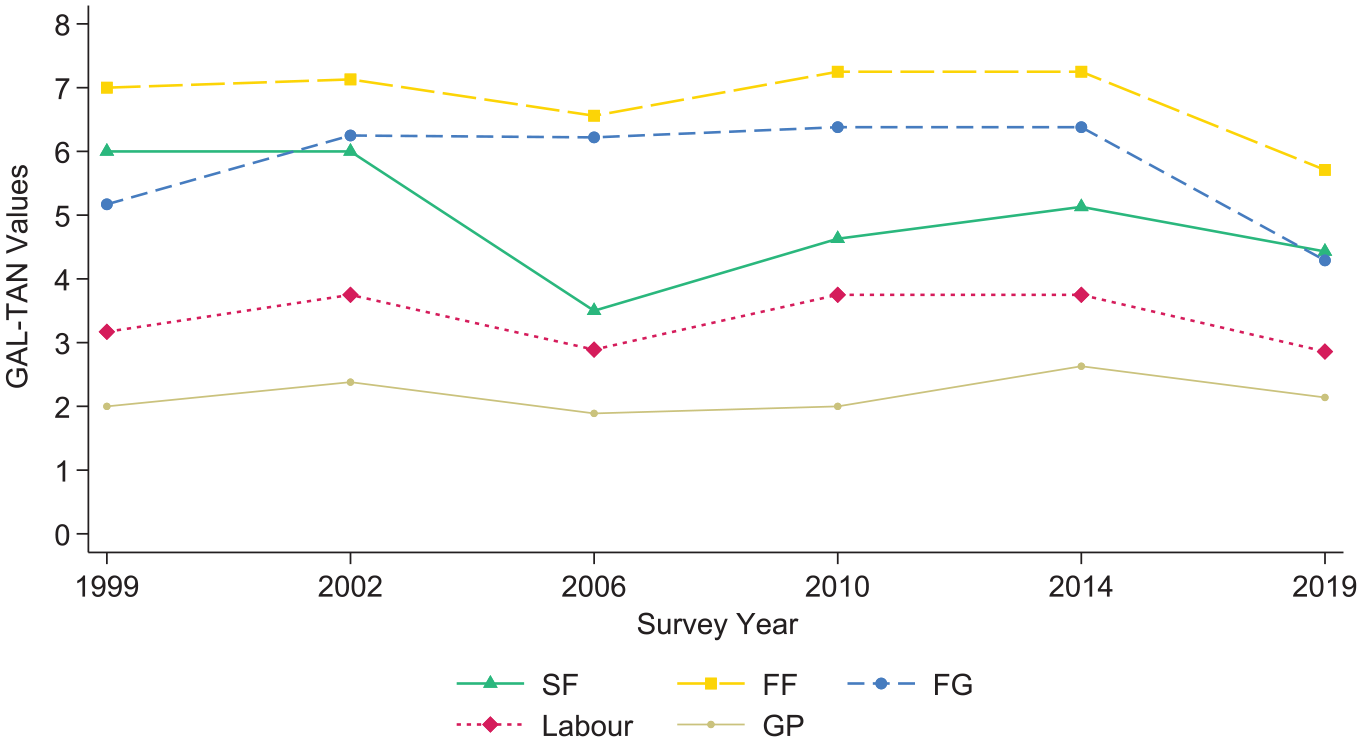
Sinn Féin’s position on GAL-TAN values in the Irish party system.
Figure 2 shows that the Green Party and the Irish Labour Party – which was to the forefront of the struggle for liberal rights in Ireland – are more supportive of GAL values than Sinn Féin. In contrast, the establishment parties of Fianna Fáil and Fine Gael tend to be less supportive of GAL values. However, both Sinn Féin and Fine Gael enter a similar ideological space in the 2019 survey, partly due to changes that both parties made on abortion liberalisation in the lead up to the 2018 referendum. Campaigning on equality – and against sectarian discrimination – is strategically important to Sinn Féin, especially in Northern Ireland (Bean and Hayes, 2009: 136). So, why is Sinn Féin not in a similar position on GAL values as other parties of the Irish left?
Unlike many other left-wing parties, Sinn Féin’s nationalism – and the Catholicism of many of its members – means that the party has been slow to embrace the GAL values that have become a cornerstone of left activism in Europe (March and Mudde, 2005: 43). For instance, abortion has been a difficult issue for Sinn Féin that represented a generational divide in the party between younger socialist members – often based in the South – and an older membership that were more likely to be practicing Catholics (Moore, 2023: 212). Its shift to support a woman’s right to choose up to 12 weeks of pregnancy led to a split in the party when some pro-life members formed a new socially conservative Republican party, named Aontú. Also, unlike the Green Party and Labour, Sinn Féin remains competitive in rural constituencies where green policies are often looked upon with suspicion, which limits its ability to embrace an environmental agenda when competing for rural seats against Fianna Fáil or Fine Gael. Furthermore, it is the most nationalist of all mainstream Irish parties, although that nationalism takes the form of an emancipatory struggle that sits uncomfortably with most right-wing ideologies (O’Malley, 2008). Significantly, Sinn Féin also has a reputation for internal authoritarianism due to its support for the IRA and its strict intra-party discipline (Whiting, 2016).
In summary, Sinn Féin’s party identity – as a left-wing nationalist party with a militant past – leads to higher GALTAN scores than other Irish left-wing parties (see Figure 2). How comfortable the party has become with the economic aspects of liberalism can be assessed through a novel measure for the support of free-market issues using MARPOR (2023) data (see Figure 3). Importantly, unlike CHES data, MARPOR allows comparison between Sinn Féin’s Westminster and Dáil Éireann manifestos. This measure was created by combining the MARPOR codes against protectionism and labour groups, with the codes in support of economic orthodoxy (i.e. liberalism), free-market economics, and reducing the welfare state. It shows that Sinn Féin – North and South – devotes less space to free-market policies within its manifestos than any of the political parties detailed in Figure 3. The Democratic Unionist Party (DUP) is shown to be more supportive of free-market policies than Sinn Féin. However, despite the DUP’s evangelical protestant roots and support for social conservatism, this has not led to any significant desire to reduce the welfare state in Northern Ireland (Tonge et al., 2014: 143). 3 Sinn Féin in the South dedicates more space in support of free-market issues than the North, but this may be a result of the greater fiscal powers of Dáil Éireann. However, the party in the North does become significantly more supportive of free-market policies (over 5% of coded manifesto sentences) in the 2017 Westminster elections; a shift that was mirrored by the DUP (see Figure 3). This can be explained by the extreme shock to the North’s political system caused by Brexit and the subsequent cross-party concern over potential trade barriers rather than a shift towards a more free-market policy agenda.
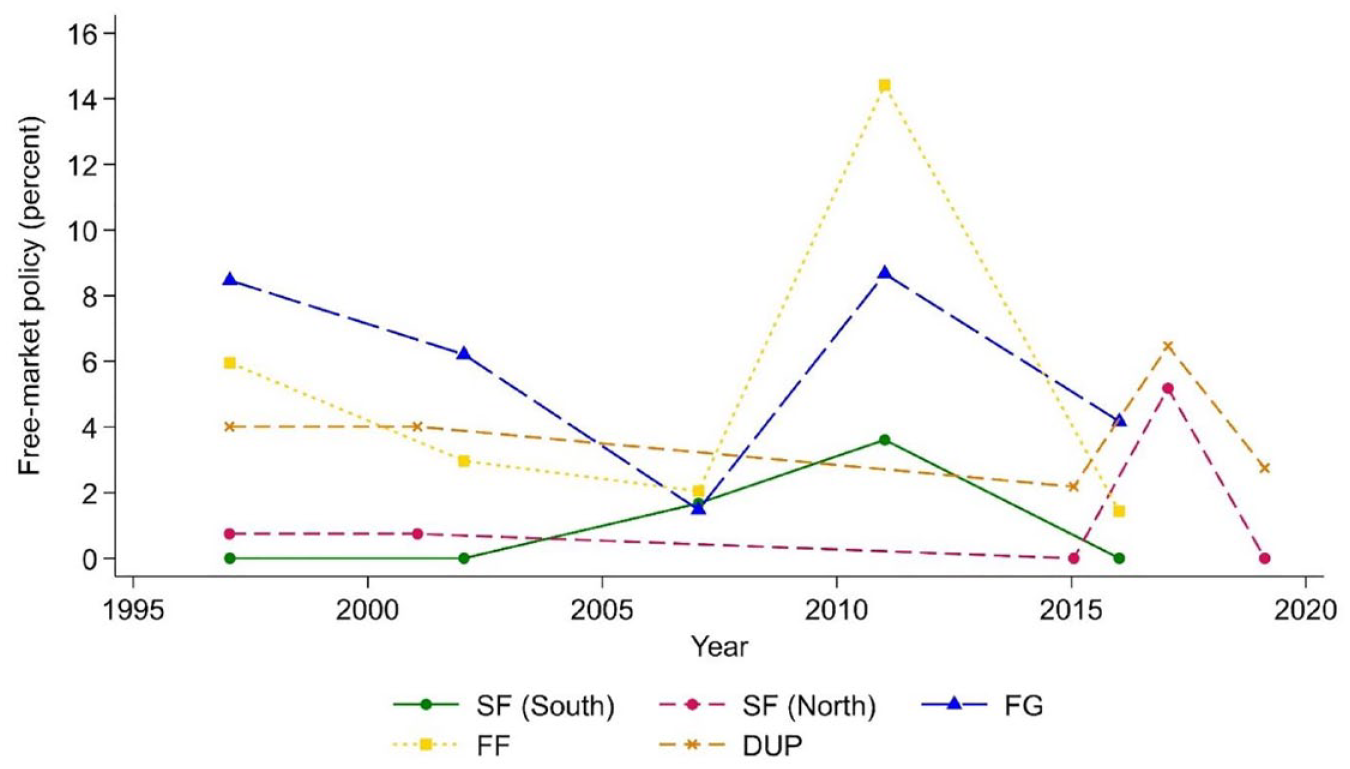
Percentage of coded manifesto sentences supporting free-market issues.
Comparing Sinn Féin’s policy agenda/issue focus, North and South
Table 1 compares Sinn Féin’s issue focus in terms of the attention paid to each issue in percentages of coded quasi-sentences and ranks its top five issues for the previous three elections in each jurisdiction. For this analysis, the DUP and Sinn Féin (North) manifestos for 2017 include the contents of their manifestos from 2016, as both these parties claimed that their 2017 policy platforms incorporated their 2016 manifestos.
Sinn Féin’s top policy agenda, North and South, 2011 – 2022 (percentage of policy agenda).

NI: Northern Ireland.
SF’s 2017 manifesto data are based on a combined 2016 and 2017 policy platform.
The table shows that Sinn Féin in the South pays attention to the types of issues that you would expect of a social democratic party, especially one that was attempting to grow its support in the aftermath of the Great Recession. So, we can see that in all three elections issues around the economy, social policy, and health care are given significant attention. This is typical of the wider West European trends in issue attention during these years of crisis and austerity for many eurozone countries, which saw a resurgence in class-based issues linked to the economy (Green-Pedersen, 2019a: 69). Sinn Féin was able to take advantage of voters’ anger around the collapse of the Celtic Tiger in 2009 and subsequent Troika-led austerity programme – as evidenced by its 24.1% economic issue attention in the 2011 election – to grow its support base among both the working class and disaffected younger voters (Cunningham and Marsh, 2021: 229).
So, as expected, Sinn Féin’s issue attention in the South plays to its strengths as a left-wing party that challenges a previously conservative party system (Hobolt and Tilley, 2016: 975). The only surprise is business entering the top five party issues in 2020, which seems unusual for a party of the left. However, its increased agenda capacity in that election – 2020 was the largest manifesto ever produced by Sinn Féin – provided space for the party to cover issues where it is traditionally viewed as being weak. For example, Sinn Féin’s opponents regularly refer to it as ‘anti-enterprise’ (McGee, 2023).
Table 1 also shows that Sinn Féin in the North exhibits a significantly different policy agenda to the South, especially in the 2016 and 2017 Assembly elections. In these elections, it is political issues that dominate the party’s issue focus, linked to problems around the functioning of the power-sharing Executive – not least, the Renewable Heat Initiative (RHI) scandal – and the fallout from Brexit (Tonge, 2022: 529). Personal rights come second in terms of issue attention in both elections, which points to the tensions between the DUP and Sinn Féin regarding the liberalisation of the North’s laws on abortion and gay marriage (Tonge, 2022). But personal rights also include religious civil rights, which coincides with Sinn Féin’s equality agenda of countering sectarian discrimination in the North. In contrast, this is not a feature of politics in the South, and Sinn Féin’s focus on personal rights in the 2020 general election is linked to more typical socially liberal issues, such as abortion and gay rights. It is not correct to categorise Sinn Féin’s issue focus on personal rights as part of a ‘new left’ agenda or an overarching commitment to ‘GAL’ values (see Figure 2). Instead, when Sinn Féin focuses on personal rights it often relates to sectarian discrimination in NI and the legacy of the conflict. When Sinn Féin does embrace GAL values – as in the lead up to the 2018 abortion referendum – this supplements its class-based focus on economic issues. Unlike some other mainstream left-wing parties, where campaigning on liberal rights replaced traditional left-wing economic policy commitments (Berman and Snegovaya, 2019: 6).
Crime and justice rank third on Sinn Féin’s issue attention for 2016 and 2017 (see Table 1), but this issue focus is not part of a ‘law and order’ agenda in the North. Instead, crime and justice for Sinn Féin predominantly involves policing reform and campaigning for victims of state-led violence during the Troubles. This makes it unusual in Europe, where a crime focus is of growing significance, but usually represents a desire for increased policing rather than structural reform (Green-Pedersen, 2019a: 69). In contrast, crime and justice are not a part of Sinn Féin’s key issues in the South. Interestingly, foreign affairs are in the top five issues in all three elections in NI. But, once again, foreign affairs are not part of Sinn Féin’s key policy agenda in the South. The foreign affairs aggregate for the Northern Irish data includes references to the Republic of Ireland and all-island policy solutions, which is a central focus for Sinn Féin given its long-term plan to incrementally reorientate Northern Irish society towards reunification.
For instance, Figure 4 shows the proportion of coded quasi-sentences in Assembly manifestos dedicated to North-South issues. It demonstrates how much more regularly Sinn Féin mentions North-South (all-island) policy issues when compared to other parties in the North, even other nationalist parties like the SDLP. In fact, Sinn Féin mentions North-South policy issues three times more than the unaligned or unionist parties in NI, which demonstrates the party’s issue ownership over all-island policy. Unsurprisingly, the parties of unionism – the DUP, the Ulster Unionist Party (UUP), and the Traditional Unionist Voice (TUV) – devote relatively little manifesto space to all-island issues when compared to nationalism, given their preference for maintaining and expanding NI’s union with Britain (see Figure 4).
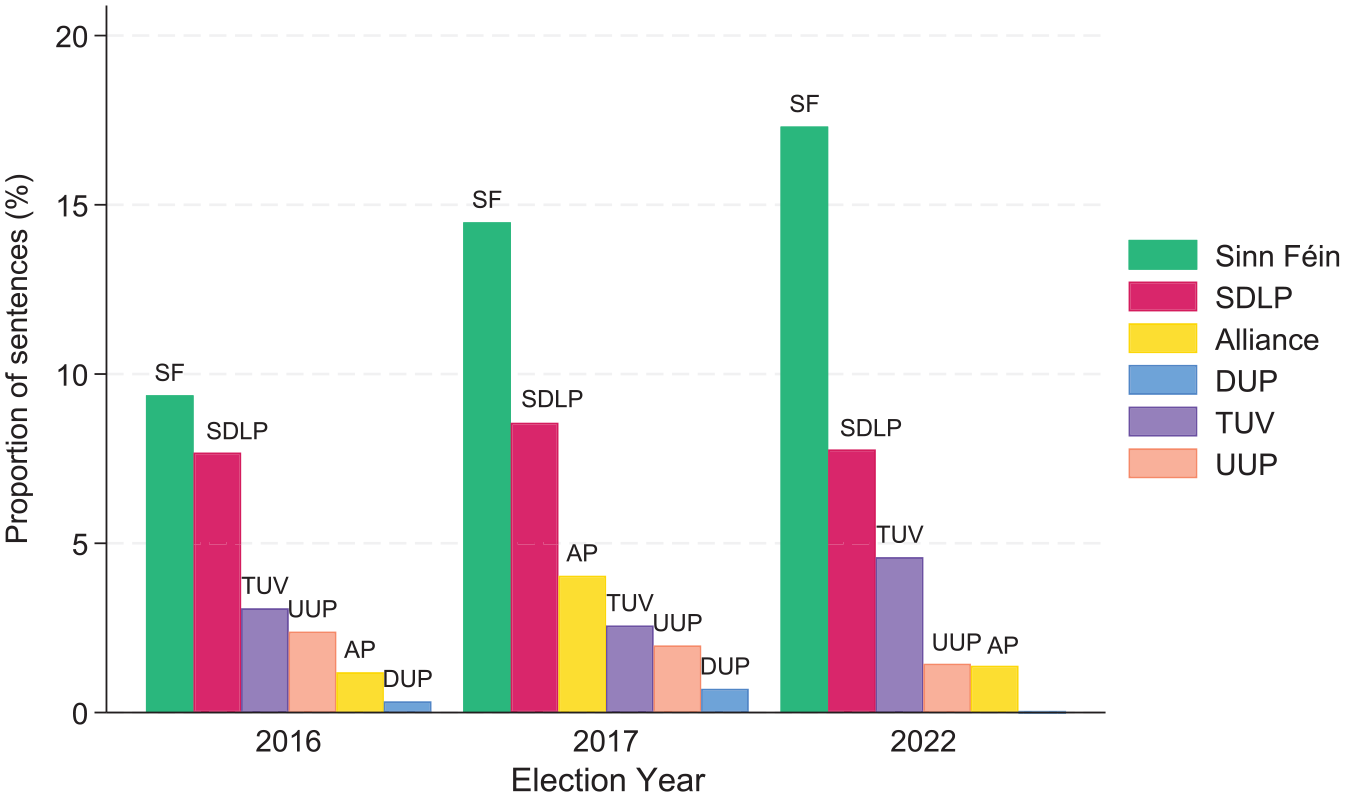
Attention to North–South issues in Northern Ireland Assembly manifestos.
Similarly, Figure 5 shows that Sinn Féin pays more attention to North–South issues than any other party in the South. 4 Although this issue focus is far less important for the party in the South than the North. The other mainstream Republican party – Fianna Fáil – ranks second on North-South issues, with just over 4% of its manifestos devoted to all-island issues. Fine Gael’s traditional suspicion of Republican ideology brings it in third on North–South issues. But the other mainstream parties – the Green Party, Labour, and the Social Democrats – consistently devote less than 2% of their manifestos to North–South issues. This demonstrates that an all-island focus is not a priority for these parties or their voters. Crucially, support for all three of these parties is concentrated in urban areas and none of them have significant support in the border counties, where all-island policy issues are the most pertinent.
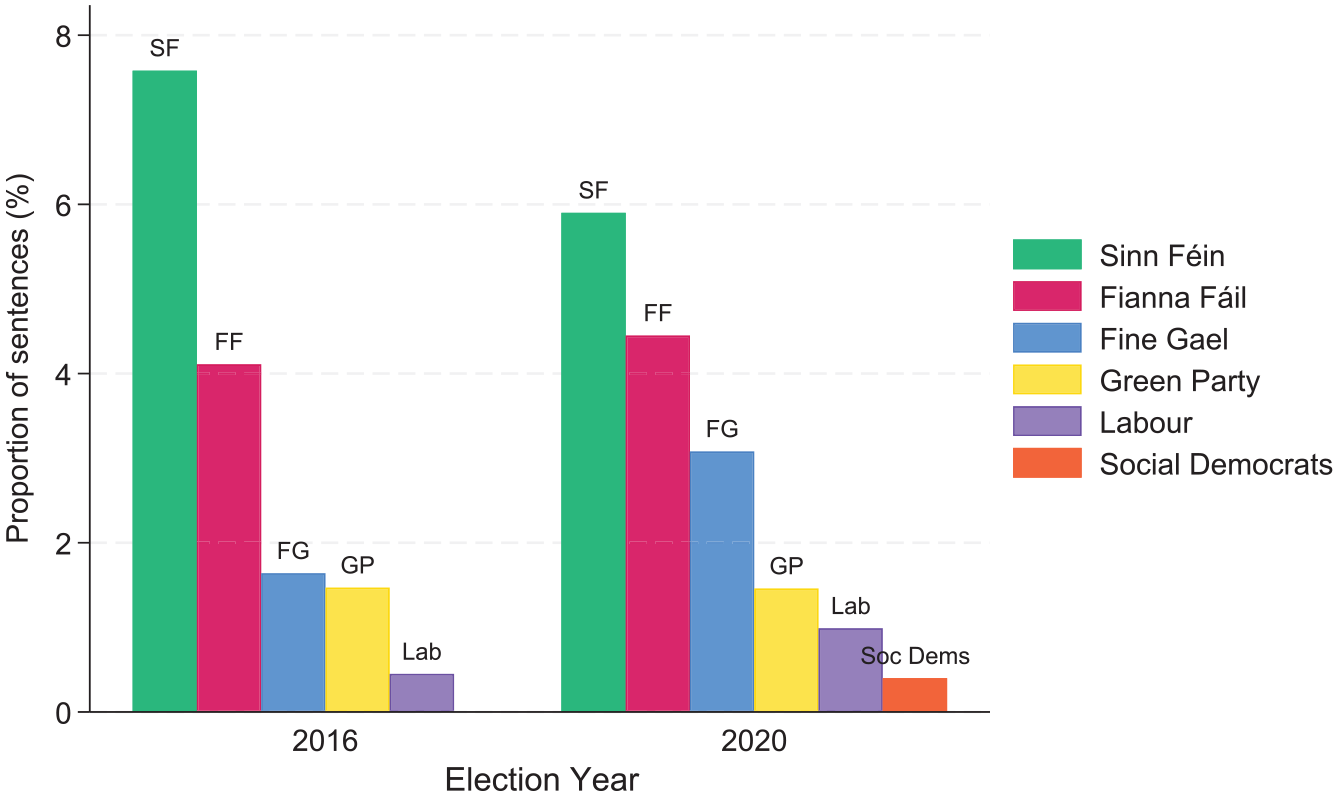
Attention to North–South issues in Republic of Ireland manifestos.
In summary, Table 1 shows that for the 2016 and 2017 Assembly elections, there are significant differences between Sinn Féin’s policy agenda, North and South. But the issue focus for the 2022 NI Assembly election resembles the party’s issue attention in Southern elections. The only significant divergence is that foreign affairs is third in terms of issue rank in 2022; but this is linked to Sinn Féin’s focus on North–South issues in NI (see Figure 4). Sinn Féin downgrades North–South issues in the South, but it does not ignore them, and it devotes more space to these policies than any other party (see Figure 5). Otherwise, Sinn Féin’s focus on issues like health care, education, and the economy is typical of other mainstream West European parties’ policy agendas (Green-Pedersen, 2019a: 69), and typical of the party system agenda in the Republic of Ireland (Green-Pedersen and Little, 2023a: 52).
Comparing Sinn Féin’s policy agenda relative to the party systems, North and South
By looking at the party system in the South more forensically, we may be able to isolate how issue competition between the parties has influenced Sinn Féin’s development of a policy agenda that could gain significant support by 2020. Table 2 compares Sinn Féin’s policy agenda to the agenda pursued by three of its competitors in the South: Fianna Fáil, Fine Gael, and Labour. 5 The extreme shock to the Irish political system caused by the Great Recession shows all three of these mainstream parties converging on the similar key issues of government, economy, politics, and business in 2011, albeit in differing orders of preference. In contrast, government and business are absent from Sinn Féin’s top issues. Issue competition theory claims that mainstream parties must deal with a similarly broad set of policy problems, so they will converge on the same issues in the lead up to elections, and their issue attention will reflect the overall party system agenda (Green-Pedersen, 2023: 213). In 2011, Sinn Féin was still a minority party that was developing its support base. However, in subsequent elections, as Sinn Féin becomes more competitive (and mainstream) in the South, its key issue focus resembles the other parties in the table.
Top issues for four mainstream parties in the Republic of Ireland, 2011 – 2020, (percentage of issue attention).

In fact, there is some evidence to suggest that Sinn Féin, like other successful opposition parties, has influenced the entire party system (Green-Pedersen and Mortensen, 2010). For instance, by 2020, all three competitor parties place housing as their most important issue. This represents party politics responding to a serious policy problem in Ireland, but it is also an issue where exit polling showed a majority of voters viewed Sinn Féin as being the most competent party during the 2020 general election (Cunningham and Marsh, 2021: 231). Presumably, housing is an issue that the establishment parties of FF and FG would prefer to avoid, especially as their confidence and supply agreement of 2016 placed them in a position of policy symbiosis in the minds of many voters, which enabled Sinn Féin to portray themselves as the party of ‘change’ in 2020 (Park and Suiter, 2021: 131). Interestingly, housing does not enter Sinn Féin’s top five issues in 2020; in fact, it is in sixth place (Green-Pedersen and Little, 2023a: 52). This suggests that Sinn Féin’s dominant issue ownership over housing policy provided them with the opportunity of prioritising other issues where voters may view them as weak, such as on business (Green-Pedersen, 2019a: 18).
Four mainstream parties in NI are also compared in terms of their issue focus in Table 3. This table shows that the SDLP and Alliance Party (AP) are much more focused on bread-and-butter issues around social provision – such as education, health care, and social policy – than either the DUP or Sinn Féin. In fact, the issue preferences of the SDLP and Alliance resemble the party system agenda in the South (see Table 2). Although, unlike parties in the South, the SDLP and Alliance focus on crime and justice issues in nearly every election. However, given the contested nature of legacy issues relating to the Troubles, this is something specific to Northern Irish politics. Also, when the NI Executive is functioning, the AP regularly holds the devolved justice ministry; for instance, both David Ford (former party leader) and Naomi Long (party leader and current Minister of Justice) have held that post. This makes crime and justice an obvious issue preference for that party.
Top issues for four parties in Northern Ireland Assembly elections, 2016 – 2022.

SDLP: Social Democratic Labour Party; DUP: Democratic Unionist Party; AP: Alliance Party.
SF and the DUP manifesto data based on a combined 2017 and 2016 policy platform.
In contrast, Table 3 shows that both Sinn Féin and the DUP are more focused on issues that are related to constitutional conflicts over the running of the Executive – such as the politics and government issue aggregates – than the SDLP or Alliance. Sinn Féin and the DUP have built their reputation on being the parties best able to represent their communities’ concerns against their ethnic opponents (Moore et al., 2014): focusing on political and governmental issues are integral to their campaign strategies. However, the period from 2016 to 2022 can be viewed as one of instability for the NI party system, thus shaping the overall party system agenda (Bevan and Jennings, 2019: 228). For example, Sinn Féin and its then leader in the North, Martin McGuinness, reluctantly collapsed the NIA in January 2017 due to tensions with the DUP over gay marriage, abortion, the Irish language, the RHI scandal, and a general sense within their Republican base that DUP representatives were failing to respect the nationalist community (e.g. withholding funds for school children to visit the Gaeltacht and mocking the Irish language in the Assembly). Tensions surrounding Brexit were in the foreground, but the referendum result in June 2016 was not a deciding factor in the subsequent collapse of power sharing structures (Tonge, 2022: 529). However, the fallout from Brexit became the main reason why the Assembly remained suspended after the 2022 Assembly election.
The DUP refused to return to the Assembly until February 2024 because the NI Protocol and subsequent Windsor Framework placed NI in a customs union with the EU to avoid a hard border on the island of Ireland, necessitating a trade border in the Irish sea between Britain and NI (Hayward, 2023). This places NI in a separate position to the rest of the United Kingdom, which many unionists view as a dilution of the union (Murphy and Evershed, 2020). Conversely, Sinn Féin is relatively happy with the Windsor Framework because it ensures no border on the island of Ireland and gives NI free trade with both Britain and the EU (Evershed and Murphy, 2022). Importantly, for Sinn Féin, this provides a welcome incentive for the Northern Irish economy to reorientate away from Britain and towards an Irish/EU axis.
The extreme shock to the NI party system caused by the fallout from Brexit is shown in Table 4. It provides the issue focus for the shortened document (or manifesto addendums) that both Sinn Féin and the DUP produced in lieu of full manifestos in 2017. Essentially, these addendums stated that the 2016 manifesto was still their party platform and introduced some new issues to deal with more recent events. For both parties, political issues dominate their issue focus in these addendums, with politics at 31.7% issue attention for Sinn Féin and 41.5% for the DUP (see Table 4). Also, for the first time, Europe enters the top five ranked issues for both parties. Personal rights are the second most important issue for Sinn Féin in this 2017 document because Article 2 of the NI Protocol is committed to upholding the rights and equality protections that had been guaranteed by the GFA, which are viewed as an important safeguard by the nationalist community (Hayward, 2023, 3).
Short manifesto addendum of Sinn Féin and the DUP, March 2017.

DUP: Democratic Unionist Party.
It is interesting how the Brexit fallout has had a greater impact on the main parties on nationalism (Sinn Féin) and unionism (DUP) than other mainstream parties in the North. This suggests that representing ethnic concerns at periods of crisis for their community is still part of Sinn Féin’s voter appeal and issue focus. However, Table 3 does show that in 2022 Sinn Féin had a typical social democratic focus on issues like education, health, housing, and the economy. So, why were constitutional issues around politics and governance downgraded in that campaign?
By 2022, nationalism in the North was in a position of confidence and political security. In contrast, back in 2007, Sinn Féin desperately needed the DUP to enter power sharing to justify the Adams and McGuinness peace strategy: proving that an incremental working of the GFA structures could lead to political progress and a United Ireland (Tonge et al., 2014: 46–47). However, in 2022, the pressure was on the DUP to re-enter power sharing and not Sinn Féin. While political paralysis was not welcomed by Sinn Féin, it did not damage them politically because the DUP was viewed as the intransigent party. In fact, continued paralysis could have been used to support a border poll based on the North being a ‘failed state’ (Breen, 2023). But if the Assembly restarted then Sinn Féin could portray themselves as a responsible party of government in the North, ready to take power in the South. A position that Sinn Féin eagerly took up when power sharing was restored in February 2024 and Michelle O’Neill (vice-president of Sinn Féin) became First Minister. Essentially, the impasse in the North was a strategic win-win situation for Irish Republicanism. This suggests that during periods of insecurity for nationalist interests in the North, Sinn Féin’s party policy agenda focuses on political and ethnic identity issues, but when nationalist interests are more secure, it can embrace a social democratic policy agenda that resembles its policy preferences in the South.
Issue overlap between Sinn Féin (North and South) and its competitor parties
Sigelman and Buell (2004) have devised a measure for issue convergence which can tell us how similar party manifestos are when compared (in this case) on the 23 central issues detailed in the Appendix 1. The measure involves taking the absolute differences in issue attention between the 23 issues in the two manifestos that are under comparison. This number is then calibrated to a range from 0 (completely dissimilar) to 100 (completely similar) and is then subtracted from 100 to give the extent of issue overlap and not difference (Sigelman and Buell, 2004: 653).
Table 5 illustrates the extent of similarity between Sinn Féin’s manifestos, North and South, through this issue overlap measure. As argued above, it shows that Sinn Féin’s manifestos in the North are most similar to the South when nationalist interests are relatively secure, as when the 2022 NI Assembly manifesto is compared to the 2020 General Election in the South (at 70.6% overlap). But they become least similar during the 2017 NI Assembly election – at 59.9% overlap – when Irish nationalism in the North was concerned about the fallout from Brexit and the collapse of the Assembly. Overall, there is an average issue overlap of 65% between Sinn Féin’s manifestos over the years assessed (2011–2022).
Issue overlap between Sinn Féin manifestos, North and South.

NI: Northern Ireland.
The issue overlap figures for the party system in NI (Table 6) and the Republic of Ireland (Table 7) demonstrate the influence that office and vote-seeking incentives have on Sinn Féin’s policy preferences. In fact, Sinn Féin’s policy preferences overlap more with their competitor parties in each jurisdiction than they do between their own manifestos. For instance, Table 6 shows that in the South the average overlap between Sinn Féin manifestos and the three parties assessed (Fine Gael, Fianna Fáil, and Labour) are all greater than Sinn Féin’s cross-border issue overlap of 65%. The issue overlap with Fine Gael even reaches a high of 80.8% in 2020. Fine Gael was in government during the years assessed, so Sinn Féin had an incentive in mirroring (and criticising) its issue focus. Similarly, in NI, Table 7 shows that the average overlap for Sinn Fein’s main competitor parties, the nationalist SDLP (71.9%) and non-aligned AP (75.7%), are all higher than Sinn Féin’s manifesto overlap between North and South. The only exception is the DUP which is at an average overlap of 65.5%. Given that Sinn Féin and the DUP compete for different voters along the ethnic divide and are ideologically incompatible, their policy preferences are unlikely to be similar. But it is surprising that the average issue overlap between Sinn Féin, North and South, is 0.5% less than the average overlap with their DUP opponents. The fact that Sinn Féin’s issue overlap is closer to its main competitors in each jurisdiction rather than between the party (North and South) accentuates how much the processes of issue competition and agenda-setting impact policy preferences within states. In effect, Sinn Féin’s manifestos in the North are more similar to the DUP’s policy agenda than the agenda of Sinn Féin in the South. This shows that even a highly disciplined and ideologically committed party like Sinn Féin must adapt its policy preferences to cater to vote and office-seeking incentives across jurisdictions if it wishes to remain electorally competitive.
Issue overlap between Sinn Féin manifestos and competitor parties in the South.

Issue overlap between Sinn Féin manifestos and competitor parties in the North.

SDLP: Social Democratic Labour Party; DUP: Democratic Unionist Party.
Sinn Féin’s policy preferences: Reunification as the overarching goal
For a party that is dedicated to the goal of a United Ireland, Sinn Féin devotes a relatively small amount of policy attention to reunification issues. Figure 6 shows the extent (in terms of coded quasi-sentences in manifestos) that parties in the North devote to issues that question the constitutional position of Northern Ireland. Sinn Féin allots between 5% and 7% of their manifestos to reunification issues between 2016 and 2022. This can be understood as its unique selling point, where it has issue ownership. But the party knows that an issue focus that prioritises the national question over day-to-day problems does not win elections. So, Sinn Féin ensures that its policy agenda is not dominated by the national question. In 2022, the TUV devotes nearly as much manifesto space to questioning the constitutional position of Northern Ireland as Sinn Féin (see: Figure 6). But this issue focus comes from a more radical unionist perspective that claims the union is in danger and needs protection, rather than an Irish Republican perspective of advocating for the end of the union.
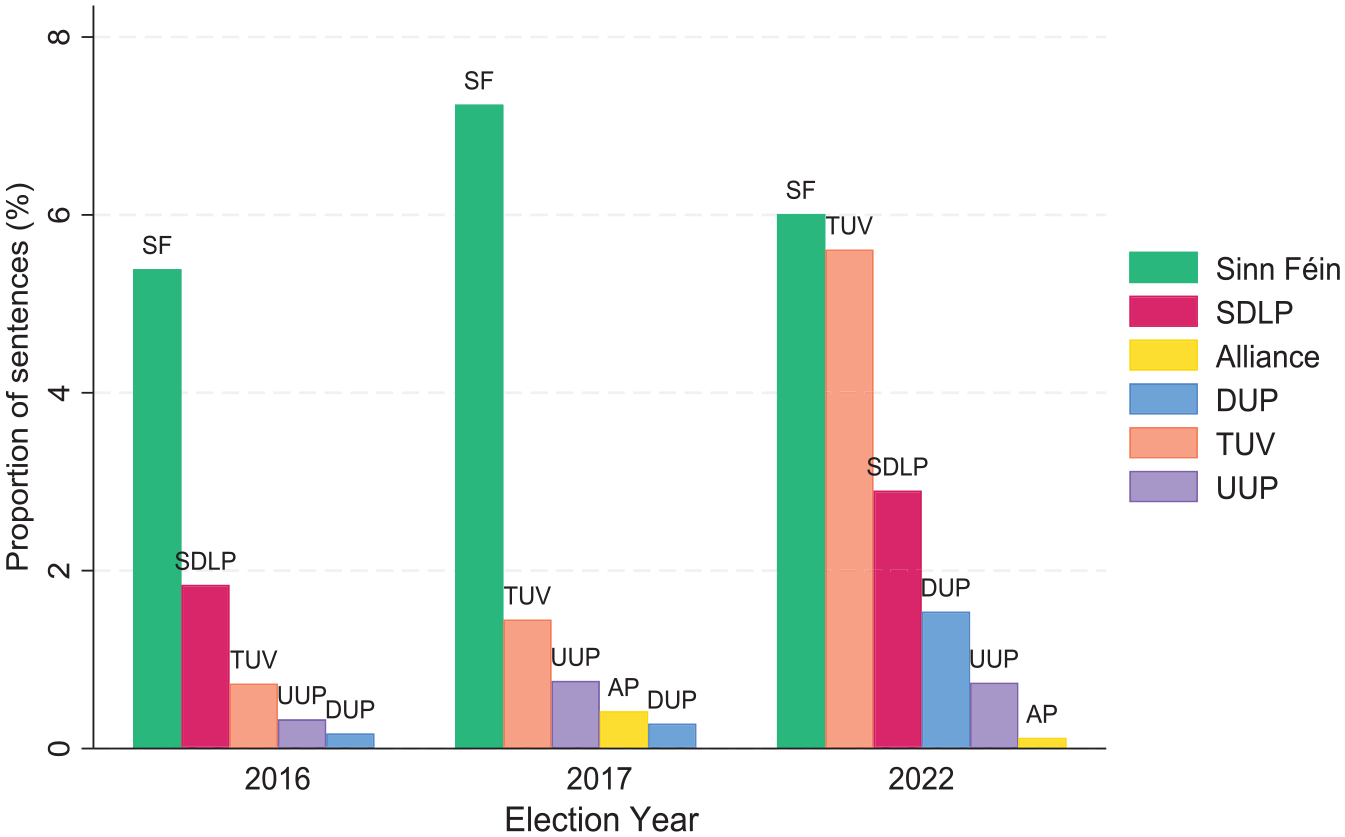
Attention to the constitutional status of Northern Ireland in Assembly manifestos.
In the South, the attention paid to the constitutional position of NI by political parties has been in decline since the stabilisation of the peace process (Green-Pedersen and Little, 2023b: 10). Figure 7 shows how Sinn Féin tailors its message to Southern voters by allotting less than half the space to Irish reunification when compared to its manifestos in the North, at only between two to three per cent of coded manifesto sentences. 6 A United Ireland is a popular policy in the South, polling shows that 64 per cent support reunification (Loscher, 2023), but it is not an issue of day-to-day concern and does not win elections. However, Sinn Féin still devotes more space to reunification than any other mainstream party (see Figure 7). In fact, the other parties assessed assign less than half a per cent of their manifestos to reunification and some do not consider it at all, such as Fine Gael in 2016 or the Green Party in 2020.
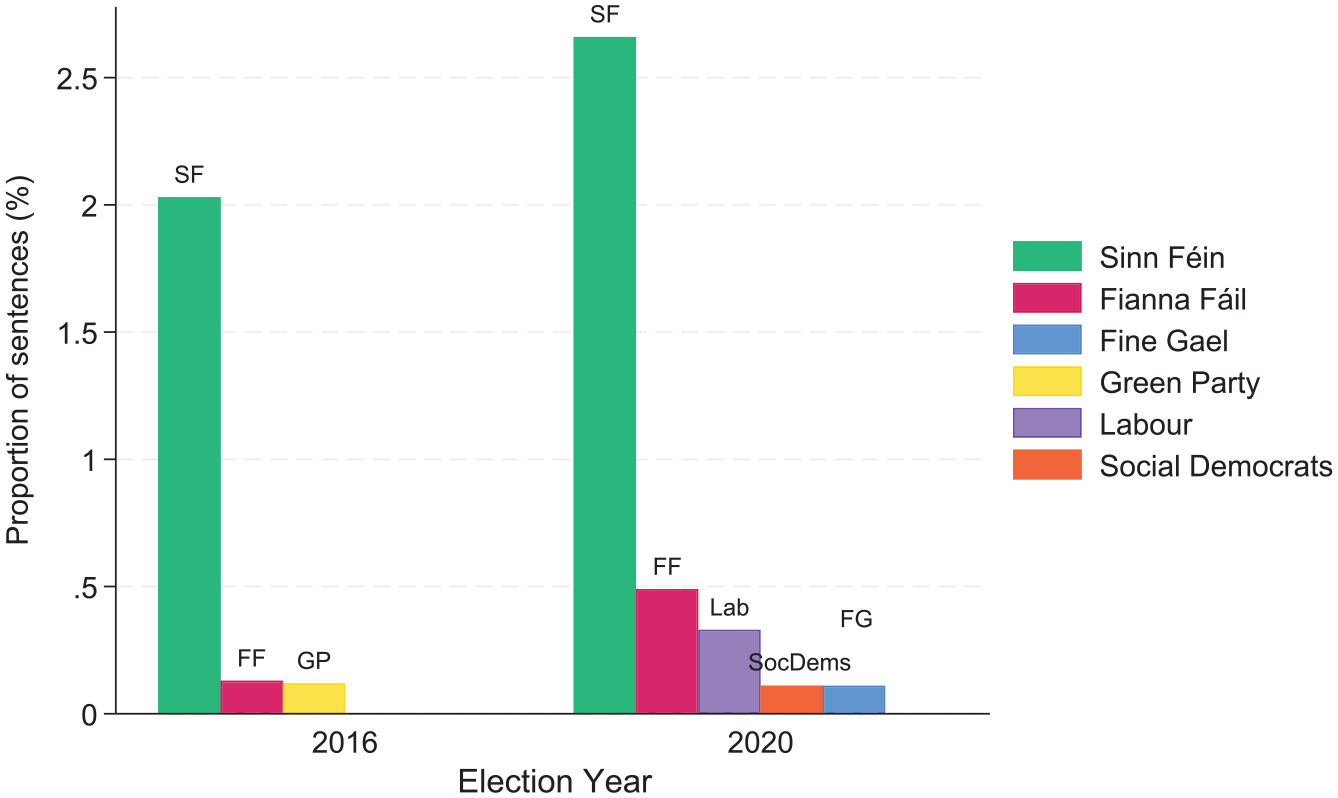
Attention to the constitutional status of Northern Ireland in Republic of Ireland manifestos.
What Sinn Féin lacks in issue attention on a United Ireland it makes up for in policy framing. For instance, in Sinn Féin’s manifesto for the 2020 General Election in the South, its introduction expresses Sinn Féin’s desire for ‘change’ through the context of the historic struggle for Irish independence and a United Ireland (Sinn Féin, 2020: 3). Tellingly, the first policy section after the manifesto’s executive summary is on reunification (Sinn Féin, 2020: 11). Similarly, in the 2022 NI Assembly election manifesto, the first page is a photo of Dublin-based Mary Lou McDonald, surrounded by a Northern leadership team made up of Michelle O’Neill MLA, John Finucane MP, and Conor Murphy MLA. The first address in the manifesto is by McDonald, and it frames Sinn Féin’s policy agenda for the Assembly through an all-island lens: ‘In the South, Sinn Féin leads the opposition, and we are ready to lead the government. We are ready to deliver the kind of change that people are crying out for’ (Sinn Féin, 2022: 4). So, while Sinn Féin’s issue focus is not dominated by the nationalist struggle, its overarching goal of a United Ireland is something that frames its policy preferences, North and South.
Conclusion
The assumptions outlined by issue competition and agenda-setting theory are proven to be accurate in the case of Sinn Féin: the party does significantly adapt its policy agenda based on the varying institutional contexts and voter attitudes acting upon it, North and South. The theoretical implications of this article highlight the importance of issue competition and agenda setting within party systems in shaping party policy preferences. It is telling that Sinn Féin’s issue overlap is greater with its competitor parties in the North and South, than between its own cross-border manifestos. This shows how public attitudes (including ethnic cleavages), coalition constraints, and institutional contexts can influence policy preferences, even within a centralised party like Sinn Féin that is unified through a defining cause. Institutional context and varying public attitudes do, in fact, determine party policy preferences.
What the results tell us is that Sinn Féin’s position as a ‘tribune party’ that defends Irish ethnic identity is still an important part of its electoral appeal in the North (Mitchell et al., 2009). But this ethnic representation comes to the fore during periods when nationalist interests are under threat, as during the collapse of the NI Executive and the fallout from Brexit in 2017. In the South, Sinn Féin’s electoral strategy – and policy preferences – are based on its social democratic economic and social policy. In terms of issue saliency, Sinn Féin’s policy agenda does not differ significantly from other mainstream parties; instead, its appeal is based on a message of change and policy competency on issues that represent policy failure for successive Irish governments, such as on health and housing (Green-Pedersen and Little, 2023a: 54–55). However, its position on these issues is to the left of the establishment parties of Fianna Fáil and Fine Gael. Sinn Féin’s focus on competency and valence issues that affect voters’ lives – such as health, education, and housing – is typical of mainstream electorally competitive parties in Western Europe because these are the issues that concern a majority of voters, and it is where elections can be won (Green-Pedersen and Seeberg, 2023).
Espousing consistent policy between North and South is a priority for Sinn Féin, especially when policy divergence could hinder electoral performance or open the party to allegations of hypocrisy. For instance, in August 2014, and again in March 2015, Gerry Adams – the then party leader – intervened to stop the party agreeing to implement Tory cuts to welfare as part of the negotiations for the Stormont House Agreement in Northern Ireland (Fitzmaurice, 2015). It was Adams, and officials from the South, who felt the party could not agree to implement welfare cuts in the North while opposing them in the South, even as part of a compromise within Northern Ireland’s power-sharing Executive (Fitzmaurice, 2015). But these findings do suggest that Sinn Féin could embrace contradictory policy positions between North and South when responding to the issue competition and agenda-setting processes in the separate jurisdictions, as part of an all-island vote and office-seeking strategy.
In 2023, immigration became a serious political issue for the first time in Irish politics (Arlow and O’Malley, 2024). For the years assessed in this article (2011–2022), Sinn Féin only devotes 1% or less of their coded manifesto sentences to issues of immigration either side of the border. Essentially, it was just not an important issue for the party or Irish voters in general. But the rise of immigration as a more salient issue for voters in the South has shattered the coalition that Sinn Féin built during the 2020 election of the working class and disaffected middle-class youth. This has led to a dramatic decline in Sinn Féin’s support, from a high of 36% in July 2022 to 20% by August 2024 (Louwerse and Müller, 2024). Recent surveys have shown that former Sinn Féin supporters view immigration as their number one concern, and the voters who still support the party view the housing crisis as a more important issue (Costello, 2024). In response, Sinn Féin has attempted to mirror Fianna Fáil and Fine Gael by taking a centrist line on immigration, acknowledging that there are problems in processing asylum claims and legitimate concerns held by some deprived communities over asylum-seeker accommodation, but retaining a fundamentally liberal position on immigration (Sinn Féin, 2024a: 2). This stance risks alienating their left-wing supporters who view triangulating on immigration as pandering to the radical right and a betrayal of its anti-racist principles. Importantly, in the 2024 European Parliament election, Sinn Féin devoted an entire section to voter concerns over immigration in their manifesto, the first time they have ever allocated significant space to this issue (Sinn Féin, 2024b: 25–26). It is likely that immigration will continue to be a significant issue for all parties leading into the next general election in the South, but surveys show that immigration is still not an important issue for the nationalist community in NI, with only 13% of nationalists believing immigration is too high (Breen, 2024). This means that in future elections Sinn Féin’s policy preferences between North and South could significantly diverge on the saliency of immigration as a political issue. Although, it is important to note that immigration is not a devolved issue, and this structural constraint could facilitate Sinn Féin choosing to ignore this issue during regional elections in Northern Ireland.
Finally, further research could build on the article’s findings by utilising Comparative Agenda Project data to see if other radical parties – that are dedicated to an ideal or cause – become most responsive to public attitudes during critical periods for their support base, and if the same parties shift to core policy preferences when the interests of their base are no longer under threat. Essentially, crises may lead radical parties to become more responsive to vote and office-seeking incentives as they adapt their policy preferences to further their electoral ambitions and to progress the cause. This theory could only apply to those left-challenger or anti-systemic parties that are serious about office-seeking, as opposed to lesscompetitive parties that prize ideological purity over other goals.
Footnotes
Appendix
Twenty-three policy issues (aggregates of subtopics).
| Economy |
| Personal rights |
| Immigration |
| Health care |
| Agriculture |
| Labour |
| Education |
| Culture |
| Environment |
| Energy |
| Transportation |
| Crime and justice |
| Social policy |
| Housing |
| Business |
| Defence |
| Technology |
| Foreign affairs |
| European integration/EU |
| Local and regional affairs |
| Government operations |
| Politics |
| Territories/former colonies |
Source: Green-Pedersen (2019a: 46).
Acknowledgements
I am grateful to Conor Little and Jon Tonge for their helpful advice on this research.
Funding
The author(s) disclosed receipt of the following financial support for the research, authorship, and/or publication of this article: This work was supported by the UK Research and Innovation, Horizon Europe Guarantee [Grant Number EP/Y027590/1].
