




Abstract
Because the prejudice of the ingroup builds into fear of the outgroup, jihadist terrorism is expected to strengthen the politicized link between security and immigration. I use a causal inference in a clustered cross-country analysis to test the simultaneous short-run causal impact of the jihadist threat on security fear and ethnic prejudice of the public in Israel, the Netherlands, Russia, Sweden, France, and Germany. In line with common wisdom, jihadist attacks significantly increase security fear. Against it, jihadist attacks non-significantly decrease ethnic prejudice. This empirical pattern holds in across different types of immigration attitudes, ethnic groups, intervals of time and terrorist events, and is robust to placebo treatments, placebo policy preferences, fake and failed terror attacks. These findings challenge extant consensus, and suggest that jihadist attacks, particularly at the local level, induce risk-aversion rather than desire for retaliation.
Introduction
Following 9/11, scholars became increasingly interested in how security concerns, on top of cultural and economic ones (e.g., Citrin et al., 1997; Hainmueller & Hopkins, 2014; Mayda, 2006; Pardos-Prado & Xena, 2019; Valentino et al., 2017), shape attitudes towards immigrants and minorities (e.g., Böhmelt et al., 2020; Lahav, 2010; Legewie, 2013; Messina, 2014). Episodes of hate crimes (Hanes & Machin, 2014), labor (Davila & Mora, 2005), housing (Gautier et al., 2009) or institutional discrimination (Shayo & Zussman, 2011) are thought to signal a worrisome shift in public attitudes (e.g., Elsayed & De Grip, 2018). However, whether the public at large leans with or against such discriminatory behavior is still an open question.
This paper tests how jihadist attacks impact on the public’s “security fear,” capturing the public’s concern for security threats, and “ethnic prejudice,” encompassing all negative emotions or evaluations associated with immigrants and minorities. I propose a three-step empirical design. I begin by defining terrorist attacks as murderous plots perpetrated by members of known jihadist organizations and collect any attack that matches this definition from the Global Terrorism Dataset (GTD, 2017). I then systematically check whether any such jihadist attack happened to have occurred during the fieldwork period of any round of the European Social Survey (ESS, 2016). Because the timing of the interviews is as good as random with respect to the date of each attack as they were scheduled earlier through strict random sampling, jihadist attacks represent plausibly exogenous variation of the level of security threat. I can hence use a causal inference in cross-country design to compare public attitudes before (the control group) and after (the treatment group) jihadist attacks.
Findings are as follows. In line with conventional wisdom, jihadist attacks significantly increase the public’s security fear. Against conventional wisdom, I find that jihadist attacks non-significantly decrease ethnic prejudice. This empirical pattern holds across different types of immigration attitudes, including those focusing on economic or cultural concerns, different ethnic groups, including the Muslim, Gypsies and Jewish migrants, and different specifications including varying intervals of time and terrorist event. After conducting several robustness checks and placebo analyses, I conclude that the public reacts to terrorist attacks with fear without prejudice.
I interpret these findings according to group-threat theory. Jihadist attacks may de-emphasize perceived group threat, which elicits desire for retaliation (see e.g., Kam & Kinder, 2007; Lahav & Courtemanche, 2012), while highlighting perceived individual threat, which elicits anxiety thereby lowering ethnocentrism (Fischhoff et al., 2003; Lerner & Keltner, 2000). Although this mechanism cannot be tested directly in non-experimental settings, conditioning attitudinal patterns on threat-exposure furthers its plausibility. Among more directly exposed respondents, who experience stronger security fear, the decrease in prejudice is both stronger and less partisan (Huddy et al., 2005, 2009).
From a methodological perspective, I contribute to the literature on terrorism and public opinion in two ways. Firstly, while previous research has largely focused on the transnational effect of jihadist attacks (Finseraas et al., 2011; Legewie, 2013; Nussio et al., 2019; Schüller, 2016), I focus on the effect of jihadist attacks at the local level, either national or regional. In doing so, I maximize compliance with the treatment, increasing the internal validity of the analysis. Secondly, while previous work restricts statistical inference to one case study only (Finseraas et al., 2011; Legewie, 2013; Nussio et al., 2019; Schüller, 2016; Van Hauwaert & Huber, 2020), I draw conclusions based on nine jihadist attacks that occurred between 2002 and 2016 in Israel, the Netherlands, Russia, Sweden, France, and Germany using the same empirical design. Such a design yields higher external validity.
These methodological differences are important beyond internal and external validity; they result in findings that substantively contrast with previous literature (Finseraas et al., 2011; Legewie, 2013; Nussio et al., 2019; Schüller, 2016, for an exception see Van Hauwaert & Huber, 2020). It is often assumed that since the prejudice of the ingroup builds into fear of the outgroup (e.g., Quillian, 1995), stronger outgroup-driven security threats should monotonically increase ethnic prejudice (Legewie, 2013). Seen as the behavioral counterpart of a widespread attitudinal shift, episodes of discrimination against Muslims in the shadow of jihadist threat have reinforced this view (e.g., Hanes & Machin, 2014). My findings indicate that this conventional wisdom should be re-qualified: the correlation between security fear and ethnic prejudice, relevant in peaceful times vanishes precisely under the most salient of all threats. Terrorism and the fear of it may thus entail an ironically positive effect on democracy because heightened risk-aversion fosters information-seeking and reduce prejudice; “a worried citizen is a good citizen” (Valentino et al., 2008).
The paper proceeds as follows. Firstly, I bridge the literature on group threat theory with that on terrorism and public opinion to set out expectations. Then I present the empirical design. In doing so, I place emphasis on the various steps that lead from the definition of terror attacks to the collection of episodes, and from the collection of episodes to the estimation strategy. I also discuss the main threats to identification. Section 1 presents and discusses the main results at several levels of aggregation. Finally, section 1 highlights strengths and weaknesses of the paper, discussing avenues for future research.
Literature and Hypotheses
Terrorism is generally conceptualized as requiring adjustments in the balancing of civil liberty against national security (e.g., Waldron, 2003). However, counterterror policies often trade-off a flagrant reduction of civil liberties against an uncertain increase in national security (e.g., Dragu, 2011). Immigration policy makes no exception. On the one hand, an immigration ban on ethnic minorities may halt the jihadist network thereby ceteris paribus lowering long-run terrorist activity. 1 On the other hand, explicitly targeting ethnic minorities may initiate a process of risk subjectification that alienates minorities (Mythen et al., 2013), potentially aligning them with the terrorist organization (Ingram, 2019) and ultimately aggravating those political grievances that contributed to the emergence of terrorism in first place (Bueno de Mesquita & Dickson, 2007; Walsh & Piazza, 2010). 2
In this context, the public is both decisive and uncertain. It is decisive because it expedites or hinders the process by which immigration rules are decided “out of the realms of conventional policy-making and into the domain of emergency politics” (Messina, 2014, p. 532). It is uncertain because it is exposed to a threat that activates conflicting feelings, coping mechanisms, and attitudinal responses discussed in detail in the next section.
The Public Under Terror Threat
Group-threat theory is the single most important framework to study the attitudes of citizens, the “ingroup,” towards immigrants and minorities, the “outgroup” (for a review, see Hainmueller & Hopkins, 2014). That individuals value their own membership group over groups to which they do not belong enjoys a nearly axiomatic status (e.g., Brewer, 2007). It is equally well-established that, in a world characterized by scarce resources, the ingroup perceives the outgroup as a threat to its privilege (Quillian, 1995).
While postulating that terrorist attacks affect perceived threat is relative uncontentious (Legewie, 2013), the mapping between perceived threat and attitudinal patterns is far from trivial. It is characterized by (i) the relevant target of the threat and associated psychological reactions (Huddy et al., 2005; Lerner & Keltner, 2000); (ii) the relevant dimension of the threat, possibly encompassing security, economic, or cultural concerns (Ben-Nun Bloom et al., 2015; Canetti-Nisim et al., 2008; Lahav & Courtemanche, 2012); and (iii) the degree of homogeneity of the outgroup (Bar-Tal & Labin, 2001; Pickett & Brewer, 2001).
Group versus individual threat
The most important distinction is that between group threat and individual threat (e.g., Stephan & Stephan, 2013). The former is perceived to target the whole group to which one belongs to without directly targeting the individual, whereas the latter is perceived to directly target the single individual and her close ties (Rosenstein, 2008). Different target-perceptions result in different psychological reactions (Cottrell & Neuberg, 2005), leading to opposite risk-profiles (Fischhoff et al., 2003; Joslyn & Haider-Markel, 2018). On the one hand, group threat produces anger, leading to under-estimates of the risk of intergroup conflict. On the other hand, individual threat produces anxiety, leading to over-estimates of the risk of intergroup conflict.
In turn, opposite risk-profiles predict opposite attitudinal adjustments (Fischhoff et al., 2003; Huddy et al., 2005, 2009). Under-estimating the risk of intergroup conflict makes individuals comfortable with group-antagonism, including for example, authoritarianism and exclusionist political attitudes (Canetti-Nisim et al., 2009; Hetherington & Suhay, 2011), negative immigration attitudes (Lahav & Courtemanche, 2012; Legewie, 2013), ethnocentrism (Brader et al., 2008; Kam & Kinder, 2007) and support for punitive actions against the outgroup (Bar-Tal & Labin, 2001). By stark contrast, over-estimating the risk of intergroup conflict leads individuals to adopt safe, conciliatory attitudes towards the outgroup (Huddy et al., 2005).
The distinction between country and individual threat yields two competing hypotheses. If group threat and desire for retaliation dominate, terrorist attacks should increase ethnic prejudice along with security fear. If individual threat and anxiety dominate, terrorist attacks should successfully spread security fear without increasing ethnic prejudice.
While disentangling the group and individual component of perceived threat is difficult in non-experimental settings, there exist two indirect, complementary ways to test the consistency of the proposed mechanism. Firstly, we should expect more directly targeted individuals to experience stronger anxiety under terror threat. Following 9/11, residents in the New York metropolitan area displayed substantially higher anxiety relative to residents in the North-East. This led them to oppose risky policies that would have retaliated against Arab communities (Huddy et al., 2005). Secondly, we should expect more anxious individuals to forgo ideological processing. Following the Orlando shooting, anxious liberals and anxious conservatives aligned on key political and policy attitudes related with mass-shooting (Joslyn & Haider-Markel, 2018).
To summarize, jihadist threat is more likely to increase ethnic prejudice and to ideologically polarize among weakly exposed individuals. Consistently, extant quasi-experimental evidence based on transnational studies find that jihadist attacks worsen attitudes towards immigrants and minorities. 3 Focusing on the local—either NUTS2 level or national—effect of jihadist attacks should lead to nonpartisan, risk-averse public opinion responses.
Realistic versus symbolic threat
Whether it targets the group or the individual, threat is multidimensional; it is realistic if it harms physical safety or wealth and symbolic if it harms the ingroup’s cultural identity (Riek et al., 2006). This distinction is important because it allows the linking of specific sources of threat with specific immigration-related concerns (e.g., Ben-Nun Bloom et al., 2015). Canetti-Nisim et al. (2008) argue that security threats affect attitudes towards ethnic minorities more directly than economic or cultural threats do (Canetti-Nisim et al., 2008). Assuming that jihadist terrorism represents a security threat, we should expect it to affect those immigration attitudes that capture ethnocentrism, rather than those that proxy cultural or economic concerns (Kam & Kinder, 2007).
However, jihadist terrorism is not uniquely a security threat. It also affects the economy (e.g., Dixon et al., 2017), informs about changes in power relationships among nations (e.g., Findley et al., 2012), and heightens both social cleavages, by reducing trust (Geys & Qari, 2017), and cultural cleavages, by making stereotypes salient (e.g., Obaidi et al., 2018). The multifaceted nature of terrorism as a social phenomenon, together with the strong correlation among different types of immigration attitudes (see e.g., Ben-Nun Bloom et al., 2015), mean that jihadist attacks may ultimately affect different immigration attitudes in a similar way (e.g., Finseraas et al., 2011; Legewie, 2013). Following the idea that terrorism is mainly a security threat, I mainly focus on those immigration attitudes that more directly account for ethnic prejudice. However, I also consider those immigration attitudes that weigh economic or cultural concerns, expecting similar dynamics.
Homogeneous versus differentiated outgroup
The threatening outgroup can be perceived as homogeneous or specific. Intuitively, attitudinal changes should be limited to attitudes towards Muslims in the context of jihadist terrorism. Three related observations cast doubt on such intuition. The construction of social identity reflects both the desire to assimilate with an ingroup and the desire to differentiate with respect to an outgroup (Brewer, 1991). In turn, stressing intragroup similarities accommodates the desire to assimilate, whereas stressing social distance with respect to the outgroup accommodates the desire for distinctiveness (Rothgerber, 1997). And since intergroup threat broadens the scope for group cohesion, it also strengthens desire for both assimilation and distinctiveness, leading to the refining of ingroup membership and, correspondingly, to the perception of greater outgroup homogeneity (Pickett & Brewer, 2001).
The empirical literature backs perceived group homogeneity in several contexts. The seminal contribution of Bar-Tal and Labin (2001) provides evidence for the effect of threat on perceived group homogeneity within the context of terrorism in Israel. Bar-Tal and Labin (2001) find that during peaceful times, Israeli teenagers generally hold a specific ethnoracial hierarchy of groups, based on threat levels, placing Jordanians above Arabs, and Arabs above Palestinians. However, when asked to complete the same survey following a series of terrorist attacks carried upon by the Palestinians, their ethnic prejudice increases similarly across different groups. Focusing on the case of Spain, Echebarria-Echabe and Fernandez-Guede (2006) reinforce this result. They show that the jihadist attack in Madrid on March 11, 2004 increased anti-Arab and anti-Semitic prejudice in a similar manner. Such a homogenization effect may be furthered by the parallel effect of threat on authoritarianism (Canetti-Nisim et al., 2008). As put by Joshua Legewie, “Islamic terrorism precipitated a debate about immigrants and immigration in general” (2013, p. 1202). Consistently, the empirical work in the literature of terrorism and public opinion to which I connect to does not make a distinction between Muslims and other groups (Finseraas et al., 2011; Nussio et al., 2019; Schüller, 2016). Considering existing theory and evidence, it seems reasonable to expect that changes in ethnic prejudice should be similar across different groups, including Muslims, Gypsies, and Jews.
Empirical Analysis
The
I systematically check whether each such jihadist attack recorded in the Global Terrorism Dataset (
These attacks are briefly summarized in the caption of Figure 1, which plots the daily distribution of survey collection around each attack. In Figure 1, the gray spikes give the density of the daily survey collection whereas the black dashed spike is the date at which each attack took place. Individuals interviewed before any attack are in the control group. Vice-versa, individuals interviewed after any attack are in the treatment group.
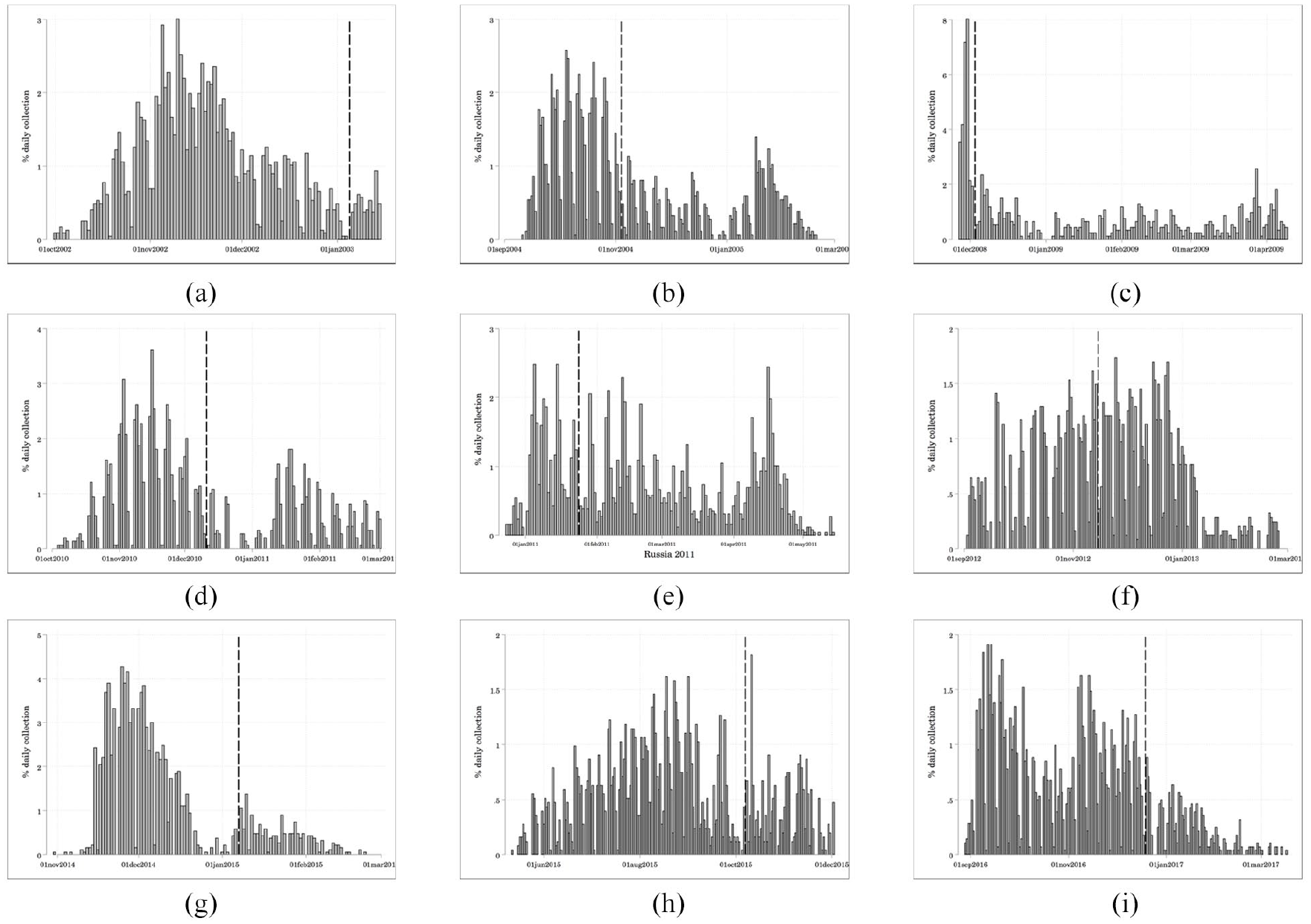
Data collection around terrorist attacks.
Data and Estimation
Individual-level data come from eight rounds of the
I test whether jihadist attacks cause the public to jointly increase security fear and ethnic prejudice. To proxy the security fear, I use the following item:
■ “It is important that the government ensures safety against all threats. The state must be strong so it can defend its citizens.” (0) “Completely disagree” to (5) “Completely agree”;
and test
To proxy the ethnic prejudice, I use the following items:
■ To what extent do you think your country should allow people of the different race or ethnic group as most country’ s people to come and live here? 1: “Allow many” to 4: “Allow none”;
■ To what extent do you think your country should allow people of the same race or ethnic group as most country’ s people to come and live here? 1: “Allow many” to 4: “Allow none.”
The succession of the two questions explicitly primes the role of race/ethnicity, and the two questions only differ in the race dimension. I generate the variable ethnic prejudice as follows:

and test
Hypothesis testing yields four possible scenarios:
■ Fear with prejudice: Jihadist attacks increase security fear and ethnic prejudice (
■ Prejudice without fear: Jihadist attacks increase ethnic prejudice only (
■ Fear without prejudice: Jihadist attacks increase security fear only (
■ Terrorist attacks are ineffective (
Figure 2 provides the normalized distribution of the two dependent variables for the control and treatment group. The left panel of Figure 2 shows that security fear has higher mean and lower standard deviation after terrorist attacks. The right panel of Figure 2 shows that ethnic prejudice has lower mean higher standard deviation after terrorist attacks.
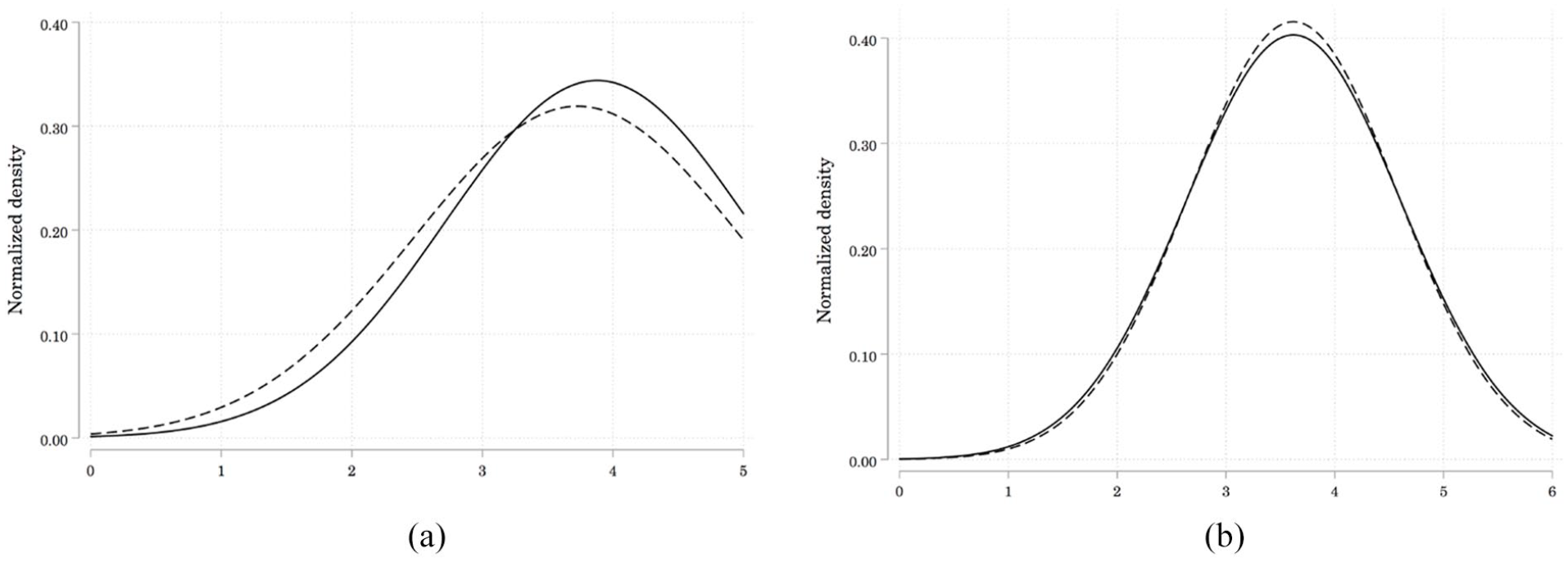
Distribution of the dependent variables.
I estimate the following equation:

The empirical specification includes a vector of baseline individual covariates,
To ease the interpretation of terror treatment effects, the model is fit through
Threats to Identification
The empirical design proposed here is subject to three major threats to identification that I briefly discuss and extensively cover in the appendix. 5
Conditional ignorability: The respondents’ treatment status should be independent of their potential outcomes, which are conditional on a set of covariates. Two major threats to conditional ignorability are addressed: (i) imbalance and (ii) attrition. (i) The actual treatment assignment reflects a set of sampling decisions, possibly resulting in an imbalance between the control and treatment groups. For instance, the easier it is to reach a respondent, the more likely that she or he is in the control group (Legewie, 2013). I address both the imbalance in the covariates and in geographic units (A.2.1). If the regions were sampled at different points in time, the outcomes could be biased by a regional imbalance. 6 I deal with imbalance in the covariates and geographic units by combining entropy balancing (Hainmueller, 2012), and nonparametric pretreatment matching (Iacus et al., 2012). The details are discussed in appendix (A.2.1). (ii) There are two potential attrition issues. First, individuals may become unwilling (or more willing) to take the survey because of terrorist attacks. To rule out potential drops in survey collection in correspondence with terrorist attacks, I compare that survey collection rates in terror-targeted regions—where the strongest drop should be observed if attrition was a problematic issue—against all other regions before and after terrorist attacks (A.2.2). I show that the survey collection rates in areas targeted by terrorist attacks stay constant in the immediate aftermath of the attacks. Second, individuals may become unwilling (or more willing) to give a valid answer to either dependent variable because of terrorist attacks. Further analysis rules out this possibility (A.2.3).
Excludability: No other event than the terrorist attack should affect the outcome. Two major threats to excludability are addressed: (i) unobserved time-varying trends and (ii) compound treatment. (i) The observed terror treatment effects may spuriously reflect unobserved time-varying trends. It appears reasonable to choose time bandwidths that are short enough to minimize attribution issues and large enough to achieve sufficient statistical power. I assess the robustness of the main outcomes to varying time bandwidths as well as proposing an augmented specification in which we increase the number of control variables by including a linear and a quadratic time trend. In addition, we show that running permutation tests shows that resampling the treatment variable within each country–year systematically results in null simulated treatment effects (A.2.4). (ii) Terror treatment effects may weigh the collateral events. For instance, terrorist attacks trigger political reactions that align with attitude formation. This possibility cannot be ruled out. What can be ruled out, instead, is that the reported evolution of ethnic prejudice reflects major changes in immigration-related attitudes that are simultaneously taking place in the sampled countries for reasons unrelated to terrorism. The appendix reports the treatment effects for a set of additional survey items that act either as alternative dependent variables for security fear (A.4.1), or as placebos for it (A.4.2).
Full compliance: For the assignment to the treatment group to be valid, individuals must be informed about the occurrence of terrorist events. Conversely, individuals in the treatment group who are unaware of the attack should have been assigned to the control group. Noncompliance would bias the treatment effects downward, making false positives less likely. Because the assumption of full compliance cannot be directly tested, it may be more appropriate to label the treatment intention to treat. Yet two different arguments render plausibility to the assumption of full compliance. First, my focus on local terrorism makes full compliance more credible because individuals are more likely to be informed about a terrorist attack if the latter happened in their country. A similar argument applies when it comes to my focus on murderous jihadist attacks, which are presumably more salient than the fake and failed attacks analyzed in the appendix (A.5). Second, an analysis of Google trends during the fieldwork period of each attack confirms that the searches for “ terrorism” are the highest on the day of the attacks (A.6).
Fear without Prejudice
The first four columns of Table 1 show that terrorism increases security fear. The outcomes are not model dependent: adding socioeconomic covariates (models (ii) and (iii)) or extracting the outliers through pretreatment matching (model (iv)) results in minor changes. In the full specification, being interviewed after terrorist attacks increases security fear by about three percentage points. Because ensuring security is widely considered a primary function of the state, the mean of security fear is rather high (≈3.8, see Figure 2), with
Fear Without Prejudice.
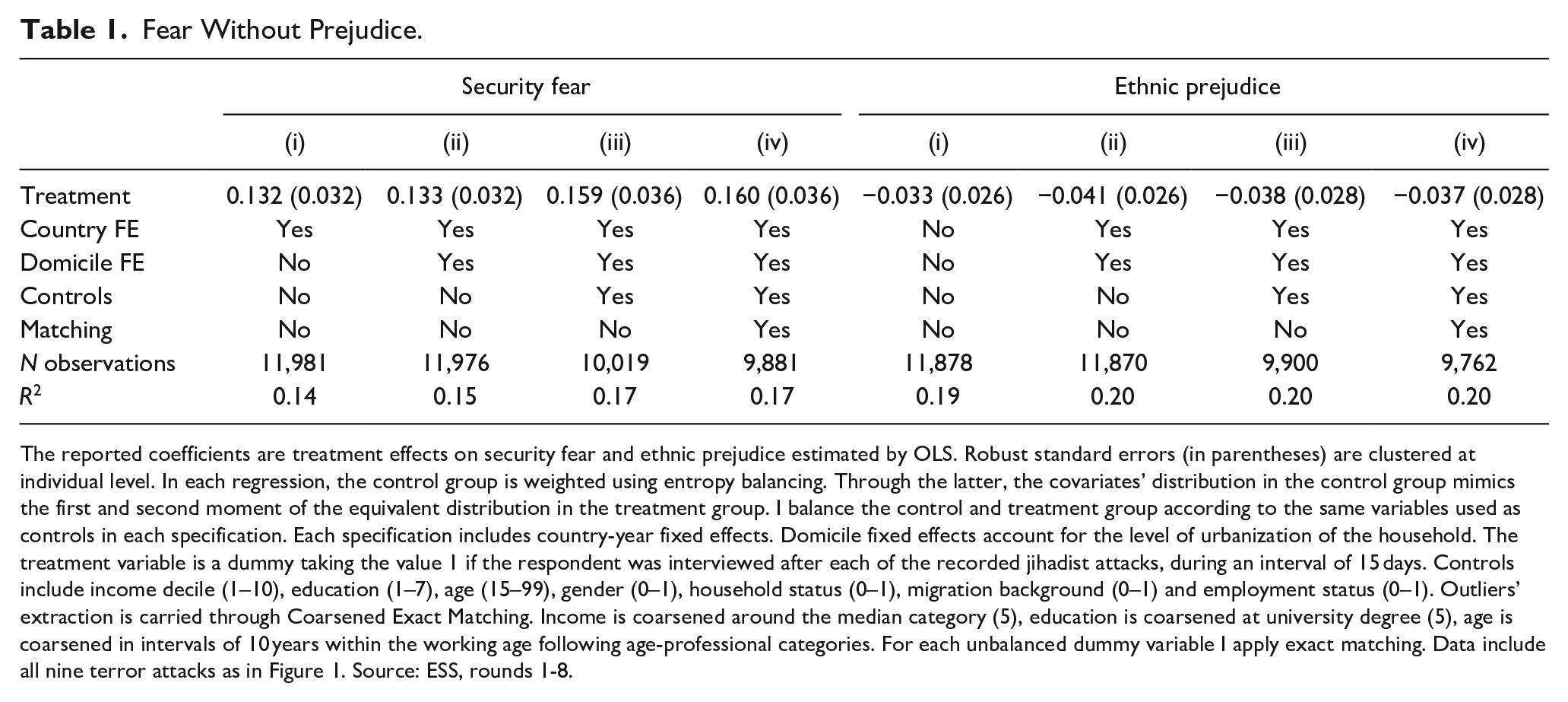
The reported coefficients are treatment effects on security fear and ethnic prejudice estimated by OLS. Robust standard errors (in parentheses) are clustered at individual level. In each regression, the control group is weighted using entropy balancing. Through the latter, the covariates’ distribution in the control group mimics the first and second moment of the equivalent distribution in the treatment group. I balance the control and treatment group according to the same variables used as controls in each specification. Each specification includes country-year fixed effects. Domicile fixed effects account for the level of urbanization of the household. The treatment variable is a dummy taking the value 1 if the respondent was interviewed after each of the recorded jihadist attacks, during an interval of 15 days. Controls include income decile (1–10), education (1–7), age (15–99), gender (0–1), household status (0–1), migration background (0–1) and employment status (0–1). Outliers’ extraction is carried through Coarsened Exact Matching. Income is coarsened around the median category (5), education is coarsened at university degree (5), age is coarsened in intervals of 10 years within the working age following age-professional categories. For each unbalanced dummy variable I apply exact matching. Data include all nine terror attacks as in Figure 1. Source: ESS, rounds 1-8.
The empirical pattern holds true across different time horizons and terrorist incidents. Although the analysis presented in Table 1 focus on the very short term (within 15 days after each attack), Figure 3a summarizes the terror treatment effects for alternative time bandwidths. Terror treatment effects are qualitatively and quantitatively similar across alternative intervals of time, either shorter or longer. The left panel of Figure 3a focuses on security fear. It shows that the treatment is the strongest after 1 week. Then it slightly decays. The right panel of Figure 3a focuses on ethnic prejudice. It shows that the latter softens to a similar extent across different bandwidths.
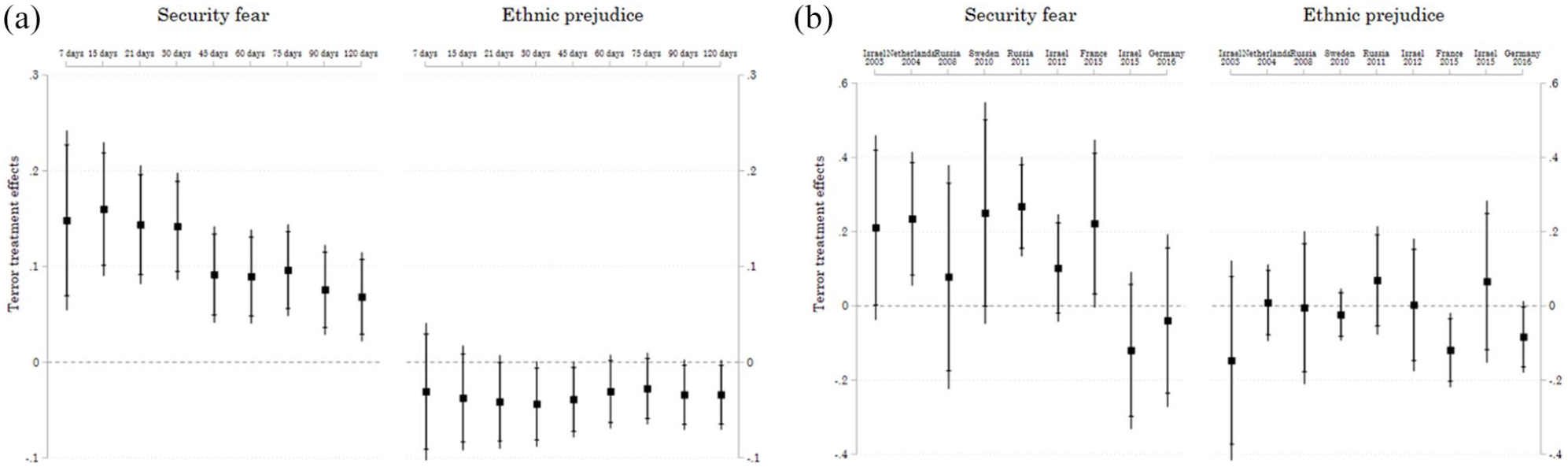
Robustness across time and terrorist episode. (a) By time bandwidths, (b) By terrorist episodes.
Figure 3b shows that the aggregate increase in security fear is driven by some of the largest attacks, including the attack perpetrated by Hamas in Tel Aviv in 2003 (
Group versus individual threat
The empirical analysis discloses an empirical puzzle. Although security fear and ethnic prejudice are indeed correlated in the control group (
Firstly, alike residents in the New York metropolitan area following 9/11 (Huddy et al., 2005), individuals living in the area targeted by terror attacks should perceive the strongest anxiety and thus soften their ethnic prejudice to a greater extent than individuals living elsewhere do. Table 2 reports the coefficients for an additional specification in which I split the sample in two depending on whether or not the respondent lives in the targeted region. 7 The coefficients in Table 2 strongly supports this possibility: security fear increases and ethnic prejudice decreases to a substantially greater extent among respondents living in the targeted region. Aggregate terror treatment effects in Table 1 are indeed driven by individuals with higher exposure to the terror threat.
Anxiety and Risk Aversion.
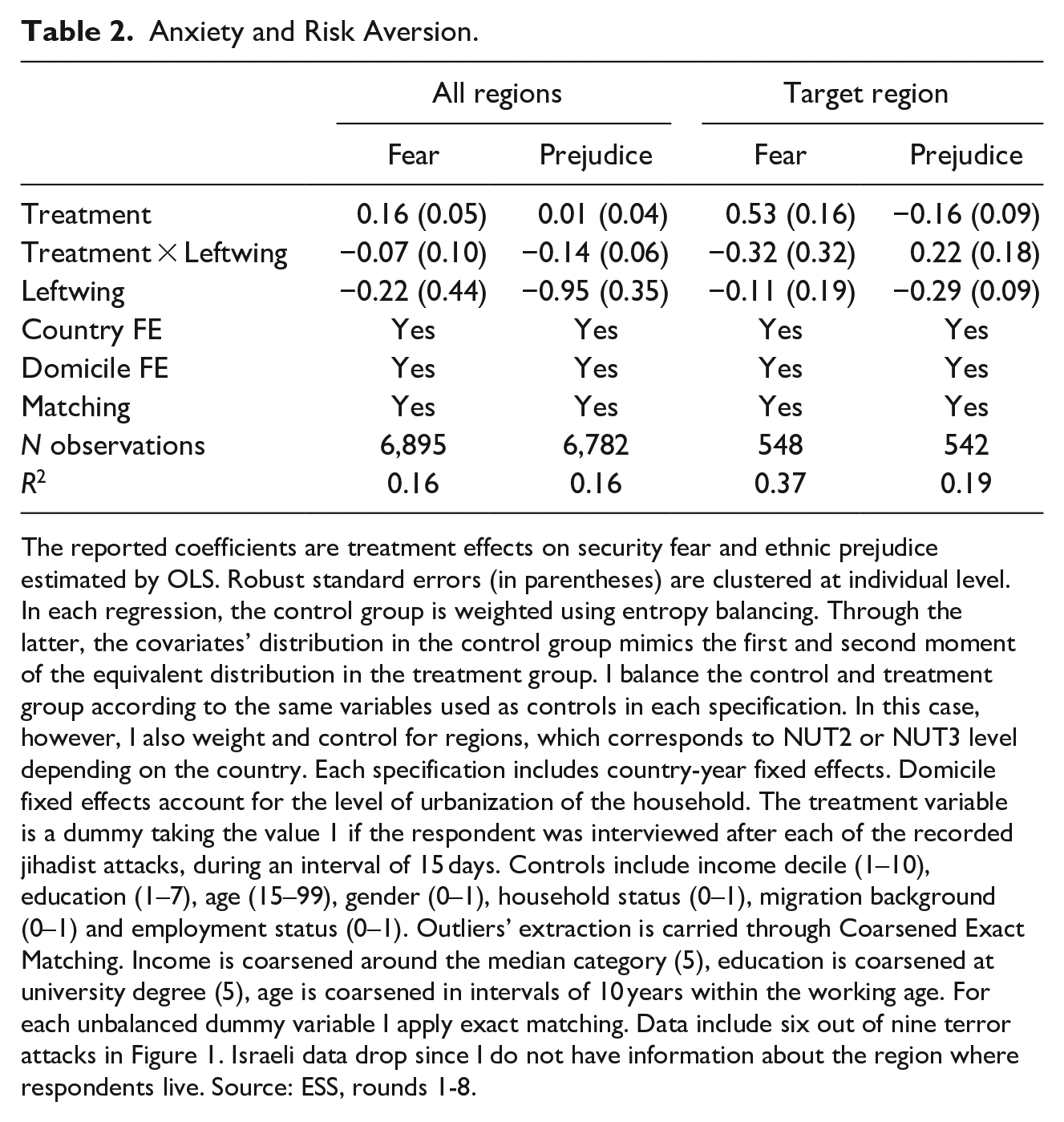
The reported coefficients are treatment effects on security fear and ethnic prejudice estimated by OLS. Robust standard errors (in parentheses) are clustered at individual level. In each regression, the control group is weighted using entropy balancing. Through the latter, the covariates’ distribution in the control group mimics the first and second moment of the equivalent distribution in the treatment group. I balance the control and treatment group according to the same variables used as controls in each specification. In this case, however, I also weight and control for regions, which corresponds to NUT2 or NUT3 level depending on the country. Each specification includes country-year fixed effects. Domicile fixed effects account for the level of urbanization of the household. The treatment variable is a dummy taking the value 1 if the respondent was interviewed after each of the recorded jihadist attacks, during an interval of 15 days. Controls include income decile (1–10), education (1–7), age (15–99), gender (0–1), household status (0–1), migration background (0–1) and employment status (0–1). Outliers’ extraction is carried through Coarsened Exact Matching. Income is coarsened around the median category (5), education is coarsened at university degree (5), age is coarsened in intervals of 10 years within the working age. For each unbalanced dummy variable I apply exact matching. Data include six out of nine terror attacks in Figure 1. Israeli data drop since I do not have information about the region where respondents live. Source: ESS, rounds 1-8.
Secondly, anxiety leads citizens to alleviate ideological processing, making public opinion responses similar across ideological groups that hold otherwise different stances (see e.g., Joslyn & Haider-Markel, 2018). Since such phenomenon is typical of anxiety, we should expect it to occur in targeted regions to a greater extent than elsewhere. If this is the case, jihadist attacks should unify the public in targeted regions and polarize the public elsewhere. Such effect should concern ethnic prejudice, which is a polarizing attitues, rather than security fear. We test for this possibility by interacting the treatment with a dummy variable that takes the value of one if the respondent identifies as leftwing (from
Realistic versus symbolic threat
In section, I explain that since jihadist terrorism is not uniquely a security threat, but also an economic and cultural one, it is reasonable to expect that all immigration attitudes evolve in a similar way. I proxy further immigration-related concerns as follows:
■ Overall concerns: Immigrants make country worse or better place to live. 1: Worse; . . . ; 10: Better.
■ Cultural concerns: Country’s cultural life undermined or enriched by immigrants. 1: Undermined; . . . ; 10: Enriched.
■ Economic concerns: Immigration bad or good for country’s economy. 1: Bad; . . . ; 10: Good.
Figure 4a confirms that terror treatment effects on these standard immigration proxy are similar to those presented in Table 1.
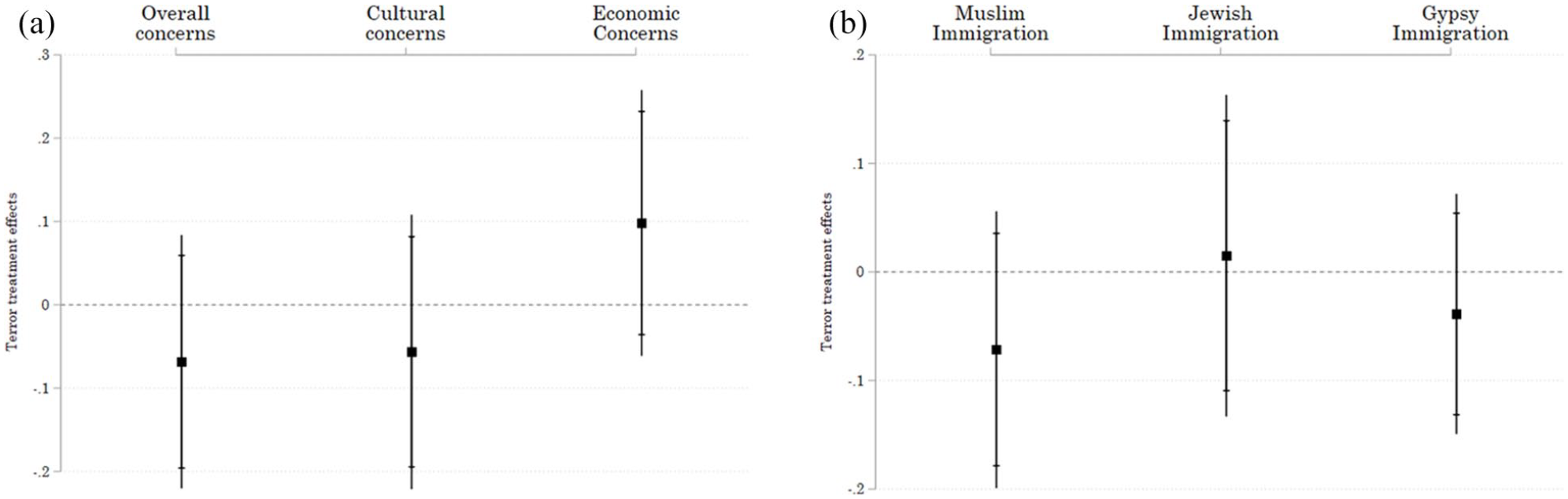
Robustness across immigration concern and ethnic group. (a) By immigration concern and (b) By ethnic group.
Homogenous versus differentiated outgroup
Previous research has shown that jihadist terrorism is expected to foster discriminatory attitudes not only toward Muslims, but also toward other ethnic minorities (e.g., Canetti-Nisim et al., 2009). Hopefully, the seventh round of the ESS includes more detailed information about specific ethnic groups. The survey items are the following:
■ Gypsy immigration. Allow many or few Gypsies to come and live in country. 1: Many; . . . ; 4: None.
■ Jewish immigration. Allow many or few Jews to come and live in country. 1: Many; . . . ; 4: None.
■ Muslim immigration. Allow many or few Muslims to come and live in country. 1: Many; . . . ; 4: None.
Figure 4b shows that terror treatment effects on ethnic prejudice are similar across different ethnic groups. This confirms that security threats lead the public to undifferentiated responses.
Conclusion
Governments around the globe did not necessarily make concessions to terrorist groups (Abrahms, 2012), but sometimes responded to 9/11 by suspending civil liberties (e.g., Epifanio, 2011). Whether this social cost was worth it in terms of higher security is theoretically contestable and empirically unclear (e.g., Daxecker & Hess, 2013; Waldron, 2003). In this context of policy uncertainty, public opinion is pivotal.
In the current paper, I test whether jihadist attacks jointly increase security fear and ethnic prejudice. I propose an empirical protocol that exploits the timing of survey interviews, which is random regarding the exact date of the terrorist attacks, to analyze nine terrorist attacks in six countries between 2002 and 2016. My analysis confirms that terrorism, particularly in the targeted terror areas and in relation to large-scale terrorist incidents, spreads fear. This effect survives in the medium run; terrorism calls for policy responses. Yet within diverse contexts, the public does not give in to ethnic prejudice towards immigrants and minorities.
These findings offer an important contribution to the empirical literature on terrorism and public opinion. Largely based on transnational studies and single-case studies, the extant consensus is that jihadist attacks worsen attitudes towards immigrants and minorities. Such a consensus should be updated since it does not hold at more disaggregated geographic levels, whatever time-bandwidth, terrorist episode, type of immigration attitude and ethnic group one chooses. I argue that the distinction between (perceived) group and individual threat offers theoretical ground to the disclosed attitudinal pattern.
Some caveats are in order. While the focus on immigration attitudes is important, it would be interesting to single out other policy areas that the public link to security concerns. Support for hawkish foreign policy or extrajudicial practices such as arbitrary detention or torture may increase following terrorist attacks. Unfortunately, the
Supplemental Material
AppendixF – Supplemental material for Fear without Prejudice in the Shadow of Jihadist Threat
Supplemental material, AppendixF for Fear without Prejudice in the Shadow of Jihadist Threat by Marco Giani in Comparative Political Studies
Supplemental Material
data – Supplemental material for Fear without Prejudice in the Shadow of Jihadist Threat
Supplemental material, data for Fear without Prejudice in the Shadow of Jihadist Threat by Marco Giani in Comparative Political Studies
Supplemental Material
Readme – Supplemental material for Fear without Prejudice in the Shadow of Jihadist Threat
Supplemental material, Readme for Fear without Prejudice in the Shadow of Jihadist Threat by Marco Giani in Comparative Political Studies
Supplemental Material
Replication – Supplemental material for Fear without Prejudice in the Shadow of Jihadist Threat
Supplemental material, Replication for Fear without Prejudice in the Shadow of Jihadist Threat by Marco Giani in Comparative Political Studies
Supplemental Material
Replication_appendix – Supplemental material for Fear without Prejudice in the Shadow of Jihadist Threat
Supplemental material, Replication_appendix for Fear without Prejudice in the Shadow of Jihadist Threat by Marco Giani in Comparative Political Studies
Footnotes
Acknowledgements
The author thanks the editors and three anonymous reviewers at CPS for excellent guidance. This work benefited from discussions with several colleagues and most notably Daniele Ambroglini, Marjorie Gassner, Margarita Gelepithis, Brett Meyer, Dimitris Minos, Ellen Ronsmans, Rubén Ruiz-Rufino, several participants at the LSE political behavior seminar and at the UCU social science seminar.
Declaration of Conflicting Interests
The author declared no potential conflicts of interest with respect to the research, authorship, and/or publication of this article.
Funding
The author received no financial support for the research, authorship, and/or publication of this article.

Supplemental Material
Supplemental material for this article is available online.
Notes
Author Biography
References
Supplementary Material
Please find the following supplemental material available below.
For Open Access articles published under a Creative Commons License, all supplemental material carries the same license as the article it is associated with.
For non-Open Access articles published, all supplemental material carries a non-exclusive license, and permission requests for re-use of supplemental material or any part of supplemental material shall be sent directly to the copyright owner as specified in the copyright notice associated with the article.
