




Abstract
This introductory essay outlines the key themes of the special issue on the long-term impact of autocracies on the political attitudes and behavior of their subjects. Here, we highlight several important areas of theoretical and empirical refinements, which can provide a more nuanced picture of the process through which authoritarian attitudinal legacies emerge and persist. First, we define the nature of attitudinal legacies and their driving mechanisms, developing a framework of competing socialization. Second, we use the competing socialization framework to explain two potential sources of heterogeneity in attitudinal and behavioral legacies: varieties of institutional features of authoritarian regimes, which affect the nature of regime socialization efforts; and variations across different subgroups of (post-)authoritarian citizens, which reflect the nature and strength of alternative socialization efforts. This new framework can help us to better understand contradictory findings in this emerging literature as well as set a new agenda for future research.
Introduction
Today, about half of the world’s population lives in either closed or electoral authoritarian regimes. 1 Another 40% live in countries, which experienced autocratic periods in the last 80 years. Taken together, nine out of 10 people in the world today had direct or indirect exposure to authoritarian regimes. 2 Crucially, there is widespread agreement and much anecdotal evidence that this experience has shaped—often in dramatic and lasting ways—the attitudes and behavior of individuals living under such regimes, often for long after the regime has been overthrown. Yet, we have surprisingly limited knowledge of the mechanisms through which authoritarian attitudinal and behavioral legacies emerge and persist. This special issue proposes a new framework and research agenda for a more systematic study of authoritarian attitudinal legacies and brings together four papers that contribute to several key dimensions of this emerging research agenda.
Although in the last two decades there has been a significant revival in the study of authoritarian legacies, the bulk of this literature has focused on aggregate outcomes, such as institutions and elite actors, especially political parties. 3 These issues are undoubtedly very important for understanding post-authoritarian politics, including the prospects for successful democratization and democratic survival, as well as many other aspects of policy making in former authoritarian countries. However, we know from the democratization literature that public support, a democratic political culture, and an active citizenry are also fundamental for the survival of democracy (e.g., Booth & Seligson, 2009; Claassen, 2020; Diamond, 1999; Norris, 1999). Similarly, the political attitudes of citizens matter greatly for the types of economic and social policies that we can expect to emerge from the democratic process.
If citizens’ political preferences and behavior are crucial for understanding the resilience and functioning of democracy, it is important to investigate how these are formed. Although this question has received considerable attention in established democracies (e.g., Alvarez & Brehm, 2002; Jennings, 1989; Jennings & Markus, 1984; Zaller, 1992), in a post-authoritarian context an important part of the answer hinges on understanding how political attitudes and behavior are shaped by the authoritarian past. The articles in this special issue contribute to a small (but growing) set of studies focused more squarely on the impact of authoritarian regimes on individual political attitudes and behavior.
At the most basic level, we can think of authoritarian attitudinal legacies as consisting of two necessary steps. The first step is for authoritarian regimes to shape the attitudes and behavior of their citizens. The second step is for these effects to persist across a regime divide, that is, after the end of the regime that inculcated those initial effects (Beissinger & Kotkin, 2014). The first step can be studied directly by focusing on public opinion in contemporary authoritarian regimes. Such an approach, which is exemplified by one of the contributions to this special issue (Tertytchnaya, 2020) and by a growing literature on the contemporaneous attitudinal effects of authoritarian regimes, 4 has the obvious advantage of allowing for a direct test of authoritarian attitudinal effects. However, in addition to their analytical challenges, 5 such studies are limited in the extent to which they can address the durability of these effects, and—by definition—they cannot establish the nature of post-authoritarian attitudinal legacies.
The second approach is to analyze the effects of these regimes on their citizens’ political attitudes and behavior after the regime breaks down. This approach, which is the primary focus of three of the four articles in this special issue, as well as of a small but rapidly growing literature on authoritarian attitudinal legacies, has the advantage of being able to address the crucial question of legacy durability. Several existing studies have established the existence and the durable impact of authoritarian regimes on a variety of attitudes including lower support for and satisfaction with democracy (Neundorf, 2010; Pop-Eleches & Tucker, 2014, 2017), demand for democracy (Mattes & Bratton, 2007), support for the previous regime (Mishler & Rose, 2007), the emergence of political trust (Mishler & Rose, 2001), attitudes toward markets and welfare states (Alesina & Fuchs-Schündeln, 2007; Pop-Eleches & Tucker, 2014, 2017), as well as behavior, including lower civic and political participation (Bernhard & Karakoç, 2007; Ekiert & Kubik, 2014; Northmore-Ball, 2014; Pop-Eleches & Tucker, 2014).
Despite producing some promising and valuable insights, the existing research has produced contradictory results, 6 is still limited in its scope, and faces a number of important theoretical and analytical challenges. This introductory essay draws on the contributions to this special issue to lay out a new framework and research agenda that can help us overcome at least some of these limitations of previous studies. First, existing research in this area lacks a unified theoretical framework, which conceptualizes key concepts related to attitudinal legacies. Furthermore, though several of these studies have started to investigate the mechanisms underlying the production and reproduction of these legacies (Darden & Grzymala-Busse, 2006; Lupu & Peisakhin, 2017; Neundorf, 2010; Pop-Eleches & Tucker, 2017; Wittenberg, 2006), a lot more work remains to be done to theorize and test these mechanisms. This introductory essay tries to fill this gap. Second, because much of this work has focused on the post-communist countries of Eastern Europe and the former Soviet Union, the existing studies have largely failed to take advantage of the analytical advances in the literature on varieties of authoritarianism. Third, with a few exceptions, existing studies have not sufficiently addressed the important individual heterogeneities in authoritarian attitudinal legacies. This applies both with respect to differential effects on different subgroups of authoritarian subjects and with respect to different types of attitudes and behavior. We discuss each of these issues in greater detail in the next sections and then touch upon a few additional analytical challenges in our discussion of future research directions in the conclusion.
Authoritarian Attitudinal Legacies—A New Theoretical Framework
To understand how authoritarian regimes shape political attitudes, and how these short-term effects eventually translate into attitudinal legacies, we need to understand the mechanisms through which attitudes are formed and reproduced. In this section, we discuss a new theoretical framework of authoritarian attitudinal legacies, focusing on three key questions: First, how do autocracies affect their citizens? Second, what is the mechanism underlying this authoritarian influence? Finally, what affects the longevity of this effect?
Direction: How Do Autocracies Affect Their Citizens?
To understand the initial attitudinal impact that autocracies have on their citizens, it is important to distinguish between different possible individual reactions to regime efforts, mainly transmitted through indoctrination. Perhaps the most straightforward scenario, which we will call internalization, is that individuals will adopt political attitudes and behaviors in line with the “official line” of the regime. Several findings in this special issue—such as the greater prevalence of left-authoritarians among respondents with greater personal communist exposure (Pop-Eleches & Tucker, 2020) as well as higher nostalgia and weaker democratic support and satisfaction among individuals who spend their formative years under authoritarianism (Neundorf et al., 2020)—suggest that authoritarian indoctrination can indeed produce significant and lasting attitudinal effects, which are in line with the goals of the authoritarian regime.
However, given the legitimacy deficit of many authoritarian regimes, there are also good reasons to expect that indoctrination could be ineffective or even counterproductive. As Tertytchnaya’s (2020) analysis in this special issue suggests, the rejection of the authoritarian regime can result either in disengagement from the political process or in embracing the opposition. In attitudinal terms, these two alternative types of resistance should translate either into a lack of correlation between authoritarian ideology and mass attitudes (in the case of disengagement) or to embrace the opposite of whatever attitudes the authoritarian regime is trying to promote (in the case of rejection; Wittenberg, 2006).
Dinas and Northmore-Ball’s (2020) article in this special issue provides a further example of a rejection effect. They show that respondents from countries with a recent history of right-wing authoritarian regimes were more likely to embrace a leftist ideology subsequently: a pattern that they interpret as reflecting the rejection of the ideological tenets of the illegitimate authoritarian regimes. Furthermore, they show that a greater reliance on repression is associated with a higher rejection of the ideological orientation of both left- and right-wing authoritarian regimes.
Our starting point here is the assumption that autocracies can influence their citizens in two ways. Their indoctrination efforts can either pay off and lead to internalization of the regime doctrine or lead to a resistance among citizens, which can either lead to an outright rejection of the regime’s doctrine or at the very least to a disengagement of citizens from the political process. To understand why authoritarian regimes sometimes produce compliant citizens and sometimes trigger resistance or even backlash, we need a better understanding of the mechanisms through which both of these effects occur.
Competing Socialization: What Are the Mechanisms of Authoritarian Influence?
One of the key limitations in the literature on authoritarian attitudinal legacies relates to the mechanisms underlying regime impact. Prior work on authoritarian legacies has highlighted a variety of channels, including political socialization through regime indoctrination (Neundorf, 2010; Pop-Eleches & Tucker, 2017) and intergenerational transmission of attitudes (Darden & Grzymala-Busse, 2006; Lupu & Peisakhin, 2017). Nevertheless, the study of the mechanisms underlying the production and reproduction of these legacies is still in its infancy.
Here, we argue that the key mechanism underlying authoritarian attitudinal legacies—regardless of whether authoritarian subjects internalize or reject the regime doctrine—is driven by political socialization and learning. Drawing on insights from research in advanced democracies on the emergence and durability of political attitudes and behavior (Bartels & Jackman, 2014; Jennings, 1989; Jennings & Markus, 1984; Krosnick & Alwin, 1989; Mannheim, 1952; Zaller, 1992), we argue that initial attitudes are formed when people are young during their so-called formative years. As we know from research on political socialization, children and young people learn about and internalize societal norms, values, and identities through processes of imitation and repetition. These norms then translate into political preferences and behavior. New information and later-life political experiences will be processed in relation to these initial political attitudes formed early on (Mishler & Rose, 2001; Sears & Funk, 1999; Zaller, 1992). More recent work on post-communist countries (Pop-Eleches & Tucker, 2017) suggests that authoritarian socialization continues—and may even strengthen—among adults.
The main question then is what kind of information and which agents are key in the formative socialization and potential revision of political attitudes and behavior in later life. We argue that this process is best conceived as a set of competing socialization efforts. At any point in time, individuals are influenced by a range of different—and potentially competing—socialization agents: on the macro-level, the political regime; on the meso-level, political and societal organizations; and on the micro-level, family and peers. Although any of these different agents can either reinforce or undermine each other’s socialization efforts, for the purpose of understanding authoritarian legacies, the key question is how the socialization “project” of the authoritarian regime interacts with the agendas of various meso- and micro-level actors. In the next section, we briefly outline how we expect each socialization agent to impact individuals’ political belief system.
First, we expect the political regime to play a key role in shaping the political socialization of its citizens. In their efforts to ensure mass support and compliance, authoritarian regimes try to shape the political attitudes and behavior of individuals in line with official ideology. As Dinas and Northmore-Ball (2020) argue in their contribution to this special issue, schools are a key component in the indoctrination apparatus of any state. Many autocracies directly control the education system, which allows them significant access to young people during the crucial formative years. 7 As Cantoni et al. (2017) show in the Chinese case, regimes can use schools for indoctrination and propaganda purposes. Through textbooks and curriculum design, regimes affect the content and nature of information that young, impressionable individuals are exposed to, which we expect to impact the development of certain political attitudes and behavior, leading to internalization.
Moreover, autocracies often control the media and the broader information environment, which allows them to transmit the regime ideology or mentality to citizens of all ages. In sum, we expect that citizens who are exposed to a singular worldview (that of the regime), transmitted by an education and information environment, which is strongly controlled by the political regime, to internalize these ideas in their own political belief system. However, to understand authoritarian attitudinal legacies, these macro-level regime indoctrination mechanisms need to be complemented by meso-level and individual-level institutional and social mechanisms responsible for both internalization and resistance.
The political regime does not have full control of people’s socialization and learning. Individuals are further exposed to potentially contradictory narratives and information by other societal organizations, for example, churches, unions, and political parties. For example, the Communist indoctrination was clearly challenged in Poland (and other parts of Eastern Europe) by the Catholic Church, which provided an alternative education and ideology (Mazgaj, 2010; Mueller & Neundorf, 2012). Although much work remains to be done in this area, the contributions to the special issue take some steps in the direction of identifying and testing some of these institutional transmission mechanisms. For example, Pop-Eleches and Tucker (2020) test whether the weaker communist socialization effects among women were due to their lower participation rates in the formal workforce, the communist party, and the army, three potentially important sites of indoctrination at the meso-level. Although they find no evidence that any of these channels explain the gender differentials, they do find that higher church attendance among women may account for their greater resistance to communist socialization, which reinforces earlier findings about the role of churches as a key institutional source of anti-authoritarian resistance (see, for example, Wittenberg, 2006). Given this argument, and preliminary findings that meso-level socialization agents could potentially undermine regime’s efforts to create mass support and compliance, it is not surprising that autocracies often use different forms of repression to minimize the impact of other actors beyond the regime’s main actors and organizations (Escribà-Folch, 2013). But, as already mentioned above, repression can also backfire, creating more resistance among citizens (Dinas & Northmore-Ball, 2020; Rozenas & Zhukov, 2019).
Finally, we expect the family and peers to shape the development of individuals’ political attitudes and behavior (Darden & Grzymala-Busse, 2006; Pop-Eleches & Tucker, 2017). As with societal organizations argued above, the individual-level socialization agents can either reinforce or undermine the regime socialization. Intergenerational transmission of political preferences can strengthen the regime’s efforts to impact the hearts and minds of its citizens if parents are supporters of the regime, though the opposite is true if parents are in opposition to the regime. The impact of the individual-level agents on authoritarian attitudinal legacies is least understood and tested.
Here, we argue that there are different levels and agents that affect the development of individuals’ political socialization. Although we are here primarily interested in how autocracies shape the political attitudes and behavior of their citizens, we argue that this process cannot be properly understood if we ignore the fact that authoritarian socialization efforts can be challenged by competing socialization agents, such as societal organizations or the family. In the next section, we outline how these various competing processes lead to long-term attitudinal legacies.
Reinforcement Mechanism: What Affects the Longevity of This Effect?
The previous section focuses on the initial development of political attitudes and behavior and the impact of authoritarian regimes on this process. The question now is, whether the beliefs, instilled by the regime, persist even after the regimes are overthrown and replaced by democracies or another type of dictatorship. At the most basic level, the answer to this question depends on the relative importance of early versus adult socialization. If, in line with much of the literature of political socialization (Neundorf et al., 2013), initial attitudes and behavior remain quite stable in later life, then individuals who spent their “impressionable years” under authoritarianism should be expected to continue reflecting these patterns well after the authoritarian regimes have fallen. However, if political socialization continues into adulthood (Pop-Eleches & Tucker, 2017) or if initial attitudes were less central and therefore weaker, then political attitudes can be updated when new information becomes available (Zaller, 1992). Under such circumstances, authoritarian attitudinal legacies may have short half-lives, as attitudes and behaviors increasingly reflect the new post-authoritarian political reality.
Based on our competing socialization framework, we postulate that two factors are key in explaining the longevity of authoritarian legacies: the initial strength of these effects and the influence of new information. We expect the strength of the regime’s initial attitudinal influence to depend on the nature of competing socialization efforts. If an individual is exposed to strong regime indoctrination, which is reinforced by participation in regime-supporting organizations, such as political parties, as well as a regime-loyal family, we expect them to strongly internalize the regime’s ideology and political identities. Such individuals are unlikely to accept new contradictory information to update their political attitudes and behavior. In this case, we expect to see a strong initial authoritarian legacy effect. The opposite should be true for individuals exposed to competing socialization, which would undermine the regime indoctrination.
The second factor, which affects the longevity of authoritarian legacies, relates to the nature of the new information environment. To the extent that the socialization approach of the new regime is not radically different (e.g., because of high elite continuity despite a nominal change in regime), then we should expect the initial attitudinal imprint of the previous authoritarian regime to be highly resilient. However, if the new regime espouses radically different political values than its predecessor—such as in the case of East European countries embracing free markets and liberal democracy after the fall of communism—then the evolution of political attitudes among individuals to these conflicting socialization projects is much more uncertain. In part, this trajectory will depend on the strength of the initial authoritarian socialization success of the former authoritarian regime (as discussed above). However, it also matters how effective the new regime is in its pursuit of its alternative socialization project, which in turn depends both on how committed the new political elite is to this new ideological project and how the economic and political performance of the new regime compares to that of its predecessor. 8 Thus, we argue that the competing socialization framework can be fruitfully applied to studying how post-authoritarian developments affect the durability of authoritarian legacies.
The empirical evidence on the longevity of attitudinal legacies is still rare (but see Pop-Eleches & Tucker, 2017, pp. 247–281). Two of the contributions to the special issue (Dinas & Northmore-Ball, 2020; Pop-Eleches & Tucker, 2020) highlight important variations in the temporal persistence of authoritarian legacies. However, our understanding of what drives these variations is limited. To move this literature forward, we need to pay greater attention to institutions and social practices that either reproduce or undercut the attitudinal and behavioral patterns from the authoritarian period. One obvious example in this respect would be the persistence of authoritarian successor parties, such as the more or less reformed communist parties of Eastern Europe during the early transition period (Grzymala-Busse, 2002; Kitschelt et al., 1999; Kitschelt & Smyth, 2002).
More broadly, one would expect the public discourse surrounding the authoritarian legacy, as well as the overall mnemonic regime (Bernhard & Kubik, 2016), to be influenced by the degree of elite turnover in both economic and political institutions. From this perspective, we might expect variations in transitional justice and lustration programs to shape the extent to which authoritarian attitudinal legacies are preserved and reproduced (Capoccia & Pop-Eleches, 2020). Relatedly, building on our discussion above, future research could engage more systematically with the question about how various post-authoritarian developments, such as institutional reforms or economic and political crises, interact with authoritarian legacies, by either undercutting or reinforcing them. 9 For example, it would be important to establish to what extent the persistence of antidemocratic attitudes in the former communist countries is driven by the effective indoctrination of the communist regimes as opposed to the widespread and systematic shortcomings of post-communist “democratic” governance.
Explaining Heterogeneity in Authoritarian Attitudinal Legacies
In this section, we apply our new theoretical framework to explain one of the crucial features of authoritarian attitudinal legacies, which is reflected both in the contributions to this special issue and in some of the earlier literature: their remarkable heterogeneity across regimes, groups, and individuals. We show that the competing socialization framework offers useful analytical tools to understand why regime indoctrination efforts sometimes achieve effective internalization of authoritarian beliefs and attitudes, whereas at other times they are either ineffective (disengagement) or even trigger the opposite effect (rejection).
Legacy Differences Across Regimes: The Impact of Authoritarian Socialization Strategies
Within our competing socialization framework, an important potential driver of the significant variations in authoritarian attitudinal legacies is a factor that has received insufficient attention in prior work: the important variations in the strategies of indoctrination and political control of different types of authoritarian regimes. 10 Although this limitation was largely due to the fact that most of the existing studies focus either on individual countries 11 or on particular types of authoritarian regimes, 12 it nevertheless means that the literature in this area has largely failed to take advantage of the significant advances in the study of authoritarian regime varieties, which largely focuses on institutions and elites (Svolik, 2012). This is potentially an important omission both because it raises questions about the scope conditions of earlier findings and because it runs the risk of treating authoritarian regimes as black boxes and thus undermines the search for causal mechanisms.
Although most autocracies try to shape the political attitudes and behavior of their subjects, they differ significantly in the methods they use to achieve this goal. To understand the variation in attitudinal legacies, which results from these different approaches, it is important to discuss the different tools, which regimes use to achieve compliance by ordinary citizens.
First, dictatorships use coercion to control citizens (Linz, 2000). Repression can be applied in hard form, which usually includes political killings, torture, and imprisonment. Hard repression has been shown to be counterproductive and lead to a rejection of the regime and its principles (Rozenas & Zhukov, 2019). However, subtler forms of repression, which mainly target restrictions of civil liberties (e.g., freedom of assembly, religion, or movement), have been shown to be more effective in preserving the legitimacy and stability of regimes (Escribà-Folch, 2013).
Second, many authoritarian regimes use carrots, often in the form of private or public goods provision, to buy off the population in exchange for loyalty, as part of an authoritarian bargain, “by which citizens relinquish political rights for economic security” (De Mesquita & Smith, 2010; Desai et al., 2009, p. 93). This “authoritarian contract” can be targeted narrowly to specific groups, or it can take the form of universal public goods provision.
A third tool used by regimes, which is mostly understudied, is indoctrination. Here, we define indoctrination as a deliberate inculcation of a doctrine that legitimizes the regime’s existence and actions, which in the most advanced form consists of a set of ideological principles (Brandenberger, 2011, p. 7). The ultimate goal of indoctrination is to instill diffuse system support of the authoritarian regime (Easton, 1965). Indoctrination promotes a single view through various channels, such as control over the media and the use of propaganda (Adler, 2012; Chen & Xu, 2015), mass organizations and culture (Linz, 2000), but most importantly through the educational system (Cantoni et al., 2017; Dinas & Northmore-Ball, 2020).
The literature on authoritarian legacies has not paid much attention to these varying regime tools and the potential heterogeneity in the extent to which these tools are successful in molding citizens’ political outlook. We expect the effects and long-term legacies of autocratic regimes to be affected by the tool(s) they use to gain compliance from their citizens. To explore whether authoritarian regimes indeed differ in how they use different tools to manage their citizens, we turn to the data of Varieties of Democracies (V-Dem), which compiled expert survey data on 180 countries from 1900 to today (Coppedge et al., 2018). In Figure 1, we contrast how democracies and autocracies 13 vary in their use of (a) hard repression (e.g., torture and political killings), 14 (b) private civil liberties, as a measure of soft repression, 15 (c) public goods provision, 16 and (d) freedom of expression and the use of alternative, nongovernmental controlled information, as a measure for indoctrination. 17 As argued above, all these measures directly affect ordinary citizens living in these regimes.
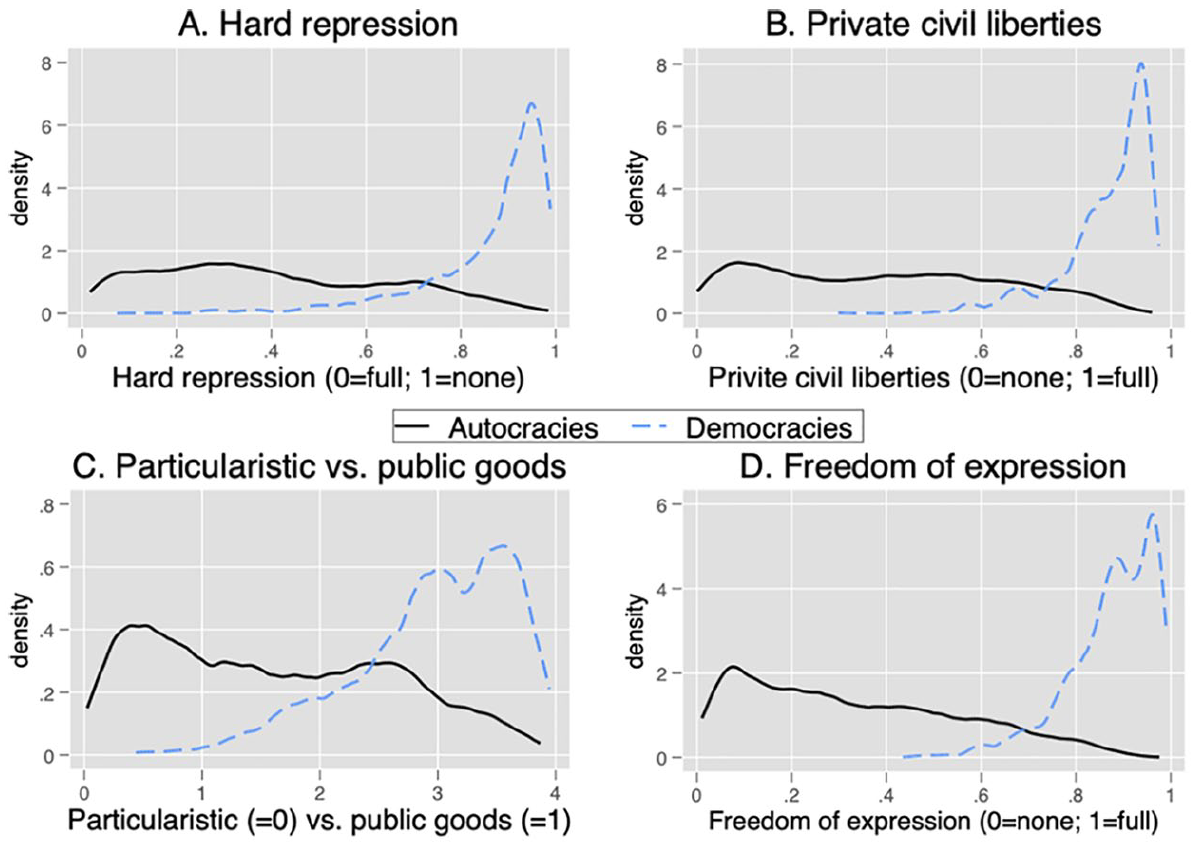
Hard and soft repression, public good provision, and media indoctrination by political regime type.
As Figure 1 reveals, autocracies vary significantly more in the tools that they use to manage their citizens than democracies. The density functions for all four indicators are nearly uniformly distributed for dictatorships, which indicates that autocracies are fairly evenly split among regimes that use hard repression and those who do not. The same pattern emerges in the use of the other tools. Autocracies seem to vary greatly in their use of soft repression of civil liberties (even though no regime provides full liberties), the extent to which they provide public goods, or allow for freedom of expression and a free media. 18 In contrast, democracies rarely use hard repression, mainly provide public goods, and respect civil liberties and media freedom.
The crucial question for our purposes is how these variations in authoritarian strategies affect the political attitudes of citizens both during and after authoritarian rule. The papers in this special issue highlight a few important variations in this sense: Dinas and Northmore-Ball (2020) show that right-wing dictatorships were more likely to provoke ideological backlash than their left-wing counterparts, and that while indoctrination efforts were generally effective in shaping ideological preferences, greater use of repression was counterproductive. Neundorf et al. (2020) show that economically and politically inclusive regimes were more likely to inculcate antidemocratic preferences than more exclusive autocracies, which concentrated benefits on narrower parts of society. Finally, Pop-Eleches and Tucker (2020) show that even among the communist regimes of the Soviet bloc, the attitudinal impact was stronger for hard-line regimes than for their more ideologically flexible counterparts.
Explaining Individual- and Group-Level Heterogeneity: The Role of Competing Socialization
Just as our discussion in the previous section has argued that institutional differences between different types of authoritarian regimes can have a significant impact on the nature of attitudinal legacies, in this section, we tackle another set of theoretically important sources of heterogeneity. In particular, we address the question of whether and why authoritarian regimes may have different—and possibly diametrically opposed—effects on different individuals as a function of the context in which these individuals experience the authoritarian regime. As we show below, these differences are driven both by regime strategies—that is, how the regime chooses to try to influence different types of social groups—and by constraints on the regime’s ability to implement these strategies, for example, because regime socialization efforts clash with alternative modes of socialization, such as from families or churches.
Although authoritarian regimes often try to remake the societies over which they rule to facilitate more effective societal control, even the most ambitious, sustained, and murderous attempts along these lines (such as communist collectivization) have not succeeded in creating completely uniform societies (see, for example, Lankina & Libman, 2019). Such societal heterogeneity is bound to interact with even the most top-down authoritarian political projects and, therefore, we expect them to moderate the attitudinal and behavioral consequences of these regimes.
The first source for such societal heterogeneity comes from variations in how different groups fit into the political project of the authoritarian regime. Although all political systems create winners and losers, the magnitude of these gains/losses is often amplified in authoritarian regimes. This means that we should expect the political message of authoritarian regimes to resonate better, and therefore leave a greater attitudinal imprint, among individuals and groups who benefit from the regime, while the effects should be weaker or even reversed among marginalized/excluded groups. An illustration of this pattern is provided by two of the contributions to this special issue, focusing on religious, ethnic, and social groups (Neundorf et al., 2020; Pop-Eleches & Tucker, 2020). Both papers find that religious individuals, who were disadvantaged and sometimes actively persecuted by communist regimes, displayed noticeably weaker communist legacy effects than their nonreligious counterparts.
A second source of societal heterogeneity is rooted in the differential reach of authoritarian regimes in different parts of society. Sometimes these differences are rooted in the ideological and strategic priorities of authoritarian regimes, 19 at other times they may simply reflect limitations in state capacity, which undermine the ability of such regimes to project their political message with equal intensity to all of their subjects and should result in differential attitudinal and behavioral effects for different groups. This expectation is confirmed by Pop-Eleches and Tucker’s (2020) contribution to this special issue, which shows that communist exposure effects were weaker among rural residents in countries with limited collectivization of agriculture, that is, a sector of society where the presence of the communist party state was much more limited.
Third, certain individual characteristics could strengthen or weaken the regime indoctrination efforts. Education appears to play an interesting role in this. For example, Croke et al. (2016) demonstrate that more educated citizens in contemporary Zimbabwe are more likely to be critical with the regime and less likely to participate in elections. In contrast, Tertytchnaya (2020), in this special issue, shows that more educated citizens are less likely to disengage from politics in authoritarian regimes, but (at least in the Russian case) this engagement did not translate into either higher or lower opposition support. This suggests that we may expect to see both stronger indoctrination and stronger resistance among educated citizens, which in turn raises interesting questions for future research about the institutional features of education systems that may help explain the nature of the overall effect.
Additional Applications of the Competing Socialization Framework
The discussion so far has illustrated how our theoretical conception of authoritarian legacies as the product of competing socialization efforts helps explain two important types of legacy heterogeneity, which are highlighted by the contributions to this special issue: variations across different types of authoritarian regimes and across different individuals and social groups within particular regimes. In this final section, we briefly discuss how the framework can be fruitfully applied to at least two other types of heterogeneity, which were less central for the articles in this special issue but are an important part of the attitudinal legacies research agenda.
Legacy Variety Across Issue Areas
Another understudied but potentially promising research area would be to take advantage of the analytical potential inherent in the heterogeneity of legacy effects across different issue areas. Given the analytical complexity of studying attitudinal legacies, it is perhaps not surprising that individual studies have focused on a single outcome or a small set of related outcomes. One exception in this sense is the book by Pop-Eleches and Tucker (2017), who find that communist legacies were stronger and more durable in some areas (support for welfare) than in others (gender equality), and they speculate that these differences are driven by variations in the ideological centrality and consistency with which the regime pursued particular aspects of indoctrination. Although this explanation is plausible, our competing socialization framework suggests an alternative—though not necessarily mutually exclusive—theoretical explanation, which instead highlights the strength of non-regime socialization efforts. From this perspective, the relative weakness of gender equality legacies could be due to the fact that these were resisted vigorously by conservative churches or family structures, while communist efforts to expand the welfare state met no comparable resistance.
Therefore, we expect that studying within-regime legacy variations across different types of political attitudes or behavior could be a fruitful way of disentangling the mechanisms through which even small variations in regime strategies and societal responses can lead to very different long-term outcomes.
The Role of Pre-Authoritarian Legacies
The competing socialization framework also provides a useful perspective to understand how pre-authoritarian historical legacies may shape authoritarian socialization efforts. Although several previous studies have shown how communist socialization was undermined by pre-communist education (Darden & Grzymala-Busse, 2006; Neundorf, 2010; Pop-Eleches & Tucker, 2017), this question has not received much attention outside of the East European context. From a competing socialization perspective, such pre-authoritarian legacies can be understood as shaping the ability of societal actors (such as churches, civil society organizations, or families) to promote resistance to regime indoctrination by offering more (or less) resilient alternative socialization projects.
Conclusion
This essay has identified several potentially fruitful areas for future research as we move toward the second generation of studies on the attitudinal impact of authoritarian regimes. In particular, here we introduced a new theoretical framework of competing socialization, which provides an overarching framework to study attitudinal and behavioral legacies of authoritarian regimes. We started from the premise that regime efforts to impact their citizens can either be successful and lead to an internalization of the regime’s doctrine or it could lead to a resistance to these efforts. The reasons why regimes can be more or less successful in indoctrinating their citizens is first based on the argument that they are not the only forces, which impact citizens. Other—potentially competing—socialization agents, such as political and societal organizations as well as individuals’ family and peers, also impact the development and updating of political attitudes and behavior. Second, regimes vary in their degree and capability to indoctrinate their citizens and sometimes rely on counterproductive measures such as repression, which potentially undermine the degree of authoritarian socialization. Finally, we argued that varying legacy effects are driven by individual heterogeneity, whereas some social groups are more or less receptive to the regime.
The contributions to this special issue highlight some of the exciting research opportunities inherent in a more systematic engagement with the complexities of authoritarian rule, but there is obviously much more that remains to be done if we want to shed light on the black box of authoritarian politics and the legacy these leave on individual political attitudes and behavior. We hope that the competing socialization framework, which we have proposed in this introductory essay, provides a starting point for a more systematic analysis of the theoretical underpinnings of the heterogeneity of authoritarian attitudinal and behavioral legacies. Viewing heterogeneous legacies through the prism of competing socialization projects should help researchers move from the important first step of documenting legacy heterogeneity to identifying the causal mechanisms that produce these patterns.
Research Data
Figures for Dictators and Their Subjects: Authoritarian Attitudinal Effects and Legacies
Figures for Dictators and Their Subjects: Authoritarian Attitudinal Effects and Legacies by Anja Neundorf and Grigore Pop-Eleches in Comparative Political Studies
Footnotes
Acknowledgements
We would like to thank the CPS editors and the three anonymous reviewers for their helpful feedback and suggestions, which have helped us strengthen the article and clarify our contribution. We would further like to thank the contributors of this special issue who have very much influenced the work that went into this article: Elias Dinas, Johannes Gerschewski, Ksenia Northmore-Ball, Roman G. Olar, Katerina Tertytchnaya, and Joshua Tucker. Finally, we would like to thank the participants of the 2017 ECPR Joint Session Workshop “The Legacy of Authoritarian Regimes—Political Culture, Institutions, and Democratization” (University of Nottingham).
Authors’ Note
Introductory essay for the special issue of the same title.
Declaration of Conflicting Interests
The authors declared no potential conflicts of interest with respect to the research, authorship, and/or publication of this article.
Funding
The authors disclosed receipt of the following financial support for the research, authorship, and/or publication of this article: The research of this article was generously funded by the UK Economic and Social Research Council (ESRC)—Secondary Data Analysis Initiative Project: “The Legacy of Authoritarian Regimes on Democratic Citizenship” (code: ES/N012127/1).

Notes
Author Biographies
References
Supplementary Material
Please find the following supplemental material available below.
For Open Access articles published under a Creative Commons License, all supplemental material carries the same license as the article it is associated with.
For non-Open Access articles published, all supplemental material carries a non-exclusive license, and permission requests for re-use of supplemental material or any part of supplemental material shall be sent directly to the copyright owner as specified in the copyright notice associated with the article.
