




Abstract
Why do some communities overtly declare their opposition to violent groups, while others disguise it by engaging in seemingly unrelated activities? Why do some communities manifest their dissent using nonviolent methods instead of organizing violence of their own? I argue that ideational factors are crucial to answering these questions: normative commitments can restrict civilian contention to nonviolent forms of action, while exposure to oppositional ideologies can push civilians toward more confrontational forms of noncooperation with armed groups. Furthermore, I contend that the role of political entrepreneurs activating and mobilizing this ideational content is crucial for it to shape contention. I support this argument with a wealth of microlevel evidence collected in various warzones in Colombia, analyzed within a purposively designed comparative structure. My findings support the growing conflict scholarship that stresses that ideology matters in war, but extends its application beyond armed actors’ behavior to that of civilian communities.
Introduction
Why, when facing very similar war dynamics, do some communities overtly declare their opposition to violent groups while others disguise it by engaging and participating in seemingly unrelated activities? Why, in an already violent context such as civil war, do some communities opt to manifest their dissent through nonviolent methods instead of organizing violence of their own? Answers to these questions will improve our understanding of how armed conflict operates on the ground, how it transforms the lives of ordinary people caught up in war, and how civilians manage to retain and activate their agency when faced with the possibility of violent repression. This improved understanding can in turn inform ongoing policy debates on the protection of civilians—in particular, civilian self-protection—and postconflict reconstruction.
Although recent studies have explored the conditions under which these types of community level responses to violent actors are more likely to emerge, and their potential effects on armed groups’ behavior (Arjona, 2016; Kaplan, 2017; Masullo, 2017; Rubin, 2019), we still know little about why they take different forms when they emerge. Grassroots responses range from everyday forms of resistance (Scott, 1985) and disguised collective action (Fu, 2017) to the creation of zones of peace (Hancock & Mitchell, 2007) and the formation of community-initiated militias (Jentzsch, 2014; Schubiger, 2019). I argue that ideational factors help explain this variation in the form that community responses to armed groups take.
Despite acknowledging that war is fundamentally a political enterprise fuelled by ideas, theories of civil conflict tend to focus on structural conditions, organizational characteristics, and/or situational factors. Until a recent renewed interest in understanding how ideology affects armed groups’ behavior (Costalli & Ruggeri, 2017; Gutierrez Sanín & Wood, 2014; Leader Maynard, 2019), ideas had long been overlooked in the political science conflict scholarship. This new line of inquiry has provided a more complete and sophisticated understanding of how armed groups behave, refining and sometimes challenging established theories of civil conflict. We have learned, for example, that ideology can shape civilian targeting (e.g., in Mozambique and Angola; Thaler, 2012), tactical escalation of violence (e.g., in Peru; Ron, 2001), systems of governance (e.g., in Greece; Kalyvas, 2015), and rebel infighting and alliance formation (e.g., in Syria; Gade et al., 2019; Gade, Hafez, & Gabbay, 2019). This increased attention to ideology has also yielded important macrolevel findings. For example, Balcells and Kalyvas (2015) show that rebel groups that embrace a socialist ideology are defeated at a higher rate, and conflicts in which they are involved tend to be fought as irregular wars, last longer, and result in more fatalities. 1
I contribute to this new strand of research by extending the examination of ideational factors to civilian behavior. I focus on one possible way in which civilians can respond to armed groups: noncooperation—that is, the refusal to cooperate, either directly or indirectly, with armed organizations. Although civilian support has long been central to the study of civil war (Johnson, 1962; Kalyvas, 2006; Wood, 2003), noncooperation has received scant attention. This omission is problematic: not only is noncooperation common enough to be important in its own right, but it also has the power to shape war trajectories and outcomes in consequential ways. Recent studies have shown that it can affect the level of violence that armed groups inflict on civilians (Kaplan, 2017), the distribution of territorial control and the establishment of rebel governance (Arjona, 2016; Rubin, 2019), communities’ resilience to communal violence (Krause, 2018), and communities’ capacity to engage in postconflict reconstruction (Masullo, 2018).
Noncooperation campaigns can be violent or nonviolent, and may involve different degrees of confrontation vis á vis armed groups, ranging from oblique manifestations of disobedience to declaring entire areas off limits to armed groups. 2 I contend that ideational factors—in the form of normative commitments and oppositional ideologies, and through the workings of political entrepreneurs—are central to explaining variation in the type of noncooperation.
This article bridges two areas of inquiry that are gaining increasing attention in conflict research: ideology and civilian agency. 3 In doing so, it creates a new complementary research avenue that recognizes civilians as agents—rather than merely victims or resources to be plundered—and explores ideational factors beyond the dominant armed group focus. Moreover, by exploring organized civilian responses, this study also promotes a promising dialogue between research programs on the microdynamics of civil war and contentious politics, two strands of literature that despite exploring very similar phenomena have largely advanced in cordial indifference to each other’s findings (Tarrow, 2007).
The Role of Ideational Factors in Civilian Contention
Ideational factors, unlike structural variables and situational incentives, are nonmaterial and related to the content of actors’ cognitions (Jacobs, 2014). They account for different belief systems and cover various aspects such as identities, ideals (that can be expressed as structured ideologies), narratives, interpretative frameworks, and normative commitments. They give actors particular ways of understanding the world. As such, they serve as roadmaps for action: they help actors define their goals and how to achieve them, provide frames for certain courses of action, and delineate ways to relate to and interact with others (Costalli & Ruggeri, 2015, 2017; Gutierrez Sanín & Wood, 2014; Leader Maynard, 2019; Ugarriza & Craig, 2013). Just as ideational factors have been found to affect armed groups’ propensity to employ specific strategies over others, I expect them to also shape civilian communities’ preference for and disposition to engage in some strategies over others when organizing noncooperation. 4
I argue that ideational factors inform civilian decisions regarding what form of noncooperation to engage in, and can have an observable impact on, for example, what frames are used in noncooperation campaigns, the methods of action employed, the concrete ways in which noncooperators interact with combatants, and even the communal institutions civilians design to advance their campaigns. In a process that resembles the path to armed mobilization (Costalli & Ruggeri, 2015), situational incentives—such as peaks in violence—influence a community’s willingness and urgency to engage in noncooperation (campaign emergence), and ideational factors suggest roadmaps for action that give it direction (campaign form).
Ideational content has greater leeway to affect the type of campaign during the premobilization or early mobilization phase, when most of a campaign’s fundamental features are defined. It is during this formative period, when actors are evaluating and discussing possible frames, tactics and strategies, that prevailing belief systems inform their deliberations and choices. Concretely, I propose that normative commitments and sets of more or less systematic political ideas can shape the form of civilian noncooperation on two different—yet interrelated—levels: (i) the method of action and (ii) the level of confrontation.
However, the effect of normative commitments and political ideas is not automatic. Ideational content needs to be activated and mobilized. This is typically the job of political entrepreneurs. In the context of community collective action in civil conflicts, most such entrepreneurs are community leaders, but they could be external allies that support civilian communities in the risky task of mobilizing against heavily armed groups. 5 I contend, therefore, that in addition to helping overcome collective action problems by coordinating the inputs of others and/or assuming disproportionate risks (Petersen, 2001; Popkin, 1979; Read & Shapiro, 2014), political entrepreneurs can also promote specific norms and ideas that are linked to certain frames and modes of action. 6
Leaders and allies can mobilize norms and ideas to influence both methods of action and levels of confrontation. Empirically we might find instances in which one type of political entrepreneur exclusively mobilizes norms to shape modes of action and another type only mobilizes political ideologies to shape levels of confrontation (as we will see in two of the cases analyzed in this article). However, theoretically, there is no reason to expect any specific division of labor. Moreover, while we can see both types of political entrepreneurs operating in a single case, we can also find cases in which only one type is present, compensating for the absence of the other.
To be sure, multiple—and sometimes opposing—belief systems might coexist in the same community, even in highly localized and close-knit ones. Stressing the role of political entrepreneurs does not imply an elitist view in which “rank-and-file” community members unconditionally follow them, or one in which political entrepreneurs impose their norms and ideas on the rest of the community. To be successful, political entrepreneurs need to activate and mobilize ideational content that resonates within the community at large, or at least among the actors that are likely to be necessary for mobilization to take place. Consequently, to ensure that they “strike a responsive chord” (Snow & Benford, 1988, p. 198), political entrepreneurs will likely capitalize on the prevailing normative commitments and political ideologies in the social and cultural environment in which they operate.
If political entrepreneurs mobilize ideational content that counters (or is inconsonant with) the belief systems of large or key portions of the population, they will likely fail to influence the form of the campaign, and might even risk jeopardizing the collective action itself. 7 This was the case, for example, of early Communist political entrepreneurs in Vietnam: urbanites educated in Europe or in French schools in Vietnam who professed concepts, outlooks, and beliefs no peasant could understand or relate to initially failed to mobilize them into armed rebellion (Popkin, 1979, pp. 260–261). Consequently, while political entrepreneurs will try to activate and mobilize the norms and ideas they have truly internalized, they could also instrumentally embrace—or even conform with—prevailing views in the community to avoid undermining collective action and to ensure they have a leading role in the campaign. 8 Thus, if multiple political entrepreneurs try to mobilize conflicting sets of norms and ideas, those who promote content that resonates with the general population will likely succeed; others will likely exit or conform. As in foreign policy, available ideas define the universe of possibilities for action, but prevailing ones will likely succeed in shaping outcomes (Goldstein & Keohane, 1996).
To sum up, for ideational content to shape what form noncooperation will take, two factors are particularly important: (a) normative commitments/political ideas and (b) political entrepreneurs to mobilize them. Observable implications follow from this theoretical argument: if noncooperation is to emerge in a village where norms of nonviolence are widespread and political entrepreneurs mobilize these norms, the noncooperation campaign is likely to be nonviolent. Conversely, noncooperation is more likely to be armed where prevailing norms that permit the use of violence are mobilized or where there are no strong norms against the use of violence. Similarly, if a village has been exposed to highly oppositional ideologies and political entrepreneurs mobilize this ideational content, noncooperation will likely be more confrontational. Conversely, if noncooperation emerges in a village that has not been exposed to political ideologies, or where a more reformist or conciliatory set of political ideas prevails and political entrepreneurs exploit these ideas, noncooperation will likely involve less confrontation.
Research Design
The theoretical argument proposed in this article results from an iterative process between theory and empirics, and synthesizes what can be expected to be a generalizable pattern of the influence of ideational factors on the type of civilian collective action in civil war, within given scope conditions. 9 It is the outcome of a comparative strategy designed to first trace the effects of ideational factors within three different campaigns of noncooperation, and then compare the findings across them to distill what is theoretically most relevant. This procedure provides greater confidence that the core components of the theoretical argument are not mere idiosyncratic manifestations of single cases and that they are not “contaminated” by major confounders. 10 As this is an exercise of theory development, future studies should systematically test my theoretical claims in other Colombian cases and/or other comparable settings of internal conflict.
Theories of political choice commonly recognize that ideas influence actors’ decisions and behavior, and stress that choices generally flow from cognitions that are informed by ideas in the form of beliefs (see, for example, Elster, 1983, Part IV; Elster, 2007, Parts II, V). I go beyond this baseline understanding to propose that ideational factors can independently affect grassroots community decisions about how to oppose armed groups. This implies that the ideational content shaping specific choices is not endogenous to the material and situational features that structure civilian choices (see, Jacobs, 2014). To account for this, I expand the scope of the analysis beyond the communities themselves and the moment they chose to pursue a path of noncooperation to show that the ideational content predated the choice and/or was external to it.
Structure of the Comparison
I compare three campaigns of civilian noncooperation in three different conflict-affected regions of Colombia. All three are peasant communities located in rural areas characterized by a weak state presence and limited access to basic needs. Although they were exposed to very similar war dynamics and responded to the same armed organizations, each pursued a very different type of noncooperation, covering the range of variation of a typology I proposed elsewhere (see Masullo, 2017). 11
The first campaign is the Youth’s Project of Peace (Joppaz), which began in 2000 in the municipality of San Carlos; it is an example of “oblique noncooperation,” the least confrontational type. The second is the Peace Community of San José de Apartadó (PCSJA), which emerged in 1997 in the municipality of Apartadó and constitutes an example of “unilateral noncooperation,” the most confrontational type. The third case is the Peasant Worker Association of the Carare River (ATCC), which started in 1987 in La India and is an expression of “pacted noncooperation,” which falls in between (see Figure 1). 12

Overview of cases.
I compare these three campaigns at the two levels identified in the theoretical argument—(i) choice of methods of action and (ii) level of confrontation involved in the campaign—using two sets of paired comparisons (Tarrow, 2010): first, Joppaz and the PCSJA, and then the PCSJA and the ATCC. This procedure allows me to first focus on the extreme values of the variation and then add nuance by including the intermediate value. In addition, it increases the analytical leverage and evidentiary power of the comparative exercise, as the second pair helps fill in the gaps left by the first pair, control for some key confounders and cast doubt on some alternative explanations.
Regarding Level (i), the first pair involves two cases in which civilians opted for nonviolent methods of action. For my argument to hold, I must find evidence that in both cases, political entrepreneurs mobilized norms of nonviolence, which in turn played a role in restricting civilians’ choice of tactics. Yet greater confidence requires a control case. The ideal control would be a case of armed noncooperation, as this would allow me to look for either an absence of normative commitments pushing villagers toward nonviolence or the presence of norms that facilitate or promote violence. However, for practical and security reasons I could not include such a control in my research design. 13 The second paired comparison involves the ATCC, a case in which influential leaders seriously considered armed resistance, but eventually decided against it. This serves as a second-best “plausibility check” that allows me to approximate a counterfactual scenario. 14 Finding evidence that normative commitments mobilized by political entrepreneurs help explain why villagers shifted away from armed resistance strengthens confidence in the explanatory power of my argument.
As for Level (ii), the first pair examines two cases with extreme values in the level of confrontation. Evidence that this wide variation was to some extent driven by villagers’ different degrees of exposure to the oppositional ideologies would provide strong support for the argument. However, this first comparison has a crucial observable confounder: the more confrontational campaign (the PCSJA) exhibits significantly greater organizational capacity across various indicators identified in the literature. This introduces the possibility that capacity, rather than oppositional ideologies, drives the difference in levels of confrontation between the two cases. To address this possibility, the second paired comparison analyzes two cases with fairly similar levels of capacity which still, exhibited different degrees of confrontation. That ideational factors help explain variation across these two cases further increases confidence in the validity of the theoretical argument.
Data
In 2014 and 2015, I conducted immersive field research to gather fine-grained, microlevel data on the history of the localities and communities where noncooperation emerged, covering both prewar and wartime experiences. 15 I collected information from when residents first settled in the three areas up until the emergence of noncooperation. I reconstructed war trajectories and the impact of civil war in all three areas, the presence and roles of community leaders, long-term peasant participation in various social and political organizations, and the influence of external actors.
The main data collection technique was interviewing. I conducted over 150 semistructured interviews and engaged in several informal conversations with key informants. 16 Interview protocols were structured based on batteries of questions tapping into the emergence and form of noncooperation, following specific theoretical cues and including indicators for alternative explanations. To ensure that the data were comparable across cases, the interviews included the same core questions and main probes. Respondents represented a wide variety of relevant actors who had a direct or indirect stake in (different components of) the process of mounting noncooperation. 17 This included rank-and-file participants and leaders of noncooperation campaigns, members of local social and political movements and parties, external actors that supported civilian mobilization—such as the church and national and international non-governmental organizations (NGOs)—as well as (ex) combatants of state and nonstate armed organizations. In addition, to counter potential issues associated with memory and/or a biased ex post reconstruction of events, I collected primary documents in local archives (such as press articles and meeting minutes) produced at the time events unfolded. These other sources allowed me cross-check testimonial data. 18
Empirics
Paired Comparison I: Joppaz and PCSJA
Joppaz is an example of oblique noncooperation. In this type of campaign civilians refuse to cooperate with armed groups in an indirect, disguised way. Disguised not in the sense of concealing, as civilians do engage in overt and visible collective actions. Yet, these actions are not openly related to war and do not overtly express defiance. Civilians do not publicly declare noncooperation, and campaigns often remain carefully circumspect and institutionally invisible. By contrast, the PCSJA represents a case of unilateral noncooperation, in which civilians publicly refuse to collaborate with armed groups. Noncooperation is unequivocally signaled to armed groups and actions are explicitly and directly related to the war dynamics.
In the late 1990s, in the municipality of San Carlos—where Joppaz later emerged—the Bloque Metro (BM), a right-wing paramilitary block, fiercely challenged the territorial control that the Revolutionary Armed Forces of Colombia (FARC)—the largest left-wing rebel group in the Colombian civil war—had enjoyed for several years. This shift in territorial control led to a sharp increase in violence against residents, pushing a large number to flee and many of those who stayed to avoid public spaces (especially after dusk) and interactions with neighbors. Responding to this situation, a group of high school students, with the support of the Catholic Church and a body of volunteer firefighters, decided to organize evening street activities to convene people to play board games and share chocolatadas (i.e., hot chocolate in communal pots). Many welcomed this campaign, known as Joppaz. The number of participants increased from 8 to 10 the first few evenings to 50. By taking part, residents defied the dusk-to-dawn curfew that armed groups had placed on the town, fought against youth recruitment, and countered the distrust and isolation that was feeding deadly cycles of denunciations.
Jimena, a young resident who took part in the campaign, characterized it as “visible and invisible”: people were in the streets, but not in the central square; while the idea was to oppose armed groups, the actual activities consisted of people playing parcheesi and eating together. 19 Although participants refused to cooperate with either the BM or the FARC and to obey their implicit (and sometimes explicit) norms, they did so without any outward manifestation of dissent. Naturally, as noncooperation was masked behind other activities, direct interaction with armed groups was minimal, and the level of confrontation was very low. Yet, organizers were well aware of the oppositional nature of their campaign. Camila, an organizer, without any probing described the activities as “civil disobedience” with a “dissimulation mechanism.” 20
The form of noncooperation undertaken by the PCSJA was quite different, but emerged under fairly similar local war conditions. Territorial control in the village of San José was also in flux, and here too, FARC was facing the military challenge of an arriving paramilitary group, the Peasant Self-Defense Forces of Córdoba and Urabá (ACCU). As in San Carlos, these changing dynamics lead to an increase in violence against civilians, pushing large numbers to flee. 21
After most residents had fled the village, around 1,000 peasants decided to stay put, declare themselves neutral and establish the PCSJA. On March 23, 1997, villagers publicly signed a declaration pledging not to participate in the war and disavowing any form of cooperation with armed groups, including government forces; national and international actors witnessed the pledge. 22 With flags, billboards and fences, they designated physical areas off limits to armed groups hoping to create a form of local sanctuary. 23 Villagers did not consult, let alone negotiate, with armed actors beforehand. According to demobilized rank-and-file combatants, villagers’ decision came largely as a surprise. 24 Relative to Joppaz, being publicly declared and involving activities openly related to was dynamics, this campaign involved high levels of confrontation. In fact, unlike Joppaz, the creation of the PCSJA led to a series of frontal encounters with armed groups, which still persist today and on several occasions have involved violence against the community. 25
Level (i): The choice of nonviolent methods
In this section I provide evidence that the normative commitments promoted and adopted by actors that supported the mobilization efforts in both cases shaped the frames to designate both campaigns and pushed them to use exclusively nonviolent methods of action.
Jaider, a founder of Joppaz, recalls that he and some of his friends were worried because armed actors—mostly paramilitaries—were constantly approaching them at school to join their ranks, and several of his classmates were already undertaking intelligence work at school and patrolling the streets at night. He and five of his classmates reached out to the Pastoral Social of the Catholic Church for support. “We want to carry out some actions, we want to mobilize people,” they ventured. 26 In secrecy, together with the Parish, they explored different ways to manifest their discontent, from symbolic “light marches” (walking around the central square holding candles) to overt protest. After long deliberations, they came up with the idea of the street activities. They wanted to shake off people’s apathy, reactivate social interaction and get youths busy away from the war.
They were only high school students; not involved in politics and with no leadership role within the community. However, they had been active in various activities organized by the Pastoral, which enabled them to socially appropriate the Church to launch Joppaz. 27 The Church played a key role in solving coordination and collective action problems: it made available a relatively safe space to meet, discuss strategies and plan activities, and provided needed encouragement and validation.
However, the Church’s input was not limited to facilitating collective action. With its principled pacifist approach to war and its tradition of organizing activities to reject violence in the municipality, the Church encouraged the youth to embrace a discourse of peace, nonviolence and reconciliation rather than one of protest and opposition. 28 The centrality of the “peace frame” in this campaign—evident in the group’s name—was directly influenced by the Pastoral and explicitly reflected its normative commitments.
Some organizers noted that their original ideas were much more about “resisting recruitment and violence” than “building peace,” and that the activities they had envisioned were more direct and oppositional. Nevertheless, the “peace frame” easily resonated with the beliefs of a predominately Catholic community and in a social and cultural environment where the Church had long promoted norms of peace and reconciliation. Even if this was not the initial approach of organizers, it rang true among Sancarlitanos. Ultimately, building peace was perfectly consistent with saying No! to armed groups and fighting recruitment. 29 As the campaign unfolded, the Church’s normative imprint became apparent beyond framing. The evening activities began to more closely resemble performances exhibited by the Church in the past. For example, residents started to wear white t-shirts and light up candles.
It is virtually impossible to know if this would have unfolded differently without the Pastoral’s effort to mobilize this specific ideational content; in any case the campaign evolved within a largely Catholic environment that had been exposed to the Church promoting these activities. However, the fact that organizers explicitly stressed that they did not originally have a “peace frame” in mind, did not conceive many of these actions, and had initially envisioned more overt and possibly oppositional ones before they reached out to the Church, provides valid “hoop-type evidence” 30 that the normative commitments upheld and mobilized by the Church impacted the form Joppaz took.
The Catholic Church also played a crucial role in villagers’ mobilization in the case of the PCSJA. After discussing for several days (even months, according to some accounts) how to respond to intolerable levels of violence, villagers in San José sought support from the Diocese of the Catholic Church. Leonidas Moreno, a local priest, recalls this moment: I remember well when peasants from La Unión [a hamlet in San José where villagers were ordered to flee] arrived to my office to ask me what do to, where to go. They told me that the Army had gone to them, said that although they had no issues with them [ . . . ] they had to leave within 15 days, otherwise the “beheaders” [los mochacabezas; i.e., paramilitaries] will come and get rid of everyone.
31
A pivotal leader of the PCSJA recognized that while they were resolute about staying put and refusing to cooperate with armed groups, they were not clear about how to do it. 32 They thought the Church could help in this regard, and they were right. Monsignors Tulio Duque and Isaías Duarte Cancino had for a while been thinking about how to deal with the emergency situation in the region. In 1995, in the neighboring municipality of Turbo, Tulio Duque had publicly promoted the idea of creating “peace communities” to protect civilians from violence (Hernandez Delgado, 1999, p. 72). Similarly, Duarte Cancino, apparently influenced by the Basic Ecclesial Communities in Brazil (Aparicio, 2009, p. 107), 33 had proposed the formation of “neutral zones” a year before the creation of the PCSJA.
Practically every respondent recognized the crucial role of the Church in the early phase of mobilization. Even founding leaders who insisted that the decision to resist was theirs and not imposed on them by external actors, identify the Church—in particular Duarte Cancino—as one of the main instigators of the “peace community.” This frame, which was mobilized by the Church and at the time was new for many villagers, 34 had an important behavioral implication: it ruled out any response that would involve violence or siding with one faction. 35 As noted by a representative of the Fellowship of Reconciliation (FOR)—a US-based interfaith organization that has supported the PCSJA for years—being a “peace community” implied that whatever villagers autonomously decided to do had to be nonviolent and in the name of peace. 36
Beyond this pacifist frame, the Church—along with Gloria Cuartas, then the mayor of the municipality—reinforced nonviolent and pacifist commitments by brokering faith-based external actors that proved vital for villagers’ mobilization. 37 First, a group of nuns came to the village and, with the Red Cross, provided humanitarian assistance (food and medical supplies) to those who stayed put—something that proved vital for their survival as a road block established by the paramilitaries had confined villagers. 38 In addition, two faith-based national NGOs— the Center for Investigation and Popular Education (CINEP) and the Inter-Congregational Commission of Peace and Justice (CIJP)—came to San José along with two very influential individuals—Javier Giraldo, a Jesuit priest, and Eduar Lancheros, a human rights defender. Both organizations had experience protecting civilians in other conflict-affected regions. Consequently, they brought with them more or less concrete ideas of how villagers should respond to violence.
Members of the Church, Gloria Cuartas, and FOR staff stressed that an implicit (and occasionally explicit) commitment to nonviolence was a precondition for these actors to support the campaign. 39 However, this was not imposition. The norms of nonviolence promoted by these actors resonated well with the values and beliefs of the community. The fact that the vast majority of residents of San José consider themselves Catholic—which gave especial room to the Church to be heard in times of crisis and explains why villagers reached out to the Diocese for support—made easier for the norms and frames promoted by these allies to resonate widely. In addition, the fact that after so many years of war many residents were “sick of violence” and believed that “violence only brings more violence,” allowed for the normative content mobilized by these entrepreneurs to click widely. 40
This became particularly apparent when I asked villagers about the option of armed resistance. Without any probing, leaders noted that this was not an option, stressing that war had taught them the hard way that “violence was not the answer” and that it was something the community at large would have not been up to—in part because of their Catholic background. In fact, only a few “rank-and-file” members reported that they individually considered arming themselves. However, all noted that they opted not to pursue the idea, not even to discuss it with other villagers, as they feared social ostracism and were cognizant that “with arms in the process” many residents and crucial allies would have left. 41 This attitude can be interpreted as evidence of the constitutive effects of norms of nonviolence, which made armed resistance almost a “taboo.” 42
This first comparison provides supportive evidence of the impact of normative commitments to nonviolence and peace on the form noncooperation took both in Joppaz and PCSJA. Detailed evidence of the process shows that, in both cases, it shaped both the general framing of the campaigns and the choice of methods of action. However, as in neither case armed resistance was seriously considered, probing further the role of normative commitments in a least-likely situation is needed to leverage stronger evidentiary power. I take on this task in the second paired comparison, but I first turn to Level (ii) of the argument.
Level (ii): The degree of confrontation
The regions where the PCSJA and Joppaz emerged were deeply influenced by left-wing political movements throughout the 1960s–1980s. Both are well known in Colombia for having hosted strong, oppositional left-wing movements. However, while the creation of the PCSJA was heavily informed and influenced by this contentious past, the Joppaz campaign was not. In this section I argue that this difference helps explain why, even if both groups restricted their actions to nonviolent methods, the PCSJA constitutes a considerably more confrontational campaign.
Joppaz was pushed forward by a group of largely apolitical high school students and emerged in a context where most residents were disenchanted with left-wing mobilization. “The more oppositional, the worse” was one of the lessons learned by two decades of violent silencing of social protest. 43 In the late 1970s and 1980s, the population fiercely reacted against megainfrastructural projects taking place in the area. San Carlos residents were particularly active and determined. For example, during an iconic regional civic strike in 1984, San Carlos went on striking for several days more than all the other municipalities in the region, organizing almost daily street protests.
The story of this cycle of protest, known as the Civic Movement, is as much one of successful mobilization as heavy repression. In 1978, during the first regional strike, the state began to heavily repress activists. As protest deepened over the years, assassinations and disappearances became increasingly frequent. Social protest was heavily criminalized, and activists were associated with guerrilla groups that were gaining salience in the area. Regional media reports from the time reflect this well: activists were commonly referred to as “subversives,” “rebels,” “insurgents,” and “anarchists”—the same labels used to refer to the guerrillas. 44
With this framing, the interests of the traditional political class eventually aligned with those of the early paramilitaries, leading to the almost complete disappearance of the movement. The Death to Kidnappers (MAS), a paramilitary organization closely linked to drug cartels, began to threaten and kill leaders and notable activists. Archival data shows that between January 1988 and October 1991 alone, 66 social and political activists were killed in the region. 45 According to my interviews, press reports and local written sources (e.g., Olaya, 2012), most leaders had been killed or had fled the region by the beginning of the 1990s, several years before the creation of Joppaz.
The legacies of this experience were, in at least some respects, detrimental to future collective action. Several residents noted that the (fate of the) Civic Movement taught Sancarlitanos that being overly oppositional and voicing discontent was very costly and risky, and thus created serious disincentives to engage in further protest. Even active members of the movement recognized this negative lesson, despite potential incentives to aggrandize their experience and its legacies. Repression against the Movement, rather than creating better-skilled resisters via a “phoenix effect” as we have observed in other contexts (Finkel, 2015; Finkel, 2017, Chap. 7), in the words of an old militant, left San Carlos “without energy and soul.” 46 Consequently, Joppaz organizers avoided evoking the oppositional spirit of the past, let alone the political ideologies that informed the movement. Without any probing, one organizer explicitly noted that “[Joppaz] was not about politics, it was about stopping violence, building peace, taking spaces and kids off the hands of war.” 47
This less confrontational attitude was further reinforced by the norms and values promoted by the Church. According to the Pastoral, when Joppaz organizers reached out for support, the then priest of San Carlos insisted that any action taken should seek to unite the community rather than further divide it. Invoking the Church’s principle of communion, he stressed that, unlike protest, activities like community potlucks would not exacerbate civilian–combatant divisions, and would allow more people to participate, including youth at risk of recruitment and even those who had already joined armed organizations. 48 Organizers welcomed this approach on both principled and strategic grounds, as they knew that nonconfrontational forms of action would resonate better with the prevailing norms and values of the population and, at the same time, would imply fewer (moral) barriers to participation. 49 Ultimately, according to one of the group’s founders, Joppaz sought “to bring people together, to unite the community” rather than to oppose armed groups. 50
The case of the PCSJA stands in stark contrast. Several PCSJA organizers had been active militants in left-wing social and political organizations, and were socialized into oppositional ideologies and forms of action for more than three decades, leaving important legacies that were later transferred to the peace community.
In the late 1950s and early 1960s, the original settlers of the lands where the PCSJA later emerged engaged in highly contentious action to colonize a largely inhabited and wild jungle. This was done with the support of two highly oppositional left-wing organizations: the National Association of Campesino Users (ANUC) and the Colombian Communist Party (PCC). While a radical faction of the former promoted land invasions to force the implementation of an agrarian reform, the PCC actively helped settlers organize into “peasant associations” to pressure the government to provide basic public and social services. 51
Then, in the late 1960s and early 1970s, the accelerated pace of population growth that followed the expansion of the banana agro-industry (the PCSJA is located in the country’s “Banana Belt”) pushed peasants beyond land invasions (Uribe de Hincapié, 1992, p. 163). Working alongside some of the country’s strongest trade unions (linked to the Communist Party and later to rebel groups), peasants were socialized into an explicit anticapitalist discourse and began to demand better working conditions and social provisions not only from the state, but also from the private sector (Hernandez Delgado & Salazar Posada, 1999, p. 32; Romero, 2003, p. 170). Many villagers, even those who did not work in the banana industry, developed close links with these unions and participated in highly contentious marches and strikes.
Finally, in the late 1970s and throughout the 1980s, with the arrival of rebel groups—in particular the Popular Liberation Army (EPL) and the FARC—peasant mobilization and community organization entered a whole new phase. Guerrilla groups radicalized most of the existing peasant associations and unions, and capitalized on them to mobilize supporters and further promote revolutionary peasant mobilization (Bejarano, 1988; Carroll, 2011; A. García, 1996; Ramírez Tobón, 1993). In advancing their insurgent agenda, rebels not only lectured peasants on revolutionary ideals (Hernandez Delgado & Salazar Posada, 1999, p. 58), but also exposed them to means of action that were new to them, such as armed strikes.
Electoral results from the 1980s provide a good indication of how left-wing oppositional ideas had permeated villagers. The Patiotic Union (UP), a national political party formed by a coalition of left-wing movements and parties including the FARC, became the main political force in the village. 52 The UP won mayoral elections in Apartadó (the municipality where San José is located), and notorious community leaders, such as the village founder, Bartolomé Cataño, ran council posts within UP lists. Pacho, tasked by the UP to gear and monitor support for the party in San José, asserts that almost every leader in every hamlet collaborated with the party, and stressed that it was hard to find “a single soul” in the village who did not vote for it or participate in its meetings. 53 In fact, polling station-level data from 1991 elections reveal that over 90% of San José villagers supported the UP—by far the largest vote share from Apartadó’s rural areas. 54
Although these organizations had disappeared or were not active when the PCSJA was created, some villagers explicitly identified them as the building blocks of the peace community. Finding “smoking gun” evidence of the influence of these past contentious experiences on the creation of the PCSJA is no easy task. Participation in these movements leaves little trace and, due to fear of stigmatization via association with FARC, villagers have good reasons to avoid being linked to this contentious past. However, to my surprise, some community leaders not only recognized their past participation in groups such as in the PCC and/or the UP, but also explicitly linked it to their efforts to set up the peace community. For example, Consuelo, a recognized local leader of the PCSJA, noted: I believe that the experience of having been a communist and part of the UP was a privilege . . . I was involved in everything: parent associations, the JAC [communal boards], peasant associations . . . I helped organize trade unions and banana workers . . . Look, since I was in the Communist Party I developed the skills to organize people, to help those who suffer . . . [in the context of creating the PCSJA] we had to lead a whole new process and we did not know well what were we doing, but we had the experience in the PCC and the UP to build on.
55
This interpretation is also shared by some of those who accompanied and supported the early mobilizing phase of the PCSJA. For example, the then mayor of the municipality asserted that villagers’ experience with the UP is the “milestone for understanding the organization [the PCSJA], the sense of defending the territory and of doing community work, and the practice of joint-decision making.” 56
These recollections differ sharply from those from the Joppaz case, according to which organizers actively avoided links to the municipality’s contentious past and expressed real doubts regarding the value of collectively expressing dissent. In social movement terminology, while the PCSJA had a strong sense of collective efficacy (Klandermans, 2013), these sense was very weak within the population where Joppaz emerged. Moreover, while those who created and led Joppaz were new actors, there was an important degree of overlapping membership between the militants of the past and the organizers of the PCSJA. 57 These militants, acting as political entrepreneurs, activated these oppositional ideologies (and some practices attached to it) to which many others had also been exposed to and put them at the service of noncooperation.
Naturally, the influence of these different past histories led to campaigns exhibiting notoriously different levels of confrontation. First, rather than disguising noncooperation as Joppaz did, the PCSJA opted for an overt and public campaign. Second, while Joppaz intended to be as inclusive as possible (even including youth who had joined armed factions) to avoid exacerbating existing cleavages—just as the Church promoted, the PCSJA demarcated areas off limits to armed groups and radically halted any interaction with them. Third, while Joppaz remained institutional circumspect, the PCSJA developed its own institutions to achieve greater autonomy vis á vis armed groups, the state and the private sector: they established days for community work (Thursdays at the time of my field work)—mimicking a practice common in past peasant associations; established a system of fair trade for their produce—anchored in a critique of “export-based capitalism” common in the banana industry unions; and developed their own local school with an alternative educational approach.
Table 1 summarizes this first paired comparison.
Paired Comparison 1.
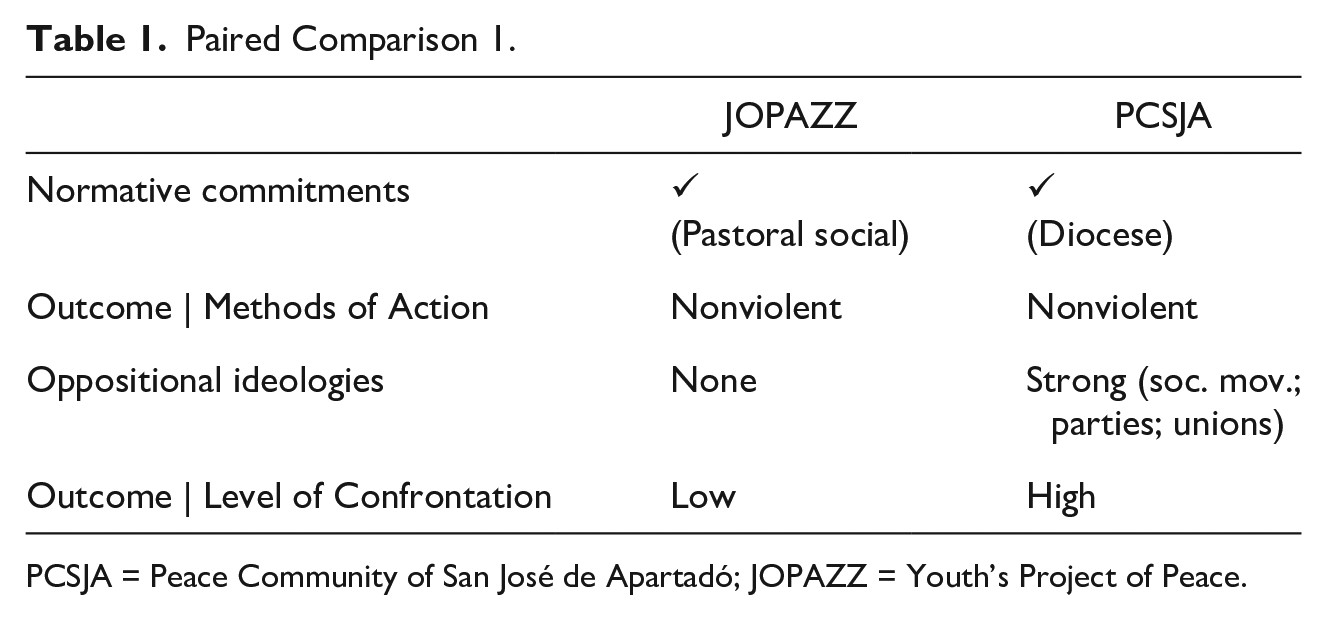
PCSJA = Peace Community of San José de Apartadó; JOPAZZ = Youth’s Project of Peace.
The strong influence various left-wing organizations had on San José villagers might come across as contradicting the PCSJA’s pledge to neutrality, especially in relation to FARC. However, despite having had supported these organizations in the past and even collaborated with FARC, changing war dynamics—including FARC’s violence against them—pushed villagers to update their beliefs regarding armed actors and the payoffs they attached to cooperating with FARC, leading them believe that neutrality was the best course of action. 58 Attitudinal partiality (or a preference for the ideology of one armed group over the other) does not preclude behavioral neutrality; it does not need to translate into behavioral support (Masullo, 2017, Chap 3; Kalyvas, 2006, pp. 87–110; Valenzuela, 2009, Chap. 1).
Paired Comparison II: PCSJA and ATCC
The first paired comparison provided supportive evidence for both Level (i) and (ii) of the argument. Key factors that could be associated with variation in the degree of confrontation—such as the level of threat or the type of armed groups civilians faced—were kept fairly constant, yielding stronger evidentiary power. However, there is one factor that still varied considerably and that could have a bearing on the level of confrontation: the PCSJA enjoyed noticeably higher levels of mobilization capacity than the Joppaz. This was evident in the availability of various resources that has been identified as shaping collective action capacity in rural Colombia and beyond, such as supportive external allies, existence of local social and political organizations, and the extent and depth of past experiences of collective action (Arjona, 2016; Kaplan, 2017; Masullo, 2017). Therefore, it can be counter-argued that the PCSJA pursued a more confrontational campaign not because of exposure to and socialization into oppositional ideologies, but because they had the capacity to do so. To cast doubt on this plausible alternative explanation, in this second paired comparison, I pit the PCSJA against a campaign with very similar levels of collective action capacity, the ATCC.
The ATCC represents an instance of pacted noncooperation. Unlike Joppaz, ATCC villagers did engage armed groups openly and directly. However, this engagement was different from what we observed in the PCSJA. Dialogue and negotiation, rather than a unilateral declaration, underpinned noncooperation.
Pacted noncooperation goes through some form of bargaining or consultation. While in unilateral noncooperation the rules of the game are defined by civilians alone and commonly imply a radical break in their interactions with armed groups, in pacted noncooperation civilians establish a channel of communication with armed groups to discuss the terms of interaction before declaring noncooperation. Civilians’ intentions are discussed a priori and, as in the case of the ATCC, concrete mechanisms to advance noncooperation might result from the bargaining process. Although still premised on the nonnegotiable choice of not cooperating with any side, negotiation and dialogue tempers the degree of confrontation in this type of noncooperation.
In early 1987, the Peasant Self-defense Groups of Magdalena Medio (ACMM), a paramilitary group, convened peasants in the rural village of La India. They gave them an ultimatum: they had about 15 days to decide whether to join the paramilitaries, side with the rebels (FARC), leave the region, or be killed. As in the two previous cases, this paramilitary incursion was part of an effort to take control of an area long controlled by FARC and led to a sharp increase in violence against civilians. With little lead time to decide what to do, a group of community leaders met in an ad hoc assembly to analyze their options. After a long deliberation, in the words of a community leader, they concluded that “Neither everybody will die, nor people will go with an armed group. We are from here, we are colonos [colonizers, settlers], so they [armed groups] will respect us. We will be neutral . . .” 59 This decision gave birth to the ATCC.
Instead of making a unilateral declaration of their choice, villagers addressed armed groups and expressed their determination to stay put without taking any sides. After intense dialogues with the different factions, commanders accepted the decision and agreed to try to leave them out of the war and designed a joint procedure to ensure that villagers fulfill their neutrality and to investigate cases of alleged noncompliance. 60 Dialogues with armed groups still persist 30 years later, and the ATCC continues to govern the lives of hundreds of peasants living in La India and surroundings.
Level (i): The choice of nonviolent action
In the absence of a case of armed noncooperation, within-case evidence from the ATCC provides a second-best way to explore the potential role of normative commitments. Some of the most influential community leaders of the ATCC did seriously contemplate arming themselves, and reported having the means to do so. Yet, armed resistance did not emerge. This section provides evidence that normative forces played a role in constraining armed resistance.
The Adventist Church settled in La India in the early 1960s. Since then, it has been a focal point for community congregation and an engine for communal work. Julio, one of the very first settlers, established the Church in the village. “[T]he Adventist Church began in the middle of the jungle,” he recalls. Given the multiple challenges associated with setting up a town in the wilderness, the Church ended up deeply involved in organizing the population. What the PCC did in the case of the PCSJA, to a large extent, was taken over by the Adventists in La India. This role gave the Adventist Church—and Julio himself—a privileged position within the emerging community. Julio became a central community leader, and eventually served as the first president of the village’s Communal Board (JAC), which was comprised by an Adventist majority. 61
Adventists and non-Adventists alike recognize that the Church was a central—if not the central—associational space that facilitated preference convergence and mobilization. However, as in the PCSJA (and Joppaz), its role was not restricted to facilitating collective action. Without any probing, Julio stated that for many years (prior to the creation of the ATCC) he deliberately “used” the Church to shape people’s beliefs regarding participation in war and the use of violence. 62 He, and some of his closest followers, noted that they deliberately put concrete teachings of the Bible at the service of guiding villagers on how to behave in a war zone. Almost every resident I spoke to recalled that the Adventists had in fact long promoted a message of unity, nonparticipation (in war) and nonviolence. The Church repeatedly stressed that while one should not see armed groups as enemies, by mingling with them one ends up promoting violence in one way or another. 63
When the paramilitaries gave villagers the ultimatum, the decision to engage in noncooperation was not straightforward. Some considered it too risky, and community leaders had diverging views of what form it should take. Some, including Josué—ATCC’s first president and by almost all accounts the most influential leader of the village—thought they should organize armed resistance. This was not about joining any of the existing factions, but rather organizing self-defense violence of their own. David, another historical leader and founder of the ATCC, asserted that Josué and others had considered arming themselves for a long time, and that the ultimatum presented them with an opportunity to propose it to the rest of the community. David was not fully against the idea, and was ready to tap into his previous experience with liberal guerrillas in his home region to support the process. 64
Pastor Julio remembers well the day he discussed this issue with Josué. They were a few kilometers south of La India when Josué said “we need to do something because [armed groups] will finish us. Let’s arm ourselves as others are doing in Puerto Boyacá [a neighboring municipality infamous for the emergence of self-defense groups many of which later evolved as paramilitary armies].” Julio’s reply was unequivocal: “we [the Adventists] are here to collaborate, but not with arms. The Adventists don’t kill.” 65
Josué knew that to be successful in organizing noncooperation—armed or unarmed—they needed almost universal participation and, therefore, whatever they proposed had to resonate with the population at large. 66 With the ultimatum haunting them, those who entertained the idea of armed resistance did not have time to survey villagers’ intentions; but as community leaders they had a good sense of villagers’ beliefs. Considering that about 35% of the village was Adventist, noncooperation would have not been possible if they pursued armed resistance. Moreover, given the prevalent normative beliefs long promoted by the Church, armed opposition would have set hard-to-overcome moral barriers for participation also for non-Adventists. In fact, every “rank-and-file” villager I spoke to (Adventists and non-Adventists), with the exception of one individual who noted that if that was the only way out she would have supported it, noted that they would have vehemently rejected armed resistance. One respondent—interestingly, not an Adventist—further explained “we are peaceful people, not perpetrators of violence.” 67
Those who entertained the idea of armed resistance, including Josué, eventually dropped it. It is virtually impossible to determine whether in the absence of the Adventists La India would have engaged in armed resistance. However, relative to the case of the PCSJA (and even more, Joppaz), armed noncooperation was clearly a more plausible potential outcome. First, those who contemplated the idea were influential leaders who eventually came to lead the ATCC. Second, previous experiences (of at least some of them) and the example of neighboring localities could have helped them fulfill the technical and material requirements of armed struggle. These two facts cast doubt on cognitive unavailability and lack of material resources as plausible alternative explanations of why violence did not emerge, which strengthens the ideational argument. Moreover, the fact that influential leaders who entertained this idea approached members of the Church reveals that the community had not already chosen a nonviolent approach before “nonviolent entrepreneurs” entered the picture—an option that was not fully ruled out in the first paired comparison.
Level (ii): The degree of confrontation
The ATCC emerged in a very similar ideational landscape to that of the PCSJA, with particularly strong regional left-wing movements and political parties in the years preceding the emergence of noncooperation. From the 1960s, and particularly in the 1970s, oppositional movements were very successful in the region, especially in Cimitarra—the closest urban center to La India. The PCC was a central political actor and different left-wing organizations, such as the Liberal Revolutionary Movement (MRL), the National Popular Alliance (ANAPO), and the National Opposition Union (UNO), enjoyed broad popular support. Again, electoral results provide a good indication of their strength: in the 1976 local elections, the UNO—a coalition of the Communist Party and other left-wing political movements—won six of the 10 seats of Cimitarra’s Municipal Council (Equipo Nizkor, 2001).
Throughout the 1960s and part of the 1970s, these left-wing organizations helped organize the population and stimulated communal work. As in the case of the PCSJA, these initial experiences considerably enhanced villagers’ subsequent capacity to mobilize. Moreover, along with the political work undertaken by FARC in the 1970s and early 1980s, these organizations nourished an oppositional spirit among the residents of the region (Grupo de Memoria Histórica, 2011, p. 81). However, for several reasons, this contentious past did not inform the creation of the ATCC as it did in the PCSJA.
First of all, villagers of La India were not as exposed to the political ideologies promoted by these oppositional movements as San José residents were, and many prominent leaders that pushed for the creation of the ATCC did not participate in these opposition movements to the extent PCSJA leaders did. This was the case, in part, because most of the influential movements in the region where the ATCC emerged were mostly based and active in urban areas—such as Cimitarra. Moreover, residents of La India, mostly campesinos who work and live off of the land, were not exposed to the highly oppositional trade unions that emerged in San José linked to the banana agro-industry.
Second, some years before the creation of the ATCC, the political left had almost completely disappeared from the political landscape. Due to early repression stimulated by the electoral success of the UNO in the late 1970s and FARC’s increasing control of rural areas during the 1980s, the region witnessed what residents still refer to as the “extermination of the left.” 68 Many leaders of the most salient political movements were forced to leave, and several were killed, shaping the profile of La India’s next generation of leaders. As community leader David noted, most of those who remained in La India survived because they were not “into the political thing” and were not “rebellious,” and the few who managed to stay despite of having been involved in that contentious past, like himself, were left with “no enthusiasm [sin gana] to get into politics.” He explained that while he still identified himself with Marxism-Leninism, he never brought that into ATCC meetings or affairs. 69
This apolitical attitude is still clearly present in current ATCC leadership. One of the association’s most influential present leaders of the Association explicitly noted, without any probing: … we created a peasant association not a political movement. We don’t follow any color. We are not part of any political or ideological group. This allows for dialogue [with armed groups] and does not lead us to take radical positions.
70
When asked about the differences between the ATCC and the PCSJA, the same respondent noted that the peace community was “very radical” and “very left-wing,” and stressed that the ATCC was different because they do not have any “ideological color.” 71
Peasants from La India learned the hard way that being associated with any organized expression of the left, armed or unarmed, was way too risky and, for several years before the creation of the ATCC, residents remained as uninvolved in politics as possible. Previous experiences of repression successfully “sorted” the population, selecting out the most oppositional actors and subjectively traumatizing those who remained. 72 In this regard, La India’s experience is closer to that of Joppaz.
Finally, the Adventist Church also played its part in tempering the ATCC’s degree of confrontation. By actively advocating dialogue with all factions, political entrepreneurs coming from the Church, such as Pastor Julio, contributed in making the campaign less confrontational. 73 Records of the time when the ATCC was being created reveal how people like Josué—not an Adventist and probably the most confrontational leader—had already embraced some of the ideas and values promoted by the Church. In the first meeting villagers held with FARC’s Central High Command, Josué told the rebels: “We simply seek to live in peace and work, we are not your enemies.” 74
Besides its dialogue-based approach, the difference in the degree of confrontation between the ATCC and the PCSJA is apparent in other crucial organizational decisions regarding how to interact with combatants. Although the PCSJA banned armed groups from entering the community’s hamlets, combatants have the right to transit and even stay overnight in the ATCC’s area of influence as long as they do not use members’ houses as shelter, enter spaces designated for the exclusive use of the Association, and/or take advantage of services provided by and for ATCC members.
75
Similarly, while the PCSJA has engaged in a restless effort to publicly denounce armed groups’ violence for over 30 years, blaming and shaming armed factions both nationally and internationally,
76
the ATCC agreed to reach out commanders to clarify events before denouncing violence. Even in 1990, when three of their main leaders (including Josué) were massacred—the toughest assault in the campaign’s history—they stuck to this practice: Instead of making public accusations of the killings of our leaders, we need to intensify our efforts to get closer to those who declare to be our enemies in order to demonstrate them that, in practice, for us no one is an enemy.
77
In sum, while both the ATCC and the PCSJA emerged in areas where left-wing organizations (both legal and illegal, unarmed and armed) were historically strong, for various reasons oppositional ideologies did not inform the ATCC to the extent they did in the PCSJA. As a result, the ATCC mounted a pacted campaign that is noticeably less confrontational than the unilateral campaign in San José. This was the case even though both communities had comparable high levels of organizational capacity, evidenced in the availability of strong leadership, the number of active local organizations (such as JACs), and the fact that both managed to launch organizationally complex and demanding campaigns.
Table 2 summarizes this second paired comparison.
Paired Comparison 2.
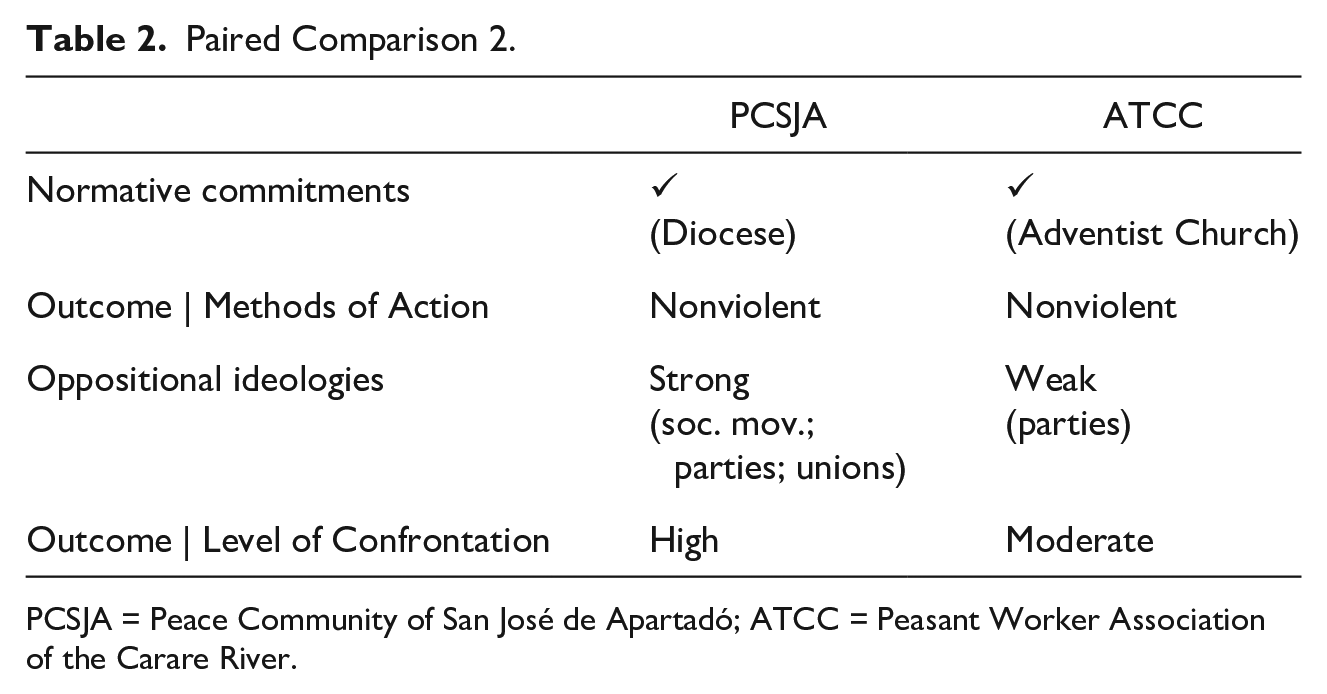
PCSJA = Peace Community of San José de Apartadó; ATCC = Peasant Worker Association of the Carare River.
Conclusion
This article supports the increasingly salient claim that ideational factors matter in civil war. However, it expands its contours by showing that these factors also affect the behavior of civilians living in warzones, which in turn makes a novel contribution to the emerging literature on civilian agency in conflict settings. I provide evidence that civilians, like armed groups, “use ideas when taking literally life and death decisions” (Gutierrez Sanín & Wood, 2014, p. 213). A complete picture of civilian collective responses to armed groups in civil war should include a role for nonmaterial factors.
When civilians decide to organize to refuse to cooperate with armed groups, norms of nonviolence and oppositional ideologies shape their choices regarding the methods of action and the level of confrontation vis á vis armed groups. However, for these factors to have an effect, political entrepreneurs must activate and mobilize ideational content that resonates in the local normative and ideological context. I offer microlevel comparative evidence from the Colombian civil war supporting this argument.
Methodologically, this article exemplifies that we can trace the effect of ideas and offer valid ideational explanations by drawing on rich field-based evidence and using a purposively designed micro-comparative structure. Claims that ideational factors independently affect choices require evidence showing that the ideational sources are exogenous to the material features of the choice being examined (Jacobs, 2014). This article shows that such evidence can be produced by expanding the scope of the analysis beyond the moment when crucial mobilization choices were made (i.e., examining communities’ histories), disaggregating collective actors (i.e., analyzing leaders and rank-and-file members separately) and exploring the potential role of actors external to the core dyad of contention (i.e., external allies that come to support community collective action).
Furthermore, this study confirms the “contentious politics” program claim that similar processes and mechanisms can shape collective action across different expressions of contention (McAdam et al., 2001). My findings are in line with recent civil resistance research showing that ideological variation in ethno-political organizations influences civilians’ decisions about whether to engage in violent or nonviolent resistance (Asal et al., 2013). Similarly, they yield additional support to a long tradition of social movement research that stresses the role of the Catholic Church and its normative commitments in shaping collective contention, from left-wing mobilization in Latin America (Peterson, 1996) to struggles for civil rights in the United States (Morris, 1986) and resistance to communism in Central Europe (Wittenberg, 2006). Finally, my results show that the process of nonviolent mobilization in the context of civil war exhibits important analytical similarities with that of armed mobilization: when changes in conflict dynamics (such as peaks in violence) push communities away from the status quo, political entrepreneurs and external allies are likely to mobilize ideational and normative content that provides guidelines on how to fight back (Costalli & Ruggeri, 2015). A closer dialogue between these intimately related literatures would likely enrich our understanding of where, when and how ideas matter in contentious politics.
Supplemental Material
methodologicalappendix – Supplemental material for Civilian Contention in Civil War: How Ideational Factors Shape Community Responses to Armed Groups
Supplemental material, methodologicalappendix for Civilian Contention in Civil War: How Ideational Factors Shape Community Responses to Armed Groups by Juan Masullo in Comparative Political Studies
Footnotes
Acknowledgments
I am enormously grateful to all my respondents for sharing their time and experiences with me, as well as for hosting me in their villages while conducting this research. For useful comments on previous versions of this paper, I thank Ana Arjona, Diana Fu, Nelson Kasfir, Ollie Kaplan, Jonathan Leader Maynard, Zach Mampilly, Pam Oliver, Andrea Ruggeri, Abbey Steele, Sid Tarrow, and participants at the Annotation for Transparency Inquiry Workshop (November 2018, New York), EISA 5th European Workshops in International Studies (June 2018, University of Groningen), Young Scholars in Social Movements Conference (April 2018, University of Notre Dame), ISA 59th Annual Convention (April 2018, San Francisco), Workshop on Civilian Activism in Civil Wars (February 2018, University of Konstanz), CRS Annual Meeting (September 2017, University of Oxford), and the Workshop on Ideology and Armed Groups (June 2017, University of Montreal). I’m also grateful to CPS’ reviewers and editors for engaged feedback and a swift review process. All remaining errors are my own.
Authors’ Note
A longer version of this paper has been annotated using “analytic notes” with the open-source software Hypothesis and the support of the Qualitative Data Repository (QDR). These notes aim at increasing analytical and production transparency by discussing data generation and analysis, explaining further why and how the pieces of data reported in the paper support the claims made. For more information on this, visit my website:  .
.
Declaration of Conflicting Interests
The author declared no potential conflicts of interest with respect to the research, authorship, and/or publication of this article.
Funding
The author disclosed receipt of the following financial support for the research, authorship, and/or publication of this article: Fieldwork for this research was financially supported by the European University Institute.
Notes
Author Biography
Juan Masullo is lecturer at the Department of Politics and International Relations at the University of Oxford. His research focuses on social processes of political and criminal violence, especially in Latin America.
References
Supplementary Material
Please find the following supplemental material available below.
For Open Access articles published under a Creative Commons License, all supplemental material carries the same license as the article it is associated with.
For non-Open Access articles published, all supplemental material carries a non-exclusive license, and permission requests for re-use of supplemental material or any part of supplemental material shall be sent directly to the copyright owner as specified in the copyright notice associated with the article.
