




Abstract
Since Tocqueville linked the quality of democracy in America to its vibrant civic culture, studies have explored the relationship between social capital and the quality of governance. Yet, few have examined the mechanisms between individual components of social capital and democracy in depth. This study focuses on the link between one component of social capital, civil society engagement, and the linkage between public opinion and policy. It argues that engagement in associations with an interest in the policy issue may stimulate correspondence between public opinion and policy through their ability to collect and disseminate information to policy makers and the public. The analysis of 20 specific policy issues from 30 European countries confirms these expectations: Issues that experience a high level of associational engagement display a stronger relationship between public opinion and policy. The findings underline the role civil society organizations can play in policy representation beyond engaging in interest advocacy.
Keywords
Introduction
Since De Tocqueville (1840) linked the quality of democracy in America to its vibrant civic culture, scholars have argued that civic participation and networks of cooperation and trust in society have important benefits for the quality of democracy. The most prominent example of this argument is perhaps presented in Putnam’s work on social capital. Together with norms of reciprocity and trust, he considers social networks as one of the building blocks that help improve the democratic performance of a society on a range of different indicators (Putnam, 1993, 2000). Among other beneficial consequences, such as teaching democratic norms and recruiting political leaders, participation in civil society organizations is assumed to provide a mechanism for citizens to channel their preferences toward political elites and, ultimately, to have their views represented.
A large body of literature examines the link between associational engagement on one hand and various aspects of government performance (see, for example, Andrews, 2011; Cusack, 1999; Putnam, 1993) as well as citizens’ ability to keep governments politically accountable on the other (see, for example, Claibourn & Martin, 2007; Jottier & Heyndels, 2012). However, there is limited systematic evidence regarding the effect of associational engagement on the link between opinion and policy, which is an indicator of policy representation and hence a key aspect of the democratic process. Verba and Nie’s (1972) study of participation in American communities constitutes a milestone in this respect as it explicitly examines whether communal participation affects priority congruence between citizens and leaders (see also Hansen, 1975; Hill & Matsubayashi, 2005).
Yet, it is possible that it is not the overall engagement in all kinds of associations concerned with different issues that is relevant when it comes to representation in specific areas of policy. An important way in which civil society organizations might affect the opinion–policy linkage is by providing information that helps citizens become “sophisticated consumers of politics” (Boix & Posner, 1998, p. 690) and policy makers to find out about public preferences. However, as associations have specific purposes and goals, they are likely to provide information primarily about issues that are relevant for their activities. Hence, engagement in issue-relevant organizations rather than associational life as a whole may be the determining factor when it comes to facilitating the transmission of information between voters and politicians and, ultimately, strengthening the link between public opinion and policy.
We test this hypothesis through multilevel regression analysis on a data set of opinion and policy on 20 specific policy issues in 30 European countries. The issues fall into a broad range of different policy areas, while the countries cover almost the entire European continent and feature high levels of variation in important political institutions. Using data with variation at both the country and the issue level is crucial as issue-specific civil society engagement varies at both levels and because it allows us to control for a range of variables at both levels. Our findings deliver strong support for the argument that associational engagement in the relevant issue jurisdiction is an important predictor of the strength of the opinion–policy link. While overall associational engagement in a country is also positively related to policy representation, the effect disappears when the domain-specific measure is introduced.
Our findings underline the value of integrating research on engagement in voluntary associations with research on policy representation. They support the popular claim that civic engagement can improve the quality of democracy and advance our knowledge about the specific channels through which the two are linked. While the vibrancy of civil society might positively affect democracy in various ways, we show that the benefits for policy representation as a particular aspect of democratic governance appear to be limited to the particular issue domain in which civil society associations are active. Therefore, it is most likely that associations affect representation through the transmission of issue-specific information rather than the overall associational engagement in a country.
In addition, the study contributes to the literature that examines the factors influencing the quality of policy representation (e.g., Hobolt & Klemmensen, 2008; Kang & Powell, 2010; Lax & Phillips, 2009, 2012; Peters & Ensink, 2014; Rasmussen, Romeijn, & Toshkov, 2018; Toshkov, Mäder, & Rasmussen, 2018; Wlezien, 2005). It provides a new perspective to the more common view of associations as lobbyists by focusing on the role that civil society associations active on an issue play regardless of their policy positions. The positive effect that associational engagement exerts on the opinion–policy link persists even when we control for the net support for a given policy in the community of associations. Consequently, when debating the potential of advocacy groups to push for policy that is contrary to the views of the public, we also need to take into account that their actions might (even if unintended) simultaneously promote the link between public opinion and policy.
Civil Society Engagement and the Opinion–Policy Link
The argument that the quality and amount of social interactions in a society influence the possibility of individuals to achieve their goals and influence democratic governance was popularized by Bourdieu (1986), Coleman (1988, 1990), and more recently by Putnam’s studies of social capital in Italy (1993) and the United States (2000). Social capital is generally understood as comprising (a) engagement in civil society organizations, which is marked by and promotes (b) norms of reciprocity and (c) generalized interpersonal trust (Putnam, 1993). These different facets are expected to influence democracy in a variety of ways (see, for example, Paxton, 2002; Putnam, 1993). For instance, trust and reciprocity are said to facilitate cooperation and reduce free riding, thereby increasing citizens’ ability to stand up against political elites who exploit their power. Moreover, associations are argued to be beneficial because they serve as a training ground for political leaders (Paxton, 2002).
A range of studies have tested whether social capital does in fact influence democracy, usually analyzing the relationships between broad indicators of trust, associational engagement, and democracy (see, for example, Andrews, 2011; Claibourn & Martin, 2007; Cusack, 1999; Jottier & Heyndels, 2012; Paxton, 2002; Putnam, 1993). While such a holistic approach undoubtedly yields valuable insights, it does not necessarily advance our understanding of which of the various proposed mechanisms are actually at work (Andrews, 2012). Therefore, several scholars have taken more nuanced approaches and investigated different mechanisms that potentially link social capital and democracy (e.g., Jottier & Heyndels, 2012, on accountability; Griesshaber & Geys, 2012, on associations and corruption; and Knack, 2002, on different indicators of government performance).
We aim to contribute to this endeavor by focusing on the relationship between engagement in civil society organizations and policy representation. The representation of citizen preferences in the adopted policies is a key aspect and goal of contemporary democratic governance (Dahl, 1989). Accordingly, a large body of political science literature is devoted to studying the direct linkage between opinion and policy (e.g., Bevan & Jennings, 2014; Hobolt & Klemmensen, 2008; Lax & Phillips, 2012; Page & Shapiro, 1983; Rasmussen, Reher, & Toshkov, 2018; Toshkov et al., 2018; Wlezien, 1995). The literature also examines what factors affect the strength of this relationship, paying most attention to political institutions and issue salience (e.g., Hobolt & Klemmensen, 2008; Kang & Powell, 2010; Lax & Phillips, 2009, 2012; Monroe, 1998; Rasmussen, Reher, & Toshkov, 2018; Wlezien & Soroka, 2012). 1 The expectation that a particular factor will strengthen the opinion–policy link is usually based on its potential to increase either the capacity or the incentive (or both) of policy makers to respond to public opinion.
The potential role of civil society organizations is largely neglected in this literature (for recent reviews, see Bevan & Rasmussen, 2017; Burstein, 2014; Rasmussen, Mäder, & Reher, 2018). The few studies that do include associations tend to take an advocacy perspective, meaning that they view civil society organizations as interest groups that seek to influence policy. The predominant hypothesis is then that they can either strengthen or weaken the link between public opinion and policy, depending on whether the preferences of these groups are aligned with those of the public. As an example, a recent study of 39 policies in the U.S. states showed that congruence between opinion and policy was higher when interest groups and the public were aligned (Lax & Phillips, 2012). Moreover, Gilens’s (2012) analysis of 1,779 U.S. policy issues found a higher likelihood that policy changes supported by the public are adopted when the powerful interest groups are also positive toward these changes.
Our theoretical argument takes a different perspective on the role of civil society organizations in policy representation by focusing on their “informational carrying capacity” (Claibourn & Martin, 2007, p. 200), which helps the public form policy preferences and political elites to learn about them. We thereby attempt to bridge the gap between existing research of policy representation and the literature on civil society engagement. According to this argument, the presence of associations may increase the likelihood of policy representation no matter whether the views of associations and the public are aligned. On the one hand, associations help policy makers respond to citizens by making information about public opinion regarding policy issues that lie within the realm of their purpose and interests available to them. They do so both directly, by actively conveying information to policy makers, and indirectly, by placing issues on the public agenda, for instance, through political action and media presence (see, for example, Austen-Smith & Wright, 1994; Burstein & Linton, 2002; Kollman, 1998; Milbraith, 1960; Naurin, 2007; Rasmussen, Carroll, & Lowery, 2014; Schlozman, Verba, & Brady, 2012; see also Agnone, 2007, on social movements).
In a world in which decision makers face cognitive, time, and information constraints (Jones, 2003; Simon, 1991), such associational engagement is likely to increase their awareness of public preferences on an issue. Consequently, they will be better able to increase the link between public opinion and policy by passing or maintaining policy in line with the views of the majority of citizens or by making efforts to convince citizens of the policies they consider to be in the public’s best interest, thereby achieving representation “from above” (Esaiasson & Holmberg, 1996).
There is of course always the possibility that associations are somewhat selective in which information they provide and, therefore, present a distorted view. Yet, Wright (1996) mentions how “any group that exaggerates, distorts, or does not fully reveal what it truthfully knows risks exposure by a competing group that presents the facts accurately. Competition among interest groups, therefore, is crucial for keeping groups honest” (p. 201). Thus, while “it cannot be claimed that interest groups would never misrepresent the facts [. . .] there are strong incentives for them not to do so” (p. 200). Moreover, even if individual civil society organizations only present a partial perspective, strong engagement on one side on an issue is likely to be followed by countermobilization and action by opposing groups (Truman, 1951). Decision makers are thus likely to obtain information about the preferences of different sections of the public. In addition, the vast majority of associations in which we study engagement are not classic examples of interest groups that represent narrow constituencies of specialist interests (Olson, 1971). Instead, they often speak on behalf of broad-based constituencies representing diffuse interests of large sections of society, such as consumer and environmental groups (Bevan, Baumgartner, Johnson, & McCarthy, 2013). Therefore, we argue that associational activity is likely to improve the ability of representatives to be responsive to the citizens, regardless of the policy positions that the groups themselves hold on the issue in question.
On the other hand, civil society organizations support the formation of informed policy preferences among the public. They supply citizens with information about the issues in which they have an interest, thereby turning them into what Boix and Posner (1998) have referred to as “sophisticated consumers of politics” (p. 690; see also Burstein & Linton, 2002). According to Wright (1996), associations “monitor, evaluate, and even shape perceptions of how well incumbents are doing their job” (p. 91). They oversee and scrutinize elites’ statements and actions concerning policy issues and transmit this information to their members, for instance through internal media (Cohen, 2012), as well as to the wider public by engaging in different types of outsider lobbying, that is, attempts to mobilize citizens outside the political system to put pressure on the political insiders (Kollman, 1998; Wright, 1996). As a result, citizens are better able to hold policy makers accountable. As Jottier and Heyndels (2012) showed, associational engagement, together with other components of social capital, enables voters to base their vote choice more strongly on their assessment of which party is most likely to implement their policy preferences. Through their informational role, civil society organizations can thus put pressure on political elites to take the opinions of the broader segments of society they represent into consideration. Therefore, like other factors that have been argued to affect policy representation, associational engagement should increase both the ability and the incentives of elites to be responsive and thereby strengthen the link between opinion and policy.
General Versus Issue-Specific Effects of Civil Society Engagement
A small number of studies have developed and tested similar arguments to the one put forth here. Verba and Nie (1972) found in their classic study of Participation in America (see also Hansen, 1975) that cooperative participation, which captures active membership in voluntary associations as well as more informal cooperative community engagement (Verba & Nie, 1972, p. 58), is positively related with congruence between citizen and elite policy priorities. However, this relationship only exists in communities with high levels of consensus between active and inactive citizens and in contexts with high voter turnout (Verba & Nie, 1972, pp. 325-327). Later, Berry, Portney, and Thomson (1993) demonstrated that engagement in neighborhood associations has a positive effect on the ability of citizens to communicate their wishes to public officials in five U.S. cities when it comes to both placing neighborhood issues on the agenda and getting actual policy adopted. Rather than looking at associational engagement as a whole, Hill and Matsubayashi (2005) differentiated between “bridging” and “bonding” voluntary associations, which might affect representation differently (Putnam, 2000). Bonding associations represent homogeneous groups of actors, whereas bridging associations cut across class divisions and cultural identities. However, they did not find the expected positive effect of membership in bridging associations on priority congruence between citizens and elites.
Gray et al. (2004) tested a similar argument within the interest group literature. They assess whether the density of the interest community, which comprises both nonprofit and for-profit organizations lobbying for their policy interests, affects the representation of public opinion in policy irrespective of the groups’ policy positions. A denser interest community, they argue, “might provide politicians a more precise representation of interests in society” (p. 413). At the same time, “a crowded system may clog-up the policy process, inducing gridlock” and thus weaken representation (p. 413). They find evidence of a positive effect for one of the two years under investigation.
While these studies have argued that civil society groups can influence policy representation and hence the democratic process by providing information to citizens and policy makers, they all remain agnostic with regard to the specific purposes and policy interests of associations. In contrast, we expect the effect of associations on representation to be largely restricted to the policy issues that lie within the realm of interest of a particular association. No matter how encompassing the membership of associations is, they are likely to affect the information environment primarily on issues that are relevant for their purpose. This idea also drives recent work by Bevan and Rasmussen (2017) and Cohen (2012) who argue that associations have the potential to help citizens set the agenda and hold leaders accountable with respect to the issues in which the groups are interested. Even high levels of engagement in groups are unlikely to strengthen substantive representation in policy areas that are unrelated to their specific goals and interests; for instance, environmental associations are unlikely to transmit information about workers’ rights. Instead, primarily associations for whom the issue is relevant can be expected to increase the flow of information from decision makers to citizens. Our hypothesis is thus that the higher the engagement in voluntary associations linked to a policy issue, the stronger the link between public opinion and policy on this issue.
Data and Method
Testing our hypothesis requires data on policy representation and associational engagement with variation across both policy issues and countries. We created a unique data set containing information on public support for 20 specific policy issues and the status of legislation on these issues in 30 European countries, 2 allowing us to measure the strength of the relationship between public opinion and policy across issues and countries. We link this data on policy representation to information about engagement in different types of voluntary associations across the countries.
Public Opinion and Policy
The unit of analysis in our study is a policy in a country. Among the data required to test our hypotheses, public opinion on a set of policy issues across a large number of countries is the most difficult to obtain. We therefore made the collection of these data our starting point. To assemble a sample of policy issues on which public opinion data are available across countries, we searched major cross-national surveys of representative samples of the population conducted between 1998 and 2013 that include at least 15 European countries for questions measuring attitudes toward specific policy issues. All included questions fulfill a number of criteria: They concern issues of national (as opposed to EU) competence, measure respondent attitudes to the policy on an agreement scale, and allow us to determine whether the policy was in place at the time the survey question was asked (i.e., questions concerning future policy changes, such as increases in spending, are excluded). From this set of issues, we selected a sample of 20 survey items (Table 1; Rasmussen, Reher, & Toshkov, 2018; Reher, 2018). We ensured that these issues represent a variety of different policy areas. The appendix includes a list of the policy issues as well information about the year, the specific survey, and the number of countries included. 3
Policy Issues and Related Voluntary Associations.
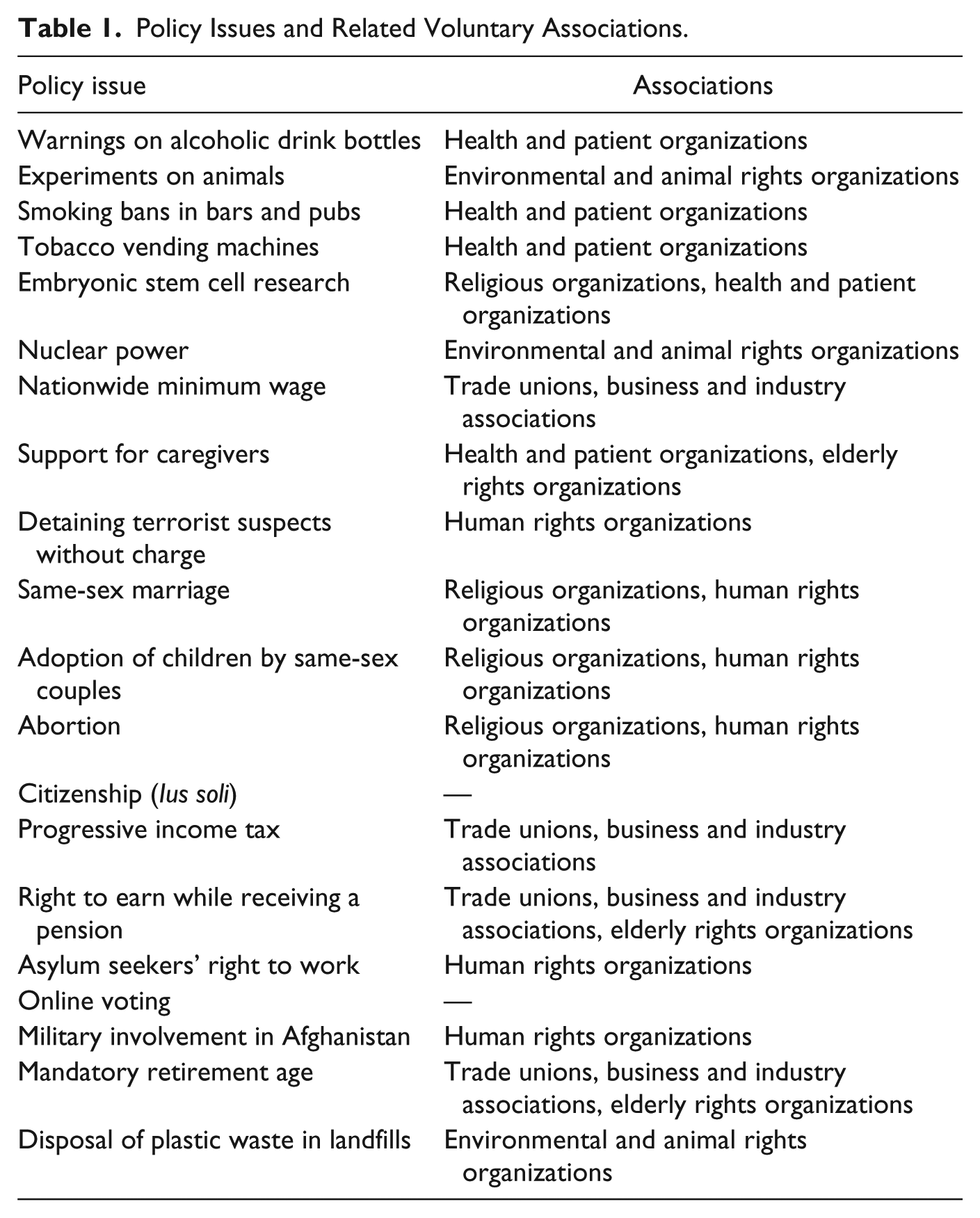
Subsequently, we mapped the state of policy on the issues in the different countries at the time point at which the degree of public support for the policies was measured in the opinion polls. For each issue, we conducted a search for information in documents published by government agencies, international organizations, nongovernmental organizations, academic publications, newspaper articles, and so forth. Whenever possible, information obtained from one source was verified by another, independent source and in cases of doubt experts were consulted, for instance, academics and public servants. Policy was coded on scales constructed for each issue, which were transformed into ordinal scales with three levels, where 0 indicates that the policy was not in place, 1 that it was partially in place, and 2 that it was in place. As an example, for the issue of adoption rights of same-sex couples, 0 means that they are banned from adopting children, 1 means that they may adopt internally, that is, one partner may adopt the child of the other partner, and 2 means that the couple may also adopt externally, that is, a child to whom neither partner is a parent (cf. Online Appendix A; Rasmussen, Reher, & Toshkov, 2018; Reher, 2018).
To measure the quality of policy representation, we regress the policy measure on the degree of public support for it. Public support is measured as the proportion of survey respondents in a country who indicated to be in favor of the policy among all respondents who indicated to be either in favor or against it (those who responded “neither nor” or “don’t know” are excluded). We are explicitly agnostic as to whether public opinion moves policy or whether policy moves public opinion, which is reflected in our decision to measure opinion and policy at the same point in time. Both processes might lead to a positive relationship between the two, and it is also possible that external forces, such as events or the media, move both public opinion and policy. Our approach to policy representation is that it can occur in different ways and that a top-down process of opinion formation need not be seen as opinion manipulation by elites. Citizens’ policy preferences are generally based on some kind of information and not, as Holmberg (2011) put it, “born via some sort of immaculate conception, without the imprint of external opinion molders” (p. 54). Assuming that citizens are capable of evaluating political elites’ claims and arguments equally well as information stemming from other sources, public opinion formation through policy makers can be considered a legitimate part of the democratic representation process (Esaiasson & Holmberg, 1996). Descriptive statistics for public opinion and policy can be found in the Online Appendix A.
Associational Engagement
We obtained data on engagement in civil society organizations from the same set of cross-national surveys from which we selected the policy issues. We use items from eight surveys 4 conducted between 1998 and 2011, which ask respondents in which type(s) of association they are members and/or engaged and which use similar categories of associations. We match each policy issue to one or more association types with an interest in the issue (Table 1). As the item wording varies across surveys and because they do not cover all years, we calculate the mean engagement levels per country for each policy issue across all eight surveys. The resulting variable, specific associational engagement, indicates the proportion of survey respondents in a country who indicated to be engaged in one of the association types linked to the policy issue, averaged across surveys.
When several association types are linked to an issue, the scores are added, so that the measure indicates the cumulative proportions of citizens who are engaged. As a result, engagement in several types of organizations per respondent may be included in the measure. This procedure reflects our interest in the strength of the associations rather than in the engagement levels of individual citizens. As most association types have low engagement levels and few have high levels, we use the natural logarithm of the cumulative proportion (+0.01; see Online Appendix A for descriptives). The level of engagement across countries is 0 for the issues of citizenship and online voting, which have no associated organizations, and highest for the right to earn a salary while receiving a pension.
To substantiate the argument that issue-specific associations in particular are important in transmitting policy-related information, we also create a measure of general associational engagement. Our indicator is based on the same data and indicates the average number of association types in which a respondent is engaged in a country. 5 Controlling for this variable enables us to test whether it is indeed the strength of issue-specific associations rather than general civic engagement that increases the quality of policy representation. The measures of general and issue-specific associational engagement are only correlated at Pearson’s r = .50, indicating that they measure distinct aspects of associational engagement.
Control Variables
We include several control variables in our models. First, we examine whether the salience of an issue influences the link between opinion and policy by interacting a measure of media salience with public opinion. The salience of an issue in the media might affect the ability of both politicians and citizens to acquire information about each other’s preferences and behavior on an issue. It can therefore be expected that salience also has a positive impact on the ability of citizens to hold politicians accountable for their policy actions (see, for example, Lax & Phillips, 2012). We construct an indicator of the overall media salience for each specific issue across Europe based on the relative number of articles in the Financial Times’ coverage of Europe that concern the policy issue over a 3-year period, using the year of the survey item as the final one. 6 While the Financial Times clearly does not devote equal amounts of attention to the public debates in all countries in Europe, the measure has the advantage of not being endogenous to policy adoption in a country, which is likely to be covered by the media (for a similar argument regarding the United States, see Lax & Phillips, 2012). The lack of between-country variation in the measure is moreover not overly problematic because the main contribution of this study is to test whether the relationship between civil society engagement and policy representation is issue-specific, which is why it is particularly important to control for factors that might account for variation in the degree of both engagement and representation between issues.
An alternative way of measuring the public salience of a policy issue would be to rely on respondents’ replies to the survey question about the “most important problem” (MIP) facing their country. Yet, while this survey item is frequently used to measure issue salience, it is problematic for our study that the categories into which the mentioned issues are divided are much broader than the issues on which we measure opinion and policy (Monroe, 1998, p. 20, who uses such an approach, also highlights this mismatch). For instance, policy on the disposal of plastic waste would be considered as salient as environmental issues overall, which is likely to be an overestimation, whereas the issue of sending troops to Afghanistan was probably more salient at some point than foreign policy more generally. Despite these reasons for using the policy-specific, media-based measure of salience instead, we also conduct robustness checks with an MIP-based indicator (see Online Appendix C).
Importantly, engagement in civil society associations is only modestly correlated with the media-based measure of salience (r = .22, p < .001) and uncorrelated with the MIP-based measure, indicating that associational engagement is not simply a proxy for salience. Whereas engagement in associations may increase when issues become more salient, its drivers are far more complex in practice and linked to a number of other factors besides the public salience of an issue (see also Curtis, Baer, & Grabb, 2001).
Second, we interact a measure of generalized social trust with the public opinion variable to account for the possibility that the creation of interpersonal trust in civil society associations might be responsible for the relationship between associational engagement and policy representation. As social trust is another component of the broader concept of social capital that is both closely linked to associational engagement and frequently argued to affect the quality of democracy (Putnam, 1993), it is important to control for its potential effect. The measure is the country average of social trust based on an item included in the six European Social Surveys (ESS) conducted between 2002 and 2012. It measures trust on an 11-point scale, ranging from you cannot be too careful in dealing with people to most people can be trusted.
The political institution that is most commonly believed to influence representation is the electoral system. Rules that translate the percentage of votes more proportionally into seats have for a long time been assumed to produce better representation (Hobolt & Klemmensen, 2008; Lijphart, 1984; Powell, 2000). Yet, there are also reasons to believe that majoritarian systems lead to better representation, for instance, because they tend to produce single-party governments with less need to compromise (Wlezien & Soroka, 2012). At this point, the empirical evidence is as inconclusive as the theoretical discussion, and particularly the role of electoral rules in citizen–government congruence on the left–right dimension remains fiercely debated (Blais & Bodet, 2006; Ferland, 2016; Golder & Lloyd, 2014; Powell, 2009). We control for a potential effect of electoral rules on representation by interacting public opinion with a measure of the effective number of parliamentary parties (ENPP), developed by Golder (2005) and later extended by Bormann and Golder (2013; cf. Wlezien & Soroka, 2012). The composition of parliament is thought to be an important mechanism through which electoral rules, such as district magnitude and electoral thresholds, may affect representation.
We also estimate models that include additional interaction terms between public opinion and institutions, namely, the legislative–executive balance, federalism, bicameralism, and EU membership. The inclusion of these control variables does not change our findings (see Online Appendix D). We furthermore interact public opinion with a continuous year variable to account for potential time trends in the opinion–policy link. This is also important because the data for later years tend to include more countries and, in particular, more Central and Eastern European countries as several of the surveys were conducted among the EU member states at the time.
Finally, it is important that we address a particularly powerful alternative way in which civil society associations might influence policy, and hence the link between public opinion and policy: interest advocacy. It is plausible that the presence of strong civil society organizations supporting a policy, and potentially lobbying policy makers, increases the likelihood of a policy being in place (for literature on interest group influence, see, for example, Baumgartner, Berry, Hojnacki, Kimball, & Leech, 2009; Bunea, 2013; Dür, Bernhagen, & Marshall, 2015; Klüver, 2013; Mahoney, 2008). If engagement in associations in favor of a policy is positively correlated with public support for a policy, the strength of the relationship between public support and policy might be overestimated if we do not take into account that associations lobbying alongside the public might “help” the public obtain its preferences.
We therefore construct a variable measuring the proportion of respondents who are engaged in associations that support a policy in a country. If the association type that we linked to the policy issue is against the policy (e.g., animal rights organizations are against allowing experiments on animals), the variable takes a negative value. If several associations with opposing views are linked to an issue, the engagement levels are subtracted from one another so that the variable indicates the amount of net associational policy support. Similar approaches have been taken in recent studies of responsiveness to public opinion on specific policy issues (Gilens, 2012; Gilens & Page, 2014; Lax & Phillips, 2012). By identifying interest groups expected to be the most powerful in the policy processes, these studies examine whether policy is more likely to get adopted when it enjoys support by powerful interest groups. All independent variables are grand mean centered.
Analysis and Results
As the policy measure has three ordered but noninterval levels, we use ordered logit regression. The unit of analysis—a policy in a country—is clustered within both issues and countries, meaning that the variance in the policy status and in the relationship between public opinion and policy might be partially accounted for by both dimensions. To test whether this is the case and whether we consequently need to account for the clusters in our models, we first estimate two multilevel ordered logit regression models with public opinion as the only independent variable and random intercept and slope components at the country and the issue level, respectively (Table 2, Models 1 and 2). Both models show that public support for a policy is positively and significantly related to the likelihood of the policy being in place. Moreover, we find that the random variance components are extremely small in the model with countries as compared with the model with issues at the higher level. The Likelihood Ratio tests comparing the two models with the equivalent model without random variance components suggest that the multilevel model with issues at Level 2 has a significantly better fit, whereas this is not the case for the model with countries at Level 2. The appropriate model for our estimations is therefore a multilevel ordered logit model in which the intercept and the coefficient of public opinion vary randomly across policy issues.
Multilevel Ordered Logistic Regressions of the Effect of Associational Engagement on the Opinion–Policy Link.
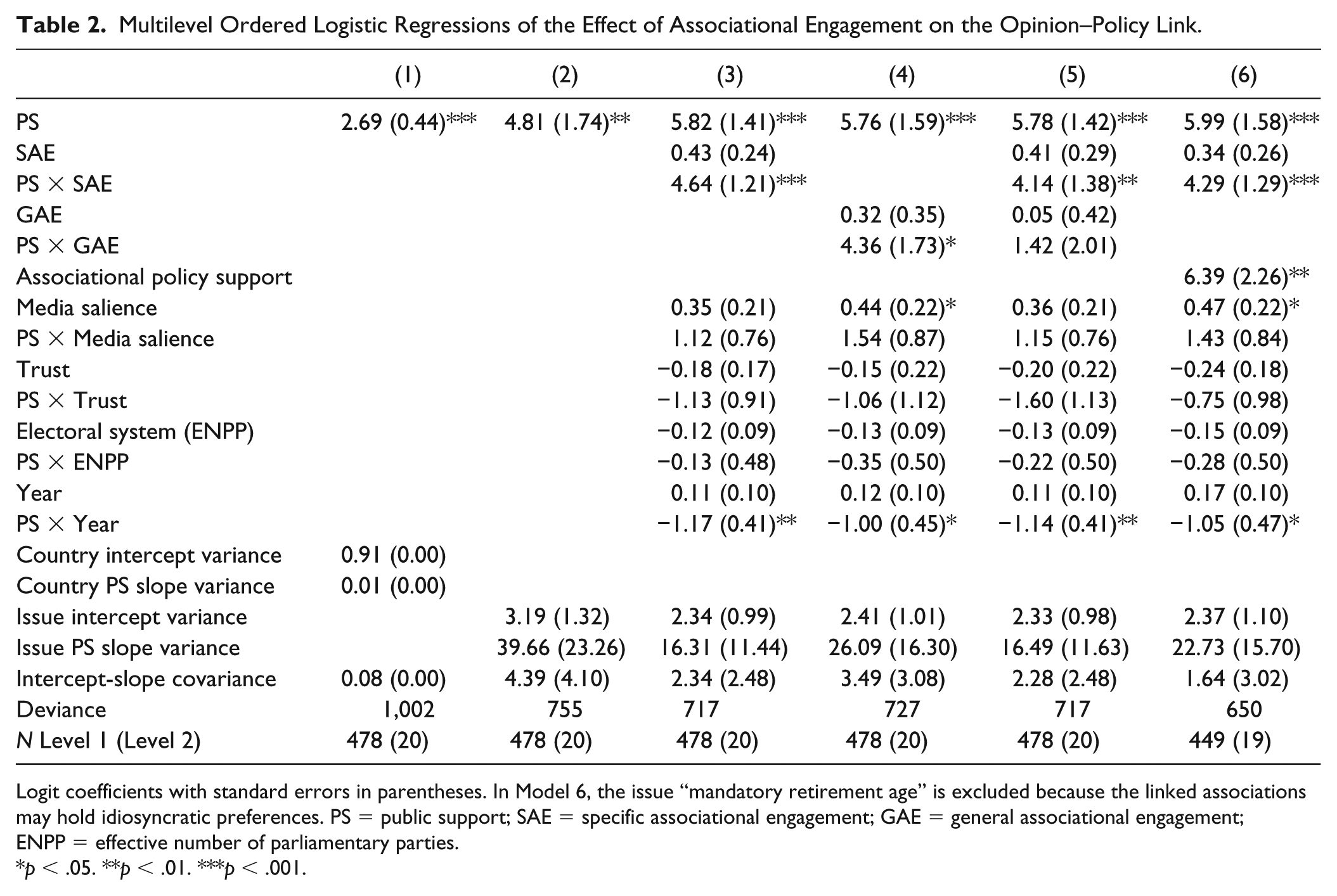
Logit coefficients with standard errors in parentheses. In Model 6, the issue “mandatory retirement age” is excluded because the linked associations may hold idiosyncratic preferences. PS = public support; SAE = specific associational engagement; GAE = general associational engagement; ENPP = effective number of parliamentary parties.
p < .05. **p < .01. ***p < .001.
Next, we examine whether the opinion–policy relationship is influenced by engagement in issue-specific associations, controlling for potential effects of salience, trust, electoral system, and year (Model 3). We find a positive and statistically significant coefficient for the opinion–engagement interaction, supporting our hypothesis. We also observe that the variance of the random slope decreases drastically, suggesting that the strength of associations interested in a policy issue plays an important part in determining how strongly policy is related to public support for it. Neither the media salience of a policy issue nor the level of interpersonal trust in a society or the effective number of parties affects the strength of the opinion–policy link. As a robustness check, we also estimate the models with the alternative, MIP-based salience measure, which does not provide evidence for a conditioning effect either (Online Appendix C). Meanwhile, the negative interaction between year and public opinion indicates a weakening in the relationship between opinion and policy over time. 7
We then test whether we obtain a similar result if we replace the issue-specific associational engagement measure with the general engagement measure. Indeed, the coefficient of the interaction with public opinion is positive and significant (Model 4). However, when we test both moderating effects in the same model, we find that only engagement in issue-specific associations significantly affects the opinion–policy link, whereas the interaction between general associational engagement and opinion becomes insignificant (Model 5). This finding suggests that it is indeed engagement in associations concerned with the specific issue that strengthens the link between policy and public opinion and not the overall level of associational engagement in a society.
Finally, we estimate the interaction between public opinion and specific associational engagement while controlling for the net associational policy support. The purpose is to rule out that the relationship between opinion and policy is explained by interest advocacy through civil society groups that hold the same policy views as the public. As Model 6 shows, the likelihood of a policy being in place indeed increases with the net strength of civil society engagement in favor of it. At the same time, the relationship between public opinion and policy remains positive and significant with the variables with which public opinion is interacted at their grand means. Importantly, the positive effect of associational engagement on the opinion–policy link also remains statistically significant. This underlines that associations play a role not only by increasing the likelihood of policy being in place in cases where they favor a given policy but also by increasing correspondence between public opinion and policy irrespective of whether their advocacy efforts coincide with the view of the majority of the public. 8
Figures 1 and 2 illustrate how engagement in issue-specific civil society associations conditions the opinion–policy relationship. Figure 1 shows the average marginal effect of public opinion across the observed range of values on the logged scale of associational engagement. The higher the associational engagement, the stronger the positive association between public support and the probability of having the policy in place. Likewise, the higher the engagement, the stronger the negative association between public support and the probability of no policy being in place. The effect of public opinion on the likelihood of the policy being partially in place is relatively stable at all levels of engagement. The graphs also show the distribution of associational engagement values through the histograms and rug plots.
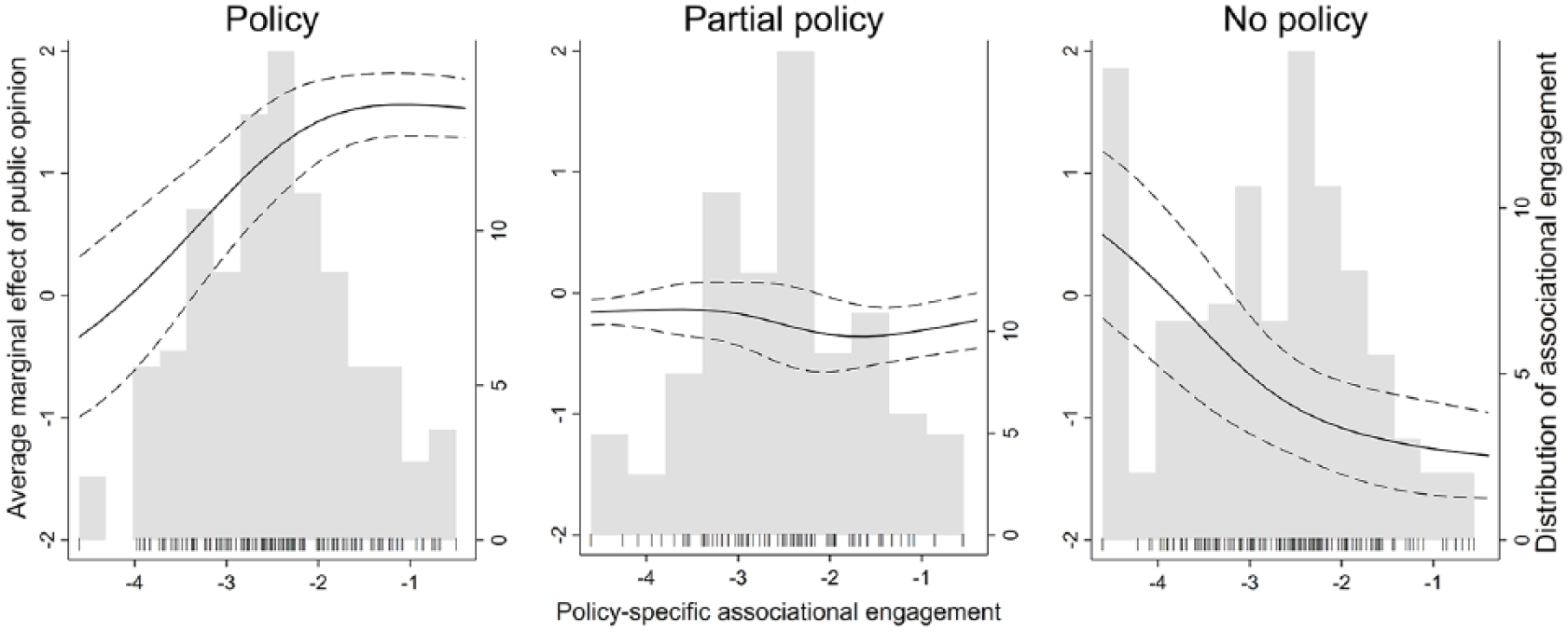
Average marginal effect of public support on policy across levels of engagement in voluntary associations.
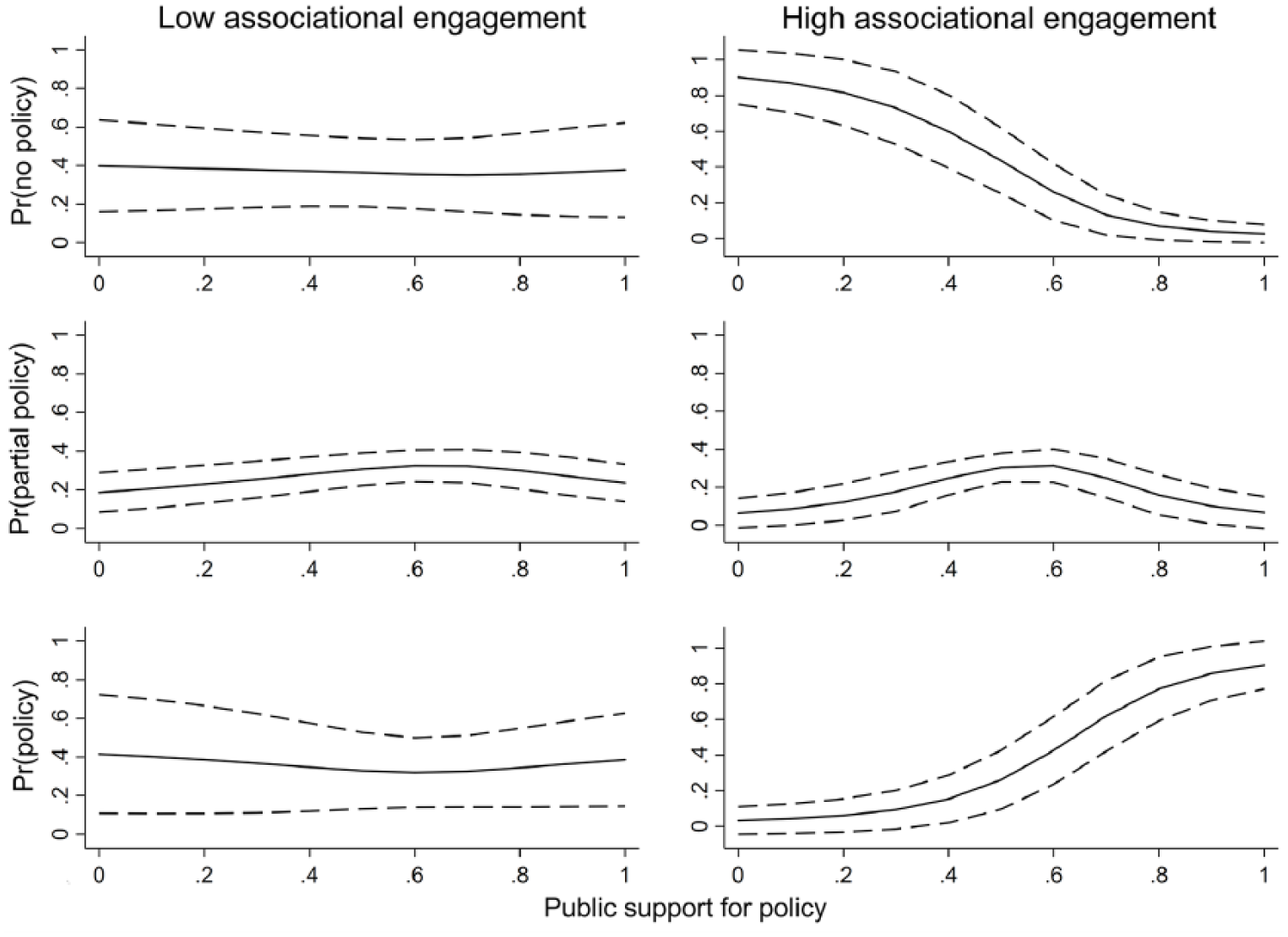
Predicted probabilities of policy by public support for low and high levels of specific associational engagement.
Figure 2 illustrates how the predicted probabilities of the three policy levels vary with public policy support at low and high levels of specific associational engagement. In contexts where associational engagement is at one standard deviation below the mean (a cumulative engagement level of 2.6%), the probability of policy being in place or not in place essentially remains stable with increases in public support. In contrast, when associational engagement is at one standard deviation above the mean (18.4%), a shift from no to full public support is associated with an increase from 3% to 91% probability that the policy is in place. This clearly shows that the link between public opinion and policy is stronger in contexts with higher levels of engagement in issue-relevant civil society organizations.
Conclusion
The representation of the policy preferences of the public in policy outcomes is one of the core principles of representative democracy (Dahl, 1989). Which conditions and factors strengthen the link between public opinion and policy have therefore been on the minds of political scientists for decades. Yet, whereas their recent research has put high emphasis on the conditioning roles of political institutions and issue salience (e.g., Hobolt & Klemmensen, 2008; Lax & Phillips, 2009, 2012; Rasmussen, Reher, & Toshkov, 2018; Wlezien & Soroka, 2012), the potential role of civil society organizations has received sparse attention. At the same time, social movements and engagement in voluntary associations have long been central objects of sociological studies, while the role of public opinion in affecting policy shifts has received less attention here (McAdam & Su, 2002).
Linking insights from these two bodies of literature, our focus in this article was on how engagement in voluntary associations might exert a positive influence on policy representation by facilitating the transmission of information between the public and policy makers. Specifically, we argued that associations whose purposes and goals are related to a policy issue inform the public about the issue and the policy debate around it while transmitting cues about public preferences to policy makers. Consequently, decision makers should both be better able to make policy choices in line with public opinion and be incentivized to do so as the public has more resources to monitor their actions closely. Our analysis, based on data on public opinion, policy, and associational engagement on 20 policy issues in 30 European countries, supports this hypothesis.
By disaggregating the overall level of associational involvement of a citizenry and focusing on issue-specific associations, we recognize that associations have different purposes and are unlikely to provide information about issues outside their realm of interests. Some scholars have suggested that associational engagement improves representation and accountability by increasing the public’s general knowledge about politics as “more social interaction leads to more political discussion” (cf. also Coleman, 1988; Jottier & Heyndels, 2012). Yet, we find that the positive effect of overall engagement in voluntary associations on the link between opinion and policy on specific issues disappears when we introduce our measure of the strength of issue-specific associations into the model. This suggests that the capacity of voluntary associations to benefit democracy might be more limited than is often thought, at least with respect to the quality of policy representation. At the same time, our findings suggest that the role of civil society organizations in public policy goes beyond their lobbying efforts with which they aim to convince decision makers of policies that are in the interests of their members.
As the study focused on the consequences of civil society engagement rather than its origins, our results do not preclude the possibility that associational engagement is stimulated by political leaders (see, for example, Maloney, Smith, & Stoker, 2000). This means that the positive effect it has on policy representation may to some degree reflect a demand by representatives for information about public opinion. By the same token, citizens might mobilize in civil society organizations precisely because they hope to increase policy responsiveness in their issue area of concern. We thus need not conceive of associations as an independent force that influences the link between citizens and elites. What our findings suggest instead is that, regardless of the precise reasons for the existence and strength of civil society organizations in a policy area, they appear to act as important vehicles for distributing information and reducing uncertainty between the citizens and the decision makers and thus help stimulate correspondence between opinion and policy.
This might then imply that political elites can actively contribute to closing the gap between opinion and policy, either more generally or in particular issue areas. Exchanges with civil society organizations may be facilitated both through durable institutions like in corporatist systems and in an ad hoc manner. Associations themselves may also enhance representation by promoting civil society engagement, for instance, through running advocacy campaigns. Meanwhile, citizens might be able to improve the responsiveness and accountability of policy makers on specific issues by deliberately joining associations on either side of a policy debate.
Future endeavors should extend our analysis through longitudinal designs that would allow examining the dynamic relationship between changes in associational engagement and policy representation. This will also provide insight into how the impact of associational engagement varies at different stages of policy-making processes. There is moreover scope for future research to include information about additional aspects of associational life, for example the resources, management, membership dialogue, and political activities of the associations active on an issue. Such factors are likely to be important for the extent to which voluntary associations can act as information transmission belts between voters and political elites. Linking these data to the demographic and socioeconomic composition of the membership of organizations might also generate insights into the potential role of associations in alleviating or reinforcing inequalities in policy representation. The large-scale public opinion surveys on which we relied in this study do not contain such information and it is beyond our scope to map such detailed information for all active voluntary associations on 20 issues within 30 countries. However, our analysis provides an important stepping stone for research that can complement our macro-level approach by conducting detailed studies of associational engagement for specific policy areas and/or countries over time.
Supplemental Material
Rasmussen_Reher_13122018_Online_appendix – Supplemental material for Civil Society Engagement and Policy Representation in Europe
Supplemental material, Rasmussen_Reher_13122018_Online_appendix for Civil Society Engagement and Policy Representation in Europe by Anne Rasmussen and Stefanie Reher in Comparative Political Studies
Supplemental Material
Rasmussen_Reher_replication_materials – Supplemental material for Civil Society Engagement and Policy Representation in Europe
Supplemental material, Rasmussen_Reher_replication_materials for Civil Society Engagement and Policy Representation in Europe by Anne Rasmussen and Stefanie Reher in Comparative Political Studies
Footnotes
Appendix
Policy Issues, Year, Survey, and Number of Countries Covered.
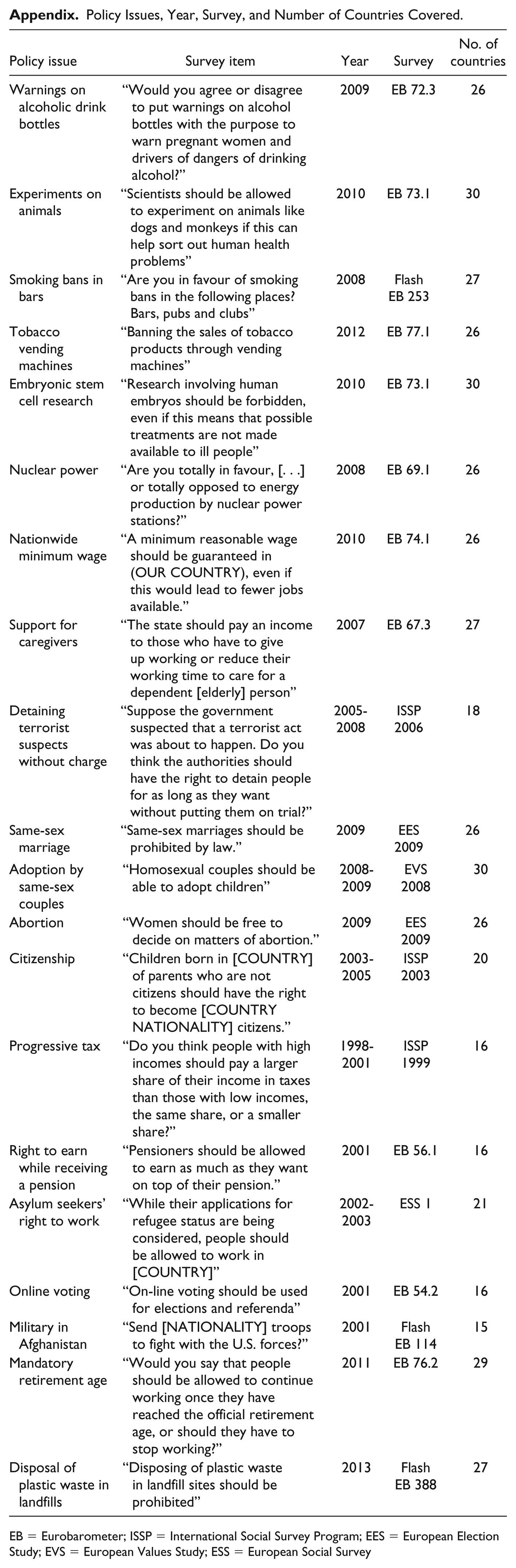
| Policy issue | Survey item | Year | Survey | No. of countries |
|---|---|---|---|---|
| Warnings on alcoholic drink bottles | “Would you agree or disagree to put warnings on alcohol bottles with the purpose to warn pregnant women and drivers of dangers of drinking alcohol?” | 2009 | EB 72.3 | 26 |
| Experiments on animals | “Scientists should be allowed to experiment on animals like dogs and monkeys if this can help sort out human health problems” | 2010 | EB 73.1 | 30 |
| Smoking bans in bars | “Are you in favour of smoking bans in the following places? Bars, pubs and clubs” | 2008 | Flash EB 253 | 27 |
| Tobacco vending machines | “Banning the sales of tobacco products through vending machines” | 2012 | EB 77.1 | 26 |
| Embryonic stem cell research | “Research involving human embryos should be forbidden, even if this means that possible treatments are not made available to ill people” | 2010 | EB 73.1 | 30 |
| Nuclear power | “Are you totally in favour, [. . .] or totally opposed to energy production by nuclear power stations?” | 2008 | EB 69.1 | 26 |
| Nationwide minimum wage | “A minimum reasonable wage should be guaranteed in (OUR COUNTRY), even if this would lead to fewer jobs available.” | 2010 | EB 74.1 | 26 |
| Support for caregivers | “The state should pay an income to those who have to give up working or reduce their working time to care for a dependent [elderly] person” | 2007 | EB 67.3 | 27 |
| Detaining terrorist suspects without charge | “Suppose the government suspected that a terrorist act was about to happen. Do you think the authorities should have the right to detain people for as long as they want without putting them on trial?” | 2005-2008 | ISSP 2006 | 18 |
| Same-sex marriage | “Same-sex marriages should be prohibited by law.” | 2009 | EES 2009 | 26 |
| Adoption by same-sex couples | “Homosexual couples should be able to adopt children” | 2008-2009 | EVS 2008 | 30 |
| Abortion | “Women should be free to decide on matters of abortion.” | 2009 | EES 2009 | 26 |
| Citizenship | “Children born in [COUNTRY] of parents who are not citizens should have the right to become [COUNTRY NATIONALITY] citizens.” | 2003-2005 | ISSP 2003 | 20 |
| Progressive tax | “Do you think people with high incomes should pay a larger share of their income in taxes than those with low incomes, the same share, or a smaller share?” | 1998-2001 | ISSP 1999 | 16 |
| Right to earn while receiving a pension | “Pensioners should be allowed to earn as much as they want on top of their pension.” | 2001 | EB 56.1 | 16 |
| Asylum seekers’ right to work | “While their applications for refugee status are being considered, people should be allowed to work in [COUNTRY]” | 2002-2003 | ESS 1 | 21 |
| Online voting | “On-line voting should be used for elections and referenda” | 2001 | EB 54.2 | 16 |
| Military in Afghanistan | “Send [NATIONALITY] troops to fight with the U.S. forces?” | 2001 | Flash EB 114 | 15 |
| Mandatory retirement age | “Would you say that people should be allowed to continue working once they have reached the official retirement age, or should they have to stop working?” | 2011 | EB 76.2 | 29 |
| Disposal of plastic waste in landfills | “Disposing of plastic waste in landfill sites should be prohibited” | 2013 | Flash EB 388 | 27 |
EB = Eurobarometer; ISSP = International Social Survey Program; EES = European Election Study; EVS = European Values Study; ESS = European Social Survey
Acknowledgements
We received excellent comments on earlier versions of this article from Paul Bauer, Jonathan Chapman, Linda Flöthe, Masaaki Higashijima, Frederik Hjorth, Will Jennings, Wiebke Marie Junk, Ann-Kristin Kölln, Christoph Knill, Hanspeter Kriesi, Lars Mäder, Yvette Peters, Jeroen Romeijn, Chris Wlezien as well as from the participants at the Annual Meetings of the European Political Science Association and the American Political Science Association in 2015, the workshop “Responsiveness: Identifying new research focuses and methods” at University of Gothenburg on May 26, 2015, the Rokkan Symposium at University of Bergen, September 20-21, 2016, and the “Governance, Constitutionalism and Democracy” group at European University Institute. The article also benefited from feedback received during presentations at University of Lund, Trinity College Dublin, European University Institute, University of Amsterdam, Ludwig-Maximilians-University Munich and University of Texas at Austin between 2016 and 2018. Finally, we are grateful for the efforts that Cæcilie Venzel Nielsen and several other student assistants put into coding our data.
Authors’ Note
Anne Rasmussen is also affiliated with University of Bergen, Norway.
Declaration of Conflicting Interests
The authors declared no potential conflicts of interest with respect to the research, authorship, and/or publication of this article.
Funding
The authors disclosed receipt of the following financial support for the research, authorship, and/or publication of this article: Our research received financial support from Sapere Aude Grant 0602-02642B from the Danish Council for Independent Research and VIDI Grant 452-12-008 from the Dutch Netherlands Organization for Scientific Research (NWO).

Notes
Author Biographies
References
Supplementary Material
Please find the following supplemental material available below.
For Open Access articles published under a Creative Commons License, all supplemental material carries the same license as the article it is associated with.
For non-Open Access articles published, all supplemental material carries a non-exclusive license, and permission requests for re-use of supplemental material or any part of supplemental material shall be sent directly to the copyright owner as specified in the copyright notice associated with the article.
