




Abstract
Why are executive bills sometimes amended significantly in authoritarian legislatures? Bill change clashes with the conventional picture of parliaments in nondemocracies as “rubber stamp” bodies. Recent work challenging the “rubber stamp” model suggests that cases of amendment are the result of legislator influence. This article proposes an alternative argument: Amendment can result from intraexecutive policy-making processes, unresolved in the prelegislative, cabinet-level stage. Factionalised executives can use legislative institutions to help overcome information asymmetries, as well as the commitment and monitoring problems involved in collective decision making. The article evaluates this alternative account using a combination of statistical and case-study analyses, drawing on both cross-national and fine-grained data from contemporary Russia. The findings contribute to our knowledge of authoritarian legislatures, policy-making processes in nondemocracies, and Russian politics.
Introduction
Why are executive bills sometimes amended significantly in authoritarian legislatures? According to conventional wisdom, parliaments in nondemocracies are simply meant to “rubber stamp” decisions, with legislative passage serving only to dress decisions in the “garb of constitutional legality” (Fainsod, 1965, p. 384). In a recent review of work on “democratic authoritarianism,” Brancati (2014) summarizes this widely held view: “because authoritarian legislatures exist at the discretion of the dictator, they do not have real decision-making power and only rubber-stamp government-proposed legislation” (p.317). The role of authoritarian parliaments is, simply put, to “formalize decisions already made” (Jones, 1984, p. 168). Bill change is, therefore, unexpected in nondemocratic assemblies. 1
But there is evidence—albeit largely unrecognized—of bill amendment from a broad range of nondemocracies. Figure 1 presents survey data from the Organisation for Economic Co-operation and Development (OECD) on whether budget bills have been amended during legislative review, comparing the experience of 63 democracies with 33 nondemocracies. The group of nondemocracies includes cases of monarchical, military, one-party, and multiparty authoritarian states. Whereas “rubber stamp” theory suggests that nondemocratic states should return values of “No change,” the majority of states that supplied information reported amendments to executive budget initiatives, with spending figures both increasing and decreasing. Indeed, patterns of reported change differ little between those democracies and nondemocracies included in the OECD data set.
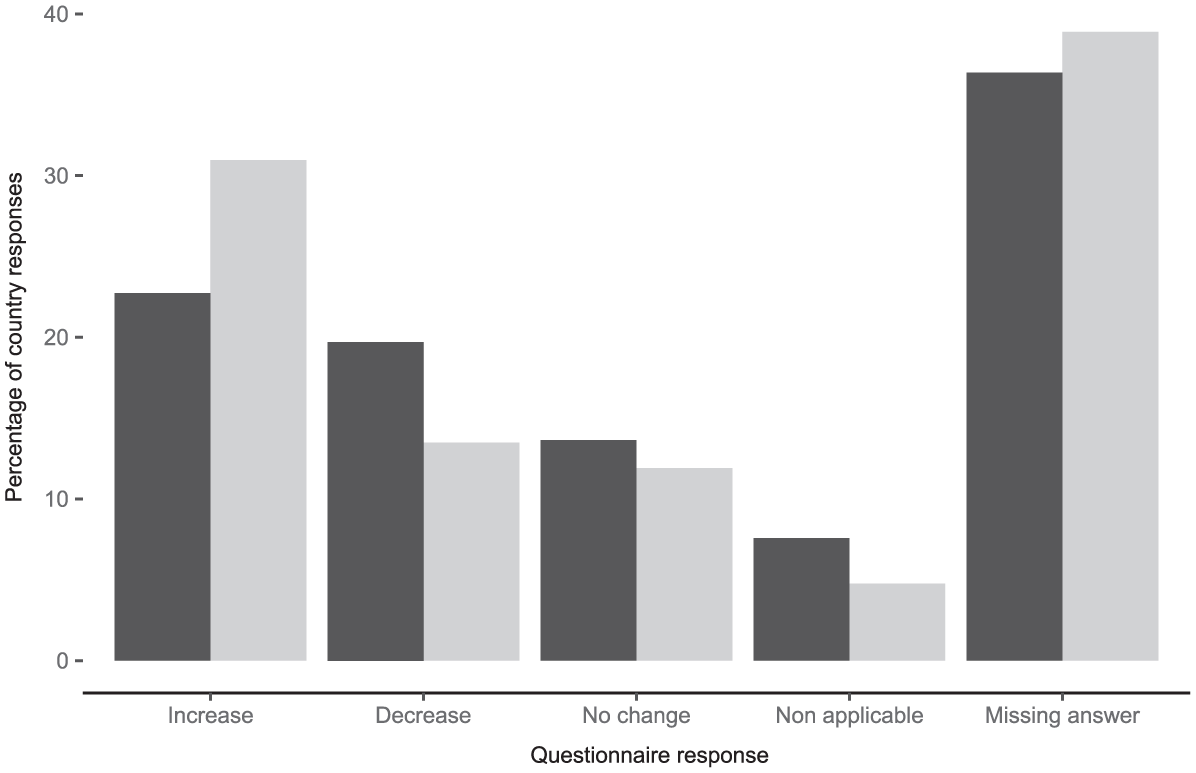
OECD survey responses regarding budget bill change during parliamentary passage in 63 democracies and 33 nondemocracies.
What explains these puzzling observations? The prevailing explanation—consistent with “co-optation” (Gandhi, 2008) and “information” (Truex, 2016) theories of authoritarian institutions—is that these deviations from “rubber stamp” expectations reflect legislative influence: Bill amendments are concessions to members of the “potential opposition” (Gandhi, 2008, xviii) with seats in parliament, or they reflect regime responses to information relayed by regime-loyal legislators regarding citizen grievances. To be sure, there is relatively little work focusing directly on legislative politics in the recent flourishing of studies on authoritarian politics, and there is even less work addressing the specificities of the lawmaking process itself. However, even though this body of work remains inchoate, it is possible to delineate core claims for further empirical scrutiny.
According to information theory, regime elites use loyal legislators as conduits to provide information about societal conditions, without which the regime risks overlooking “citizen grievances” and revolutionary potential (Truex, 2016, p. 6). Legislatures, therefore, improve the information available to elites when crafting policy initiatives. According to co-optation theory, members of the potential political opposition gain a seat in the legislature (with its access to rents and limited policy influence) in exchange for regime fealty. This group of co-opted actors might include elite members of the active political opposition with a track record of antiregime protest, or grassroots members of the real opposition, or even wavering members of the regime-party elite. The broad range of possibly co-opted actors does, of course, raise the semantic question of what, in fact, constitutes the “opposition” (Schuler & Malesky, 2014, pp. 684-685), not to mention the added complication of acknowledging that different “modes” of co-optation might be used for these “different categories of politicians” (Golosov, 2014, p. 271). However, by adopting a broad definition of the term “potential opposition,” recent works on co-optation claim that nondemocratic legislatures serve as a “forum for regime opponents” (Schuler & Malesky, 2014, p. 684)—a venue “in which the regime and opposition can announce their policy preferences and forge agreements” in a regularized fashion (Gandhi, 2008, p. xviii).
Although differing in certain respects, both information and co-optation theories argue that authoritarian legislatures matter because of legislators. Whether as members (or representatives) of the real opposition elite, the potential opposition elite, or potentially rebellious citizens, parliamentarians in nondemocratic parliaments do not simply nod through finalized policy initiatives. Moreover, their actions might result in bill amendment during legislative passage.
This article proposes an alternative argument: Cases of amendment can result from the continuation and resolution of intraexecutive policy-making processes, unresolved in the prelegislative, cabinet-level stage. Like their democratic counterparts, authoritarian executives contain actors with differing policy preferences, and information asymmetries and commitment problems during the prelegislative policy-making phase mean that initiatives formally signed off by cabinet might not, in fact, be ready for “rubber stamping.” Executive actors can use legislative institutions—such as mandatory bill text publicity and amendment opportunities—to help overcome the commitment and monitoring problems associated with joint decision making. Authoritarian legislatures can, therefore, be “places of action” (Truex, 2014, p. 234), but this action is driven by intraexecutive disputes over policy, rather than by legislators.
One key advantage of the intraexecutive argument proposed by this article is its ability to reconcile observations of bill amendment with legislator subservience. Consistent with Charap’s (2007, pp. 336-337) conceptualization of “executive strength,” the executive can at the same time be relatively powerful over the legislature and internally fragmented. In other words, this executive-centered argument is more parsimonious than extant theory, which asks us to alter widespread impressions regarding the executive–legislative balance of power in nondemocracies.
This article develops and provides a preliminary exploration of this theory using policy-making data from one contemporary, high-profile authoritarian regime: Russia. The research design combines fine-grained analysis of qualitative data for bill amendment case studies and quantitative text analysis for all cases of executive bill amendment, 2008 to 2013. This mixed-methods approach combines, therefore, the strengths of process-tracing’s focus on causal mechanisms and sensitivity to equifinality, and the population-wide view afforded by exhaustive data on bill changes over 6 years.
The article contributes directly to three research areas. The first area is the policy-making process in nondemocracies. As Remington (2019) notes, recent work on authoritarianism has largely neglected questions of policy making, preferring to focus on broader issues, including regime durability, threats to property rights, and economic performance—see, for example, Svolik (2012); Jensen, Malesky, and Weymouth (2014), and Wilson and Wright (2017); and Reuter and Gandhi (2011), respectively. This article, therefore, joins a nascent body of work calling to “bring policy back in.” 2 The second area is the debate concerning the role that legislatures play in authoritarian politics. An influential strand of existing work has conceptualized legislatures as constraints on dictatorial (or executive) action. Nondemocratic legislatures are regarded as mechanisms to “bind the grabbing hand”—“credible commitments” that constrain the autocrat’s power to expropriate (North & Weingast, 1989; Wright, 2008, p. 327; cf. Jensen et al., 2014, p. 680). Whereas co-optation theory (Gandhi, 2008) posits that it is the “potential opposition within society” that (imperfectly) constrains the elite through legislative institutions (p. xviii), “power-sharing” theory (Boix & Svolik, 2013; Gehlbach & Keefer, 2012; Svolik, 2012) contends that authoritarian institutions serve to ameliorate commitment and monitoring problems between elite actors. As such, the former account relates to elite–society relations, whereas the latter relates to intraelite relations. And yet, for power-sharing theory, little work has been done to extend this intraelite logic to policy making, as well as to specify how legislative institutions in particular might figure in high-level negotiations. This article addresses these issues, and, in doing so, constitutes one of the first detailed analyses of bill amendment in a nondemocratic legislature. The third area of knowledge to which the article contributes is contemporary Russian politics. Even if executive actors are loyal to Vladimir Putin, this does not prevent bitter policy disputes from raging between executive actors and—as this article demonstrates—animating the legislative stage of policy making.
Theory
Authoritarian political executives, like their democratic counterparts, contain actors with differing policy preferences. Given limitations of time, resources, and policy expertise in the policy-making process, policy drafting is delegated to particular executive bodies. As a result, this delegation from executive principals—whether a dictator, cabinet leadership, or ministers in plenary—to ministry agents runs the risk of “agency loss.” That is, ministers face the temptation of producing policies closer to their own party’s, or ministry’s, ideal point rather than being an honest reflection of the coalition compromise, the executive median, or the dictator’s wishes—a phenomenon Martin and Vanberg (2011, p. 25) label “ministerial drift.” Cabinet review is meant to provide an opportunity for executive actors to monitor for such “drifting” initiatives, as well as to challenge and modify their content, before compromise policy proposals can be stamped with the collegiate government’s imprimatur and then sent off for legislative review. Laver (2006) summarizes this basic, two-stage policy-making sequence, which is likely common to many democracies and nondemocracies: [T]he government is not a unitary actor and does not draft legislation at the cabinet table. Rather, division of labor and responsibility between cabinet ministers means that most draft legislation originates in a particular government department, under the jurisdiction of a particular cabinet minister . . . What gets debated in the legislature is thus the outcome of a two-stage agenda-setting process, whereby a designated department under a particular cabinet minister first presents draft legislation for approval by cabinet. What emerges from this process as government policy then sets the legislative agenda. (pp. 125-126)
In contrast to democracies, conventional wisdom suggests that, in nondemocracies, the second stage in this two-stage process is simply ceremonial. The legislative stage of policy making is purely for show: The government sets the legislative agenda and writes the script for parliamentary “debate,” and all initiatives are swiftly signed into law with no amendments. Although policy conflicts might rage in the preparliamentary stage, the extant expectation is that these disputes are settled before legislative introduction, with norms of “collective cabinet responsibility” or “democratic centralism” invoked to ensure executive unity following cabinet sign-off.
Legislative Institutions as Intraexecutive Constraints
Intraexecutive policy disputes might not, however, be resolved before legislative introduction. “Ministerial drift” might not be comprehensively caught and corrected during the prelegislative stage of policy making. Although “Decision-Rules” might spell out the framework for policy drafting negotiations between executive actors in the preparliamentary stages of policy making, various factors work against such discussions being “‘properly’ concluded” (Eckstein & Gurr, 1975, p. 121). Limitations of time, resources, inclusion, and expertise hamper the ability of executive actors to monitor for, scrutinize, challenge, and amend “hostile” policy proposals from other executive actors. As Martin and Vanberg (2011) suggest, “[t]he very workload and need for specialisation in the cabinet that makes delegation necessary in the first place makes it difficult to use these [cabinet-level] institutions as ‘routine’ checking mechanisms” (p. 33).
Bills with the nominal support of the entire executive can, therefore, progress to parliament without, in fact, enjoying the support of all executive actors. Drawing on data from West European parliamentary systems with coalition governments, Martin and Vanberg (2004, 2005, 2011) argue that coalition partners can compensate for these cabinet-level deficiencies by using legislative institutions—and their co-partisan legislators—to monitor for, scrutinize, challenge, and amend “hostile” policy proposals after cabinet sign-off.
The core proposition of this article is that executive actors in nondemocracies can also use legislative institutions to overcome the commitment and monitoring problems of cabinet decision making. Although this article draws on the insights of Martin and Vanberg’s work regarding the conditions of preparliamentary policy making, as well as the claim that intraexecutive policy disputes can be resolved during the legislative stage of policy making, the particular actors and the precise mechanisms of this resolution are different. Whereas Martin and Vanberg conceptualize executive factionalism in terms of discrete coalition party partners, in nondemocracies, we can think of formal bodies, such as ministries and government departments, as the actors of interest. This conceptual shift from factions as parties to ministries is not as drastic as it might at first seem in nondemocratic settings. Huskey (1996a) notes, for example, that ministries not only govern Russia, they represent it—or at least its most powerful interests . . . Whereas in democratic countries political parties are the primary mediating institutions between the state and society, ministries perform that function in Russia. (p. 369)
Multiple pathways to amendment
Authoritarian executive actors can use the legislative stage of policy making in different ways. Two amendment pathways are particularly worthy of attention. First, executive actors are motivated to finalize decision making at the latest possible stage in the policy-making process, given the difficulties of enforcing commitment to negotiated positions. At the same time, the executive’s expectation of legislator subservience removes executive actors’ fear of agency loss, as loyal parliamentarians can be relied upon to approve revised executive decisions. Safe in the knowledge that legislators will not autonomously modify bills against the executive’s wishes, executive disputes can spill over into the nominally legislative stage of policy making. Put differently, although executive actors are fully aware that policy disputes between them have not been resolved, they can introduce a bill into the legislature anyway, knowing that policy discussions can continue in the privacy of executive rooms, but during the nominally legislative stage of policy making; the final outcome of intraexecutive negotiations can then be ratified as amendments to bills made in parliament at the instruction of the executive. This seemingly premature move of a bill from cabinet to parliament might occur, for example, if there are time pressures associated with the policy change proposed. We can call this pathway to amendment “spillover.”
Second, the publicity entailed by legislative introduction allows executive actors to monitor for potentially “hostile” initiatives from other members of the executive. In other words, the mandatory publication of bill drafts at the point of legislative introduction alters the informational relationship between executive actors, allowing them to capture potentially negative proposed changes to the policy status quo. At one end of the spectrum, this will be beneficial to actors who lacked the time to review policies in detail in cabinet; at the other end of the spectrum, this will allow actors excluded from policy negotiations the first opportunity to respond to proposals. We can call this pathway to amendment “discovery.”
These are two of four basic pathways to executive bill amendment during legislative review. Table 1 presents these four types, which relate to whether legislative bills and amendments are the object of intraexecutive contestation and whether the need for amendment is acknowledged by executive actors before parliamentary review. Importantly, all of these four pathways are consistent with the fact that we might observe non-“rubber stamping” behavior in authoritarian legislatures, even when legislators remain perfectly subservient to their executive principals. This article will focus, however, on “spillover” and “discovery.” 3
Four Pathways to Executive Bill Amendment.
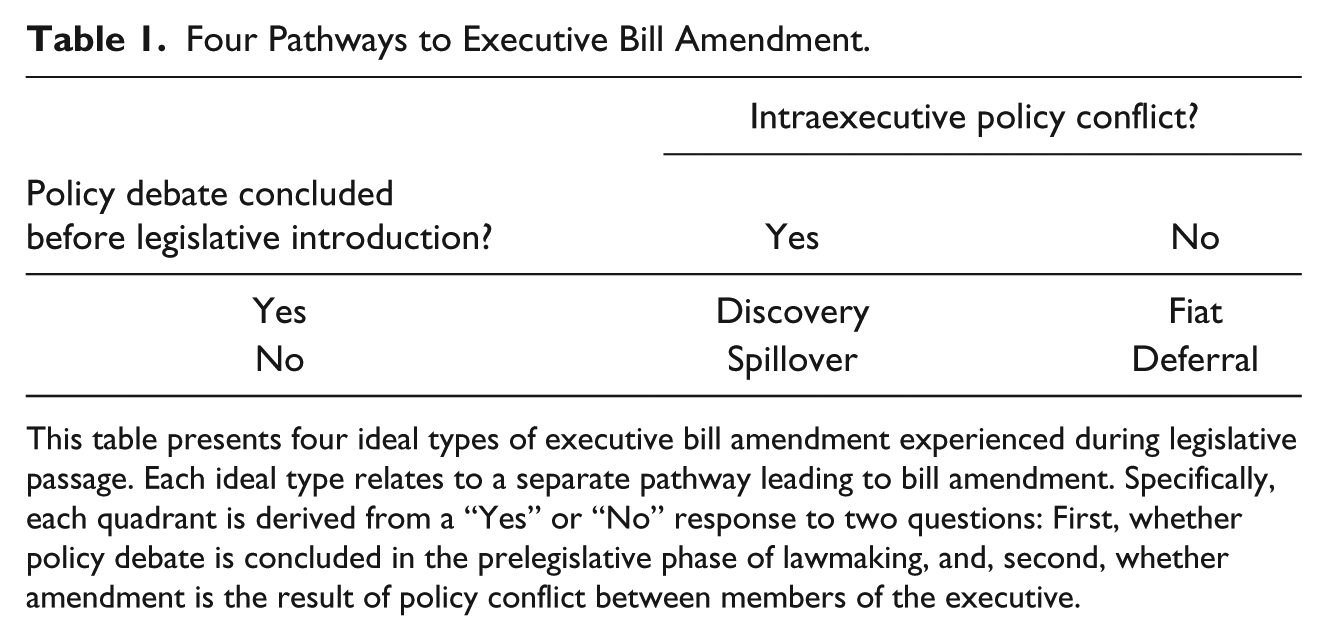
This table presents four ideal types of executive bill amendment experienced during legislative passage. Each ideal type relates to a separate pathway leading to bill amendment. Specifically, each quadrant is derived from a “Yes” or “No” response to two questions: First, whether policy debate is concluded in the prelegislative phase of lawmaking, and, second, whether amendment is the result of policy conflict between members of the executive.
Summary and alternative explanations
Rather than preparliamentary cabinet-level discussions constituting the “storm before the calm” of legislative passage, intraexecutive conflict can rage during the legislative stage of policy making. Indeed, rather than an unintended consequence of imperfect conflict resolution in the preparliamentary stage, executive actors can consciously use the opportunities afforded by legislative passage to alter the content of bills with the nominal imprimatur of the collegiate executive.
Does this account underplay the costs associated by elites with the airing of “dirty laundry”? Executives of all stripes are wary of the reputational costs resulting from public displays of internal discord. Why would authoritarian executives choose to resolve policy-making disputes in the relative publicity of the legislative stage rather than the relative privacy of cabinet? There are two basic responses to this. First, the idea of executives “choosing” in this regard is problematic as it implies a level of homogeneity and competent, centralized, core executive control that is called into question by this article. And, second, we should not overstate the publicity associated with legislative review. Although executives might clash, this most likely takes place well away from the relative publicity of the legislative floor. 4
What is distinctive about legislative institutions in particular rather than other institutions, such as parties, in helping executive actors to confront the challenges of collective decision making? An alternative account could be that executive actors prefer the relative privacy of party venues for the resolution of policy conflicts (Brownlee, 2007). Although certainly plausible, the distinctive elements of legislative institutions and the legislative stage of policy making are the very publicity entailed by initiative introduction, as well as the formal procedures for initiative amendment in the final phase of policy making. By contrast, party-level negotiations could still exclude certain executive actors; they might lack clear procedures for initiative challenging and change; and they will likely take place before parliamentary review. Insofar as there is an advantage in proposing amendments later in the policy process (Heller, 2001), then there are grounds to believe that party-level discussions will spill over into, or be deferred until, legislative review—and in a way consistent with the scenario proposed here. To be sure, the argument is not that authoritarian elites design legislatures to carry out this function. Rather, once in existence, executive actors can use legislative institutions to monitor and challenge the policy-making projects of other, possibly “hostile” executive actors.
What alternative explanations might also explain observations of executive bill amendment? Recent work from the literature on authoritarian institutions suggests that the legislative stage of policy making can be more consequential insofar as legislators—as members or representatives of the potential political opposition—can influence the content of bills (in exchange for regime fealty) or as regime-loyal deputies relay negative social reactions to proposed policy changes. Put differently, nonexecutive actors influence the content of executive policy initiatives during parliamentary passage.
Research Design
This article explores the plausibility of the executive-centered account of bill amendment through a detailed analysis of policy-making processes and outputs in one contemporary authoritarian state: Russia. 5 This country-case is chosen for three reasons. First, there are suggestions that the contemporary Russian political elite is a relatively unified group, or that, even if actors clash as a result of different policy preferences, they fall into line following intervention from Vladimir Putin. Either way, impressions of elite uniformity or discipline constitute difficult conditions for an account of bill amendment centered on executive policy factionalism. For example, when referring to President Putin’s inner circle, Babayan (2016) writes of the Russian ruler’s “specific and rather homogeneous entourage—Russia’s siloviki, who come into politics from long careers in the security and military services,” seeing this as indicative of “personalist regimes such as Russia, where one person largely makes all major domestic and foreign policy decisions.” 6 Indeed, Schleiter (2013) presents evidence that, with Russia’s post-Soviet authoritarian turn, ministers have increasingly been selected according to loyalty to the president rather than for their technocratic expertise or party ties, suggesting that these actors will comply with policy diktats from the chief executive (see also Egorov & Sonin, 2011). Whereas we might expect to observe executive factionalism in other post-Soviet regimes—such as Ukraine under Kravchuk (Way, 2015, p. 53), Russia under Yeltsin (Chaisty, 2006, pp. 128-131), or Moldova under the Alliance for European Integration (Way, 2015, pp. 111-112)—Russia under Putin is a less obvious candidate. Second, existing work—albeit sparse—from Russia specialists suggests that significant bill amendment simply does not occur. For example, commenting on changes in policy-making dynamics in the transition from the third to the fourth Duma convocations (2000-2003 and 2003-2007, respectively), Remington (2008) notes: “[it is] striking that, in contrast to the bargaining that accompanied tax bills in the past, there were almost no changes to the government’s initial version while the bill was going through the Duma” (p. 975). More broadly, Taylor (2014) argues that “although the Duma formally has the power to discuss and amend laws, its real function is simply to pass laws—it is not an opportunity for influence” (p. 245). 7 Third, the bulk of extant scholarship has argued that legislative institutions facilitate elite co-optation of opposition actors (see, for example, Reuter & Robertson, 2015). In short, contemporary Russia constitutes a trying preliminary testing ground for the alternative, executive-centered account of bill amendment proposed by this article. At the same time, information is available for this country-case regarding the development of executive bills during legislative review.
The empirical analysis contains two distinct stages. The first stage consists of bill case studies—episodes that exemplify the proposed causal pathways from intraexecutive policy dispute to bill amendment during legislative review. The second stage places these cases into population-wide perspective through a statistical analysis of amendments made to all executive-sponsored bills signed into law between 2008 and 2013 (inclusive). 8 Given the distinct difficulties in collecting population-wide data on intraexecutive factionalism, the main strategy of this second, statistical stage is to discount alternatives to the executive-centered account, which should increase our confidence that the executive-centered dynamics presented in the case studies are generalizable to the population of interest.
Although this analysis does not provide a definitive test of the executive-centered account of bill amendment, it moves knowledge forward in four ways. First, it provides some of the most extensive, detailed evidence yet of bill amendment in an authoritarian legislature. Second, it provides preliminary evidence regarding the drivers of bill change. Third, the combination of process-tracing and quantitative text analysis constitutes a complementary approach, particularly for a political setting in which data access issues limit our ability to observe directly the processes of interest. And finally, the case studies help theory-building, both with respect to intraexecutive relations and their implications for legislative politics.
Bill Amendment Case Studies
The two bill cases presented below are selected for their ability to illustrate two of the hypothesized pathways from intraexecutive conflict to bill amendment during legislative review. The two cases are not selected such that we can generalize findings to the complete population of executive-sponsored bills. Although this approach prioritizes internal over external validity, this is an appropriate approach in light of the theory-building goal of the article. These cases were discovered through a close reading of the Russian domestic press, beginning in June 2012. 9
“Spillover”
There is extensive evidence that the Russian Government signs off on the introduction of bills into the State Duma, whereas at the same time acknowledging that intraexecutive discussions have not finished and disputes have not been resolved. In his final meeting on May 2, 2012 as chair of the cabinet of ministers before returning to the presidency, then Prime Minister Vladimir Putin made an apparently frank statement: “I know that, unfortunately, it was not possible to agree points fully between departments, but this is the normal working process” (emphasis added, Government Meeting, 2012a). Moreover, according to a report from the Center of Strategic Research, the interagency sign-off (soglasovanie) process lacks systematization, with each executive structure acting according to its own logic (see Prokopenko, 2017). This results in the Russian cabinet of ministers not being able to present an internally agreed-upon point of view when introducing bills into the Duma (see, for example, Gorbachev & Rodin, 2017).
One illustration of the “spillover” of intraexecutive debate from cabinet to the legislative stage of policy making is provided by Bill 102334-6—“On the introduction of changes to the Budget Code of the Russian Federation and certain legislative acts of the Russian Federation regarding the use of the oil and gas revenues of the federal budget” (Bill 102334-6, 2012). Drafted by the Ministry of Finance, this bill proposed to introduce a “budget rule” specifying the use of oil and gas revenues included in the federal budget. In his 2012 budget address (Biudzhetnoe Poslanie, 2012), President Putin called for the reintroduction of a “budget rule,” suspended during the recent world economic crisis. This rule would provide statutory limits on the use of revenues from oil and gas, motivated by a desire for an anticyclical budget policy.
The specifics of the budget rule were fought over by executive actors, with differences especially apparent between the Ministry of Finance and the Ministry of Economic Development. In particular, the two ministries disagreed over the number of years used to calculate the base (average) oil price, with the former backing 10 years and the latter suggesting 3 years. In practice, the Ministry of Finance’s proposal would result in a lower base oil price, leading to more conservative spending figures. In the end, a compromise decision was reached, with an initial period of 5 years chosen, increasing by an additional year each year up to 10 years (Butrin, 2012; Netreba, 2012; RIA Novosti, 2012a; Smirnov, 2012; Visloguzov, 2012a).
These differences seemed, however, to be resolved, given the tabling of the bill for consideration at a Government meeting on June 28, 2012. Following an outline of the main features of the rule given by Minister of Finance Anton Siluanov, Prime Minister Dmitry Medvedev’s call for comments from other members of Government was qualified by the suggestion that there was, in fact, no need for further discussion as “we already discussed the budget rule with the President” (Government Meeting, 2012b). Possibly to the Prime Minister’s surprise, Minister of Economic Development Andrei Belousov asked to make a “brief comment”: We [the Ministry of Economic Development] signed off on this bill with one small remark [zamechanie] which is, it would seem, technical in nature . . . [to wit, that] when calculating the base oil price . . . [we should] take into account an indicator of global inflation.
Belousov continued, “We are proposing now, of course, not to hold up the law . . . but to take this amendment into account during the preparation of Government amendments for second reading [in the State Duma].” The minister was, therefore, proposing during a meeting of the cabinet to make a supposedly technical change to a Government initiative during the nominally legislative stage of the lawmaking process.
Finance Minister Siluanov’s response was resolutely negative: He made it clear that he thought the proposed change was not merely technical but would have a significant impact on the calculated base oil price. Other members of cabinet, however, came out in support of Belousov’s inflation proposal: Deputy Prime Minister Arkadii Dvorkovich argued that “the basic rules of economic and mathematical logic speak of the need to take inflation into account,” stating that “it is necessary to factor in this amendment during consideration of the law at second reading,” and First Deputy Prime Minister Igor Shuvalov noted that the idea of incorporating inflation had been discussed at a meeting with Medvedev, with “the majority of participants of the meeting [soveshchanie] supporting the position of the Ministry of Economics.”
These differences are revealing. If Shuvalov was correct when arguing that a majority of soveshchanie participants backed the Ministry of Economic Development—and if Belousov was correct when arguing that the same ministry signed off on the bill on the condition that its amendment regarding inflation was taken into account—then it appears that the Ministry of Finance was reneging on an earlier Government decision. As such, this example appears to be a clear manifestation of “ministerial drift.” Dmitry Medvedev condoned the continuation of intraexecutive policy debate into the legislature: “Of course, we will enter the law [into the State Duma], but we will return to this question” of its particular content during legislative review. In short, intraexecutive policy conflict spilled over from cabinet into the legislative stage of policy making. In spite of the Prime Minister’s belief that the matter had been settled—in particular, following discussion with President Putin—executive actors continued to debate policy substance.
Following Duma introduction, the bill was comfortably adopted in first reading with 66.2% of votes in favor of the initiative (Bill 102334-6 first reading vote, 2012). In preparation for second reading, a deadline of August 29 was set for the presentation of amendments to the lead committee. However, on September 27, the period for the proposal of bill changes was extended to October 13 (Duma Council, 2012a), and consideration of the bill was again delayed on October 22 “to a later date” (na bolee pozdnii srok; Duma Council, 2012b). What explains this delay?
The amendment-proposal period was changed, it seems, due to continued intraexecutive disagreement. September 2012 saw the finalization of the Ministry of Finance’s draft budget for the 2013 to 2015 period. This initiative received heavy criticism from President Putin, arguing that it did not take into account important electoral promises he had made—for example, in relation to development projects in the Far East (RIA Novosti, 2012b; Tovkailo & Liutova, 2012). In addition to these broader concerns—and possibly capitalizing on Putin’s displeasure with the Finance Ministry—Minister Belousov proposed to amend the “budget rule” bill, revising down the guideline value (normativnaia velichina) of the Reserve Fund—a sovereign wealth fund—from 7% to 5% of gross domestic product (GDP), which Belousov argued would allow for more spending on infrastructure (Kuvshinova & Tovkailo, 2012).
Understandably, Prime Minister Medvedev did not react well to this continued intra-Governmental dispute, stating that “[t]he decisions have been adopted, and I consider it necessary to end their discussion, including in Government circles.” However, it took presidential intervention to settle the dispute: Although deputies submitted an amendment in second reading proposing to change the Reserve Fund guideline value from 7% to 5% of GDP on behalf of the Ministry of Economic Development, Putin at the last moment took the Ministry of Finance’s side, and United Russia deputies had to change their minds quickly—the Budget Committee (in a rare event) rejected the five percent amendment, introduced by the committee’s chair, Andrei Makarov, and the first deputy speaker of the State Duma, Aleksandr Zhukov.
10
Overall, 23 amendments were proposed. Of these, 17 were recommended by the Budget Committee for adoption by the Duma—and of these successful amendments, nine were formally sponsored by the Government; most of the other eight successful changes were formally sponsored by Andrei Makarov, the committee chair (Committee Amendment Table, 2012a; 2012b). None of these amendments related to inflation adjustments—the subject of the original Government meeting dispute. However, of the adopted amendments, one is of particular note: The removal of a proposed additional section to article 94 of the Budget Code (on sources of financing of the deficit in the federal budget). Whereas the original bill proposed that the Government could modify deficit financing sources during the implementation of the federal budget without needing to amend the federal budget law, this was excluded from the final law. Although there is no clear evidence regarding the reasons for this amendment, one interpretation is consistent with the argument of this article regarding the ways executive actors use legislative institutions in the intraexecutive decision-making process. If the Government—in practice, the Ministry of Finance, in all likelihood—were to gain the right to make such changes during budget implementation without needing to amend the budget law, this would deprive other executive actors of a means to monitor for, scrutinize, contest, and possibly amend proposals with which they disagreed. It is plausible, therefore, that this amendment constituted a victory for the Ministry of Economic Development—or a concession granted by the Ministry of Finance in light of its own victory regarding the Reserve Fund guideline value.
The bill was considered for second and third readings on December 14, garnering 240 and 238 yes votes, respectively (Bill 102334-6 second reading vote, 2012; Bill 102334-6 third reading vote, 2012). The law faced no apparent resistance during passage through the Federation Council, being reviewed positively by two committees and being adopted with 83% of votes in favor and none against (Committee Report, 2012a, 2012b; Federation Council plenary transcript, 2012).
In spite of the bill’s passage into law as Federal Law 268 (2012), this did not, however, signal the conclusion of intraexecutive dispute. Immediately after the final State Duma vote on the bill, Igor Shuvalov noted that debate concerning the appropriate guideline value for the Reserve Fund would continue within the Government, arguing that the 7% option selected was “too conservative” (quoted in Visloguzov, 2012b). Indeed, this speaks to the broader difficulties faced by collegiate executives in reaching consolidated and resolute decisions.
In short, this case provides an example of intraexecutive dispute—on display in the preparliamentary phase of policy making—spilling over into the formally legislative stage of lawmaking and resulting in executive bill amendment. Executive actors appeared reluctant to conclude their dispute, attempting at various stages to revise the putatively final decision. Indeed, Prime Minister Medvedev appeared powerless to prevent such ongoing policy conflict. Moreover, there was no suggestion that the bill was delayed or amended due to bargaining with deputies.
“Discovery”
[W]e will do everything to impede the [presidential] initiative in the Duma.Senior official in the Ministry of Economic Development
11
Bill 357559-6—“On repealing various provisions of legislative acts of the Russian Federation”—was introduced into the Duma by President Putin on October 11, 2013 (Bill 357559-6, 2013). The resulting law—“On the introduction of changes to the Criminal Procedure Code of the Russian Federation”—was signed by Putin on October 22, 2014. Rather than reflecting successful opposition legislator influence, or an elite response to popular misgivings about the proposal, bill amendments resulted from intraexecutive policy disagreement, with disputed initiative proposals discovered thanks to mandatory bill publicity.
The presidential bill concerned the initiation of criminal cases relating to alleged tax crimes. This area of criminal justice has been particularly controversial in post-Soviet Russia, given the practice of law enforcement officials initiating criminal proceedings for offenses such as tax evasion, not with a view to realizing justice but to exert pressure on businesses to extract rents (Khamraev, 2013a). In 2011, then President Medvedev introduced a liberalization to Russian criminal law removing the right of investigators to initiate criminal cases alone, with the hope that this would limit the law’s abuse by law enforcement officials. In line with the Medvedev-era reform, criminal cases could only now be initiated on the basis of a report compiled by the Federal Tax Service (Federal’naia nalogovaia sluzhba, FNS)—an organization considered by reformers to be relatively unmarred by the pathologies of extortion. Liberalisers pointed to the fall in the number of cases initiated following the legal change as a sign that the reform had worked—that is, they claimed that this decline demonstrated that many cases previously had been initiated simply for the purposes of rent extraction; fewer businesspeople would now be subject to interference from law enforcement officials (Titov, 2014). However, others saw it differently: According to law enforcement officials, the fall in the number of cases initiated constituted a dangerous collapse both in the prosecution of tax crimes and the legitimate tax-extraction capacity of the state (Papchenkova, 2014a; Aleksandr Bastrykin, quoted in Pavlova, 2014).
The Investigative Committee (Sledvstvennyi komitet, SK)—Russia’s chief federal investigating body—drafted a bill proposing to reverse the Medvedev-era reform. In accordance with formal procedures to gain the assent of executive actors, the SK introduced its legislative proposal for intra-Governmental sign-off. The proposal was, however, rejected (Parfenova, 2013). In other words, Government departments did not consent to the proposal being introduced into the State Duma with the Government’s imprimatur. In response to this setback, the SK took its bill to the Presidential Administration, which also has the authority to submit bills to the legislature. In contrast to Government-submitted bills, however, presidential legislative initiatives are not subject to the formal sign-off process with other executive actors. As a result, Government bodies—such as federal ministries—are not necessarily aware of proposals in the pipeline, nor do they have an opportunity to amend or block such initiatives.
President Putin gave his blessing for the SK bill to be sent to the State Duma. This move caught Government actors by surprise: When the bill was registered in the Duma, commentators noted that it had been introduced “over the heads of Government officials—its introduction was a shock to many of them” (Papchenkova & Tovkailo, 2013). As the quotation at the beginning of this section reveals, Government actors were openly opposed to the bill.
12
In a rare display of apparent autonomy, even Prime Minister Medvedev publicly criticized the presidential bill in a speech on November 12. Putin’s response to this public display of intraexecutive disagreement is instructive: there is a specified practice for resolving questions before they appear in the media. It is well known that if somebody does not agree with this practice, as [former Minister of Finance] Kudrin did in his time, then he moves to the expert community [and out of cabinet] . . . We have a long-established practice, according to which we carry out discussions either in the Government or in the Presidential Administration. We do this collectively and sufficiently democratically. We all, of course, want to appear, as they now say, white and fluffy, and liberal. But this is not our task. We are not actors of an artistic genre, of artistic words. In making decisions of this kind, we must find balanced decisions, which ensure the interests of all groups of society—of the business community and the rest of society.
13
In effect, this constituted a thinly veiled threat of firing those officials—including Medvedev—who provided a window onto the reality of intraexecutive conflict. Moreover, the president appeared to criticize the expression—even behind closed doors—of a plurality of views.
The bill also spooked the business community. Influential individuals, such as Boris Titov (Presidential Commissioner for Entrepreneurial Rights) and Mikhail Prokhorov (billionaire and founder of the party, Civic Platform), as well as peak organizations (such as the Russian Union of Industrialists and Entrepreneurs [RUIE], Delovaia Rossiia, the Commercial and Industrial Chamber, and Opora Rossii) were vocal in their criticism of the proposal (Khamraev, 2013b; Parfenova, 2013; Petrov & Evstigneeva, 2013). They feared that its passage into law would re-empower law enforcement agents to interfere with businesses without legal grounds.
Despite this opposition, there was never any sense that the presidential initiative would be defeated in the legislature or that the president would remove it from consideration. However, in a meeting held on November 11, 2013 by presidential aide Andrei Belousov, it became clear that there was a consensus among stakeholders that the bill could not progress without amendment (Papchenkova & Tovkailo, 2013). Putin’s willingness to soften the bill was made clear during a meeting with the head of the FNS, Mikhail Mishustin, on November 25, 2013, during which the president suggested that law enforcement agencies be required to consult the FNS when initiating criminal tax cases (Latukhina, 2013). Around this time, the Government and the RUIE were developing their own amendments to the presidential bill, which were discussed in a Kremlin working group, including the SK and the FNS (Agamalova, 2013).
The bill was adopted by the Duma in first reading on December 10, 2013. Although some parliamentarians criticized the bill—particularly in light of the fact that they had been asked to pass precisely the opposite measure 2 years previously—the proposal was supported by 86% of Duma deputies (Bill 357559-6 first reading vote, 2013). However, the debate on the floor also made clear that a compromise between the SK and the FNS had not yet been reached (Visloguzov, 2013). The deadline for presenting amendments to the lead committee before second reading was set for 30 days following first reading. However, on January 20, 2014, the Duma Council postponed the bill’s further consideration, presumably because a compromise solution had not yet been reached (Duma Council, 2014). Meanwhile, the bill’s progression simply to first reading was seen as one of the worst tax developments for Russian business in 2013 (Visloguzov, 2014).
Negotiations continued throughout winter, with a compromise only being reached in spring (Papchenkova, 2014a; Petrov & Evstigneeva, 2013; RBK Daily, 2014; Sterkin & Papchenkova, 2014). 14 Some actors doubted the meaningfulness of the deal reached—the RUIE, for example, called it simply the “appearance of compromise,” and even the chair of the Duma committee responsible for the bill, Pavel Krasheninnikov, stated, “I am [still] afraid of [the initiation of] false criminal cases” (quoted in Papchenkova, 2014b). However, 70% of deputies voted in favor of the presidential initiative in second reading on September 26, 2014 (Bill 357559-6 second reading vote, 2014), followed by 85% in third reading on October 10.
The policy battle was not yet over, however. The bill was returned from third reading status to second reading to amend the proposal further, although the substantive impact of these changes was ambiguous. On one hand, the FNS was granted more time to review SK case materials, which the business community welcomed; yet, on the other hand, investigators now had the right to initiate criminal proceedings without a report from the tax authorities given “sufficient information indicating the signs of a crime” (Papchenkova, 2014c; Shkliaruk, 2014; Shtykina, Makutina, & Koptiubenko, 2014). Following inclusion of these changes, the bill was adopted in third reading on October 10, 2014 by 85% of deputies (Bill 357559-6 third reading vote, 2014).
What can we learn from this case? Most importantly, the obligatory publication of draft legislation allowed members of the Government to discover a policy proposal from the presidency, which they did not support—indeed, they thought they had vetoed it during interagency review. The publicity entailed by legislative introduction allowed for intraexecutive monitoring. Moreover, although the bill spent a year in the Federal Assembly, it was discussed very little on the Duma floor; transcripts of these floor debates reveal little evidence of parallel, influential Duma committee discussion. Therefore, although the development of the bill took place during the nominally legislative stage of policy making, executive actors and venues proved the most important. And, although the amendments introduced during legislative review were drafted by extraparliamentary actors, bill changes were formally sponsored by Duma deputies. Without the wider contextual detail, we might mistakenly attribute these amendments to deputy influence.
Much like the “spillover” bill case study discussed above, the case of Bill 357559-6 also underscores the difficulties faced by collegiate executives in reaching consolidated and resolute decisions. Moreover, the ambiguity of the final settlement signed into law reflects a compromise between executive actors without a clear victor—something that, much like for Bill 102334-6, increases the likelihood of continued intraexecutive conflict. 15
Case Study Summary and Evidence
These case-study findings are novel. The scenarios leading to executive bill amendment jar significantly with expectations concerning the drivers of change from recent prominent theories of authoritarian legislative politics. Table 2 summarizes the features of these cases, relating them to existing theories and the expectations of the alternative, executive-centered story proposed by this article. Although the case studies only relate specifically to two executive bills, they flesh out two hypothesized causal pathways leading from intraexecutive conflict to bill amendment during legislative review, thus helping to push forward theory-building in the field of authoritarian legislative—and executive—politics.
Congruence Between Theoretical Expectations and Bill Case Studies.
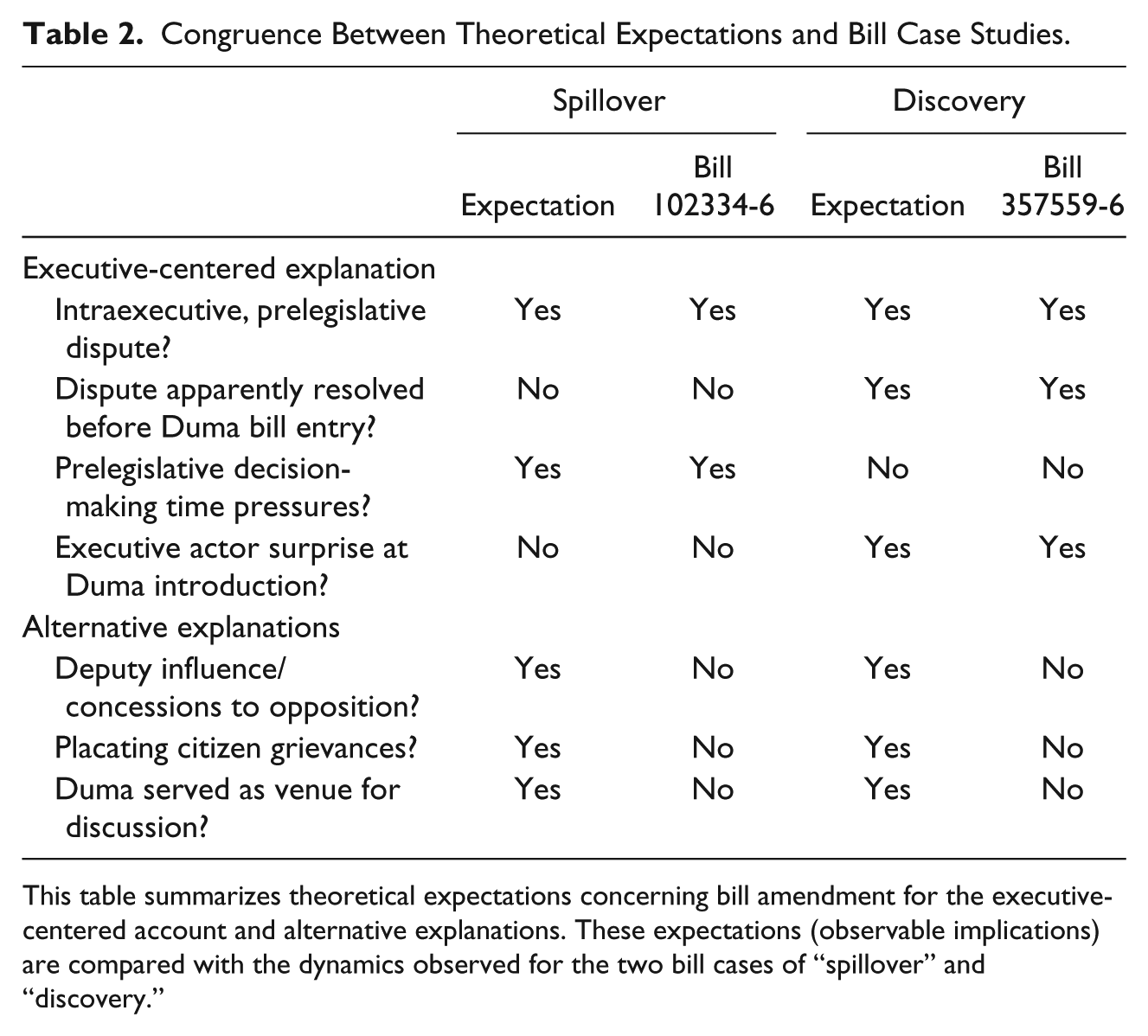
This table summarizes theoretical expectations concerning bill amendment for the executive-centered account and alternative explanations. These expectations (observable implications) are compared with the dynamics observed for the two bill cases of “spillover” and “discovery.”
The ability to trace the processes of particular bill cases is, in part, a reflection of the very dynamics hypothesized—that is, executive actors sometimes use the strategic leaking of information in policy-making battles with other executive actors. For the Russian case, Huskey (1996b), for example, writes that “individual departments within the executive, most notably those responsible for defence, agriculture, and social spending, have publicised intra-executive conflict as a means of mobilising support for their positions in parliament, the executive, and the nation” (p. 464).
How do these two cases relate to the population of interest? Although these cases are interesting episodes, they might be exceptional and, therefore, unrepresentative of general amendment dynamics. The second empirical stage of the article will address this issue. Given the pronounced difficulty of developing, and collecting data on, a proxy for intraexecutive conflict—in contrast to the relative accessibility of information on legislator activities and the use of legislative institutions—the statistical analysis will focus on a more modest task: To discount alternative explanations for executive bill change—that is, that amendments stem from the intervention of parliamentarians who are members or representatives of the potential opposition, or that amendments reflect the incorporation of elements addressing citizen grievances.
Population Analysis of Bill Amendment
Data
From a population of 1,332 executive bills finalized (signed into law) between 2008 and 2013, 837 bills are included in the analysis. This excludes cases of international agreement ratifications (385 bills), budget initiatives and related legislation (95 bills), and 15 initiatives for which the relevant amendment information could not be collected. 16 International agreement ratifications and budget initiatives (and budget-related legislation) are excluded because the rules regulating their legislative passage in Russia differ from “normal” legislation. For example, whereas most legislation is required to undergo three readings on the State Duma floor, international agreement ratifications usually only undergo one reading, and the State Duma has a restricted amount of time to review budget bills, unlike “normal” legislation, which can remain under legislative consideration indefinitely. 17 Texts of introduced bills and final laws were scraped from the Federal Assembly’s online lawmaking database, ASOZD, and the online legal database, Zakonodatel’stvo Rossii (Legislation of Russia). (See the Online Appendix for a longer description and discussion of data collection.)
Figure 2a plots bill word lengths (logged) against law word lengths (logged) for the 837 bill–law dyads. The “rubber stamp” expectation would, of course, be a straight line, demonstrating no change between introduced bills and final laws. Although a large proportion of cases cluster around the line of parity, many cases clearly do not, with the majority of these cases demonstrating increases in initiative word length from bills to laws. Although Figure 2a demonstrates that the mere fact of executive bill amendment is not exceptional—bill change is the norm, not deviant—these crude amendment data do not speak to the drivers of change. The first step in addressing this issue involves developing a defensible measure of bill amendment on which possible determinants of change can be regressed.
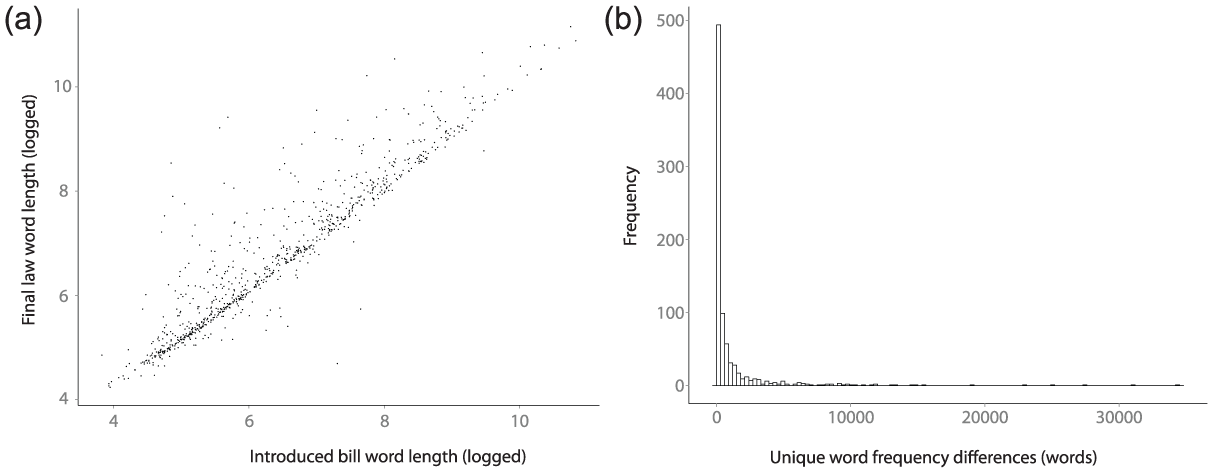
(a) Scatter plot of submitted bill word lengths (logged) against final law word lengths (logged) and (b) histogram of unique word frequency differences.
Measuring amendment
There are various ways of measuring bill amendment. This article follows Pedrazzani and Zucchini (2013) in measuring the extent of bill text amendment by calculating the total unique word frequency difference (UWFD) between introduced bills and final laws—a “bag-of-words” approach, with scores bounded on the left from 0 and unbounded above. This UWFD measure of bill amendments is the dependent variable. Calculating the level of bill change requires complete texts for both introduced bills and final laws—thus, 1,674 documents in all. One clear downside of this measure is that it cannot capture the substantive importance of particular amendments. The advantages of this text-based approach to measuring amendment, however, are that the change statistic is easy to compute; it does not require fine-grained information on discrete amendments moved; and it does not require subjective judgments about amendment significance. 18
Figure 2b is a histogram of unique word frequency difference scores for the bill–law dyads. The distribution has a notable right tail, given cases of remarkable text change between introduced bill and final law. The mean level of change is 1,116 words, although the median is 197, consistent with the skewed distribution. Using this measure of bill change, the text of Bill 102334-6 (the “spillover” case study) changed by 28% during passage through the State Duma. 19 For bill 357559-6 (the “discovery” case study), the respective change figure is 522%.
Independent and control variables
What drives variation in unique word frequency differences between introduced bills and final laws? The two primary alternative explanations for bill amendment—co-optation and information theories—contend that change is driven by legislator activity. Two measures of legislator scrutiny are used. The first is a proxy for the length of time a particular bill is considered on the State Duma’s floor. Specifically, the HTML variable is the number of HTML lines used to compose the web page of the floor transcripts for a particular bill on the Duma’s website. 20 By searching for a particular bill, all discussions and voting activity relating to that bill are summarized on a single page. As such, the data contained within this page provide a comprehensive record of Duma floor activities in relation to each individual bill. The number of HTML lines constituting each bill’s transcript record page can be taken as a proxy for the floor activity associated with each bill—the longer a bill is discussed on the Duma floor, the more HTML lines are required to compose a web page of the transcripts of these discussions.
This HTML-line measure of legislative floor activity should, therefore, provide a closer proxy for legislator scrutiny than the traditional bill velocity measure, which captures an ambiguous mix of activities carried out by a variety of actors, including debates between executive actors.
One criticism of the HTML variable might be that it does not take account of legislative committee discussions. Although this is an intuitive concern, Shevchenko and Golosov (2011) argue that “policy making that takes place in Duma committees is tightly controllable [sic] by the executive” (p. 211), suggesting that these bodies might not serve as autonomous sources of legislator influence (in contemporary Russia, at least). Rather than assuming committee impotence, however, the second measure of legislator scrutiny (Committees) is the (logged) number of legislative committees formally involved in the review of each executive bill—a variable that has been used in previous research (Martin & Vanberg, 2005, 2011; Pedrazzani & Zucchini, 2013; and Zubek, 2008). Both of these variables should be insignificant in explaining executive bill amendment according to the intraexecutive policy conflict model proposed by this article, whereas the major alternative explanations for bill amendment in nondemocratic legislatures suggest they should be significant predictors.
According to the executive-centered account of bill change, the time taken for bill passage through the legislature will be driven by factors beyond legislator scrutiny. Most importantly, this measure (Velocity)—the number of days between bill introduction and official law publication—will include the time taken up by intraexecutive negotiation. As a result, the residual of the variable, after controlling for legislative scrutiny proxies (HTML and Committees), should capture this executive-centered activity and constitute a significant predictor of bill amendment.
A key control to include in the model is the length of the submitted bill (Bill word length), measured as the number of words (logged) forming the introduced draft. It is a plausible assumption that longer drafts are susceptible to more changes than shorter texts. Indeed, this control variable has been found to be a substantive and statistically significant correlate of bill change in extant scholarship (see, for example, Martin & Vanberg, 2011, p. 114; Pedrazzani & Zucchini, 2013, p. 702; Zubek, 2008, p. 157). (Table A1 in the Online Appendix presents summary statistics for these variables.)
Results and Discussion
Table 1 presents the results of five negative binomial regression models. As the dependent variable is a count measure characterized by overdispersion, negative binomial regression is used for modeling in preference over a Poisson model (Hilbe, 2011, p. 141). 21 The main figures are negative binomial coefficients, with standard errors in parentheses. These results suggest that prominent theories of authoritarian legislative politics cannot account for executive bill change—in contemporary Russia, 2008 to 2013, at least. Both variables relating to the level of legislator scrutiny—the length of time bills are discussed on the Duma floor (HTML) and the number of committees involved in the scrutiny of particular bills (Committees)—are insignificant in Models 3-5 and 4-5, respectively. By contrast, in results reported in Table A3 in the Online Appendix, the HTML measure of floor attention for bills is both substantively and statistically significant for an earlier, putatively more democratic period, 2003 to 2007. This is consistent with the idea that Duma deputy scrutiny effort—as captured by the length of time a bill was discussed on the floor of the lower chamber, at least—influenced the level of bill change in this more democratic period but did not in the authoritarian, 2008 to 2013 period. 22 Although the HTML-line measure of Duma deputy scrutiny effort does not help explain variation in bill change, 2008 to 2013, the more general velocity measure, which captures the time taken up by a large variety of factors, including intraexecutive debate, is highly statistically significant in Models 2-5. For ease of interpretation, we can convert the findings of Model 5 into incident rate ratios: Bill word length (log) (2.092), Velocity (1.002), HTML (1.000), Committees (log) (1.056), State (0.310), Defense (0.273), Social (0.457), and Economic (0.604). Thus, for example, a one standard deviation increase in bill velocity (around 274 days) is associated with a 53% increase in text change.
In line with findings from existing studies of bill amendment in democracies, the (logged) number of words in submitted bills is a substantively and statistically significant predictor of the level of amendment experienced by executive initiatives during passage through the State Duma—a finding that holds across all five models. Longer bills are amended more than shorter bills.
Model 5 also includes information on executive bill policy area. 23 Bills in the reference category—“budget, tax, and financial legislation”—undergo the most text change during legislative passage, followed in descending order by bills relating to “economic policy,” “social policy,” “state construction and constitutional rights,” and “defence and security.” 24 Although interpreting these findings can only be tentative, the pattern suggests a distributional logic, with bills relating to the division of scarce resources undergoing more amendment, in contrast to bills relating to core state concerns, including changes to political institutions and maintaining order. Future work should generate and test expectations in this area.
These findings are robust to the exclusion of extreme values (those cases exhibiting word length differences between submitted bill and final law above or equal to 1,000%, or below or equal to −1,000%), which might disproportionately influence the results. (See Table A4 in the Online Appendix for these results.)
A possible alternative to using negative binomial regression would be to use ordinary least squares (OLS), regressing a log-transformed dependent variable (unique word frequency difference) on the control and independent variables. This alternative modeling strategy does not significantly alter the substantive and statistical significance of the results reported in Table 3. (See Table A5 in the Online Appendix for these OLS results.)
Negative Binomial Regression Model Results—Executive-Sponsored Bills, 2008 to 2013.
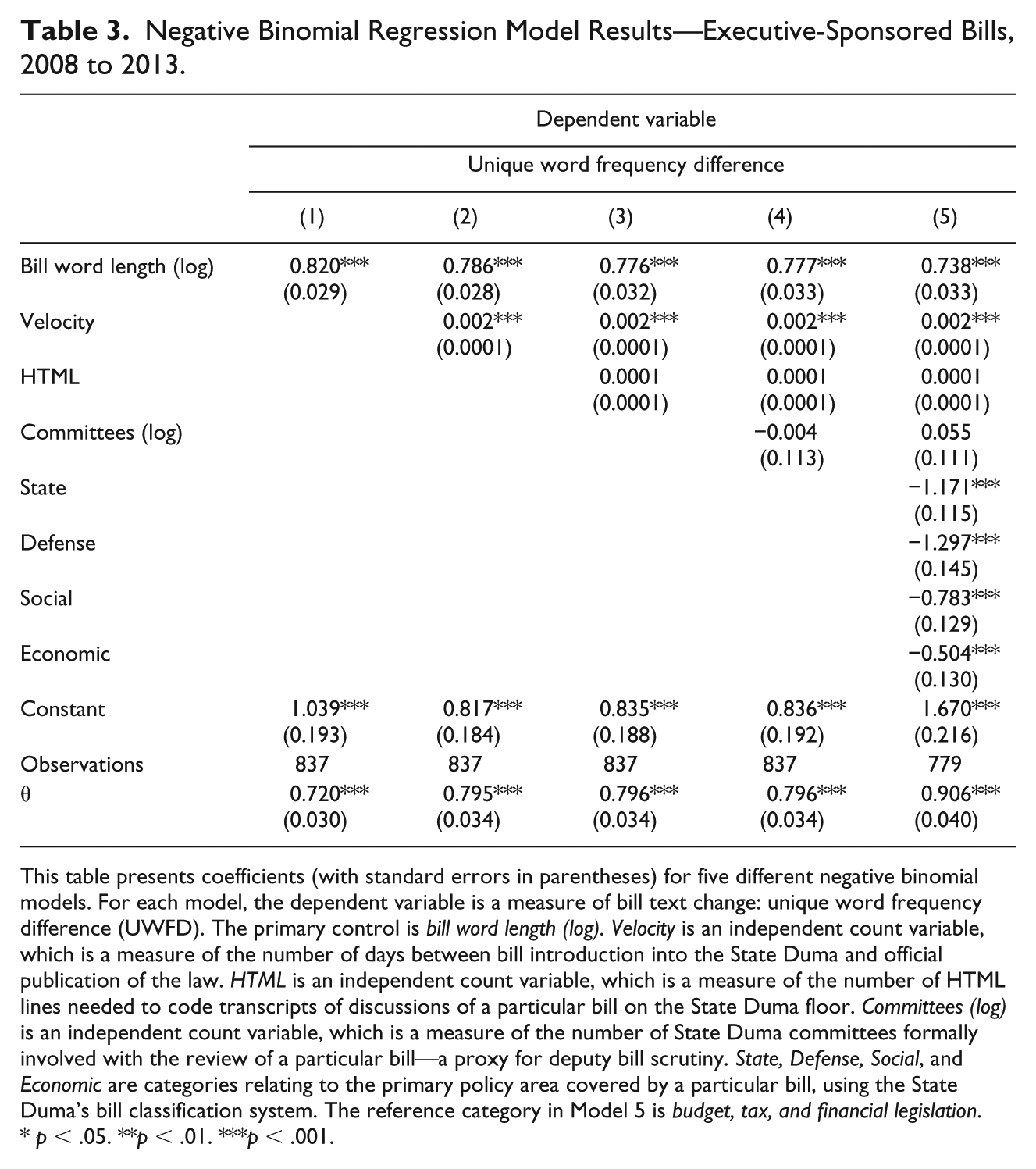
This table presents coefficients (with standard errors in parentheses) for five different negative binomial models. For each model, the dependent variable is a measure of bill text change: unique word frequency difference (UWFD). The primary control is bill word length (log). Velocity is an independent count variable, which is a measure of the number of days between bill introduction into the State Duma and official publication of the law. HTML is an independent count variable, which is a measure of the number of HTML lines needed to code transcripts of discussions of a particular bill on the State Duma floor. Committees (log) is an independent count variable, which is a measure of the number of State Duma committees formally involved with the review of a particular bill—a proxy for deputy bill scrutiny. State, Defense, Social, and Economic are categories relating to the primary policy area covered by a particular bill, using the State Duma’s bill classification system. The reference category in Model 5 is budget, tax, and financial legislation.
p < .05. **p < .01. ***p < .001.
Although these results do not allow us to tease apart the relative balance of different amendment pathways associated with the executive-centered account proposed above, they cast significant doubt on the leading explanations of bill change in the extant literature—namely, co-optation and information theories—as well as providing population-wide context for the bill case studies provided above. 25
Conclusion
There is persistent incredulity regarding the possibility of bill change during parliamentary review in nondemocracies. In a study on Mubarak-era Egyptian politics, Blaydes (2011) states that “legislative institutions have little influence on policy” (p. 23): “Although the Egyptian legislature enjoys broad policy-making authority in principle, in practice, the president controls a docile majority in parliament, which generally renders his legislature [sic] prerogatives into formal laws” (p. 15). Similarly, Truex (2014) argues that the “returns to office” for members of China’s National People’s Congress (NPC) come in the form of a “reputation boost,” rather than “formal policy influence” (p. 235). And Reuter and Robertson (2015, p. 247) argue that “concessions are more about sharing private access to rents than about granting influence over policymaking” for deputies in Russia’s regional legislatures. In spite of this general picture of legislator impotence and the associated expectation of no, or limited, bill change during passage through nondemocratic parliaments, this article has presented evidence of bill change in one authoritarian legislative body, the contemporary Russian State Duma, as well as comparative data. What explains these “deviant” observations?
This article argues that executive bill amendment in authoritarian legislatures can result from the resolution of intraexecutive policy disputes. Bill changes stem from the fact that legislative institutions are used by authoritarian executive actors to constrain each other in the policy-making process. The legislative stage of lawmaking, and the rules and opportunities associated with it, can be used by nonlegislative actors to confront information asymmetries, as well as commitment and monitoring problems in the policy-making process. Writing of the “executive constraints” variable included in the Polity IV data set, Marshall, Gurr, and Jaggers (2016) state that this relates to the extent of institutionalized constraints on the decision-making powers of chief executives, whether individuals or collectivities. Such limitations may be imposed by any “accountability groups.” In Western democracies these are usually legislatures. Other kinds of accountability groups are the ruling party in a one-party state; councils of nobles or powerful advisors in monarchies; the military in coup-prone polities; and in many states a strong, independent judiciary. The concern is therefore with the checks and balances between the various parts of the decision-making process. (p. 24)
This article argues that the “accountability groups” active during the legislative stage of policy making can include executive actors, constraining the policy-making efforts of other executive actors. Interministerial disputes are not necessarily neatly contained in the preparliamentary stage of policy making because of both cabinet-level limitations and legislative-stage possibilities. Indeed, decision making in general, and lawmaking in particular, can be distinctly messy in authoritarian regimes. In contrast to popular images of ruthless dictatorial efficiency, policy making in nondemocracies can often involve squabbling, mistakes, false starts, and u-turns.
There is anecdotal evidence in support of the executive-centered account proposed by the article beyond current-day Russia. Writing of the Chinese NPC, Paler (2005) reports that NPC officials sought to eliminate the frequent occasions on which State Council ministries, forced to compromise on draft legislation, have re-opened the debate when it comes before the NPC, inevitably prolonging disagreement on legislation through the unlimited opportunities for opponents to block progress. (p. 308)
And, writing of the Supreme Soviet in the Soviet Union, Hough and Fainsod (1979) note that “it is very probable that the preparatory committees are the place where final inter-agency agreement on the details of the plan and the budget are hammered out” (p. 378). The Soviet Union and the People’s Republic of China are, like contemporary Russian, examples of bureaucratic authoritarian regimes in nominally communist, or formerly communist, countries. It might well be, therefore, that an important scope condition for the model of executive-centered amendment proposed by this article restricts its applicability to such regimes.
The model proposed by this article is not meant, therefore, as a sufficient explanation for legislative politics in all legislatures in nondemocratic regimes across space and time. As Barbara Geddes has noted, “[a]utocratic legislatures play different roles and serve different functions in different dictatorships” (contribution to Jensen, 2012). Put simply, “context matters” (Wilson & Wright, 2017, p. 1; Wright, 2008). Indeed, Reuter and Robertson (2015) note that “variation among authoritarian legislatures may be just as important as variation between dictatorships with and without legislatures” (p. 237). As Figure 1 demonstrates, both democracies and nondemocracies exhibit variation regarding budget bill amendment. Moreover, the same assembly will likely exhibit different practices at the same time. Thus, co-optation of the elite might take place at the same time as ministers squabble over the content of bills at the same time as elites learn of citizen misgivings about proposed policy changes. In a recent study, for example, Krol (2017) argues that amendments made to executive-introduced bills are concessions to regime-loyal legislators. Future research should explore the relative balance of these different practices over time and space. 26
Although the setting of more precise scope conditions for the executive-centered theory of bill amendment proposed by this article should certainly involve studying legislative politics in other types of nondemocratic regimes, we might also look to democracies for guidance. Martin and Vanberg’s (2004, 2005, 2011) work on bill amendment in West European coalitional parliamentary democracies points to the intraexecutive origins of amendments made during legislative passage. Indeed, their basic argument informed the theory proposed in this article. And yet, in their account, executive actors act in concert with political parties and legislators. One possible implication of this is that, even in nondemocratic settings where there is greater institutional and personnel overlap between executives, parties, and legislators—in China, for instance—we might still observe legislative institutions being used to resolve interministerial policy disputes. And Paler’s (2005) work (noted above) suggests that this can, in fact, occur.
This article does not engage with broader questions discussed in the recent flourishing of work on authoritarian political institutions, such as regime survival and economic growth. It does, however, constitute an important micro account of how intraexecutive relations can animate the legislative stage of policy making, allowing us to account for a key “deviant” observation—executive bill amendment. Nondemocratic parliaments can matter, not (or not only) as venues to co-opt members of the potential opposition or to learn of citizen grievances, but as a mechanism for the resolution of intraexecutive factionalism. We should not, therefore, simply ignore the legislative stage of policy making in nondemocracies. As well as trying to peer inside the black box of ruling political parties, it is also important to look inside legislative bodies and the parliamentary stage of lawmaking. Legislatures can matter as institutions, even if legislators, on the whole, do not.
Supplemental Material
CPS797941_Online_Appendix_CLN – Supplemental material for Authoritarian Amendments: Legislative Institutions as Intraexecutive Constraints in Post-Soviet Russia
Supplemental material, CPS797941_Online_Appendix_CLN for Authoritarian Amendments: Legislative Institutions as Intraexecutive Constraints in Post-Soviet Russia by Jennifer Gandhi, Ben Noble, Milan Svolik and Ben Noble in Comparative Political Studies
Supplemental Material
Replication_R_code – Supplemental material for Authoritarian Amendments: Legislative Institutions as Intraexecutive Constraints in Post-Soviet Russia
Supplemental material, Replication_R_code for Authoritarian Amendments: Legislative Institutions as Intraexecutive Constraints in Post-Soviet Russia by Jennifer Gandhi, Ben Noble, Milan Svolik and Ben Noble in Comparative Political Studies
Footnotes
Acknowledgements
The author thanks Ben Ansell, Shaun Bevan, Fabian Burkhardt, Paul Chaisty, Stephen Fortescue, Jennifer Gandhi, Yue Hou, Jody LaPorte, Xiaobo Lü, Timothy Power, Sebastian Rahtz, Thomas Remington, Ora John Reuter, Graeme Robertson, Bryn Rosenfeld, Cameron Ross, Marsel Salikhov, Paul Schuler, Milan Svolik, Arco Timmermans, Rory Truex, and Matthew Wilson, as well as three anonymous journal reviewers for excellent feedback and assistance at various stages of the project, which draws on material from the author’s doctoral dissertation from the University of Oxford. All remaining errors are, of course, the author’s alone.
Declaration of Conflicting Interests
The author declared no potential conflicts of interest with respect to the research, authorship, and/or publication of this article.
Funding
The author disclosed receipt of the following financial support for the research, authorship, and/or publication of this article: The research project started during the author’s tenure of a Leverhulme Trust Study Abroad Studentship (award number SAS-2011-038) and completed during the author’s tenure of the Herbert Nicholas Junior Research Fellowship, New College, University of Oxford. Support from the Basic Research Program of the National Research University Higher School of Economics is gratefully acknowledged.

Notes
Author Biography
References
Supplementary Material
Please find the following supplemental material available below.
For Open Access articles published under a Creative Commons License, all supplemental material carries the same license as the article it is associated with.
For non-Open Access articles published, all supplemental material carries a non-exclusive license, and permission requests for re-use of supplemental material or any part of supplemental material shall be sent directly to the copyright owner as specified in the copyright notice associated with the article.
