




Abstract
We examine how descriptive representation, formal representation, and responsiveness affect the legitimacy of political decisions: Who are the representatives, how are they selected, what is the outcome of the decision-making process, and to what extent do these three aspects matter for decision acceptance among the citizens? We examine this from the citizens’ perspective, and ask whether decisions are perceived as more legitimate when they are made by groups that reflect society in certain characteristics and chosen according to certain selection procedures. In a Norwegian survey experiment, we find that people are more willing to accept a decision when it is made by a group of people like them, and who are assigned as decision makers based on their expertise. Descriptive representation also serves as a cushion for unfavorable decisions. Moreover, when asked, the traditionally less advantaged groups tend to value descriptive representation more than other citizens.
Keywords
Does a representative body that descriptively mirrors society make people more willing to accept the decisions it makes? Representation is at the heart of how contemporary democracies organize their governing “by the people,” and has as such been studied extensively. One important aspect within this field has been the normative and empirical study of descriptive representation (e.g., Bratton & Ray, 2002; Mansbridge, 1999; Reynolds, 2013; Schwindt-Bayer & Mishler, 2005). Scholars have, for example, examined under what conditions descriptive representation may be fruitful and what policy consequences it has. Many studies have concluded that descriptive representation can crucially support the principles of democracy. However, while studies have gained vital insights in the workings of representation, we know much less about what citizens think of the specifics of these processes. More precisely, while scholars have argued that descriptive representation tends to improve the quality of policy output, it is unclear whether people are also more willing to accept a political decision made by a representative body that is more descriptive.
In essence, descriptive representation is argued to produce better decisions that are inclusive to a wider set of popular voices. We examine whether descriptive representation also helps the popular willingness to accept a political decision using a survey experiment run in the Norwegian citizen panel in 2014. Ceteris paribus, will a decision made by a representative group of decision makers be more acceptable than one made by a nonrepresentative group? We find that it does. This has important implications for the legitimacy of policy making in democracy, as the acceptability of a decision increases compliance and facilitates implementation.
Furthermore, in examining people’s ideas on representation, we aim to find which characteristics people find important for representation—in Mansbridge’s terms, which characteristics are relevant for representation? We asked survey respondents about this explicitly. We find that no single feature was very important for a large group, but most had some importance. When broken down into subgroups, the responses yield that those who may be considered politically disadvantaged were more concerned with descriptive representation. For example, women found gender representation more important than men did. This fits with the expectation, and indeed underlines the claimed benefit of descriptive representation, namely, the better representation of various groups in society. However, when it comes to education, the opposite occurs.
Moreover, in addition to the descriptive characteristic of the decision-making process, we explore the extent to which the (s)election procedure, as well as the actual outcome of the process, matters for the legitimacy of decisions. We find that people tend to value decisions made by experts, and those that align with their own preferences. In sum, our study deals with the legitimacy of the representational process based on its descriptive, procedural, and responsive features.
Democratic Representation
Hanna Pitkin (1967) argues that representation in principle implies the “making present” what is not, as well as an “acting for.” The representative should be responsive to the represented. At the same time, a representative cannot be that when it purely executes orders or demands. He or she is not a “mere instrument” (Pitkin, 1967, p. 126) or servant, but the represented should be present in the representative. Thus, the much-studied distinction between representatives being “trustees” or “delegates” (see, for example, Esaiasson & Holmberg, 1996; Eulau, Wahlke, Buchanan, & Gerguson, 1959) is somewhat irrelevant. A representative, by definition, should be both. Accordingly, scholars have developed other theoretical typologies of representation (see, for example, Andeweg & Thomassen, 2005; Mansbridge, 2003; Rehfeld, 2009).
Beyond the general concept of representation, it can in practice be structured in different ways. Pitkin’s theoretical analysis of representation highlights the complexity of the concept, as well as its multifaceted nature. We focus on three elements when assessing the legitimacy of the representative decision-making process: who are the representatives, how are they selected, and what is the outcome of the decision-making process. We thus examine how descriptive representation, formal representation, and responsiveness (Pitkin, 1967) affect the legitimacy of political decisions.
Descriptive Representation: Who Are the Legislators?
Are characteristics of representatives relevant in representation and should they mirror those in society? By arguing that representation includes both a “making present” and an “acting for,” Pitkin (1967) suggests that it does not matter greatly who represents, as long as the ideas and preferences are represented. Representation in her view is not about the representative, for example, being a woman, but rather about the representative capturing relatively accurately whatever ideas and preferences the women constituent has that relate to policies.
Mansbridge (1999), however, argues that it can nonetheless be desirable for the legislature to resemble the population in relevant characteristics. While it may not always be necessary, descriptive representation is particularly important in a number of contexts (Mansbridge, 1999). The representation of the relevant groups in a political conflict can result in substantive representation whenever the “making present” of the group’s ideas and the “acting for” that group is done by people who understand what it means to be part of this group. It is thus not about any specific biological attributes or about the group itself being homogeneous, but rather about a certain shared experience or history. In such conflicted contexts, descriptive representation can be important in terms of (a) adequate communication, (b) innovative thinking, (c) underlining the “ability to rule” of the group, and (d) increasing legitimacy (Mansbridge, 1999). Including members of the group in the relevant representative body may not only help the group be represented more substantively; it may also help change the public image of the group so that in the future its members will be more equally included. This inclusion also makes the disadvantaged group more part of the polity—increasing de facto legitimacy (Mansbridge, 1999).
Besides these important normative arguments for enhancing descriptive representation, studies have shown that it also matters in practice who the representatives are. For example, the (more proportional) inclusion of women, or of lesbian, gay, bisexual, and transgender (LGBT) people in the legislature has important effects on the legislation it produces on topics relevant for these groups. Bratton and Ray (2002) show that the number of women in Norwegian municipal councils positively and progressively influenced child care provision (a policy that was reported to be of greater concern for women than for men). Schwindt-Bayer and Mishler (2005) find that the number of women in the legislature positively affects the policies that are considered a concern to women. Reynolds (2013) shows that having LGBT representatives helps create policies that support the equal rights of these groups. Reynolds suggests that the sheer presence of LGBT representatives, as opposed to the proportionality of their representation, is crucial for this group (see also, for example, Phillips, 1995; Pitkin, 1967, on “threshold representation”). In all, the explicit inclusion of members of relevant groups in the legislature appears important for their substantive representation and their equal rights. Thus, descriptive representation can help representative assemblies approach the democratic ideal of political equality (Dahl, 1998).
Formal Representation: How Are the Legislators Selected?
Contemporary democracies focus on the popular election of representatives, with the idea that this gives citizens indirect control over public policies. Citizens elect decision makers who both represent them on the basis of political views and have better qualifications to perform the job of legislator than the average citizen. This view of what representation can mean is related to the idea that the concept can be defined by the “arrangements that initiate or terminate the activity” (Pitkin, 1967, p. 114; see also pp. 38-59 for a discussion on formal representation). Elections are one possibility for the appointment of representatives.
The ancient Greek democracy instead used sortation, or the selection by lot (Manin, 1997). This form of selection would result in a “true” reflection of the people in parliament, and thus one way of achieving descriptive representation. More recently, and on a smaller scale, experiments with “mini-publics” or samples of citizens drawn randomly to deliberate over particular policies have been discussed as valuable in terms of legitimacy, policy output, and, perhaps most of all, educative effects (e.g., Goodin & Dryzek, 2006; Niemeyer, 2011; Smith, 2009). Saward (2009) suggests that nonelected representatives would have the advantage of not being subject to the “temptations of the election-snapshot” (p. 8), focusing on more continuous and long-term ideas. They would also be able to follow their own ideas; they can be partial because they are a randomly selected member of the citizenry, not elected on the basis of a proposed program (Saward, 2009). However, it is argued that being a legislator requires specific skills. Making laws and policy proposals is not an easy task; it requires training. With the random selection of representatives, the emphasis on this expertise is lost. Moreover, Corazzini, Kube, Maréchal, and Nicolò (2014) find some evidence 1 that elected representatives might be better for citizens’ well-being than those who are randomly selected.
The argument that legislators require specialized skills is related to the appointment of “expert” representatives, another form of selecting representatives. Policies are increasingly created outside of the public sphere perhaps because a high level of specialization is necessary due to the technologically complex nature of the object that is being regulated (Shapiro, 2005). The idea behind this type of expert rule is that it produces better policies, is more efficient, is not limited to short time-horizons, and can solve commitment problems (Rayner, 2003; Thatcher, & Stone Sweet, 2002). One argument against the implementation of descriptive representation is that selecting representatives on socio-economic characteristics could come at the cost of ability, expertise, and commitment (see Mansbridge, 1999, for a discussion). While Mansbridge convincingly argues that a loss of expertise that comes with the implementation of descriptive representation is likely to be minimal, this may nonetheless be an issue that concerns citizens as the competence of the representatives is an issue that is of concern to citizens in agency relationships (Fearon, 1999; Landa & Duell, 2015).
Today, we see an increased use of experts in political decision making (Jordana, Levi-Faur, & i Marín, 2011). When governments actively promote and argue for the delegation to experts, citizens may adopt the idea that decision makers need to possess such expertise. It implies that there is one right answer or solution and that, as long as you have enough expertise, the right policies can be created. Yet, policy decisions are often just as much about political values as about correct or incorrect decisions, and experts are still likely to carry personal political preferences which may bias their policy decisions. Hence, it has been argued that with the increased use of expert political decision making, experts would need to be held accountable (Holst & Molander, 2014). An intrinsic problem with this is that nonexperts have few tools to hold the experts accountable, as the nonexperts by definition are less competent on the issue in question. One solution to the challenge would ensure that the recruitment of experts is based on some criteria that limit their aggregate biases. Imposing socioeconomic diversity is one option that could have such an effect.
Responsive Representation: What Is the Outcome?
In Pitkin’s discussion of representation as an “acting for,” she highlights ideas on what the activity of a representative should be, what he or she should be doing. One important element that surfaces is that representatives’ opinions and actions should—to some extent—reflect the wishes, needs, or interests of the people that they represent (Pitkin, 1967). This resonates with Dahl’s (1998) ideas on democracy: They should be responsive to what people want. 2 Scharpf (1999) further points out that output could provide a basis for legitimacy, in absence of input legitimacy. Especially over the last few decades, it has become increasingly difficult for governments to balance international commitments and their promises to the electorate (Mair, 2013), making it difficult for them to engage in a fully open and popular decision-making process. The emphasis on “good” output that may be observed in many democracies may thus not be so surprising. Indeed, many have argued that responsiveness is a key aim for democracies and that a core source of legitimacy originates from the output side (Rothstein, 2011). When governments are able to give what people want, it will enjoy support (Dahlberg, Linde, & Holmberg, 2015). The policy outcomes should be favorable to the affected citizens (Estlund, 2009), or at least perceived by the citizens as fair and unbiased (Hibbing & Theiss-Morse, 2002; Rothstein, 2009). In essence, people tend to be satisfied when they get what they want, encouraging popular legitimacy.
Political Legitimacy in the Eyes of the Citizens
At the very core of the concept of political legitimacy is the idea that something can be legitimate when it is acceptable according to certain criteria (Ziemann, 2014). Assessing legitimacy can refer to two different approaches: one at the “system-level,” that is, normative legitimacy (what third-party analysts we think ought to be legitimate), and one at the “individual-level,” that is, empirical legitimacy (what citizens believe is legitimate) (Weatherford, 1992).
On the system level, political legitimacy refers to the acceptability of legislation according to abstract normative criteria. This “macro perspective” emphasizes formal system properties, institutional procedures, and policy output criteria for democratic legitimacy that include accountability, efficiency, and procedural fairness (see also Rothstein & Teorell, 2008; Weatherford, 1992). These criteria map onto the general category of “normative legitimacy.”
On the individual level, the evaluation by citizens—those who live under the institutional structures and on whom policies have an impact—is a more subjective way of assessing legitimacy. This “micro perspective” focuses on citizens’ attitudes and actions (Weatherford, 1992). In contrast to the normative criteria devised by scholars and/or practitioners, this individual-level version of legitimacy, highlighting popular orientations and expectations, maps onto the general category of “perceived legitimacy” or “empirical legitimacy” (see, for example, Mansbridge, 2015; Thompson, 2008; Tyler, 2006).
Our aim is to evaluate representative processes based on empirical legitimacy. Along with the more objective normative criteria to evaluate democratic processes, empirical legitimacy is also crucial to the functioning of democracy. Russell Dalton (2004) maintains that “. . . democracy is at least partially based on public endorsement of the political decision-making process” (p. 10). Moreover, “democracy functions with minimal coercive force because of the legitimacy of the system and the voluntary compliance of the public” (Dalton, 2004, p. 12). Yet, Bengtsson and Wass (2010) note that while the “relationship between representatives and voters have attracted extensive theoretical interest, empirical investigations in the field have been far less common.” This particular focus on political legitimacy of decisions is timely, considering the behavioral and attitudinal changes within established democracies over the last few decades. Scholars have observed a decline in traditional forms of political participation and in political support, as well as an increase in noninstitutionalized forms of participation (e.g., Dalton, 2004; Dalton & Wattenberg, 2000; Inglehart & Catterberg, 2002; Norris, 2002; Pharr & Putnam, 2000). Even though people seem overwhelmingly supportive of democracy as a form of regime, these trends may be signs of a decline in political legitimacy (see also Dahl, 2000).
Expectations
Previous studies show that descriptive representation makes a difference: It has an impact on policies, has educative but also emancipative effects, and appears to increase the perception of legitimacy (e.g., Bratton & Ray, 2002; Mansbridge, 1999; Reynolds, 2013; Schwindt-Bayer & Mishler, 2005). Considering that descriptive representation appears to affect policies in this way, people may be more willing to accept decisions that are taken by a representative body that includes people like them.
Individuals, for example, see the “likeness” as a relevant determinant of their representatives’ interests and preferences. Studies of “in-groups” and “out-groups” show that people tend to differentiate between people belonging to a group that shares certain similar traits and those that do not (Hogg, Terry, & White, 1995; Tajfel, Billig, Bundy, & Flament, 1971). They often prefer other people who are “like” themselves (McPherson, Smith-Lovin, & Cook, 2001). They may have more trust that representatives who belong to their own group will make a decision that aligns with their interests and preferences, or they may trust that even if a representative’s decision is contrary to their preferences, this is for a good reason.
People may thus be more willing to accept a decision when a more descriptive representative body made it. Furthermore, we would expect the preference for descriptive representation to be stronger among those who could be considered part of a disadvantaged or discriminated against group. If this were the case, women, for example, would be more concerned with being descriptively represented. However, Gay (2002) has found that although both Black and White constituents value representation by members of their own race, in her study, White constituents placed even more importance on being represented by a White legislator than Black constituents did on being represented by a Black legislator. This phenomenon, to the extent that it is replicated, may simply reflect the virulence of racism. 3 Both groups of constituents do, however, tend to more frequently contact legislators who correspond to their own race (Gay, 2002).
The expectations for formal representation are related to those for descriptive representation. Although random selection in principle ensures a descriptively representative body, it is not certain that people will approve of this selection procedure per se. Descriptive representation can be important regarding some relevant socioeconomic characteristics, but it is not obvious that citizens will want the decision makers to be average in all aspects. More specifically, and as discussed, expertise has been shown to be one desirable characteristic, and random selection will not provide that. Different selection processes (election, a random draw, and appointment) of the legislators are likely to lead to different degrees of both expertise and descriptiveness (Estlund, 2009). How these selection processes are perceived among the public is unclear and has not been fully studied empirically. However, people might like representatives that are overall more capable than the average citizen, suggesting that people might prefer appointed experts to randomly drawn or elected candidates. On the contrary, citizens may prefer representatives that are like them—even if that comes at the cost of expertise. The election of representatives may yet again trump both selection procedures because it presents a compromise between expertise and descriptiveness. Moreover, citizens in most contemporary democracies are simply used to electing their legislators—they may view elections as more legitimate than alternative selection procedures, simply because of their experience with them. The opposite may be true for sortation: Citizens do not have actual experience with representation based on randomly drawn members of the public and may simply for that reason be more skeptical about it.
Concerning responsiveness, there is evidence that suggests that people react negatively when they perceive the decision makers to be nonresponsive (Esaiasson, Gilljam, & Persson, 2016). Studies have shown that outcome favorability is an important factor for the acceptance of a decision (Arnesen, 2017). Citizens are likely to be concerned with the outcome of the decision, and we thus expect that the legitimacy is higher when the decision is in line with the respondent’s preference.
The Norwegian Case
To examine the relationship between representational processes and legitimacy, and to see which characteristics are particularly important in this respect, we need data that tap individuals’ ideas about decision making by representatives. Moreover, as the debate explicitly concerns democracy, we ideally examine citizens living in a democracy. Norway makes for an interesting and useful country to look at. For one, Norway is a relatively homogeneous country in terms of the population. Descriptive representation would theoretically be more important to people when differences between groups within a country are substantial. Thus, a finding indicating that descriptive representation increases legitimacy in Norway could be taken as indicative for more diverse countries. Norway may then be seen as something of a least-likely case (Eckstein, 1975).
Norway is not completely homogeneous, though. Politically marginalized groups exist in all countries including Norway. Sociopolitical cleavages have historically formed along the dimensions of economic class (workers vs. capitalists), religion (Christian vs. secular), and geography (center vs. periphery) (Lipset & Rokkan, 1967). During the 20th century, the Norwegian political party system was formed based on these cleavages, winning representation and political influence for the formerly politically marginalized groups.
Friction between the groups still exists, perhaps most strongly along the geographical center/periphery dimension. Geographical representation has historically been a key issue in Norwegian politics given its challenging topography. It was from this context that Stein Rokkan theorized about political conflict lines generated along the center–periphery dimension. Specifically, the regions that felt they were farthest away from the central power can have an antipathy toward the political center, namely the northern and western regions. Moreover, while Norway is considered a country progressive in terms of gender equality, women have been excluded from politics historically. Even today, women’s political participation is still lower than that of men (Ringkjøb & Aars, 2008). From this perspective, women are still a politically marginalized group. Furthermore, Norway has become more increasingly diverse in terms of the population’s ethnic and cultural background, as many other Western countries.
Data and Design
The data for the study were generated by including a factorial survey experiment and a question battery in the 2014 fall survey wave of the Norwegian Citizen Panel. This panel is a general population web panel established for academic purposes. The participants have been recruited via random sampling from the official national population registry (Ivarsflaten et al., 2015). This registry contains names and contact information about all residents in the country, ensuring that all have an equal probability of being contacted. 4 The participants in the experiments presented here are representative of the population. That the study reflects society is of particular importance on an issue such as political legitimacy, where the target population is the entire citizenry. In 2014, the panel consisted of about 8,500 panelists; 3,241 of these participated in our experiment, and 1,667 received the question battery that directly taps preferences for specific characteristics in descriptive representation. 5
To tap the effects of descriptive representation, formal representation, and responsiveness on the legitimacy of political decisions, we designed a full factorial vignette survey experiment involving a hypothetical political decision on how to spend money owned by the collective people of Norway. The vignette sets up a general scenario, where we present the respondents with a hypothetical situation in which a group of hundred persons is said to decide on some money to be spent. Respondents were told that (a) the group reflects the population in socio-economic characteristics (or not); (b) the group was selected by lot, elected by the population, or appointed as experts by the government; and (c) the final decision is the same as the respondent’s preference (or not the same). This leads to a total number of 12 different scenarios, resulting in an equal number of experimental groups The respondents are told that the money comes from what is commonly known as the “Oil fund.” The official name is the Government Pension Fund of Norway, where the revenues come from the country’s oil sector. It is one of the largest pension funds in the world whose revenue is something all citizens have an ownership to and are familiar with.
This is one of the vignettes, serving as an example for how the respondents were presented the scenario: We would like you to consider this scenario: A political decision is to be made about how some of the money in the Oil fund will be used. This decision is made by a group of a hundred people
Very willing
Willing
Somewhat willing
Slightly willing
Not willing at all
The legitimacy concept is thus operationalized as the degree of willingness to accept the decision, in line with other studies on legitimacy (Grimes, 2005; Van der Toorn, Tyler, & Jost, 2011). See the appendix for further details about the full experimental vignette universe as well as further statistics. The answers are analyzed as differences of mean responses on the dependent variable, that is, how willing the respondents would be to accept the decision made by the group.
To gain insight into what characteristics the respondents find important with regard to political representation, we included an additional question: “If you could choose one politician who would represent your interests in the national authorities in Norway, how important do you think the qualities below are for this person. The representative:
Has the same level of education as you have
Comes from the same part of the country as you do
Has the same gender as you have
Has the same religious belief as you have
Has about the same age as you have
Has the same ethnic background as you have
Has the same political views as you have
Has the same type of work experience as you have
Has the same sexual orientation as you have”
The questions are posed in a battery, where the order is randomized. We analyze the answers for the respondents as a whole and break the responses further down based on background information that we have about the panel respondents.
Results
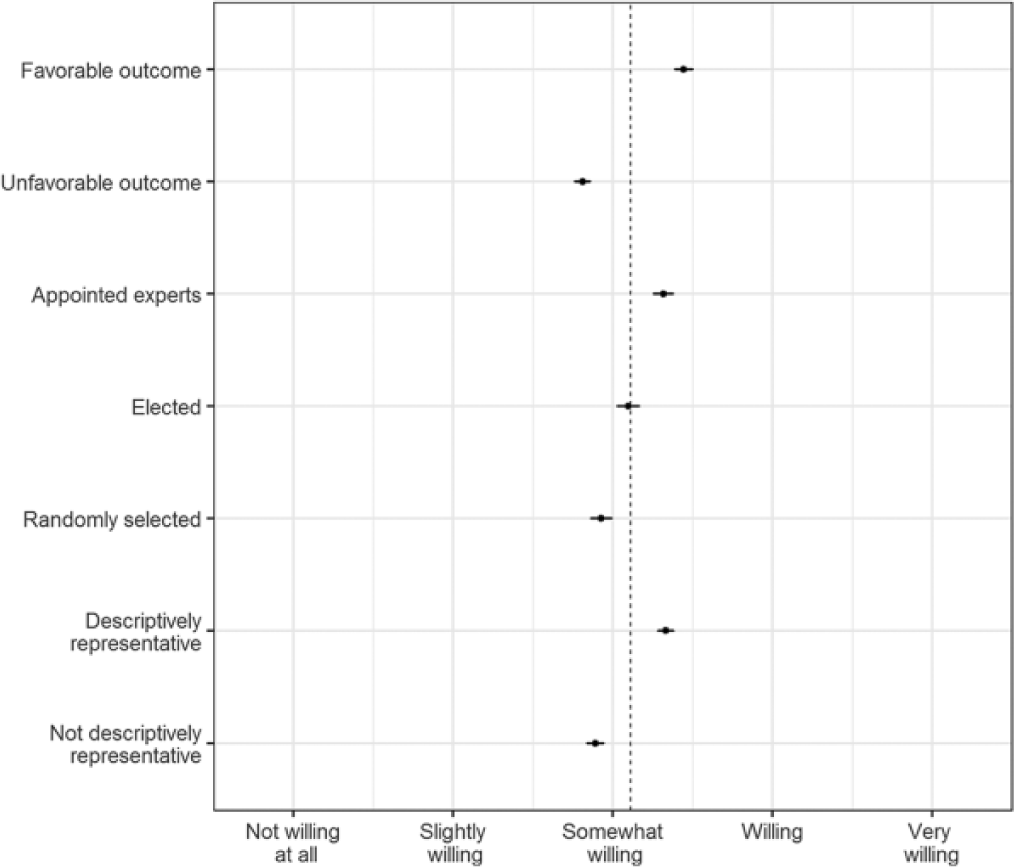
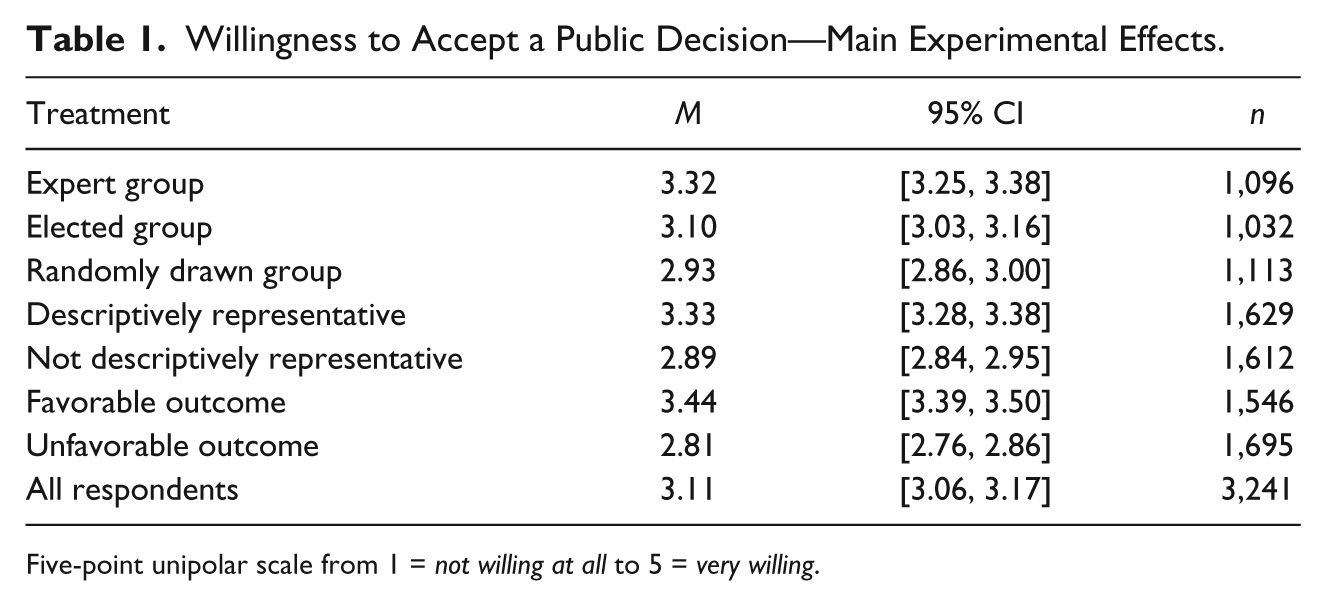
In all, 3,241 respondents participated in the survey experiment. Figure 1 graphically shows the results of the main treatment effects, and Table 1 provides the statistics. They show the mean and confidence intervals on a scale from 1 to 5, where 1 is not willing at all and 5 is very willing. The dotted vertical line indicates the grand mean of all respondents, which is 3.11 (see also Table 1). The appendix provides more detailed information, including the full factorial 3 × 2 × 2 vignette universe and some key statistics.
Experimental treatment effects.
Willingness to Accept a Public Decision—Main Experimental Effects.
Five-point unipolar scale from 1 = not willing at all to 5 = very willing.
To assess whether people find a decision taken by a more descriptive representative body more acceptable than one that is taken by a nondescriptive body, we compare the answers of the two groups.
Figure 1 shows that people prefer a more descriptively representative decision-making body to a nondescriptively representative one. The group that was asked to indicate how acceptable they found a decision taken by a group of people that reflected the population in socioeconomic characteristics has a significantly higher willingness to accept such a decision, than the group to whom it was proposed that a nondescriptive body would take a decision. Indeed, the difference is quite large. Having a decision-making body representative in descriptive social background characteristics increases the acceptability of the decision by 0.44 points compared with the case where the decision makers were said not to reflect the population in these characteristics. This is close to half a standard deviation difference from the mean. The results presented in Figure 1 thus suggest that people care about who makes the decisions on their behalf and that they prefer representatives to reflect the society in socioeconomic terms.
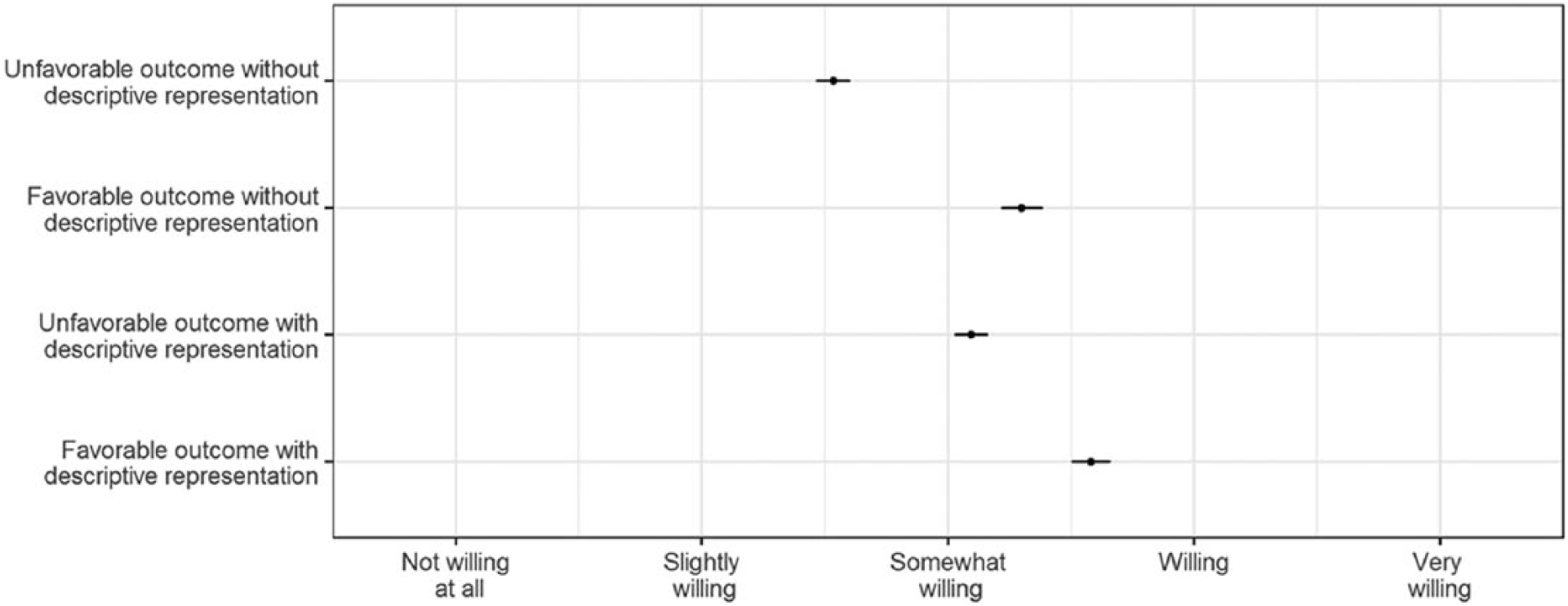
Figure 2 further illustrates the importance of descriptiveness, particularly in the situation when a decision goes against the respondent’s preferences. While legitimacy appears higher in all scenarios that include descriptive representation, the difference in legitimacy for descriptive and nondescriptive representation is biggest in situations where the decision is unfavorable: On average, decision legitimacy with descriptive representation drops by only 0.49 points when the outcome goes from favorable to unfavorable, while it drops by 0.77 points from an already lower level without descriptive representation.
Interaction between outcome favorability and descriptive representation.
The results further show that people are more willing to accept the decision in the vignette scenario where the group of decision makers is composed of appointed experts. As Table 1 displays, the difference between experts and elected decision makers is 0.22, and between the experts and the randomly drawn group, it is 0.39 points higher for the experts. These results hold regardless of whether the outcome of the decision is in line with the respondent’s preference. The pattern of the finding, that is, that decisions are considered most legitimate when they are made by appointed experts and least when made by randomly selected citizens, suggests that the “expertness” of the decision-making body increases legitimacy—regardless of whether the body is also more descriptively representative. Furthermore, when combining the descriptive and formal features of the experiment, it becomes clear that decisions made by expert groups that are also descriptively representative are considered somewhat more acceptable than expert groups that are not (see Table A1 in the appendix).
Regarding the responsiveness of the decision, the results presented in Figure 1 and Table 1 show that people indeed qualify a decision as more acceptable when it is in line with the respondent’s preferences. This finding aligns with our expectations and with findings from previous studies.
Which Socioeconomic Characteristics Are Important?
The above experiment reveals that people find decisions made by a descriptively representative group more acceptable. However, the experimental vignette scenarios are designed such that the socioeconomic backgrounds are compounded. This setup thus does not allow us to examine which of the socioeconomic characteristics the respondents find important. For this reason, we further investigate which characteristics are important to people, and for whom it matters the most. We expected that those who perceive themselves as members of politically marginalized groups are more concerned with descriptive representation simply because they will see it as a means to reduce disempowerment. To reiterate, respondents were asked how important it is to them that their representative possesses various background characteristics. The list of characteristics that we presented to the respondents is similar to that in the survey experiment, with answer categories from 1 to 5, where 1 = not important at all and 5 = very important.
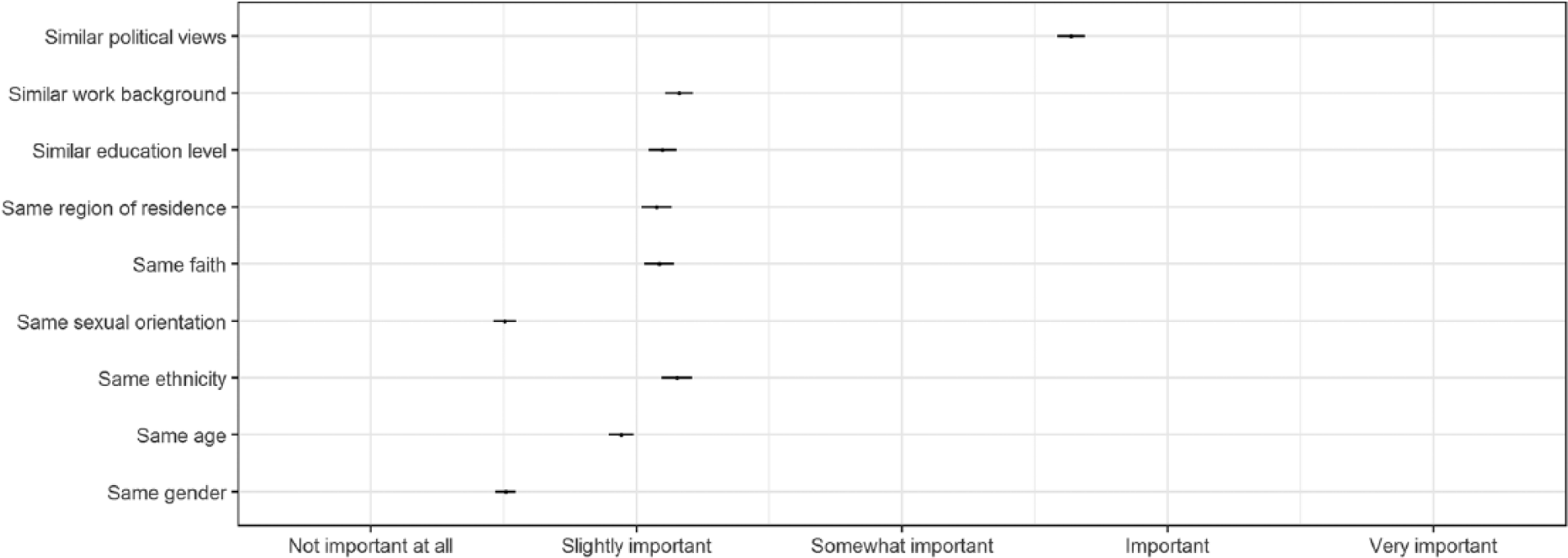
To have substantive representation as a point of reference, the battery also asked the respondents how important it was for them that their political representative shared the same political views as themselves. Figure 3 shows that this was the single most important feature, with a mean score of 3.64—by far the highest among the characteristics. It is perhaps surprising that this feature is not even more important to people considering that political views are so central to representation.
Importance of similar background with political representative.
Figure 3 also gives the mean importance regarding the social background characteristics. Respondents reply that, on average, it is slightly important that their representative would have similar work and educational background, come from the same geographic region as themselves, share their faith and ethnic background, and be of approximately the same age. Regarding sexual orientation and gender, the respondents found it less important that their representatives were similar to them in this respect.
Overall, descriptive representation thus seems only slightly important for the respondents. Using data on the respondents’ background for some of the battery items, we can further analyze these subgroups view on descriptive representation. We have information about their area of residence, gender, age, and level of education. These data allow us to compare the supposed “marginalized” groups’ response in how important they find it that representatives have specific characteristics to the rest of the respondents’ response. When we break the answers down according to these subgroups, the results show that politically marginalized groups tend to put stronger emphasis on having their representative share their social background, following our expectation. Figures 4-7 show the results.
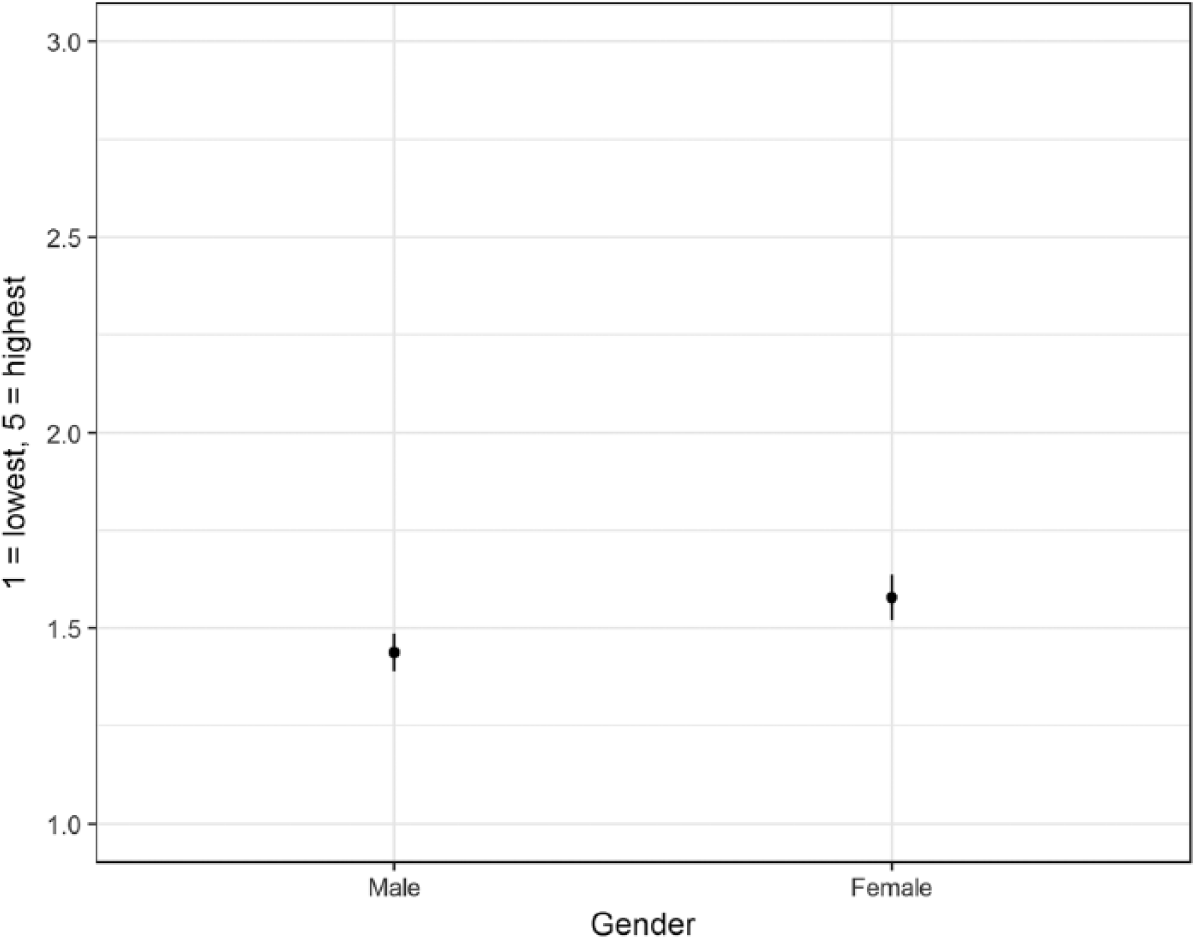
Importance of gender representation, by gender.
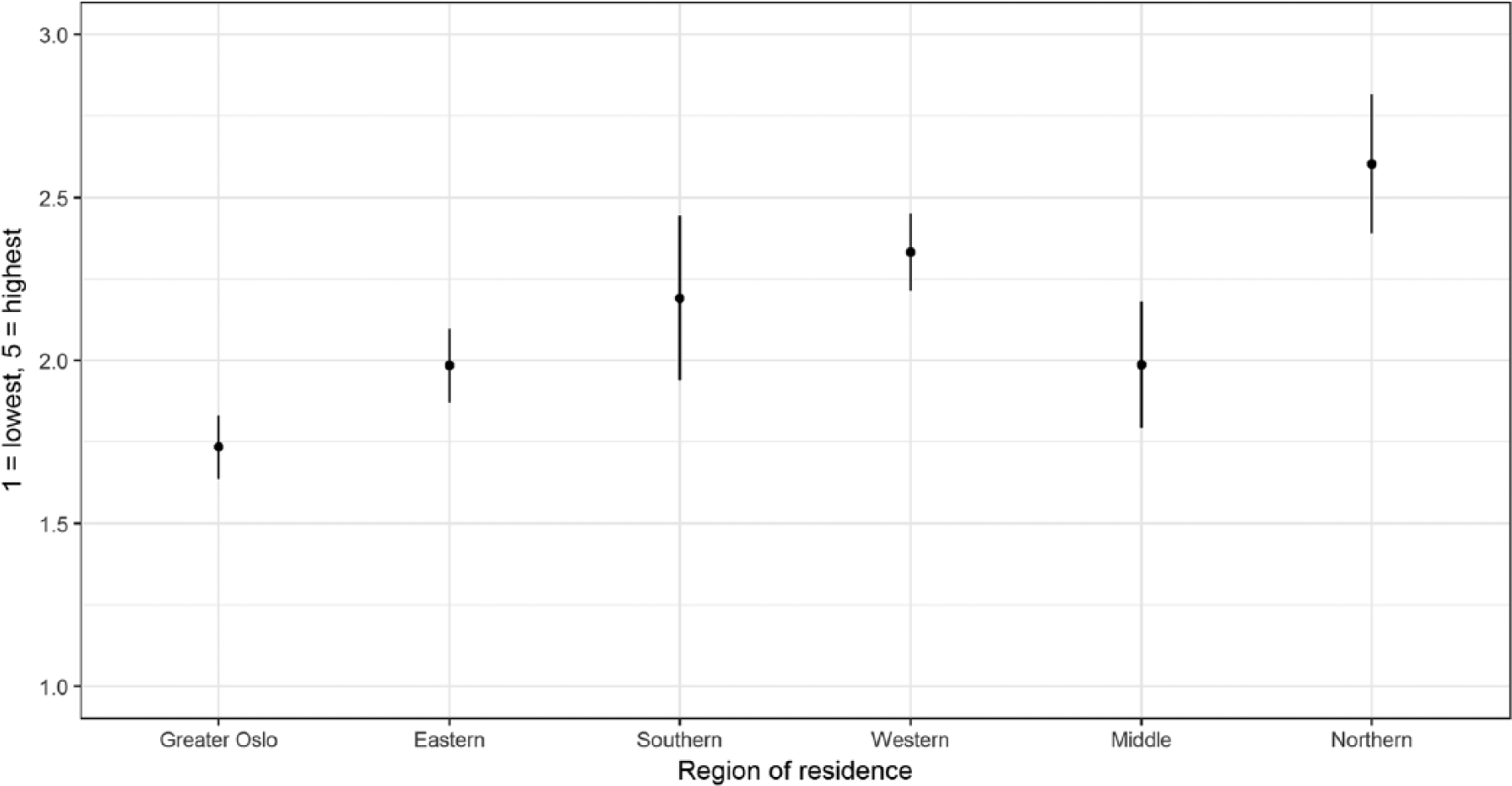
Importance of regional representation, by region.
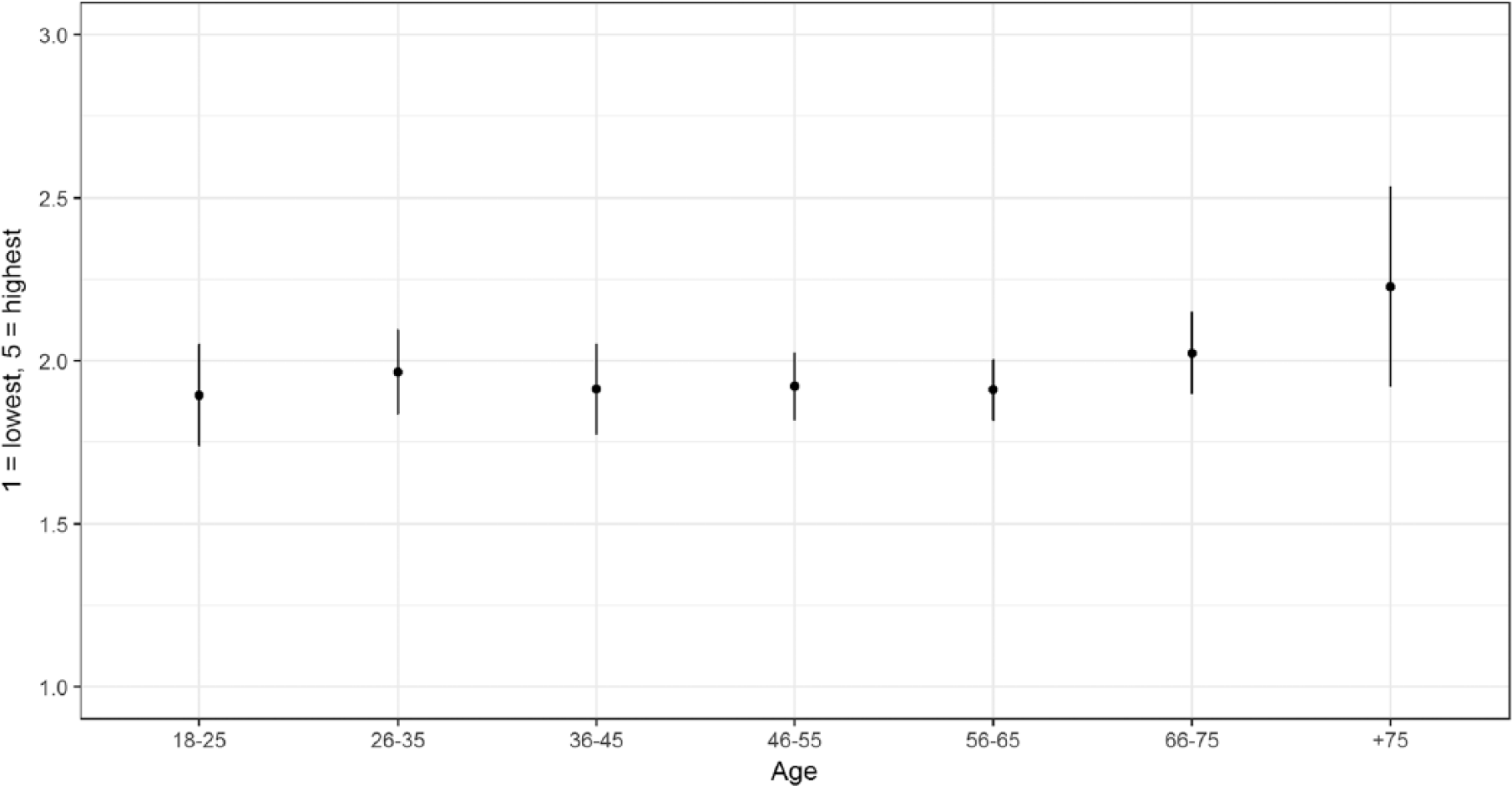
Importance of age representation, by age.
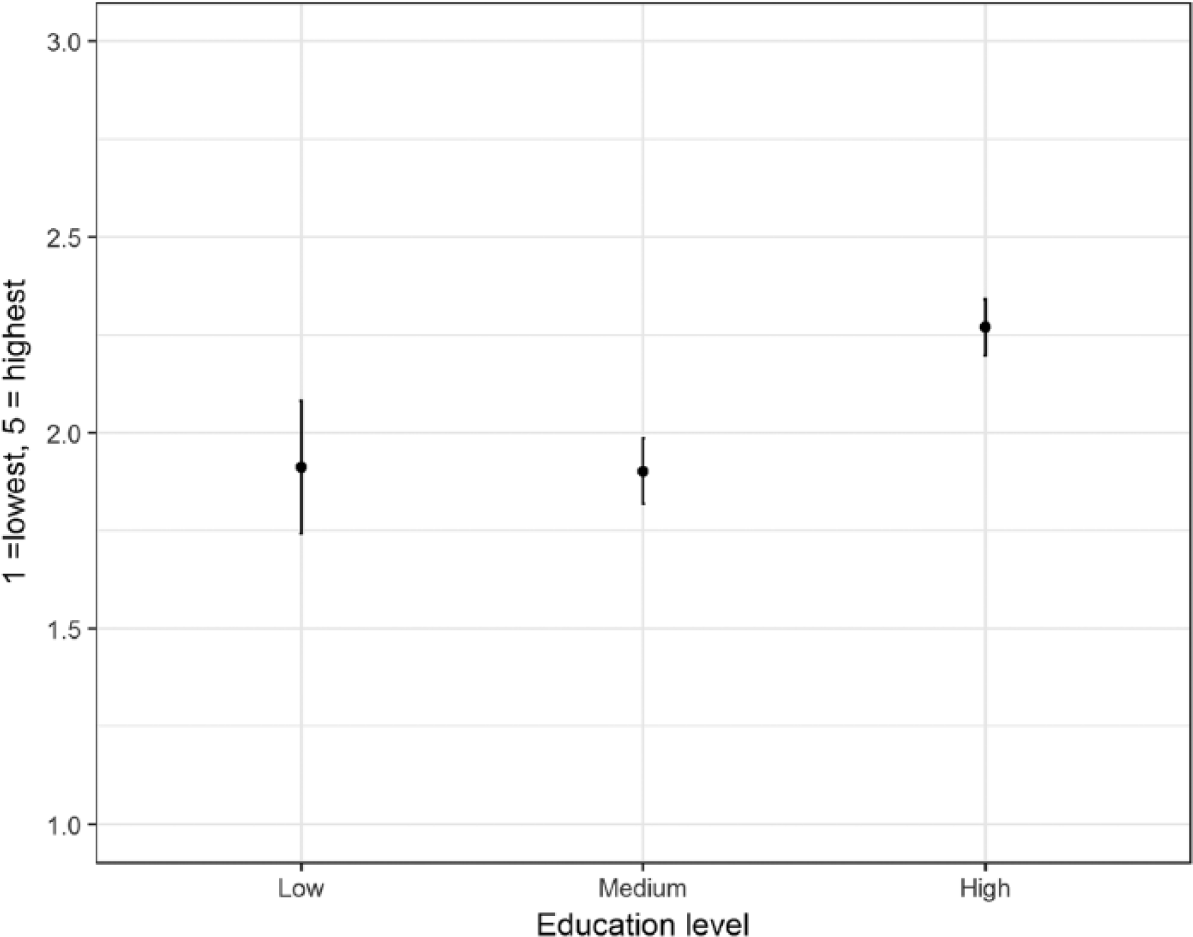
Importance of educational representation, by education.
Figure 4 shows that women find it more important that gender is reflected in the representative body than men. The same pattern surfaces on the geographical dimension. As Figures 5 above shows, the respondents who live in the northern and western regions are also those who find similar geographical background more important, while those residing in the geographical political center of the country are least concerned with this issue. The difference between the two extremes is large, with 0.87 points on a 1 to 5 scale. Regarding age (Figure 6), the same pattern emerges. Respondents in the highest age categories find it most important to be represented by a politician that is about the same age as them, albeit with overlapping confidence intervals with other age groups. Taken together, these findings point at a clear pattern in that groups that perceive themselves as peripheral to political power, are those most concerned with being descriptively represented. The one deviation from this pattern is education (Figure 7). Here, the lower educated respondents find it less important that their representative has similar educational background than those with higher education.
Discussion
When people accept the outcome of a decision, they are more likely to comply with it when it is being implemented. It is therefore important that the respondents view the decision as more acceptable when it is taken by a group of decision makers that descriptively represents the public. The decision-making body becomes more legitimate in the eyes of the public, which in turn facilitates the execution of policies. Such popular legitimacy is crucial within democracies, as these systems explicitly emphasize the rule of the people. It is especially valuable when people can accept decisions made based on the process of decision making—even if they do not get what they want all the time, they are more likely to accept a decision when the decision-making body reflects the population.
In the above experiment, we found that different characteristics of the representative decision-making process matter for the overall legitimacy of the decision. Descriptive representation, formal representation, and responsiveness features affect people’s willingness to accept a decision. People tend to be more favorable when a decision is made by a group of people that resemble the population and that are experts, and when that decision is in line with their preferences.
Descriptive Representation
The argument in favor of descriptive representation has so far been that it increases substantive representation, as well as the emancipation for disadvantaged groups. One way of understanding this finding is to view it in light of the literature on procedural fairness (Lind & Tyler, 1988). In terms of political decision making, Grimes (2006) operationalizes procedural fairness as (a) Effective influence, the public’s opportunity to influence the decision, and (b) public justification, the decision makers’ ability to listen to citizen input, to openly exchange information, and to show consideration for the individuals affected by the decision. Descriptive representation to some extent combines these elements. With descriptive representation, citizens may feel that they can more easily contact and be understood by representatives like them (Gay, 2002). Effective influence may therefore be enhanced. With descriptive representation, decision makers will be more diverse and may therefore be more likely to listen to the input of more diverse citizens, to give and receive from them the kind of information that is relevant to their concerns, and to respond to their expressed needs (Broockman, 2013). By making the decision-making process more transparent, inclusive, and predictable, outsiders are reassured that the outcome is unbiased, in this way legitimizing the decision by following procedures outsiders adhere to.
The experimental results revealed that the acceptability of the outcome was reduced when the outcome was unfavorable. Yet, the scenarios where the decision makers were descriptively representative of the population, the drop was significantly lower than for the decisions that were made by a nondescriptively representative body. This could be an indication that the respondents assumed the decision-making body was less biased when their backgrounds reflected society. Bo Rothstein and Jan Teorell convincingly argue that political support in part comes from the governmental institutions’ ability to implement policies in an impartial manner (Rothstein & Teorell, 2008). Central to their argument is that once a policy has been decided upon, all citizens are treated equally during the implementation process of the policy. We will argue that descriptive representation serves as a counterpart on the input side of the decision-making process: If the decision-making group is composed of members that reflect the relevant population, it can be viewed as another measure to reassure the outsiders that the outcome is unbiased and does not systematically favor certain social groups over others. While the principle of universal suffrage formally allows all citizens to partake in the election of their political representatives, it does not guarantee that the outcome is a decision-making body that mirrors the society regarding their social background. As such, descriptive representation is a measure to increase fair political decision-making procedures, which in turn increases the legitimacy of the decisions. When decision-making bodies are descriptively representative, they serve as a “legitimacy cushion,” mitigating the negative effects of unfavorable outcomes.
People with low or no education are less involved in politics than those with higher education (Rosenstone & Hansen, 1993; Verba, Schlozman, & Brady, 1995), and members of parliament are generally higher educated. It is thus interesting that people seem to find that it is more important that representatives be well educated than that the representatives share their own educational levels. One potential explanation for this finding could be that people simply want competent people to make political decisions. Whether this is in the substantive political interest of the lower educated is questionable. Hakhverdian (2015) suggests that a higher level of education does not only provide skills and knowledge, it also brings with it a different political belief. And, following Mansbridge (1999) on what constitutes a relevant characteristic in descriptive representation, if these beliefs constitute a relevant dimension of political conflict, education in itself would be relevant.
Formal Representation
Regarding the experimental treatment on Formal Representation, the results show that the decisions made by appointed experts are the most acceptable to the citizens. Elected representatives come second, and randomly drawn decision makers come third. The result that expert decisions are thought of as more acceptable than those made by a group of elected people seems to suggest that the competence level of the decision makers is more important than democratic selection procedures are. It seems that people assume that it is a good thing that representatives possess a certain degree of expertise—they prefer these people taking decisions for them, ideally when these experts are also “like” them. This further highlights the finding that those who have a lower education do not particularly want other lower educated people to be their representatives. Overall, our findings underline people’s preference for “capable” representatives—even when this means that representatives do not resemble an average citizen, or that they are not democratically elected.
It needs to be noted, however, that the experiment presents respondents with a general scenario of monetary spending. People may consider expertise as an important element within this specific scenario, more so than in other, more value-laden, political issues. We should, therefore, be cautious of extrapolating the results to other political domains, and further research needs to examine the more general effects of (s)election procedures on political legitimacy, and under which conditions they occur.
Interestingly, people judge a decision more acceptable when the expert group is descriptively representative than when it is not. While these findings align with our expectations, it also points at what people find important in representation—even if these criteria may initially appear contradictory. While some scholars opposed the idea of descriptive representation because of the suggested loss of expertise, citizens indicate that both descriptive representation and the presence of expertise are important for them, also in combination. Furthermore, it is interesting that the results indicate that people are positive about descriptive representation but less about sortation, even though sortation would ensure descriptiveness. As discussed above, the possible loss of expertise is one likely explanation for this. In addition, the notion that (non)descriptiveness was explicitly part of the vignette could account for this: Respondents might have assumed that one can have random selection without descriptive representation, and therefore focused on other implications of sortation (e.g., low of expertise) more. Moreover, people do not have experience with sortation, making them possibly more skeptical about it.
Experimental Design
We designed the survey experiment specifically to examine the ways that representational processes affect empirical legitimacy. In doing so, we focused on the descriptiveness and selection procedure of the decision-making body, as well as the outcome of the decision. While we believe that the experiments addresses the issues that we wanted to deal with, and that they provide valuable and innovative insights in the legitimacy of representation, we also recognize that our study can be improved upon in terms of its experimental setup. 6
The first issue relates to the treatment of descriptiveness. In the design of the experiment, we were interested in the different reactions to decisions made by a descriptively representative body versus a nondescriptively representative one. We thus phrased this part of the scenario as such: In one scenario, we present the respondent with a good (descriptive representation), and in the alternative scenario we highlight the absence of that good (nondescriptive representation). The second scenario thus does not offer an alternative good. Therefore, the respondents getting the second scenario may be somewhat framed to think that the absence of descriptive representation is a failure, and may thus be somewhat biased in their response. With that, it is possible that we find a slightly stronger effect of descriptive representation than we would otherwise find.
The solution to this problem is not immediately straightforward, however. It would involve offering the respondent with an alternative good that is not in the purest form nondescriptive representation, making it again difficult to isolate its effect. One possibility is to additionally create a reference group that is presented with a neutral scenario, excluding the descriptiveness element, for example: “. . . This decision is made by a group of a hundred people elected by the citizens of Norway. The decision that is reached goes against your wishes.” Here, it is not possible to know whether people have specific assumptions about who these people are, but it could work as a baseline to evaluate the findings. Another alternative, offering an alternative good, may be, . . . This decision is made by a group of one hundred people elected by the citizens of Norway through competitive elections with contending political parties. Like the current parliament, the group for many reasons does not reflect the Norwegian population in terms of age composition, education, gender, place of residence, sexual orientation, ethnic background, work experience and religion.
This scenario neutralizes the normative implication of a certain good not being present by offering the continuation of a known situation. At the same time, it would result in a comparison between the evaluation of a real situation and a hypothetical one. This may prompt associations with the current situations that cannot be controlled by the experimental setting. In sum, the setup of the experimental design is a thorny issue that is not easily resolved, and will require further examination in the future.
Second, the phrasing of the scenario regarding descriptiveness is somewhat generic. It aims to describe the principle of descriptiveness in general terms, and follows our aim to study whether people judge a decision more legitimate partly based on this principle. However, because the scenario is this general, we also lose information and the possibility to further explain our findings. It is possible that, for example, someone feels that regional residence is important in descriptiveness, but opposes the idea that religion is included to the same extent. While the experimental design considers the general principle of descriptiveness, it does not reflect individual ideas about whether someone from their own group should represent them. Indeed, an experiment that could specify the treatment to focus on the members of specific groups might result in stronger findings—and could also formulate more specific conditions under which legitimacy of decisions occurs. Future studies should consider these issues more thoroughly.
Conclusion
Our aim with the current study was to investigate in what way the representative process affects people’s willingness to accept a public decision. While previous research has demonstrated the importance of descriptive representation in terms of normative legitimacy as well as its crucial effects on policies, few studies have considered whether descriptive representation also fosters individual-level legitimacy. We find that it also increases the willingness to accept public decisions. Moreover, this is also the case when the group consists of appointed experts, as opposed to elected or randomly drawn decision makers. The findings thus complement previous research on descriptive representation in that, besides normative legitimacy, it also contributes to perceived or empirical legitimacy.
Furthermore, we find that those who may be perceived as politically marginalized groups in general are more concerned with descriptive representation than others. Women want to be represented by women more than men want to be represented by men, and those who live in politically peripheral regions find it more important that their political representative comes from the same region as them. Education, in this respect, provides the exception: People with a lower education find education much less important as an element that should be reflected in a representative body, than the higher educated. Education may thus be one element where the normative and empirical legitimacy findings are at odds.
There is still much to learn about how the composition of political decision-making bodies influences individual legitimacy beliefs. Under which conditions is descriptive representation a source of legitimacy and under which conditions is it not? Future research could investigate whether the importance of descriptive representation varies across political issues, why some people are more concerned with descriptive representation than others, as well as look into the mechanisms that explain why descriptive representation has the potential to increase the legitimacy of political decisions.
Footnotes
Appendix
Declaration of Conflicting Interests
The authors declared no potential conflicts of interest with respect to the research, authorship, and/or publication of this article.
Funding
The author(s) disclosed receipt of the following financial support for the research, authorship, and/or publication of this article: The research has in part been funded by the Norwegian Research Council, through the project entitled “Can Fair Decision-Making Procedures Increase the Legitimacy of Democracies?”, project number 262986.
Supplemental Material

Notes
Author Biographies
References
Supplementary Material
Please find the following supplemental material available below.
For Open Access articles published under a Creative Commons License, all supplemental material carries the same license as the article it is associated with.
For non-Open Access articles published, all supplemental material carries a non-exclusive license, and permission requests for re-use of supplemental material or any part of supplemental material shall be sent directly to the copyright owner as specified in the copyright notice associated with the article.
