




Abstract
Recent years have witnessed an increased interest in research on advocacy success, but limited attention has been paid to the role of public opinion. We examine how support from the public affects advocacy success, relying on a new original data set containing information on public opinion, advocacy positions, and policy outcomes on 50 policy issues in Denmark, Germany, the Netherlands, Sweden, and the United Kingdom. Claims by advocates are measured through a news media content analysis of a sample of policy issues drawn from national and international public opinion surveys. Our multilevel regression analysis provides evidence that public support affects advocacy success. However, public opinion does not affect preference attainment for some of the lobbying advocates whose influence is feared the most, and the magnitude of its impact is conditional upon the number of advocates who lobby on the policy issue in question.
Introduction
Whether interest advocates are able to influence “Who gets What, When, How” (Lasswell, 1936) has been the concern of policy commentators and academics for as long as the discipline of political science has existed. It is a crucial question not only because actors and groups with various purposes and objectives invest vast resources into lobbying with the hope of advancing their policy goals but also because their potential influence has important implications for democracy. A frequently expressed concern is that lobbying groups and elites, who do not represent all kinds of interests in society equally (Olson, 1971; Schlozman, 1984), may twist policy outcomes away from what would be in the interest of the general public (Dornhoff, 2013; Gilens, 2012). Consequently, the question of whether and how advocacy groups influence policy making has played a prominent role in many of the classical works on political systems (see, for example, Bentley, 1908; Truman, 1951) as well as in a number of recent studies (see, for example, Binderkrantz & Rasmussen, 2015; Bunea, 2013; Burstein, 2014; Dür, Bernhagen, & Marshall, 2015; Furlong & Kerwin, 2005; Klüver, 2013a; Yackee & Yackee, 2009).
At the same time, a growing body of research suggests that policy does represent public opinion to a significant degree, in the United States (see, for example, Erikson, Wright, & McIver, 1993; Lax & Phillips, 2012; Shapiro, 2011) as well as in Europe (see, for example, Rasmussen et al., 2015). Because policy makers’ chances of staying in office depend on their support among voters, it might not be surprising that they respond to the public. They thus seem to pay attention to both the general public and the variety of actors that advocate their policy preferences when making policy decisions, weighing the benefits they obtain from both against each other. It is, therefore, plausible to expect that interest advocates’ chances of seeing their policy preferences realized might partly depend on the level of support for their positions among the public.
Yet, apart from a few important exceptions (see, for example, Dür & Mateo, 2014; Smith, 2000), the literature on advocate influence rarely considers the potential impact of public opinion. This may seem surprising given the important lesson from the literature on advocate influence and success (for recent literature reviews, see Lowery, 2013; Smith, 1995) that the outcome of lobbying is not simply a function of the characteristics of the actors themselves but also of the characteristics of the policy issues and the preference alignment of other actors (see, for example, Baumgartner et al., 2009; Mahoney, 2007). Because the success of individual advocates depends, for instance, on how conflictual the lobbying environment is (Dür et al., 2015; Mahoney, 2007), lobbying should be regarded as a “collective enterprise” in which actors rely not only on themselves but also on the actions and characteristics of likeminded lobbying advocates to achieve their policy goals (Klüver, 2013b). These findings underline the importance of taking the potentially crucial role of the public into account when studying advocacy success, not only for normative reasons, because political decision makers should be responsive to citizens (Dahl, 1971), but also to obtain an accurate picture of the power that lobbyists have over policy.
In this article, we focus on this important issue and argue that advocates depend not only on support from “friends” among other advocates but also on the preferences of the general public. Moreover, we identify a set of factors that might condition the influence of public opinion on advocate success. First, we propose that public opinion might play a stronger role if a higher number of lobbying actors are active on the issue, making it salient in the public debate and transmitting information about public opinion to policy makers. Second, different types of advocates might depend on public support for their attainment of policy to different degrees. Specifically, experts and individuals, who possess fewer resources that are valuable to political elites for securing electoral success, should be strongly dependent on the views of the public. The same goes for groups representing diffuse interests, whose power is based on their ability to provide legitimacy to decision makers among the parts of society that feel represented by them. Being able to influence public opinion is, thus, a crucial factor on which they rely in their advocacy efforts, which should make the lobbying success of these groups strongly dependent on public opinion. In contrast, groups representing special interests, such as particular industries, can offer campaign contributions and expertise in exchange for political influence. These benefits might outweigh the costs of enacting unpopular policies by helping politicians gain electoral support through other channels. Thus, the lobbying success of these groups might be less contingent on public support for their desired policies.
To test these hypotheses, we present a research design that includes data on public opinion, preferences of the policy advocates, and policy outcomes on policy issues spanning across a broad range of policy areas. Altogether, our new original data set contains information on lobbying activity of more than 800 actor appearances in the news media on 50 specific policy issues. For each policy issue, we systematically map the policy positions of interest advocates, public opinion, and final policy outcomes. This allows us to examine whether public support affects lobbying success, and to scrutinize under which circumstances and for which types of actors it does. The 50 issues concern specific policies and are selected in such a way that we have variation in important issue-level factors that may affect the opportunity for advocates to be successful, namely, whether or not the public supported policy change on the issue, the media salience of the issue, and the type of policy.
The results of our multilevel regression analysis show that public support for advocates’ policy preferences does indeed matter for their success; however, the effect is conditioned by a number of factors. As hypothesized, the effect of public support for an advocate’s policy goal on advocacy success increases with the size of the advocate community on a given issue. The argument that interest groups representing diffuse interests and individual advocates depend on public opinion for their preference attainment also finds empirical support. Moreover, in line with our expectations, the advocacy success of specialist interest groups does not depend on public opinion. Thus, although having the support of the public plays a role in lobbyists’ chances of seeing their policy goals realized, the effect is contingent on characteristics of the advocates themselves and the community of lobbyists.
Advocacy Success: The Preference Attainment Approach
Our study uses a behavioral definition of advocates in which we include actors based on their observable policy-related actions (Baroni, Carroll, Chalmers, Marquez, & Rasmussen, 2014). This means that rather than being concerned with traditional membership interest associations only, we include a broad range of actors that lobby on a given issue. We refer to these actors as “interest advocates” and differentiate between advocates of diffuse and special interests, experts, and individuals in our analysis. All the examined actors have in common that they are “external” to the political system; in other words, we exclude political parties, party officials, and the public administration in the concerned countries.
While studies of tactics and strategies play a prominent role in interest group research (Bunea & Baumgartner, 2014), the study of advocacy influence has received somewhat of a revival in recent decades, with scholars presenting a more optimistic view with respect to the challenges of measuring influence and encouraging empirical research in the area (e.g. Dür & De Bièvre, 2007; Klüver, 2013a). Different approaches to measuring influence have been proposed and used, including attributed influence, process tracing in individual case studies, and the assessment of preference attainment based on information about preferences and policy outcomes. We use the latter approach and compare the claims and demands concerning a range of policy issues raised by interest advocates in the news media with the outcome on the respective policy issue (Dür, 2008). The preference attainment approach certainly does not allow us to examine all aspects related to power and influence in politics (see, for example, Bachrach & Baratz, 1962; Dahl, 1957; Lukes, 1974). Therefore, although scholars using the approach often refer to both influence and lobbying success (see, for example, Bunea, 2013), we restrict ourselves to the term “lobbying success” here (see, for example, Mahoney, 2007). In contrast to influence, the concept of success does not assume causality but recognizes that convergence is not necessarily a direct result of specific actions exerted by a given lobbying actor (Dür et al., 2015). Thus, our approach does not require visible behavior for identifying “lobbying success,” and allows for it to happen through different channels of access. Using the preference attainment approach in a large-N study has the advantage that external validity is higher than in single, qualitative case studies or in studies of perceived influence, in which it is possible that actors over- or underestimate influence levels (Dür, 2008).
The Role of Public Opinion in Advocacy Success
A range of studies has sought to determine which conditions make it more or less likely for advocates to see the policies they desire adopted (see, for example, Bunea, 2013; Dür et al., 2015; Klüver, 2013a; Mahoney, 2007). One of the key conclusions is that lobbying success is not only a question of the attributes of the individual advocates but strongly influenced by the context in which lobbying takes place. One factor that has emerged as very important in the preference attainment literature is the extent to which the other lobbying advocates support an actor’s position on an issue. An actor’s likelihood of failing to attain its goals is higher for issues with directly opposing camps among the advocates (Mahoney, 2007), and business groups fare better if they “face limited opposition from other actors” (Dür et al., 2015, p. 24). Similar conclusions have arisen in the literature on perceived influence: Furlong (1997) outlines how coalition building is regarded as important for increasing the effectiveness of formal methods for exerting group influence. These findings strongly suggest that the efforts of lobbyists to affect policy must not be regarded in a vacuum, but that the context and support network play a crucial role in their chances of seeing their demands fulfilled. Our focus is on a factor that has been largely overlooked in this context, namely, public opinion.
We argue that the public should play an important role in advocacy success, as politicians ultimately depend on the public for winning votes to secure reelection (Mayhew, 1974). And indeed, a range of studies provide empirical support for policy responsiveness to public opinion (e.g., Erikson et al., 1993; Lax & Phillips, 2012; Rasmussen et al., 2015; Shapiro, 2011). According to Lohmann (1993), it may even be “puzzling that rational political leaders with majoritarian incentives would ever respond to political action” (p. 319) by actors or groups representing only parts of society (see also Burstein & Linton, 2002). However, interest groups, businesses, and other lobbyists are able to provide valuable resources to political decision makers in the form of campaign contributions, expertise, and legitimacy (see, for example, Bouwen, 2004). Yet, the policy preferences of advocates may be in conflict with the preferences of the public. In such cases, policy makers—assuming that their actions are strongly motivated by electoral success—have to weigh the benefits of listening to lobbyists with the costs of implementing unpopular policies. As mentioned above, lobbyists might often be able to provide resources that directly counter the negative effects of implementing (not implementing) an unpopular (popular) policy on electoral support, for instance, legitimacy among the section of society that an advocate represents or support for the election campaign. Yet, if a large majority of the public disagrees with an advocate, policy makers might not consider these resources sufficient. Thus, the likelihood that the benefits that listening to an advocate can provide will outweigh the costs of public opposition to the policy should decrease with the amount of public opposition to the policy. In other words, the likelihood that policy makers will implement a policy change or maintain the status quo in line with an advocate’s preference should increase with the proportion of the public that agrees with the advocate.
Research linking public policy to both advocacy and public opinion is sparse (for reviews, see Agnone, 2007; Burstein, 2010). In a meta-analysis of studies aiming at explaining policy decisions or the results of policy decisions, Burstein and Linton (2002) find that those that take account of both forces constitute a small minority. Public opinion is largely ignored in the literature examining preference attainment of interest groups on large-N samples of policy issues, not least as a result of the difficulty of linking data sources on interest groups, public opinion, and policy outcomes. However, the few studies that do incorporate data on both advocacy and public opinion give us reason to believe that public opinion is far from irrelevant. Gray, Lowery, Fellowes, and McAtee (2004) found some evidence that public opinion and interest groups interact to influence policy liberalism in the U.S. states in one of the two years examined but focused on the density of the group populations as a whole. Moreover, findings show that public opinion affects interest group mobilization and strategies (Kollman, 1998; Rasmussen et al., 2014), although we do not know whether such behavior results in interest group success. According to Wilson, the constraints of public opinion may even be so severe that groups are limited to making “demands that are, or can be construed as, legitimate or within reason by the standards of the larger publics that will eventually learn of them” (as cited in Dür & Mateo, 2014, p. 1205).
Smith’s (2000) work provides strong evidence that business success in lobbying is constrained by public opinion even when businesses act in a unified manner, where the conventional wisdom leads us to expect public opinion to matter the least. To him, the likely reason is that issues with high business unity are often ideological, partisan, and salient to the public, which provides politicians with strong electoral incentives to be responsive. This claim underlines the importance to study advocacy success and the role of public opinion at the level of specific policy issues, where the characteristics of the issues can be taken into account. Moreover, the study calls for an investigation of the impact of public opinion on the preference attainment of other lobbying actors than businesses, including interest associations and individual advocates such as experts and concerned individuals. Many of these actors represent the views of specific sections of society rather than the public as a whole, on whose electoral support parties and political leaders in government ultimately depend. We therefore test the following hypothesis using data on the views of the public and a range of advocates on a set of specific policy issues:
This positive effect of public support on lobbyists’ chances to attain or maintain their preferred policy should exist alongside the influence of the support among the advocate community, which previous research has shown (e.g., Dür et al., 2015). In other words, we expect that advocates are most likely to see their demands implemented if both the public and a large share of the lobbying community share their positions. However, the impact of public opinion may not be independent from the actions of the lobbying community. Instead, we argue that public support for an advocate’s position should have a stronger impact on the actor’s likelihood of policy attainment if the number of actors that lobby on the issue is higher. A high level of lobbying activity implies strong pressure on policy makers to listen to the demands of the various actors involved. At the same time, the high advocacy intensity likely increases the salience of the policy issue in the public debate. As a result, the public may be more likely both to form opinions on the issue and to find out whether their demands are heard and implemented into policy. For these reasons, policy makers may be especially cautious to take public opinion into account when deciding to change or maintain a policy in cases where a large number of lobbyists are involved. This is particularly relevant if the lobbying activity occurs through the media, or is reported by it, as in this study.
This line of reasoning extends work by Agnone (2007) on how protest may amplify the effect of public opinion on policy decisions. Using the case of the environmental movement in the United States, she argues that the effect of any change in public opinion on the volume of environmentally friendly legislation is likely to be stronger when it is accompanied by an increase in the number of proenvironment protests. Our argument differs in that we consider all lobbying advocates with a position on an issue, rather than only one side of the debate, as both support for and opposition to the actor’s policy goal among other lobbyists should create “noise” around the policy issue and thereby increase decision makers’ attention to public opinion. Dür and Mateo (2014) present a similar argument in a case study of the ratification of the Anti-Counterfeiting Trade Agreement. They find that a high volume of interest group activity on the issue played an important role in making it salient to the public and in transmitting public opinion to politicians. We therefore expect that the lobbying community influences the preference attainment of an advocate not only through its degree of support for the actor’s demand but also by amplifying the importance of having the support of the public:
The effect of public opinion on preference attainment might also vary between different types of advocates. As discussed above, lobbying actors provide a variety of types of resources to political decision makers in exchange for influence, including funding, information, expertise, and legitimacy (see, for example, Bouwen, 2004; Klüver, 2013b), which might outweigh the costs of ignoring public opinion. However, there is variation in both the resource levels of the different types of advocates and the nature of resource exchanges between them and the political decision makers. This, in turn, may imply differences in the level of support from the public that the actors need in order to see their policy preferences realized.
Individual lobbying advocates—such as private persons and experts—generally draw on a more limited amount of resources than collective actors such as membership associations and firms. Individual advocates are less likely to deliver resources to political elites in the form of campaign contributions in exchange for political influence. This may mean that having support from the general public is a factor that plays a stronger role in determining whether they ultimately end up attaining their preferences than for actors who have the possibility to provide substantial amounts of resources to political decision makers.
Within the population of collective actors, we can distinguish between those that represent special interests and those that represent diffuse interests. Groups representing special interests have a well-defined constituency such as specific socioeconomic or producer interests, in contrast to diffuse interest groups, such as consumer and environmental groups, whose constituencies are not clearly defined and whose mission is typically linked to societal concerns more generally (Olson, 1971). Diffuse interest groups, thus, represent a broad range of societal interests (Dür & Mateo, 2014). A reason for why diffuse interest groups get access to political decision-making processes is precisely that their strong roots in civil society help politicians ensure legitimacy vis-à-vis the sections of the public who feel represented by these groups, and ideally the public at large (see, for example, Klüver, 2013b). Before elections, it is valuable for political candidates and parties to be embraced by such organizations, and in-between elections, diffuse interest groups can act as links between policy makers and the wider public. On the one hand, such associations can transmit information about public preferences, which may be valuable for politicians to secure public support. On the other hand, they can help policy makers gain acceptance and support for their decisions among wider sections of the public. The incentive for policy makers to take the demands of diffuse interest groups into account should, therefore, depend on the extent to which they are supported by the public and, hence, are able to bestow legitimacy.
In contrast, lobbying advocates representing special interests do not act as representatives of the public as a whole. Exchanges between them and politicians are more likely than for diffuse groups to be dominated by a logic in which expertise and/or monetary contributions are exchanged for access and political influence for the groups’ specific constituencies. Groups representing special interests are also more likely than many diffuse groups to enjoy insider access to the administrative apparatus of the political system in the form of being strongly represented, for instance, in governmental advisory bodies (Binderkrantz, Christiansen, & Pedersen, 2015). For them, the support of public opinion may, therefore, be less of an important currency when it comes to getting their views heard by the political decision makers. Our third hypothesis is, therefore, as follows:
Data and Method
We focus our analysis on five countries: Denmark, Germany, the Netherlands, Sweden, and the United Kingdom. All these countries are European parliamentary democracies and represent differences and similarities with respect to state–society structures. A prominent classification of such structures in interest group research has been the distinction between corporatist and pluralist systems (Schmitter, 1974). Corporatist systems are known for providing institutionalized access into the decision-making structures to key groups, whereas pluralist countries have more open and competitive structures for advocacy interaction with the political system (Eising, 2004; Öberg et al., 2011). Even though there may be differences between corporatist and pluralist systems in the relative access of different types of advocates to the political system, we would not necessarily expect differences in the success rates of an average group within these systems (Binderkrantz & Rasmussen, 2015). Yet, our design allows us to test whether variation in state–society structures affect lobbying success. The U.K. system is pluralist, whereas the remaining systems are corporatist in nature but display different degrees of corporatism (Siaroff, 1999).
It is often a challenge in the interest group literature that there is no sampling frame of all possible policy issues. Instead, scholars rely on different sources for sampling policy issues, for example, legislative databases (Beyers, Dür, Marshall, & Wonka, 2014; Burstein, 2014), the media (Bernhagen, 2012), or asking groups themselves on which issues they work (Baumgartner et al., 2009). Whereas all these different approaches have their strengths, they also come with certain weaknesses, such as excluding items that have not made it onto the legislative agenda or into the media, or on which there is no interest group activity. In our case, the issues come from a pool of issues on which public opinion measures are available. From the time period between 2005 and 2010, we first collect a large number of items from public opinion surveys that fulfill a number of criteria, which include that they relate to very specific policy issues rather than overall policy areas and present the respondents with a simple choice whether to implement a suggested course for future action. Moreover, the responses to each question are measured on an agreement scale and concern national (as opposed to EU, state, or local) policy competences. From the resulting sets of policy issues, we subsequently select 10 issues in each country. Rather than choosing our issues randomly from all issues fulfilling our selection criteria, we select them in a way that ensures variation across key characteristics that might influence actors’ preference attainment. The selected issues vary on the following dimensions: (a) issue type (redistributive, distributive, and regulatory), (b) media salience (low and high), and (c) public support for (vs opposition to) policy change. By ensuring such variation, we aim to optimize our ability to draw conclusions that are generalizable to a broader set of policy issues. We provide a list of all included policy issues alongside their classification along the three dimensions in the online appendix.
Using available public opinion polls as a sampling frame means that, in some respects, we are more inclusive than studies relying on legislative databases, because public opinion polls often ask about issues before they enter the legislative agenda. Forty-three of the 50 policy issues in our sample had not been introduced as bill proposals at the time the public opinion question was asked, and many never reached the legislative agenda. This means that our study provides insight into the factors influencing whether advocates see any of their policy goals implemented, as long as they are covered by the news media, rather than only their preferences on issues that have already entered the parliamentary debate, in which case the determining factors may be different. Yet, this selection strategy may mean that we are less inclusive in other respects, given that polls are not conducted about all issues but predominantly focus on issues that are more salient (see also Burstein, 2014). This limitation has the benefit that studying issues with a certain level of salience may ensure that the public has formed an informed opinion about the issues in the first place (for a similar argument, see Gilens & Page, 2014). 1 Yet we need to be aware that salience may affect what causes preference attainment. Selecting issues in such a way that there is variation in the media salience of the issues is, therefore, important to us. We measure the media salience of a policy issue by the number of newspaper articles referring to it in one major nationwide daily newspaper in the respective country (Politiken in Denmark, Sueddeutsche Zeitung in Germany, The Guardian in the United Kingdom, Dagens Nyheter in Sweden, and de Volkskrant in the Netherlands). More specifically, we conduct a Boolean keyword search for articles published 1 month prior until 1 month after the date when the respective survey question was asked, using the media databases LexisNexis and FACTIVA. 2
In line with recent responsiveness research (see, for example, Gilens, 2012; Lax & Phillips, 2012; Monroe, 1998; Petry & Mendelsohn, 2004), we define a policy change as having taken place if the specific call for policy action to which a survey question refers at t0 was subsequently implemented at t1. In line with Gilens (2012), we use a time frame of 4 years between t0 and t1, allowing all items in our sample an equal period of time to experience a policy change, no matter whether they were asked at the beginning or end of our 2005 to 2010 sampling period. To determine whether the policy was implemented, we evaluate information provided by online newspaper archives, interest groups, legislative databases, and governmental webpages. 3
Measuring Advocacy in the News Media
To measure advocacy on a policy issue, we manually content code newspaper articles retrieved through a search equivalent to the one conducted for the media salience measure, except that we take a longer time frame into account and consider an additional media source in each country: Jyllands-Posten in Denmark, Frankfurter Allgemeine Zeitung in Germany, The Daily Telegraph in the United Kingdom, Svenska Dagbladet in Sweden, and NRC Handelsblad in the Netherlands. This way, our media content analysis codes articles from two national broadsheet news sources in each country, one left-leaning and one right-leaning. This is important to reduce potential biases in the types of advocates represented in different news media. We code all articles from these sources that were published between 1 month before the respective survey question was asked up until the policy was implemented or, if there was no policy change, until 4 years after the question was asked. We measure actor policy positions on the basis of reported statements and actions in these articles. In the initial coding scheme, the unit of analysis is a statement, which may be either in favor, neutral, or against policy change on the respective issue. Only one statement per actor is coded in an individual newspaper article, but several statements by the same actor from different articles may be included. Because our focus is on lobbying by actors external to the political system, all statements made by policy makers, party members, and other political actors who may have direct, institutionalized influence on the policy outcome are excluded. As a result, the focus of our analysis is on advocacy by firms, interest associations, experts, and individuals. 4 More detailed information and the codebook used to code the statements and the specific actor types can be obtained on www.govlis.eu.
For the empirical analysis, we aggregate the data from the statement level to the level of an actor within a policy issue (the actor-per-issue level), of which we have 847 observations. 5 We only consider statements that are clearly in favor or against the implied policy change, excluding all neutral statements. Moreover, we exclude 27 of the 847 observations on the actor-per-issue level in which actors made opposing statements on the same issue in different newspaper articles, leaving us with 820 observations in our final data set. Our dependent variable indicates whether the position of an individual actor on a policy issue is congruent with the policy. Congruence means either that an actor favored a policy change and the policy change occurred or that an actor opposed policy change and it did not occur.
Independent Variables
To analyze whether public opinion influences the likelihood of congruence between an actor’s position and the policy, we calculate for each actor on each issue the proportion of the public that supports the actor’s position. The measure in our data set ranges from .08 to .92, and higher values on the variable indicate stronger support from the public for the actor’s position. The measure only takes into account public opinion in favor or against policy change, excluding survey respondents replying with “don’t know” rather than implicitly assuming that this category of actors opposes policy change. 6
To measure whether the effect of public support on preference attainment is conditional upon the number of lobbying advocates, we interact our measure of public support with the number of actors on an issue expressing a position either in favor or against a given policy change. Because the distribution of the total number of actors per issue is right-skewed, we use the natural logarithm of this variable.
Finally, we interact public opinion with the actor type to determine whether the effect of public opinion on preference attainment varies between actor types. According to our theoretical predictions, we distinguish between advocates representing individuals (either private persons or experts), advocates representing special interests, and those representing diffused interests. Advocates of special interests refer to firms as well as institutional, business, and professional interest groups and labor unions, whereas diffuse interests include the remaining set of membership associations such as groups representing public, hobby, religious, and identity interests.
Control Variables
We control for a set of additional variables that might influence convergence between advocates’ preferences and the policy outcomes. As mentioned, an actor’s likelihood of preference attainment might be strongly affected by whether its position is shared by other advocates. Therefore, we control for the degree of support for an actor’s policy position from other advocates in the lobbying community. It is measured by the proportion of advocates with the same policy position as the respective actor among all other advocates who made statements on the respective issue. Thus, if for a given policy issue there are three advocates with positions in favor of and only one with a position opposing policy change, the actors favoring policy change have a support level of two thirds from the other lobbying advocates, whereas the opposing advocate has no support at all. We also use a crude measure of potential conflict on an issue by controlling for the logarithm of the total number of actors that took a position on an issue, which is the same variable that is interacted with public opinion to analyze whether its effect is conditioned by the amount of lobbying.
In addition, we include a dummy variable indicating whether or not the statements of an actor are in favor of a policy change as opposed to the status quo. Findings from the literature on lobbying success show that most issues witness a strong status quo bias (Baumgartner et al., 2009) and that it is harder for advocates to change than preserve the status quo (Mahoney, 2007). We further measure for each actor on each policy issue how many articles include one or more statements by an actor, because actor activity might be positively related to preference attainment. 7 Moreover, by considering the main effect of the actor type variable, we are able to examine whether there are overall differences in preference attainment between the three groups of advocates (see, for example, Binderkrantz & Rasmussen, 2015; Bunea, 2013; Dür et al., 2015; Golden, 1998; Yackee & Yackee, 2006).
We also control for the public salience of the examined issues by relying on the media salience measure used to select our policy items. To control for a possible country bias in the overall volume of news coverage, we standardize the measure within each country, so that higher numbers indicate higher media attention. When decisions are shielded from the public eye, the public pressure on politicians to deliver certain policies might be lower, making it easier for groups to get what they want (Mahoney, 2007). However, the public visibility of an issue might affect advocacy preference attainment in a positive manner to the extent that there is convergence between what the public and the advocate want (see, for example, Dür & Mateo, 2014).
We also control for policy type, the idea being that policies generate different levels of conflict and controversy, which might affect both the mobilization and lobbying success of interest advocates (Dür & De Bièvre, 2007; Rasmussen & Carroll, 2014). Lowi’s (1964, 1972) distinction between regulatory policy (which constrains and allows specific activities), distributive policy (which allocates resources to particular social groups), and redistributive policy (which transfers resources from certain groups to others) is still one of the most prominent typologies in the public policy literature. 8 Due to differences in levels of contestation and public involvement, the likelihood of interest group lobbying success may vary between the issue types (Dür & De Bièvre, 2007). Finally, we include country dummies to control for the potential effect of differences in state–society structures between the countries on congruence.
Analysis
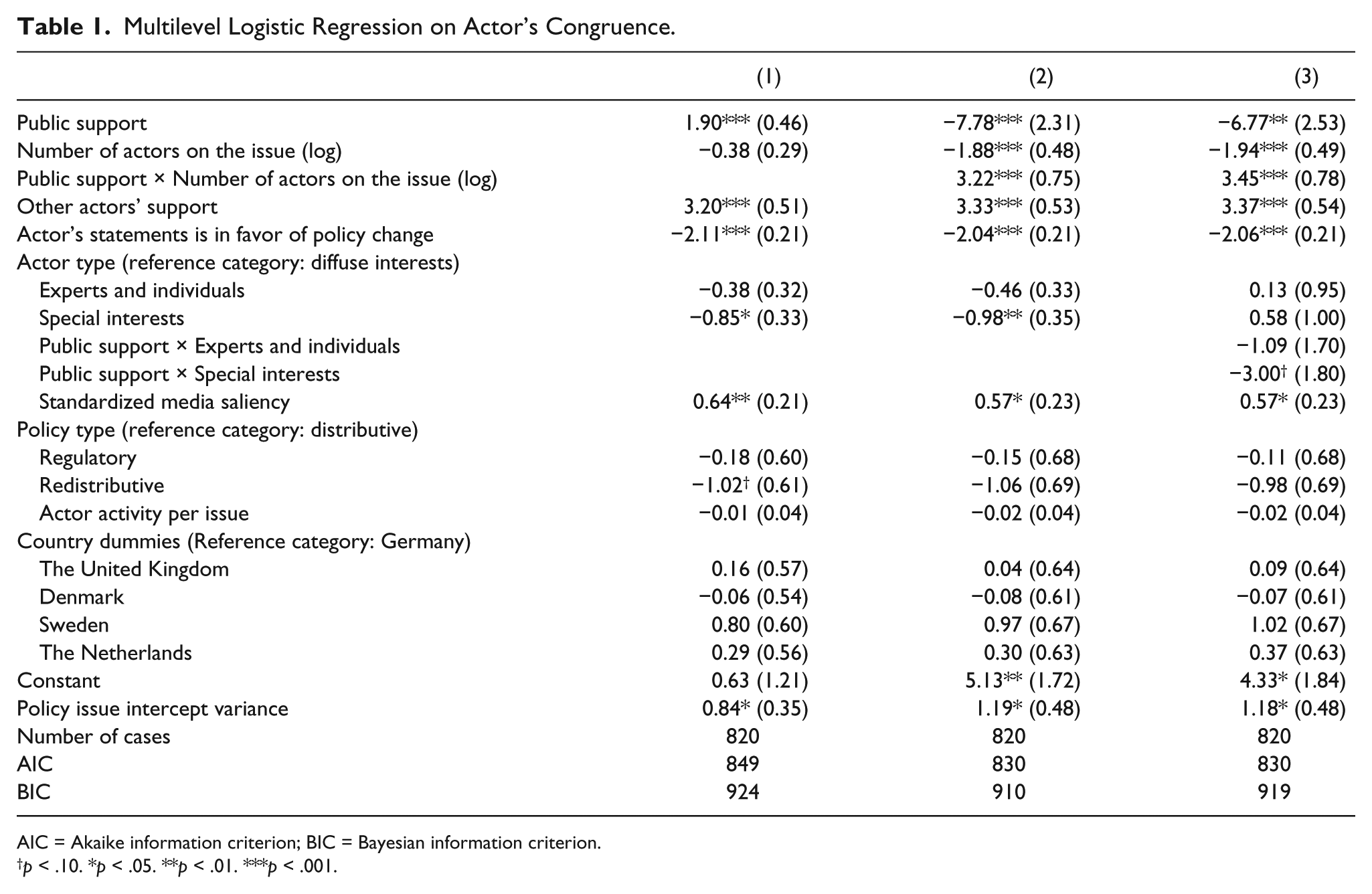
Table 1 displays the results of three multilevel logistic regression models with random intercepts for the policy issues. The estimate of the policy issues intercept variance shows that the probability of congruence between actors’ statements and the implemented policies varies across the policy issues. In all our models, we obtain a significant likelihood-ratio test comparing the model with a logit regression without a random intercept, which indicates that the multilevel model has a significantly better fit.
Multilevel Logistic Regression on Actor’s Congruence.
AIC = Akaike information criterion; BIC = Bayesian information criterion.
p < .10. *p < .05. **p < .01. ***p < .001.
In Model 1, we include all our main variables together with our control variables. The model displays a significant positive effect of public support on preference attainment. Thus, the model provides strong evidence in support of our first hypothesis regarding the impact of public opinion. The probability of an advocate’s congruence increases from .42 (±.09) to .67 (±.08) as the share of the general public supporting its claims increases from the minimum to the maximum of observed values. 9 At the same time, the significant positive effect of the other actors’ support variable provides strong evidence for the finding in the existing literature that support from “friends” among other advocates crucially increases actors’ chances of success. As the proportion of the supporting actors increases from 0 to 1, the predicted probability of congruence of the actor’s statements with the policy increases from .26 (±.09) to .75 (±.07).
That advocates are most likely to see their demands implemented if both the public and a large share of the lobbying community share their positions is illustrated in Table 2. The table lists the predicted probabilities of congruence for scenarios in which support of the public and other advocates is low and high, that is, at one standard deviation below and above the mean, respectively. Importantly, the likelihood of preference attainment for an advocate increases from .37 (±.07) to .72 (±.06), when we move from low to high support on both variables, reflecting an increase of almost 100%.
Predicted Probabilities of Congruence at Low and High Levels of Support From the Public and Other Actors.
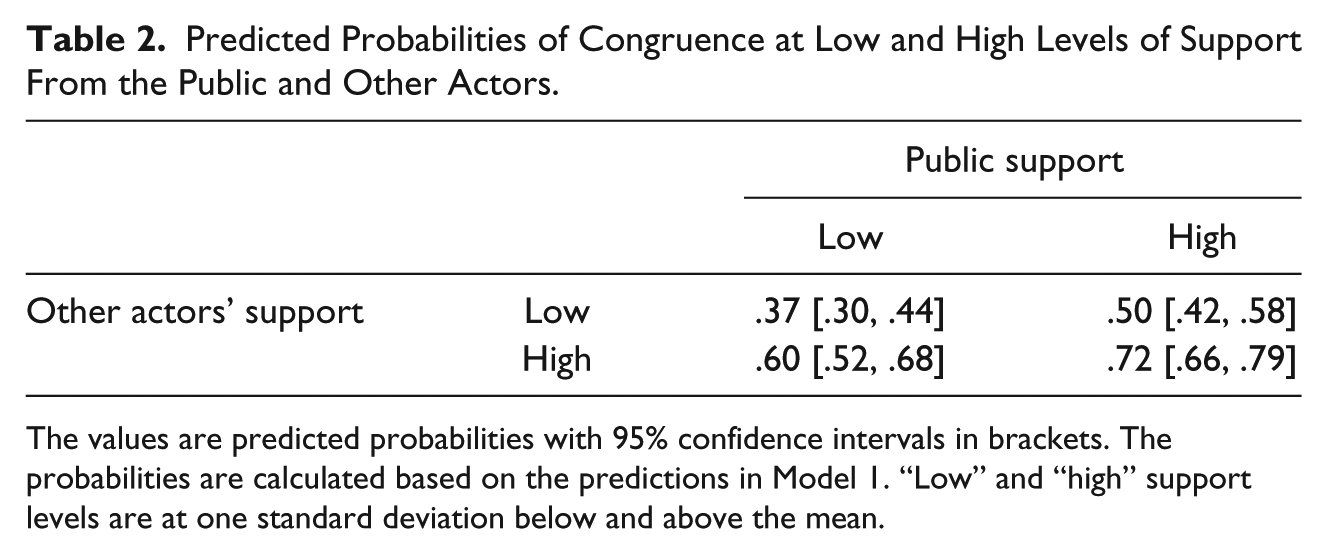
The values are predicted probabilities with 95% confidence intervals in brackets. The probabilities are calculated based on the predictions in Model 1. “Low” and “high” support levels are at one standard deviation below and above the mean.
In addition, the model reveals a significant status quo bias. The probability of congruence for actors favoring policy change is significantly lower (.38 [±.07]) than for actors preserving the status quo (.74 [±.07]). We also find significant differences between the different actor types, but not necessarily in the direction we would have expected based on the existing literature: Advocates representing diffuse interests have a significantly higher likelihood of congruence than advocates representing special interests. While our sample is constructed in such a way that we have issues of both high and low salience, it is possible that the low congruence rate of special interests results from the fact that all our issues have received a certain degree of media exposure. Model 1 also displays a highly significant effect of media salience. Interestingly, congruence between an actor’s statements and implemented policy is higher, rather than lower, for policy issues that are salient in the media. Hence, at least for the actors appearing in the media, salience seems to have a positive impact on their degree of success. For low salience issues, the model’s predicted probability of congruence is .45 (±.09), while for high salience issues it is .65 (±.09).
Advocates lobbying on distributive issues are more likely to be successful than those lobbying on redistributive ones, yet the difference is only significant at the .10 level and their success rate is not different from those actors lobbying on regulatory issues. Instead, success is significantly less likely on redistributive issues than on regulatory ones, presumably due to the high levels of conflict and public salience of issues to do with redistribution (results not shown). The model does not show significant effects for the number of advocates per issue, nor for the activity level of the advocates. Finally, the model does not reveal any significant differences between the countries. This supports evidence in recent research that system-level variation might matter less than sometimes thought when analyzing interest group behavior and its effects (Binderkrantz & Rasmussen, 2015).
In Models 2 and 3, we test the hypotheses about how the effect of public opinion on preference attainment is moderated by various variables. Because in nonlinear models the interaction effect cannot be reliably evaluated by the sign, magnitude, and statistical significance of the included interaction term itself, we turn to the graphical display of the predicted probabilities for the substantial interpretation of the conditioning effects (Ai & Norton, 2003). 10 In Model 2, we include the interaction term between public support and the logarithm of the number of lobbying advocates per issue to analyze whether the effect of public support is amplified by the number of advocates that voice an opinion on the issue (Hypothesis 2). Figure 1 plots the predicted probability of congruence along the entire range of public opinion at one standard deviation below and above the mean of the logged number of advocates per issue. The figure clearly reveals a significant positive effect of public support, but only for issues with a high number of lobbying advocates. This finding indicates that the effect of public support is affected by the size of the advocacy community lobbying on the respective issue in the media.
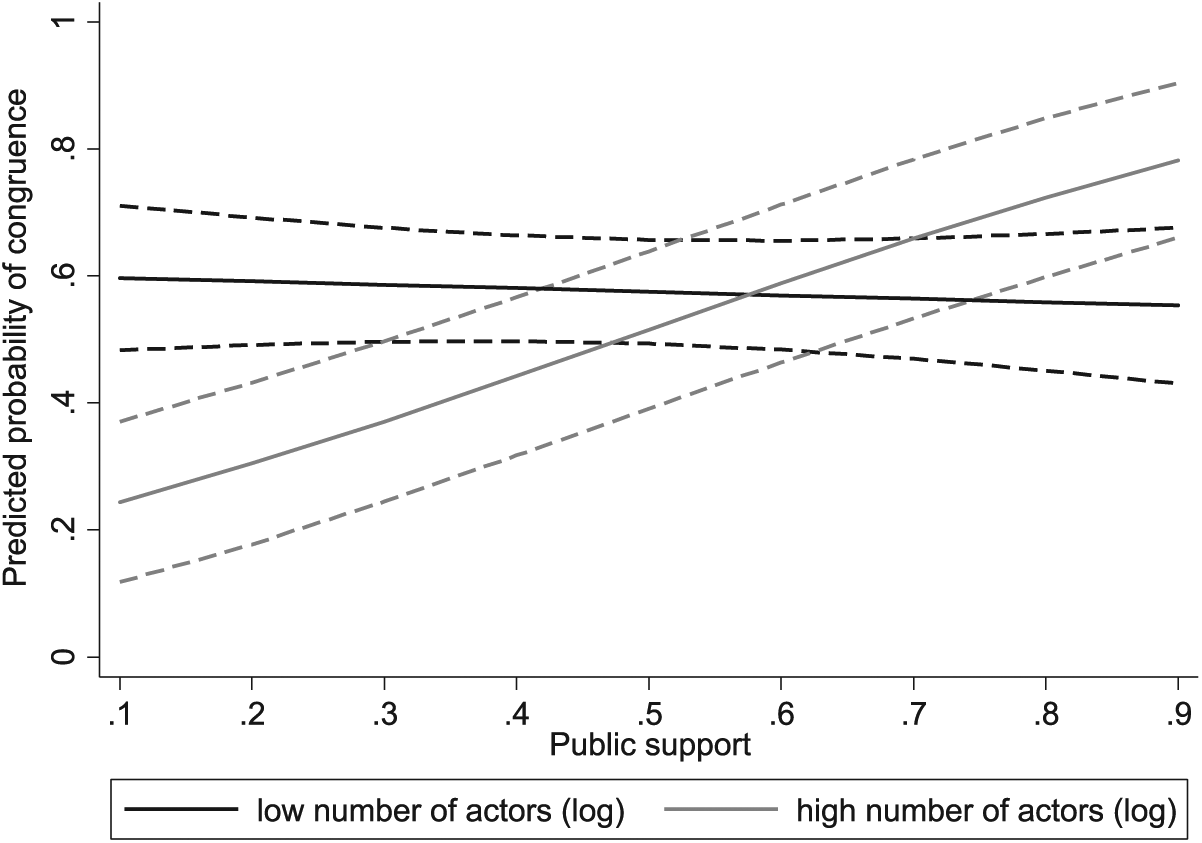
Predicted probabilities of congruence across public support for high and low numbers of advocates per issue.
In our final and fully specified model (Model 3), we include an additional interaction effect between public support and our categorical actor type variable to analyze whether the effect of public support on preference attainment varies for the different actor types (Hypothesis 3). Although we do not have evidence for significant differences in the effect of public support between the groups at the .05 level, our results indicate that, as expected, the average marginal effect is only positive and statistically significant for two of our groups, namely, experts and individuals as well as advocates representing diffused interests. Figure 2 shows that for both types of advocates, the probability of preference attainment increases with the level of public support. In contrast, we do not find a significant effect of public support on preference attainment for special interests.
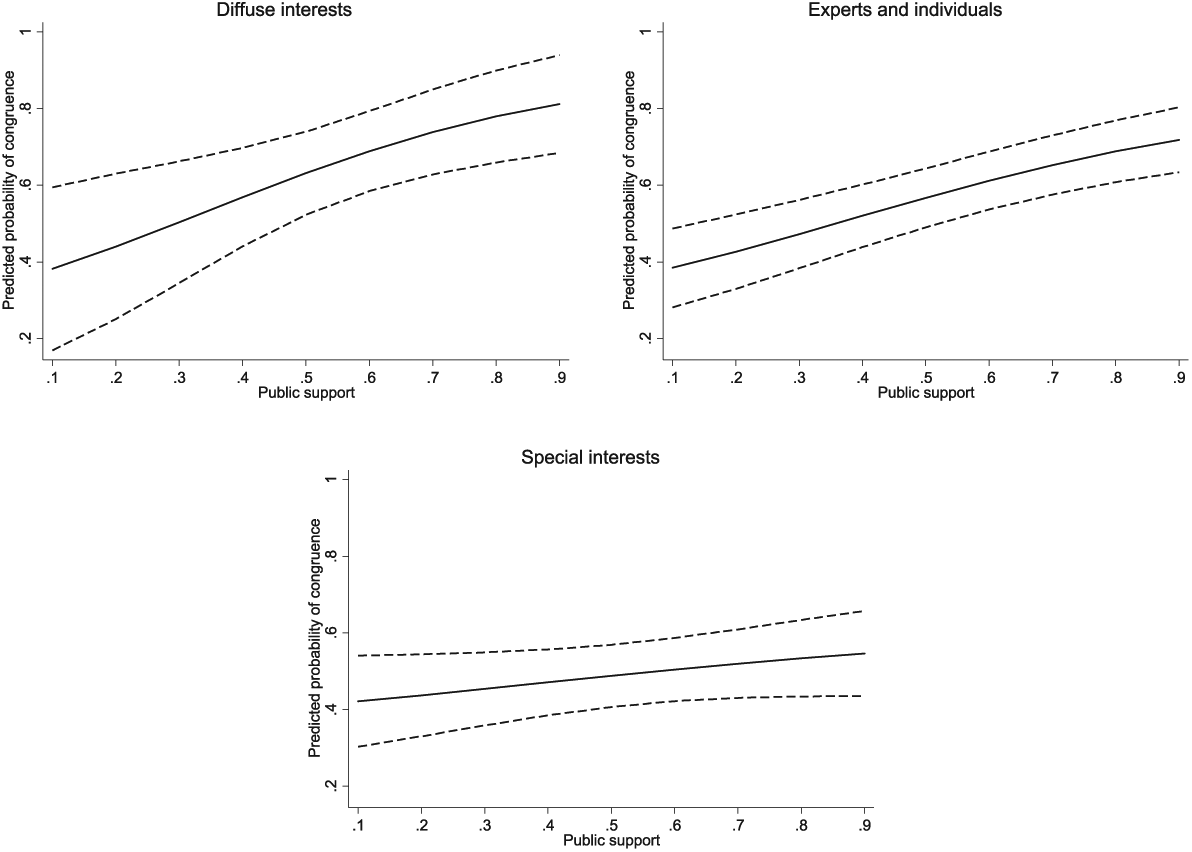
Predicted probabilities of congruence across public support by actor types.
In line with our theoretical expectations, it appears that, indeed, the preference attainment of some advocates is dependent on public support. Presumably because individuals and experts are generally not able to provide financial resources or legitimacy to policy makers, decision makers seem more likely to follow their advice and demands if it means that they will also satisfy the majority of the public. Moreover, diffuse interests are more likely to be able to deliver legitimacy and be listened to by policy makers the more these advocates are supported by the general public. In contrast, the likelihood of preference attainment for advocates representing special interests does not depend on public support. In many cases, the financial resources that special interests can offer might be able to sway policy makers even in the absence of support from the larger public. This finding is important as it seems to confirm the fear often voiced in the public debate that money can buy influence, even in established democracies.
Conclusion
A common picture of lobbying is one in which advocates persuade decision makers to follow their interests rather than act in line with the preferences of the general public. The idea is that decision makers may be willing to ignore the views of the general public and instead listen to interest advocates, who provide valuable resources to them in the form of, for instance, expertise and financial support. Yet, we still know little about whether public opinion influences the likelihood that the adopted policies correspond to the positions of the interest advocates. Although the study of advocacy success has grown considerably in recent decades, the vast majority of the existing literature does not consider the impact of public opinion on preference attainment. We conduct such a study with a large-N design, using data on advocacy, public opinion, and policy on 50 different policy issues from Denmark, Germany, the Netherlands, Sweden, and the United Kingdom.
The existing literature on group success makes clear that when actors or groups attempt to convince political decision makers to change certain policies, the context is a crucial factor to be taken into account. Confirming previous research, we find that the likelihood of advocacy success, that is, congruence between a lobbying actor’s or group’s policy preference and implemented policy, increases with the share of other advocates who support, rather than oppose, the actor’s position. However, we also find that advocates need more than a little help from their friends among the lobbying community. Public support for advocates’ policy demands is another important factor in their chances of preference attainment: We find evidence that advocacy success increases with the proportion of the public supporting the policy position.
These results reveal how constrained the potential of individual lobbyists to influence policy is. Policy makers are not very likely to follow the advice and demands of advocates who act in isolation, and in addition to the role of the community of lobbyists as a whole, the public needs to be considered. Our study thus connects research on advocacy success and on policy responsiveness to public opinion and highlights the importance of considering the other when analyzing one. It also reconciles evidence for the influence of interest groups and businesses on policy with the finding that public opinion shapes policy in many policy areas and countries.
At first sight, our results present good news for democracy: The preferences of the public play a role. However, we also find evidence that qualifies this statement: Public opinion does not seem to influence the chances of all actors to attain their preferences. In fact, the organized interests typically feared the most, namely, special interests such as businesses, appear to be independent of public support when making their demands heard by policy makers. This suggests that such organized interests may be able to offer resources and benefits to policy makers, which outweigh the benefits of making policy that is congruent with the views of the majority of citizens. It contrasts work from the United States, which found that the success of business in influencing the items on the legislative agenda depends on public opinion (Smith, 1995). Instead, we only find evidence that organizations representing diffuse interests (organizations with a broad membership and strong roots in civil society) and individual advocates (i.e., private persons or experts) benefit from the support of public opinion in attaining their preferences.
Furthermore, we find evidence that the extent to which an advocate’s chances of preference attainment increases with public support depends on the number of advocates lobbying on an issue. A higher number of advocates is likely to increase the salience of an issue in the public debate and make it even more crucial for the decision makers to act in line with the views of the advocates that enjoy public backing on an issue.
Our 50 different policy issues represent a wide range of policy areas with variation in media salience and policy types, which have been shown to matter in government responsiveness to public opinion and interests groups. This means that our results are likely to be valid for a large range of policy issues. Moreover, we believe that the findings are generalizable to other European democracies, and potentially beyond, because the five countries included in our study vary along a number of institutional dimensions. Future research would make a valuable contribution by testing the hypotheses in other context, such as the United States, where campaign contributions by lobbyists play a much more important role, and in newer democracies.
Even though the same groups may seek access in multiple arenas (Binderkrantz et al., 2015; Holyoke, 2003; Holyoke, Brown, & Henig, 2012), there is also scope for extending our approach to considering the impact of public opinion on advocacy success in other lobbying venues than the media. The news media constitutes a source of evidence for deriving actor positions that can be used in a comparative study such as ours, where the institutional access points of lobbying vary between countries. Moreover, measuring advocates’ policy claims through a content analysis of major newspapers and relating them to actual policy means that we do not need to rely on perceptions of lobbying efforts and influence by advocates or political elites themselves. The downside of this approach is that we do not directly observe whether and how decision makers take the demands of individual advocates into account. Yet, observing such complex and rarely transparent processes is nearly impossible, making a large-N approach that relates inputs with outcomes and refrains from drawing causal inferences a viable and promising approach.
Footnotes
Acknowledgements
We would like to thank Jacolien Cornet, Benjamin Egerod, Sophia Hunger, Jeroen Romeijn and Lisa Westling for excellent research assistance. The paper benefited from comments received during the annual conference of the European Political Science Association on 23-25 June 2016 in Brussels, the annual meeting of the Southern Political Science Association on 7-9 January 2016 in San Juan and the annual conference of the Danish Political Science Association on 27-28 October 2015 in Kolding. In particular we are grateful to Tom Holyoke, Wiebke Marie Junk, David Marshall and Dimiter Toshkov for comments on earlier drafts.
Declaration of Conflicting Interests
The author(s) declared no potential conflicts of interest with respect to the research, authorship, and/or publication of this article.
Funding
The author(s) disclosed receipt of the following financial support for the research, authorship and/or publication of this article: Our research received financial support from Sapere Aude Grant 0602-02642B from the Danish Council for Independent Research and VIDI Grant 452-12-008 from the Dutch NWO.
Notes
Author Biographies
References
Supplementary Material
Please find the following supplemental material available below.
For Open Access articles published under a Creative Commons License, all supplemental material carries the same license as the article it is associated with.
For non-Open Access articles published, all supplemental material carries a non-exclusive license, and permission requests for re-use of supplemental material or any part of supplemental material shall be sent directly to the copyright owner as specified in the copyright notice associated with the article.
