




Abstract
Can politicians facilitate citizen acceptance of unwelcome policy decisions by acting responsively during the decision-making process? We suggest a framework to analyze the responsiveness–acceptance connection and report findings from two studies designed for that purpose. First, we ran a survey experiment to examine how exogenously induced responsiveness actions affect reactions to a policy decision. Second, we conducted a case study to see how results hold up in a real-world setting. We find that responsiveness actions are rewarded provided that citizens are convinced that politicians have paid attention to their wishes and views. Responsiveness actions that signal willingness to communicate (“to listen” and “to explain”) are more effective than the action to follow majority opinion (“to adapt”). However, the responsiveness–acceptance connection is sensitive to perceptual bias; policy losers are hard pressed to accept that politicians have indeed acted responsively.
Politicians frequently make policy decisions that are unwelcome to some citizens. Examples of this kind are decisions to raise income tax, to cut back on unemployment compensation, and to regulate Internet use. An unwanted consequence of such decisions is that citizens who have their preferences denied are forced to live by rules that they do not approve of (Przeworski, 2010). Because democratic states seek to minimize coercion, it is preferable that disappointed citizens are motivated to voluntarily accept the new policies (Levi, 1997). 1
When searching for ways to facilitate decision acceptance, democratic theory directs attention to procedural factors. The argument is that citizens have reason to accept decisions they dislike if they are made through fair procedural arrangements (e.g., Dahl, 1989). In the context of policy decisions, a central procedural requirement is that politicians are responsive to citizens’ wishes and views (Dahl, 1971; Pitkin, 1967). Responsiveness, thus, is regarded as a means to counteract the unwanted consequences of controversial policy decisions: If politicians act responsively during the decision-making process, they will be rewarded not only by policy winners but also by policy losers who, while disappointed with the outcome of the decision, will appreciate the fairness of the process.
However, the procedural solution is demanding on policy losers. It works only if disappointed citizens agree with politicians about the meaning of acting responsively and if procedural considerations can indeed compensate for the burden of living under rules that one disagree with. Acknowledging that we are dealing with a complex problem in democracy, this article sets out to improve on our common understanding of the responsiveness–acceptance connection.
In the most general sense, politicians act responsively by paying attention to citizens’ wishes and demands (Korolev, 2015; Soroka & Wlezien, 2010). An obvious way for politicians to demonstrate attentiveness is to adopt the policy that is preferred by the majority of citizens (Page, 1994; Powell, 2004). In addition, politicians can pay attention to citizens by keeping themselves informed about their wishes and views (Butler, 2014; Jacobs & Shapiro, 2000) and by explaining their own reasons for actions (Mansbridge, 2003; Pitkin, 1967). David Easton elucidates why responsiveness thus understood may matter to policy losers: Even though some outputs may not succeed in meeting demands, knowledge that efforts have been made on behalf of producers of inputs and that they are not being neglected or ignored will, in itself, help to reduce frustrations and discontent and thereby either prevent the withdrawal of support or positively stimulate it. (Easton, 1965, p. 433)
In support of the responsiveness–acceptance connection, comparative survey research (Bowler, 2017) shows that responsiveness is a central democratic value for citizens. Considering that people feel a moral obligation to support just institutions (Folger, 1998) and that individuals have a drive for cognitive consistency (e.g., Anderson, Blais, Bowler, Donovan, & Listhaug, 2005), it is plausible that citizens would appreciate responsiveness actions beyond preference fulfillment. Further underlining the importance of responsiveness actions, procedural fairness research argues that people care deeply about how decisions are made (see MacCoun, 2005, and Tyler, 2006, for reviews).
However, as of yet there is little empirical research to back up the responsiveness–acceptance connection. As discussed in the introduction to this special issue, the responsiveness literature pays scarce attention to the outcomes of responsiveness processes. Research on general representational quality has mainly focused on the consequences of issue agreement and of formal institutional arrangements (e.g., Thomassen, 2014). Moreover, most studies of representational quality deal with generalized attitudes and processes and not with acceptance of specific policy decisions (see, for example, Reher, 2015).
Closest to the question we ask is a recent study from Grose, Malhotra, and Van Houweling (2015). The point of departure for the study is Fenno’s call for research on politicians’ explanations for their actions (Fenno, 1978). Heeding this call, Grose and colleagues map constituents’ evaluations of U.S. senators following their vote on a controversial policy matter. In line with a responsiveness–acceptance connection, their survey experiment shows that a tailored explanation generates support among constituents who disagree with the vote. However, these authors study attitudes toward a specific politician rather than toward a policy decision. Because of person-positivity bias (Sears, 1983) it might be easier for people to support an individual politician who has voted the wrong way than to accept a policy decision that one disagree with. Moreover, providing explanations is only one type of responsiveness action.
To expand on previous research, we designed two empirical studies that directly address the responsiveness–acceptance connection. First, we ran a survey experiment that examined how exogenously induced responsiveness actions affect individuals’ acceptance of a policy decision. We found not only that clearly signaled responsiveness actions are effective to a degree but also that policy losers are much less likely than policy winners to accept that representatives have been acting responsively. Second, to consider a situation in which responsiveness actions are less clearly signaled, we conducted a case study of a local policy controversy. Findings from our panel study of affected citizens confirmed that the favorability of the policy decision colors responsiveness perceptions and that it is hard to convince policy losers that politicians have paid attention to their wishes and views.
Responsiveness Actions
Responsiveness is commonly understood as a bottom-up process in which politicians adopt policies that citizens indicate that they prefer (Manin, Przeworski, & Stokes, 1999; Powell, 2004; Stimson, Mackuen, & Erikson, 1995). The bottom-up perspective has guided a large number of empirical studies on policy adaptation (e.g., Butler & Nickerson, 2011; Lax & Phillips, 2009; Page & Shapiro, 1992) as well as rhetorical adaptation (Hobolt & Klemmensen, 2008).
However, a one-sided focus on bottom-up responsiveness sits uneasily with the core assumption in representation theory: that elected representatives are unbounded by citizens’ instructions between elections (e.g., Manin, 1997; Urbinati & Warren, 2008). Logically, if representatives are not obliged to follow instructions, and if responsiveness is intrinsic for high-quality representation, then representatives can demonstrate attentiveness toward citizens in other ways than by adopting their current policy preferences (Esaiasson, Gilljam, & Persson, 2013).
Specifically, representation theorists emphasize that politicians should provide credible justifications for their actions. Hanna Pitkin (1967) famously contends that elected representatives are free to define the actions that are in the best interest of the represented as long as they present “good reasons in terms of their interest of why their views are not in accord with their interest” (pp. 209-210). Similarly, Jane Mansbridge’s (2003) “anticipatory representation” allows politicians to educate voters in a continuous communication process (see also Disch, 2011). In the empirically oriented literature, Fenno (1978) pinpoints the explanation of Washington activities as a central part of U.S. representatives’ home style, and he goes on to argue that “explanation involves legitimation, whereby the acts of representatives are accepted as authoritative by those they represent” (p. 169; cited in Grose et al., 2015).
Furthermore, for politicians to knowingly adopt citizens’ policy preferences (Soroka & Wlezien, 2010), and to provide good explanations if they do not (Jacobs & Shapiro, 2000), they must have a clear understanding of public sentiment. This means that “listening”—to learn about citizens’ wishes and views—is an additional type of responsiveness action. Acknowledging the importance of “listening,” there has been a stream of innovative research into elected representatives’ information processing using both experimental methods (e.g., Butler, 2014; Butler & Nickerson, 2011; Öhberg & Naurin, 2015; Richardson & John, 2012) and observational methods (Miller, 2010).
Drawing from the above, we identify three types of responsiveness actions:
To listen: actions taken to stay informed about citizen sentiments.
To explain: actions taken to provide a credible justification for policy decisions.
To adapt: actions taken to adjust policy decisions in the direction of the majority opinion.
Each of these actions might potentially motivate citizens to accept unwelcome policy decisions. “Listening” and “explaining” may matter because these actions signal that policy losers’ wishes and demands have been duly noted during the process (e.g., Easton, 1965, p. 433). “Adaptation” may matter for policy losers because they appreciate that politicians decide in line with the majority opinion.
This tripartite typology will be used to explore the causal relationship between responsiveness actions and decision acceptance. More precisely, we will test empirical support for how the acts of “listening,” “explaining,” and “adapting” help citizens to accept policy decisions they disagree with.
The empirical analysis will also consider whether decisions satisfy individuals’ personal policy preferences (“outcome favorability”). Accounting for personal favorability of decisions helps to put the responsiveness–acceptance connection in perspective: What is the relative importance of being subject to a responsive decision-making process (a procedural consideration) and receiving a favorable outcome (an instrumental consideration)?
Even more important, outcome favorability is considered to be specifically central to our understanding of adaptive responsiveness. Deciding in line with the majority position will lead to widespread decision acceptance because many individuals have their personal policy preference fulfilled (acceptance for an instrumental reason). This is important but obviously differs from accepting a decision because majorities have the right to decide (acceptance for a procedural reason). By accounting for outcome favorability, we can differentiate between the two reasons why adaptive responsiveness is effective for decision acceptance.
Decision Acceptance
The fact that a policy decision has been made in a procedurally fair way does not oblige policy losers to change their minds about the policy itself (e.g., Estlund, 2009). Rather, for a democracy that seeks to minimize coercion, the relevant reaction toward unwelcome decisions relates to policy losers’ willingness to tolerate the new policy (Przeworski, 2010). We identify two aspects of decision acceptance thus understood.
The first one is related to willing compliance with the new policy. Although some policy decisions can be obstructed (regulation of Internet use is a case in point), it is typically difficult for policy losers to escape the consequences of decisions such as tax hikes and cutbacks in unemployment compensation. Therefore, we understand that willing compliance is an attitudinal orientation toward the decision that captures the extent to which affected individuals find the decision acceptable.
The other aspect of decision acceptance concerns trust in the decision-making authority. Even if affected individuals remain unsatisfied with the specific decision, responsiveness actions from politicians may motivate individuals to develop more trusting views of authorities. In fact, because institutional trust is essential for legitimacy in the long term, procedural fairness research increasingly explores such trust in authority-effects of decision-making processes (Tyler, 2006).
The Causal Model
We posit that responsiveness actions generate decision acceptance for procedural reasons in a three-step process: representatives act responsively when deciding about a new policy, citizens agree that their wishes and views have been taken into account during the process, and these responsiveness perceptions inform citizens’ willingness to accept the new policy. Thus, as illustrated in Figure 1, responsiveness perceptions mediate between an objective condition (actual responsive actions) and an outcome reaction (decision acceptance).
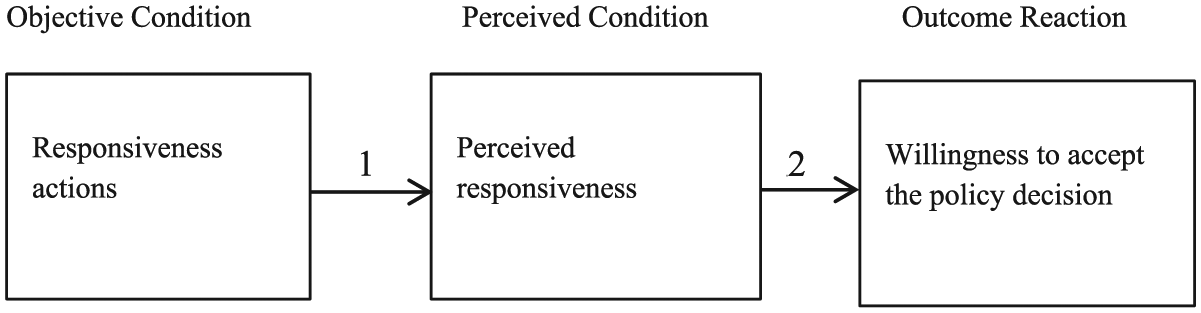
How responsiveness actions affect decision acceptance.
In this model, responsiveness actions will lead to decision acceptance when individuals’ responsiveness perceptions are accurate (Condition 1), and when these perceptions weigh heavily for decision acceptance (Condition 2). Of course, both conditions might be violated.
The threat against Condition 1 is misperception. There are two primary sources. First, people may not be attentive enough to notice what politicians are doing. If people do not know whether politicians are responding, the association between actual responsiveness and decision acceptance would be essentially random. Second, it may be that people’s perceptions of responsiveness are biased. Citizens may engage in motivated reasoning to maintain their valued beliefs (Kunda, 1990; Lodge & Taber, 2013; Taber & Lodge, 2006). To exemplify this, research shows that people who distrust politicians are less likely to credit them with good intentions (Hetherington, 2005). Condition 2 is violated if fulfillment of personal policy preferences takes precedence over perceived responsiveness when individuals react to decisions. 2
The model may play out in various ways. Imagine a situation in which a majority of citizens favor an increased sales tax and politicians carefully gather information about citizens’ wishes and views (they “listen”) and then decide in line with the citizen majority (they “adapt”) and provide strong justification for the decision (they “explain”). In other words, we postulate that politicians do their part to ensure a strong responsiveness–acceptance connection.
Notice first that the responsiveness–acceptance connection is realized only if policy losers—who oppose the tax increase—realize and acknowledge that representatives have been acting responsively (Condition 1 is fulfilled) and attach importance to this fact (Condition 2 is fulfilled). Of course, the model may also work for policy winners, that is, if proponents of the tax increase accept the decision because they value the fairness of the process leading up to the decision, not because they received the policy they wanted.
Now let us consider the case in which instrumental considerations take precedence over responsiveness perceptions (Condition 2 is violated). As before, citizens agree that representatives have been acting responsively during the decision-making process. However, for citizens, responsiveness actions are substantively meaningless. The only thing that matters is the fulfillment of one’s personal policy preference. Because politicians decide in line with the majority view, the overall level of decision acceptance will be high, but we will also observe a deep divide between supporters and opponents of the tax increase.
Finally, we look at the model in which responsiveness perceptions are biased by outcome favorability concerns (Condition 1 is violated). A probable mechanism is that individuals seek to reconcile their instrumental concerns with support of the norm that representatives should act responsively. If that were the case, proponents of the tax increase would seek to confirm that representatives have been sensitive to citizens’ wishes and views, and opponents would seize on evidence that representatives have been unresponsive. Under this condition, individuals attach importance to their responsiveness perceptions, but because perceptions are colored by outcome favorability, we will, though for a different reason, once more observe a deep divide between supporters and opponents of the tax increase.
The empirical analysis that follows evaluates empirical support for the various models.
The Experimental Study
The study is set in a single parliamentary democracy—Sweden. Because we are studying a common situation in representative democracy, and because people from different parts of the world share ideas about procedural fairness (Cohn, White, & Sanders, 2000; Helwig, Arnold, Tan, & Boyd, 2007), we believe that the national context is not highly consequential. However, to the extent that national context matters, Sweden’s high-quality democratic institutions (Kaufmann, Kraay, & Mastruzzi, 2010) and consensual political culture (Dahlström, 2015) should be generally favorable for the responsiveness–acceptance connection.
The experiment was designed to reflect the situation in which politicians keep their part of the deal for a strong responsiveness–acceptance connection. To achieve this, we provided experimental subjects with strong reasons to believe that politicians had been listening, explaining, and adapting during a decision-making process. As a consequence, the experiment minimizes the chance for perceptual bias. (The subsequent case study allows us to assess what happens where responsiveness is not as obvious.)
Responsiveness perceptions are nevertheless important for the analysis. We use them to ensure that experimental subjects experience manipulations of responsiveness actions in the expected way. Moreover, we will test whether outcome favorability bias responsiveness perceptions despite the strong signal that politicians have been responsive.
Proceedings
Using vignettes for treatment, we ran a web-survey experiment with a 2 × 3 between-subject design on a sample of adult Swedes. The policy matter is immigration policy. Because immigration has developed into a permanent source of conflict in Swedish politics (e.g., Rydgren & Ruth, 2013), the topic will likely be salient to experimental subjects.
In the vignette, subjects were asked to imagine a situation in which politicians were about to liberalize Swedish immigration laws (see Figure 2 for details). Following the introduction, subjects were asked to report both the likely majority view and their personal view on the proposal. Most subjects (71%) believed that a majority of citizens would be against the proposal. (At the time of the study, Swedish immigration policies were the most liberal in the European Union and, while this has no consequence for the experiment, the majority of subjects were likely factually correct about public opinion.) With regard to their personal views, most subjects (52%) favored the proposal to liberalize immigration laws, whereas one third (33%) was against, and a comparatively small number (15%) preferred the neutral alternative “neither good nor bad proposal.”
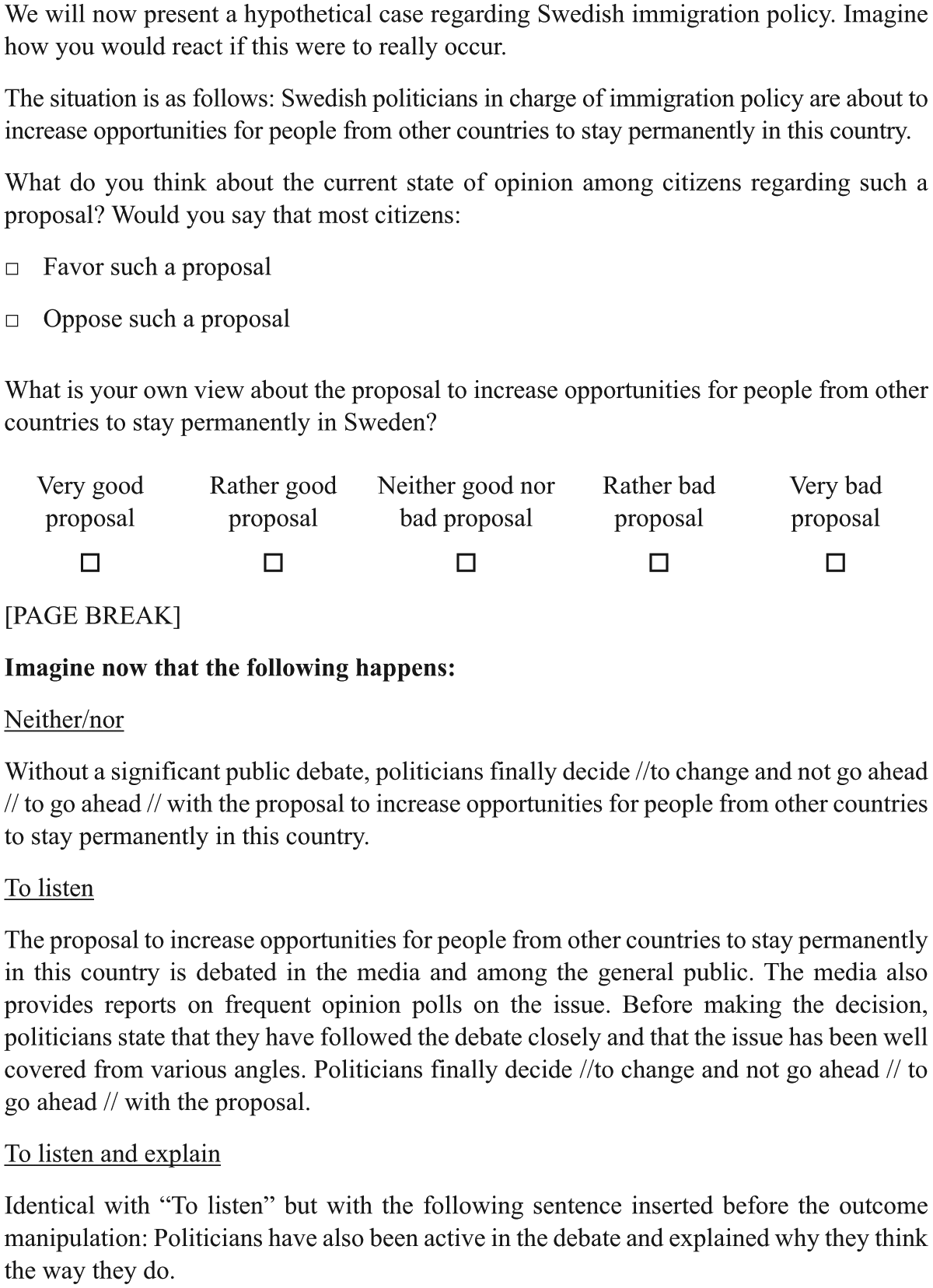
Text of the survey experiment.
Having stated their views on the policy proposal, subjects were randomly assigned to a treatment condition in which we manipulated (a) the direction of the policy decision and (b) responsiveness actions by politicians. After exposure to the manipulations, subjects reported their responsiveness perceptions (three items) and their reactions to the decision (three items).
The manipulation of the direction of the decision informed subjects either that politicians decided to withdraw the proposal to liberalize policies or else to go ahead with the proposal. In combination with information from the pre-manipulation questions, this allows us to construct individual-level variables for outcome favorability (the decision was, or was not, concordant with subject’s personal preference), and adaptive responsiveness (representatives did, or did not, decide in accordance with subject’s view on the majority opinion). Although the overall frequency distribution of the respective variable is sample-dependent, both variables are randomly distributed across treatment groups. However, because subjects tended to believe that the majority opinion agreed with their own preference, outcome favorability and adaptive responsiveness are interdependent (r = .46, p ≤ .001).
In the manipulation of responsiveness actions (other than adaptation to the majority view), subjects learned that politicians had been carefully following an extensive public debate on the proposal (listening), that politicians, in addition to carefully following the debate, had been explaining their policy positions to the public (listening and explaining), or that there had been no public debate prior to the decision (neither/nor).
The manipulations are explicit about responsiveness actions (or lack thereof). Thus, we provide favorable conditions for responsiveness effects on decision acceptance. For support for this approach, consider that experimental studies on another complex analytical construct like “transparency” only find the expected consequences when the term itself is used in the manipulations (de Fine Licht, 2014). Drawing on this research, we signaled loud and clear that the politicians had been listening and explaining during the decision-making process or that they had not.
Table 1 lists all treatment groups. 3 The design allows us to conduct two randomized analyses. One (T1-T6) involves the three types of responsiveness actions “to listen,” “to listen and explain,” and “to adapt to the majority view among citizens” along with the no-responsiveness treatment in which politicians neither listened nor explained and decided against the majority opinion (T1). For instance, in T4, subjects were exposed to politicians who listened and decided in line with the majority view among citizens, whereas in T5, politicians listened and explained but did not adapt to the majority view. 4
Treatment Groups.
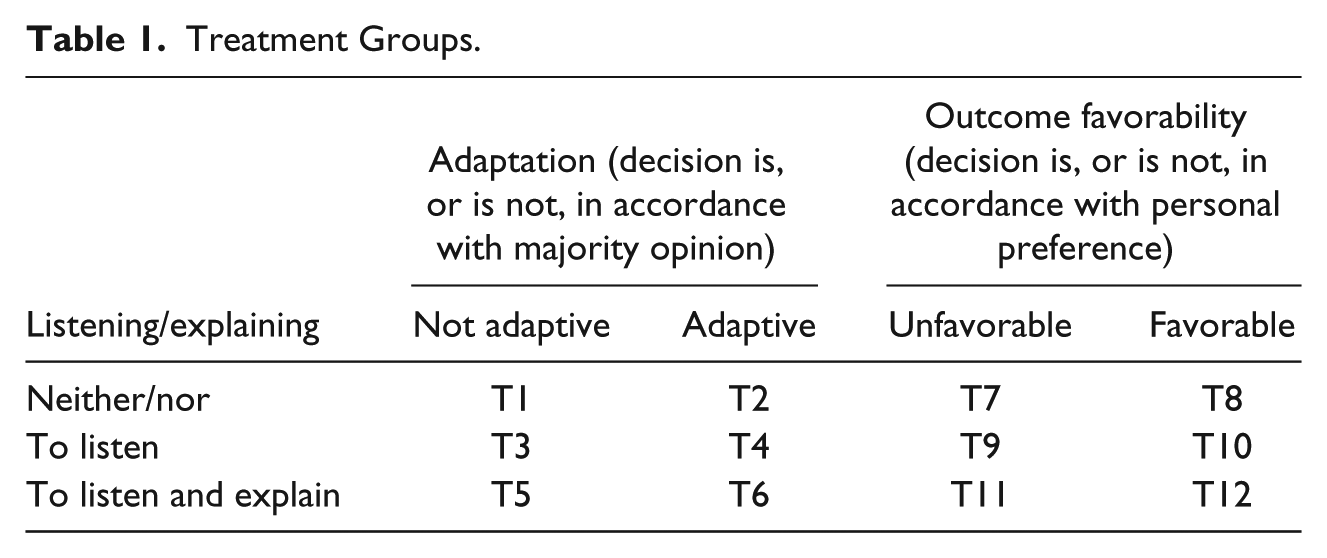
The other analysis (T7-T12) uses the favorability manipulation. It involves the responsiveness acts “to listen” and “to listen and explain” as well as “outcome favorability” along with the least favorable condition, in which politicians neither listened nor explained and decided against subjects’ personal preference (T7). For instance, in T10, subjects read about politicians who listened and decided in line with subjects’ personal preferences, whereas in T11, politicians listened and explained but decided against subjects’ preferences.
In our conceptual framework, adaptive responsiveness is associated with procedural considerations (the majority has the right to decide), whereas outcome favorability reflects instrumental considerations (my policy preference is fulfilled). Because the two manipulations are interdependent, their relative importance will be evaluated within a multiple regression framework. Note moreover that the design is not full factorial, for example, there is no condition in which politicians explain without listening.
Measurements, Sample Information, and Randomization Control
The measure of perceived responsiveness matches the three responsiveness actions: To what degree have politicians “found out about citizens’ wishes,” “explained their policy to citizens,” and “tried to accommodate citizens’ wishes.” 5 All items were measured on a 0 to 10 point scale with designated endpoints to a very small degree and to a very large degree. The psychometric qualities of these measures have been evaluated with satisfactory results (Esaiasson, Kölln, & Turper, 2015). Items were combined into an additive index (Cronbach’s α = .87), which was rescaled to vary between 0 and 10.
Adjusting for the wording of the designated endpoints, items pertaining to decision acceptance were similarly designed. Two items were directed toward compliance: “How important do you think it is to comply with the decision?” (willingness to comply) and “If you now think of the decision itself to increase//to not increase//opportunities for people to stay in Sweden, in general, what do you think of the decision?” (satisfaction with decision). The third item captured reactions related to trust: “How much do you trust the politicians who made the decision?” (trust in politicians). All these indicators of decision acceptance are commonly used in the procedural fairness literature (Skitka, Winquist, & Hutchinson, 2003).
The experiment was conducted between December 15, 2010, and January 15, 2011, as part of a standing web-survey panel of Swedish citizens, which is run by Laboratory of Opinion Research (LORE) at the University of Gothenburg. At the time of the study, there were about 8,000 respondents in the panel, of which we were allotted a randomly selected subsample of 1,300. With a participation rate of about 75%, the effective sample size was 975. In the regression models, we never have more than four predictors. This means that we have enough power to detect medium-sized effects (Field, Miles, & Field, 2012).
The sample is opt-in with an overrepresentation of males, politically interested, and highly educated individuals, but it is nevertheless relatively diverse (Dahlberg, Lindholm, Lundmark, Oscarsson, & Åsbrink, 2011). Moreover, the quality of the LORE data is thoroughly monitored (e.g., Martinsson, Lindgren, Pettersson, & Åsbrink, 2013). A series of one-way analyses of variance (ANOVAs) confirm that the original treatment groups are balanced with regard to gender, age (four categories), party vote, satisfaction with democracy, and political trust (p = .17 or higher for all factors). 6
Manipulation Control
When evaluating treatments, we direct attention toward our manipulation of adaptive responsiveness (whether or not politicians decided in line with majority opinion). While manipulations of “listening” and “listening and explaining” only require that subjects read a scenario text and find it reasonably plausible, the manipulation of “adaptation” requires subjects to connect the direction of the policy decision as presented in the scenario with their personal estimate of citizens’ policy preference.
For manipulation control, we assess the extent to which the actions of our hypothetical politicians affect subjects’ responsiveness perceptions. Absent strong effects, we cannot claim to study the consequences that follow from exogenously induced variations in responsiveness acts. Figure 3 reports mean perceived responsiveness for each treatment group (T1-T6) and the associated 95% confidence intervals. Indicating that all manipulations worked as intended, we can observe an increasing level of perceived responsiveness as we move from the unresponsive condition to the more responsive conditions. For instance, in the adapt-only condition (T4) subjects assessed responsiveness significantly higher than in the least-responsive condition (T1) but significantly lower than in the two most responsive conditions (T5 and T6).
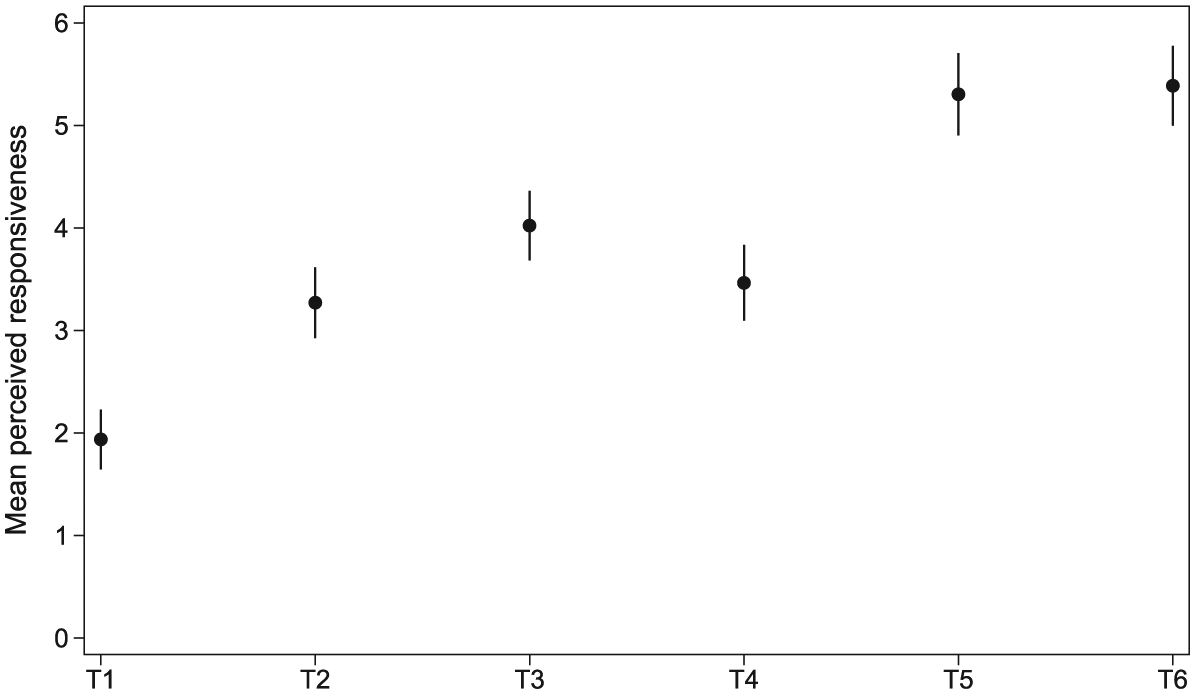
A manipulation control (mean perceived responsiveness and 95% confidence intervals).
It can be noted, moreover, that there are no signs of strong and theoretically meaningful interaction effects between treatments. As this is also true for most subsequent analyses, we will, for the sake of brevity, focus throughout on the main effects of treatments.
Results
We focus first on perceptual bias and the extent to which citizens’ responsiveness perceptions are colored by the outcome favorability. Recall that such perceptual bias undermines causality owing to responsiveness actions. Because our manipulations send strong signals that politicians have been acting responsively, manifestations of such tendencies in our data would indicate strong perceptual bias.
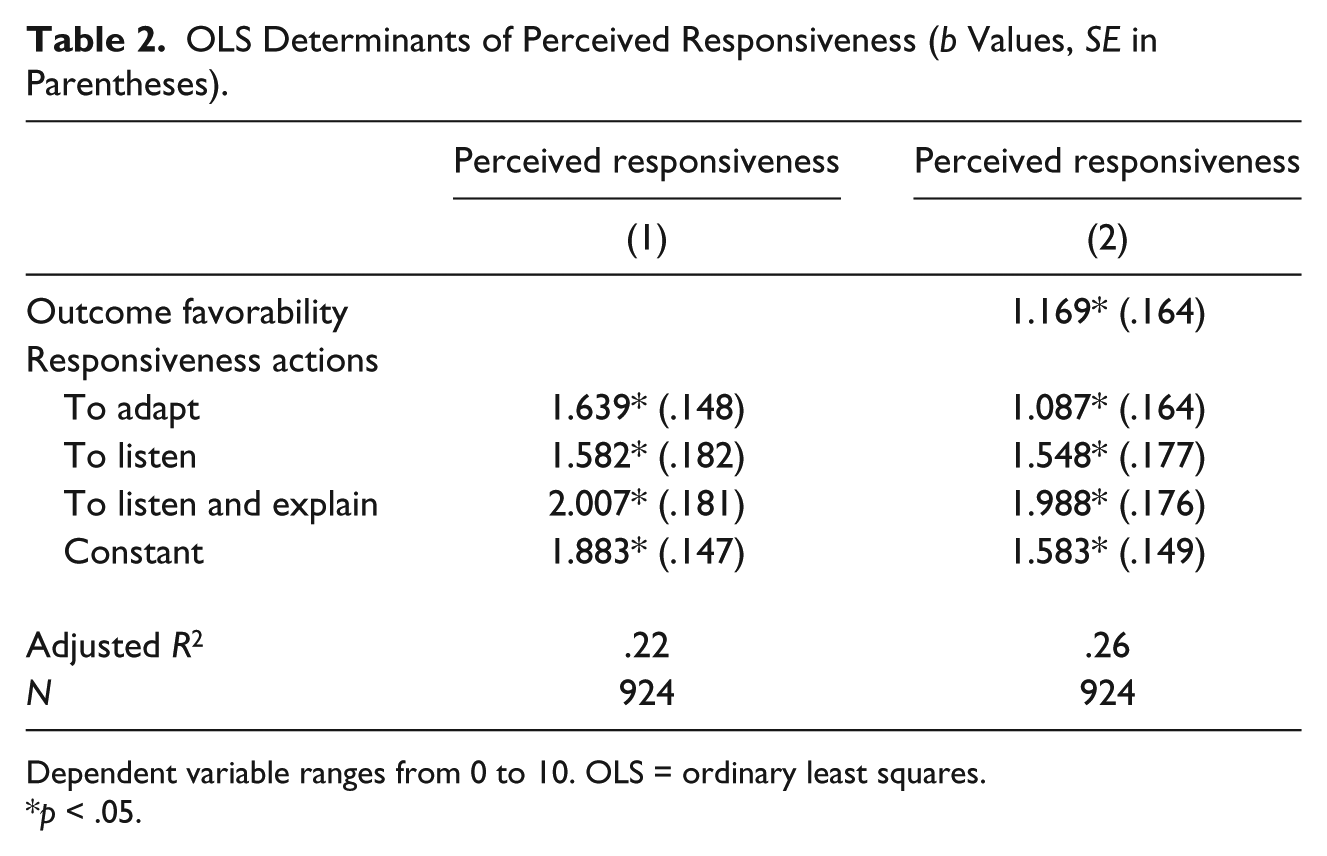
As discussed above, the variable “outcome favorability” is correlated with “adaptive responsiveness” but uncorrelated with “listening,” “listening and explaining,” and “neither/nor.” To track the relative effects of the two correlated variables, we rely on a regression framework for estimates. We estimate two ordinary least squares (OLS) models. 7 Model 1 is essentially a replication of the manipulation control in which perceived procedural fairness is regressed on the three types of responsiveness actions (using “neither/nor” [T1] as the reference group). Model 2 includes outcome favorability. This modeling strategy allows us to separate the effects of having a favorable outcome (an instrumental consideration) and having the experience of representatives deciding in accordance with the majority opinion (a procedural consideration). Because of randomization, the effects of other variables do not change meaningfully between models.
The results presented in Table 2 confirm that adapting, listening, and listening and explaining all have strong, highly reliable effects on responsiveness perceptions. However, as we can see in Model 2, perceived responsiveness also reflects outcome favorability. With all else remaining equal, subjects who had their policy preference fulfilled perceived that politicians had been 1.2 units more responsive than did subjects who learned that politicians had decided against their personal preference. But even more important than this is that the inclusion of outcome favorability reduces the effects of adaptive responsiveness actions on perceptions. The coefficient decreases by one third between the models, from 1.6 to 1.1. There is thus a healthy amount of perceptual bias even when there is a strong signal that politicians have acted responsively.
OLS Determinants of Perceived Responsiveness (b Values, SE in Parentheses).
Dependent variable ranges from 0 to 10. OLS = ordinary least squares.
p < .05.
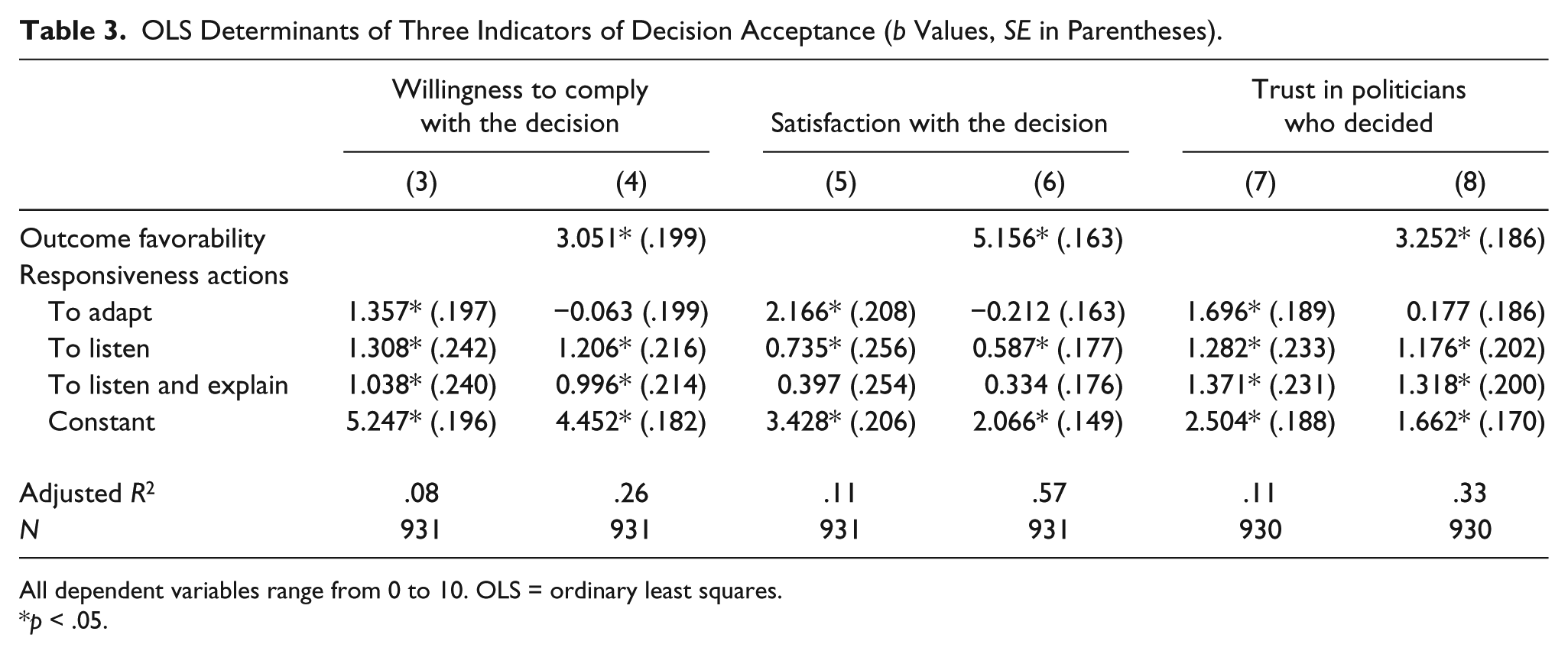
We move on to decision acceptance, the outcome of primary interest. To what extent, if at all, do responsiveness actions shape reactions toward the decision on immigration policy? We apply the same analytical logic as in Table 2 to differentiate between the effects of outcome favorability and adaptive responsiveness actions. Table 3 reports results for each pair of models for each of the three indicators of decision acceptance—willingness to comply with the decision, satisfaction with the decision, and trust in politicians who made the decision.
OLS Determinants of Three Indicators of Decision Acceptance (b Values, SE in Parentheses).
All dependent variables range from 0 to 10. OLS = ordinary least squares.
p < .05.
A comparison within each pair of estimated models indicates that responsiveness actions are important for decision acceptance, particularly when outcome favorability is excluded. But outcome favorability is clearly the strongest determinant of decision acceptance. The effects are particularly strong for satisfaction with the decision, where a favorable outcome increases satisfaction by 5.2 units on the 10-point scale but are also substantial for willingness to comply and trust in the politicians who made the decision, for which there is an increase of 3.1 and 3.3 units, respectively.
Adding outcome favorability also reduces the effects of adaptive responsiveness. Indeed, there is no support for policy losers rewarding politicians who decide in line with the majority view when outcome favorability is taken into account. (The coefficient for the variable to adapt is close to zero and statistically insignificant in Models 4, 6, and 8.) This is a potentially important finding, as it implies that substantive representation of the median voter is something that just does not matter to citizens, at least in regard to their acceptance of decisions.
Results are more positive for the other two types of responsiveness actions—to listen and to listen and explain. Both variables exert sizable, statistically significant effects on willingness to comply and trust in politicians, and listening matters for decision satisfaction, as well. These effects, while important and consequential, are still only about one third as strong as the effect of outcome favorability.
Summary of Experimental Results
There are three main findings from the experiment. First, the instrumental concern to have a favorable outcome is more important for citizens’ willingness to accept a policy decision than responsiveness actions. It is not only that outcome favorability exerts a strong direct effect on citizens’ reaction to the decision but also that the outcome people receive colors their responsiveness perceptions.
Second, results demonstrate that citizens reward politicians whom they believe have acted responsively when making controversial policy decisions. In line with Easton’s claim, the most rewarded actions are those that capture communicative aspects of the relationship between citizens and representatives, “to listen” and “to listen and explain.”
Third, adaptive responsiveness does not affect decision acceptance once outcome favorability is taken into account. Thus, the fact that politicians decide as the majority of people would prefer them to does not in and of itself facilitate acceptance.
The Case Study
To see how our experimental findings hold up in the real world, we turn to a case study. The study is set in an affluent Swedish municipality in a metropolitan area. We call it Suburbia to ensure the anonymity of the parties involved. Shortly after the local election in 2010, the governing center-right majority in Suburbia proposed a restructuring of the local school system that would affect nearly 700 children and their parents (with a total population of 34,000). The proposal, which was initiated for budgetary reasons, was strongly opposed by affected parents.
After months of contestation, the ruling majority made a compromise decision that involved fewer schools than the original proposition. Using our conceptualization, the compromise meant that politicians adapted to the wishes and views of protesting parents. However, because many children would still have to change schools, only about one half of protesters had their personal preferences fulfilled. Further connecting these events with our conceptual framework, protesting parents could observe up close how politicians kept themselves informed about their wishes and views and how they explained policy proposals.
The case represents what Mansbridge (1997) calls “contestedly legitimate coercion.” On the one hand, politicians are obliged to manage public funds in a responsible way, and they have the formal right to restructure the school system. On the other hand, the proposed policy change would interfere with people’s everyday lives, parents viewed the proposal as factually unfounded, and because the plan was not discussed during the just-completed election campaign, parents had not had the opportunity to take it into account when transferring authority to their elected representatives.
The basis for our analysis is a web-survey panel with a sample of protesting parents. For recruitment, we used an online petition drive against the original proposal that was initiated by a group of parents shortly after the proposal became public knowledge. The petition was signed by about 500 affected individuals (and a few minors and residents of neighboring municipalities). We contacted as many of the relevant petition signers as possible by phone and asked them to join a web panel on the school issue. In the end, 214 individuals participated in two panel waves, one before the decision was made in January 2011 (T1) and another after the decision was made in March 2011 (T2). The panel survey was administered by LORE at the University of Gothenburg. 8
With a single case, there is limited variation in actual responsiveness. However, the panel design allows us to study how the adaptive responsiveness action to offer a compromise decision affected protesting parents. Moreover, because all parents experienced the same decision-making process, we can analyze perceptual bias by studying within-group variations in panelists’ responsiveness perceptions. Furthermore, as only about one half of parents had their kids’ school exempt from the restructuring program, the case provides variation in outcome favorability.
Results
We start by replicating two key findings from the experiment for which the case provides the relevant variation: that outcome favorability is of primary importance for decision acceptance and that adaptive responsiveness is not once outcome favorability is taken into account.
To protect respondents’ privacy, we did not collect the detailed information needed to identify the individuals who benefitted personally from the compromise decision (by having their child’s school exempt from the restructuring program). Absent a direct measure of outcome favorability, we focus our attention on changes in attitudes toward the school’s policy after the compromise decision. The key indicator is whether we can observe differential reactions among parents in the sample. If outcome favorability drives reactions to the decision, we can expect an even split among parents post-decision. (Recall that about half of the protesters had their personal preference fulfilled.) Conversely, a uniform reaction to the decision suggests that personal preference fulfillment was a lesser concern.
In support of a strong outcome favorability effect, parents reacted differently to the decision. When surveyed before the decision, 95% of respondents reported a negative view on the proposal. When surveyed after the decision, 47% of parents were satisfied with the new school policy, whereas 53% remained negative. 9
Because of the data limitations just described, we cannot be certain that the parents who were satisfied with the compromise decision were those whose kids would be unaffected by the new policy. However, our data allow for an indirect test for that decision acceptance was primarily driven by outcome favorability. The test targets parents’ attitudinal support of their local politicians. If having a favorable outcome was the prime concern for parents, we would expect to find higher levels of support (as measured by satisfaction with the way democracy works in the municipality [SWDLocal]) among those who were positive toward the new policy.
Results presented in Figure 4 confirm expectations: Those who were satisfied with the new policy became significantly more supportive of local politicians after the decision; those who were dissatisfied with the policy did not change in a meaningful way.
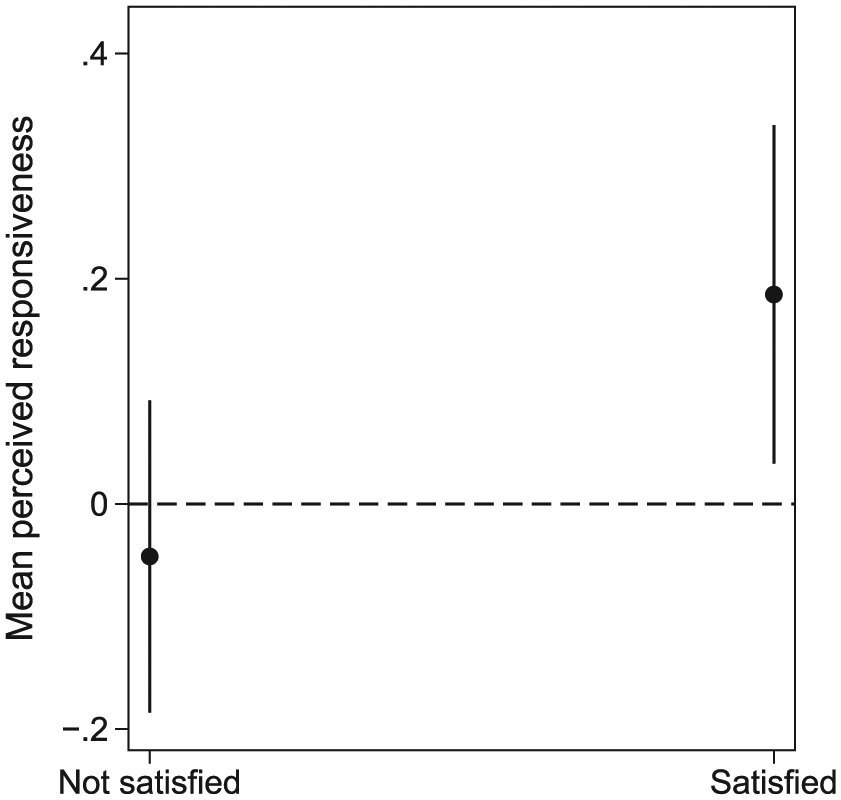
Mean change and 95% confidence intervals in satisfaction with local democracy among parents who were, or were not, satisfied with the new policy.
In sum, the case study data support the experimental analysis showing that outcome favorability is important for decision acceptance and that policy losers find little comfort in that politicians have adapted to majority opinion. Although the evidence is not perfect, it comports nicely with our experimental results.
We turn, then, to the role of perceived responsiveness for decision acceptance. Given our causal model, we seek to elaborate how outcome favorability interplays with responsiveness perceptions to shape citizens’ reactions to the decision. Importantly, in the real world politicians’ responsiveness actions are less clearly signaled than in the experiment. Because there is more room for subjective interpretations of politicians’ actions, we expect to find strong perceptual bias in our case study data. For measurement of perceived responsiveness, we use the same three items as in the experiment. 10
One option that was identified in the theory section is that the only thing that matters to citizens is outcomes and that, therefore, responsiveness perceptions are unrelated to decision acceptance. However, given findings from the experiment, and because fairness is important for most people (Folger, 1998), we deem it unlikely to find such naked instrumentality among citizens.
The more plausible option is that citizens attach importance to their responsiveness perceptions but that these perceptions are strongly colored by outcome favorability. This would violate Condition 1 for a strong responsiveness–acceptance connection. Accordingly, parents who reacted positively to the decision maintain that they did so not only because they got what they wanted for their kids but also because they appreciated that protesting parents had been listened to during the process and that politicians provided reasonable justifications for their decision. Correspondingly, disappointed parents who reacted negatively to the decision will not refer to the outcome but to the fact that politicians are out of touch with citizen sentiments.
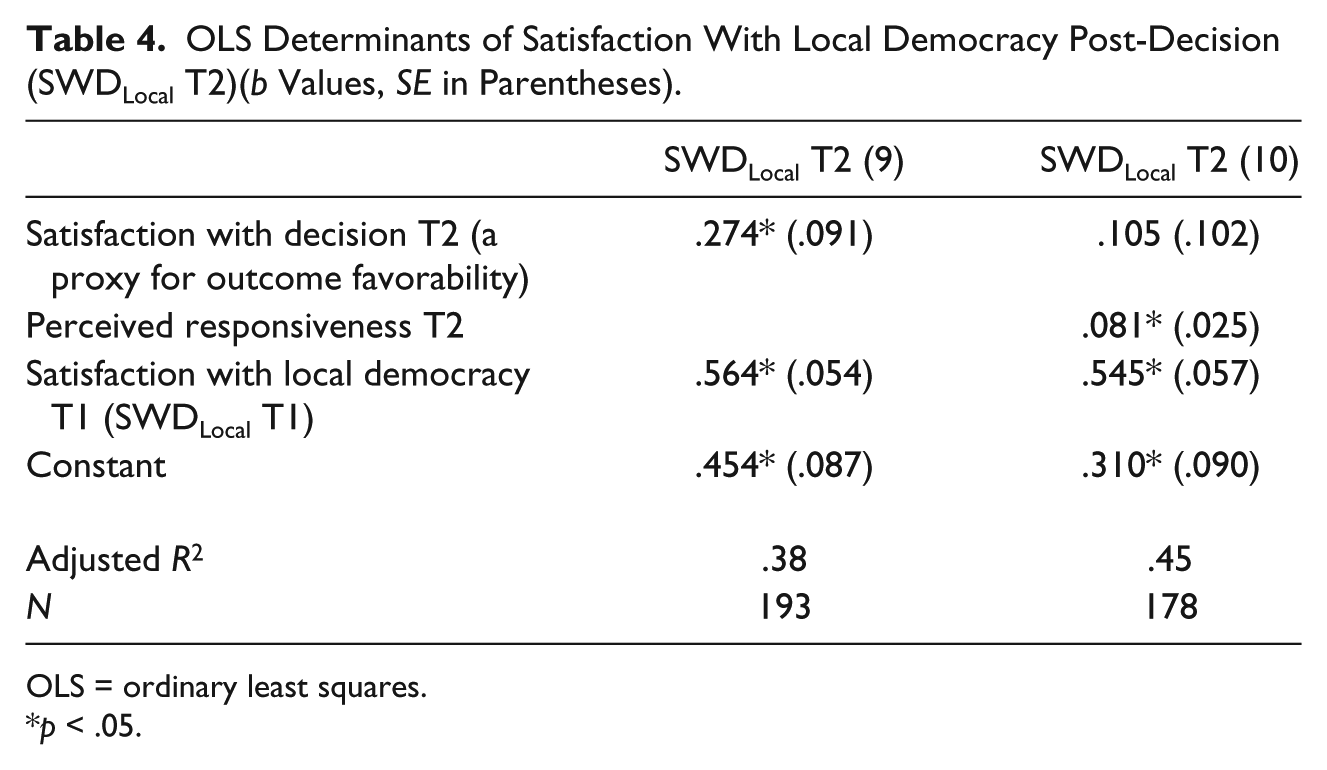
To see whether this reasoning is consistent with our data, we proceed in two steps. First we look for evidence that perceived responsiveness mediates between outcome favorability and outcome reactions, that is, the causal effect of outcome favorability on outcome reactions flows through perceived responsiveness. For this, we look again into the relationship between decision satisfaction (our proxy for outcome favorability) and support of local politicians after the decision (SWDLocal at T2). We expect to find a reduced effect of decision satisfaction on support of local politicians (evidenced in Figure 4) once responsiveness perceptions are accounted for.
We estimate two lagged dependent variable models. The only difference between Models 9 and 10 in Table 4 is that the latter includes perceived responsiveness. Results are consistent with the reasoning above: Perceived responsiveness has a statistically and substantially significant effect on support of local politicians post-decision (SWDLocal T2), and the coefficient for decision satisfaction is close to zero when perceived responsiveness is included in the model.
OLS Determinants of Satisfaction With Local Democracy Post-Decision (SWDLocal T2)(b Values, SE in Parentheses).
OLS = ordinary least squares.
p < .05.
Second, we move further back in the causal chain and look for evidence that responsiveness perceptions are affected by outcome favorability. For a test, we estimate another lagged dependent variable model in which perceived responsiveness at T2 is regressed on our proxy for outcome favorability (satisfaction with the decision at T2).
A first thing to note in Table 5 is the sizable and statistically significant coefficient for the variable perceived responsiveness T1. This is evidence that parents’ responsiveness perceptions at T2 are anchored in pre-decision perceptions. Hence, outcome favorability is not the only thing that affects how parents assess politicians’ responsiveness actions after the decision has been made. However, confirming expectations about biased perceptions, results also show that decision satisfaction is a strong determinant of responsiveness perceptions. True, the two variables were measured simultaneously at T2, which raises doubts about reversed causality. But because perceptual bias was also documented in our experiment, it seems safe to conclude that a substantial causal flow runs from decision satisfaction to responsiveness perceptions.
OLS Determinants of Perceived Responsiveness Post-Decision (b Values, SE in Parentheses).
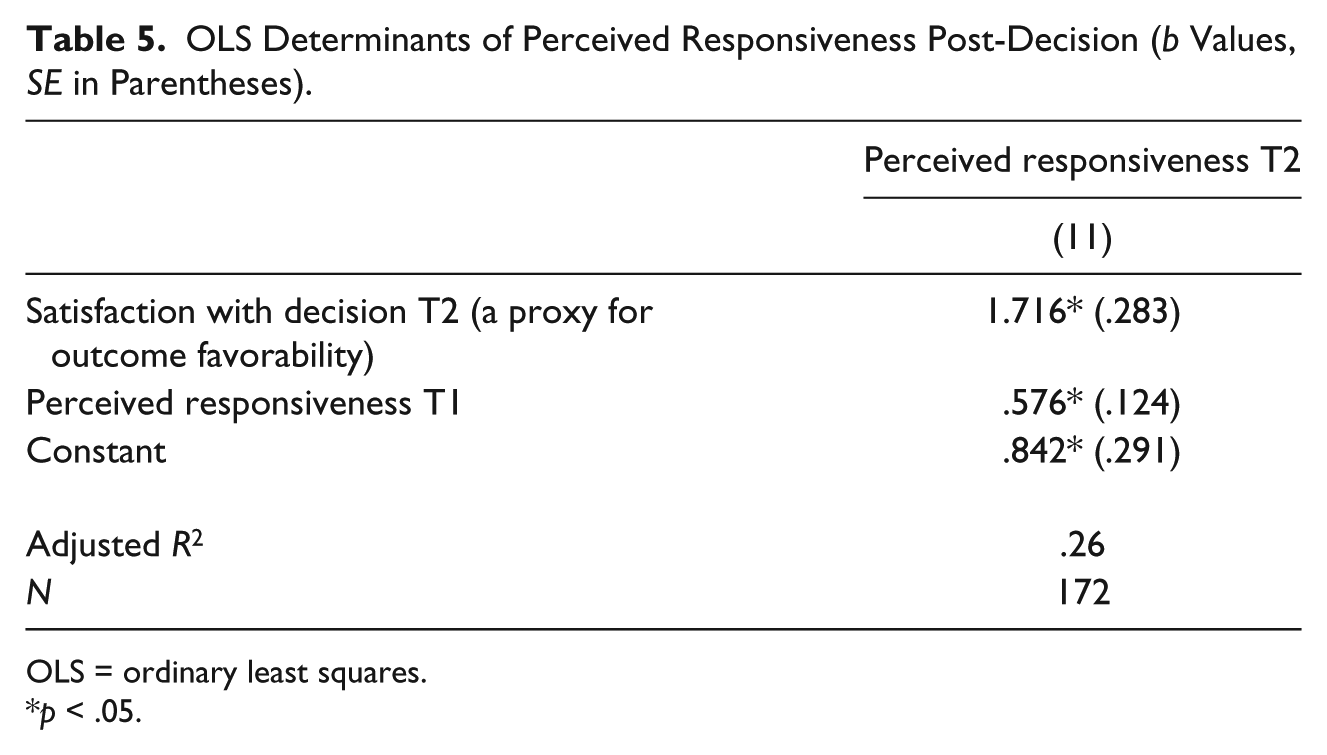
OLS = ordinary least squares.
p < .05.
Overall, our case study confirms key findings from the experiment. It offers evidence that outcome favorability is crucially important to the willingness to accept controversial policy decisions, whereas adherence to the majority principle does not in and off itself make much difference for affected individuals. Moreover, results suggest that responsiveness perceptions are strongly colored by favorability of the outcome people receive.
Conclusion
This article has demonstrated support for a responsiveness–acceptance connection. When politicians act in a way that convinces citizens that their wishes and views have been taken into account—a situation which was artificially constructed in our experiment—citizens find it easier to overcome disappointment with unfavorable policy decisions. Overall, thus, we can add credibility to the claim that fair decision-making procedures facilitate decision acceptance among policy losers.
According to our experimental data, moreover, the type of responsiveness action affects how citizens react. Actions that signal sincere communication by learning about citizens’ wishes and views, and by explaining the reasons for proposals and decisions, are much more effective than adaptation to the majority view among citizens once outcome favorability is taken into account. The underlying mechanism for this may be found in David Easton’s observation that citizens want to be convinced that they are not “neglected or ignored” (Easton, 1965, p. 433).
However, the importance citizens ascribe to receiving a favorable outcome limits the significance of responsiveness actions. Outcome favorability is a much stronger determinant of reaction to decisions than actual responsiveness. Even more important for the responsiveness–acceptance connection is that responsiveness perceptions appear to be strongly colored by the outcome people receive (Kunda, 1990; Lodge & Taber, 2013; Taber & Lodge, 2006). Both experimental and observational data indicate that individuals who receive an unfavorable outcome find it hard to credit politicians with responsive actions. These findings are not surprising per se, but they have significant implications as to how democracy works.
A cynical interpretation of findings is that, above all, citizens want politicians to decide in accordance with their preferred policy. If politicians do, they are rewarded with democratic satisfaction. If they do not, they will be perceived as poor representatives who are out of touch with citizen sentiments.
However, there is also a more positive interpretation. A strong outcome favorability effect has destructive consequences because, in a world of limited resources, not all citizens can have their preferences fulfilled all the time. But the experiment shows that these consequences can be attenuated if affected citizens are convinced that representatives have indeed been acting responsively (as participants in the experiment were). This means that the linkage between actual responsiveness and perceived responsiveness is crucial. If, in the real world, politicians could manage to communicate better and relay that citizens’ sentiments have entered into the decision-making process (provided that they have), and if citizens could force themselves to make fair assessments of politicians’ conduct, then representation relationships might be improved.
Clearly, findings from two empirical studies will not be the last words on the subject. The studies focused on singular issues in a single country. The results may differ on other issues. For instance, the moral mandate theory in psychology maintains that procedural considerations matter less when people have strong moral convictions about an issue (Skitka & Mullen, 2008). Results may also differ in other countries in which the quality of government is lower and the political culture less consensual than in Sweden. Whether this is the case is a subject for future research.
Footnotes
Acknowledgements
We are grateful to Maria Andreasson and Sebastian Lundmark for excellent research assistance and Shaun Bowler, Daniel Butler, Kimmo Grönlund, Armen Hakhverdian, Sara Hobolt, Ann-Kristin Kölln, Elin Naurin, Stefanie Reher, Jan Rosset, Maija Setälä, Paul Sniderman, Stuart Soroka, and Chris Wlezien for helpful suggestions.
Authors’ Note
Earlier versions of this article were presented at the Nordic Political Science Association Meeting, Gothenburg August 12-15, 2014, and at the Conference on Advances in the Study of Democratic Responsiveness, University of Gothenburg, November 22-23, 2014.
Declaration of Conflicting Interests
The authors declared no potential conflicts of interest with respect to the research, authorship, and/or publication of this article.
Funding
The author(s) disclosed receipt of the following financial support for the research, authorship, and/or publication of this article: The research was financed by Grant no. P-10-0210:1 from Riksbankens Jubileumsfond (The Swedish Bank of Tercentenary Foundation).
Notes
Author Biographies
References
Supplementary Material
Please find the following supplemental material available below.
For Open Access articles published under a Creative Commons License, all supplemental material carries the same license as the article it is associated with.
For non-Open Access articles published, all supplemental material carries a non-exclusive license, and permission requests for re-use of supplemental material or any part of supplemental material shall be sent directly to the copyright owner as specified in the copyright notice associated with the article.
