



Abstract
This article seeks to measure the effect of parental socialization on the intergenerational transmission of religion and religiosity levels in Canada. Basing the analysis on the cohort replacement theory, the author is able to quantify the intergenerational change in religiosity. The use of a novel database – The Transmission of Religion across Generations – allows the author to demonstrate that there was an intergenerational decline in affiliation within all of the religious groups analysed (Catholicism, mainline Protestant, evangelical and Pentecostal, Islam, and ‘other religions’) and that the average level of religiosity is also decreasing. Among the socialization factors examined, only ‘talking about religion with certain family members’ and ‘the presence of religion in the household during childhood’ had a positive effect on the religiosity of the respondents. However, despite the positive effect of these indicators, the results reveal that their strength is not sufficient to reverse the overall trend of intergenerational religious decline and general secularization.
Introduction
Demographic changes resulting from modern family dynamics are reshaping today’s religious landscapes. Although it is a well-known phenomenon in Canada, very few studies seek to explain this (Stolz, 2020: 291). That is what I will attempt to do in this article. Studying religious (non-)transmission from the family perspective in a context strongly influenced by secularization requires rethinking traditional indicators of religiosity because belonging to a religion no longer comes as a default identity (Kasselstrand et al., 2023: 130). This is even more important when one is interested in Canada, as its religious landscape is largely shaped by recent immigration and the decline of traditional religions (Beyer, 2005; Breton, 2012; Reimer and Hiemstra, 2018). The new representative survey I am using, which was carried out in 2021, reflects this changing reality. 1 Some provinces, such as British Columbia or the Prairies, now have a much higher proportion of their population who score low on all religiosity indicators or who have more unconventional spiritualities (Bramadat et al., 2022), whereas in other provinces, like in Ontario, the religious landscape has never been more diverse (Wilkins-Laflamme, 2023).
Growing religious diversity and secularization are two key factors disrupting our traditional understanding of religious transmission within the family – especially among Christians (Clarke and Macdonald, 2017). In recent years, although some scholars have examined the transmission of religious affiliation within families (Wilkins-Laflamme, 2020), little to no work has used an in-depth approach to studying the intergenerational transmission of the level of religiosity in Canadian families. I will address this gap by analysing the effect of religious socialization mechanisms found in families during childhood. Moreover, there is no recent study of the Canadian case that measures the intergenerational transmission of religion by comparing the level of religiosity of the parents with the level of religiosity of the respondents, their children. I will also carry out this analysis.
The first objective will be to quantify the decline of religious affiliation across generations in Canada. The second will then be to measure the influence of family socialization on the respondents’ level of religiosity, and the third will be to analyse the nature of the intergenerational decline by looking at various indicators of religiosity. Ultimately, this article will shed light on the Canadian reality of the intergenerational transmission of religion while highlighting its distinctive features across a range of religious affiliations and practices. The results will show that parental religious socialization has a limited effect, rarely reproducing a level of religiosity equal to or greater than that of the parents. This is true for all the religious groups studied below, including Muslims and evangelical Christians, albeit to varying degrees. The results also show that talking about religion or faith with one’s parents during adolescence has a similar, weakly positive effect across all the religious groups tested.
Theoretical framework
Intergenerational decline and cohort replacement
The analysis of the evolution of religiosity over time can take various forms depending on the underlying factors constitutive of such religiosity. There are a number of ways that one can account for the process of secularization: the age effect, the period effect and the cohort effect. According to Crockett and Voas (2006: 568), changes in religiosity over a person’s life course are minor or non-existent because ‘age differences reflect generational shifts rather than the consequences of aging’. Nevertheless, Bengtson et al. (2015) note that age can have a modest effect on religiosity in the American context. The level of religiosity tends to increase slightly, particularly during retirement (the retirement surge), despite the stability of service attendance. Regarding the period effect, although it has been demonstrated (Crockett and Voas, 2006), especially in Europe, that certain historical moments, such as the 1960s, or specific historical events, such as the fall of the Soviet regime and of the Berlin Wall, can have a pronounced effect on individuals, predicting their precise outcomes remains challenging.
When looking at the effect of socialization on intergenerational transmission, the cohort effect becomes the most suitable approach to measure differences. Focusing on the disparities between two successive generations allows me to measure what is passed on versus what is omitted or not retained. The period of socialization thus becomes the stage of childhood and adolescence during which differentiation occurs between the religiosity of the parents and the religiosity adopted by their children. This period can also be a time of resistance on the part of the younger generation to the teachings of the parental generation. This intergenerational tension can either diminish the effect of socialization or act as a deterrent (Stolz, 2020; Thiessen and Wilkins-Laflamme, 2017: 76). A snowball effect then seems to operate from one generation to the next. As socialization is often less effective or less present, it leads to a younger generation that is likely to be less religious than the previous one. External societal influences outside the family environment also play a role in this decline in religious socialization. The level of religiosity of society in general can have an effect: ‘it seems that religious parents transmit their faith more effectively in religious than in secular environments’ (Voas and Storm, 2021: 195). Several factors related to modernity allow me to explain this phenomenon. Advancements in science and technology, the developments of medicine, growing individualization, democracy, the welfare state, education levels and rationalism are factors that reduce the need for religion (Stolz et al., 2016; Wallis and Bruce, 1995). These different developments disrupt aspects of life where religion played a privileged role in the structure it offered or in the explanations it provided for questions concerning, for example, the nature or meaning of life (Norris and Inglehart, 2004).
The transmission and enduring adoption of one form or other of religiosity is also being put to the test due to the increasing number of alternative opportunities available to individuals. This competition occurs notably between the supply of religious and secular goods. For instance,
the need for social contacts can be satisfied by the religious good ‘active membership in a religious community’ – but there are also many secular competitors available, such as sports clubs, associations of all kinds, neighbourhood networks, etc. Depending on the need, other competitors to religious suppliers come into view. (Stolz et al., 2016: 23)
In the context of transmission, a parent might be tempted to send their child to Sunday school for socialization and enjoyable gospel learning, for example. Alternatively, they could choose to enrol their child in a sports team for physical activity and socialization, or in a science club to open their mind to scientific questions. Consequently, the reproduction of religiosity becomes less of an automatic process, devoid of reflection. Transmitting or not transmitting religion becomes a socially legitimate question that every parent must answer and continually reconsider during their child’s upbringing and more broadly in daily family life. Nevertheless, religious transmission remains a complex process that can take various forms and manifestations. It may result in the transmission of practices, values, beliefs or initiatory rites, for example. These are some of the dimensions that could be transmitted through socialization. I will, then, attempt to shed light on what is retained through the socialization process and the mechanisms that enable the reproduction of religiosity.
Measuring religiosity and secularization
Works such as those by Bibby and Brinkerhoff (1973, 1983, 1994), Grand’Maison (1992), and Grand’Maison and Lefebvre (1993) are important milestones for the study of religious transmission in Canada today. They mark a shift from a sociology of religion that was ‘interested’ in the perpetuation of Christianity to a sociology of religion that was less focused on growing church membership (Milot, 1991). Nowadays, the subfield of religious transmission is informed by a few more recent indicators.
Traditionally, religious affiliation and church membership have been used to measure the number of individuals belonging to a certain religion. Recent studies by Wilkins-Laflamme (2020, 2023) show how relevant this indicator is in assessing the intergenerational transmission of religion. By comparing the religion of parents and respondents using survey data, Wilkins-Laflamme was able to quantify the decline in religious affiliation among millennials. She puts into perspective the positive effect that parents’ religious affiliation can have on transmission. This effect is weaker when the two parents do not share the same religion, for example. It is also among Catholics or mainline Protestant couples that the transmission is the weakest, whereas in the case of parents with no religion, the non-affiliation transmission is quite high. Other studies have also shown that two parents belonging to the same religion are more likely to transmit their religion than those who do not share the same religious affiliation (Bader and Desmond, 2006; Wilson and Sandomirsky, 1991). In Bader and Desmond’s (2006) work, this constitutes a marker of religious constancy that favours the intergenerational transmission of religion. Parents’ religious affiliation is also a useful predictor for quantifying changes in religion over the life course (Caron-Malenfant et al., 2018; Reimer and Hiemstra, 2018). Despite this, however, religious affiliation is not synonymous with a devout or fulfilled religious life. Meunier and Wilkins-Laflamme (2011) have shown that religious affiliation does not necessarily come with any level of religious practice. Rather, affiliation may be a mere marker of cultural identity.
Religious-service attendance is also a frequently used indicator for measuring religious transmission. As an indicator of religiosity, it has been used since the beginning of work on religious transmission, and many continue to use it today (Haskell et al., 2016; Meunier et al., 2010; Min et al., 2018: 581; Smith and Snell, 2009; Vermeer et al., 2012). However, it remains challenging to apply in some circumstances, as it is generally used to measure the transformations of Christianity. Moreover, the analysis of dominical practice fails to factor in transformations in practice or its ‘bricolage’ (Hervieu-Léger, 1999). It makes it difficult to analyse recent transformations, especially in Quebec, where mass attendance declined in the early 1970s and has remained extremely low ever since (Meunier and Legault-Leclair, 2021). Prayer is also an indicator of religiosity, making it possible to take into account individual practice. Müller and Porada (2022) have used three types of prayer (mealtime, bedtime and other occasions) to show that it can be a means of socialization during childhood, as well as constituting an element of private religious practice. Looking at the transmission of religious and civic values represents another way to assess religious dynamics. In this regard, different value orientations can be used to better understand what enables religious transmission. For instance, Jesse Smith (2021) shows that religious transmission is stronger in religiously conservative family settings. In addition, religious values can be used as a marker for what is transmitted from one generation to the next (Pinquart and Silbereisen, 2004).
One of the most significant works in this field of study, which uses many of the variables I have discussed, is by Bengtson et al. (2013): Families and Faith: How Religion Is Passed Down across Generations. Using the Longitudinal Study of Generations, a survey carried out repeatedly between the 1970s and 2005, Bengtson et al. (2013: 185) find that ‘the extent to which religious families are successful in passing on their faith to younger generations appears to have remained stable over time’. However, in a later article, Bengtson et al. (2018: 273) argues that the family is an important driving force in the socialization of those without religion, and that it contributes to religious decline across generations.
Several European scholars have also contributed to this field of study using the European Value Survey and the International Social Survey Programme. Generally closer to research on secularization, their conclusions often point in that direction. Voas and Storm (2021), for example, write that a secular social context has a negative effect on family transmission of religion. Molteni and Biolcati (2023: 2049) are of the same opinion when they write that the ‘religious landscape did not change because people changed, but because of a change of people’. Bréchon (2018: 25) even goes so far as to claim that the future of Christian Europe is set to change in a few decades’ time.
Beliefs can also be subject to a degree of quantification (Thiessen and Wilkins-Laflamme, 2017, 2020). This can be done by estimating their prevalence while comparing certain groups to others (Beyer et al., 2019). This body of literature highlights the growth of the ‘spiritual but not religious’ category among young people. Such individuals are often characterized by an abandonment of traditional religious indicators or a blending of them with perhaps some level of spiritual beliefs or practices. Studying beliefs can make comparison across religious groups difficult, but it remains a useful indicator for measuring changes during the general decline.
Religious transmission and family socialization
Praying with one’s children, bringing them to church, involving other family members, sharing values, coherence between what is transmitted and the way the family lives, closeness between family members and the nature of their relationships are all factors associated with religious transmission (Smith and Adamczyk, 2021). Yet some studies suggest that parents talking about religion with their children is one of the most effective means of socialization for a successful transmission of religion (Pinquart and Silbereisen, 2004: 85). Smith and Adamczyk are unequivocal on this point:
parents regularly talking to their children about religious matters during the week has a very powerful association with the children growing up to be religiously committed and involved – sometimes stronger than even parent religiousness variables. (Smith and Adamczyk, 2021: 71)
They argue that talking about religion with children is especially important for transmission in social environments where ‘religious language’ is no longer dominant. This would include many parts of Canada where religiosity indicators are very low among the majority of the population (Wilkins-Laflamme, 2022). Even more than in the USA, the absence of a religious ethos can act as a headwind for religious transmission in Canada. The ability to master some form of religious culture, which is transmitted within the family through regular, warm, positive, sensitive, child-centred communication, would increase the chances that a viable long-term religious transmission takes place. This approach stems from a current of study that puts family socialization at the centre of its analysis. It advocates the importance of parents and grandparents in the transfer of values, especially at an early age (Copen and Silverstein, 2008; Min et al., 2018: 582).
The implicit but important effect of the more secular Canadian context acts as a groundswell that has a lasting effect on the socialization of young Canadians. Going against this powerful trend is a challenge. The work of Voas and Storm (2021, 2022) points to the importance of context in shaping the religious futures of younger generations. In the case of more religious families in such contexts, there is a form of perpetual tension between the family milieu and the dominant social environment. Other work on European countries tends to attribute a dominant effect to context and ‘ambient religion’ (Bruce, 2011: 70; Voas, 2009), 2 while many American authors place the family at the heart of religious transmission (Bengtson et al., 2013; Smith and Adamczyk, 2021). This macro social and historical approach is more akin to secularization theory. It suggests that the context is changing profoundly and that there is a historical and lasting decline of religion at the level of the family unit as well as in society (Stolz, 2020; Voas, 2009; Wilkins-Laflamme, 2016). In this sense, the transmission of religion within the family would be a ‘victim’ of this larger context, as these same families would be affected by it. Others see a form of exculturation of religions that were once dominant in Canada, pushing them further to the margins of society (Meunier et al., 2010). The goal here is not to decide between an approach that favours socialization or one that emphasizes secularization, but rather to attempt to reflect on transmission as it occurs in a more secular and diverse Canada. By analysing the family as an institution of Canadian society, I will be able to address this ongoing tension that exists across the country while showing that the effect of socialization differs only slightly among different religious groups. Ultimately, this article will contribute to the study of religious transmission by showing that religious socialization has not been able to systematically prevent intergenerational decline, regardless of religious tradition.
Research questions and hypotheses
Central to this research is the question of religious transmission within the family: What is the effect of parental religiosity and socialization, and to what degree does religion change across generations? As discussed in the previous sections, there are numerous ways to measure how religiosity is transmitted (affiliation, practices, beliefs, etc.). On the one hand, many of these indicators of religiosity are useful to assess what is being transmitted and to what degree. On the other, a vast set of family socialization indicators can be mobilized to test their influence on the variables used to measure transmission. I will therefore investigate the effect of a set of parental and family variables on the respondents’ religiosity. To guide my analysis, I have formulated five hypotheses. The first three deal with parental differences in religious affiliations and religiosity, and their effects on transmission in Canada:
Hypothesis 1. The share of religiously affiliated individuals declines from one generation to the next, irrespective of religious affiliation (Catholics, mainline Protestants, Muslims, evangelicals and Pentecostals, and other religions). Hypothesis 2. The religious affiliation of the parents has no effect on the level of religiosity of the respondents, irrespective of the parents’ affiliation (Catholics, mainline Protestants, Muslims, evangelicals and Pentecostals, and other religions). Hypothesis 3. The level of religiosity of the parents has a positive effect on the level of religiosity of the respondents.
The fourth hypothesis deals with parental socialization, which is measured by the question of whether parents talk about religion and/or faith with their children during adolescence:
Hypothesis 4. Talking about religion during adolescence has a positive effect on the respondents’ level of religiosity.
The fifth hypothesis deals with the religion the respondent has been raised in, irrespective of the religion of one parent or both parents:
Hypothesis 5. Being raised as Catholic, Muslim, evangelical or Pentecostal has a positive effect on the respondents’ level of religiosity compared to being raised in a mainline Protestant family.
In the course of this analysis, I will demonstrate that, by itself, the family institution does not provide a sufficiently strong religious socialization to enable stable or upward intergenerational religious reproduction between generations. However, it does transmit a weaker level of religiosity as the decline is generally not total but gradual from one generation to the next. This process of decline is particularly pronounced in families with a high level of religiosity, as the gap between their level of religiosity and the ambient one is more significant. No tradition is immune to this decline. The mechanisms of socialization used to transmit religion are unable to halt the decline, at best slowing it down.
Methodology
Data and procedures
This study uses a novel source of survey data, which was collected as part of the broader research project ‘The Transmission of Religion across Generations: A Comparative International Study of Continuities and Discontinuities in Family Socialization’, led by Christel Gärtner and Olaf Müller from the University of Münster, Germany. The survey was approximately 25 minutes long and was carried out by Ipsos. It was administered by computer-assisted telephone interviews to individuals aged 18 and older in five countries (Germany, Finland, Italy, Hungary and Canada). A total of 1501 respondents were surveyed in Canada during the months of January, February and March 2021. In this article, I only use the Canadian subsample of the survey. To reflect Canada’s linguistic composition, the participants were given the option of answering in English or French. This was done under systematic and controlled conditions in a multi-stage stratified random selection procedure based on random sampling together with the random selection of respondents. Using a dual-frame procedure, two separate samples were generated in each of the survey countries. The interview was conducted in the mode by which the respondent was reached. Thus, respondents who had a mobile phone connection but were reached via landline were interviewed in landline mode. The data was then weighted according to the age, gender and region of the respondents. It should also be noted that all questions regarding other family members (parents and grandparents, among others) were answered by the respondent only. As the survey was administered during the COVID-19 pandemic, the questionnaire was tailored to reflect people’s religious habits in normal times rather than in a time of crisis, when the various closures affected places of worship and gatherings of all kinds.
The analysis will first consist of descriptive data on the reproduction of religious affiliation between the parents and respondents, and among religious groups. Then, I will elaborate a series of linear regression models using the respondents’ level of religiosity as the dependent variable.
Measures
Dependent variables
The dependent variable used in the linear regression model represents the respondents’ level of religiosity. It is based on the following question: How religious would you say you are? Please rate your religiousness on a scale from 1 to 5. The respondents were given a choice of five responses ranging from 1 (not religious at all) to 5 (very religious). The categories 2, 3 and 4 were designated only by their number on the scale.
To measure the intergenerational difference in levels of religiosity in the descriptive analysis, I will use the religiosity gap. It is composed of the level of religiosity of the parents (during the respondent’s childhood) as reported by the respondent subtracted from the level of religiosity of the respondent. The parents’ level of religiosity was gauged by asking the following question: Thinking about your parents when you were a child, how religious would you say your parents were at the time? Like with the respondents’ level of religiosity, this question was answered on a 5-point scale (1 = not religious at all to 5 = very religious) for each parent separately. The parents’ level of religiosity was then averaged by adding the scores from these two items together and dividing by two. This does not consider the household composition, and it is possible that the parents were separated or divorced, for example. The religiosity gap thus reflects the difference in the level of religiosity between the parents and the respondent from one generation to the other. The religiosity-gap scale ranges from −4 (intergenerational decrease of religiosity levels between parents and the respondent) to 4 (intergenerational increase in religiosity levels between parents and the respondent). The closer the religiosity-gap scale is to 0, the closer it is to a reproduction of the parents’ level of religiosity for the respondent. This measure does not take into account the religious affiliation of either the parents or the respondent. 3
While it has been shown at length in the literature that high parental religiosity is an important factor in the transmission of religion, the religiosity-gap indicator allows me to account for change – an increase or decline in the level of religiosity – along with reproduction in family environments with varying levels of religiosity. This indicator will provide greater precision when examining low levels of religiosity but small intergenerational increases in levels of religiosity, as well as cases with high levels of religiosity but small intergenerational decreases in levels of religiosity.
Independent variables
In the linear regression model, a set of sociodemographic items will serve as control variables. These are age, gender, childhood social class evaluation on a scale of 1 (low) to 5 (high), childhood region of residence (Atlantic, Quebec, Ontario, Prairies, British Columbia, outside Canada) and childhood rural/urban setting.
Five variables measure parental religiosity and religious socialization during childhood. ‘Religious affiliation of parents’ corresponds to the religion to which the respondent said their parents belonged when they were a child. The declared ‘level of religiosity’ of their mother and their father, measured on a scale from 1 to 5, will also be independent variables predicting the respondent’s level of religiosity. The ‘talking about religion as a teenager’ variable was derived from the following survey question: When you were a teenager, how often did you talk about faith or religious issues with the following people? The respondent was then given four options (1 = never, 2 = seldom, 3 = occasionally, 4 = regularly) and asked to rank various members of their extended family (mother, father, grandparents and siblings). Each family member was included in the model with their own scale in order to assess their relative importance. This question has been used by Smith and Adamczyk (2021: 40), as well as Dollahite and Thatcher (2008), who have shown its importance in the transmission process within families with different levels of religiosity in the USA. In terms of the ‘presence of religion in the home’, the respondents were asked: Now think of the role religion played in your family during your childhood. To what extent was religion present in your family during childhood? They were given a choice of five answers (ranging from 1 = not at all to 5 = a lot). The final question I used was: What religion, if any, were you raised in? I have sorted the answers into six categories: mainline Protestant, Catholic, evangelical and Pentecostal, Muslim, other religions and nones. By using two questions on parental religiosity and three questions on religious childhood socialization, I can assess the relative importance not only of the parents’ religion and religiosity, but also of the role that the parents had in transmission. In other words, these two orders of variables will allow to control for the effect of parental religious profile and the effect of parental socialization.
Results and discussion
Erosion of religious affiliation
In examining the transmission of religious affiliation among millennials (1986–2005) in Canada and the USA, Wilkins-Laflamme (2020) found that no religious group is immune to intergenerational decline. Leading the way in this intergenerational weakening of transmission among millennials are Catholics and mainline Protestants, who had the largest losses in affiliation between parents and respondents. Even having two parents who share the same religion while religiously raising their child is not a guarantee for transmission. According to Wilkins-Laflamme (2020), it is actually non-religious parents who are the most successful in transmission when it comes to transmitting no religious affiliation to their adult millennial children. If we consider the American population as a whole, the religious reproduction rate is comparable to the Canadian case: ‘if one parent was a Protestant Christian and the other identified with no religion (“none”), then only 56 percent identify as Protestant Christian, with 34 percent being religiously unaffiliated’ (Kasselstrand et al., 2023: 110). As for ‘people who were raised by two Catholics parents, 62 percent are Catholic today, but of those who had one parent who was Catholic and one parent who was not, only 32 percent are Catholic today’ (Kasselstrand et al., 2023: 110). In 2011, Bruce (2011: 110) reported that a similar phenomenon was at work in Britain, where transmission was around 50% among Christians. It was possible to replicate similar findings for the entire Canadian adult population by calculating the percentage of respondents who had the same religion as both or only one of their parents.
Figure 1 shows that, in Canada, the rate of reproduction of religious affiliation among individuals with two Catholic or two mainline Protestant parents is 60% and 54%, respectively. In other words, 40% and 46% of the respondents who had two Catholic or two mainline Protestant parents, respectively, did not share the same religious affiliation as the adults. Although intergenerational decline is less among evangelicals and Pentecostals, Muslims and the ‘other religions’ 4 category, it remains relatively high at between 27% and 37%. Retention (of non-affiliation) is strongest among those with no religion (93%), even if only one parent is a religious none (72%). Thus, parental religious homogeneity is not a guarantee of religious reproduction. However, these statistics do not account for the effect of parents’ level of religiosity. What is most notable about this Figure 1 is that all the religious groups seem to follow the same pattern. The intergenerational retention of religious affiliation among religions with the highest average level of religiosity, such as evangelicals and Pentecostals, as well as Muslims (see Appendix 1), is not significantly higher than among the other groups. This reveals the sweeping effect of cohort replacement across religions in Canada.
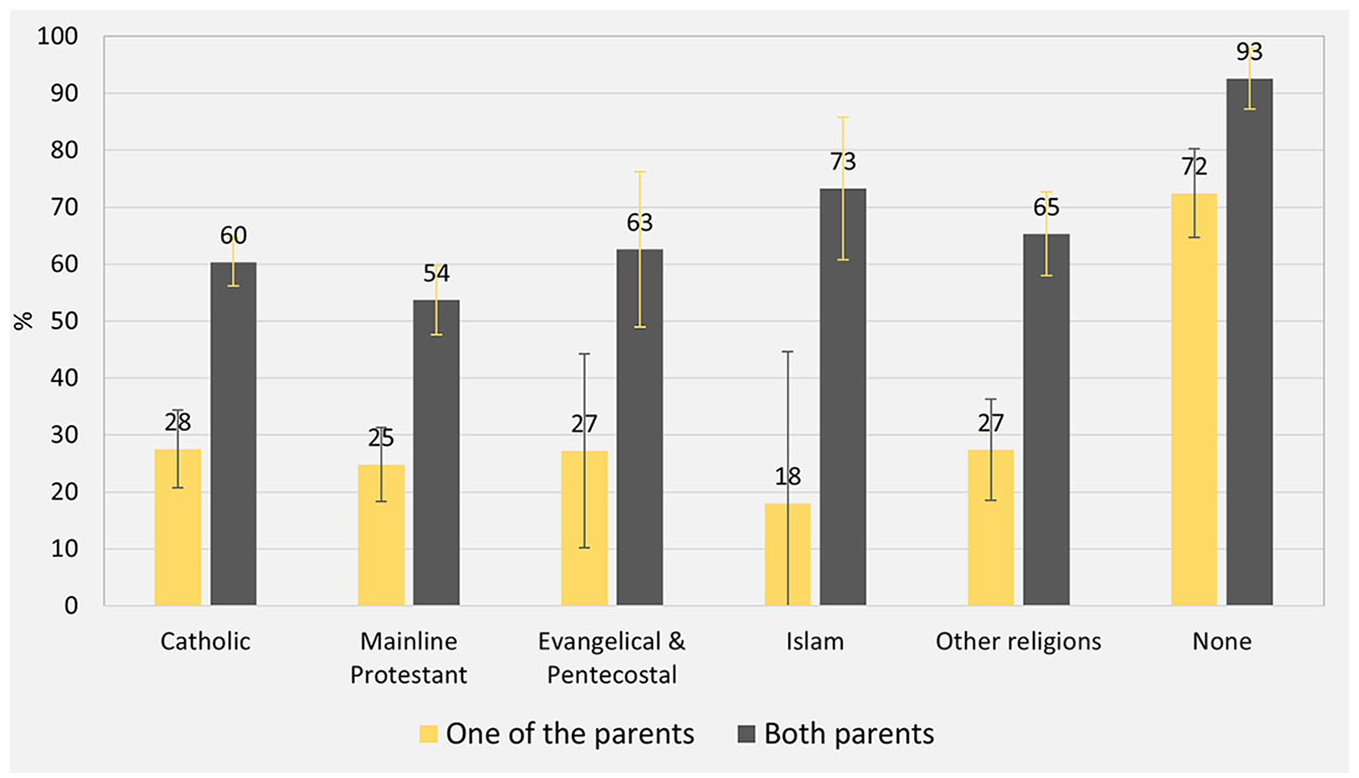
Percentage of respondents who have the same religious affiliation as one or both of their parents, Canada, 2021.
Intergenerational decline and transmission of level of religiosity
Figure 2 shows the distribution of the religiosity gap for each of the six religious groups identified.
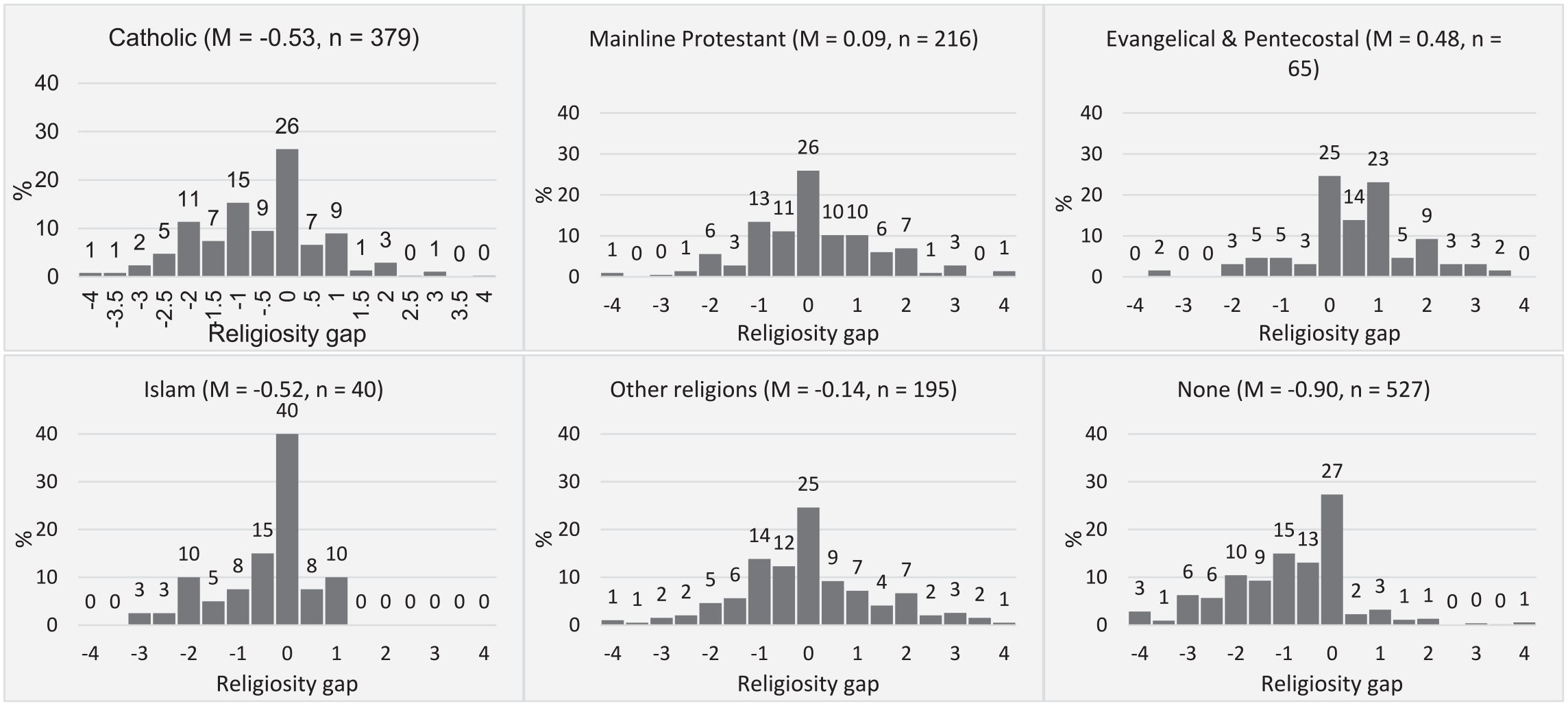
Religiosity-gap distribution (%) by religious affiliation of the respondents, Canada, 2021.
Figures 1 and 2 show that despite maintaining a religious affiliation, it is possible that a decline in religiosity occurs. In other words, the intergenerational decline in the level of religiosity is not only due to disaffiliation; it also occurs among affiliates. This is particularly the case for Catholic respondents, who have a negative mean religiosity gap (M = −0.53). Conversely, among mainline Protestants, the average religiosity gap is very close to zero (M = 0.09), meaning that there is little to no overall difference between the religiosity of parents and respondents who identify with a mainline Protestant denomination. However, each of these two religious groups is nevertheless losing a significant number of its members to the nones (Wilkins-Laflamme, 2020). This may partly explain why the largest negative religiosity gap is present among the religiously unaffiliated (M = −0.90). As for the evangelical and Pentecostal respondents, they show the greatest average gain in religiosity from parents to respondent (M = 0.48), while Muslims show a marked decline (M = −0.52). For all groups, it should be noted that the mode is zero, meaning that reproduction of the average religiosity level of both parents is the most common outcome, notably among respondents who are religiously affiliated.
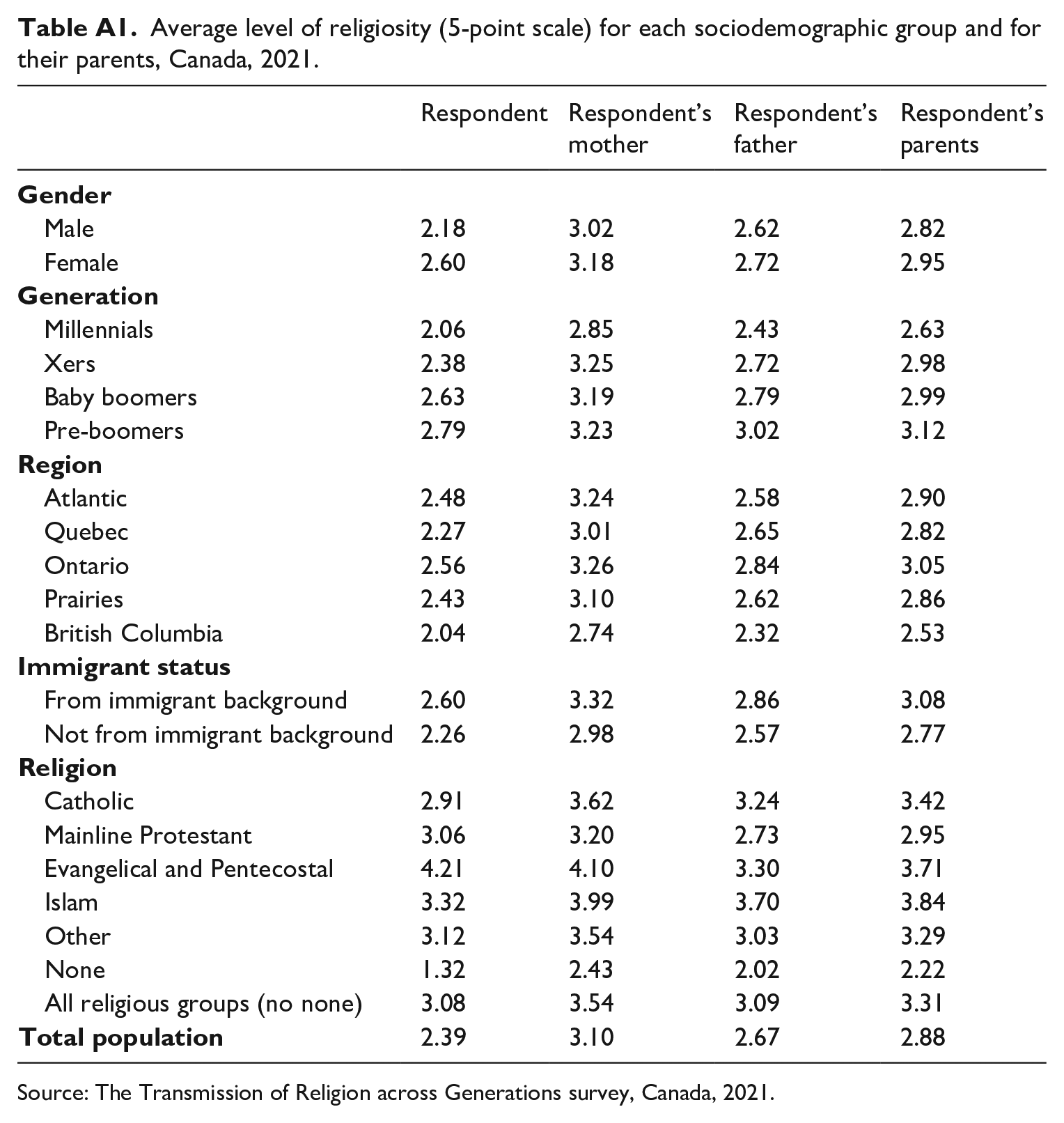
To understand the true meaning of this indicator, however, one must consider the initial level of religiosity of the parents and respondents. Although intergenerational declines in religiosity are comparable between Catholics (M = −0.53) and Muslims (M = −0.52), the average religiosity of Catholics (M = 2.91) remains lower than that of Muslims (M = 3.32; for the levels of religiosity, see Appendix 1). This similar decline seems to point to a more contextual effect, such as the secularization process observed in Canada. Yet, although Catholics have larger intergenerational declines of religiosity compared with mainline Protestants, the average respondent religiosity of these two groups remains similar (Catholic, M = 2.91; mainline Protestant, M = 3.06). This could be explained by the fact that mainline Protestants began their decline in affiliation earlier, leaving behind, in the 1960s and 1970s, a significant proportion of those whose level of religiosity was somewhat lower. This lower average level of religiosity among Catholics might also suggest that Catholics have a higher proportion of cultural affiliations than mainline Protestants.
Effect of family socialization and parental religiosity on transmission
Considering the different indicators that measure the intergenerational transmission of religion, I opted for a multi-step approach. I compare the use of five independent variables in a set of regression models. To do this, I use an approach that captures the level of religiosity of all the groups present in this study. These independent variables are intimately related to previous work on religious transmission but allow me to incorporate the Canadian case into that international discussion and body of literature on religious transmission.
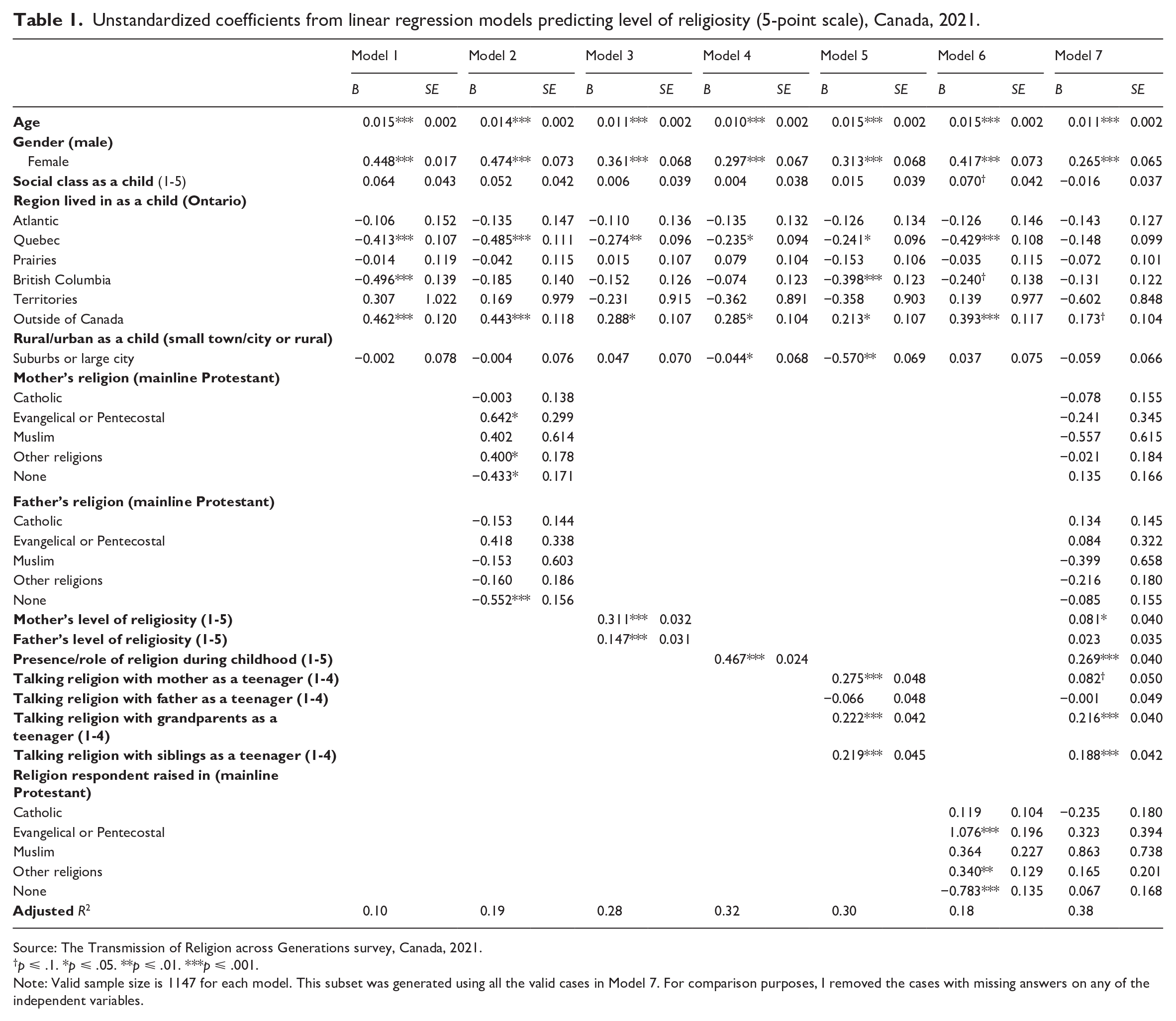
Predicting the level of religiosity of the respondents using sociodemographic variables, religious socialization variables and parental religiosity variables is quite effective in accounting for what leads to religious transmission, as well as high religiosity. Model 7 in Table 1 is representative of that strength, with an adjusted R2 of 0.38.
Unstandardized coefficients from linear regression models predicting level of religiosity (5-point scale), Canada, 2021.
Source: The Transmission of Religion across Generations survey, Canada, 2021.
p ⩽ .1. *p ⩽ .05. **p ⩽ .01. ***p ⩽ .001.
Note: Valid sample size is 1147 for each model. This subset was generated using all the valid cases in Model 7. For comparison purposes, I removed the cases with missing answers on any of the independent variables.
Overall, several variables confirm what has been reported in the literature on this topic (Bengtson et al., 2013; Smith and Adamczyk, 2021; Wilkins-Laflamme, 2020, 2022). 5 In the first model, one can see that age is a factor having a positive effect on the level of religiosity, as is being a woman. The place of residence during childhood is also important in influencing the level of religiosity, since there are significant differences between individuals who lived outside Canada, in Quebec or in British Columbia. People who have lived in Quebec and British Columbia are less religious than those from Ontario. However, people who grew up outside Canada – most of them immigrants – are more religious on average than Canadians who grew up in Ontario. The lower average level of religiosity in British Columbia has been there since the beginning of settlement and it has maintained its difference from the rest of the country ever since (Marks, 2017). The province’s religious fabric does not seem to have developed at the same pace as the rest of Canada. As far as Quebec is concerned, recent work on this issue seems to point more towards the exculturation of traditional Catholicism. As a result, the general practice of religion is declining (service attendance and prayer), and so is the level of religiosity (Wilkins-Laflamme et al., forthcoming). In this regard, my results seem to be in line with the literature analysing religious differences among Canadian regions (Wilkins-Laflamme, 2023).
With the second model, when the parents’ religious affiliation is taken into consideration, it has a moderate effect on the level of religiosity. Compared with mainline Protestant parents, it is only in the presence of an evangelical or Pentecostal mother and a mother from an ‘other religion’ that one finds a higher average level of religiosity among the offspring. As one would anticipate, when the parents have no religion, the effect on the level of religiosity is expected to be negative. What is surprising here is that it is impossible to distinguish any paternal religious affiliation that would have a significant and positive influence on the level of religiosity. This is perhaps an indicator of the greater importance of the mother in transmitting the level of religiosity.
Model 3 reveals that the parents’ level of religiosity significantly influences the respondents’ level of religiosity. When comparing Model 2 with Model 3, it is clear that the third model has a higher R2 (0.19) than the second (R2 = 0.10). The results of this model show that the impact of the mother’s level of religiosity is stronger than that of the father, signifying the greater importance of the mother in the transmission process. Furthermore, when comparing the effect of the mother’s level of religiosity with that of the father, it is clear that the mother’s effect is twice as strong as the father’s. These results challenge some American data suggesting that the father’s level of religiosity can sometimes be greater than that of the mother (Baker-Sparry, 2001).
As for the fourth model, it indicates that the presence and role of religion in the family environment is an important factor in predicting the level of religiosity. This variable is quite important as it produces the strongest model (R2 = 0.32), with the exception of the complete model. This underlines the importance of immersion in a religious milieu in furthering the transmission of religiosity. It also testifies to the importance of having a ‘religious family life’ (Smith, 2021). Beyond the parents’ religiosity and consistent socialization, the role played by religion in the family environment enables religiosity to emerge in many facets of life. This allows religion to operate in the form of an ambient ethos that enables the child to learn the ‘religious language’, as Smith and Adamczyk (2021: 71) write.
The fifth model (R2 = 0.30) focuses on the action of talking about religion or faith with relatives during the teenage years. Once again, the mother’s effect is positive and significant, while the father’s effect is not. It is also interesting to note that talking about these topics with grandparents or siblings also has a positive effect on the level of religiosity. To my surprise, this data shows the positive effect of grandparents and siblings. This variable, which serves as a proxy for socialization by family members, shows that there is a clear distinction to be made between the two parents. The father’s non-significant effect is in line with Models 2 and 3, where the father’s religious affiliation had no effect and the effect of the father’s level of religiosity was weak and lower than that of the mother. In this case, the difference may be a reflection of the fact that the respondents generally spoke less frequently with their fathers than with their mothers. These findings lead me to put into perspective, or even minimize, the effect of fathers on the transmission of religiosity. This contradicts what Smith and Adamczyk (2021: 5) found in the American context – namely, that the father’s role is especially important in the child’s religious formation. In fact, they argue that ‘parents talking [about religion] is even more strongly associated with religious importance than either increased parents’ importance of faith or more frequent religious service attendance’ (Smith and Adamczyk, 2021: 53).
However, the positive and significant effect of grandparents corroborated what is found elsewhere in the American literature (Bengtson et al., 2013: 102; Copen and Silverstein, 2008). In a context of gradual secularization such as Canada’s, the fact that an older generation influences the level of religiosity is not completely unreasonable. If we remain consistent with the cohort replacement theory, it is understandable that grandparents have a higher general religiosity than the next-generation parents, and that they could still carry a desire to transmit religion. As secularization has accelerated over the last few decades in Canada, a generation gap has opened up, sometimes creating significant religious differences within families. Therefore, it is not surprising that evidence was found of grandparents trying to influence parents on certain aspects of religious socialization or perhaps taking matters into their own hands. While the effect of grandparents seems to reflect a desire for religious continuity over several generations, the positive effect of siblings seems to point more towards the integration of religion within the family sphere. 6 When siblings talk to each other about religion or faith, it shifts the focus of religious socialization away from a hierarchical relationship and may contribute to the normalization of religion in everyday life.
The sixth model addresses the religion in which the respondent was raised; its inclusion brings R2 to 0.18. It shows that the religion in which an individual was raised was less influential in determining the respondent’s level of religiosity than the parents’ level of religiosity (Model 3), the presence of religion in childhood (Model 4) and the fact of talking about religion with one’s parents during the teenage years (Model 5). The effect of the religion in which one was raised was, however, comparable to Model 2, which measured the effect of the religions of the parents. 7 A correspondence can also be found between the effects produced by this variable and the effect caused by the mother’s religious affiliation (Model 2). The effects of evangelical/Pentecostal and ‘other religions’ are both positive, while the effect of non-affiliation is negative. Although the effect sizes are larger in Model 6, there still seems to be a similarity of effect between the mother’s religion and the religion in which the respondents reported having been raised. When looking at the effect generated by the father’s religious affiliation during childhood, it is impossible to conclude that any denomination would be more influential, with the exception of non-affiliation.
What is most striking about Model 6 is the largely positive effect on the level of religiosity (1.076) of having grown up in evangelicalism or Pentecostalism. This also corroborates the results in Figure 2 and Appendix 1, since the average level of religiosity is highest among evangelical and Pentecostal respondents. Therefore, it would seem that it is with these denominations, as with ‘other religions’ (but to a lesser extent), that the level of religiosity is highest. This is not surprising in itself, given the abundant and convincing literature on the fact that evangelicals and Pentecostals are more religious than average Canadians, and that a greater emphasis is placed on the transmission of religion in these communities (Reimer and Wilkinson, 2015).
One of the factors that could explain this is the community dimension of these groups, because ‘evangelicalism remains a congregational-centred faith’ (Reimer, 2023: 169). The community dimension is far weaker in traditional Canadian religions such as mainline Protestantism and Roman Catholicism. In fact, these two groups have acquired a cultural dimension that has had the effect of reducing levels of religious practice, despite the relative stability of religious affiliation until recently (Meunier and Wilkins-Laflamme, 2011). This, in turn, has the effect of lowering the average level of religiosity among these affiliates and, by extension, among those who have grown up within these traditions. A question remains, however: Is it affiliation that produces this effect or is it the parents’ level of religiosity and desire for socialization that have the greater influence? The cumulative model and subsequent analysis allow this question to be answered by controlling for all variables.
Looking at the full model (Model 7), it is noticeable that age, being a woman or being born in a different country continue to have a positive and significant effect on the respondent’s level of religiosity. As in the second model, the parents’ religious affiliation remains non-significant. Parental non-religious affiliation, however, loses its significance. In other words, having a religious ‘none’ parent no longer has a statistically significant negative effect on the level of religiosity of the respondent. Yet the mother’s level of religiosity still has a positive effect (0.081) on the respondent’s level of religiosity, albeit much weaker. As for the effect of the father’s level of religiosity, it goes from being weak in the second model to being non-significant in the full model. When it comes to the role played by religion in the family during childhood, this remains significant, and the effect is relatively strong (0.269). Regarding religious socialization, expressed by the act of talking about religion or faith during adolescence with the mother (0.082), grandparents (0.216) and siblings (0.188), this also remains a factor that positively influences the respondent’s level of religiosity. Although the positive effect of talking about religion with one’s mother during childhood is very weak, it is still significant and again enables corroboration with the American studies that show the importance of this variable (Pinquart and Silbereisen, 2004; Smith and Adamczyk, 2021). It is surprising, perhaps, that the variable of the religion in which the respondent was raised no longer has significance in this model. Variables indicating belonging, such as the parents’ religious affiliation and the religion in which the respondent grew up, lose significance but those reflecting concrete socialization efforts (such as talking about religion with family members and the role religion played in the family during childhood) and religiosity (such as the mother’s level of religiosity) remain significant. Considering these results, it is necessary to put into perspective the importance of parental religious affiliation during socialization. At this stage of the analysis, one cannot conclude that, by itself, it has a positive and significant effect on the respondent’s level of religiosity.
The results from this series of models prompted me to conduct further tests to determine if the effect of socialization on the level of religiosity remained consistent when it originated from parents of different religious traditions. I then proceeded with an interaction analysis between the variable ‘talking about religion/faith during the teenage years with one’s mother or father’ and ‘mother’s or father’s religious affiliation when the respondent was a child’. Figure 3 shows the interaction model for each parent. In both cases, I controlled for all sociodemographic variables, as well as for variables associated with the other parent.
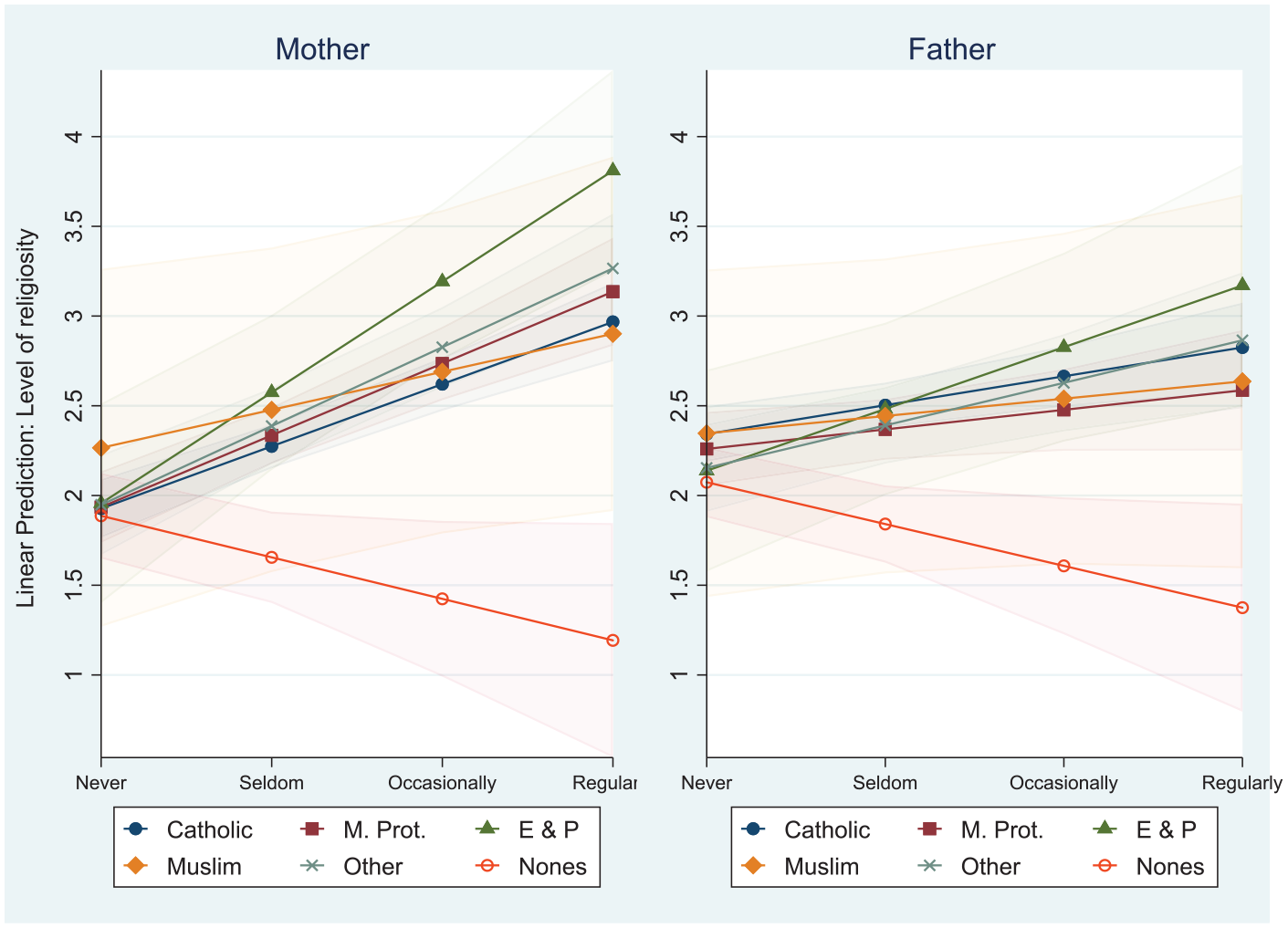
Effect of the interaction between parents’ religion and talking about religion/faith during the teenage years with the respondent on their level of religiosity, Canada, 2021.
The model presenting the interaction of variables relating to the mother confirms the generally positive effect of talking about religion or faith with a mother who has a religious affiliation. However, the effect is hardly discernible for the father, as was shown with the second model in Table 1. More interestingly, the analysis of the interaction between parental socialization and the parent’s religion revealed no significant differences across the various religious groups. In other words, the effect of talking about religion or faith with one’s mother or father did not vary depending on the religious affiliation of the parents. As one would expect, the results do confirm that the influence of religious parents is greater than that of parents without affiliation. It would, however, be incorrect to state that this type of socialization has a greater effect in any of the five measured religious groups, both for mothers and for fathers.
In a rapidly secularizing society where religious authority has already lost most of its influence and the symbolic value of religion is decreasing, these figures do not come as much of a surprise. It would have been surprising to find out that family socialization had been largely abandoned in a tradition that still provided some sort of ‘symbolic goods’ to its members, for example, or that religious socialization had been maintained in a place where religion no longer had any social function. In the Canadian context, however, the effect of religious socialization is weak and hardly distinguishable between religious groups. Consequently, intergenerational decline is observed, albeit to varying degrees, in all of the religious groups measured.
One exception seems to emerge from the data, however. Evangelicals and Pentecostals ‘lose’ a significant proportion of their followers from one generation to the next (Figure 1), but the average level of religiosity of those who remain affiliated is higher than that of the preceding generation (Figure 2). This counter-example should not cause one to lose sight of the overall picture of religious transmission in Canada: the youngest generations are systematically less religious than their predecessors, their proportion of affiliates is still declining, and the effect of socialization is moderate and circumscribed, making it unlikely that the general trend of a secular transition will be reversed any time soon.
Religiosity gap between parents and respondents
Focusing on religious intensity allows one to identify the factors that are favourable for a substantial level of religiosity in adulthood. This, however, raises the question of the relevance of the level of religiosity as the only indicator of religious transmission. What about family scenarios in which transmission starts from a low level of parental religiosity and stays low for the respondent? Since the Canadian religious context is changing and an increasing number of individuals are transmitting lower levels of religiosity, it is also important to look at the whole range of (non-)transmission, not just from the higher levels of religiosity. To address this limitation, I turn to a different analytical strategy, which identifies the tipping point – that is, the level of religiosity where the overall decline seems to end and intergenerational gain in religiosity begins.
Figure 4 displays the average religiosity level of the respondents (grey) as well as the parent–respondent gap (yellow) as a function of the average religiosity level of the parents (x-axis). It can be noted that the average religiosity level of the respondents is closest to that of their parents when the latter have a religiosity level ranging between 1.5 and 2 – in this case, a gap of only ± 0.2 on the 5-point scale. It is also noticeable that as the religiosity level of the parents increases, the intergenerational gap widens. In other words, the loss is more significant the more religious the parents are because there is more to lose (the ceiling effect). The most religious parents struggle to transmit their level of religiosity. By contrast, parents with very low religiosity experience minimal intergenerational gain (the floor effect). The tipping point, which falls between 1.5 and 2 on average parental religiosity, is below the average religiosity level of the respondents (2.4) and that of their parents (2.9). Since intergenerational gain only occurs below these averages, the overall intergenerational trend is still in decline, thereby failing to reverse the secular transition. This snowball effect progressively and steadily contributes to the intergenerational decline.
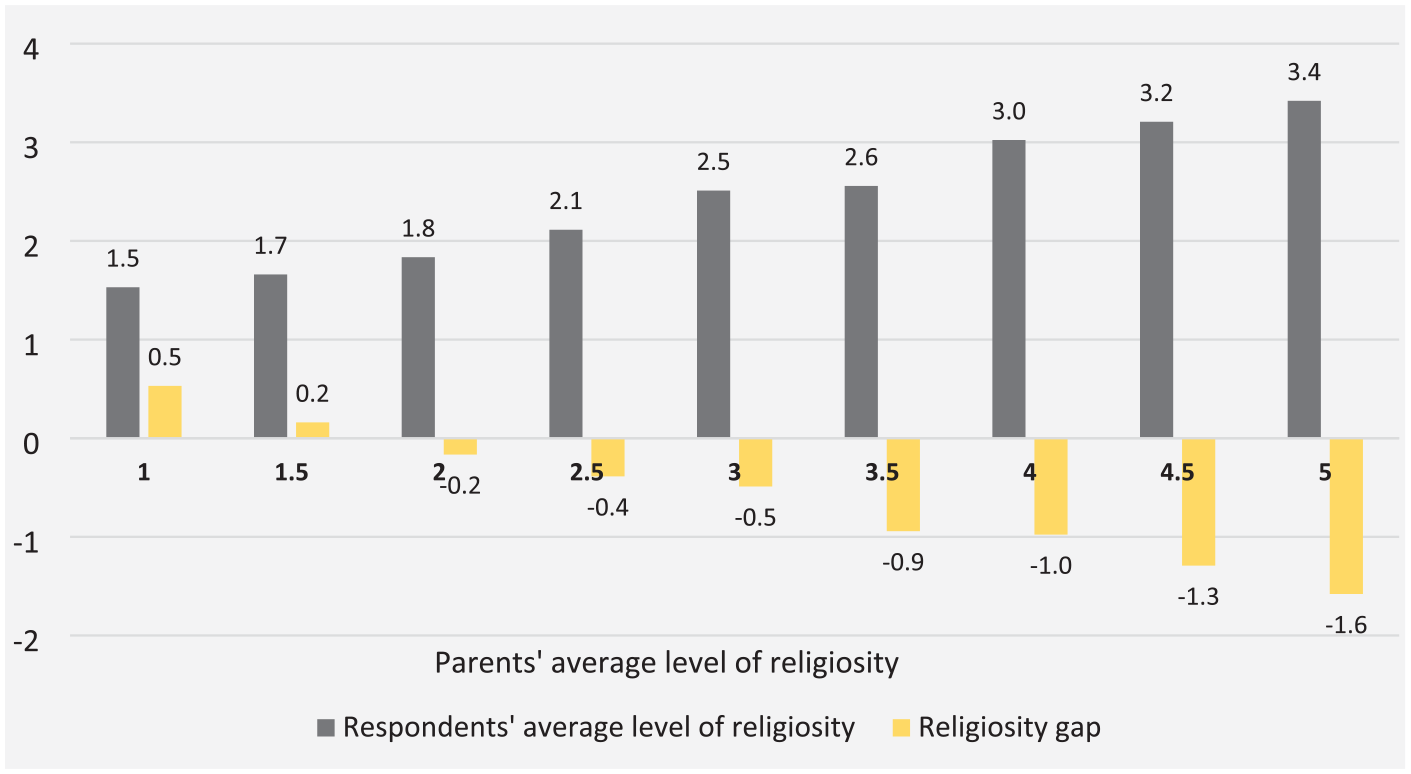
Average level of religiosity and religiosity gap relative to the parents’ average level of religiosity, Canada, 2021.
Model 3 (Table 1) showed that religious parents have a more significant impact on religious transmission compared to parents with a low level of religiosity. However, the more religious the parents are, the more their lifestyle contradicts that of the secular world around them. In a context of generalized secularization, several scholars claim that it is primarily the macro-sociological context that influences the decline of religion (Friesen, forthcoming; Voas and Storm, 2021). Without strong socialization, this distance between the outside world and the family acts as a deterrent between the individual and their piety. For religious parents who wish to pass on their religiosity to their children, the family is often the only environment where this can occur, as the vast majority of other socialization institutions (schools, sports teams, peer groups, etc.) are no longer predominantly religious. Gone are the days of Catholic scouting. Gone are the times when the parish priest also coached the hockey team. The secularization of Canadian society has contributed to the marginalization of religious groups, associations and institutions, making their access even more challenging. Extending religious socialization outside the home becomes a difficult, but not impossible, task, which can entail social and financial costs. It can mean moving to a larger city or choosing a private school for one’s children. Families who wish to increase the chances of successful transmission must then deliberately create their own religious milieu as the social environment becomes increasingly secular.
I reject the idea of a single cause to explain the intergenerational decline in religiosity. While it is now primarily the responsibility of the family to transmit religion – more so than the school, a group of friends or the parish, for example – the family is also an actor in the social world that participates in its transformation while being influenced by it at the same time. As an institution, the family is not external to the social world; it is constitutive of it. Therefore, it must adapt to its time in order to position itself as favourably as possible within its environment.
Conclusion
Throughout this article, I have shown that the effect of religious socialization was moderate and, on average, did not reproduce the parents’ average level of religiosity. Although some of the most religious parents discuss religion with their children and incorporate religion into their homes, it is among these individuals that the average gap in religiosity from one generation to the next is the largest. However, this does not represent the norm. It is parents with a moderate or low level of religiosity who transmit religion to varying degrees who are the primary figures behind these transformations. More importantly, it seems that no religious group is exempt from this decline (confirming the first hypothesis). The data also showed that it was the religious group in which the individual was brought up that was more important (partially confirming the fifth hypothesis), while the effect of the parents’ religious affiliation did not appear to be significant (confirming the second hypothesis). Rather, it is the mother’s level of religiosity and the role played by religion during childhood that have the strongest positive effect on the respondents’ level of religiosity (confirming the third hypothesis). The religious socialization achieved through talking about religion also contributes positively to the level of religiosity of the respondents, especially if it comes from the mother, grandparents and siblings (partly confirming the fourth hypothesis). In summary, the results do not allow me to assert that the average transmission effort will have a strong and positive impact on the average level of religiosity of the respondents. However, I do not exclude the possibility that meaningful transmission may occur in many cases. Canada is an increasingly secular country, and parents desiring to transmit their religiosity will need to work even harder to hope for any substantial results.
Footnotes
Appendix 1
Average level of religiosity (5-point scale) for each sociodemographic group and for their parents, Canada, 2021.
| Respondent | Respondent’s mother | Respondent’s father | Respondent’s parents | |
|---|---|---|---|---|
|
|
||||
| Male | 2.18 | 3.02 | 2.62 | 2.82 |
| Female | 2.60 | 3.18 | 2.72 | 2.95 |
|
|
||||
| Millennials | 2.06 | 2.85 | 2.43 | 2.63 |
| Xers | 2.38 | 3.25 | 2.72 | 2.98 |
| Baby boomers | 2.63 | 3.19 | 2.79 | 2.99 |
| Pre-boomers | 2.79 | 3.23 | 3.02 | 3.12 |
|
|
||||
| Atlantic | 2.48 | 3.24 | 2.58 | 2.90 |
| Quebec | 2.27 | 3.01 | 2.65 | 2.82 |
| Ontario | 2.56 | 3.26 | 2.84 | 3.05 |
| Prairies | 2.43 | 3.10 | 2.62 | 2.86 |
| British Columbia | 2.04 | 2.74 | 2.32 | 2.53 |
|
|
||||
| From immigrant background | 2.60 | 3.32 | 2.86 | 3.08 |
| Not from immigrant background | 2.26 | 2.98 | 2.57 | 2.77 |
|
|
||||
| Catholic | 2.91 | 3.62 | 3.24 | 3.42 |
| Mainline Protestant | 3.06 | 3.20 | 2.73 | 2.95 |
| Evangelical and Pentecostal | 4.21 | 4.10 | 3.30 | 3.71 |
| Islam | 3.32 | 3.99 | 3.70 | 3.84 |
| Other | 3.12 | 3.54 | 3.03 | 3.29 |
| None | 1.32 | 2.43 | 2.02 | 2.22 |
| All religious groups (no none) | 3.08 | 3.54 | 3.09 | 3.31 |
|
|
2.39 | 3.10 | 2.67 | 2.88 |
Source: The Transmission of Religion across Generations survey, Canada, 2021.
Acknowledgements
I would like to thank Peter Beyer, Alyshea Cummins and Isaac Friesen for their many contributions to this research. I am also grateful to Peter Beyer, Sarah Wilkins-Laflamme and Jörg Stolz for their generous comments on earlier drafts of this article.
Declaration of conflicting interests
The author declared no potential conflicts of interest with respect to the research, authorship and/or publication of this article.
Funding
The research reported here was made possible through the support of the John Templeton Foundation (grant number #61361). The opinions expressed in this article are those of the author and do not necessarily reflect the views of the John Templeton Foundation.
