




Abstract
Religious nones – or, in other words, those who say that they have no religion when asked – are one of the fastest growing demographics in Canada, especially among young adults aged 18–35. Using statistical data from a 2019 Millennial Trends Survey, a diversity of approaches to religion, spirituality and non-religion can be seen within this broad category of individuals. Based on these findings, the author argues that the two main theoretical frameworks of ‘secular transition’ and ‘spiritual but not religious’ should be understood as complementary, rather than contradictory, in understanding the religious none phenomenon. Evidence of five distinct regional patterns of religious nones across the country is found, which are designated as ‘spiritual British Columbia’, ‘dispersed Prairies’, ‘vestigial and uncertain Ontario’, ‘non-believing Quebec’ and ‘stigmatized Atlantic Canada’ nones.
Having studied those who say that they have no religion for a number of years (Thiessen and Wilkins-Laflamme, 2017, 2020; Wilkins-Laflamme, 2015, 2021, 2022; Wilkins-Laflamme and Thiessen, 2020) and having travelled the country to speak on my research findings, I have come to know some of the common assumptions that are made about those who we designate as ‘religious nones’. Some people I have encountered assume that all nones are atheists; others presume instead that they are all personally quite spiritual. Some see the nones as liberated from oppressive forms of institutionalized religion; others see them as carrying a God-shaped hole around with them, just waiting for that special someone or something to guide them back to a religious group. There are many different types of assumptions made about religious nones, even in a place like Canada where individuals who do not affiliate with a religious tradition have represented a substantial share of the population for many decades.
The goal of this article is to develop a better understanding of who this rapidly growing demographic of nones actually represents in Canada, along with nones’ internal diversity, among the generation of adults in which nones are the most numerous: the millennial generation. Using novel quantitative data collected in March 2019 from the Millennial Trends Survey, aspects of two main theoretical frameworks that speak to the continued presence and popularity of religious nones in western societies are put to the test: ‘secular transition’ theories and ‘spiritual but not religious’ (SBNR) theories. There is also a special focus on the regional dynamics among young adult religious nones across Canada – something that has yet to be done. Canada is known for its large regional differences, including when it comes to its religious landscape. To what extent does this regionalism also extend to the nature of its non-religious populations?
Background on religious nones in Canada
Religious nones – or, in other words, those who say they have no religion when asked – have been growing as a share of the population in Canada since the 1970s, when Statistics Canada included ‘no religion’ as a distinct category in the census. Most of this growth of religious nones has happened between generations (see Figure 1). In Statistics Canada’s 2019 General Social Survey, for example, 47% of millennials between the ages of 15 and 34 said that they had no religion, compared with 33% among Generation X (aged 35–54), 20% among boomers (aged 55–74) and 13% among the Silent Generation (aged 75 years and older). The rates of religious nones remain relatively constant within both the Silent Generation and boomers over the period of 1985–2019, at around 10% and 15%, respectively, for most years. When Generation X and millennial cohorts first come onto the survey scene as teenagers and young adults in the 1980s and 2000s, their rates of no religion in turn initially resemble those of the previous generation. However, over the course of their late teen and early adult years, these rates increase for both Generation X and millennials.
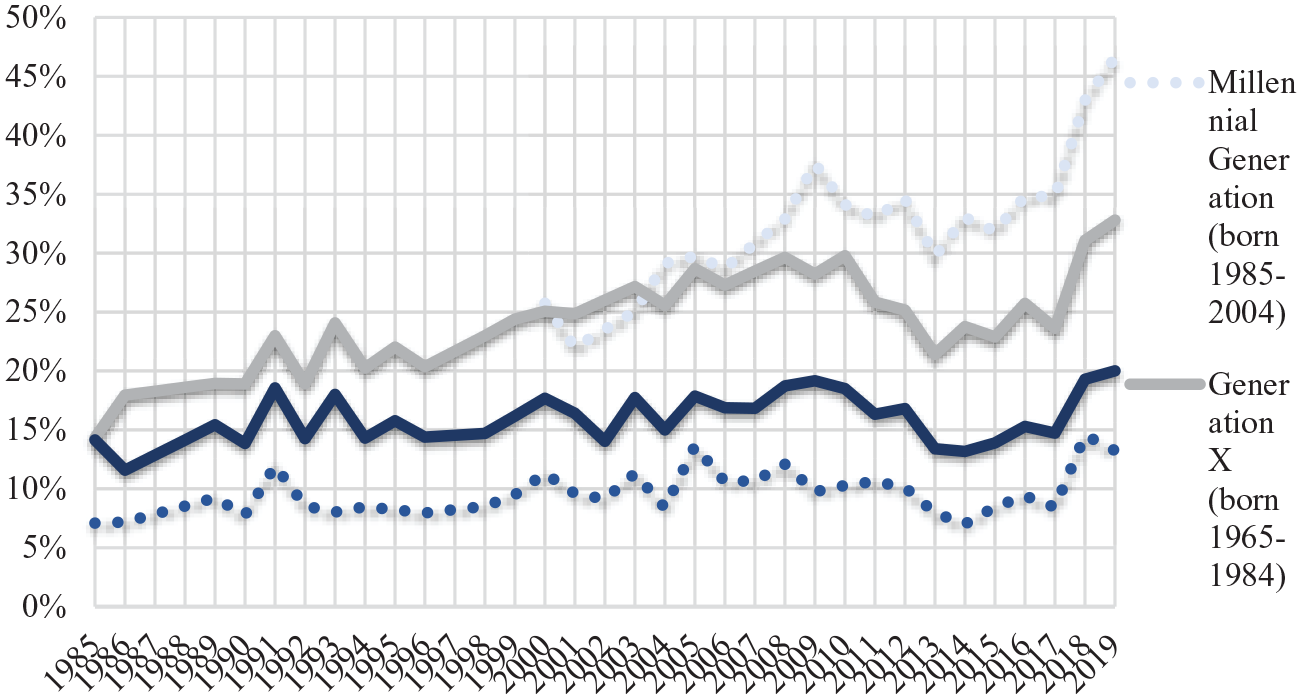
Rates of no religious affiliation (%) by generation, Canada, 1985–2019.
An ongoing theoretical debate
These trends are not unique to Canada but are found across most traditionally Christian North American and European nations (Sherkat, 2014; Voas, 2009; Zuckerman et al., 2016). Two main frameworks in the fields of sociology of religion and religious studies offer different explanations for what we see unfolding. First, secular transition theory understands the decline of religiosity indicators, including religious affiliation, as a consequence of long-standing, progressive and generational religious decline over time, driven by changing socialization patterns and social environments among important segments of western populations (Brauer, 2018; Bruce, 2011; Stolz, 2019; Voas, 2008). Many members of older generations initially diminished their religiosity by gradually dropping their regular church attendance and religious group activities that were once prevalent during their childhood years. In many regions, such as Ontario and Quebec for Canada, this happened especially among the Boomer Generation in the mid 20th century. However, in other countries and regions, this process began earlier, such as with the Silent Generation in the earlier part of the 20th century in places like British Columbia, Scotland, England, Sweden, France and the Netherlands. Moreover, in other nations and regions, this process began much later, such as with Generation X in the 1980s and 1990s in Atlantic Canada, Ireland and Poland.
Religious identification and occasional involvement with a religious group persisted for many of these individuals however (e.g. for religious holidays or rites of passage), as they maintained social and cultural ties to their religious tradition and experienced remaining normative expectations surrounding religion (Bibby and Grenville, 2013; Day, 2011; Meunier and Wilkins-Laflamme, 2011; Thiessen, 2015). Yet when these generations had children of their own, more of these children were raised without explicit religious socialization (they did not attend religious services regularly with their parents or receive regular religious education at school or at home) and grew up in much more secular social environments than in the past. This, in turn, has driven larger numbers of members of younger generations not to see the need to have any ties, including identity ties, with religion (Crockett and Voas, 2006; Manning, 2015; Thiessen and Wilkins-Laflamme, 2017, 2020).
In this framework, the demand for religious goods (beliefs, activities and identities tied to organized forms of religion) as well as spiritual goods (less conventional beliefs, activities and identities tied to the superempirical and supernatural) is not seen as a fundamental need among all humans across time and cultures, but rather as socially constructed in a given time and place. The argument is that we currently find ourselves in a time and place where this need has not been learned or socially constructed among an important segment of the population. Inspired by classic secularization models but also building more complexity into them, the most well-known contemporary example of a secular transition study is that of David Voas (2009). Using 2002 European Social Survey data, Voas maps out where many European nations currently find themselves in this larger process of religious decline, which he terms ‘secular transition’ (argued to be a quasi-universal process unfolding across modern western democracies) and is measured notably through the indicators of religious affiliation, salience of religion in life and frequency of religious service attendance.
In contrast to the secular transition framework, where researchers focus on declining institutional expressions of religious affiliation, belief and practice, the second group of SBNR theories argues that religion and spirituality are not necessarily declining as such, but are instead changing (Ammerman, 2014; Beaman and Beyer, 2013; Chandler, 2008; Davie, 1994; Drescher, 2016; Fuller, 2001; Heelas and Woodhead, 2005; Houtman and Aupers, 2007; Roof, 1999). Rather than narrowly defining and measuring religion against conventional institutional markers, such as church attendance or other communal-oriented religious activities, the SBNR framework stresses ongoing private spirituality among individuals. This can include, for example, belief in a god, supernatural beings or a higher power; belief in an interconnected natural world and universe; or belief in some form of afterlife, prayer, meditation or mindfulness activities. Individuals draw on a number of beliefs, rituals and practices from a variety of sources, some of which are linked to religious groups and some of which are not, to build and maintain their own personalized spiritual and meaning systems away from church doors (Hervieu-Léger, 1999). These more personalized spiritual and meaning systems may infuse and inspire not only special activities, but also the ordinary aspects of life at home and work, relationships and health (Ammerman, 2014). The trend towards no religion is understood by this framework as a shift to more innovative and individualized forms of believing and spirituality in people’s quest to continue to answer their fundamental spiritual needs.
This move away from organized religion and towards more personalized spiritual and meaning systems is seen by many scholars of the SBNR framework as a more permanent shift in modern individualized consumer societies. Those arguing for secular transition theories do not deny that these spiritual changes are happening, but usually see them more as transitional phases towards further declines of spirituality and belief in the superempirical among large segments of non-religious populations. Others, including supply-side theorists inspired by Rodney Stark and Roger Finke’s (1992, 2000) work in the USA, see potential for a revival of more organized forms of religion in the remaining demand for spiritual products among the population highlighted by the SBNR framework (see, notably, Reginald Bibby’s work for the Canadian case; Bibby, 2017; Bibby et al., 2019). For these scholars, churches are simply not innovating enough to offer those religious and spiritual products that individuals want today. The current decline of organized religion is thus seen as mainly the result of a consumer frustration of sorts, and reversible under the right conditions.
Distinct regional landscapes
These fundamental debates about what is really behind the rise in the number of religious nones continue in the disciplines of sociology of religion and religious studies. What has received less attention is the regional variations in the rates of no religion found within many countries, including within Canada. As illustrated in Figure 2, and as some previous studies have found (Dilmaghani, 2018, 2020; Thiessen and Wilkins-Laflamme, 2020; Wilkins-Laflamme, 2014), there are strong regional disparities in the rates of no religion across the country that have been present for many decades. Across all birth cohorts, the rates of no religion are highest in British Columbia and Northern Canada, and lowest in Atlantic Canada and Quebec, with Ontario and the Prairies in between.
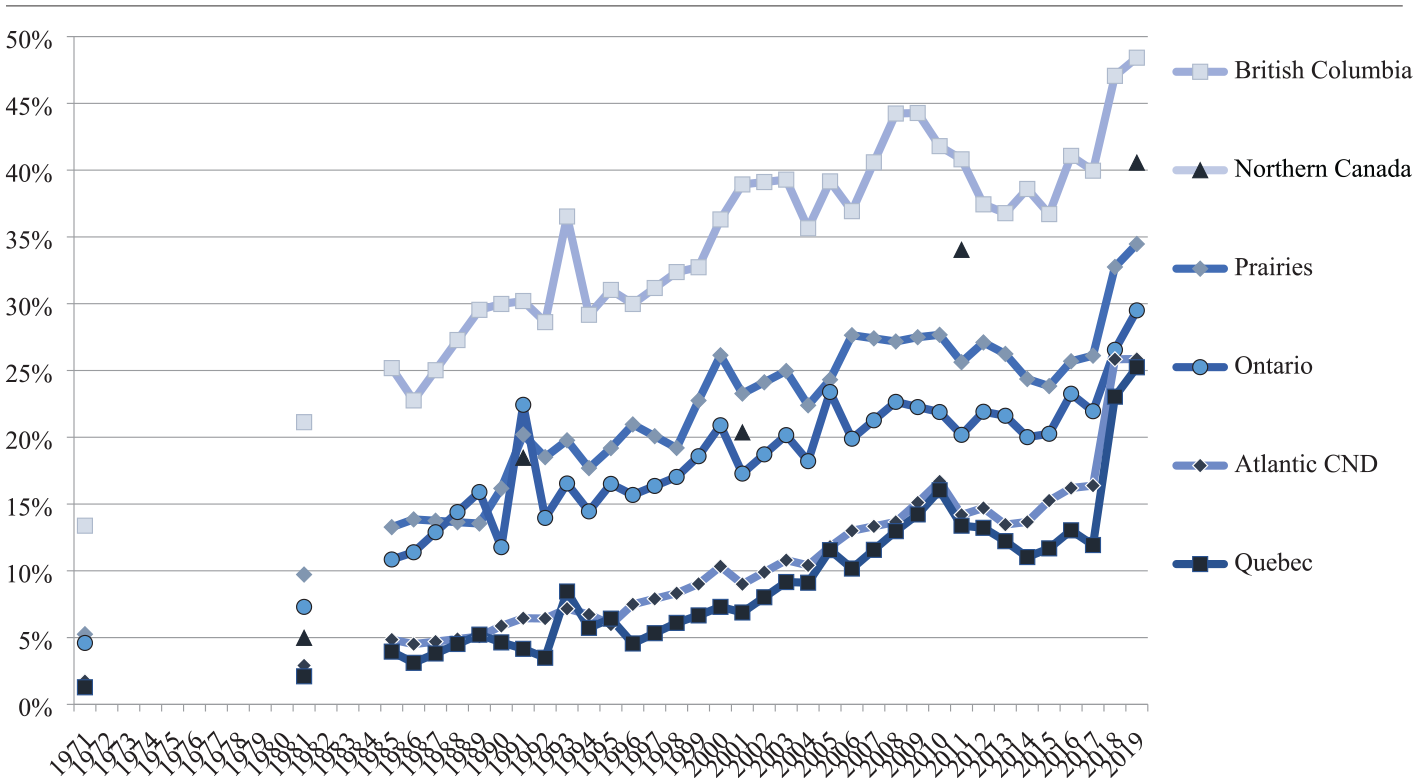
Evolution of rates of religious nones (%) by census region, Canada, 1971–2019.
Indeed, the Canadian religious landscape has always been, and continues to be, defined by large regional differences: from (1) Old Canada Christianity, which is still at its strongest in the Atlantic provinces, with 53% of the general adult population affiliated with a mainline Protestant denomination or Catholicism, as well as 24% attending religious services at least once a month in 2019 (Statistics Canada, 2020), to (2) cultural Catholic Quebec, where the majority of residents identify as Catholic but have also had a love–hate relationship with the Church since the 1960s, and where rates of religious service attendance as well as religious marriages among couples are the lowest in North America (Lemieux and Montminy, 2000; Meunier and Wilkins-Laflamme, 2011), to (3) ever more religiously and culturally diverse Ontario, being fed especially by non-western immigration (especially in the Greater Toronto Area), to (4) the Prairies, where Bible Belts and relatively high rates of no religion coexist, to (5) British Columbia and Northern Canada, where European settlement and Christianity came later, and organized Christianity did not seem to become entrenched in as large a segment of both Indigenous and settler European populations in the 19th and 20th centuries (Block, 2017; Marks, 2017).
These regional divisions in the Canadian religious landscape impact, in turn, the size of non-religious populations. Strong ties between Protestant, Roman Catholic and cultural identities in Atlantic Canada and Quebec seem to make religious affiliation more resistant to decline when faced with the growing post-1960s forces of moral liberalism, individualism and pluralism. Instead of large groups of religious nones, these two Canadian regions are characterized by sizeable proportions of marginal affiliates who identify as belonging to a religious tradition and may occasionally attend religious services for holidays and rites of passage, but do not have frequent contact with a religious group (Dilmaghani, 2018, 2020; Meunier and Wilkins-Laflamme, 2011; Wilkins-Laflamme, 2014).
As one moves west across the country, these current-day cultural and family ties to religion seem to grow weaker. We find the most pronounced case of this in British Columbia. Although many Christian, especially Protestant, groups and denominations encompassed the majority of European settlers in the 19th and early 20th centuries in British Columbia, Christianity never became as institutionalized in the province as it did elsewhere in the country, with rates of regular church attendance always having been lower in the region (Block, 2017; Marks, 2017). With no one religious group having established strong ties with the overall regional culture, and with individual and family ties to religious groups often being more precarious in the region, religious affiliation was not as resistant to decline from the 1960s onwards (Clarke and Macdonald, 2017; Putnam and Campbell, 2010). Nowhere did the normative expectations of belonging to a religion disappear so utterly among such a large segment of the population as they did in British Columbia (Wilkins-Laflamme, 2017). Looking north to the Yukon, the Northwest Territories and Nunavut, Indigenous peoples make up a much larger share of the population in these regions (53% across all three territories according to the 2016 census). A large portion of First Nations, Inuit and Métis in turn do not identify with a religion: 32% of First Nations, Inuit and Métis across Canada say they have no religion according to Statistics Canada’s 2011 National Household Survey. They often understand religious labels as a further dimension of settler colonialism and removed from their own nation’s spiritualties, traditions and ways of life.
Yet how deep does the regional impact on non-religion in the country go? Do we see differences only in the size of religious-none populations or also in the forms that non-religion takes in each region? Are Canadian regions just at different stages in a similar process of secular transition, as put forward by Voas (2009) and the secular transition framework? This would imply that where nones form a larger segment of the population (have been increasing in size for longer), like in British Columbia, they are further along the secularization process and score lower on spirituality and supernatural belief indicators. Or are there high rates of spiritual belief and practices removed from conventional religion among most nones in the country, in line with the SBNR framework? Or do we instead see distinct configurations of religious nones when it comes to their world views and spiritual and secular practices, as well as their attitudes towards religion, and different configurations of nones between Canadian regions, impacted by each region’s distinct social environment and family histories?
Methodology
In order to answer these research questions, data from the 2019 Millennial Trends Survey are used. The Millennial Trends Survey was administered online between 4 and 27 March 2019 in both English and French by the present author at the University of Waterloo. The questionnaire contained a total of 69 questions on the respondents’ sociodemographic characteristics, (non-)religious and (non-)spiritual affiliations, beliefs and practices, friendship networks, and inclusivity attitudes. 1 The survey was reviewed by and received ethics clearance from the University of Waterloo’s Research Ethics Committee.
A total of 2514 respondents aged 18–35 from the USA and Canada completed the 15-minute web survey. This study focuses on the Canadian subsample of 1508 young adults. The respondents were recruited through Léger’s panel of registered members to complete the survey, which was hosted by the University of Waterloo’s Survey Research Centre. 2 Léger recruits a large portion (70%) of its online panel using probability techniques (random digit dialling). For the 2019 Millennial Trends Survey, a soft launch was successfully performed on 4 March 2019, with 560 email invitations distributed. After reviewing the completed survey data, a full launch began on 5 March. Age, gender, regional and education-level quotas were applied during the initial random selection of respondents, and later monitored as responses came in to adjust further recruitment efforts and completes. 3 Potential respondents were sent an initial email invitation to complete the web survey and were reminded up to two times, if necessary, to complete the survey. A total of 26,716 invitations were sent to Canadian panel members.
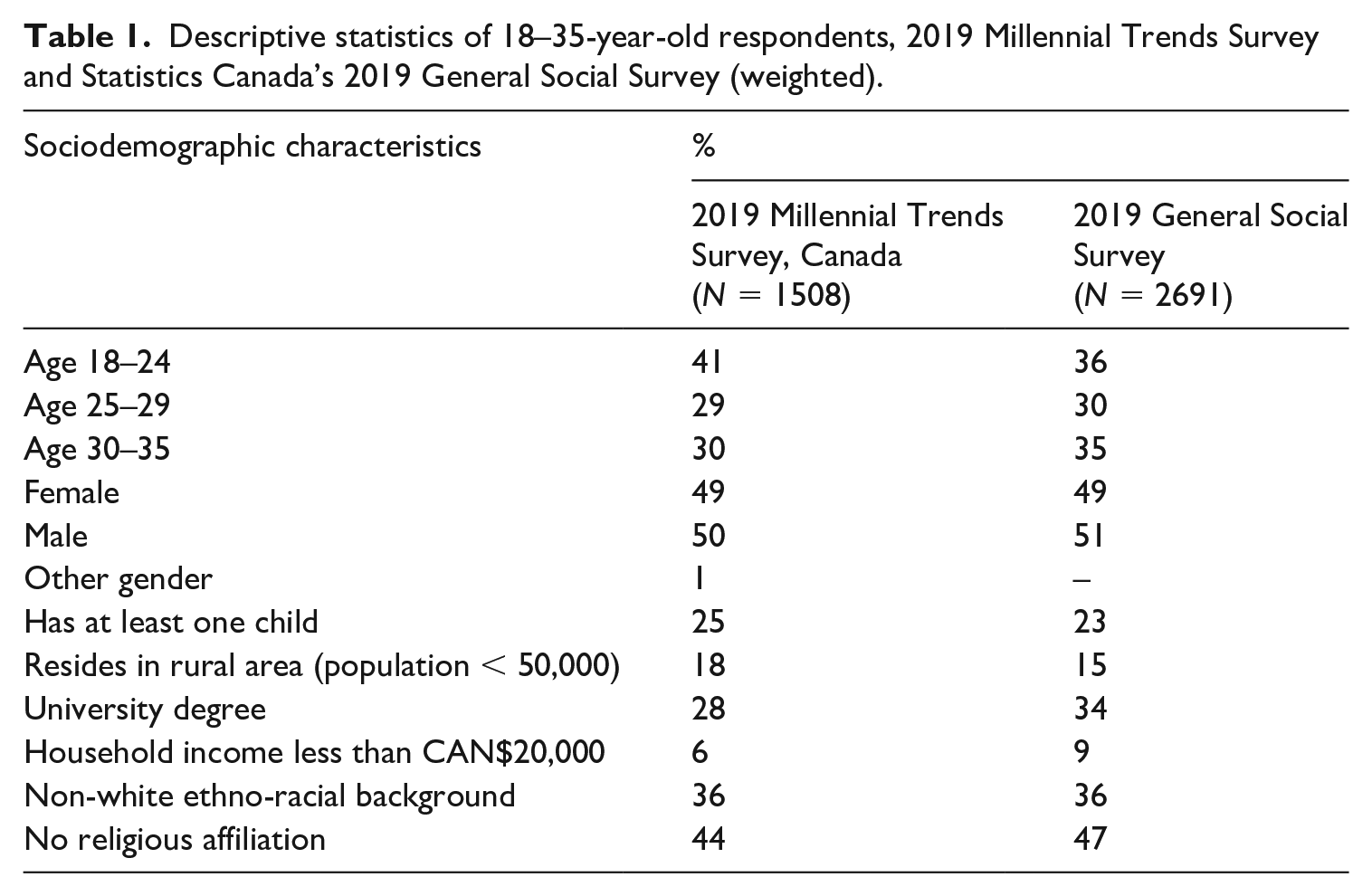
The final response rate for the Millennial Trends Survey was 6.1% in Canada. This response rate may have been slightly lower than what is common for online surveys because of the additional recruitment efforts required to fill some of the harder-to-reach quotas (notably, young adult males with no university education). Post-stratification weights were then created and applied to the statistical analyses in order to achieve greater young adult population representativeness on the variables of country of birth, household income and race/ethnicity. 4 Table 1 compares the sociodemographic characteristics of the weighted Canadian young adult subsample from the 2019 Millennial Trends Survey with the weighted 18–35-year-old subsample from Cycle 34 (2019) of Statistics Canada’s General Social Survey. The 2019 Millennial Trends Survey Canadian subsample comes very close to matching the key sociodemographic characteristics from the 2019 General Social Survey subsample of 18–35-year-olds, with a slight over-representation of 18–24-year-olds and a slight under-representation of those with a university degree in the 2019 Millennial Trends Survey subsample.
Descriptive statistics of 18–35-year-old respondents, 2019 Millennial Trends Survey and Statistics Canada’s 2019 General Social Survey (weighted).
In the Millennial Trends Survey, respondents were asked, ‘What, if any, is your religion?’, and were provided with 18 categories to choose from, including 5 ‘no religion’ options: ‘agnostic’, ‘atheist’, ‘secular humanist’, ‘spiritual with no religion’ or ‘no particular preference’. Forty-four percent of Canadian young adult respondents selected one of these ‘no religion’ categories and are considered religious nones for the purposes of this study.
In this study, we explore socialization, identity, belief, religious, spiritual and non-religious behaviour, social ties and attitudes towards religion as the outcomes measured in the Millennial Trends Survey among religious nones across the five census regions covered by the survey. 5 The Canadian sample comprises 56 young adult nones residing in Atlantic Canada at the time of the survey, 180 from Quebec, 219 from Ontario, 124 from the Prairies and 110 from British Columbia, for a total of 689 nones overall. The observed differences between these nones in the 2019 Millennial Trends Survey give us a first informative glimpse of potential regional patterns emerging among the nones. The outcomes of religious nones as a whole are also compared with the outcomes among marginal affiliates (respondents affiliated with a religion but attending religious services less than once a month; N = 459) and active affiliates (respondents affiliated with a religion and attending religious services at least once a month; N = 357) in the country.
The statistical estimates in this study come from a series of Ordinary Least Squares and binary logit regression models. These models control for the respondent’s age, gender, labour force status, household income, level of education, world region of birth, non-white ethno-racial background and rural/urban residence. Controlling these sociodemographic variables at their means when generating outcome estimates allows one to better isolate regional and affiliate dynamics that go beyond variations in the demographic composition of young adult populations. Due to space limitations, the focus here is on the predicted means and probabilities of a wide variety of religious, spiritual and secularist outcomes in order to observe the size of differences between regions and between affiliate types, rather than focusing on statistical significance levels (although the larger regional and affiliate-type differences mentioned in the results section below are statistically significant in the regression models).
Results
(Non-)religious socialization, identities and (non-)beliefs
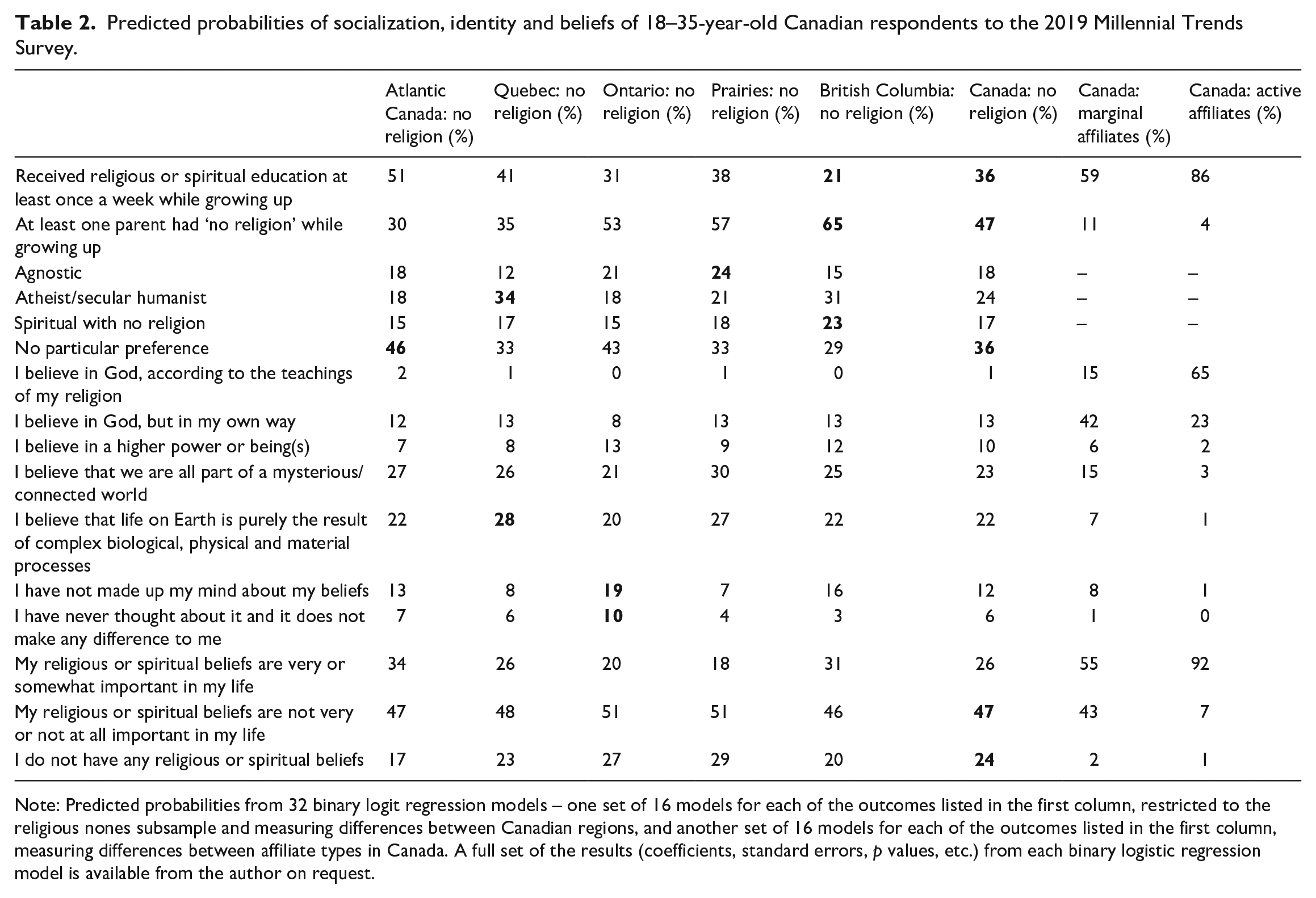
We begin by delving into the socialization, identity and belief patterns among young adults (see Table 2). There is a large body of existing research showing the importance of childhood religious socialization for a person’s adult religious identity, beliefs and practices (Bengtson et al., 2013; Sherkat, 2014; Smith and Snell, 2009). Those children who are raised in a more religious family and community environment are much more likely to remain religiously active as adults. Non-religious childhood socialization also plays a crucial role among non-religious adult populations (Manning, 2015; Thiessen and Wilkins-Laflamme, 2017; Wilkins-Laflamme, 2020; Zuckerman et al., 2016). Just over a third of the Canadian young adult nones said they received some form of religious or spiritual education at home, school or a place of worship at least once a week while growing up, compared with the predicted probabilities of 59% among marginal affiliates and 86% among active affiliates. In turn, just under half of the young adult Canadian nones said they had at least one non-religious parent, compared with the predicted probabilities of only 11% among marginal affiliates and 4% among active affiliates.
Predicted probabilities of socialization, identity and beliefs of 18–35-year-old Canadian respondents to the 2019 Millennial Trends Survey.
Note: Predicted probabilities from 32 binary logit regression models – one set of 16 models for each of the outcomes listed in the first column, restricted to the religious nones subsample and measuring differences between Canadian regions, and another set of 16 models for each of the outcomes listed in the first column, measuring differences between affiliate types in Canada. A full set of the results (coefficients, standard errors, p values, etc.) from each binary logistic regression model is available from the author on request.
The more secular British Columbian context is apparent in these socialization patterns, with British Columbian nones the least likely to have received frequent religious education growing up (only 21% said that they did, once sociodemographics are controlled for). British Columbian nones also contain the largest share of respondents with at least one non-religious parent (65%). By contrast, more young adult nones in Atlantic Canada and Quebec seem to have disaffiliated from a religious childhood upbringing.
For young adult nones in Canada at the time of the survey, the most popular non-religious identity is not a specific secularist, atheist, agnostic or spiritual belonging as such, but rather a seeming indifference towards such labels: the predicted probability of none respondents selecting the ‘no particular preference’ category is 36% in the survey. This is especially the case in Atlantic Canada, where nearly half of nones selected this category over the four other non-religious identities. In turn, atheism and secular humanism find their stronghold in Quebec, where 34% of nones identified with these categories. Twenty-eight percent of Quebec nones also said that they believed first and foremost that life on Earth is purely the result of complex biological, physical and material processes – the highest rate of belief in this more material and scientific world view among young adult nones in Canada.
Agnosticism finds its highest share of nones in the Prairies (24% of Prairie nones) and ‘spiritual with no religion’ in British Columbia (23% of British Columbian nones). So, although a more spiritual non-religious identity seems to be present among a substantial portion of nones, it does not encompass the entirety or even most of the non-religious young adult population in Canada, as some SBNR scholars would argue. Indeed, just under half of Canadian millennial nones said that religious or spiritual beliefs were not very or not at all important in their lives, and another 24% said they had no religious or spiritual beliefs at all.
Yet the region where the highest rates of religious nones can be found – British Columbia – is not the region that is characterized by the highest rates of other forms of non-religion, including non-belief as well as non-spiritual identities and world views. This, then, also raises doubts, at least within the Canadian landscape, about the secular transition framework’s argument that religious decline is one large process of secular transition in which those regions that are more advanced in non-religious identities should also be further along in the decline of spiritualities.
Religious, spiritual and non-religious behaviour
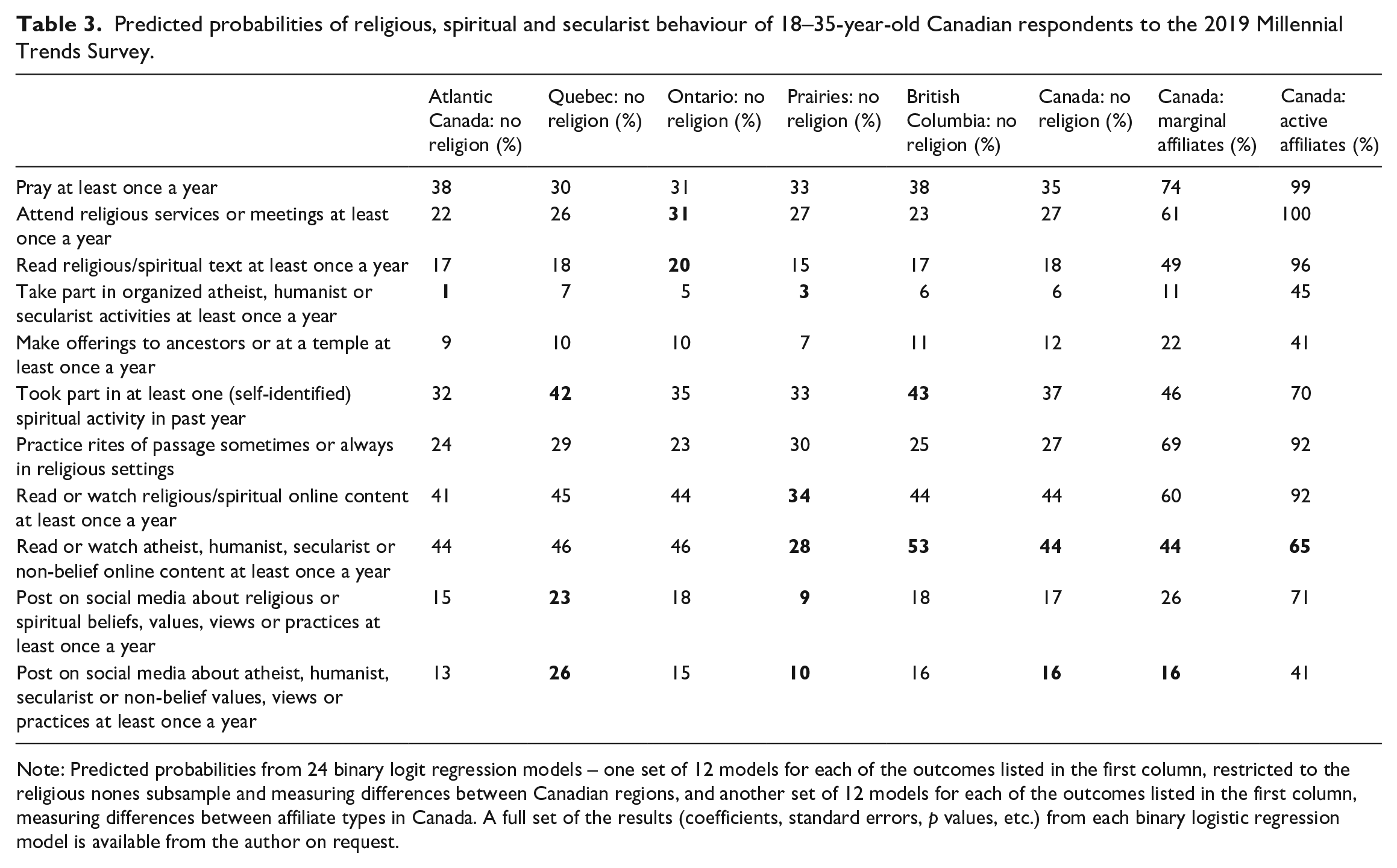
What, then, of millennial nones’ behaviour? What do Canadian millennials actually do in terms of religion, spirituality and non-religion in their daily lives? Table 3 presents a series of results on this topic. Young adult nones across the country score lower than marginal and active affiliates not only on indicators of more organized religious behaviour, such as religious service attendance and the practice of rites of passage in a religious setting, but also on all the more spiritual and even non-belief in-person and digital activities measured in the survey and included in Table 3. These more spiritual and non-belief in-person and digital behaviours that a majority of young adult Canadian nones did not practice at all in the year prior to the survey include prayer; reading religious or spiritual texts; making offerings to their ancestors or at a temple; activities that the respondents themselves identified as spiritual; reading or watching online religious or spiritual content; posting on social media about religion or spirituality; taking part in organized non-belief activities (e.g. with organizations such as the Council for Secular Humanism, the Secular Student Alliance, Atheist Alliance International or the Freedom from Religion Foundation); reading or watching non-belief online content; and posting on social media about non-religion or non-belief. The only exceptions to nones scoring lower on all of these indicators than marginal and active affiliates are with reading or watching non-belief online content and posting about non-religion or non-belief on social media, for which young adult nones take part at the same rates as young adult marginal affiliates in the country.
Predicted probabilities of religious, spiritual and secularist behaviour of 18–35-year-old Canadian respondents to the 2019 Millennial Trends Survey.
Note: Predicted probabilities from 24 binary logit regression models – one set of 12 models for each of the outcomes listed in the first column, restricted to the religious nones subsample and measuring differences between Canadian regions, and another set of 12 models for each of the outcomes listed in the first column, measuring differences between affiliate types in Canada. A full set of the results (coefficients, standard errors, p values, etc.) from each binary logistic regression model is available from the author on request.
That said, an important proportion of nones in Canada do take part in more personalized spiritual activities away from organized religion, with, for example, a predicted probability of 37% of nones saying that they had practised at least one self-identified spiritual activity at least once in the year prior to the survey (such as meditation, mindfulness and breathing activities, yoga, outdoor nature activities, prayer, art, writing, dance or music). These behavioural SBNR nones do not, however, represent the majority of those who said they had no religion. Additionally, although another important share of young adult nones in Canada take part in non-belief activities, with, for example, a predicted probability of 44% of nones reading or watching online content on atheist, humanist, secularist or non-belief values, ideas or practices at least once in the year prior to the survey, this group also does not represent the majority of those who said they had no religion. Young adult active affiliates seem to be more involved even in these non-belief behaviours, with, for example, a predicted probability of 65% of them reading or watching online non-belief content at least once in the year prior to the survey, although they may be doing so for different reasons or they may be defining non-belief content differently.
British Columbian nones stand out in a number of ways from nones in the rest of the country regarding their behaviour, including a greater prevalence of practised activities identified as spiritual experiences in British Columbia (among 43% of British Columbian nones), along with in Quebec (among 42% of Quebec nones), and more British Columbian nones reading or watching online content on atheist, humanist, secularist or non-belief values, ideas or practices at least once in the year prior to the survey (53%). As well as more Québécois nones practising self-identified spiritual activities, they are also the social media kings and queens among nones in the country, with proportionally more of them posting about religious or spiritual beliefs, values, views or practices (23%), as well as about atheist, humanist, secularist or non-belief values, views or practices (26%) at least once in the year prior to the survey.
More Ontario nones, in turn, take part in infrequent religious service attendance (a predicted probability of 31% of Ontario nones attend at least once a year) and read religious or spiritual texts (a predicted probability of 20% of Ontario nones do so at least once a year). Finally, taking part in organized non-belief activities with groups such as the Council for Secular Humanism, the Secular Student Alliance, Atheist Alliance International or the Freedom from Religion Foundation, for example, is relatively uncommon among young adult nones across the country. It is especially uncommon among nones in both Atlantic Canada and the Prairies. In the Prairies, we also find lower levels of online activities of all sorts, including consuming religious, spiritual and non-belief content online, and posting about such topics on social media.
Social ties
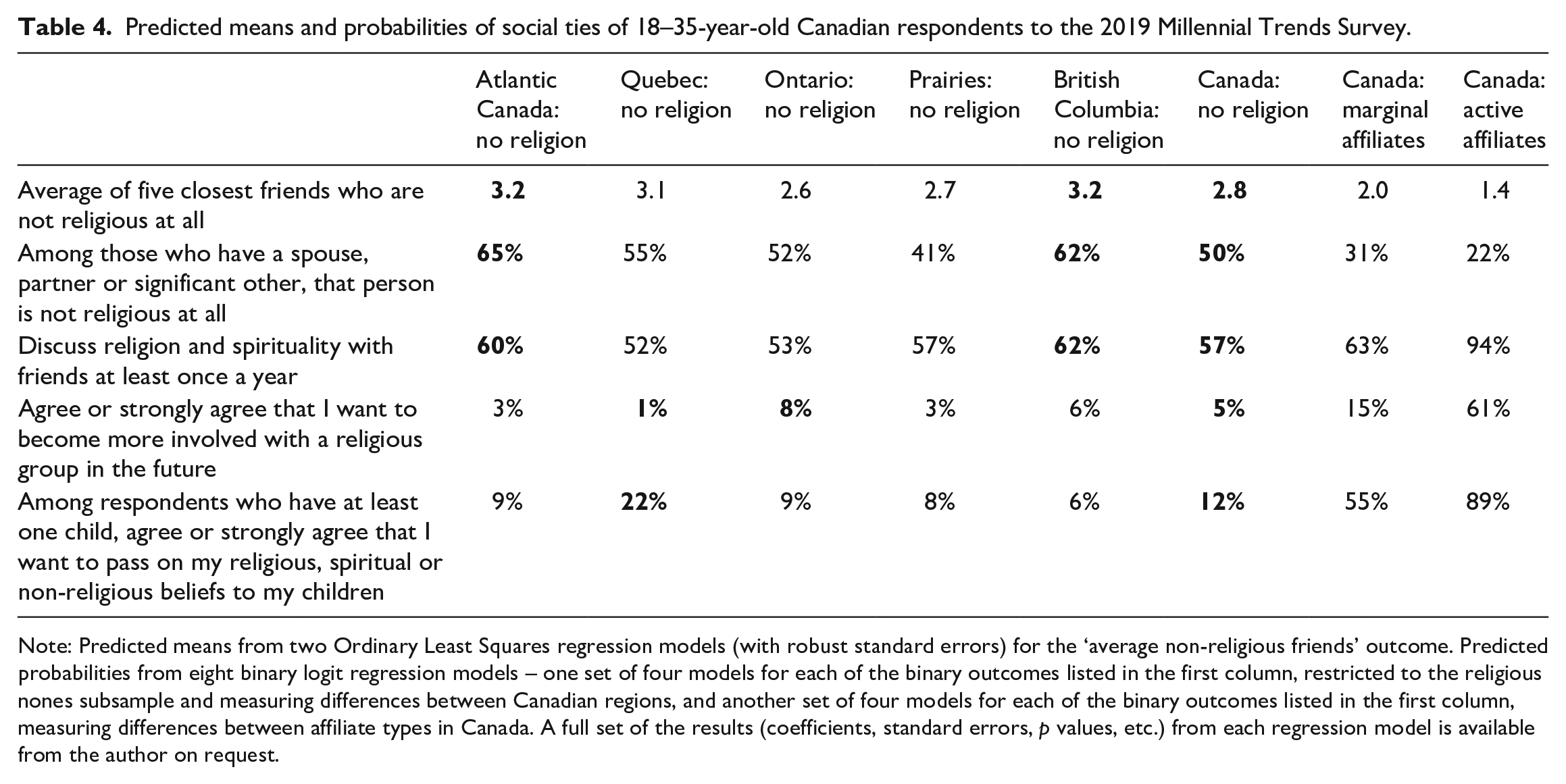
Extending the analysis to young adult nones’ social interactions and networks, we can see first of all from the results in Table 4 some group closure at play across the country. Like with homophily trends among the more religious (Cheadle and Schwadel, 2012; McPherson et al., 2001; Olson and Perl, 2011; Smith et al., 2014), nones are more likely to have close friends who are not religious at all (a predicted mean of 2.8 out of 5 closest friends), compared with marginal and active affiliates. Of their five closest friends, 51% of young adult nones in Canada said that three or more of these friends were not religious at all. Young adult nones are also more likely to have a spouse, partner or significant other who is also not religious at all (a predicted probability of 50% of partnered nones said so), once again compared with marginal and active affiliates. These trends are a product of nones picking their friends and partners from the available pool of people around them in their social environments, choosing friends and partners with values and behaviours similar to their own, and friends and partners becoming more like each other as they spend time together (Cheadle and Schwadel, 2012; McPherson et al., 2001; Olson and Perl, 2011; Smith et al., 2014). These homophily and endogamy trends are especially strong among nones in both Atlantic Canada and British Columbia. In British Columbia, this may be more a product of a larger non-religious population available to nones for friendships and relationships. In Atlantic Canada, however, where the overall religious none population is smaller, this may reflect greater group closure due to greater external pressures and stigma from a remaining religious regional environment.
Predicted means and probabilities of social ties of 18–35-year-old Canadian respondents to the 2019 Millennial Trends Survey.
Note: Predicted means from two Ordinary Least Squares regression models (with robust standard errors) for the ‘average non-religious friends’ outcome. Predicted probabilities from eight binary logit regression models – one set of four models for each of the binary outcomes listed in the first column, restricted to the religious nones subsample and measuring differences between Canadian regions, and another set of four models for each of the binary outcomes listed in the first column, measuring differences between affiliate types in Canada. A full set of the results (coefficients, standard errors, p values, etc.) from each regression model is available from the author on request.
Over half (a predicted probability of 57%) of young adult nones in Canada discuss religion and spirituality with their friends at least once a year – which is lower than among marginal and active affiliates, but still a substantial portion. This is especially the case among Atlantic Canadian and British Columbian nones, where 60% and 62%, respectively, did so at least once in the year prior to the survey.
A much smaller proportion of young adult nones – only 5% for all of Canada – indicated that they would like to be more involved in a religious group in the future. This predicted probability is at its highest in Ontario, at 8% of young adult nones, and at its lowest in Quebec, at only 1% of young adult nones. There is therefore not much evidence here for supply-side theories arguing for a potential return to organized religion among an important segment of religious nones if religious supply were to improve, supporting Thiessen’s (2015) similar findings in this regard.
Only 12% of young adult nones who had at least one child indicated that they wanted to pass on their religious, spiritual or non-religious beliefs to their children. This is compared to 55% of young adult marginal affiliates with children and 89% of young adult active affiliates with children. This predicted probability reaches its highest among nones in Quebec, at 22%. This is in line with findings in existing research that non-religious parents often favour a hands-off approach to parenting when it comes to religion, spirituality and non-religion, leaving learning and choices on these matters up to their children. As Zuckerman et al. (2016: 127) note: ‘Secular people tend toward nonconformity, independence, and antiauthoritarianism . . . to base their maturational goals on personal independence, and their childrearing philosophy emphasizes autonomy rather than obedience to authority’. Yet the analyses in this article indicate that 90% of Canadian millennials who said that both their parents had no religion during their childhood also said they had no religion themselves at the time of the survey. This further supports the finding in Thiessen and Wilkins-Laflamme’s study that modeling a ‘hands-off’ approach to religion in the home does, in fact, pass on a particular individualist and secular orientation to religion and the world more generally. Such an approach strengthens the likelihood that someone who identifies as a religious none will raise children who also say they do not identify with a religion. (Thiessen and Wilkins-Laflamme, 2020: 53)
Attitudes towards public religion and religious groups
In the previous section, we saw that young adult nones in Canada are more likely to have social ties with other non-religious individuals, compared with young adult marginal and active affiliates. That said, most nones also do not exclusively associate with only non-religious individuals. For example, 48% have at least one close friend involved with a religious group. So, what are young adult nones’ attitudes towards religion, both in its more public forms and when it comes to members of various religious traditions?
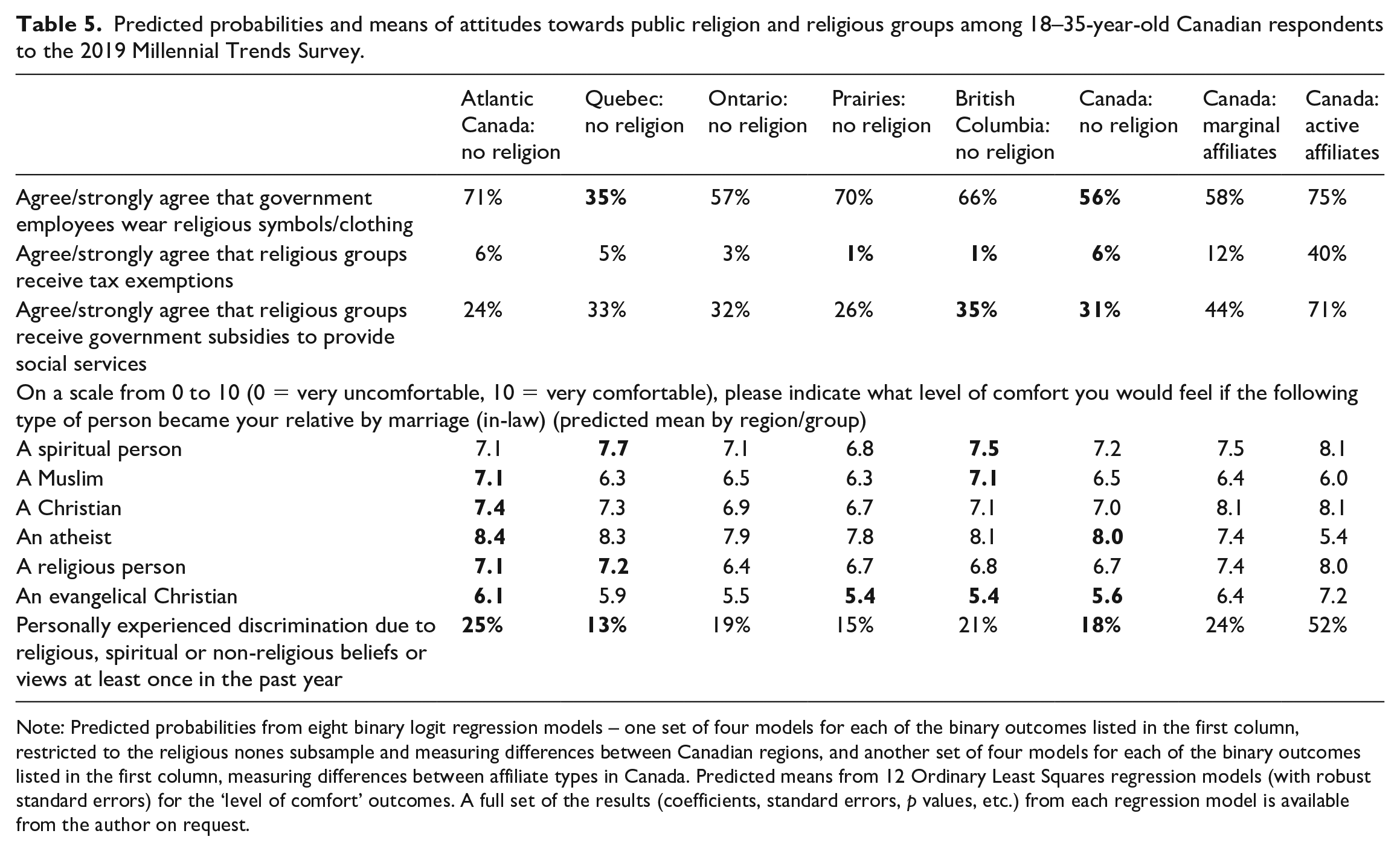
As can be seen from the results in Table 5, with regard to public forms of religion, just over half (56%) of Canadian young adult nones agree or strongly agree that government employees should be allowed to wear religious symbols and clothing while working. This predicted probability is similar to that found among marginal affiliates (58%) but lower than among active affiliates (75%). Quebec young adult nones have the lowest level of support among nones in the country for government employees wearing religious symbols and clothing (35%), reflecting low rates of support for this measure across the province (Angus Reid Institute, 2019).
Predicted probabilities and means of attitudes towards public religion and religious groups among 18–35-year-old Canadian respondents to the 2019 Millennial Trends Survey.
Note: Predicted probabilities from eight binary logit regression models – one set of four models for each of the binary outcomes listed in the first column, restricted to the religious nones subsample and measuring differences between Canadian regions, and another set of four models for each of the binary outcomes listed in the first column, measuring differences between affiliate types in Canada. Predicted means from 12 Ordinary Least Squares regression models (with robust standard errors) for the ‘level of comfort’ outcomes. A full set of the results (coefficients, standard errors, p values, etc.) from each regression model is available from the author on request.
Fewer young adult nones in Canada support religious groups receiving government subsidies when providing social services, or tax exemptions; only 31% agree or strongly agree with such government subsidies, and only 6% agree or strongly agree with such tax exemptions. Both are lower predicted probabilities of support than can be found among marginal or active affiliates. Prairies and British Columbian nones have the lowest levels of support for religious groups receiving tax exemptions (with predicted probabilities of 1% in both regions), but British Columbia also has the highest level of support among nones in the country for religious groups receiving government subsidies when providing social services (35%).
In terms of attitudes towards six different types of (non-)religious persons, and how comfortable respondents would be if such a person were to become their relative by marriage (in-law), young adult nones across Canada expressed the most comfort towards atheists and the least comfort towards evangelical Christians. The most comfortable feelings towards atheists among young adult nones in the country can be found in Atlantic Canada, where stronger homophily and endogamy trends among nones were also found in the previous section of results. Yet Atlantic Canadian nones also have some of the warmest feelings towards Muslims, Christians, ‘religious’ persons and evangelical Christians as well, when compared with nones in the rest of the country. In turn, British Columbian nones expressed on average the most discomfort towards evangelical Christians (along with nones in the Prairies), yet the most comfort towards ‘spiritual’ persons (along with Quebec nones) and Muslims.
When it comes to personally experiencing discrimination due to religious, spiritual or non-religious beliefs or views, a predicted probability of 18% of young adult religious nones across the country said they experienced such discrimination at least once in the year prior to the survey. This rate is at its highest in Atlantic Canada, where a quarter of nones fall into this category, and at its lowest in Quebec, where 13% of nones said they experienced this type of discrimination.
Discussion
One main conclusion that can be drawn from these results is that the secular transition and SBNR frameworks should not necessarily be viewed as opposing explanations of current-day (non-)religious trends, but instead as complementary transformations at play. On the one hand, many religiosity and spirituality indicators are at their lowest among millennials, compared with their parents’ and grandparents’ generations (Putnam and Campbell, 2010; Sherkat, 2014; Wilkins-Laflamme, 2015). There is a substantial portion of those who said they had no religion who are non-religious in the full sense of the term (showing no signs of religious or spiritual beliefs or conduct), either with strong atheist, secular humanist or agnostic identities, views and behaviours or seemingly indifferent and uninvolved in any of it. Yet, on the other hand, there is also a substantial portion of young adult nones in Canada who indicated that personal spiritual beliefs and practices were an important part of their lives.
Unlike some scholars of secular transition theories who foresee the disappearance of all things religious and spiritual over the coming years, and unlike some scholars of SBNR theories who expect to find personal forms of spirituality among a majority of non-religious populations, the empirical reality, at least among young adults in Canada and at least as measured in this study, falls somewhere between the two. Religious nones in Canada are part of what Beaman (2017, 2018) refers to as the country’s ‘new diversity’, along with greater religious pluralism brought with increased migration as well as with a greater public awareness and focus on Indigenous peoples and spiritualities. As efforts are made to develop better measures, both quantitively and qualitatively, to capture the lived realities of religious nones, we are better able to observe the internal pluralism within this broad category, with key divisions and distinctions especially between the SBNR, the involved non-religious (with secularist organizations and identities) and the indifferent non-religious.
What is much less present is any declared desire to be more involved with a religious group sometime in the future from young adult religious nones. Only 5% in Canada signalled this type of interest in the survey. This is an important indication, along with findings from other studies (Thiessen, 2015; Thiessen and Wilkins-Laflamme, 2020), that a simple change in Canadian religious supply – in what religious groups offer individuals – may not have much of an impact on young adults in the country, especially among cradle nones with very little or no religious upbringing, religious literacy or contact with religious groups.
For the trend of high rates of no religion to change, and for organized religion to become once more salient to a near entirety of young adult Canadians, there would have to be a more fundamental societal shift, in my opinion. A more fundamental societal shift in the conditions of late modernity (see, notably, Giddens, 1990, 1991, 1992) – conditions such as detraditionalization, expressive individualism and pluralism of choice (religious and secular) – would have to take place for many individuals in western societies to feel the need (or social pressure) to go back to organized religion. Most individuals are now socialized to value their own autonomy, freedom, mobility and choice amid a cornucopia of options before them, with religion only being one among many. This environment and socialization would likely have to change before we see religious revivals of a society-wide magnitude. Social change on such a scale does happen, and has happened over the course of history, but may not happen for many hundreds of years yet and, when it does come, may not have the effect of driving most back to organized religion (depending on what kind of change happens, it could conceivably drive even more away).
Some similarities can be found among nones across the country, such as a diversity of SBNR, involved and indifferent non-religious subtypes in each region, along with very low levels of more traditional religious beliefs, frequent religious behaviour or a desire to be more involved with religion across the country. That said, some key regional patterns among the nones also emerge from the results (see Figure 3). Nones in British Columbia, a majority of whom come from a non-religious childhood background, show higher rates of spiritual self-identification and practice. More assign importance to religious and spiritual beliefs in their lives; more pray occasionally; more discuss religion and spirituality with their friends; and more express comfort towards both atheists and spiritual persons alike.
It may be that, in other regions, individuals who are more spiritual in their self-identities, beliefs and practices remain affiliated with a religious tradition tied to their family and cultural roots, even if they are not in regular contact with a religious group. With such family and cultural ties to organized religion having long been weaker in British Columbia, however (Block, 2017; Marks, 2017), more spiritual individuals may find a home instead among the nones. The importance of Indigenous populations, traditions and cultures in British Columbia, in terms of demographics (representing 6% of the general adult population in the province in the 2016 census) as well as in public discourse and popular culture, may also offer young adult nones spiritual and world view alternatives to organized religion that are less present elsewhere in the country among settler populations. In these ways, the trends in British Columbia go against the secular transition hypothesis – that regions with larger unaffiliated populations are also those that are the least religious and spiritual overall.
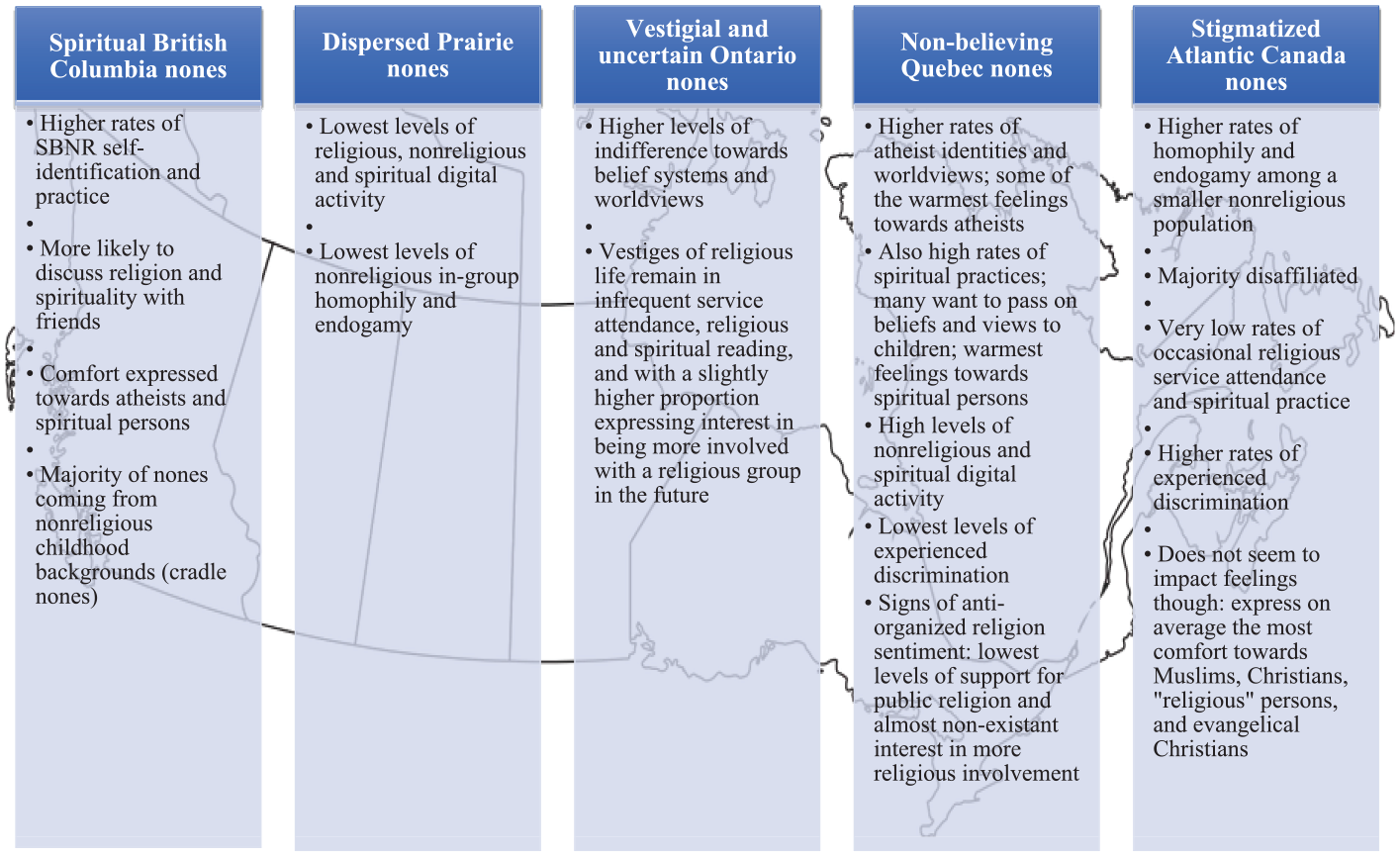
Summary of religious none regional configurations in Canada.
At the other end of the country, in Atlantic Canada, we find instead a social context where organized Christianity is still the norm in the (non-)religious landscape. More young adult nones in this region, who for the most part have disaffiliated from more religious upbringings and family backgrounds, show signs of dealing with higher levels of stigma directed towards them. Some vestiges of religious life remain among Atlantic Canadian nones, most notably among disaffiliates, such as more assigning importance to religious and spiritual beliefs in their lives, more praying occasionally, and more occasionally discussing religion and spirituality with their friends. Nevertheless, levels of in-group non-religious homophily and endogamy are high, even with a smaller number of non-religious individuals available in the surrounding social environments. Levels of experienced discrimination are also higher among Atlantic Canadian young adult nones.
In turn, religious nones in Ontario have higher rates of uncertainty, even disinterest, when it comes to belief systems and world views. They also have some of the highest rates among nones in the country of attending religious services infrequently and reading religious or spiritual texts infrequently. Very few Ontario nones take part in these more traditional religious or spiritual activities at least once a month (5%–6%), but between a fifth and just under half do so a few times a year.
Nones in the Prairies also have some vestiges of religion in their lives – notably, higher rates of practising rites of passage in religious settings. However, Prairie nones have higher rates of agnosticism, are less engaged in all forms of digital religious, non-belief and spiritual activities, and show some of the lowest levels of non-religious in-group homophily and endogamy.
Quebec nones appear to be the most polarized in the country between, on the one hand, a large proportion of self-declared atheists who have a more material or scientific world view (just over a third of Quebec nones) and, on the other, nones who practise many self-identified spiritual activities at least once a year (42% of Quebec nones). These two types rarely overlap within the same person, but rather are two main subgroups within the wider Quebec none population. Both seem to generate higher than average levels of digital activity with regard to non-religion and spirituality. Both reflect a distinct reaction towards a history, cultural landscape and family backgrounds strongly impacted by Catholicism. Hints of the anti-organized-religion sentiment that is more prevalent among nones in the province come in the form of lower levels of support for public religion in the survey, along with an almost utter lack of interest in being more involved with a religious group in the future.
Returning to the statements made at the beginning of this article, rather than making a series of (often false) general assumptions about religious nones, this first glimpse of potential regional patterns when it comes to nones in Canada provides us with a richer understanding of the diversity within this substantial young adult demographic. It also hints at the wider religious and sociopolitical regional environments at play in the country. This is only a first step, however. Much more research is needed – both quantitative, in terms of larger and even longitudinal surveys as well as big data analytics, and qualitative, in terms of interviews, focus groups, cultural content analysis and observation – to further avenues of knowledge of this growing phenomenon.
Footnotes
Declaration of conflicting interests
The author declared no potential conflicts of interest with respect to the research, authorship and/or publication of this article.
Funding
The author(s) disclosed receipt of the following financial support for the research, authorship, and/or publication of this article: This study received funding from the Social Sciences and Humanities Research Council’s (SSHRC) Insight Development Grant program.
