



Abstract
Spatial approaches to religion have grown significantly in recent years and offer original perspectives for understanding new religious realities in the context of secularized countries. This article is an opportunity to show the richness of this “spatial turn” through an analysis of the theoretical tools developed by the French anthropologist Albert Piette in his work La religion de près: l’activité religieuse en train de se faire. Although this work, which has a connection to actor-network theory, does not deal directly with space, it exhibits a geographical sensibility that we will reveal. We show that these tools can be used to demonstrate a complex geography of contemporary religion—in particular the existence of a socio-spatial dialectic—and illustrate their fruitfulness with the case of an ethnographic study of two Quebec evangelical churches.
Introduction
For some thirty years, geography’s utility to religion and the sensitivity to space in religious studies have been growing. Just when geographers were exploring new fields and distancing themselves with a strictly descriptive approach to religion’s spatial dimensions (Holloway, 2011; Holloway and Valins, 2002; Kong, 1990, 2001, 2010; Olson, Hopkins, and Kong, 2013), religious studies effected what certain authors qualify as a “spatial turn” (Warf, 2010; Warf and Arias, 2009). Such a convergence of interests illustrates the fact that analyses of religion’s spatial dimensions are no longer the exclusive domain of geographers and that “spatial methodology” (Knott, 2005b, 2008, 2009) now concerns anthropologists (Low, 2017) as much as sociologists (Fuller and Löw, 2017).
If authors, though not geographers, clearly state their interest in religion’s spatial dimensions, others are not so explicit, and an attentive reading of their works is necessary to bring their geographical sensibilities to light. In the pages that follow, we wish to do this work of explanation based on the work La religion de près: l’activité religieuse en train de se faire by the French anthropologist Albert Piette (1999). The book’s originality lies in the fact that it is an explicit follow-up to the sociology of science and technology personified by an author like Bruno Latour (1987). The theoretical connection is apparent in the subtitle: the expression l’activité religieuse en train de se faire (roughly, “religious activity in the making”) is a reprise of “science in the making,” an expression popularized by Latour (1987: 4). In the same way that Latour opened the “black box” of “ready-made science,” Piette takes on the “black box” of “ready-made religion”—the box that contains the heterogeneous elements a researcher has only to marshal to decipher what they are observing in the field. Once this box is open, Piette reveals the existence of “chains of association” that link “the mediators concerned: men, gods, and objects” (Piette, 1999: 32). In a spatial reading of La religion de près, we show that the places where parish life plays out in concrete terms occupy a significant place in the “chains of association.”
In addition to this explanation of Piette’s spatial sensibility, this article recalls how the research program outlined in La religion de près concurs in a number of aspects with some of the most fruitful proposals on space formulated in religious studies in recent years. Piette aligns himself with authors for whom “‘space’ is not seen as the passive container or backdrop in or against which religious activity takes place. It cannot be separated from notions of embodiment and everyday practice, knowledge and discourse, and production and reproduction, and is an engaged and dynamic arena for religion no less than for other aspects of social and cultural life” (Knott, 2009: 156). In doing so—and Kim Knott’s quote reflects this—such a conception of space enables authors proposing a “spatial methodology” in their analyses of religion to form bridges to other approaches, such as “lived religion” (Ammerman, 2020; McGuire, 2008; Orsi, 2003) and “material studies” (Hazard, 2013). Finally, the analysis of religion developed by Albert Piette shares commonalties with authors who have endeavored to address religion from a geographical standpoint based on actor-network theory (ANT), of which Latour was a pioneer (Holloway, 2000, 2011).
To achieve these two main objectives, the text is organized into two parts: the first makes explicit the role of place in the theoretical framework elaborated by Piette, paying particular attention to the modalities by which place is delineated in the sequence of activities; in the second, I apply the method of La religion de près to ongoing research into two Quebec evangelical churches. Rooted as they are in the Protestant tradition, these churches make the place of worship not the domus Dei, but the domus ecclesiae, one that, without being a sacred space, nevertheless offers the possibility conditions of a personal encounter with God (Turner, 1979).
The places of religion “in the making”
The production of (religious) space
Contemporary geography has been marked by the (re)discovery of the writings of the philosopher and sociologist Henri Lefebvre. It was an opportunity for geographers to engage in a discussion as much on their discipline’s theoretical foundations as on its objectives and has taken the form of a “movement from products to production” (Lefebvre, 1991: 26). This movement—from space as product to space as result of a production process—is at the heart of The Production of Space. In it, Lefebvre states that “(social) space is a (social) product” (1991: 26) and that, as such, “space embodies social relationships” (1991: 27). The American geographer Edward Soja, as part of a discussion on Lefebvre’s contribution to the Marxist conception of space, coined the expression “socio-spatial dialectic” (Soja, 1980) to designate the process by which society is a producer of places and spaces that, in return, act on society. To fully understand what this dialectic involves, we can refer to The Production of Space, in which Lefebvre cites the example of “religious ideology”: What is an ideology without a space to which it refers, a space which it describes, whose vocabulary and links it makes use of, and whose code it embodies? What would remain of a religious ideology . . . if it were not based on places and their names: church, confessional, altar, sanctuary, tabernacles? What would remain of the Church if there were no churches? The Christian ideology . . . has created the spaces which guarantee that it endures. (Lefebvre, 1991: 44)
A cursory reading of this excerpt would suggest it is reintroducing a geographic determinism or a “fetishization of space” (Soja, 1989). In fact, Lefebvre is not stating that individuals’ practices of space can necessarily be deduced from certain places’ properties and characteristics, but suggesting that the places offer possibilities and opportunities for action. In this sense, they are material elements that interact with practical dispositions (Bourdieu, 1980) specific to the believers in the different religious traditions.
Lefebvre’s double intuition (the passage from produced space to production of space, and the assertion of a socio-spatial dialectic) has considerable significance for spatial approaches to religion (Knott, 2005a, 2008; Obadia, 2015) because it signaled a break with a descriptive conception of the geography of religions that was specific to authors who opened the way to geographical approaches to religion (Deffontaines, 1948; Sopher, 1967). These authors were primarily interested in the lasting material forms that religions inscribe in the landscape. In a seminal work, the geographer Pierre Deffontaines writes that his book’s objective is to “note the geographical repercussions of religion in the landscape” (Deffontaines, 1948: 10, our translation). Since the 1990s, the writers of movements in cultural and social geography have clearly shown how a spatial approach might be used to explain the transformations of religion in largely secularized societies, highlighting how these transformations were accompanied by a new geography of religion (Bartolini, 2018; Garbin, 2017; Hopkins and Gale, 2009; Hopkins, Kong, and Olson, 2013).
A sociology of associations
Though La religion de près is not explicitly aligned with the theoretical program initiated by Lefebvre and used in religious studies since (Knott, 2005b), we nevertheless find in it a similar concern for associating the places of religion with the sequences of activity that take place within and for integrating them into a socio-spatial dialectic. The objective of this is to highlight the “chains of association” that relate to religious activity. To understand Piette’s approach in his analysis of religious activity “in the making,” we should recall that his ambition was to do in the field of anthropology and sociology of religions what Bruno Latour did in the field of the sociology of science. Piette’s approach is explicitly rooted in the sociology of science and technology: he writes that his religious anthropology program is “directly inspired by the scientific anthropology program” (Piette, 1999: 56; all citations on Piette, our translation). He borrows from its vocabulary, particularly the expression “black box,” 1 which Latour explains this way: “The word black box is used by cyberneticians whenever a piece of machinery or a set of commands is too complex. In its place they draw a little box about which they need to know nothing but its input and output” (Latour, 1987: 2–3). In the sociology of science and technology, the black box “consists of operations of liaison and assembly, of constitution and stabilization of networks, of the weakening and strengthening of the multiple associations from which these networks are made; it is social insofar as it establishes, comforts, and stabilizes links” (Quéré, 1989: 97, our translation). The black box represents “ready-made science,” as opposed to “science in the making,” whose purpose is to open the black box of “ready-made science” and reveal everything that went into it: “Uncertainty, people at work, decisions, competitions, controversies are what one gets when making a flashback from certain, cold, unproblematic black boxes” (Latour, 1987: 4). Then, Latour broadened his reflection to all of sociology: “instead of studying society—this assemblage of ready-made entities that sociologists believe is made from social matter—it made more sense to start studying the way in which human and nonhuman entities are grouped together to form collectives” (Vries, 2018: 110, our translation). Latour calls this approach the “science of associations,” better known by the name actor-network theory (Latour, 2007).
Albert Piette refers in turn to the Latourian conception of the social world and applies it to the rural Catholic parishes under his investigation. He explains that “parish life may be compared to a chain of associations made up of an assemblage of elements, such as the parish priest, the parishioners, the town hall, and the municipal councilors, but also documents, such as evangelical writings, the Roman Missal . . . and objects as diverse as the heating, the hosts, the wine, the chalice, the candles, and the liturgical vestments” (Piette, 1999: 57). The purpose of all this work of connections through chains of association is “God as he is rendered present, objectified from this particular articulation” (1999: 58).
In the fieldwork, “the departure of the parish priest provokes a kind of opening of a black box whose constituents, brought together in a very controlled and integrated system, seem inseparable and that it is impossible to leave in such a situation of uncertainty” (1999: 59). The opening of the black box is prompted by a crisis in which the ordinary connections are threatened and new ones must be devised. The priest’s departure therefore opens up a period of uncertainty during which the “chain of associations” is, in a sense, revealed.
Places in the chain of associations
As Latourian sociology suggests, the “chains of association” are made up of heterogeneous elements that may be people, objects, and even institutions. Places, too, are likely to enter into the composition of these chains of association. Piette mentions some when he writes that certain of these elements facilitate the movement of reconstructing parish life. This reconstruction can build “on an initial capital that can represent . . . the upholding of central elements, such as the church, the presbytery, and the instrumental infrastructure they contain” (1999: 58). Like the curate or an object such as the missal, these places (the church and the presbytery) are presented as repertories of meaning directly related to their part in a tradition connecting the church of the past to the church of the present. From this point of view, the church, by its architecture, by the material elements it houses (Stations of the Cross, altar, ex-voto, etc.), connects the different historical phases of the parishes and constitutes the materialized narrative in the space of the Catholic institution.
In addition to including certain places in the category of elements that stabilize religious life, Piette acknowledges their status as “mediators” in the course of religious activities. He distinguishes four forms of mediation by which God is present in a situation: (1) objectification (when the priest through his gestures and words makes bread and wine the body and blood of Christ); (2) representation, by priests who are associated with Christ because they are ordained; (3) exemplification (of attitudes, behaviors, or words that testify to Christ’s love; and finally (4) “the vestige in various forms, of objects (ciborium, chalice), of the church/building, or of icons” (1999: 78). These artefacts, products of a religious tradition, are the repositories of a meaning that the parishioners are able to decode and interpret because of their religious education and socialization. These places and objects make it possible to actualize tradition, in the here and now. They are therefore points of convergence for a religion already constituted (the black box) and a religion “in the making.” In the last chapter of La religion de près, entitled “Les déplacements du prêtre” (roughly, “The Displacements of the Priest”), Piette returns to the mediators participating in the actualization of God’s presence. He emphasizes the role of tradition, which is presented as a convenient repertory of ways of doing things in the here and now: “the past seems to constitute one of the principal resources for coordinating these sequences . . . The place itself, the spatial dispositions, the altar, the lit altar candles, the vestments, the arranged objects . . . constitute so many resources vested at different levels with the presence of God” (1999: 189).
Though the reference to the spatiality of parish life is maintained, it nevertheless merits an explanation because it has important consequences in any geographical analysis of religion. In the same way Lefebvre was able to assert a “socio-spatial dialect,” Piette attributes to the places of religious activities the status of mediators that do not determine the course of actions, but give them an orientation and offer the actors possibilities for action. To avoid falling into the trap of the “fetishization of space,” we return here to the notion of “affordance” (Gibson, 1979), used in recent years in material studies (Keane, 2008; Tilley, Keane, and Küchler, 2006), which mainly examine the ways individuals interact with objects. By applying the notion of “affordance” to the places, we are signaling that they are acting as mechanisms with which individuals interact in sequences of action whose outcome is never predefined. In this sense, though they may facilitate a particular action, they nevertheless do not determine it. In the religious domain, the places are also the repositories of a discourse and a theology of which they are the products and whose permanence they also ensure. We find here the intuition formulated by Henri Lefebvre when he described Christian places and objects as mediators of the “Catholic ideology.”
Places in sequences of action
Now that we have explained the status of places in Piette’s theoretical program, let us see how this actually plays out in La religion de près. Because the book is based on a description and analysis of sequences of activities that are codified to a greater or lesser extent (preparatory meetings for a service, informal discussions, rites, etc.) and because they are inevitably situated in time and space, the places are present, as much in the descriptive pages as in the phases of analysis. 2 Frequently, what is involved are the church, the church hall, or the presbytery—in other words, all the ordinary places in the life a French Catholic parish. To highlight the role of the places in the sequences of action described, I analyze three excerpts, each mentioning Sunday celebrations in the absence of a priest and each highlighting the role of the places in the sequences of activity.
In the first excerpt, parishioners gather to plan a celebration of this kind: “Michel steers the conversation to the celebration arrangements. He has his ideas, directed at anyone and everyone: to do something friendly, something nicer, in the middle of the celebration, with different seating; making it so the hosts weren’t distanced from the people” (Piette, 1999: 50). In the second scene, Piette describes the celebration in the absence of a priest: “On the stated day, Yves is there. He prepares a room in the old presbytery. There is the organ, the chairs, and sheets of paper . . . Everyone is more or less set up before a chair, along two walls of the room, the other two being reserved for the musicians and a large table” (1999: 65). Finally, in the third excerpt, it is again the parishioners who prepare a Sunday celebration in the absence of a priest: “holding the celebration in the absence of a priest in the small chapel adjacent to the church is more intimate; the altar has no reason to be there, nor the priest’s chair; sharing the word of God in dialogue form; prioritizing spontaneous prayer intentions” (1999: 70).
The three excerpts offer a glimpse at original forms of religious innovation in a context marked by the absence of the priest, a central figure in parish life. Because of this unprecedented situation, the parishioners are invited to rethink their relationship with the Catholic rite, particularly the Mass. This reflection on Catholic rituality is accompanied by a renewed relationship with the places and objects forming the material aspect of the rites. From this point of view, the religious practices must be considered in relation to the apparatuses that connect places and objects. In the second and third excerpts, the celebration does not take place in the church, but respectively in the “old presbytery” and in a “small chapel adjacent to the church.” In the absence of a priest, the church no longer seems the appropriate place to accomplish an authentic rite coinciding with the parishioners’ aspirations. Everything occurs as if the absence of a celebrant was an opportunity to experiment with a new spirituality accompanied by a hitherto unknown spatiality. The two places proposed (the presbytery and a chapel) encourage intimacy and conviviality and signal a break with more conventional ways of doing things with centuries of tradition behind them.
Even so, the break produced by this work of innovation is not a complete one because it is still rooted in a Catholic world: it involves a presbytery and a chapel, not just any rooms. There is therefore a redefinition and reinterpretation of the institutional places and spaces, whose significance is connected with the uses the parishioners make of them. These three short examples perfectly illustrate the central idea in spatial approaches to religion—that although there is indisputably a link between the places and the ritual accomplishments, we must not lose sight of the fact that the places do not determine practices, but may be subject to various types of uses and interpretations (Coleman and Collins, 2006).
Pursuing this idea that “buildings may appear to contain theologies fixed in space” (Coleman and Collins, 2006: 34), it is possible to replace the places and spaces of parish life in the typology of the discursive categories established by Piette as a result of his fieldwork. He identifies four orientations the actors take in the course of their exchanges and community practices. Each orientation “results from the harmonization of a set of arguments . . . and is articulated around a specific pole: filiation, sociopolitics, inspiration, and objectification” (Piette, 1999: 120). Whereas the first two (filiation/sociopolitics) primarily concern the relationship with the Catholic institution and how it structures parish life, the second two (inspiration/objectification) have to do with the relationship with God. The categories are not mutually exclusive and may occasionally be combined. In addition, these discursive categories are reflected in concrete terms in specific relationships with objects and places. Table 1 provides an overview of each category, its characteristics, and the relationships to the places or spaces that define it.
Typology of the discursive categories.
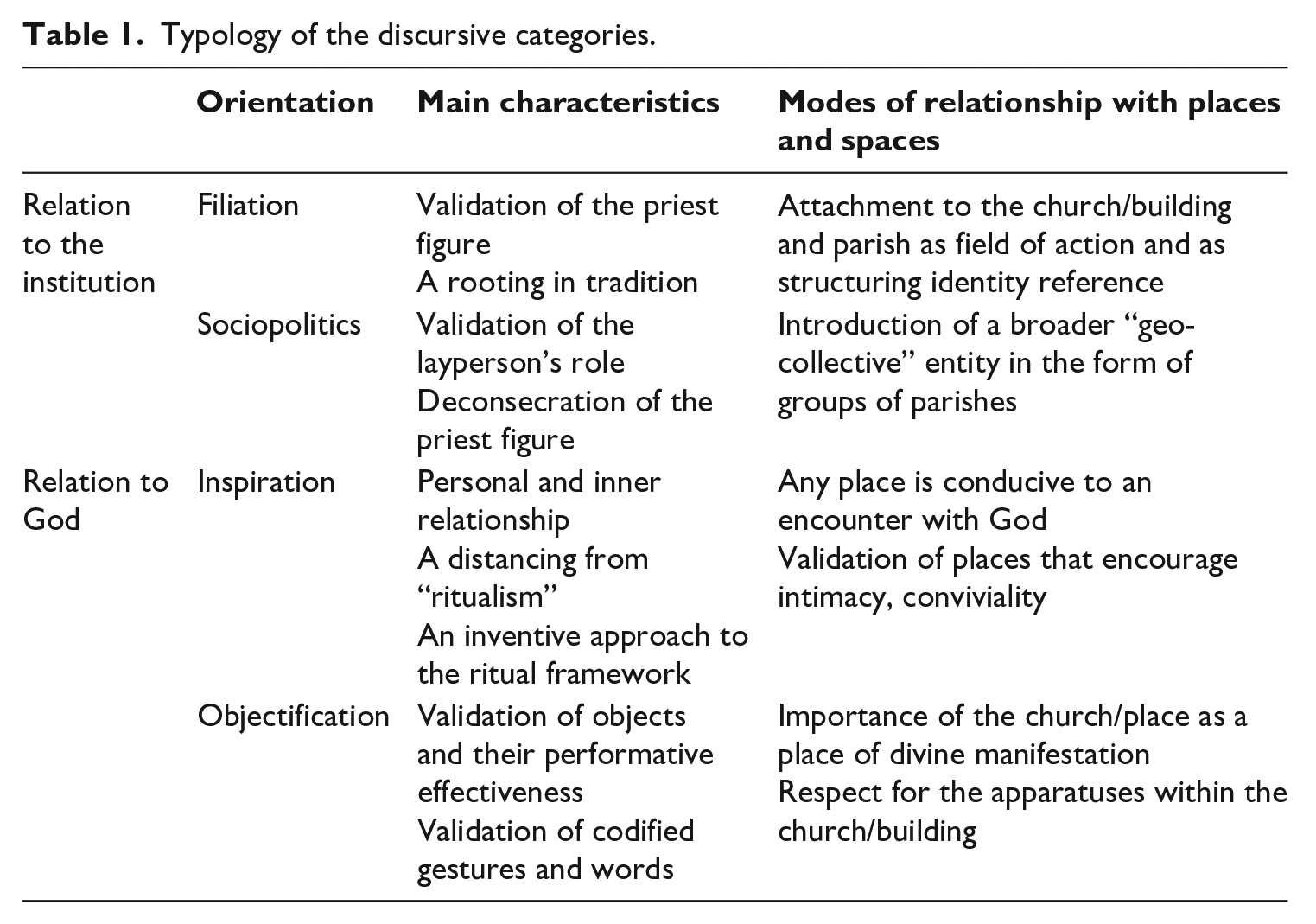
The four orientations indicated in Table 1 must not be understood as set categories to which an individual might be exclusively attached. On the contrary, Piette writes that “between these four arguments . . . there are possible compromises and alliances” (1999: 129), particularly between the two series of pairs. For example, the filiation and objectification poles can be easily combined because of the relationship with the church/building. Finally, Table 1 sheds light on the three excerpts cited previously, which can be identified as manifestations of a combination of the sociopolitics and inspiration poles. The emphasis here is on the role assigned to laypersons in celebrations in the absence of a priest and on the importance of the authentic individual religious experience.
Table 1 demonstrates the fact that the four orientations identified by Albert Piette are not only situated in the discourse, but are embodied in objects, places, and spaces that are as much their manifestations as their conditions of possibilities. The church (building) manifests attachment to the “objectification” pole, one of the four orientations around which the statements of the actors in the situation are structured: unlike the “inspiration” category, which assigns to interiority the central place in the relationship to God, the arguments of the “objectification” pole directly responding to it validate the presence of objects and their relationships according to a specific codification . . . What counts is the performative effectiveness of these objects, which are structured on codified gestures or words . . . Regulation can also act as the place where objects evoking God’s presence are assembled: the church/building and the liturgical calendar. (1999: 125)
The quote shows that these different objects or places only have meaning insofar as they are aligned with a particular pragmatics, that is, in a situation from which they draw meaning and to which, in return, they give meaning.
If the church/place relates to the objectification pole, the fact of not holding “religious” activities in the church relates to the “inspiration” pole mentioned in the previous quote: “The main idea is that one has to feel disposed to enter into contact with God. It is an interior relationship detached from all ritualism” (1999: 124). This pole is illustrated earlier in the book when a “sort of family celebration” organized by laypersons is described. The excerpt is entitled “New Ritual?” The celebration does not take place in the church, but in a room in the old presbytery. The choice of place echoes the desire to “experience another form of ritual” expressed by the father behind the initiative (1999: 63). Yet the innovation is still firmly rooted in tradition: it is not in the church, but it is in the presbytery all the same, in a room where chairs have been set up. These chairs echo the “benches” mentioned a few pages earlier in the context of a Sunday celebration in the absence of a priest: “Michel and Marie-Agnès agree in thinking that the benches are an obstacle to these modifications” (1999: 50). The particular ways in which places are associated with collective religious practice is not specific to the catholic parishes studied by Albert Piette. As we will see in the next section, they are central to the lives of two Quebec evangelical Protestant churches to which we are dedicating an ethnographic research.
Using La religion de près to analyze two Quebec evangelical churches’ relationships with space and place
In the previous part, we recalled that Albert Piette does not give any particular status to space or place, nor dedicate to them any targeted analyses. He nevertheless demonstrates a “spatial sensibility” because it is possible to reconstruct a theory of space and place from scattered elements in La religion de près. Religious activities—especially when they are collective—occur in places and, as such, they are their conditions of possibility. But all of these activities are also producers of places. Piette writes that the places relate to “religion in the making by such and such an activity, in such and such a situation, according to the apparatuses that fall into place, in the chosen places and at the chosen times, with the mediators concerned: men, gods, and objects” (1999: 32). places constitute its projection in space (Brace, Bailey, and Harvey, 2006)
In this part, we show how the “spatial sensibility” in La religion de près can be usefully invoked in analyzing the relationships to space of two evangelical churches that are the subject of an ethnographic research. With Piette’s analytical framework, we can go beyond a dualist conception that establishes the social and the spatial as two distinct categories and think instead of a continuity between the sequences of action and the material apparatuses they are associated with, and finally present a circumstantial conception of space whose existence is intimately linked to the sequences of action that bring it about. The result is a procedural conception of space aligned with the efforts of certain geographers (Holloway, 2000) who, using Bruno Latour’s ANT, show that places arise from chains of association that stabilize and delimit “institutional geographies” (Holloway, 2000: 556). This idea of places that are the crystallization of chains of association within space corresponds to the conception of the place/space duo that, developed by the humanistic geography of the 1970s (Tuan, 1977), is now consensus in the social sciences: “Space is the more encompassing construct, while place retains its relevance and meaning but only as a subset of space. Place is defined as lived space made up of spatial practices and is phenomenologically experienced, such as the culturally meaningful space of home” (Low, 2017: 12).
Applying this analytical framework to the evangelical world seems all the more relevant because recent work in religious studies has shown that these churches demonstrate a large capacity for innovation, particularly in their use of place and in their relationships with the urban space. Among this research, two main focuses must be distinguished: the functions of the places of worship and their connections with the churches’ theological sensibility (Coleman and Collins, 2000, 2006; Hovland, 2016; Kilde, 2002) and the ways in which the churches are inserted into the urban space (Connell, 2005; Fer, 2007; Fer and Malogne-Fer, 2017; Garbin, 2013; Wilford, 2012). The question of place is all the more interesting in the evangelical case in that the place of worship does not have a sacred dimension and is not addressed as a means of access to the divine (Coleman and Collins, 2006; Grellier, 2004; Reymond, 1996). To borrow the vocabulary of Harold Turner, the evangelical place of worship is not so much a “temple” as a “meeting house” (Turner, 1979) that makes collective religious expression possible. The absence of a sacred character does not mean, for all that, as we show, that place is without importance: it offers resources and a material framework for religious performance—whether it be praise through music or the message delivered by the pastor—and community sociability.
An ethnography in two Quebec evangelical churches
Quebec is known more as a land of Catholic tradition than of Protestant. Catholicism has played a considerable role in Quebec, particularly from the second half of the 19th century on, up until the episode known as the “Quiet Revolution” (Zubrzycki, 2016). Yet mainstream Protestant churches (e.g., the United Church of Canada) have taken root alongside Catholicism, as have evangelical churches. For example, in the 1920s, a first Francophone Pentecostal church was established in Montreal. Now, a century later, the Pentecostal Assemblies of Canada number close to 50 congregations in the Montreal metropolitan area. It was in the 1960s to 1980s, however, that Quebec really experienced a phase of evangelical “awakening” (Lougheed, 2011). Today, the evangelical presence benefits from the conjunction of three phenomena: a significant growth in churches deriving from immigration—Haitian, African, and Latin-American churches—mainly located in the Montreal metropolitan area; a Francophone evangelical entrepreneurship, which, stemming from the Baptist tradition, is developing a renewed and innovative religious offer, largely inspired by what is happening in the United States; and, finally, mission work from English Canada or the United States. This positive dynamic, though modest, 3 is quite remarkable when weighed against the profound crisis affecting the Catholic church (Meunier and Wilkins-Laflamme, 2011).
The research covered in this part illustrates the second tendency. Two churches, La Chapelle and Axe 21, are involved, both recently created (2010 and 2013), both based on Baptist theology, and both helmed by pastors in their forties (the pastoral teams in each range in age from 25 to 40). Both churches have the particularity of being “multi-site churches” (Surratt et al., 2009). Prior to the Covid-19 pandemic, La Chapelle held gatherings in three places in Montreal (in a theatre and in the auditoriums of two schools) and in 2021 started two assemblies outside of Montreal: one in Gatineau and the other in Quebec City. After only one year of existence, La Chapelle Québec, which meets Sunday morning in a college auditorium, now welcomes some 600 adults at two different services. Axe 21 meets in two mid-size cities in the Eastern Townships (Sherbrooke and Magog). Both churches are addressed to a relatively young audience, made up of students and young professionals, and demonstrate a remarkable capacity for innovation in terms of their religious offering. For the founding pastors, this innovation is a way to distance themselves from the image of Christianity in Quebec. Though the break from tradition is not really situated in their discourse or professed theology, it is nevertheless evident in terms of their practices, to the point that the two churches greatly resemble what can be found on the other side of the border in “seeker sensitive churches” (Sargeant, 2000) or “new paradigm churches” (Miller, 1999): messages accessible to the greatest number, simplified rituals and liturgy, relaxed pastors, the adoption of a musical style of the “contemporary worship music” kind (Ingalls, 2018). Finally, a characteristic common to both churches is the nature of the places in which the “meetings” occur. They can be concert halls, school auditoriums, or movie theatres. Axe 21, for example, acquired the city of Magog’s municipal theatre, located on the main commercial street. Both churches also rent premises on the weekends. In practical terms, this means that the necessary equipment (reception table, coffee and refreshment stand, musical instruments, etc.) must be set up and taken down at every meeting.
Places at the heart of “chains of association”
The ethnographic approach to these two churches is directly connected to “congregational studies” (Ammerman, 1998; Chaves, 2004), which are closely associated with the sociology of organizations and the sociology of religion (Ammerman, 2006). These studies also have a practical goal similar to the form religious sociology (so-called “pastoral sociology”) took in France (Willaime, 2012) and Quebec (Warren, 2014) in the aftermath of the Second World War. In the Canadian context, “congregational studies” have inspired authors interested in the recent evolutions of Protestantism, and more particularly of evangelicals 4 (Reimer, 2003; Reimer and Wilkinson, 2015).
We showed in the first part that Albert Piette’s ambition was to open the “black box” of parish life in such a way as to uncover the “chains of association” uniting not only individuals in sequences of action, but places and objects as well. Like the parish, the congregation in the Protestant world is treated as taken for granted and as the “natural” scale of analysis for religious life, particularly in the US context (Bender, 2013). Only on rare occasions is the question of the production of the congregation addressed. The ongoing research into the two churches uses Piette’s tools of analysis to highlight the work that all members of the two churches must provide in order to ensure the survival of their assemblies and make possible the presence of God. It also involves showing that place is at the heart of “religion in the making.”
To do this, we focus our analysis on the places the two churches occupy throughout their meetings and on their relationship with the urban space. If the place of worship tangibly fixes the congregation in space (Willaime, 2007), the ephemeral organization of nonreligious premises into places of worship is an opportunity for members to become aware of the fragility of a congregation whose existence is not assured. The relationship that unites the temporary places of worship with the congregations is therefore a metonymical one: in the same way that the former fade as soon as the collective activities are over, the latter are only possible because people make them happen. From this point of view, the congregation is experienced in performance mode. On Sunday morning, the performance is not just limited to worship, but also encompasses all the preparatory activities beforehand. For example, at La Chapelle Québec, there are nearly 60 volunteers in all who, starting at 6 o’clock in the morning, are hurrying to have everything ready for the meeting’s start at 9 o’clock. All this work is a constraint that rests on the shoulders of the church members. Yet one of the church’s pastors sees this in a positive light: “We all work together to make these meetings possible. This enables the members to collaborate and get involved in the life of the church, but also to get to know each other.” 5 To borrow the vocabulary developed by Piette, it is as if the chains of association, generally invisible because they are stabilized in well-established structures, were here exposed to the light of day, demonstrating to everyone how precarious the existence of the church is and that all it would take would be a lack of motivation for it to disappear. These “chains of association” are made manifest in a place that metonymically expresses all of the relationships and interactions that keep the church going.
Even if the spatial experiences at La Chapelle and Axe 21 are very different from the catholic tradition described by Piette, especially because religious activities take place in theaters or auditoriums, it is relevant to mobilize the discursive categories established by Piette and mentioned in the first part. The two Churches we studied are at the intersection of two orientations (“sociopolitics” and “inspiration”). From the leaders’ perspective, any place is conducive to a personal encounter with God and it is essential to choose place which is not intimidating and in which people feel comfortable, even if it is their first visit to the church. One of the Axe 21 founders testified to this: “What obstacle prevents people from hearing the Bible message? We came to the conclusion that . . . the place we meet is intimidating, it’s a church, which is kind of off-putting for most people. It’s not always very welcoming . . . This led to our decision to rent the Granada Theatre, which is the oldest theatre in Sherbrooke and that everyone knows about.”
The Covid-19, the fragmentation of space and the “liquid church”
The context of the Covid-19 pandemic constitutes a sort of laboratory in which we can observe how these two churches continued their activities and maintained strong community ties even while, for several months, religious gatherings were prohibited in Quebec. 6 Because of their target audience (young adults and young families), La Chapelle and Axe 21 were already present on the social networks and had better technical tools than the average Quebec church before the Covid-19 pandemic. As such, they were able to quickly offer their members substitute activities—in particular, entirely virtual Sunday morning services. These virtual meetings marked a tipping point in the relationship members maintained with the church as an institution and place of worship, one that, thanks to the virtual meetings, literally entered the members’ living rooms. Questioned during the Covid-19 pandemic on the way her family was experiencing the absence of in-person meetings, one mother—a member of La Chapelle Montréal—explained, “On Sunday morning, we move the furniture around in the living room, we get the whole family together, and we project the online meeting on the television. It’s as if our living room becomes a little place of worship.” 7 As to the question of knowing whether her family would be attending the in-person meetings once the restrictions were lifted, she added, “We live in the suburbs, and obviously it’s more practical to not have to take the car. So I think that we will be alternating between online meetings and in-person ones.” Such remarks show that the Covid-19 episode was not a simple digression before a return to normal, but considerably reconfigured the practices of the churches’ members and their relationships with community spaces. Even the founding pastor of La Chapelle acknowledged the process: “I think that Covid will change people’s habits. I think that people who go to church every week and who have gotten used to having it online will no longer necessarily go every week. That doesn’t mean that they will no longer go in person, but I think that they will go less often. So it will be a necessity for churches who want to reach people to continue to offer online services.” 8 The same pastor went so far as to describe the pandemic episode as a “trend accelerator,” one of whose characteristics is a fragmentation of the places within which the church is experienced. Such an evolution matches the one Pete Ward, professor of ecclesiology at King’s College in London, described in the early 2000s in his book Liquid Church (Ward, 2005). Inspired by Zygmunt Bauman’s notion of “liquid modernity” (Bauman, 2000), Ward proposes a “shift from seeing church as a gathering of people meeting in one place at one time—that is, a congregation—to a notion of church as a series of relationships and communications” (2005: 2). This “liquid church” therefore rests on the articulation of multiplied physical places (a member’s living room or the place of worship) and virtual places (a virtual room on Zoom, for instance), which, far from being mutually exclusive, instead draw an original geography.
Redefining the church
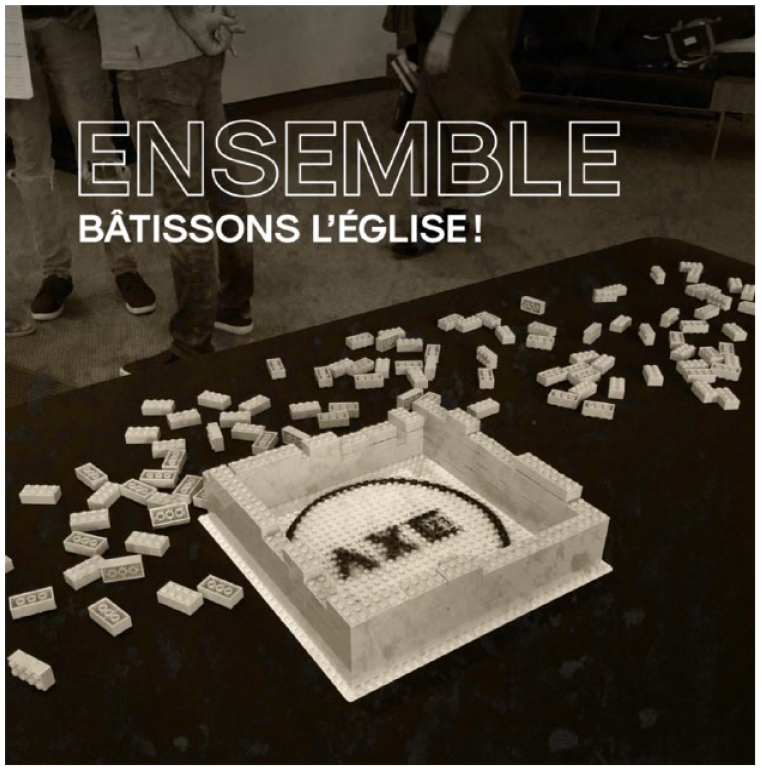
For La Chapelle and Axe 21, the period was an opportunity to think about what a church does and taking a deeper look at the role of the community formed by all church members. On September 12, 2021, La Chapelle began a new series of “messages” dedicated to the church. To mark the occasion, a message was posted on the church’s Facebook page: “What is Church with a capital C and what will it look like in 2021? At La Chapelle, we firmly believe that the Church is neither a building nor an institution. The Church is people, and not only people who attend on Sunday, but those who experience it on a day-to-day basis. The Church is you! The Church is us!” 9 (our translation). At roughly the same time, Axe 21 published a message entitled “Let’s build the Church together” (see Figure 1).
Detail of Axe 21’s Facebook page (posted August 31, 2021).
The image (Figure 1) was accompanied by a short text that offered an interpretation: “It is God who builds the church! It is God who is our foundation. And we, like these Lego blocks, are the bricks that build the walls of Axe 21. The church was never about a building, but about people. Wherever we end up in the months to come, the years to come, we want to build a solid foundation TOGETHER” (our translation). Even if these examples give the impression of a vertical power, almost authoritarian, it is important to analyze them in the context of the Covid-19 crisis, characterized by a period of hesitation, during which what was at stake was the definition of the church. Because places of worship were closed, some members of the churches considered that the crisis was an opportunity to envision a new conception of the church, aligned with the spirit of the “early church” (few families gathering at home). It is in this context that the leaders had to defend their conception of the church as an essential institution for an authentic Christian life and insist on the responsibility of each member in its future.
The fieldwork turned up three primary ways in which place is integrated into the churches’ lives: in terms of practice, in terms of discourse, and finally in terms of the imagination. The first concerns the tangible use of the places and the way the members interact with them; the second is manifested in meetings and gatherings, in the course of which the church leaders plan and organize activities in their communities; finally, the third refers to how the places are integrated into a conception of urban life and how the church participates in that life.
The ethnographic work carried out exclusively during the pandemic revealed that the places were very present in both churches’ communication on the social networks: in effect, talking about the places was a way to evoke the resumption of collective face-to-face activities. It was in the middle of the pandemic, for example, that La Chapelle church in Gatineau announced that a place had been found for the Sunday services. Here is the transcription of part of the message the pastor of La Chapelle Gatineau posted on the church’s Facebook group (the pastor was being filmed in the parking lot of the movie theatre in which the church planned to gather as of September 2021): 10
I am really excited. After two years of going over Gatineau with a fine-toothed comb to find a place. After two years of prayer, we have finally found a site for the launch of La Chapelle Gatineau in autumn. And it will be at Starcité, the movie theatre on the Hull Plateau. We’re building an excellent relationship with the landlord, and the “creative team” is working on a project to make the atmosphere inside the theatre unique. It’s going to be crazy! I just can’t wait to tell you about it . . . But what do we do now? You can start telling your friends about it, your family, and your entourage, pray with intent. You can also click on the link to sign up as a volunteer to receive information for the gatherings in August . . . Thank you for your time, your energy, your emotional support, your support in prayer, continue to pray. We will see the glory of God in Gatineau, I believe it.
This example shows that speeches mobilizing members develop around places and that these places constitute a kind of litmus test for the community’s solidity and its capacity to hold events. The pastor also states that the “creative team” 11 is exploring technical fixes that will help the members to live a genuine experience with God. In this respect, it is worthwhile to observe that even if specific devices are required to create an atmosphere which fits with the encounter with God, the church builds on the existent configuration of the place. For instance, the absence of window facilitates make the members forget the nature of the place and make the religious experience for them authentic.
If, in this example, the place is the subject of a message asking the members to mobilize in preparation for the services, it also happens that the speeches in the places articulate the practical and the theological.
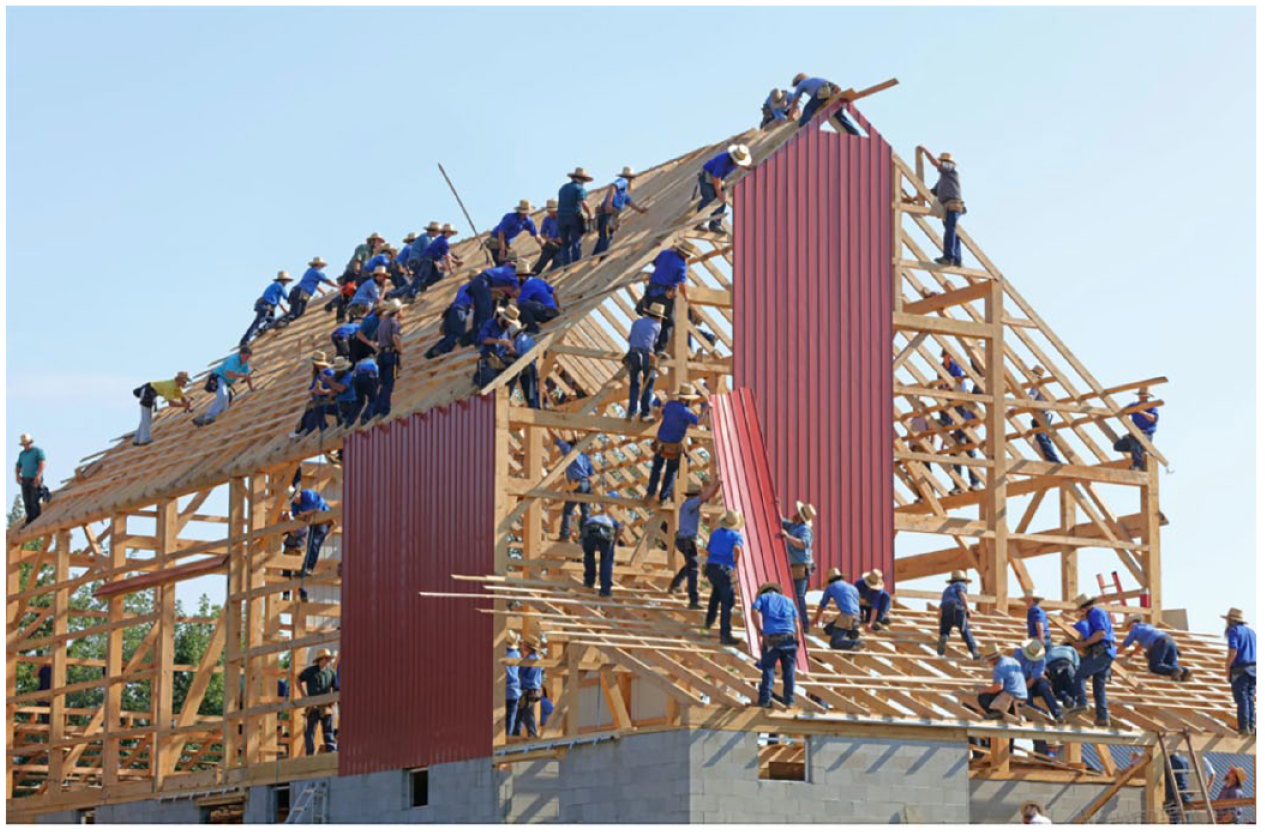
The image in Figure 2 was taken from the Facebook page of La Chapelle Mile End (Montreal). It accompanies a message inviting members of the church to lend a hand after the gathering to put everything away and load the equipment into a van. The photograph shows men—maybe members of an Amish or an Old German Baptist Brethren community judging by their clothing—constructing a building. In a humorous tone, the message illustrates the idea that it is the involvement of all members of the church, not only that of the leaders and a few volunteers, that make the gatherings in the rooms rented every weekend possible. At another level, the photograph appears as a metaphor, where the building being erected represents the church: it only exists through the investment of all.
Detail of La Chapelle’s Facebook page (message posted on September 9, 2021).
Here is a final example that illustrates how places are decisive elements in the “production” of the church. La Chapelle Québec officially opened its doors on Sunday, September 12, 2021, for a service that took place in the auditorium of a Quebec City college. The event was preceded by number of preparatory meetings that, because of the Covid-19 pandemic, took place on Zoom. One of these was an information meeting during which the pastoral team outlined to those who wanted to join the future church how they could become involved, in concrete terms, in making the inaugural service possible. When the meeting began, the pastor reported that 80 people had completed the volunteer form available on the church’s Facebook page. In his presentation, he explained that 10 teams were going to share the various responsibilities. There were teams for setting up the room (starting at 6 o’clock in the morning), putting things away after the service, the security service, guiding people in the parking lot (a task presented as highly strategic because newcomers’ first contact with the church would be with the people in the parking lot outside), manning the donation stand, serving tea and coffee at the refreshment table, and making conversation with people who were there alone. This long list echoes the findings of researchers who have highlighted the capacity of churches, especially megachurches, to divide tasks in a way that gets the largest number of people possible involved (Fath, 2008).
The vignettes just presented clearly relate to what Albert Piette calls “religious activity in the making.” Though they don’t suggest sequences that can be traditionally qualified as religious (for example, a service or a prayer), they illustrate how place is integrated into the two churches’ communications with their members. Talking about a place is an opportunity to mobilize members and remind them of responsibility that falls to them individually to ensure the church survives. These examples also testify to the fact that these temporary places require the practical involvement of the members and that this involvement takes on a considerable theological significance.
Conclusion
With his work La religion de près: L’activité religieuse en train de se faire, the anthropologist Albert Piette proposes an original use of the sociology of science developed by Bruno Latour. This use of ANT opens the door to an “exercise of deconstruction of the social sciences of religions” (Piette, 1999: 12), which is manifested in particular by a calling into question of traditional categories of analysis that select the facts observed and integrate them into preexisting systems of intelligibility. This movement led Piette to seek out “the religious fact elsewhere than in religious activity” (1999:12, our translation).
Though such an expression constitutes a form of paradox, it clearly illustrates the core theoretical ambition defended by Albert Piette: on the one hand, to not automatically distinguish activities that would be identified as religious and activities that would fall under another category and, on the other, to reintegrate into the analysis of sequences of activities a whole set of objects and places that enter into what he calls “chains of associations” and that are so many mediators between individuals, but also with divinity. In these conditions, the places do not only form the material framework within which religious activities take place, but relate entirely to religious activity on multiple levels: they create opportunities for the sequences of action and are integrated into considerations of a theological nature to which they give a material form.
The example of the two Quebec evangelical churches, La Chapelle and Axe 21, illustrates how the theoretical tools developed by Piette can be mobilized in research and find a place in works developed by cultural and social geography. We have shown that the temporary places set up in concert halls and movie theatres are not only the result of external constraints, but are fundamentally aligned with a church program, within which the places as much provide a setting for the community as constitute it by encouraging the involvement of all members.
Footnotes
Declaration of conflicting interests
The author declared no potential conflicts of interest with respect to the research, authorship, and/or publication of this article.
Funding
The author received no financial support for the research, authorship, and/or publication of this article.

Statement on replication
The data needed to duplicate and replicate the findings in the paper will be made available immediately following publication. Some data in this paper come from a research funded by the Social Sciences and Humanities Research Council (Canada).