



Abstract
The presence of Jews in Iran has always had its ups and downs. Naturally, political and social changes have influenced their way of life and the interaction of religious minorities in the urban context and neighbourhoods of Tehran. Politics rules society. The architecture of the religious buildings of religious minorities, on the one hand, influences the urban context and, on the other, is influenced by the sociopolitical conditions and structures that govern society. Cities are places for religious presentations and celebrations, which form part of urban consumer cultures and contribute to constructing urban identities and city images. In Iran, Jews are recognized minorities and scattered throughout the country. This study investigates the relationship between urban spaces and religious buildings, especially synagogues in Tehran, the capital of Iran.
Introduction
Visibility is a general concept, meaning to be seen or a tendency to appear in a particular place, time and event. It plays an essential role in the behaviour, deeds and customs of individual and social life, and many actions and reactions can be evaluated using this concept. Visibility is not a simple idea but a social and actual process (Brighenti, 2010). The visibility of minorities becomes meaningful following their recognition in society because their non-recognition in society is accompanied by concealment and an unwillingness or inability to be seen in society. Various religious places (such as mosques, churches, synagogues and temples), decorations (such as minarets, garlands, crosses and the Star of David), resonating sounds (such as the call to prayer or the sound of bells) and rituals (such as Friday prayers, mourning, celebrations and holidays) all show the desire of the followers of religions to be seen – for their observers to realize the existence of sacred and ritual places, and the followers who inhabit them. This is directly related to the concept of visibility and is an essential factor in how humans perceive their urban contexts. The extent of people’s interaction with the environment and how they perceive space through it effects their environmental behaviour and is related to the concept of visibility in urban space (Bada and Farhi, 2009).
Anthropologists and scholars of religious studies argue for the importance of religious identity in urban settings and explore how religious minorities negotiate their presence in large cities in their daily lives (Burchardt and Griera, 2020). Nevertheless, they look comparatively at how the practices and identities of religious minorities residing in urban settings are formed by regulatory processes, and how religious communities participate in governance networks (Manouchehrifar, 2018). Evidently, urban authorities and administrations are not the only players involved in the urban governance of religious diversity. Regulations dealing with religious diversity develop through the actions of complex networks and assemblages of actors comprising diverse governmental agencies, legislative bodies, religious representatives and organizations, neighbourhood and residents’ associations, and other elements of civil society.
Although religious communities are intrinsic parts of urban social life, only recently have social scientists begun to study the specificities of urban religion as a significant marker of cultural difference and diversity in a rigorous fashion. Clearly, urbanization shapes religious identities and forms of belonging (Lefebvre and Beaman, 2014). Urban religious communities affect religion by their forms of sociality within particular spatial regimes, thus contributing to territorializing religious categories. Religious identity can act as both a bridge and a barrier to incorporating migrant groups into urban society. In this regard, establishing places of worship is especially crucial for migrants, with their attendant visions, desires and problems.
Architecture is a powerful way to manage visibility (Brighenti, 2010). Architectural visibility is not limited by either political and social influence or even current public discourses. For example, a religious construction in a city might no longer be connected to any contemporary public discussion but may still transmit a part of the city’s history and be perceived by all people passing by, regardless of their religion. Moreover, religious activities carried out in public can receive a high amount of public interest. Therefore, the complex interaction of public/private and visible/invisible can appear in many configurations.
In Iran, conditions have been set for the presence of the symbols of religious minorities in the urban space and architectural works. The effect of these conditions, which are mainly due to Islamic Shiite jurisprudential standards, has changed during the Islamic period due to governmental sociopolitical situations. Considering the influential role of religious identity in locating urban neighbourhoods and the settlement of minorities in separate neighbourhoods of Tehran, which can be identified mainly by their names, a proper understanding of settlements and the impact of religious identity on urban life and their architecture is essential. Especially with the beginning of Tehran’s expansion in the Qajar period in the late 1700s and its population growth, the distribution of Jewish settlements also changed. The change in the body of Tehran’s Jewish neighbourhoods was not influenced by social and religious factors. The political conditions of the late Qajar period, the beginning of the Constitution, and the beginning of modernism in architecture and urban planning, especially Reza Shah’s nationalism, had an important influence on Tehran’s urban texture.
The concept of urban religion approaches religion from a particular angle. According to Rüpke (2020), urban religion does not focus on aesthetics or practices and media properties of religion but on a specific spatial setting. Religious identity happens to be confronted with, and has to employ tools to deal with, space. Urban formation disciplines are now fully aware of spatiality and the social characteristics of space, as articulated by Michel Foucault, Henri Lefebvre and Edward Soja (Rüpke, 2021). This spatial turn has been taken up by Knott (2021), giving her spatial analysis of the location of religion a programmatic drive for religious studies. The anthropologist Stephan Lanz (2018) has proposed a comprehensive definition of urban religion as a specific element of urbanization and everyday urban life intertwined with the visibility of urban lifestyles and imaginaries.
The traces of Jews can be seen directly and indirectly in the history of many Iranian monuments. In a city where there are 30 synagogues, except for one that has been nationally registered (Haim Synagogue) and three downtown synagogues that the public can visit, the rest, which are scattered throughout the city, have no external appearance in most cases. This raises the question of how the relationship between the synagogue and public space in Tehran has been defined, considering the continuity of using Jewish religious buildings in the Qajar era, the first and second Pahlavi periods, and after the Islamic Revolution. This continuity makes sacred buildings a mirror of different times and endows them with a diachronic dimension. They never belong to just one generation or epoch. Instead, they are woven into the often eventful histories of their neighbourhoods. The influence of Jewish society in the historical context of Tehran has had many ups and downs. In studies conducted on urban plans for the development of cultural spaces (including detailed plans, comprehensive plans and neighbourhood development plans), except for the Oudlajan neighbourhood, the presence of Jews and their places of worship, such as the synagogue, are not mentioned. 1
It is difficult to understand the religious architecture of the Jews, especially in Tehran, because limited information is available. Especially during the Qajar period, it seems that Jews were reluctant to record their customs and cultural events. For example, except for a few synagogues where their date of construction is available, there is no accurate information about the history of the synagogues. It is essential to study Tehran’s old and new maps depicting the distribution of Jews and their religious sites in the city. Apart from the simple map by Berezin in 1852, two crucial official maps of the city were drawn during the reign of Nasser al-Din Shah (1848–1896). The first map, known as August Krziz’s map, was drawn at the beginning of his reign in the 1840s; the second map, known as Abdul Ghaffar’s map, was drawn towards the end of his reign in the 1890s. Although Jewish neighbourhoods are clearly depicted on both maps, no information about the synagogues in the neighbourhoods is available. However, conventionally, the names of the houses and landmarks in each neighbourhood are mentioned on the maps to determine the neighbourhood boundaries. The trend of not mentioning the names of the synagogues in Tehran can be seen on the printed maps of Tehran up until the 2010. In the meantime, unlike Zoroastrians and Armenians, Jewish places of worship do not have particular characteristics in urban plans.
In addition, the view of synagogues (especially old synagogues) among Jews differs from that of Muslims with regard to Islamic mosques. The primary Islamic rulings oppose repurposing mosques, and their destruction or change of use is allowed only in emergencies and based on secondary rulings. However, Jewish communities appear not to have had such a religious and jurisprudential view of their synagogues (Sohrabi, 2021).
Tehran before the Pahlavi dynasty
The central texture of Tehran, like other urban textures in Iran, was cohesive and integrated before the influence of western culture. Climatic factors, security, privacy and similar issues, in addition to their gradual formation, contributed to the non-geometric and irregular development of cities (Soltanzadeh, 1993). The maze of passages, which can also be seen in the organic context of Tehran city centre, played a defensive role and protected residents to some extent from intrusion and murder by invaders, and from the direct view of pedestrians. Urban planning in the early Qajar period in the late 1700s was a continuation of the traditional urban planning process in Iran. However, gradual changes occurred in the urban context of Iran, especially in Tehran, which can be seen in the early formation of Tehran: Rey, old Tehran and Shemiran. The arrival of Jews, among the first inhabitants of Tehran, occurred in 1780. In the same year, the cemetery of the Sepah (Imam Khomeini Street) was purchased by Jews and used to bury their dead. 2
It is also noteworthy that, on the one hand, the poor livelihoods of Jews in the small cities in the form of wanderers, which was specific to the Jews, and Tehran being the capital of Iran, on the other, led Jews to think that the government would support them in Tehran, and this was the main reason for their migration to Tehran (Mohammadi and Shahmoradi, 2019). In 1868, Jews, with a population of 1578, were the most significant minority in Tehran. Their population rose to 5881 and 6568 in 1884 and 1932, respectively. The Oudlajan neighbourhood has existed since the beginning, when Tehran was no more than a village. Its people spoke in a dialect very similar to that of the residents of Shemiran (Najmi, 2003). Jews were not forced to live in one neighbourhood but because of the importance of traditional Jewish considerations, they gathered around their synagogues. The issues of baths, Kosher meat and security also encouraged them to live together.
Oudlajan was the smallest neighbourhood in Tehran, with an area of 157,480 square metres (Natsr, 1999). The neighbourhood was located in the north-eastern part of old Tehran and was marked by the city fort to the north and east, the royal citadel battlements to the west, the Chaleh Maidan neighbourhood to the south and the Bazaar neighbourhood to the south-west (Noorbakhsh, 2002). 3 The residents of the Oudlajan neighbourhood were divided mainly into two groups: Jews and relatively prosperous Muslims (Shahri, 1990). A relatively significant number of Muslim religious sites, rather than Jewish sites, is one of the characteristics of the neighbourhood. 4 The existence of religious places – such as the Tomb of Haft Dokhtaran in the north-east, the Dangi Mosque in the north-west, the Houz Mosque in the south-west, the Abolfazl Mosque and the Pir Ata Tomb in the east, and the Montazer Al-Mahdi Mosque in the west – is remarkable.
In the pre-constitutional period, many synagogues were constructed in the Oudlajan neighbourhood of Tehran, but today only the two synagogues of Hakim Asher and Ezra Yaghoub remain in the neighbourhood. The main features of the pre-constitutional synagogues are their small size, simplicity and minimal visual connection with the urban texture. Sometimes, the dimensions and decorations of some synagogues are very limited compared even with the small mosques of Tehran. In fact, before the Constitution, there was no place of worship suitable for people, a place in accordance with the definition of the Grand Mosque – that is, during the Qajar period, there was no large synagogue, and new synagogues were usually built in the Jewish neighbourhood only with an increase in the population and the need for more places for worship. There were relatively large numbers of small synagogues close to each other, even outside the Jewish neighbourhood, or several places of worship in a complex (such as Ezra Yaghoub). Some of them were sold or have changed their use, especially in the Oudlajan neighbourhood. Therefore, it is not possible to provide an accurate number for the Qajar synagogues, and all we have is the limited information that exists among some study sources. Accordingly, the great (and first) synagogue in Tehran was constructed by Haji Barkhordar during the reign of Fath Ali Shah (1797–1834). Later, small synagogues (Yaghoub David, Ezra Yaghoub and Khaleh) were constructed (Levy, 1960).
Kahnim (1993: 35) writes: ‘Mulla Mukhtar had an aunt who bought land at the northwest alley of Sarchal and Hammam Ishaq to construct a synagogue. This synagogue is called both the aunt and the Mullah Mukhtar’. There were about 11 Qajar synagogues in Tehran, 10 of which were constructed in the Jewish quarter and before the Constitution. 5 There were 10 synagogues in the Oudlajan neighbourhood during the reign of Nasser al-Din Shah. Out of all the Qajar synagogues, only four remained (Hadash, Hakim Asher, Ezra Yaghoub and Haim). In 2005, the Hadash Synagogue was demolished following a plan to widen the alleys of the Oudlajan neighbourhood.
Hakim Asher, who was recognized as one of Naser al-Din Shah’s physicians, was the founder of the Hakim School (Najmi, 1998). Also, in 1892, he constructed a synagogue called Kohan Sedgh (Sultan Suleiman), which later became famous in his own name. Hakim Asher Synagogue is located at the end of a dead end in the Oudlajan neighbourhood and is currently the oldest existing synagogue in Tehran. The synagogue does not have direct access from the central alley. The entrance, despite the possibility of installing a door in the central alley, is located in a one-metre-wide corridor in the south-west corner of the building. At the end of the corridor, there is an entrance to another house, which probably belonged to Jewish residents of the Oudlajan neighbourhood. The door opens onto a courtyard measuring approximately nine metres by seven metres. A central courtyard has no essential connection with the construction of Jewish religious buildings and follows the traditional pattern of residential architecture in Tehran. In fact, the courtyard is a barrier between the public spaces on the south side and the place of worship in the northern part and allows light into the place of worship. It is worth mentioning that the destroyed Hadash Synagogue was constructed next to the Hakim Asher Synagogue one year before the Asher Synagogue. Graffiti by the artist Mirza Mahmoud can be seen on the remaining walls of the Hadash Synagogue. The Ezra Yaghoub Synagogue is also located at the end of a dead end in the Oudlajan neighbourhood. This synagogue consists of three separate places of worship. An enclosed rectangular courtyard is the first space that one encounters after the entrance, which connects to the central courtyard of the synagogue with a 90-degree turn from the north corner. There is a roofed porch on the eastern front and a more extensive porch without a roof on the western front. The south front has a 130-centimetre-high platform.
Several characteristics were shared by the synagogues of the Oudlajan neighbourhood: they were located in dead-end alleys, had indirect entrances to the alleys and were nearly invisible. In other words, there was a clear tendency to hide Jewish religious buildings in Tehran in this period. The apparent concealment was not limited to the buildings. The Jews of Tehran traditionally refrained from using the word ‘synagogue’ and often used the word ‘mosque’ instead. This was so prevalent among the residents of the Oudlajan neighbourhood that the alley where seven synagogues were located is called Haft Masjed alley. Another example can be seen in the synagogues of Yazdi and Davood Mashe from the second Pahlavi period, which are located in a dead-end alley that is called Do Masjed, despite there being no mosque there. 6
The development of Tehran up to the end of the Qajar period
The city of Tehran was still within the Safavid wall until two decades after the reign of Nasser al-Din Shah (1848–1896). Its construction and renovation were mainly within the Tahmasebi rampart. 7 According to official statistics, in 1853, Tehran had five neighbourhoods: Arg, Oudlajan, Bazaar, Sanglaj and Chaleh Maidan. Due to an increase in population, the area around the Dar al-Khalafah wall could not accommodate new residents. Therefore, by order of Nasser al-Din Shah in 1868, the plan to expand the city of Tehran began on four sides, and the perimeter of the city increased from 3 kilometres to about 19 kilometres. Then, an octagonal fort was built around the new city limits, which initially had 12 gates, with 2 more gates being added later. The expansion of Tehran, in the first instance, resulted in a considerable portion of the land inside the new city wall remaining as gardens, open spaces and farms. The division of the original city into five neighbourhoods (Arg, Oudlajan, Bazaar, Sanglaj and Chaleh Maidan) was carried over into the expanded city; just one neighbourhood with a new name was created – namely, Dowlat, to the north of Arg. Unlike the old neighbourhoods inside the city of Tehran, which due to the dense texture, lack of barren land and narrowness of the passages did not see much change in their structure and basic construction, in the new parts of the city, especially the Dowlat neighbourhood, there were new patterns of construction for the main thoroughfares (Takmil Homayoun, 2014).
After the development of the city during the reign of Nasser al-Din Shah, some Jewish families gradually left their old neighbourhood and settled in the newly established Dowlat neighbourhood, which is close to the embassy of the United Kingdom. The Jews of the city moved northwards through Tehran over time from the east and west. The continuation of this route to two or three neighbourhoods outside the Oudlajan neighbourhood was as follows: for the western route, the first neighbourhood to be created outside the Oudlajan neighbourhood was the Ghavam Al-Saltanah neighbourhood and Hassan Abad crossroads. The second and third neighbourhoods were Haj Sheikh Hadi Street and Anatole France Street. For the eastern route, the first neighbourhood was around the Alliance school and its surrounding streets, and the second was around Fakhrabad Street (Banayan, 1996).
The constitutional movement and its effects on the life of the Jews of Tehran
The most important change in the social life of the Jews of Tehran began during the reign of Nasser al-Din Shah. 8 During his first visit to France, representatives of the World Alliance managed to meet with Nasser al-Din Shah. During the meeting, they asked the Shah to support Jews and establish an Alliance school in Iran. He agreed to this request. Since that time, the Ministry of Foreign Affairs has been in charge of Jewish affairs (Rahbar, 1946). However, until 1898, during the reign of Muzaffar al-Din Shah, the Jews did not make any progress in building schools. At this time, the Jewish Alliance established its first association and school in Tehran (Soltanian, 2012). This was a turning point in the social situation of Jews. Later, with the constitutional evolution and the formation of the National Assembly of Iran, more opportunities were provided for the social, political and cultural activities of Jews. With the victory of the constitutional movement, the entrance of religious minorities into the National Assembly of Iran was raised. The Jews first sent Azizullah Simani as their representative to parliament, but he resigned after a few days because he felt that this freedom was not for him and, except for a few who were kind to Jews, the rest had a different outlook with regard to Jews. The Jews then elected Seyyed Abdullah Behbahani as their representative in the National Assembly. Among the Jews who later appeared as representatives of the Jewish community in the National Assembly were Loghman Nehuraei, Monsieur Haim, Lotfollah Hay, Murad Aria and Yusuf Kohan.
The constitutional era: creating conditions for expansion and social visibility
The leaders of the first Constitutional Revolution, who pursued nationalist goals, sought the protection of the rights of religious minorities. During the constitutional period, ethnic and religious minorities helped the movement in various ways, from financial aid to a physical presence in the movement. After the victory, these religious minorities, due to the sacrifices they had made for the establishment of the Constitution and the martyrs who had helped to gain freedom, enjoyed citizenship rights and privileges, left their mandated neighbourhoods and were able to move freely in the newly established neighbourhoods of Tehran (Hovian, 2003). On the other hand, the modernization process in Tehran accelerated, and the face of the city changed rapidly. The role of the political and social consequences of the Constitution in the life of Jews and their religious architecture is remarkable. Although the Jews of the city were not political people (Tajpour, 1974), the Law on Equality of Rights and Immunity from Aggression (Natsr, 1996) had a significant impact on the social interaction of this minority with society, and on their religious architecture.
Prior to the Constitution, Jews preferred to live together in Jewish neighbourhoods. However, gradually, increasing security and social freedom changed this way of life. Apart from a number of wealthy Jews who no longer lived in the Jewish neighbourhood, the Jews in Tehran lived in the Oudlajan neighbourhood (Yashayaei, 2009). Little by little, their standing in the social arena improved. Thus, a synagogue (Haim) was constructed outside the Jewish neighbourhood next to the Church of the Blessed Virgin Mary and the Zoroastrians’ Adrian on Si Tir Street (Mirzaei, 2019). Some information is available on the time of the settlement of Jews in this area (around Si Tir Street). Some sources state that a number of Jews have lived in the neighbourhood since its founding (Alder, 1954).
Therefore, from the very beginning of the migration to this neighbourhood, Jews gradually moved to the area. Among the influential factors that can be mentioned with regard to the settlement of Jews in this area is the existence of an old Jewish cemetery close to the Majd Al-Doleh Mosque and an American school. Regarding the proximity to the Majd Al-Doleh Mosque, it should be said that the study of Jewish neighbourhoods in Iranian cities, such as Yazd and Isfahan, reveals that Jews established their neighbourhoods near the important mosques of the city. The Constitution provided the basis for Jewish social change. All-Jewish (Alliance) schools operating in Iran under the supervision of international Jewish organizations and western support were teaching French and English, the methods of trading with European countries and the printing industry (Moallemy, 2010). During this period, Jews welcomed the Balfour Declaration (1917). Levy writes: A meeting was held in the Khaleh Synagogue and then in the Hadash Synagogue. Iranian Jews saw the declaration as a sign of salvation. This meeting led to the establishment of the Cultural Association of the Jewish Youth of Tehran. (Levy, 1960: 876)
This was the beginning of a new chapter for the Jews of Iran.
The synagogues of the constitutional era
At the end of the Qajar period (early 1900s), the city was divided into 10 districts, and the number of commissars increased by the same number. Therefore, the Haim Synagogue was located in District 10, known as Hassan Abad. Many buildings around the street became famous with this extension. The Haim Synagogue was the second religious building to be constructed in this area.
We do not know the exact time of the migration of Jews to this area. After constitutionalization, Jews bought land in 1911 through the efforts of Es’hagh Sedgh and Es’hagh Mordekhai in one of the side alleys off 30 Tir Street, in front of the American Church, to build a synagogue. After a year, a wall was constructed around the piece of land and a small synagogue, which was actually a room of about 30 square metres, was built for prayer. In 1913, the small synagogue was demolished and the current building was erected. For a while, it was known as the Hassan Abad Synagogue, but later became known as the Haim Synagogue.
In the middle of the Second World War (1943), a group of European (mostly Polish) Jews came to Tehran. The officials of Tehran’s Jewish community settled several war-torn families in the Haim Synagogue. Given the increase of Polish families in and around the synagogue, with the consent of the Jewish community and the elders of the Polish community, permission was granted to construct a small building, called the Polish Synagogue, in the north-western part of the courtyard. This place provided an independent space for Ashkenazi worshippers so that they could practise their own particular ceremonies. The Haim Synagogue also hosted a large number of Jewish refugees from Iraq in the 1950s.
Unlike the synagogues from previous eras, the Haim Synagogue is completely visible. It is located on a plateau about a metre above the surrounding ground level and the courtyard has a water reservoir (Divandarei et al., 2016). The word ‘Synagogue’ is written in Hebrew above the entrance and in Persian and English in the middle . The courtyard is five steps down an alley. The main shrine is located near the south side of the land and connected to the west side, and the small shrine is located in the north-west corner of the courtyard. Thus, an L-shaped yard is formed on the east and north sides, and a narrow backyard is formed on the south side. The walls of the courtyard are covered with white and red stone slabs. The roof of the synagogue is sloping on all four sides. It seems that the capacity of this synagogue is more than that of the Oudlajan synagogues, as it can accommodate more than 100 people. Apart from the old building, the synagogue was also a place of worship and residence for Polish Jews.
At the entrance to the synagogue, the year 1913 is carved as the date of construction. The cost of building the synagogue was covered by Yaghoub Sedigh and Es’hagh Kohan (Kahnim, 1993). One of the most active periods of the synagogue was during the Second World War when Jewish refugees from European countries, especially Poland, were settled in the synagogue. Now, as the Jewish population in the area is declining, the number of worshippers is decreasing dramatically, and the synagogue is not flourishing as it did before; it is used only for special ceremonies such as Shabbat and Moadim (in the three pilgrimage festivals of Pesach, Shavuot and Sukkot). The Haim Synagogue is owned by the Tehran Jewish Association.
The Haim Synagogue is the only building that remains from the constitutional period; it is a structure with deconstructive Jewish religious architecture that has had a particular influence on the construction of later synagogues. Giving height to the building, the gable roof, focusing on vertical elements, and the columns on the exterior (the porch) are features of the Haim Synagogue that are visible from the outside of the building. Increasing the height of buildings for visibility was one of the characteristics of the architecture in the constitutional period (Kiani, 2004) – a clear difference from the religious architecture before the Constitutional Revolution. This shows a change in the view and insight of the Jews and their freedom of action. However, although the Haim Synagogue was the most obvious Jewish religious building to date and a symbol of the Jewish social transformation in Iran, issues such as the lack of previous experience in creating iconic architecture, introversion, and paying more attention to the interior decoration of the building rather than its exterior design were influential in the design of this building. In particular, being located on a side street was an important factor. If there was no trilingual inscription at the entrance to the building, there would be no distinction between this synagogue and the adjacent buildings.
Change of government from Qajar to Pahlavi: transition from pre-modern to modern
The transformation that took place following the Constitution and the changes in lifestyles and society thereafter, especially the conditions of the first Pahlavi period (1925–1941), required various types of architecture and new buildings in the field of urban and national management. The rapid action of the government in response to public needs was the most important factor in the changes in the urban context of this period. The first Pahlavi period was the beginning of extensive activities in urban and interurban infrastructure and communications. The construction of roads, railway networks, inter-road facilities such as bridges, administrative buildings, radio and telecommunications facilities, and factories addressed social needs and led to remarkable changes (Bavar, 2009).
Under these circumstances, Reza Shah destroyed two-thirds of the fabric of the city that remained from the Qajar period to create a modern city with new infrastructure, and created the space for architecture to blossom. It is noteworthy that Reza Shah, on the other hand, sought to destroy the works of the Qajar period and link pre-Islamic works with the European architectural model – that is, a mixture of nationalism and modernity. In order to achieve this goal, he realized that he had to trust foreign architects (Kiani, 2004).
Challenges of the first Pahlavi period: the status of Jews
With the start of the Second World War in September 1939, Iran declared its neutrality to the international community but, due to the expansion of Iran’s border with the Soviet Union and the conflict with Germany, this neutrality was unstable. 9 The social conditions of Jews in the Pahlavi period were strongly influenced by the political situation. Reza Shah’s actions at the beginning of his rule in the field of equality for Iranian citizens provided suitable conditions for religious minorities, especially Jews. Of course, this did not mean that Reza Shah supported Jews, but it was rooted in his desire for the equality of all Iranians on one level in order to achieve a strong government (Mokhber Dezfouli, 1992). The support of the British government also played an influential role in the situation of Jews. In addition to its support for minorities during the Qajar period, the recognition of British rule over Palestine in 1922 by the United Nations and the acceptance of this issue by the Iranian government as a member of the United Nations was a factor in support for Jews.
The United Nations, following the Balfour Declaration, endorsed the concept of a Jewish national territory, and efforts were made for the migration of Jews to Palestine, which had the support of Iranian Jews (Yousefi, 2003). The Jewish migration to Palestine and the position of the Iranian government inside and outside the country were very sensitive matters and met with reactions (Zare, 2005). With the declaration of Israel’s independence, the migration of Jews to Israel began, and Iran, which had pursued a policy of tolerance, attracted Jews from other countries who could not migrate to Palestine (Kouhestani Nejad, 2003). Accordingly, the religious architecture of the Jews of Iran being influenced by the architecture of western synagogues (specifically, in the Cyrus Synagogue) can be justified by the extensive contact with Jews from other countries and their presence in Iran. On the other hand, in the second half of his reign, Reza Shah turned to Germany with a change in international politics. This political change had significant effects on the social situation of Jews, and the anti-Jewish tendency of Germany and politicians close to it provoked reactions in Iran’s Jewish community. During this period, extra pressure was exerted on Jews, which, unlike in previous eras, did not have religious but racial roots. 10
Pirnazar (1996: 93) writes: ‘The influence of the Nazis’ view and racial supremacy with the German conquests in World War II was mainly published in Iran by the newspapers and magazines and the intellectual class of that period’. As a result, the first Pahlavi period, despite initial support, created a kind of instability in the social conditions of Jews, under pressure from intellectual groups close to the Nazi Party and with racist motives. The occupation of Iran by the Allies and the rise of Mohammad Reza Pahlavi were welcomed by Jews (Nikbakht, 1996). Accordingly, Jews did not have much opportunity to develop their religious sites during the first Pahlavi period. The construction of only 4 synagogues (Cyrus, Moll Hanina, Lavian and Pol-e Choubi) in this period, in comparison with the construction of 25 synagogues in the second Pahlavi period, is proof of this claim.
The synagogues of the first Pahlavi period: influenced by modern and conservative architecture
The first Pahlavi period witnessed fundamental changes in the urban texture of Tehran. The mayor of Tehran changed the texture of neighbourhoods, constructing new streets, removing gates and city walls, extensively destroying and levelling some neighbourhoods, and forming new ones (Kiani, 2004). With more attention being paid to Tehran as the capital and the removal of some obstacles and problems that had existed in the past with regard to population mobility, there were effects on the population and the distribution of Jews in Tehran (Moallemi, 2010). The Jewish neighbourhood in Tehran underwent major changes during this period due to the construction of Cyrus (Mostafa Khomeini) Street.
Takmil Homayoun (2016:23) writes: ‘The splitting of the Oudlajan to the east (Cyrus Street, the neighborhood of rich Jews) and west (the middle-class and low-income neighbourhood) created a kind of turmoil’. The situation developed in such a way that, at present, the Jewish neighbourhood of Tehran is largely uninhabited. As mentioned above, the Jews moved to the north of Tehran from two directions: west through Pahlavi Street (now Valiasr) and east through Cyrus, Baharestan and Sepah Streets towards Shemiran. Thus, to the west, the first neighbourhood of this kind that was formed outside Oudlajan was the Ghavam Al-Saltanah neighbourhood and Hassan Abad crossroads, and the second was Haj Sheikh Hadi Street (Banayan, 1996). Seddiqpour (2003) indicates the beginning of a new era and structural changes in Jewish religious architecture. Synagogues built after the Qajar period have a different construction pattern than before. During this period, on the one hand, a residential house was transformed into a synagogue (Lavian), with a change of use; on the other, synagogues such as the Cyrus Pol-e Choubi were built, which shows the challenge between traditionalism and the desire for structural change in religious buildings that were more visible.
The most important point with regard to the synagogues of the first Pahlavi period is the beginning of the construction of larger synagogues and the creation of prominent buildings for worship. For example, the Pol-e Choubi Synagogue is a magnificent, monumental building compared to the Qajar synagogues. The Cyrus Synagogue illustrates the desire to be visible and the splendour of religious architecture by following the example of Christian churches. The basilica skylights and, most importantly, the change in the arrangement of the chairs and the proximity of the place of prayer to the Hekhal are all reminiscent of the atmosphere of a Christian church. It looks like the language and expression of architecture has a problem in showing the greatness and glory of religious architecture. Therefore, instead of being influenced by its surroundings, like the architecture of the Qajar period, the features of Christian architecture have been adopted. The Cyrus Synagogue is unique in Iran with regard to the features of Jewish religious architecture, despite some influences from the architecture of European reformist synagogues. In this synagogue, the religious architectural structures of the Iranian Jewish community have undergone fundamental changes. 11 The changes in the religious architecture of the Cyrus Synagogue can probably be attributed to communicating with Jews abroad and the influence of European reformist movements. 12
An analytical insight
Religions are faced with a fundamental decision regarding the question of visibility or concealment. Not every religious community seeks a form of visibility, and thus publicity, at all times. There may be external reasons for this – for example, visibility must be avoided because it could put a religious community in danger. In the history of most religious traditions, there are probably examples of how religious life was only possible in seclusion and how visibility would cause repression or even extinction.
The location of buildings and visible architecture are influential factors in terms of visibility – that is, situating a building in a street or the main square of a city offers much higher visibility than it being located in an alley or side street. Also, having prominent and visible architecture in the urban space, which is related to the extroversion or introversion of the architecture, is a fundamental factor. It should be noted that the type of introverted or extroverted architecture directly affects the visibility of buildings. 13 Landscaping for a building on both sides of a street is one of the most prominent examples of urban extroversion, and has not been a common feature of traditional architecture and urban planning. Soltanzadeh (1993: 9) writes: ‘The importance of the street and imitation of the design of Western buildings changed one of the important features of traditional textures, namely the lack of designed exterior’. The tradition of Iranian Islamic architecture originates in introverted architecture. However, religious buildings with high porches, minarets and decorations on the exterior display a kind of extroversion. As a result, the use of these elements of religious architecture can be linked to greater visibility in the city.
In this study, the Qajar synagogues of Tehran have been divided into two periods: before and after the Constitution. The recognition of minorities has had a particular effect on their visibility at the community level. Accordingly, if the visibility of Jews is assessed before the Constitution, the most important point is the lack of formality in society and thus an unwillingness to be visible in public. It seems that the Jews of Iran did not want to be visible due to the unpleasant experiences they had been subjected to and the determinism of the time, and this reluctance is evident in the architecture of the buildings of the period. On the other hand, the Jews did not carry out any propaganda. 14 Apart from other sociopolitical conditions, this issue has been one of the most important reasons for not needing to be visible in society, which can be seen in the location of holy places and their architectural style. This is clearly evident in the study of the religious buildings of this period. In general, the religious buildings of the first period of Tehran not only do not have a tendency to be visible in the urban space but also have a specific tendency to be hidden from public view. The Haim Synagogue was the only Jewish religious building outside the Jewish neighbourhood in Tehran. Unlike other synagogues, it was not only not hidden away, but was also the most distinctive synagogue compared to previous synagogues by being on a plateau for greater height and visibility and having larger dimensions.
The entrance to the Hakim Asher Synagogue in the Oudlajan neighbourhood is in a dead-end corridor, although an entrance could have been created from the main alley. This synagogue is an introverted building and not only are there no significant features of a religious building on its exterior, but no distinction can be made between it and the adjacent buildings (even in terms of dimensions). Similarly, the entrance to the Ezra Yaghoub Synagogue is located at the end of a dead-end street.
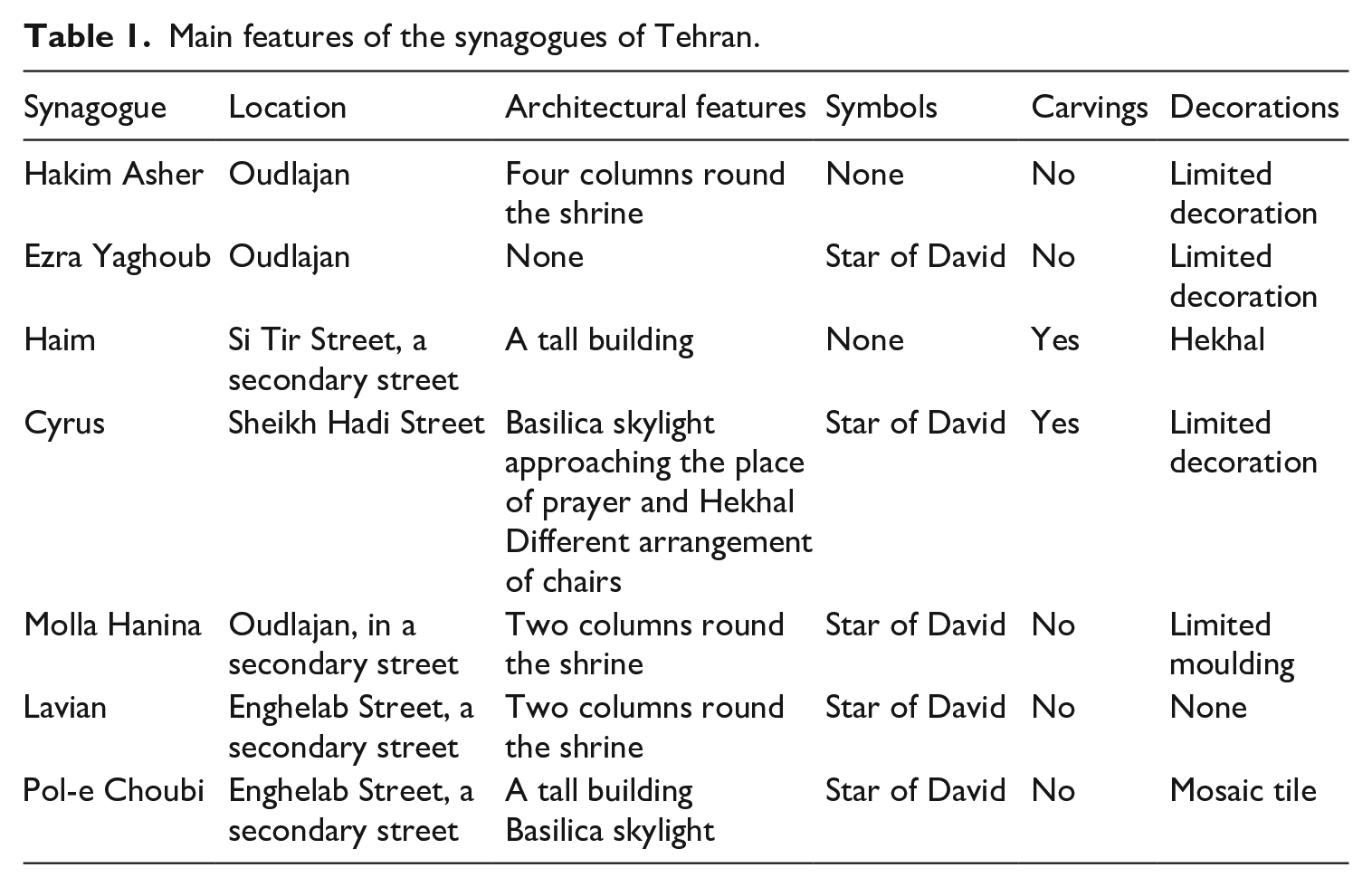
This study of the synagogues of Tehran shows that the special symbols of this minority group – such as the Star of David, Menorah or the roaring lion, symbolizing the Children of Israel – are rarely seen on the facades of synagogues, which is related to their unwillingness to be visible in the fabric of society. The entrance of the Ezra Yaghoub Synagogue, which is located in a narrow alley, is decorated with the Star of David. Above the entrance to the Molla Hanina Synagogue, there is a very small star that can only be seen if you look closely at the facade of the building (now, it is even covered). In addition, it is not common among Jews to put signs on their synagogues. The tile inscription with the name of the Cyrus Synagogue as one of the most important synagogues in Tehran is an exception. However, only the word ‘Synagogue’ is written over the entrance of the Haim Synagogue. The closer we get to the Pahlavi era from the Qajar period, the more the Jewish architecture tends to be visible in the urban context. This trend continues until the Iranian Revolution. Table 1 summarizes the main features of the synagogues of Tehran.
Main features of the synagogues of Tehran.
Conclusion
Research in the field of Jewish religious architecture in Tehran reveals lesser-known aspects of the social structures and political conditions that have governed this minority group. It must be acknowledged that social and political conditions have directly impacted attitudes towards Jewish religious architecture. The Qajar period required social isolation and the avoidance of any revelation of religious sites in the urban context for Jews. The constitutional movement, which brought more social equality for minorities, led to a change in the structure of Jewish religious architecture, with it becoming more influential in the urban context. Due to the distinct social and political conditions of the period, Jews experienced a level of extroversion and a desire to be more visible with their religious architecture in the urban context. The reluctance to be visible in the urban space of the Qajar period gradually disappeared and thus caused a change in attitudes towards architecture and the desire to construct significant buildings after the introduction of the Constitution and the first Pahlavi government. Accordingly, the synagogues of Tehran have been evaluated in three separate periods. The synagogues of the first period, which date from the Qajar era to the constitutional era, are lesser-known buildings. The main features of these synagogues are their small size, simplicity and minimal visual connection with the urban fabric. It is worth mentioning that the only feature of the religious architecture of this period – that is, the use of columns round the shrine – has played the role of visual guidance in the synagogue. The use of such columns was probably influenced by the synagogues of Isfahan and the traditional architectural texture of that city.
The Constitution provided the basis for Jewish social change. In this period, unlike the previous period, synagogues were established outside the Jewish neighbourhood, with distinct and obvious plans in the urban context. The social situation of Jews and their religious architecture in the first Pahlavi period were strongly influenced by the political conditions, and there were certain complexities. The first Pahlavi period, despite initial support, created a kind of instability in the social conditions of Jews, under pressure from intellectual groups close to the Nazi Party and due to racist motives. The synagogues of the first Pahlavi period, following the conditions that led to the tendency for synagogues to be more visible in the city, all have a clear view and entrance on a main passage. However, even in the Cyrus Synagogue and Pol-e Choubi Synagogue, which have distinct architecture, there is no sign of particular Jewish architecture. The most important point with regard to the synagogues of the first Pahlavi period is the beginning of the construction of large synagogues and the creation of significant architecture. As mentioned, Judaism failed to create a unique language and expression for its religious architecture in Iran, and Jews were subject to the architecture around their place of residence. However, the social and political changes after the Constitution and the first Pahlavi period created a sense of the need for distinctive architecture.
Footnotes
Declaration of conflicting interests
The author declared no potential conflicts of interest with respect to the research, authorship and/or publication of this article.
Funding
The author received no financial support for the research, authorship and/or publication of this article.
