




Abstract
Is the gambling business compatible with Christianity? Catholicism, the largest Christian denomination, does not provide a clear answer to this question, which has also been largely dismissed by scholars from gambling studies and religious studies alike. This article fills this gap through an assessment of the gambling business in light of Catholic moral and social teachings. It offers two main findings. First, it challenges the widespread notion of the neutrality of the Catechism towards gambling and argues that contemporary commercial gambling is in contravention of core Catholic moral teachings. Second, it offers a novel assessment of the legitimacy of the gambling enterprise through the application of the concept of ‘social usefulness’. It proposes that any positive social outcomes resulting from gambling, regardless of their entity, do not render the gambling enterprise socially useful and legitimate – from a Catholic social-teaching perspective – since gambling also brings about significant gross social costs. This article contributes to a better understanding of the place of gambling within Catholicism, and hence within Christianity more broadly. Likewise, it offers suggestions on how the Catholic Church could embrace a more accurate assessment of the gambling enterprise that better reflects Catholic social doctrine so as to mitigate problem gambling, which is particularly salient among Catholics.
Introduction
Whilst there is not an all-embracing, generally accepted definition of ‘gambling’, this term generally refers to a broad set of conducts that entail the ‘wagering on an uncertain event’ (Schüll, 2014: 313). Hence, gambling is a rather expansive concept, and this is often reflected in legal definitions of the term, which tend to be all-inclusive. For example, according to the Illegal Gambling Businesses Act (1970), gambling ‘includes but is not limited to pool-selling, bookmaking, maintaining slot machines, roulette wheels or dice tables, and conducting lotteries, policy, bolita or numbers games, or selling chances therein’. However, from a conceptual point of view, the notion of gambling is not necessarily limited to activities and products formally or officially categorized as gambling. For example, certain speculative products that fall under the remit of financial services regulation and supervision closely resemble gambling products. An example is binary options, which until recently were deemed as gambling products in Cyprus, Malta and the United Kingdom, even though today these very same jurisdictions treat them as financial products (Iglesias-Rodríguez, 2021: 634–635).
Different gamblers may pursue different aims, and a single gambler may be driven to gamble by various reasons. Whereas obtaining a reward seems to be a common motivation to gamble, the nature of such a reward is very heterogeneous and includes different factors that go beyond mere financial gains. For example, according to Lee et al. (2007), the main drivers of gambling are monetary gains, amusement, excitement, avoidance and socialization. Indeed, some research shows that gamblers may experience a reward through a dopamine release in the case of monetary loses, and suggests that the latter constitute a stronger driver of gambling than monetary gains (Anselme and Robinson, 2013: 1–2).
Gambling has its roots in ancient history and, since very early times, both civil and religious authorities and thinkers have tried to address the risks associated with it (Grant et al., 2019: 50–53). Ancient Jewish law censured organized gambling on various grounds, one being that the concepts of divine will and of chance are incompatible (Brenner, 1990: 51). Aristotle considered gains from gambling to be dishonourable (Ore, 2017: 194), and Roman legislation from the 3rd to 1st century
Scholars have largely dismissed the analysis of this topic. On the one side, gambling studies research tends to address religious aspects primarily with a view to finding out correlations between religious traditions or practices and gambling behaviour (e.g. Grichting, 1986; Hoffmann, 2000; Mutti-Packer et al., 2017). On the other side, the few theological contributions that tackle the issue of gambling generally analyse it from the point of view of scripture (e.g. Binde, 2007: 155–157; Moore, 2011), rather than broader current Christian moral and social teachings, and put their focus on the actions of individuals (e.g. Moore, 2011) or state-based gambling schemes (e.g. Fleming, 2011), rather than the gambling business in general.
In the last three decades, the gambling industry has experienced an unprecedented expansion and transformation (Kindt and Joy, 2002: 111–112, 123–124; Walker and Jackson, 2013: 80–82). In the USA, 2021 set a record in terms of revenue for the gambling industry, which amounted to more than US$44 billion (Velotta, 2021). Likewise, in recent years, research has shed new light on the operation of the gambling industry, and on the features of gambling and their role in the phenomenon of problem gambling (e.g. Orford, 2020). Problem gambling has two core defining features. The first is ‘the presence of a subjective sense of impaired control’, whereby the gambler is unable to control the urge to gamble, and the second is the causation of harm to the gambler and/or the gambler’s social or family environment (Blaszczynski and Nower, 2002: 488). Research suggests that the severity of problem gambling is greater among Catholics than among those with other religious affiliations (Mutti-Packer et al., 2017; Wynne Resources, 1998: 26, 68). This brings about two important questions. The first is whether the contemporary commercial gambling enterprise abides by Catholic moral and social teachings. The second is whether such teachings are tailored to the reality of the contemporary commercial gambling industry and the extent to which they may contribute to mitigate the phenomenon of problem gambling.
This article tackles these questions through a novel assessment of the gambling enterprise in light of Catholic moral and social doctrine and teachings. The article proceeds as follows. The next section examines the justness of the gambling enterprise in view of the Catechism. It argues that, despite the latter’s apparent neutrality towards the former, the offer of gambling services and products is in contravention of its Paragraph 2413. The article then examines the legitimacy of the gambling enterprise considering Catholic social teaching. It claims that the gambling enterprise does not fulfil the requirement of social usefulness of the Compendium. This argument is supported by an analysis of papal activities and statements in the period 1990–2019 pertaining to gambling and the gambling industry. This is followed by a summary of the main findings and an examination of the potential of a catechetical revision on Catholic attitudes towards gambling. It is proposed that the Catechism should be revised with a view to embracing a more accurate and explicit assessment of the gambling enterprise that better reflects Catholic social doctrine.
A catechetical assessment of the gambling business
The Catechism is rather succinct when it comes to the issue of gambling. According to Paragraph 2413 on games of chance, which also include gambles, these are not contrary to justice per se. However, there are three exceptions to this general rule. The first is when they ‘deprive someone of what is necessary to provide for his needs and those of others’; the second refers to instances when ‘[t]he passion for gambling risks becoming an enslavement’; and the third relates to cases where gambling is unfair or involves cheating. From the point of view of a gambling provider, compliance with Paragraph 2413 would require that gambling is organized, offered and provided in a way whereby none of these exceptions, which result in damage to the gambler, occur.
As regards the first and second exceptions, scholarly research suggests that 15–50% of gambling revenue derives from problem gamblers (Williams and Wood, 2017). This would support the view that, in practice, the operation of gambling businesses is at odds with the goals of Paragraph 2413 of the Catechism. Fulfilment of the latter would require that gambling is provided in accordance with the affordability and non-addiction requirements of Paragraph 2413 of the Catechism, and this would be extremely difficult to achieve, since it would require that the gambling provider has access to full and complete information about the gamblers’ financial situation (in relation to both their own family’s and personal needs), as well as their psychological profile, with particular emphasis on their propensity to or dependence on addictive gambling behaviours. This would, in turn, allow it to provide gambling services tailored to the financial situation of each gambler – for example, subject to gambling limits – or even to exclude certain gamblers who are particularly vulnerable. However, besides the inherent difficulties that the proper acquisition and processing of such information would entail, the existing regulatory framework and industry practices aimed at the protection of gamblers are ill-suited for effectively achieving such purposes. For example, on their gambling-warning labels, gambling providers often present the information in a way that makes it difficult for the gambler to make informed gambling choices (see Newall et al., 2022). Moreover, some of the main responsible gambling instruments that may be used to prevent or limit the damage of gambling on vulnerable gamblers largely depend on the willingness of the individual gamblers themselves. For example, very often, play, bet, deposit and loss limits are voluntary and set at the request of the gambler, not at the initiative of the gambling provider (Auer et al., 2020: 15–16). This is the case with exclusion bans, which are in most cases voluntary and initiated at the request of a gambler, rather than imposed by gambling providers (Sulkunen et al., 2019: 132). In addition, research has shown that the design and application of responsible gambling instruments often suffers from a number of limitations which affect their effectiveness, and most problem gamblers do not use them (Delfabbro and King, 2019: 71; Gainsbury, 2014; Ross, 2012).
When it comes to the behaviour of the gambling industry itself, research has evidenced that among gambling providers there is a widespread use of practices – largely based on psychology – aimed at misleading gamblers about their chances of winning and, more generally, encouraging them to spend more. These range from the design of the gambling venues themselves to the use of gambling features such as losses disguised as wins or near misses (Orford, 2020: 61, 71–89).
Paragraph 2413’s reference to the passion for gambling ‘becoming an enslavement’ may be interpreted in two interrelated ways. On the one side, it may be understood as a statement of fact – namely, that a passion for gambling inherently poses the risk of addiction. On the other side, it may be interpreted as a condemnation of gambling if and when it leads to the gambler experiencing a degree and form of passion that may extend into a gambling addiction. Regardless of the specific interpretation of this passage, the inherent difficulties of ascertaining the gamblers’ financial situation and their propensity to addiction, and the limitations of the mechanisms for the protection of gamblers, as well as the behaviour of the gambling industry, as explained above, would suggest that modern gambling products and services are provided in a way that fundamentally involves a serious risk of creating forms of addiction – or ‘enslavement’, in the words of the Catechism – for gamblers.
When it comes to the third exception of Paragraph 2413, which determines that gambling is contrary to justice when it is unfair or involves cheating, its assessment poses a complex predicament that relates to the nature of gambling itself. In this respect, some commentators have characterized gambling as intrinsically unfair. Consider, for example, Walker’s words: The reality is that the gambling industry exists because gambling is unfair. The gambling industry has the odds in its favour: there are no even money gambles. There is a mathematical theorem that proves that the more a person gambles, the more sure they are to lose. All regular gamblers will lose in the long run no matter what their earlier successes. (Walker, 2001: 5)
If we take this view, which indeed reflects very well one of the core features of the modern gambling industry (Read, 2009: 35), there is no such a thing as fair gambling, and this would render commercial gambling contrary to justice per se. Hence, whilst Paragraph 2413 of the Catechism does not explicitly censure the gambling enterprise, the features, actual operation and effects of the latter do appear to be in clear contravention of it.
Without formally questioning the apparent neutral position of the Catechism towards gambling, Catholic dioceses across the world have strongly criticized commercial gambling on the grounds of its pernicious effects on individuals and society (e.g. Diócesis de Alcalá de Henares, 2021; Roman Catholic Archdiocese of Singapore, 2016). These concerns have often been voiced in response to legislative proposals aimed at expanding gambling. For example, in 2012, the Catholic Diocese of Cleveland reacted to plans for the expansion of gambling in Ohio, as proposed by House Bill 386 (2012), with a statement which highlighted the damage that gambling inflicts on local communities: we desire to call attention to . . . the dangers of enslavement which the passion for gambling may bring on . . . when new gambling opportunities come into a community, there tends to be an increase of prostitution, human trafficking, white-collar crime, violence, scam artists, selling of drugs, credit card fraud and other criminal activity all of which are detrimental to the well being of individuals, families and the larger community. We realize that, for some who may be most vulnerable, there can be a temptation to see the casino as a means to alleviate financial problems and provide a largely illusionary way to ‘get rich quick’. (Catholic Diocese of Cleveland, 2012)
In a similar fashion, in response to draft legislation aimed at authorizing new casinos in Chicago and other areas in the state of Illinois, as well as permitting the operation of slot machines at horse-racing tracks (Geiger and Ruthhart, 2015), the Catholic Conference of Illinois, which gathers the six Catholic Illinois dioceses, issued a statement that implicitly opposed the proposed legislation, largely on the grounds of catechetical criteria: Our traditional teaching is clear. Gambling is not immoral in itself . . . While this Church teaching may be clear, it also may be difficult at times to evaluate or even specify the particular circumstances that make gambling a moral problem . . . Nevertheless, the serious negative impact of gambling experienced in Illinois is prompting greater numbers of people to evaluate the circumstances surrounding gambling in our state. For it seems that in our state . . . ‘the passion for gambling’ is becoming ‘an enslavement’ both for individual persons and for society. (Catholic Conference of Illinois, 2015)
The main concerns of Catholic conferences and dioceses have generally related to commercial gambling. Cassidy et al. (2013: 13) define the latter as ‘a profit-making industry which is legal, state-owned or regulated and licensed to provide a variety of gambling products, such as casino games, betting or online gambling’. This definition captures two key elements of commercial gambling – namely, its for-profit-making nature and the broad scope of the gambling products and services it refers to. However, it is also rather narrow as it fails to acknowledge, among others, the fact that commercial gambling may also occur in unregulated settings. Hence, a more accurate definition of commercial gambling generally encompasses all forms of for-profit gambling that are ‘organized, widespread, and systemic, whether legal or illegal’ (Catholic Bishops’ Conference of the Philippines, 2005). Such concerns have in some instances materialized in recommendations or prohibitions against commercial gambling-related investment or fundraising activities. For example, in 2010, the Catholic Archdiocese of Edmonton, Canada, issued Policy No. 216, which prohibits Catholic parishes, institutions and organizations under the remit of the Archdiocese to raise funds through harmful gambling activities; make applications for funding to organizations that raise those funds through harmful gambling activities; or receive donations of funds that originate from harmful gambling activities – with the latter defined as casino gaming, video lottery terminals and high-stakes bingo (Catholic Archdiocese of Edmonton, 2010). More recently, in 2020, the Italian Episcopal Conference published a document with responsible investment principles, primarily addressed to dioceses, parishes, congregations, religious foundations, associations and entities, which instructs that investments in activities linked to betting, slot machines and casinos should be avoided (Conferenza Episcopale Italiana, 2020: 11, 30). Similarly, the United States Conference of Catholic Bishops (2021) has indicated that it will not carry out investments ‘in companies whose primary purpose is to derive revenue from gambling’ (19), and one of its guiding investment principles is the duty to avoid scandal (6–8), which has a catechetical root. In this respect, Paragraph 2284 of the Catechism defines ‘scandal’ as ‘an attitude or behavior which leads another to do evil. The person who gives scandal becomes his neighbor’s tempter . . . Scandal is a grave offense if by deed or omission another is deliberately led into a grave offense’ . Hence, underlying the United States Conference of Catholic Bishops’ investment principles, and its decision not to invest in companies whose main purpose is the gambling business, is the idea that the latter is ‘evil’, and that an investment in such business may convey the idea of endorsement and hence encourage others ‘to do evil’ (i.e. offer gambling services and/or products).
It is interesting to note that some diocesan documents extend their criticism, albeit in lesser degrees, to non-commercial gambling – and even gambling linked to charitable Church activities. For example, the Catholic Conference of Ohio (2006) has acknowledged that charitable bingo may also bring about ‘social ills’ and has consequently discouraged Church institutions to use it as a means of fundraising.
Hence, even though national and local Church authorities stress the neutrality of the Catechism towards gambling, what stems from their statements and actions is an underlying view of gambling, and particularly of commercial gambling, as an activity that, from the point of view of the provider, de facto contravenes or brings about a high risk of contravention of Paragraph 2413 of the Catechism. Indeed, rather than speaking of a ‘neutrality’ of the Catechism towards the offer of commercial gambling, it may be more adequate to speak of a ‘silence’ of the Catechism in relation to it, or, as put by the Alberta Conference of Catholic Bishops (1998): ‘The Catechism, of course, does not address the more profound questions associated with an elaborate system of gambling’.
The legitimacy of the gambling business: a social doctrine perspective
Does the gambling business contribute to the common good? The Compendium and the notion of social usefulness
The Compendium recognizes the importance of private initiative in the business sector as an inalienable right, which constitutes a means of both expressing individual creative subjectivity and generating wealth. Consequently, the Compendium deems that such initiative must be defended and promoted (Catholic Church, 2004: para. 336). However, at the same time, the Compendium determines that the exercise of such initiative must be bound by certain limits, which largely revolve around the concept of the ‘common good’ (e.g. paras. 336, 338, 340).
The concept of the ‘common good’ has been subject to extensive philosophical and theological debates. The contemporary theological meaning of the term has been largely shaped by the work of Aristotle, Thomas Aquinas and Ignatius Loyola, who, whilst engaging in different interpretations, shared the view that this referred to a good of the community that is greater than the good of each individual (see Hollenbach, 1999: 1). The Compendium provides a general definition of the common good as ‘the sum total of social conditions which allow people, either as groups or as individuals, to reach their fulfilment more fully and more easily’ (Catholic Church, 2004: para. 164). Moreover, it demands the cooperation of each member of society in its attainment (para. 167).
Paragraph 348 of the Compendium determines that: The individual profit of an economic enterprise, although legitimate, must never become the sole objective. Together with this objective there is another, equally fundamental but of a higher order: social usefulness, which must be brought about not in contrast to but in keeping with the logic of the market. When the free market carries out the important functions mentioned above it becomes a service to the common good and to integral human development.
It follows that, according to the Compendium, for-profit economic enterprises are legitimate only as long as they bring about social usefulness. This raises the question of whether the gambling industry, whose core purpose is to make profits, can and does generate, at the same time, social usefulness, and whether the latter is directly linked to the provision of gambling services. This, in turn, requires an ex ante examination of the concept of ‘social usefulness’.
Whilst there is not an all-encompassing definition of the term ‘social usefulness’, it is normally used to refer to an outcome that is beneficial for society at large or, as put by Woodward (1917: 526), ‘usefulness to the community as distinguished from usefulness merely to the individual’. In the field of economics, where social usefulness is often assessed on the basis of a comparison between social benefits and social costs, commentators have different views on gambling’s degree of social usefulness. On the one side, some libertarian interpretations that oppose gambling prohibitions propose that gambling brings about a number of social benefits, such as entertainment and the exercise of freedom by the people (e.g. Basham and Luik, 2011). These types of analyses tend to associate social usefulness with individual benefits rather than broader societal outcomes, and consider problem gambling as a minor, overrated problem (e.g. Forbes, 2003). More generally, some commentators suggest that gambling brings about certain economic benefits – notably, in the form of income, employment and tax revenue (e.g. Littlepage et al., 2004). However, there is research that suggests a potential substitution effect, whereby gambling displaces consumer expenditure, and hence the related economic benefits, from other sectors and activities such as non-gambling entertainment businesses. According to this view, gambling may not lead to additional economic benefits but merely displace income, employment and tax revenue from those other activities and sectors (Clark et al., 2021; Garrett, 2003; Hill, 2018; Siegel and Anders, 1999; Walker and Jackson, 2011). On the other side, several studies suggest that the social costs of gambling far outweigh its social benefits. For example, in a detailed study of casino gambling in the USA, Grinols (2004: 175) finds that the social costs of casino gambling – which the author identifies with costs derived from negative externalities such as crime, bankruptcy, sickness, suicide and regulatory expenditure – exceed its social benefits by a factor that ranges between 3.9:1 and 6.3:1.
The economic concept of ‘social usefulness’ as an outcome where social benefits exceed social costs offers useful, albeit limited, insights to assess the compliance of gambling, as an economic enterprise, with Catholic social doctrine and teachings. Accordingly, gambling would be legitimate only to the extent that the social costs resulting from it are lower than the related social benefits. However, the specific answer may vary depending on the concrete outcomes of gambling in relation to a given sample, and how these outcomes are valued and assessed. Whilst the determination and valuation of the social costs and benefits of gambling remains a controversial, disputed issue (see Walker and Barnett, 1999), the research of authors such as Grinols (2004) would lead to the conclusion that the economic enterprise of gambling does not comply with the requirement of Paragraph 348 of the Compendium. However, it is also important to bear in mind that the concept of ‘social usefulness’ of Paragraph 348 of the Compendium is different from its economic interpretation explained above. In this respect, according to the Compendium, an economic enterprise will be deemed as socially useful only to the extent to which it contributes to ‘the common good and to integral human development’ (Catholic Church, 2004: para. 348). In the Compendium, the concept of the ‘common good’ refers to a sum of (positive) social conditions that contribute to societal and individual fulfilment (para. 164) – namely, ‘the good of all people and of the whole person’ (para. 165). Moreover, ‘integral human development’ refers to a development accomplished in respect of principles of morality (Booth, 2020).
What stems from this understanding of social usefulness is that it refers to an outcome of a for-profit activity consisting of a gross social benefit, rather than to an outcome that merely consists of a net social benefit. This is also reflected in the reference to social usefulness as an objective that must be achieved ‘not in contrast to but in keeping with the logic of the market’, and that is of a higher order than the individual profit of an economic enterprise (Catholic Church, 2004: para. 348). In other words, in order to be legitimate, the for-profit enterprise must bring about a socially useful outcome that must be directly and intrinsically related to the activity of such an economic enterprise. Moreover, the morality of an economic activity is conditional on it consisting of ‘the production of goods and services that are useful for the growth of each person’ (para. 333), not just of some persons. Hence, for-profit economic enterprises that result in negative (i.e. costs) or neutral net social outcomes, gross negative social outcomes or only neutral gross social outcomes would not be deemed as socially useful.
The Compendium’s underlying understanding of ‘social usefulness’ has important implications for the interpretation of the gambling enterprise’s overall legitimacy in the sense that any positive social outcomes resulting from gambling, regardless of their entity, do not render the gambling enterprise socially useful, since gambling also brings about (significant) social costs. This view is embraced in a message from Cardinal Peter Kodwo Appiah Turkson, issued on 26 June 2017 on the occasion of the International Day against Abuse and Illicit Trafficking of Drugs: The legalization of gambling, even when it is supported by the intention of unmasking its criminal management, exponentially increases the number of pathological players; moreover, taxation by the state is to be considered incompatible from an ethical standpoint and contradictory in terms of prevention. (Turkson, 2017)
This statement denotes an understanding of the gambling enterprise not only as a socially useless activity, but also, and rather, as a socially destructive activity, and hence unethical. It refers to both illegal gambling, owing to its criminal nature, and to legal gambling, due to its negative effects on society and individuals. Consequently, the generation of state revenue from legal gambling is also deemed contrary to the Church’s social doctrine.
Does the gambling business contribute to the common good? Papal views on gambling and the gambling industry
Catholic social teaching is a broad concept whose sources include certain papal addresses and documents on relevant social issues (Schlag, 2017: 1–2). More generally, all papal expressions of opinion on social matters can provide very useful and complementary guidance on how a given matter is to be interpreted in light of core documents within Catholic social teaching, such as the Compendium. Popes have referred to gambling and the gambling enterprise on different occasions and in different documents, hence analysis of the latter offers important insights into the Church’s views on the gambling enterprise.
One of the earliest written papal references to gambling may be the homily ‘De Aleatoribus’, also known as ‘Adversus Aleatores’, which, according to some commentators, was written by Pope Victor I in the 2nd century (Cross and Livingstone, 2005: 461). The author of ‘De Aleatoribus’ describes gambling as a work of the Devil and incompatible with Christian values – a depiction consistent with the views of early Christian thinkers (Brattston, 2019: 80–83). However, throughout the Church’s history, papal views on gambling and the gambling enterprise have varied, ranging from a strict position such as that of Pope Benedict XIII – who, in 1725, issued a ban on lottery gambling in the Papal States under threat of excommunication for those who did not follow it – to the more flexible views of Pope Clement XII – who lifted such bans and reintroduced lottery gambling in 1731 (Colzi, 2004: 820–821; Von Döllinger, 1862: 403).
Since the beginning of the 1990s, there has been a surge in the number and frequency of papal references that are critical of gambling and the gambling industry (a summary of the main ones is provided in Table 1). This may partly be due to the massive increase of commercial gambling since the mid 1980s, which has had a profound negative impact on problem gambling (Abbott, 2017: 1–2) and hence poverty – an area of increasing concern for the Church after the Second Vatican Council (see California Catholic Conference, 2021). Already in 1990, Pope John Paul II (1990) acknowledged how the ‘spread of gambling’ was contributing to widespread poverty in Asia. Since then, a number of statements by both Pope John Paul II and, notably, Pope Francis have underscored the idea of gambling as a pernicious phenomenon. The popes’ focus is not on disapproving the behaviour of gamblers but rather on highlighting the dangers and evils that gambling may bring about for individuals and society, and also on censuring those who offer and/or provide gambling to others.
Public papal references to gambling (1990–2019).
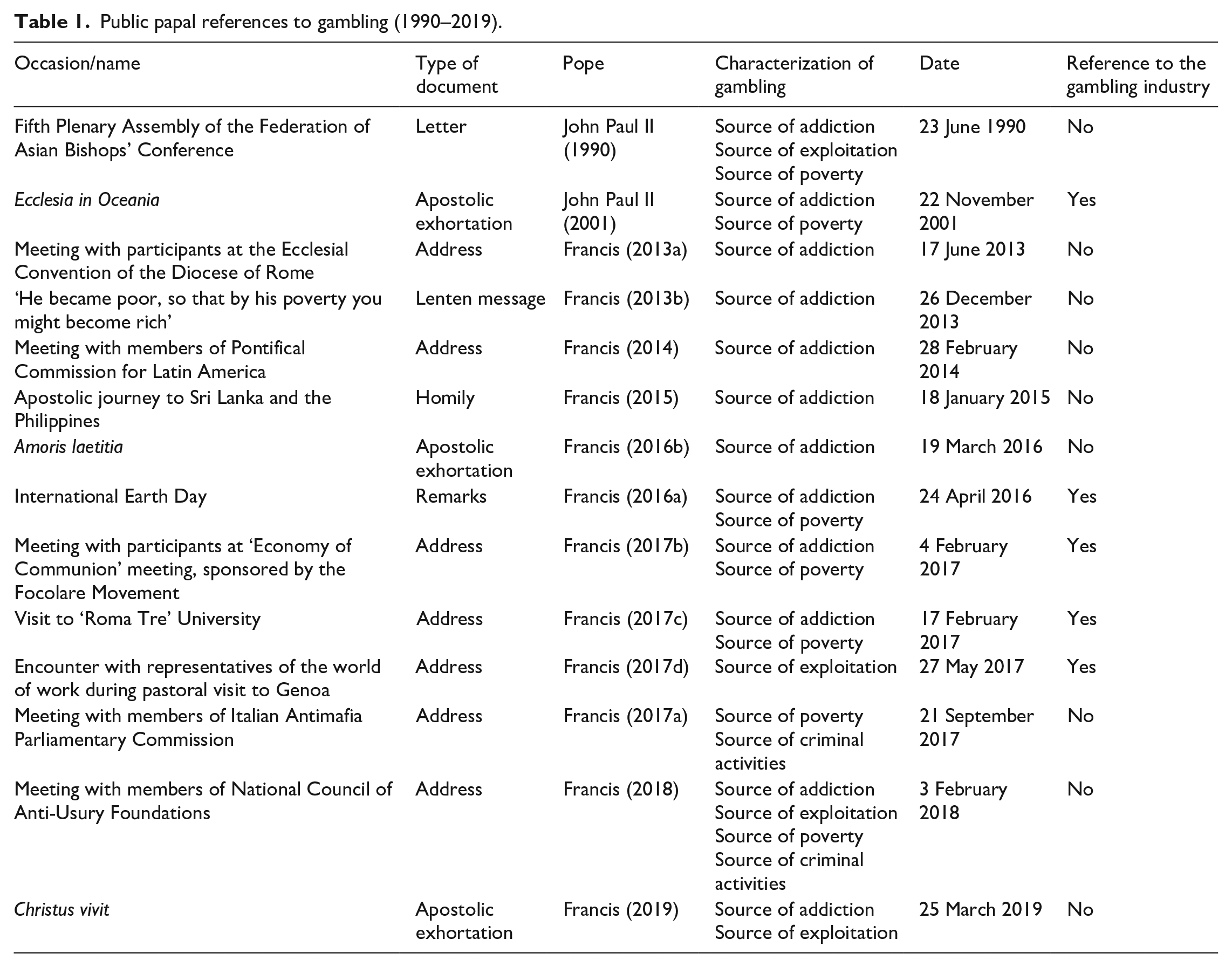
The references to and use of the term ‘gambling’ by Pope John Paul II and Pope Francis reveal a rather disapproving view of it as a phenomenon that is intrinsically negative and has no social usefulness. Sometimes, such characterization is implicit and evidenced in the sequence of terms where the word ‘gambling’ appears and with which it is associated. For example, in his letter to the bishops delegates to the Fifth Plenary Assembly of the Federation of Asian Bishops’ Conference, Pope John Paul II (1990) criticizes the ‘spread of gambling and violence’. However, in most cases, papal references are explicit in their acknowledgement of gambling as an inherently destructive phenomenon with pernicious effects at both the individual and societal levels, such as addiction, exploitation, poverty or criminal activities. The most explicitly negative characterizations refer to gambling as a ‘destructive phenomenon’, one among ‘the serious problems of modern society’ (John Paul II, 2001), and a ‘scourge’ (Francis, 2018).
The popes’ denunciation refers to the offer of both illegal and legal gambling, and the latter is not seen as more innocuous than the former. Indeed, some papal statements focus their main criticism on organized legal gambling ‘offered by merchants who trade in emptiness’ (Francis, 2017c), luring people into false promises of happiness or solutions to financial problems, only to bring them ‘into an even more difficult situation’ (John Paul II, 2001). Pope Francis (2017b) also criticizes the hypocrisy of ‘[g]ambling companies [that] finance campaigns to care for the pathological gamblers that they create’. More generally, Pope Francis (2017d) considers the gambling industry to be a business ‘without dignity’.
Pope Francis has signalled his opposition to gambling and those who provide gambling services not only through pronouncements to that effect, but also through his meetings with representatives of civil society organizations whose work involves the fight against gambling, and the formulation of statements during such meetings that explicitly or implicitly endorse the views and activities of those civil society stakeholders in aspects relating to gambling. For example, on 4 February 2017, in an audience with the participants at the ‘Economy of Communion’ meeting, Pope Francis (2017b) stated: ‘The “goddess of fortune” is increasingly the new divinity of a certain finance and of the whole system of gambling which is destroying millions of the world’s families, and which you rightly oppose’. This meeting was sponsored by the Focolare Movement, a civil society organization that has supported various initiatives against gambling, such as ‘Slotmob’, a campaign aimed at the eradication of slot machines from Italian bars (De Santis, 2015). Pope Francis (2018) has also praised and supported the work of the National Council of Anti-Usury Foundations, which has taken various initiatives against gambling. For example, in 2012, it launched ‘Together against Gambling’, a network of various stakeholder organizations in the realm of social action that aims to fight gambling through initiatives ranging from hosting events warning about the risks of gambling to lobbying with a view to influencing the adoption of legislation that effectively addresses gambling (Consulta Nazionale Antiusura, 2012).
The relevance of the papal views on and criticism of gambling and the gambling industry is stressed by the nature of some of the documents chosen to express them. They include three apostolic exhortations (Francis, 2016b, 2019; John Paul II, 2001) and are hence some of the most important in the hierarchy of papal documents (see Roman Catholic Diocese of Charleston, 2019).
Concluding remarks and recommendations: the potential of a catechetical revision on Catholic attitudes towards the gambling business
The analysis conducted in the previous sections reveals that the Catechism’s approach to the assessment of commercial gambling and the gambling enterprise suffers from two inconsistencies. First, Paragraph 2413 of the Catechism shows an internal inconsistency in the sense that it does not explicitly censure the gambling enterprise, even though the latter’s characteristics, actual operation and effects are in contravention of the Catechism. On the contrary, the wording of Paragraph 2413 is confusing because it conveys the idea that the gambling enterprise is contrary to justice, illegitimate and unethical only vis-à-vis problem gamblers, when it involves cheating or takes place in an unauthorized or illegal setting. Secondly, Paragraph 2413 of the Catechism is inconsistent with Catholic social teaching. As explained above, the gambling enterprise neither contributes to the objective of the common good nor fulfils the requirement of social usefulness, which, according to the Compendium, is an essential requirement for an economic activity to be deemed as legitimate. Moreover, as has been shown above, papal statements concerning gambling and the gambling industry unambiguously consider them as intrinsically negative in all their forms. These inconsistencies bring about the question of whether it would be appropriate to revise Paragraph 2413 of the Catechism so as to provide a more accurate assessment of the gambling enterprise. This article argues that there are two core rationales that would justify such an amendment.
The first rationale is normative in nature. By being silent on and not providing an accurate picture of the morality of the gambling enterprise, Paragraph 2413 of the Catechism does not fulfil its objective of ‘presenting an organic synthesis of the essential and fundamental contents of Catholic doctrine, as regards both faith and morals’ (Catholic Church, 1993: para. 11). More generally, as regards the inconsistency of the Catechism with Catholic social teaching, the former has the Church’s Magisterium among its main sources (Catholic Church, 1993: para. 11) and the Church’s Magisterium, in turn, includes the Church’s social doctrine (Catholic Church, 2004: para. 80). Accordingly, the Catechism should embrace and accurately reflect such doctrine.
The second rationale for a revision of Paragraph 2413 of the Catechism relates to policy. In the last three decades, the Church has taken a very activist position against gambling in general and the gambling industry in particular, as evidenced by the pronouncements made by Pope John Paul II, Pope Francis, members of the Curia, Catholic conferences, archdioceses and dioceses (as examined in the preceding sections). This has been particularly the case since Pope Francis assumed office. Hence, from a policy viewpoint, an amendment of Paragraph 2413 of the Catechism may be useful for the Church to advance its agenda in this area.
On the one side, a catechetical censure of the gambling enterprise could strongly influence the views and approaches of Catholic gamblers towards gambling and may make them more reluctant to engage with it. In this respect, research shows that there are strong links between religious traditions – and their views on gambling – and gambling behaviour in the sense that individuals who belong to religious traditions that disapprove of gambling (e.g. evangelical Protestants) are less prone to engage in gambling activities, such as casino and lottery gambling, than those who belong to religious traditions with more lenient views on gambling (e.g. Catholics) (Beyerlein and Sallaz, 2017).
On the other side, an explicit catechetical disapproval of commercial gambling may also influence the behaviour of the gambling industry itself, particularly of those gambling businesses owned and/or run by Catholics – which, indeed, is a very common occurrence in Las Vegas (Gumbel, 1998). Whilst it is unlikely that such a catechetical disapproval would result in a drastic reaction by Catholic gambling operators, it could at least potentially influence them towards the adoption of measures aimed at making their gambling enterprises more responsive to the risks of problem gambling.
Additionally, greater clarity and consistency of the Catechism as regards the gambling enterprise could also bring about positive outcomes – from the point of view of Catholic social doctrine – in the form of fewer investments in, or even disinvestments from, the gambling business. Gambling is indeed an area in relation to which institutional investors that engage in Catholic faith-based investments do not necessarily follow a common position. For example, the BlackRock (2021: 93) Catholic Charities Growth and Income Fund explicitly excludes investments in companies where at least 10% of their latest annual turnover was from gambling-related products. However, Morgan Stanley (2020: 5) does not appear to consider that investing in a company which makes a substantial revenue from gambling would be contrary to Catholic values.
As indicated by the Congregation for the Doctrine of the Faith (2018), on the occasion of the revision of Paragraph 2267 of the Catechism concerning the death penalty, social developments and changes in the social context may render a revision of the Catechism relevant and justified. Since the Catechism was promulgated in 1992, the gambling industry has experienced an unparalleled expansion owing to, inter alia, an increased legalization of gambling (Petry, 2015) and the availability of new gambling platforms, such as online gambling (European Business Review, 2021). This has made gambling more accessible and has contributed to the phenomenon of problem gambling (see Storer et al., 2009). Likewise, since the 1990s, a vast amount of research has shed new light on the characteristics of gambling products and platforms, the behaviour and operation of the gambling industry, and how these may contribute to gambling addiction and the phenomenon of problem gambling. Hence, a revision of the Catechism that takes stock of such changes and new knowledge would render it more responsive to the reality of contemporary gambling and its pernicious effects on individuals and society.
Footnotes
Declaration of conflicting interests
The author declared no potential conflicts of interest with respect to the research, authorship and/or publication of this article.
Funding
The author received no financial support for the research, authorship and/or publication of this article.
