




Abstract
An increased critical awareness of the sociopolitical production of occupational inequities, based on intersections of dis/ability status, race, socioeconomic status and other socially constructed markers of “difference,” is evident in occupational therapy (Trentham, 2022). This increased awareness has been accompanied by calls to become a socially responsive profession, one that intervenes to ameliorate occupational inequities through addressing discursive, systemic and structural “root” factors that sustain them (Trentham et al., 2022). Such calls have been integrated into recent guiding documents in Canada, including the tenth version of the Canadian Association of Occupational Therapists’ guidelines (Egan & Restall, 2022a, p. v), the first unified set of occupational therapy competencies (ACOTRO, ACOTUP & CAOT, 2021), and the Occupational Therapy Truth and Reconciliation Task Force final report (OT TRC, 2023). These documents emphasize the imperative to “contribute to work that dismantles social systems and structures that create injustices and inequities” (Egan & Restall, 2022a, p. 1), take steps toward “dismantling the structures that privilege some people over others” (ACOTRO, ACOTUP & CAOT, 2021, p. 6), and partner with Indigenous communities to co-construct “systems that lead to social, economic, political reconciliation” (OT TRC, 2023, p. 6).
Moving forward in enhancing social responsiveness requires transforming dominant ways occupation is understood and addressed within occupational therapy, given that these often privilege Western, middle class, ableist, white, Anglophonic, and Christian ways of knowing and doing (Farias et al., 2025; Trentham et al., 2022). A key critique has been that individualistic conceptualizations of occupation, combined with ahistorical and apolitical lenses, leave the profession ill-equipped to address “root” causes of inequities embedded in oppressive power relations, such as colonialism and ableism (Gerlach et al., 2018; Laliberte Rudman, 2021; Trentham, 2022).
Scholars have drawn upon critical social theories to generate reconfigured conceptualizations of occupation to inform equity-oriented praxis (Farias et al., 2025). By enhancing knowledge regarding how power is enacted across time to advantage dominant social groups while disadvantaging equity-deserving groups, critical perspectives can enhance occupational therapists’ capacities to act on “situations and systems of inequity and oppression within their spheres of influence” (ACOTRO, ACOTUP & CAOT, 2021, p. 13). This paper presents a citation review of a critically-informed conceptualization of occupation, specifically occupational possibilities. This concept was chosen given its integration into Canadian guiding documents for occupational therapy. For example, the “Competencies for Occupational Therapists in Canada” (ACOTRO, ACOTUP & CAOT, 2021) indicates that the “competent occupational therapist looks at how occupational possibilities are enhanced or limited by context” (p. 21). Occupational possibilities are also an essential consideration in the Canadian Model of Occupational Participation, with occupational therapists described as “experts in expanding occupational possibilities” (Egan & Restall, 2022b, p. 81).
Occupational possibilities are defined as “what people take for granted as what they [and others] can and should do, and the occupations that are supported and promoted by various aspects of the broader systems and structures in which their lives are lived” (Laliberte Rudman, 2010, p. 55). This concept serves to highlight how dominant taken-for-granted assumptions about what members of particular social groups can and should do shape how they come to understand their possibilities for occupation, as well as how others, such as health care professionals or educators, think about what occupations are appropriate and inappropriate for them. The concept also underlines how taken-for-granted assumptions influence what occupations are supported, and not supported, for specific social groups through education, health care, transportation, and other systems. Occupational possibilities that are differentially supported for various “types” of social groups often reinforce the privileges of dominant groups while simultaneously restricting possibilities for equity-deserving groups, shaping occupational inequities. Attending to this differential construction, the concept can be mobilized to disrupt what are taken-for-granted as “natural,” normative or immutable differences in access to and participation in occupation (Laliberte Rudman, 2010).
The concept of occupational possibilities is grounded in a Foucauldian-informed governmentality perspective (Foucault, 1991). A governmentality perspective highlights that power, particularly in neoliberal contexts emphasizing individual responsibilities, productivity, and self-reliance, often operates not by explicitly forcing people to act in particular ways but rather by producing and circulating knowledge or “truths” (Rose et al., 2006). This knowledge, embedded within and circulated through discourses, that is, ways of speaking and writing about a phenomenon, marks out ideal and non-ideal ways of being and doing. In turn, norms, values and assumptions aligned with the worldviews, logics and interests of dominant social groups come to be seen as natural and normative, shaping how occupations are governed by social authorities. While the occupational possibilities promoted and negated are not deterministic, over time particular occupational possibilities come to be idealized and supported in specific contexts. Moreover, occupational possibilities change across time, given that “truths” generated and promoted through discourses are dynamic (Laliberte Rudman, 2010). For example, “truths” about women promoted within patriarchal Western contexts have historically bounded what women have understood as possible occupations and how their occupational participation has been judged and addressed within health care, education, legal, and economic systems. Shifting “truths” about women have expanded access to the formal labour market, with such access supported by changes in legislation and social norms. Simultaneously, persistent truths about women continue to shape inequities, such as a long-standing wage gap and an inequitable distribution of caregiving work (Shulte, 2014).
Overall, the concept of occupational possibilities aims to shift away from individualistic conceptualizations towards understandings of occupation as political and situated. Understanding occupation as political involves considering how social power operates through occupation in ways that (re)produce inequities, as well as how occupation is used to resist and transform power relations. Understanding occupation as situated involves attending to how it is shaped in relation to social, economic, and other contextual elements, and how it contributes to such elements (Laliberte Rudman et al., 2022). Another key intent was to promote scholarship that disrupts taken-for-granted “truths” about occupations and generates knowledge of interconnected implicit and explicit roots of inequities. Consequently, such knowledge generation can inform equity-oriented practices that diversify occupational possibilities by reconfiguring discourses, practices, and systems (Laliberte Rudman, 2021). Within this citation analysis, we examined how the concept of occupational possibilities has been taken up in occupation-focused scholarship, paying particular attention to if and how its critical intents are being enacted.
Method
We conducted a mixed-methods citation content analysis, a methodology designed to quantify the uptake of a concept and interpret how it has been engaged in and towards what ends (Goodnight et al., 2023). The foci and conduct of this project were influenced by the shared critical positioning of the authors, with the first author being a white Canadian-based occupation-focused scholar whose work is centred on examining occupation as situated and political, the second author being an international doctoral student from India who incorporates a critical lens oriented by decolonizing perspectives in her scholarship, and the third author being an Eelam Tamil student occupational therapist whose intersecting positionalities have fostered a commitment to anti-oppressive practice. Following Hamilton et al.'s (2003) approach, we searched for articles that cited two foundational publications addressing occupational possibilities, including the research article introducing the concept (Laliberte Rudman, 2005) and a terminology article addressing its conceptualization (Laliberte Rudman, 2010).
The third author conducted the citation search in two rounds, one in July 2023, with no time limit, and a second extending to July 2024. The search was conducted in Google Scholar, CINAHL, and Scopus, thereby including databases with varying indexing systems. All retrieved articles had an English language version, although some were originally written in other languages. Overall, 367 hits were uploaded into Covidence software, with 175 remaining after duplicate removal (163, round 1; 12, round 2). In the first screening round, abstracts and titles of the 175 articles were screened, and full texts were searched for the term occupational possibilities. Citations were excluded if they were book chapters, books, dissertations, if occupational possibilities did not appear in the article's body, or if the full text was unavailable. Citations were included if they were peer-reviewed articles, an indication of scholarly quality. This first round was conducted by the second and third authors, with disagreements adjudicated by the first author based on initial reviewers’ notes and inclusion/exclusion criteria. Seventy-four articles were excluded (68, round 1; 8, round 2), leaving 101 articles. In the second screening round, a full text review was conducted by the first author, resulting in 8 exclusions (2 only used foundational articles to inform methodology, 5 were duplicates, 1 was not peer-reviewed). Overall, 93 articles were included (first round, 89; second round, 4).
Analysis was informed by Goodnight et al.'s (2023) approach. The first stage, conducted by the first and second authors using a form created in Covidence, involved data extraction and quantitative analysis of all 93 articles. We also categorized articles according to if occupational possibilities was integrated into 6 aspects: rationale; aims, objectives or research questions; theoretical framework; practice implications; research implications; and policy, advocacy or social change implications. Finally, articles were categorized according to the extent of integration of occupational possibilities, including cursory (concept mentioned less than 2 times, with no definition or explanation); limited (concept mentioned at least 2 times, with some attention to definition or explanation); or extensive (concept mentioned several times, with sufficient definition and explanation).
In the second stage, following Goodnight et al.'s (2023) suggestion to prioritize articles enabling deep analysis, the first author conducted a qualitative analysis of the 43 articles that extensively used the concept. Following open reading and reflexive note writing, sections of articles integrating the concept were extracted and inductively coded to trace how the concept was used, types of knowledge produced, and key implications. A recursive process involving visual mapping was used to group codes into categories addressing types of knowledge generated.
Findings
The first section of the findings presents descriptive characteristics of the entire sample of articles (n = 93; see supplementary table for full list), while the second presents three categories resulting from the qualitative analysis.
Descriptive Findings
Citations of the two foundational publications increased across time, with almost 70% (n = 64) published since 2016 (see Table 1). Although almost 80% (n = 74) included at least one author from North America, authors spanned 17 other countries. Just over 50% (n = 49) were published in the Journal of Occupational Science, and almost 60% (n = 54) were research articles (articles incorporating primary or secondary quantitative and/or qualitative data analysis).
Descriptive Characteristics of Included Articles (n = 93)
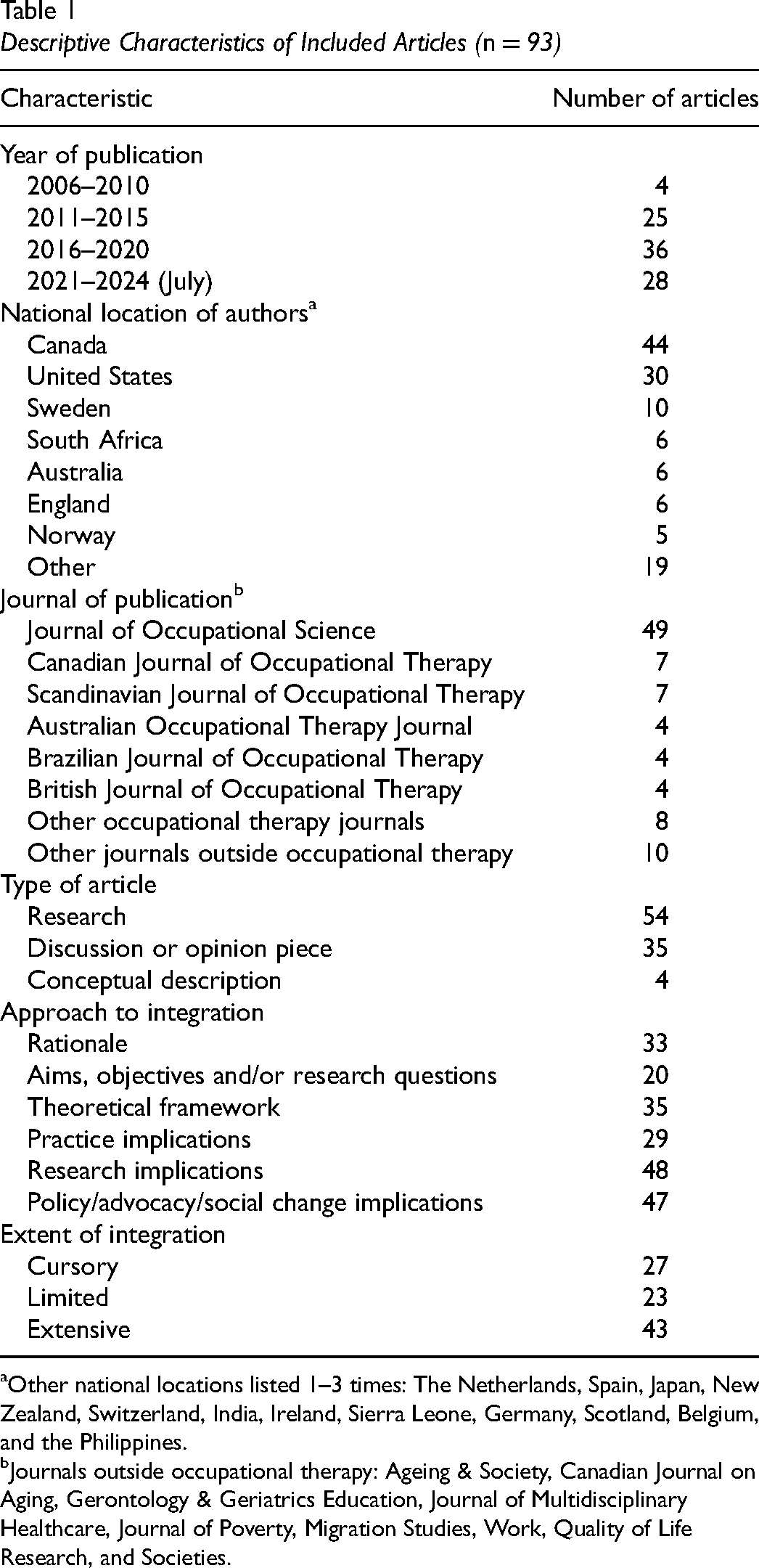
Other national locations listed 1–3 times: The Netherlands, Spain, Japan, New Zealand, Switzerland, India, Ireland, Sierra Leone, Germany, Scotland, Belgium, and the Philippines.
Journals outside occupational therapy: Ageing & Society, Canadian Journal on Aging, Gerontology & Geriatrics Education, Journal of Multidisciplinary Healthcare, Journal of Poverty, Migration Studies, Work, Quality of Life Research, and Societies.
Occupational possibilities were integrated into several aspects of articles, most frequently to address implications for research (n = 48) and policy, advocacy and social change (n = 47). The concept was explicitly integrated into the foundational theoretical framework in 38% of the articles (n = 35), and into the guiding aims, objectives or research questions in 21% (n = 20). Articles with cursory integration (n = 27) typically briefly mentioned the concept in the introduction or discussion. Those rated as having limited integration (n = 23) provided some explanation of occupational possibilities, but the concept was peripheral to the main foci. As illustrated below, articles with extensive integration (n = 43) addressed occupational possibilities in several ways.
Main Foci and Types of Knowledge Generated
Three main categories address how the concept of occupational possibilities was used and the types of knowledge generated in the 43 articles that extensively integrated the concept.
Revealing and Disrupting “Implicit” Roots: Critical Analysis of Discourses
One key intent of occupational possibilities was to inform critical deconstruction of discourses to expose implicit roots of occupational inequities and open spaces for thinking, writing and acting in alternative ways towards equity (Laliberte Rudman, 2010). Aligned with this intent, one key focus within the reviewed literature was on discursive constructions, specifically attending to how occupational possibilities are constructed in relation to equity-deserving groups. A key rationale weaving through this work was problematizing what has come to be dominantly accepted as true regarding occupations that are appropriate, ideal and possible for particular social groups. These studies have attended to broad social discourses as well as discourses within occupational therapy and occupational science, interrogating a range of types of texts, such as newspaper articles (Laliberte Rudman et al., 2009; Mayne-Davis et al., 2020), policy frameworks (Pereira, 2014; Zur & Laliberte Rudman, 2013), academic publications (Farias & Laliberte Rudman, 2016; Reparon et al., 2024), and data generated through research (Silcock et al., 2014). This work has enhanced critical awareness of the “implicit” roots of occupational inequities, given that the “truths” conveyed via discourses have material effects through their embeddedness in social relations, systems, and practices (Dash et al., 2023; Pereira, 2014).
Studies attending to broad social discourses addressed the discursive shaping of occupational possibilities for aging adults, disabled persons, persons negotiating poverty, youth, and immigrants, refugees and asylum seekers (Laliberte Rudman et al., 2009; Mayne-Davis et al., 2020; Opland Stenersen et al., 2016; Pereira, 2014; Silcock et al., 2014; Zur & Laliberte Rudman, 2013). For example, Fuchigami et al. (2022) conducted an analysis of Canadian newspaper articles addressing assistive technology designed for older adults with vision loss to deepen understanding of how discourses contribute to the problems of low uptake of assistive technologies and persistent occupational restrictions. Fuchigami et al. (2022) found that articles were imbued with power relations tied to ageism, neoliberalism and biomedicine in ways that narrowly framed such technologies, emphasizing their use for a constricted range of occupations tied to independence, self-care and mobility. These authors also attended to occupations that were marginalized within these articles, such as community-based occupations not tied to self-reliance, as well as the neglect of older adults’ lived expertise. Fuchigami et al. (2022) raised concerns that these areas of emphasis and neglect bound what occupational possibilities assistive technology is designed to support, what forms of technology are funded within neoliberal systems emphasizing self-reliance, and what older adults with vision loss understand as possible occupations. In turn, these authors called for discursive reconfiguration to expand “possibilities for designing assistive technology to support a greater range of occupations and outcomes relevant in the lives of older adults” (p. 161). As a second example, Bulk's (2022) critical discourse analysis of British Columbia's framework for accessibility legislation, which examined “how occupational possibilities and the attainment of occupational rights are influenced by the contextual and governing processes evident in the Framework” (p. 579), also drew attention to the problematic implications of intersecting neoliberal and ableist power relations. Bulk's analysis revealed that this policy framework embedded and reproduced a “participation hierarchy” (p. 582) that, aligned with neoliberalism and ableism, emphasized paid employment while neglecting the “wide range of occupations that support development, inclusion and health” (p. 582). Given this restricted construction, Bulk argued for discursive reconfiguration of accessibility legislation to expand occupations framed as valuable and worthy of societal support and achieve “the aim of creating a culture of inclusion” (p. 582).
A smaller number of studies attended to discursive constructions of occupational possibilities within occupation-focused scholarship and practice. These studies raise critical awareness of how broader discourses, imbued with oppressive power relations, can be reproduced and perpetuated, often unthinkingly, within research and practice, highlighting the need for ongoing critical reflexivity to avoid complicity (Dash et al., 2023; Njelesani et al., 2015; Reparon et al., 2024). This second type of study is exemplified by Njelesani et al. (2015) who critically reflected on three case studies drawn from the authors’ research, spanning young men with Duchenne muscular dystrophy and the transition to adulthood, youth with complex care needs and leisure occupations, and older adults and discharge planning. Their critical analysis revealed how client-centred OT practice can be tacitly guided by prevailing social discourses about “normal” occupational possibilities tied to age, ability status and other positionalities. These authors point to various ways that the “unreflexive pursuit of ‘normal’ occupations which are value-laden with judgements and social expectations” (p. 257) may lead occupational therapists to unintentionally reproduce oppressive power relations tied to ableism and ageism, and “lead occupational therapists and clients to narrow the range of occupational possibilities that they consider while negating or never considering others” (Njelesani et al., 2015, p. 253). In turn, these authors call upon occupational therapists to engage in ongoing reflexivity regarding the discourses that implicitly bound practice and occupational possibilities. A similar call for critical reflexivity regarding discourses embedded within and reproduced through scholarship and practice was forwarded by Dash et al. (2023). Dash et al.'s critical interpretive synthesis of occupation-focused research addressing parenting and autism raised concerns regarding ways normative assumptions of parenting tied to gendered roles, ableism, and neoliberalism bound this research. These discourses lead to an emphasis on the individual responsibility of parents, particularly mothers, to ensure their children approximate normative standards of child development through intensive caregiving. These authors pointed to ways these representations may limit parents’ occupational possibilities, both within and outside of parenting roles, calling upon researchers to expand possibilities through promoting “new ways of thinking about and working with parents of autistic children” (p. 13).
Revealing and Disrupting Intersecting Implicit and Explicit Roots: Systemic and Structural Forces Bounding Occupational Possibilities
A second key approach to mobilizing the concept of occupational possibilities has involved analyzing the intersections of systemic and structural conditions that bounded, and sometimes facilitated, occupational possibilities of particular social collectives. In connecting these systemic and structural conditions to discourses, this work reveals the complex ways discourses have material effects. These studies have addressed intersecting micro, meso and macro level conditions within and outside service contexts, addressing community dwelling older adults (Hart & Heatwole Shank, 2016; Trentham & Neysmith, 2018), Syrian refugee youth (Khan et al., 2023), discouraged workers and persons experiencing long-term unemployment (Aldrich & Dickie, 2013; Laliberte Rudman & Aldrich, 2016, 2017), French-speaking immigrants (Huot, 2013), women living in shelters (Salsi et al., 2017), community health workers (Holthe et al., 2020), occupational therapists working in specialized education services (Sonday et al., 2019), and return to work services for persons with spinal cord injury (Holmlund et al., 2021). A shared rationale underpinning these studies is that knowledge regarding intersecting discursive, systemic and structural factors that shape occupational possibilities can enhance the capacities of occupational scientists and therapists to enact discursive, practice, systemic and structural transformations.
A mixed-methods study by Salsi et al. (2017) linked explicit and implicit forces shaping occupational possibilities within a service setting, specifically a shelter for female-identifying residents experiencing homelessness. Although the study's primary purpose was to understand personal factors and resources impacting residents’ occupational engagement, the concept of occupational possibilities was used to interpret how proximal and distal factors restricted access to occupations within the shelter and surrounding community in ways that created a dissonance between desired occupations and daily patterns. For example, explicit rules and regulations prioritizing safety and order served to considerably restrict residents’ occupational possibilities and contributed to staff labelling the women as struggling parents. These authors revealed how discourses, such as those associated with Christian charity and professionalism, underpinned such rules and regulations, as well as the relational patterns and judgements bounding what occupations were supported for residents. These authors concluded that while trauma-informed, occupation-based interventions with sheltered women can enhance access to occupational participation, “sustainable transformation of the occupational lives of homeless women” (p. 239) requires addressing intersecting discursive and systemic conditions bounding occupational possibilities.
A study conducted by Hart and Heatwole Shank (2016) extended beyond a service setting to consider the participation of older adults in “out-and-about occupations” within an urban shopping mall. Drawing on documentary, spatial, observational, and interview data, these researchers situated the dynamics of inclusion and exclusion of older adults’ participation in the mall within sociopolitical, economic and discursive forces. For example, the analysis showed how the mall management's process of economically revitalizing the mall to attract youthful consumers and high-end retailers disrupted older adults’ occupational possibilities and detracted from their sense of belonging. At the same time, older adults engaged in preferred non-consumer occupations in the space, such as socializing in stores and knitting in seating areas, in ways that “challenged the status quo” (p. 79) and supported their occupational possibilities. This study revealed a complexity of factors influencing the “age-friendliness” of community spaces and older adults’ occupational possibilities, and how occupation itself can be used to resist ageist policies and practices. Hart and Heatwole Shank (2016) concluded that in “order to create age-friendly communities, we must consider the larger socio-political processes that shape the places where older adults go, and their occupational possibilities once they are there” (p. 79, 80).
As a final example, Khan et al.'s (2023) examination of the narratives of four Syrian refugee youth attended to how the youth actively negotiated their occupational engagement within various national contexts during their migration journey, turning attention to how “shifts in certain physical, socio-cultural, and political contexts” (p. 12) expanded and constrained occupational possibilities. Their analysis revealed how differing sociocultural expectations tied to gender, education, and disability encountered in various contexts reshaped occupational possibilities for education, work, self-advocacy, and family roles. While values and sociocultural expectations, such as contributing to one's family and community, were maintained by youth and families across contexts, the occupational possibilities for enacting these shifted. This study highlighted how enhanced personal awareness of structural and systemic factors constraining occupational aspirations “enabled the participants’ agency to navigate valued sociocultural expectations while pushing against systemic barriers” (p. 19), while also pointing to systemic and structural changes that can expand occupational possibilities for refugee youth and support their negotiation of occupational transitions.
Disrupting and Reconfiguring Understandings of Occupational “Choice”
Many of the reviewed studies disrupted individualism by critically unpacking how occupational “choice” is constrained within imposed occupational possibilities. These studies addressed external forces constraining choice and how contextually constrained occupational possibilities become internalized in ways that bound what people come to understand as options given their social positionalities. A range of occupations and social groups have been addressed, such as ecologically sustainable occupations, technology use, and the occupations of persons receiving social welfare, women living with cancer, youth with disabilities, and Indigenous mothers (Simó Algado & Townsend, 2015; Gerlach et al., 2018; Pergolotti & Cutchin, 2015; Peter & Polgar, 2020; Ramugondo, 2015; Silcock et al., 2014). This scholarship also challenges occupational therapists to more fully attend to occupations often silenced or constructed as deviant “choices” (Floríndez & Floríndez, 2018; Trentham & Neysmith, 2018).
Gallagher et al.'s (2015) study of Irish youth living in a marginalized neighbourhood explicitly challenged an individualistic conceptualization of occupational choice, concluding that “occupational choices do not appear to emanate from individual interests and abilities but rather from necessitated and mandated actions based on socio-cultural expectations” (p. 622). Results from this study highlighted how the youths’ limited perceptions of what they could and should do were shaped through socio-cultural expectations and oppressive gender and class power relations, as well as restrictions in geographical mobility and economic resources. These factors created ingrained patterns of necessitated and mandated occupations that perpetuated gender inequities and put well-being at risk, with resultant occupational possibilities not being questioned by the youth. Gallagher et al. recommended that occupational therapists seeking to enhance occupational possibilities for “at-risk” youth expand beyond providing opportunities to address the “occupational choice process as a transactional whole” (p. 627).
Within a participatory videomaking study with disabled children in a rural village in India, Benjamin-Thomas et al. (2022) extended beyond an individualistic conceptualization of choice while considering a diverse range of sanctioned and non-sanctioned occupations. Benjamin-Thomas et al.'s findings revealed complex ways that the “choices” of children, family members, and teachers were bound within occupational possibilities shaped through intersecting social, political and economic forces, such as sociocultural beliefs regarding disability that stigmatized disabled children and constrained economic resources that pushed them to the margins in schools, homes, and communities. Turning attention to non-sanctioned occupations, such as substance abuse and domestic violence, Benjamin-Thomas et al.'s findings raised awareness of how these had become situated “as taken-for-granted, immutable ways of doing even when considered as problematic” (p. 108) within contexts imbued with constrained socio-economic resources and the “legacy of colonialism and on-going forces of structural violence” (p. 109). In turn, rather than individualizing blame for “choosing” such occupations, Benjamin-Thomas et al. (2022) highlight the need to address hegemonic forces shaping these occupational possibilities.
Turning to an example that attends to occupations often silenced in occupational therapy, Aldrich and White (2012) called for a reconceptualization of occupations involving violence. These authors shifted away from framing such occupations as “deviant” choices, turning attention to how power relations and situational elements, such as cultural ideologies and pragmatic needs, shape engagement in illegal occupations as “normal” or acceptable occupational possibilities in particular contexts. Consistent with broader literature addressing non-sanctioned occupations (Kiepek et al., 2019), the endpoint proposed is not about condoning criminal occupations but rather enhancing consciousness of situational elements and power relations that shape such occupations as occupational possibilities. Consequently, a more holistic understanding can serve to inform interventions, at micro to macro levels, that address how these elements and relations inequitably distribute “choice” (Aldrich & White, 2012).
Discussion
The concept of occupational possibilities is being mobilized in ways aligned with its critical intents, with increasing uptake since 2016. However, only 46% of the articles extensively integrated the concept. While this finding parallels other citation analyses that note high rates of surface-level uptake of concepts (Goodnight et al., 2023), deeper engagement with the concept could further support occupational therapists in analyzing and addressing power relations and systemic factors. Indeed, several articles that integrated occupational possibilities in a limited way did so after data generation was completed to interpret power relations and systemic factors that surfaced (e.g., Lund & Engelsrud, 2008; Njelesani et al., 2021). As well, it is of concern that in a few instances there was a tendency to individualize occupational possibilities by focusing primarily on individual perceptions, a tendency that signifies the importance of engaging with the concept's theoretical foundations (e.g., Pergolotti & Cutchin, 2015; Perkinson, 2021). Despite these limitations, articles that extensively engaged the concept have generated knowledge regarding implicit and explicit roots of occupational inequities, disrupted what have come to be taken-for-granted as unchangeable or “natural” differences in access to occupations, and forwarded implications aligned with emphases in recent guiding documents for Canadian occupational therapy practice. In this discussion, we highlight overarching implications of this scholarship to mark out key starting points for researchers, practitioners, and educators aiming to promote equity through transforming occupational possibilities.
We acknowledge that our findings are bounded by including only articles with an English language version and those that cited one of the selected foundational publications. At the same time, the use a mixed methods approach enabled the analysis to extend beyond equating citation counts with influence to more deeply consider how the concept had been taken up, thereby demonstrating how its uptake has advanced understanding of occupation as situated and political. In doing so, this work highlights a range of implicit and explicit “root” factors that differentially shape occupational possibilities, as well as resources and systemic changes that can expand occupational possibilities. In addition, this body of scholarship highlights the importance of acknowledging and addressing the political nature of occupation and occupational therapy, given that the unthinking reproduction of dominant ways of thinking about what occupations are possible and impossible for particular “types” of clients or groups can uphold oppressive power relations (Aldrich & Laliberte Rudman, 2020; Gerlach et al., 2018). As such, there is an emerging knowledge base that can inform reconfigurations of scholarship, education and practice to be part of “dismantling the structures that privilege some people over others” (ACOTRO, ACOTUP & CAOT, 2021, p. 6) and challenge “unnecessary boundaries constructed for particular occupations and social groups” (Kiepek et al., 2019, p. 10).
The ways that occupational therapists understand, write about, and address occupation, that is, the discourses embedded in scholarship, practice models, assessments, interventions, and daily intersections with clients, have power effects, shaping what comes to be seen and supported as occupational possibilities by both clients and therapists (Njelesani et al., 2015; Reparon et al., 2024). Given that occupational therapy can reproduce or resist oppressive conditions constraining occupational possibilities, on-going critical reflexivity and reconfigured actions are imperative (Mondaca, 2021). To inform reconfigured actions towards equity, it is vital that such critical reflexivity interrogate the basis of thinking and acting, resist dominant tendencies to individualize occupational issues, and continually question taken-for-granted occupational possibilities. The transformations required demand that critical reflexivity move beyond individual introspection to include collective dialogue that generates critically informed action (Trentham, 2022; Zembylas, 2022). It is important to create spaces, within educational programs, conferences, practice settings, professional development sessions, and research groups, to engage with challenging questions, such as what is missed by neglecting to discuss other occupational possibilities in practice with clients (Njelesani et al., 2015), what power relations are maintained through education, research, and clinical practices (Laliberte Rudman, 2021), and how can we enact transformations within systems underpinned by biomedical and neoliberal logics (Aldrich & Laliberte Rudman, 2020). Such dialogue, particularly if done in participatory ways with community members and clients, can generate new “possibilities of speaking, thinking, acting together” (Zembylas, 2022, p. 237) that support capacities to address diverse socio-political determinants of occupation.
In terms of next steps, key starting points for diversifying occupational possibilities and countering inequities were consistently forwarded across the reviewed articles. Discourses, within the profession and broader systems, were identified as a key terrain for transformation. For example, one path forward involves interrogating the discourses embedded in the assessment forms and modes of documentation used within practice areas, modifying these to challenge unnecessary boundaries constructed through them (Dash et al., 2023; MacLachlan & Grenier, 2022). As another example, educators can critically review texts and perspectives integrated into courses, acting to diversify these to challenge taken-for-granted assumptions and expand thinking about occupational possibilities (Sterman et al., 2022). At a broader level, reflecting on spheres of influence, these studies demonstrate that occupational therapists can identify and engage in opportunities to change policies and practices in the systems in which they work and the communities in which they live to expand occupational possibilities. There is also a need to expand approaches to occupational analysis in order to address complex interactions of micro to macro contextual features, as well as implicit assumptions tied to power relations that facilitate and bind occupational possibilities (Farias et al., 2025). It is also important to mobilize the knowledge being generated about root causes of occupational inequities in ways that enhance collective awareness and awaken a sense of responsibility among stakeholders whose spheres of influence extend into systems and structures requiring change (Laliberte Rudman, 2021; Mondaca, 2021). Finally, to fully enact the calls to action embedded in guiding documents for occupational therapy in Canada, occupational therapy educators, scholars, and practitioners must take risks to enact and support alternative ways of doing, as through such enactment, we can demonstrate the possibilities and outcomes of thinking and acting otherwise (Njelesani et al., 2015; Trentham, 2022).
Conclusion
The concept of occupational possibilities has been integrated into recent guiding documents for occupational therapy in Canada as one way to enhance the social responsiveness of the profession. In addition to explicating the concept's critical theoretical underpinnings, this citation analysis found that research addressing occupational possibilities has generated vital knowledge regarding the implicit and explicit roots of occupational inequities and forwarded implications that mark out key starting points to enact social transformation towards equity.
Key Messages
The critically informed concept of occupational possibilities has been integrated into guiding documents for occupational therapy in Canada as one way forward to enhance social responsiveness.
Scholarship addressing occupational possibilities has begun to generate a knowledge base regarding intersecting implicit and explicit root forces producing occupational inequities.
Key starting points for expanding occupational possibilities through occupational therapy practice, education and scholarship necessitate transforming dominant ways of thinking about and addressing occupation.
Supplemental Material
sj-docx-1-cjo-10.1177_00084174251381997 - Supplemental material for A Citation Analysis of the Concept of Occupational Possibilities
Supplemental material, sj-docx-1-cjo-10.1177_00084174251381997 for A Citation Analysis of the Concept of Occupational Possibilities by Debbie Laliberte Rudman, Agnes Mathew and Maathangi Kuruparan in Canadian Journal of Occupational Therapy
Footnotes
Acknowledgments
Parts of this manuscript were previously presented as the University of Western Ontario, School of Occupational Therapy, Barbara Sexton Lecture at the 2023 OSOT conference by the first author. We acknowledge the Anishinaabek, Haudenosaunee, Lūnaapéewak and Chonnonton Nations, whose traditional territories are where this publication was produced. This land continues to be home to diverse Indigenous Peoples whom we recognize as contemporary stewards of the land and vital contributors to the profession of occupational therapy.

Supplemental Material
Supplemental material for this article is available online.
Author Biographies
References
Supplementary Material
Please find the following supplemental material available below.
For Open Access articles published under a Creative Commons License, all supplemental material carries the same license as the article it is associated with.
For non-Open Access articles published, all supplemental material carries a non-exclusive license, and permission requests for re-use of supplemental material or any part of supplemental material shall be sent directly to the copyright owner as specified in the copyright notice associated with the article.
