



Abstract
The occupation of swimming for children with autism is an unexplored field of research in the South African context. This study explores the experiences of swimming teachers and parents of children with autism in the context of swimming lessons. Semi-structured in-depth interviews were utilized with a qualitative, descriptive-phenomenological design. Data analysis utilized Colaizzis’s seven-step method. Parents first sought swimming lessons for their children as a survival skill. Although facing barriers to accessing this service, parents experienced swimming as a meaningful occupation with unexpected benefits. Swimming teachers also derived meaning from providing lessons, despite a lack of knowledge. They expressed a need for greater support and training. Swimming is a meaningful occupation for children with autism and their families, but swimming teachers in South Africa are not always equipped to provide this service. Occupational therapists could play a variety of roles in supporting participation for all stakeholders.
Introduction
Occupational scientists, and occupational therapists, have long held the belief that occupation is central to human existence (American Occupational Therapy Association, 2020), the vehicle through which we are able to not only survive, but also thrive. Engagement in occupation is a human need—a need all people (regardless of race, sociocultural, or disability status) should have the right to fulfill in a meaningful and purposeful way (Hocking et al., 2019). However, occupational deprivation and exclusion, as opposed to inclusion, are often the experiences of people with disabilities (Bailliard et al., 2020), including children with autism and their families in South Africa (Schlebusch et al., 2017). Due to difficulties with social communication and the restricted/repetitive patterns of behavior/interests characteristic of autism, children and their families may find participating in the same, meaningful, activities as typically developing children difficult—or may be excluded altogether (Reddy et al., 2019; Schlebusch et al., 2017), leading to disruption of previously valued family occupations and routines, and increased parental and family stress (Bravo-Benítez et al., 2019; Iadarola et al., 2019). Swimming, and indeed swimming lessons that provide vital prerequisite skills which enable safe participation, has proven a meaningful occupation for children with autism and their families in America (Eversole et al., 2016; Lawson et al., 2019), Canada (Lobo, 2020), and the United Kingdom (Martin & Dillenburger, 2019). However, at present there is no formally recognized training equipping swimming teachers to provide swimming lessons for children with autism in South Africa and there is no research within this area.
Literature Review
Children with autism are reported to participate in fewer leisure activities than typically developing children (Askari et al., 2015), leading them to be at a higher risk of occupational imbalance, deprivation, and alienation (Hocking, 2017). A core component in the definition of both leisure and occupational justice is that activity choices should be meaningful, intrinsically motivated, and self-determined (American Occupational Therapy Association, 2020; Hocking, 2017). It is therefore important to understand not only the benefits of participation, but also which activities are most motivating. In a study conducted in the United States by Eversole et al. (2016), the activity enjoyment of children with autism was compared with that of typically developing children. The research demonstrated that children with autism enjoyed swimming significantly more than typically developing children, with swimming being rated as the fifth most enjoyed leisure activity for children with autism (Eversole et al., 2016). In multiple qualitative studies examining parents’ experiences of swimming for children with autism, swimming was found to be a meaningful occupation that provided families with an opportunity to engage in a “typical” leisure activity (Lawson et al., 2019; Lobo, 2020; Woodson & Kemp, 2021).
Studies on aquatic-based therapy or specialized swimming lessons for children with autism have shown benefits for motor skill development, muscle strength and endurance, self-esteem, self-regulation, and repetitive behaviors (Alaniz et al., 2017; Murphy & Hennebach, 2020; Walsh et al., 2021). Given the benefits of swimming for children with autism, it could prove to be a valuable nonspecialist mediated intervention (Naveed et al., 2019) in cases where specialist treatment is neither an accessible nor affordable option. Participation in this type of “naturally occurring activity” supports the occupational rights of families of children with autism and can serve as a protective factor to mediate parental stress and increase family quality of life (Iadarola et al., 2019; Naveed et al., 2019). However, the meaning, treatment benefit, and enjoyment derived from swimming is somewhat of a “happy accident” and not the primary reason that motivates parents to take their child for swimming lessons—water safety is (Casey et al., 2020; Lawson et al., 2019; Lobo, 2020).
Autistic children are thought to be at a higher risk of drowning than typically developing children due to wandering behavior, decreased risk awareness, and attraction to water (Casey et al., 2020; Lawson et al., 2019; Martin & Dillenburger, 2019; Murphy & Hennebach, 2020). Among the World Health Organization (WHO) recommendations (WHO, 2014) to prevent accidental drowning, is teaching school-age children, including those with disabilities, basic swimming and water safety skills through evidence-based intervention programs implemented by trained teachers.
Developing research in this field has shown that children with autism are capable of learning basic swim skills that can enable their participation in swimming, provided the teacher is skilled and utilizes appropriate techniques (Alaniz et al., 2017). While useful techniques have been documented in a number of studies (Kraft et al., 2019; Murphy & Hennebach, 2020), swimming teachers’ experiences (such as what motivates them to provide lessons or how they feel about lessons) are mostly absent within the literature. Exploring a “lived experience” provides an opportunity to empower unheard voices, test the relevance and quality of existing knowledge, and guide future research (Creswell, 2014). As this is an unexplored area of study within the South African context, the voices of those already involved first need to be heard and acknowledged to guide the need for and direction of future research.
Aim and Objectives
The aim of the study was to explore the lived experience of parents and swimming teachers of children with autism, engaging in swimming lessons, in a South African context. The objectives of this study were to (a) understand the lived experience of swimming teachers in teaching one/multiple children with autism, and (b) to understand the lived experience of parents taking their child with autism for swimming lessons.
Method
Study Design
As swimming lessons for children with autism are an unexplored topic within the African and South African context, a qualitative research approach was selected with a descriptive phenomenological design. The research was further framed through a lens of occupational justice (Wilcock & Townsend, 2018) within the discussion.
Research Context
All the research participants reside/work in the Johannesburg and Ekurhuleni Metropolitan Municipalities in Gauteng Province, South Africa. Parents and swimming teachers were from similar socioeconomic backgrounds within middle/upper class suburbs in these areas.
Sampling and Participants
Participants included in the study were (a) parents of children (below the age of 18 years) who are formally diagnosed with autism and participating/have participated in swimming within Gauteng for at least 6 months, and (b) swimming teachers who are qualified learn-to-swim (LTS) instructors with Swimming South Africa (SSA) and are teaching/have taught children with a formal diagnosis of autism within Gauteng for at least 6 months.
Purposeful sampling and snowballing were used. Requests for participation, including background of the study and consent forms, were initially sent out in an email through SSA to registered LTS instructors. Once teacher interviews were conducted, the researcher obtained permission from the teachers to approach some of the parents of the children they were teaching, with the parents’ permission given to the teacher first.
Based on Malterud et al. (2016) recommendations, a sample size of 12 participants to ensure sufficient “information power” was used. In total, 11 participants were obtained, with six teacher and five parent interviews being conducted. A 12th participant could not be recruited due to timing of the first COVID-19 lockdown restrictions in South Africa.
Research Instrumentation
The research utilized semi-structured, in-depth interviews. An interview schedule was developed, trialed, and refined before being used as a suggestive, not prescriptive tool (Supplemental Appendix 1). Demographic data were collected through the interview process. Voice recordings were taken during all the interviews. In addition, parents and teachers self-initiated the sharing of videos and photos of their lessons. Eight interviews (five teachers and three parents) were completed face-to-face, in person, while three were conducted through video call. For the three online interviews, good internet connections with clear video were established. Online interviews provided equal length, depth, and quality to those that were conducted face-to-face, with consistent themes emerging. All interviews were between 60 and 90 min in length. To ensure consistency, only audio recordings were taken.
Data Analysis
Colaizzi’s (1978) seven-step method for data analysis was utilized as it provides explicit, sequential steps that increase the reliability and dependability of the results (Wirihana et al., 2018). The researcher (1) read and reread the interview transcripts, and then (2) extracted significant statements, (3) grouping them to formulate meanings. These meanings were (4) then further arranged into themes, (5) later being combined to create a rich and exhaustive description of the phenomenon. The steps were followed exactly as prescribed and ran concurrent to data collection, Steps 6 and 7 are described under trustworthiness.
Trustworthiness
Epistemologically, the researcher is an occupational therapist working from an occupational science frame of reference and a trained LTS instructor. There was no connection between the researcher and participants prior to the study. The researcher is from the same broader cultural background as the participants. The background knowledge available to the researcher enabled the researcher’s engagement in the research process. Strategies including bracketing, member checking, and peer review were utilized to ensure the trustworthiness of the research (Creswell, 2014; Wirihana et al., 2018). Bracketing took place during protocol development, data collection, and analysis. The sixth and seventh step of Colaizzi’s method requires participants to validate the findings (Wirihana et al., 2018). A summary was sent through email to all participants to provide feedback. In the 2 weeks allowed to provide feedback, six of the 11 participants (four parents and two teachers) responded. All six stated that they felt the results were a true reflection of their perceptions and experiences. An occupational therapist and master’s student read and co-coded a parent and teacher interview at the beginning of the data analysis process, from which no new codes emerged.
Ethics
Ethical clearance for the research study was given by the University of the Witwatersrand Human Researcher Ethics Committee (Clearance number: M190910). Informed consent was obtained from all participants prior to their agreeing to participate in this study.
Results
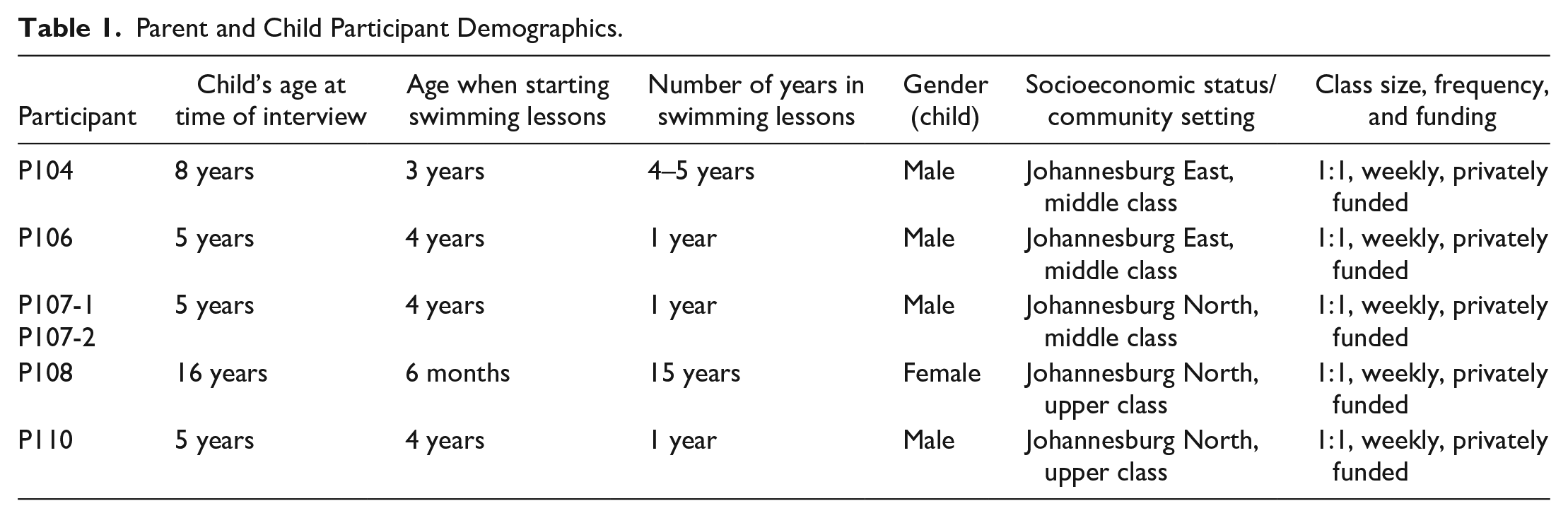
Three themes emerged in answer to the research aims, exploring both swimming teachers and parents’ experiences. Demographic data regarding participants are set out in Tables 1 and 2. Themes, categories, and subcategories are laid out in Table 3.
Parent and Child Participant Demographics.
Teacher Participant Demographics.
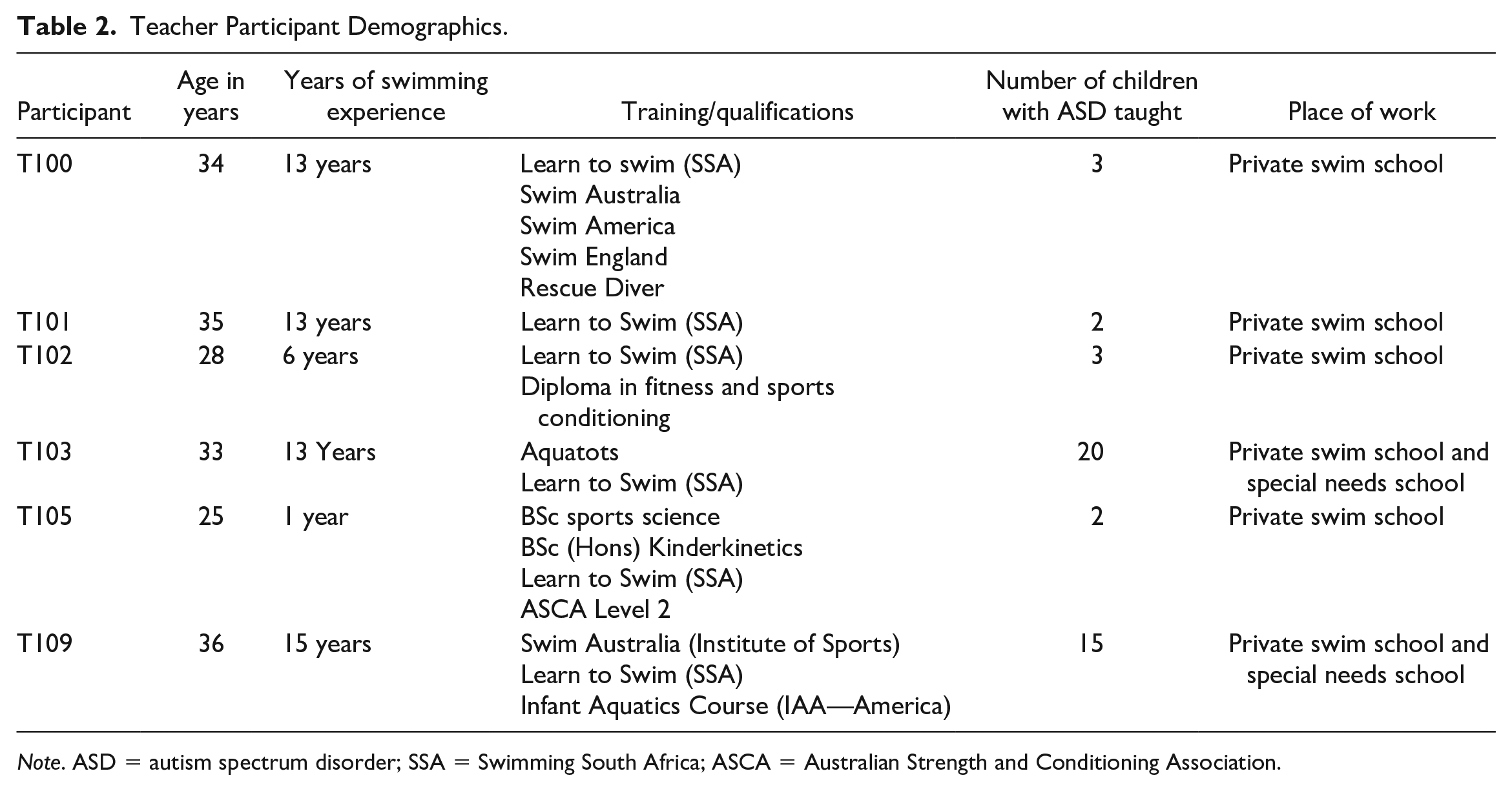
Note. ASD = autism spectrum disorder; SSA = Swimming South Africa; ASCA = Australian Strength and Conditioning Association.
Results of Thematic Analysis.
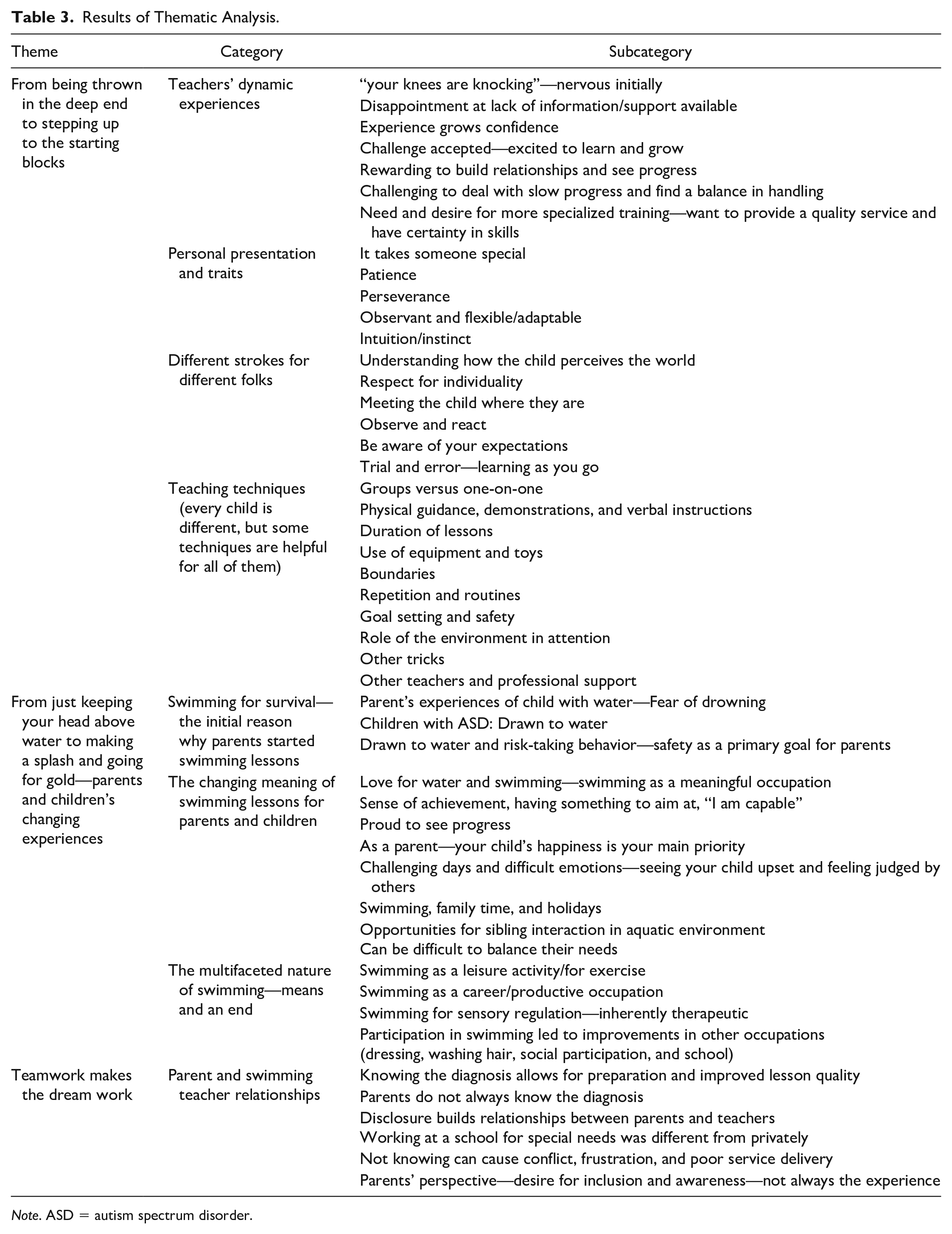
Note. ASD = autism spectrum disorder.
Theme 1: Teachers’ Experiences—From Being Thrown in the Deep End to Stepping Up to the Starting Blocks
Teachers experienced providing swimming lessons for children with autism in a dynamic way, going from being “thrown in the deep end”—that is, feeling ill-equipped with the knowledge/training necessary to provide this service with confidence—to “stepping up to the starting blocks”—with nervousness gradually shifting toward a feeling of confidence and accomplishment. Teachers experienced lessons as rewarding when they gradually saw progress and as they built a relationship with the child and their family: T101: The first lesson I was extremely nervous. How should I be talking to these kids? What ways do they learn better so that I can like implement those into my classes? T103: And then from there it becomes rewarding to see them grow and to see how they actually can learn different skills. They carry on because they want to better their swimming. It becomes something that they actually enjoy. It is like a hobby. It is not just for safety anymore. It is now become part of their lives.
Despite the rewards of experiential learning, there was still disappointment at the lack of information and support available, and thus an expressed desire for more specialized training: T105: . . . I was disappointed that it’s not [a career], and that’s exactly why I’m here, to help make this happen . . .
Despite the lack of available training and resources, teachers gained confidence and learned what worked. In general, teachers’ insight into autism developed partly through informal, online research, but mostly through interaction in context and employing a trial-and-error approach to lessons. They realized that they needed to adapt and individualize their teaching methods to meet each child’s specific needs, noting that every child with autism is different: T102: . . .every day is a new day; you just never know what you getting with a special needs child, or a superhero kid. You just have to adapt who you are all the time.
Participants noted that it takes a special teacher to work with a special child: Personality and presentation were important factors affecting the success of lessons. Patience emerged as the single most important trait, combined with perseverance, intuition, and flexibility. Overall, teachers recommended a “just wing it” approach, stating that preparing for a first lesson with a child with autism was difficult (and sometimes pointless) as they are each so different: T101: I would say winging it, because you don’t know until you have the kid in front of you. They are all completely different people. I guess I would just wing it.
Although each child with autism is different, certain techniques proved useful for most of the children. These techniques included a preference toward one-on-one lessons, increased use of physical guidance, repetition and routine, the use of simpler language and demonstrations, and selective use of toys/equipment dependent on sensory needs. There was a mixed opinion about the duration of classes. Shorter classes compensated for poor attention, whereas longer classes allowed repetition and a slower pace. Teachers all expressed the importance of having a support structure to help troubleshoot problems and come up with new techniques.
Theme 2: Parent Experiences—From Keeping Your Head Above Water to Going for Gold
The second aim of this research was to understand the experience of parents of children with autism in the context of swimming lessons in South Africa. Four out of five of the parents described an experience with their child and a body of water, which led them to become fearful of their child drowning and, as such, swimming lessons were sought as a survival skill. All parents described their children as being especially drawn to water. This affinity for water, combined with risk-taking behavior, impulsivity, and tendency to elope made them especially fearful of their child drowning: P104: He is fearless. It is also one of the motivating factors to get him to swim, because he didn’t understand the dangers of water.
However, as children engaged in lessons the meaning derived therefrom shifted. What started out as a survival skill soon became a meaningful family occupation due to their children’s love for water and a number of other hidden benefits. Parents expressed a sense of pride and achievement at seeing their children’s skills develop and in seeing them participate. They also described their children’s sense of achievement—with many sharing memorable moments of their child bringing a medal home with pride or participating in a gala: P108: At the end of every season [Teacher’s name] gives them a medal, you know? So now, our other daughter is a rower and if she got a medal she’d come and show. So [child’s name] obviously saw that and learnt it or visualised it. So when she came home [from swimming] one day she took the medal out of her bag and she put it on. She said, “look!” She had her swimming medal on. That was a very good memory. . . P107-2: After Thursday when he had a swim session with [teacher’s name], he is really mellowed down. So Thursdays are like the best day of the week in the evenings when we see him again
Swimming was described as a meaningful activity that siblings could participate in together—both at home and on family holidays. Although the aquatic environment provided opportunities for siblings to interact, balancing their needs with lessons became difficult for some parents. Siblings’ skills often improved much faster, requiring them to attend a different lesson. As such, cost and time constraints proved to be limiting factors to participation: P106: [child’s name] and [sibling’s name], they can stay in the pool the entire day. They love it.
Most parents also noted that swimming has provided their children with exercise that, in some cases, has improved their posture and participation at school. Many parents (and some teachers) noted that the aquatic environment is inherently therapeutic. It was noted that the sensory qualities of the water helped to regulate their level of arousal, sometimes resulting in reports of better attention in the classroom or better regulation at home after lessons: P108: So with swimming, it’s almost like the weightlessness and the lightness of the water. . . she senses that. It’s almost like. . . it doesn’t interfere with her sensory system integration. . . it has this calming effect. . . [child’s name] is very anxious when she doesn’t perform. But when she’s in water, it doesn’t matter if she can’t perform because she’s free. . . And happy, you know?
Parents also noted that their child’s participation in bath time, specifically being comfortable to put their head back and wash their hair, improved once they became comfortable going on their back during swimming lessons. Some parents also spoke about how their children were more likely to engage socially with others in an aquatic environment.
Theme 3: Teamwork Makes the Dream Work
Overall, the relationship between teachers and parents affected experiences and engagement within this context for all role players. Positive relationships involved open communication and offered acceptance and support to parents. Teachers stated that parents’ disclosure of the child’s diagnosis greatly aided preparation for lessons allowing for a better quality service. Lessons became more rewarding once mutual trust was established: T101: . . . so the more I understand about whatever condition you have, the better I can do my job. I feel like there’s a lot of like pressure to treat your kid the exact same way I treat every other kid, which is not fair on your kid
Although open communication was important to teachers, they did not always know how to facilitate this process and expressed frustration when parents did not disclose this information. Swimming teachers working at a school for children with special needs found the experience of lessons to be overall more positive as they had good insight into the children’s diagnosis and support from teaching staff.
Most parents expressed a degree of frustration when trying to find a swimming teacher/swimming school that really understood and matched their child’s needs: P104: So, it’s the ignorance that needs to change and the fact that they don’t understand awareness. . . . and I think if a school actually comes out like that, it would be so great because there is a lot of special needs kids that don’t know how to swim. Because they’re scared. You make an environment conducive to their needs, it will be awesome.
Some parents experienced barriers to participation when disclosing their child’s diagnosis. Similar to teachers, parents of the children at the special needs schools also had a more positive experience as teachers were more aware and accepting of the diagnosis. Insight and support broke down barriers to participation.
Discussion
The aim of the study was to explore the lived experience of parents and swimming teachers of children with autism, engaging in swimming lessons, in a South African context.
Teacher’s Experiences
Swimming teachers’ experiences in teaching children with autism have not been well explored in existing research (Murphy & Hennebach, 2020). Due to the lack of available support/training in this field in South Africa, accessibility at present appears to rely largely on the swimming teacher’s personality and past experience. The findings of a reliance on personality and experiential learning paralleled those of studies based in the inclusive classroom setting (Anglim et al., 2018; Stites et al., 2020). Teachers in both environments (aquatic and classroom) demonstrated a high self-efficacy, which enabled them to overcome nervousness, due to lack of knowledge/support/experience, and apply their skills in a new way (Anglim et al., 2018). It is clear, however, from the perspective of occupational justice, that access to an activity fulfilling a number of different meanings for children with autism and their families should not rely so heavily on a teacher’s personality and self-efficacy.
Teacher participants’ expressed desire for more support and training also paralleled findings from studies in the inclusive classroom setting (Stites et al., 2020). It is interesting to contrast this with the available literature in the context of aquatic-based therapy, where lessons were provided by health care professionals (HCPs) or teachers with specialist training/knowledge (Lawson & Carlson, 2021; Mortimer et al., 2014; Walsh et al., 2021; Woodson & Kemp, 2021). In these studies, the need for more support was neither identified nor explored, raising an interesting question: Should swimming lessons for individuals with autism be a service delivered by HCPs or should HCPs be providing support/training to teachers, enabling children with autism to access mainstream/existing services?
Recent articles in this field tend to advocate for swimming/aquatic therapy to form part of the OT scope (Alaniz et al., 2017; Woodson & Kemp, 2021). While occupational therapists may be well positioned and capable of providing this service, research would also support the importance of task sharing and integration of children and their families into already existing services (Lobo, 2020; Mortimer et al., 2014; Naveed et al., 2019). This both makes services more affordable and provides families with an opportunity to experience inclusion in their communities. Calls for affordability and integration were echoed by parents and teachers in this study and may be an important consideration in terms of occupational justice and accessibility moving forward (Lobo, 2020). That is, swimming lessons (as opposed to aquatic therapy/hydrotherapy) are not necessarily a service that occupational therapists (or any other HCPs) need to take over/offer directly. Rather, HCPs could play a consultant/advocate role, offering support to swimming teachers to enable them to provide a more accessible service.
When providing support, therapists should keep in mind that teachers’ shared experiences of teaching a child with autism across contexts/subject matter could be used to provide support through universality. Although the skill that teachers are trying to impart and the environment in which they are doing so may vary, the core experience of teaching a child with autism appears to be similar. Techniques found useful in previous literature in both settings, such as the use of routine and repetition, physical guidance with fewer verbal cues, slower pacing, and one-on-one instruction (Alaniz et al., 2017; Kraft et al., 2019; Lawson et al., 2019; Murphy & Hennebach, 2020) were noted to be useful by teacher participants and could be utilized in further research and training. Using evidence-based approaches to working with children with autism negates the need to rely solely on intuition and provides teachers with confidence and consistency in the service they are providing (Kraft, 2019), thereby increasing the likelihood of accessibility, inclusion, and skill acquisition in a just and equitable way.
Overall, teachers’ shared experiences indicate that support from occupational therapists may be valuable in mitigating the risk of occupational injustice in this setting. Occupational therapists, in an advocacy and consultative role, can provide support and education that not only provides teachers with a greater sense of confidence in their skills, but also enables children with autism and their families to access existing services in an inclusive way. Parents’ perspectives served to further support these assertions.
Parents’ Experiences
Swimming proved a meaningful occupation for children with autism and their families. Parent’s experiences, similar to teachers, were dynamic, especially with regard to the meaning derived from engaging in swimming lessons. Overall, parent participants’ experiences and motivations were similar to the results of many other previous studies, including Casey et al. (2020), Eversole et al. (2016), Lawson et al. (2019), Lobo (2020), Murphy and Hennebach (2020), and Woodson and Kemp (2021). Parent participants’ initial concern regarding their children being at a higher risk of drowning than typically developing children is well supported by literature (Casey et al., 2020; Guan & Li, 2017; Murphy & Hennebach, 2020). In its classification as a “survival skill” alone, one can see the importance of equitable access to this service. However, the hidden meaning derived from the “normal” experience of taking their child for swimming lessons serves to further demonstrate the transformative power of occupational engagement (AOTA, 2020).
Parents of children with disabilities can sometimes experience a degree of “loss” as they adjust their expectations and hopes relative to their child’s unique needs and can find it difficult to know what to expect/hope for in their child’s future (Bravo-Benítez et al., 2019). Finding occupations through which they can derive a sense of belonging and connectedness to their community can be particularly difficult for parents of children with autism, especially in South Africa, due to a lack of community insight and service accessibility (Reddy et al., 2019; Schlebusch et al., 2017). It can also be difficult for parents and siblings to experience connectedness to the child with autism due to the nature of the diagnosis and its impact on social skills and communication (Iadarola et al., 2019; Reddy et al., 2019). Swimming lessons, when accessible and provided with appropriate support, appear to enable parents to experience a sense of connectedness, belonging, and well-being, and offer an opportunity to experience hope, pride, and “dreaming” as children attain this lifelong skill (Lobo, 2020).
While swimming lessons fulfilled parents’ occupational right to experience social inclusion and meaning through engagement, children’s right to experience meaning and develop health were also realized from parents’ perspectives. Engagement in exercise reportedly resulted in improved posture and participation at school for some, and improved quality of life and self-esteem with decreased symptom severity, similar to the finding of Güeita-Rodríguez et al. (2021), Lawson et al. (2019), Lobo (2020), and Askari et al. (2015). The correlation between improved regulation (likely due to the “inherently therapeutic” nature of water) and improved participation in multiple activities, spanning multiple environments, was again similar to findings of Lawson et al. (2019) and Lobo (2020).
Swimming appears to have the potential to fulfill a number of occupational rights for parents and children with autism, but equitable access to this occupation continues to prove limited due to teachers’ lack of awareness and training with regard to autism (Askari et al., 2015; Lawson et al., 2019), representing occupational injustice.
Study Limitations and Considerations for Future Research
One limitation of the study is that the direct experiences of children with autism themselves was not explored. The research also does not include the potential experience of children with autism and their families who had not gained access to or stopped lessons; hence, this aspect remains unexplored. Similarly, teachers who had refused or stopped teaching children with autism were neither encountered nor interviewed. Furthermore, the relatively small population size of the study makes generalization difficult in a demographically and geographically diverse context. As such, further studies in different populations groups and locations would enhance the reliability of the findings.
Conclusion
The aim of this study was to explore swimming as an occupation for children with autism in South Africa, by first gaining insight into the experiences of parents and swimming teachers. Swimming proved to be a meaningful occupation for children with autism and their families—one with a diverse range of positive outcomes. It provided not only a survival skill for children (and peace of mind for their parents), but also an opportunity for family engagement, to feel a sense of belonging and achievement, opportunities for sensory regulation, and even perceived improvements in objective performance of other occupations. However, there proved to be barriers to accessing this valued occupation. Due to a lack of training, support, and resources available to them, teachers mostly needed to rely on their intuition and employ a trial and error approach to lessons. This meant that accessibility tended to rely on the teacher’s personality and personal preferences. Although teachers mostly gained knowledge and confidence through their experiences, intuitively using techniques recommended in the available literature, they still expressed a desire for more specialized training. Training would better equip them to provide this service and would allow them to advertise and reach more families of children with autism. The lack of formal support and training for swimming teachers appears to be a significant barrier limiting participation in this valued occupation for children with autism and their families in South Africa.
Ultimately, it is through teamwork and communication that we can overcome occupational injustice and create the opportunity for children with autism to participate in everyday activities. It falls well within the scope of occupational therapy to support their occupational rights and facilitate engagement in meaningful and health-promoting occupations. Occupational therapists are well positioned, in a consultancy, advocacy, and educator role, to support the swimming teachers’ understanding of autism and assist them in adapting their lessons to promote and facilitate access and acceptance for children with autism and their families.
Supplemental Material
sj-docx-1-otj-10.1177_15394492221143048 – Supplemental material for Swimming Lessons for Children With Autism: Parent and Teacher Experiences
Supplemental material, sj-docx-1-otj-10.1177_15394492221143048 for Swimming Lessons for Children With Autism: Parent and Teacher Experiences by Bronwyn Claire Carter and Lyndsay Koch in OTJR: Occupation, Participation and Health
Footnotes
Authors’ Note
This article was originally submitted and accepted in partial fulfillment of the MSc OT degree at the University of the Witwatersrand.
Declaration of Conflicting Interests
The author(s) declared no potential conflicts of interest with respect to the research, authorship, and/or publication of this article.
Funding
The author(s) received no financial support for the research, authorship, and/or publication of this article.
Ethical approval
Ethics clearance number: M190910 obtained from the University of the Witwatersrand Human Research Ethics Committee (HREC).

Supplemental Material
Supplemental material for this article is available online.
References
Supplementary Material
Please find the following supplemental material available below.
For Open Access articles published under a Creative Commons License, all supplemental material carries the same license as the article it is associated with.
For non-Open Access articles published, all supplemental material carries a non-exclusive license, and permission requests for re-use of supplemental material or any part of supplemental material shall be sent directly to the copyright owner as specified in the copyright notice associated with the article.
