




Abstract
Introduction
In Canada, entry-level education of occupational therapists became a graduate-level Master's degree in 2008 (CAOT, 2018). The holistic admissions approach and prerequisite classes or degrees required by academic institutions influence the diversity of learners admitted to each program (Bowyer et al., 2018). Academic prerequisites vary between institutions and previous coursework in the biological sciences may or may not be required (Dove et al., 2023). More specifically, some learners entering occupational therapy will have prior knowledge of human anatomy through completing courses to fulfill the requirements of their undergraduate degrees (e.g., kinesiology). In contrast, learners with degrees in the arts or humanities may have no prior coursework in anatomy. The academic diversity of students requires that occupational therapy educators be strategic in addressing the learning needs of students with and without a medical science background (Dempsey et al., 2021). This is especially important for those who teach courses with content related to musculoskeletal anatomy.
The literature on the learning needs of students with and without coursework in the medical sciences largely focuses on comparative academic outcomes. Studies in the broader medical profession and occupational therapy indicate that previous science coursework does not equate to better academic outcomes in professional graduate training programs (Kondrashov et al., 2017; Lysaght et al., 2009; Robertson et al., 2020; Thew & Harkness, 2018). In medicine, Kondrashov et al. (2017) conducted a comparative outcome study which found no significant differences in gross anatomy course grades, medical school grade point average, and comprehensive licencing exam scores of osteopathic medical students with and without a premedical anatomy course. In occupational therapy, Lysaght et al. (2009) found no relationship between students’ previous education in anatomy, kinesiology, or physiology and outcomes on the physical determinants course in their Master in Occupational Therapy entry-level program (Lysaght et al., 2009). Thew and Harkness (2018) investigated the relationship between previous undergraduate degrees and final academic outcomes. Their study found that students with pure arts degrees fared just as well or slightly better than those with science-based degrees on their final Master of Science in Occupational Therapy (MScOT) academic outcome (Thew & Harkness, 2018). Overall, these studies indicate that the course or final academic outcomes of students are similar, irrespective of their academic background. However, these studies do not provide insight into the factors that enable students without science backgrounds to achieve these outcomes.
Using quantitative and qualitative questionnaire data, Robertson et al. (2020) begin to explore these factors in their comparative study of medical and dental students. Similarly to previous literature, they found that coursework did not impact final student grades; however, students reported perceived benefits of taking anatomy prior to professional school. Time management, stress reduction, being able to focus on other classes, and feeling less overwhelmed were some of the benefits captured through open-ended questionnaire responses (Robertson et al., 2020). This highlights the importance of understanding student learning experiences and factors that foster academic outcomes. This is especially important for courses that have heavy foundational medical science content. It is well understood that health professional students, including student Occupational Therapists (OTs), find anatomy and physiology courses difficult. These courses have a demanding workload with heavy reliance on content memorization compared with other courses in the programs (Hull et al., 2016). Students without science backgrounds reportedly struggle with learning the language of anatomy (Fagalde & McNulty, 2023). It takes time for these students to acclimatize to new terminology and develop effective learning strategies. In addition, factors such as student confidence and recency of anatomy knowledge have been shown to influence student readiness to engage in learning related to musculoskeletal practice areas (Giles et al., 2021).
Student OTs also need to quickly integrate knowledge of the anatomical sciences with occupational and practice sciences as the length of professional training has shortened with the shift to graduate-level education (Lall et al., 2003). At the same time, anatomy educators are also called to place occupation at the centre of their teaching (Hooper et al., 2015). Yet, effective integrated learning approaches of anatomy in occupational therapy have not been well studied. In fact, this appears to be a challenge for educators and curriculum developers. First, to integrate learning, students need a fundamental knowledge of anatomy. However, the theoretical lens of the professional is broad, and anatomy instructors are obliged to streamline content. Further, effective pedagogies to prioritize and teach this content to learners with diverse academic backgrounds have not been identified (Dove et al., 2022). Last, the above concerns are embedded within the broader context of the shift in anatomy education in graduate-level occupational therapy programs to optimally meet the needs of diverse students, broad curriculum goals, and resource accountabilities (Veazey & Robertson, 2023). For example, a recent survey of entry-level occupational therapy programs in the United States found that ten of the 68 (15%) programs surveyed did not teach anatomy as part of their curriculum. Of the programs that teach anatomy, the course design, resources, and instructors involved (i.e., anatomists without a clinical background, or clinicians without anatomy training) influenced the quality of the anatomy education delivered in the occupational therapy curriculum. Therefore, effective integrated learning demands research on curriculum design and classroom strategies that support the value and quality of fundamental anatomy knowledge in student OTs.
In addition to fundamental knowledge of the structures and functions of the human body which largely use lower-order thinking skills such as remembering and understanding, integrated learning requires higher-order thinking. It requires that students apply foundational knowledge to novel situations and analyze relationships between concepts (Thompson & O'Loughlin, 2015). Integrated learning of anatomical sciences with occupational science and clinical contexts is demanding for all students but may create additional difficulties for students who do not have previous anatomy coursework. For example, students with previous anatomy coursework are ready to apply basic anatomy knowledge to clinical contexts after a review of the relevant anatomical material. Meanwhile, those without previous anatomy education are working to orient themselves to the new terminology and commit a large volume of information to memory.
As a sound knowledge of the anatomical sciences is critical for competent practice (Schofield, 2014), occupational therapy educators must learn how to best teach anatomy to meet the learning needs of the diversity of students in the classroom. Key factors that may influence the learning processes of students without previous anatomy coursework are time and higher-order thinking skills that require foundational learning prior to application. Therefore, the purpose of this study is to compare anatomy learning outcomes of student OTs with and without prior anatomy coursework throughout the term (temporal effect) and on higher- versus lower-order thinking assessments.
Method
An observational cohort study was conducted of MScOT 2021-23 first-year student OTs at the University of Toronto who took the course on musculoskeletal foundations for occupational therapy practice. The primary research question was, “Among MScOT students who took a musculoskeletal foundations for occupational therapy practice course, does anatomy assessment performance (i.e., quizzes) over time differ between students with and without previous anatomy coursework?” The secondary research question was, “Is there a difference between students with and without previous anatomy coursework on their performance on higher- versus lower-order anatomy assessments (i.e., quiz multiple-choice questions)?”
All learners in the MScOT 2021-23 cohort were eligible to participate in the study. Students who completed an undergraduate or graduate degree in anatomy or were concurrently enrolled in any post-secondary anatomy or kinesiology course(s) were excluded from the study, as the intensity and recency of their anatomy education would influence learning outcomes (Giles et al., 2021). Students who withdrew from the MScOT program before December 31, 2021, were also excluded. A faculty research team member [AD] not actively involved in teaching the 2021-23 cohort of students conducted the informed consent process to reduce possible coercion. Students were informed that their participation in the study would not be known to their anatomy instructors [ESH, LA, AA] until after their final grades were posted. Students self-reported whether they had taken one or more post-secondary courses in human musculoskeletal anatomy including kinesiology courses with gross anatomy content. Their response was cross-referenced with the documented entry degree at the time of their application to the program. Approval for this study was obtained from the University of Toronto Research Ethics Board (Approval #41315), and informed consent was received from the students who participated.
Within the musculoskeletal occupational therapy course, anatomy was taught using a blended learning approach that used computer-assisted instruction (CAI) and traditional weekly lectures (Madden et al., 2019). The main CAI used to teach anatomy was asynchronous online self-study anatomy modules that featured Acland's Video Atlas of Human Anatomy, an online video series of anatomical specimens with a 360-degree view of prosections (Acland, 2010). Each module included gross anatomy structure and function content, followed by case scenarios that applied anatomy knowledge to occupational therapy practice contexts. Completion of each module was mandatory for all students, including a culminating module-specific multiple-choice quiz. Informed by active and student-centred learning approaches (Green et al., 2014; Wilson et al., 2019), discussion forums were assigned to each online module. The objective of the online discussion forums was to foster the course learning community. Students were instructed to participate in the discussion board by initiating, responding, and/or synthesizing posts. The forums were student-led and were one of several activities (e.g., lab small group contributions, in-class participation) that contributed to the course participation grade (5%). The goal was to foster peer support and learning while using these asynchronous modules (Green et al., 2014; Green & Hughes, 2013). Following the anatomy lectures and CAI, the course included in-person clinical skills lectures and labs (i.e., goniometry, manual muscle testing) with live-streamed clinician facilitators. Concurrently, students were enrolled in foundational courses in occupational therapy practice, assessment, neuroanatomy and neurological conditions, and occupational science.
Anatomy learning outcomes were determined by the course assessments. Alongside weekly anatomy lectures, seven multiple-choice question (MCQ) format quizzes were delivered throughout the term. These quizzes were designed using the Blooming Anatomy Tool (BAT), a rubric for developing MCQs based on the first four levels (knowledge, comprehension, application, analysis) of Bloom's taxonomy of learning (Thompson & O'Loughlin, 2015). Each quiz was designed to have two knowledge, two comprehension, two application, and two analysis-level questions. The quizzes were formative, meaning that students had unlimited attempts to independently complete each quiz and actively engage in these assessments as a learning process (Marden et al., 2013). Importantly, students were strongly advised to complete their first attempt as a self-assessment, without aids, and then encouraged to repeat the quiz until they obtained a desirable score. Students were not able to complete their first attempt of the quiz until they completed the corresponding online anatomy module. Student assessment outcomes on the first attempt of these seven quizzes were evaluated across the term (temporal effect) as well as comparatively between higher-order (i.e., application, analysis) and lower-order (i.e., knowledge, comprehension) MCQs. At the end of the term, the students’ grades on the cumulative practical exam were compared to determine any differences between groups that deviated from the expected outcome reported in the literature that both groups would fare similarly. The practical exam at the end of the term was a consolidated assessment of surface anatomy, anatomy terminology, muscle actions, and joint movements using peer simulation. The exam consisted of six structured clinical assessment tasks involving instructing and demonstrating accurate and safe assessment of active and passive joint range of motion.
The quantitative data analysis was conducted using the Statistical Package for the Social Sciences (SPSS) statistical analysis software v.29 (SPSS Inc., 2023). The Shapiro–Wilk test of normality was used to examine the distribution of the anatomy quizzes (i.e., first-attempt total scores). Descriptive statistics were first used to characterize student performance on the seven anatomy quizzes (i.e., total score, higher-order BAT score, lower-order BAT score). As the data were not found to be normally distributed, Mann–Whitney U tests were used to chronologically compare the outcomes of students with and without previous anatomy coursework on the anatomy quiz total scores. Next, the difference between student performance on higher- and lower-order BAT MCQs was calculated per student. These within-student difference scores were compared using the non-parametric Wilcoxon Signed Ranks test to determine individual student performance on higher- versus lower-order BAT MCQs. Next, the within-student difference scores between students with and without anatomy background were compared using Mann–Whitney U tests. Last, Mann–Whitney U tests were used to compare students’ performance on the end-of-term practical exam. Adjustments for multiple comparisons were not conducted, as this comparative analysis of students with and without anatomy background aimed to describe the processes that influence learning rather than determine the magnitude of the effect between groups.
Results
Of the students enrolled in the MScOT program (n = 125) at the time of consent on December 6, 2021, 78% (n = 97) consented to participate in the study. There were no students who were excluded based on our criteria. No students withdrew from the study after initially providing consent. Demographic information, including gender, was not collected to maintain the anonymity of the participants as there is traditionally a small proportion of male students in the MScOT program. Sixty-seven (69%) of the students had previous anatomy education and 30 (31%) had not taken an undergraduate course in human anatomy before admission to the MScOT program.
The results of the seven anatomy quizzes are organized chronologically according to when the corresponding lectures and quizzes occurred (e.g., musculoskeletal [MSK] terminology was taught in week one, and lower limb anatomy was taught in week seven of the program). The median and interquartile range (IQR) of the total score of the first attempt on the seven anatomy quizzes are shown in Table 1. The comparison of quiz total scores between groups is shown as box plots in Figure 1. There was a significant difference between the two groups for the first three quizzes: MSK terminology (Mann–Whitney U, p = .005), upper limb bones and joints (Mann–Whitney U, p = .02), and upper limb proximal muscles (Mann–Whitney U, p = .03). The assessment grades on these three initial quizzes were higher in the group of students who had previous anatomy coursework.
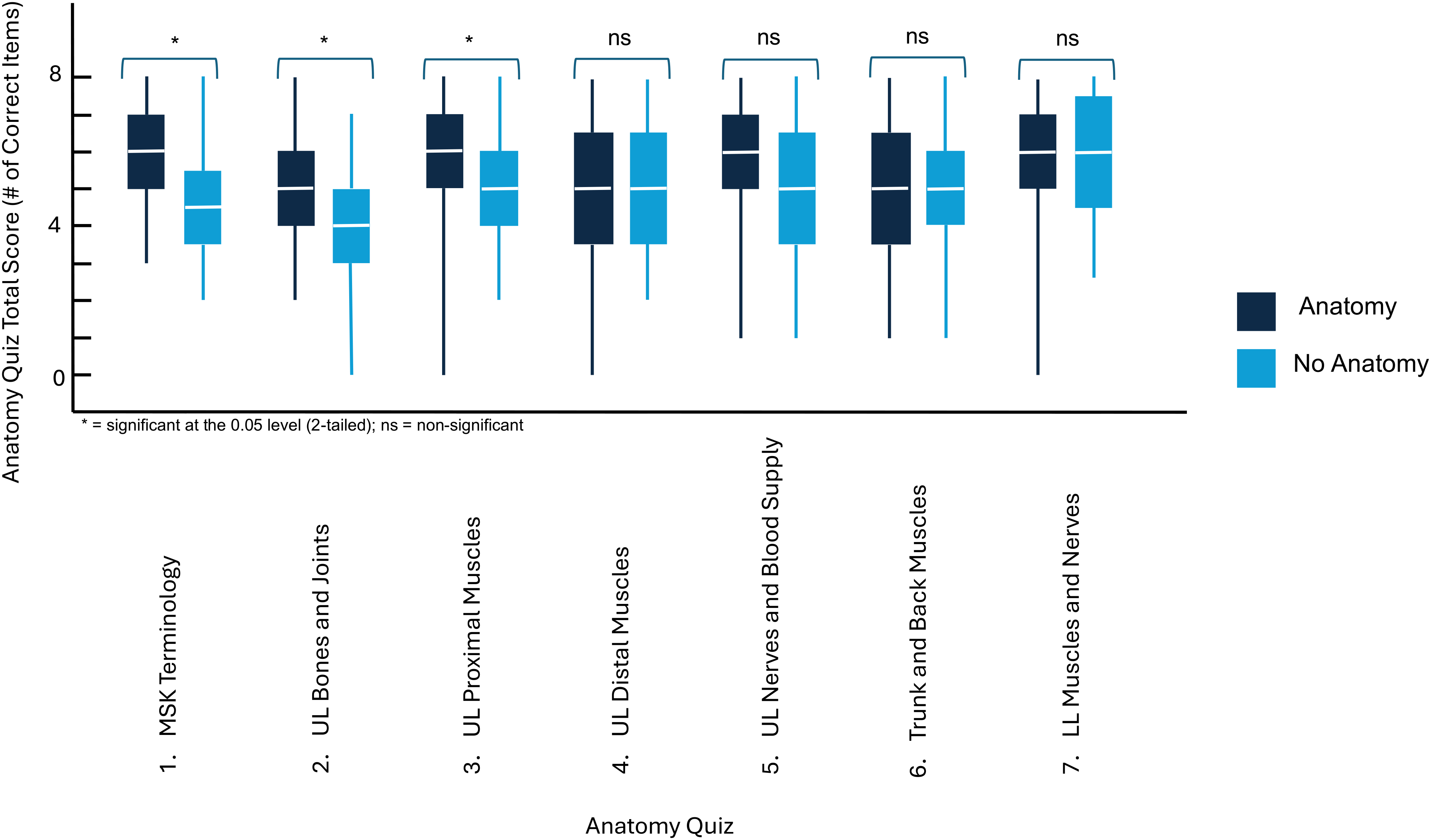
Box plot comparison of anatomy quiz total scores between students with and without previous anatomy coursework.
Comparison of Anatomy Quiz Outcomes Between Students With and Without Previous Anatomy Coursework.
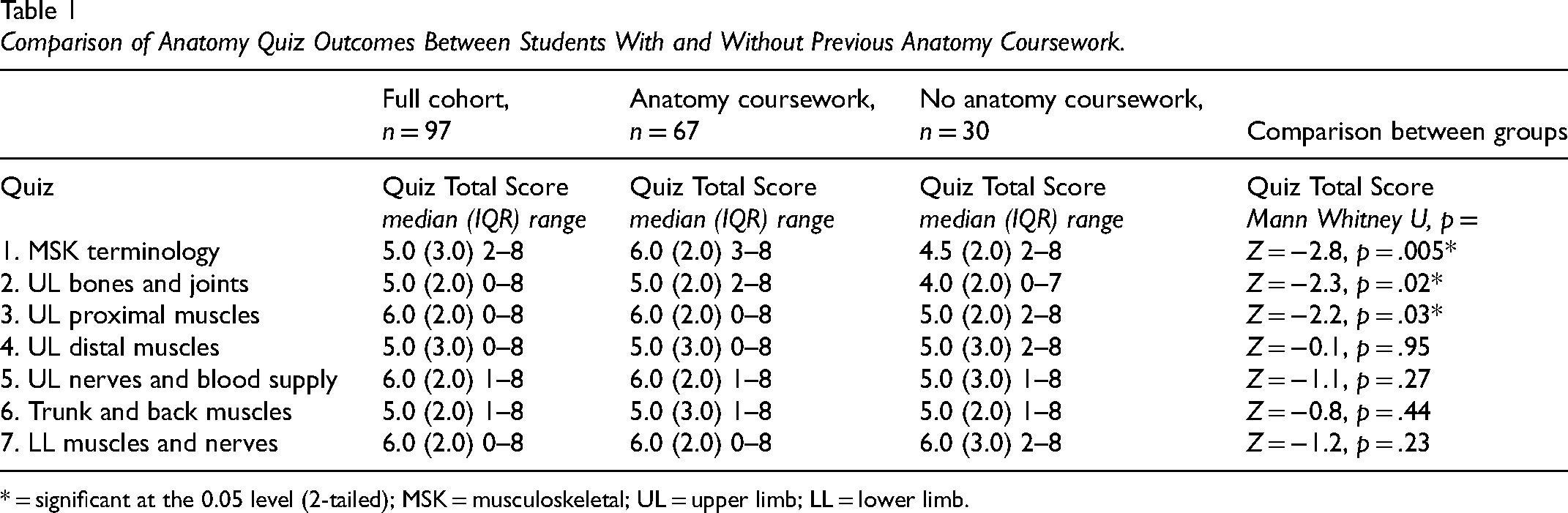
= significant at the 0.05 level (2-tailed); MSK = musculoskeletal; UL = upper limb; LL = lower limb.
In Table 2, the difference between student performance on higher- versus lower-order BAT MCQs is shown for the entire cohort and broken down between students with and without previous anatomy coursework. The median scores of the students’ performance indicate that their scores on the application and analysis (i.e., higher-order) MCQs were lower or the same as their performance on knowledge and understanding (i.e., lower-order) MCQs for all quizzes, except Quiz 6 on trunk and back muscles. Comparatively, the findings were the same when the higher- versus lower-order assessments were evaluated separately in students with previous anatomy coursework and in those without. The only exception was that students with an anatomy background did not have a significant difference in their performance on higher- versus lower-order assessment items on the trunk and back muscles quiz. At the end of the term, the student scores on the practical exam were an average 13.6 ± 1.4 (mean ± SD), with scores between 8 and 15 (maximum score = 15).
Comparison of Within Student Performance on Higher-Versus Lower-Order Assessments.
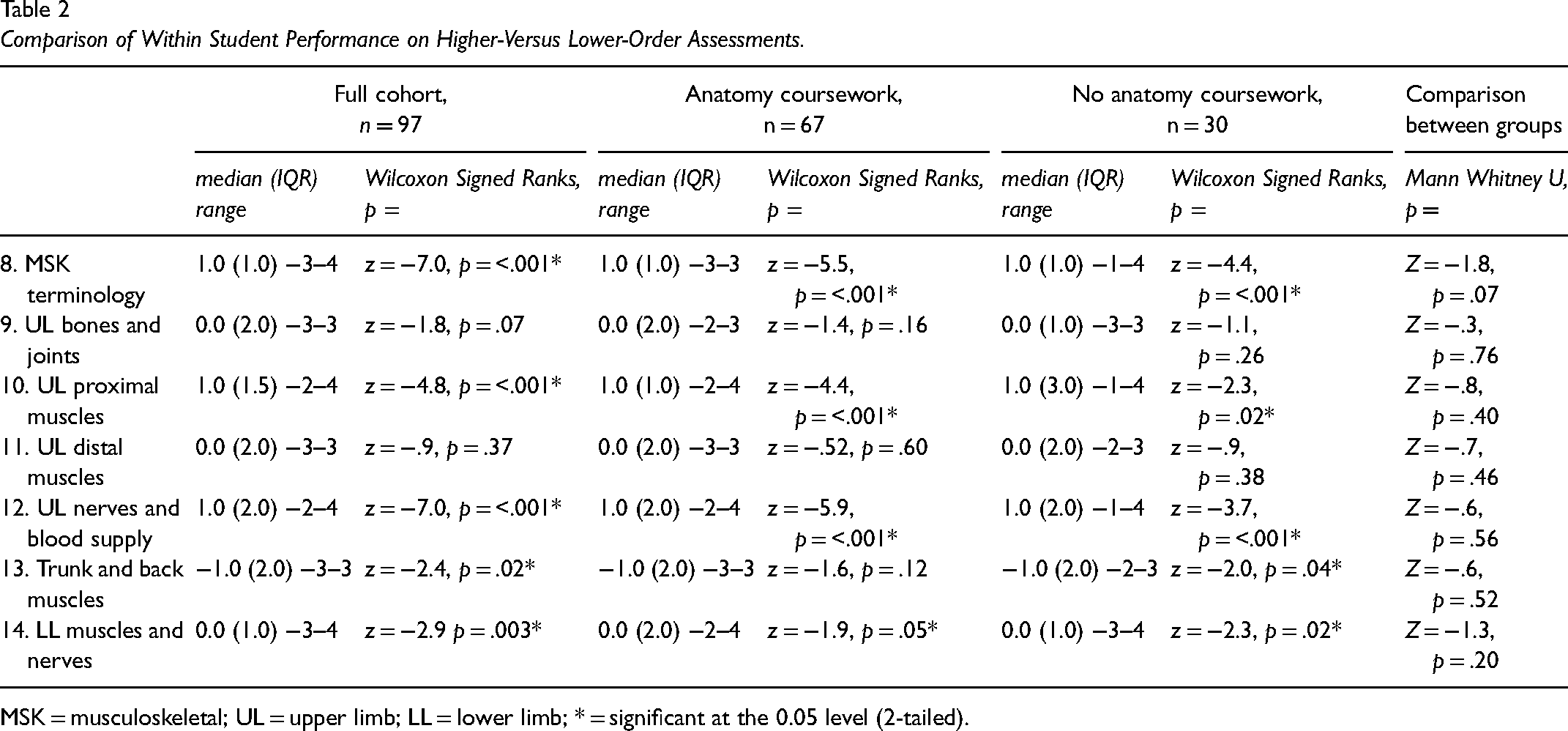
MSK = musculoskeletal; UL = upper limb; LL = lower limb; * = significant at the 0.05 level (2-tailed).
Last, there was no significant difference in the practical exam scores between students with differing experiences with anatomy coursework (Mann–Whitney U, z = 0.6 p = .3).
Discussion
This study aimed to compare anatomy learning outcomes of student OTs with and without prior anatomy coursework throughout the term and on higher- versus lower-order thinking assessments. The findings indicate that student OTs with previous anatomy coursework fared better on anatomy quiz assessments taken earlier in the term, while their peers who did not have previous anatomy coursework experienced a catch-up period. By the end of the term, both groups fared similarly on anatomy quiz assessments as well as the cumulative practical exam. With respect to higher-order thinking assessments, both groups had difficulty with applying and analyzing anatomical knowledge compared to remembering and understanding the material on four of the seven quizzes (i.e., MSK terminology, upper limb proximal muscles, upper limb nerves and blood supply, and lower limb muscles and nerves). Students’ performance on higher- versus lower-order MCQs did not change over the course of the term; therefore, a temporal effect on students’ ability to acquire higher-order thinking anatomy skills is not apparent. Comparatively, students with an anatomy background did not demonstrate better performance on higher-order thinking assessments than their peers. Overall, these findings have important significance to occupational therapy educators who design and teach anatomy.
First, our study findings aligned with previous findings indicating that undergraduate coursework in science does not relate to higher academic outcomes in subject-specific courses (e.g., anatomy, physical determinants) or final grades (e.g., grade point average) (Kondrashov et al., 2017; Lysaght et al., 2009; Robertson et al., 2020; Thew & Harkness, 2018). This study adds to the literature on these comparative outcomes by demonstrating a temporal effect on student learning outcomes. Learners without previous anatomy coursework need time to ‘catch up’ with their peers. Our findings align with the recent study by Louro et al. (2024) who reported that medical students with previous anatomy coursework fared better on their first anatomy laboratory exam than their peers who did not have anatomy experience. With subsequent exams, the difference between group performance was not seen (Louro et al., 2024). It is proposed that students with previous coursework benefit from having established baseline knowledge and the time to determine what learning strategies are most effective for their needs (d'Arnaud & Husmann, 2023; Louro et al., 2024). Further, the time commitment and high engagement involved in cadaveric-based pedagogies are felt to positively influence student outcomes (Louro et al., 2024). This may be a reason why pro-section anatomy coursework is associated with better student learning outcomes (Forester et al., 2002). Overall, students without anatomy coursework may need time to get oriented and develop individual learning strategies to effectively develop baseline knowledge of anatomical terms. Occupational therapy anatomy educators may help to accommodate these students by using formative assessments early in the term while scheduling summative assessments at the end of the term.
Anatomy formative assessments are helpful in shaping discipline-specific and higher-order thinking anatomy knowledge as well as monitoring students’ learning progress. Studies have shown a relationship between student anatomy formative and summative assessment outcomes. A positive correlation can be found for higher-order learning outcomes if the formative approach also includes higher-order thinking components (Kingston et al., 2023). In our approach to the formative anatomy quizzes, higher-order analysis type MCQs involved knowledge of anatomical structures and identifying how their function relates to occupation. For example, students were asked to choose which activity among those presented would be most affected if a client has a flexion contracture of the long and little fingers (i.e., Dupuytren's contracture). The aim was to shape integrated learning of the anatomical and practice sciences within the context of occupational therapy as well as prepare them for the summative culminating practical exam.
Designing the type and timing of course assessments to accommodate students without previous anatomy coursework may be helpful; however, what is still unaccounted for is the degree of stress that these students may undergo to catch up with their peers. This has a potential negative impact on student mental health. Stress reduction, feeling less overwhelmed, and better time management are perceived benefits reported by medical students with previous anatomy coursework (d'Arnaud & Husmann, 2023; Robertson et al., 2020). In occupational therapy, the anatomy curriculum may be taught as a standalone course or integrated as content throughout the curriculum (Schofield, 2018; Veazey & Robertson, 2023). Irrespective of the delivery format, students need to balance coursework in anatomy with other areas in the curriculum such as occupational science, jurisprudence, professional practice, and neurosciences. Effective anatomy course design should consider the broader curriculum goals and demands to support overall optimal student learning outcomes in the program.
Second, there was no difference between students with and without previous anatomy coursework on their performance on higher- versus lower-order thinking assessments. To our knowledge, comparative outcomes of higher-order thinking assessments in occupational therapy between students with and without a science background have not been conducted. The similarities in the academic performance of both groups on higher-order thinking assessments may be reflective of student selection for graduate-level professional occupational therapy education. The University of Toronto admissions process is holistic and considers academic (e.g., undergraduate grade point average) and non-cognitive factors (e.g., professionalism, problem-solving) which have been shown to correlate with students’ fieldwork performance (Stier et al., 2021). The lack of difference in higher-order anatomy assessment in students with non-science backgrounds also aligns with the evidence that students’ academic backgrounds do not influence their occupational therapy learning outcomes (Lysaght et al., 2009; Thew & Harkness, 2018).
Last, as an overall cohort, the lower performance on some of the higher-order assessments evaluated in this study was not surprising and consistent with previous studies (Thompson & Giffin, 2021). By definition, higher-order assessments demand higher cognitive processes. In our study, the higher-order MCQs were designed to connect anatomy content with clinical practice in occupational therapy. The use of case-based instruction and assessment is an example of a cognitive-constructivist approach to integrated learning of basic science and clinical concepts. Integrated learning of anatomy with the occupational and clinical sciences is needed; however, little is known about how to effectively achieve this to positively affect fieldwork and practice outcomes. The literature calls for coordinated efforts to implement integrated learning throughout curriculum and fieldwork (Wijnen-Meijer et al., 2020). From the onset of the program to graduation, consistent representation of foundational concepts with repeated applications to various contexts will help foster knowledge transfer in professional graduate students (Wijnen-Meijer et al., 2020). The use of case-based instruction may be useful in an academic setting to help frame and support students’ ability to transfer anatomy knowledge to practice contexts (Kulasegaram et al., 2013; Norman, 2009). At the same time, fieldwork preceptors and colleagues may play an important role in creating linkages to hands-on clinical skills (e.g., goniometry, muscle strength, functional mobility). Therefore, time, support, and investment are needed to support academic and fieldwork educators to intentionally and strategically implement integrated learning into the curriculum.
Limitations
This study provides new evidence and insights regarding anatomy education in occupational therapy, but the findings should be considered within the context of its limitations. Firstly, this study was conducted at a single institution, the University of Toronto, with a response rate of 78% of the 2021-23 MScOT student cohort. Although students remained anonymous until their grades were submitted, the sample may be more representative of students who have an interest in anatomy and musculoskeletal clinical practice. Second, formative quizzes have been shown to foster active learning and student engagement and are predictive of student summative performance (Marden et al., 2013). In our study, students were asked to use their first attempt as a self-assessment; however, some may have consulted resources during these online tests. Therefore, some quiz scores may be inflated despite the reported range of mean total quiz scores of between 59% and 71% (Table 2). Last, in prioritizing the anonymity of the students, the influences of age, gender, and socioeconomic status on anatomy learning could not be evaluated.
Conclusion
The anatomical sciences are an important part of occupational therapy education (Dove et al., 2023). This study demonstrated that students who did not have previous anatomy coursework fared the same as their peers on learning assessments but after a period of adjustment at the start of term. Strategies to help students transfer knowledge to clinical contexts may support higher-order thinking in anatomy education. Future research to investigate the processes that foster effective integrated learning of the anatomical sciences with occupational and practice sciences is needed.
Key messages
Student Occupational Therapists with previous anatomy coursework fared better on anatomy quiz assessments taken early in the term, while their peers without previous anatomy coursework experienced a catch-up period.
Both groups fared similarly on anatomy higher- and lower-order thinking quiz assessments and the cumulative practical exam at the end of the term.
Formative assessments and strategies to integrate the learning of anatomical, occupational, and practice sciences may help support overall student learning.
Footnotes
Authors’ Contributions
Emily S. Ho: project administration, conceptualization, methodology, formal analysis, resources, supervision, writing—original draft, review and editing. Erica Dove: conceptualization, methodology, formal analysis, writing—original draft, reviewing and editing. Lorna Aitkens: methodology, writing—review and editing. Andrea Duncan: methodology, resources, writing—review and editing. Anne M.R. Agur: conceptualization, methodology, writing—review and editing.
Declaration of Conflicting Interests
The authors report there are no competing interests to declare. This research study was presented as an oral scientific presentation at the Canadian Association of Occupational Therapists Annual Meeting on Friday, May 3, 2024, in Halifax, Nova Scotia.
Funding
The authors received no financial support for the research, authorship, and/or publication of this article.
