






Abstract
Objective/Background
The purpose of this study was to assess whether the incorporation of an environmental assessment for accessibility, as part of an “Activity Analysis” course, would enhance new students’ knowledge, competence, awareness, and interest in accessibility issues for people with disabilities.
Methods
In this research, we included an out-of-class training of environmental assessment for accessibility. One hundred and two 1st-year occupational therapy students at Tel Aviv University participated in this research. Of the 102 participants, 56 experienced the training and 46 did not but attended the regular Activity Analysis course. The students explored a typical community environment, during which a specific checklist was used for assessing levels of accessibility. The “Accessibility-Knowledge Competence Awareness and Interests” questionnaire was administered before and after the course to both groups.
Results
Students who participated in the out-of-class training showed significant increases in their knowledge, competence, and partial awareness of accessibility and also had better grades in two separate courses that required knowledge of accessibility. There was no significant difference in the results of the Accessibility-Knowledge Competence Awareness and Interests before and after the Activity Analysis course in the control group.
Conclusion
The findings of the current study support the contribution of teaching 1st-year occupational therapy students the principles and practices of accessibility for people with disabilities, by improving their knowledge and level of competence at this early stage of their professional lives. Further studies are needed, however, to determine the optimal course of implementation in order to enhance awareness and interest in the subject of accessibility.
Introduction
An enabling environment is one of the central factors in optimizing an individual's performance of his or her everyday activities. This notion has been recognised by professional occupational therapy bodies (
Occupational therapy educators also need to deal with the challenge of providing an education curriculum that helps students move from a theoretical understanding to application of theory in the complexity of actual service situations (
Occupational therapy educators use both traditional “chalk and talk” lecture approaches with more active learning techniques in their courses (
First-year students are generally not aware of the major environmental impact of mobility technology on the lives of people with disabilities. By enabling students to physically experience everyday environmental barriers, they gain a better understanding of the challenges of accessibility for people with disabilities and are more motivated to look for solutions (
In summary, the literature supports the need for developing educational strategies that include both theoretical and practical approaches in a learning process intended to facilitate the students’ awareness, raise their levels of competence and knowledge, and arouse their interest in the subject of accessibility for people with disabilities. Hence, the purpose of this study was to investigate whether incorporating environmental assessments for accessibility (outside class), as part of an “Activity Analysis” course, would be effective in enhancing students’ knowledge and feelings of competence, awareness, and interest in accessibility issues for people with disabilities. Specifically, the study addressed the following research questions:
Was there a difference in knowledge, competence, awareness, and interest in accessibility in occupational therapy students who had experienced the out-of-class training and those who had not experienced the out-of-class training (control group)?
Was there a difference in students’ achievements in courses that required knowledge of accessibility in those who had experienced the out-of-class training and those who had not?
Methods
Study design
This was a prepost study design: questionnaires were administered prior to the Activity Analysis course and on completion of the course. The control group did not perform the out-of-class training.
Participants
Overall, 102 occupational therapy students attending their 1st year of study for a BA degree at the university participated in this research. Their age range was 20–40 years (mean age 23.5 years, standard deviation 3.28) and they included 100 women and two men. There were 46 students in one academic year and 56 students in the following academic year. The former group attended the regular Activity Analysis course, while the latter group attended the same mandatory Activity Analysis course but with the additional out-of-class training in keeping with the educational philosophy of active learning (
Outcome measurement
Activity analysis: An additional out-of-class training
The curriculum for a Bachelor's degree in occupational therapy includes an Activity Analysis course in the 1st year of study. In this study we integrated the out-of-class training of accessibility into the Activity Analysis course. The Activity Analysis course applies a number of means for analysing activities and occupations. The students analyse the components of various activities, occupations, and environments, the possible meaning that these features have for clients, how the activity can be made accessible, and their therapeutic potential. During the course, students practice activity analysis within the classroom by investigating motor, sensory, and mental client factors in relation to a given activity.
In this study, we added two sessions to this course: the first was a lecture given to the class about accessibility, and the second was an out-of-class training that included an environmental assessment for accessibility. The latter allowed the students to practice a broad activity analysis of accessibility features outside of the classroom. The students, together with their lecturers (the authors of this paper), explored a typical community environment, during which a specific checklist was used for assessing levels of accessibility by measuring and documenting them. The checklist was based on local regulations that covered all of the elements designated for examination (i.e., parking places, signposting, physical structures, furniture, websites, and utility accessories). The answers were either “yes” or “no” and full accessibility was defined by each aspect of that element having received a “yes” score. In preparation for this experience, the lecturers approached nonprofit agencies in the community which promote accessibility for people with disabilities. It was agreed upon by those agencies that students were granted access to explore cafes in the community and document the conditions they found. Following this agreement the students embarked on the actual assignment. Their reports were then made available to the nonprofit agencies in order to share the information among those with disabilities as well as with the general public.
The Accessibility-Knowledge Competence Awareness and Interests questionnaire
In order to assess the contribution of the additional out-of-class training, we developed the “Accessibility-Knowledge Competence Awareness and Interests” (A-KCAI) questionnaire. The A-KCAI was based on previous questionnaires that were used at the university to receive students’ feedback on courses. It was designed to assess 1st-year occupational therapy students’ knowledge and their levels of competence, awareness, and interests regarding accessibility for people with disabilities. The A-KCAI consisted of 16 items that cover various topics relating to accessibility, such as physical structures, access to different services, and knowledge of the local laws on accessibility. The questionnaire covered three categories: (a) knowledge and level of competence (4 questions plus 1 4-part question), (b) awareness (8 questions) and, (c) interest in the subject of accessibility for people with disabilities (2 questions). It also included one stand-alone question for evaluating the relevance of using a checklist in learning about accessibility. Each item was scored on a Likert scale of 1–5, where higher scores indicated greater knowledge, higher levels of competency, and greater awareness and interest in the various aspects of accessibility for people with disabilities. The A-KCAI had an electronic form which the students were asked to fill online. The participants also provided demographic information, including age, sex, and previous experience in the field of accessibility.
The A-KCAI questionnaire was evaluated by experts in accessibility who determined its validity and confirmed that it was suitable for its designated use in this study. Analysis of data gathered in this study revealed that the A-KCAI had good internal consistency reliability (Cronbach's coefficient alpha ranges between .54 and .78) and good temporal stability (intraclass correlation coefficient .54–.77).
Procedures
First-year students received a detailed explanation from the course lecturers (the authors of the paper) about the study objectives. The lecturers explained that since the students’ reports would be made available for use by nonprofit agencies, the project would contribute to the community. Students in one academic year were not exposed to the additional out-of-class training but attended the regular Activity Analysis course while students from the following academic year experienced the additional out-of-class training within the Activity Analysis course. Both student groups filled out the A-KCAI questionnaire online within the 1st week of the Activity Analysis course and once again at the end of the semester after completing their course assignments (an academic year separating the 2 groups). The forms were identified by identification numbers. In order to minimise the sense of obligation on the students’ part to enrol in the study, the students did not receive grades on filling out the A-KCAI and they filled the forms in their own time and in private (e.g., at home, in the dorms, or at their place of work). For the comparison of grades of two other courses where knowledge of accessibility is required, “Assistive Technology” and “Occupational Therapy in Physical Dysfunction” grades were taken from the department's grading system. These two courses were taught by two different lecturers (not the authors) who were unaware of the students’ out-of-class training. Both courses were evaluated and grades were awarded the same way in both academic years. The study received ethics approval from Tel Aviv University, Tel Aviv, Israel.
Data analysis
SPSS version 17 (SPSS Inc., Chicago, IL, USA) was used to process the data. The level of significance for comparing the A-KCAI scores before and after the out-of-class training was set at .003. Since the questionnaire included 16 questions, a Bonferroni correction was required (.05/19, as 1 question had 4 parts). The intraclass correlation coefficient was calculated to determine the A-KCAI's reliability. The level of significance for comparing students who experienced the out-of-class training to the control group was .05.
The Wilcoxon signed ranks test was calculated to test the differences in students’ knowledge and levels of competence, awareness, and interest in the subject of accessibility for people with disabilities before and after attending the Activity Analysis course.
The Mann—Whitney U analysis was calculated to compare the results of the three categories of the A-KCAI between the students who experienced the out-of-class training and the control group. Independent t tests were used to analyse the differences in students’ achievements in courses (Activity Analysis, Assistive Technology, and Occupational Therapy in Physical Dysfunction) between the students who experienced the out-of-class training and the control group.
Results
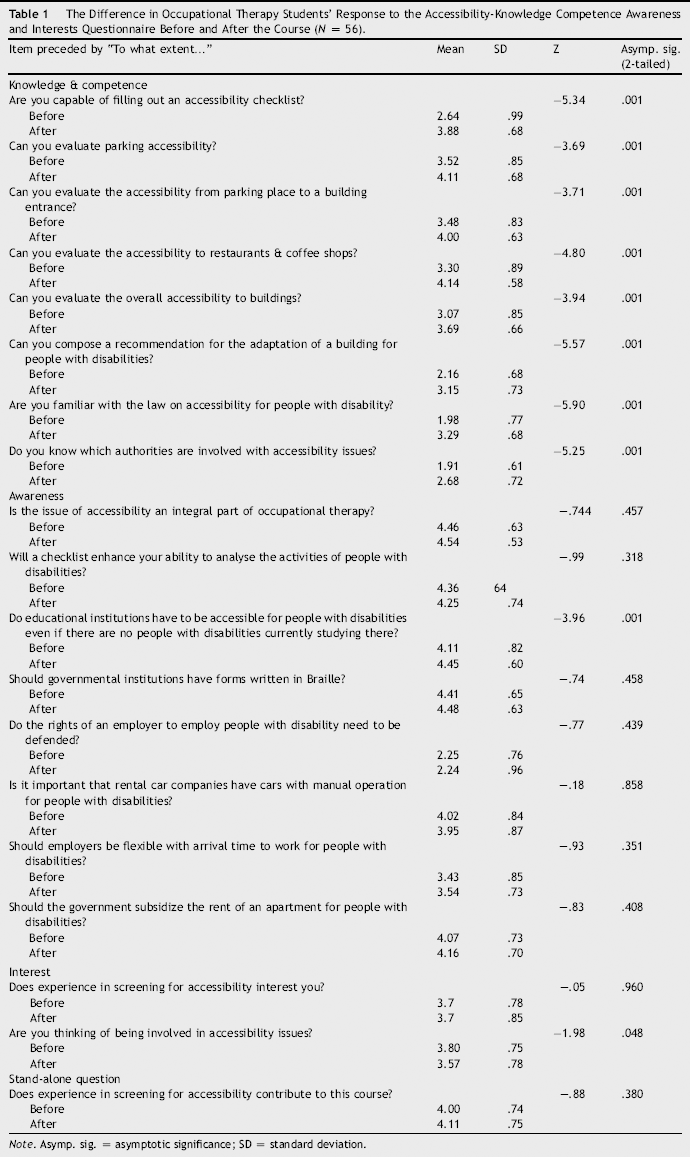
According to a comparison of students’ answers to the A-KCAI questionnaire before and after completing the course (p = .003), their knowledge, competence levels, and partial awareness of the issues regarding accessibility for people with disabilities increased considerably in students who experienced the out-of-class training. There was no significant difference between the students’ interest levels or in their answers to most of the awareness questions on accessibility before and after the accessibility project. The detailed questionnaire is presented in order to provide an overall picture of the full questionnaire. The results are displayed in
The Difference in Occupational Therapy Students’ Response to the Accessibility-Knowledge Competence Awareness and Interests Questionnaire Before and After the Course (N = 56).
Note. Asymp. sig. = asymptotic significance; SD = standard deviation.
There was no significant difference in the A-KCAI results of the control group before and after the Activity Analysis course (data not shown).
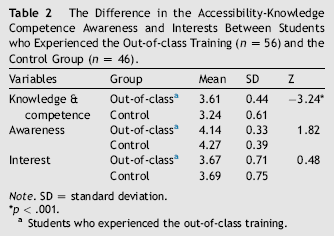
There was no significant difference in the level of knowledge, competence, awareness, and interest levels of occupational therapy students between the two groups before starting the Activity Analysis course. However, there was a significant difference in the levels of knowledge and competence of students who experienced the out-of-class training in comparison to the control group after completing the Activity Analysis course (p < .001). The results are detailed in
The Difference in the Accessibility-Knowledge Competence Awareness and Interests Between Students who Experienced the Out-of-class Training (n = 56) and the Control Group (n = 46).
Note. SD = standard deviation.
p < .001.
Students who experienced the out-of-class training.
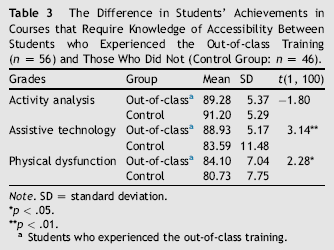
Results of the comparison between students who experienced the additional out-of-class training and those who did not experience it, revealed that students’ achievements in both the Assistive Technology course and the Occupational Therapy in Physical Dysfunction course were significantly higher for students who experienced the out-of-class training (p < .01 and p < .05, respectively). There were no significant differences between the two groups in the final grade of the Activity Analysis course. The results are displayed in
The Difference in Students’ Achievements in Courses that Require Knowledge of Accessibility Between Students who Experienced the Out-of-class Training (n = 56) and Those Who Did Not (Control Group: n = 46).
Note. SD = standard deviation.
p < .05.
p < .01.
Students who experienced the out-of-class training.
Discussion
The exposure of occupational therapy students to a comprehensive accessible experience at an early stage of their studies contributed considerably to promoting their knowledge and level of competence in issues involving accessibility for people with disabilities. However, the practical experience contributed less to promoting their awareness of these issues and it failed to stimulate their interest in this subject. Nevertheless, the results suggest that the additional out-of-class training contributed to the students’ achievements in their Assistive Technology and Occupational Therapy in Physical Dysfunction studies where knowledge of accessibility issues is required, as was demonstrated by the significant improvement in their grades on these courses. The combination of subjective perception (the students’ self-report revealed by the A-KCAI) and objective parameters (quantitative grades in the courses) has thus validated the contribution of the out-of-class training as a learning tool in promoting the understanding of environmental barriers that people with disabilities face daily.
Knowledge and level of competence
In this study, the students felt more competent in conducting an accessibility survey and filling in a checklist for reporting on the accessibility of several elements in the environment, including parking lots, restaurants, and buildings. They also felt that they now had the basic tools to make recommendations about accessibility issues. The new teaching experience also contributed to their knowledge of the laws and regulations concerning accessibility.
Enabling participation by engagement in everyday activities is considered one of the main goals in occupational therapy (
In summary, knowledge and competence are two of the most important components of professional identity.
Awareness
The students’ awareness of accessibility was partially changed after the implementation of the accessibility teaching experience. Perhaps the students in the current study began the course with relatively high levels of awareness and therefore the practical experience made only a negligible difference.
Students in
Interests
The present study's results revealed that there were no significant differences between the two groups in the students’ interest levels. Promoting and developing interest among students is a challenge to all educators. Although the level of a person's interest has been found to be a powerful influence on learning, many educators do not know how to intensify their students’ academic interest (
Another explanation for the lack of change in students’ interest in accessibility issues after experiencing the out-of-class training may be partly due to how they perceive the occupational therapy profession. The expressed primary interest of new students is in treating people, rather than issues related to the environmental challenges faced by those people (
Students’ achievements
Students’ achievements in the Assistive Technology course and in the Occupational Therapy in Physical Dysfunction were higher for the group which had received the out-of-class training. These results may indicate the way students transfer knowledge from one course to the other. Students’ reporting of the transfer of skills and concepts from one course to another has been described in a previous study (
Limitations and recommendations for future research
This study has some limitations. Firstly, the study lasted only 2 academic years; it would need to be extended over a longer period of time for the results to be validated for application to an occupational therapy curriculum. Secondly, although we had the same teaching method in both years—the out-of-class training notwithstanding—it remains possible that there might have been a researcher's bias. Perhaps unconsciously we invested more in teaching skills and knowledge regarding accessibility in the group that experienced the out-of-class training. Thirdly, information regarding any disability among participants’ relatives is missing. Having a family member or a relative with a disability may have increased their awareness and affect attitudes towards people with disabilities. In addition, and purely by chance, the two students with a disability themselves belonged to the group that was exposed to the out-of-class training, which might have indirectly influenced the results. In order to generalise the study's results and conclusions more research should be carried out with students from a variety of universities. Further studies on methods to promote the students’ awareness and interest in accessibility for people with disabilities are warranted.
Conclusion
The findings of the current study support the contribution of teaching 1st-year occupational therapy students the principles and practices of accessibility for people with disabilities for improving their knowledge and level of competence at this early stage of their professional lives. Incorporation of an environmental assessment for accessibility within the out-of-class training enhanced student learning and understanding of accessibility for people with disabilities. This understanding will help them in promoting the participation and inclusion of people with disabilities in community life and thus, in promoting occupational justice. Furthermore, knowledge might be transferred from the new accessibility experience to other study domains within the occupational therapy curriculum.