



Abstract
Digital technologies’ transformative impact continues to disrupt businesses. Despite digital transformation’s crucial role in shaping organizations’ future competitiveness, many companies still grapple with navigating their digital journey. To guide managers in realizing their digital ambitions, this article reports on a qualitative meta-synthesis of the digital transformation journeys of 64 companies, culminating in a process model that captures the complexity of digital transformation. The model provides practitioners with a framework for assessing the progress of their digital transformation journey. In addition, the article outlines actionable recommendations for managing companies’ digital endeavors.
Accordingly, business success is nowadays intricately linked to an organization’s effectiveness in managing its digital transformation endeavor. Digital transformation refers to the holistic and profound organizational changes induced by digital technologies. 2 To leverage opportunities associated with digital technologies, companies transform their business models, information technology (IT) architectures, cultures, and structures. Central to the challenge of undergoing a digital transformation is the necessity to reassess and craft strategies that seamlessly integrate and sustain a transition from a firm’s present state to its envisioned future. This process entails harmonizing different groups toward enhancing and fortifying the organization’s competitive standing. 3
While digital transformation has become a key concern, successfully orchestrating digital initiatives remains a formidable challenge for managers. Numerous firms striving to undergo such a transformation ultimately encounter failure. Reports suggest that 86% of digital transformation projects fall notably short of their objectives. 4 But why is succeeding in digital transformation such a challenging task?
Previous IT-enabled change processes have shown that technological superiority alone is no recipe for success—as illustrated by Kodak’s famous failure. Despite Kodak’s investments in relevant technologies for the digital photography industry, the company failed to adapt to the digital age. 5 However, compared to previous technology-driven organizational transformations, digital transformations are propelled by emerging technologies that are generative, malleable, and combinatorial, 6 shaking up an organization’s deep structures. Consequently, digital transformations holistically affect all facets of the firm and involve many stakeholders across the company and the external environment. These aspects suggest that—alongside questions of what firms seek to achieve in their digital transformations—coordinating the digital transformation process is notably complex. Yet, researchers and practitioners often primarily focus on what digital transformation is and what a desired destination could look like. 7 In contrast, how a digital transformation unfolds and what activities firms undertake during their journey largely remain a black box.
We analyzed 64 individual cases of firms’ digital transformations outlined in the literature to holistically integrate the insights on companies’ digital transformation journeys. These cases span various industries and include traditional, non-digital-native companies like LEGO, which—after experiencing significant losses in the early 2000s—underwent a comprehensive business transformation, restructuring its operations and prioritizing the development of an enterprise platform to drive digital innovation and foster value co-creation with customers, partners, and employees. Based on the 64 cases, we develop a digital transformation process model with two goals: reinterpreting the rich data and insights from the case studies and unearthing new perspectives.
Conceptual Background
Opening the black box of the digital transformation process is crucial for practitioners since it enables management to develop a targeted and tailored governance approach for digital transformation. 8 Yet, digital transformations are inherently complex and often prove more challenging than traditional technology-focused or business-focused organizational change efforts. While IT-enabled organizational transformations are primarily concerned with the incremental improvement of business processes driven by the implementation of enterprise systems, 9 digital transformation deals with fundamental change that blurs organizational boundaries, holistically affects the whole organization, and even raises questions about a firm’s identity. 10 Compared with past generations of technologies, the technologies inducing the current changes present more complex challenges because of their interconnectivity and generativity. Thus, digital transformation processes are more complex than previous technology-enabled change processes. This is echoed by a survey where 45% of the interviewed managers stated that they do not know where to start with their digital transformation, and 44% claimed that previous efforts were a waste of time. 11 Specifically, the challenge of managing the digital transformation process can be traced to three complexity-inducing characteristics that warrant a new, closer look (see Figure 1):
Digital transformation is a moving target that unfolds amid ever-changing environments. Central to this dynamism is the pervasive impact of evolving digital technologies, which significantly shape modern business environments. These powerful and readily accessible digital technologies are commonly represented by the acronym SMACIT (social, mobile, analytics, cloud, and Internet of Things [IoT]). 12 Digital technologies’ unique properties enable their integration with various physical products, igniting unprecedented waves of digitalization that drive innovation processes. 13 These rapid technological developments require companies to continuously adapt to new technological realities and hamper the predictability of the digital transformation process. Against this backdrop, organizations must resist the temptation to chase every new technology trend without considering its long-term viability. Consequently, selecting technologies that align with their strategic objectives and operational needs is vital. Mindlessly following technology fashion fads can lead to misallocating resources and failure to achieve meaningful digital transformation.
Digital transformation is a company-spanning challenge that surpasses mere technology adoption, addressing various aspects such as shifts in business models, organizational structures, capabilities, and culture. 14 In contrast to IT-enabled transformations, the IT department is just one player among many involved in driving the transformation. Therefore, successful digital transformations demand a holistic approach that integrates all facets of the company, directing digital activities throughout the organization. Such digital initiatives can emerge top-down or bottom-up. 15 For the former, top management provides overarching strategic direction, allocates resources, and sets organizational priorities. For the latter, digital transformation is frequently influenced by emerging digital initiatives within departments, which can quickly identify and implement digital solutions tailored to their specific contexts. Thus, thriving digital transformation requires balancing top-down guidance and bottom-up innovation. The challenge is to effectively integrate the two disparate efforts to ensure alignment with overarching business objectives while leveraging the agility and creativity inherent in departmental initiatives.
Digital transformation is a boundary-blurring phenomenon that surpasses organizational confines. 16 Recognizing and navigating external interrelations is essential for companies embarking on the digital transformation journey because success hinges not only on internal capabilities but also on effectively harnessing the power of external networks and partnerships. For instance, today, customers do not just consume products or services; they actively participate in their design, delivery, and refinement. 17 This dynamic interaction—that is, value co-creation—blurs the traditional boundaries between producers and consumers and requires organizations to adapt their strategies and operations accordingly. Moreover, a firm’s digital transformation journey is intricately linked with its suppliers and competitors. Companies often find themselves entangled in a web of dependencies with their suppliers, relying on seamless integration and collaboration to ensure supply chain efficiency and agility. Simultaneously, they must cope with a competitive environment, where rivals may adopt similar digital strategies or disrupt traditional business models. Finally, digital transformations often extend into broader ecosystem settings, which change the nature of collaboration and competition within and across industries. 18 Within such ecosystems, companies must navigate complex interdependencies (including technological interdependencies) and power dynamics, leveraging collaborative relationships to drive innovation and create sustainable competitive advantages. 19
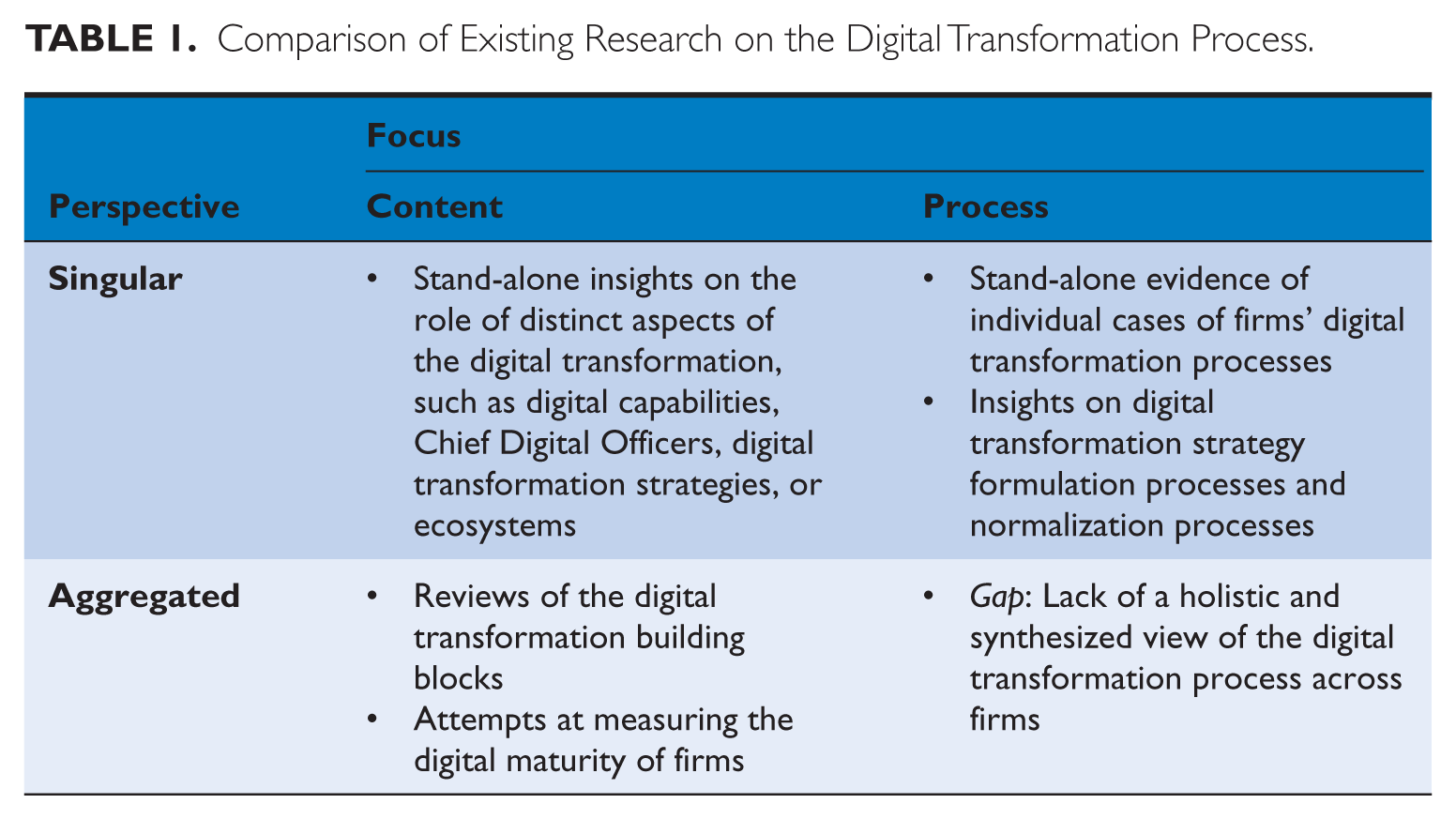
While it is crucial to grasp the intricacies of the digital transformation process for effective navigation, our current understanding remains constrained. Scholars primarily depict firms’ individual transformation journeys or delve into specific aspects, such as the formulation process of digital transformation strategies 20 or the development of digital capabilities. 21 Accordingly, practitioners lack a synthesized picture of the digital transformation process beyond these insightful yet stand-alone attempts. Table 1 summarizes the work on digital transformation and points toward the need for a synthesized view of the digital transformation process across firms.
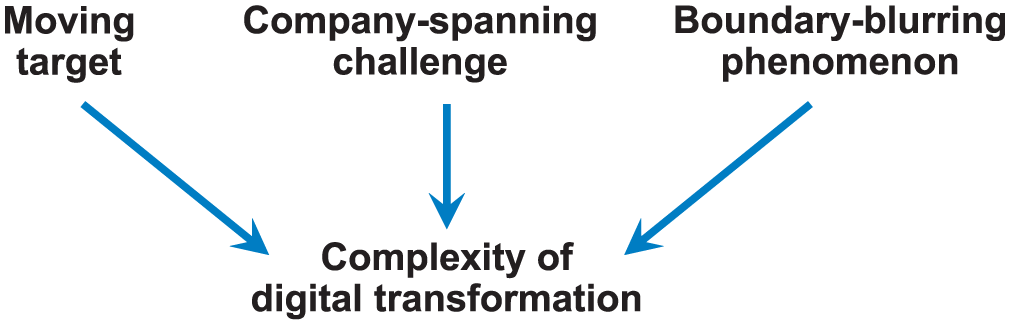
Complexity-inducing characteristics of digital transformation.
Comparison of Existing Research on the Digital Transformation Process.
Research Methodology: A Qualitative Meta-Synthesis
Qualitative case studies continue to generate substantive contributions to various research areas, including digital transformation. Yet, case studies often remain isolated, stand-alone works, with their cumulative potential frequently overlooked. In fact, they hold the potential to be revisited and synthesized through comprehensive analysis alongside other case studies. 22 Following this rationale, we employ a qualitative meta-synthesis to leverage the extensive empirical data from published cases, recognizing the impracticality of gathering such data in a stand-alone case study. 23 A meta-synthesis seeks to synthesize primary qualitative case studies and make original contributions beyond those achieved in the original studies based on the data. While literature reviews integrate the studies’ results, meta-syntheses draw on the case descriptions to synthesize the cases and derive new insights from the aggregate data pool of the qualitative studies not originally envisioned by the authors. 24 For the present research, we aim to elicit existing qualitative cases describing firms’ digital transformations to infer a typical digital transformation process. For this purpose, we first systematically collected relevant case studies. Then, we thoroughly coded the case studies, culminating in an aggregate digital transformation process model.
Sampling
Since digital transformation is a phenomenon relevant across disciplines, our sampling strategy was purposefully multidisciplinary. We included several disciplines (i.e., information systems, general business administration, strategic management, and technology, innovation, and entrepreneurship), given that a multifaceted phenomenon like digital transformation cannot be entirely grasped within a single discipline but calls for an integrative approach. 25 We considered papers published up to and including September 2022, and we screened the results to ensure that we only included real digital transformations and not mere IT-enabled change projects. We excluded studies that examine digital transformations in the public sector because of its well-known peculiarities. The cases feature globally operating, non-digital-born companies primarily headquartered in Europe and North America. They span various industries and represent firms ranging from 500 to more than 100,000 employees. This diversity provided valuable insights into distinct digital transformation journeys and enabled us to identify patterns that transcend specific company contexts.
Coding
To analyze and synthesize the case descriptions from the 64 cases, we engaged in multiple iterative coding cycles to ensure a structured and reproducible approach. 26 Initially, we systematically gathered all data from the papers related to the activities and strategic events that companies engage in during their digital transformation. Thereby, we decomposed the digital transformation process into discrete activities, assigning descriptive labels to each. We continually refined and merged similar concepts, paying close attention to commonalities and differences between cases.
We observed specific themes recurring repeatedly in the cases, often with little chronological order. This prompted us to categorize the topics into two levels: one demonstrating a sequential progression and another characterized by iterative and non-linear patterns. Finally, we grouped related topics into six aggregate dimensions that serve as the phases of our process model. The grouping process also reflected two levels of temporality and captured the essence of the underlying topics, thereby delineating distinct phases of the transformation process.
Findings: A Process Model for Digital Transformation
We analyzed the 64 identified cases of digital transformation to understand how companies can maneuver their digital transformation. While digital transformation manifests uniquely in each company, certain commonalities underpin the process, leading to an aggregated digital transformation process model with six distinct phases (see Figure 2): initiating, preparing, mobilizing, implementing, disseminating, and iterating. While the first five phases follow a sequential order in firms’ digital transformation journeys, the sixth phase (iterating) is ongoing throughout the process and includes supporting activities for the other five phases. Hence, the digital transformation process consists of two levels (the sequential linear level in the bottom part and the iterative level in the top part of Figure 2) that mutually influence each other.
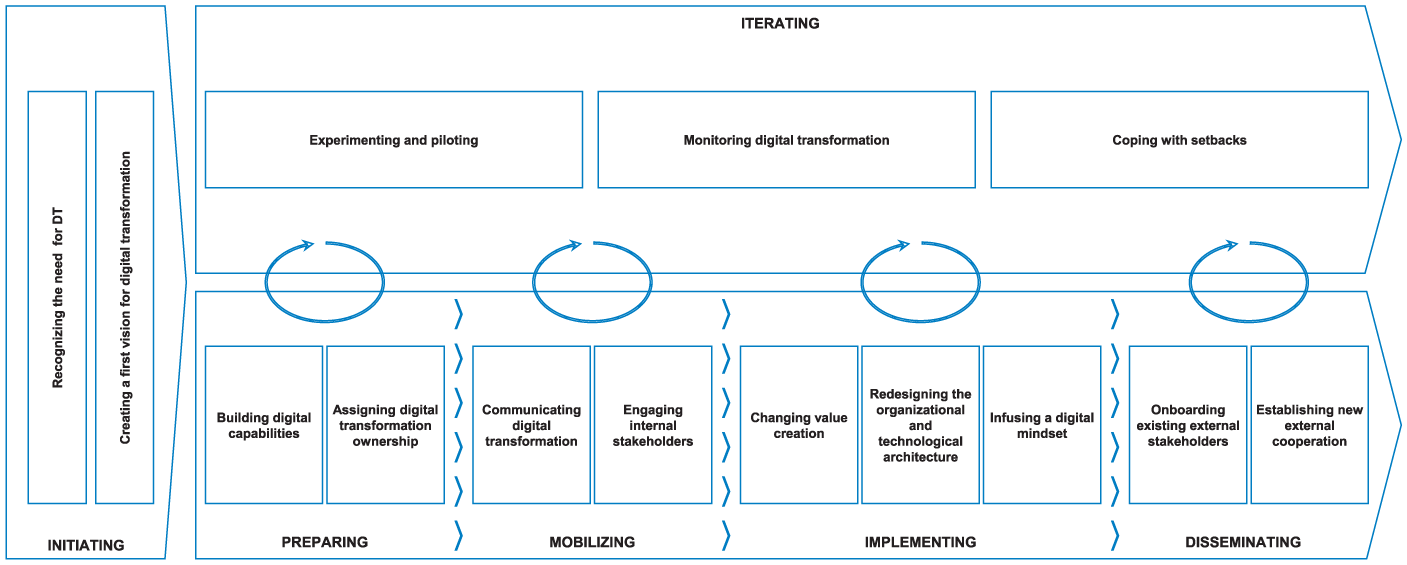
The digital transformation process.
Below, we delineate the six phases of the model, including their corresponding activities, and illuminate the trajectory of companies as they embark on their digital transformation journey. Given that digital transformation indeed constitutes a substantial voyage for organizations and is akin to navigating uncharted waters, we leverage a sailing analogy to contextualize and elucidate the digital transformation process within companies.
Initiating Digital Transformation
“Recognize shifting winds and plan the route.”
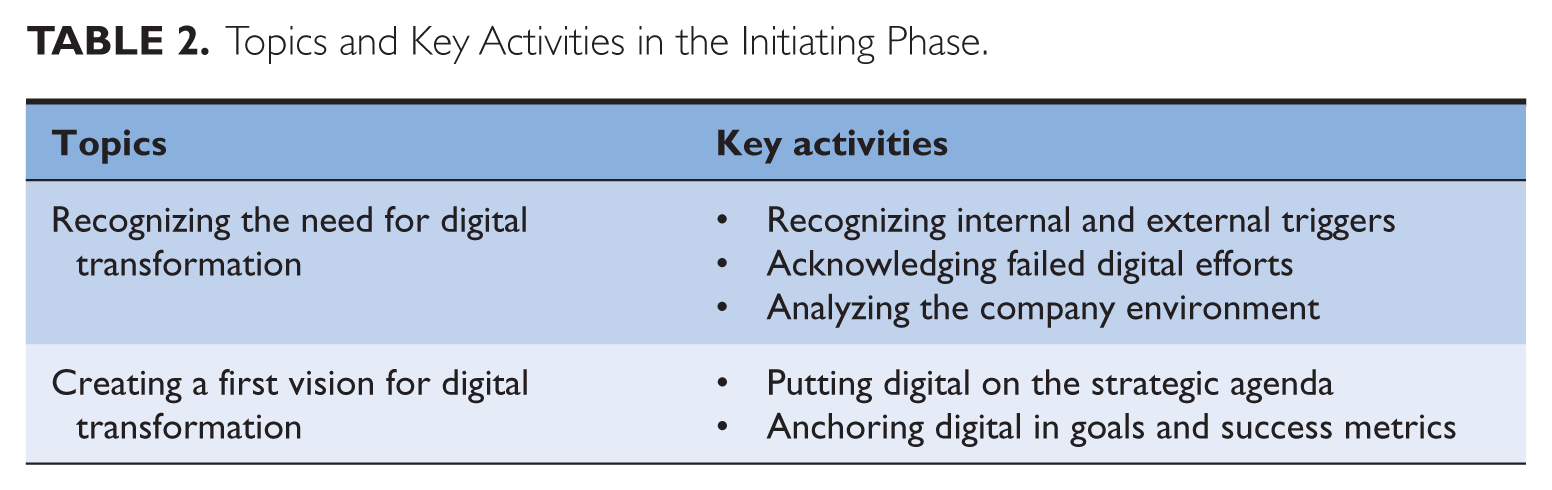
Just as a captain observes shifting winds and decides to chart a new course, firms start their digital transformation by initiating it. The triggers for digital transformation can be manifold, ranging from external factors, such as the pressure from changing market dynamics and the need to remain competitive, to internal factors, such as the acknowledgment of previously failed digital initiatives. Once the impetus is set, firms create a first vision for their journey. This vision is typically made explicit by anchoring digital in the corporate strategy or success metrics. Some companies even formulate an initial digital transformation strategy to emphasize the strategic importance of the endeavor. Table 2 summarizes the topics and key activities in the initiating phase.
Topics and Key Activities in the Initiating Phase.
Recognizing the Need for Digital Transformation
Firms experience various triggers that prompt them to embark on a digital transformation. These triggers can be classified into internal and external factors. Internally, triggers may stem from cost constraints and the recognition that the current organizational framework is not suited to remain competitive in the future. External triggers include technological advancements, evolving customer preferences, shifts in the market or industry dynamics, and rising competitive pressures. Here is an example from one of the case studies we reviewed: Further, born-digital players, especially digital platforms, are increasingly impacting on the industry’s sales channels and may take over the future (digital) touchpoints with end-consumers. Thus, FoodCo initiated a digital business strategy to aim to build a “digital food ecosystem” in which it could explore digital business models.
27
In addition, recognizing the need for digital transformation often stems from reflecting on prior unstructured attempts to implement digital initiatives that ended in failure or a thorough evaluation of the firm’s ecosystem. Typically, multiple reinforcing triggers coincide, intensifying the pressure on firms to take action.
These environmental analyses were carried out internally or conducted by consulting and research firms. HardCorp, for example, noticed how its main competitor pioneered the platform- and IoT-based service business in the manufacturing space. In addition to responding to its direct competition at the time, HardCorp and other incumbents had to protect against the vertical business expansion of platform natives, such as Microsoft and Amazon Web Services.
28
Creating a First Vision for Digital Transformation
After committing to a digital transformation, companies undertake activities to establish an initial vision for their digital journey. Crafting a comprehensive digital transformation strategy becomes imperative for many firms to navigate this path successfully. Spearheaded by top management and integrating existing bottom-up initiatives, the digital transformation strategy lays the groundwork by initiating a strategic process that encompasses the primary action fields of the organization’s digital transformation.
Aftonbladet advanced the digital first strategy and formulated a forceful transformation strategy to move from print to digital. The strategy was to optimize the print business and develop the digital business to be independent of print.
29
Most firms establish goals and success metrics to monitor the progress of these initiatives. However, tracking tangible results proves challenging. While a few firms incorporate measurable key performance indicators (e.g., for the work of digital units or the share of revenues from the digital business), the majority articulates a desired or benchmarked target state without specific metrics.
To address these challenges and market conditions, Encana’s business and IS [Information Systems] leaders set two organizational goals for digitization: 1. Respond effectively to price volatility; and 2. Reduce production costs by seeking unconventional sources of natural gas.
30
Preparing for Digital Transformation
“Inspect the boat and gather a crew.”
Just as a sailing crew inspects its boat, trains its members, and defines responsibilities for the voyage, firms must lay the foundation for their digital transformation journey. Once the impetus for digital transformation is set and a first vision has been formulated, companies proceed with preparing for digital transformation. In this phase, they often build digital capabilities and assign ownership for their digital transformation endeavor. Table 3 summarizes the topics and key activities in the preparing phase.
Topics and Key Activities in the Preparing Phase.
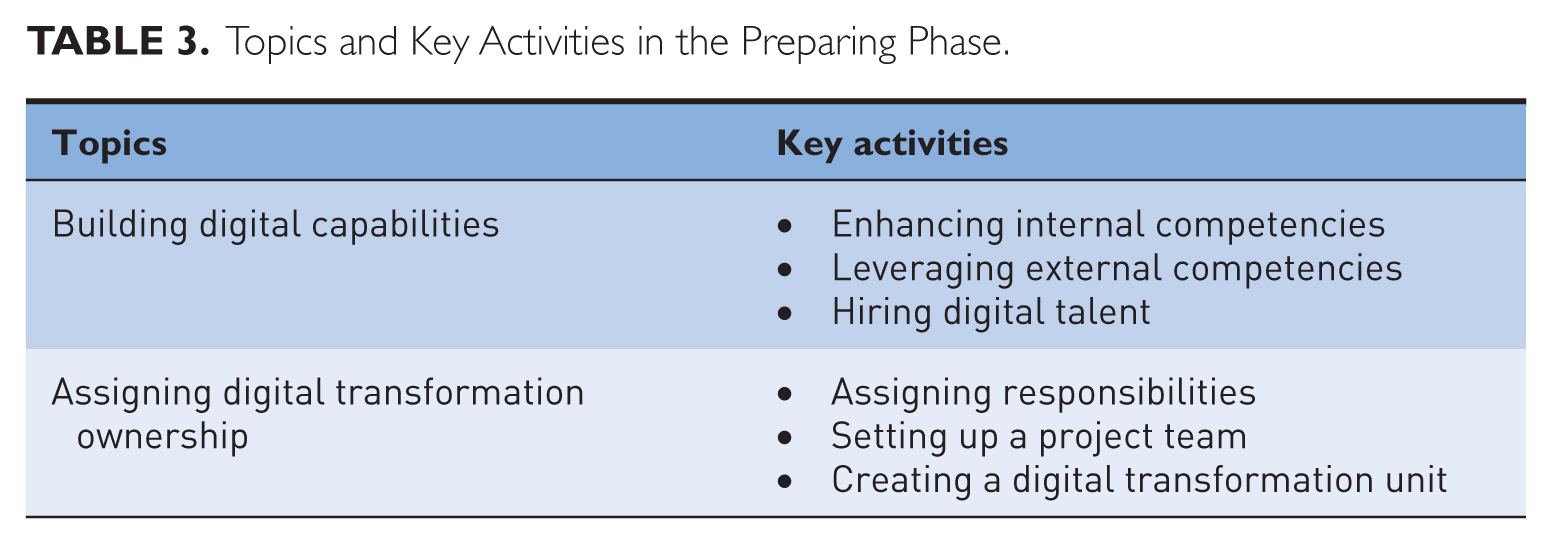
Building Digital Capabilities
The analysis of the case companies highlights the critical need for firms to cultivate a holistic range of collective digital competencies—comprising digital skills, knowledge, expertise, and experience—to navigate digital transformation effectively. Generally, companies have three primary avenues for enhancing their digital competencies. First, firms can develop competencies internally by offering training programs, capitalizing on employees’ knowledge and familiarity with the organization.
In the Vodafone case, the digital transformation project compelled managers . . . to enhance their employees’ capabilities. A call-center unit was trained to no longer answer customer calls directly, but to design conversational frameworks for the chatbot to be used in serving customer requests.
31
Second, companies might harness competencies by enlisting consultants’ support or forging partnerships. This enables companies to complement their internal competencies for digital initiatives by tapping into expertise beyond their organizational boundaries. Third, companies frequently seek to address gaps in digital competencies by hiring external talent with specialized expertise who bring new ideas to the table.
They therefore began to recruit new employees from outside, seconding them directly into the digital unit. These new hires and external consultants did not have any previous relations with the core organization and they therefore only engaged to a limited extent, if at all, in knowledge transfer activities with the core organization.
32
Assigning Digital Transformation Ownership
In the initial stages of their digital transformation, most companies delineate clear lines of responsibility. This involves assigning individuals with defined roles, often entrusting overall accountability to a top management team member, commonly the CEO. Furthermore, some organizations appoint a Chief Digital Officer (CDO) to coordinate digital transformation efforts centrally.
To this end, a new CDO was hired to collaborate with the strategic planning team and be in charge of the planning, development, implementation, and modification of DT initiatives.
33
In addition to assigning individual responsibilities, firms sometimes establish project teams (some of which are cross-functional) to oversee digital transformation endeavors, often alongside their regular operations. Alternatively, some organizations build dedicated digital transformation units—typically separated from the core business—to drive digital innovation activities and advance the digital transformation agenda.
In response to this need, in Q2 2018, FoodLtd founded a new unit to develop its marketing and business model. This unit would coordinate the entrepreneurial initiatives and develop further necessary digital capabilities.
34
Mobilizing for Digital Transformation
“Get the whole crew on board.”
A successful journey relies not only on the core team’s effort but also on rallying the supporting crew members on board, given that the large boat can only be maneuvered with the backing and collaboration of the entire crew. Likewise, digital transformation demands not only a motivated digital team but rather a company-wide effort. Therefore, mobilizing the company for digital transformation is crucial. In the examined cases, companies mobilize by spreading the digital transformation strategy across the organization and engaging internal stakeholders. Table 4 summarizes the topics and key activities in the mobilizing phase.
Topics and Key Activities in the Mobilizing Phase.
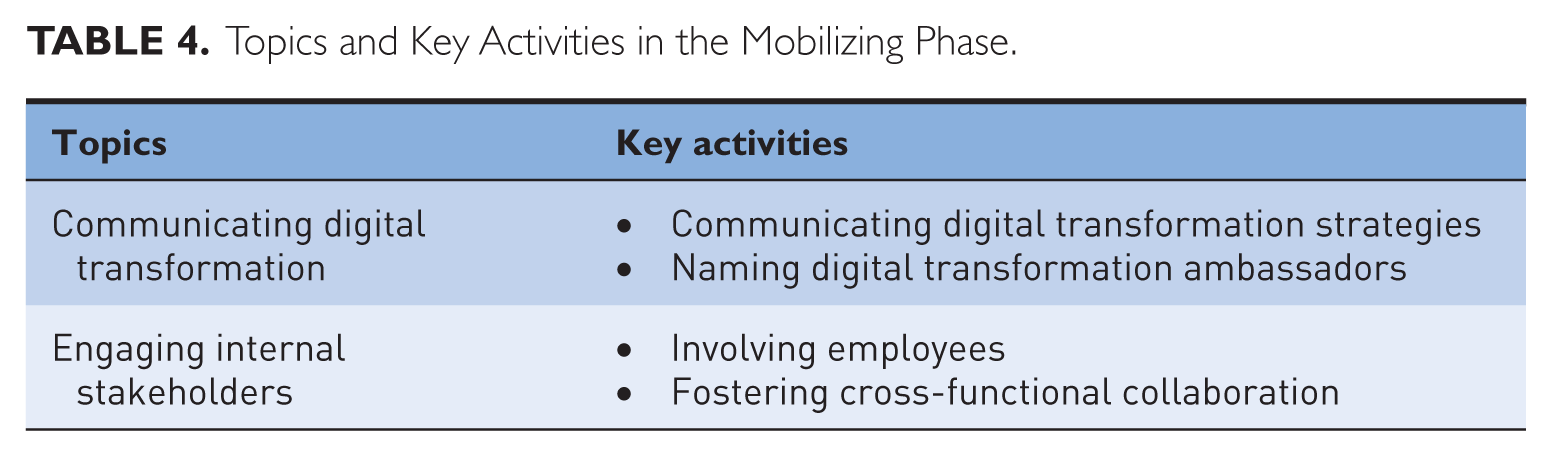
Communicating Digital Transformation
Comprehensive communication of digital transformation via targeted information campaigns and announcements (e.g., blog posts and town hall meetings) seeks to enhance awareness of digital transformation within the company and to bolster commitment to digital transformation endeavors.
The companies communicated the new target culture through various channels to create cultural awareness. Communication ranged from internal platforms and magazines to communication at employee events.
35
Moreover, firms appoint digital ambassadors—employees up to middle management—who demonstrate high engagement in digital transformation initiatives, are driven to disseminate knowledge, and foster positive attitudes toward the envisaged change. These individuals can act as boundary spanners, bridging different units.
To favor dialogue among the units involved in the innovation activities, a new role has been introduced, the “innovation antenna.” . . . Antennas are employees particularly keen on innovation and able to communicate among the company’s departments, functions, and business units to guarantee a high level of coordination and communication at all levels.
36
Engaging Internal Stakeholders
Digital initiatives frequently hinge on the involvement of employees. Engaging the workforce proactively (e.g., by conducting workshops and idea contests) serves as a strategic approach to garner employee support for digital transformation and opens avenues for employees to actively contribute to their companies’ transformation. Similarly, fostering cross-functional collaboration empowers internal stakeholders by establishing connections between different departments. When employees collaborate across various functions, they exchange complementary skills, which is essential for the success of digital transformation given its cross-cutting nature.
One intervention to get people from product development, sales, operations, and other areas to work together across functional silos was the Accelerate Leadership Program (ALP, for executive level management), and the similar ATP (Accelerate Team Program, for operational teams). The ALP program was designed as a three-day offsite training to bring together leaders from different functions who were all working on a specific business problem. The idea was to create “end-to-end” teamwork across functional silos.
37
Implementing Digital Transformation
“Set sail for the journey.”
After months of planning and preparing for the long journey, the day has come to set sail and navigate the ship out of the homely harbor into unknown waters. Similarly, firms start implementing organization-wide changes with the final goal of becoming digitally transformed. The implementation of digital transformation activities is visible in three main topics: First, organizations change their value creation, leading to new business models and value propositions. Second, the changes are often facilitated by redesigning the organizational and technological architecture, encompassing adaptations to the IT and data infrastructure, organizational structure, and processes. Finally, firms frequently embark on a cultural change initiative to infuse a digital mindset. Table 5 summarizes the topics and key activities in the implementing phase.
Topics and Key Activities in the Implementing Phase.
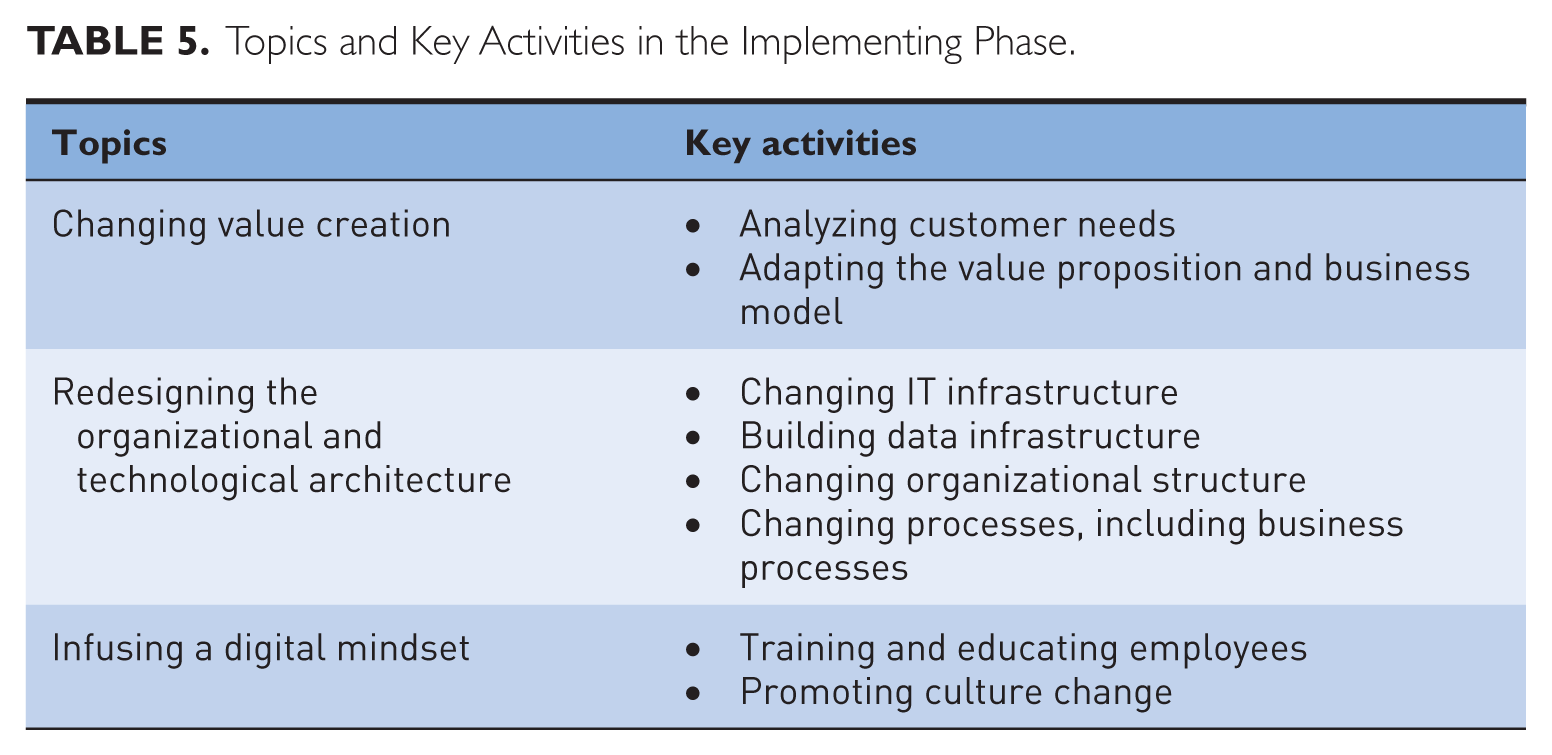
Changing Value Creation
The redefinition of how to deliver value to customers is at the heart of numerous firms’ digital transformation endeavors. To gain profound insights into their customer base, firms undertake comprehensive analyses. For example, by leveraging digital touchpoints, they get insights into customer needs and how new products or services might address both current and future challenges. With this understanding, firms reconfigure their business models, innovate digital products and services, or broaden their existing market offerings.
Nevertheless, the company has begun to follow its customers, who are moving toward digital offerings. In addition to introducing electronic sales channels for its products, Ravensburger has entered the e-book and online gaming markets. Additionally, the publisher has begun to develop complementary digital products that enrich its existing analog products.
38
Redesigning the Organizational and Technological Architecture
Developing and implementing digital innovations necessitate wide-reaching adjustments to existing IT landscapes, data channels, organizational structures, and processes. From a technological perspective, firms upgrade their IT systems to facilitate the integration of new solutions and enhance the agility of their digital infrastructure. Data assumes a crucial role in nearly all digital transformations. Consequently, firms dedicate substantial resources and attention to establishing the requisite infrastructures for data collection, analysis, and utilization—from improved master data management to real-time data tracking.
To support the omnichannel strategy, Hummel’s IT system had to be enhanced. Beyond the tighter integration required between Hummel’s websites and the back-end ERP system for its B2B and B2C e-commerce, there were also issues related to the IT infrastructure, which needed to support a new set of “rich” product data.
39
From an organizational perspective, digital transformation typically entails creating new structures and processes, including business processes. These adaptations serve as the foundation upon which organizations build their capacity to thrive in the digital age. By restructuring, companies can break down traditional silos and hierarchies, fostering collaboration and agility essential for navigating rapidly evolving markets. Moreover, these changes enable the seamless integration of innovative technologies and practices, ensuring organizations remain competitive and adaptable in an ever-changing landscape.
Servivor changed its structure . . . from a hierarchical organization with functional units towards holacracy with self-organized teams. Thereby, it was essential to “cannibalize existing structures” . . . and “break down silos” . . . to allow unrestricted information and knowledge flow for mutual value creation.
40
Infusing a Digital Mindset
In addition to implementing tangible changes in their digital transformation efforts, firms place significant emphasis on the human aspect of this transformation, underscoring the importance of adopting a digital mindset. Specifically, companies cultivate cultural change by providing comprehensive training and educational sessions for the entire workforce. The foundations for upskilling employees are already laid in the preparing phase by recruiting new digital talent or acquiring external digital competencies to drive the digital transformation agenda effectively and in the mobilizing phase by increasing employees’ buy-in through active involvement. The activities in this phase focus on fostering digital thinking. The objective is to instill a culture characterized by a willingness to take risks, agility, and a digital-first mindset across the organization.
During this time, the DTU [digital transformation unit] also worked on several topics related to employees’ attitude towards digital transformation and AssetCo’s culture. To achieve these goals, the DTU made use of a variety of communication measures, including mailings, arranging fireside chats, leading workshops and preparing a short video. The video compared AssetCo to a “surfer riding the digital wave,” which became the leitmotif for the overall DTS [digital transformation strategy].
41
Disseminating Digital Transformation
“Nurture and forge alliances at sea.”
During a journey, boats are usually accompanied by other ships that share the same route, potentially forming a strong fleet. Likewise, toward the later stages of digital transformation, firms often engage in disseminating their initiatives by onboarding existing external stakeholders or establishing new external ties. These activities help firms to collect external input and tap into external resource pools. Table 6 summarizes the topics and key activities in the disseminating phase.
Topics and Key Activities in the Disseminating Phase.
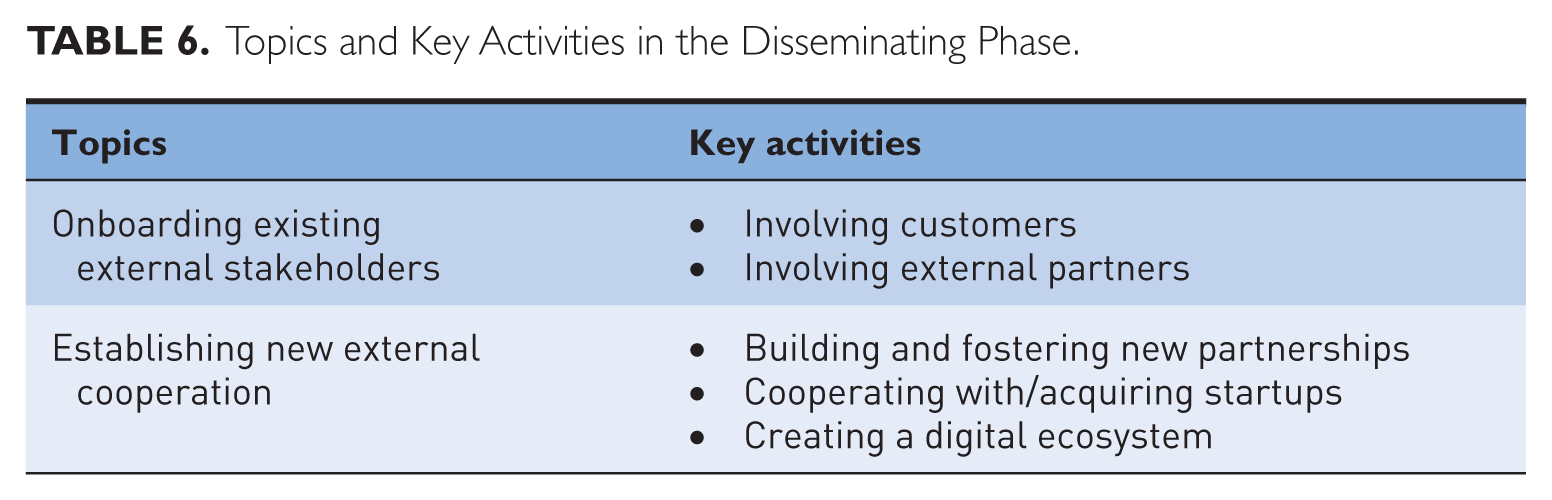
Onboarding Existing External Stakeholders
Following the implementation of first digital transformation projects (particularly those focused on value creation), firms share aspects of their outputs with customers, inviting them to express their views and get input for future directions. Some firms even involve customers early in the ideation process. However, for most firms, this engagement typically begins once the initial results of the digital transformation have materialized. Similarly, firms engage their key stakeholders in discussions about changes, extending initiatives beyond company boundaries. Especially when firms depend on external collaborators, onboarding their partners becomes instrumental in mitigating resistance to change and facilitating the exchange of best practices among stakeholders.
It was critical to encourage people to use (and participate) in the PCT [Partner Connection Tool] platform since it allowed the partners to “see the benefits” of the digital transformation. This was also predicated by the various demonstrations and training events to guide partners through a new digital process and experience of HPEFS [HPE Financial Services].
42
Establishing New External Cooperation
Beyond involving existing external partners in their digital transformation, establishing and nurturing new partnerships becomes essential for most firms to gain fresh insights and perspectives for digital initiatives. Many companies deliberately target startups for partnerships or acquisitions, recognizing their potential to provide access to previously untapped digital resource pools. Finally, some companies aim to create digital platforms or integrate their organization into a connected ecosystem to accelerate digital transformation by forging connections with a wide range of industry players.
The second phase in Alpha Security’s digital transformation journey required the firm finding ways to “open-up” its business ecosystem, meaning to initiate new collaborations related to digital transformation . . . Opening-up the business ecosystem meant that Alpha Security had to gain the support and assess the willingness of other firms to undertake the digital transformation journey with them. Alpha Security’s approach therefore shifted from its inward focus in the initiation phase, towards being outward focused.
43
Iterating on Digital Transformation
“Trim the sail and adjust the course.”
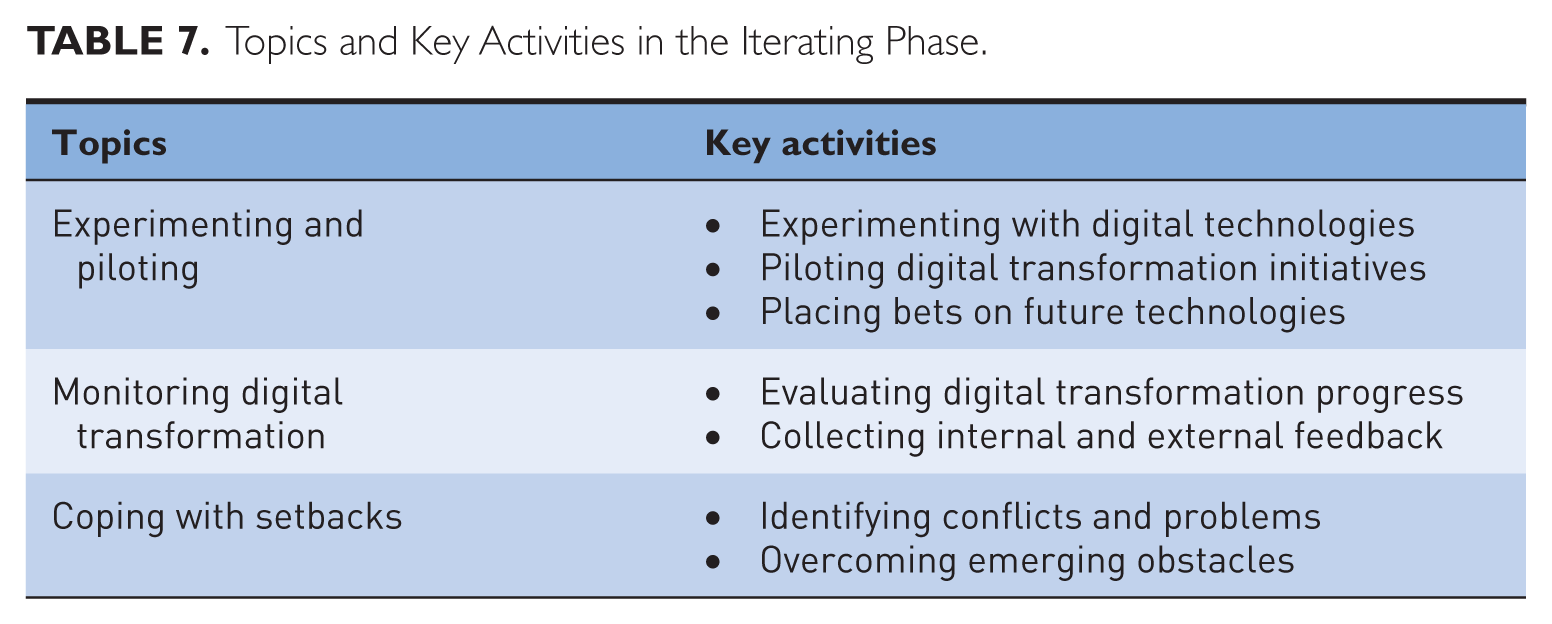
A long journey cannot be fully mapped out in advance but requires regular adjustments to the ship’s course in response to unforeseen changes in the weather and emerging obstacles. Thus, adding to the sequential phases, all digital transformation cases provided evidence for iterating activities that run in parallel with the other phases. Iterating activities are not stand-alone but strongly interwoven with the preparing, mobilizing, implementing, and disseminating phases. Digital transformation is highly dynamic, so the individual activities in the sequential phases are not conclusive; they are in flux and, thus, subject to ongoing adjustments. Therefore, companies constantly experiment, pilot, monitor, and cope with setbacks to adjust their digital transformation. Table 7 summarizes the topics and key activities in the iterating phase.
Topics and Key Activities in the Iterating Phase.
Experimenting and Piloting
The cases illustrate that the digital transformation journey involves continuous experimentation. Experimenting with digital technologies and piloting digital initiatives are strategies aimed at exploring the potential of digital technologies. This approach enables companies to assess valuable use cases before committing to extensive changes. Thus, companies craft minimum viable digital innovations and refine them through pilot implementations and feedback loops. By concentrating on smaller pivots in specific areas that require continuous testing and learning, organizations can mitigate the financial and capacity-related barriers to digital transformation while keeping pace with the changes triggered by emerging digital technologies. Failure is actively encouraged to learn quickly.
We experiment—try things quickly—so we start to act a bit more like a startup, like an e-commerce company. It is about taking small, calculated risks that have no impact if they fail. This year we are running 1,000 small experiments across the bank, and they will be exactly that, small things we can test in safety that give us a huge amount of insight into action.
44
In addition to experimenting with digital technologies, many firms consistently invest in emerging business areas, placing strategic bets on future digital technologies. This ongoing monitoring of the technology market with a forward-looking mindset highlights the necessity for companies to stay abreast of the ever-evolving technology landscape.
Monitoring Digital Transformation
To facilitate a targeted and effective digital transformation, companies maintain a continuous evaluation process to gauge the progress of their digital initiatives against predefined goals and success metrics. This systematic assessment serves as a vital mechanism for identifying areas where the organization is making strides in its digital transformation efforts and pinpointing areas that require further improvement or refinement. By regularly reviewing and analyzing the performance of digital initiatives, companies can adapt their strategies, allocate resources more effectively, and ensure alignment with overarching business objectives.
Bi-weekly, the [program steering] board considers the collaboration model, prioritizes topics and reviews the overall strategy, current status of projects and challenges, future goals and open issues.
45
In addition, firms proactively pursue internal and external feedback on their digital transformation efforts. Internally, this involves regular meetings and workshops with all stakeholders to guide the company in the right direction for its digital transformation. Externally, many organizations engage regularly with their broader network, including customers and suppliers, to gather feedback on their digital transformation initiatives.
These interactions between the middle management and operational level occurred continuously. New versions of the OPRA software were released on a continuous basis, and services were added or changed to the infrastructure based on the learning and feedback from the operational level users, who again adopted and tested, and again provided feedback to the middle management.
46
Coping with Setbacks
As firms navigate their digital transformation journey, they almost certainly confront a spectrum of challenges. While some setbacks and failures are expected and actively embraced, for example, when experimenting with novel digital technologies to receive quick feedback, others are more surprising and emerge throughout the process. Typical obstacles encompass employee reluctance toward embracing the digital paradigm, uncertainties surrounding customer adoption of digital solutions, or technological glitches. In such instances, it is crucial to promptly identify, evaluate, and mitigate these challenges through targeted actions. Leveraging insights gained from setbacks in prior digital initiatives, numerous companies proactively adapt their approaches to overcome the hurdles they face.
MarComp acknowledged this conflict at the first workshop. The solution was to introduce KPIs on the company level instead of the unit level to reduce local optimization problems. The product manager of the system also established collaboration between the heads of the planning centers, who were now organized as a team and had regular meetings to discuss and improve the digital booking process. Eventually, surveyors from the planning centers started to perceive the system as the right way for the company.
47
Sustaining the Digital Transformation Process
Having portrayed the digital transformation process analogue to an explorer’s voyage, it is still unclear when or whether the anchor is set. Where does the journey end?
The interplay of our process model’s two levels provides a frame for understanding the transition to a firm’s steady state post-transformation. While our process model highlights the sequential and logical order of digital transformation phases and emphasizes that certain activities should be completed before others can be initiated, the importance of this overall chronological order becomes less important with time. After having gone through the sequences of the phases for the first time, firms continue to undertake digital transformation activities non-linearly and iterate routinely in reaction to emergent changes. The activities that we identified as following a sequential pattern do not end but instead are undertaken continuously and repeatedly. Figure 3 illustrates the interplay of the four phases that follow the initiation of the digital transformation process. For example, the insights gained through experiments with emerging technologies and the results of organizational pilot projects require firms to readjust their IT landscape or tweak business models. Similarly, addressing the human aspects of digital transformation is not a one-off event but a continuous task. Accordingly, the distinct phases and their associated activities are deeply interconnected, influencing and shaping one another. The repeated iteration during digital transformation maintains the interplay’s momentum.
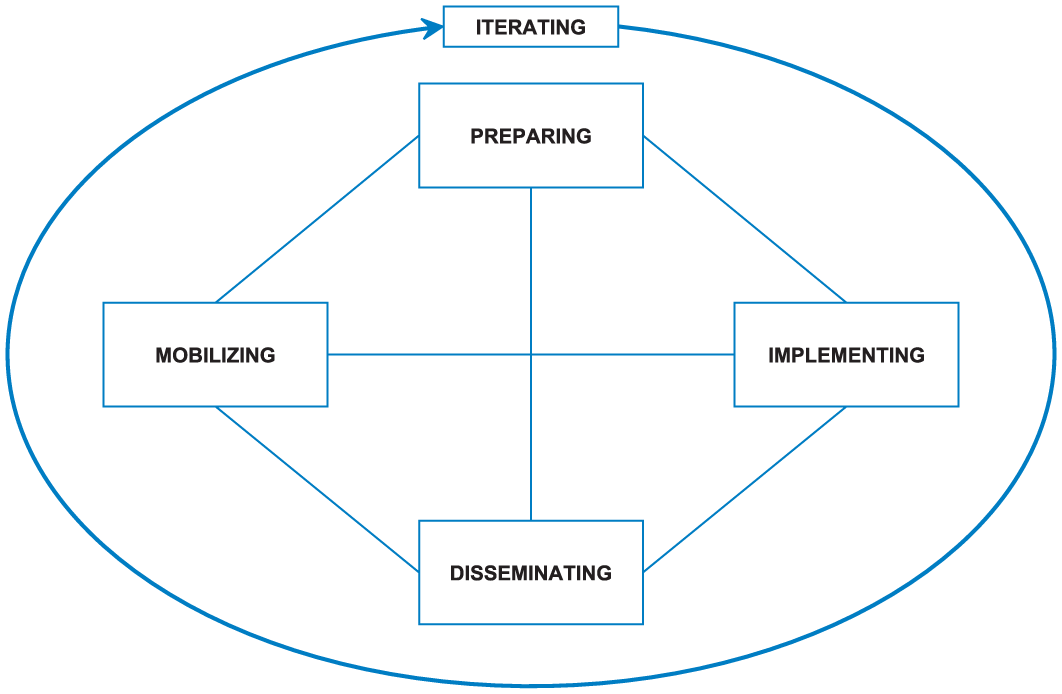
Sustaining the digital transformation process as a continuous interplay.
Since the identified digital transformation process has no clearly defined end, the question arises of how digital transformation approaches its final state. First empirical insights indicate that digital transformation seems to become the new normal once transformational activities are seamlessly integrated into the daily operations of both managers and employees. 48 While none of the firms we analyzed had reached a stage where their primary digital transformation efforts were completed, we found evidence for the establishment of routines in some organizations. For example, firms no longer pursue dedicated digital transformation strategies but embed them into their digital business strategy. This change shifts the perception of the nature of digital transformation from one big push toward a sustained effort. Digital transformations are meant to be anchored and sustained, manifesting in new practices and a new steady state.
In early 2019, Alpha Security recognized that “no digital solution is perfect” (IT Employee, Alpha Security), and therefore decided to expand its digital transformation journey beyond projects Omega and Sigma. In this sense, Alpha Security’s digital transformation approach shifted from an initial “one-off” attempt intended to address immediate market needs, to a constant undertaking that became integral to the business ecosystem. Put differently, in early 2019, orchestrating was no longer just a process of initiating a digital transformation journey, but rather something that had emerged as Alpha Security’s identity.
49
Based on the case insights, we argue that the more the iterating phase becomes an integral part of firms’ practices, and the structural, technological, and cultural groundwork has been laid by progressing through the phases, the more future changes are embedded in everyday company practices. Once the continuous interplay of activities illustrated in Figure 3 is no longer perceived by managers and employees as a significant upheaval but instead woven into the fibers of the organization, digital transformation begins to fade from view and is accepted as the new normal until new technologies may trigger the firm to question its deep structures once more. Thus, the digital transformation process ends once it reaches a steady state. In line with our analogy, the more the whole crew routinely keeps the ship running, intuitively steers it through turbulent waters, and perceives the grand voyage as a predictable trip to known shores, the more the digital transformation journey comes to an end.
Recommendations: Managing the Digital Transformation Process
Based on our analysis of 64 case studies on firms’ digital transformation journeys and the resulting process model, we derive six recommendations for managers navigating the (un)charted waters of the digital transformation process. The recommendations are strongly connected to the process model of digital transformation and the interplay of its dimensions over time (see Figure 4). They either address the model as a whole or emphasize particular parts but are not limited to one phase alone. The model and the associated recommendations collectively serve as a blueprint for managers to understand, plan, and monitor the digital transformation process. Thus, they provide guidance on how to strategically deal with the complexity and turbulence of their companies’ digital transformation journey.
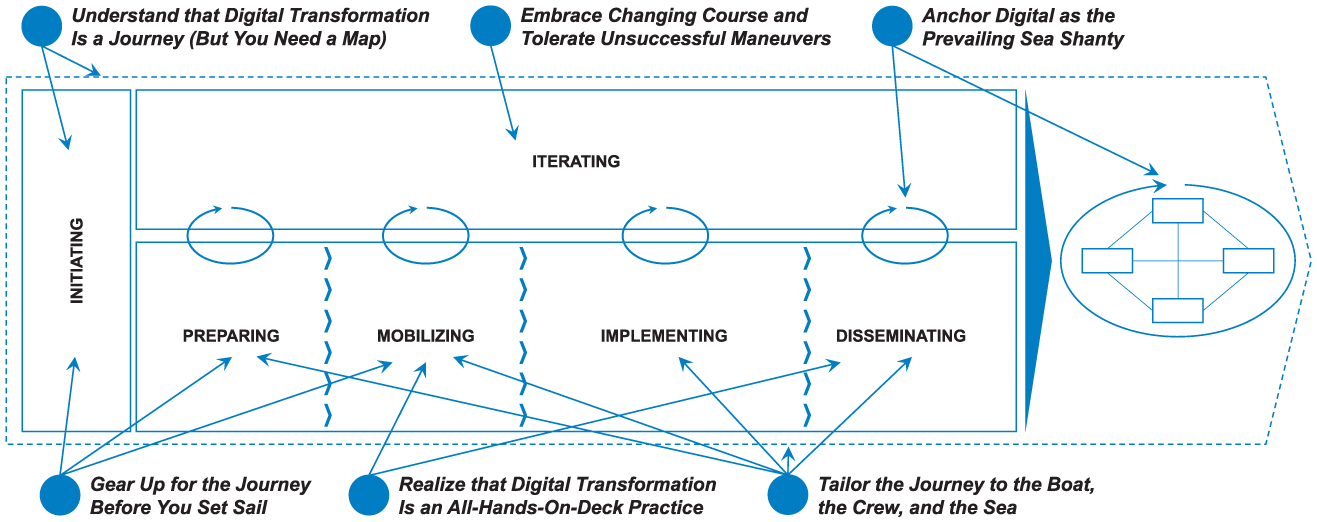
Recommendations for managers navigating the digital transformation process.
Understand that Digital Transformation Is a Journey (but You Need a Map)
Digital transformation presents managers with a conundrum. Evidence suggests that it is emergent in nature and can hardly be predicted, but embarking on a digital transformation journey without a map is a recipe for failure. Managers should understand that their company’s digital transformation will sometimes be surprising, bumpy, and challenging. Not all eventualities can be foreseen. However, our process model shows that the core components of the digital transformation process are similar across companies and follow logical patterns. Managers should use these best practices to draw a rough map of their digital journey but also be prepared to adjust their course as needed. Yet, this approach requires a shift of mindset. When the transformation’s final destination is hard to predict and ever-changing, focusing on thriving on the journey becomes vital. Hence, companies benefit from viewing digital transformation more as a challenge to co-create their own future by embarking on a course rather than as a complex and nearly impossible task to predict the future. Connectedly, managers should accept that the digital transformation is neither short nor easy—the journey will be long and arduous. And even harder without a map.
Gear Up for the Journey Before You Set Sail
Numerous companies face hurdles on their digital transformation journeys, often due to hastily launched initiatives within the organization, lacking sufficient preparation. Our findings highlight a critical lesson: implementation should not precede preparation. Instead, the success of digital transformation relies on meticulous groundwork and thorough gearing up for effective implementation. Preparation entails building appropriate digital capabilities and assigning digital transformation ownership to ensure a targeted approach. Furthermore, effectively communicating digital transformation efforts and engaging internal stakeholders are essential to foster a collective understanding of the digital journey, thus reflecting the company-spanning nature of digital transformation. This alignment ensures that every organizational member is engaged and actively contributes to digital transformation, reinforcing the collaborative nature of digital change. Since digital transformation is as much about convincing people to change their ways of working as it is about altering IT architectures and application landscapes, managers should understand that gearing up first is critical when transforming the organization. Accordingly, managers must recognize that quick wins in digital transformation are unlikely without laying solid groundwork and setting up enabling structures and processes for implementing digital initiatives. Therefore, by dedicating particular attention to the early phases of the process, managers can better navigate the challenges of digital transformation and secure lasting benefits.
Realize that Digital Transformation Is an All-Hands-on-Deck Practice
Digital transformation affects everyone in and around the company, thus presenting an all-hands-on-deck practice. The task cannot be solved by one unit (e.g., digital innovation unit), one level of hierarchy (e.g., top management), or one manager (e.g., the CDO) alone. Therefore, managers should realize that mastering digital transformation is a team effort throughout the journey and encourage collaboration both horizontally and vertically within their organization. Since departments across the company are affected by the challenges and opportunities created by digital technologies, they need to collaborate on cross-functional projects, exchange ideas, and integrate new members with digital skills. Similarly, top management teams should open strategizing processes for bottom-up inputs and grassroots initiatives to leverage the employees’ innovative potential and create a sense of shared responsibility for digital transformation. Since digital transformation fundamentally changes how companies operate, think, and tick, managers should acknowledge that they must win their employees’ hearts and minds. However, the team effort transcends company boundaries. Digital transformation can only thrive when customers appreciate the novel value propositions and when suppliers, partners, and other stakeholders not only follow the new course but actively participate in the journey.
Embrace Changing Course and Tolerate Unsuccessful Maneuvers
Digital transformation resembles a journey in uncharted waters with many uncertainties and potential forks on the way. Managers need to explore and experiment with nascent technologies to uncover innovative solutions and capitalize on emerging opportunities. By embracing experimentation, companies not only stay abreast of the latest developments but also gain a competitive edge by continuously evolving their technological capabilities. Yet, instead of chasing after every trend without restriction, companies should engage in a rigorous evaluation process to determine which technologies hold genuine relevance and potential for their specific context. Connectedly, in navigating digital transformation, it is recommended to test ideas on a smaller scale through pilot projects before committing to company-wide changes. This approach acknowledges that not every maneuver in the digital realm will yield success, nor will every strategic bet on new technologies pay off immediately. Setbacks are an inevitable aspect of digital transformation. Therefore, managers should recognize and proactively anticipate problems to prevent them from derailing the entire transformation endeavor. Each setback presents an opportunity to refine approaches and incorporate lessons learned into subsequent initiatives. Just as seasoned sailors adjust their courses in response to changing winds, managers should be prepared to adapt and realign their strategies, ensuring that the digital transformation journey remains on course despite unexpected obstacles along the way.
Tailor the Journey to the Boat, the Crew, and the Sea
Upon analyzing various cases illustrating diverse digital transformation processes, it became apparent that numerous commonalities existed in the firms’ respective trajectories. However, it is important to note that each digital transformation and each organization is unique, and not all activities will be relevant in every case. Managers should tailor the overall process model to fit their respective situations—internally and externally. Depending on the areas in which companies excel or face significant shortfalls, firms need to emphasize different parts of the journey. Managers should never tackle digital transformation without the legacy IT architectures, existing product portfolio, and employees’ digital readiness in mind. For instance, managers should focus on overhauling their boats when companies’ IT architectures are not set up to integrate novel digital technologies and modular components. Likewise, when employees see digital technologies as a risk rather than an opportunity, managers should pay more attention to upskilling and rallying the crew. Companies should recognize the value of utilizing this process model as a foundation, thereby leveraging insights from the entire fleet. However, it is essential to appreciate that every digital transformation is distinct and shaped by its own influencing factors.
Anchor Digital as the Prevailing Sea Shanty
Despite the inherently iterative and non-linear nature of the digital transformation process, many firms tend to conduct their digital transformation activities in a somewhat sequential manner. Particularly during the initiation phase of digital transformation initiatives and the first implementation of changes, companies often follow similar phases in the process across the board. Yet, although digital transformation resembles a journey, it is crucial to understand that certain routes must be traversed multiple times. The iterating phase highlights the importance of continuous feedback loops, which are both typical and necessary for keeping digital transformations aligned with the evolving target, akin to a dynamic goal undergoing constant change. Therefore, managers should avoid the misconception that preparing the organization and mobilizing employees for digital transformation are one-time tasks. Likewise, managers should recognize that new initiatives are consistently being implemented, and digital transformation efforts should continuously be disseminated to partners. Consequently, digital transformation cannot be regarded as a one-off project but an ongoing process. Managers should continually adapt and refine their digital transformation within each phase, responding to challenges, embracing new technologies, and nurturing bottom-up initiatives. These iterative cycles underscore the dynamic and evolving nature of digital transformation. Therefore, it is crucial to anchor digital initiatives as a central organizational building block in the long run, reducing resistance to change and establishing digital as the new normal.
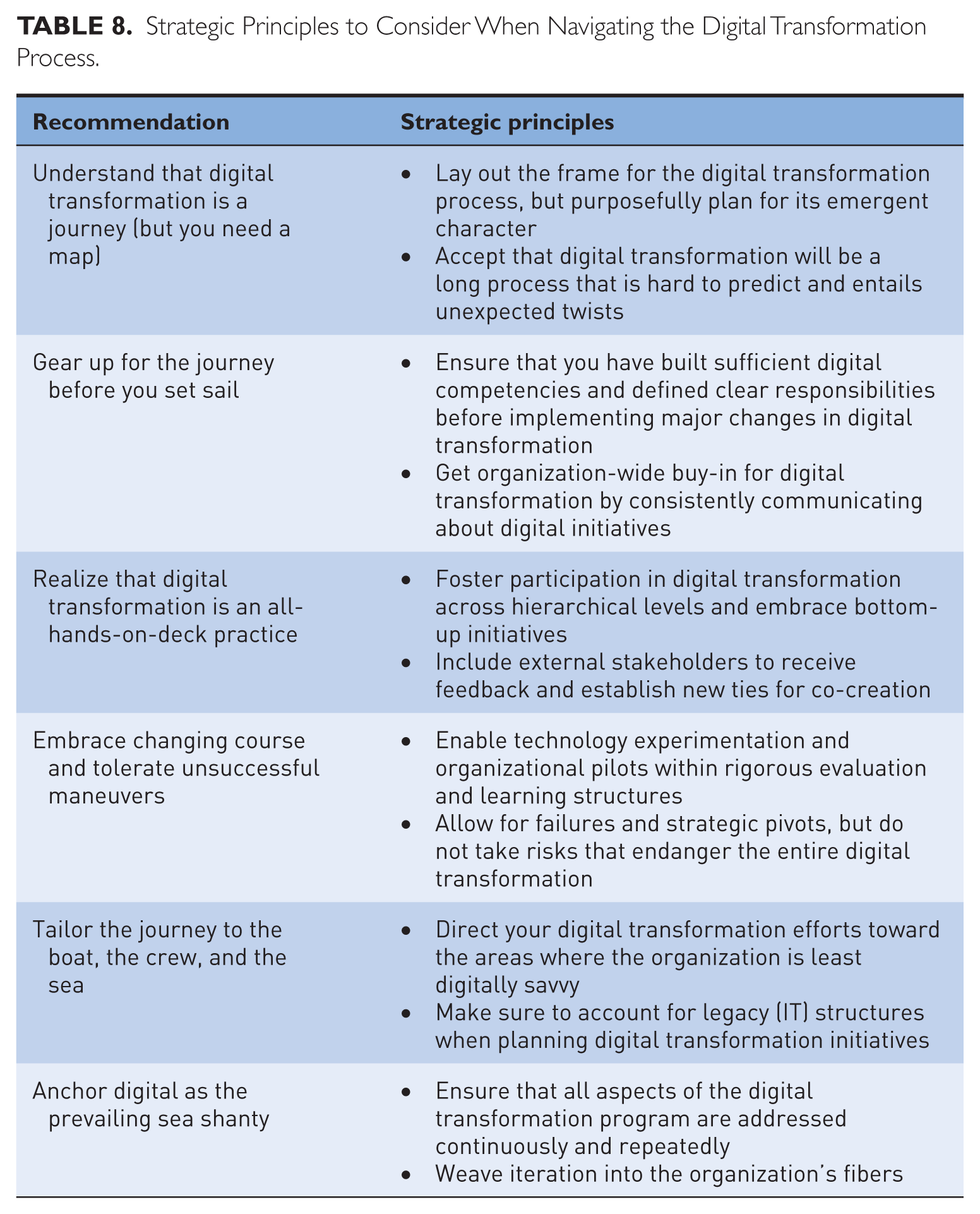
Table 8 summarizes our recommendations for managers navigating the treacherous waters of digital transformation and outlines strategic principles managers should consider when steering their company’s digital transformation journey.
Strategic Principles to Consider When Navigating the Digital Transformation Process.
Concluding Comments
Digital transformation resembles a long journey, requiring companies to navigate uncharted waters. This poses significant challenges for organizations, as evidenced by many failed transformation initiatives. However, it is not only the specific content of digital transformation that challenges organizations, but especially the process of digital change. Digital transformation is a moving target, involves adaptations throughout the entire company, and includes many internal and external stakeholders. Due to the resulting inherent complexity of digital transformation, companies cannot simply transfer their knowledge from regular project management and organizational change initiatives, leaving many questions unanswered about how digital transformation unfolds and what activities firms engage in during the process.
Through a qualitative meta-synthesis of 64 case studies examining firms’ digital transformation endeavors, we delineated a comprehensive digital transformation process model outlining six phases: initiating, preparing, mobilizing, implementing, disseminating, and iterating. Our model depicts firms’ digital transformation journey as comprising five phases that unfold predominantly sequentially alongside a deeply iterative phase, marked by ongoing monitoring, adjustment, and recalibration.
Crucially, digital transformation questions our previous assumptions of technology-driven change. It represents a fundamental shift in how organizations operate, make decisions, and create value. Unlike earlier change efforts that typically involved integrating new technologies into stable structures, digital transformation often requires rethinking those structures entirely. It is not a finite project, but an ongoing journey shaped by rapid technological evolution, shifting market dynamics, and the continuous redefinition of strategic priorities. Our data reflects this: while the process may roughly follow familiar stages—initiation, change, and routinization—these stages are fluid, overlapping, and continuously influenced by emerging technologies and external pressures. Digital transformation, therefore, is less about deploying predefined solutions and more about cultivating the ability to adapt continuously.
Unlike conventional change models that often assume a clearly defined endpoint, digital transformation unfolds in an environment of ambiguity. Goals are provisional, success criteria evolve, and outcomes are actively negotiated, often leading to course corrections and strategic realignments. Conflicting perspectives and priorities fuel these shifts, and not all initiatives survive; some are adapted and others abandoned, depending on how they align with evolving organizational priorities. Consequently, digital transformation requires tailored approaches and new mental models—ones that embrace complexity, foster agility, and accept uncertainty as core operating conditions.
With our model, we open the black box of how firms approach digital transformation, mapping the previously uncharted waters of the digital transformation process. Across the six phases, our study provides actionable insights into specific activities, serving as a blueprint to pinpoint gaps in companies’ digital journey. Our model emphasizes the sequential nature of these activities, offering essential guidance for orchestrating the necessary sequence of actions to drive organizational transformation with an emphasis on the iterative nature of the process. Our practical recommendations address the diverse nuances of the digital transformation process and underscore the importance of a holistic approach for mastering the digital transformation process.
