




Abstract
When many of today’s deepest problems are intractable, how can public, private, and nonprofit actors collaborate to mitigate negative local effects? Given the open-endedness of any collective effort to “chip away” at a grand challenge, these intersectoral collaborations must align the scope of a shared goal with the governance arrangements distributing decision-making authority. By juxtaposing insights from fieldwork on intersectoral collaborations formed to aid local homeless communities in São Paulo (Brazil), California (USA), and Manchester (UK), this research presents four goal-governance alignments to achieve coordinated collective action. To pursue a targeted goal, an organization can set up or join a local structure of centralised (Partnerships) or distributed (Coalitions) decision-making authority. To pursue broader goals, an organization can evolve into a Mission by engaging simultaneously in multiple, mutually reinforcing local partnerships and coalitions. Or evolve into a Movement by not only adding local structures of collective action, but also adopting a participation architecture to encourage collaboration at scale from third parties outside the organization’s managerial control.
Grand challenges ranging from climate change to poverty, and global health, are more than just big problems: they are epic in their scale, scope, and complexity in ways that require resources and capabilities that exceed those of even the largest organizations. These “wicked problems” are characterized by incomplete, contradictory, and changing requirements that are often difficult to recognize, and complex interdependencies and feedback loops that can cause solving one aspect of the problem to reveal or create problematic issues elsewhere. 1 Thus, tackling grand challenges requires integrating efforts from multiple actors operating in different sectors, including public, for-profit, nonprofit organizations, and even local communities. However, fostering and sustaining collaboration from disparate actors with divergent interests, perceptions, values, belief systems, and time orientations is complex and fraught with pitfalls. Effective collaboration will flounder unless specialized knowledge, resources, and capabilities are integrated in ways that transcend each party’s perceptions of the grand challenge and short-term interests. These difficulties in organizing intersectoral collaborative efforts therefore underlie a global lack of progress in resolving grand challenges. 2
Homelessness is an oft-cited case in point. The history of governmental efforts to tackle homelessness is long and varied, including the U.K. government’s Housing Act of 1977 that gave local authorities a statutory duty to provide accommodation for homeless people; the 400 Continuum of Care programs in the United States to coordinate homeless service providers launched in the 1990s; and Latin America’s largest ever social housing program, Minha Casa Minha Vida [“My Home, My Life”] set up in Brazil in 2009. Such efforts notwithstanding, in 2015—when homelessness was unexpectedly not included as one of the 169 indicators listed in the UN Sustainable Development Goals (SDGs)—1.6 billion people were already estimated to live in inadequate shelter. 3 In 2020, after a rise in the homeless population over prior years in advanced economies, the UN called for action and defined homelessness as a condition in which a person lacks habitable space, including anyone living on the streets or in open spaces (“rough sleepers”), in emergency shelters/temporary accommodation, and in inadequate housing without the security of tenure and access to basic services (e.g., squatters, overcrowded tenements, slums, informal settlements, so-called “hidden homelessness”). Since 2020, limited progress has been made in eradicating what the UN now sees as a “serious violation of human dignity.” 4 Pressure to graft green and living wage agendas into social housing programs and NIMBYism have frustrated governmental plans to quickly build, at scale, housing that is affordable for low-income families. 5 Overburdened community-based mental health services and overcrowding in psychiatric emergency rooms hamper governmental plans to treat homeless people suffering from mental illnesses. 6 Polarized politics make it hard to scale pilot projects. 7 Today, a third of the world’s population is estimated to experience homelessness.
In response to governmental and market failures to tackle grand challenges such as homelessness, policymakers have emphasized “intersectoral” collaboration, recognizing that grand challenges require collaboration by public, profit, and nonprofit actors working across different domains such as health, energy, and social services. 8 Organizations committed to intersectoral collaboration face two organizational choices, both of which involve inescapable trade-offs. First, they must grapple with delineating the scope of their collective intervention, pondering which “chunk” of the grand challenge to focus on to maximize joint impact. 9 Second, they must determine by what degree decision-making authority might be distributed across the participants. 10 In short, they must settle on a goal and a suitably aligned governance arrangement. Misalignment risks inadequate commitment or premature resource depletion, hindering coordinated collective action. But how does one align goals and governance when the underlying problem is rooted in many interdependent factors which may be poorly understood and experiencing rapid change, and when heterogeneity across autonomous participants is extreme?
Close examination of four intersectoral collaborative efforts with a proven record in aiding local homeless communities yielded a framework that illuminates four archetypes of goal-governance alignment to chip away at a grand challenge (Figure 1). The alignments vary in terms of the scope of the unifying stated goal, and the extent to which decision-making authority is distributed. Targeted goals facilitate goal congruence across a group of legally independent participants and reduce the size of the resource bundle required to achieve that goal, limiting possible failure, or participants becoming overwhelmed, burned out by collective action problems, and ultimately demobilized. Narrowing to more attainable goals, however, can limit the impact of efforts to chip away at a grand challenge. Hence, some organizations pursue broader goals. In turn, centralized decision-making authority facilitates quick adaptation and reduces the risk of collective action problems frustrating cooperation, while sharing of decision rights encourages voluntary participation and creativity, and enhances the legitimacy of outcomes.
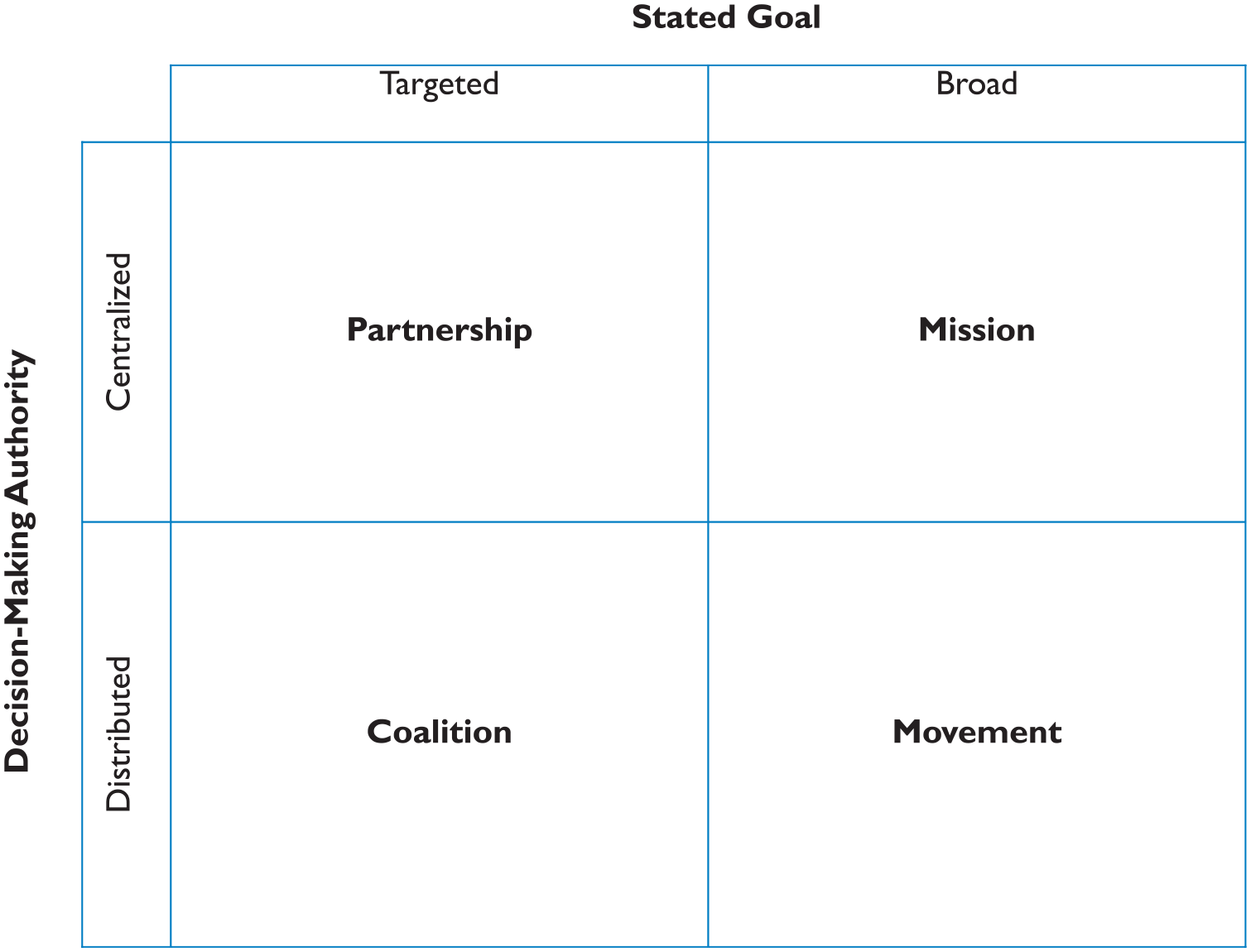
Chipping away at a grand challenge: Alternative goal-governance alignments.
We propose that when an organization is committed to pursuing a targeted goal, it can choose between two basic governance arrangements to foster intersectoral collaboration at a local level. One is partnerships, by which a tight-knit group of actors centralize decision-making authority over a local issue, relying on a combination of formal contracts and relational ties to support mutually advantageous and voluntary exchanges among the participants, with allowances made for the mitigation of contractual hazards. 11 The other governance arrangement is coalitions, which is a loosely coupled collaboration between a large group of participants with complementary resources, where the participants agree informally to share local decision rights. 12
If an organization is committed to pursuing a broader goal that exceeds the capacity of local partnerships or coalitions, it can evolve its own structure, choosing between two forms of organizing that are distinguished by their respective approach to enabling non-hierarchical organizational growth. Missions occur when an organization adapts its managerial hierarchy to engage simultaneously with multiple local partnerships and coalitions that cohere with and reinforce centrally determined subgoals. 13 In missions, the organization’s top management commits to sharing decision rights at a local level to foster collaboration from legally independent actors that control complementary resources, but management keeps tight control over the organization’s strategic choices. This approach facilitates controlled organizational growth through non-hierarchal collaboration at a local level that is aligned with the organization’s own overarching goal, as set by its own managers. 14 Alternatively, an organization can evolve into a movement to draw not only on mutually reinforcing local partnerships and coalitions, but also on a “participation architecture” through which third parties (e.g., beneficiaries, unaffiliated stakeholders) take on decision rights over the organization’s strategic choices, flattening collaboration at scale. 15
All four goal-governance alignments support coordination and cooperation among multiple autonomous actors possessing complementary capabilities, but who have distinct beliefs, interests, or objectives regarding how much of the grand challenge to address. Working independently, none of these alignments can resolve a global societal problem as intractable as homelessness, and that is not their intent. Rather, each alignment aims to have a meaningful local impact by doing something that reduces the negative effects of a grand challenge. Hence, organizing to “chip away” at a grand challenge is a pragmatic choice, rather than a Sisyphean one.
Approaching Intractable Challenges: The Role of Governance
Intersectoral collaborations are valuable when multiple parties are committed to tackling a grand challenge because of resource complementarities: public actors can regulate, issue permits, and legislate; nonprofits have moral legitimacy and a commitment to further societal causes; and for-profits introduce logistical and other operational efficiencies. 16 But identifying and harnessing resource complementarity brings challenges. 17 Dependence on idiosyncratic resources held by another party can lead to bargaining and bottlenecks in the absence of formal contracts or relational ties. Furthermore, intersectoral collaboration requires participants with different cultures, practices, standards, and criteria for success to align their objective functions, reconcile belief systems and values, and overcome institutional obstacles, disagreements over trade-offs, and even historical feuds. 18 . Resolution of these differences, therefore, requires the adoption of mutually agreed-upon governance arrangements.
Governance is “the means to infuse order, thereby to mitigate conflict and realize mutual gain from voluntary exchange.” 19 In other words, governance is about the rules and procedures that control resource accumulation, development, and allocation; how the rules are made; the distribution of the organization’s production; and the resolution of disputes. In intersectoral collaborations, governance requires combining the structures of different entities operating in different sectors to create new arrangements in which decision and ownership rights may be shared, and yet the arrangements are flexible enough to adapt to external shocks and the emergence of new capabilities. Intersectoral governance can thus be understood as
the sum of the many ways individuals and institutions, public and private [and nonprofit], manage the connections of their common affairs . . . it includes formal institutions and regimes empowered to enforce compliance, as well as informal arrangements that people and institutions either have agreed to or perceive to be in their interest.
20
The governance of intersectoral collaborations formed to tackle grand challenges varies in scale, from partnerships and multi-stakeholder networks between established organizations to social movements and supranational collaborations. 21 All these forms of organizing rely on informal agreements and formal contracts, but we lack a deep understanding of how the balance between formal and informal mechanisms varies to guide decision making and resolve disputes and how individual and collective responsibilities and rights are assigned. Moreover, we have more to learn about how differing governance arrangements can overcome the managerial problems that are inherent to intersectoral collaboration, ranging from engendering trust and common ground across organizational boundaries to coordinating work, preventing and solving disputes, and overcoming institutional obstacles and ambiguity in subjective assessments of the value to be achieved through collective action.
To further our understanding of intersectoral governance, we focus on collaborations that are designed to assuage the local, negative impact of an unresolved grand challenge. While many actors may commit to working together toward a shared goal, whether the goal operationalizes a UN SDG or focuses on a specific cause (e.g., whale conservation), rarely do the very same actors not struggle to make progress. They may agree on talking points but fail to execute them, inaction that has been traced to: failure to reconcile competing subgoals 22 ; path dependencies that arise from self-reinforcing forces limiting choice inside organizations, impeding otherwise sound collaborative efforts from making progress 23 ; disagreements over the monetary value of achieving a shared goal, leading to paralysis by analysis 24 ; and difficulties in negotiating multi-level meanings. 25 In short, designing governance solutions to tackle grand challenges effectively is itself an organizational design task facing herculean obstacles.
Methods
To learn about how organizations can engage in intersectoral collaboration toward grand challenges, we examined collaborative efforts with a proven record not in “solving” homelessness, but in mitigating its local impact by providing stepping stones to help vulnerable communities. We acknowledge that, when facing intractable grand challenges, intersectoral collaborations may need to pursue smaller goals that tackle a portion of the challenge 26 and to deconstruct the scope of the work into stages for which subgoals can be articulated, ways to mobilize relevant resources identified, and measurement benchmarks defined. 27
Our research employs a multiple case study approach. 28 Homelessness has evolved to become an intractable global problem that undermines efforts to achieve the UN SDGs, since the lack of adequate shelter drives disparities in health, educational opportunity, medical care, and living and working conditions. 29 We started with two “exploratory” cases conducted in California—the state in the United States with the largest homeless population, where 40% of the homeless population is chronically homeless, and just 30% have access to emergency shelters. 30 An early examination of the situation identified two intersectoral collaborations:
a loose coalition in San Rafael that unified multiple nonprofits and public agencies to house chronically unhoused people and where the lead actor (the city authority) committed to sharing decision rights over this targeted issue with all participating parties; and
a mission in San Diego involving a nonprofit that kept centralized control over its strategic choice to pursue a broader goal—to help all homeless people in the city—while sharing local decision rights through partnerships and coalitions to encourage other nonprofits, public agencies, and private actors (e.g., donors) to collaborate on local issues that the nonprofit alone could not address effectively.
These findings raised the question about what other goal-governance alignments were possible to chip away at a grand challenge. Could a narrow goal be pursued in a much more centralized fashion than a coalition? Could a broad goal be pursued through a form of organizing more decentralised than a mission?
These questions led us to deepen our research question to: what are the alternative goal-governance alignments to organize intersectoral collaboration toward chipping away at a grand challenge? Because organizational choice can be context-sensitive, we selected two very different contexts than California, a liberal market economy where actors tend to coordinate with each other primarily via hierarchies and competitive market arrangements. First is Manchester, UK, where a lack of affordable housing gives the city one of the highest shares of homelessness in the United Kingdom, a country that is one of the worst OECD performers. Unlike the focal cities in California, Manchester has a long tradition of coordinated collective action among government entities as well as between public and private actors, having “developed an economic and political system which seems to work,” as put by The Economist back in 2013. 31 Second is São Paulo, Brazil, a setting that is beset by extreme inequality of income, and where weak institutions amplify disadvantage, create uncertainty, solidify aversion to accountability, and enable opportunistic behavior. 32 In São Paulo, we encountered over 100 housing movement organizations, led by progressive social entrepreneurs, which gained traction in the mid-1980s when up to 20% of the city’s population was estimated to be homeless. The housing movement as a whole has been a major force behind significant housing policy reforms, although half a million families in São Paulo, a city of about 12 million, still lack adequate housing today. 33
With access to four collaborative efforts across three different socio-political and institutional environments, we followed a multiple case study approach engaging in within-case analysis and searching for cross-case patterns. Using an organizational design perspective to guide an iterative analysis, we generalized our results in the framework introduced in Figure 1. Armed with this framework, we examined the mechanisms enabling intersectoral collaboration that underpin each form of organizing. We assumed that once a shared goal aligns multiple autonomous actors, a division of labor emerges to harness the complementarity in the resources and capabilities that each one controls. Then, the actors unified by that goal need to agree on how to integrate efforts across organizational boundaries and resolve the two universal problems of organizing: coordination by enabling information processing; and cooperation by aligning rewards and incentives. 34 To unpack the mechanisms underpinning the different governance arrangements, we mobilized a classic framework in organization theory that suggests that coordinated collective action requires three integrating conditions: common understanding, accountability, and predictability. 35
Common understanding refers to the shared knowledge and conception of activities and their purpose, that is, how, and why they are performed, and who does what. It suggests not only a shared, overarching goal for the work of a group of actors but also enough alignment among the participants’ own goals to allow them to communicate effectively and work together efficiently, even with breakdowns in coordination. Accountability refers to the responsibility that participants have toward one another for the outcomes of their actions. Mutual accountability makes interdependence among parties, their responsibilities, and progress on tasks visible, which pre-empts individual behaviors that could frustate collective action. Finally, predictability refers to the degree to which individual actions can be anticipated by others so actors can plan and coordinate their own actions because they see how their work fits into the bigger picture. Without predictive knowledge, actors tend to act on a short horizon, and long-term plans can fall apart because of haphazard individual activities that spur chaos. 36 When predictability is low, common understanding and accountability can compensate by fostering adaptability and providing extra resources in case something does not go as planned, or expectations change. 37 Appendix A includes more information about how we collected and analyzed our data.
Case Studies: Exploring Goal-Governance Arrangements
We start by examining two basic governance arrangements to pursue targeted goals: the Embassy partnership in Manchester, UK; and the Homeless Outreach Team coalition in San Rafael, California. Both arrangements go beyond economic exchanges, technical systems of production, and political instrumentality to allow moral issues to inform participation. Because both arrangements rely on voluntary participation, the participants tend to regard each other as equals, so even if one actor (or tight-knit group) takes the lead role, they remain accountable to all others. Hence, in both governance arrangements, participants are unlikely to cede substantive decision rights to a managerial hierarchy, including control over their work, duty of loyalty, compensation, dispute resolution, and voice. Still, partnerships and coalitions differ in the underpinning mechanisms that enable coordinated collective action.
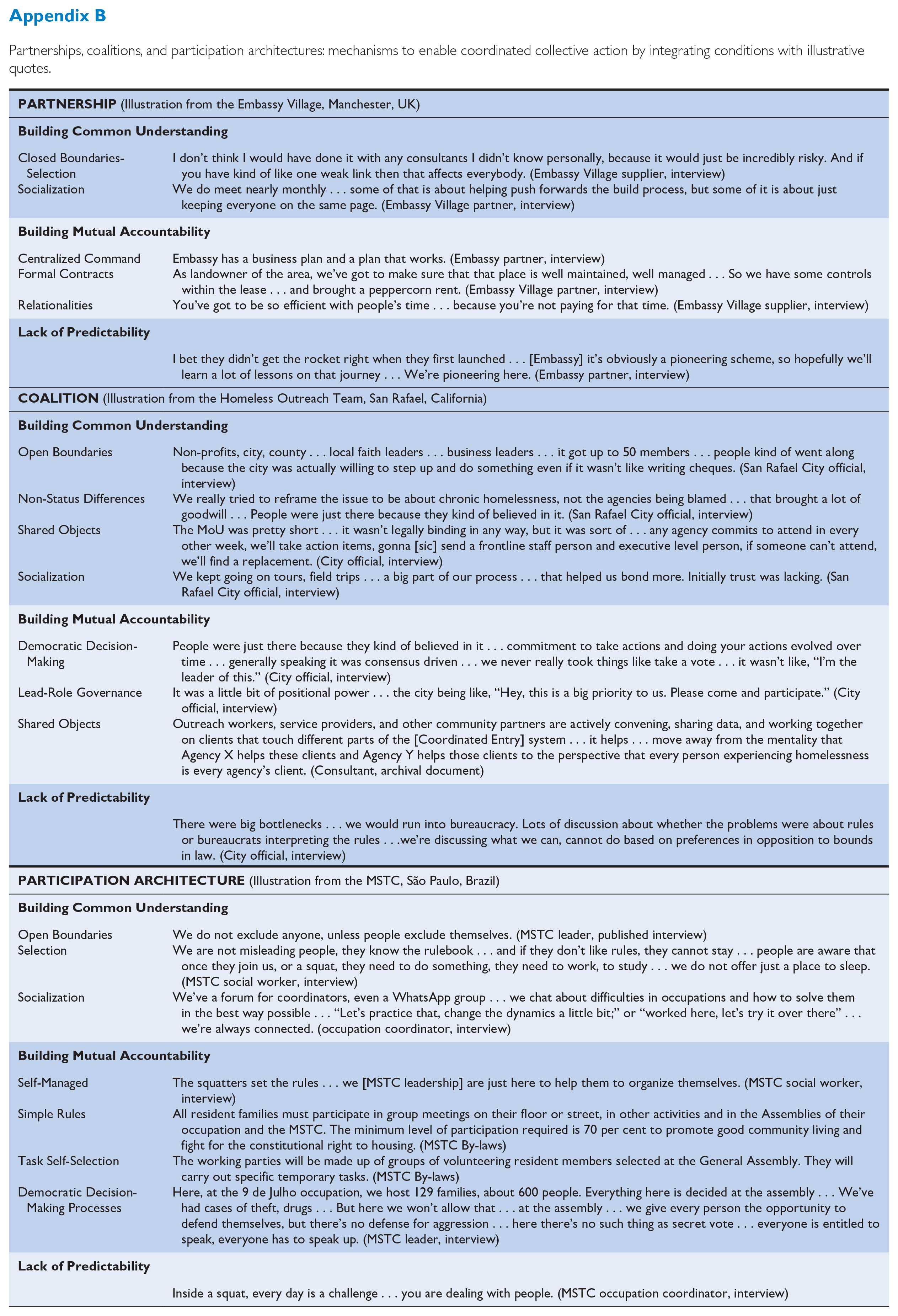
We then examine the governance arrangements of two forms of organizing that pursue broad goals: the Father Joe’s Villages (FJV) mission in San Diego, California, and the Movimento Sem Teto do Centro (MSTC) movement organization in São Paulo, Brazil. FJV is a nonprofit organization that draws extensively on participation in local partnerships and coalitions to foster collaboration with private and public actors. To pursue its broad “mission,” FJV keeps centralized control over strategic choice, while relying on shared decision rights to tackle targeted local issues. In contrast, the architecture of the MSTC movement subsumes that of the FJV mission and, in addition, adopts a participation architecture – a decentralised system that channels large-scale engagement through predefined pathways and rules. This third basic governance arrangement enables MSTC to encourage collaboration from the local homeless community to pursue social change by giving homeless families decision rights over strategic choice and opportunity to achieve their individual, pressing goal of home ownership. The table in Appendix B offers a summary with illustrative quotations from primary sources on the mechanisms underpinning each of the three basic governance arrangements that enable voluntary collaboration toward chipping away at grand challenges.
Embassy Village Partnership: Closed Boundaries, Formal Contracts, and Relational Ties
Embassy Village 38 exemplifies a local partnership between private firms, a nonprofit, and public agencies jointly pursuing a targeted goal: helping chronically unhoused people transition to independent living. When completed, the £5m village Embassy will offer 40 affordable assisted living studios in Manchester’s city center, where selected rough sleepers can reside for up to two years while benefiting from support services. To ease neighbors’ concerns, Embassy residents must have no criminal record, addictions, or mental health struggles and are restricted to male occupants to reduce management complexity. Residents will pay rent supported by housing benefits and commit to six hours a week of training in shopping, cooking, and budgeting. “We wanted to get away from the shelter model...the whole thing is a live ‘dress-rehearsal’ for running your own home” said the director of the nonprofit and an Embassy founder.
Developing Embassy required voluntary resource contributions from many independent parties, but decision-making authority stayed centralized among five parties: two high-end property developers eager to sustain their license to operate; the Manchester Mayor, an elected leader under pressure to deliver on his pledge to eradicate “rough sleeping”; a nonprofit struggling to acquire property to house rough sleepers; and, later, a private donor in search for an opportunity to further its charitable goals. Through a close-knit partnership, the five parties committed to providing mutually supportive contributions: one developer committed to lease land with a symbolic fee; the mayor’s charity—led pro bono by the second developer—committed to leverage its institutional clout and raise funds through the city’s businesses; the nonprofit brought know-how, authority, and credentials in helping rough sleepers; and the donor mobilized most of the capital needed to build the village. By leveraging in-house expertise in property development, the initial partners rapidly lined up around 50 businesses that were eager to help develop the planning application pro bono and build the village at cost, and they later managed to identify one donor that pledged to finance most of the construction costs.
Building Common Understanding—Our findings trace the ability of the Embassy partners to build a shared understanding of the targeted goal and of the ways to achieve it to two enabling mechanisms. First, the organizational boundaries of the collaboration were kept closed, a selection mechanism that aimed to ensure homogeneity in values, norms, and beliefs among the participants, thereby reducing the likelihood of conflict. “We didn’t want anyone that would volunteer their time, but then change their mind,” said a core partner. By drawing from their trusted networks, the partners could also use peer pressure when it came to inviting others (e.g., builders, consultants) to volunteer resources. “If somebody didn’t want to help, you can say, ‘everyone thinks it would be a good idea,’” said one partner. Second, the core partners invested substantive time and effort in socialization, including setting up a steering group that met regularly to agree on the business plan and program of action and organizing fundraising events to socialize the goal through top-down and peer-to-peer influence.
Building Mutual Accountability—Mutual accountability was developed through a combination of formal and relational mechanisms. For example, a board of trustees was set up (“my bosses,” said the nonprofit director), and formal contracts were established between the partners to regulate land use, and between the partners and downstream suppliers to regulate other resource exchanges (“a big structure of governance,” said one partner). Complementing contractual safeguards were strong relational ties. “We knew [the suppliers] and they knew us . . . we had mutual responsibility, respect, and accountability to each other,” said one developer. Furthermore, the partners made themselves accountable to one another by acknowledging their mutual interdependence and exposing themselves to the public by using social media and reaching the press (“My reputation is based entirely on making things happen,” said one developer). Even the main donor shared accountability after joining the steering group. “[The donor] will be hearing the day-to-day issues . . . this way, we can be really transparent,” said the mayor’s charity director.
Lack of Predictability—Uncertainty over progress in resource acquisition made it hard to set reliable targets for the Embassy project. Initially scheduled for completion in 2022, Embassy is now expected to open before the end of 2025. The relational ties between participants cultivated from past exchanges, however, have enabled them to develop predictive knowledge of one another. “We saw the same lines,” said one partner. Relational ties also made task uncertainty less of an issue in exchanges with suppliers. “I trusted the [leadership] team,” said Embassy’s project manager, who worked pro bono, “and so did the [City] Council.” Furthermore, by leveraging the contractible shadow of the future in that most suppliers were keen to do business with the developers and the city, the core partners ensured that the suppliers behaved cooperatively. “If you’re getting something for free, it’s hard to tell somebody that they need to do better. So, we had to have an additional lever,” said a developer.
San Rafael HOT Coalition: Open Boundaries, Relational Ties, and Shared Objects
Like Embassy Village, San Rafael’s Homeless Outreach Team (HOT) 39 —a loose coalition of local public and nonprofit providers of homeless services led by the city authority—was established to pursue a targeted goal: aid the chronically homeless in transitioning into permanent housing. Unifying the HOT participants was their shared frustration with the lack of collaboration, stiff competition for funds, and accountability only for their own goals. “We were all mad at each other,” said one official. Despite the many nonprofits and public agencies providing homeless services and funding opportunities from government and private donors, chronic homelessness in San Rafael was a fifth of the local unhoused population and was taking a toll on the city’s resources. Worse, community members were turning against the nonprofits operating local health clinics, shelters, and kitchens, asking for their permits to be revoked. In 2016, this situation spurred the city authority to form a local coalition commited to eradicate chronic homelessness in the city by 2022. “We saw our job as that of creating a buffer between public opinion and nonprofits,” said one city official. Remarkably, between 2016 and 2018, chronic homelessness in San Rafael declined by 28%, with 95% of those housed remaining housed. This achievement was behind the recognition of San Rafael’s HOT as a “California state-wide best practice.”
Building Common Understanding—In marked contrast to the Embassy partnership, the organizational boundaries of the San Rafael coalition were deliberately left open to encourage participation from as many local providers of homeless services as possible. But this also meant that once any provider volunteered to join the HOT, it would be hard to exclude it from the decision-making process. Rivalry quickly ensued, with some nonprofits threatening to walk away in protest of, for example, the idea of submitting unified bids to chase funds. Conflict also emerged on how to deal with mental illness issues, with some parties accusing others of bias in interpreting laws. Fearing chaos, the HOT founders toyed with creating a centralized entity, “Opening Doors.” “It seemed like the gold standard . . . [one agency] to work through all the BS of trying to work out all the relationships,” said a city official. To unify the participants under a common goal and distributed governance, in addition to non-binding Memorandums of Understanding (MoUs) through which participants pledged to send operational staff and top executives to two-hour bi-weekly meetings, the participants invested in socialization. Together, they went on tours and field trips to nearby cities to see best practices in action, gradually becoming closer colleagues and friends. Early successes encouraged others to join HOT. “It was a Herculean lift to change the way we did things,” said a city official.
Building Mutual Accountability—Democratic decision-making processes were key in building shared accountability. “There was no formal voting structure or anything like that . . . we wanted them to come along but weren’t going to force them to join kicking and screaming,” said one city official. That said, some nonprofits were suppliers to local government, which gave the city and county authorities leverage in the decision-making process. “If your funder is in the room . . . you aren’t going to flat out reject what they’re saying,” admitted that official. Contributing to making everyone accountable was also a shared digital platform, “Coordinated Entry,” which relied on voluntary data sharing, reporting, and impact tracking. Coordinated Entry provided a shared inventory of the chronically unhoused and their challenges, enabling joint decisions to offer an individualized approach to prioritizing them for housing openings.
Lack of Predictability—Emboldened by their initial results, in 2018, the HOT participants agreed to broaden the goal to address issues with other local homeless populations, such as veterans and families, and to intervene in related policy debates. This choice accelerated the growth of the coalition to over 50 members, giving rise to internal tensions. Later, facing a rise in encampments and unsheltered homelessness with the Covid pandemic, the goal was broadened again to address new demands, for example, shelter capacity, emergency rental assistance, and encampment outreach, to be pursued by an even larger coalition, the Marin Alliance to Solve Homelessness. The founders questioned the ability to scale up HOT effectively: “How do you keep that creative spark going?” said one, noting, “We were strongest . . . willing to go above and beyond our job descriptions . . . when we were focused on chronic homelessness.”
Father Joe’s Villages Mission: Controlled Expansion Led by Managerial Hierarchy
Unlike the targeted goals of the Embassy partnership and the HOT coalition, Father Joe’s Villages (FJV) 40 in San Diego set the much broader goal to never turn away any unhoused person, reflecting its motto, “preventing and ending homelessness, one life at a time.” Founded in the 1950s, FJV evolved to become the largest nonprofit homeless service provider in San Diego. By 2020, FJV was providing at least one service to nearly all the 7,000 homeless in the city and planned to grow its provision of affordable housing to 2,000 units (from 50 units in 1997).
Building Common Understanding
Building Mutual Accountability
Lack of Predictability
MSTC Movement: Empowering Third Parties through a Participation Architecture
The goal of the FJV mission is broader than those of Embassy and HOT. Still, FJV is a bystander when it comes to policy debates. Pushing for policy reforms, side by side with providing permanent assisted affordable housing are, however, both integral facets of the goal pursued by the MSTC, or Downtown Roofless Movement, in São Paulo. 41 “Our aim is not to occupy for the sake of occupying, we’re fighting against leaving housing in the hands of the market,” said the main MSTC leader. This broad agenda made participation in local partnerships and coalitions a necessary but insufficient condition. MSTC also needed to fostercollaboration at scale through protests to pressure authorities into reforming housing policies, making São Paulo’s unhoused community the obvious group to engage. Thus, MSTC complemented its affiliation with local coalitions and partnerships with a participation architecture. This approach provides unhoused families with an opportunity to address their immediate housing needs and have a voice in strategic decisions in exchange for their commitment to volunteering time and effort to advancethe MSTC’s goals as defined by its leaders.
From a strict legal perspective, MSTC is a centralized nonprofit governed by a set of bylaws. Its modus operandi hinges on rallying large numbers of unhoused families to occupy buildings that have been abandoned for several years in São Paulo’s city center. “When dwelling is a privilege, occupying is a right,” MSTC claims. 42 The organization relies on the constitutional principle that all property must have a social function, itself a conquest by the housing movement in the late 1980s. “We’ve never positioned ourselves against the authorities,” says an MSTC founder. 43 To identify buildings suitable to occupy, obtain grants to retrofit the organized squats, and help the squatters fight judicial attempts to evict them, MSTC mobilizes resources from local partnerships with ideologically aligned professionals (e.g., engineers, architects, and lawyers). “Things will only be all right if we draw on our partners,” says an MSTC leader. 44 To pressure authorities to change housing policies, MSTC is part of coalitions with other likeminded movement organizations such as the Centre for Popular Movements (Central dos Movimentos Populares) and Housing Struggle Front (Frente de Luta por Moradia). In addition, to help squatters reach their potential and self-actualize, MSTC engages in local coalitions with civil society (e.g., academics, artists, chefs, and social workers). These range from running onsite open kitchens, art galleries, computer labs, and nurseries to hosting school visits, arranging for doctors to visit the squats, and advancing an inclusive culture to protect minorities. “MSTC allows us something beyond the house key . . . to become someone,” said one squat resident. 45 The fact that MSTC has existed for more than two decades—with a positive impact on reportedly over 2,000 families, 600 of which are currently clustered across six organized squats—suggests effective alignment between its broad goal and governance. “We’re not landlords . . . we work collectively, and the collective must function,” said its founder.
Building Common Understanding
Building Mutual Accountability—MSTC leaders reward families’ participation in protests and other forms of street activity with the opportunity to move from a base group to an organized squat. Each squat is a self-managed structure where families can make their own rules, even if most rules are handed down by the MSTC leaders, the hidden hand of authority, to ensure that the squats do not succumb to chaos. Squats have simple but strict rules against domestic violence, drug dealing, and misogynistic and racist behavior. All families must pay a monthly symbolic fee (three city bus fares) and meet minimum levels of participation. Families must contribute to the running of the squat by self-selecting into predefined roles and joining committees best aligned with their capabilities; families shirking their responsibilities by, say, volunteering less than the minimum required can be sanctioned or even expelled. Contributing to mutual accountability inside MSTC is the democratic nature of the decision-making process. For example, squatters must attend regular assemblies on site where MSTC leaders give updates on talks with public agencies, and day-to-day issues are resolved by raised hands.
Lack of Predictability—MSTC operates under high uncertainty because resources to transform organized squats into adequate housing (e.g., money, permits) are controlled by authorities engaged in erratic, ideologically motivated behavior. Furthermore, it can be hard to anticipate each family’s “zone of acceptance” in return for help finding a shelter and voice. 46 Still, uncertainty has not undermined MSTC’s capacity to enable coordinated collective action, as the clarity of simple rules helps the participants predict how people are likely to behave albeit the unpredictability of the tasks. MSTC’s leaders themselves are careful not to create false expectations and to ensure that families see the bargain offered to them as sufficiently fair. Uncertainty makes it impossible for MSTC to make promises as to when enlisted families will be housed. But were MSTC to renege on commitments to aid families in finding adequate housing, families would lack incentives to contribute to street activities, jeopardizing squatters’ chances to access public funds and security of tenure. Should squats be seen as hopeless places, MSTC would collapse.
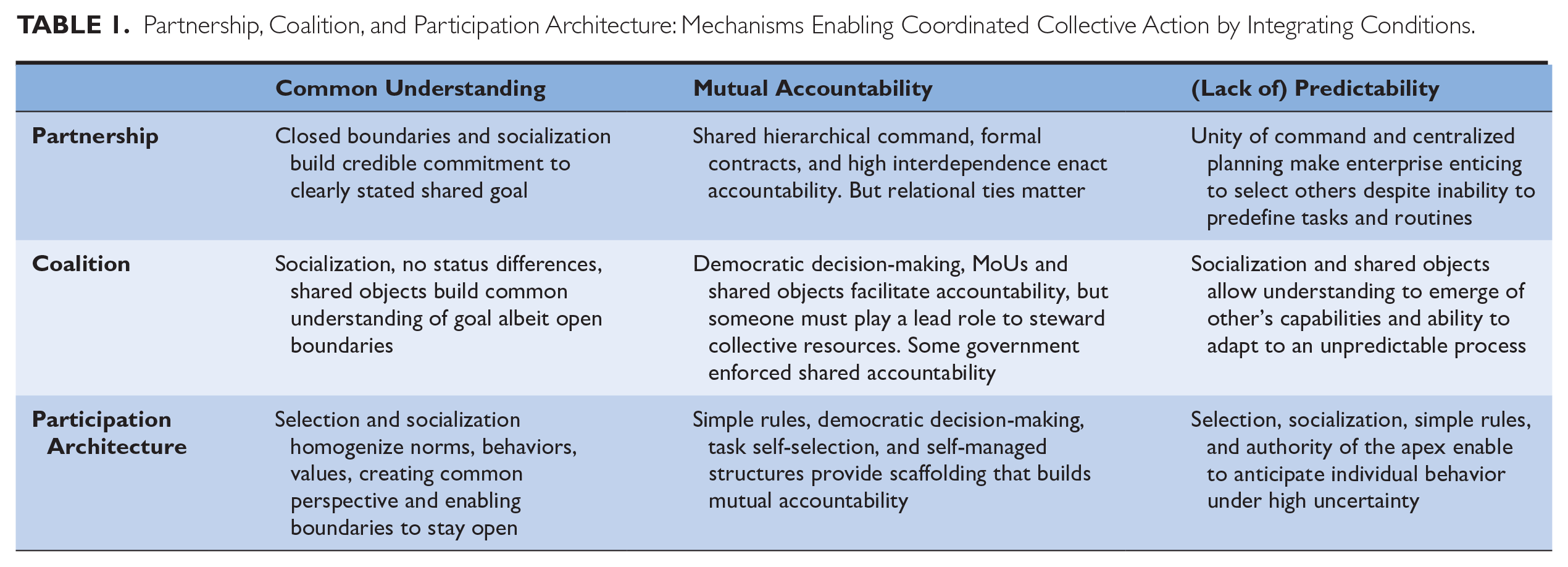
In sum, each goal-governance alignment requires building both common understanding and mutual accountability in the absence of task predictability. As the stated goal broadens, the task structure becomes more complex, demanding greater care in both organization design and management. Table 1 summarizes the mechanisms enabling coordinated collective action across the three basic governance arrangements that underpin the alternative goal-governance alignments.
Partnership, Coalition, and Participation Architecture: Mechanisms Enabling Coordinated Collective Action by Integrating Conditions.
Choosing a Goal-Governance Alignment
Our case studies have illustrated how tackling intractable grand challenges such as homelessness requires rallying for-profit, public, and nonprofit organizations as well as local communities around shared goals, resulting in high diversity in information, belief systems, culture, and standards as well as gaps in communication among actors. Participants must cope with low task predictability given the systemic and dynamic nature of the underlying problem, as well as cope with high uncertainty in the pace of acquisition of essential resources. As captured in Figure 2, to achieve coordinated collective action, the parties trade off taking on as much of the underlying problem as possible, thus increasing managerial complexity while restricting the scope of the stated goal to make intersectoral governance less overwhelming.
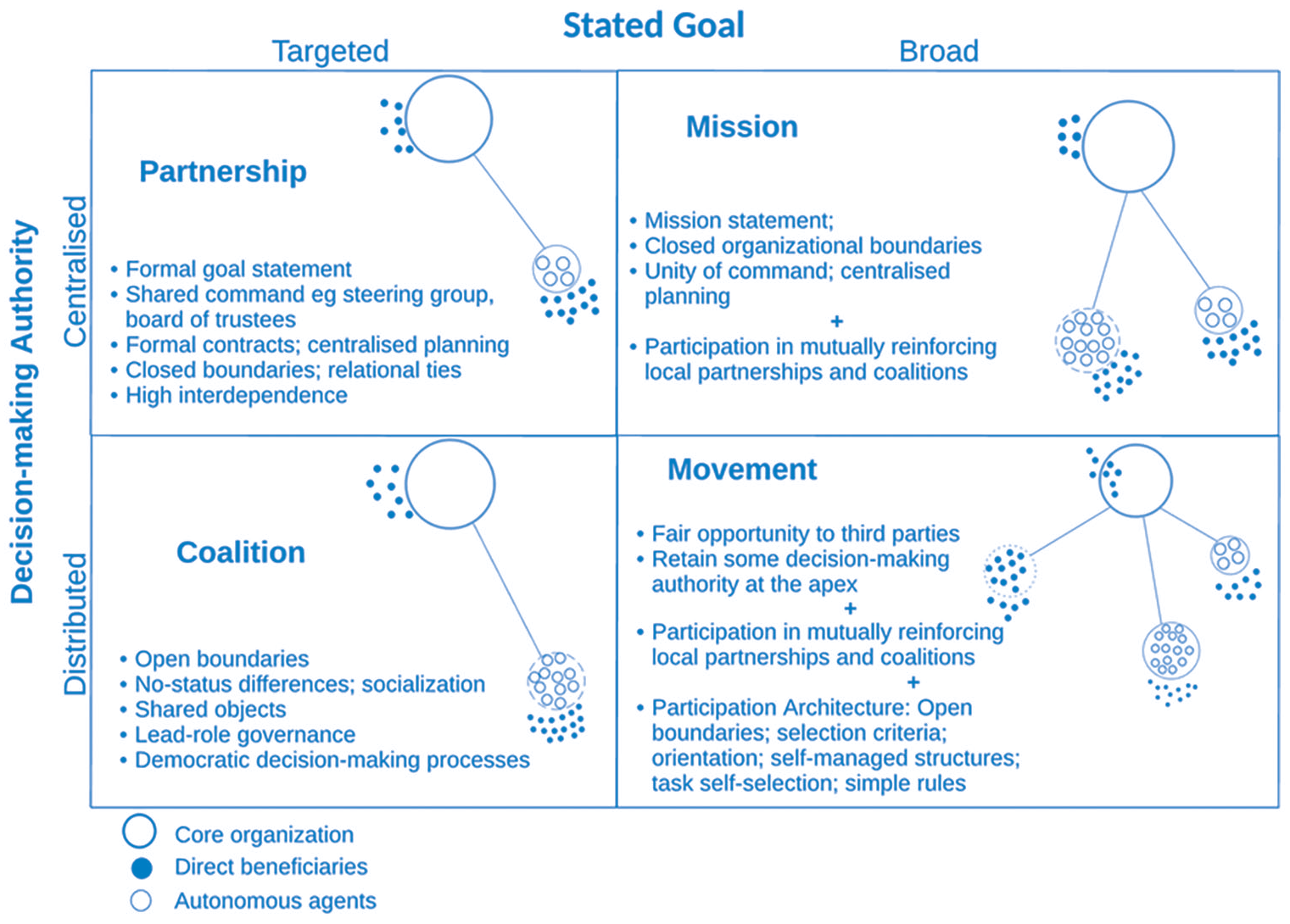
Goal-governance alignment options with mechanisms enabling coordinated collective action.
In the Pursuit of Targeted Goals: Partnerships or Coalitions?
A targeted goal can be pursued by either a stand-alone partnership, relying on closed, contractually enforceable mechanisms and strong relational ties, or by a stand-alone coalition that gives participants greater decision-making authority and flexibility and keeps the organizational boundaries porous. In a partnership, the participants are not “co-opetitors” vying for a greater share of the value but share a common understanding that they control complementary resources that need to be pooled into a legal entity, and that these resources exist in a well-defined regime of property rights. The tight-knit lead group of actors believes that order is best created if decision-making authority stays centralized and participation is restricted to trusted networks. Local partnerships like Embassy Village or San Diego’s Operation Shelter to Home (to which FJV belongs) are thus “club goods” in that strategic interaction between the selected participants is non-rivalrous. 47 In these closed environments of mutual interdependence, the participants’ competences tend not to overlap, and conflict over benefits distribution is low, which facilitates agreeing on a division of labor and on how to integrate effort. Complementing this closed voluntary association are strong relational ties, which give the participants confidence in handshake agreements and create peer pressure to ensure everyone keeps to their word. Together, these mechanisms enable the partnership to form a “sub-society” where everyone, albeit coming from different sectors of the economy, shares similar moral principles regarding “right vs. wrong” and “good vs. bad” and stays identified with the partnership rather than feel alienated when difficulties arise. 48
In marked contrast, coalitions are the outcome of a choice to govern coordinated collective action through a loosely coupled strategic effort. As in a partnership, the participants in a coalition seek social connectedness, dialogue, and collaboration within geographical boundaries, but they may also try to find consensus among divided conflict-laden spaces within political boundaries. Participation in a coalition is voluntary, and the self-interested participants are likely to disagree on their shared goal and how to pursue it. However, a coalition becomes more tempting than a partnership when the nature of the targeted goal would frustrate efforts to centralize decision-making authority and deploy formal contracts. 49 Specifically, coalitions pursue targeted goals that require assembling resources controlled by many parties that operate in an ill-defined regime of property rights and where competences may overlap. This is true for HOT in San Rafael, as it is for the many local coalitions that FJV and MSTC belong to.
Unlike a partnership, a coalition is not a “club” but rather a “commons” that brings together non-excludable actors with rivalrous preferences. In this governance arrangement, the organizational boundaries are porous to encourage actors that control valuable resources to join, and efforts to build mutual accountability occur by specifying what each participant is expected to do through non-binding MoUs. The lead actors struggle to exclude others from decision-making processes once they join. Were the leaders to exclude someone, they would be seen as reneging on their word to make decisions by consensus, eroding their accountability to the others, who could defect. As such, the sustainability of a coalition relies on democratic decision-making processes and rules ensuring no status differences, including proportionality between costs and benefits, graduated sanctions, independent monitors, and no interference from outside authorities. 50 By using socialization and shared boundary objects to develop a degree of homogeneity in values, beliefs, and social norms, a coalition can avoid being trapped in a tragedy of the commons and lower the transaction and monitoring costs. Furthermore, a targeted goal increases the likelihood of the participants sharing moral and ethical standards, reducing the risks of free riding. Still, the porosity of the boundaries of a coalition makes its governance a struggle. 51 Coalitions are also unlikely to scale up well because democratic decision making can bog down in conflict if many parties have a say. 52 Since peer pressure is an informal sanction that induces cooperation but dissipates in large commons, the enlargement of a coalition can lead to goal displacement as the participants revert to fulfilling individual, short-term goals in the interest of their own efficiency and effectiveness.
In the Pursuit of Broad Goals: Missions or Movements?
As an organization chooses to commit to a broad goal, it can evolve to become a mission by restricting adaptation of its managerial hierarchy to simultaneous participation in multiple local partnerships and coalitions, while allowing top managers to retain decision-making authority and control over strategic choice. A centralized structure sets and controls the mission’s overall goal, informing the raison d’être for affiliation with local partnerships and coalitions, while selective outsourcing of activities facilitates acquisition of resources when transaction costs are low and rapid adaptation to changing conditions. Alternatively, the organization can choose a movement structure by joining and setting up not only multiple local coalitions and partnerships at the same time, but also by adopting a participation architecture to encourage collaboration at scale with autonomous third parties. In the case of a movement organization, management keeps the organizational boundaries open and allows third parties to see themselves on an equal footing. The more the organization broadens its scope, the more adopting a participation architecture seems necessary. Differentiating missions from movements is therefore the degree to which top management is willing to share decision-making authority to encourage collaboration at scale from actors across different sectors.
If top management is keen to control the overall strategy and core resources, the organization can evolve toward a mission by adding multiple, mutually reinforcing local partnerships and coalitions to its administrative structure. Limiting the scope of intervention of the managerial hierarchy at a local level fosters welfare-oriented intersectoral collaboration to pursue contributory subgoals. In a mission, the organization’s top management retains authority to instruct subordinates on their tasks and resolve disputes and flexibility in adapting the organization’s governance to best enact its mission. The mission’s architecture also shows a degree of self-containment, in which interdependence between partnerships and coalitions can be minimized to reduce conflict and let each local structure independently pursue subgoals algined with the mission’s statement.
When the nature of the broad goal is such that its pursuit in earnest requires going beyond sharing local decision rights, the option left is for the organization to evolve into a movement organization. In addition to subsuming a mission’s architecture by joining multiple local partnerships and coalitions, the movement organization adapts its own administrative structure by also adding a participation architecture. Through predefined pathways for engagement, rules and incentives, the movement’s architecture creates an opportunity for third parties to pursue their own individual goals while giving them a voice in strategic decisions. In exchange, the movement asks third parties to contribute time, effort, and resources to the organization’s cause—a bargain that third parties need to see as fair to sustain collaboration. To build a common understanding of the stakes, tasks, and subgoals, the movement’s participation architecture relies on selection and socialization to create homogeneity among third parties regarding norms, values, and belief systems and invests in collective sensemaking created through leadership, culture, and networks of interaction.
To prevent chaos in the movement’s participation architecture, the third parties need to be clustered into low-conflict, self-managed groups. 53 Mutual accountability is enabled not through formal contractual obligations and/or strong relational ties to a managerial hierarchy, but rather by: first, a system of simple rules designed to minimize inner-group conflict and reduce interdependency between the self-managed groups; and, second, willingness to share rule-making authority with third parties to ensure the system and its rules can adapt to exogenous shocks (environmental, political, institutional, technological) and manage exceptions. A movement’s participation architecture therefore relies on creating interdependences between the subgoals that drive the coalitions, partnerships, and self-managed structures. While simple rules enable self-containment between the differing local structures, the very same rules unify all self-managed groups of coordinated collective action under a broad goal to flatten collaboration at scale.
Increasing Impact
We shed light on four goal-governance alignments to chip away at a grand challenge using a framework that varies the scope of the shared goal and the distribution of decision rights. Still, many questions of practical relevance remain. A focus on a small part of a grand challenge enables benefiting from having attainable milestones, assuring continued momentum instead of “flailing out against an unjust universe.” 54 But how scalable is each goal-governance alignment? Are these alignments contingent on context? Are there synergies between different alignments that can be harnessed to make the whole bigger than the sum of its parts? Do the actors at the helm need to come from a specific economic sector?
Scalability—the ability of a form of organizing to perform and even improve as it grows—is a desirable attribute. If we see organizations as collections of smaller, “micro” organizational structures, scalability is possible 55 as seen when missions draw on multiple local partnerships and coalitions, and movements subsume the architecture of a mission. Yet, scalability is not straightforward. For example, it seems unlikely that the scope of local partnerships could broaden to include policy reform efforts, given that institutional change requires reaching actors that lie outside the networks of trust and may lack incentives to agree to policy reforms that will curtail their own power and authority. Coalitions are also hard to scale because democratic decision-making processes do not scale up well. Even a mission like FJV seems limited in the extent to which it can grow without undermining top management’s ability to implement strategic choices and overwhelming their capacity to intervene when conflicts flare up at a local level. The movement organization’s architecture is unlikely to be boundless either, since collaboration at scale with third parties seems unsustainable, unless the organization can filter actors likely to align with its goals and throughsocialization, they can be equipped to be clustered into low-conflict, self-managed structures.
Replicability—the ability to copy a goal-governance structure in different contexts—is also desirable, and the three basic governance arrangements do not always seem context-sensitive. For example, facilitating Embassy was a coordinated market economy in a robust institutional environment that offered a contractible shadow of the past and future, enabling all participants to trust each other. However, partnerships can happen in the absence of these conditions. The FJV case suggests that partnerships happen in liberal market economies, perhaps because participation in prosocial collaborations may require limited management attention and resource commitment, not deterring private firms from value capture activities. This suggests participation in partnerships may offer reputational and network benefits to firms that exceed the discretionary, voluntary costs of their prosocial contributions. 56 From this perspective, moral and ethical commitments by firms can be seen as a de facto factor of production that enhances economic value capture. 57 Meanwhile, the MSTC case suggests concerns with the impacts from extreme inequality may trigger private firms to also enter into prosocial partnerships that, if effective, lead to social change. Likewise, coalitions like the San Rafael HOT rely upon institutions that guarantee that authorities respect local rules and proportionality between costs and benefits, but these institutions are not universal. Still, the MSTC case suggests that a lack of robust institutions is not a sine qua non to build sustainable coalitions, although the time it may take to replicate basic governance arrangements in the absence of favorable contingencies may not be commensurate with the urgency to assuage the local impact of a grand challenge.
A question also remains: do the actors taking a lead role in each goal-governance alignment need to come from a specific sector? At the helm of the Embassy partnership were two profit seekers. Meanwhile, the mission and the movement organizations were both led by nonprofits, and the HOT coalition was led by a public agency. Could it be otherwise? By centralizing decision rights, a local partnership seeks a degree of alignment between its centralised governance and the dense technical interdependencies that underlie its collaborative efforts to pursue a targeted goal, which addresses the concerns of private actors with efficiency and the use of scarce cognitive resources. In contrast, as a loosely coupled form of organizing to pursue a targeted goal, a coalition cannot benefit from the efficiencies of mirroring the technical and organizational systems. 58 So, perhaps nonprofits and public agencies are better fit to lead coalitions. Meanwhile, the consensus-oriented decision-making process in a movement organization’s architecture is in tension with the authority hierarchy that characterizes the structure of private firms and public bureaucracies, suggesting movement organizations are more suitable to be led by nonprofits. Likewise, a mission involves such a substantive sharing of decision rights through participation in coalitions and partnerships that it may not be suitable to be led by profit seekers and public actors.
Conclusion
We suggest that organizations eager to reduce the impacts of an intractable grand challenge need to align goals and governance. This requires considering how much of the grand challenge to take on and selecting a governance arrangement that distributes authority in a way that coheres with the capabilities and resources at hand, and that acknowledges the regulative and normative context. Our framework highlights exemplars of four goal-governance alignments and adds some clarity on how to address wicked problems, a conversation lacking in success stories and viable approaches. If an organization chooses to pursue a targeted goal, it can either seek to join or set up a local partnership or coalition to gain access to complementary resources. As the goal broadens, it can build upon local partnerships and coalitions to create a mission. Or the organization can go further and also adopt a participation architecture to encourage collaboration at scale from third parties, becoming a movement organization. We encourage future work to explore how each goal-governance alignment can scale up, be replicated, and interact to make a bigger dent in a grand challenge. We recognize that even a choice to juxtapose coalitions, partnerships, and participation architectures may not suffice to tackle a grand challenge. After all, thegoals and scope of activity of movement organizations, no matter how broad they may be, are ultimately restricted by externalities, such as governments. Still, given the current global failures of coordinated collective action, we invite readers to use our framework as part of a broader discussion about how we can tackle grand challenges and what scaffolding is needed for effective interventions that perforce require intersectoral collaborations.
Footnotes
Appendix A
Appendix B
Partnerships, coalitions, and participation architectures: mechanisms to enable coordinated collective action by integrating conditions with illustrative quotes.
|
|
|
| Closed Boundaries-Selection Socialization |
I don’t think I would have done it with any consultants I didn’t know personally, because it would just be incredibly risky. And if you have kind of like one weak link then that affects everybody. (Embassy Village supplier, interview) We do meet nearly monthly . . . some of that is about helping push forwards the build process, but some of it is about just keeping everyone on the same page. (Embassy Village partner, interview) |
|
|
|
| Centralized Command Formal Contracts Relationalities |
Embassy has a business plan and a plan that works. (Embassy partner, interview) As landowner of the area, we’ve got to make sure that that place is well maintained, well managed . . . So we have some controls within the lease . . . and brought a peppercorn rent. (Embassy Village partner, interview) You’ve got to be so efficient with people’s time . . . because you’re not paying for that time. (Embassy Village supplier, interview) |
|
|
|
| I bet they didn’t get the rocket right when they first launched . . . [Embassy] it’s obviously a pioneering scheme, so hopefully we’ll learn a lot of lessons on that journey . . . We’re pioneering here. (Embassy partner, interview) | |
|
|
|
| Open Boundaries |
Non-profits, city, county . . . local faith leaders . . . business leaders . . . it got up to 50 members . . . people kind of went along because the city was actually willing to step up and do something even if it wasn’t like writing cheques. (San Rafael City official, interview) |
|
|
|
| Democratic Decision-Making |
People were just there because they kind of believed in it . . . commitment to take actions and doing your actions evolved over time . . . generally speaking it was consensus driven . . . we never really took things like take a vote . . . it wasn’t like, “I’m the leader of this.” (City official, interview) |
|
|
|
| There were big bottlenecks . . . we would run into bureaucracy. Lots of discussion about whether the problems were about rules or bureaucrats interpreting the rules . . .we’re discussing what we can, cannot do based on preferences in opposition to bounds in law. (City official, interview) | |
|
|
|
| Open Boundaries |
We do not exclude anyone, unless people exclude themselves. (MSTC leader, published interview) |
|
|
|
| Self-Managed |
The squatters set the rules . . . we [MSTC leadership] are just here to help them to organize themselves. (MSTC social worker, interview) |
|
|
|
| Inside a squat, every day is a challenge . . . you are dealing with people. (MSTC occupation coordinator, interview) | |
Acknowledgements
We acknowledge all the participants in the public agencies, private firms, and nonprofits across our four focal settings for all the time and knowledge they volunteered for our research. We are also grateful to our reviewers and editors for their valuable guidance. Any errors and omissions are the responsibility of the authors only.
Notes
Author Biographies
Nuno A. Gil is a Professor of New Infrastructure Development at the Alliance Manchester Business School, UK (email:
Sara L. Beckman is Teaching Professor and Director, Product Management Programs, at the University of California, Haas School of Business (email:
Felipe G. Massa is an Associate Professor and the Steven Grossman Endowed Chair in Entrepreneurship at the University of Vermont’s Grossman School of Business (email:
Cristina Sousa is a PhD student in Business and Management at Alliance Manchester Business School, University of Manchester, UK (email:
Özge Kutun is an MSc graduate from Alliance Manchester Business School and is a public sector Strategy Analyst in Turkey (email: