



Abstract
Managing acquired subsidiaries can be daunting. Parent and affiliate executives strive to co-create value, but fixed mindsets around subsidiary autonomy can result in diverging interests and outcomes. Through a longitudinal study of Audi’s post-acquisition integration of supercar manufacturer Lamborghini, this article provides guidance on how to manage the level of acquired subsidiary autonomy as a strategic dial that can be dynamically adjusted over time for mutual benefit. This dynamic approach to autonomy rests on three specific managerial levers—appraisal respect, organizational identity, and resource orchestration. These can enable the renewal of competitive capabilities and sustain post-acquisition success.
“The degree of autonomy you can get is the one you want. Because if you go along with the stream, your autonomy level is very small. If you feel that your job is not going along with the stream but trying to lead it in some way, then you have to accept the risk of major autonomy.”—Former President and CEO of Automobili Lamborghini S.p.A.
Alternatively, Google’s acquisition of Nest is an example of an acquired business that retained autonomy purportedly to facilitate continued innovation in smart home products. But after several years of underperformance, Google’s parent, Alphabet, decided to enfold it into the larger corporation. Similarly, Google’s acquisition of Waze resulted in a decade of relative detachment for the navigation app innovation incubator until the unit was folded into Google’s Geo business, alongside Google Maps, Google Earth, and Street View. As Google’s troubled acquisitions of firms like Nest and Waze indicate, the middle managers of acquiring firms commonly succumb to conquering hero syndrome, 1 wherein they force the parent’s way of business on the subsidiary and gradually destroy value. This raises the question of how acquirers can integrate target companies in a way that prevents value destruction and ensures superior strategic outcomes.
At the heart of the acquirer’s post-acquisition integration dilemma is how to skillfully manage the acquired company’s autonomy. While we do not propose a “one best way” solution, we argue that relatively static, linear integration processes that cumulate in pre-determined end states (ranging from full integration to disposal) typically do not optimize the value that can be achieved post acquisition. Furthermore, a more dynamic integration process can result in superior (and sustained) outcomes for both the acquirer and the target company. We use the metaphor of the strategic dial to capture the process of adjusting the target company’s autonomy over time, using various managerial levers to achieve long-term success. To illustrate the potential of the strategic dial, we draw on a 22-year longitudinal case study involving the acquisition of Italian supercar manufacturer Lamborghini by the German automotive giant, Audi AG, a subsidiary of Volkswagen Group (VW) AG. 2 The takeover was orchestrated by Ferdinand Piëch, then Chairman and CEO of VW, as part of an acquisition spree that also included brands like Bugatti. Prior to the acquisition, Lamborghini was in a perilous state and needed a turnaround. Since Audi’s takeover, Lamborghini’s sales have increased by a factor of 35.
Through our in-depth analysis of this case, we demonstrate that a dynamic approach to autonomy can create a sustained advantage for both the parent and its business unit. Managing this process is challenging but our investigation identified several key mechanisms that managers can follow for similar benefits. Specifically, we identified three levers—appraisal respect, organizational identity, and resource orchestration 3 —that can enable the proactive and productive management of organizational autonomy. To use these levers effectively, corporate parents and business unit managers need to consciously oscillate over time between higher and lower levels of subsidiary autonomy (which we define as the subsidiary’s ability to perform organizational practices without explicit direction or approval from the parent or other external entities). 4 In other words, managers at corporate parents must encourage or constrain the subsidiary unit’s capacity to exercise discretion over strategic activities such as the management and orchestration of resources that underpin customer value and competitive advantage. 5 We argue that sustained competitive edge can require a dynamic management of business units’ autonomy, and not the conventional static approach focused on a single solution or compromise. We challenge conventional wisdom on how to manage autonomy, and we advance techniques for increasing or decreasing efficiency-driven stages and innovation-oriented freedoms.
Autonomy in the Post-Acquisition Integration Process
There have been repeated calls to better understand what is really going on during the post-acquisition implementation process, contingent on the type of post-acquisition mode. 6 Haspeslagh and Jemison’s well-known typology of four post-acquisition integration strategies has different implications for managerial actions and the transfer of capabilities between the acquiring parent and the acquired target, using mechanisms of resource sharing, functional skills transfer, and general management capability. Alongside this strategic task of transferring capabilities to create value, the degree of organizational autonomy granted to the target reflects a concern for protecting the target’s strategic capabilities, which have motivated the acquisition in the first place. The recommendation of the typology is that, depending on the type of acquisition, acquirers set the level of acquired company autonomy accordingly throughout the entire integration process. Indeed, it indicates that adjusting post-acquisition levels of autonomy is harmful. 7
Acquisitions, where the strategic purpose is to gain economies of scale and scope through efficiency gains, can involve a robust focus on the reconfiguration of resources and capabilities (R&C) across both companies—resulting in low target autonomy. In such acquisitions, the acquired company is fully integrated into the parent firm and loses its distinctiveness (i.e., absorption). This is particularly the case when the acquired firm is in poor acquisition health. In these instances, it is common to remove organizational autonomy from the outset, as these companies are generally deemed incapable of effective self-management. With this loss of autonomy, the acquired company will be run in a highly directive way by the parent company and its identity will fade. Often acquirers are unable to successfully restructure severely distressed firms and the acquisition of deeply troubled targets decreases acquirers’ long-term accounting and market return. 8 The acquisition of a distressed firm usually follows a logic of absorbing the key assets or capabilities into the acquiring firm and rapidly divesting what remains, thereby highlighting speed of integration as a key driver of M&A transaction success. 9
Method
When supercar manufacturer Automobili Lamborghini S.p.A. was acquired by Audi AG in 1998, it was in terminal decline, after years of underperformance, unsuccessful turnaround, and bankruptcy. But after the Audi takeover, Lamborghini experienced a remarkable and sustained recovery. It is unusual for a failing company to resurge so strongly after being acquired while keeping its identity intact, rather than being subsumed by the acquirer. To understand this apparent paradox, we therefore carried out a detailed investigation of this extreme exemplar 10 of the acquisition of a failing company that subsequently exhibited sustained and remarkable recovery, including strengthening its identity. Our investigation was prompted by the question: how was the post-acquisition integration managed and this success against the odds achieved?
To address this complex line of inquiry, we used qualitative research techniques consisting of a fine-grained longitudinal case study spanning 22 years and including 77 semi-structured interviews with past and present managers and leaders at Lamborghini, Audi, VW, and partner companies. Within Lamborghini, our informants were in all functions and at all levels of the organization, including the three CEOs who served from 1999 to 2004, 2005 to 2016, and 2016 to 2020. The Audi executives interviewed included three with seats on the board of Lamborghini, as well as the head of corporate strategy, and a CEO and chairman of the board of Audi AG, who was also a member of the board of the VW group. In total, we analyzed 1,203 pages of single-spaced transcripts, along with extensive secondary data. The secondary data were drawn from sources including Audi annual reports, press releases, videos, and social media posts since 2012, magazine articles, newspaper interviews, website pages, and extracts from Factiva or patent databases.
On the face of it, Lamborghini’s poor performance should have led to an immediate loss of autonomy and being integrated into Audi. However, while this appeared to be intended at the outset, it turned out not to be the case. In fact, we observed significant variation in Lamborghini’s level of autonomy over the 22 years that seemed to defy the prevailing wisdom of post-acquisition integration. Our longitudinal single case design 11 enabled us to observe an unfolding process and to understand the multiple interactions and complex negotiation of autonomy between a parent firm and a subsidiary company.
Case Overview
Automobili Lamborghini S.p.A. was founded in 1963 by Italian industrialist, Ferruccio Lamborghini. Based in Sant’Agata Bolognese, in Lamborghini’s home province of Emilia-Romagna in northern Italy, the fledgling high-performance sports car manufacturer aimed to produce the perfect touring car. Lamborghini made his fortune during Italy’s post-war agricultural and industrial revival, including engineering tractors and founding Lamborghini Trattori, now owned by Italian agricultural machinery manufacturer SDF Group. This lineage is important because a key driver for establishing his supercar business was a personal dispute with Enzo Ferrari about the quality of the Ferrari 250 GT clutch. Lamborghini believed that he could leverage his engineering experience and expertise in tractor design and performance to produce a higher-performance vehicle than Ferrari.
The results materialized swiftly. Within two years, Lamborghini’s engineers had developed a novel concept: rather than reinterpret the classic gran turismo (GT), they would translate the design of a full-fledged race car into a road-safe consumer vehicle. The project produced what some consider the world’s first supercar, the Miura, which had pride of place at the 1966 Geneva Motor Show.
Lamborghini rapidly established a brand associated with ambition and excess—a willingness to disregard conventions if it meant outpacing and outperforming rivals. However, the design and engineering aspirations did not always align with the business reality. Despite producing a raft of iconic supercars such as the Espade, Diablo, and Countach, Lamborghini’s 35 years of history (up to 1998) was marked by being sold five times (including once to Chrysler), going bankrupt once, and being briefly turned around twice. By the end of the 1990s, Lamborghini was in trouble: it no longer had sufficient funds to develop a new car and so decided to contact Audi and request access to the aluminum platform used in the A8. This approach sparked Audi’s interest in acquiring Lamborghini, eventually leading to the $110 million purchase in 1998. Since then, sales at Lamborghini have grown by a factor of 35—success so remarkable that, in 2021, Audi/VW reportedly rejected an offer of €7.5 billion for the fabled supercar manufacturer. How did the German car giant turn around the fortunes of Lamborghini, and more broadly, what lessons can we glean for parent companies striving to manage their struggling targets?
As soon as the deal closed, Audi began reducing Lamborghini’s autonomy. Nevertheless, Lamborghini later demonstrated an ability to push back against reduced levels of autonomy, which is unusual, particularly as increased control from Audi had clearly resulted in positive outcomes. Through our robust data set, we identified several reversals in the integration process (resulting in what we call low-autonomy/high-autonomy oscillations 12 ), indicating that this was not simply one serendipitous occurrence, but rather a pattern evident in the managerial processes.
Findings
When Audi rescued the ailing Lamborghini in 1998, the acquirer followed the old parent company M&A playbook by insisting that Lamborghini needed to follow many of Audi’s processes for manufacturing, procurement, and quality control. This is the classic treatment that M&A integration frameworks recommend for this type of deal. 13 But the 2007-2011 development of the Lamborghini Aventador indicated a reversal of this trend. Audi gave the smaller unit more autonomy with which to innovate in terms of product design and development. The result was a hugely successful and iconic supercar. Over the 14 years from 2007 to 2021, we witnessed several more fluctuations between amalgamation (no autonomy) and separation (full autonomy), occurring at the moment of product definition. This unique oscillation of autonomy has been a key driver of Lamborghini’s growth and success over the last 20 years, which is nothing short of phenomenal for a company that previously experienced nothing other than red ink printed on the wrong side of a ledger.
Lamborghini’s surprising results and their underlying causes cannot be easily explained by existing frameworks for post-acquisition management. But they can be decoded with a fluid, oscillating approach to autonomy, which provides more space for target firms to experiment and innovate, and for acquirers to learn about and leverage their unit’s resources. Oscillating autonomy can provide superior solutions for managers facing similar strategic issues and may deliver sustained advantage for parents and their business units; in particular, by allowing a subsidiary to explore and do things differently, with various partners and, ultimately, to renew its distinctive capabilities. However, managing such a process is challenging, and we identify several key mechanisms that can be relevant for managers willing to follow the same perspective. Long-cycle oscillations in autonomy can bring benefits for both the parent and its subsidiary unit. But if oscillations exceed a certain amplitude and fall outside of what we call a harmonic domain, 14 then the autonomy trajectory risks drifting and becoming unsustainable. Therefore, it is important that managers understand how this dynamic unfolds and can be managed as a process.
Insights into Our Evidence
We developed our dynamic framework by observing oscillations in Lam-borghini’s level of organizational autonomy during four post-acquisition ph-ases. Underneath each of these phases, shown in Figure 1, we indicate the level of appraisal respect accrued, the distinctiveness of its resource orchestration (in terms of resources and capabilities that are either shared with the parent or distinctive to the unit), and the alignment of its organizational identity (pitching up or down in terms of construed external image relative to future desired image). These underlying levers result in the longitudinal oscillations of Lamborghini’s level of organizational autonomy.
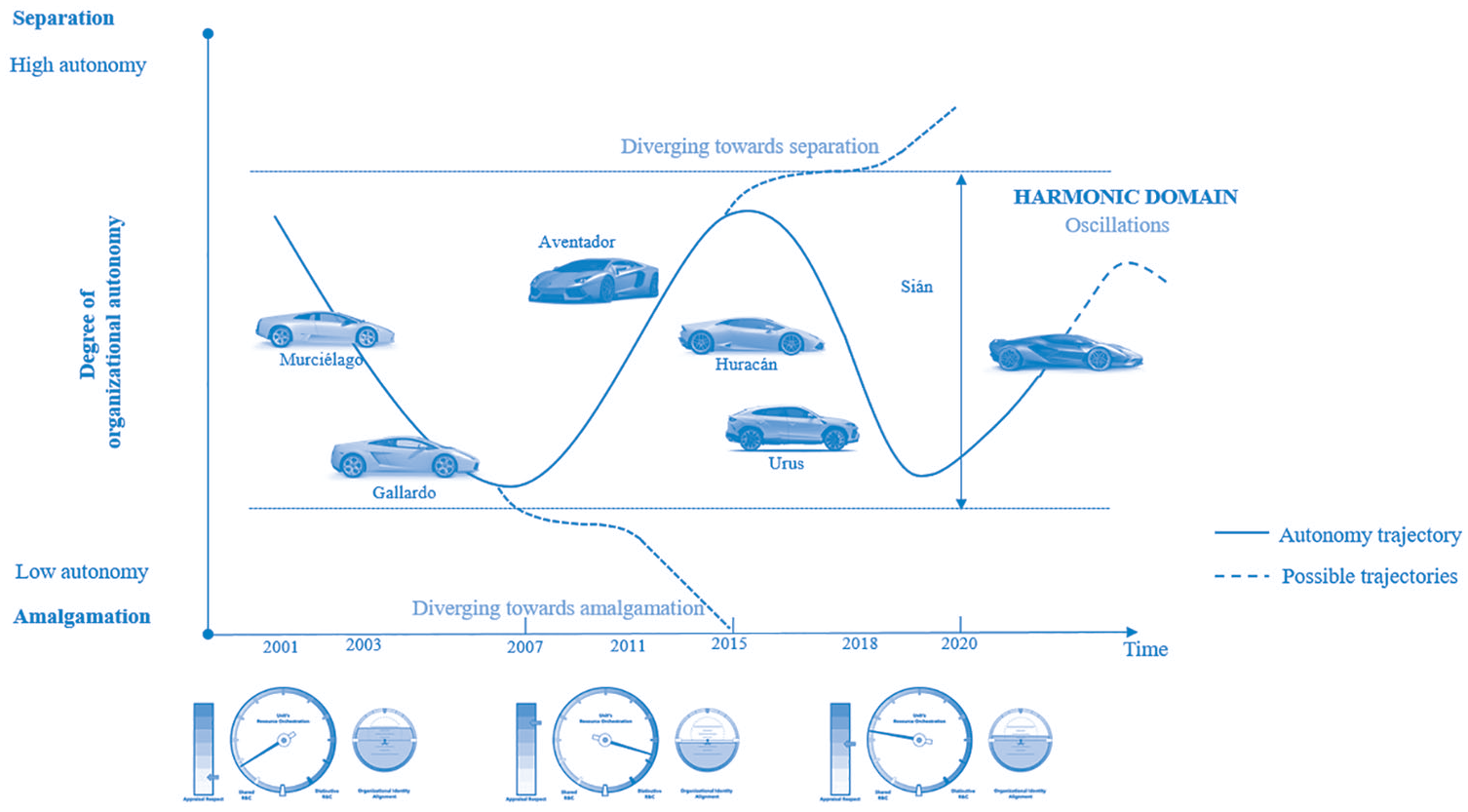
Oscillations in autonomy at Automobili Lamborghini.
Phase 1: Strategic Integration of Automobili Lamborghini (1998-2007)
In this first phase, Audi managers pushed for integration and standardization, which entailed strongly decreasing Lamborghini’s organizational au-tonomy to help facilitate turnaround. For instance, the firm’s first new design post-acquisition, the Gallardo, was developed around the Audi R8 platform, based on Audi AG’s aluminum spaceframe capabilities, and shared many components and systems from the VW Group. The incredible success of the Gallardo—with its celebrated design and less-common V10 engine—produced more sales in eight years than Lamborghini had achieved in all years prior—induced strong competitive responses from Ferrari and McLaren, and prompted Audi executives to see integration as the right choice. This first stage could therefore be described as the standard integration process imposed by the parent, where the acquirer recommends reducing the target firm’s organizational autonomy due to poor performance. 15 However, the next stages did not follow the usual post-acquisition integration prescriptions.
Phase 2: The Aventador: Regaining More Autonomy (2007-2015)
When it was time to renew the more complex and costly V12 engine product line at the end of 2007, Audi AG wanted to maintain Lamborghini’s low level of autonomy. After all, the initial strategic integration had produced very successful results. However, Lamborghini’s managers were concerned that the current trajectory—of increasingly tight integration and control from Audi AG—was destroying the company’s ethos. They were worried that continuing to produce Audi-derived designs, with VW group components, would undermine the iconic supercar brand and damage its ability to justify premium market pricing. They believed they had to fulfill the creative potential of a Lamborghini car on their own. Advocating the distinctive design improvements, performance, and strategic vision of Lamborghini, the unit’s chief executive officer (CEO) and chief technology officer (CTO) argued for moving away from Audi’s product platform to regain the autonomy and freedom needed to develop the “best super sportscar in the world.”
During the acquisition, Audi had not entertained the notion of granting Lamborghini greater autonomy at this stage in the post-acquisition phase. Considering the success of the Gallardo, based on an Audi platform, it seemed unlikely that the Audi board would go along with the suggestion. However, Audi managers, who had been appointed as Lamborghini directors, were able to assist the management team in presenting a business case to the Audi board that aligned with the group’s logic. This enabled the Lamborghini management team to present a strategic vision for the new supercar based on a radical technological innovation: a carbon fiber monocoque. No automotive company in the world had ever managed to achieve the homologation of a carbon monocoque for a series production car; hence, the Audi board’s doubts that Lamborghini would succeed. Yet, Lamborghini had been exploring this issue for some time, in collaboration with the Boeing Company in Seattle, to gain the necessary engineering and simulation capabilities. The successful results of this partnership reassured the Audi board that this innovation would work. Together with the anticipated low volumes for the new supercar and the appeal of the envisioned differentiation strategy, Audi decided to grant additional autonomy to Lamborghini. As an Audi executive highlighted, the Audi Board became “convinced that, in order to enable the brand, something very special on the technological side was needed” and that “it was also the main driver for the Aventador.” The Aventador marked a milestone in the automotive industry, as well as a turning point in the relationship between Lamborghini and its parent, Audi, leading to what we termed the second stage in our dynamic framework for co-creating value: regaining autonomy. With the learning from Boeing and the greenlight from Audi, Lamborghini invested heavily in its distinctive process capabilities to build these superior in-house carbon composites. Lamborghini also worked independently with several other external, non-VW Group suppliers to develop new capabilities. As a result, the Aventador introduced many radical innovations to a series-production car (see Figure 2). With its regained autonomy, Lamborghini also adapted some of Audi and VW Group’s processes to its specific competitive context.
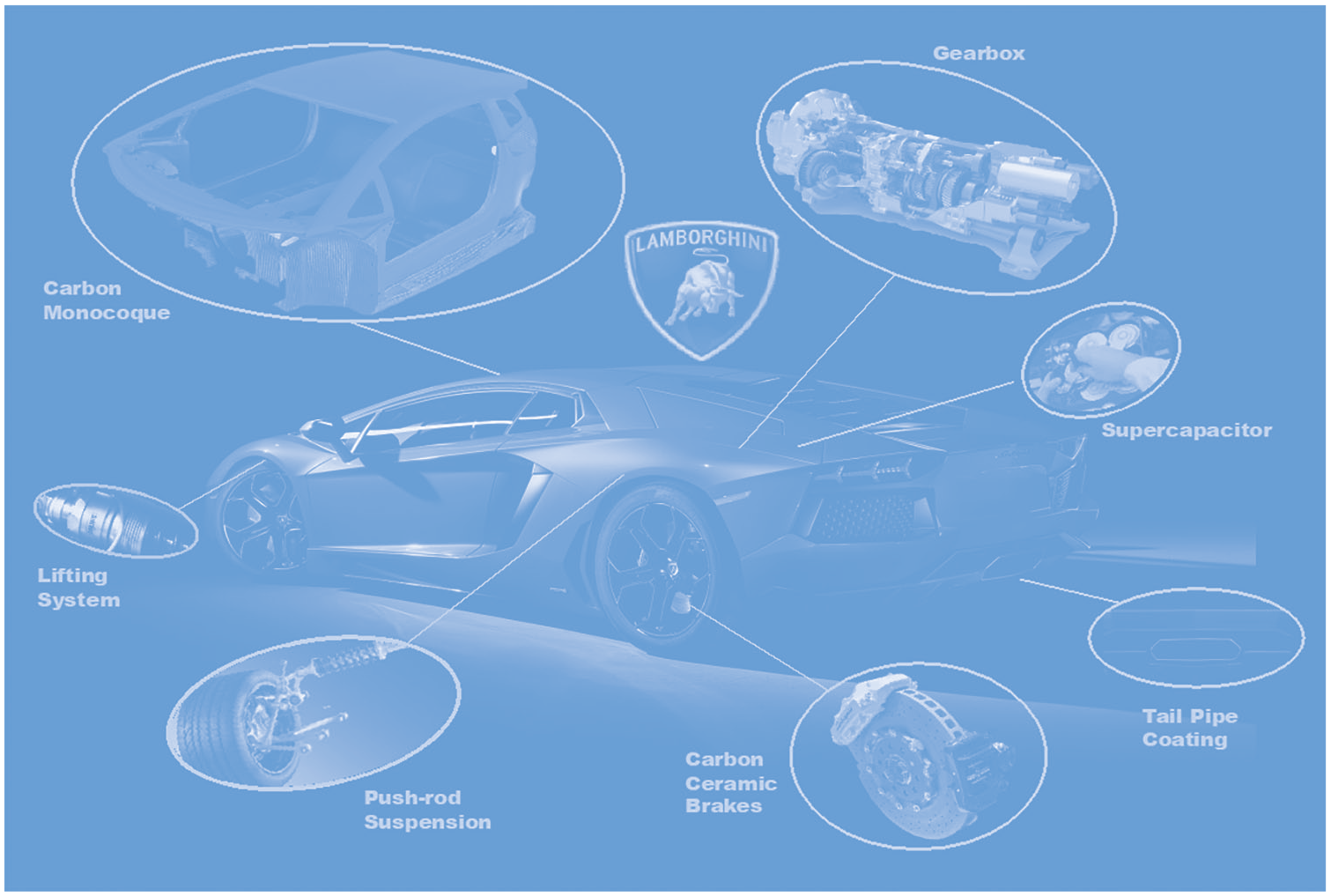
Lamborghini’s renewal of strategic resources and capabilities.
Phase 3: The Urus: Dialing Back to Greater Integration (2015-2020)
With the success of the Aventador, Lamborghini wanted to develop and commercialize a third model: a V8-powered super-SUV named the Urus. Expecting that this new model would once again double Lamborghini in size, Audi managers sensed a need to apply group processes more rigidly. Audi once again pushed for further integration, but that also entailed transferring some of the resources and capabilities developed by Lamborghini—such as carbon composite, thin film transistor (TFT) screens, and a customization approach—into its own products and process. For instance, Audi developed its new Audi R8 based on a shared platform with the Huracán (the successor to the Gallardo in the V10 engine segment) by leveraging these composite capabilities. Lamborghini engineers trained and helped their Audi colleagues to replicate these carbon composite capabilities. While Lamborghini retained its capabilities in carbon composite engineering and manufacturing in Sant’Agata Bolognese, all of its carbon composite patents were transferred to Audi. Hence, these upward transfers slightly reduced the distinctiveness of Lamborghini’s capabilities, which could have impacted its differentiation over the next product lifecycle. On this basis, we describe phase 3 as the parent pulling back toward greater integration.
Phase 4: Regaining Autonomy, Again (2020-)
The level of autonomy oscillated again in 2020 with another new phase. As Audi’s head of corporate strategy explained, Lamborghini’s demonstrated ability to operate at this new scale of complexity with the Urus convinced the Board to renew the allowance of autonomy so that its subsidiary could develop new capabilities. This strategic renewal was exemplified by the Sián limited series, the first super sports car powered by a V12 engine and hybrid technology based on supercapacitors. Staying true to its foundational principles to disregard conventions and excel at any cost, Lamborghini began pushing to create a fully electric, decarbonized high-performance supercar. As described in Direzione Cor Tauri (“heart of the bull” in Latin), this strategy—involving an investment of more than €1.5 billion over four years—aims to deliver the first full electric Lamborghini before the end of the 2020s. Given these efforts, the fourth phase seemed to be predicated on renewing strategic resources and capabilities.
Collectively, these long-cycle oscillations between lower and higher autonomy act as a renewal mechanism for the parent and unit. We use the term “harmonic domain” to capture the proper range of these oscillations, which also implies that too much or too little autonomy could negatively impact the relationship. 16 While there was a high chance that the integration process would break out of the harmonic domain (as indicated in Figure 1), leading to either full amalgamation or complete separation, that problem was subverted by managerial actions (or agency). In a clear illustration of managerial agency, the subsidiary’s senior management team recognized that they were ultimately accountable for their actions, including how they leveraged autonomy within limits defined by the parent. 17 The turning points between each of the four post-acquisition phases that we describe signaled negotiations—or dialectical syntheses 18 —and autonomy reversals that depended on the agency and ability to deal with the dualities of both parent and unit managers. As a former Chairman and CEO of Audi AG emphasized, the dynamics of organizational autonomy are “not a law of nature; it’s about management principles.” All three Lamborghini CEOs with whom we spoke emphasized that the organizational autonomy dialectic requires unit managers to engage with parent managers who are, as one of the CEOs noted, from “a big planet against a small satellite,” but they also have to accept and share the “risk of autonomy.”
Three Strategic Levers for Autonomy
The organizational dynamics we observed had three main drivers: appraisal respect, organizational identity, and resource orchestration. These strategic levers within the parent-unit relationship can be leveraged by both sides to influence internal bargaining processes and the trajectory of autonomy outcomes.
#1: Appraisal Respect
Naturally, business unit managers have to demonstrate satisfactory performance improvements to the parent before they can petition for increased autonomy. We call this appraisal respect: certain managers’ positive appreciation for the behaviors of other managers, which signals respect for competent performance or, at least, the efforts to achieve competence. 19
Acquired unit managers. Understanding the crucial role of appraisal respect can guide the nature and timing of the acquired business unit managers’ agency in several ways.
Walk the line and walk the talk. In acquisitions of poorly performing companies, the parent normally begins with the basics: imposing its key organizational processes, transferring some of its resources to rapidly initiate (the easiest) synergies, assigning strict and precise mandates, and developing first-hand knowledge about the unit’s actual resources and liabilities. 20 The target firm’s business managers must see this as an opportunity and not as an inconvenience. These parent initiatives can improve aspects of the acquired business that were previously lacking, but more importantly, they open a space for the management of both firms to establish a relationship. By actively engaging with this process, the unit management not only learns the parent’s practices, politics, culture, and strategy, but also signals an ability to achieve objectives and mandates. Without this stockpile of credibility, the parent will be less likely to grant more autonomy to the unit. In order to achieve their autonomy trajectory, the business unit managers need to maintain this same mindset as the post-acquisition integration process continues. First, they need to keep delivering on the basics to preserve the parent’s appraisal respect for the unit. Second, they need to carefully apply their additional autonomy to resource orchestration decisions. Successful initiatives will bolster the supply of accumulated respect, 21 but strategic blunders may dampen that respect and undermine future requests for autonomy.
Leverage improvements and achievements. If the subsidiary managers do not engage with the parent, the parent will likely preserve the status quo or keep reducing the unit’s autonomy. It is only when subsidiary managers detect a positive shift in the parent’s appraisal respect for their performance that they can start asserting differences. As a former Lamborghini CEO noted: “I want to challenge the other way around to show that we are strong enough, to make sure that they rely on and trust us on what is best for our brand.”
Parent company managers. For parent managers, appraisal respect means positively appreciating the behaviors that signal the business unit’s efforts in achieving performance targets. Parent managers can strongly influence this by providing the unit with opportunities to exercise and demonstrate its competency, as we describe below.
Provide clear and challenging mandates. The parent needs to regularly provide the acquired firm with mandates that are intended to develop appraisal respect. These mandates do not need to be bold or disruptive; they only need to allow the acquired business to exercise its discretion to reach the objectives. The mandates do need to have a challenging aspect, as it will be difficult otherwise for the parent to develop respect. It is important for these mandates to be explicit, presenting the unit with clear qualitative and quantitative objectives so that the parent can easily assess the level of competency and contribution. It follows that, in cases where the unit clearly and unequivocally fails, the parent’s appraisal respect will decrease or disappear. Hence, the existing stock of appraisal respect continuously evolves based on the unit’s positive or negative performance.
Monitor progress and recognize improvements. The immediate post-acquisition phase is generally a short period wherein the parent measures progress on the transfer and application of shared resources. Beyond realizing the integration benefits, the parent managers should also recognize that such monitoring can reflect their own appraisal respect for the unit managers’ performance. As an Audi manager noted: “Yes, we have been in Lamborghini, and these guys are doing a good job; they are managing the turnaround. And this changed [Audi’s] perspective and attitude.” By recognizing the acquisition’s improvements, parent managers can create the conditions to engage with unit managers in the strategic exploration and renewal of the target’s distinctiveness. In this vein, it is important that the parent recognize not only successful performance, but also the unit’s competent efforts. This implies some generosity on the parent’s part. For instance, even if the unit does not fully reach its key performance indicators or strategic objectives, the parent can still respect unit managers’ efforts in facing extreme or unpredictable events in their competitive environment. 22 In short, parent managers can offer a judicious assessment of the unit and its managers, beyond just a quantitative evaluation, and exhibit reasonable tolerance for errors. The key point is that parent managers need to be able to understand and factor in how external events and internal managerial missteps or inadequacies affect results, and not simply place the full burden on the unit managers.
#2: Organizational Identity
For this lever to prove effective, the managers of the parent and target companies must develop a collective understanding of their merged organization’s distinguishing features. 23 While those features tend to be deeply rooted, there is some fluidity in how managers interpret the resources’ present and future value. This reinterpretation process is driven by two important dimensions of organizational identity: first, the construed external image, which reflects internal members’ perceptions of how outsiders currently conceive of the organization; and second, the desired future image, that is, the perception that managers would like both internal and external stakeholders to hold about the organization in the future. 24 The desired future image can serve as a basis for a shared strategic vision. 25
For Lamborghini, there was a real fear that the integration logic of shared resources, common parts, and similar technologies entailed a serious risk of reducing the perceived distinctiveness of the company and its automobiles over time. This reduction creates a misalignment between the construed image and desired future image; between “how do we think others currently perceive us” and “how do we want others to perceive us in the future?” Such misalignment in organizational image and identity is key to driving dialectics and guiding managerial agency.
Acquired unit managers. To create and maintain dynamism in their organizational autonomy, and thereby ensure strategic renewal, business unit managers must present an antithesis to the parent managers’ thesis of integration. To this end, these business managers must focus on three points.
Displaying cognitive resilience. Previous studies have shown that in response to a degraded or unfulfilled image, unit managers may resort to cognitive coping tactics to reduce discomfort and preserve the integrity of their collective self-perception. 26 Instead, Lamborghini shows how acquired business managers can perform identity-consistent resource orchestration after the post-acquisition integration to address the misalignments between their construed and desired future images. But they must focus on specific requests, aligned with their organizational identity, to increase organizational autonomy and preserve or increase their unit distinctiveness.
Values and image. The target business managers must articulate the essential values of their unit. To this end, they need to develop a strong organizational identity, rooted in a distinctive image that will garner the parent’s respect and ensure dialectics. We often think of identity claims as decisions about crafting and reinforcing a distinctive position vis-à-vis competitors. 27 But this same interplay between strategy and identity can also occur between a business unit and its parent. For this reason, business unit managers should develop strategic proposals that highlight shared superordinate values with the parent, while also emphasizing the unit’s unique characteristics that will drive resource orchestration decisions.
Bridging construed and desired future images through strategic vision. The desired future image provides a strategic vision for the unit, guiding its resource orchestration decisions. This strategic vision builds on the distinctiveness of the unit, relative to not only competitors, but also to its parent. That envisioned position will inform the unit’s resource orchestration choices: those strategic tradeoffs on the product or service attributes that, in turn, inform the portfolio of resources and capabilities that must be maintained, discarded, or developed to bridge both images. The unit managers should leverage their performance improvements to not only increase appraisal respect but also establish the credibility needed to sell the parent on their desired future image.
Parent company managers. Meanwhile, parent managers must recognize that the acquired unit’s distinctive organizational identity plays a central role in negotiations about autonomy.
Discrepancies versus Alignment. Parent managers need to define the organizational elements that unit managers will need to adopt to achieve the integration benefits. At the same time, the parent managers need to articulate a longer-term perspective about the distinctiveness of the unit’s organizational identity. Therefore, the parent managers must also consider the scope of decision-making discretion they want to extend to realize the unit’s strategic vision. Incidentally, it means that the unit needs a strong organizational identity to trigger or sustain the dialectical process of organizational autonomy. When parent companies acquire a target with such an identity, then parent managers must learn to tolerate, and even support, some specificities of that identity post-acquisition. Again, a level of discrepancy in organizational identity between the parent and its unit is paramount to achieving post-acquisition harmony around organizational autonomy and resource orchestration dynamics.
Openness. Parent managers should not perceive the unit managers’ claim to their own distinctiveness as a challenge to the parent’s identity. A stern and formal denial of dialogue would undermine any chance of organizational dynamics. Instead, parent managers must remain open to engaging about autonomy and connect those discussions to the stock of appraisal respect.
Fit with the deal motivation. The parent should maintain some flexibility about the unit’s distinctiveness and focus on the benefits of upward transfer that would materialize over time rather than through rapid amalgamation. In this spirit, they need to accept that the initial motivations for the deal may evolve, and they will need to recalibrate their expectations.
#3: Resource Orchestration
With organizational autonomy, unit managers can employ discretion over resource orchestration decisions: namely, how resources and capabilities are structured, bundled, and deployed. Those decisions are integral to achieving the unit’s desired future image, renewing the unit’s competitiveness, and beyond that, transferring resources to the parent.
Acquired unit managers. Once they have garnered the parent’s appraisal respect through their performance, the unit’s business managers can make a case for additional autonomy by articulating their desired future image and outlining the distinctive resources and capabilities required to achieve it. They can rhetorically emphasize how this autonomy will preserve distinctiveness while also complementing the parent’s resources.
Distinctive resources and capabilities. The unit’s business managers must envision a set of resources and capabilities—technologies, processes, products, brands, and so on—that will allow their unit to renew and enhance its distinctiveness (i.e., its idiosyncrasies relative to the parent). For example, unit managers may request some more autonomy to adapt an existing organizational process for competitive reasons or to develop technologies that the parent lacks. In the case of Lamborghini, the unit managers recognized that the firm’s design capabilities were foundational to its product success and had to be protected.
Access to the parent’s resources. Integration can bring obvious benefits to a target firm: the parent’s resources can give the acquired company access to advanced technologies or broader markets that would normally be out of reach. However, too many shared components could erase the unit’s distinctiveness—and perhaps even its competitiveness. After all, the parent’s organizational processes may not be well suited to helping the unit reacts to competitive changes or preferences in its specific segments. Hence, the unit’s business managers must be clear about which resources they can leverage from their parent and which ones they need to develop autonomously to achieve their desired future image. In other words, unit managers need to approach the parent’s resources as a strategic opportunity for resource orchestration. In our case, Lamborghini benefited greatly from Audi’s structured processes (which improved the quality of its products), network of large and technologically advanced suppliers (which boosted the caliber of inputs), and shared components (which reduced development costs).
Access to partners’ resources. In the effort to develop its own resources and capabilities, the unit may want to seek access to outside partners. Unit managers should be mindful about choosing partners for not only their technical qualities, but also their rhetorical impact. After all, parents may be more persuaded to extend respect and autonomy to unit managers who demonstrate competence by choosing reputable partners. In some cases, unit managers may cultivate more appraisal respect by being proactive and exploring collaborations with potential partners without waiting for the parent’s approval. For instance, Lamborghini started a development project with the University of Washington and the Boeing Company, which they then leveraged to convince Audi managers, and the VW board, to grant them autonomy to develop a carbon monocoque.
Parent company managers. Parent managers must be mindful of the benefits that can result from maintaining distinctiveness.
Recognize synergies and distinctive resources. The parent managers need to be open to the unit managers’ dialectical claims for additional resource orchestration decision rights. They must also consider downward synergies (where the unit leverages the parent’s resources) and articulate for the unit that appraisal respect is tied to a satisfactory level of performance. They should also push the unit managers to formulate and articulate a precise case for the requested autonomy. Ideally, parent managers will achieve a balance between recognizing the unit’s need for resource distinctiveness and wanting a strategic vision that is coherent with the progress and goals of the post-acquisition process.
Shared resources and capabilities. The parent managers must be able to dynamically mark the perimeter of the integration benefits and then be willing to let the unit managers further explore and adapt to their idiosyncratic context. This issue should be familiar to companies that adopt product platform strategies, where managers have to determine the elements that unite and differentiate their products across market segments. However, parents should expect some negotiation over the boundaries of exercising discretion. Parents should always keep resource sharing in mind but recognize that the perimeter and dominant mode can shift. For instance, while the organizational autonomy dynamic always involves the sharing of resources and capabilities between parent and unit, both parties must recognize that the perimeter and dominant mode of that dynamic varies over time.
Upward transfers. Parent managers should recognize that they can indirectly benefit, strategically and financially, by allowing the unit to achieve a distinctive position through its autonomy. However, parent managers should not be too hasty to absorb the unit’s earnings. Accumulated financial resources may need to be kept within the unit to develop its resources. For that reason, parent firms should focus on the long-term, more indirect benefits that result from the unit gradually introducing new strategic resources. Parents can later transfer those resources to their own products and services where there is a strategic fit. Granted, managers should be mindful of how such upward transfers will necessarily reduce the unit’s distinctiveness, and organizational autonomy, until the next dialectic phase.
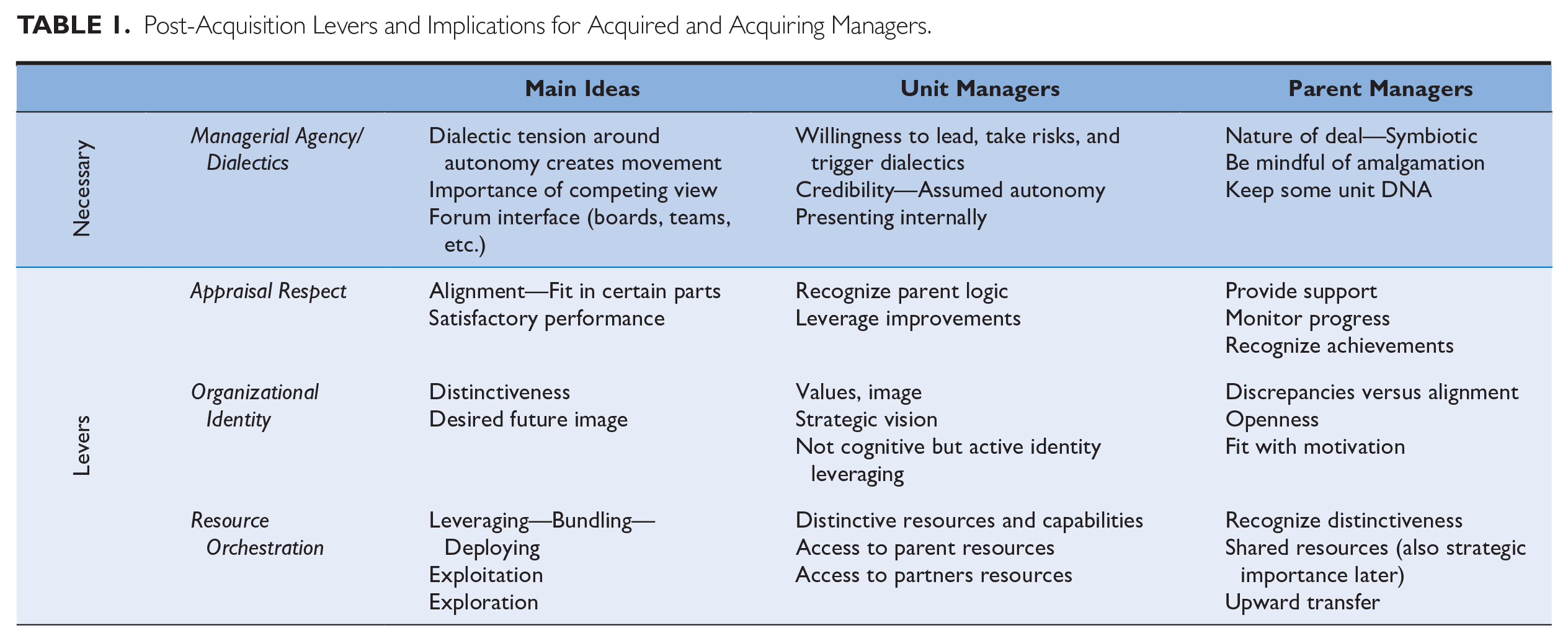
Table 1 summarizes and synthesizes the main managerial takeaways from our study. We illustrate how, over time, autonomy can be utilized as a strategic dial that contributes to the post-acquisition success of both parent and subsidiary companies.
Post-Acquisition Levers and Implications for Acquired and Acquiring Managers.
A Dynamic Approach to Post-Acquisition Autonomy
A static managerial mindset—resulting in either amalgamation or separation, or an ossification of an autonomy level and its value creation mechanisms—can ensure that acquisitions fail to extract the full potential value and return over time. In this article, we argue for the importance of a dynamic post-acquisition integration process that, depending on the context, can result in sustained positive outcomes for acquiring and acquired companies alike. We investigated the post-acquisition integration of supercar manufacturer Lamborghini, which was failing and then rejuvenated, allowing it to achieve superior performance despite the odds. Acknowledging a counterfactual situation, if standard post-acquisition prescriptions had been followed, at best, Audi would have imposed its parent systems and resources resulting in the destruction of Lamborghini’s distinctiveness and identity. Although acquiring companies may intend to rejuvenate underperforming companies, more often their focus is on short-term stabilization, and they neglect longer-term value potential. Despite research that shows turnarounds may be managed for greater future value by taking a longer strategic time horizon, M&A integration frameworks often advise against mixing and matching post-acquisition integration strategies 28 as value destroying. This article shows what needs to happen to ensure acquirers do not stifle innovation and distinctiveness during the post-acquisition integration process and to generate sustainable strategic value over the long term.
Our findings reveal that oscillating autonomy post-acquisition can enable capabilities renewal, contributing in turn to performance improvement for both the target and the parent. In the case of Lamborghini, this improvement manifested over time as a 35-fold increase in sales. Employing a dynamic integration process that consists of oscillating between lower and higher target autonomy creates generative potential. Within a harmonic domain, this higher/lower autonomy oscillation—driven by a tension between the search for economies via lower organizational autonomy versus the search for distinctiveness via higher organizational autonomy—is the key driver of sustainable value. Acquirers can avoid stifling innovation in an acquired company by moving back and forth over time between, for example, the integration of costs and systems, and autonomy around product design and development. Once appraisal respect is established around integration processes, autonomy can be relaxed to give the acquired turnaround more voice. Similarly, the need to focus tightly on the acquired organization may also be relaxed over time to enable the rejuvenation power of the innovation ecosystem to enhance the continued value creation.
Managing such a dynamic process is challenging, especially to prevent defaulting to complete amalgamation or separation of the acquired company. We identify several key mechanisms that can be relevant for managers willing to pursue a dynamic integration strategy. It is crucial to create and maintain an organizational autonomy dialogue between the managers of the acquired and the acquirer, to be continually negotiated. It is negotiating common ground that will enable cycles of renewal to occur. It depends upon acquired business managers being willing to lead and take some risks, assume a level of autonomy, and communicate effectively with the acquirer. It also needs acquirer managers to create the conditions for the symbiotic potential of the acquisition to emerge. This requires an appropriate organizational interface. With this general condition in place, there are three strategic levers—collectively a strategic dial—that managers can adjust to influence the level of acquired company autonomy.
The first is developing appraisal respect, and we indicate ways in which both acquired and acquiring managers can achieve mutual positive respect. The second concerns managing the acquired unit’s organizational identity, and this aims to achieve alignment between two dimensions of its identity: its construed external image and its desired future image. For Lamborghini, the importance of misalignment with the strategic vision derived from its desired future image drove its efforts to regain organizational autonomy from its parent. The third concerns resource orchestration decisions which are determined, for the acquired unit, by its desired future vision (sense of purpose and direction), and we provide indicators of how both acquirer and acquired managers should perceive and manage resources and capabilities.
Does this mean that all acquisitions must be managed using our dynamic integration strategy? No. It depends on the original strategic intention for the acquisition and the approach for integrating the acquired company post deal. If the objective of the deal was just to add the target to a portfolio of subsidiaries in a holding corporate structure with a financial perspective, then there would be no need to embark on this complex managerial process. The same applies for the opposite case where a target is acquired only to be quickly dismantled and absorbed by the parent. For other types in terms of the original strategy for acquisition, the evidence suggests that many, if not the majority, fail to achieve the hoped-for returns. While the reasons for underperformance may be multiple, being open to a dynamic post-acquisition integration process may allow a more fine-tuned and durable approach to value creation than a static post-acquisition integration strategy. A dynamic approach is more likely to achieve benefits through a more accurate post-acquisition assessment of capability interaction than relying on a snapshot assessment at the time of the acquisition itself. This more sensitive approach to managing integration over time is likely to more closely approximate optimal performance than a static one-way take-all approach. However, time frames matter, and there needs to be sufficient time for this evolutionary approach to integration to bear fruit. This is not always the case where some acquirers may require quick returns. Nonetheless, our case was of a distressed company, requiring deliberate and substantial intervention, and yet space was created for a dynamic approach to organizational autonomy for long-term benefit.
Organizational identity is a key driver of the dialectical tension in the parent-unit relationship and may indicate a boundary condition. If the acquired target lacks a strong identity, oscillations in the autonomy dynamics may not occur. A further limiting factor may relate to the funding of the acquisition. If significant amounts of debt are used to purchase the acquisition, then it is likely there will be a demanding repayment schedule. Depending upon how substantial the acquisition is in relation to the parent’s business, this will determine the extent to which benefits from the acquisition need to be crystallized to keep shareholders and creditors happy, so the integration timetable may be driven more by a short-term financial imperative than a longer time frame.
Conclusion
During a post-acquisition integration, managers face a strategic dilemma: On one hand, managers from corporate parents often strive for strategic integration and standardization, in order to synergize corporate processes and resources. Naturally, it is easier to transform internal synergies into cost savings than into market-based gains. Therefore, the default approach favors low organizational autonomy for acquired businesses. On the other hand, the managers of acquired companies frequently seek to maintain or develop a certain level of autonomy so as to retain their organizational identity and successfully manage their competitive environment. Although practitioners are eager for a solution to these tensions, they have generally not considered the value of oscillating autonomy. This could be due to the enthusiasm decline that follows an acquisition: newness is a depreciating asset and the will to change erodes with time. 29 It is not about natural forces as much as the process is complicated and often protracted, and most managers do not exercise the requisite discipline or patience. This might be due to constrained thinking, where existing post-acquisition frameworks and conventional rules assume a final end state for integration. By contrast, we offer a fresh, long-term perspective on how to manage the relationship between a parent and its business unit. Our research shows that organizational autonomy does not need to be fixed, but can instead be fluid and continuously negotiated, allowing the parent and business unit to achieve sustained integration success. Our study suggests that managers can unlock their firms’ potential by dynamically adjusting autonomy over time, like a strategic dial, for mutual benefit and long-term advantage.
Footnotes
Acknowledgements
The authors thank the Editor-in-Chief, David Vogel, and the anonymous reviewers for their insightful and constructive comments that helped shape this paper. Also, the Managing Editor, Kora McClain-Gonzalez, and Editorial Contractor, Paul Lee, for their efficient and supportive engagement and advice. They also wish to thank Professors Sydney Finkelstein, Maureen Meadows, Nelson Phillips, and Tazeeb Rajwani for their comments on previous versions of this paper. Finally, they express their sincere gratitude to the senior management, past and present, of Automobili Lamborghini S.p.A. In particular, Stefano Rutigliano, Riccardo Parenti, Maurizio Reggiani, and Umberto Tossini. Their positive and transparent approach over many years made this work possible.
Notes
Author Biographies
Thomas C. Lawton is Professor of Strategy and International Business at University College Cork, Ireland, and Visiting Professor of Business Administration at the Tuck School of Business at Dartmouth, USA (email:
Duncan N. Angwin is Professor of Strategic Management and Director of Executive Education at the UCL School of Management, University College London, and Honorary Professor at the University of Nottingham, UK (email:
Brice Dattée is Associate Professor of Strategic Management at emlyon business school, Paris, France (email:
Jean-Luc Arregle is Professor of Strategy at emlyon business school, France (email:
Paolo Barbieri is Associate Professor of Supply Chain Management in the Department of Management, University of Bologna, Bologna, Italy (email: