



Abstract
In blockchain consortia, different companies band together to develop, govern, and operate a shared blockchain-based system. However, many blockchain-based systems are exposed to the risk of never going live without a proper understanding of the peculiar collaboration this technological architecture entails. To understand how blockchain consortia develop and advance collaborative relationships, this article reports on an extensive analysis of online material and interviews of key members. It draws from the literature on interorganizational collaboration and digital platforms to explain the staged progression of blockchain consortia and the key features of blockchain consortia.
Keywords
Blockchain talk is everywhere, but actual working implementations are rare. What captures our attention is that while this kind of technology originated from the rejection of organizations, it has been taking on a core organizational function: collaboration. In a nutshell, blockchains of all types are based on consensus algorithms that allow collaboration between actors that would otherwise be impossible. Clearly, consensus without parties among which consensus is sought makes no sense: no parties, no party. Indeed, across the business world, and increasingly in the public sector, interest in blockchain technology is consolidating in a growing number of blockchain consortia. In blockchain consortia, different parties or organizations band together to develop, govern, and operate a shared blockchain-based system without one single entity being in complete control of it. Blockchain has supported and developed collaboration in new domains and functions by being tried out in different settings. Successfully launched blockchain-based platforms, such as the MediLedger Network, 1 demonstrate how blockchain technology can reduce friction and increase transparency and efficiency in interorganizational collaboration. 2 As such, management of chargebacks through the MediLedger Network (by automatically enforcing business rules) allows for early detection of any errors, hence avoiding disputes between trading partners. 3
How and why do companies enter relationships and engage in forming blockchain consortia? In contrast to other IT trends, such as artificial intelligence (AI), a single company cannot (or should not) attempt blockchain alone. The reason is straightforward: blockchains are a resource-intensive way of keeping consensus across the parties involved by authenticating records. Thus, any single organization is better off using established management tools and practices. Banding together with other companies to form a blockchain consortium even before being sure what a blockchain-based partnership can realize, however, is a complex endeavor, which is further embroiled by the long-term commitment to the immutability of a ledger that blockchain trust relies upon. Our article focuses on the formation stages before transactions start and smart contracts are automatically executed. In line with this focus, our empirical data are on the creation of the rails before trains and passengers move on them.
Considering the increasing number of blockchain consortia that have been formed, continue to be formed, and fail, this article sheds light on how members of blockchain consortia initiate and advance collaborative relationships. Previous works on interorganizational collaboration and alliances used the analogy of romantic partnerships to analyze how interfirm relationships form and develop. 4 While in many societies, these partnerships consist of two individuals (as opposed to the multiparty blockchain consortia), we adopt this analogy for illustrative purposes. Expanding on this lens, first, we provide background about interorganizational collaboration, platforms, and interorganizational systems (IOS). Next, we detail our methodology, which combines a multiple-case study relying on 53 interviews with representative members of 19 consortia (selected out of hundreds) with an extensive analysis of online material. Based on our data analysis, we present a staged progression that blockchain consortia go through when establishing collaborative relationships. Grounded in those empirical and conceptual insights, we discuss how blockchain consortia differ from other IT projects, distill our theoretical angle, and derive managerial recommendations for the different developmental stages of blockchain consortia. Insights from our article are particularly relevant for managers interested in forming or joining a consortium. To avoid common pitfalls, they need to properly understand the peculiar collaboration that blockchain’s technological architecture entails. Our findings are also relevant for companies that are involved in a blockchain consortium and seek to identify and get advice on their developmental stage.
Setting the Scene
Blockchain allows different parties to collaborate in two ways. First, blockchain technology enables companies to authenticate physical objects (such as shipped goods or precious stones) or data (such as certificates or credentials) that are needed across parties who may not trust each other. Second, blockchains promise to store and automatically execute preset agreements between parties when certain conditions are met. Based on those characteristics, blockchain technology allows different parties to participate in a common system without the necessity to trust each other individually or have a third-party guarantee the whole system. All parties are held together according to a consensus algorithm.
Interorganizational Relationships
Why do companies engage in interorganizational relationships and what affects the performance of such collaborations? The dichotomy market versus hierarchies 5 persists in being used as widely as it has been criticized. For instance, networks have been conceptualized as a distinct mode of organizing rather than a segment on the market/hierarchy continuum. 6 More recently, partial organizations have been seen far beyond the usual structures that define organizations, in standardization, prizes, crimes, and platforms. 7 Before focusing more on this last form of partial organization, let us step back to consider studies on interorganizational relationships.
Following an increasing number of domestic and international alliances from the 1970s, a large stream of literature in management research has developed covering the formation 8 and management 9 of alliances, selecting alliance partners, 10 factors influencing alliance performance, 11 as well as strategies to exit unsuccessful alliances. 12 In terms of objectives, the literature 13 distinguishes financial motives (e.g., cost reduction), technological motives (e.g., joint new technology or product development), managerial motives (e.g., supply base reduction), and strategic motives (e.g., achieving core competency). In addition, companies use interorganizational linkages as an opportunity to learn, such as through research and development partnerships. 14 Aspects such as compatible goals, synergy among partners, balanced contributions between partners, and effective management and governance procedures contribute to the success of alliances. 15 As with personal relationships, business alliances cannot be successful if individual companies act solely in their own interest while neglecting their partners’ expectations and needs. 16 Indeed, fuzzy or conflicting goals and low trust can undermine alliances because they can lead to opportunistic behaviors, whose mere possibility spreads uncertainty and degrades commitment. Partners have different governance choices depending on the alliance setup, ranging from autocratic to participatory/democratic governance. 17 Detailed contracts are a formal governance mechanism to deal with high degrees of uncertainty and stabilize interorganizational arrangements, such as when working with competitors from other countries. 18 Also, targeting a problem outside partners’ core business can be a strategy to deflect conflicts. 19 Beyond strategies, trust is commonly regarded as an informal albeit important safeguard to opportunism. 20 For instance, a partnership mode for customer-vendor relationships referred to as “adaptive strategic partnering” focuses on joint value creation, problem-solving, and flexible contracts that can be adapted in light of changes in the environment rather than assuming that parties act opportunistically. 21
Platforms, a form of multiparty relationship made common by the wide diffusion of IT, have been studied extensively in information systems (IS) research. 22 Before discussing their technological aspects in the next section, we highlight that platform organization has proven superior to traditional, vertically integrated systems in many sectors. 23 What characterizes this mode of organization is its generativity—that is its capacity to foster innovation by actors from anywhere on the network, especially its fringes, that extends the usage scope and value for all platform users. 24 So, platforms can be seen as an innovative type of interorganizational relationship that has been named ‘Möbius arrangement’. 25 If markets are based on buy, hierarchies on make, and networks on cooperate, platforms have been said to be based on co-opt, that is they rely on external assets operating in their model like Uber with cars and Airbnb with beds. According to this view, platforms can be seen as a novel mode of organizing distinct from established ones (such as markets, hierarchies, and networks).
Interorganizational Systems
The field of IS includes an extensive body of research on IOS covering, for instance, factors influencing the adoption of IOS, adoption and diffusion processes, as well as governance-related impacts and organizational consequences of IOS use. 26 As part of establishing alliances, organizations have been pursuing the integration of IS by adopting a shared infrastructure that allows for electronic exchanges and interactions. 27 Fulfilling a similar purpose, blockchain technology can be compared with previous data exchange technologies, for example, Electronic Data Interchange and Web Services that allow IOS. 28 Companies may adopt IOS to meet regulatory demands, improve efficiency in interorganizational processes, enable trust, foster coordination and collaboration, exert power over other organizations, or for innovation and value creation. 29 Several promises and challenges of IOS, especially evident in web services, overlap with those experienced today when adopting blockchain technology. Years ago, web services were boosted by enthusiastic claims of revolutionizing collaborations when companies shared the same standards. Yet, web services require IS integration across organizations to the extent that is already difficult to achieve within a single organization. 30 Because of the inherent complexity and high costs involved in setting up such agreements and technological infrastructure, companies are much more likely to form linkages with existing and trusted partners.
Even though platforms have been thematized before the wide diffusion of IT, they have gained a new centrality for how they coordinate distributed parties. Platforms have been defined as “a set of digital resources,” including services and content, that “enable value-creating interactions between external producers and consumers.” 31 Digital platforms can enable far-reaching innovation ecosystems with their specific mode of organizing actors. The analogy put forward to characterize this kind of interorganizational relationship is the Möbius strip, 32 a continuous geometrical shape that does not present an in or out. So, the Möbius arrangement captures platforms’ capacity to co-opt a wide array of actors and resources while blurring boundaries without providing an offramp to the arrangement. For instance, while it is quite clear if one is affiliated with an organization or not, or if one is on a market or not, it is not straightforward for most people to say to what extent they are on Google or Meta beyond their explicit will and interest. Even though the cases this analogy originates from and applies to are IT giants, it is particularly poignant here because it highlights blockchain’s peculiarity of coordinating actors implicitly, thus beyond make (hierarchy), buy (market), and cooperate (network).
Blockchain as IOS
Blockchain consortia are interorganizational arrangements, in which different organizations collaboratively design, implement, govern, and eventually operate a shared blockchain-based system that stabilizes the collaboration between the parties involved. 33 Like previous forms of IOS, blockchain consortia pursue relational integration and IS integration simultaneously. 34 Relational integration refers to organizational linkages between two or more organizations. Based on trust, commitment, and shared resources, such cooperative relationships have a long-term orientation and aim at joint value creation. On the other hand, IS integration refers to developing a joint IOS allowing electronic exchanges and communication between member organizations.
What is special to blockchain collaboration? Distributed ledgers promise to increase transparency and reduce friction. Plus, since costs for value exchange and transaction verification promise to decrease, blockchain increases efficiency and scalability. 35 Blockchain technology is predicted to enable business networks to create value, whereas traditional supply chains are expected to become less relevant. 36
On the other hand, blockchain-enabled collaboration comes with certain challenges. The essential ones descend from the key property of blockchains and distributed ledgers more broadly; their immutability, which can enhance trust in their records, also makes it challenging to co-opt actors to commit to them in the first place. Similarly, smart contracts that allow companies to automate agreements are difficult to change once implemented. So, companies need to develop capabilities to verify whether the algorithms actually support what different parties have agreed on 37 and address the difficulties of managing unforeseen consequences of immutable systems. This core set of problems motivates our choice to use the analogy of romantic partnership to illustrate a staged view of blockchain consortium-building that emerged from our study. This analogy suggests a staged evolution and possible pitfalls of blockchain consortia’s life cycle when pursuing increasing levels of integration 38 from formation, negotiation, and operationalization of their alliance.39,40 Like a couple, consortia members may only realize over time that “cloud nine” does not provide permanent residency. Moving in together requires decisions and compromises at different and sometimes unforeseen levels. Adopting any IOS to manage and develop interdependencies between organizations further increases complexity as companies need to agree at various levels for such a system to be set up and run.
Methodology
The high number of blockchain consortia formed in recent years has resulted in relatively few projects actually being in operation. So, why and how are blockchain consortia formed, how do they evolve, and what are their unique challenges? Our research combines different methods to achieve a comprehensive picture. It is based on a deep and broad empirical study over one year that involved about a dozen researchers from two major universities and a global consulting firm. We conducted a multiple-case study, 41 including 53 qualitative semi-structured interviews 42 with key members of 19 consortia selected from hundreds of various industries, such as banking, healthcare, automotive, and public services. The interviews, with an average length of 75 minutes, covered the motivation of participating organizations to found a consortium, the consortium’s business model, technological solutions that were envisioned, governance and collaboration structures, and legal issues. The interviews were transcribed verbatim and coded 43 by interview topics using a software for qualitative data analysis. The team of researchers and practitioners discussed the coding results during several workshops. Analysis of the interview material primarily allowed us to derive the staged progression of collaboration in blockchain consortia and to identify and understand the choices that members make in the different stages. To complement the in-depth insights from the multiple-case study, we conducted wide-scale systematic internet-based research to gain an overview of the current state of blockchain consortia drawing on the steps of a systematic literature review. 44 To identify as many blockchain consortia as possible, we searched Google using queries that combined terms relating to various industries, large companies, countries, large universities, and large cities. For example, we searched “Agriculture “blockchain” (consortium OR alliance)” or “Pharmaceutical Industry “blockchain” (consortium OR alliance)” to identify blockchain consortia in those industries. Our initial search identified more than 400 blockchain collaborations by the end of 2019.
After removing duplicates from this initial list and checking if the identified collaborations met our definition of a blockchain consortium, we kept 113 that were pursuing the development of a blockchain-based system. Next, we collected online material regarding the consortia and analyzed it. Specifically, we characterized the consortia and their participating members based on consortia and company website whitepapers, which, since Bitcoin, became an essential part of presenting a blockchain idea to the public and professional networking platforms. For all 113 consortia, we obtained information about the consortium as a whole, such as when founded, the number of participating organizations, and what sector it addressed. While we also sought information to characterize the consortium members, for 15 out of 113, we could not obtain details on the participating organizations either due to a lack of information or the consortium being too large (more than 15 members) to complete research on all member organizations.
To contextualize the findings from multiple-case studies, we identified trends related to predominant industries and member firm size. As such, the analysis of online material constitutes a type of secondary data analysis that refers to the use of existing data regarding institutions and businesses, such as financial data or archival data. 45
Combining our deep multiple-case study and comprehensive documentary study enabled in-depth insights into this particular form of collaboration and emerging mode of organizing. Even though we obtained a sizable and multifaceted data set, it is qualitative in nature and represents a snapshot of the state of blockchain consortia at specific points in their life cycle. Consequently, rather than drawing general conclusions on causal effects from our findings, our study provides well-grounded and actual insights into blockchain collaboration, all framed by the overarching analogy to personal partnership building. Our insights about blockchain peculiarities were cross-checked with other interviews and empirical materials (see Appendix for Table 1).
Findings: Will They Live Happily Ever After?
We framed the stages we identified by relying on the analogy of a romantic partnership. The adoption of this analogy is not completely new when describing business relations, 46 and we found it particularly poignant because a central claim of our study is that blockchains require parties to commit early on in the process for the rest of the collaboration to happen. Hence, not everything can be planned in advance. Still, breaking up may be possible anytime, but it gets harder as the relationship matures. Concerning IS integration, or the development of a blockchain-based IOS, we draw on stages of agile software development. 47 Based on our data analysis, we present the staged progression that blockchain consortia go through when establishing patterns of collaborative relationships. Figure 1 visualizes the development process of a consortium, showing the relational integration and the development of a blockchain-based system, such as IS integration, 48 as two processes that happen in parallel and interact with each other. In terms of relational integration, such as organizational linkages between two or more organizations, we draw on the stages for forming and managing alliances suggested in the literature. 49
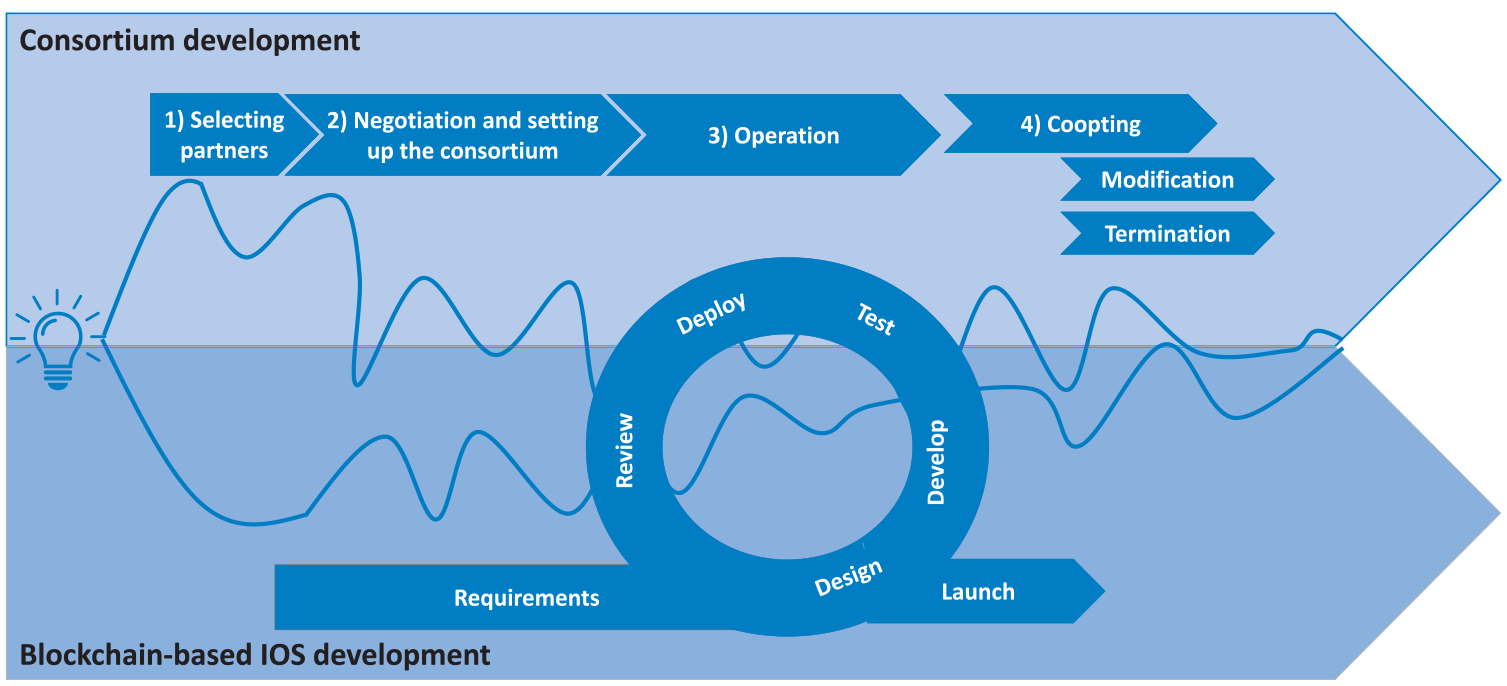
Parallel development and entanglement of consortium and blockchain IOS structures.
Pre-Consortium and Blockchain System Imagination: A Flirt
Consistently, the initial spark for consortia formation is a general interest in “doing something” with blockchain technology. In other words, blockchain technology is often a solution in search of a problem. The lack of immediate needs is substituted by the “cool factor,” which new technologies often come wrapped in. Despite being an understudied factor, it repeatedly emerged through our interviews with prominent stakeholders as the initial spark for exploring future partnerships:
“we were looking . . . for areas and where to apply [blockchain] technology. So, it’s not the use case which drove the solution, which should be the normal way. But it was more technology trying to find a problem to solve.”
In this stage, one or several companies have the idea of developing a blockchain-based system. As exemplified by this quote from a consortium member, such ideas are often driven by individuals interested in blockchain technology who connect with others at blockchain-related meetups or cross-organizational innovation events or workshops:
“And then we founded a community in [CompanyX] for blockchain, where we also invited external acquaintances, friends, partners, whatever you want to call it, and at one of these community meetings, our colleagues . . . from [CompanyY] were present, saw our showcase and then one thing actually led to another . . .”
Existing (often informal) relationships between individuals from different organizations or current interorganizational relationships are other options that initiate a “flirt” to start brainstorming about a collaborative blockchain project.
Interestingly, industries that have shown an interest in blockchain consortia are not the ones that usually include a high number of digital champions. 50 Together with the Software & IT Services industry, the financial sector was at the forefront of participating in blockchain consortia since 2015. Companies from the Education, Nonprofit, and Transportation & Logistics sector were next to start joining blockchain consortia. Coinciding with the overall peak of newly established blockchain consortia in 2018 (Figures 2 and 3), we observe the use of blockchain consortia in various industries, with the sectors Energy and Mining, Healthcare, Manufacturing, and Public Administration taking a leading role among those later adopters. In addition, as with personal partnerships, some locations seem to be more conducive to starting (and advancing) a relationship than others. As such, blockchain hubs in countries like the United States, the United Kingdom, and Switzerland provide a favorable environment for finding partner candidates and establishing a consortium.
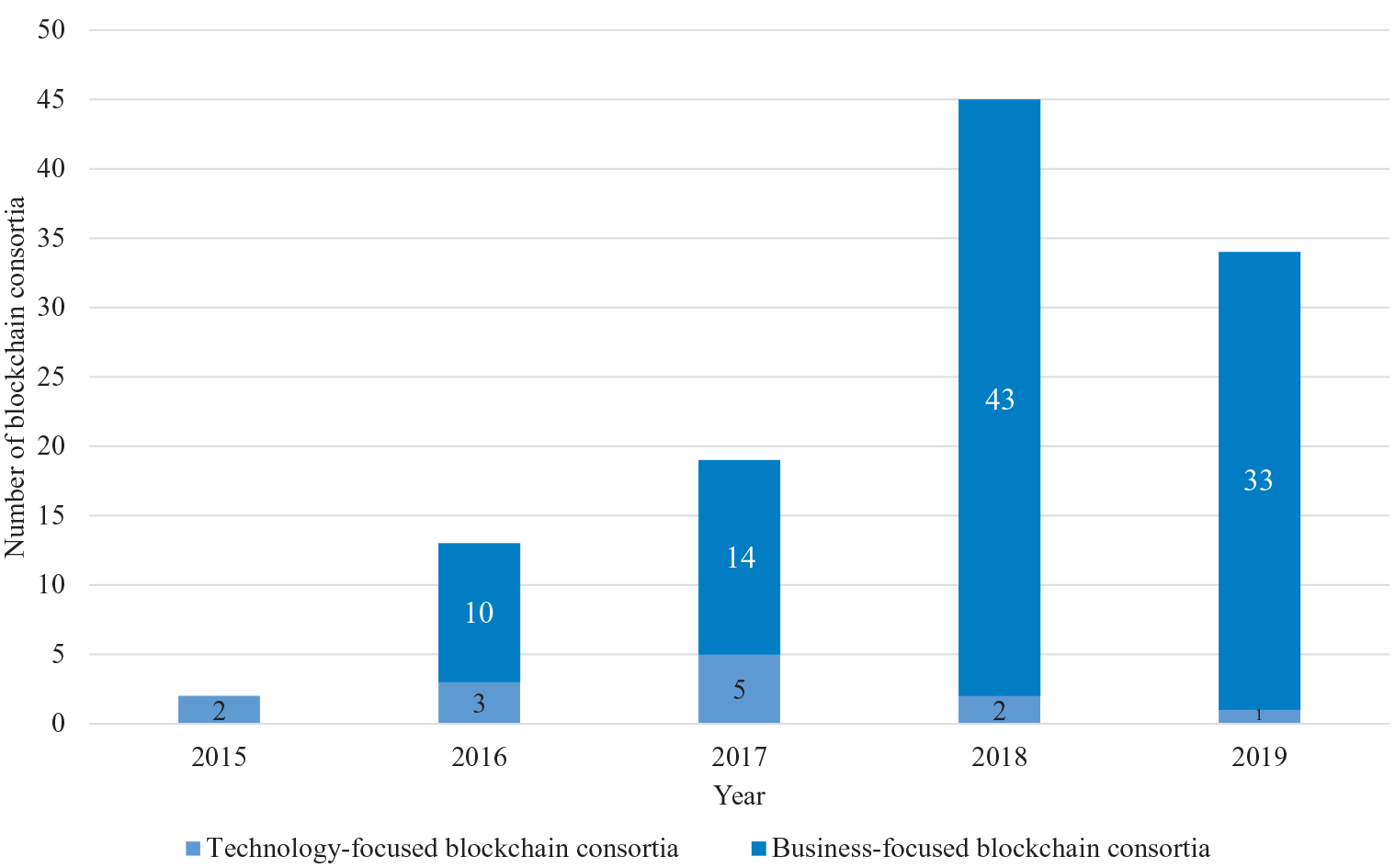
Inception of business- and technology-focused consortia over time.
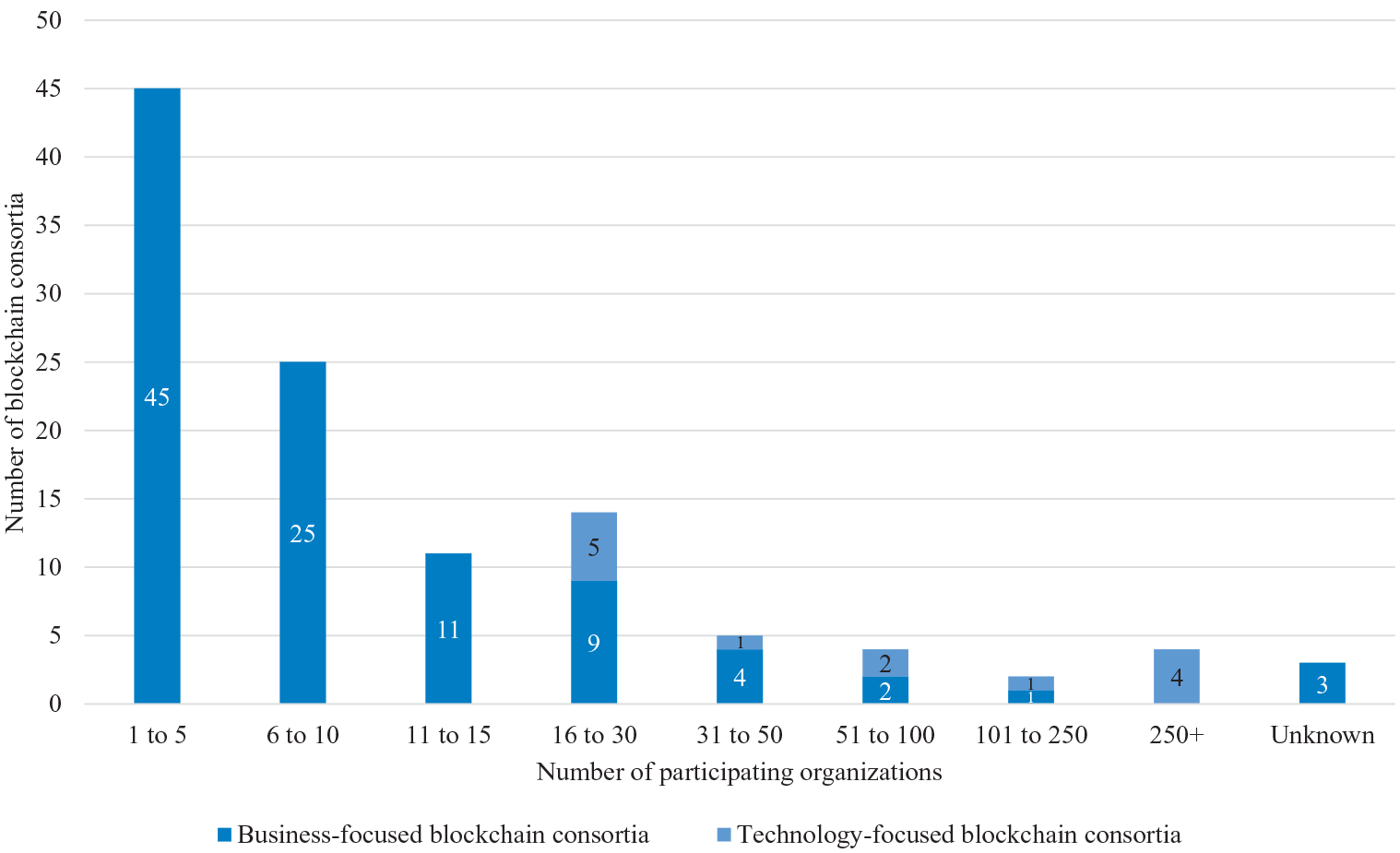
Number of participating organizations in business versus technology-focused blockchain consortia.
Selecting Partners: Dating and Chemistry
After establishing a rough idea of the intended blockchain-based system, one company or a core group of initiating companies start looking for and recruiting additional members. Selecting partners is a crucial step because “the choice of a spouse largely determines the fate of a marriage.” 51 Not unlike many singles, they are hesitant to leave their comfort zone and remain fishing in familiar ponds. However, not unlike some spouse hunters, the one sought for might be highly reputable, like a large organization in our cases. This second stage needs to be considered from different angles:
Complementarity and Chemistry—In the process of dating, consortium member candidates need to make sure that there is a fit in terms of resources and skills that different partners contribute to the consortium’s project for building the platform and managing the process. (This would be the phase in which two people sense if there is chemistry between them.) Such resources and skills include technology skills (e.g., blockchain implementation skills), domain knowledge about the intended system’s focus, project management skills, and marketing skills. Besides resources, potential partners should be contacted by considering which interorganizational processes will be supported by the future platform. For instance, a consortium aiming at a blockchain system supporting a supply chain process would recruit firms from different supply chain steps, while a consortium intending to build a system for sharing patient information would reach out to members from industries who could benefit from such data. A consortium member involved in the partner selection process summarizes the importance of considering the value chain:
“we just realize[d] that it doesn’t make sense to make something like a [blockchain-based system] without having business partners from the ecosystem. For us, it was important to cover the whole lifecycle of a [object] to get the various data sets from the partners . . .”
Compatible Goals and Mutual Benefit—As we discussed, interfirm arrangements are doomed to failure if the different partners’ interests cannot be aligned, or complementarities cannot be pursued. Earlier than others, blockchain consortia need a joint value creation strategy 52 that allows consortia members to develop and realize their business cases while also contributing to the consortium’s goals. As exemplified by the quote from a consortium manager, the targeting of a common industry problem, such as building a blockchain system to comply with regulatory demands, is a well-suited case for joint blockchain initiative as it benefits all members while not touching companies’ core business:
“We are picking business problems that are not a competitive advantage to anybody. They’re just crappy. . . . [The consortium member firms] will compete on better molecules in the world. They’re not going to compete on how the financial process goes.”
It is worth noting that, consistently with our overarching analogy, partners select each other based on formal fit and the chemistry among them when considering a shared future.
Size of Member Firms—Established partners seem to be attractive. Indeed, of the 486 companies that we identified as members of one or more consortia, almost 60% are large organizations. Similar to previous forms of IOS, blockchain-based IOS seem to be adopted to manage interorganizational relationships between large organizations. Having big players onboard, such as large and reputable organizations, can be a strategy to achieve visibility of a newly established consortium early on, which may also help to onboard more organizations and gain market penetration once the blockchain-based system is set up. At the same time, large organizations can generally contribute more financial and personnel resources to a consortium. On the other hand, initiating firms should consider the potential influence of large member firms on decision-making processes and the collaborative dynamics in a consortium. Size may come with dominance and higher levels of bureaucracy, which means that larger member firms could distort the collaborative spirit and slow down decision-making processes despite the benefits.
Trust and Cohesion—In contrast to the commonly held belief that “trust machine” blockchain facilitates cooperation between almost anyone, soft factors of collaboration play a decisive role in forming and consolidating blockchain consortia. Would you date (and continue dating) someone you do not trust? In line with previous work on alliances 53 and recent work in interorganizational blockchain initiatives, 54 interorganizational trust is a safeguard against opportunistic behavior and is necessary for working together over an extended period, plus it helps negotiate and commit to the rules of future collaboration. Strategies to mitigate complexity and increase cohesion include keeping the consortium small (i.e., a maximum of ten members). A consortium manager explained,
“A very important decision and success factor is that you have the players on board from day one, and then the question is which ones and how many, and that is very difficult, not too many and not too few, but the right ones, it has to be important ones, i.e., big players. [. . .] I wouldn’t bring any competitors on board at the very beginning, later you need them, but not at the beginning; otherwise, you don’t get off the ground, and we were then all in all seven partners, and I think it was just good to have them on board.”
Similar to endogamy (marriage within a specific group), this means that companies tend to remain within their social circles and use blockchain consortia to facilitate and develop their existing business rather than establish partnerships for entirely new businesses. Indeed, we find that organizations tend to form consortia with other organizations of similar size and from the same or related industries. Given that blockchain has been primarily adopted in conservative industries and comprises large organizations, it can be seen as a technology for incumbents who are unwilling to abandon their comfort zone. At the same time, the usual handsome early mover at high school may not be the best partner for long-term commitment later in life.
Negotiation and Setting Up the Consortium: From Situationship to Moving in Together
In this phase, partners who have developed an idea for a blockchain-based system and have informally agreed to work together formally commit to this collaboration by signing a cooperation agreement.
Location, as in where partners decide to move in together, plays a decisive role in blockchain collaboration, more than in other more placeless technologies like cloud computing or AI. In this regard, the United States, Switzerland, the United Kingdom, and Germany are the top locations for consortia’s headquarters and their constitutive members. Where blockchain consortia are established seems to correlate with the locations where blockchain innovation generally occurs. The United States, United Kingdom, and Switzerland are also home to the biggest blockchain hubs worldwide. 55 The fact that companies involved in blockchain innovation cluster in specific locations is a unique feature of blockchain innovation compared with other IT innovations in recent years. For example, AI does not seem to “have a location”. We reason that some jurisdictions, especially smaller ones like Switzerland, have been faster in adapting their regulatory environment, which is particularly relevant for this technology, to accommodate the specific requirements of blockchain-related companies. Switzerland, for instance, has amended its laws to account for the specifics of distributed ledger technologies. 56
Besides deciding on a location, partners must discuss and commit to the resources they will contribute to the joint venture (e.g., financial resources and personnel) and establish communication and governance mechanisms 57 for the consortium (e.g., modes of decision-making) and the blockchain-based system itself (e.g., infrastructure deployment and management).
In terms of governance, the role of the technology provider, meaning the company that implements the consortium’s blockchain-based system, is key. Besides the financial sector, software and IT services companies—often involved in many different blockchain consortia—tend to act as brokers (they may have also started earlier, in phase one, acting as matchmakers) in the overall network of collaboration in blockchain consortia. This is not surprising because such companies typically develop blockchain solutions that companies in other sectors then employ. However, we want to point to a potential new role that such companies may play in blockchain consortia beyond developing and delivering a software solution. While often assumed neutral, or mere executors by the other members, technology companies act as network orchestrators
58
(or matchmakers following our analogy) in that they play a central role in initiating and maintaining a blockchain consortium as much as starting new ones based on their own business interests. As such, IT companies may pursue a strategy of scaling up (i.e., seeking to establish new or growing existing consortia in industries about which the technology company has domain-specific knowledge) or scaling out (i.e., leveraging and translating domain-specific knowledge into neighboring sectors). While some argued that industry consortia should advance standards,
59
up until now in our study, technology companies tended to have been in powerful positions to arrange partnerships and influence the rules of collaboration across industries. To keep technology firms’ vested interests in check, consortium members need to carefully evaluate the consequences of design decisions concerning the role of technology firms in a consortium, such as being a solution provider only or a full-fledged member on a level playing field with other consortium members whose responsibility is implementation. A consortium member describes this balancing act:
“So yes, if [the technology providers] are part of it, they have skin in the game, maybe more motivation, strive a little bit more to push that forward, on the other hand, how much are you locked in then, especially with [PlatformX], who knows if in four years [PlatformX] still exists?”
Operation: Probing for a Long-Term Commitment
Having moved in together, couples in this stage will “test the waters” before making a longer-term commitment. Each step, such as signing contracts together and sharing expenses, can be seen as deepening their relational and technological integration. After an extended period, telling apart mine and yours from ours becomes challenging. Breaking up and moving out becomes harder (and a deterrent from breaking up in case of problems).
Blockchain consortia in this phase implement the consortium’s goals by jointly building a proof of concept (PoC) of the blockchain-based system to achieve IS integration. As an interorganizational endeavor, software development and project work tend to happen in a geographically distributed manner and often draw on agile methods. System requirements derived from negotiations in the previous stages are used as input and refined or changed as the blockchain system is built. While agile and iterative approaches to software development are widely used nowadays, they are not easily aligned with building a blockchain-based system. Adding to or refining bits and pieces of a system sprint-by-sprint means that consortium members make many small decisions while delaying the fundamental ones, which should shape the smaller ones. Relational and technological integration are intertwined, meaning that the negotiated governance structures will eventually be inscribed into the code of the blockchain-based system. So, there is an inherent tension between using an iterative development approach on one side while, on the other, an overarching commitment is needed. A sluggish commitment at this stage creates uncertainty and may lead to vaporware that will never actually go live.
As shown in Figure 4, a relatively low number of consortia have made it to the stage of going live. About a third of the consortia in our data set are merely announced, which means we did not find information about those consortia beyond an initial press release. The hype around blockchain may have contributed to a certain percentage of consortia being abandoned as quickly as they were announced. On the other hand, the fact that blockchain consortia face a high risk of getting stuck hints at the complexity of establishing and negotiating interorganizational collaboration. Insights from these consortia suggest that the inherent complexity of interorganizational collaboration is intensified in these early stages of consortium-building by the shared and immutable nature of blockchain-based systems, which is the wedlock of our analogy. At the same time, it is still uncertain if complexity is eased by consensus automation at later stages. This is a promising hypothesis to explore in further studies.
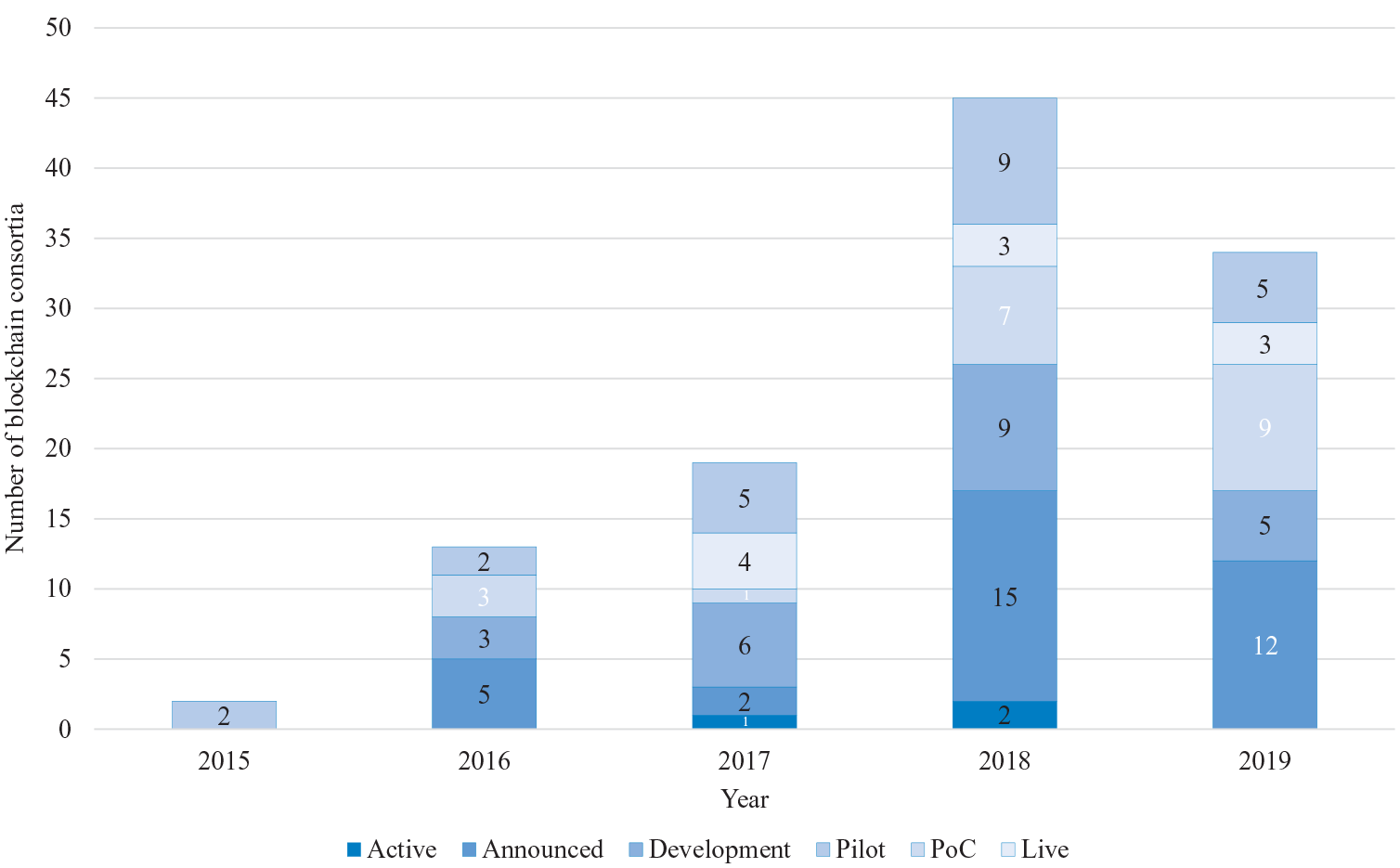
Year of inception and consortia project stage.
Co-Opting: Will You Marry Me?
While couples may remain together or break up at some point after the first PoC, blockchain consortia need to assess relational integration (collegiality and overall harmony) and IS integration (functioning of blockchain-related processes). This stage may include a renegotiation of governance structures and a modification of the upcoming PoC. If consortia members reach an agreement, they will commit to the PoC and, as a next step, work toward a minimum viable product (MVP). If an agreement cannot be reached, the consortium will dissolve. To ensure a smooth dissolution, organizations should specify a clear exit strategy or at least essential criteria for leaving 60 while `staying friends’.
Similar to a marriage, consortia in this stage often form a new legal entity, such as an association or a joint venture, to fix a specific governance structure and be able to enter legally binding agreements.
61
A consortium member describes the necessity for legality a legal entity as follows:
“. . . you must have a legal entity to be able to act at all. There are also liability issues . . .”
Following this, the implementation of the blockchain-based system is finished, and the system goes live. Additional consortium members must be recruited to increase the blockchain-based system’s coverage and achieve greater penetration in the market or cross-fertilization across industries. Onboarding new members is a challenge that must be tackled to ensure a blockchain-based system’s survival:
“[The next 14 to 18 months will show whether the consortium] also manages to build up further the that is, that the [consortium] has enough companies because with the existing ones alone we would not generate [enough] traffic. Because if we don’t have any [data] in there, we can’t optimize our processes because we simply won’t find anything. This also means that if the [consortium] doesn’t manage to get enough [partners] on board, then, of course, [scale effects] will somehow fail to materialize . . .” (see Appendix for Table 2)
Discussion and Implications for Blockchain Consortia
The ideal-typical progressive consolidation, or dissolution, of collaborative relations offers a plausible interpretation of the shift from the appealing and sparking crypto rhetoric to the deployment of blockchain technology for broader organizational purposes. In other words, our analogy introduces a new dimension to collaboration; one may trust a marriage without the need to trust the spouses as individuals, but the overall trust in the system does not amount to the sum of individuals. It may sound like a far-fetched corroboration, but in societies and cultures in which marriages are arranged, families and clans use this social institution to enforce cooperation and reduce tribal conflicts. 62 The organizations we studied rely on co-opting to acquire assets that would be out of reach for each partner even if vital to their operations. One may see this mutual dependency as piggybacking onto others’ resources or exploiting their gravitational pull. More prosaically, blockchain consortia can collaborate by relying on trustworthy records—also on external resources—even when other commitments to long-term collaboration wouldn’t support the uncertainties of life. 63
Making our interpretative lens more concrete, the novel arrangement of blockchain-sealed ledgers brings forward the practical relevance of governance concerns, at least because marriages are not managed as other collaborations. How to orchestrate the different actors that constitute consortia and operate in their ecosystems? What about the tensions and outcomes they produce? 64 The paradox of change states that if platform governance is too permissive, low-quality services could undermine the platform’s legitimacy, not unlike a facade marriage. The peculiarity of collaboration around distributed ledgers is that they force consortia members to consider scenarios and make decisions earlier than in other IT projects because later they could be hampered by the inherent immutability of those ledgers. The practical implication is that a longer-than-usual leap of faith is needed to move from flirtatious decentralization to long-term commitment without knowing what immutability will bring. Not unlike marriages, those consortia will need to navigate unforeseeable situations while remaining unable to break the vows underwritten in their mutually agreed ledger.
To manage such a leap of faith and build an immutable record including smart contracts (incomes go to both spouses, expenses, and taxes from both, etc.), industry consortia have to specify what to automatize and what to leave discretional (i.e., on-chain and off-chain rules of collaboration), and avoid an offhand delegation of technology matters to technology companies. 65 Insights from these blockchain consortia suggest that the inherent complexity of interorganizational collaboration is front-loaded—so it is intensified in the early stages of consortium-building by the shared and immutable nature of blockchain-based systems. It remains uncertain if complexity is eased by consensus automation at later stages. Starting with high expectations and enthusiasm, members of blockchain consortia seem to only realize along the way what they are building: a shared ledger that, once in place, cannot be changed easily and which has to be aligned with current and future (thus partly unknown) business goals, processes, and changing environments. So, while the inherent complexity of managing interorganizational collaboration is still in place, it is now pushed toward the early stages of design and development. The critical issue for practitioners is to realize that those same early stages are when many other competing issues (such as legal, trust, incentives, and membership) need to be sorted out.
We suggest that our analogy offers a consistent interpretative lens about how co-opting operates to create partial organizations. 66 So, to the extent blockchains perform typical organizational functions like managing collaboration, they can be seen as organization technologies. 67
Conclusion
Blockchain requires parties to collaborate: no parties, no party. However, even though it may start with a flirt at a party, blockchain collaboration requires the right environment (e.g., regulation) and partners who walk the talk and make a long-term commitment. For a blockchain consortium to be successful, member firms need to be aware of those two layers of integration—relational and technological integration—and understand how the two are interrelated and need to be aligned much earlier than usual. A blockchain consortium is not an IT project with an end date for delivering a system to its customer. Instead, in forming and shaping relational and electronic mutual dependencies, consortium members need to negotiate early on their own future rules of collaboration, the rules of collaboration with future generations of users (who may not be involved in early development), and the extent to which those rules are inscribed into and made immutable by the ledger. Audrey Hepburn said, “If I get married, I want to be very married.”
Footnotes
Appendix
Stages of Blockchain Consortia Development.
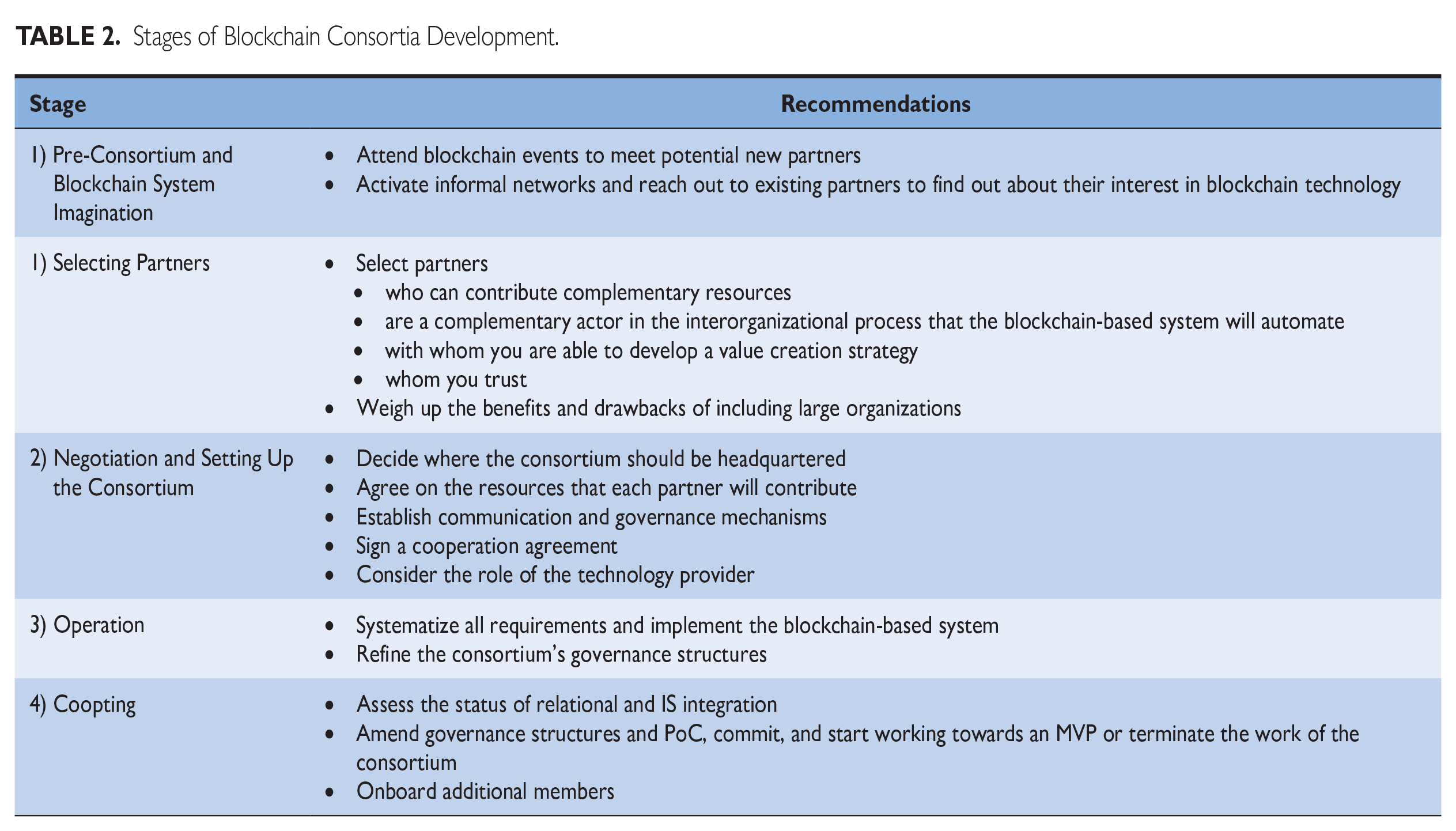
| Stage | Recommendations |
|---|---|
| 1) Pre-Consortium and Blockchain System Imagination | • Attend blockchain events to meet potential new partners • Activate informal networks and reach out to existing partners to find out about their interest in blockchain technology |
| 1) Selecting Partners | • Select partners • who can contribute complementary resources • are a complementary actor in the interorganizational process that the blockchain-based system will automate • with whom you are able to develop a value creation strategy • whom you trust • Weigh up the benefits and drawbacks of including large organizations |
| 2) Negotiation and Setting Up the Consortium | • Decide where the consortium should be headquartered • Agree on the resources that each partner will contribute • Establish communication and governance mechanisms • Sign a cooperation agreement • Consider the role of the technology provider |
| 3) Operation | • Systematize all requirements and implement the blockchain-based system • Refine the consortium’s governance structures |
| 4) Coopting | • Assess the status of relational and IS integration • Amend governance structures and PoC, commit, and start working towards an MVP or terminate the work of the consortium • Onboard additional members |
Acknowledgements
The authors want to thank the professional services firm Deloitte Switzerland, members of the Information Management Research Group at the University of Zurich as well as Fabian Leisibach, who wrote a thesis in the context of the research project on blockchain consortia, for their support in the data collection and analysis for this study. The authors also thank the interviewees for their invaluable contributions.
Notes
Author Biographies
Janine Hacker is an Assistant Professor at the Department Information Systems & Computer Science at the Liechtenstein Business School of the University of Liechtenstein doing research on how individuals and organizations communicate and collaborate using digital technologies (email:
Gianluca Miscione is a Tenured Assistant Professor at UCD School of Business, Ireland, where he conducts research on information and organization (email:
Tobin Felder earned a Bachelor’s degree in Information Systems from the University of Zurich and is currently Head of Operations at holo|one (email:
Gerhard Schwabe is a Full Professor at the University of Zurich engaging in research at the intersection of collaborative technologies and information management (email: