




Abstract
Countless enterprise blockchains fail to live up to high expectations, often because the supporting governance structures are insufficiently established or have become stagnant. Based on interviews with 153 blockchain executives and an analysis of publicly documented use cases, this article offers a guide for blockchain scholars and practitioners. Its framework highlights the coordination and control challenges that exist in blockchain governance contexts and presents four generic governance modes to address them: chief, clan, custodian, and consortium. Managers can use these governance modes as a basis for four strategic moves (connecting, isolating, loosening, and tightening) to navigate blockchain governance challenges.
Keywords
Blockchain is all about getting into an agreement with different partners, . . . having the power of influencing, and the power of establishing governance. —Manager of an oil and gas blockchain
Enterprise blockchains are hailed as the key to secure and transparent processing of complex transactions within and between organizations. 1 Enterprise blockchains are a peer-to-peer technology for validating and immutably storing transactions on a shared ledger that is distributed to participating enterprise nodes. While enterprise blockchains are increasingly recognized by managers as effective governance tools that reach far beyond the cryptocurrency domain, frustration is growing over the question of how to govern such blockchain networks. In the business context, the governance question around blockchains is often more critical and complex than the decisions to use and implement the technology. In fact, choosing the appropriate governance mode early on is crucial for the success of enterprise blockchain initiatives, especially when managing complex transactions with many parties. 2
While recent research has highlighted the potential of blockchain technologies to govern complex business transactions in secure and transparent ways, 3 the practical challenges that come with implementing a digital governance system have been largely ignored. An implicit assumption in existing research is that blockchains are self-sufficient forms of governance that run more or less “autonomously.” 4 However, in practice, this idealized view of blockchain is rarely tenable, as managers often face significant challenges in coordinating and controlling joint actions of a blockchain network. 5 Therefore, managers need to be aware that blockchains typically require governance mechanisms that are layered on top of the technical foundation provided by blockchains to achieve desired business objectives and avoid serious conflicts that could hinder adoption and success. Managers would strongly benefit from systematic approaches to blockchain governance that allow them to achieve a good fit between the blockchain as a generic technological solution and the specific needs that arise in the organizational context. At the same time, very little guidance exists for managers on how to deal with the issue of blockchain governance, as most existing blockchain research is rather technical and does not directly focus on managerial implications beyond the adoption decision. 6 Creating a strong alignment between technological solutions and organizational needs is thus very challenging and could explain the limited success of enterprise blockchains thus far. 7
To provide clearer governance guidelines for managers seeking to implement enterprise blockchain solutions, we combine insights from governance research 8 and our analysis of publicly documented blockchain use cases with rich findings from 153 expert interviews with blockchain executives and our case studies on IBM Food Trust™ and TradeLens. A central finding from the analysis of our extensive interview material is that blockchain initiatives are most successful when the underlying coordination and control issues are clearly understood and accounted for at the onset. To facilitate this important governance decision, we derive a corresponding framework that yields four generic blockchain governance modes: chief, clan, custodian, and consortium. We show which of these modes is best suited for what type of projects and give examples from blockchain use cases to illustrate each mode. Since networks are often dynamic and necessitate adjustments in governance, we further devise four strategic moves (connecting, isolating, loosening, and tightening) to channel directive actions around blockchain governance adaptations. Our overview can assist managers navigating the complex governance choices and dynamics inherent to enterprise blockchain networks to fully leverage the technology’s potential.
We integrate our governance typology with a three-stage process model that summarizes the critical decisions involving blockchain governance: analysis, adoption, and adjustment. First, to identify the most appropriate blockchain governance form, managers need to carefully analyze the network in which blockchain will be deployed, taking into account the needs and concerns of participants, to understand existing network interdependencies and competitive tensions. Second, managers should seek to understand for whom and for what purpose the blockchain is being used to tailor the coordination and control mechanisms to the network structure and the needs of the participants. Finally, managers must be aware of governance dynamics in the network that may require continuous governance adjustments. Therefore, managers may need to adapt blockchain governance over time to allow for dynamic growth of the network. This process-oriented view of blockchain governance provides the flexibility needed to steer digital organizations. Our strategic framework can help managers navigate the governance challenges around enterprise blockchains and provide a useful theoretical foundation for the emerging scholarship on blockchains.
How Firms Respond to the Blockchain Governance Challenge
The origins of digital blockchain networks can be traced to the cryptocurrency Bitcoin, which introduced modern distributed ledger technologies. 9 In essence, blockchain technologies provide decentralized and immutable transaction records that enable so-called “smart contracts” 10 that execute, track, and validate transactions among peers without relying on intermediaries. 11 In other words, blockchains are decentralized databases (transparency), where new data can only be appended if there is consensus on the new record among participants (validation), and where no data can be deleted once it is registered in the database (immutability). Given these technical features, blockchains are particularly effective for securing information flows where network participants may not fully trust each other, and the risk of fraud or opportunistic behavior is high. 12
Since their inception, blockchain technologies have evolved far beyond the cryptocurrency domain and have expanded to the enterprise domain. 13 Enterprise blockchains are featured in many applications across industries including the automobile, energy, food, global trade, government services, health care, and real estate industries. Blockchains promise significant economic benefits due to their ability to cut out the “middleman” without sacrificing security, 14 which permits direct transactions among business partners, faster and cheaper settlements, tracking and tracing of assets, data provenance, and tamper-proof security models. 15 However, as blockchain efforts among enterprises grow, so do the challenges in orchestrating the technology effectively within and across organizational boundaries. 16
Blockchain technologies offer an exciting opportunity to digitally manage large intra- and inter-organizational networks. 17 As companies operate in increasingly large and interconnected networks of customers, partners, subsidiaries, suppliers, and regulators, the need to manage these transactions efficiently and securely has also increased. 18 It has long been recognized in the management literature that network governance is central to business success, as companies operate in value networks that can only create value through the interplay of cooperation and competition. 19 At the same time, managing large networks presents managers with significant challenges, as they must bring together and align different actors with sometimes shared, sometimes competing goals. Blockchain technologies thus provide only the bedrock of digital network governance and require careful design.
To illustrate how successful blockchain networks approach governance, let us consider the example of IBM Food Trust™, which used two different governance modes during its evolution to accelerate growth.
20
IBM Food Trust™ aims to offer its network participants (e.g., farmers, truckers, and retailers) greater traceability, transparency, and efficiency for food provenance. IBM Food Trust™ was created by the technology firm IBM, in collaboration with the global retail giant Walmart, after a successful proof-of-concept with Tsinghua University in 2016.
21
In this blockchain project, IBM retained control over most strategic decisions and tightly coordinated activities with Walmart, who provided industry-specific knowledge and resources to develop the solution for its own inter-organizational supply chain network.
22
However, it soon became clear that the blockchain’s ultimate success would depend on attracting many more network participants who were critically important in the food industry. A program director at IBM recalled: We saw that a lot of the stuff that we had developed was really tailored towards one kind of retailer. . . . We quickly realized that if everybody was supposed to participate—and even though in the supply chains the retailer is king—you still really have to give everyone value.
IBM and Walmart had to pivot, proving that competitors could collaborate in the same network. With Walmart as its primary trust anchor, the blockchain solution was successfully piloted among the retailer, some suppliers, and trucking companies, which represented only a small fraction of the industry. After fruitful pilots with Walmart, additional key players from the industry (including Carrefour, Dole, Kroger, Nestlé, and Unilever) were eager to join in. “Together, powerful retailers and food manufacturers can do a whole lot more,” said Kroger VP Howard Popoola when interviewed on Food Trust.
23
To accommodate competitors’ skepticism about the blockchain’s organization that was geared toward Walmart, the governance mode assumed in the beginning had to give way to a new structure. The addition of large players called for a more decentralized governance approach to reflect the increasing interdependencies across organizational boundaries. In response, IBM decided to introduce coordination mechanisms designed for multiple retailers—such as Carrefour and Kroger—that were competitors to Walmart. This new coordination structure manifested in the introduction of guidelines for decentralized data ownership, clear rules of engagement, and advisory councils.
24
In the words of the IBM General Manager of Blockchain Ecosystems, Raj Rao, the advisory council is basically a convening initiative where IBM plays the role of a convener to bring together the industry while they have competing businesses and often different viewpoints on challenges in the industry. They also share a lot of the same challenges: data security; trust in data; the ability to have systems that can interoperate with one another; and the ability to agree to common standards for sharing data. These are things that everyone in the food industry, or even in the logistics industry, tends to agree are universal challenges. . . . Being able to use a platform that solved the majority of the challenges, I think, was the most interesting aspect of driving it forward.
Today, IBM Food Trust™ is one of the largest and most active enterprise blockchain networks. 25 This telling example of a successful blockchain governance implementation holds many important lessons for managers. Most importantly, IBM Food Trust™ has managed to design effective governance structures and adapt them over time. In the following, we systematize the underlying strategic rationales and provide a guide for managers charged with blockchain governance.
A Strategic Guide to Enterprise Blockchain Governance
It is important to realize that blockchains are typically used for business processes where trust is critical. Because of this sensitivity, it is a highly strategic, highly political technology decision to adopt blockchains. (CEO of a blockchain service provider)
When it comes to deploying blockchains in a business context, managers should think far beyond the mere technical aspects. Most importantly, managers need to establish clear governance structures for blockchains that closely align with the overall vision for the network and reflect the parties’ roles in the transaction network. Previous research has begun to recognize the importance of blockchain governance to the overall success of blockchain initiatives. 26 An important insight from this emerging scholarship is that blockchains do not represent a self-sufficient governance mode but need to be complemented by a well-balanced governance structure that is layered on top of the technical solution to ensure that the blockchain solution addresses the desired business needs. 27 In particular, this includes the careful consideration of the coordination and control challenges that arise when blockchains connect multiple actors. To provide managers with a guide to these challenges, we complement existing insights and the experiences of blockchain experts who we interviewed to focus attention on the most pressing and common issues in establishing enterprise blockchain networks.
Research Methods
Our findings originate from extensive qualitative, in-depth interviews about blockchain governance and adjacent themes with 153 blockchain executives worldwide. The sample covers most major sectors, including industrial, consumer goods, financial, information technology, telecommunication, and utilities. The interviews took place between 2019 and 2021. Each interview lasted between 25 and 90 minutes and was recorded and transcribed verbatim for subsequent qualitative analysis using ATLAS.ti. In the analysis of our interview material, we followed established research methods. 28 The findings for this article are based on direct quotes from practitioners that we aggregated to overarching themes and dimensions. 29 The insights presented here reflect a synthesis of the most salient topics described by managers, which appear to be of particular practical relevance. All company and individual information in this article is drawn from publicly available sources or we have obtained explicit permission to use them. At the request of some interviewees, we anonymized some of the quotes to protect blockchain projects that were considered highly confidential. We supplement our interview material with our extensive analysis of blockchain use cases that are publicly documented as a means to balance and triangulate our interview material. Details on the methods and supporting interview quotes can be found in our Online Appendix.
Coordination and Control in Blockchain Networks
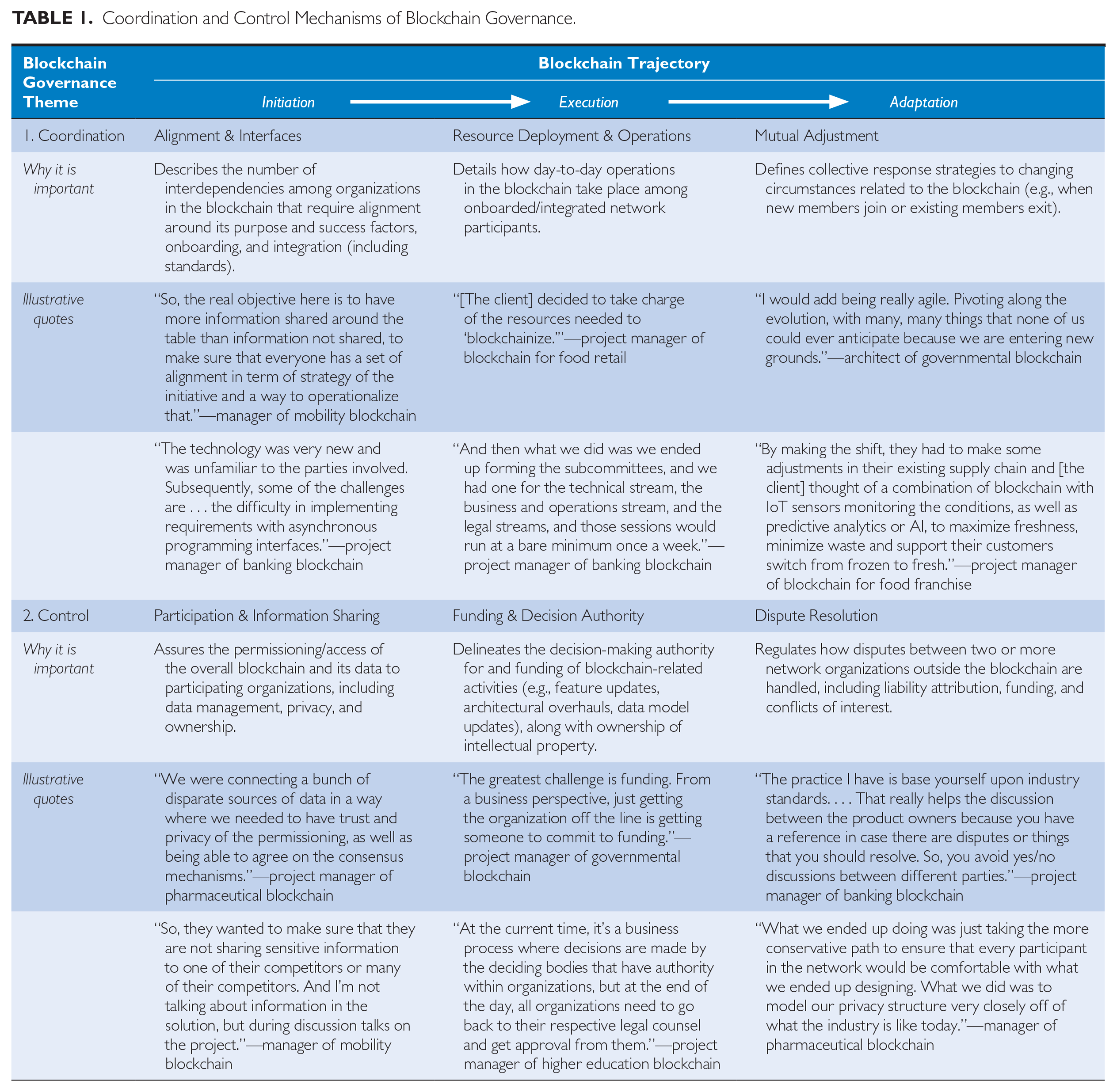
A recurrent theme in the governance literature and our interviews relates to the management of the coordination and control challenges present in blockchain networks. 30 These challenges arise because blockchains often forge new connections and change the way transactions are carried out. From a technical perspective, this reorganization occurs because blockchains enforce radical peer-to-peer interactions in a decentralized way, which departs from the traditional hierarchical forms of organizing and the reliance on intermediaries. 31 The shift gives rise to coordination and control concerns that are unique to the blockchain context and which pose a critical managerial challenge. Table 1 highlights these coordination and control challenges of blockchain governance, along with illustrative evidence from our interviews.
Coordination and Control Mechanisms of Blockchain Governance.

Coordination
We told our blockchain client from the beginning: “you need to set up structured governance processes. We need to coordinate more,” and they always refrained from including additional parties in their process. (Architect of a construction blockchain)
Coordination refers to the management of interdependencies that exist within and across organizations. 32 Since blockchains are often used in environments with high organizational interdependencies, there are numerous coordination tasks that occur over the growth trajectory of a blockchain. Our research identified three distinct coordination challenges that are elemental to the design of blockchain governance: alignment and interfaces; resource deployment and operations; and mutual adjustments. Regarding the first challenge, our interviewees highlighted how coordination was often needed during initial project phases to align the high number of interdependent organizations around a common purpose, while simultaneously getting organizations to use the same (technical) language. Next comes the problem of coordination during the execution phase, when there is typically a strong need to coordinate the effective use of resources and the ongoing operation of the blockchain. A third major coordinative task surfaces during the adjustment phase that demands a form of coordinated adaptation among network members, especially when new members join or existing members exit.
Our findings further reveal that these coordination challenges can either exist within a given organizational hierarchy or be transferred to a dedicated interface where coordination is orchestrated across organizations. This locus of coordination is a critical determinant of the governance mode. For instance, if coordination primarily pertains to activities within an organizational hierarchy, this warrants a more concentrated governance mode compared with transactions involving interdependencies with other organizations. Coordination that takes place across organizational boundaries increases governance complexity, as aligning interests in “politically” charged settings incurs significant administrative costs. Coordinating activities across organizational boundaries may also involve aligning with competitors whose goals and incentives may differ. Therefore, it is crucial that managers consider coordination early in the process to account for the evolution of the blockchain network and whether it might expand to external organizations.
Control
Companies simply do not want to give up control. If anything, they want to usurp more of it. The simple answer is to recognize this fact—central authority is here to stay in the enterprise. But that doesn’t mean centralized organizations cannot embrace decentralized applications wrapped by their centralized services. (Avivah Litan, analyst at Gartner Research)
33
Control relates to the allocation of decision-making authority in relation to the blockchain network. 34 Specifying clear control mechanisms and the associated decision rights is critical to ensuring that blockchain projects can move forward despite sometimes divergent interests among participants. Overall, three salient control challenges emerged from our interviews: participation and information sharing; funding and decision-making authority; and dispute resolution. For example, our interviewees mentioned that approval rules for the blockchain and its data are an important control consideration to initiate a blockchain network. Another control issue is the delineation of decision making for blockchain-related activities (e.g., feature updates, architecture overhauls, and data model updates) that are critical to moving a blockchain project beyond the initial phase. Finally, arrangements need to be made for how disputes between network participants are resolved (e.g., regarding funding or conflicts of interest) and who holds the final decision-making authority in case of a deadlock.
Control comes in different facets. In most governance structures of enterprise blockchain networks, control is either centered on specific organizational actors or is shared between organizations. The locus of control has direct consequences for blockchain governance. If control is centered, one organization in charge calls the shots for the network. If control is shared, organizations need to agree on matters such as the future direction and funding of the blockchain, permissioning rules, data visibility of transactions, and dispute resolutions. Such control matters are distinct from coordination activities in that control enforces and regulates elements of the blockchain governance structure through formal decision-making authority. 35 Control is an important lever to understand for blockchain governance because it determines how much sovereignty organizations retain in defining their network strategy. For instance, a large industry player with a vast supply network may find it easier to impose a tightly controlled governance mode with strict decision authority due to its market share compared to a small, new entrant that might have to share control among various industry organizations. Together, coordination and control make up the two overarching axes that shape blockchain governance.
The Four Modes of Governance for Blockchains Explained
The decision on the loci of coordination and control described above translates into four generic governance modes: chief, clan, custodian, and consortium. Each of these four modes has certain characteristics, advantages, and disadvantages and it is important that managers be aware of them in reflecting on their preferred governance mode. The governance modes illustrated in Figure 1 are explained and illustrated in more detail below.
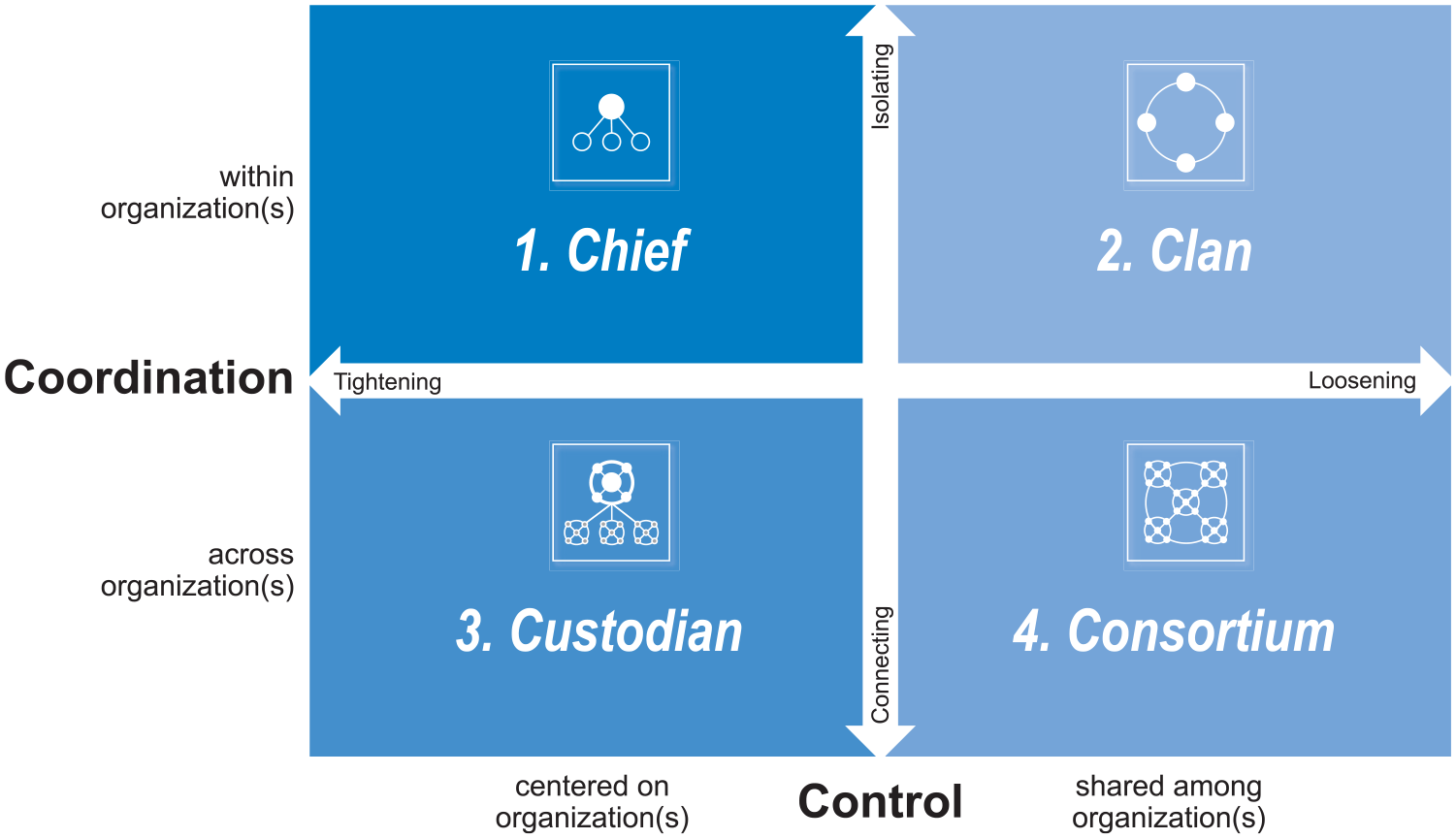
Four Modes of Governance for Blockchains.
Chief
Blockchain really makes things easier in this case, because it gives you the tracking of actions, auditing of the assets, and data integrity. That is for sure something good that blockchain delivers. But the network is related to the same organization. . . . The solution was dedicated to an internal process among several different legal entities. (Manager of an oil and gas blockchain)
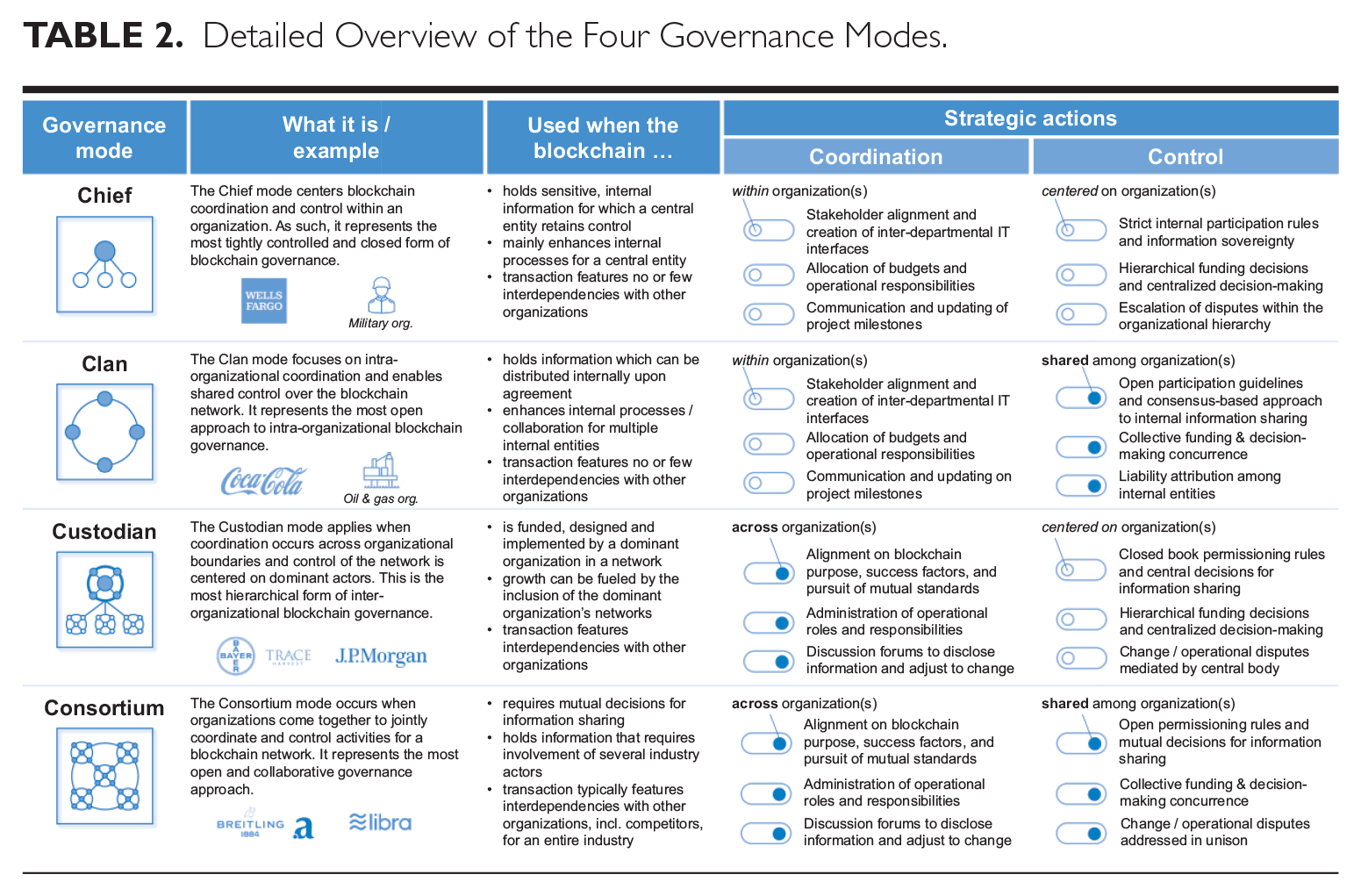
The chief mode emerges when a blockchain is orchestrated and directed by the same instance, that is, coordination and control reside “in-house.” As such, it represents the most tightly organized and closed form of blockchain governance. The chief mode typically occurs when large corporations fund and control blockchain initiatives designed to administer relationships with customers (e.g., loyalty programs) or subsidiaries (e.g., internal transfer pricing) while restricting the scope to the narrow confines of their own organization. The chief mode has coordination activities that lie within the focal organization, which applies to stakeholder alignment and creation of inter-departmental IT interfaces, allocation of budgets and operational responsibilities, and communication and updating of project milestones. Similarly, control is centered on specific organizational actors as the chief mode has strict internal participation rules and information sovereignty, hierarchical funding decisions and centralized decision making, and escalation of disputes within the organizational hierarchy. This governance mode is especially beneficial for holding companies with many loosely coupled business units that engage in frequent interactions where transparency is critical. Because the blockchain initiator retains critical decision-making authority, the speed of execution can be quite high in this mode. The mode’s downside is that the top-down governance approach often creates conflicts in intra-organizational settings because the needs of individual subsidiaries are not sufficiently accounted for in the network and thus clash with the strategic intent of the parent organization. For instance, power dynamics between strong and weaker subsidiaries—for example, high- vs. low-performing geographies—can provoke boycotts if interest groups are not adequately represented.
The chief governance mode was adopted in a blockchain pilot project by Wells Fargo. The bank decided to introduce “Wells Fargo Digital Cash” to improve internal cross-border payments within the Wells Fargo Group. 36 Wells Fargo Digital Cash is a tokenized currency that is run in the bank’s private blockchain network. It is a classic example of a chief governance mode because blockchain transactions are bound to Wells Fargo as a focal actor in the network who coordinates activities and because the transactions are proprietary to the group and its subsidiaries for internal optimization. Lisa Frazier, head of the Wells Fargo Innovation Group, commented that the solution is “faster than SWIFT, cheaper, and definitely more efficient,” indicating that this governance mode can be encouraging for intra-organizational, tightly knit blockchains. 37
Despite such positive pursuits of the chief governance mode, the mode can also meet resistance given certain conditions. In our interviews with a military organization that pursued a chief governance mode, the greatest challenge became expanding beyond their “proof-of-concept” phase and inviting external suppliers to join. The root cause of this issue was their rigid and hierarchical pursuit of standards and regulations for security purposes—applicable to their own organization—that made it near-infeasible and less alluring from an integration standpoint for other parties to join. As stated in an interview with a consultant working on the case, the biggest lesson learned is that the proof-of-concept is usually the easy part. It goes off without a hitch, and it can satisfy the customer’s needs. But then getting to that next step—bringing in external partners, growing the network, expanding the scope of the use case, and the application on the blockchain—is the most difficult part of working with the technology.
Clan
[We had] no external parties, but internal, in terms of an internal auditor. We did have an internal audit perspective on the project, but it wasn’t a project consortium, just in terms of having oversight. For external . . . it didn’t end up going there and I don’t think it ever would have with the nature of the products that we were doing. (Manager of a pharmaceutical blockchain)
Similar to the chief mode, the clan mode coordinates activities within an organization but differs in that it permits shared control over the blockchain network. The clan is a blockchain governance mode that is often used when an organization and its subsidiaries, departments, or internal auditors strive to optimize operations and share control over information sharing, funding, decisions, and disputes among functional departments or national subsidiaries. In rare instances, the clan mode can also involve external organizations, for instance, when multiple organizations decide to fund a blockchain and reign over its decisions but leave coordination of day-to-day activities to the organization that actually uses the solution (e.g., BlockLab’s “Deliver” platform 38 ). This means that while coordination activities in the clan mode (e.g., alignment, operations, and mutual adjustment) are still within an organizational hierarchy, control (e.g., participation, funding, and dispute resolution) is shared among participants. Typically, the clan mode enables shared control among organizations, with open participation guidelines, a consensus-based approach to internal information sharing, collective funding and decision-making concurrence, and shared liability attribution among entities. The clan mode shares common benefits with the chief mode, such as the possibility for organizations new to blockchain to first align their own purposes in tight internal collaboration before expanding to a broader inter-organizational network. Since decisions are participatory, this mode fosters a supportive, network-wide culture and drives solutions that are designed for all entities. On the other hand, we often see cumbersome attempts when this mode is expanded to a larger number of organizations (a strategic move we later refer to as “connecting”) because coordination activities have been aligned specifically for one organization rather than multiple potential organizations in the network. Hence, process and data standards might be overlooked, and the internal focus might make it difficult for other organizations to join later on.
The clan mode was adopted by Coca-Cola for 70 franchised bottling organizations operating across its $21 billion supply chain. 39 The blockchain was formally announced and set up by Coke One North America (CONA) and SAP in 2019. CONA is the shared IT platform provider for 12 of the largest Coca-Cola bottlers in North America. 40 CONA’s Andrei Semenov explained how the decision to introduce a blockchain originated from a need for better coordination within Coca-Cola’s own supply chain: “There are a number of transactions that are cross-companies and multi-party that are inefficient, they go through intermediaries, they are very slow. And we felt that we could improve this and save some money.” 41 Using blockchain in the Coca-Cola production line, bottling companies can fulfill orders for the brand more reliably and at a faster pace because inventory data are stored immutably and are transparently accessible. As a result, the firm hopes to see their usual 50-day reconciliation time drop to under a week. 42 The beverage giant has started to consider expansion and integration with other players, including Walmart and Target. 43 At present, CONA focuses on the Coca-Cola bottling franchises, 44 indicating that the clan mode can be used to effectively coordinate internal processes with a shared control structure.
Although some firms fair well with the clan governance mode, it is not suited for all situations. From our interviews with an oil and gas giant, who built a blockchain shared among its subsidiaries using the clan governance mode, communication became a key struggle, as all subsidiaries (more than ten legal entities) had to align on the overarching goal of the blockchain. “It was not miscommunication but more messy communication, while internally it was really no communication at all in certain moments. So, we had to go with assumptions, and those assumptions caused us to rework,” a senior manager of the oil and gas blockchain recalled. Although the use of blockchain was clearly advantageous in terms of traceability, immutable history, and data segregation, significant communication efforts were required as a result of the coordination within organizations in the clan governance mode to argue why traditional databases would show less of an impact compared with blockchain. This was amplified due to the shared control in the governance mode. According to the senior manager, there was a typical battle between headquarter and operating companies. The operating companies have a lot of power because they are the ones producing all the oil and gas. Then the headquarter is where a lot of senior people are sitting, making policies and all of that. There was a natural friction.
This friction of shared control led to sluggish decisions in how the blockchain would introduce a more modern way of working, “away from their traditional ways of doing things over email or Excel sheets.”
Custodian
Currently, we’re thinking about a founder-led network for the first part. But we’re aiming to scale this once we are comfortable with the network status, and then scale it out to a consortium-based network. (Architect of a construction blockchain)
The custodian mode applies when coordination occurs across organizational boundaries and control of the network is centered on a single actor. 45 In other words, the locus of coordination activity resides outside the organization’s boundaries while the locus of control remains within the focal organization. Typically, a custodian mode is used when a large dominant organization in a network funds, designs, and implements a blockchain and leverages its existing network (e.g., suppliers and customers) to fuel growth. Contrary to the former two modes, coordination takes place across organizations, in that inter-organizational relationships must be synchronized around a common blockchain purpose and operation. However, not all aspects of the custodian mode are as open to outsiders. The custodian mode exercises hierarchical control through one organization, which means that there are closed book permissioning rules and central decisions for information sharing, hierarchical funding decisions and centralized decision making, and disputes that are mediated by a central body. The custodian mode has the clear advantage that speed is prioritized for the focal organization that launches the network. Instead of giving all network members a say in strategic decisions, the custodian mode prioritizes fast decisions and their execution based on sufficient blockchain “trial runs” by one or a few key organizations. If the focal organization has a suitable existing network, it can easily fuel initial growth by convincing allied organizations to join. The downside of the custodian mode is that it can alienate critical network organizations, and decisions made upfront by the focal organization may need to be revisited or altered to accommodate such requests.
The custodian governance mode was successfully pursued in the IBM Food Trust™ case outlined above. This is a custodian governance mode because IBM coordinates blockchain-related activities with other network participants, such as farmers, truckers, and retailers, using a dedicated advisory council for industry alignment, operations, and mutual adjustments, but retains control over the blockchain’s governance in terms of funding and decision authority. Another promising example of the custodian governance mode is the TraceHarvest Network, which similarly enables traceability of agricultural products through the supply chain. 46 In this case, control lies with Bayer Crop Science in close collaboration with BlockApps. Bayer Crop Science served as a founding member and active user of the network for trial runs with live customers before they announced plans to open the network and expand globally. 47 According to TraceHarvest, 48 cross-organizational coordination was intended from the start, so “any agriculture business or partner that wants to be part of the industry’s transformation is also welcome.”
Conversely, the custodian governance mode can also lead to difficulties in onboarding competing network participants. Many banks have become familiar with the issue. “Banks and other financial institutions have invested millions of dollars to test new blockchain systems aimed at reducing the costs and complexity of cumbersome processes. . . . Few projects have been deployed at scale so far.” 49 One particular issue mirroring the pitfalls of custodian governance was witnessed recently in the “Quorum®” blockchain by JPMorgan, an enterprise variant of the Ethereum blockchain intended to facilitate collaboration across different blockchain networks. The network was launched and run by JPMorgan as the focal organization, intended for inter-organizational collaboration. Will Martino, former lead engineer for JPMorgan’s first blockchain Juno, points out that “if JPMorgan, one of the biggest companies ever, can’t drive adoption, even when they have a great internal use case, you have to ask yourself ‘why’?” 50 JPMorgan struggled to onboard large incumbents such as Morgan Stanley, Wells Fargo, and Bank of America, given the tight control JPMorgan retained over the network. JPMorgan sold Quorum® to ConsenSys in late 2020. 51
Consortium
I’m a big proponent of the idea that for each member type that’s involved in the network there should be at least two client representatives of each. Otherwise, if there’s just one, sometimes they think that they can exert certain control. (Manager of a pharmaceutical blockchain)
The consortium mode occurs when organizations come together to jointly control activities for a blockchain network across organizational boundaries. It thus represents the most open and collaborative governance approach. What makes up a “blockchain consortium” is still an ongoing debate. 52 Because consortia are founded for cross-organizational blockchain networks and are essentially an association of several companies, we often see this type of governance mode when large corporations come together in a blockchain network to solve pressing business problems for an entire industry. While the consortium mode enables coordination across organizations, it differs from the custodian mode in that control is shared among organizations as well. This means that a consortium favors consensus-based decisions regarding information sharing, reigns over funding and strategic decisions, and allows for collective handling of operational disputes. The consortium mode has the advantage that ideally all critical network organizations are at the table when decisions are being made. This early inclusion of key parties raises conflicts early and allows the network to address them collaboratively. A consortium mode will thereby facilitate consensus between organizations in crucial areas such as network intent, feature requirements, technology roadmaps, voting rights, advisory boards, and entry-exit criteria. The downside we have often witnessed with this mode of governance is a high level of bureaucracy over building a working solution. It can take years for large organizations to agree on key points, requiring iron-clad contractual agreements to assure organizations that their confidential data and intellectual property are safe.
In general, consortia hold particular promise for businesses. Take the luxury watch brand Breitling, for example, which decided to contribute to a blockchain consortium to benefit its customers. The blockchain can be used to transfer ownership of Breitling watches by means of a secure blockchain transaction. As elaborated by Antonio Carriero, Breitling Chief Digital and Technology Officer, “transparency, traceability, and tradability are the key benefits for the happy owner of a Breitling watch. The history of the watch is forever connected to the watch certificate, supported by the blockchain’s native capabilities.” Breitling understood that their brand is one of several in the luxury space and that customers can engage with multiple brands. The consortium Breitling joined—powered by Arianee—holds the advantage that customers can enjoy the immutability and transparency features of blockchain for multiple luxury brands. For instance, next to Breitling, the consortium brings together luxury watch groups such as Richemont and Audemars Piguet. 53 “Arianee is a consortium that aggregates key players of the luxury industry,” explained Carriero. Furthermore, “watch owners do not have to share any personal details to entertain a relationship with the brand from which they own a product. And owners do not need to have any privacy and security concerns anymore.” This is a classic example of a thriving consortium governance mode because large luxury players have found a way to come together “to share ideas and activate a global standard,” as described by Carriero.
However, consortia are also ripe for antitrust, regulatory, and legal issues, as recently witnessed by member dropouts at Facebook Libra. Facebook attempted to pursue a “consortium” governance mode with coordination across organizations and control shared among organizations but failed due to regulatory challenges. Libra was a consortium model given that Facebook’s governance role was “equal to that of its peers, and being fully subject to the voting cap of 1%.” 54 The “Libra Association” intended to offer a permissionless global currency whose value would be stabilized by a basket of assets. High-profile members of the Libra Association (including eBay, Visa, MasterCard, and PayPal) faced governance tensions that spawned from uncertain regulatory jurisdiction and liability for financial crimes. 55 Many critical members left the consortium, as they were unwilling to define and assume responsibility for the many disputed matters in the context of their governance structure. As a result of the struggles, Libra was rebranded as Diem in December 2020 to attempt a fresh start.
Each of the four governance modes for blockchains—chief, clan, custodian, consortium—comes with distinct coordination and control dynamics. The outline and illustrations above show that each mode has inherent advantages and disadvantages and that choosing a suitable governance mode can make or break blockchain success. Table 2 provides a comprehensive view of the four governance modes for blockchains and the strategic coordination and control actions associated with each mode.
Detailed Overview of the Four Governance Modes.
Negotiating and Re-Negotiating Blockchain Governance
Choosing the right blockchain governance mode is just one component of successful enterprise blockchain governance. Governance choices are a series of events that can occur dynamically. To illustrate these complex governance adaptations, let us consider the example of TradeLens, a prominent blockchain network that faced a turbulent governance journey and managed to mitigate the challenges successfully. TradeLens, one of the largest blockchain networks for global trade, connects global supply chain organizations—such as shippers, ocean and inland carriers, freight forwarders, and logistics providers—in a blockchain network to facilitate secure data transactions and trade workflows. 56 TradeLens was formally launched in 2017 by the ocean carrier Maersk and the technology provider IBM.
When establishing TradeLens, Maersk and IBM started small by analyzing their networks and opting for a custodian governance mode, which brought important advantages but also set the course for future challenges. This governance mode is characterized by a focus of control on a small number of actors while coordination extends to many market participants. In adopting this governance mode, Maersk and IBM focused on creating a compelling use case rather than engaging in endless discussions with other stakeholders. For instance, the custodian mode enabled quick decisions concerning technology roadmaps, data sharing specifications, and branding since Maersk and IBM were running the show. IBM Head of TradeLens, Marvin Erdly, recalled that we had a decision to make a few years ago on how we were going to do this. We could either take years and try to work out some really complex consortium model, or we could jump into the deep end with the largest player in the industry and hope we can work out a model that would bring along the rest of the industry. And we chose the second of those two.
Maersk and IBM initially fared well with the custodian governance mode when it was mostly Maersk’s network that joined TradeLens. However, as the two founders sought to expand their network, their governance decision was met with increasing resistance from competitors, who were considered essential to the network and without whom growth would be virtually impossible to secure. To meet this challenge, Maersk and IBM decided to loosen control in their governance mode, in which the competitors of Maersk were involved in the decision-making processes. They achieved this governance shift through multiple activities, for example, by seeking contractual agreement with ocean carrier competitors on issues such as founder status and legal/data ownership. Today, as a result of this strategic governance shift, TradeLens is attracting an increasing number of organizations, for instance, with the addition of the ocean liners CMA CGM and MSC. IBM’s Marvin Erdly said that the initial challenge faced by the TradeLens network was reaching a critical mass. The more entities we have on the network, the more valuable the network becomes. Other entities will now want to join, ultimately creating a network effect. This is why CMA CGM and MSC joining is such an important milestone.
57
The TradeLens success story has been one of dynamic blockchain governance, allowing tensions to be resolved through critical reflection and fast execution.
Blockchain Governance Dynamics
What we learn from the TradeLens case is that the initial governance mode is often only the starting point, and it is necessary to adapt the coordination and control mechanisms to dynamically changing circumstances. In the TradeLens case, we observed a shift from a centralized control structure to a more decentralized structure. However, reverse moves are also conceivable, in which managers react to possible decision impasses in a decentralized consortium by diverting control toward a single organization that can then act more quickly and effectively. This was the case, for example, with JPMorgan, which, due to decision conflicts in the consortium “R3” around the use of the Ethereum network, decided to exit the established consortium and focus on its in-house distributed ledger Quorum®, which would support Ethereum. 58
We conceptualize these possible governance sequences into four strategic moves as they may occur for blockchain networks: connecting, isolating, loosening, and tightening. Each of these strategic moves comes with distinct outcomes that managers of blockchains can expect as they choose and adapt to a given governance mode over time. Figure 1 highlights each of the four strategic moves managers can pursue.
Connecting and isolating
I think if I could have done this differently in the beginning, I would have some amount of focus on: “How are we going to grow this blockchain into a widely adopted decentralized solution?” It wasn’t something that we were being asked to do in the very beginning, but it’s something I think you have to acknowledge in the beginning. (Manager of a home appliances blockchain)
“Connecting” is a common strategy in which the blockchain is extended to include and coordinate external organizations. From a technical point of view, this means setting up new nodes in the network. This strategic move is beneficial as a gateway for network effects, as other organizations can be integrated quickly through open standards. Connecting is valuable for obtaining feedback from participating organizations or simply for growing the size of the network once a desirable level of maturity is reached. Since connecting involves external organizations, it is important to keep in mind that the alignment of activities, processes, and adjustments becomes much more complex. Another disadvantage is that connecting can lead to conflicts around decisions previously made for an isolated organization, for example, when defining common standards. Connecting is quite common, as shown by the example of the “Trust Your Supplier” blockchain, first built by IBM, before other organizations such as Anheuser-Busch InBev, Cisco, Lenovo, and Vodafone were connected. 59
In contrast, “isolating” is a strategic move that reduces dependencies of organizations on the outside and instead focuses future design and development on coordinative actions on the inside. Isolation has the advantage of allowing organizations to focus on their own operational needs first and pause expansion to others. This strategy is useful for testing blockchain adoption internally before involving other parties. For example, after early test runs with a few organizations, it may be beneficial to return to using the blockchain internally before involving more external organizations. Managers who pursue an isolation move should consider that they are effectively foregoing growth potentials through network effects, as they are excluding other organizations from joining. Also, when multiple organizations pursue their own blockchains in isolation, they are contributing to market fragmentation, in which there are many small networks with proprietary standards rather than a single network that is interoperable and closely aligned. The move should also be taken with a grain of salt, as organizations that were previously involved in the network could be alienated if development work continues internally. For this reason, we see isolating as a more radical approach that only applies to certain contexts in early stages of blockchain projects. For instance, a manager of an early-stage health care blockchain relayed to us the difficulties in keeping organizations engaged, which warranted an isolation move. After the founder carried out initial tests (“pilots”) with other prominent health care organizations, the organizations involved in the tests could not be converted to sponsors. The concerns of the involved organizations had to do with the founder’s governance structure, that is, “getting everyone to agree and setting up the governance based on our pilot,” as the manager recalled. The founder then concentrated on activities in-house and continued working on the blockchain governance approach internally before approaching external organizations again.
Loosening and tightening
Some clients participated in the network to gain trust and transparency, but it is really difficult to get these clients to agree to share their data in any supply chain. I think from the start, it really should have been the expectation, if they want to be part of a blockchain network, where you’re going to be increasing transparency and sharing data, that you will have to share it, obviously in a super secure way. That’s definitely a key part of collaborating on the blockchain network. (Manager of a travel and transportation blockchain)
In addition to the connecting-isolating spectrum, strategic moves around “loosening” and “tightening” control are also conceivable. Loosening describes a move in which control is relinquished to other organizations in the governance structure, for example, to facilitate more open, mutual decisions around participation and information sharing, funding and decision authority, and dispute resolution. This move is beneficial for giving network-critical organizations a seat at the table and ensuring that decisions gain consensus. Loosening also has the advantage of stopping siloed implementation activities that may not be appropriate for the rest of the network. However, loosening carries a general risk because each organization must disclose what is “under the hood” to participate. The decision also comes with the pitfall that once other entities are involved, the speed of implementation to get a working solution off the ground slows down due to communication costs. The loosening move is one we have seen with TradeLens, which relinquished control to a broader network of ocean carriers.
At the opposite end, “tightening” is a move in which control over blockchain activities is concentrated in one or a few network organizations. Tightening is advantageous in situations where organizations want to regain control over design, implementation, operation, or customization decisions, for instance, when developments take unfavorable turns. Tightening can also contribute to higher implementation speed, as decisions can be made centrally and thus with higher autonomy. Yet, tightening control typically makes it more difficult for other organizations to integrate with a blockchain. This is because tightening control can lead to a lack of exchange and emerging friction between network participants—especially among competitors—which can prevent adaptation processes and joint value creation. Particularly problematic is that the focal organization with a firm grip on the blockchain network can more easily act opportunistically and prioritize its own interests (e.g., by preferring proprietary solutions) at the expense of other network participants. Fear of opportunistic behavior and lopsided value creation can alienate network participants, slow growth, and prevent the network from reaching its full value potential. This type of bias toward a single dominant entity can be criticized by external organizations that demand a neutral solution. Tightening control was used as a strategic move by a manager of a banking blockchain that decided to “run their own blockchain, internally for themselves under their control,” after working with a consulting partner.
Each of these four strategic moves can be considered in certain combinations. For instance, loosening control may often coincide with connecting other organizations, as linking and coordinating more competitors to the blockchain might demand a shared control approach. Alternatively, tightening control can go hand in hand with isolating coordination activities. This may inherently occur when organizations drop out of a network and development activities continue internally. When combined, however, some of the moves can also become grounds for conflict. Take, for example, an organization tightening control of the network while simultaneously connecting new organizations to it. In this case, the tight control structure would dilute the potential for other organizations to join, as new joiners could rally against the firm control structure and demand an equal seat at the table. It is important for managers to weigh the benefits and downsides of these possible moves and combinations as they approach blockchain governance strategically.
Bottom Line: The Blockchain Governance Journey
Notably, it is unlikely that there is a universal approach to blockchain governance, and managers must match governance decisions to the specific circumstances and dynamics they encounter. To support managers in making these complex decisions, we close by proposing an overarching process model that can help managers navigate their blockchain governance journey. We illustrate this process model in Figure 2 as a synthesis of the testimonies from dozens of managers who have gone through blockchain adaptation processes. It is important to note that the adjustments are primarily administrative changes, and the technical layer only needs to be adjusted in some cases, for example, in the case where a blockchain needs to expand the intra-organizational focus to include inter-organizational collaboration and thus additional nodes need to be accounted for in the system. Or, in instances when selected governance issues happen “on-chain,” as is the case with token-weighted voting. 60 Most of the time, however, the adjustments in the coordination and control mechanisms relate to the supporting administrative processes.
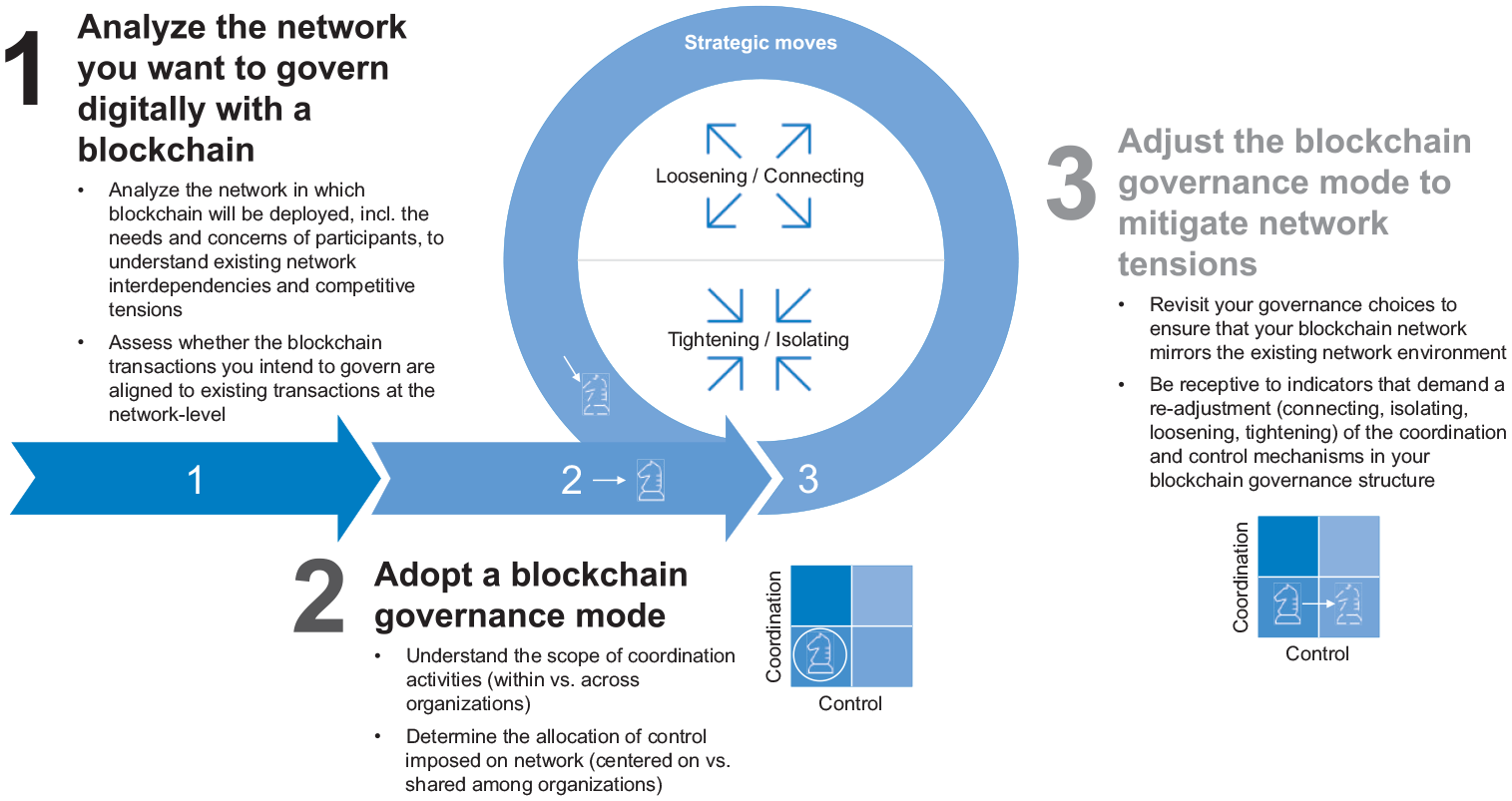
The Blockchain Governance Journey.
Analyze the network you want to govern digitally with a blockchain
I think it’s more meaningful to look across the network that you’re looking to establish. Who has the leverage, the influence, and the market share to be able to drive a change in the ecosystem? (Project manager of a banking blockchain)
Managers need to carefully analyze the existing network their blockchain is meant to govern to understand network interdependencies and anticipate possible competitive tensions in advance. While some networks might facilitate high dispersion of transactions, others might have few dominant players that absorb the majority of the transactions. Managers should account for these network dynamics early on to avoid choosing an inadequate governance mode that might alienate critical network participants. This can be achieved through in-depth analysis and mapping of existing network interdependencies within and across the organization that might conflict with the blockchain network. We also recommend assessing whether the blockchain transactions that will be governed are aligned to existing transactions at the network level. A lack of network analysis beforehand will lead to adverse effects, such as deficient or even failed blockchain governance with negative implications for network growth and performance.
Adopt a blockchain governance mode
Right from the beginning, we made clear what information needs to be shared and what information should not be shared. So, that means that confidentiality and how to classify information were truly important things and [were discussed] upfront with all the parties. (Consultant of a banking blockchain)
Managers should introduce one of the four governance modes that ideally matches and corresponds to existing coordination and control dynamics. For instance, trying to introduce a custodian mode, even though there are plenty of powerful incumbents in the network, might jeopardize the network’s success because crucial participants feel isolated and do not join. Instead, a consortium approach might be more suitable, as such an approach disperses control among more organizations that should have a voice. Choosing the appropriate governance mode requires two important activities at the top management level: first, understanding the scope of coordination activities (within vs. across organizations) and second, determining the allocation of control imposed on the network (shared among vs. centered on organizations). Trying to use a blockchain governance mode that does not match the underlying characteristics of a network often leads to debilitating bureaucracy, alienated network participants, antitrust and legal issues, and, ultimately, lagging network growth.
Adjust the blockchain governance mode to mitigate network tensions
The most important lesson I think I learned in this long project is that while it’s nice to have a structure, it needs to be adjusted every time. (Manager of a transportation blockchain)
Blockchain governance is a dynamic game. Rarely will organizations have all the right information on network composition and governance expertise at hand to make the perfect governance call at the onset. Networks are dynamic by nature, which means that their governance should evolve along with them. In this regard, it is crucial that managers stay alert to changes and tailor blockchain governance to the shifting needs of the network. Organizations that start with a particular governance mode might find, after some time, that it is best to tighten or loosen control to better align to network requirements and to limit or expand the scope covered by the blockchain. Managers need to anticipate such dynamics and critically revisit their governance choices to ensure that they meet the requirements of the network environment and secure network growth. We recommend managers be receptive to indicators that demand adjustment and readjustment of the coordination and control mechanisms in the implemented blockchain governance structure, using our four strategic moves—connecting, isolating, loosening, and tightening—as a baseline.
Conclusion
Blockchain is fraught with hype. 61 As organizations test blockchain technology and learn how to apply it to their specific organizational contexts, a game of natural selection will reveal which solutions prosper and which solutions fail. 62 The governance of blockchains will be a critical factor in determining which companies benefit from the new technological opportunities. Regardless of whether organizations build or join blockchains, 63 or find themselves in a mélange of both, the governance of blockchains should always be seen as a strategic imperative—one that influences aspects such as blockchain investments, how they are made, and among which organizations they are best used. Blockchain initiators who pay careful attention to blockchain governance and thus are sensitive to the needs of participants can create higher network value. In doing so, they uncover potential conflicts between network members early, which they then collaboratively address with greater precision and economic efficiency. Organizations that manage to move from siloed and competitive thinking to cross-organizational collaboration have the best chance of successful blockchain deployment with enduring growth.
We believe that the governance of blockchain is one of the most critical ingredients to overall blockchain success. Using our framework, managers can assess how to address various blockchain governance challenges and choose the appropriate governance mode to support successful transactions. Most importantly, we urge managers to consider the governance mode that adequately reflects their coordination and control needs (chief, clan, custodian, or consortium) and be prepared to adjust their choice (by connecting, isolating, loosening, tightening) as the composition of the network changes.
Our framework also holds significant theoretical value for the emerging literature on enterprise blockchains in the management field. We advance the literature on blockchains by showing that blockchains are by no means self-sufficient governance solutions that exist independently alongside traditional governance forms such as contracts, administrative controls, and relational mechanisms such as trust. 64 Instead, blockchains require well-designed supporting governance structures—such as dedicated administrative interfaces and clear decision-making processes—to be viable solutions in the business contexts where permissioned blockchain solutions prevail. 65 Our framework can serve as a valuable typology in this regard, providing more nuance beyond existing technological distinctions such as those between permissioned and permissionless blockchains. Moreover, we highlight that blockchain governance is subject to frequent adjustments as the composition of the network changes over time, leading to mismatches between the evolved network and its original governance. Therefore, our study also invites scholars to revisit the blockchain phenomenon to understand the antecedents and consequences of blockchain governance decisions and adaptations. 66
We close by issuing a word of caution: Although blockchain governance is a core component of overall blockchain success, the need to think about other intersecting areas—such as use cases, business value, and technological features (as discussed in other issues of California Management Review 67 )—remains critical. We therefore propose that managers see our governance approach as a complementary framework to existing blockchain thought leadership. Regardless of where you stand in your blockchain journey, the governance challenge will remain vital.
Supplemental Material
sj-docx-1-cmr-10.1177_00081256221080747 – Supplemental material for The Boon and Bane of Blockchain: Getting the Governance Right
Supplemental material, sj-docx-1-cmr-10.1177_00081256221080747 for The Boon and Bane of Blockchain: Getting the Governance Right by Curtis Goldsby and Marvin Hanisch in California Management Review
Footnotes
Acknowledgements
Our thanks go to Vasileios Theodosiadis, who supported us with his expertise on blockchains and friendly reviews. We further extend our thanks to 153 (anonymous) industry experts who shared their valuable insights during our interviews.
Supplemental Material
Supplemental material for this article is available online.
Notes
Author Biographies
Curtis Goldsby is a Managing Consultant at IBM Corporation and a Research Scholar in the Technology and Operations Management Department of Rotterdam School of Management, Erasmus University (email:
Marvin Hanisch is an Assistant Professor in the Innovation Management & Strategy department at the University of Groningen (email:
Supplementary Material
Please find the following supplemental material available below.
For Open Access articles published under a Creative Commons License, all supplemental material carries the same license as the article it is associated with.
For non-Open Access articles published, all supplemental material carries a non-exclusive license, and permission requests for re-use of supplemental material or any part of supplemental material shall be sent directly to the copyright owner as specified in the copyright notice associated with the article.
