



Abstract
Product innovation increasingly involves both human designers (engineers, developers, lead users, creative geniuses, and other innovators) and machine designers (algorithmically organized software tools that autonomously collect and interpret data to make innovative design decisions). This article provides practical guidance about how firms can leverage different forms of machine designers in tandem with human designers to fundamentally change the way they engage in product innovation. It describes how successful companies have managed to optimally orchestrate the capabilities of human and machine designers to create both effective and ethical product innovations that were previously unthinkable.
Keywords
Imagine a world where machine designers—algorithmically organized software tools that autonomously collect and interpret data to make innovative design decisions—actively participate in, or even lead, the product innovation process with little to no direction from human designers—engineers, developers, lead users, creative geniuses, or other innovators. While this might sound like science fiction, many leading firms across a wide range of industries from General Motors (automotive) to Moderna (biotechnology) to Starbucks (food and beverages) to Ubisoft (video games) increasingly leverage machine designers to develop novel products.
The integration of machine designers gives rise to an entirely new way of approaching product innovation. Until now, product innovation was fundamentally based on co-creation among humans as the agents of creativity and design. Corporate research and development labs, 1 open innovation, 2 user-centric design, 3 or crowdsourcing 4 approaches are all essentially human-centric. The only difference is who and where the human designers are—internal employees, external partners such as lead users, suppliers, startups, universities, or even lone inventors, end consumers, or entire crowds of makers and tinkerers. 5 And while digital tools have long been adopted within these traditional approaches, their role has been restricted to enabling the innovation process and supporting the individual tasks of human designers through software such as project management suites, collaboration software, or computer-assisted design and simulation engines. 6
This situation is changing. With the advent of machine designers that can autonomously process unparalleled amounts of data in near real time and independently act on them to generate new design options, innovation processes are no longer exclusively driven by human designers. Innovation processes where ensembles of human and machine designers work hand in hand have become possible through the pervasive emergence of connected and smart products; the presence of ubiquitous sensors that generate unprecedented amounts of data, and the availability of analytics tools to make sense of such copious product-generated data. 7 We see glimpses of the immense potential of the now-available collective intelligence 8 that emerges when human and machine designers jointly solve the great challenges of our time. For example, Moderna, a digital biotech leader, used both human and machine designers with platform-based molecules called mRNA that digitally encode viral proteins into genetic material to develop a COVID-19 vaccine. In this process, machine designers radically shortened the development time of the vaccine by autonomously exploring various potential mRNA sequences to identify an optimum sequence, overall resulting in a fundamentally different vaccination product design compared to traditional vaccinations. 9
Yet, the involvement of machine designers during product innovation is no silver bullet. While cases such as Moderna are impressive, we have also seen foolish or even downright harmful applications of the potential of machine designers, from FinTech product failures 10 to algorithmic products that amplify undesirable behaviors in all aspects of our society. 11 The growing trend to involve machine designers in product innovation is also generating thorny ethical issues such as when algorithms incorrectly classify ethnicities and genders based on facial features 12 or when algorithmic bots disseminate false information or make illegal, immoral, or potentially harmful decisions. 13 Firms not only need to learn about how machine designers operate but also and more pressingly how to coalesce both human and machine designers to optimize existing innovation processes, how to create entirely new processes, and how to develop cutting-edge products while balancing the ethical and social implications stemming from the involvement of machine designers during product innovation. In short, firms need to learn the art of orchestration—deliberate and purposeful actions that are needed to arrange and coordinate both human and machine designers when engaging in product innovation.
In this article, based on our research with thought-leading companies that have begun to master this orchestration challenge, we provide practical guidance about how firms can leverage machine designers in tandem with human designers to fundamentally change the way they engage in product innovation. Our article has three core messages. First, we clarify different forms of machine designers and discuss the choices firms have when involving them during product innovation. Second, we demonstrate how the inclusion of machine designers into human-driven product innovation yields new types of human-machine designer ensembles that need to be orchestrated carefully to benefit product innovation. Last, we present a set of guidelines for managers to overcome practical and ethical challenges when trying to establish new product innovation processes featuring human-machine designer ensembles.
Choosing the Right Machine Designer Matters
Machine designers are algorithmically organized software tools that autonomously collect and interpret data to generate innovative design options. They have become possible because of two fundamental developments: first, the increasing availability of digital trace data—records of granular-level use activity that are captured by digital technology—and second, the advances in artificial intelligence (AI) technologies that have deeper learning capacity and greater autonomy than any technology that has come before. 14
Historically, it was challenging for companies to obtain granular real-world use data about their products at a large scale that they could leverage as input for innovation. However, with the increasing pervasiveness of digital technologies and their capability to sense the environment and store and communicate activity data, it is now possible for firms to obtain increasingly rich and granular product use data beyond the point of sale. 15 Such digital trace data can directly come from the use of firms’ digitized products but also from third-party data sources such as social networks, sensor networks, or complementors in the product ecosystems surrounding digital products. 16 Making sense of the copious amounts of digital trace data about product use that is generated constantly is one role that machine designers can play better than humans because powerful search algorithms and machine learning technologies can extract, discover, and analyze usage patterns that are literally unseeable to the human eye.
Second, advances in AI have given rise to autonomous generative software solutions, such as generative design tools, 17 which can independently construct and validate design options, a role that was traditionally reserved for human designers. While autonomous AI is already being deployed in operations throughout domains such as service delivery, 18 medical care, 19 HR, 20 and policing, 21 the application of AI to product innovation and design is still nascent. Yet, autonomous generative tools have the potential to carry out innovation tasks with unprecedented speed, scale, and scope and render design outputs that are qualitatively different from what human designers can imagine. Machine designers are fundamentally different from human designers in their abilities to perform product innovation tasks with scale and efficiency. 22 They can either augment or supplant human designers in all stages of innovation, from ideation to development to validation to implementation, all the way to decommission.
But not all machine designers are created equal. We use two dimensions—core innovation capability and process sovereignty—to differentiate four broad forms of machine designers from our case research (Figure 1).
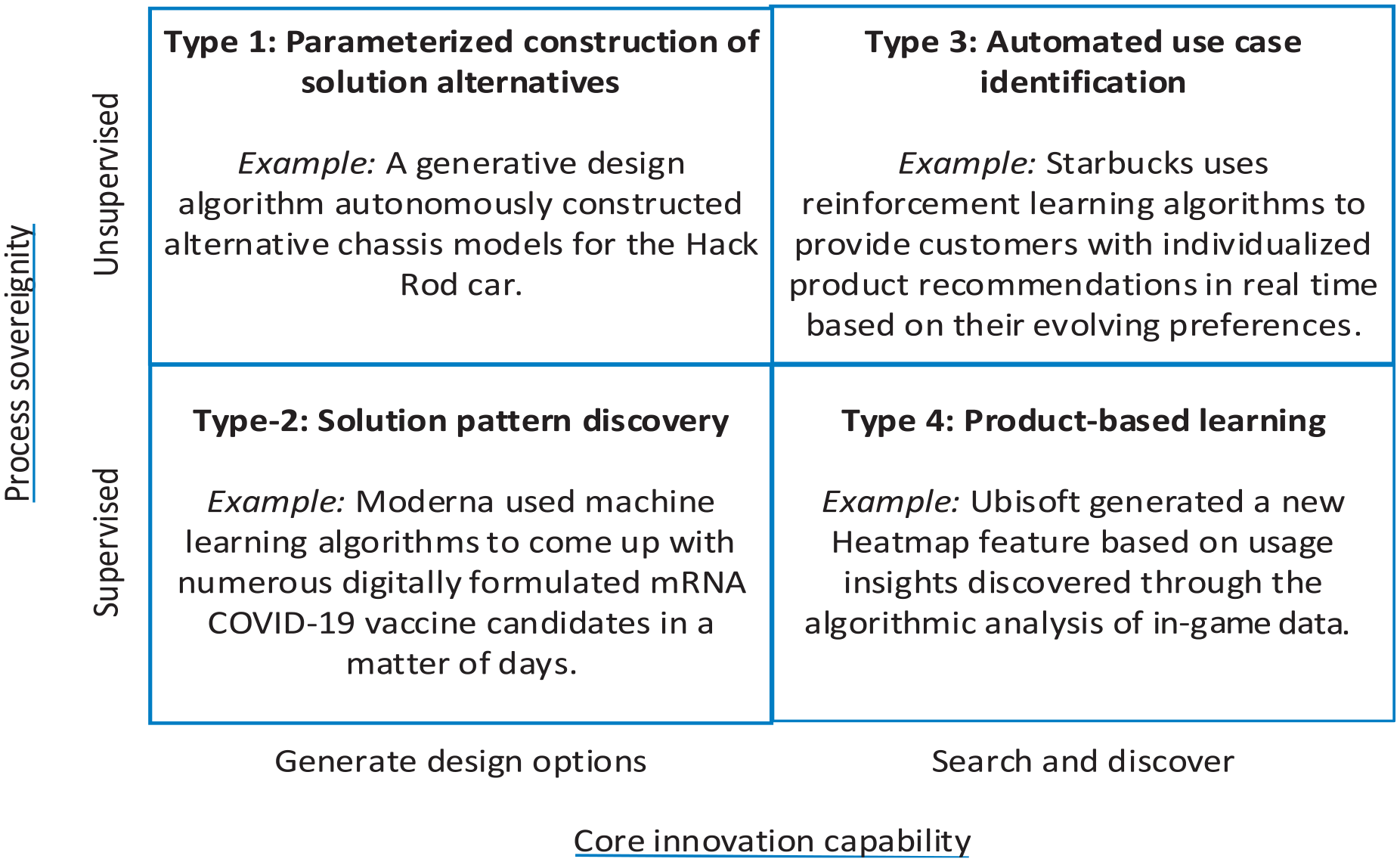
Four types of machine designers.
One way to differentiate machine designers is based on their constructed core innovation capability—their algorithmic capacity to search and discover patterns from vast amounts of digital trace data versus their algorithmic capacity to generate design options. These abilities are not identical. Search and discovery describe the ability of a machine designer to traverse and scan the product design problem space to infer unmet customer needs, latent requirements, or hidden usage opportunities. In contrast, generating design options describes the ability of a machine designer to traverse the vast solution space, or the landscape where concepts, mock-ups, wireframes, prototypes, and other representations of product design reside, to identify desirable configurations of product design attributes. Problem and solution space are interrelated though not necessarily interdependent and can be traversed in any order, not just from problem to solution. 23 Importantly, both solution and problem spaces are often wide landscapes where algorithmically organized machine designers are better positioned to locate optimums because of their computing prowess.
The second way to differentiate machine designers is by their sovereignty over the product innovation process, or how their respective agencies are joined together. 24 Being capable of making autonomous decisions during search and discovery or in generating design options permits human agents the opportunity to delegate authority to unsupervised machine designers that do not require additional human intervention or even human knowledge. An alternative for human agents is to direct supervised machine designers as they search and discover or generate design options. In this model, humans instruct, monitor, and control the machine designers.
Different forms of sovereignty lead to differences in how learning and iteration are implemented into product innovation. In the supervised use of machine designers, the machine designer learns from human agents and rests on human, contextualized learning processes such as imitation, deliberation, correction, and adjustment. When autonomy is truly and fully delegated to unsupervised machine designers, learning and iterating become data-driven and inscrutable processes that are fundamentally different from human processes. Such processes incorporate deep, reinforcement, or adversarial learning, and move learning and iteration beyond the reach of human mediation or augmentation. 25
Type 1: Parameterized Construction of Solution Alternatives: The Hackrod
In 2018, Felix Holst, former Vice President of Creative for Mattel Hot Wheels, and Mouse McCoy, film director and former motorcycle racer, set out on an experimental project to design a race car as it had never been designed before. They first handcrafted their dream car. Then, they equipped a real car with sensors and had a professional race driver drive it through various punishing scenarios and conditions in the Mojave Desert. They collected data on the heat and vibration of the car, the driver’s brainwaves and heartbeats, and used drones to create 3D images of the desert terrain and the exact routes the driver took. All this resulted in a massive amount of data on the physical forces at play between the car, the driver, and the environment, which the designers used to create a digital twin of the car. Then, they turned the digital twin over to a machine designer, specifically, an AI-based generative design engine software, and provided it with product constraints, reflecting multiple, often conflicting dimensions of design goals. The machine designer in turn employed computational techniques to generate thousands of design options for how the product goals and constraints could be met within a single chassis. The design options were first tested in virtual reality simulations before a physical version of the desired design was fabricated. The result was a car that no human designer could have accomplished alone because no human could have ever integrated such massive amounts of information and made sense of what the generative design engine learned. For example, the machine designer came up with a chassis that weighed 30% less without any loss of strength and resiliency. And while the Hackrod is a proof-of-concept vehicle, leading firms in the automotive industry such as BMW and General Motors are already employing the same techniques, for example, to develop novel seat brackets that are 40% lighter, 20% stronger, and consist of only a single part. 26
Type 2: Solution Pattern Discovery: Moderna’s COVID-19 Vaccine
During the COVID-19 pandemic, century-old and well-established innovation processes for drug discovery and development were radically accelerated and transformed through the inclusion of machine designers. Moderna, for example, developed a COVID-19 vaccine around a platform-based medicine called mRNA that encodes viral proteins in genetic material. Because of mRNA’s digital properties, Moderna’s machine designers were able to generate numerous digitally formulated mRNA vaccine candidates in a matter of days. Importantly, Moderna’s machine designers did not just radically shorten the vaccine development process, but identified fundamentally new patterns of activity for drug discovery. 27 For example, protein sequencing, a traditional instrument used for the automatic determination of amino acid sequences in proteins and peptides, is now a digital instrument and provides data that machine learning algorithms can use to search for new drugs. Drug innovations for the cure of other diseases, too, can now be explored in radically shortened timeframes. 28
Type 3: Automated Use Case Identification: Starbucks
In 2016, Starbucks set out to develop the industry’s leading customer engagement program. Its starting point was a traditional customer segmentation model with product personalization based on broad customer groups for each channel. For example, Starbucks would normally send 30 different emails to 12 million customers, meaning that on average, 400,000 customers received the same “customized” product offering via email based on the broad segment they fell into. However, Starbucks realized that its legacy systems already captured more than 100 million points of digital trace data about customer preferences daily from sources such as cash registers, mobile phones, and retail store sensors. Starbucks decided to leverage unsupervised machine designers in the form of reinforcement learning algorithms that could process this vast amount of data to create individualized customer experiences and product offerings. These machine designers now integrate all the digital trace data scattered across Starbucks’s legacy systems, use it to explore tailor-made journeys for individual customers, and autonomously provide customized product recommendations to customers based on their evolving preferences in real time. 29 As a result, Starbucks sends 380,000 different emails to 12 million customers, meaning that an average of only 32 customers receive the same customized product offering; the only reason for not sending each customer a unique email is that some customers simply have the same preferences. Within the first year, the new individualized customer engagement program resulted in a 100% increase in marketing engagement and $100 million of new incremental revenue for Starbucks.
Type 4: Product-Based Learning: Ubisoft
As a global leader in the video game industry, one of Ubisoft’s strategic weapons is to use machine designers to innovate its products through the analysis of “in-game” playing data from its customers. 30 For example, in its Ghost Recon Wildlands franchise, data analysts leveraged machine designers in the form of anomaly detection and pattern recognition algorithms to explore player’s in-game movements. The insights gained by the machine designers led human designers to create a real-time heatmap that shows gamers the popularity of certain paths and areas within the game and informs interested players where they might find new information for their missions and in-game progress. Both the scale of the data (real-time behavior data from millions of players) and the scale of the product (the video game features vast open-ended landscapes) presented a design problem landscape previously unsurmountable for human designers. But machine designers’ capabilities for pattern detection and visualization coupled with human designers’ ability to explore each identified pattern in situ within the context of the gameplay allowed the creation of a new product feature that could be implemented post-launch; that feature increased customer engagement from an initial 6.87 million players to more than 15 million players, contributing to making the product the top-selling game in the industry for several years. 31
What these examples tell us
Whatever the type of machine designer, it is important to realize that they do not simply automate the product innovation process. Firms must balance several considerations when choosing machine designers for their innovation processes.
First, as our examples show, it matters which product innovation outcomes are being pursued. Different outcomes can be accrued from involving machine designers during product innovation. Hackrod improved product quality, Moderna sped up the product development process, Starbucks managed to scale enormously, and Ubisoft increased user engagement.
These outcomes do not necessarily have to be about financial benefit. In fact, in the case of Moderna, speed was more important than price. In the case of Hackrod, demonstrating the difference in the product was more important than the achievable margin. In Ubisoft’s case, the primary goal was to keep players hooked to the game, not necessarily to have them spend more money on it (for which they could have pursued a strategy of maximizing in-game purchases instead).
Looking forward, the choice of product innovation outcomes in light of the possible involvement of machine designers will get even more complicated. As more and more companies pay closer attention to environmental social, as well as corporate governance, and as ethical questions about the involvement of data and algorithms in business practice increasingly come to the forefront, the outcomes of the choice to involve machine designers in product innovation must balance multiple, potentially conflicting dimensions including sustainability, quality, and costs, but also fairness, accountability, and liability.
Second, firms must also choose the product innovation problems that human-machine designer ensembles are meant to work on. The problem setting is not merely the sales domain of the product. Setting a problem is a social process of framing in which humans construct a problem through stories they associate with the situation about what is wrong or needs fixing. 32 And when machine designers are involved, this framing must not only consider the mental model that humans use when framing the problem but also the mental model chosen to be embedded in the machine designers. 30 Moreover, the act of setting a problem can also be a creative act in itself, and it is humans who can shape the eventual solution by making choices about how to understand and frame the innovation problem. 33 For example, by asking machine designers to minimize the maintenance cost and environmental impact throughout the entire life cycle of the product, human designers can fundamentally reshape the framing of the problem.
Finally, it is humans who must decide whether to direct supervised or delegate to unsupervised machine designers’ different innovation actions at different stages of product innovation (search and discover versus generate design options).
Collectively, the choices around how to frame the problem, what outcomes to prioritize, and how to deploy machine designers fundamentally impact how the ensemble of traditional human designers paired with emerging machine designers can be orchestrated.
Making these choices requires asking questions such as: which solution goals or constraints do we consider sacrosanct or ephemeral? Which elements of the problem space are well-known or stable, and which ones could be challenged in the field? How important are human augmentation and oversight in each stage of the innovation process? What are the implications for product outcomes if decisions are rendered increasingly by autonomous machine designers? For example, human designers can use morals, ethical values, empathy, common sense, and their own ability to identify both obvious and unexpected customer needs. By contrast, machine designers can use algorithms to identify hidden patterns or generate previously unobserved, yet plausible design patterns based on vast amounts of granular use data that are hard to process for human designers. Hence, both human and machine designers can complement each other with different strengths and weaknesses. The key challenge is to leverage them synergistically throughout all stages of the innovation process. In other words, the key challenge is optimizing the orchestration between human and machine designers.
Orchestrating Human-Machine Design Ensembles in Product Innovation
In traditional innovation processes, human designers work with a finite number of collaborators, a limited amount of data, and selected use case scenarios to design products with discrete sets of features targeted to distinct user segments. Now, human designers have the opportunity to direct supervised machine designers or even delegate parts of the problem and solution search process entirely to unsupervised machine designers. Contrary to human designers, machine designers can leverage a continuous stream of rich, granular, real-time data at scale to design for dynamically evolving and fleeting externalities. They can process highly context-specific data that are specific to all users, not just a subset of data for a subset of users, however large it may be.
But the situation is not as simple as stepping back and letting the machine designers carry out product innovation on their own. Both machine and human designers have their own capabilities and challenges. For example, one challenge of human designers is to frame global, not local, search problems and explore solution goals and constraints while making sense of large amounts of new information. One challenge for machine designers is that, while they are fast in analyzing data and exploring problem or solution spaces globally, they, thus far, lack the human ability to interpret and make sense of the results within the relevant social context they are embedded within. 34
Managing product innovation involving machine designers is a challenge of effectively orchestrating human-machine designer ensembles, not unlike orchestrating different members of a band where each player knows exactly what territories they can explore with their instruments. To make the ensemble function, each player must also learn to listen and trust in the skills of the other players to take them to places neither of them could ever reach alone.
Orchestration involves, among other aspects, deciding who will be involved in the innovation process, arranging both types of designers in terms of sequence and role, and coordinating the relevant responsibilities and decision rights. This has always been a challenge in innovation management 35 but historically orchestration during innovation only meant arranging the actions of heterogeneous human designers (such as between an organization and the crowd) and matching problems and needs with potential solutions.
In human-machine designer ensembles, orchestration means achieving clarity in arrangement and coordination across four different aspects (Table 1): ensemble configuration, sequencing, problem domain, and innovation goal. These four aspects are interdependent; design choices about the configuration and sequencing are dependent on the problem domain and the innovation goal, and vice versa. For example, problem-driven, poorly structured innovation initiatives might favor a machine-first approach using multiple types of machine designers capable of exploring vast and unstructured problem spaces to narrow down potential design options to a range of solutions that can be handled by one or a few human designers. Importantly, human designers need to trust the machine designers’ solution preselection and potentially engage in dialogue with them such as to iteratively fine-tune the parameters machine designers use to explore the solution space.
Orchestration of Human-Machine Designer Ensembles.
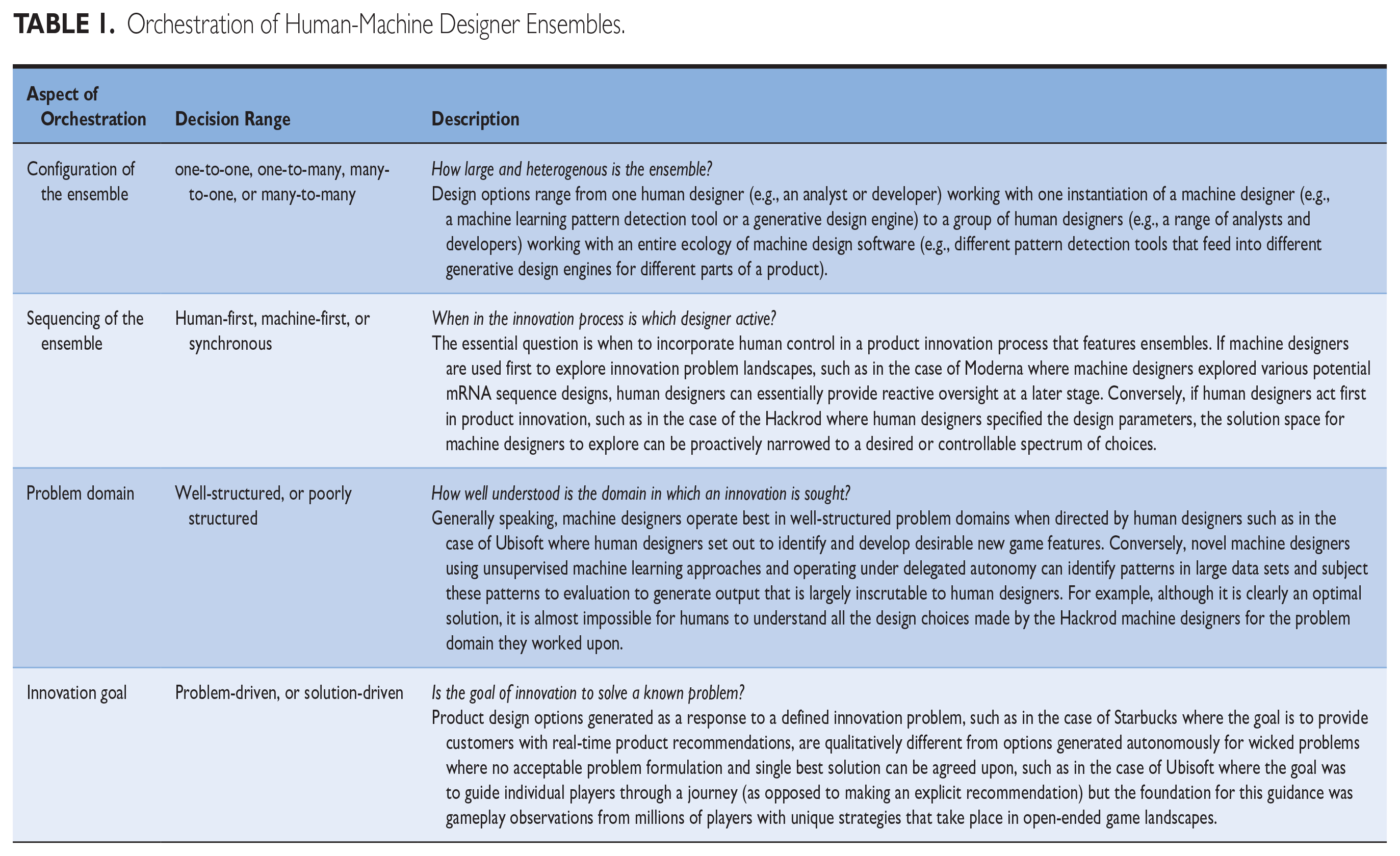
Conversely, creating product design options for solution-driven innovations in well-structured problem domains might benefit from a human-first approach, with many-to-one human-machine designer ensembles where humans feed and direct supervised machine designers who then come up with optimal solutions. As human designers are driving the innovation process and guiding machine designers, questions of trust and confidence in the work of machine designers become less of an issue.
Key Lessons for Implementing Human-Machine Designer Ensembles
Successful companies do four things well: optimize the ensemble of human-machine designer working styles, know which data sources are appropriate for machine designers, find effective workplaces for them, and manage the ethical and social implications of human-machine designer ensembles.
Optimize Human-Machine Designer Working Styles
Human designers and machine designers work differently. Managers must learn how to effectively deploy and train their employees to understand how both human and machine designers can be arranged to complement each other’s strengths and mitigate each other’s weaknesses. For example, human designers can exercise value judgments based on the situated social context and ethical or moral norms, while machine designers come up with computationally “optimal” solutions. Human designers’ creativity works slowly compared with machine designers, but human designers have an ability for large abductive leaps across metaphorical solution spaces, 36 while machine designers have computational advantages for traversing global problem or solution landscapes. Both human and machine designers are biased but in different ways. While humans are prone to biases such as information bias, selection bias, and confounding bias, 37 machine designers are prone to biases such as incorrect problem-framing, unrepresentative data sources, or working with the wrong data attributes. 38 Ultimately, any choice of how human and machine designers work together needs to be driven by the innovation strategy of the firm, the market goals and constraints, the potential for evolution of the organizational culture and market needs, and the desire to jointly meet important standards for equitability, accountability, and moral responsibility.
As Figure 1 shows, it is possible to discern different types of machine designers, which allows firms to orchestrate their human-machine designer ensemble in light of their desires for agency and available capabilities given introjected constraints such as problem domain and innovation goal (Table 1). Some might choose to keep human designers in charge of the ensemble sequencing and thus favor directed forms of machine designers; some might want to restrict machine designers as problem-driven search agents in well-structured domains; others might delegate much responsible to a larger set of unsupervised machine designers with capabilities to explore vast solution spaces for problems that cannot be conceived let alone agreed upon by humans. For example, when innovation domains are ill-structured then the innovation problem cannot, or should not, be specified in advance.
To optimize the orchestration of human-machine designer ensembles, firms should consider three parameters: type of product design, pace of innovation, and potential bias.
First, the type of product design substantially influences which type of machine designer is most suitable for product innovation and which role they should take. In the design of complex products such as microprocessors or chips where the goal is known but it is critical and particularly challenging to find optimal solutions because of the sheer scale of potential alternatives, machine designers with generative design capabilities are particularly suitable to drive product innovation. Leading chip manufacturers, for example, often draw heavily on a mix of types 1 and 2 machine designers. 39 At a chip manufacturer that one of us worked with, human designers who work on core components of new chips collaborated heavily with type 2 machine designers, while human designers who work on non-core components collaborated heavily with type 1 machine designers. By contrast, with experience products such as restaurants or clothes where the challenge is to make value judgments by considering various contextual factors, human designers are better suited to drive the product innovation process. In that process, machine designers that can support human designers through computational search and discovery become particularly valuable.
Second, the cadence between different forms of configurations is also an important managerial decision to consider, and the perfect orchestration in this regard depends to a large extent on the required innovation pace. The question is not only which types of machine designers a firm will use but also how quickly firms must switch between these different machine designers. For example, ride-sharing companies depend on just-in-time management of large amounts of drivers and riders who are distributed across vast spatial maps. Here, the fast identification of solutions is of utmost importance. As a result, type 3 machine designers inform unsupervised search and discovery to predict and identify areas where demand is surging. Then, it is the role of unsupervised generative design engines to construct solution alternatives that manage the network of available vehicles to prepare for and address the surging demand. The determination of surge prices, or the temporary incentives drivers receive to stay in an area, is the work of machine designers in the form of unsupervised generative design engines. In such cases, the innovation pace is high and the dialogue between these different machine designers needs to take place essentially in real time, a capability difficult to achieve for human designers. On the contrary, smartphone manufacturers whose innovation pace is determined by annual product update cycles deploy type 4 machine designers to discover use patterns, which human-machine designers then evaluate and test in light of judgment and contextual information. Only afterward, types 1 and 2 machine designers are used to generate next-generation smartphones, because the pace allows for it.
Third, in optimizing human-machine designer ensembles, the consideration of potential types of bias and their implications for product innovation is crucial. For example, insights generated from machine designers with search and discovery capabilities are often used as the basis of the work of machine designers with generative design capabilities, meaning that bias introduced at the search and discovery stage can easily trickle into the final product if not controlled by human designers. Similarly, the creation of products with the support of machine designers with generative design capabilities will lead to new data that can be used by machine designers with search and discovery capabilities; but the optimal solutions created by generative machine designers bear the risk of being too optimized while missing important contextual criteria, thereby risking a self-reinforcing learning and design cycle that might lead to increasingly sub-optimal solutions. Firms must consider where and what type of bias might be introduced in the process that could create concatenations of human and machine designers where one eliminates or at least reduces the potential bias of the other; the need to involve human designers (at least in a control function) increases when the ratio of in-kind innovation parts increases.
Know the Most Appropriate Data Sources
Because machine designers are algorithmically organized, they require more structured data, and larger volumes of data, than human designers. For example, while human designers can learn from observations in small focus groups, machine designers require the micro-level activities underlying these observations to be formalized and digitized, plus they also require a larger volume of observations to be able to reliably identify problems or generate solutions. Overall, the higher the quality and comprehensiveness of the data that machine designers can feed on, the more benefits firms can reap by engaging machine designers in their innovation processes. Managers must identify which data they need to achieve their goals and how they can obtain this data before being able to create successful ensembles of human and machine designers.
To make optimal decisions about data sources for product innovation involving machine designers, firms can pursue four strategies.
First, if a firm’s product offering lends itself to digitization, that is the obvious place to get data. However, there is a fine line between gathering enough data to be able to provide added value to customers and being creepy or outright unethical. With increasing regulations on personal data, companies must demonstrate at a minimum that they are complying with these regulations and are trustworthy. And with growing awareness of ethical issues surrounding AI and algorithmic decision-making through efforts such as the Algorithmic Justice League (https://www.ajl.org/), firms must establish data provenance that guarantees fairness, accountability, transparency, and explainability for decisions that are incorporated into the products. 40 Whatever path firms follow, managers must carefully consider the ethical, accountable, and fair use of data as they feed such data to machine designers.
Second, if the product offering does not lend itself to digitization, managers must consider digitizing aspects of the product delivery, or gather data traditionally and then digitize it retrospectively to create complementary offerings. Starbucks provides a good example. Its coffee will always be non-digital, but the customer interactions that go hand in hand with each coffee sale can be captured digitally. So, Starbucks digitized its stores and other aspects of the customer experience by creating digital loyalty programs and implementing digital ordering, payment, and interaction channels, which together allowed the company to gather rich digital trace data that in turn enabled its machine designers to better understand and serve its customers.
Third, firms can use data from third-party data sources. This strategy is suitable if a product offering does not lend itself to digitization and the firm is not in direct contact with its customers. For example, Shiseido’s face serums are non-digital products sold through independent cosmetic retailers, which makes it challenging for the firm to obtain in-use customer data. Shiseido overcame this restriction by using publicly available data from sources such as air-quality monitors and weather stations together with private customer data such as location and photo data from smartphones to create customized serums on demand via a special serum dispenser. Overall, the number of potential data sources has increased exponentially over the last few years. If a firm’s product offering and its mode of delivery do not lend themselves to digitization, managers need to think about which alternative sources of data exist within the wider ecosystem of delivery or use that they could tap into. For example, pictures of customers slouching on the couch they just bought might be enough for a machine designer to understand how the ergonomics of the furniture could be improved further. At the same time, with growing concerns about how personal use of products is being tracked and sold, it will not be long before third-party data will become less effective or outright difficult to acquire. For example, Apple’s policy to change user tracking to opt-in radically reduced third-party companies’ ability to collect user behavior. Google will implement a similar policy in 2023. The end of third-party cookies in Chrome browser, at the moment of writing the most popular web browser, is expected to create similar impacts. With the enactments of privacy-protection laws like Europe’s General Data Protection Regulation and the California Consumer Privacy Act, firms’ ability to acquire third-party data will likely continue to decrease, and the growing expectations about accountability and transparency will require firms to maintain humans-in-the-loop as a safeguard for algorithmic mistakes or biased input such as pre-labeled data. 41
Last, firms can fall back on synthetic data. 42 This strategy is particularly suitable if it is difficult to obtain sufficient amounts of data via the three previous strategies. For example, Tesla was able to sell more fully digitized cars earlier than anyone else, resulting in the company assembling the world’s largest driving data set, which it now uses to constantly improve its autopilot. Google’s Waymo, which had not sold any digitized cars, overcame the disadvantage by augmenting its comparatively smaller data set derived from autonomous test vehicles with artificial data generated through simulation technology to create a synthetic driving data set that was even larger than Tesla’s original data set.
Find Effective Work Spaces
Another managerial challenge is to develop organizational structures and governance mechanisms appropriate for machine designers. Traditionally, innovations were carried out in firms by dedicated innovation teams of human designers at the front end of the innovation process, often located at particular innovation centers with curvy windows, open studios, and whiteboards with lots of Post-it Notes. Examples of such classical human-only innovation teams are company labs such as Bell Labs, Xerox PARC, and more recently Apple and Google, all of which produced groundbreaking innovations.
With the emergence of machine designers and their potential to participate in various aspects of the innovation process and to do so autonomously and in digital, not physical, spaces, innovation can potentially be democratized throughout the organization. For example, Starbucks leveraged the potential of machine designers not only to develop new products but also to provide tailored recommendations of existing products to customers, thereby empowering other organizational functions (such as customer experience teams) to actively participate in and drive innovation processes. Of course, this does not mean that every part of the organization should work with machine designers and drive innovation—instead, many functions that were previously only tangentially involved in innovation can be empowered to take a more active role and increase an organization’s overall innovation capacity.
Further, with the emergence of machine designers, firms must rethink how they govern innovation activities. With machine designers’ ability to leverage continuing streams of digital data, the innovation of digitized market offerings does not necessarily end with sales and initial customer use. Instead, it can continue throughout the lifetime of the offerings. Therefore, the rise of machine designers means that innovation in organizations can be carried out continuously, at any time. And because machine designers can be dispersed throughout the organization, innovation can be driven everywhere by both machine designers and human designers. This does not mean that firms no longer need a central innovation team. It means that the role of human designers within such innovation teams must be different. Human designers will need to engage more in strategic higher order thinking to decide on delegating to unsupervised or directing supervised machine designers. They will also need to develop and train the machine designers, set the boundaries of design spaces with multiple goals and constraints, and ensure that machine designers follow ethical standards and brand promises.
Manage the Ethical and Social Implications
Any company that plans to use algorithmically organized machine designers in its innovation processes has a responsibility to consider and address ethical and social aspects because, like any algorithmic tool, machine designers are value-laden in the sense that they, intentionally or otherwise, create moral consequences, reinforce or undermine ethical principles, and propel or diminish stakeholder rights and dignity. 43
One thorny ethical challenge in human-machine designer ensembles flows from the question of sovereignty (Figure 1); deciding on who-does-what (i.e., directing supervised or delegating to unsupervised machine designers) carries moral implications that must be considered because machine and human designers cannot be perfectly substituted. Delegation inevitably means shifting responsibility and roles from human designers to machine designers. But human designers must stay in the loop to guarantee responsibility, accountability, liability, and legitimacy of algorithmic decisions made by machine designers. Ethical questions cannot be delegated to machine designers, so firms must find and implement an appropriate augmentation strategy. 44 The chosen augmentation strategy must always be based on the firm’s acceptance of accountability for the machine designers they choose to use, in terms of their input (choices of source and training data), algorithm design, and outcomes. One key aspect of this responsibility includes the ability to scrutinize how machine designers operate. While the product innovation itself may present a “black box” for users, the machine designers must be “explainable” to their human counterparts. That is, firms must maintain an ability to disclose and scrutinize machine designers because they are going to be held accountable.
Another thorny challenge that flows from machine designers traversing problem and solution spaces is that of data privacy and bias. At a superficial level, it is tempting to say that no company should have access to personal data. At the same time, one must admit that the protection of privacy, while extremely important, is not the only ethical consideration. For example, there are cases where sharing personal data in a careful manner allows firms to innovate with incredible social benefits in areas like healthcare, education, and economic development. Even when it comes to digital marketing, the effective use of personal data to address unmet user needs more precisely can reduce spam and information overload, thereby improving the overall allocation of resources in the economy. 45 Hence, managers need to balance three tensions that are inherent in managing personal data with machine designers 46 to establish which of the data they have at their perusal they can ethically feed to machine designers, and how they can ensure the consent of data providers (for example, from end users) by implementing appropriate and responsible data provenance schemes:
First, firms must deal with the tension between data privacy and data portability. Simply put, just like cash that is stored under a mattress is not creating value in the economy, personal data locked away in a private vault cannot be used to create value in the digital economy. However, while the modern economy rests on layers of financial regulations to ensure the ownership and portability of private financial assets, the current centralized cloud-based data model resembles a reckless financial product that gives a bank full access to customers’ private assets to make risky investments without customers’ knowledge or consent. The solution is not only to limit firms’ ability to use personal data to gain deeper insights into users’ needs and market opportunities. Rather, the solution should be based on the recognition of legal and functional ownership of personal data by individual users. There are several emerging technologies, including personal cloud servers, 47 decentralized data access control, 48 decentralized digital identities, 49 and edge computing, 50 which offer various ethical ways to let users collect, store, legally own, and make personal data portable while preserving privacy. Using these data architectures, firms now can leverage machine designers—both supervised and unsupervised—with minimum or even no collection of personal data in centralized cloud-based storage. 51
Second, firms need to consider how they obtain user approval to leverage data. Many firms like Google, Amazon, Instacart, and Uber require users to provide wide, sweeping consent to the use of their data as a precondition for product use. However, the idea of consent only works when users can be fully informed about the exact nature of the agreement. For example, in the healthcare industry, a surgeon can provide a detailed and precise description of what will be done to the body of a patient together with possible risks. However, because user data are infinitely portable once manifested in digital bitstring format and become malleable, generative, and re-combinatorial in nature, it is often challenging if not outright impossible for firms to provide precise and detailed descriptions of how data will be used over time. Even when data are obtained with consent from the data owner, such consent cannot possibly cover all the myriad ways in which that data might be used in the future. Firms must define standards for control and protection of data lineage, integrity, confidentiality, and availability, for example, through metadata management or data audits. Finding alternatives to the currently wide-sweeping consent model is also not easy. One potential solution is asking for much narrower and limited consent, but this comes with the risk of consent fatigue. Another alternative might involve independent third-party agents, be they humans or machines, to act on behalf of users to grant or deny consent on an ongoing basis. Such agents then bear legal fiduciary responsibility to act in the best interest of users. 52
Third, firms must pay attention to the tension between user participation and algorithmic bias, which spawns ethical issues such as fairness, justice, and discrimination. 53 For example, many innovative healthcare products are created with the help of machine designers that learn predominantly from data obtained from white Caucasian users who can afford to go to prominent hospitals with access to leading digital healthcare programs. Therefore, if risks exist that available data sets might not represent fairly or equitably, firms should consider preempting potential biases in machine design by requesting the use of synthetic data to ensure a purposeful representation of important characteristics in the data set. An additional benefit of using synthetic data is that it could help eliminate data privacy issues upfront. Of course, synthetic data are not a silver bullet against all potential biases and come with its own caveats such as potentially being an inferior representation of the real world, but it can help to address biases such as gender or race biases that are commonly found in real-world data sets.
Conclusion
The advance of digitization has allowed firms to leverage digital traces as novel sources of insights as they bring new features and functions to their products. But digitization has not stopped there. With the emergence of autonomous computational algorithms capable of both search and design, new digital tools in the form of machine designers have emerged that can both analyze data and generate design options at scale and speed. The availability of machine designers allows firms to enter a new era of innovation in which product innovations are driven by ensembles of machine designers working in tandem with human designers. Firms that recognize this potential and master the challenges in orchestrating these ensembles will have an opportunity to leapfrog competitors but will also have to contend with increased ethical responsibilities for maintaining accountability, liability, and legitimacy over their products, the algorithms used by machine designers, and the data sources they feed upon.
About Our Research
This article is based on our ongoing research involving several of the companies we mention in this article, in particular Hackrod, Moderna, Ubisoft, and Starbucks. Members of our author team have directly worked with these firms. We also performed several semi- and unstructured interviews with lead personnel involved in innovation and product development initiatives that involved machine designers. In addition, we inspected publicly available sources and writings about the initiatives we refer to in this article. Where possible, we also involved responsible personnel from the firms during our analysis of the data, the development of our ideas, and the writing of this article. Finally, we draw on the experiences and observations we made in other research projects on digital innovation, with companies such as Samsung, Intel, SAP, Ultimaker, Judo Bank, Domino’s, Woolworths, Daimler, and others.
Footnotes
Declaration of Conflicting Interests
The author(s) declared no potential conflicts of interest with respect to the research, authorship, and/or publication of this article.
Funding
The author(s) received no financial support for the research, authorship, and/or publication of this article.
Notes
Author Biographies
Jan Recker is Nucleus Professor for Information Systems and Digital Innovation at the University of Hamburg (
Frederik von Briel is a Senior Lecturer in Strategy and Entrepreneurship and the Program Leader of the Master of Entrepreneurship and Innovation at UQ Business School (
Youngjin Yoo is the Elizabeth M. and William C. Treuhaft Professor in Entrepreneurship and Professor of Information Systems at the Department of Design & Innovation at the Weatherhead School of Management, Case Western Reserve University (
Varun Nagaraj has had a 30-year career in product innovation in Boston and Silicon Valley and is now Professor for Information Management & Analytics and Dean at the S P Jain Institute of Management and Research (SPJIMR) (
Mickey McManus is a Research Fellow Emeritus with Autodesk and a pioneer in the field of collaborative innovation, pervasive computing, and human-centered design and education (